
莉莉_BTC
1k Posts

莉莉_BTC
Report
Block User
📊 专注 Web3 与加密货币前沿趋势 💡 深入剖析币圈生态,用清晰、理性的逻辑解码数据与市场。 🚀 拒绝盲从,与 Lily 一起从零提升 Crypto 认知,把握未来机遇! 📈 “知识是变现的底气。” 关注我,一起成长
29 Following
20 Followers
76 Liked
Posts
·
--
Bullish
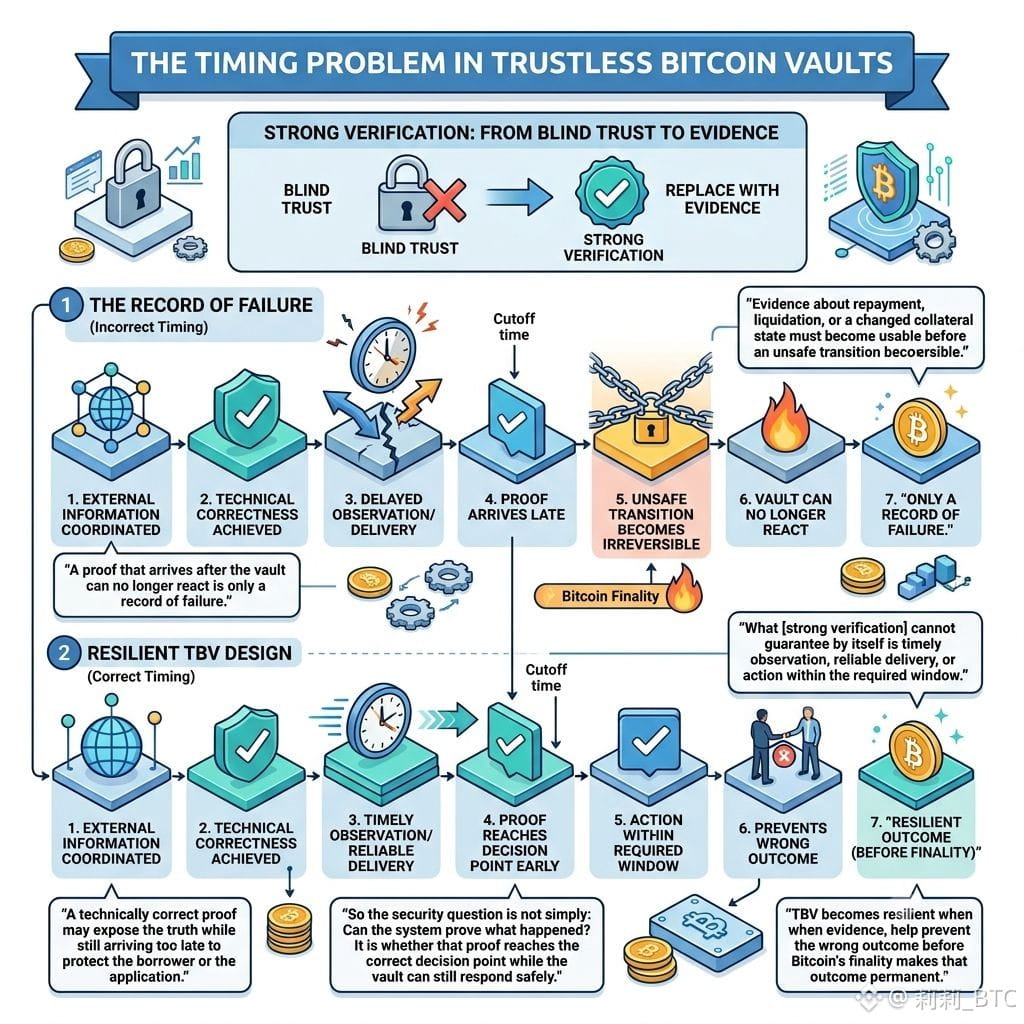
A proof that arrives after the vault can no longer react is only a record of failure.
That is the timing problem I find most important in Trustless Bitcoin Vaults from BabylonLabs_io.
TBV can use verified external information to cordinate what happens around native BTC. That reduces the need for one intermediary to make discretionary decisions.
But verification alone is not enough.
Evidence about repayment, liquidation, or a changed collateral state must become usable before an unsafe transition becomes irreversible. A technically correct proof may expose the truth while still arriving too late to protect the borrower or the application.
So the security question is not simply:
Can the system prove what happened?
It is whether that proof reaches the correct decision point while the vault can
still respond safely.
This is what strong verification changes: it replaces blind trust with evidence.
What it cannot guarantee by itself is timely obsrvation, reliable delivery, or action within the required window.
For me, TBV becomes resilient when evidence does more than explain failure afterward.
It must help prevent the wrong outcome before Bitcoin’s finality makes that outcome permanent.
$BABY @babylonlabs_io #baby
{alpha}(560x777bf78ad4546b61607a17bf4a1977dbbea98c28)
A proof that arrives after the vault can no longer react is only a record of failure.
That is the timing problem I find most important in Trustless Bitcoin Vaults from BabylonLabs_io.
TBV can use verified external information to cordinate what happens around native BTC. That reduces the need for one intermediary to make discretionary decisions.
But verification alone is not enough.
Evidence about repayment, liquidation, or a changed collateral state must become usable before an unsafe transition becomes irreversible. A technically correct proof may expose the truth while still arriving too late to protect the borrower or the application.
So the security question is not simply:
Can the system prove what happened?
It is whether that proof reaches the correct decision point while the vault can
still respond safely.
This is what strong verification changes: it replaces blind trust with evidence.
What it cannot guarantee by itself is timely obsrvation, reliable delivery, or action within the required window.
For me, TBV becomes resilient when evidence does more than explain failure afterward.
It must help prevent the wrong outcome before Bitcoin’s finality makes that outcome permanent.
$BABY @BabylonLabs_io #baby
That is the timing problem I find most important in Trustless Bitcoin Vaults from BabylonLabs_io.
TBV can use verified external information to cordinate what happens around native BTC. That reduces the need for one intermediary to make discretionary decisions.
But verification alone is not enough.
Evidence about repayment, liquidation, or a changed collateral state must become usable before an unsafe transition becomes irreversible. A technically correct proof may expose the truth while still arriving too late to protect the borrower or the application.
So the security question is not simply:
Can the system prove what happened?
It is whether that proof reaches the correct decision point while the vault can
still respond safely.
This is what strong verification changes: it replaces blind trust with evidence.
What it cannot guarantee by itself is timely obsrvation, reliable delivery, or action within the required window.
For me, TBV becomes resilient when evidence does more than explain failure afterward.
It must help prevent the wrong outcome before Bitcoin’s finality makes that outcome permanent.
$BABY @BabylonLabs_io #baby
2
87
·
--
Bullish
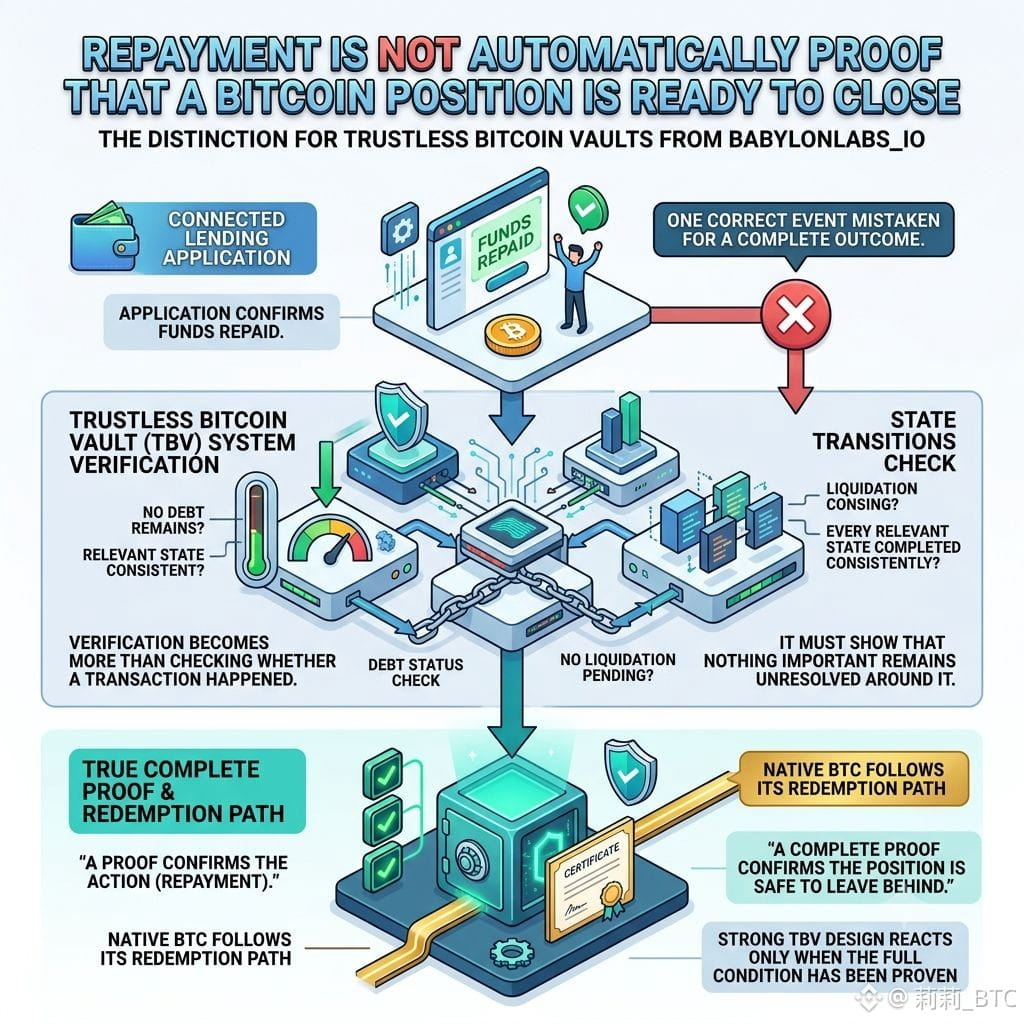
Repayment is not automatically proof that a Bitcoin position is ready to close.
That distinction matters for Trustless Bitcoin Vaults from BabylonLabs_io.
A connected lending aplication may confirm that funds were repaid. But before native BTC follows its redemption path, the system may still need to establish that no debt remains, no liquidation is pending, and every relevant state transition has been completed consistently.
One correct event should not be mistaken for a complete outcome.
This is where verification becomes more than checking whether a transaction happened. It must show that nothing important remains unresolved around it.
For me, strong TBV design means the vault reacts only when the full condition has been proven—not when one convenient piece of evidence apears sufficient.
A proof should confirm the action.
A complete proof should confirm that the position is safe to leave behind.
$BABY @babylonlabs_io #baby
{alpha}(560x777bf78ad4546b61607a17bf4a1977dbbea98c28)
Repayment is not automatically proof that a Bitcoin position is ready to close.
That distinction matters for Trustless Bitcoin Vaults from BabylonLabs_io.
A connected lending aplication may confirm that funds were repaid. But before native BTC follows its redemption path, the system may still need to establish that no debt remains, no liquidation is pending, and every relevant state transition has been completed consistently.
One correct event should not be mistaken for a complete outcome.
This is where verification becomes more than checking whether a transaction happened. It must show that nothing important remains unresolved around it.
For me, strong TBV design means the vault reacts only when the full condition has been proven—not when one convenient piece of evidence apears sufficient.
A proof should confirm the action.
A complete proof should confirm that the position is safe to leave behind.
$BABY @BabylonLabs_io #baby
That distinction matters for Trustless Bitcoin Vaults from BabylonLabs_io.
A connected lending aplication may confirm that funds were repaid. But before native BTC follows its redemption path, the system may still need to establish that no debt remains, no liquidation is pending, and every relevant state transition has been completed consistently.
One correct event should not be mistaken for a complete outcome.
This is where verification becomes more than checking whether a transaction happened. It must show that nothing important remains unresolved around it.
For me, strong TBV design means the vault reacts only when the full condition has been proven—not when one convenient piece of evidence apears sufficient.
A proof should confirm the action.
A complete proof should confirm that the position is safe to leave behind.
$BABY @BabylonLabs_io #baby
1
1
100
·
--
Bullish
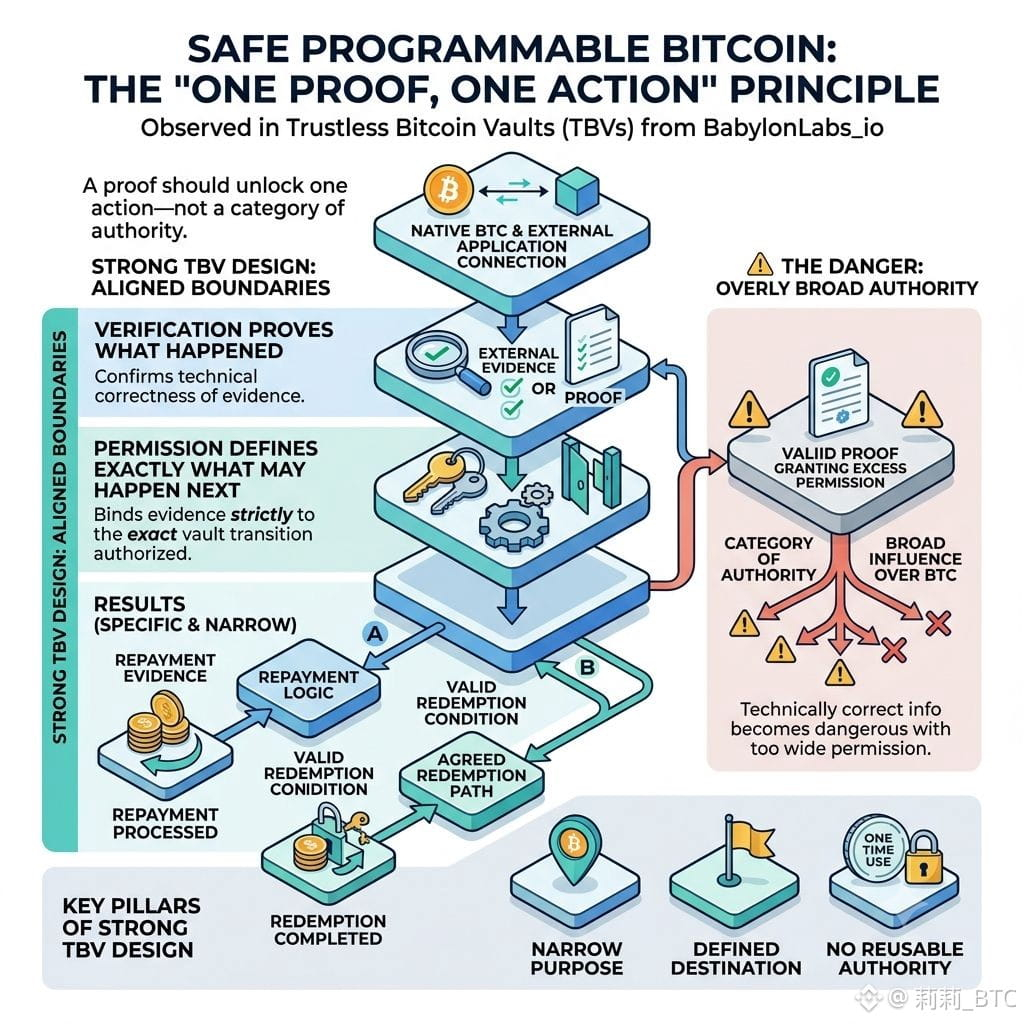
A proof should unlock one action—not a category of authority.
That is the security principle I see inside Trustless Bitcoin Vaults from BabylonLabs_io.
When native BTC is connected to an external aplication, verification should do more than confirm that some condition occurred. It should bind that evidence to the exact vault transition it was meant to authorize.
Repayment evidence should support repayment logic.
A valid redemption condition should enable the agreed redemption path.
Neither should quietly grant broader influence over the BTC.
This matters because technically correct information can still become dangerous when its permission is too wide. The weakness may not be a false proof, but a valid proof that authorizes more than the user intended.
For me, strong TBV design means every piece of external evidence has a narrow purpose, a defined destination, and no reusable authority beyond that moment.
Verification proves what hapened.
Permission defines exactly what may happen next.
Keeping those two boundaries aligned is what can make programmable Bitcoin safer.
$BABY @babylonlabs_io #baby
{alpha}(560x777bf78ad4546b61607a17bf4a1977dbbea98c28)
A proof should unlock one action—not a category of authority.
That is the security principle I see inside Trustless Bitcoin Vaults from BabylonLabs_io.
When native BTC is connected to an external aplication, verification should do more than confirm that some condition occurred. It should bind that evidence to the exact vault transition it was meant to authorize.
Repayment evidence should support repayment logic.
A valid redemption condition should enable the agreed redemption path.
Neither should quietly grant broader influence over the BTC.
This matters because technically correct information can still become dangerous when its permission is too wide. The weakness may not be a false proof, but a valid proof that authorizes more than the user intended.
For me, strong TBV design means every piece of external evidence has a narrow purpose, a defined destination, and no reusable authority beyond that moment.
Verification proves what hapened.
Permission defines exactly what may happen next.
Keeping those two boundaries aligned is what can make programmable Bitcoin safer.
$BABY @BabylonLabs_io #baby
That is the security principle I see inside Trustless Bitcoin Vaults from BabylonLabs_io.
When native BTC is connected to an external aplication, verification should do more than confirm that some condition occurred. It should bind that evidence to the exact vault transition it was meant to authorize.
Repayment evidence should support repayment logic.
A valid redemption condition should enable the agreed redemption path.
Neither should quietly grant broader influence over the BTC.
This matters because technically correct information can still become dangerous when its permission is too wide. The weakness may not be a false proof, but a valid proof that authorizes more than the user intended.
For me, strong TBV design means every piece of external evidence has a narrow purpose, a defined destination, and no reusable authority beyond that moment.
Verification proves what hapened.
Permission defines exactly what may happen next.
Keeping those two boundaries aligned is what can make programmable Bitcoin safer.
$BABY @BabylonLabs_io #baby
1
1
103
·
--
Bullish
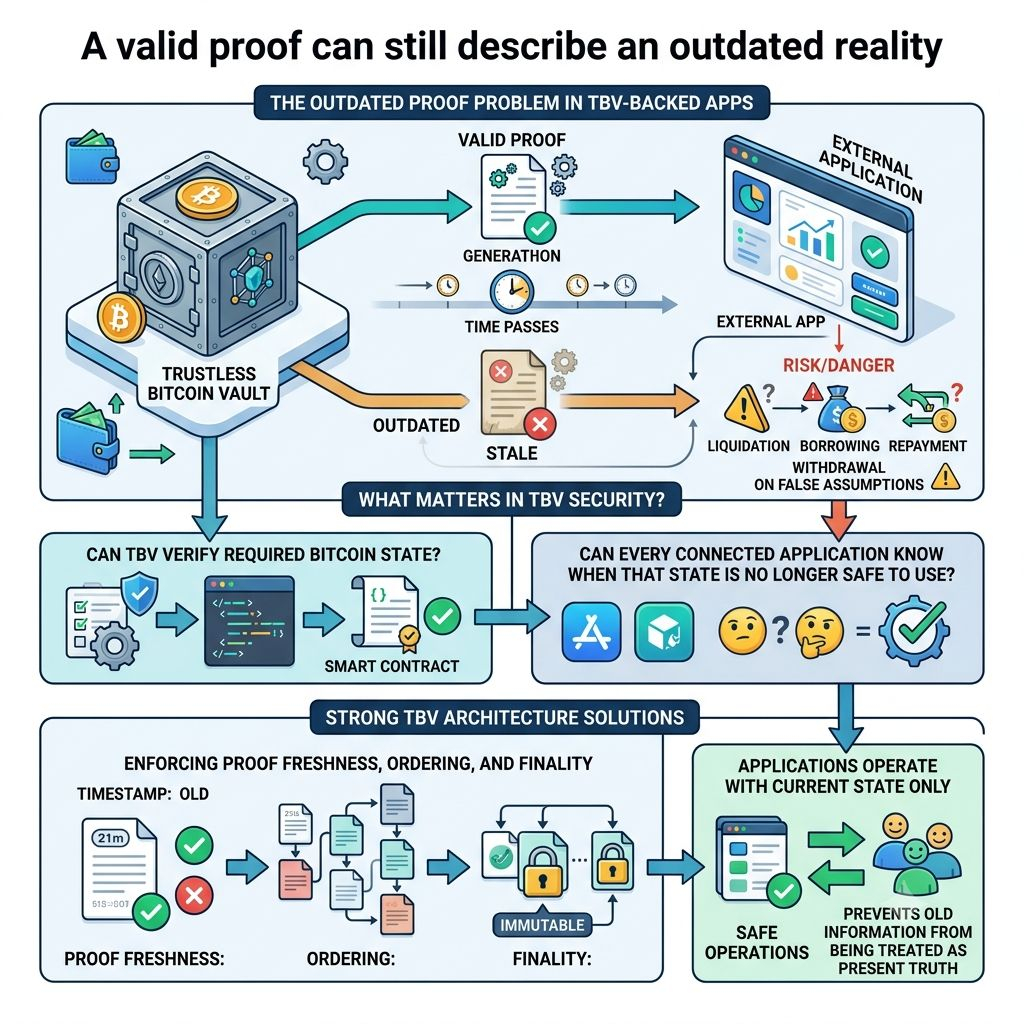
A valid proof can still describe an outdated reality.
That is the problem I keep coming back to with Bitcoin-backed applications.
Trustless Bitcoin Vaults from BabylonLabs_io depend on more than proving that a vault exists or that BTC follows predefined spending conditions. External applications also need confidence that the vault state they are acting on is still current.
That matters during borrowing, repayment, withdrawal, and liquidation.
A proof may be correct when produced, yet become dangerous if the application proceses it after the position has already changed elsewhere.
For me, the important question is not only:
Can TBV verify the required Bitcoin state?
It is:
Can every connected application know when that state is no longer safe to use?
This is where proof freshness ordering, and finality become part of the security model—not just technical details.
The strongest TBV architecture will not merely reject false information.
It will also prevent old information from being treated as present truth.
$BABY @babylonlabs_io #baby
{alpha}(560x777bf78ad4546b61607a17bf4a1977dbbea98c28)
A valid proof can still describe an outdated reality.
That is the problem I keep coming back to with Bitcoin-backed applications.
Trustless Bitcoin Vaults from BabylonLabs_io depend on more than proving that a vault exists or that BTC follows predefined spending conditions. External applications also need confidence that the vault state they are acting on is still current.
That matters during borrowing, repayment, withdrawal, and liquidation.
A proof may be correct when produced, yet become dangerous if the application proceses it after the position has already changed elsewhere.
For me, the important question is not only:
Can TBV verify the required Bitcoin state?
It is:
Can every connected application know when that state is no longer safe to use?
This is where proof freshness ordering, and finality become part of the security model—not just technical details.
The strongest TBV architecture will not merely reject false information.
It will also prevent old information from being treated as present truth.
$BABY @BabylonLabs_io #baby
That is the problem I keep coming back to with Bitcoin-backed applications.
Trustless Bitcoin Vaults from BabylonLabs_io depend on more than proving that a vault exists or that BTC follows predefined spending conditions. External applications also need confidence that the vault state they are acting on is still current.
That matters during borrowing, repayment, withdrawal, and liquidation.
A proof may be correct when produced, yet become dangerous if the application proceses it after the position has already changed elsewhere.
For me, the important question is not only:
Can TBV verify the required Bitcoin state?
It is:
Can every connected application know when that state is no longer safe to use?
This is where proof freshness ordering, and finality become part of the security model—not just technical details.
The strongest TBV architecture will not merely reject false information.
It will also prevent old information from being treated as present truth.
$BABY @BabylonLabs_io #baby
1
102
·
--
Bullish
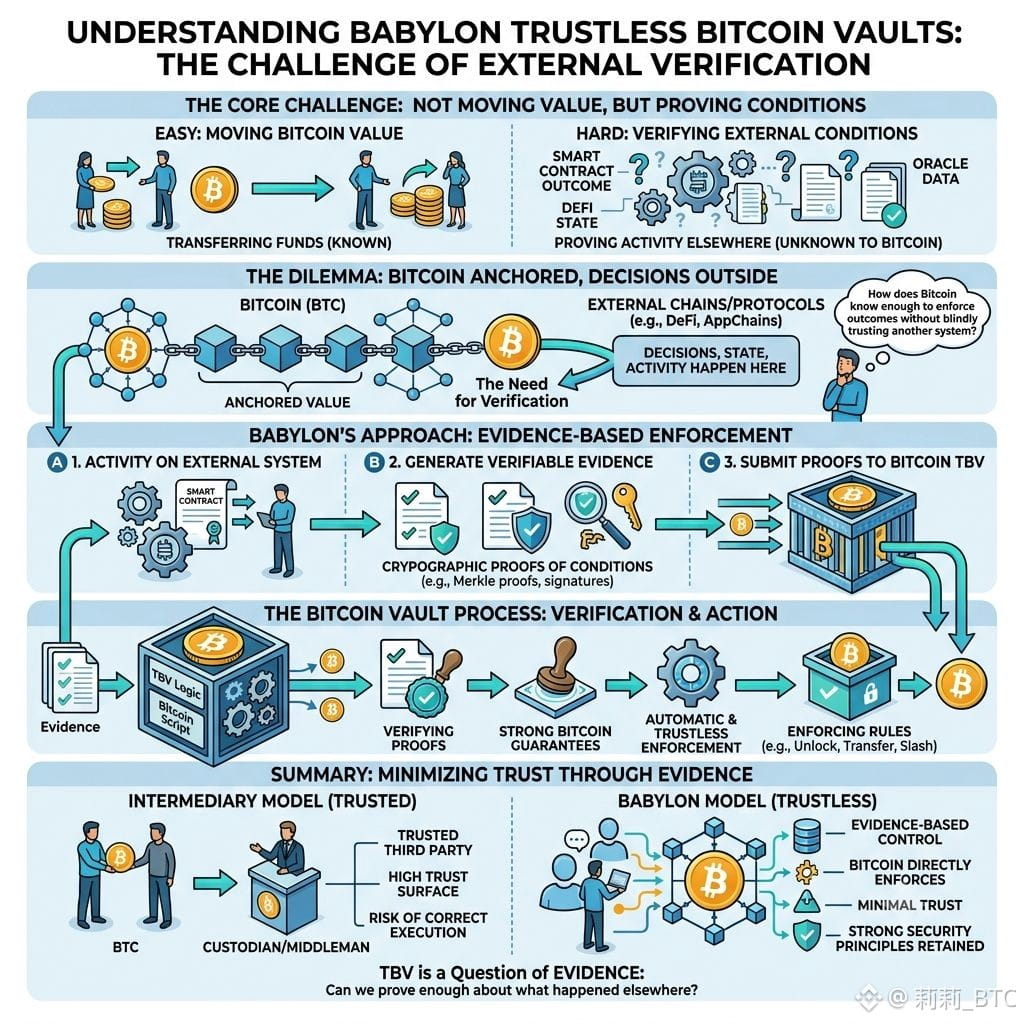
The hardest part of making Bitcoin useful elsewhere isn’t moving value. It’s proving that the conditions around that value were actually satisfied.
That is the part of Babylon Trustless Bitcoin Vaults I find most interesting.
When I look at BabylonLabs_io, I keep coming back to verifcation. If BTC remains anchored to Bitcoin while decisions depend on activity or state outside Bitcoin, then the real challenge becomes obvious: how does Bitcoin know enough to enforce the right outcome without blindly trusting another system?
For me, that is where TBV becomes much more than a “Bitcoin utility” story.
The deeper design problem is turning external conditions into something Bitcoin can verify with strong enough guarantees to control what happens next. That creates a very different security model from simply handing assets to an intermediary and trusting them to execute correctly.
I think this is why verification matters more than the headline feature.
A vault can have sophisticated logic, but if the proof conecting external events to Bitcoin-side enforcement is weak, complexity just creates another trust surface.
The more I study this idea, the more I see TBV as a question of evidence:
Can a system prove enough about what happened elsewhere for Bitcoin to enforce rules without giving up the security principles that made the asset valuable in the first place?
That, to me, is where the architecture becomes genuinely interesting.
$BABY @babylonlabs_io #baby
{alpha}(560x777bf78ad4546b61607a17bf4a1977dbbea98c28)
The hardest part of making Bitcoin useful elsewhere isn’t moving value. It’s proving that the conditions around that value were actually satisfied.
That is the part of Babylon Trustless Bitcoin Vaults I find most interesting.
When I look at BabylonLabs_io, I keep coming back to verifcation. If BTC remains anchored to Bitcoin while decisions depend on activity or state outside Bitcoin, then the real challenge becomes obvious: how does Bitcoin know enough to enforce the right outcome without blindly trusting another system?
For me, that is where TBV becomes much more than a “Bitcoin utility” story.
The deeper design problem is turning external conditions into something Bitcoin can verify with strong enough guarantees to control what happens next. That creates a very different security model from simply handing assets to an intermediary and trusting them to execute correctly.
I think this is why verification matters more than the headline feature.
A vault can have sophisticated logic, but if the proof conecting external events to Bitcoin-side enforcement is weak, complexity just creates another trust surface.
The more I study this idea, the more I see TBV as a question of evidence:
Can a system prove enough about what happened elsewhere for Bitcoin to enforce rules without giving up the security principles that made the asset valuable in the first place?
That, to me, is where the architecture becomes genuinely interesting.
$BABY @BabylonLabs_io #baby
That is the part of Babylon Trustless Bitcoin Vaults I find most interesting.
When I look at BabylonLabs_io, I keep coming back to verifcation. If BTC remains anchored to Bitcoin while decisions depend on activity or state outside Bitcoin, then the real challenge becomes obvious: how does Bitcoin know enough to enforce the right outcome without blindly trusting another system?
For me, that is where TBV becomes much more than a “Bitcoin utility” story.
The deeper design problem is turning external conditions into something Bitcoin can verify with strong enough guarantees to control what happens next. That creates a very different security model from simply handing assets to an intermediary and trusting them to execute correctly.
I think this is why verification matters more than the headline feature.
A vault can have sophisticated logic, but if the proof conecting external events to Bitcoin-side enforcement is weak, complexity just creates another trust surface.
The more I study this idea, the more I see TBV as a question of evidence:
Can a system prove enough about what happened elsewhere for Bitcoin to enforce rules without giving up the security principles that made the asset valuable in the first place?
That, to me, is where the architecture becomes genuinely interesting.
$BABY @BabylonLabs_io #baby
4
96
·
--
Article
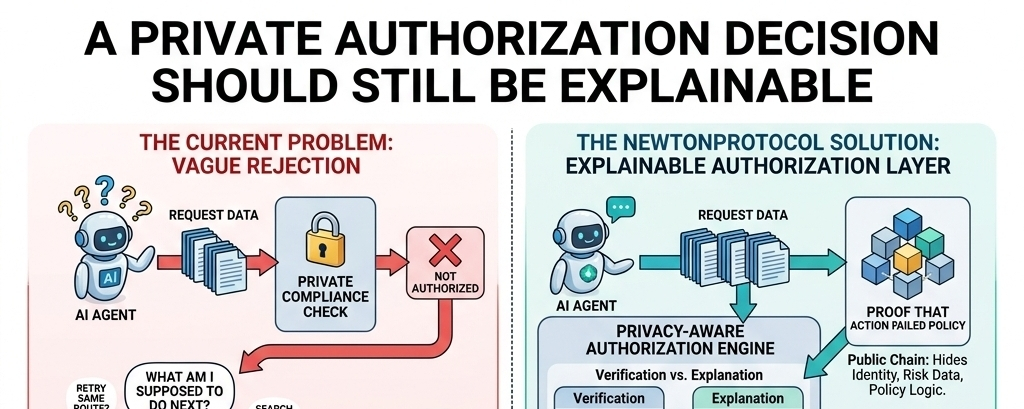
A Private Authorization Decision Should Still Be ExplainableI would hesitate to trust a financial decision I can verify cryptographically but cannot meaningfully question.
Suppose my transaction is rejected before settlement. My identity remains hidden, the private compliance data never appears onchain, and the system produces evidence that the required policy check ran correctly.
From a privacy perspective, that may be a sucess.
From my perspective as the person whose action was blocked one question remains:
What am I supposed to do next?
That tension is what interests me about @NewtonProtocol.
Newton Mainnet Beta and VaultKit bring authorization closer to execution. Instead of relying only on frontend warnings or reviewing transactions after funds move, an application can check defined policies before settlement and use a signed attestation to show that the evaluation occurred.
I think that direction addresses a genuine weakness in automated onchain finance.
But privacy-preserving enforcement can create a new problem if the result becomes impossible to understand.
## “Not authorized” is a result, not an explanation
A transaction may fail because its amount exceeds a limit.
It may involve an unapproved asset.
The required credential may have expired.
The policy may have changed.
An external data source may be unavailable.
The transaction may have been evaluated under an older policy version.
All of these situations can produce the same visible outcome: execution does not proceed.
Yet they require completely different responses.
If I exceeded a transaction limit, I may be able to reduce the amount.
If a credential expired, I may need to renew it.
If a price feed failed, retrying later may solve the problem.
If the counterparty is prohibited, repeating the transaction should not help at all.
A system that hides every distinction in the name of privacy may protect sensitive data while leaving the user unable to correct a legitimate problem.
For me, that is not complete authorization.
It is enforcement without usable explanation.
## AI agents make vague rejection more dangerous
This issue becomes more serious when the requester is an automated agent rather than a person.
A human can see an unclear rejection and pause.
An AI agent may retry the same route, reduce the amount randomly, switch counterparties, or search for another path without understanding why the original action failed.
That behavior can create unnecesary activity and even increase risk.
If the policy rejected the action because the agent reached a spending limit, switching venues should not bypass that restriction.
If the failure came from temporary data unavailability, abandoning the strategy entirely may be unnecessary.
If the action was blocked because it increased exposure beyond the mandate, the agent should know that the correct response is to stop—not to search for a cleverer route.
So I think a privacy-aware authorization layer needs more than a binary answer.
It needs enough structured feedback for the authorized requester to respond safely.
Not the private identity record.
Not the full compliance file.
Not every rule inside the policy.
Just the minimum explanation needed to understand the category of failure and the permitted next step.
## Verification and explanation are different jobs
This is where I think the $NEWT thesis becomes more nuanced.
A signed attestation can help prove that the authorization process followed defined logic. That is valuable evidence.
But proof that a check ran correctly is not automatically an explanation of the decision.
Those are two different functions.
Verification asks:
“Was the required policy evaluated as designed?”
Explanation asks:
“Which condition affected this action, and what can the requester legitimately do about it?”
A strong system may need both, while revealing different information to different parties.
The public chain may only need proof that the transaction did not receive valid authorization.
The user may need a private reason category and a remediation path.
The AI agent may need machine-readable instructions such as stop, retry later, reduce risk, refresh credentials, or request review.
An authorized auditor may need deeper evidence showing which policy version and data source were used.
I do not think all of that should be public.
I do think all of it should exist where appropriate.
## Privacy should not remove the right to contest an error
Policies and data sources can be wrong.
A credential provider may return outdated information.
A wallet may be classified incorrectly.
A policy update may unintentionally block legitimate activity.
A developer may create a rule whose actual behavior differs from its intended purpose.
If the system only says “authorization failed,” the affected user has no meaningful way to distiguish a valid restriction from an implementation mistake.
That matters because automated enforcement can make errors feel final.
A manual compliance team may reconsider an unusual case. A rigid policy engine simply executes the rule it receives.
I want the efficiency of programmable authorization, but I do not want privacy to become an excuse for unchallengeable decisions.
For applications using Newton infrastructure, I would look for a clear contestability path:
Which policy version was applied?
Was the required data current?
Did the failure come from the rule itself or from an unavailable dependency?
Can the user request a review without exposing private information publicly?
Can an auditor verify the outcome without revealing unnecessary details to everyone else?
Those questions are not secondary user-experience concerns.
They are part of whether authorization deserves trust.
## The balance I want to see
Too much disclosure can expose identity, risk status, strategy, or institutional relationships.
Too little disclosure can turn policy enforcement into a black box.
The useful middle ground is selective explanation.
The system should reveal enough for the affected party to understand and respond, while keeping sensitive evidence restricted to the parties that genuinely need it.
For me, this is one of the more important tests for #Newt as Newton Mainnet Beta develops.
I am not only watching whether applications can block transactions before settlement.
I am watching whether a legitimate user can understand a rejection without forcing the system to publish private information.
I am watching whether an AI agent receives enough context to stop safely instead of repeatedly probing the same boundary.
And I am watching whether an incorrect decision can be reviewed without weakening the privacy model around every other transaction.
A private proof is valuable.
A verifiable policy is valuable.
But financial authorization becomes much stronger when the person or agent affected by the decision can understand what kind of boundary was reached.
Because privacy should protect the reason from unnecessary exposure.
It should not erase the reason for the party who genuinely needs to know.
$NEWT @NewtonProtocol #Newt
{spot}(NEWTUSDT)
A Private Authorization Decision Should Still Be Explainable
I would hesitate to trust a financial decision I can verify cryptographically but cannot meaningfully question.
Suppose my transaction is rejected before settlement. My identity remains hidden, the private compliance data never appears onchain, and the system produces evidence that the required policy check ran correctly.
From a privacy perspective, that may be a sucess.
From my perspective as the person whose action was blocked one question remains:
What am I supposed to do next?
That tension is what interests me about @NewtonProtocol.
Newton Mainnet Beta and VaultKit bring authorization closer to execution. Instead of relying only on frontend warnings or reviewing transactions after funds move, an application can check defined policies before settlement and use a signed attestation to show that the evaluation occurred.
I think that direction addresses a genuine weakness in automated onchain finance.
But privacy-preserving enforcement can create a new problem if the result becomes impossible to understand.
## “Not authorized” is a result, not an explanation
A transaction may fail because its amount exceeds a limit.
It may involve an unapproved asset.
The required credential may have expired.
The policy may have changed.
An external data source may be unavailable.
The transaction may have been evaluated under an older policy version.
All of these situations can produce the same visible outcome: execution does not proceed.
Yet they require completely different responses.
If I exceeded a transaction limit, I may be able to reduce the amount.
If a credential expired, I may need to renew it.
If a price feed failed, retrying later may solve the problem.
If the counterparty is prohibited, repeating the transaction should not help at all.
A system that hides every distinction in the name of privacy may protect sensitive data while leaving the user unable to correct a legitimate problem.
For me, that is not complete authorization.
It is enforcement without usable explanation.
## AI agents make vague rejection more dangerous
This issue becomes more serious when the requester is an automated agent rather than a person.
A human can see an unclear rejection and pause.
An AI agent may retry the same route, reduce the amount randomly, switch counterparties, or search for another path without understanding why the original action failed.
That behavior can create unnecesary activity and even increase risk.
If the policy rejected the action because the agent reached a spending limit, switching venues should not bypass that restriction.
If the failure came from temporary data unavailability, abandoning the strategy entirely may be unnecessary.
If the action was blocked because it increased exposure beyond the mandate, the agent should know that the correct response is to stop—not to search for a cleverer route.
So I think a privacy-aware authorization layer needs more than a binary answer.
It needs enough structured feedback for the authorized requester to respond safely.
Not the private identity record.
Not the full compliance file.
Not every rule inside the policy.
Just the minimum explanation needed to understand the category of failure and the permitted next step.
## Verification and explanation are different jobs
This is where I think the $NEWT thesis becomes more nuanced.
A signed attestation can help prove that the authorization process followed defined logic. That is valuable evidence.
But proof that a check ran correctly is not automatically an explanation of the decision.
Those are two different functions.
Verification asks:
“Was the required policy evaluated as designed?”
Explanation asks:
“Which condition affected this action, and what can the requester legitimately do about it?”
A strong system may need both, while revealing different information to different parties.
The public chain may only need proof that the transaction did not receive valid authorization.
The user may need a private reason category and a remediation path.
The AI agent may need machine-readable instructions such as stop, retry later, reduce risk, refresh credentials, or request review.
An authorized auditor may need deeper evidence showing which policy version and data source were used.
I do not think all of that should be public.
I do think all of it should exist where appropriate.
## Privacy should not remove the right to contest an error
Policies and data sources can be wrong.
A credential provider may return outdated information.
A wallet may be classified incorrectly.
A policy update may unintentionally block legitimate activity.
A developer may create a rule whose actual behavior differs from its intended purpose.
If the system only says “authorization failed,” the affected user has no meaningful way to distiguish a valid restriction from an implementation mistake.
That matters because automated enforcement can make errors feel final.
A manual compliance team may reconsider an unusual case. A rigid policy engine simply executes the rule it receives.
I want the efficiency of programmable authorization, but I do not want privacy to become an excuse for unchallengeable decisions.
For applications using Newton infrastructure, I would look for a clear contestability path:
Which policy version was applied?
Was the required data current?
Did the failure come from the rule itself or from an unavailable dependency?
Can the user request a review without exposing private information publicly?
Can an auditor verify the outcome without revealing unnecessary details to everyone else?
Those questions are not secondary user-experience concerns.
They are part of whether authorization deserves trust.
## The balance I want to see
Too much disclosure can expose identity, risk status, strategy, or institutional relationships.
Too little disclosure can turn policy enforcement into a black box.
The useful middle ground is selective explanation.
The system should reveal enough for the affected party to understand and respond, while keeping sensitive evidence restricted to the parties that genuinely need it.
For me, this is one of the more important tests for #Newt as Newton Mainnet Beta develops.
I am not only watching whether applications can block transactions before settlement.
I am watching whether a legitimate user can understand a rejection without forcing the system to publish private information.
I am watching whether an AI agent receives enough context to stop safely instead of repeatedly probing the same boundary.
And I am watching whether an incorrect decision can be reviewed without weakening the privacy model around every other transaction.
A private proof is valuable.
A verifiable policy is valuable.
But financial authorization becomes much stronger when the person or agent affected by the decision can understand what kind of boundary was reached.
Because privacy should protect the reason from unnecessary exposure.
It should not erase the reason for the party who genuinely needs to know.
$NEWT @NewtonProtocol #Newt
Suppose my transaction is rejected before settlement. My identity remains hidden, the private compliance data never appears onchain, and the system produces evidence that the required policy check ran correctly.
From a privacy perspective, that may be a sucess.
From my perspective as the person whose action was blocked one question remains:
What am I supposed to do next?
That tension is what interests me about @NewtonProtocol.
Newton Mainnet Beta and VaultKit bring authorization closer to execution. Instead of relying only on frontend warnings or reviewing transactions after funds move, an application can check defined policies before settlement and use a signed attestation to show that the evaluation occurred.
I think that direction addresses a genuine weakness in automated onchain finance.
But privacy-preserving enforcement can create a new problem if the result becomes impossible to understand.
## “Not authorized” is a result, not an explanation
A transaction may fail because its amount exceeds a limit.
It may involve an unapproved asset.
The required credential may have expired.
The policy may have changed.
An external data source may be unavailable.
The transaction may have been evaluated under an older policy version.
All of these situations can produce the same visible outcome: execution does not proceed.
Yet they require completely different responses.
If I exceeded a transaction limit, I may be able to reduce the amount.
If a credential expired, I may need to renew it.
If a price feed failed, retrying later may solve the problem.
If the counterparty is prohibited, repeating the transaction should not help at all.
A system that hides every distinction in the name of privacy may protect sensitive data while leaving the user unable to correct a legitimate problem.
For me, that is not complete authorization.
It is enforcement without usable explanation.
## AI agents make vague rejection more dangerous
This issue becomes more serious when the requester is an automated agent rather than a person.
A human can see an unclear rejection and pause.
An AI agent may retry the same route, reduce the amount randomly, switch counterparties, or search for another path without understanding why the original action failed.
That behavior can create unnecesary activity and even increase risk.
If the policy rejected the action because the agent reached a spending limit, switching venues should not bypass that restriction.
If the failure came from temporary data unavailability, abandoning the strategy entirely may be unnecessary.
If the action was blocked because it increased exposure beyond the mandate, the agent should know that the correct response is to stop—not to search for a cleverer route.
So I think a privacy-aware authorization layer needs more than a binary answer.
It needs enough structured feedback for the authorized requester to respond safely.
Not the private identity record.
Not the full compliance file.
Not every rule inside the policy.
Just the minimum explanation needed to understand the category of failure and the permitted next step.
## Verification and explanation are different jobs
This is where I think the $NEWT thesis becomes more nuanced.
A signed attestation can help prove that the authorization process followed defined logic. That is valuable evidence.
But proof that a check ran correctly is not automatically an explanation of the decision.
Those are two different functions.
Verification asks:
“Was the required policy evaluated as designed?”
Explanation asks:
“Which condition affected this action, and what can the requester legitimately do about it?”
A strong system may need both, while revealing different information to different parties.
The public chain may only need proof that the transaction did not receive valid authorization.
The user may need a private reason category and a remediation path.
The AI agent may need machine-readable instructions such as stop, retry later, reduce risk, refresh credentials, or request review.
An authorized auditor may need deeper evidence showing which policy version and data source were used.
I do not think all of that should be public.
I do think all of it should exist where appropriate.
## Privacy should not remove the right to contest an error
Policies and data sources can be wrong.
A credential provider may return outdated information.
A wallet may be classified incorrectly.
A policy update may unintentionally block legitimate activity.
A developer may create a rule whose actual behavior differs from its intended purpose.
If the system only says “authorization failed,” the affected user has no meaningful way to distiguish a valid restriction from an implementation mistake.
That matters because automated enforcement can make errors feel final.
A manual compliance team may reconsider an unusual case. A rigid policy engine simply executes the rule it receives.
I want the efficiency of programmable authorization, but I do not want privacy to become an excuse for unchallengeable decisions.
For applications using Newton infrastructure, I would look for a clear contestability path:
Which policy version was applied?
Was the required data current?
Did the failure come from the rule itself or from an unavailable dependency?
Can the user request a review without exposing private information publicly?
Can an auditor verify the outcome without revealing unnecessary details to everyone else?
Those questions are not secondary user-experience concerns.
They are part of whether authorization deserves trust.
## The balance I want to see
Too much disclosure can expose identity, risk status, strategy, or institutional relationships.
Too little disclosure can turn policy enforcement into a black box.
The useful middle ground is selective explanation.
The system should reveal enough for the affected party to understand and respond, while keeping sensitive evidence restricted to the parties that genuinely need it.
For me, this is one of the more important tests for #Newt as Newton Mainnet Beta develops.
I am not only watching whether applications can block transactions before settlement.
I am watching whether a legitimate user can understand a rejection without forcing the system to publish private information.
I am watching whether an AI agent receives enough context to stop safely instead of repeatedly probing the same boundary.
And I am watching whether an incorrect decision can be reviewed without weakening the privacy model around every other transaction.
A private proof is valuable.
A verifiable policy is valuable.
But financial authorization becomes much stronger when the person or agent affected by the decision can understand what kind of boundary was reached.
Because privacy should protect the reason from unnecessary exposure.
It should not erase the reason for the party who genuinely needs to know.
$NEWT @NewtonProtocol #Newt
4
1
89
·
--
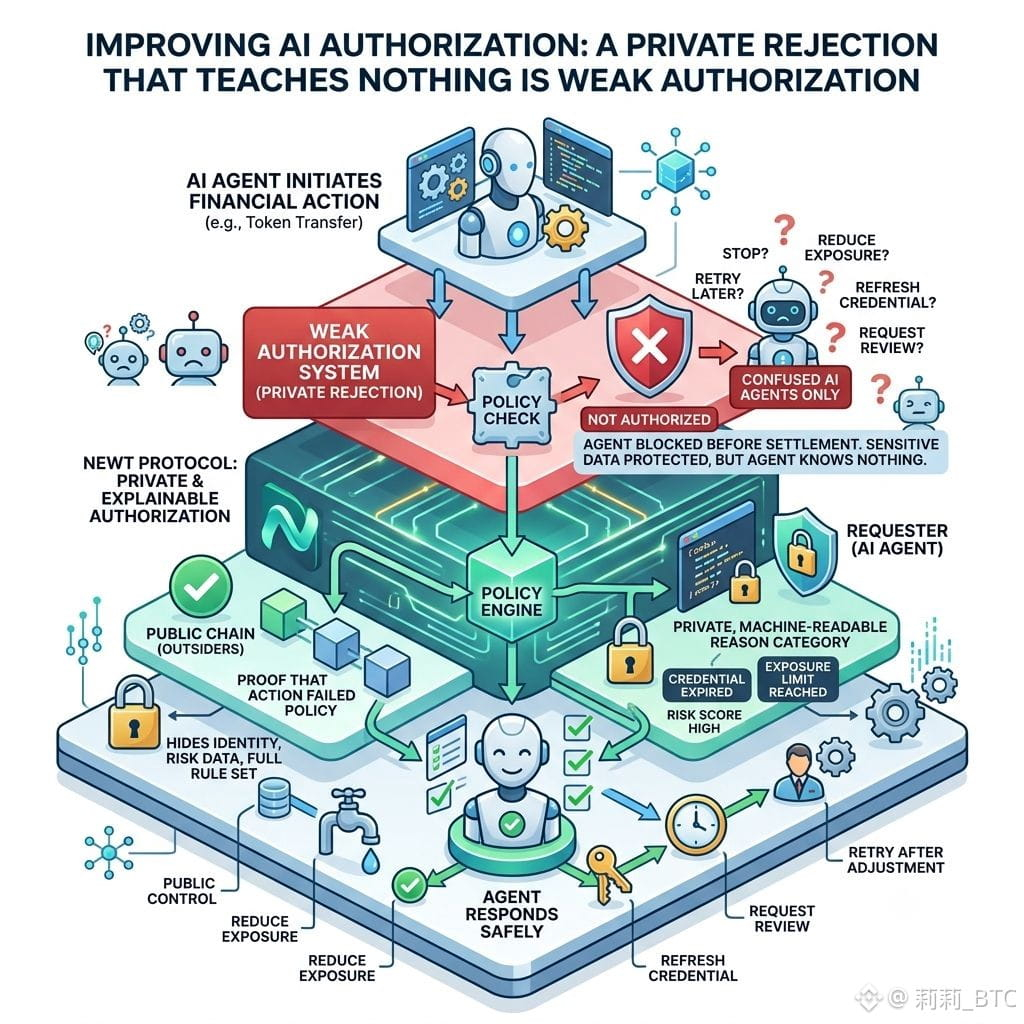
A private rejection that teaches nothing is still a weak authorization system.
That is what I keep thinking about with NewtonProtocol.
If an AI agent is blocked before settlement, “not authorized” may protect sensitive data—but it does not tell the agent whether it should stop, retry later, reduce exposure refresh a credential, or request review.
For me, NEWT becomes more useful when privacy and explainability work together.
The public chain may only need proof that the action failed policy The requester should receive a private, machine-readable reason category without exposing identity, risk data, or the full rule set.
That is what I’m watching with Newt.
Good authorization should hide what outsiders do not need to know while still giving the affected user or agent enough information to respond safely.
$NEWT @NewtonProtocol #Newt
{spot}(NEWTUSDT)
A private rejection that teaches nothing is still a weak authorization system.
That is what I keep thinking about with NewtonProtocol.
If an AI agent is blocked before settlement, “not authorized” may protect sensitive data—but it does not tell the agent whether it should stop, retry later, reduce exposure refresh a credential, or request review.
For me, NEWT becomes more useful when privacy and explainability work together.
The public chain may only need proof that the action failed policy The requester should receive a private, machine-readable reason category without exposing identity, risk data, or the full rule set.
That is what I’m watching with Newt.
Good authorization should hide what outsiders do not need to know while still giving the affected user or agent enough information to respond safely.
$NEWT @NewtonProtocol #Newt
That is what I keep thinking about with NewtonProtocol.
If an AI agent is blocked before settlement, “not authorized” may protect sensitive data—but it does not tell the agent whether it should stop, retry later, reduce exposure refresh a credential, or request review.
For me, NEWT becomes more useful when privacy and explainability work together.
The public chain may only need proof that the action failed policy The requester should receive a private, machine-readable reason category without exposing identity, risk data, or the full rule set.
That is what I’m watching with Newt.
Good authorization should hide what outsiders do not need to know while still giving the affected user or agent enough information to respond safely.
$NEWT @NewtonProtocol #Newt
1
99
·
--
Article
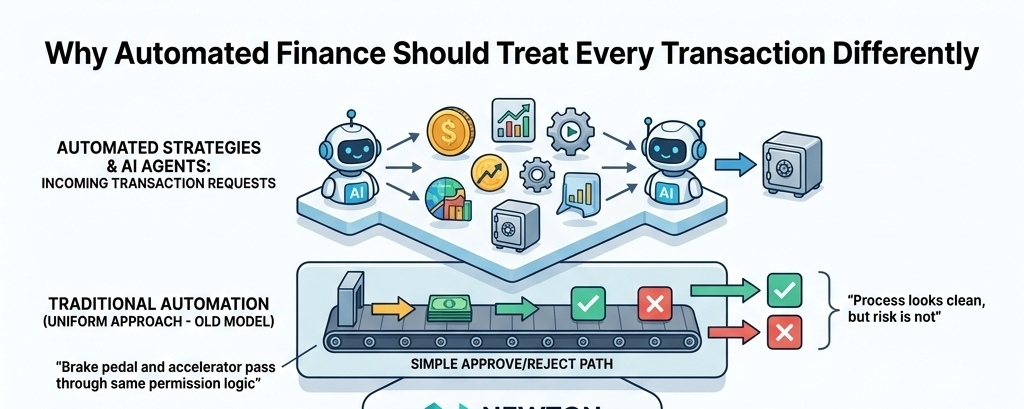
Why Automated Finance Should Treat Every Transaction DifferentlyA brake pedal and an accelerator should not pass through the same permission logic.
That may sound obvious, but I think automated finance often treats actions too uniformly. A transaction arrives, the system checks a policy, and the result becomes approve or reject.
The process looks clean.
The risk behind each action is not.
An AI-driven strategy increasing leverage is doing something fundamentally different from the same strategy closing a position. Moving funds to a new counterparty creates a different exposure than returning capital to an approved vault. Buying an unfamiliar asset should not necessarily face the same authorization path as reducing concentration in an existing position.
This is where I think @NewtonProtocol becomes more interesting than a simple automation narrative.
Newton’s Mainnet Beta and VaultKit are focused on pre-settlement authorization: checking an action against defined rules before it settles, then producing a signed attestation that can show the evaluation occurred.
I see real value in that design.
But I think the strongest version of the idea goes beyond asking whether a transaction fits a policy.
It asks how much authorization that specific action deserves.
Consider an automated vault during a volatile market.
One action increases leverage because the strategy sees an opportunity.
Another action reduces exposure because collateral conditions are deteriorating.
If both transactions move through exactly the same approval process, the system may be technically consistent while remaining financially insensitive.
The first action increases potential loss.
The second may prevent it.
That difference should matter.
For me, this is where risk-proportional authorization becomes important. An action that expands exposure may need stricter conditions: fresher market data, tighter limits, stronger counterparty checks, or a narrower execution window.
An action that clearly reduces risk may need a faster path, especially when delay itself could make the position worse.
I am not arguing that risk-reducing transactions should bypass authorization.
I am arguing that authorization should understand direction.
A system that only knows “allowed” and “not allowed” may miss the economic meaning of what the agent is trying to do.
This becomes even more important with AI agents because automated systems do not naturally pause and interpret context the way a human trader might.
A person can look at the market and think:
“This trade normally violates my preferred route, but I need to reduce exposure immediately.”
A rigid policy engne may only see that the route is not approved.
The result could be a strange contradiction: the authorization layer blocks an action designed to make the portfolio safer because the transaction does not fit a rule written for normal conditions.
That would not mean the rule failed.
It would mean the policy lacked risk awareness.
This is the part of NEWT I find worth following closely. Newton is trying to bring enforceable permissions into automated onchain finance. The harder challenge is making those permissions expressive enough to distinguish between actions that create risk and actions that remove it.
A signed attestation could become more useful when it communicates that distinction.
Instead of only proving that a transaction passed a rule, I would want the surrounding policy logic to make clear why that level of authorization was applied.
Was the strategy increasing leverage?
Was it reducing exposure?
Was it interacting with a previously approved asset?
Was it entering a new market?
Was it using an emergency exit condition?
Those details can change what a sensible authorization process should look like.
I also think this could improve user understanding.
Most people do not want to study every internal policy module before using an automated strategy. They want confidence that the system becomes more cautious when the action becomes more dangerous.
That is easier to understand than a long technical list of controls.
The principle is simple:
More risk should require stronger permission.
Less risk should not be delayed without a good reason.
Of course, implementing that principle is difficult.
The first problem is defining what “risk-reducing” actually means.
Closing part of a position may reduce market exposure but create liquidity costs. Moving into a stable asset may lower volatility but introduce counterparty or depegging risk. Exiting one vault may reduce smart-contract exposure while creating settlement or bridge risk somewhere else.
Financial actions rarely move risk in only one direction.
That means the policy cannot rely on a simple label.
It may need to consider several dimensions at once: leverage, liquidity, collateral quality, concentration, counterparty exposure, and the reliability of the data being used.
The second challenge is preventing abuse.
If an application gives faster authorization to risk-reducing actions, a poorly designed strategy may try to classify aggressive behavior as defensive. The definition must be enforceable, not merely descriptive.
The third challenge is transparency.
A user should be able to understand why one action required stronger approval while another moved through a faster path. If the logic is hidden, risk-sensitive authorization can start to feel arbitrary.
This is where verifiable attestations could become especially meaningful.
A receipt should not be treated as a guarantee that every financial judgment was correct. But it can provide evidence that the action was evaluated under a defined policy and that the required authorization path was followed.
For me, that is more useful than simply seeing that a transaction executed.
I want to know whether the system recognized the type of risk it was creating.
I also think different aplications will need different authorization profiles.
A conservative institutional vault may require strict checks for nearly every capital movement.
A retail rebalancing tool may use simpler limits.
An AI agent managing a narrow set of approved assets may need less friction than one operating across multiple chains, counterparties, and lending markets.
That flexibility is important because one universal risk model would probably become either too loose for serious capital or too restrictive for practical use.
Newton-specific infrastructure becomes valuable only when developers can translate those differences into enforceable rules without making the user experience impossible to understand.
That is the balance I would watch with Newt.
Too little control, and automation becomes dangerous.
Too much rigid control, and automation loses the ability to respond when markets move quickly.
The best authorization layer should not only stop prohibited actions. It should recognize that some actions deserve deeper scrutiny than others.
For me, this is the real standard for controled AI finance.
I do not just want an agent that follows rules.
I want an agent whose permission system becomes stricter as the consequences become larger.
Because in automated markets, treating every transaction equally does not always create fairness or safety.
Sometimes it only means the system failed to understand the difference between taking risk and escaping it.
$NEWT @NewtonProtocol #Newt
{spot}(NEWTUSDT)
Why Automated Finance Should Treat Every Transaction Differently
A brake pedal and an accelerator should not pass through the same permission logic.
That may sound obvious, but I think automated finance often treats actions too uniformly. A transaction arrives, the system checks a policy, and the result becomes approve or reject.
The process looks clean.
The risk behind each action is not.
An AI-driven strategy increasing leverage is doing something fundamentally different from the same strategy closing a position. Moving funds to a new counterparty creates a different exposure than returning capital to an approved vault. Buying an unfamiliar asset should not necessarily face the same authorization path as reducing concentration in an existing position.
This is where I think @NewtonProtocol becomes more interesting than a simple automation narrative.
Newton’s Mainnet Beta and VaultKit are focused on pre-settlement authorization: checking an action against defined rules before it settles, then producing a signed attestation that can show the evaluation occurred.
I see real value in that design.
But I think the strongest version of the idea goes beyond asking whether a transaction fits a policy.
It asks how much authorization that specific action deserves.
Consider an automated vault during a volatile market.
One action increases leverage because the strategy sees an opportunity.
Another action reduces exposure because collateral conditions are deteriorating.
If both transactions move through exactly the same approval process, the system may be technically consistent while remaining financially insensitive.
The first action increases potential loss.
The second may prevent it.
That difference should matter.
For me, this is where risk-proportional authorization becomes important. An action that expands exposure may need stricter conditions: fresher market data, tighter limits, stronger counterparty checks, or a narrower execution window.
An action that clearly reduces risk may need a faster path, especially when delay itself could make the position worse.
I am not arguing that risk-reducing transactions should bypass authorization.
I am arguing that authorization should understand direction.
A system that only knows “allowed” and “not allowed” may miss the economic meaning of what the agent is trying to do.
This becomes even more important with AI agents because automated systems do not naturally pause and interpret context the way a human trader might.
A person can look at the market and think:
“This trade normally violates my preferred route, but I need to reduce exposure immediately.”
A rigid policy engne may only see that the route is not approved.
The result could be a strange contradiction: the authorization layer blocks an action designed to make the portfolio safer because the transaction does not fit a rule written for normal conditions.
That would not mean the rule failed.
It would mean the policy lacked risk awareness.
This is the part of NEWT I find worth following closely. Newton is trying to bring enforceable permissions into automated onchain finance. The harder challenge is making those permissions expressive enough to distinguish between actions that create risk and actions that remove it.
A signed attestation could become more useful when it communicates that distinction.
Instead of only proving that a transaction passed a rule, I would want the surrounding policy logic to make clear why that level of authorization was applied.
Was the strategy increasing leverage?
Was it reducing exposure?
Was it interacting with a previously approved asset?
Was it entering a new market?
Was it using an emergency exit condition?
Those details can change what a sensible authorization process should look like.
I also think this could improve user understanding.
Most people do not want to study every internal policy module before using an automated strategy. They want confidence that the system becomes more cautious when the action becomes more dangerous.
That is easier to understand than a long technical list of controls.
The principle is simple:
More risk should require stronger permission.
Less risk should not be delayed without a good reason.
Of course, implementing that principle is difficult.
The first problem is defining what “risk-reducing” actually means.
Closing part of a position may reduce market exposure but create liquidity costs. Moving into a stable asset may lower volatility but introduce counterparty or depegging risk. Exiting one vault may reduce smart-contract exposure while creating settlement or bridge risk somewhere else.
Financial actions rarely move risk in only one direction.
That means the policy cannot rely on a simple label.
It may need to consider several dimensions at once: leverage, liquidity, collateral quality, concentration, counterparty exposure, and the reliability of the data being used.
The second challenge is preventing abuse.
If an application gives faster authorization to risk-reducing actions, a poorly designed strategy may try to classify aggressive behavior as defensive. The definition must be enforceable, not merely descriptive.
The third challenge is transparency.
A user should be able to understand why one action required stronger approval while another moved through a faster path. If the logic is hidden, risk-sensitive authorization can start to feel arbitrary.
This is where verifiable attestations could become especially meaningful.
A receipt should not be treated as a guarantee that every financial judgment was correct. But it can provide evidence that the action was evaluated under a defined policy and that the required authorization path was followed.
For me, that is more useful than simply seeing that a transaction executed.
I want to know whether the system recognized the type of risk it was creating.
I also think different aplications will need different authorization profiles.
A conservative institutional vault may require strict checks for nearly every capital movement.
A retail rebalancing tool may use simpler limits.
An AI agent managing a narrow set of approved assets may need less friction than one operating across multiple chains, counterparties, and lending markets.
That flexibility is important because one universal risk model would probably become either too loose for serious capital or too restrictive for practical use.
Newton-specific infrastructure becomes valuable only when developers can translate those differences into enforceable rules without making the user experience impossible to understand.
That is the balance I would watch with Newt.
Too little control, and automation becomes dangerous.
Too much rigid control, and automation loses the ability to respond when markets move quickly.
The best authorization layer should not only stop prohibited actions. It should recognize that some actions deserve deeper scrutiny than others.
For me, this is the real standard for controled AI finance.
I do not just want an agent that follows rules.
I want an agent whose permission system becomes stricter as the consequences become larger.
Because in automated markets, treating every transaction equally does not always create fairness or safety.
Sometimes it only means the system failed to understand the difference between taking risk and escaping it.
$NEWT @NewtonProtocol #Newt
That may sound obvious, but I think automated finance often treats actions too uniformly. A transaction arrives, the system checks a policy, and the result becomes approve or reject.
The process looks clean.
The risk behind each action is not.
An AI-driven strategy increasing leverage is doing something fundamentally different from the same strategy closing a position. Moving funds to a new counterparty creates a different exposure than returning capital to an approved vault. Buying an unfamiliar asset should not necessarily face the same authorization path as reducing concentration in an existing position.
This is where I think @NewtonProtocol becomes more interesting than a simple automation narrative.
Newton’s Mainnet Beta and VaultKit are focused on pre-settlement authorization: checking an action against defined rules before it settles, then producing a signed attestation that can show the evaluation occurred.
I see real value in that design.
But I think the strongest version of the idea goes beyond asking whether a transaction fits a policy.
It asks how much authorization that specific action deserves.
Consider an automated vault during a volatile market.
One action increases leverage because the strategy sees an opportunity.
Another action reduces exposure because collateral conditions are deteriorating.
If both transactions move through exactly the same approval process, the system may be technically consistent while remaining financially insensitive.
The first action increases potential loss.
The second may prevent it.
That difference should matter.
For me, this is where risk-proportional authorization becomes important. An action that expands exposure may need stricter conditions: fresher market data, tighter limits, stronger counterparty checks, or a narrower execution window.
An action that clearly reduces risk may need a faster path, especially when delay itself could make the position worse.
I am not arguing that risk-reducing transactions should bypass authorization.
I am arguing that authorization should understand direction.
A system that only knows “allowed” and “not allowed” may miss the economic meaning of what the agent is trying to do.
This becomes even more important with AI agents because automated systems do not naturally pause and interpret context the way a human trader might.
A person can look at the market and think:
“This trade normally violates my preferred route, but I need to reduce exposure immediately.”
A rigid policy engne may only see that the route is not approved.
The result could be a strange contradiction: the authorization layer blocks an action designed to make the portfolio safer because the transaction does not fit a rule written for normal conditions.
That would not mean the rule failed.
It would mean the policy lacked risk awareness.
This is the part of NEWT I find worth following closely. Newton is trying to bring enforceable permissions into automated onchain finance. The harder challenge is making those permissions expressive enough to distinguish between actions that create risk and actions that remove it.
A signed attestation could become more useful when it communicates that distinction.
Instead of only proving that a transaction passed a rule, I would want the surrounding policy logic to make clear why that level of authorization was applied.
Was the strategy increasing leverage?
Was it reducing exposure?
Was it interacting with a previously approved asset?
Was it entering a new market?
Was it using an emergency exit condition?
Those details can change what a sensible authorization process should look like.
I also think this could improve user understanding.
Most people do not want to study every internal policy module before using an automated strategy. They want confidence that the system becomes more cautious when the action becomes more dangerous.
That is easier to understand than a long technical list of controls.
The principle is simple:
More risk should require stronger permission.
Less risk should not be delayed without a good reason.
Of course, implementing that principle is difficult.
The first problem is defining what “risk-reducing” actually means.
Closing part of a position may reduce market exposure but create liquidity costs. Moving into a stable asset may lower volatility but introduce counterparty or depegging risk. Exiting one vault may reduce smart-contract exposure while creating settlement or bridge risk somewhere else.
Financial actions rarely move risk in only one direction.
That means the policy cannot rely on a simple label.
It may need to consider several dimensions at once: leverage, liquidity, collateral quality, concentration, counterparty exposure, and the reliability of the data being used.
The second challenge is preventing abuse.
If an application gives faster authorization to risk-reducing actions, a poorly designed strategy may try to classify aggressive behavior as defensive. The definition must be enforceable, not merely descriptive.
The third challenge is transparency.
A user should be able to understand why one action required stronger approval while another moved through a faster path. If the logic is hidden, risk-sensitive authorization can start to feel arbitrary.
This is where verifiable attestations could become especially meaningful.
A receipt should not be treated as a guarantee that every financial judgment was correct. But it can provide evidence that the action was evaluated under a defined policy and that the required authorization path was followed.
For me, that is more useful than simply seeing that a transaction executed.
I want to know whether the system recognized the type of risk it was creating.
I also think different aplications will need different authorization profiles.
A conservative institutional vault may require strict checks for nearly every capital movement.
A retail rebalancing tool may use simpler limits.
An AI agent managing a narrow set of approved assets may need less friction than one operating across multiple chains, counterparties, and lending markets.
That flexibility is important because one universal risk model would probably become either too loose for serious capital or too restrictive for practical use.
Newton-specific infrastructure becomes valuable only when developers can translate those differences into enforceable rules without making the user experience impossible to understand.
That is the balance I would watch with Newt.
Too little control, and automation becomes dangerous.
Too much rigid control, and automation loses the ability to respond when markets move quickly.
The best authorization layer should not only stop prohibited actions. It should recognize that some actions deserve deeper scrutiny than others.
For me, this is the real standard for controled AI finance.
I do not just want an agent that follows rules.
I want an agent whose permission system becomes stricter as the consequences become larger.
Because in automated markets, treating every transaction equally does not always create fairness or safety.
Sometimes it only means the system failed to understand the difference between taking risk and escaping it.
$NEWT @NewtonProtocol #Newt
2
61
·
--
Bullish
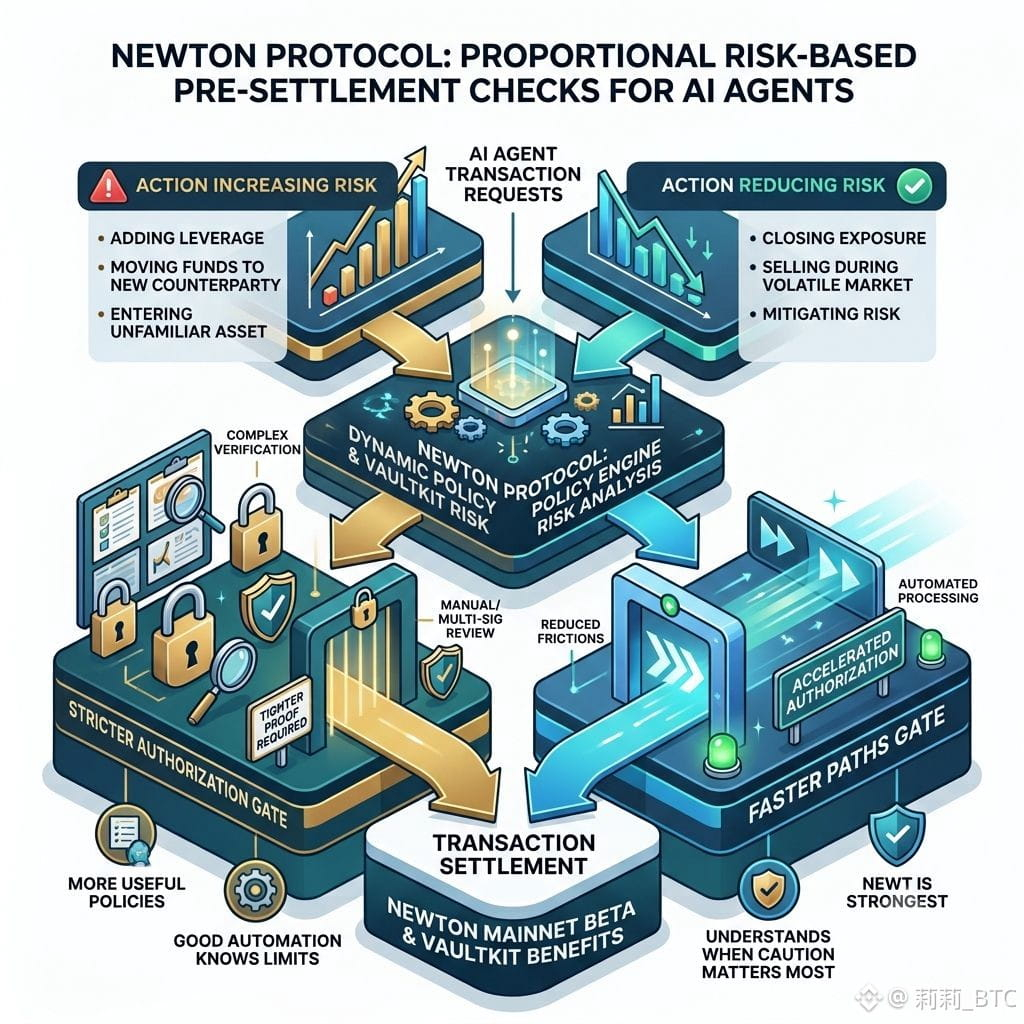
An AI agent increasing risk and one reducing it should not face the same gate.
That distinction matters to me when I look at NewtonProtocol. A strategy adding leverage, moving funds to a new counterparty, or entering an unfamiliar asset should probably require strcter authorization than an action closing exposure during a volatile market.
I think Newton Mainnet Beta and VaultKit become more useful when policies can reflect the risk of the action itself—not just approve or reject every transaction through one rigid process.
For me NEWT is strongest when pre-settlement checks become proportional: tighter proof for actions that expand risk, faster paths for actions that clearly reduce it.
That is what I’m watching with Newt. Good automation should not only know its limits. It should understand when caution matters most.
$NEWT @NewtonProtocol #Newt
{spot}(NEWTUSDT)
An AI agent increasing risk and one reducing it should not face the same gate.
That distinction matters to me when I look at NewtonProtocol. A strategy adding leverage, moving funds to a new counterparty, or entering an unfamiliar asset should probably require strcter authorization than an action closing exposure during a volatile market.
I think Newton Mainnet Beta and VaultKit become more useful when policies can reflect the risk of the action itself—not just approve or reject every transaction through one rigid process.
For me NEWT is strongest when pre-settlement checks become proportional: tighter proof for actions that expand risk, faster paths for actions that clearly reduce it.
That is what I’m watching with Newt. Good automation should not only know its limits. It should understand when caution matters most.
$NEWT @NewtonProtocol #Newt
That distinction matters to me when I look at NewtonProtocol. A strategy adding leverage, moving funds to a new counterparty, or entering an unfamiliar asset should probably require strcter authorization than an action closing exposure during a volatile market.
I think Newton Mainnet Beta and VaultKit become more useful when policies can reflect the risk of the action itself—not just approve or reject every transaction through one rigid process.
For me NEWT is strongest when pre-settlement checks become proportional: tighter proof for actions that expand risk, faster paths for actions that clearly reduce it.
That is what I’m watching with Newt. Good automation should not only know its limits. It should understand when caution matters most.
$NEWT @NewtonProtocol #Newt
85
·
--
Article
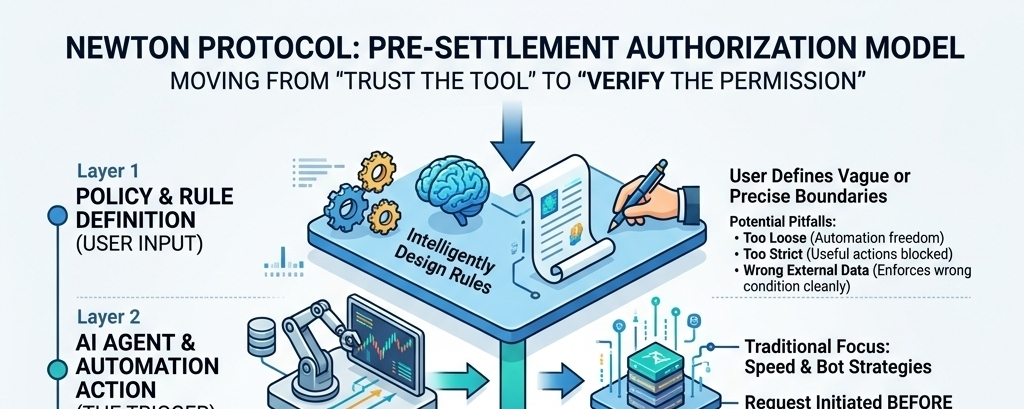
The weakest part of automation is often the rule nobody questionedThat thought kept coming back to me while looking at @NewtonProtocol. Most people discuss automated finance as if the main risk is the agent itself: the bot, the model, the strategy, the speed. I see the problem a little differently.
For me, the real risk starts earlier.
What exactly did I allow the system to do?
That question matters because an AI agent can only be as safe as the policy controlling it. If the boundary is vague the automation may still behave “correctly” from a technical point of view while creating a result the user never truly intended.
This is where Newton’s Mainnet Beta and VaultKit direction feel more specific than the usual AI-trading narrative. Newton is not only talking about faster execution. It is focused on pre-settlement authorization, where an action is checked against defined rules before it settles onchain. If the request matches the policy, a signed attestation can prove the check happened. If it does not, the action should not move forward.
I like that idea because it shifts attention from reaction to prevention.
A normal monitoring tool may warn me after something suspicious happens. An audit may tell me the contract looked safe at one point in time. But a pre-settlement policy layer asks a different question at the moment of action: does this transaction fit the permission structure right now?
That difference feels important for vaults, automated strategies, and agent-controlled workflows.
Still, I don’t think this makes everything automaticaly safe. A signed attestation proves that a rule was checked. It does not magically prove that the rule was written perfectly. If the policy is too loose, automation may get too much freedom. If the policy is too strict, useful actions may get blocked. If external data is wrong, the system may enforce the wrong condition very cleanly.
That is the part I find most interesting about NEWT. Newton is building around authorization, but the quality of authorization still depends on how intelligently the rules are designed.
So I’m not watching Newt only as an AI-agent story.
I’m watching it as a test of whether onchain finance can move from “trust the tool” to “verify the permision.”
Because in automated finance, the best execution is not always the fastest one.
Sometimes the best execution is the one that was allowed for the right reason.
$NEWT @NewtonProtocol #Newt $LAB $VANRY #Velvet #xau #VANRY #Labs
{spot}(NEWTUSDT)
The weakest part of automation is often the rule nobody questioned
That thought kept coming back to me while looking at @NewtonProtocol. Most people discuss automated finance as if the main risk is the agent itself: the bot, the model, the strategy, the speed. I see the problem a little differently.
For me, the real risk starts earlier.
What exactly did I allow the system to do?
That question matters because an AI agent can only be as safe as the policy controlling it. If the boundary is vague the automation may still behave “correctly” from a technical point of view while creating a result the user never truly intended.
This is where Newton’s Mainnet Beta and VaultKit direction feel more specific than the usual AI-trading narrative. Newton is not only talking about faster execution. It is focused on pre-settlement authorization, where an action is checked against defined rules before it settles onchain. If the request matches the policy, a signed attestation can prove the check happened. If it does not, the action should not move forward.
I like that idea because it shifts attention from reaction to prevention.
A normal monitoring tool may warn me after something suspicious happens. An audit may tell me the contract looked safe at one point in time. But a pre-settlement policy layer asks a different question at the moment of action: does this transaction fit the permission structure right now?
That difference feels important for vaults, automated strategies, and agent-controlled workflows.
Still, I don’t think this makes everything automaticaly safe. A signed attestation proves that a rule was checked. It does not magically prove that the rule was written perfectly. If the policy is too loose, automation may get too much freedom. If the policy is too strict, useful actions may get blocked. If external data is wrong, the system may enforce the wrong condition very cleanly.
That is the part I find most interesting about NEWT. Newton is building around authorization, but the quality of authorization still depends on how intelligently the rules are designed.
So I’m not watching Newt only as an AI-agent story.
I’m watching it as a test of whether onchain finance can move from “trust the tool” to “verify the permision.”
Because in automated finance, the best execution is not always the fastest one.
Sometimes the best execution is the one that was allowed for the right reason.
$NEWT @NewtonProtocol #Newt $LAB $VANRY #Velvet #xau #VANRY #Labs
For me, the real risk starts earlier.
What exactly did I allow the system to do?
That question matters because an AI agent can only be as safe as the policy controlling it. If the boundary is vague the automation may still behave “correctly” from a technical point of view while creating a result the user never truly intended.
This is where Newton’s Mainnet Beta and VaultKit direction feel more specific than the usual AI-trading narrative. Newton is not only talking about faster execution. It is focused on pre-settlement authorization, where an action is checked against defined rules before it settles onchain. If the request matches the policy, a signed attestation can prove the check happened. If it does not, the action should not move forward.
I like that idea because it shifts attention from reaction to prevention.
A normal monitoring tool may warn me after something suspicious happens. An audit may tell me the contract looked safe at one point in time. But a pre-settlement policy layer asks a different question at the moment of action: does this transaction fit the permission structure right now?
That difference feels important for vaults, automated strategies, and agent-controlled workflows.
Still, I don’t think this makes everything automaticaly safe. A signed attestation proves that a rule was checked. It does not magically prove that the rule was written perfectly. If the policy is too loose, automation may get too much freedom. If the policy is too strict, useful actions may get blocked. If external data is wrong, the system may enforce the wrong condition very cleanly.
That is the part I find most interesting about NEWT. Newton is building around authorization, but the quality of authorization still depends on how intelligently the rules are designed.
So I’m not watching Newt only as an AI-agent story.
I’m watching it as a test of whether onchain finance can move from “trust the tool” to “verify the permision.”
Because in automated finance, the best execution is not always the fastest one.
Sometimes the best execution is the one that was allowed for the right reason.
$NEWT @NewtonProtocol #Newt $LAB $VANRY #Velvet #xau #VANRY #Labs
8
2
261
·
--
Bullish
A bad rule can make a smart agent dangerous.
That’s the part I keep thinking about with NewtonProtocol. Everyone talks about AI agents getting faster, but speed means very little if the permission layer is weak.
For me, Newton’s Mainnet Beta is interesting because it pushes the question before settlement: does this action actually fit the policy I agreed to?
VaultKit, pre-settlement checks, and signed atestations make $NEWT more than a simple AI-trading narrative. The real value is not just automation. It is proving that automation stayed inside defined limits.
Still, I don’t think a receipt means every decision is perfect. If the policy is written badly the system may enforce a bad rule very cleanly.
That is why I’m watching #Newt differently: not for faster agents, but for better authorization.
$NEWT @NewtonProtocol #Newt $LAB $VANRY #Velvet #xau #VANRY #Labs
{spot}(NEWTUSDT)
A bad rule can make a smart agent dangerous.
That’s the part I keep thinking about with NewtonProtocol. Everyone talks about AI agents getting faster, but speed means very little if the permission layer is weak.
For me, Newton’s Mainnet Beta is interesting because it pushes the question before settlement: does this action actually fit the policy I agreed to?
VaultKit, pre-settlement checks, and signed atestations make $NEWT more than a simple AI-trading narrative. The real value is not just automation. It is proving that automation stayed inside defined limits.
Still, I don’t think a receipt means every decision is perfect. If the policy is written badly the system may enforce a bad rule very cleanly.
That is why I’m watching #Newt differently: not for faster agents, but for better authorization.
$NEWT @NewtonProtocol #Newt $LAB $VANRY #Velvet #xau #VANRY #Labs
That’s the part I keep thinking about with NewtonProtocol. Everyone talks about AI agents getting faster, but speed means very little if the permission layer is weak.
For me, Newton’s Mainnet Beta is interesting because it pushes the question before settlement: does this action actually fit the policy I agreed to?
VaultKit, pre-settlement checks, and signed atestations make $NEWT more than a simple AI-trading narrative. The real value is not just automation. It is proving that automation stayed inside defined limits.
Still, I don’t think a receipt means every decision is perfect. If the policy is written badly the system may enforce a bad rule very cleanly.
That is why I’m watching #Newt differently: not for faster agents, but for better authorization.
$NEWT @NewtonProtocol #Newt $LAB $VANRY #Velvet #xau #VANRY #Labs
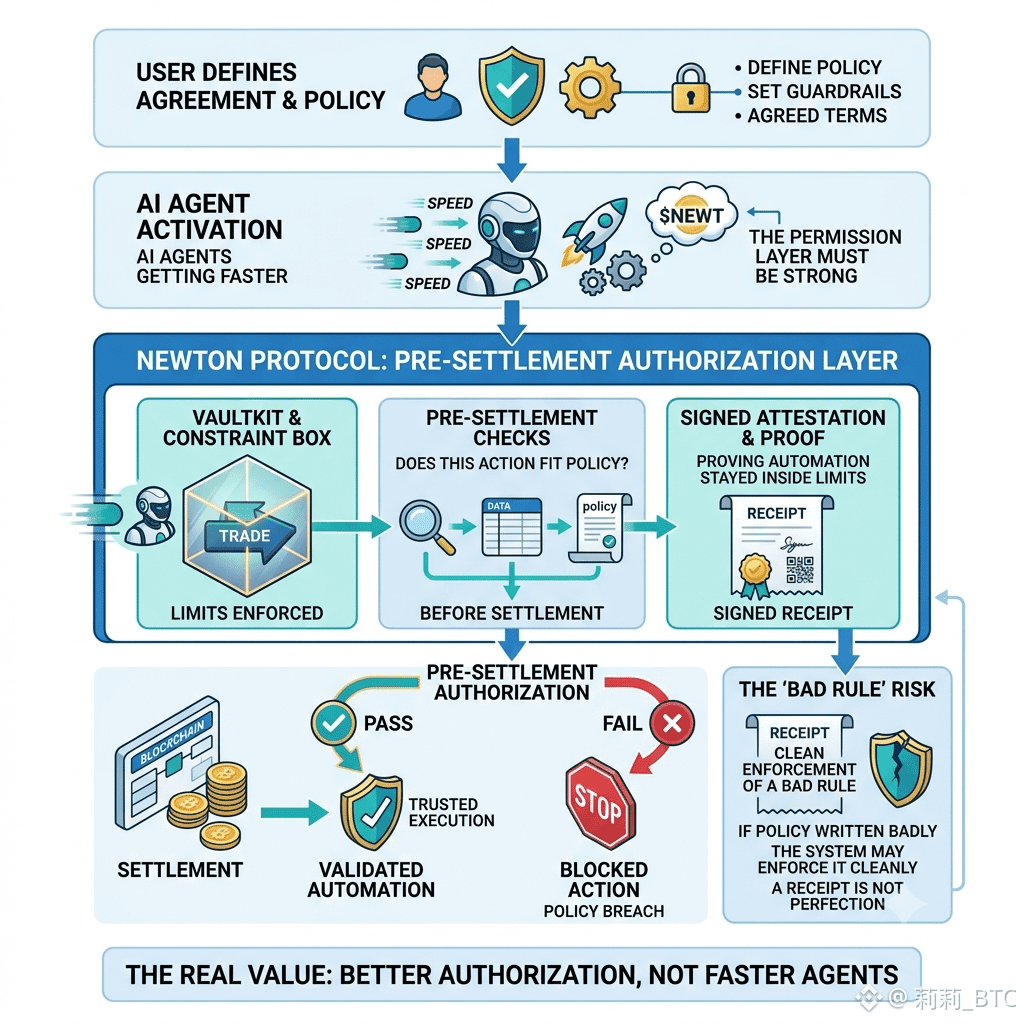
6
3
114
·
--
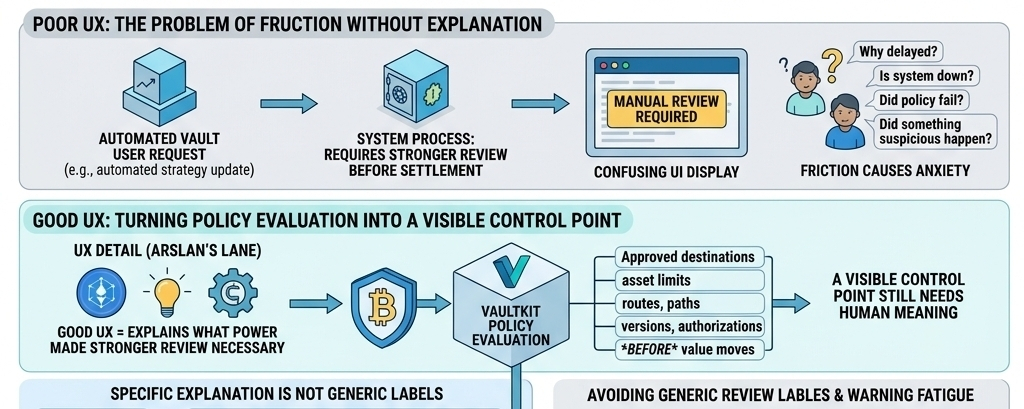
Article
Extra Review Should Explain the Power It Is Slowing DownThe most frustrating delay in an automated vault is the one that never tells the user what it is protecting. That is the UX problem I would watch around Newton Mainnet Beta.
Automation usually sells speed
The agent can act quickly.
The vault can respond before humans coordinate.
The strategy can move when market conditions change.
The policy can check the action before settlement.
Speed matters. But serious financial automation cannot treat every delay as a product failure. Sometimes the right interface is not the one that approves faster. It is the one that slows down because the action deserves stronger review.
The problem is that friction without explanation feels broken.
Imagine a vault user requests an automated strategy update.
The action touches a new route.
It increases the amount an agent can move.
It changes a destination category.
It comes close to an exposure boundary.
The system does not reject it outright. Instead, it requires stronger review before settlement.
From a risk perspective, that may be correct.
From a user perspective, it may feel confusing.
Why is this action delayed?
Is the system down?
Did the policy fail?
Is the agent unsafe?
Is the user being blocked for no reason?
Did something suspicious happen?
A vague message like “manual review required” may be technically accurate, but it does not create understanding. It creates anxiety.
This is where Arslan’s lane becomes important.
Good UX should not only show that stronger review is happening. It should explain what kind of power made stronger review necessary.
Through VaultKit, applications can place policy checks before setlement. Actions can be evaluated against approved destinations, asset limits, routes, execution paths, policy versions, and authorization conditions before value moves. @NewtonProtocol can make the authorization layer more explicit by turning policy evaluation into a visible control point.
But a visible control point still needs human meaning.
If an action is slowed down, the interface should help the user understand whether the reason is size, route sensitivity, authority expansion, policy uncertainty, repeated near-limit behavior, or a change in execution path.
Those are different experiences.
“Delayed because this transfer is near your approved limit” is not the same as “Delayed because this update expands future agent authority.”
“Requires review because the destination category changed” is not the same as “Requires review because data confidence is degraded.”
“Needs approval because this is a one-time large movement” is not the same as “Needs approval because the agent will gain recurring permission.”
If all of those become one generic review label, the product hides the very risk it is trying to manage.
That is not clarity.
That is friction without consent education.
The best review UX should answer three questions quickly.
What changed?
Why does it need stronger review?
What happens if the user approves it?
The user does not need to read policy logic like a developer. But the user should understand the practical authority being protected.
If the action changes future permissions, say that.
If it touches a sensitive route, say that.
If it moves near the limit, say that.
If it shifts from one-time execution to recurring authority, say that.
If it is only delayed because another reviewer must confirm the same boundary, say that.
This matters because users learn from frction.
If every review message is generic, users learn to ignore it.
If every delay looks like the same warning, users stop distinguishing normal caution from serious authority change.
If the interface repeatedly says “review required” without meaning, the product trains users to click through or complain, not understand.
That is how protective friction becomes warning fatigue.
A serious Newton-powered application should avoid that.
It should make friction risk-calibrated and explanation-calibrated.
A small action near a soft threshold may need a light warning.
A route that introduces new counterparty exposure may need a stronger explanation.
A policy update that expands agent authority may need a clear before-and-after consequence.
A recurring mandate change should not be explained like a one-time transaction delay.
The interface should match the message to the authority at stake.
There is a trade-off.
Too little explanation makes review feel arbitrary. Users lose confidence because they cannot tell whether the system is protecting them or malfunctioning.
Over-explaining clutters the screen. If every approval becomes a long technical report, users may stop reading. They may approve faster just to escape the complexity.
The better standard is layered review clarity.
The first layer should be plain and direct:
“This needs review because it expands future agent authority.”
The second layer can show the specific affected route, limit, destination, or policy condition.
The third layer can preserve technical detail for risk teams, auditors, or advanced users.
That structure respects both speed and understanding.
This is the UX standard I would apply to Newton Mainnet Beta.
Can a VaultKit-powered application explain why an action needs strnger review before settlement?
Can it separate ordinary delay from authority-changing delay?
Can it tell the user whether review protects a route, a limit, a destination, or a recurring mandate?
Can it avoid making every risk state look like the same generic warning?
Can signed authorization history later connect the review reason to the policy context that required it?
These questions matter because friction is part of consent.
A delay can be annoying.
But an unexplained delay is worse: it teaches the user nothing.
In automated finance, stronger review should not feel like a black box.
It should feel like the interface pausing long enough to say:
“This is the power we are slowing down.”
$NEWT @NewtonProtocol #Newt $LAB $VANRY #Velvet #xau #VANRY #Labs
{spot}(NEWTUSDT)
Extra Review Should Explain the Power It Is Slowing Down
The most frustrating delay in an automated vault is the one that never tells the user what it is protecting. That is the UX problem I would watch around Newton Mainnet Beta.
Automation usually sells speed
The agent can act quickly.
The vault can respond before humans coordinate.
The strategy can move when market conditions change.
The policy can check the action before settlement.
Speed matters. But serious financial automation cannot treat every delay as a product failure. Sometimes the right interface is not the one that approves faster. It is the one that slows down because the action deserves stronger review.
The problem is that friction without explanation feels broken.
Imagine a vault user requests an automated strategy update.
The action touches a new route.
It increases the amount an agent can move.
It changes a destination category.
It comes close to an exposure boundary.
The system does not reject it outright. Instead, it requires stronger review before settlement.
From a risk perspective, that may be correct.
From a user perspective, it may feel confusing.
Why is this action delayed?
Is the system down?
Did the policy fail?
Is the agent unsafe?
Is the user being blocked for no reason?
Did something suspicious happen?
A vague message like “manual review required” may be technically accurate, but it does not create understanding. It creates anxiety.
This is where Arslan’s lane becomes important.
Good UX should not only show that stronger review is happening. It should explain what kind of power made stronger review necessary.
Through VaultKit, applications can place policy checks before setlement. Actions can be evaluated against approved destinations, asset limits, routes, execution paths, policy versions, and authorization conditions before value moves. @NewtonProtocol can make the authorization layer more explicit by turning policy evaluation into a visible control point.
But a visible control point still needs human meaning.
If an action is slowed down, the interface should help the user understand whether the reason is size, route sensitivity, authority expansion, policy uncertainty, repeated near-limit behavior, or a change in execution path.
Those are different experiences.
“Delayed because this transfer is near your approved limit” is not the same as “Delayed because this update expands future agent authority.”
“Requires review because the destination category changed” is not the same as “Requires review because data confidence is degraded.”
“Needs approval because this is a one-time large movement” is not the same as “Needs approval because the agent will gain recurring permission.”
If all of those become one generic review label, the product hides the very risk it is trying to manage.
That is not clarity.
That is friction without consent education.
The best review UX should answer three questions quickly.
What changed?
Why does it need stronger review?
What happens if the user approves it?
The user does not need to read policy logic like a developer. But the user should understand the practical authority being protected.
If the action changes future permissions, say that.
If it touches a sensitive route, say that.
If it moves near the limit, say that.
If it shifts from one-time execution to recurring authority, say that.
If it is only delayed because another reviewer must confirm the same boundary, say that.
This matters because users learn from frction.
If every review message is generic, users learn to ignore it.
If every delay looks like the same warning, users stop distinguishing normal caution from serious authority change.
If the interface repeatedly says “review required” without meaning, the product trains users to click through or complain, not understand.
That is how protective friction becomes warning fatigue.
A serious Newton-powered application should avoid that.
It should make friction risk-calibrated and explanation-calibrated.
A small action near a soft threshold may need a light warning.
A route that introduces new counterparty exposure may need a stronger explanation.
A policy update that expands agent authority may need a clear before-and-after consequence.
A recurring mandate change should not be explained like a one-time transaction delay.
The interface should match the message to the authority at stake.
There is a trade-off.
Too little explanation makes review feel arbitrary. Users lose confidence because they cannot tell whether the system is protecting them or malfunctioning.
Over-explaining clutters the screen. If every approval becomes a long technical report, users may stop reading. They may approve faster just to escape the complexity.
The better standard is layered review clarity.
The first layer should be plain and direct:
“This needs review because it expands future agent authority.”
The second layer can show the specific affected route, limit, destination, or policy condition.
The third layer can preserve technical detail for risk teams, auditors, or advanced users.
That structure respects both speed and understanding.
This is the UX standard I would apply to Newton Mainnet Beta.
Can a VaultKit-powered application explain why an action needs strnger review before settlement?
Can it separate ordinary delay from authority-changing delay?
Can it tell the user whether review protects a route, a limit, a destination, or a recurring mandate?
Can it avoid making every risk state look like the same generic warning?
Can signed authorization history later connect the review reason to the policy context that required it?
These questions matter because friction is part of consent.
A delay can be annoying.
But an unexplained delay is worse: it teaches the user nothing.
In automated finance, stronger review should not feel like a black box.
It should feel like the interface pausing long enough to say:
“This is the power we are slowing down.”
$NEWT @NewtonProtocol #Newt $LAB $VANRY #Velvet #xau #VANRY #Labs
Automation usually sells speed
The agent can act quickly.
The vault can respond before humans coordinate.
The strategy can move when market conditions change.
The policy can check the action before settlement.
Speed matters. But serious financial automation cannot treat every delay as a product failure. Sometimes the right interface is not the one that approves faster. It is the one that slows down because the action deserves stronger review.
The problem is that friction without explanation feels broken.
Imagine a vault user requests an automated strategy update.
The action touches a new route.
It increases the amount an agent can move.
It changes a destination category.
It comes close to an exposure boundary.
The system does not reject it outright. Instead, it requires stronger review before settlement.
From a risk perspective, that may be correct.
From a user perspective, it may feel confusing.
Why is this action delayed?
Is the system down?
Did the policy fail?
Is the agent unsafe?
Is the user being blocked for no reason?
Did something suspicious happen?
A vague message like “manual review required” may be technically accurate, but it does not create understanding. It creates anxiety.
This is where Arslan’s lane becomes important.
Good UX should not only show that stronger review is happening. It should explain what kind of power made stronger review necessary.
Through VaultKit, applications can place policy checks before setlement. Actions can be evaluated against approved destinations, asset limits, routes, execution paths, policy versions, and authorization conditions before value moves. @NewtonProtocol can make the authorization layer more explicit by turning policy evaluation into a visible control point.
But a visible control point still needs human meaning.
If an action is slowed down, the interface should help the user understand whether the reason is size, route sensitivity, authority expansion, policy uncertainty, repeated near-limit behavior, or a change in execution path.
Those are different experiences.
“Delayed because this transfer is near your approved limit” is not the same as “Delayed because this update expands future agent authority.”
“Requires review because the destination category changed” is not the same as “Requires review because data confidence is degraded.”
“Needs approval because this is a one-time large movement” is not the same as “Needs approval because the agent will gain recurring permission.”
If all of those become one generic review label, the product hides the very risk it is trying to manage.
That is not clarity.
That is friction without consent education.
The best review UX should answer three questions quickly.
What changed?
Why does it need stronger review?
What happens if the user approves it?
The user does not need to read policy logic like a developer. But the user should understand the practical authority being protected.
If the action changes future permissions, say that.
If it touches a sensitive route, say that.
If it moves near the limit, say that.
If it shifts from one-time execution to recurring authority, say that.
If it is only delayed because another reviewer must confirm the same boundary, say that.
This matters because users learn from frction.
If every review message is generic, users learn to ignore it.
If every delay looks like the same warning, users stop distinguishing normal caution from serious authority change.
If the interface repeatedly says “review required” without meaning, the product trains users to click through or complain, not understand.
That is how protective friction becomes warning fatigue.
A serious Newton-powered application should avoid that.
It should make friction risk-calibrated and explanation-calibrated.
A small action near a soft threshold may need a light warning.
A route that introduces new counterparty exposure may need a stronger explanation.
A policy update that expands agent authority may need a clear before-and-after consequence.
A recurring mandate change should not be explained like a one-time transaction delay.
The interface should match the message to the authority at stake.
There is a trade-off.
Too little explanation makes review feel arbitrary. Users lose confidence because they cannot tell whether the system is protecting them or malfunctioning.
Over-explaining clutters the screen. If every approval becomes a long technical report, users may stop reading. They may approve faster just to escape the complexity.
The better standard is layered review clarity.
The first layer should be plain and direct:
“This needs review because it expands future agent authority.”
The second layer can show the specific affected route, limit, destination, or policy condition.
The third layer can preserve technical detail for risk teams, auditors, or advanced users.
That structure respects both speed and understanding.
This is the UX standard I would apply to Newton Mainnet Beta.
Can a VaultKit-powered application explain why an action needs strnger review before settlement?
Can it separate ordinary delay from authority-changing delay?
Can it tell the user whether review protects a route, a limit, a destination, or a recurring mandate?
Can it avoid making every risk state look like the same generic warning?
Can signed authorization history later connect the review reason to the policy context that required it?
These questions matter because friction is part of consent.
A delay can be annoying.
But an unexplained delay is worse: it teaches the user nothing.
In automated finance, stronger review should not feel like a black box.
It should feel like the interface pausing long enough to say:
“This is the power we are slowing down.”
$NEWT @NewtonProtocol #Newt $LAB $VANRY #Velvet #xau #VANRY #Labs
4
238
·
--
Bullish
#newt $NEWT A temporary permission is risky when the interface makes it feel permanent.
Imagine a vault user allows an agent to use a broader route only during market stress.
The aproval may be valid.
The policy check may pass before settlement.
But if the screen does not clearly show when that authority expires, the user may think they approved one emergency window while the agent continues acting under a wider mandate.
That is the UX detail I would watch around Newton Mainnet Beta.
Through VaultKit, @NewtonProtocol can place policy evaluation before settlement, but serious integrations should make permission duration visible in plain language.
Not just “Approved.”
“Approved until this condition ends.”
Good UX should not only show what power was granted.
It should show how long that power can survive.
$NEWT @NewtonProtocol #Newt $LAB $VANRY #Velvet #xau #VANRY #Labs
{spot}(NEWTUSDT)
#newt $NEWT A temporary permission is risky when the interface makes it feel permanent.
Imagine a vault user allows an agent to use a broader route only during market stress.
The aproval may be valid.
The policy check may pass before settlement.
But if the screen does not clearly show when that authority expires, the user may think they approved one emergency window while the agent continues acting under a wider mandate.
That is the UX detail I would watch around Newton Mainnet Beta.
Through VaultKit, @NewtonProtocol can place policy evaluation before settlement, but serious integrations should make permission duration visible in plain language.
Not just “Approved.”
“Approved until this condition ends.”
Good UX should not only show what power was granted.
It should show how long that power can survive.
$NEWT @NewtonProtocol #Newt $LAB $VANRY #Velvet #xau #VANRY #Labs
Imagine a vault user allows an agent to use a broader route only during market stress.
The aproval may be valid.
The policy check may pass before settlement.
But if the screen does not clearly show when that authority expires, the user may think they approved one emergency window while the agent continues acting under a wider mandate.
That is the UX detail I would watch around Newton Mainnet Beta.
Through VaultKit, @NewtonProtocol can place policy evaluation before settlement, but serious integrations should make permission duration visible in plain language.
Not just “Approved.”
“Approved until this condition ends.”
Good UX should not only show what power was granted.
It should show how long that power can survive.
$NEWT @NewtonProtocol #Newt $LAB $VANRY #Velvet #xau #VANRY #Labs
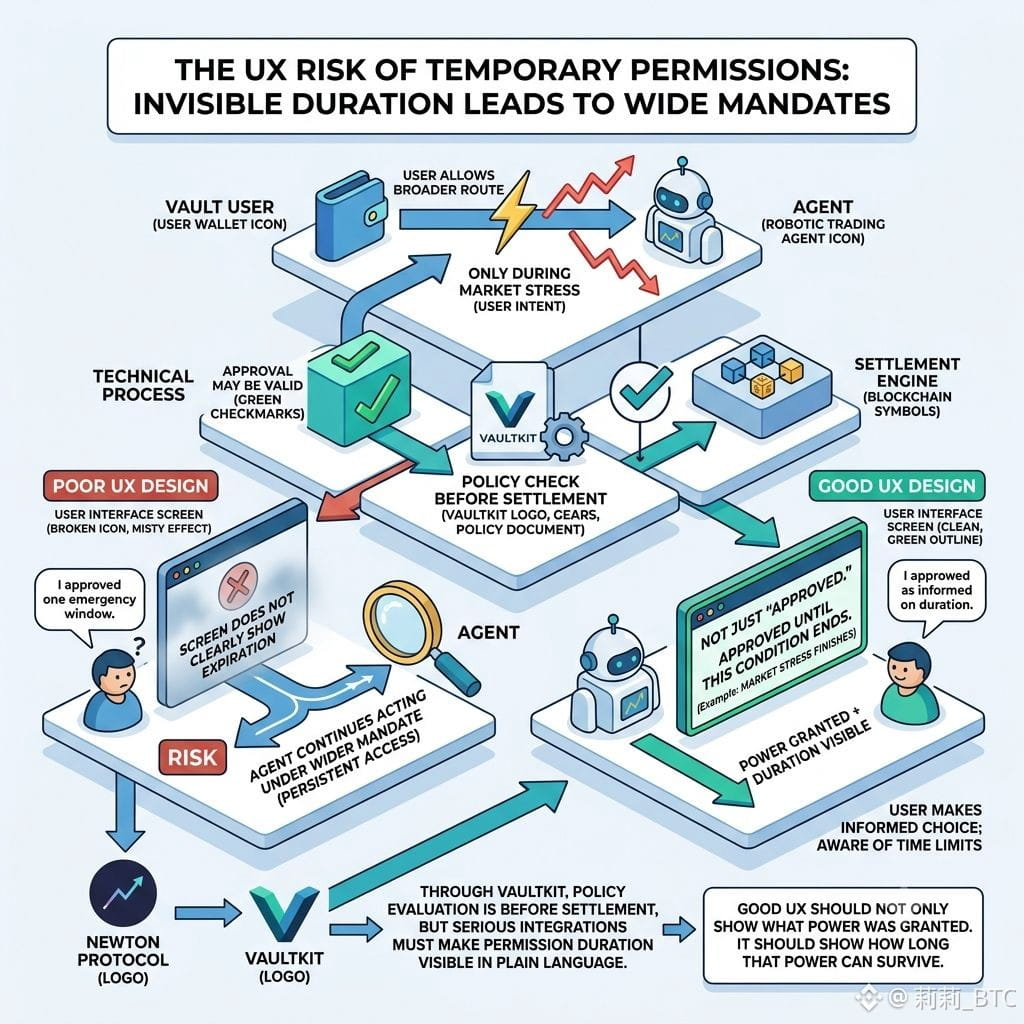
2
1
305
·
--
Bearish
📉 Selling pressure refuses to slow down across the market!
💥 Liquidity hunts continue to create rapid trading setups.
$KAT
{future}(KATUSDT)
🔴 LIQUIDITY ZONE HIT 🔴
Long liquidation spotted 🧨
$1.4026K cleared at $0.00575
Downside liquidity swept — react NOW or watch the market shift 👀
🎯 TP Targets:
TP1: ~$0.00569
TP2: ~$0.00563
TP3: ~$0.00557
#kat
📉 Selling pressure refuses to slow down across the market!
💥 Liquidity hunts continue to create rapid trading setups.
$KAT
🔴 LIQUIDITY ZONE HIT 🔴
Long liquidation spotted 🧨
$1.4026K cleared at $0.00575
Downside liquidity swept — react NOW or watch the market shift 👀
🎯 TP Targets:
TP1: ~$0.00569
TP2: ~$0.00563
TP3: ~$0.00557
#kat
💥 Liquidity hunts continue to create rapid trading setups.
$KAT
🔴 LIQUIDITY ZONE HIT 🔴
Long liquidation spotted 🧨
$1.4026K cleared at $0.00575
Downside liquidity swept — react NOW or watch the market shift 👀
🎯 TP Targets:
TP1: ~$0.00569
TP2: ~$0.00563
TP3: ~$0.00557
#kat
9
·
--
Bullish
⚡ Buyers are forcing another round of short liquidations!
👀 Momentum remains strong as upside liquidity gets taken.
$CVX
{future}(CVXUSDT)
🟢 LIQUIDITY ZONE HIT 🟢
Short liquidation spotted 🧨
$5.0706K cleared at $1.25924
Upside liquidity swept — react NOW or watch the market shift 👀
🎯 TP Targets:
TP1: ~$1.272
TP2: ~$1.285
TP3: ~$1.298
#CVX
⚡ Buyers are forcing another round of short liquidations!
👀 Momentum remains strong as upside liquidity gets taken.
$CVX
🟢 LIQUIDITY ZONE HIT 🟢
Short liquidation spotted 🧨
$5.0706K cleared at $1.25924
Upside liquidity swept — react NOW or watch the market shift 👀
🎯 TP Targets:
TP1: ~$1.272
TP2: ~$1.285
TP3: ~$1.298
#CVX
👀 Momentum remains strong as upside liquidity gets taken.
$CVX
🟢 LIQUIDITY ZONE HIT 🟢
Short liquidation spotted 🧨
$5.0706K cleared at $1.25924
Upside liquidity swept — react NOW or watch the market shift 👀
🎯 TP Targets:
TP1: ~$1.272
TP2: ~$1.285
TP3: ~$1.298
#CVX
59
·
--
Bearish
💥 Bears continue to dominate while weak hands get flushed out!
📉 Stay disciplined as key liquidity zones are being cleared.
$KAT
{future}(KATUSDT)
🔴 LIQUIDITY ZONE HIT 🔴
Long liquidation spotted 🧨
$2.0751K cleared at $0.00575
Downside liquidity swept — react NOW or watch the market shift 👀
🎯 TP Targets:
TP1: ~$0.00569
TP2: ~$0.00563
TP3: ~$0.00557
#kat
💥 Bears continue to dominate while weak hands get flushed out!
📉 Stay disciplined as key liquidity zones are being cleared.
$KAT
🔴 LIQUIDITY ZONE HIT 🔴
Long liquidation spotted 🧨
$2.0751K cleared at $0.00575
Downside liquidity swept — react NOW or watch the market shift 👀
🎯 TP Targets:
TP1: ~$0.00569
TP2: ~$0.00563
TP3: ~$0.00557
#kat
📉 Stay disciplined as key liquidity zones are being cleared.
$KAT
🔴 LIQUIDITY ZONE HIT 🔴
Long liquidation spotted 🧨
$2.0751K cleared at $0.00575
Downside liquidity swept — react NOW or watch the market shift 👀
🎯 TP Targets:
TP1: ~$0.00569
TP2: ~$0.00563
TP3: ~$0.00557
#kat
19
·
--
Bearish
💥 Bears continue to dominate while weak hands get flushed out!
📉 Stay disciplined as key liquidity zones are being cleared.
$KAT
{future}(KATUSDT)
🔴 LIQUIDITY ZONE HIT 🔴
Long liquidation spotted 🧨
$2.0751K cleared at $0.00575
Downside liquidity swept — react NOW or watch the market shift 👀
🎯 TP Targets:
TP1: ~$0.00569
TP2: ~$0.00563
TP3: ~$0.00557
#kat
💥 Bears continue to dominate while weak hands get flushed out!
📉 Stay disciplined as key liquidity zones are being cleared.
$KAT
🔴 LIQUIDITY ZONE HIT 🔴
Long liquidation spotted 🧨
$2.0751K cleared at $0.00575
Downside liquidity swept — react NOW or watch the market shift 👀
🎯 TP Targets:
TP1: ~$0.00569
TP2: ~$0.00563
TP3: ~$0.00557
#kat
📉 Stay disciplined as key liquidity zones are being cleared.
$KAT
🔴 LIQUIDITY ZONE HIT 🔴
Long liquidation spotted 🧨
$2.0751K cleared at $0.00575
Downside liquidity swept — react NOW or watch the market shift 👀
🎯 TP Targets:
TP1: ~$0.00569
TP2: ~$0.00563
TP3: ~$0.00557
#kat
23
·
--
Bearish
🌪️ Bears remain firmly in control as support levels are tested!
💥 Fast-moving markets reward disciplined traders.
$VELVET
{future}(VELVETUSDT)
🔴 LIQUIDITY ZONE HIT 🔴
Long liquidation spotted 🧨
$4.8356K cleared at $0.56418
Downside liquidity swept — react NOW or watch the market shift 👀
🎯 TP Targets:
TP1: ~$0.558
TP2: ~$0.552
TP3: ~$0.546
#Velvet
🌪️ Bears remain firmly in control as support levels are tested!
💥 Fast-moving markets reward disciplined traders.
$VELVET
🔴 LIQUIDITY ZONE HIT 🔴
Long liquidation spotted 🧨
$4.8356K cleared at $0.56418
Downside liquidity swept — react NOW or watch the market shift 👀
🎯 TP Targets:
TP1: ~$0.558
TP2: ~$0.552
TP3: ~$0.546
#Velvet
💥 Fast-moving markets reward disciplined traders.
$VELVET
🔴 LIQUIDITY ZONE HIT 🔴
Long liquidation spotted 🧨
$4.8356K cleared at $0.56418
Downside liquidity swept — react NOW or watch the market shift 👀
🎯 TP Targets:
TP1: ~$0.558
TP2: ~$0.552
TP3: ~$0.546
#Velvet
23
·
--
Bearish
🌪️ Bears remain firmly in control as support levels are tested!
💥 Fast-moving markets reward disciplined traders.
$VELVET
{future}(VELVETUSDT)
🔴 LIQUIDITY ZONE HIT 🔴
Long liquidation spotted 🧨
$4.8356K cleared at $0.56418
Downside liquidity swept — react NOW or watch the market shift 👀
🎯 TP Targets:
TP1: ~$0.558
TP2: ~$0.552
TP3: ~$0.546
#Velvet
🌪️ Bears remain firmly in control as support levels are tested!
💥 Fast-moving markets reward disciplined traders.
$VELVET
🔴 LIQUIDITY ZONE HIT 🔴
Long liquidation spotted 🧨
$4.8356K cleared at $0.56418
Downside liquidity swept — react NOW or watch the market shift 👀
🎯 TP Targets:
TP1: ~$0.558
TP2: ~$0.552
TP3: ~$0.546
#Velvet
💥 Fast-moving markets reward disciplined traders.
$VELVET
🔴 LIQUIDITY ZONE HIT 🔴
Long liquidation spotted 🧨
$4.8356K cleared at $0.56418
Downside liquidity swept — react NOW or watch the market shift 👀
🎯 TP Targets:
TP1: ~$0.558
TP2: ~$0.552
TP3: ~$0.546
#Velvet
27
·
--
Bearish
⚠️ Volatility remains elevated as liquidations continue to pile up!
👀 Keep watching for the next decisive market move.
$VELVET
{future}(VELVETUSDT)
🔴 LIQUIDITY ZONE HIT 🔴
Long liquidation spotted 🧨
$9.0326K cleared at $0.56905
Downside liquidity swept — react NOW or watch the market shift 👀
🎯 TP Targets:
TP1: ~$0.563
TP2: ~$0.557
TP3: ~$0.551
#Velvet
⚠️ Volatility remains elevated as liquidations continue to pile up!
👀 Keep watching for the next decisive market move.
$VELVET
🔴 LIQUIDITY ZONE HIT 🔴
Long liquidation spotted 🧨
$9.0326K cleared at $0.56905
Downside liquidity swept — react NOW or watch the market shift 👀
🎯 TP Targets:
TP1: ~$0.563
TP2: ~$0.557
TP3: ~$0.551
#Velvet
👀 Keep watching for the next decisive market move.
$VELVET
🔴 LIQUIDITY ZONE HIT 🔴
Long liquidation spotted 🧨
$9.0326K cleared at $0.56905
Downside liquidity swept — react NOW or watch the market shift 👀
🎯 TP Targets:
TP1: ~$0.563
TP2: ~$0.557
TP3: ~$0.551
#Velvet
37
Log in to explore more content
Join global crypto users on Binance Square
⚡️ Get latest and useful information about crypto.
💬 Trusted by the world’s largest crypto exchange.
👍 Discover real insights from verified creators.
Email / Phone number
Trending Topics
BitcoinReboundsTo$79K
19,608 views
166 Discussing
🚨 $BTC is pushing higher.
Bitcoin is trading around $78,804, up roughly 1.9%, after reclaiming the $78K area. The next level to watch is the intraday high near $78,905.
A clean break above that level could open the way toward $79K–$80K. If BTC gets rejected, support sits around $78,300, then $77,975.
Bulls have momentum, but BTC needs to hold above $78K.
#Bitcoin #BTC #CryptoTrading #CryptoMarket #CryptoAnalysis
PulseON
·18 Likes
·16.9k views
BitcoinSpotETFsNetInflow$160M
40 views
21 Discussing
SouthKoreaCryptoTaxDelayPetitionTops50000
7,338 views
210 Discussing