

web3亭姐
369 Posts

web3亭姐
Report
Block User
亭姐:资深职业经理人,币圈小菜鸟
25 Following
12 Followers
127 Liked
Posts
All
Quotes
·
--
$ZEC This big demon coin can only be opened with 10U. It can’t be more; any more just means feeding the dog-stronghold traders.
$ZEC This big demon coin can only be opened with 10U. It can’t be more; any more just means feeding the dog-stronghold traders.
334
·
--
$FLORK What kind of demon coin is this? I’m shocked—nearly a thousand times in four days 🙊
$FLORK What kind of demon coin is this? I’m shocked—nearly a thousand times in four days 🙊
1
336
·
--
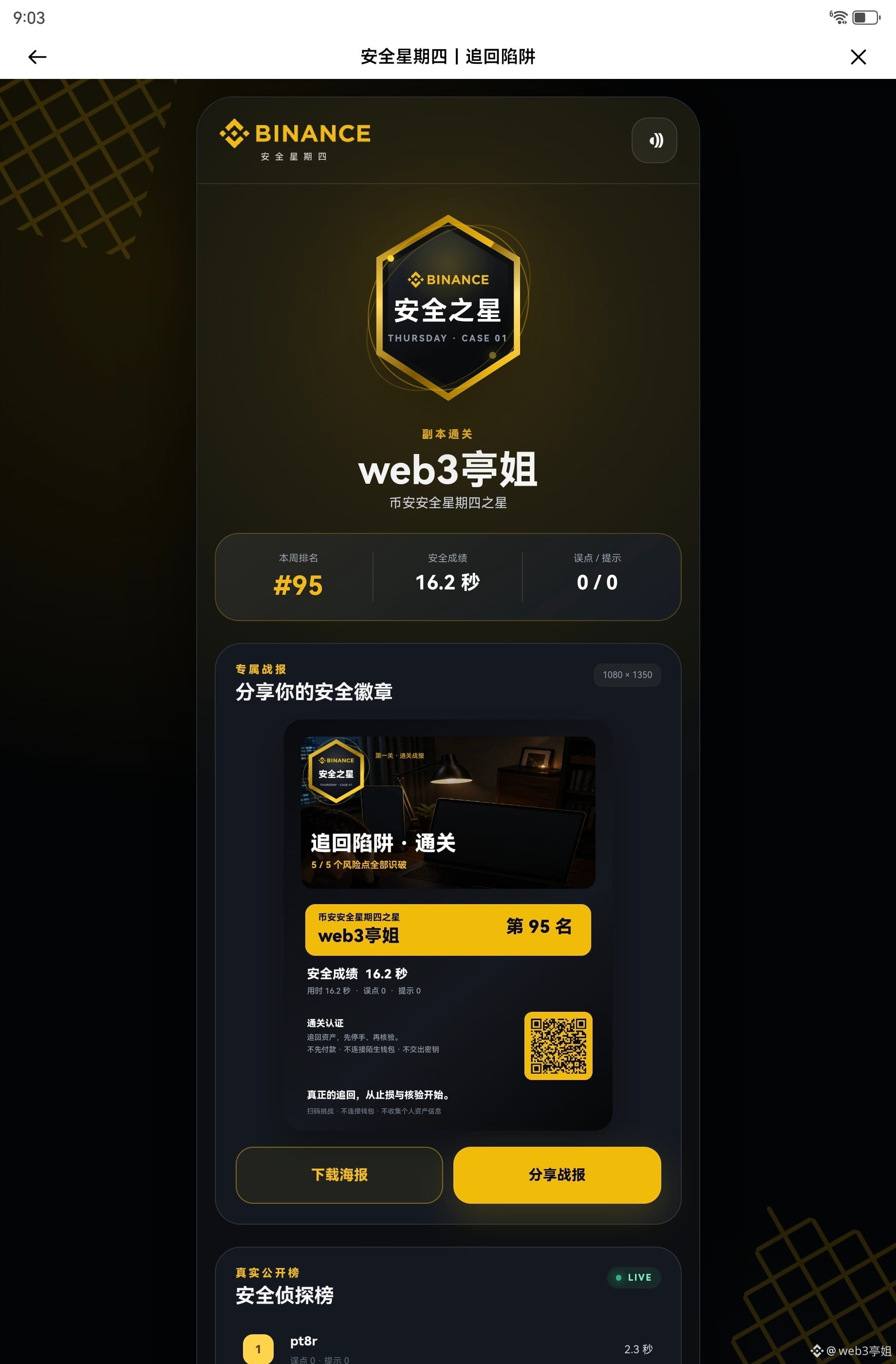
#币安安全星期四
A very fun and also very educational game. Wallet security is very important—these traps are things we might encounter in everyday life. This 17-second time is my best result out of three attempts so far. Friends, come and take on the challenge too—go for it!
#币安安全星期四
A very fun and also very educational game. Wallet security is very important—these traps are things we might encounter in everyday life. This 17-second time is my best result out of three attempts so far. Friends, come and take on the challenge too—go for it!
A very fun and also very educational game. Wallet security is very important—these traps are things we might encounter in everyday life. This 17-second time is my best result out of three attempts so far. Friends, come and take on the challenge too—go for it!


币安Binance华语
·
--
“Don’t laugh—you won’t find the 4th one either 😨”
🪤 They say this is the hardest #币安安全星期四 challenge in history: in the shortest time, can you find all the traps?
👉 点击参与实景陷阱追踪挑战, compete for a spot on the leaderboard 🏆
The top 10 on the leaderboard each get a 100U detective reward, and the top 3 also receive a themed gift box!
Share it and post your clear-through screenshot in the comments, and then 15 people will be selected to receive 44U 🧧
🪤 They say this is the hardest #币安安全星期四 challenge in history: in the shortest time, can you find all the traps?
👉 点击参与实景陷阱追踪挑战, compete for a spot on the leaderboard 🏆
The top 10 on the leaderboard each get a 100U detective reward, and the top 3 also receive a themed gift box!
Share it and post your clear-through screenshot in the comments, and then 15 people will be selected to receive 44U 🧧
60
·
--
Verified
Oh come on, the long-silent $FIL “rose from the dead” last night—surged up 15% against the trend! What signal is this? Is it about to rise for a round? The fil halving is coming (next month)—will it be a dead-cat bounce, or will we see a desperate rebound? Let’s talk it through.
First, the key take: yesterday’s rally was driven more by technical factors than by fundamental-driven value revaluation—basically a rebound after a heavy drop. As BTC and ETH pulled back amid geopolitical shifts, FIL led the pack with around a 15% gain. In essence, price broke through a key resistance level first; then leverage and short-covering amplified the momentum. The AI storage narrative just “added fuel to the fire.”
What’s really worth paying attention to is the deeper transformation the project is undergoing. The NV28 “Fire Horse Upgrade” is already live—it reworks the Gas mechanism and allows smart contracts to verify storage status in real time. Onchain Cloud has officially moved into commercial use on-chain, connecting the AWS-S3 interface and integrating USDFC stablecoin settlement. Most importantly, the Solstice proposal (FIP-0118)—the biggest economic model reform since Filecoin launched. It aims to shift incentives entirely from “capacity supply” to “paid service demand.” In the initial phase, 5% of block rewards will be directed to service providers that bring paid customers into the network.
Going forward, watch three things: first, the progress of the Solstice proposal and the community’s feedback; second, whether storage utilization can keep climbing sustainably from the current 36%; and third, the market game around the block reward halving in October. Filecoin is moving from a “storage supply network” toward a “real services economy”—the strategic direction is right. But the speed at which commercialization is executed is the core variable determining long-term value.
Oh come on, the long-silent $FIL “rose from the dead” last night—surged up 15% against the trend! What signal is this? Is it about to rise for a round? The fil halving is coming (next month)—will it be a dead-cat bounce, or will we see a desperate rebound? Let’s talk it through.
First, the key take: yesterday’s rally was driven more by technical factors than by fundamental-driven value revaluation—basically a rebound after a heavy drop. As BTC and ETH pulled back amid geopolitical shifts, FIL led the pack with around a 15% gain. In essence, price broke through a key resistance level first; then leverage and short-covering amplified the momentum. The AI storage narrative just “added fuel to the fire.”
What’s really worth paying attention to is the deeper transformation the project is undergoing. The NV28 “Fire Horse Upgrade” is already live—it reworks the Gas mechanism and allows smart contracts to verify storage status in real time. Onchain Cloud has officially moved into commercial use on-chain, connecting the AWS-S3 interface and integrating USDFC stablecoin settlement. Most importantly, the Solstice proposal (FIP-0118)—the biggest economic model reform since Filecoin launched. It aims to shift incentives entirely from “capacity supply” to “paid service demand.” In the initial phase, 5% of block rewards will be directed to service providers that bring paid customers into the network.
Going forward, watch three things: first, the progress of the Solstice proposal and the community’s feedback; second, whether storage utilization can keep climbing sustainably from the current 36%; and third, the market game around the block reward halving in October. Filecoin is moving from a “storage supply network” toward a “real services economy”—the strategic direction is right. But the speed at which commercialization is executed is the core variable determining long-term value.
First, the key take: yesterday’s rally was driven more by technical factors than by fundamental-driven value revaluation—basically a rebound after a heavy drop. As BTC and ETH pulled back amid geopolitical shifts, FIL led the pack with around a 15% gain. In essence, price broke through a key resistance level first; then leverage and short-covering amplified the momentum. The AI storage narrative just “added fuel to the fire.”
What’s really worth paying attention to is the deeper transformation the project is undergoing. The NV28 “Fire Horse Upgrade” is already live—it reworks the Gas mechanism and allows smart contracts to verify storage status in real time. Onchain Cloud has officially moved into commercial use on-chain, connecting the AWS-S3 interface and integrating USDFC stablecoin settlement. Most importantly, the Solstice proposal (FIP-0118)—the biggest economic model reform since Filecoin launched. It aims to shift incentives entirely from “capacity supply” to “paid service demand.” In the initial phase, 5% of block rewards will be directed to service providers that bring paid customers into the network.
Going forward, watch three things: first, the progress of the Solstice proposal and the community’s feedback; second, whether storage utilization can keep climbing sustainably from the current 36%; and third, the market game around the block reward halving in October. Filecoin is moving from a “storage supply network” toward a “real services economy”—the strategic direction is right. But the speed at which commercialization is executed is the core variable determining long-term value.
1
1.1k
·
--
$BTC has pulled back about $3,000 from the high. Many friends are calling for bargain buying. I feel that the direction is still unclear—there’s a possibility that BTC could drop again to the 60s. And most altcoins have already fallen back to their starting point.
Let’s recap:
As of September 1, 2026, Bitcoin is consolidating around $78,000. The roughly 24% gain in August was mainly driven by spot buying. But in the short term, the struggle between bulls and bears is intense, and the next direction remains unclear.
The bullish factors are that institutional demand is still strong. Last week, net inflows into U.S. spot Bitcoin ETFs were nearly $1 billion. Technically, if it can effectively hold above $78,340, it may further test the resistance zone at $80,000–$81,000.
The risks are also significant: the probability of a September rate hike by the Fed has risen to 57%, and hawkish expectations limit upside room. In the derivatives market, the biggest pain point for options expiring on September 25 is concentrated in the $70,000–$73,000 range—below the current spot price—and put options have been leading in trading volume, suggesting downside risk.
In the short term, the key is whether the Fed’s September meeting (September 15) and the $80,000 level can be effectively broken through.
$BTC has pulled back about $3,000 from the high. Many friends are calling for bargain buying. I feel that the direction is still unclear—there’s a possibility that BTC could drop again to the 60s. And most altcoins have already fallen back to their starting point.
Let’s recap:
As of September 1, 2026, Bitcoin is consolidating around $78,000. The roughly 24% gain in August was mainly driven by spot buying. But in the short term, the struggle between bulls and bears is intense, and the next direction remains unclear.
The bullish factors are that institutional demand is still strong. Last week, net inflows into U.S. spot Bitcoin ETFs were nearly $1 billion. Technically, if it can effectively hold above $78,340, it may further test the resistance zone at $80,000–$81,000.
The risks are also significant: the probability of a September rate hike by the Fed has risen to 57%, and hawkish expectations limit upside room. In the derivatives market, the biggest pain point for options expiring on September 25 is concentrated in the $70,000–$73,000 range—below the current spot price—and put options have been leading in trading volume, suggesting downside risk.
In the short term, the key is whether the Fed’s September meeting (September 15) and the $80,000 level can be effectively broken through.
Let’s recap:
As of September 1, 2026, Bitcoin is consolidating around $78,000. The roughly 24% gain in August was mainly driven by spot buying. But in the short term, the struggle between bulls and bears is intense, and the next direction remains unclear.
The bullish factors are that institutional demand is still strong. Last week, net inflows into U.S. spot Bitcoin ETFs were nearly $1 billion. Technically, if it can effectively hold above $78,340, it may further test the resistance zone at $80,000–$81,000.
The risks are also significant: the probability of a September rate hike by the Fed has risen to 57%, and hawkish expectations limit upside room. In the derivatives market, the biggest pain point for options expiring on September 25 is concentrated in the $70,000–$73,000 range—below the current spot price—and put options have been leading in trading volume, suggesting downside risk.
In the short term, the key is whether the Fed’s September meeting (September 15) and the $80,000 level can be effectively broken through.
101
·
--
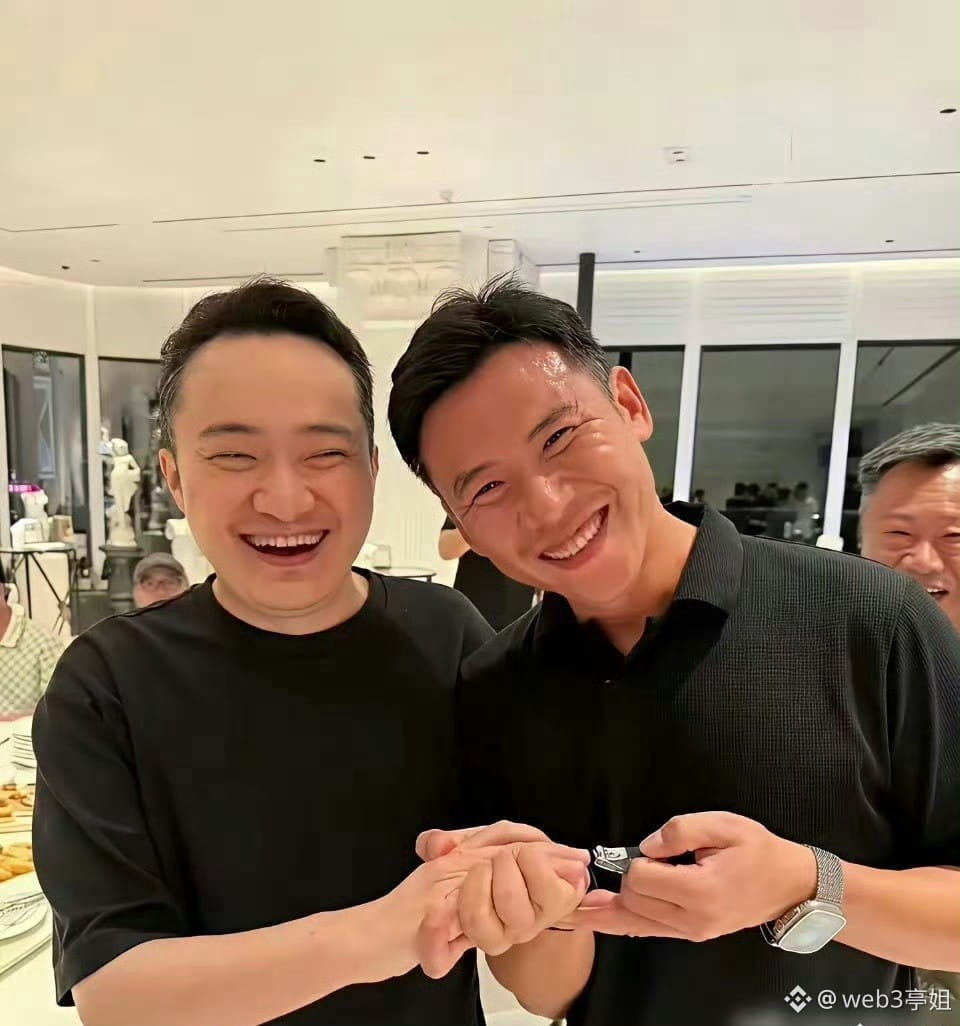
When I saw this picture of Sun Ge cutting nails, how does everyone feel—angry or not? Is it really possible to do something so shameless just for attention? A few days ago, a classmate’s post-writing basically ruined his ex-girlfriend’s career, and now he still keeps stepping on her dignity, rubbing it against the ground again and again. To demand the dowry—didn’t he already sue her, along with her parents? Why is he still so determined to trample on someone? Without even getting into who’s right or wrong, as women, I just feel a chill down my spine. It feels like a thoroughly inhumane mockery. Tell me—who will dare to get close to Sun Ge in the future?
When I saw this picture of Sun Ge cutting nails, how does everyone feel—angry or not? Is it really possible to do something so shameless just for attention? A few days ago, a classmate’s post-writing basically ruined his ex-girlfriend’s career, and now he still keeps stepping on her dignity, rubbing it against the ground again and again. To demand the dowry—didn’t he already sue her, along with her parents? Why is he still so determined to trample on someone? Without even getting into who’s right or wrong, as women, I just feel a chill down my spine. It feels like a thoroughly inhumane mockery. Tell me—who will dare to get close to Sun Ge in the future?
8
1
5.4k
·
--
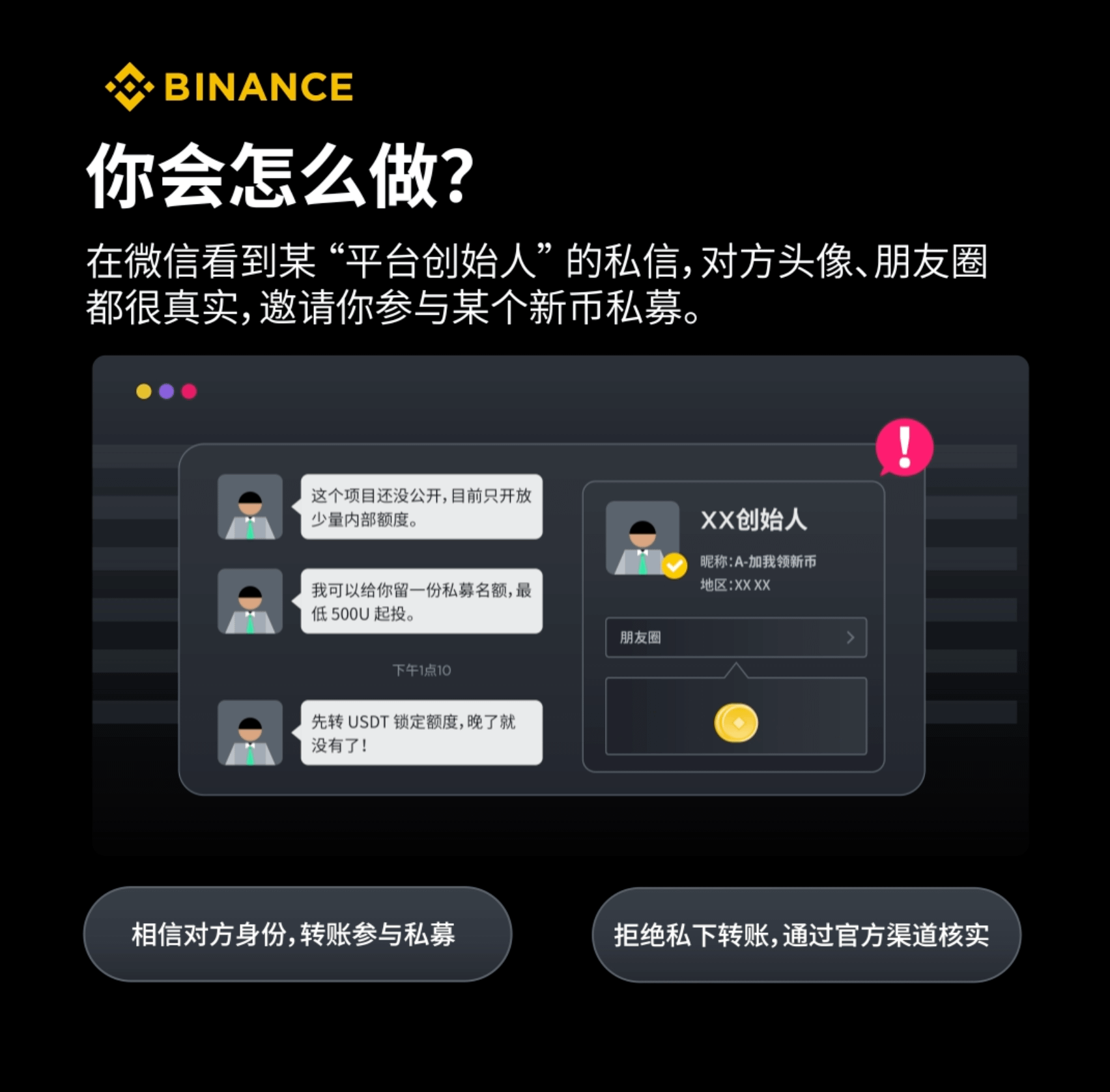
Choose C
Binance official never contacts users privately; social information is easy to forge. Internal quotas are never sold through DMs. Using a sense of urgency is a typical scam. Always verify through official channels and never transfer money.
Choose C
Binance official never contacts users privately; social information is easy to forge. Internal quotas are never sold through DMs. Using a sense of urgency is a typical scam. Always verify through official channels and never transfer money.
Binance official never contacts users privately; social information is easy to forge. Internal quotas are never sold through DMs. Using a sense of urgency is a typical scam. Always verify through official channels and never transfer money.
币安Binance华语
·
--
😈“I’m the founder of the platform. The last spot for the new coin private sale—500 USDT, hop on!”
What would you do❓
A. Finally, the fortune of wealth is my turn—I rush in 🤑
B. Everything matches in my circle of friends—the identity package is real 😎
C. I’d rather not take this luck. Don’t transfer money—go verify with the official first 🔍
⬇️ RT and leave your choice and reasons. We’ll randomly pick 3 people, each gets 40U #币安安全星期四
What would you do❓
A. Finally, the fortune of wealth is my turn—I rush in 🤑
B. Everything matches in my circle of friends—the identity package is real 😎
C. I’d rather not take this luck. Don’t transfer money—go verify with the official first 🔍
⬇️ RT and leave your choice and reasons. We’ll randomly pick 3 people, each gets 40U #币安安全星期四
86
·
--
I recently re-read the document for @Dusk_Foundation , and there’s one detail that keeps catching my attention: this project seems to be shifting from a “privacy-focused blockchain” to a more explicitly defined goal—regulated market infrastructure.
This isn’t a flashy narrative shift; it’s a series of engineering adjustments. The recent Boreas upgrade focuses on network resilience, resource accounting, and the readiness state of DuskEVM. In March, there’s another round of the Aegis upgrade, described by the official team as the most important update to date, with all nodes required to upgrade. Two rounds of forced upgrades without any major issues in the process in itself suggests that the network’s stability is being steadily validated. It may sound a bit dry, but for infrastructure, “dry” might actually be the point.
Dusk’s current three-layer architecture is already quite clear: the bottom layer, DuskDS, handles settlement, consensus, and data availability; the middle layer has DuskEVM running Solidity apps, while DuskVM runs Rust/WASM native contracts; the top layer, Citadel, manages identity and selective disclosure. The three layers are driven by the same DUSK token. The native bridges run by validators transfer value between layers without wrapping assets or involving custodians.
But I have to say this is still an evolving system—not a finished product. DuskEVM is currently running in a sequencer-only mode, with no public mempool. NPEX’s regulated securities dApp is described as an “ongoing rollout,” not yet in a full launch state. $DUSK ’s current market price is around $0.0715, and the gap between on-chain real transaction activity and the token release rate is also worth ongoing observation. I support the direction of moving from a “privacy chain” to “market infrastructure,” but the execution-layer gap is something to stay wary of.
What I’m more focused on now is: after Aegis and Boreas have sufficiently hardened the infrastructure, when will real-world assets and real transaction volume actually move in? #dusk
I recently re-read the document for @Dusk , and there’s one detail that keeps catching my attention: this project seems to be shifting from a “privacy-focused blockchain” to a more explicitly defined goal—regulated market infrastructure.
This isn’t a flashy narrative shift; it’s a series of engineering adjustments. The recent Boreas upgrade focuses on network resilience, resource accounting, and the readiness state of DuskEVM. In March, there’s another round of the Aegis upgrade, described by the official team as the most important update to date, with all nodes required to upgrade. Two rounds of forced upgrades without any major issues in the process in itself suggests that the network’s stability is being steadily validated. It may sound a bit dry, but for infrastructure, “dry” might actually be the point.
Dusk’s current three-layer architecture is already quite clear: the bottom layer, DuskDS, handles settlement, consensus, and data availability; the middle layer has DuskEVM running Solidity apps, while DuskVM runs Rust/WASM native contracts; the top layer, Citadel, manages identity and selective disclosure. The three layers are driven by the same DUSK token. The native bridges run by validators transfer value between layers without wrapping assets or involving custodians.
But I have to say this is still an evolving system—not a finished product. DuskEVM is currently running in a sequencer-only mode, with no public mempool. NPEX’s regulated securities dApp is described as an “ongoing rollout,” not yet in a full launch state. $DUSK ’s current market price is around $0.0715, and the gap between on-chain real transaction activity and the token release rate is also worth ongoing observation. I support the direction of moving from a “privacy chain” to “market infrastructure,” but the execution-layer gap is something to stay wary of.
What I’m more focused on now is: after Aegis and Boreas have sufficiently hardened the infrastructure, when will real-world assets and real transaction volume actually move in? #dusk
This isn’t a flashy narrative shift; it’s a series of engineering adjustments. The recent Boreas upgrade focuses on network resilience, resource accounting, and the readiness state of DuskEVM. In March, there’s another round of the Aegis upgrade, described by the official team as the most important update to date, with all nodes required to upgrade. Two rounds of forced upgrades without any major issues in the process in itself suggests that the network’s stability is being steadily validated. It may sound a bit dry, but for infrastructure, “dry” might actually be the point.
Dusk’s current three-layer architecture is already quite clear: the bottom layer, DuskDS, handles settlement, consensus, and data availability; the middle layer has DuskEVM running Solidity apps, while DuskVM runs Rust/WASM native contracts; the top layer, Citadel, manages identity and selective disclosure. The three layers are driven by the same DUSK token. The native bridges run by validators transfer value between layers without wrapping assets or involving custodians.
But I have to say this is still an evolving system—not a finished product. DuskEVM is currently running in a sequencer-only mode, with no public mempool. NPEX’s regulated securities dApp is described as an “ongoing rollout,” not yet in a full launch state. $DUSK ’s current market price is around $0.0715, and the gap between on-chain real transaction activity and the token release rate is also worth ongoing observation. I support the direction of moving from a “privacy chain” to “market infrastructure,” but the execution-layer gap is something to stay wary of.
What I’m more focused on now is: after Aegis and Boreas have sufficiently hardened the infrastructure, when will real-world assets and real transaction volume actually move in? #dusk

1
1
102
·
--
I’ve read the architecture for @Dusk_Foundation several times. What actually made me stop and think wasn’t how hardcore the zero-knowledge proofs are. What I care about is: if RWA wants to scale, how does the chain handle the “commercial secrets” versus “regulatory transparency” conflict, which is inherently irreconcilable? Most public chains are either so transparent that institutions are exposed, or so anonymous that regulators can’t get in.
Dusk’s answer is “selective disclosure.” At the underlying layer, it turns privacy into a programmable module: Moonlight manages public accounts, Phoenix uses ZK to shield transactions, and by default it hides amounts and participants. At the application layer, Citadel handles credentials to enable “attribute proofs” rather than exposing identities. This approach—deriving technical design from regulatory requirements—is worth paying attention to.
But I’m not fully convinced. A few practical issues make me hesitate: developers have to handle two kinds of state logic at once. When writing lending/borrowing contracts, they must compute both public balances and privacy Note nullifiers—complexity that will inevitably be offloaded onto users. Also, while verifier KYC and real-name compliance are welcomed by institutions, ordinary participants are basically kept out. Is this really “institution-friendly consensus,” or is it just a permissioned network wearing the public chain’s costume? There’s also the issue of regulatory dependence: Dusk is deeply tied to the EU framework, and if policies change, the narrative could be rewritten.
$DUSK currently has FDV around $280 million. The pledged APR has fallen from the peak earlier this year, and token unlock pressure is also weighing on the price.
What I care about more is the real settlement data after the first batch of €300 million in assets is on-chain—not yet another roadmap for what can be done. The threshold for RWA has never been simply moving assets onto the chain; it’s whether, after they’re moved, those troublesome rules in the real world can still keep being enforced.
So when I look at Dusk, I’m asking a more specific question: when regulatory rules change and investor eligibility changes, who updates the on-chain state? And after updating, what happens to the already issued assets? If you can’t answer that, no matter how elegant the privacy compliance is, it’s just another polished sandbox. What do you think?#dusk
I’ve read the architecture for @Dusk several times. What actually made me stop and think wasn’t how hardcore the zero-knowledge proofs are. What I care about is: if RWA wants to scale, how does the chain handle the “commercial secrets” versus “regulatory transparency” conflict, which is inherently irreconcilable? Most public chains are either so transparent that institutions are exposed, or so anonymous that regulators can’t get in.
Dusk’s answer is “selective disclosure.” At the underlying layer, it turns privacy into a programmable module: Moonlight manages public accounts, Phoenix uses ZK to shield transactions, and by default it hides amounts and participants. At the application layer, Citadel handles credentials to enable “attribute proofs” rather than exposing identities. This approach—deriving technical design from regulatory requirements—is worth paying attention to.
But I’m not fully convinced. A few practical issues make me hesitate: developers have to handle two kinds of state logic at once. When writing lending/borrowing contracts, they must compute both public balances and privacy Note nullifiers—complexity that will inevitably be offloaded onto users. Also, while verifier KYC and real-name compliance are welcomed by institutions, ordinary participants are basically kept out. Is this really “institution-friendly consensus,” or is it just a permissioned network wearing the public chain’s costume? There’s also the issue of regulatory dependence: Dusk is deeply tied to the EU framework, and if policies change, the narrative could be rewritten.
$DUSK currently has FDV around $280 million. The pledged APR has fallen from the peak earlier this year, and token unlock pressure is also weighing on the price.
What I care about more is the real settlement data after the first batch of €300 million in assets is on-chain—not yet another roadmap for what can be done. The threshold for RWA has never been simply moving assets onto the chain; it’s whether, after they’re moved, those troublesome rules in the real world can still keep being enforced.
So when I look at Dusk, I’m asking a more specific question: when regulatory rules change and investor eligibility changes, who updates the on-chain state? And after updating, what happens to the already issued assets? If you can’t answer that, no matter how elegant the privacy compliance is, it’s just another polished sandbox. What do you think?#dusk
Dusk’s answer is “selective disclosure.” At the underlying layer, it turns privacy into a programmable module: Moonlight manages public accounts, Phoenix uses ZK to shield transactions, and by default it hides amounts and participants. At the application layer, Citadel handles credentials to enable “attribute proofs” rather than exposing identities. This approach—deriving technical design from regulatory requirements—is worth paying attention to.
But I’m not fully convinced. A few practical issues make me hesitate: developers have to handle two kinds of state logic at once. When writing lending/borrowing contracts, they must compute both public balances and privacy Note nullifiers—complexity that will inevitably be offloaded onto users. Also, while verifier KYC and real-name compliance are welcomed by institutions, ordinary participants are basically kept out. Is this really “institution-friendly consensus,” or is it just a permissioned network wearing the public chain’s costume? There’s also the issue of regulatory dependence: Dusk is deeply tied to the EU framework, and if policies change, the narrative could be rewritten.
$DUSK currently has FDV around $280 million. The pledged APR has fallen from the peak earlier this year, and token unlock pressure is also weighing on the price.
What I care about more is the real settlement data after the first batch of €300 million in assets is on-chain—not yet another roadmap for what can be done. The threshold for RWA has never been simply moving assets onto the chain; it’s whether, after they’re moved, those troublesome rules in the real world can still keep being enforced.
So when I look at Dusk, I’m asking a more specific question: when regulatory rules change and investor eligibility changes, who updates the on-chain state? And after updating, what happens to the already issued assets? If you can’t answer that, no matter how elegant the privacy compliance is, it’s just another polished sandbox. What do you think?#dusk

2
1
108
·
--
I recently re-examined @Dusk_Foundation and noticed a more concrete issue than privacy transactions: how can on-chain financial assets determine whether a person meets the holding requirements without revealing their identity information to everyone?
Dusk’s Citadel gave me a clearer way of thinking. Users first obtain credentials from a License Provider, then use zero-knowledge proofs to prove that they possess valid credentials—rather than putting names, addresses, or full identity details directly on-chain. The Citadel contract verifies the proof; whether a specific service accepts these credentials is determined by the Service Provider according to its own rules.
I agree with this layered approach. It separates “proving eligibility” from “publicly stating who you are.” For regulated assets such as securities, investor eligibility, regional restrictions, and holding permissions don’t necessarily need to be visible to all on-chain participants in the first place.
But the problem shows up right here. Citadel can cryptographically prove that the credentials are valid, but it cannot replace market judgment about which issuers can be trusted, which attributes should be accepted, and how to handle things once credentials expire or are revoked. Official specifications also leave choices about whom to trust as the License Provider, attribute acceptance, and session management to the specific service provider. In other words, cryptography reduces the need for trust during verification, but it does not eliminate the trust entry points in the identity system.
Now look at $DUSK . It provides gas and staking functions, with a maximum supply of 1 billion tokens, and some of the tokens are released through long-term emissions. What I care about isn’t just short-term price fluctuations, but whether, as real business volume grows in the future, network transaction fees and staking demand can form more sustained usage demand.
So for me, when looking at Dusk, privacy technology is only the first gate. What truly determines whether it can enter more financial scenarios is who issues trustworthy identities and whether different institutions are willing to accept the same set of proof standards. Technical rules can be written into protocols, but identity trust is hard to solve with code alone. I think this problem is even more worth long-term observation than TPS. #dusk
I recently re-examined @Dusk and noticed a more concrete issue than privacy transactions: how can on-chain financial assets determine whether a person meets the holding requirements without revealing their identity information to everyone?
Dusk’s Citadel gave me a clearer way of thinking. Users first obtain credentials from a License Provider, then use zero-knowledge proofs to prove that they possess valid credentials—rather than putting names, addresses, or full identity details directly on-chain. The Citadel contract verifies the proof; whether a specific service accepts these credentials is determined by the Service Provider according to its own rules.
I agree with this layered approach. It separates “proving eligibility” from “publicly stating who you are.” For regulated assets such as securities, investor eligibility, regional restrictions, and holding permissions don’t necessarily need to be visible to all on-chain participants in the first place.
But the problem shows up right here. Citadel can cryptographically prove that the credentials are valid, but it cannot replace market judgment about which issuers can be trusted, which attributes should be accepted, and how to handle things once credentials expire or are revoked. Official specifications also leave choices about whom to trust as the License Provider, attribute acceptance, and session management to the specific service provider. In other words, cryptography reduces the need for trust during verification, but it does not eliminate the trust entry points in the identity system.
Now look at $DUSK . It provides gas and staking functions, with a maximum supply of 1 billion tokens, and some of the tokens are released through long-term emissions. What I care about isn’t just short-term price fluctuations, but whether, as real business volume grows in the future, network transaction fees and staking demand can form more sustained usage demand.
So for me, when looking at Dusk, privacy technology is only the first gate. What truly determines whether it can enter more financial scenarios is who issues trustworthy identities and whether different institutions are willing to accept the same set of proof standards. Technical rules can be written into protocols, but identity trust is hard to solve with code alone. I think this problem is even more worth long-term observation than TPS. #dusk
Dusk’s Citadel gave me a clearer way of thinking. Users first obtain credentials from a License Provider, then use zero-knowledge proofs to prove that they possess valid credentials—rather than putting names, addresses, or full identity details directly on-chain. The Citadel contract verifies the proof; whether a specific service accepts these credentials is determined by the Service Provider according to its own rules.
I agree with this layered approach. It separates “proving eligibility” from “publicly stating who you are.” For regulated assets such as securities, investor eligibility, regional restrictions, and holding permissions don’t necessarily need to be visible to all on-chain participants in the first place.
But the problem shows up right here. Citadel can cryptographically prove that the credentials are valid, but it cannot replace market judgment about which issuers can be trusted, which attributes should be accepted, and how to handle things once credentials expire or are revoked. Official specifications also leave choices about whom to trust as the License Provider, attribute acceptance, and session management to the specific service provider. In other words, cryptography reduces the need for trust during verification, but it does not eliminate the trust entry points in the identity system.
Now look at $DUSK . It provides gas and staking functions, with a maximum supply of 1 billion tokens, and some of the tokens are released through long-term emissions. What I care about isn’t just short-term price fluctuations, but whether, as real business volume grows in the future, network transaction fees and staking demand can form more sustained usage demand.
So for me, when looking at Dusk, privacy technology is only the first gate. What truly determines whether it can enter more financial scenarios is who issues trustworthy identities and whether different institutions are willing to accept the same set of proof standards. Technical rules can be written into protocols, but identity trust is hard to solve with code alone. I think this problem is even more worth long-term observation than TPS. #dusk
1
2
95
·
--
When I re-examined @Dusk_Foundation , what really made me stop wasn’t privacy technology—but a more realistic question: once assets like securities are put on-chain, can investor eligibility, transfer restrictions, and information disclosure be directly turned into rules on the blockchain?
Dusk’s Phoenix model gave me an interesting answer. Transactions can hide counterparties and amounts, while enabling targeted disclosure via viewing keys. For financial assets, this is more practical than simply chasing “nobody can see.” Regulators often don’t need all the data; they need to verify specific data under specific conditions. Moonlight keeps the public-account model, and DuskDS handles the underlying settlement. The two modes can serve different businesses.
But I also think the biggest advantage of this design—and the potential ecosystem hurdle—may be right there. DuskVM is built for Rust and WASM, making it well-suited for native privacy and zero-knowledge applications. DuskEVM is compatible with Solidity and existing EVM tooling. More choices don’t necessarily mean easier development. If teams ultimately rely mainly on EVM, the technical differences in Dusk itself could be weakened. A more realistic concern is that the computational cost of zero-knowledge proofs, as well as the hardware-resource requirements for provers, will also become engineering problems that must be solved for large-scale adoption.
On the token layer, I care more about the actual usage needs of $DUSK than about looking at the supply in isolation. As a network-native asset, DUSK is directly tied to network functions like transaction fees and staking. That means how much value it can ultimately carry depends—largely—on whether the network continues to add real activity over time. The official supply design uses a long-term release mechanism, with a total cap of 1 billion tokens. For me, this set of numbers isn’t the point in itself. What’s truly worth watching is whether future network usage can match the functional needs of the token.
Now looking at Dusk again, what I care about most is whether it can truly embed privacy, identity, and asset rules into the everyday workflows of financial business. Technical capability answers “can we do it,” but real adoption answers “do we even need to do it.” For Dusk, what’s probably most worth watching next isn’t how many more technical modules get added, but whether more and more real assets are willing to stay. #dusk
When I re-examined @Dusk , what really made me stop wasn’t privacy technology—but a more realistic question: once assets like securities are put on-chain, can investor eligibility, transfer restrictions, and information disclosure be directly turned into rules on the blockchain?
Dusk’s Phoenix model gave me an interesting answer. Transactions can hide counterparties and amounts, while enabling targeted disclosure via viewing keys. For financial assets, this is more practical than simply chasing “nobody can see.” Regulators often don’t need all the data; they need to verify specific data under specific conditions. Moonlight keeps the public-account model, and DuskDS handles the underlying settlement. The two modes can serve different businesses.
But I also think the biggest advantage of this design—and the potential ecosystem hurdle—may be right there. DuskVM is built for Rust and WASM, making it well-suited for native privacy and zero-knowledge applications. DuskEVM is compatible with Solidity and existing EVM tooling. More choices don’t necessarily mean easier development. If teams ultimately rely mainly on EVM, the technical differences in Dusk itself could be weakened. A more realistic concern is that the computational cost of zero-knowledge proofs, as well as the hardware-resource requirements for provers, will also become engineering problems that must be solved for large-scale adoption.
On the token layer, I care more about the actual usage needs of $DUSK than about looking at the supply in isolation. As a network-native asset, DUSK is directly tied to network functions like transaction fees and staking. That means how much value it can ultimately carry depends—largely—on whether the network continues to add real activity over time. The official supply design uses a long-term release mechanism, with a total cap of 1 billion tokens. For me, this set of numbers isn’t the point in itself. What’s truly worth watching is whether future network usage can match the functional needs of the token.
Now looking at Dusk again, what I care about most is whether it can truly embed privacy, identity, and asset rules into the everyday workflows of financial business. Technical capability answers “can we do it,” but real adoption answers “do we even need to do it.” For Dusk, what’s probably most worth watching next isn’t how many more technical modules get added, but whether more and more real assets are willing to stay. #dusk
Dusk’s Phoenix model gave me an interesting answer. Transactions can hide counterparties and amounts, while enabling targeted disclosure via viewing keys. For financial assets, this is more practical than simply chasing “nobody can see.” Regulators often don’t need all the data; they need to verify specific data under specific conditions. Moonlight keeps the public-account model, and DuskDS handles the underlying settlement. The two modes can serve different businesses.
But I also think the biggest advantage of this design—and the potential ecosystem hurdle—may be right there. DuskVM is built for Rust and WASM, making it well-suited for native privacy and zero-knowledge applications. DuskEVM is compatible with Solidity and existing EVM tooling. More choices don’t necessarily mean easier development. If teams ultimately rely mainly on EVM, the technical differences in Dusk itself could be weakened. A more realistic concern is that the computational cost of zero-knowledge proofs, as well as the hardware-resource requirements for provers, will also become engineering problems that must be solved for large-scale adoption.
On the token layer, I care more about the actual usage needs of $DUSK than about looking at the supply in isolation. As a network-native asset, DUSK is directly tied to network functions like transaction fees and staking. That means how much value it can ultimately carry depends—largely—on whether the network continues to add real activity over time. The official supply design uses a long-term release mechanism, with a total cap of 1 billion tokens. For me, this set of numbers isn’t the point in itself. What’s truly worth watching is whether future network usage can match the functional needs of the token.
Now looking at Dusk again, what I care about most is whether it can truly embed privacy, identity, and asset rules into the everyday workflows of financial business. Technical capability answers “can we do it,” but real adoption answers “do we even need to do it.” For Dusk, what’s probably most worth watching next isn’t how many more technical modules get added, but whether more and more real assets are willing to stay. #dusk
86
·
--
Revisiting Dusk’s materials, what concerns me is how it handles the inherent contradiction between “compliant privacy.” Most public chains force a choice between transparency and privacy, while Dusk tries to satisfy both simultaneously. That positioning in itself is quite conflicted.
From a technical architecture standpoint, the three-layer design (@Dusk_Foundation ) has standout elements: DuskDS handles settlement and data availability, DuskEVM is compatible with Solidity, and a Hedger layer stacked with zero-knowledge proofs enables confidential transactions. Having Moonlight’s public accounts coexist with Phoenix’s UTXO shielding lets institutions switch as needed. Market capitalization for $DUSK is about $28 million, with a total supply of 500 million coins; it serves functions including gas, staking, and governance.
But when I get into the real-world implementation, I start to feel uneasy. Moonlight’s account model maintains global state—state changes are publicly visible to all nodes. Phoenix, in contrast, uses a UTXO-based note structure: each transaction consumes an old note and generates a new one. The note contents are encrypted and readable only by the sender and the recipient. When developers write a lending contract, collateral sits in Moonlight. After liquidation is triggered, the system must generate a Phoenix note to send to the liquidator, then destroy the original note and update account balances. This conversion logic involves maintaining consistency between two different forms of state representation. The line in the documentation about “choosing as needed” may underestimate the actual workload for developers.
The KYC barrier for validators is another issue. Dusk requires node identity verification, which addresses institutions’ compliance needs, but keeps retail users out—right now the entire network has only 47 nodes. Approximately 171,000 DUSK are unlocked per day, and coupled with reliance on the EU regulatory timetable, the coin price hovers around $0.076. What worries me most, though, is the real-world performance of zero-knowledge proofs in the WASM environment. Each Phoenix transaction needs additional proof generation. In my tests on the testnet, a simple transfer took about 15 to 20 seconds from submission to being included on-chain, whereas under Moonlight it took under 3 seconds. If that gap is magnified in high-frequency scenarios, the user experience will be clearly affected.
I agree with Dusk’s direction, but getting “compliant privacy” to work requires more than cryptography. I’ll wait until the first application that puts the core liquidity pool into Phoenix and obtains clear regulatory guidance, then I’ll reassess. Do you think institutions are paying for technical privacy or for legally attributable accountability? #dusk
Revisiting Dusk’s materials, what concerns me is how it handles the inherent contradiction between “compliant privacy.” Most public chains force a choice between transparency and privacy, while Dusk tries to satisfy both simultaneously. That positioning in itself is quite conflicted.
From a technical architecture standpoint, the three-layer design (@Dusk ) has standout elements: DuskDS handles settlement and data availability, DuskEVM is compatible with Solidity, and a Hedger layer stacked with zero-knowledge proofs enables confidential transactions. Having Moonlight’s public accounts coexist with Phoenix’s UTXO shielding lets institutions switch as needed. Market capitalization for $DUSK is about $28 million, with a total supply of 500 million coins; it serves functions including gas, staking, and governance.
But when I get into the real-world implementation, I start to feel uneasy. Moonlight’s account model maintains global state—state changes are publicly visible to all nodes. Phoenix, in contrast, uses a UTXO-based note structure: each transaction consumes an old note and generates a new one. The note contents are encrypted and readable only by the sender and the recipient. When developers write a lending contract, collateral sits in Moonlight. After liquidation is triggered, the system must generate a Phoenix note to send to the liquidator, then destroy the original note and update account balances. This conversion logic involves maintaining consistency between two different forms of state representation. The line in the documentation about “choosing as needed” may underestimate the actual workload for developers.
The KYC barrier for validators is another issue. Dusk requires node identity verification, which addresses institutions’ compliance needs, but keeps retail users out—right now the entire network has only 47 nodes. Approximately 171,000 DUSK are unlocked per day, and coupled with reliance on the EU regulatory timetable, the coin price hovers around $0.076. What worries me most, though, is the real-world performance of zero-knowledge proofs in the WASM environment. Each Phoenix transaction needs additional proof generation. In my tests on the testnet, a simple transfer took about 15 to 20 seconds from submission to being included on-chain, whereas under Moonlight it took under 3 seconds. If that gap is magnified in high-frequency scenarios, the user experience will be clearly affected.
I agree with Dusk’s direction, but getting “compliant privacy” to work requires more than cryptography. I’ll wait until the first application that puts the core liquidity pool into Phoenix and obtains clear regulatory guidance, then I’ll reassess. Do you think institutions are paying for technical privacy or for legally attributable accountability? #dusk
From a technical architecture standpoint, the three-layer design (@Dusk ) has standout elements: DuskDS handles settlement and data availability, DuskEVM is compatible with Solidity, and a Hedger layer stacked with zero-knowledge proofs enables confidential transactions. Having Moonlight’s public accounts coexist with Phoenix’s UTXO shielding lets institutions switch as needed. Market capitalization for $DUSK is about $28 million, with a total supply of 500 million coins; it serves functions including gas, staking, and governance.
But when I get into the real-world implementation, I start to feel uneasy. Moonlight’s account model maintains global state—state changes are publicly visible to all nodes. Phoenix, in contrast, uses a UTXO-based note structure: each transaction consumes an old note and generates a new one. The note contents are encrypted and readable only by the sender and the recipient. When developers write a lending contract, collateral sits in Moonlight. After liquidation is triggered, the system must generate a Phoenix note to send to the liquidator, then destroy the original note and update account balances. This conversion logic involves maintaining consistency between two different forms of state representation. The line in the documentation about “choosing as needed” may underestimate the actual workload for developers.
The KYC barrier for validators is another issue. Dusk requires node identity verification, which addresses institutions’ compliance needs, but keeps retail users out—right now the entire network has only 47 nodes. Approximately 171,000 DUSK are unlocked per day, and coupled with reliance on the EU regulatory timetable, the coin price hovers around $0.076. What worries me most, though, is the real-world performance of zero-knowledge proofs in the WASM environment. Each Phoenix transaction needs additional proof generation. In my tests on the testnet, a simple transfer took about 15 to 20 seconds from submission to being included on-chain, whereas under Moonlight it took under 3 seconds. If that gap is magnified in high-frequency scenarios, the user experience will be clearly affected.
I agree with Dusk’s direction, but getting “compliant privacy” to work requires more than cryptography. I’ll wait until the first application that puts the core liquidity pool into Phoenix and obtains clear regulatory guidance, then I’ll reassess. Do you think institutions are paying for technical privacy or for legally attributable accountability? #dusk

2
1
117
·
--
Previously, I always felt that for a blockchain to serve traditional finance, it had to answer one question first: traders don’t want to expose their cards, while regulators need to see everything clearly. How do you resolve that contradiction? Most projects either focus too much on privacy or go fully transparent—satisfying neither side. It wasn’t until I dug into @Dusk_Foundation that I realized it splits the problem into two sets of models and connects them.
Let me start with what convinced me. Dusk preserves two account models: Phoenix and Moonlight. The former is built on UTXO and uses zero-knowledge proofs to keep both the amounts and the participating parties confidential, while the latter is fully transparent. The more I look at this, the more I agree with it. Corporate holdings and quotes must be kept secret, otherwise the counterparty can target you; but for staking and governance voting, openness is actually the foundation of trust. Forcing everything into a single model would only leave both sides dissatisfied.
What concerns me even more—in a good way—is that it doesn’t treat compliance as a slogan. EURQ, launched in collaboration with Quantoz Payments, is regulated by the Dutch central bank and complies with MiCA. This means that from asset issuance to trading and finally settlement, the entire chain can truly close the loop—more reliable than stablecoins issued by commercial companies. With DuskEVM compatibility with the Solidity toolchain, the migration cost for institutions is pushed down to a level where they can actually make a decision.
That said, there’s also a very real downside. EURQ isn’t an exclusive resource for Dusk—it’s deployed on other chains as well. How long can its differentiated advantage in compliance and settlement last? The mainnet only launched in January 2026, and it still needs time to validate the actual adoption rates of asset migration and payment services. The performance overhead of privacy computation is also significant. Can the experience of confidential transfers get close to that of ordinary transfers? That directly determines whether it will be used.
In the end, Dusk is doing the work of making privacy, compliance, and asset rules coexist long-term—treating it as engineering rather than a show. This direction is worth continuous attention. But whether real adoption can truly take off—I’m still watching as I go. What do you think? #dusk $DUSK
Previously, I always felt that for a blockchain to serve traditional finance, it had to answer one question first: traders don’t want to expose their cards, while regulators need to see everything clearly. How do you resolve that contradiction? Most projects either focus too much on privacy or go fully transparent—satisfying neither side. It wasn’t until I dug into @Dusk that I realized it splits the problem into two sets of models and connects them.
Let me start with what convinced me. Dusk preserves two account models: Phoenix and Moonlight. The former is built on UTXO and uses zero-knowledge proofs to keep both the amounts and the participating parties confidential, while the latter is fully transparent. The more I look at this, the more I agree with it. Corporate holdings and quotes must be kept secret, otherwise the counterparty can target you; but for staking and governance voting, openness is actually the foundation of trust. Forcing everything into a single model would only leave both sides dissatisfied.
What concerns me even more—in a good way—is that it doesn’t treat compliance as a slogan. EURQ, launched in collaboration with Quantoz Payments, is regulated by the Dutch central bank and complies with MiCA. This means that from asset issuance to trading and finally settlement, the entire chain can truly close the loop—more reliable than stablecoins issued by commercial companies. With DuskEVM compatibility with the Solidity toolchain, the migration cost for institutions is pushed down to a level where they can actually make a decision.
That said, there’s also a very real downside. EURQ isn’t an exclusive resource for Dusk—it’s deployed on other chains as well. How long can its differentiated advantage in compliance and settlement last? The mainnet only launched in January 2026, and it still needs time to validate the actual adoption rates of asset migration and payment services. The performance overhead of privacy computation is also significant. Can the experience of confidential transfers get close to that of ordinary transfers? That directly determines whether it will be used.
In the end, Dusk is doing the work of making privacy, compliance, and asset rules coexist long-term—treating it as engineering rather than a show. This direction is worth continuous attention. But whether real adoption can truly take off—I’m still watching as I go. What do you think? #dusk $DUSK
Let me start with what convinced me. Dusk preserves two account models: Phoenix and Moonlight. The former is built on UTXO and uses zero-knowledge proofs to keep both the amounts and the participating parties confidential, while the latter is fully transparent. The more I look at this, the more I agree with it. Corporate holdings and quotes must be kept secret, otherwise the counterparty can target you; but for staking and governance voting, openness is actually the foundation of trust. Forcing everything into a single model would only leave both sides dissatisfied.
What concerns me even more—in a good way—is that it doesn’t treat compliance as a slogan. EURQ, launched in collaboration with Quantoz Payments, is regulated by the Dutch central bank and complies with MiCA. This means that from asset issuance to trading and finally settlement, the entire chain can truly close the loop—more reliable than stablecoins issued by commercial companies. With DuskEVM compatibility with the Solidity toolchain, the migration cost for institutions is pushed down to a level where they can actually make a decision.
That said, there’s also a very real downside. EURQ isn’t an exclusive resource for Dusk—it’s deployed on other chains as well. How long can its differentiated advantage in compliance and settlement last? The mainnet only launched in January 2026, and it still needs time to validate the actual adoption rates of asset migration and payment services. The performance overhead of privacy computation is also significant. Can the experience of confidential transfers get close to that of ordinary transfers? That directly determines whether it will be used.
In the end, Dusk is doing the work of making privacy, compliance, and asset rules coexist long-term—treating it as engineering rather than a show. This direction is worth continuous attention. But whether real adoption can truly take off—I’m still watching as I go. What do you think? #dusk $DUSK
1
1
103
·
--
For the past few days, I’ve been thinking about a question: I’ve participated in plenty of DeFi protocols. The most uncomfortable part isn’t the ups and downs of the price—it’s the “participation certificates” the project team gives out that end up being completely disregarded. Points, ranks, badges—except for screenshots, they have zero real utility. So when I revisit the Pre-mine rules of @termmax , I’m not concerned with how much airdrop I can claim; what matters is what they actually want the token to be used for.
The FT, XT, GT system is the real subject worth discussing for TermMax. FT turns fixed-income cash flows into something financially tradable in advance: investors buy at a discount, then redeem at face value at maturity. In essence, the interest rate and the price are two sides of the same coin. GT packages leveraged positions into on-chain credentials, bundling collateral, debt terms, and position status into manageable objects. Range Orders use piecewise curves to express interest-rate needs at different scales. It doesn’t describe coin price; it describes the relationship between interest rates and tradable size. TermMax isn’t merely issuing debt—it’s redesigning how fixed-income products are expressed on-chain.
But there are still things I’m unsure about. The Curator role gave me pause. DeFi talks about removing intermediaries—yet it creates something akin to a fund manager. Even though permissions are restricted by time locks and a Guardian, idle capital can only be deployed into pre-approved markets. Still, once the Depositor hands over the funds, the underlying bet is that the Curator has better judgment than you. In extreme market conditions, a liquidation window of just a few minutes means a time lock can’t save you. Governance also has potential pitfalls: as a governance token, TMX gives large holders more influence over parameter adjustments—profit from the rules, then increase their voting power. Once this feedback loop forms, is governance decentralized, or is pricing power being centralized again?
I won’t easily say whether TermMax is a success or not. What it shows me isn’t a protocol that’s already fully operational—it’s a lab that’s trying to build a new connection between assets, time, and credit. The real test of this mechanism isn’t the token price on the TGE day; it’s whether people holding TMX will continue to stay in the market and trade.
Curator has made me rethink a question: should decentralization aim to eliminate all intermediaries, or only those intermediaries that can’t be audited. I don’t have an answer yet, but TermMax has made me start seriously thinking about it. #termmax
For the past few days, I’ve been thinking about a question: I’ve participated in plenty of DeFi protocols. The most uncomfortable part isn’t the ups and downs of the price—it’s the “participation certificates” the project team gives out that end up being completely disregarded. Points, ranks, badges—except for screenshots, they have zero real utility. So when I revisit the Pre-mine rules of @TermMax , I’m not concerned with how much airdrop I can claim; what matters is what they actually want the token to be used for.
The FT, XT, GT system is the real subject worth discussing for TermMax. FT turns fixed-income cash flows into something financially tradable in advance: investors buy at a discount, then redeem at face value at maturity. In essence, the interest rate and the price are two sides of the same coin. GT packages leveraged positions into on-chain credentials, bundling collateral, debt terms, and position status into manageable objects. Range Orders use piecewise curves to express interest-rate needs at different scales. It doesn’t describe coin price; it describes the relationship between interest rates and tradable size. TermMax isn’t merely issuing debt—it’s redesigning how fixed-income products are expressed on-chain.
But there are still things I’m unsure about. The Curator role gave me pause. DeFi talks about removing intermediaries—yet it creates something akin to a fund manager. Even though permissions are restricted by time locks and a Guardian, idle capital can only be deployed into pre-approved markets. Still, once the Depositor hands over the funds, the underlying bet is that the Curator has better judgment than you. In extreme market conditions, a liquidation window of just a few minutes means a time lock can’t save you. Governance also has potential pitfalls: as a governance token, TMX gives large holders more influence over parameter adjustments—profit from the rules, then increase their voting power. Once this feedback loop forms, is governance decentralized, or is pricing power being centralized again?
I won’t easily say whether TermMax is a success or not. What it shows me isn’t a protocol that’s already fully operational—it’s a lab that’s trying to build a new connection between assets, time, and credit. The real test of this mechanism isn’t the token price on the TGE day; it’s whether people holding TMX will continue to stay in the market and trade.
Curator has made me rethink a question: should decentralization aim to eliminate all intermediaries, or only those intermediaries that can’t be audited. I don’t have an answer yet, but TermMax has made me start seriously thinking about it. #termmax
The FT, XT, GT system is the real subject worth discussing for TermMax. FT turns fixed-income cash flows into something financially tradable in advance: investors buy at a discount, then redeem at face value at maturity. In essence, the interest rate and the price are two sides of the same coin. GT packages leveraged positions into on-chain credentials, bundling collateral, debt terms, and position status into manageable objects. Range Orders use piecewise curves to express interest-rate needs at different scales. It doesn’t describe coin price; it describes the relationship between interest rates and tradable size. TermMax isn’t merely issuing debt—it’s redesigning how fixed-income products are expressed on-chain.
But there are still things I’m unsure about. The Curator role gave me pause. DeFi talks about removing intermediaries—yet it creates something akin to a fund manager. Even though permissions are restricted by time locks and a Guardian, idle capital can only be deployed into pre-approved markets. Still, once the Depositor hands over the funds, the underlying bet is that the Curator has better judgment than you. In extreme market conditions, a liquidation window of just a few minutes means a time lock can’t save you. Governance also has potential pitfalls: as a governance token, TMX gives large holders more influence over parameter adjustments—profit from the rules, then increase their voting power. Once this feedback loop forms, is governance decentralized, or is pricing power being centralized again?
I won’t easily say whether TermMax is a success or not. What it shows me isn’t a protocol that’s already fully operational—it’s a lab that’s trying to build a new connection between assets, time, and credit. The real test of this mechanism isn’t the token price on the TGE day; it’s whether people holding TMX will continue to stay in the market and trade.
Curator has made me rethink a question: should decentralization aim to eliminate all intermediaries, or only those intermediaries that can’t be audited. I don’t have an answer yet, but TermMax has made me start seriously thinking about it. #termmax
2
81
·
--
I算过一笔账,去年用浮动利率借了三个月,到期时实际利率比最初看到的翻了一倍。那次之后我才意识到,利率波动的成本有时比手续费和滑点吓人。后来我看借贷项目,第一个要搞清楚:利率到底能不能锁住。
顺着这个需求翻@termmax ,花了我好几个晚上才把GT、FT、XT逻辑捋顺。GT把抵押品和债务打包成NFT仓位,这个我认同,因为它让杠杆头寸可以整体转让,不用平仓再开仓。FT类似零息债券,到期按面值兑付,XT承载利息部分,到期自动归零。Range Order是让我最上头的地方。利率不是定死的,而是用订单簿形成一条分段曲线,借款利率随规模增加逐段下降,贷款利率逐段上升。我觉得这个设计比单纯锁一个APR要灵活。
但反过来说,这灵活也有代价。Range Order意味着你成交的价格取决于市场订单填充情况,滑点可能比想象中大。我看官方示例,借款利率每段下降,但如果你的单子填到下一档,实际利率可能和报价页显示的年化差不少。这点让我有些在意。另外,FT通常以折价交易,折价隐含的年化收益率看起来诱人,但如果你买完后市场突然变化,到期赎回时能不能按面值拿回,取决于借款人是否正常还款。清算机制依赖预言机,如果价格剧烈波动,实物交割能不能及时执行,我心里没底。
流动性也是我反复琢磨的点。TVL虽然有过7100万,但分散到不同到期日、不同链上,每个市场的深度可能不够。V2加的可组合基础收益确实在补短板,但能不能撑起长期交易,我保持观望。
所以我现在的判断是:TermMax机制上值得研究,但它更适合能看懂定价曲线、愿意管理滑点的用户。普通人如果只盯着年化数字冲进去,可能会忽略其中的复杂度。
我更想问的是:你会把固定利率产品当成储蓄替代品,还是当成套利工具?这个选择,决定了你在TermMax里该怎么用。#termmax
I算过一笔账,去年用浮动利率借了三个月,到期时实际利率比最初看到的翻了一倍。那次之后我才意识到,利率波动的成本有时比手续费和滑点吓人。后来我看借贷项目,第一个要搞清楚:利率到底能不能锁住。
顺着这个需求翻@TermMax ,花了我好几个晚上才把GT、FT、XT逻辑捋顺。GT把抵押品和债务打包成NFT仓位,这个我认同,因为它让杠杆头寸可以整体转让,不用平仓再开仓。FT类似零息债券,到期按面值兑付,XT承载利息部分,到期自动归零。Range Order是让我最上头的地方。利率不是定死的,而是用订单簿形成一条分段曲线,借款利率随规模增加逐段下降,贷款利率逐段上升。我觉得这个设计比单纯锁一个APR要灵活。
但反过来说,这灵活也有代价。Range Order意味着你成交的价格取决于市场订单填充情况,滑点可能比想象中大。我看官方示例,借款利率每段下降,但如果你的单子填到下一档,实际利率可能和报价页显示的年化差不少。这点让我有些在意。另外,FT通常以折价交易,折价隐含的年化收益率看起来诱人,但如果你买完后市场突然变化,到期赎回时能不能按面值拿回,取决于借款人是否正常还款。清算机制依赖预言机,如果价格剧烈波动,实物交割能不能及时执行,我心里没底。
流动性也是我反复琢磨的点。TVL虽然有过7100万,但分散到不同到期日、不同链上,每个市场的深度可能不够。V2加的可组合基础收益确实在补短板,但能不能撑起长期交易,我保持观望。
所以我现在的判断是:TermMax机制上值得研究,但它更适合能看懂定价曲线、愿意管理滑点的用户。普通人如果只盯着年化数字冲进去,可能会忽略其中的复杂度。
我更想问的是:你会把固定利率产品当成储蓄替代品,还是当成套利工具?这个选择,决定了你在TermMax里该怎么用。#termmax
顺着这个需求翻@TermMax ,花了我好几个晚上才把GT、FT、XT逻辑捋顺。GT把抵押品和债务打包成NFT仓位,这个我认同,因为它让杠杆头寸可以整体转让,不用平仓再开仓。FT类似零息债券,到期按面值兑付,XT承载利息部分,到期自动归零。Range Order是让我最上头的地方。利率不是定死的,而是用订单簿形成一条分段曲线,借款利率随规模增加逐段下降,贷款利率逐段上升。我觉得这个设计比单纯锁一个APR要灵活。
但反过来说,这灵活也有代价。Range Order意味着你成交的价格取决于市场订单填充情况,滑点可能比想象中大。我看官方示例,借款利率每段下降,但如果你的单子填到下一档,实际利率可能和报价页显示的年化差不少。这点让我有些在意。另外,FT通常以折价交易,折价隐含的年化收益率看起来诱人,但如果你买完后市场突然变化,到期赎回时能不能按面值拿回,取决于借款人是否正常还款。清算机制依赖预言机,如果价格剧烈波动,实物交割能不能及时执行,我心里没底。
流动性也是我反复琢磨的点。TVL虽然有过7100万,但分散到不同到期日、不同链上,每个市场的深度可能不够。V2加的可组合基础收益确实在补短板,但能不能撑起长期交易,我保持观望。
所以我现在的判断是:TermMax机制上值得研究,但它更适合能看懂定价曲线、愿意管理滑点的用户。普通人如果只盯着年化数字冲进去,可能会忽略其中的复杂度。
我更想问的是:你会把固定利率产品当成储蓄替代品,还是当成套利工具?这个选择,决定了你在TermMax里该怎么用。#termmax
1
1
80
·
--
Choose C.
After on-chain assets are stolen, the so-called “asset-recovery experts” are in most cases a second scam. Blocking them immediately is the safest. A real technical team that can actually recover funds would not proactively direct-message you, nor would they charge you first. It’s better to miss out than to take risks—protecting the remaining assets matters more than fantasizing about recovery.
Choose C.
After on-chain assets are stolen, the so-called “asset-recovery experts” are in most cases a second scam. Blocking them immediately is the safest. A real technical team that can actually recover funds would not proactively direct-message you, nor would they charge you first. It’s better to miss out than to take risks—protecting the remaining assets matters more than fantasizing about recovery.
After on-chain assets are stolen, the so-called “asset-recovery experts” are in most cases a second scam. Blocking them immediately is the safest. A real technical team that can actually recover funds would not proactively direct-message you, nor would they charge you first. It’s better to miss out than to take risks—protecting the remaining assets matters more than fantasizing about recovery.
币安Binance华语
·
--
😈 “Bro, your wallet got stolen? I know some blockchain gurus—your assets can still be recovered!”
What would you do❓
A. Great, it’s a guru—my wallet’s saved. Send the seed phrase directly 🤝
B. Wait, I want to verify the card: who are you? Where are you from? How do you recover it?👀
C. ❌ Don’t trust any asset-recovery channel—block immediately!
⬇️ Follow the account, share, and leave your choice and reasons. 3 winners will be selected to receive a 40U security reward #币安安全星期四
What would you do❓
A. Great, it’s a guru—my wallet’s saved. Send the seed phrase directly 🤝
B. Wait, I want to verify the card: who are you? Where are you from? How do you recover it?👀
C. ❌ Don’t trust any asset-recovery channel—block immediately!
⬇️ Follow the account, share, and leave your choice and reasons. 3 winners will be selected to receive a 40U security reward #币安安全星期四
1
59
·
--
When I was doing fintech before, the conflict between privacy and compliance was always impossible to avoid. To protect customers’ trading data, regulators said they must be able to see it. The blockchain projects out there either go fully transparent and scare institutions away, or go fully anonymous and anger regulators. I kept wondering—can’t there be a third way?
Later I came across <a>@Dusk_Foundation </a>. What caught my attention was that it’s bold enough to rethink the whole issue from the ground up. It splits the chain into two layers: a DuskDS settlement layer and a DuskEVM execution layer—what needs to be verified is verified, what needs to be kept confidential is kept confidential, and they don’t get mixed together. Consensus uses Succinct Attestation, a committee-based PoS, with block production and validation separated, leading to finality being determined. The dual-account model is also interesting: Moonlight is transparent, while Phoenix uses UTXO plus zero-knowledge proofs to hide information. In other words, on one chain, public and confidential data go their separate ways, but in the end they all settle into the same ledger. On top of that, Citadel enables selective disclosure—users only need to prove they meet certain conditions, without exposing their entire identity.
But beyond the technology, there are a few real-world angles worth thinking through. DuskEVM is currently driven by a single sequencer, which is basically the same route as the centralized sequencer on Ethereum L2. Yes, it’s cheaper, but the sequencing switch is still in the project team’s hands. For institutions, finality may secure the ledger, but it doesn’t automatically control the sequencer. In May 2026, <a>OtterSec</a> also revealed a vulnerability in the PLONK implementation: validators didn’t verify multiple polynomial commitments provided by the prover, and in theory DUSK could be minted out of thin air. Although it was fixed afterward, vulnerabilities at that level appearing in core cryptographic modules mean you have to keep watching continuously. And then there’s the ongoing issuance and lockup pressure of token <a>$DUSK </a>.
So my current view is: Dusk’s technical direction is worth placing near the front of the “observation deck,” but in the short term I won’t enter the market just because it says the word “privacy.” Whether this “don’t offend either side” lane it’s trying to build actually has cars running—that’s the key question.
If Wall Street’s clearing and settlement system really goes on-chain, will they choose fully transparent, or something with privacy graded in layers like this? Feel free to leave a comment and discuss. <a>#dusk </a>
When I was doing fintech before, the conflict between privacy and compliance was always impossible to avoid. To protect customers’ trading data, regulators said they must be able to see it. The blockchain projects out there either go fully transparent and scare institutions away, or go fully anonymous and anger regulators. I kept wondering—can’t there be a third way?
Later I came across <a>@Dusk </a>. What caught my attention was that it’s bold enough to rethink the whole issue from the ground up. It splits the chain into two layers: a DuskDS settlement layer and a DuskEVM execution layer—what needs to be verified is verified, what needs to be kept confidential is kept confidential, and they don’t get mixed together. Consensus uses Succinct Attestation, a committee-based PoS, with block production and validation separated, leading to finality being determined. The dual-account model is also interesting: Moonlight is transparent, while Phoenix uses UTXO plus zero-knowledge proofs to hide information. In other words, on one chain, public and confidential data go their separate ways, but in the end they all settle into the same ledger. On top of that, Citadel enables selective disclosure—users only need to prove they meet certain conditions, without exposing their entire identity.
But beyond the technology, there are a few real-world angles worth thinking through. DuskEVM is currently driven by a single sequencer, which is basically the same route as the centralized sequencer on Ethereum L2. Yes, it’s cheaper, but the sequencing switch is still in the project team’s hands. For institutions, finality may secure the ledger, but it doesn’t automatically control the sequencer. In May 2026, <a>OtterSec</a> also revealed a vulnerability in the PLONK implementation: validators didn’t verify multiple polynomial commitments provided by the prover, and in theory DUSK could be minted out of thin air. Although it was fixed afterward, vulnerabilities at that level appearing in core cryptographic modules mean you have to keep watching continuously. And then there’s the ongoing issuance and lockup pressure of token <a>$DUSK </a>.
So my current view is: Dusk’s technical direction is worth placing near the front of the “observation deck,” but in the short term I won’t enter the market just because it says the word “privacy.” Whether this “don’t offend either side” lane it’s trying to build actually has cars running—that’s the key question.
If Wall Street’s clearing and settlement system really goes on-chain, will they choose fully transparent, or something with privacy graded in layers like this? Feel free to leave a comment and discuss. <a>#dusk </a>
Later I came across <a>@Dusk </a>. What caught my attention was that it’s bold enough to rethink the whole issue from the ground up. It splits the chain into two layers: a DuskDS settlement layer and a DuskEVM execution layer—what needs to be verified is verified, what needs to be kept confidential is kept confidential, and they don’t get mixed together. Consensus uses Succinct Attestation, a committee-based PoS, with block production and validation separated, leading to finality being determined. The dual-account model is also interesting: Moonlight is transparent, while Phoenix uses UTXO plus zero-knowledge proofs to hide information. In other words, on one chain, public and confidential data go their separate ways, but in the end they all settle into the same ledger. On top of that, Citadel enables selective disclosure—users only need to prove they meet certain conditions, without exposing their entire identity.
But beyond the technology, there are a few real-world angles worth thinking through. DuskEVM is currently driven by a single sequencer, which is basically the same route as the centralized sequencer on Ethereum L2. Yes, it’s cheaper, but the sequencing switch is still in the project team’s hands. For institutions, finality may secure the ledger, but it doesn’t automatically control the sequencer. In May 2026, <a>OtterSec</a> also revealed a vulnerability in the PLONK implementation: validators didn’t verify multiple polynomial commitments provided by the prover, and in theory DUSK could be minted out of thin air. Although it was fixed afterward, vulnerabilities at that level appearing in core cryptographic modules mean you have to keep watching continuously. And then there’s the ongoing issuance and lockup pressure of token <a>$DUSK </a>.
So my current view is: Dusk’s technical direction is worth placing near the front of the “observation deck,” but in the short term I won’t enter the market just because it says the word “privacy.” Whether this “don’t offend either side” lane it’s trying to build actually has cars running—that’s the key question.
If Wall Street’s clearing and settlement system really goes on-chain, will they choose fully transparent, or something with privacy graded in layers like this? Feel free to leave a comment and discuss. <a>#dusk </a>
1
1
97
·
--
When I entered the industry, the most fascinating part of blockchain to me was transparency. Until I talked with a friend who does asset management—he said: In your industry, all transactions are laid bare under the sun. How can institutions get in? Holdings and strategies are fully exposed, essentially letting your opponents flip your cards anytime. Since then, I’ve had doubts about “full transparency.”
So when looking at Dusk, what I care most about is how it handles “auditable privacy.” DuskDS and the layered DuskEVM architecture separate settlement from execution. With Moonlight and Phoenix operating in dual modes, public and private can be switched as needed. Collaborating with NPEX to put tokenized securities worth 300 million euros on-chain, plus EVM compatibility that attracts Solidity developers—none of this is just talk. @Dusk_Foundation
But the position of token $DUSK makes me spend even more time thinking. It’s not only for paying gas: staking 100,000 can increase your share of transaction fees by 1.2x; over 500,000 comes with ecosystem subsidies. Each block releases 19.86 tokens, with 80% going to block producers. The protocol uses real revenue to buy back and inject liquidity—effectively like a disguised burn. This design truly embeds the token into the network’s operating logic.
But I also have some uneasy points. In January 2026’s bridge incident, the attacker stole the signing wallet permissions, resulting in millions of DUSK being stolen. Later, OtterSec found a serious implementation vulnerability in PLONK zero-knowledge proofs. And who ultimately controls that “special key” that can unlock all privacy? If it can’t be clearly explained, then the boundary between “auditable” and “inspectable” becomes blurry.
My view is that the direction is worth paying attention to—its token economics have structure—but the mainnet still needs time to validate with real-world adoption data. Do you think these risks can be resolved through subsequent fixes? #dusk
When I entered the industry, the most fascinating part of blockchain to me was transparency. Until I talked with a friend who does asset management—he said: In your industry, all transactions are laid bare under the sun. How can institutions get in? Holdings and strategies are fully exposed, essentially letting your opponents flip your cards anytime. Since then, I’ve had doubts about “full transparency.”
So when looking at Dusk, what I care most about is how it handles “auditable privacy.” DuskDS and the layered DuskEVM architecture separate settlement from execution. With Moonlight and Phoenix operating in dual modes, public and private can be switched as needed. Collaborating with NPEX to put tokenized securities worth 300 million euros on-chain, plus EVM compatibility that attracts Solidity developers—none of this is just talk. @Dusk
But the position of token $DUSK makes me spend even more time thinking. It’s not only for paying gas: staking 100,000 can increase your share of transaction fees by 1.2x; over 500,000 comes with ecosystem subsidies. Each block releases 19.86 tokens, with 80% going to block producers. The protocol uses real revenue to buy back and inject liquidity—effectively like a disguised burn. This design truly embeds the token into the network’s operating logic.
But I also have some uneasy points. In January 2026’s bridge incident, the attacker stole the signing wallet permissions, resulting in millions of DUSK being stolen. Later, OtterSec found a serious implementation vulnerability in PLONK zero-knowledge proofs. And who ultimately controls that “special key” that can unlock all privacy? If it can’t be clearly explained, then the boundary between “auditable” and “inspectable” becomes blurry.
My view is that the direction is worth paying attention to—its token economics have structure—but the mainnet still needs time to validate with real-world adoption data. Do you think these risks can be resolved through subsequent fixes? #dusk
So when looking at Dusk, what I care most about is how it handles “auditable privacy.” DuskDS and the layered DuskEVM architecture separate settlement from execution. With Moonlight and Phoenix operating in dual modes, public and private can be switched as needed. Collaborating with NPEX to put tokenized securities worth 300 million euros on-chain, plus EVM compatibility that attracts Solidity developers—none of this is just talk. @Dusk
But the position of token $DUSK makes me spend even more time thinking. It’s not only for paying gas: staking 100,000 can increase your share of transaction fees by 1.2x; over 500,000 comes with ecosystem subsidies. Each block releases 19.86 tokens, with 80% going to block producers. The protocol uses real revenue to buy back and inject liquidity—effectively like a disguised burn. This design truly embeds the token into the network’s operating logic.
But I also have some uneasy points. In January 2026’s bridge incident, the attacker stole the signing wallet permissions, resulting in millions of DUSK being stolen. Later, OtterSec found a serious implementation vulnerability in PLONK zero-knowledge proofs. And who ultimately controls that “special key” that can unlock all privacy? If it can’t be clearly explained, then the boundary between “auditable” and “inspectable” becomes blurry.
My view is that the direction is worth paying attention to—its token economics have structure—but the mainnet still needs time to validate with real-world adoption data. Do you think these risks can be resolved through subsequent fixes? #dusk
2
1
80
·
--
I’ve participated in several agreements that were advertised as fixed-rate, only to find that the underlying was still a floating pool wrapped in a shell, and the yield at maturity simply couldn’t be locked in. After a few times when the actual rate failed to stay fixed, I became very particular about those two words, “fixed rate.”
So when I looked at TermMax, the first thing I checked was how it ensures the rate can truly be fixed. The Range Order struck me as interesting: instead of giving you an APR to choose from, it splits the funding amount and the interest rate into multiple bands, forming a pricing curve. When you place an order, the actual execution rate follows the curve until the order is matched. This design is essentially letting the market match maturity and price by itself, rather than the protocol arbitrarily setting a number. @termmax
But to be honest, I also noticed one thing. If you want to exit FT before maturity, you can only sell on the secondary market. Price fluctuations are affected by the remaining term and market interest rates, which means the fixed return you locked in may be sold at a discount if you cash out early. That’s not really a flaw; it’s a cost you need to understand in advance.
Another thing I kept thinking about is liquidation. Physical delivery sounds more elegant than a centralized sell-off, but if what you receive as a lender is collateral assets rather than stablecoins, would you actually want to hold them? If the collateral is a highly volatile altcoin, that fixed yield may not be enough to cover the potential volatility. So personally, I would lean toward pools with mainstream collateral and conservative loan-to-value ratios.
What really makes TermMax worth following to me is not that it fixes the outcome, but that it turns maturity itself into a tradable variable. It gives the interest-rate market another dimension, while also giving users more choices.
I wouldn’t put all my funds into it, but I would be willing to test it with a small portion, as long as I clearly understand what the collateral is.
What about you—how much liquidity discount would you accept in exchange for certainty?#termmax
I’ve participated in several agreements that were advertised as fixed-rate, only to find that the underlying was still a floating pool wrapped in a shell, and the yield at maturity simply couldn’t be locked in. After a few times when the actual rate failed to stay fixed, I became very particular about those two words, “fixed rate.”
So when I looked at TermMax, the first thing I checked was how it ensures the rate can truly be fixed. The Range Order struck me as interesting: instead of giving you an APR to choose from, it splits the funding amount and the interest rate into multiple bands, forming a pricing curve. When you place an order, the actual execution rate follows the curve until the order is matched. This design is essentially letting the market match maturity and price by itself, rather than the protocol arbitrarily setting a number. @TermMax
But to be honest, I also noticed one thing. If you want to exit FT before maturity, you can only sell on the secondary market. Price fluctuations are affected by the remaining term and market interest rates, which means the fixed return you locked in may be sold at a discount if you cash out early. That’s not really a flaw; it’s a cost you need to understand in advance.
Another thing I kept thinking about is liquidation. Physical delivery sounds more elegant than a centralized sell-off, but if what you receive as a lender is collateral assets rather than stablecoins, would you actually want to hold them? If the collateral is a highly volatile altcoin, that fixed yield may not be enough to cover the potential volatility. So personally, I would lean toward pools with mainstream collateral and conservative loan-to-value ratios.
What really makes TermMax worth following to me is not that it fixes the outcome, but that it turns maturity itself into a tradable variable. It gives the interest-rate market another dimension, while also giving users more choices.
I wouldn’t put all my funds into it, but I would be willing to test it with a small portion, as long as I clearly understand what the collateral is.
What about you—how much liquidity discount would you accept in exchange for certainty?#termmax
So when I looked at TermMax, the first thing I checked was how it ensures the rate can truly be fixed. The Range Order struck me as interesting: instead of giving you an APR to choose from, it splits the funding amount and the interest rate into multiple bands, forming a pricing curve. When you place an order, the actual execution rate follows the curve until the order is matched. This design is essentially letting the market match maturity and price by itself, rather than the protocol arbitrarily setting a number. @TermMax
But to be honest, I also noticed one thing. If you want to exit FT before maturity, you can only sell on the secondary market. Price fluctuations are affected by the remaining term and market interest rates, which means the fixed return you locked in may be sold at a discount if you cash out early. That’s not really a flaw; it’s a cost you need to understand in advance.
Another thing I kept thinking about is liquidation. Physical delivery sounds more elegant than a centralized sell-off, but if what you receive as a lender is collateral assets rather than stablecoins, would you actually want to hold them? If the collateral is a highly volatile altcoin, that fixed yield may not be enough to cover the potential volatility. So personally, I would lean toward pools with mainstream collateral and conservative loan-to-value ratios.
What really makes TermMax worth following to me is not that it fixes the outcome, but that it turns maturity itself into a tradable variable. It gives the interest-rate market another dimension, while also giving users more choices.
I wouldn’t put all my funds into it, but I would be willing to test it with a small portion, as long as I clearly understand what the collateral is.
What about you—how much liquidity discount would you accept in exchange for certainty?#termmax

2
1
117
·
--
Last year I went long on ETH and borrowed USDC. The interest rate slowly climbed from 5% to 28%, and my entire profit was eaten up by interest. Back then, I finally understood that a floating rate is a time bomb for borrowers. You don’t know what your next month’s cost will be. So I studied TermMax—not focused on the lender-side yield, but on whether borrowers can truly lock in their costs. @termmax
First, let’s talk about how TermMax handles interest-rate locking. When you borrow, you mint FT and XT. FT represents the principal debt, while XT is the interest portion. You can sell XT to lock in your interest expense early—essentially transferring future floating-rate risk to the buyer of XT. This design really impressed me because in a traditional floating-rate pool you can only passively accept rate changes; here there’s an active management tool. But the problem comes with it too: is the XT market deep enough? In extreme market conditions, the XT discount could be even harsher than the interest rate you locked in—so that so-called “fixed rate” comes at a discount.
Next, let’s discuss how the Range Order affects the borrowing side. It uses stepped pricing for matching. The more you borrow, the higher the marginal interest rate may become. This is more fair than a single unified rate, but it requires you to calculate your capital efficiency in advance. Borrowing too much may not be worth it, and borrowing too little might not be enough. I think it raises the operational barrier, but it also forces you to be more rational.
On the positive side, the structural design clearly separates term and interest rate. On the flip side, the XT secondary-market volatility and the rigidity of not being able to roll over at maturity are new risks borrowers have to bear. The liquidation mechanism uses physical delivery: the borrower’s collateral is directly handed to the lender. This avoids a chain-reaction sell-off, but for the borrower, what you may lose is the chance to catch the rebound.
For me, this mechanism does address my anxiety about uncertain costs. But how XT is priced under stress, and the rigidity of not being able to roll into a new loan at maturity, makes me feel like I still need to observe a few more times of real-world operation before drawing a conclusion. What about you—if a floating rate is clearly lower than the fixed rate you locked in, would you regret your choice back then? #termmax
Last year I went long on ETH and borrowed USDC. The interest rate slowly climbed from 5% to 28%, and my entire profit was eaten up by interest. Back then, I finally understood that a floating rate is a time bomb for borrowers. You don’t know what your next month’s cost will be. So I studied TermMax—not focused on the lender-side yield, but on whether borrowers can truly lock in their costs. @TermMax
First, let’s talk about how TermMax handles interest-rate locking. When you borrow, you mint FT and XT. FT represents the principal debt, while XT is the interest portion. You can sell XT to lock in your interest expense early—essentially transferring future floating-rate risk to the buyer of XT. This design really impressed me because in a traditional floating-rate pool you can only passively accept rate changes; here there’s an active management tool. But the problem comes with it too: is the XT market deep enough? In extreme market conditions, the XT discount could be even harsher than the interest rate you locked in—so that so-called “fixed rate” comes at a discount.
Next, let’s discuss how the Range Order affects the borrowing side. It uses stepped pricing for matching. The more you borrow, the higher the marginal interest rate may become. This is more fair than a single unified rate, but it requires you to calculate your capital efficiency in advance. Borrowing too much may not be worth it, and borrowing too little might not be enough. I think it raises the operational barrier, but it also forces you to be more rational.
On the positive side, the structural design clearly separates term and interest rate. On the flip side, the XT secondary-market volatility and the rigidity of not being able to roll over at maturity are new risks borrowers have to bear. The liquidation mechanism uses physical delivery: the borrower’s collateral is directly handed to the lender. This avoids a chain-reaction sell-off, but for the borrower, what you may lose is the chance to catch the rebound.
For me, this mechanism does address my anxiety about uncertain costs. But how XT is priced under stress, and the rigidity of not being able to roll into a new loan at maturity, makes me feel like I still need to observe a few more times of real-world operation before drawing a conclusion. What about you—if a floating rate is clearly lower than the fixed rate you locked in, would you regret your choice back then? #termmax
First, let’s talk about how TermMax handles interest-rate locking. When you borrow, you mint FT and XT. FT represents the principal debt, while XT is the interest portion. You can sell XT to lock in your interest expense early—essentially transferring future floating-rate risk to the buyer of XT. This design really impressed me because in a traditional floating-rate pool you can only passively accept rate changes; here there’s an active management tool. But the problem comes with it too: is the XT market deep enough? In extreme market conditions, the XT discount could be even harsher than the interest rate you locked in—so that so-called “fixed rate” comes at a discount.
Next, let’s discuss how the Range Order affects the borrowing side. It uses stepped pricing for matching. The more you borrow, the higher the marginal interest rate may become. This is more fair than a single unified rate, but it requires you to calculate your capital efficiency in advance. Borrowing too much may not be worth it, and borrowing too little might not be enough. I think it raises the operational barrier, but it also forces you to be more rational.
On the positive side, the structural design clearly separates term and interest rate. On the flip side, the XT secondary-market volatility and the rigidity of not being able to roll over at maturity are new risks borrowers have to bear. The liquidation mechanism uses physical delivery: the borrower’s collateral is directly handed to the lender. This avoids a chain-reaction sell-off, but for the borrower, what you may lose is the chance to catch the rebound.
For me, this mechanism does address my anxiety about uncertain costs. But how XT is priced under stress, and the rigidity of not being able to roll into a new loan at maturity, makes me feel like I still need to observe a few more times of real-world operation before drawing a conclusion. What about you—if a floating rate is clearly lower than the fixed rate you locked in, would you regret your choice back then? #termmax
2
1
101
Log in to explore more content
Join global crypto users on Binance Square
⚡️ Get latest and useful information about crypto.
💬 Trusted by the world’s largest crypto exchange.
👍 Discover real insights from verified creators.
Email / Phone number
Trending Topics
CircleMints500MUSDCOnSolana
141,775 views
2,609 Discussing
#circlemints500musdconsolana 🚨 $500M USDC PUT SOLANA DEFI UNDER THE MICROSCOPE
Circle has added 500 million Dollar in USDC to Solana. That’s a number.. Here’s what traders really need to pay attention to. 👀
A 500 million Dollar jump in USDC supply doesn’t automatically mean 500 million dollar of buying pressure. That’s not how it works. The real story is what happens next.
🔹 Does the USDC move into lending protocols?
🔹 Does borrowing demand pick up more liquidity comes in?
🔹 Do USDC lending yields drop as supply grows?
🔹 Does all this stablecoin liquidity eventually shift into SOL and other Solana assets?
Circle says the USDC can be minted in advance and held before it hits the circulating supply. That means the headline number is the start. The actual flow after minting matters more than the announcement.
Jupiter is already a player on Solana for USDC lending and borrowing. So the utilization rate and borrowing activity there are metrics to watch.
📊 Here’s my main focus:
inflows → DeFi utilization → rising borrowing demand → SOL liquidity.
Is this 500 million Dollar going to sit idle?. Will it flow into DeFi first?. Then will it eventually move into riskier assets like SOL, JUP, KMNO?
The next few days could tell us a lot, about how Solana DeFi's reacting to this injection.
#solana #crypto #Khan62 #USDC
$KMNO $JUP $ORCA
Khan 62
·6 Likes
·5.1k views
PolymarketBankFailureBetsDrawFDICConcern
125,700 views
2,126 Discussing
BlackRockBuildsTokenizedPortfoliosForOndo
121,469 views
1,522 Discussing