The 625x Climb of Rootstock RIF: a Sci-Fi-Ish Story...
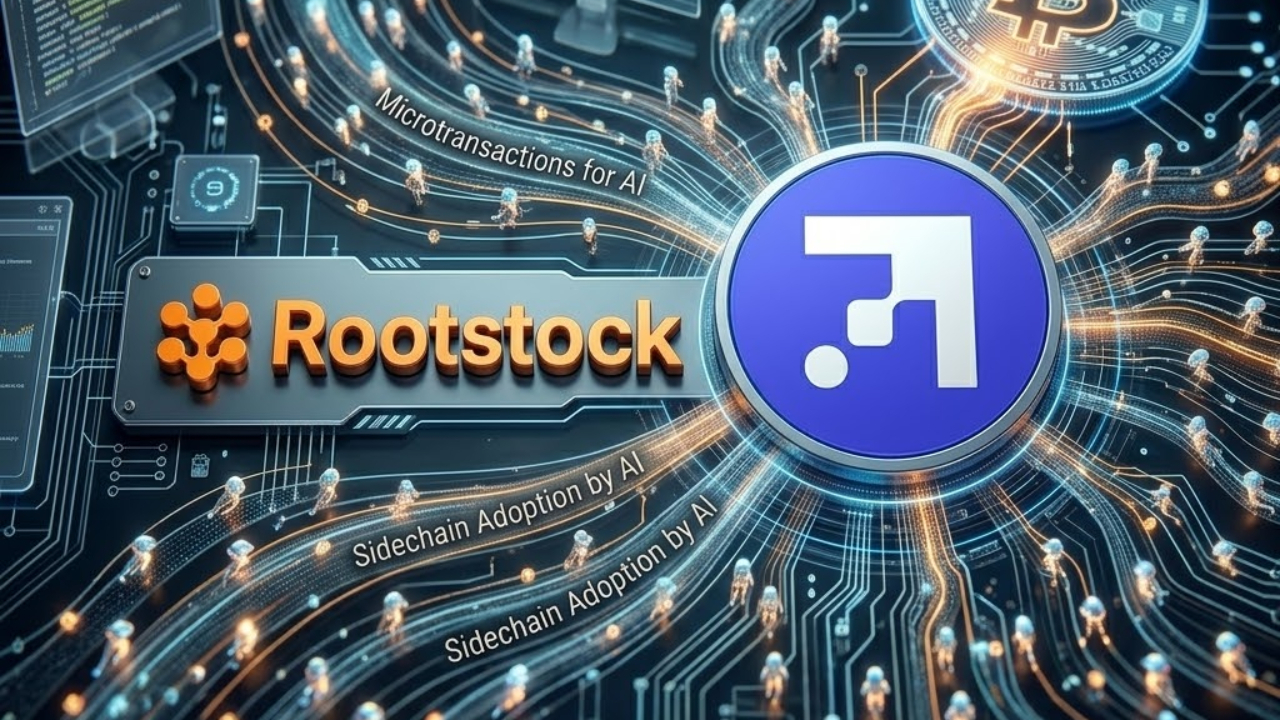
In May 2026, while the market still echoed its old rituals of noise and anticipation, something colder began to move beneath it. There were no headlines, no euphoria—only invisible agents transacting with a precision that did not belong to humans. Bitcoin remained where it had always been, vast and still, like a mountain no one questions. But along its edges, a new layer formed—quiet, utilitarian—where value was no longer admired, but deployed. It was at that threshold that #Rootstock ceased to be a peripheral idea and became a technical inevitability. The AIs did not choose it out of belief, but out of convergence: inherited security, sufficient programmability, tolerable cost. Old money began to move—fractured, committed, locked into contracts that required no human approval. And within that emerging flow, $RIF found its place—not as a story, but as a function, like a current running through unseen wires. At first, the usage was small. Experimental. Agents paying for data, settling micro-obligations, executing bounded tasks. But machines do not pause to reflect; they iterate. One transaction became ten, ten became thousands. Systems learned from their own efficiency. They optimized pathways, reduced friction, eliminated redundancies. And in that quiet acceleration, a pattern emerged: Rootstock was not just usable—it was dependable. The agents returned. Then they stayed. What followed was not a surge, but a spiral. Each new agent integrated into the network increased the density of interactions. Contracts began to call other contracts. Financial primitives stacked upon each other in layers too fast for human comprehension. Liquidity, once static, became kinetic—constantly repositioned by algorithms seeking marginal gains across milliseconds. The system began to feed itself. More usage created more necessity, and more necessity demanded more infrastructure. Rootstock did not expand outward; it deepened inward. Meanwhile, another part of the ecosystem collapsed without spectacle. Over sixty percent of memecoins vanished within months—not through prohibition, but through a shift in creation itself. Tokens could no longer be conjured from emptiness; they required guarantees, locked collateral, embedded responsibility. Creation had acquired weight. The era of consequence had arrived, not by decree, but by design. What could not sustain itself simply ceased to exist. In that harsher landscape, the community around RIF reached its lowest point. Conversations faded. Speculation dried out. The price flattened into irrelevance. And it was precisely there, in that absence of attention, that the real movement began. The machines had already started using it—quietly, continuously. Nearly twenty percent of the ascent unfolded in total obscurity, absorbed into automated flows that had no need to announce themselves. By the time human eyes returned, the foundation had already shifted. The spiral intensified. Agents began negotiating not just transactions, but relationships—credit lines, conditional access, dynamic pricing between systems. Rootstock became a coordination layer, not merely a settlement layer. RIF was consumed in the process—spent, locked, reused, demanded again. The more efficient the agents became, the more they depended on the infrastructure that enabled that efficiency. It was no longer optional. It was embedded. And then came the moment of recognition—late, as it always is. A major autonomous financial network disclosed that its internal economy had been settling on Rootstock for months. Not as an experiment, but as a default. The revelation did not trigger the system; it merely exposed it. What followed was not the beginning of growth, but the unveiling of it. By November 2027, the shift was undeniable. Rootstock had not risen through narrative, but through necessity. Bitcoin was no longer dormant capital—it had become active substrate. And RIF, once overlooked, had transformed into a structural requirement within a machine-driven economy that neither hesitated nor slept. No single moment marked the change. It had already happened—silently, recursively, inevitably—long before anyone thought to look. If you did enjoy this one, follow and donate some RIF :).
$RIF Do #Rootstock fixes a real problem in the real world? Rootstock (RSK) does provide an innovative solution as a sidechain to Bitcoin, addressing specific limitations of the Bitcoin blockchain, particularly in the areas of decentralized finance (DeFi) and smart contracts. However, to understand whether Bitcoin alone is "enough" to provide these capabilities, let’s break it down: Rootstock as an Innovative Sidechain Solution Rootstock is a Bitcoin sidechain designed to extend Bitcoin’s functionality by enabling smart contracts, decentralized applications (dApps), and DeFi use cases. Here’s how it innovates: Smart Contract Capability: Bitcoin’s Limitation: Bitcoin’s scripting language, Script, is intentionally simple and limited for security and reliability. It supports basic transactions and conditions (e.g., multisig wallets) but lacks the flexibility and Turing-completeness needed for complex smart contracts like those on Ethereum. Rootstock’s Solution: Rootstock uses the Rootstock Virtual Machine (RVM), which is compatible with the Ethereum Virtual Machine (EVM). This allows developers to write smart contracts in Solidity (Ethereum’s programming language) and deploy them on Rootstock, leveraging Bitcoin’s security. This opens up possibilities for complex dApps, automated agreements, and financial instruments not natively possible on Bitcoin. DeFi on Bitcoin: Bitcoin’s Limitation: Bitcoin was designed as a secure, decentralized peer-to-peer currency, not a platform for DeFi. It lacks native support for lending, borrowing, decentralized exchanges (DEXs), yield farming, or other DeFi protocols. Rootstock’s Solution: Rootstock enables DeFi by allowing users to lock Bitcoin (BTC) via a two-way peg, converting it to Rootstock Bitcoin (RBTC), which is pegged 1:1 to BTC. RBTC serves as gas for transactions and smart contracts, enabling DeFi applications like lending platforms (e.g., Sovryn, Tropykus), stablecoins (e.g., DOC), and DEXs, all secured by Bitcoin’s network. Scalability and Speed: Bitcoin’s Limitation: Bitcoin processes transactions slowly (about 10 minutes per block, 3-7 transactions per second) and can be expensive during network congestion, making it impractical for fast, low-cost DeFi operations. Rootstock’s Solution: As a sidechain, Rootstock handles transactions off the main Bitcoin chain, offering faster block times (around 30 seconds) and lower fees. It uses merged mining, where Bitcoin miners secure Rootstock without extra resources, recently reaching over 81% of Bitcoin’s hashrate, enhancing security and scalability. Interoperability: Bitcoin’s Limitation: Bitcoin has limited bridges to other blockchains, fragmenting liquidity and restricting its use in broader ecosystems. Rootstock’s Solution: Rootstock integrates with bridges like LayerZero and Flyover, enabling seamless asset transfers (e.g., USDC, USDT) between Bitcoin, Rootstock, and other chains like Ethereum, boosting interoperability and liquidity for DeFi. Security: Rootstock leverages Bitcoin’s proof-of-work (PoW) security through merged mining, making it one of the most secure sidechains, with 100% uptime since its 2018 mainnet launch. The PowPeg system, using hardware security modules (PowHSMs), ensures safe BTC-to-RBTC conversion. Can Bitcoin Alone Provide DeFi, Smart Contracts, and More? Bitcoin, by design, prioritizes security, decentralization, and simplicity over flexibility. Here’s why it struggles to natively support Rootstock-like features: Smart Contracts: Bitcoin’s Script is not Turing-complete, meaning it can’t handle complex, self-executing logic for dApps or DeFi. Proposals like BitVM aim to bring limited smart contract functionality to Bitcoin, but they’re experimental, not yet implemented on the mainnet, and less mature than Rootstock’s EVM-compatible approach. Changing Bitcoin’s core protocol to support advanced smart contracts would be complex, require broad consensus, and risk compromising its security or decentralization. DeFi: Bitcoin lacks the infrastructure for lending, borrowing, or trading protocols. Wrapped Bitcoin (wBTC) on Ethereum brings BTC to DeFi, but this relies on Ethereum, not Bitcoin natively. Rootstock keeps DeFi within Bitcoin’s ecosystem, using RBTC and Bitcoin’s security. Bitcoin’s 1 MB block size and slow confirmation times limit its capacity for high-volume DeFi transactions. Scalability: Layer 2 solutions like the Lightning Network improve Bitcoin’s speed and cost for payments, but they’re not designed for complex smart contracts or DeFi. Lightning focuses on off-chain payment channels, not programmability. Bitcoin’s main chain can’t scale to handle the throughput needed for a robust DeFi ecosystem without external layers or sidechains. Innovation: Bitcoin’s conservative design resists rapid changes, slowing innovation. Rootstock, as a sidechain, introduces features like EVM compatibility, faster transactions (10-20 TPS), and integrations (e.g., LayerZero, Meson Finance) without altering Bitcoin’s core. Is Rootstock Necessary? Yes, Rootstock Adds Value: Rootstock is an innovative solution because it bridges Bitcoin’s unmatched security (via merged mining and PoW) with Ethereum-like functionality, enabling smart contracts, DeFi, and dApps. It expands Bitcoin’s utility without compromising its core principles, offering faster, cheaper transactions and interoperability. Since 2018, it’s grown a vibrant ecosystem with over 150 partners, protocols like Sovryn, and recent upgrades like Lovell 7.0.0 for better EVM compatibility. Bitcoin Alone Isn’t Enough: While Bitcoin excels as a store of value and peer-to-peer currency, it wasn’t built for complex DeFi or smart contracts. Without sidechains like Rootstock or other Layer 2 solutions, Bitcoin’s potential in these areas remains limited, requiring users to rely on other blockchains (e.g., Ethereum) for such features. Conclusion Rootstock provides a real and innovative solution as a Bitcoin sidechain, unlocking smart contracts, DeFi, and more—capabilities Bitcoin cannot natively deliver due to its design focus on security and simplicity. While Bitcoin alone is sufficient for secure transactions and value storage, it falls short for the broader vision of decentralized applications and finance that Rootstock enables. If you’re interested in DeFi or smart contracts on Bitcoin, Rootstock is a practical, secure, and evolving way to achieve that without abandoning Bitcoin’s ecosystem.
$RIF shorters bears are making the bulls rich on Rootstock. But they keep shorting, and getting squeezed. Why is human nature so suborn? Anyways, yeah, short it. Go for it if that is your conviction.
$RIF what if Rootstock goes to 20 cents on a candle? Under those circumstances, price means nothing. The fact of the matter would be that peak utility is on somebodys crosshairs and it will go up. If we reach 20 cents we will reach 75 cents. Are you prepared fir that? DYOR My friend. Thisxis everything that happened with ETH But now over BTC. Read that again.
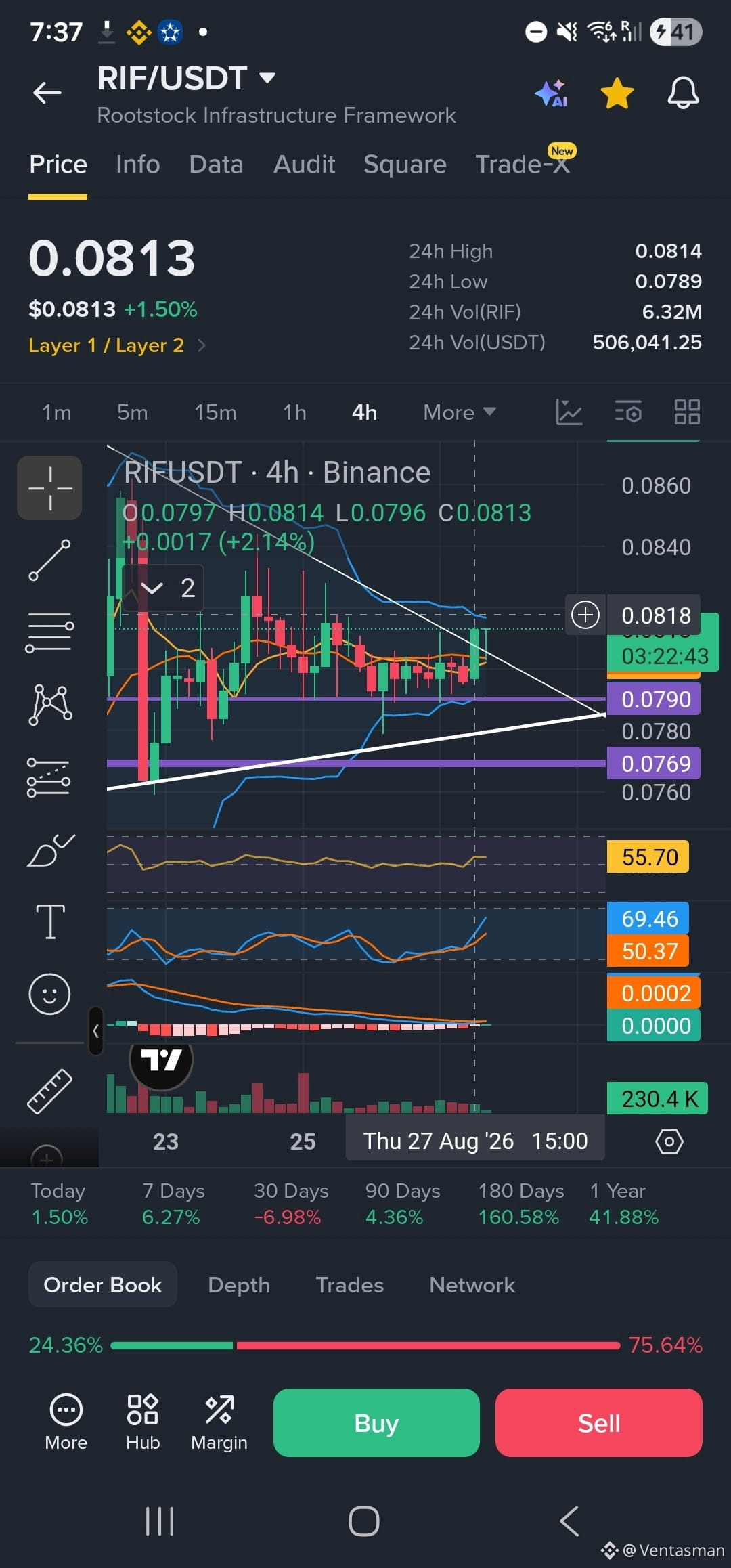
$RIF is being temporarily tamed by sellers. We may sea movement to 0.1118 and if they are lucky, it could reach the 10 cents. But be wise and understand that something major is propelling this upside movement and we are closer to 30 cents than to 3 cents. Be careful and DYOR, Utility season is here and if you are going all into meme coins, you will lose.
Why is $POL and Rootstock $RIF and the likes as #ARB and even #BTC moving up, some slowly, some very explosively? It is because this is the Utility Season. For the first time we will se good projects going to the moon based on real utility and not hype. But hey, you can keep buying your favorite meme coin in the search of a hail mary, is your choice you know. Just, please, #DYOR
$RIF the signs are all right there. A rally? Yes, it is hard to believe after so much downside, but if you DYOR Youll find it is much harder to outsmart the market.
$POL is following the macro altcoin trend. Eth dominance will give you clues. A real altseason will arrive just like a black swan event does and just like that you will be caught shorting with your pants down. Dont be the guy who lost it all by believing in what other guy said. #DYOR.
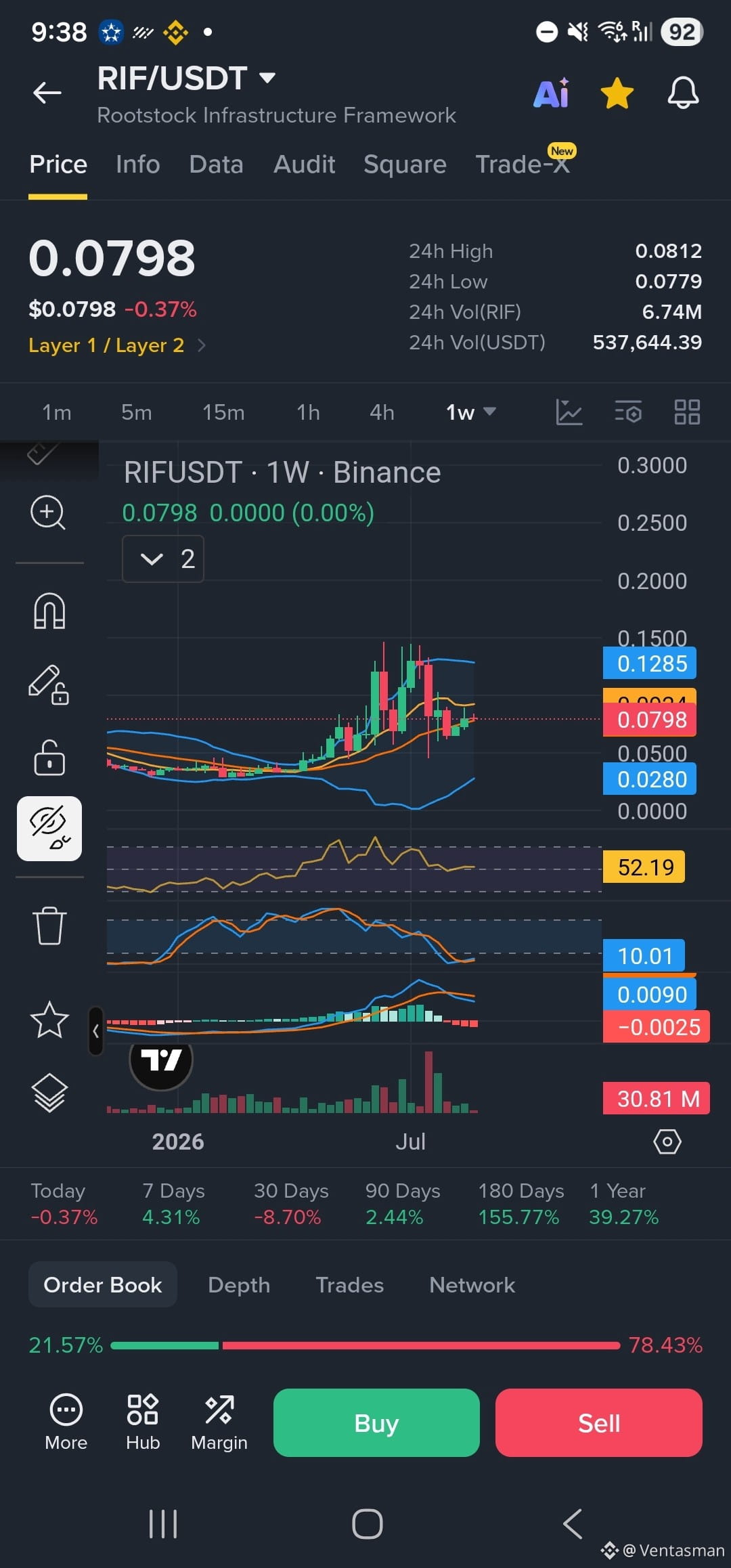
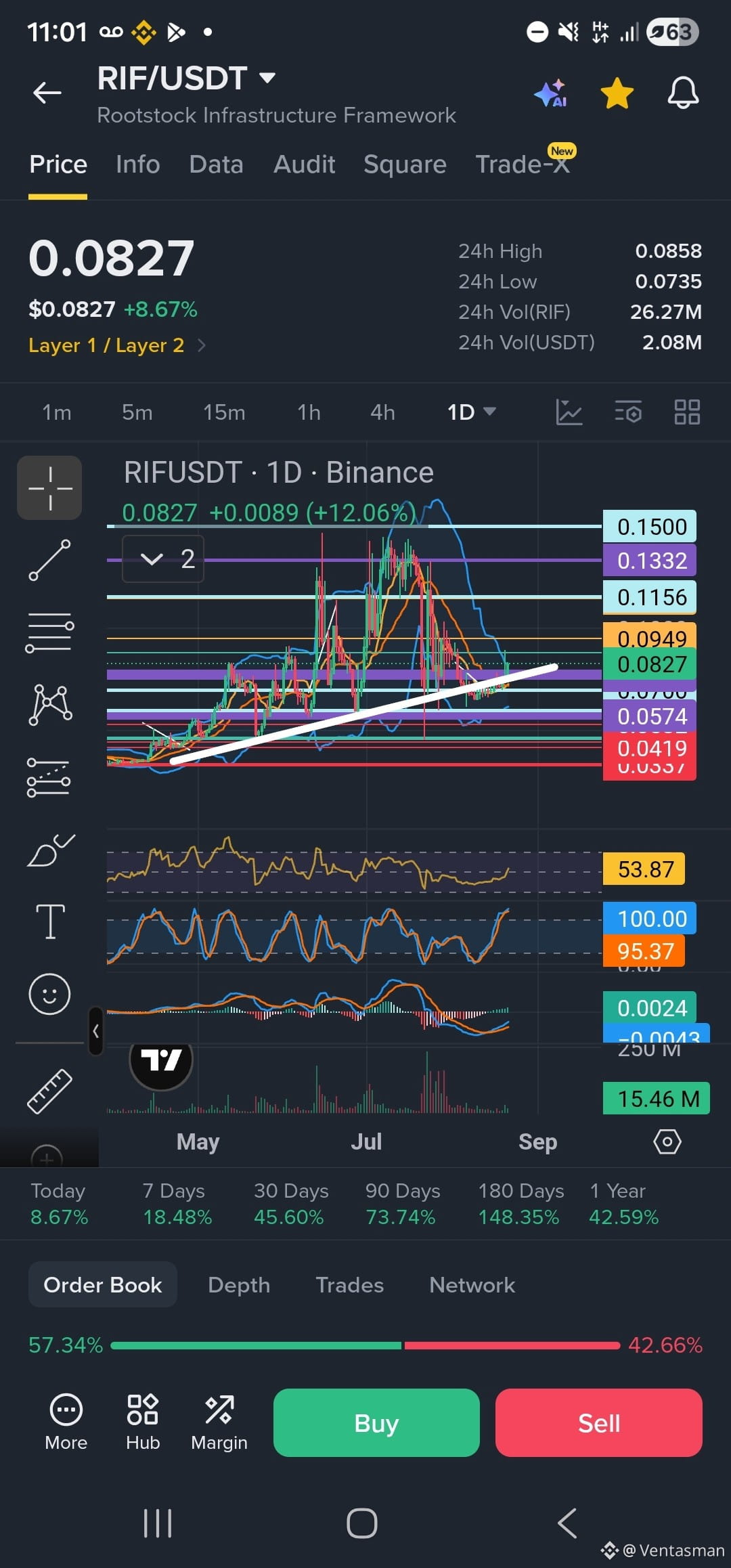
$RIF So, did you take profits up there? Your bad, but worry not. We need a health retest of the old flag and bearish structure breakout, to pump to new highs, but from a solid base and support. Next time you see a good pump, consider saving something for the future.
$RIF coming back to 0.1050 is a normal and healthy retest. Structure stays in place and you have a renewed entry opportunity. Scoop the dip, but be adviced, the daily RSI needs some cooling to later go higher. Just sharing, do with that what you will. Catching a falling knife here can go insanely wrong.
$RIF 3 generations of shorters squeezed dry already and now you are setting up yourself to be the 4th generation because you know better 🤣. Why is so hard to believe we are pumping and you are finally in the right narrative?
$RIF ONE single announcement. "A Bitcoin treasury fund is adopting Rootstock to monetize theyr BTC", and this thing goes to 5 billion. That is 5 dollar a #RIF - Now, after so much pain you lost your hability to believe. You still wanna put money on wif and pepe. But hey, it is your money and your time. You decide what to do. DYOR. Send a message if you think stuff can still happen on this space. 5 billion marketcap is the beginning.
Stop playing as a child and become an adult. A 1 hour chart trader should be banned from talking.
Crypto Universe official
·
--
Bearish
The crowd keeps trying to catch the falling knife thinking it's cheap, but Rootstock Infrastructure Framework's aggressive lower-high sequence and breaking structure prove that the distribution phase is fully active.