
Muhammad Umer Arshad
362 Posts

Muhammad Umer Arshad
here I provide everything I do every trade I do and I also provide trading singnals
Open Trade
High-Frequency Trader
2.5 Years
31 Following
52 Followers
359 Liked
Posts
Portfolio
All
Quotes
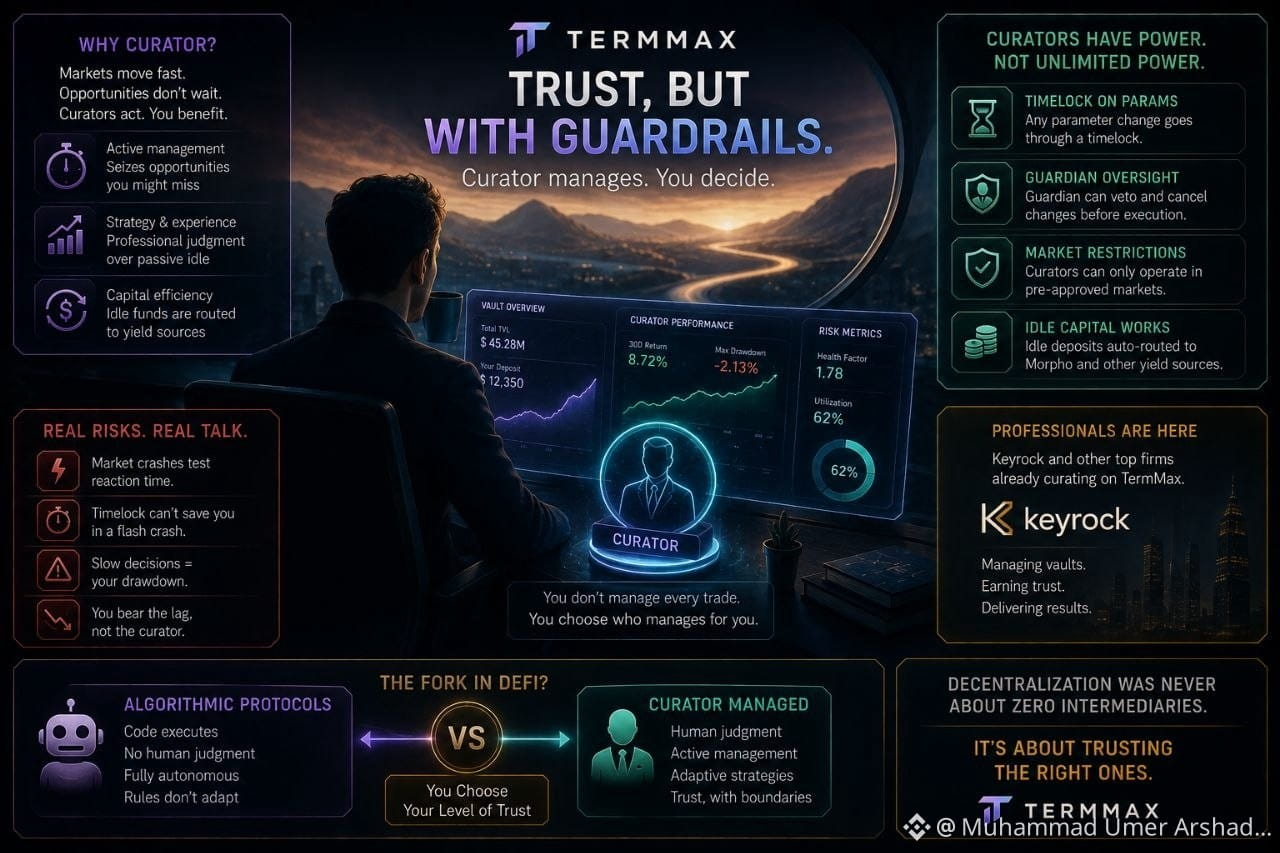
Kept digging into TermMax, and today it was the Curator role that stopped me cold. DeFi's whole pitch is cutting out middlemen, and here's a protocol handing fund management back to a person. Felt like a step backward before I'd even read the details.
Tried it anyway. Deposited into a vault and let it run without touching anything. The uncomfortable part wasn't the mechanism, it was the trust question underneath it. I pulled up the curator's on-chain history and honestly couldn't parse most of it. All I could really confirm was whether they'd lost money before. Sat with that uncertainty for a while before deciding it was fine.
Eventually it clicked, this is just what being a depositor actually means here. You're not removing trust, you're betting someone else's judgment beats sitting idle.
What eased it some was looking closer at what curators can't do. Parameter changes run through a timelock. A Guardian role can step in and cancel changes before they take effect. Curators are also restricted to pre-approved markets, they can't just wander into anything. On top of that, idle deposits get automatically routed into yield sources like Morpho, so capital isn't just sitting dead while waiting to be matched.
Still not fully settled on whether those guardrails hold up in a genuine crisis. A timelock doesn't help much in the middle of an active liquidation cascade. If a curator reacts too slowly, depositors absorb that lag regardless of what protections exist on paper.
Established names like Keyrock are already running curator vaults here, which at least tells me the skepticism isn't just mine.
My read: Curator might be DeFi's actual fork in the road, pure algorithmic protocols on one side, human-managed treasuries on the other. Decentralization was always meant to remove intermediaries you can't audit, not intermediaries themselves. That's where I'm landing on it for now.
@TermMax #TermMax #BinanceSquareTalks
Tried it anyway. Deposited into a vault and let it run without touching anything. The uncomfortable part wasn't the mechanism, it was the trust question underneath it. I pulled up the curator's on-chain history and honestly couldn't parse most of it. All I could really confirm was whether they'd lost money before. Sat with that uncertainty for a while before deciding it was fine.
Eventually it clicked, this is just what being a depositor actually means here. You're not removing trust, you're betting someone else's judgment beats sitting idle.
What eased it some was looking closer at what curators can't do. Parameter changes run through a timelock. A Guardian role can step in and cancel changes before they take effect. Curators are also restricted to pre-approved markets, they can't just wander into anything. On top of that, idle deposits get automatically routed into yield sources like Morpho, so capital isn't just sitting dead while waiting to be matched.
Still not fully settled on whether those guardrails hold up in a genuine crisis. A timelock doesn't help much in the middle of an active liquidation cascade. If a curator reacts too slowly, depositors absorb that lag regardless of what protections exist on paper.
Established names like Keyrock are already running curator vaults here, which at least tells me the skepticism isn't just mine.
My read: Curator might be DeFi's actual fork in the road, pure algorithmic protocols on one side, human-managed treasuries on the other. Decentralization was always meant to remove intermediaries you can't audit, not intermediaries themselves. That's where I'm landing on it for now.
@TermMax #TermMax #BinanceSquareTalks
Verified
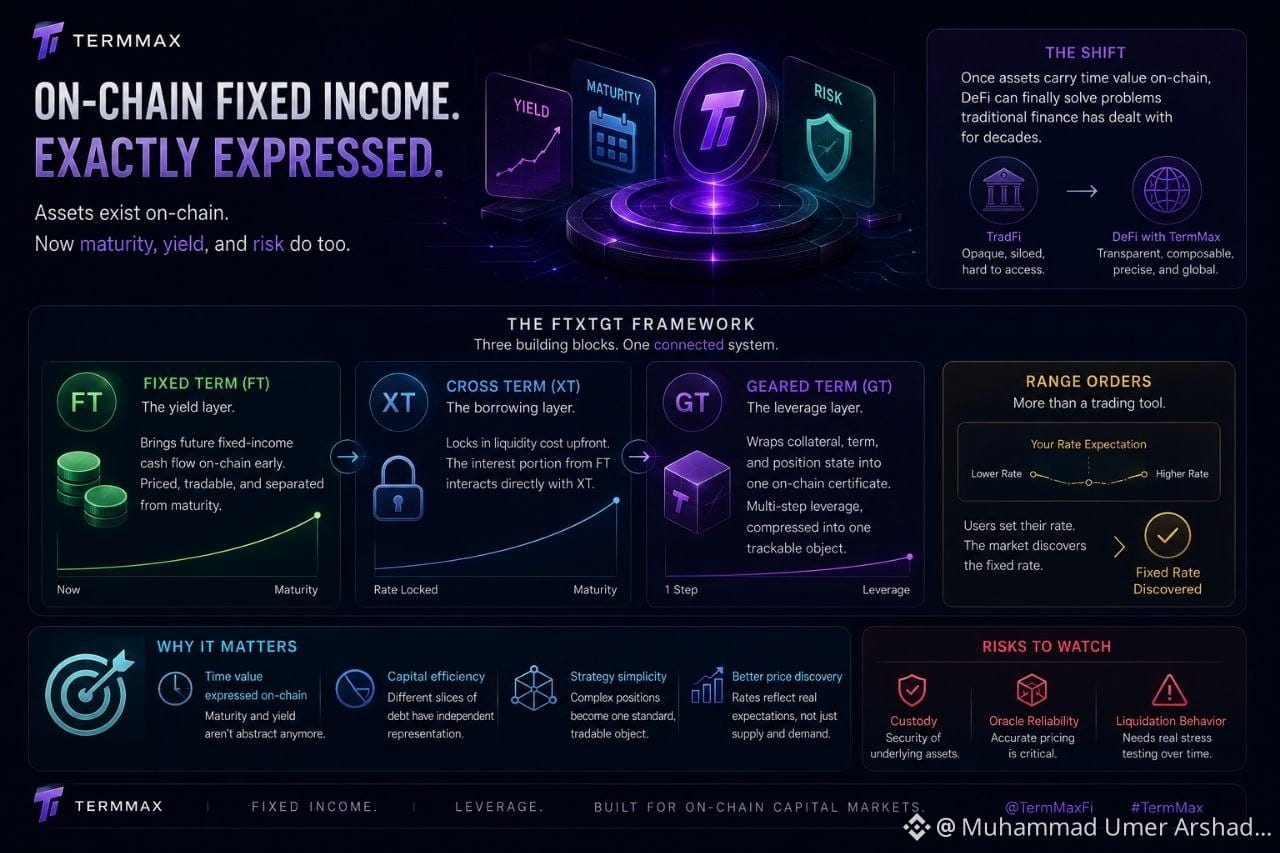
Was sorting through my TermMax notes late last night, originally just trying to nail down how FT, XT, and GT actually connect. Ended up stuck on the GT section for a while, one question kept nagging at me: if a leveraged position itself could be standardized into a single tradable object, wouldn't managing complex strategies get a lot simpler.
That question is what pulled me deeper. TermMax isn't just another lending market bolted onto DeFi's existing playbook. It's addressing something DeFi has quietly avoided for years, assets exist on-chain, but the maturity, yield, and risk sitting behind those assets rarely get expressed with any real precision.
FT was the easiest piece to grasp. It brings future fixed-income cash flow on-chain early, priced and tradable well before maturity instead of locked away as an abstract promise. The interest portion inside FT can be separated out and interacts directly with XT, giving different slices of the same debt their own independent representation.
GT is the part that actually stuck with me. It wraps collateral, term, and position state into one on-chain certificate. What used to take a multi-step manual leverage process gets compressed into a single trackable object. That's the moment the whole design clicked for me.
Range Orders shifted my attention again, not just as a trading tool, but as a rate discovery mechanism. Instead of rates adjusting passively off supply and demand like most DeFi lending, users express their own rate expectations directly, and the market finds the fixed rate from there.
Custody, oracle reliability, and liquidation behavior still need real stress-testing over time. But the core shift stands out either way, once on-chain assets can actually carry time value, DeFi starts touching problems traditional finance has dealt with for decades.
That's reason enough to keep watching this one closely.
@TermMax #TermMax
That question is what pulled me deeper. TermMax isn't just another lending market bolted onto DeFi's existing playbook. It's addressing something DeFi has quietly avoided for years, assets exist on-chain, but the maturity, yield, and risk sitting behind those assets rarely get expressed with any real precision.
FT was the easiest piece to grasp. It brings future fixed-income cash flow on-chain early, priced and tradable well before maturity instead of locked away as an abstract promise. The interest portion inside FT can be separated out and interacts directly with XT, giving different slices of the same debt their own independent representation.
GT is the part that actually stuck with me. It wraps collateral, term, and position state into one on-chain certificate. What used to take a multi-step manual leverage process gets compressed into a single trackable object. That's the moment the whole design clicked for me.
Range Orders shifted my attention again, not just as a trading tool, but as a rate discovery mechanism. Instead of rates adjusting passively off supply and demand like most DeFi lending, users express their own rate expectations directly, and the market finds the fixed rate from there.
Custody, oracle reliability, and liquidation behavior still need real stress-testing over time. But the core shift stands out either way, once on-chain assets can actually carry time value, DeFi starts touching problems traditional finance has dealt with for decades.
That's reason enough to keep watching this one closely.
@TermMax #TermMax
Verified
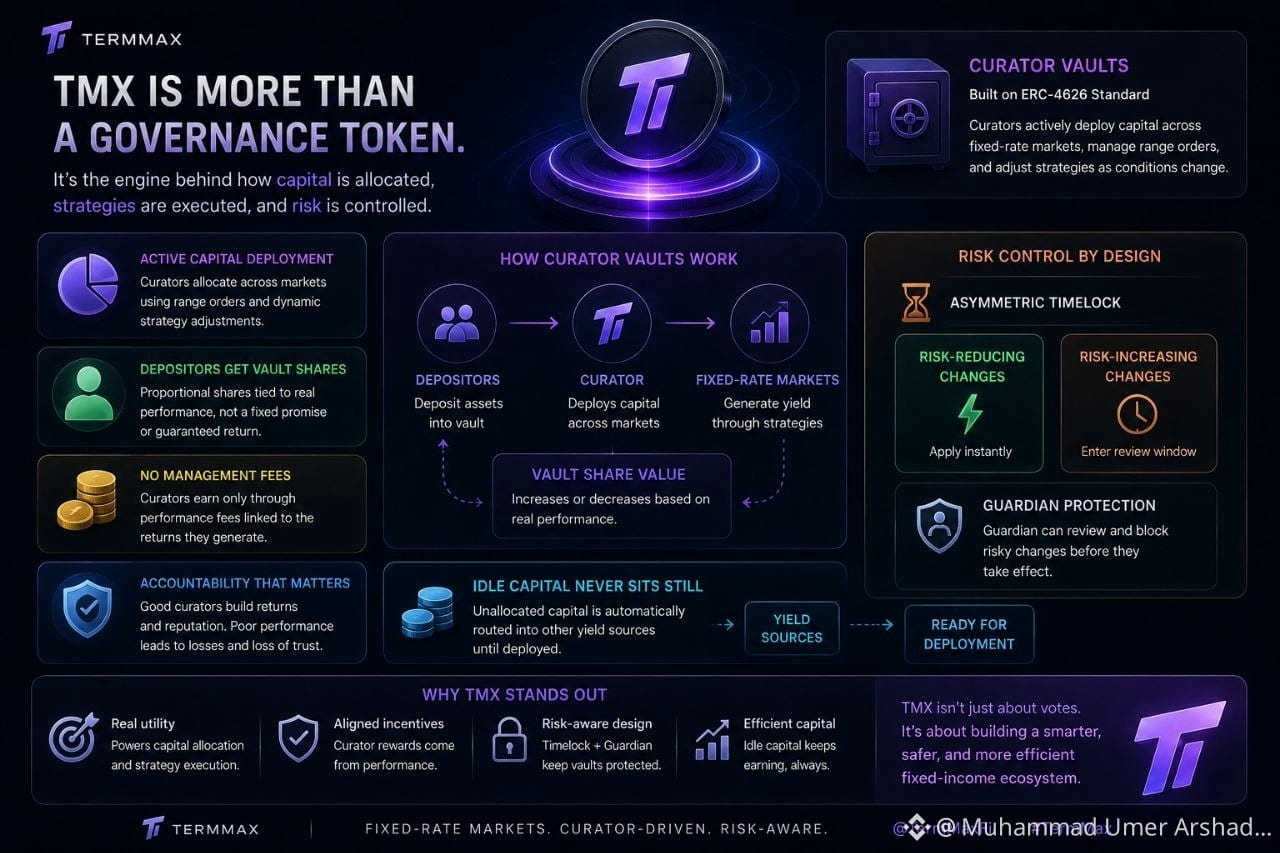
Missed a trade this week that apparently ran hard while I wasn't watching. Instead of chasing the next hype cycle, I spent the time actually reading through TermMax's TMX design, and what stood out wasn't the "governance token" label, it's how much real function sits underneath it.
The part worth understanding is Curator Vaults. These aren't simple voting rights bolted onto a token. Vaults are ERC-4626 standard, meaning curators actively deploy deposited capital across different fixed-rate markets, running range orders and adjusting strategy as conditions shift. Depositors get proportional vault shares tied to actual performance, not a fixed promise.
What makes this different from typical DeFi governance is the accountability built in. TermMax doesn't charge protocol management fees, curators only earn through performance fees tied directly to returns they generate. Good curators get rewarded, weak ones lose deposits and reputation. Changes to a vault's parameters go through an asymmetric timelock too, risk-reducing changes apply instantly, but anything that increases risk sits in a review window where a Guardian role can step in and block it before it takes effect.
Idle capital doesn't just sit dead either, it gets automatically routed into other yield sources while waiting to be matched into a position.
This is what makes TMX worth more attention than a typical governance token pitch. It's tied into how capital actually gets allocated and how risk gets reviewed, not just a vote that happens after the fact.
@TermMax #TermMax
The part worth understanding is Curator Vaults. These aren't simple voting rights bolted onto a token. Vaults are ERC-4626 standard, meaning curators actively deploy deposited capital across different fixed-rate markets, running range orders and adjusting strategy as conditions shift. Depositors get proportional vault shares tied to actual performance, not a fixed promise.
What makes this different from typical DeFi governance is the accountability built in. TermMax doesn't charge protocol management fees, curators only earn through performance fees tied directly to returns they generate. Good curators get rewarded, weak ones lose deposits and reputation. Changes to a vault's parameters go through an asymmetric timelock too, risk-reducing changes apply instantly, but anything that increases risk sits in a review window where a Guardian role can step in and block it before it takes effect.
Idle capital doesn't just sit dead either, it gets automatically routed into other yield sources while waiting to be matched into a position.
This is what makes TMX worth more attention than a typical governance token pitch. It's tied into how capital actually gets allocated and how risk gets reviewed, not just a vote that happens after the fact.
@TermMax #TermMax
Verified
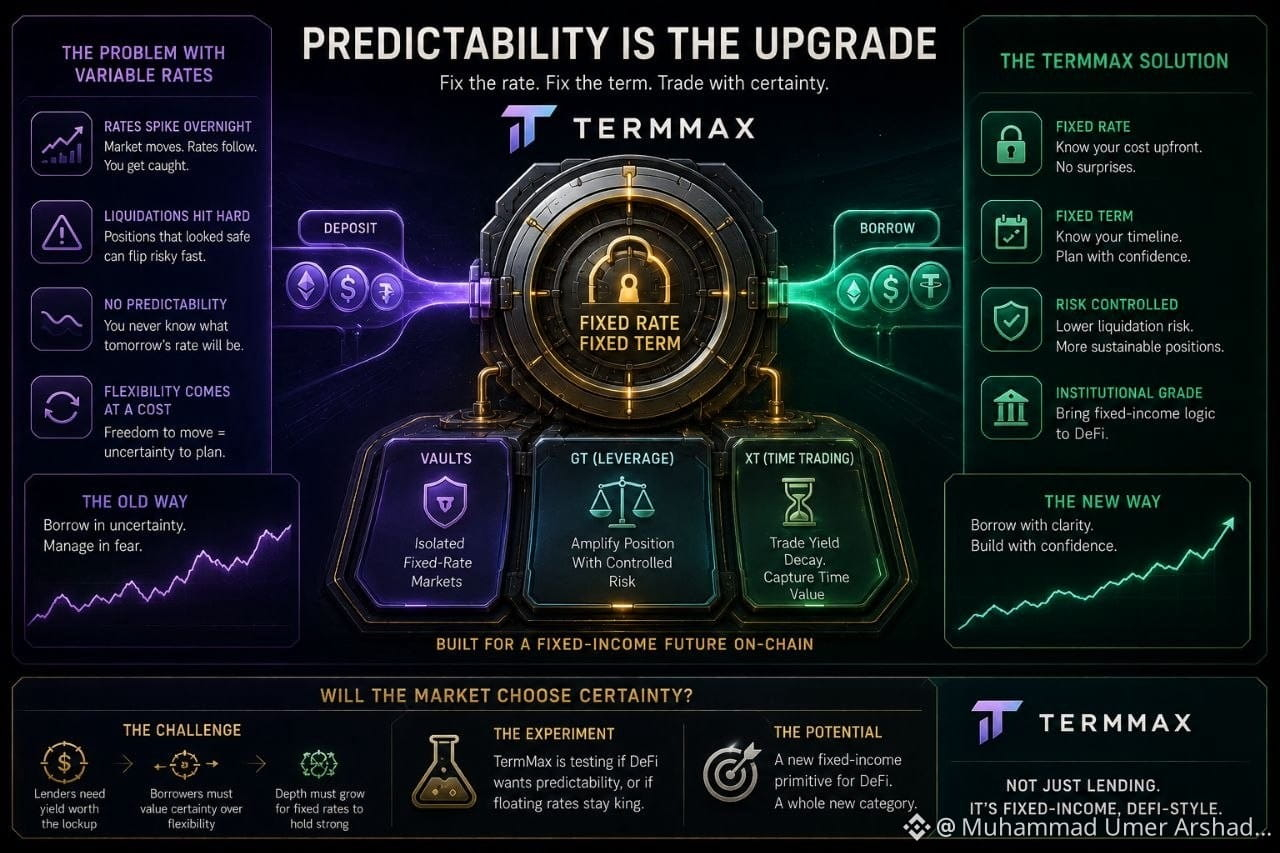
Came across TermMax while scrolling through project pages, and what stood out is how directly it goes after the "variable rate" problem in DeFi lending. Anyone who's been through an Aave or Compound cycle knows the pain, rates spike overnight when the market moves, and liquidations catch people off guard even when they thought their position was safe. TermMax's fix is straightforward, once you open a position, both the rate and the term are locked. You know exactly how much you owe and exactly when, from day one.
It's a solid idea on paper. TermMax isn't just doing plain lending either, it's layering in vaults, leverage through GT, and time-decay trading through XT, basically trying to bring the fixed-income mindset from traditional finance on-chain in full. But that raises a real question. Can that kind of certainty actually hold up in DeFi long-term? Fixed rates only work if both sides show up for it, lenders need the yield to feel worth the lockup, and borrowers need to actually want a fixed term instead of the flexibility to exit anytime. If depth isn't there, "fixed" is just a number sitting on top of thin liquidity.
That's the tension I keep coming back to. DeFi's whole appeal has been speed and flexibility. Locking terms and rates goes against that instinct, even if it solves a real problem. TermMax is essentially running that experiment for the entire sector right now, testing whether predictability is something users actually want once they can get it, or whether floating rates stay the default because people prefer the option to move.
Whether this becomes a real category or stays a niche corner of DeFi is still an open question worth watching.
@TermMax #TermMax
It's a solid idea on paper. TermMax isn't just doing plain lending either, it's layering in vaults, leverage through GT, and time-decay trading through XT, basically trying to bring the fixed-income mindset from traditional finance on-chain in full. But that raises a real question. Can that kind of certainty actually hold up in DeFi long-term? Fixed rates only work if both sides show up for it, lenders need the yield to feel worth the lockup, and borrowers need to actually want a fixed term instead of the flexibility to exit anytime. If depth isn't there, "fixed" is just a number sitting on top of thin liquidity.
That's the tension I keep coming back to. DeFi's whole appeal has been speed and flexibility. Locking terms and rates goes against that instinct, even if it solves a real problem. TermMax is essentially running that experiment for the entire sector right now, testing whether predictability is something users actually want once they can get it, or whether floating rates stay the default because people prefer the option to move.
Whether this becomes a real category or stays a niche corner of DeFi is still an open question worth watching.
@TermMax #TermMax
Three years in DeFi, and the one thing that's actually broken my patience isn't low yield, it's not knowing when my own money is coming back to me.
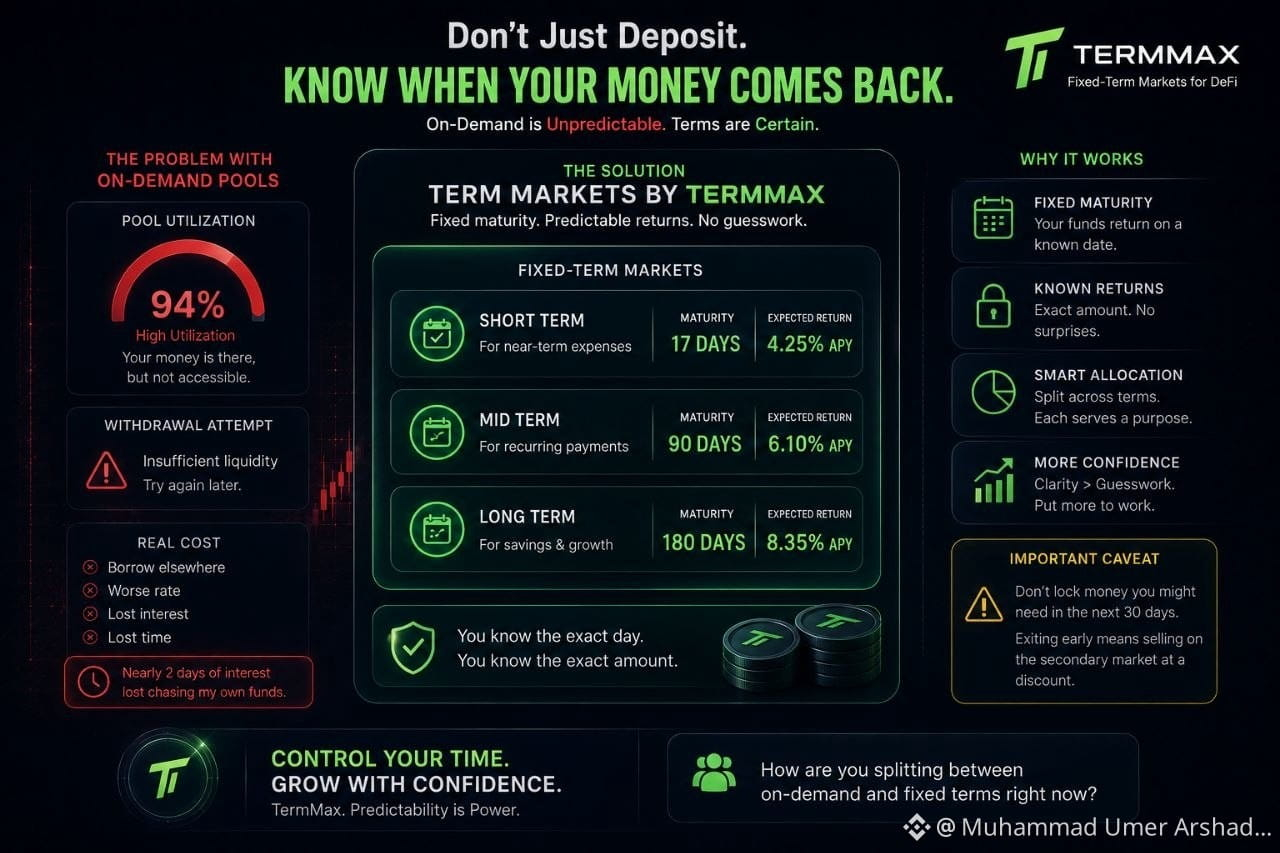
Here's what happened to me last month. I had funds sitting in a floating-rate pool, planning to pull them out on the 17th to cover a hardware payment. Tried withdrawing two days early and found the pool sitting at 94% utilization, almost nothing left to withdraw. My money was technically there, just not accessible. Had to borrow elsewhere at a worse rate just to cover the gap. Lost close to two days of interest chasing my own funds.
That's when I switched to managing my positions through TermMax's fixed-term markets instead.
The issue with on-demand pools is structural. Your withdrawal isn't actually guaranteed the moment you deposit, it depends entirely on how much other people have borrowed against that same pool at that exact moment.
Term markets remove that guesswork. Every market has a fixed maturity date, stated upfront. You know the exact day your funds return and the exact amount. I now split deposits across terms, a short one for near-term expenses, a mid one for recurring payments, a longer one I treat as untouched savings. Each bucket has one job.
I resisted locked terms at first, most crypto users do, locking money feels like giving up flexibility. What actually happened was the opposite. Knowing precisely when each portion returns made me comfortable putting a larger share of my funds to work instead of sitting idle.
One caveat worth repeating: don't put money you might need inside 30 days into a term position. Exiting early means selling on the secondary market at a discount.
How are you splitting between on-demand and fixed terms right now?
@TermMax #TermMax
Here's what happened to me last month. I had funds sitting in a floating-rate pool, planning to pull them out on the 17th to cover a hardware payment. Tried withdrawing two days early and found the pool sitting at 94% utilization, almost nothing left to withdraw. My money was technically there, just not accessible. Had to borrow elsewhere at a worse rate just to cover the gap. Lost close to two days of interest chasing my own funds.
That's when I switched to managing my positions through TermMax's fixed-term markets instead.
The issue with on-demand pools is structural. Your withdrawal isn't actually guaranteed the moment you deposit, it depends entirely on how much other people have borrowed against that same pool at that exact moment.
Term markets remove that guesswork. Every market has a fixed maturity date, stated upfront. You know the exact day your funds return and the exact amount. I now split deposits across terms, a short one for near-term expenses, a mid one for recurring payments, a longer one I treat as untouched savings. Each bucket has one job.
I resisted locked terms at first, most crypto users do, locking money feels like giving up flexibility. What actually happened was the opposite. Knowing precisely when each portion returns made me comfortable putting a larger share of my funds to work instead of sitting idle.
One caveat worth repeating: don't put money you might need inside 30 days into a term position. Exiting early means selling on the secondary market at a discount.
How are you splitting between on-demand and fixed terms right now?
@TermMax #TermMax
Verified
Was scrolling through Babylon's whitepaper late one night and got stuck on one number, market cap in the trillions. My first instinct was simple, bigger asset means safer staking, case closed. Dropped that thought fast though, because it was leaning on an old assumption I hadn't actually questioned. Rereading Section 2 properly is what actually changed my thinking.
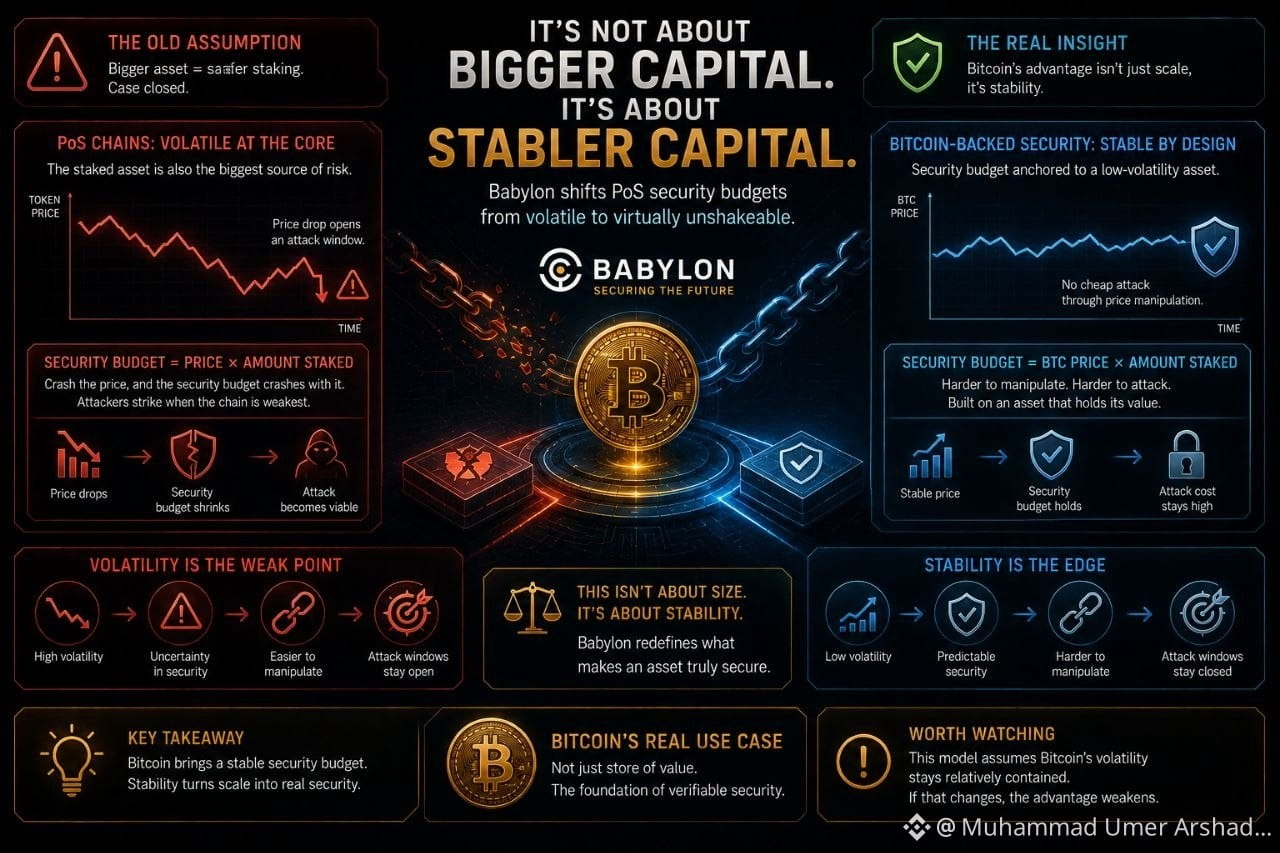
I'd always assumed Bitcoin's advantage was purely scale. One line stopped me cold though, the paper states that PoS chain security is a direct function of the staked asset's market cap, and a sharp price drop opens a real attack window.
Worked out the logic on paper afterward. Security budget equals staked asset price multiplied by amount staked. Crash the native token's price, and the security budget crashes with it, opening the door for an attacker exactly when the chain is weakest. That's a structural flaw baked into every PoS chain, the staked asset is also the biggest source of risk. Bitcoin's relatively low volatility acts like a stabilizer plugged into that fragile equation.
What Babylon actually does isn't bringing in bigger capital, it's bringing in stabler capital. It shifts the security budget's volatility profile away from a swingy native token toward Bitcoin instead. Attackers can't cheapen their attack by simply waiting for a price dump, because the underlying stake isn't an easily manipulated altcoin anymore.
This isn't optimizing budget size, it's redefining what counts as a genuinely secure asset. Size alone isn't enough, size paired with stability is what matters. Bitcoin finally has a real use case built around that specific trait.
Worth flagging honestly, this entire model assumes Bitcoin's volatility stays relatively contained going forward. If that changes and BTC starts behaving like a volatile altcoin, this advantage weakens along with it. Still watching that assumption closely.
@BabylonLabs_io #baby $BABY
I'd always assumed Bitcoin's advantage was purely scale. One line stopped me cold though, the paper states that PoS chain security is a direct function of the staked asset's market cap, and a sharp price drop opens a real attack window.
Worked out the logic on paper afterward. Security budget equals staked asset price multiplied by amount staked. Crash the native token's price, and the security budget crashes with it, opening the door for an attacker exactly when the chain is weakest. That's a structural flaw baked into every PoS chain, the staked asset is also the biggest source of risk. Bitcoin's relatively low volatility acts like a stabilizer plugged into that fragile equation.
What Babylon actually does isn't bringing in bigger capital, it's bringing in stabler capital. It shifts the security budget's volatility profile away from a swingy native token toward Bitcoin instead. Attackers can't cheapen their attack by simply waiting for a price dump, because the underlying stake isn't an easily manipulated altcoin anymore.
This isn't optimizing budget size, it's redefining what counts as a genuinely secure asset. Size alone isn't enough, size paired with stability is what matters. Bitcoin finally has a real use case built around that specific trait.
Worth flagging honestly, this entire model assumes Bitcoin's volatility stays relatively contained going forward. If that changes and BTC starts behaving like a volatile altcoin, this advantage weakens along with it. Still watching that assumption closely.
@BabylonLabs_io #baby $BABY
There's one thing that scares me more than actual volatility when I'm trading, an order book that looks deep but the market maker behind it is nearly out of ammunition. Quotes vanish all at once the moment things get stressed, and nobody sees it coming from the surface.
Same pattern applies to how I now think about Babylon's Finality Providers.
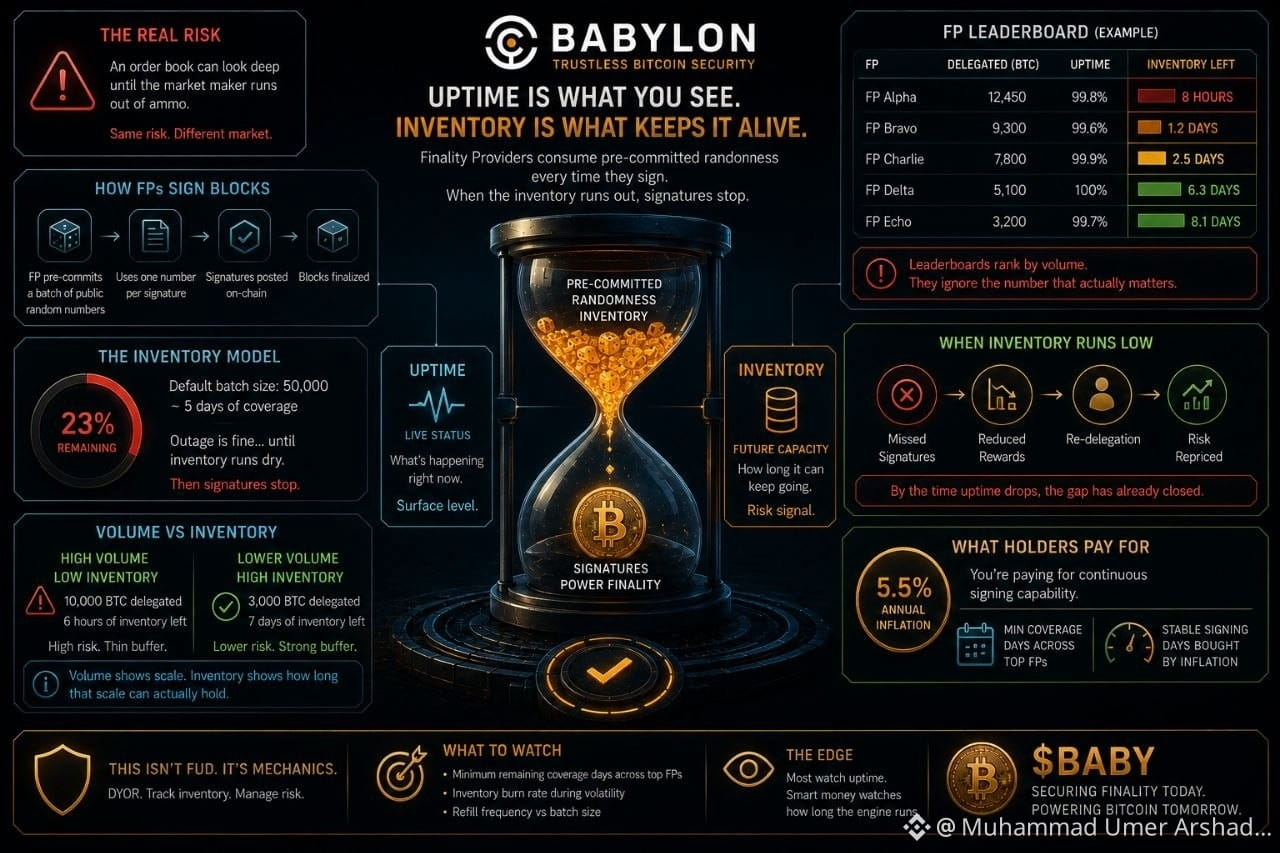
Every time an FP signs a block, it draws from a pre-committed batch of public random numbers, prepared in advance, not generated on the fly. Default batch size is 50,000, roughly five days of coverage.
A brief outage barely matters while that inventory holds. But once it runs dry, an FP can show ACTIVE status while quietly missing signatures, simply because there's no coverage left to work with.
Uptime only tells you what's happening right now. Remaining inventory tells you how close something is to breaking.
Public leaderboards rank FPs by delegated volume with real precision, but they skip the one number that actually matters for risk, how many continuous days of signing capacity each top FP has left. An FP managing 10,000 BTC with six hours of inventory left is thinner, in real terms, than one managing 3,000 BTC with seven days remaining. Volume alone hides that gap completely.
As top FP inventories shrink, the sequence tends to go: missed signatures first, reduced rewards next, re-delegation after that, and only then does the market actually reprice the risk around $BABY .
By the time uptime numbers visibly drop on a dashboard, that information gap has already closed against you.
With BABY's annual inflation sitting at 5.5%, what holders are really paying for is continuous signing capability. A more useful metric than uptime: minimum remaining coverage days across top FPs, and how many stable signing days that inflation is actually buying.
Delegated volume shows scale. Signing inventory shows how long that scale can actually hold. DYOR.
@BabylonLabs_io #baby
Same pattern applies to how I now think about Babylon's Finality Providers.
Every time an FP signs a block, it draws from a pre-committed batch of public random numbers, prepared in advance, not generated on the fly. Default batch size is 50,000, roughly five days of coverage.
A brief outage barely matters while that inventory holds. But once it runs dry, an FP can show ACTIVE status while quietly missing signatures, simply because there's no coverage left to work with.
Uptime only tells you what's happening right now. Remaining inventory tells you how close something is to breaking.
Public leaderboards rank FPs by delegated volume with real precision, but they skip the one number that actually matters for risk, how many continuous days of signing capacity each top FP has left. An FP managing 10,000 BTC with six hours of inventory left is thinner, in real terms, than one managing 3,000 BTC with seven days remaining. Volume alone hides that gap completely.
As top FP inventories shrink, the sequence tends to go: missed signatures first, reduced rewards next, re-delegation after that, and only then does the market actually reprice the risk around $BABY .
By the time uptime numbers visibly drop on a dashboard, that information gap has already closed against you.
With BABY's annual inflation sitting at 5.5%, what holders are really paying for is continuous signing capability. A more useful metric than uptime: minimum remaining coverage days across top FPs, and how many stable signing days that inflation is actually buying.
Delegated volume shows scale. Signing inventory shows how long that scale can actually hold. DYOR.
@BabylonLabs_io #baby
My assumption about PoS security was always collective, safety depends on the majority staying honest. If over a third of validators turn malicious, the chain forks, stakers get slashed or trapped together, everyone shares the fallout. That felt like an obvious truth about how staking works, until one line in Section 4 of Babylon's whitepaper made me stop mid-read.
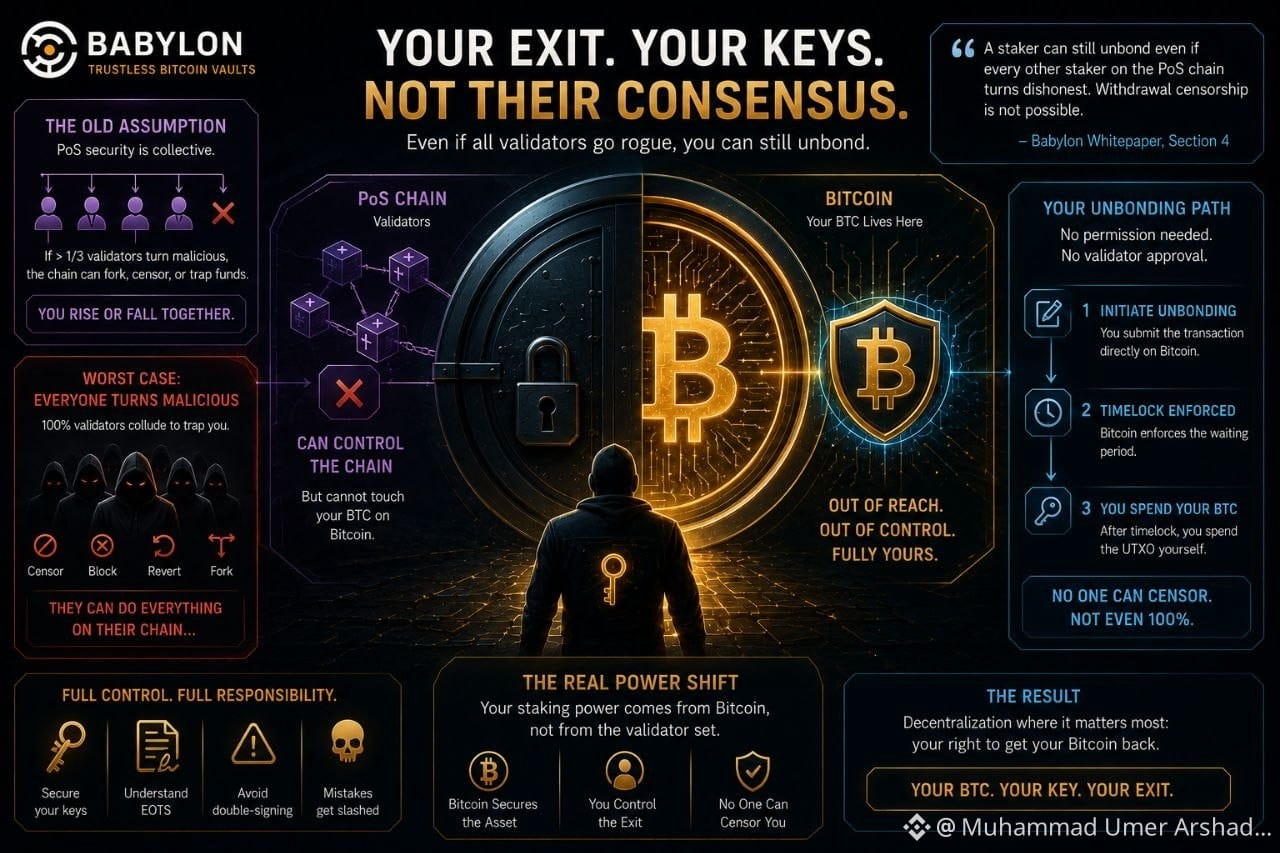
The exact wording stuck with me: a staker can still unbond even if every other staker on the PoS chain turns dishonest. Withdrawal censorship isn't possible. Read that twice. Not "most," it says all. Not "unlikely," it says not possible. Meaning even a fully corrupted validator set, unanimous in blocking your exit, still can't stop you from getting your BTC back.
Took me a while to understand why this works. The trick isn't in what Babylon does on the PoS chain, it's where the staked asset actually lives. It sits on Bitcoin, not on the PoS chain itself. So a malicious validator set can control every transaction on their own chain, but they have zero reach into Bitcoin's UTXOs. Unbonding gets initiated directly on Bitcoin, no approval from the PoS chain required at any point.
Think of it like a locked door where the landlord welded the lock mechanism onto Bitcoin itself, and only you hold the key. Every neighbor could conspire to trap you inside, and you'd still walk out. This isn't collective security getting optimized, it's redefining where an individual staker's power actually sits, separated entirely from group consensus.
The tradeoff is real though. You're responsible for your own keys and understanding how EOTS actually works. Leak your key, or accidentally double-sign, and you get slashed regardless. Full control comes with full responsibility attached.
@BabylonLabs_io #baby $BABY
The exact wording stuck with me: a staker can still unbond even if every other staker on the PoS chain turns dishonest. Withdrawal censorship isn't possible. Read that twice. Not "most," it says all. Not "unlikely," it says not possible. Meaning even a fully corrupted validator set, unanimous in blocking your exit, still can't stop you from getting your BTC back.
Took me a while to understand why this works. The trick isn't in what Babylon does on the PoS chain, it's where the staked asset actually lives. It sits on Bitcoin, not on the PoS chain itself. So a malicious validator set can control every transaction on their own chain, but they have zero reach into Bitcoin's UTXOs. Unbonding gets initiated directly on Bitcoin, no approval from the PoS chain required at any point.
Think of it like a locked door where the landlord welded the lock mechanism onto Bitcoin itself, and only you hold the key. Every neighbor could conspire to trap you inside, and you'd still walk out. This isn't collective security getting optimized, it's redefining where an individual staker's power actually sits, separated entirely from group consensus.
The tradeoff is real though. You're responsible for your own keys and understanding how EOTS actually works. Leak your key, or accidentally double-sign, and you get slashed regardless. Full control comes with full responsibility attached.
@BabylonLabs_io #baby $BABY
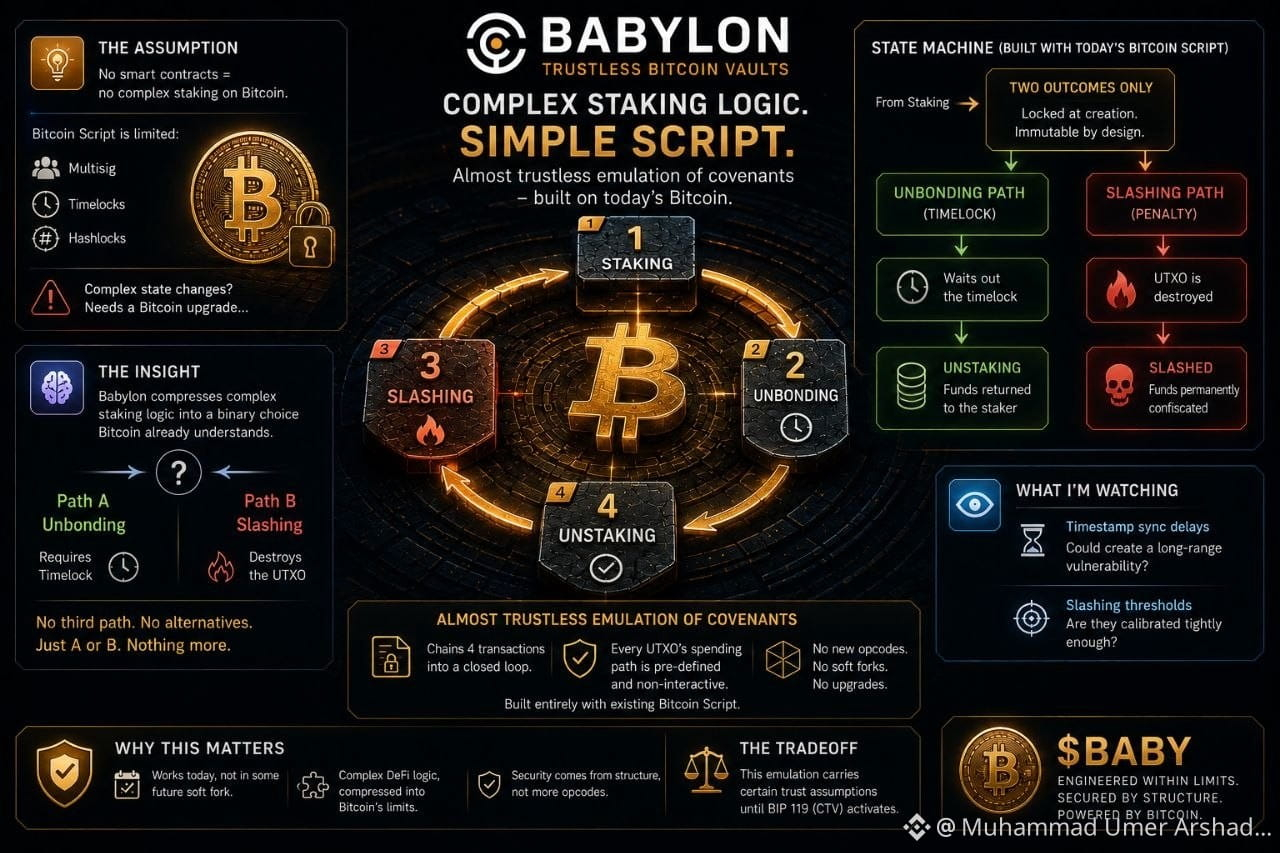
My assumption for years was simple, no smart contracts means no complex staking logic on Bitcoin. Bitcoin Script handles basic conditions, multisig, timelocks, hashlocks, and that's the ceiling. So when Babylon claimed it could switch between staking, unbonding, and slashing states, my first thought was that this needs a Bitcoin upgrade like OP_CHECKTEMPLATEVERIFY to even work.
Then I hit a specific line in Section 7.1 of their whitepaper describing what they call an almost trustless emulation of covenants. That phrase made me stop and actually redraw the state machine myself.
Turns out Babylon isn't waiting on any future upgrade. It works entirely within existing Bitcoin Script, chaining four transactions together, staking, unbonding, slashing, unstaking, into a closed loop. Every UTXO's spending path is locked down to exactly two outcomes: unbonding, which requires a timelock, or slashing, which destroys it outright. Nothing else is possible. No third path exists.
This isn't Bitcoin Script becoming more powerful. It's the opposite, compressing every use case down until Bitcoin's limited scripting can fully cover it. The real insight here isn't a stronger language, it's a smarter structure built around the language's actual limits. Complex staking logic gets reduced to a binary choice Bitcoin can already understand, path A or path B, nothing more.
Worth being honest about the tradeoff though. This emulation carries certain trust assumptions until something like BIP 119 activates formally. Whether this design holds up under sustained adversarial pressure in live conditions is still something I'm watching closely.
@BabylonLabs_io #baby $BABY
Then I hit a specific line in Section 7.1 of their whitepaper describing what they call an almost trustless emulation of covenants. That phrase made me stop and actually redraw the state machine myself.
Turns out Babylon isn't waiting on any future upgrade. It works entirely within existing Bitcoin Script, chaining four transactions together, staking, unbonding, slashing, unstaking, into a closed loop. Every UTXO's spending path is locked down to exactly two outcomes: unbonding, which requires a timelock, or slashing, which destroys it outright. Nothing else is possible. No third path exists.
This isn't Bitcoin Script becoming more powerful. It's the opposite, compressing every use case down until Bitcoin's limited scripting can fully cover it. The real insight here isn't a stronger language, it's a smarter structure built around the language's actual limits. Complex staking logic gets reduced to a binary choice Bitcoin can already understand, path A or path B, nothing more.
Worth being honest about the tradeoff though. This emulation carries certain trust assumptions until something like BIP 119 activates formally. Whether this design holds up under sustained adversarial pressure in live conditions is still something I'm watching closely.
@BabylonLabs_io #baby $BABY
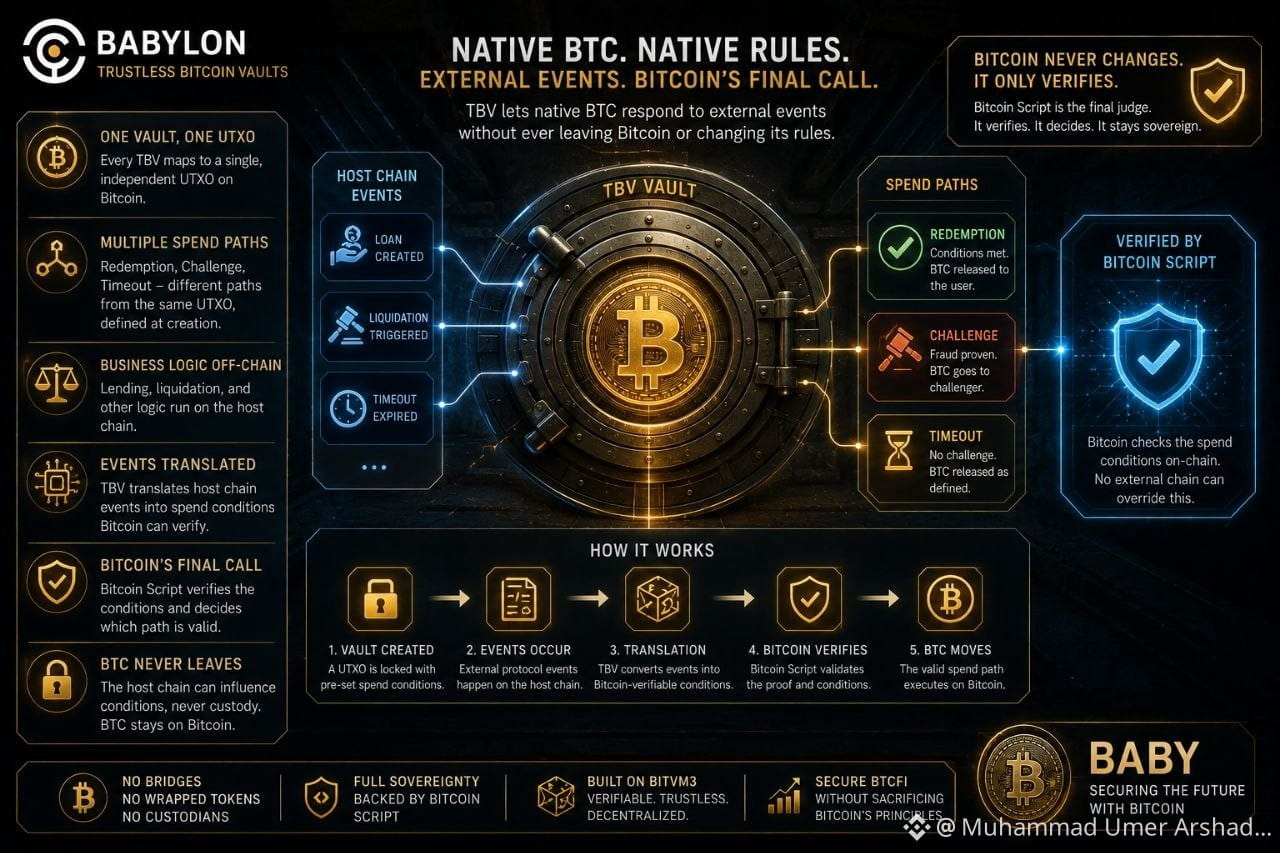
What kept pulling me back to TBV wasn't the promise of a new BTCFi product, it was noticing how much of the design depends on Bitcoin never changing its own verification rules. Bitcoin doesn't execute smart contracts, and it won't alter a BTC's spending conditions just because some other chain finished a loan or liquidation. The real problem TBV solves is letting native BTC respond safely to externally verified events without ever crossing that line.
Went back through the whitepaper's vault diagrams properly this time, and a pattern showed up everywhere. Every vault maps to one independent UTXO. Redemption, Challenge, and Timeout aren't three separate systems, they're different spend paths off that same UTXO, all defined the moment the vault gets created. The actual business logic runs on the host chain. TBV translates those host chain events into spend conditions Bitcoin can verify through its proving mechanism. From there, Bitcoin script alone decides whether the UTXO satisfies its assigned path. At no point does the host chain gain control over the BTC itself, it can only influence verification conditions, never the asset.
That's when the repeated emphasis on "Trustless Bitcoin Vaults" finally made sense to me. TBV isn't migrating BTC into a new security model, and it isn't asking Bitcoin to trust anything external. Bitcoin keeps making its own final call, under its own rules. What used to depend on third-party judgment now depends on protocol logic instead.
Going forward, I'm watching @BabylonLabs_io and $BABY closely, but not for the next app launch. What actually matters long-term is whether this vault mechanism holds up under real stress, proving that native BTC can safely join complex on-chain systems while Bitcoin itself never bends its own rules.
#baby
Went back through the whitepaper's vault diagrams properly this time, and a pattern showed up everywhere. Every vault maps to one independent UTXO. Redemption, Challenge, and Timeout aren't three separate systems, they're different spend paths off that same UTXO, all defined the moment the vault gets created. The actual business logic runs on the host chain. TBV translates those host chain events into spend conditions Bitcoin can verify through its proving mechanism. From there, Bitcoin script alone decides whether the UTXO satisfies its assigned path. At no point does the host chain gain control over the BTC itself, it can only influence verification conditions, never the asset.
That's when the repeated emphasis on "Trustless Bitcoin Vaults" finally made sense to me. TBV isn't migrating BTC into a new security model, and it isn't asking Bitcoin to trust anything external. Bitcoin keeps making its own final call, under its own rules. What used to depend on third-party judgment now depends on protocol logic instead.
Going forward, I'm watching @BabylonLabs_io and $BABY closely, but not for the next app launch. What actually matters long-term is whether this vault mechanism holds up under real stress, proving that native BTC can safely join complex on-chain systems while Bitcoin itself never bends its own rules.
#baby
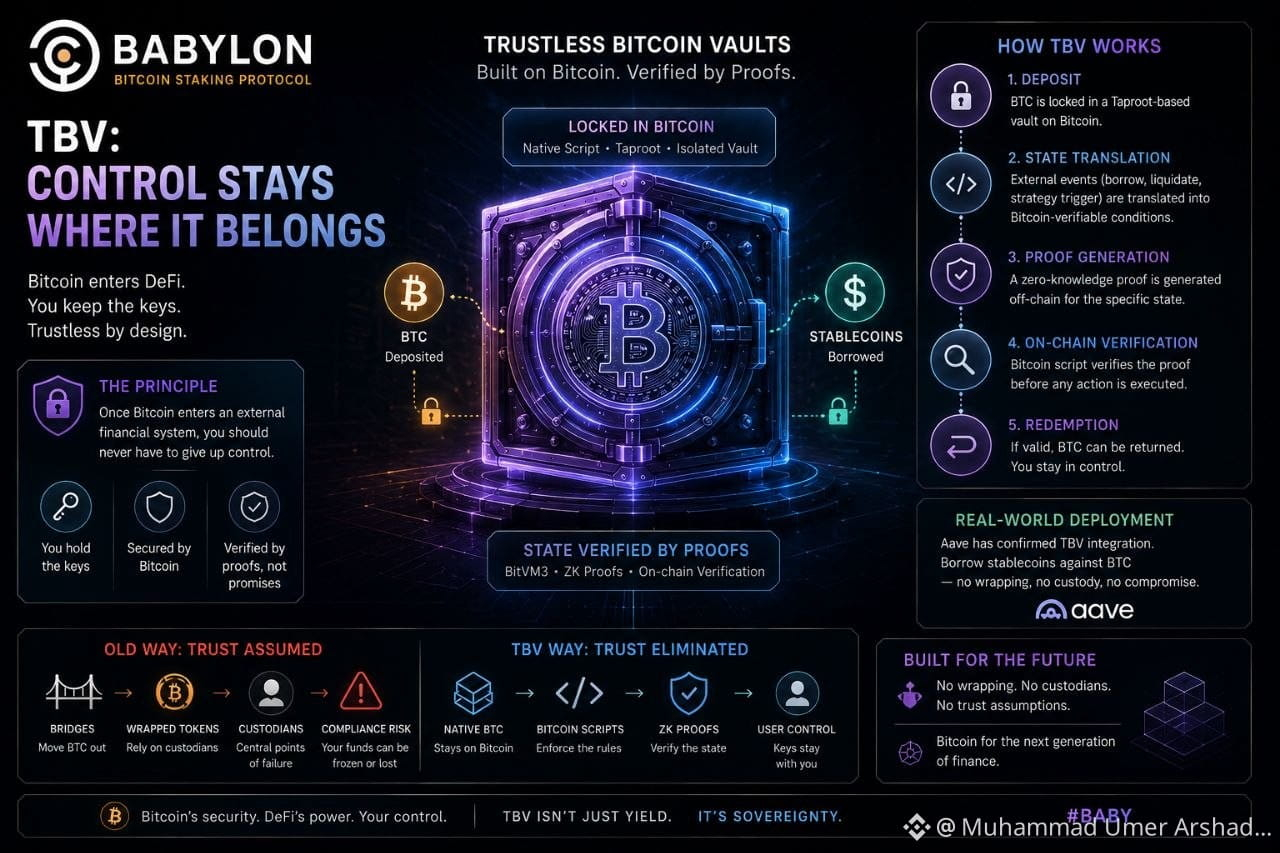
Was on a call with a friend last weekend, just catching up, when he casually mentioned he'd been reading into Trustless Bitcoin Vaults from @BabylonLabs_io . I filed it away as another yield product and kept talking. Went back and actually read the materials properly this week, and my first read was wrong. This isn't a yield pitch at all.
TBV isn't asking how BTC earns interest. It's asking something more fundamental, once Bitcoin enters an external financial system, does the user actually keep control? Older solutions leaned on bridges, wrapped tokens, and custodians syncing state on your behalf. More functionality, sure, but every added feature came with another trust assumption stacked on top. TBV takes a different route entirely, locking BTC through Bitcoin's own scripting and output structures. Each vault stays isolated, nothing gets pooled together.
The part that took me longest to understand was how state actually gets passed across. Bitcoin has no concept of lending, liquidation, or strategy triggers built in. Every external event has to be translated into something Bitcoin's script can verify on its own. Built on BitVM3, TBV pushes most computation off-chain and only verifies a compressed proof result on-chain. Redemption requires a zero-knowledge proof tied to the specific state event, verified before anything moves. This isn't a wrapped asset pretending to be the real thing.
Aave has already confirmed integration on this exact mechanism. Users can borrow stablecoins against BTC, no wrapping, no handing over keys. That's the clearest real-world deployment we have right now. Scaling this up still needs watching closely for efficiency and security, but the direction is right, BTC moving into complex use cases shouldn't mean inheriting trust it never needed before.
#baby $BABY
TBV isn't asking how BTC earns interest. It's asking something more fundamental, once Bitcoin enters an external financial system, does the user actually keep control? Older solutions leaned on bridges, wrapped tokens, and custodians syncing state on your behalf. More functionality, sure, but every added feature came with another trust assumption stacked on top. TBV takes a different route entirely, locking BTC through Bitcoin's own scripting and output structures. Each vault stays isolated, nothing gets pooled together.
The part that took me longest to understand was how state actually gets passed across. Bitcoin has no concept of lending, liquidation, or strategy triggers built in. Every external event has to be translated into something Bitcoin's script can verify on its own. Built on BitVM3, TBV pushes most computation off-chain and only verifies a compressed proof result on-chain. Redemption requires a zero-knowledge proof tied to the specific state event, verified before anything moves. This isn't a wrapped asset pretending to be the real thing.
Aave has already confirmed integration on this exact mechanism. Users can borrow stablecoins against BTC, no wrapping, no handing over keys. That's the clearest real-world deployment we have right now. Scaling this up still needs watching closely for efficiency and security, but the direction is right, BTC moving into complex use cases shouldn't mean inheriting trust it never needed before.
#baby $BABY
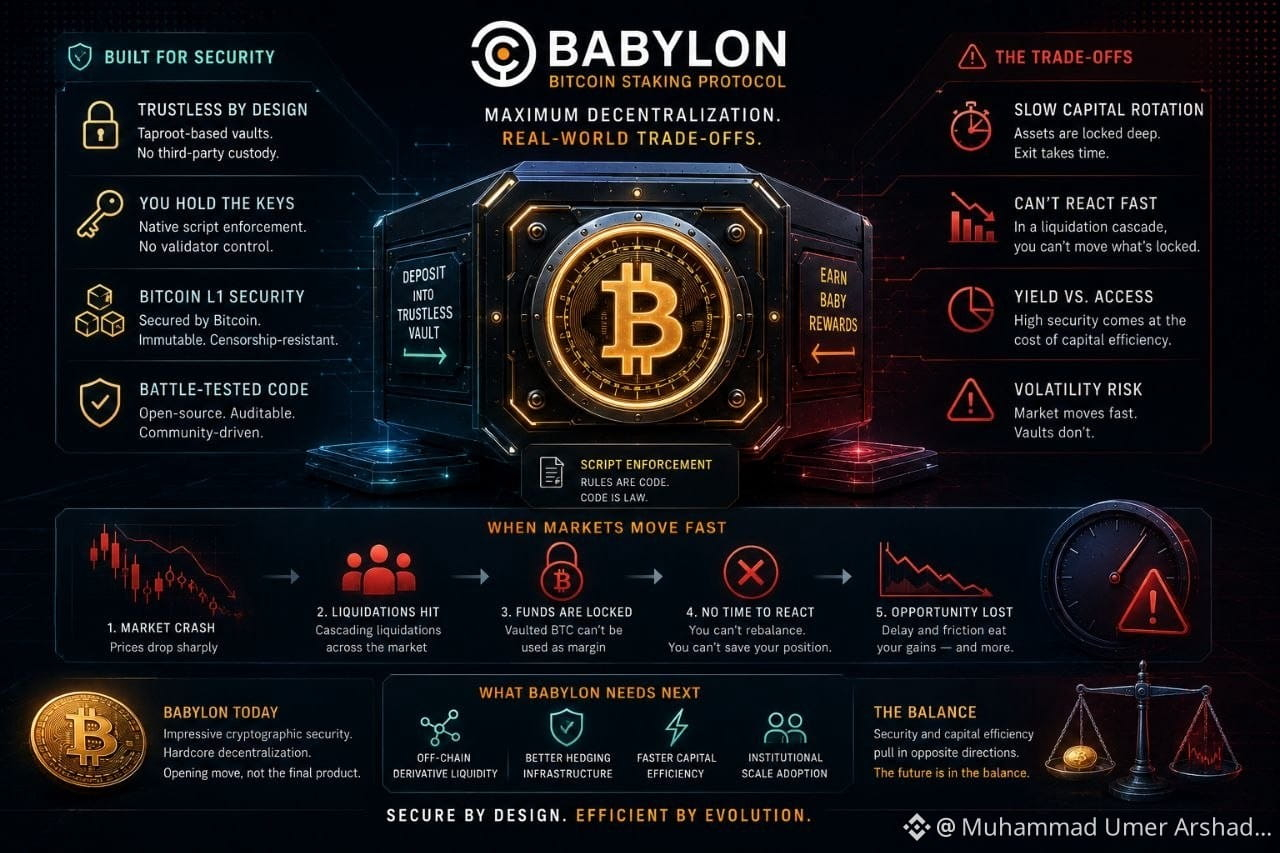
Ten years of running spot-perp arbitrage teaches you one thing: idle BTC sitting in cold storage feels like wasted capital, but chasing yield through cross-chain mapping has cost too many people their entire position. I've watched bridges get drained and multisig setups vanish overnight. So when I finally sat down to study @BabylonLabs_io properly, I went in skeptical. What I found was a genuinely hardcore, no-shortcuts approach to decentralization. What I also found, running it through my own trading models, is that this kind of safety comes with a real cost.
Depositing into a Taproot-based trustless vault removes third-party custody entirely. No validator holds your keys, everything runs on native script enforcement. That part is solid. But when I stress-tested this against extreme volatility scenarios this week, the tradeoff became obvious fast. Locking assets this deep sacrifices rotation speed, and for anyone actively managing margin, that gap matters.
Picture a sharp liquidation cascade hitting overnight. Assets isolated this tightly can't be pulled out fast enough to serve as emergency margin. Your balance shows funds, but you can't touch them when you actually need to rebalance. That delay, and the friction it creates, can quietly erase whatever yield the staking generated in the first place.
Cryptographic security here is genuinely impressive, no argument there. But in live markets, security and capital efficiency pull in opposite directions. For $BABY 's ecosystem to unlock real institutional capital at scale, defense alone isn't the full answer. This needs matching off-chain derivative liquidity to handle hedging properly. Right now, this feels like the opening move, not the finished product.
#baby $BABY
Depositing into a Taproot-based trustless vault removes third-party custody entirely. No validator holds your keys, everything runs on native script enforcement. That part is solid. But when I stress-tested this against extreme volatility scenarios this week, the tradeoff became obvious fast. Locking assets this deep sacrifices rotation speed, and for anyone actively managing margin, that gap matters.
Picture a sharp liquidation cascade hitting overnight. Assets isolated this tightly can't be pulled out fast enough to serve as emergency margin. Your balance shows funds, but you can't touch them when you actually need to rebalance. That delay, and the friction it creates, can quietly erase whatever yield the staking generated in the first place.
Cryptographic security here is genuinely impressive, no argument there. But in live markets, security and capital efficiency pull in opposite directions. For $BABY 's ecosystem to unlock real institutional capital at scale, defense alone isn't the full answer. This needs matching off-chain derivative liquidity to handle hedging properly. Right now, this feels like the opening move, not the finished product.
#baby $BABY
Happy 9th Birthday Binance! 🎉🕯️
From zero to absolute legend in 9 years... what a journey! This cake is my little way of saying thank you for all the opportunities, the innovations, and the vibes.
Let's keep building together in year 10 and beyond!
Who else is celebrating? Drop a 💛 if you're team Binance!
#BinanceTurns9 #BinanceSquareTG
From zero to absolute legend in 9 years... what a journey! This cake is my little way of saying thank you for all the opportunities, the innovations, and the vibes.
Let's keep building together in year 10 and beyond!
Who else is celebrating? Drop a 💛 if you're team Binance!
#BinanceTurns9 #BinanceSquareTG

Partly True
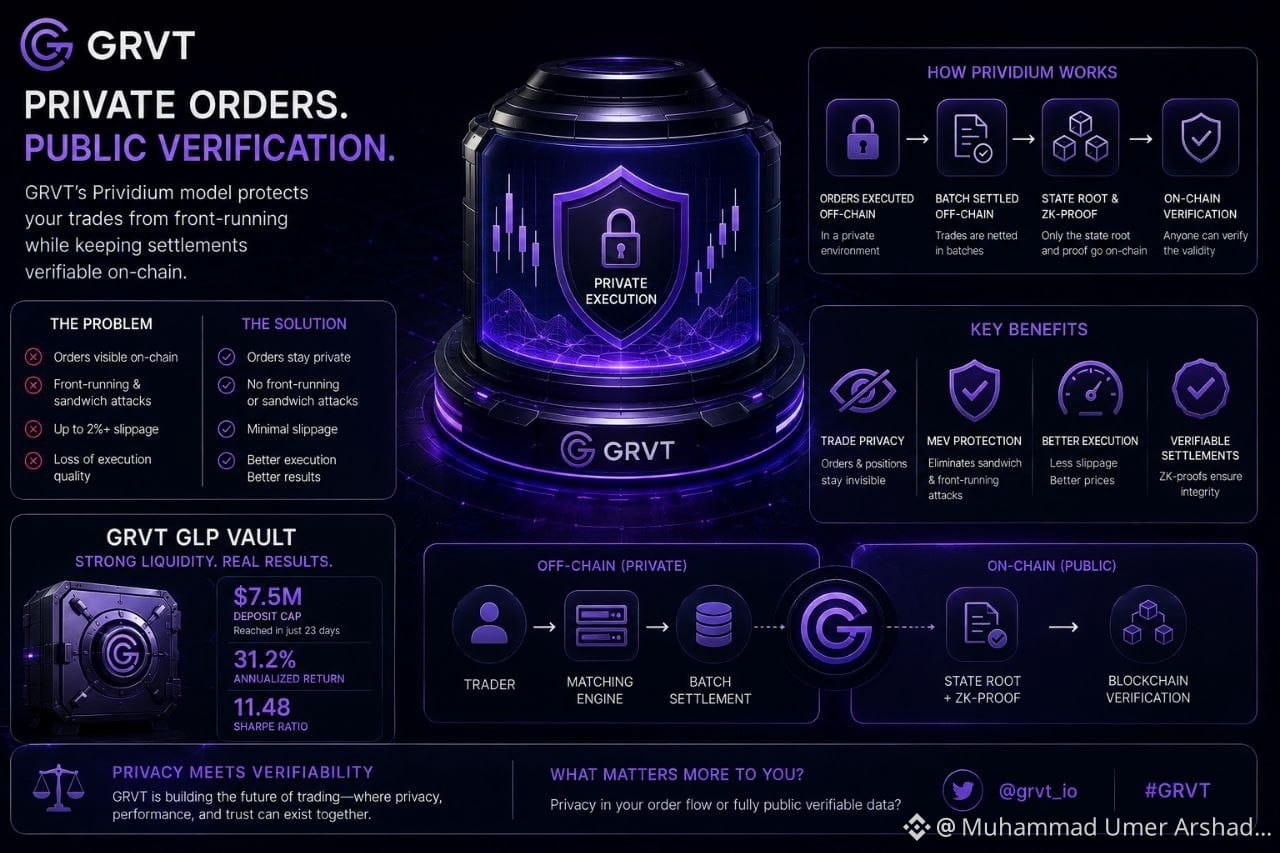
Got sandwiched on a public order book last week, lost close to 2% to slippage in one trade. That's what pushed me to actually dig into GRVT's Prividium setup instead of just skimming the marketing page.
The model flips the usual DEX assumption. Instead of broadcasting every order on-chain where anyone can see it coming and front-run you, execution happens in an off-chain private environment. What hits the chain is just the state root and a zero-knowledge proof confirming the batch settled correctly. Your positions and order details stay invisible, which cuts off most of the surface area sandwich bots and front-runners rely on. Identity checks and non-trade data are kept separate from settlement too, not bundled into the same pipe.
The liquidity numbers are what actually got my attention. GRVT's GLP vault hit its $7.5 million deposit cap in 23 days, running a 31.2% annualized return with an 11.48 Sharpe ratio. I checked that Sharpe number twice because it's unusually high, but it held up across sources.
Worth being straight about the tradeoff though. Privacy architecture means off-chain data sits with the operator. You can't independently pull and verify every trade the way you can on a fully public chain. Trust shifts toward the operator following the rules and the zk-proof system holding up, which is a different kind of trust than raw on-chain transparency.
What GRVT seems to be actually working on isn't just faster execution. It's figuring out where the line sits between public verifiability and trade privacy, and whether both can coexist without gutting one for the other.
Which side matters more to you, privacy in your order flow, or fully public verifiable data? Curious what people think.
@grvt_io #grvt $ARX $LAB
The model flips the usual DEX assumption. Instead of broadcasting every order on-chain where anyone can see it coming and front-run you, execution happens in an off-chain private environment. What hits the chain is just the state root and a zero-knowledge proof confirming the batch settled correctly. Your positions and order details stay invisible, which cuts off most of the surface area sandwich bots and front-runners rely on. Identity checks and non-trade data are kept separate from settlement too, not bundled into the same pipe.
The liquidity numbers are what actually got my attention. GRVT's GLP vault hit its $7.5 million deposit cap in 23 days, running a 31.2% annualized return with an 11.48 Sharpe ratio. I checked that Sharpe number twice because it's unusually high, but it held up across sources.
Worth being straight about the tradeoff though. Privacy architecture means off-chain data sits with the operator. You can't independently pull and verify every trade the way you can on a fully public chain. Trust shifts toward the operator following the rules and the zk-proof system holding up, which is a different kind of trust than raw on-chain transparency.
What GRVT seems to be actually working on isn't just faster execution. It's figuring out where the line sits between public verifiability and trade privacy, and whether both can coexist without gutting one for the other.
Which side matters more to you, privacy in your order flow, or fully public verifiable data? Curious what people think.
@grvt_io #grvt $ARX $LAB
Verified
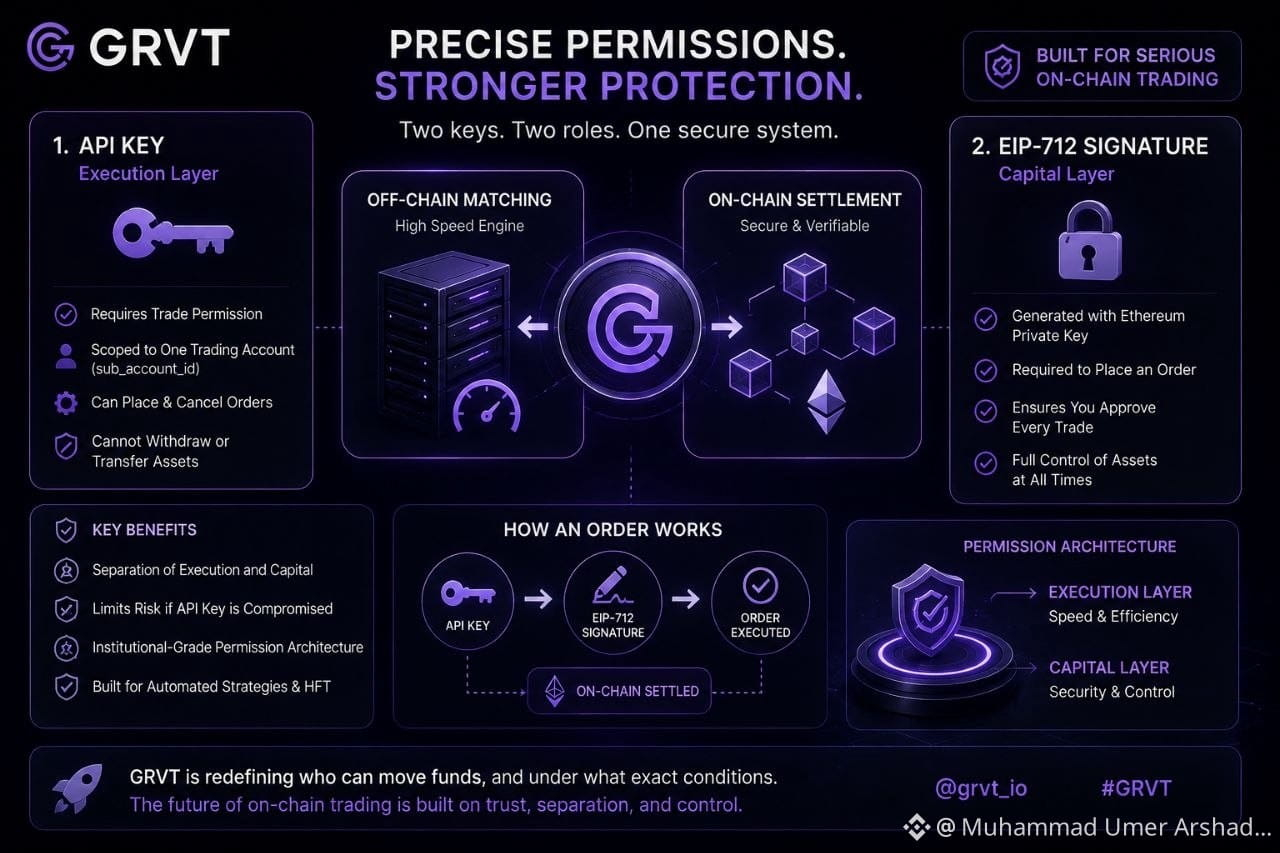
There's one detail in GRVT's API setup that stood out to me more than order book depth or execution speed ever did: how tightly it draws the line around what a key is actually allowed to do.
When you generate an API key on GRVT, you have to explicitly grant it Trade permission, and that key is scoped to a single Trading Account, tracked as sub_account_id in their docs. Placing an order still requires a separate EIP-712 signature from your Ethereum private key. Two different keys, two different jobs.
Practically, that means an automated strategy running off an API key can execute trades, but it has no path to withdrawals or asset transfers. That separation is something I've seen matter a lot in traditional quant setups too, the execution layer and the capital layer are never the same system. If the execution layer breaks or a key leaks, the damage stays contained there. GRVT is applying that same boundary on-chain.
This lines up with how their Hybrid Exchange is structured overall. Off-chain matching handles speed, so order placement can get close to centralized-exchange latency. On-chain settlement handles the actual state changes, so a trade isn't just a row in someone's internal database. Splitting permissions this finely is what lets both sides function without constantly trading off against each other.
What GRVT seems to actually be building toward isn't just another perp platform. It's a rethink of who gets to move funds, and under what exact conditions, as more serious capital starts operating on-chain.
None of this is beginner-friendly by design. And permission architecture looks clean on paper, the real test is whether it holds up once high-frequency strategies are hammering the system in production.
@grvt_io #grvt $ARX $BILL
When you generate an API key on GRVT, you have to explicitly grant it Trade permission, and that key is scoped to a single Trading Account, tracked as sub_account_id in their docs. Placing an order still requires a separate EIP-712 signature from your Ethereum private key. Two different keys, two different jobs.
Practically, that means an automated strategy running off an API key can execute trades, but it has no path to withdrawals or asset transfers. That separation is something I've seen matter a lot in traditional quant setups too, the execution layer and the capital layer are never the same system. If the execution layer breaks or a key leaks, the damage stays contained there. GRVT is applying that same boundary on-chain.
This lines up with how their Hybrid Exchange is structured overall. Off-chain matching handles speed, so order placement can get close to centralized-exchange latency. On-chain settlement handles the actual state changes, so a trade isn't just a row in someone's internal database. Splitting permissions this finely is what lets both sides function without constantly trading off against each other.
What GRVT seems to actually be building toward isn't just another perp platform. It's a rethink of who gets to move funds, and under what exact conditions, as more serious capital starts operating on-chain.
None of this is beginner-friendly by design. And permission architecture looks clean on paper, the real test is whether it holds up once high-frequency strategies are hammering the system in production.
@grvt_io #grvt $ARX $BILL
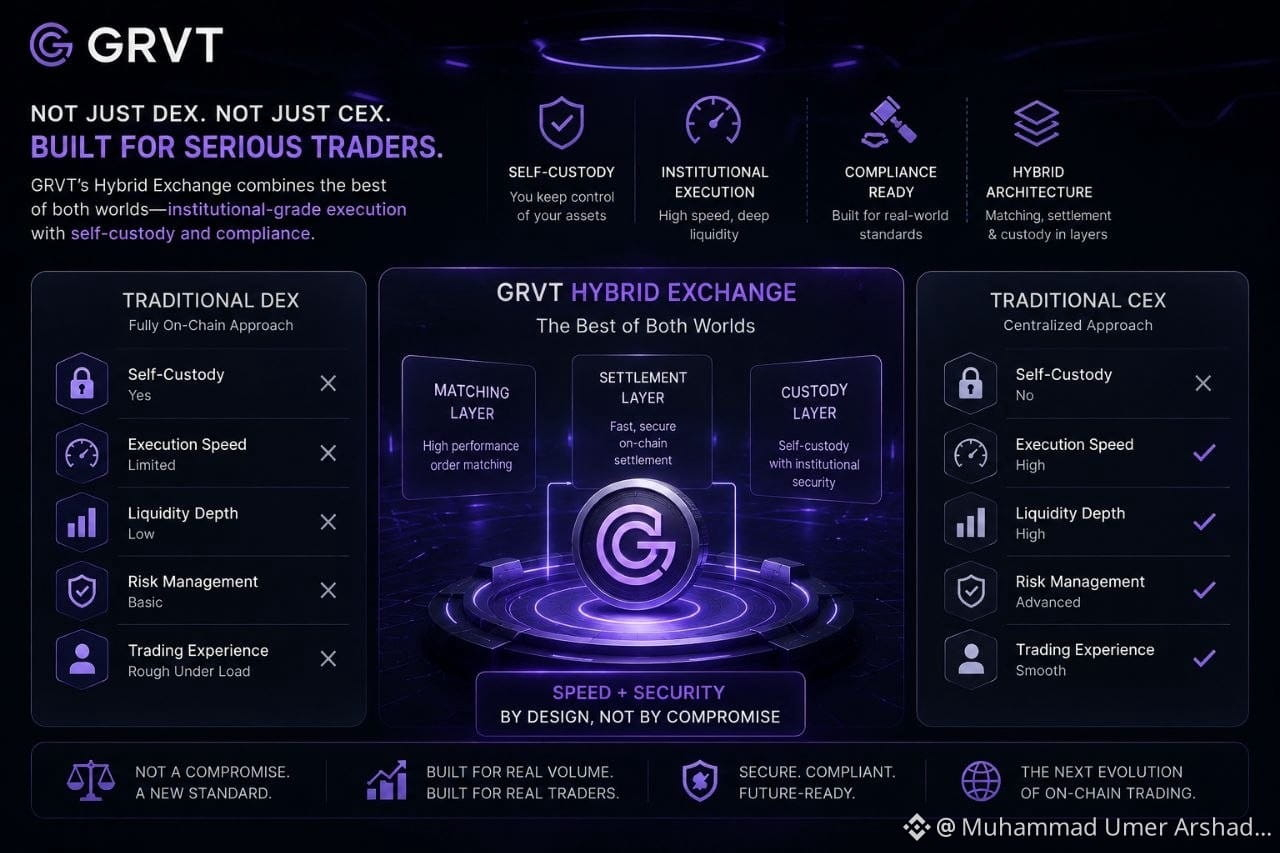
There's a detail in GRVT's docs that I kept scrolling past, and then kept coming back to. Most trading protocols right now are racing to slap "fully decentralized" on everything. GRVT does the opposite. It talks about institutional-grade execution, self-custody, and compliance in the same breath. My first reaction was that this is just a branding choice. But once I sat down and actually compared their Hybrid Exchange model against how typical DEXs are built, I realized they're not even trying to solve the same problem.
The common assumption is that if your assets stay in your own wallet, a rougher trading experience is an acceptable trade-off. That holds up fine for casual users. It falls apart the moment someone trades seriously, because then execution speed, liquidity depth, risk management, and asset custody all need to work together, not just one or two of them. Centralized exchanges nail the execution side but ask you to hand over custody. Pure on-chain trading protects custody but usually struggles under real trading load. GRVT's approach is to split the system itself, matching, settlement, and custody are handled as separate layers, each one doing only what it's actually built for.
Digging into their self-custody and security architecture made this clearer. Users keep control of their assets at every step, but "fully on-chain" was never treated as the finish line. Speed and security aren't positioned as a trade-off here, they're a design decision spread across layers.
What stands out to me isn't whether GRVT leans more DEX or more CEX. It's that it's attempting to merge two approaches that were always treated as mutually exclusive. Whether that holds under real volume is still unproven, but it's a more interesting question than fee comparisons.
@grvt_io #grvt $VELVET $CAP
The common assumption is that if your assets stay in your own wallet, a rougher trading experience is an acceptable trade-off. That holds up fine for casual users. It falls apart the moment someone trades seriously, because then execution speed, liquidity depth, risk management, and asset custody all need to work together, not just one or two of them. Centralized exchanges nail the execution side but ask you to hand over custody. Pure on-chain trading protects custody but usually struggles under real trading load. GRVT's approach is to split the system itself, matching, settlement, and custody are handled as separate layers, each one doing only what it's actually built for.
Digging into their self-custody and security architecture made this clearer. Users keep control of their assets at every step, but "fully on-chain" was never treated as the finish line. Speed and security aren't positioned as a trade-off here, they're a design decision spread across layers.
What stands out to me isn't whether GRVT leans more DEX or more CEX. It's that it's attempting to merge two approaches that were always treated as mutually exclusive. Whether that holds under real volume is still unproven, but it's a more interesting question than fee comparisons.
@grvt_io #grvt $VELVET $CAP
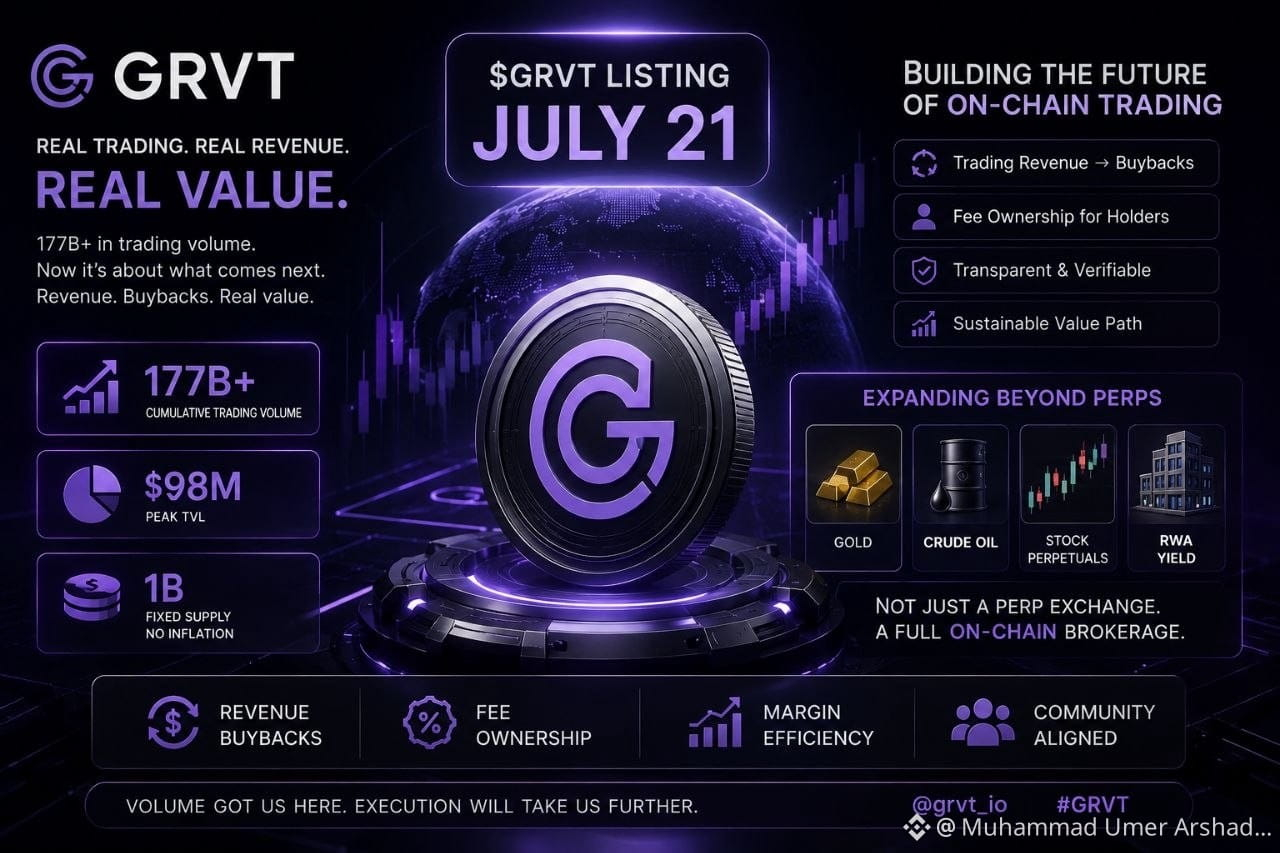
GRVT’s listing date is coming up on July 21, and the debate is heating up again. Everyone’s asking the same thing: what will the points actually be worth, and is the airdrop wait worth the opportunity cost. Fair questions. But after going through GRVT’s numbers from the past year, something else is bothering me more. Can this platform actually route its trading revenue back into the token, or does it just sit on the sidelines.
Last year GRVT processed 177 billion dollars in cumulative trading volume, with peak TVL touching 98 million dollars. In on-chain derivatives, those aren't small numbers. The platform has clearly handled real trading activity. But volume alone only proves people showed up. It doesn't prove the token can hold value once the incentives dry up. That's the recurring problem with derivatives platforms. Volume drops the moment rewards slow down, often faster than anyone expects.
So here's what I'm actually watching: revenue buybacks, fee ownership, and margin efficiency. GRVT has a fixed supply of 1 billion tokens, no inflation built in. Holders are positioned to get a share of trading fees and platform-level benefits. If buyback volume scales with real fee income, and if the process stays transparent, then there's an actual value path you can track and verify. If it ends up leaning only on points redemption after listing, that 177 billion dollar volume number becomes a marketing stat and nothing more.
GRVT is also pushing into gold, crude oil, stock perpetuals, and RWA yield products. It's not trying to be just a perp exchange anymore, it's building toward a full on-chain brokerage. Bigger opportunity, but also more room for liquidity to spread thin across products.
On July 21 I'll watch the price, but that's not the real signal. The real signal is organic volume after launch, actual fee revenue, buyback execution, and whether users stick around once the points stop.
@grvt_io #Grvt
Last year GRVT processed 177 billion dollars in cumulative trading volume, with peak TVL touching 98 million dollars. In on-chain derivatives, those aren't small numbers. The platform has clearly handled real trading activity. But volume alone only proves people showed up. It doesn't prove the token can hold value once the incentives dry up. That's the recurring problem with derivatives platforms. Volume drops the moment rewards slow down, often faster than anyone expects.
So here's what I'm actually watching: revenue buybacks, fee ownership, and margin efficiency. GRVT has a fixed supply of 1 billion tokens, no inflation built in. Holders are positioned to get a share of trading fees and platform-level benefits. If buyback volume scales with real fee income, and if the process stays transparent, then there's an actual value path you can track and verify. If it ends up leaning only on points redemption after listing, that 177 billion dollar volume number becomes a marketing stat and nothing more.
GRVT is also pushing into gold, crude oil, stock perpetuals, and RWA yield products. It's not trying to be just a perp exchange anymore, it's building toward a full on-chain brokerage. Bigger opportunity, but also more room for liquidity to spread thin across products.
On July 21 I'll watch the price, but that's not the real signal. The real signal is organic volume after launch, actual fee revenue, buyback execution, and whether users stick around once the points stop.
@grvt_io #Grvt
Verified
Took me a while to understand what GRVT is actually building. I kept reading "Hybrid Exchange" and thinking it was just another speed play. It is not.
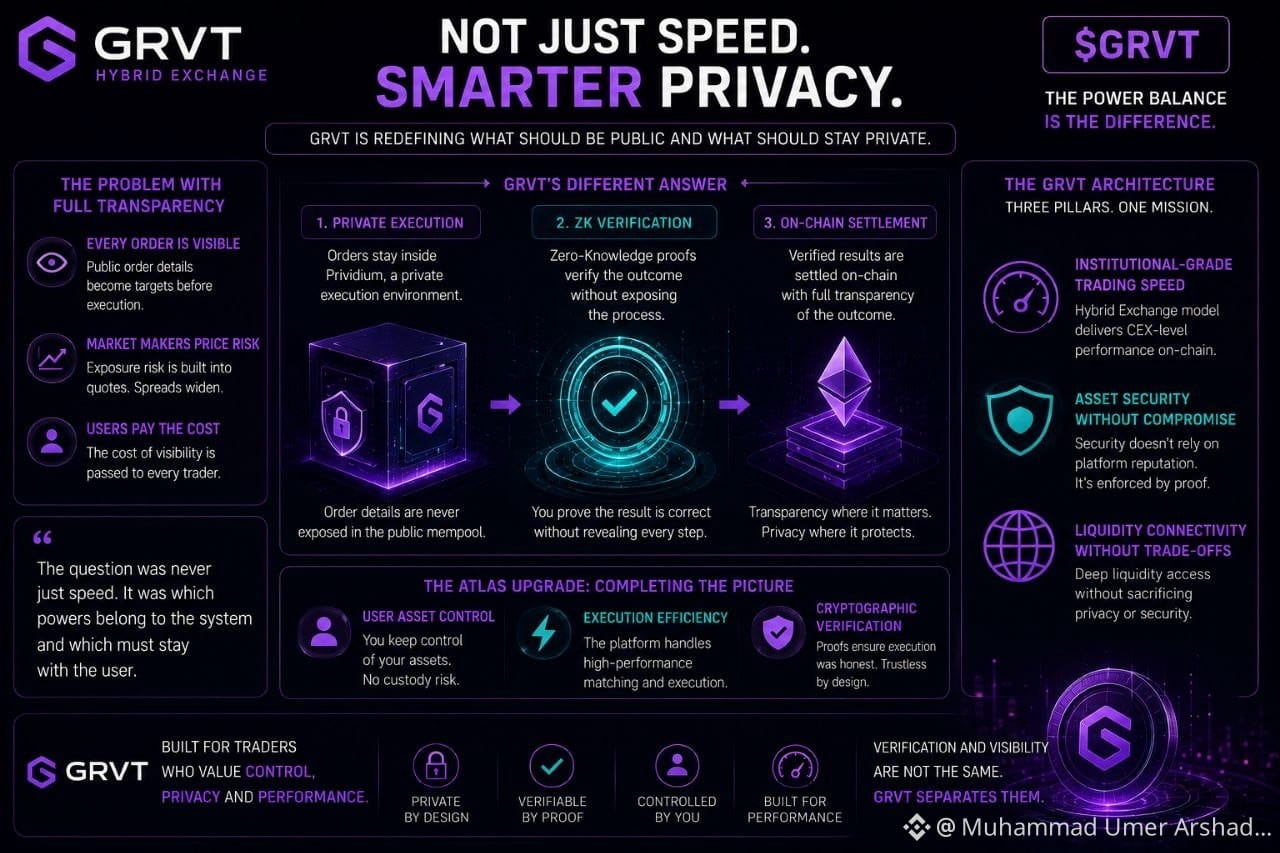
The real question GRVT is answering is different. Which parts of a trade need to be public, and which parts actively become a liability when exposed.
I used to think full transparency was always safer on-chain. Then I thought about high-frequency trading more carefully. If every order detail sits in a public environment between placement and execution, it becomes a target. Market makers price that exposure risk into their quotes in advance. Spreads widen. Users pay the cost without realizing why.
GRVT keeps order data inside Prividium, a private execution environment. The outcome gets verified on-chain using zero-knowledge proofs. You prove the result is correct without exposing every step of the process to everyone watching.
That distinction matters. Verification and visibility are not the same thing. GRVT separates them deliberately.
The Atlas upgrade fills in the rest of the picture. Users keep control over their own assets. The platform handles execution efficiency. Cryptography handles the verification that the execution was honest. No requirement to trust the platform's reputation. The proof handles that instead.
GRVT's architecture covers three things together. Institutional-grade trading speed through the Hybrid Exchange model. Asset security that does not depend on platform credibility. And liquidity connectivity that improves without compromising either of the first two.
Most people reading about GRVT stop at "faster hybrid exchange." That framing misses the actual design decision underneath it.
The question was never just speed. It was which powers belong to the system and which must stay with the user.
@grvt_io #grvt
The real question GRVT is answering is different. Which parts of a trade need to be public, and which parts actively become a liability when exposed.
I used to think full transparency was always safer on-chain. Then I thought about high-frequency trading more carefully. If every order detail sits in a public environment between placement and execution, it becomes a target. Market makers price that exposure risk into their quotes in advance. Spreads widen. Users pay the cost without realizing why.
GRVT keeps order data inside Prividium, a private execution environment. The outcome gets verified on-chain using zero-knowledge proofs. You prove the result is correct without exposing every step of the process to everyone watching.
That distinction matters. Verification and visibility are not the same thing. GRVT separates them deliberately.
The Atlas upgrade fills in the rest of the picture. Users keep control over their own assets. The platform handles execution efficiency. Cryptography handles the verification that the execution was honest. No requirement to trust the platform's reputation. The proof handles that instead.
GRVT's architecture covers three things together. Institutional-grade trading speed through the Hybrid Exchange model. Asset security that does not depend on platform credibility. And liquidity connectivity that improves without compromising either of the first two.
Most people reading about GRVT stop at "faster hybrid exchange." That framing misses the actual design decision underneath it.
The question was never just speed. It was which powers belong to the system and which must stay with the user.
@grvt_io #grvt
Verified
Capital sitting idle inside a trading account always bothered me. You deposit, you trade, and then the funds just wait. No yield, no utility, just sitting there.
That is what made me look more carefully at GRVT.
GRVT started as an on-chain perpetual trading platform. But what caught my attention was the direction it is moving toward. Trading, yield, and asset management inside one unified account system. Not three separate products you have to bridge between. One pool of capital doing multiple things at the same time.
This is how institutional desks operate in traditional finance. A single margin framework supports trading positions, liquidity management, and yield simultaneously. On-chain products have mostly stayed stuck at one application solving one problem. GRVT is trying to close that gap.
The yield integration is the specific part worth watching. GRVT pulls yield sources from Aave and brings in institutional treasury yield products through Centrifuge. Funds sitting in your trading account can now generate returns while you are not actively trading. That changes the capital efficiency equation significantly.
The spot market test environment adds another layer. Users can hold, trade, and allocate assets without jumping between platforms or managing multiple wallets.
Now the honest part. Narrative is easy. Execution is not.
A platform connecting trading and yield has to handle asset state synchronization across functions, risk isolation between positions, and system stability when markets move fast. These are hard engineering problems that only show up under real pressure.
What I am tracking next is live trading volume, user retention after the initial launch period, and how the system performs when multiple asset functions run simultaneously under stress.
That data will tell the real story.
#grvt @grvt_io
That is what made me look more carefully at GRVT.
GRVT started as an on-chain perpetual trading platform. But what caught my attention was the direction it is moving toward. Trading, yield, and asset management inside one unified account system. Not three separate products you have to bridge between. One pool of capital doing multiple things at the same time.
This is how institutional desks operate in traditional finance. A single margin framework supports trading positions, liquidity management, and yield simultaneously. On-chain products have mostly stayed stuck at one application solving one problem. GRVT is trying to close that gap.
The yield integration is the specific part worth watching. GRVT pulls yield sources from Aave and brings in institutional treasury yield products through Centrifuge. Funds sitting in your trading account can now generate returns while you are not actively trading. That changes the capital efficiency equation significantly.
The spot market test environment adds another layer. Users can hold, trade, and allocate assets without jumping between platforms or managing multiple wallets.
Now the honest part. Narrative is easy. Execution is not.
A platform connecting trading and yield has to handle asset state synchronization across functions, risk isolation between positions, and system stability when markets move fast. These are hard engineering problems that only show up under real pressure.
What I am tracking next is live trading volume, user retention after the initial launch period, and how the system performs when multiple asset functions run simultaneously under stress.
That data will tell the real story.
#grvt @grvt_io

Bullish on it

Details-Expert
·
--
$FOGO is already proving itself, and I've been following it closely. The token's official launch and listing on Binance provide significant credibility enhancement. The Creatorpad campaign, which rewards content creators and builds a robust community ecosystem, stands out now. @Fogo Official focuses on genuine engagement and long-term growth rather than just hype. Definitely a project to keep an eye on.
#fogo #bullish
#fogo #bullish

Log in to explore more content