
怪兽8号888-资讯收集箱
1.5k Posts

怪兽8号888-资讯收集箱
Report
Block User
每天更新热点,异动,盘面分析,每日总结,问就是网上扒的数据再加工给各位,哈哈!!
30 Following
120 Followers
116 Liked
Posts
All
Quotes
See translation
说说刚才的 $BLUR :15分钟 +10.92%。
一段急拉之后,整理消化通常比直接猛拉更稳。我通常不会因为一次异动改计划,除非它真的走成了趋势。
仅是一点记录,并非投资建议。
说说刚才的 $BLUR :15分钟 +10.92%。
一段急拉之后,整理消化通常比直接猛拉更稳。我通常不会因为一次异动改计划,除非它真的走成了趋势。
仅是一点记录,并非投资建议。
一段急拉之后,整理消化通常比直接猛拉更稳。我通常不会因为一次异动改计划,除非它真的走成了趋势。
仅是一点记录,并非投资建议。
The latest news, organized by topic to help you make sense of this wave of headlines.
AI and the tech supply chain: demand is genuinely booming
A Reuters poll shows that South Korea’s exports are expected to grow 96.8% year over year in November, the highest level since January 1974, driven mainly by AI-related memory chips. This shows that money is still pouring into computing infrastructure. Meanwhile, analyst Jukan believes $Huawei may be able to get around the EUV bottleneck by widening HBM channels, pursuing a path that does not depend on advanced lithography. It’s a clever idea, but yields for wafer-level hybrid bonding remain a major challenge.
Capital markets: stability comes first, while semiconductors are on fire
Regulators stressed at a meeting that they would continue to strengthen the capital market’s risk defenses, consolidate mechanisms for market stability, and optimize share buyback rules. The message was clear: stable operations take priority. In the markets, the Hang Seng TECH Index rose more than 5%, with $Zhipu AI up over 15% and $MiniMax up over 16%. The A-share ChiNext Index climbed more than 7%, while $Unitree Robotics surged as much as 13.81% intraday. Several STAR Market semiconductor equipment ETFs gained more than 10%, reflecting strong overall sentiment across the tech sector.
Crypto security: the bridge is back up, but risks remain
The $CYBER cross-chain bridge has resumed operations, with all 14 routes passing end-to-end tests on mainnet. It has upgraded to a four-validator signature scheme plus 3-of-5 multisig controls, improving security. However, an Ethereum user was hit by a poisoning attack and lost about 51,500 $USDT. Address poisoning is an old trick: always verify the full address before transferring funds—don’t just check the first and last few characters.
Risk alert: the market is starting to price in AI infrastructure debt
CRWV (CoreWeave) five-year CDS spreads have risen to 1,314 basis points, implying an estimated five-year default probability of around 68%. The market is already pricing in the debt risks of AI infrastructure—this is a signal worth watching.
Exchange update: BTW to launch a KRW trading pair
Bithumb announced that it will launch a Korean won trading pair for BTW, which may lead to some changes in short-term liquidity expectations.
One final question for everyone: with demand for AI chips so strong, do you think this semiconductor rally is being driven by fundamentals, or is sentiment leading the way?
10
No way!
The connection to prices isn't direct; it's more like one aspect of how the industry is moving forward.
$BTC —will it move along with it?
#BTC
Just a note, not a recommendation to take action.
No way!
The connection to prices isn't direct; it's more like one aspect of how the industry is moving forward.
$BTC —will it move along with it?
#BTC
Just a note, not a recommendation to take action.
The connection to prices isn't direct; it's more like one aspect of how the industry is moving forward.
$BTC —will it move along with it?
#BTC
Just a note, not a recommendation to take action.
4
See translation
$ETH |ETH 跌穿 1,642 美元,多单清算强度将达 5.25 亿美元
这条消息够评论区聊好几天了,我只负责搬瓜子。利空曝出之后,卖盘是否持续涌出,比消息本身还重要。转给你那个总说“这次不一样”的朋友。
不是指导,买卖自行决定。
$ETH |ETH 跌穿 1,642 美元,多单清算强度将达 5.25 亿美元
这条消息够评论区聊好几天了,我只负责搬瓜子。利空曝出之后,卖盘是否持续涌出,比消息本身还重要。转给你那个总说“这次不一样”的朋友。
不是指导,买卖自行决定。
这条消息够评论区聊好几天了,我只负责搬瓜子。利空曝出之后,卖盘是否持续涌出,比消息本身还重要。转给你那个总说“这次不一样”的朋友。
不是指导,买卖自行决定。
1
The latest updates are here. Today’s news roundup is packed, so let’s break it down by topic.
Things are heating up in AI. Zhihu has teamed up with DeepSeek, making Zhihu Q&As and trending topics directly searchable in DeepSeek. They’re investing in each other while also selling the same product—now that’s a savvy business model. Meanwhile, OpenAI and Anthropic are tightening their anti-distillation measures, making it harder for Moonshot AI to obtain training data. It’s been reported that the company is turning to models from Google and Meta instead. Kimi is looking for a new source of water and a fresh well. Takeaway: as the race between large language models heats up, it’s not just algorithms that matter—it’s also data pipelines and computing power.
On crypto security and policy: Japan’s JPCrypto-ISAC and SEAL have signed a memorandum of cooperation to share information about attacks and build a network of responders. A senior Bank of Japan official also said stablecoins need proper reserve management and links to central bank money. Takeaway: security groups are joining forces and regulators are weighing in—a sign that as the industry grows, rules and security need to keep pace.
A quick look at market moves. $HYPE rebounded about 8.9% from its low, as eight whales chased the rally and opened a combined long position worth about $30.77 million, without reducing their positions along the way. $HAEDAL rose 50.9% in 15 minutes after Upbit listed a KRW trading pair, briefly hitting $0.028. Takeaway: when whales chase a rally, retail traders can get swept up too. But before chasing a spike, make sure your own position can handle the ride.
On-chain moves: over the past three days, a whale swapped 1,023 BTC (about $62.5 million) for 36,195 ETH through THORChain. Takeaway: when big money shifts positions, it’s like changing seats. Small investors can watch the direction, but there’s no need to rush after them.
Other bits and pieces: Solana launched Playground, a browser-based development tool with an integrated AI coding assistant. Binance will carry out leveraged trading system maintenance on December 18, and some pending orders may be canceled, so check in advance if you have any open orders. Yi Lihua believes BTC’s rebound from $57,000 could take it to around $66,000–$68,000, but stresses that the trend hasn’t changed and advises taking profits from the rebound and getting out.
One last question: with whales chasing HYPE and BTC being called for a rebound, do you think this is a recovery in sentiment or a genuine reversal? Let’s talk in the comments.
3
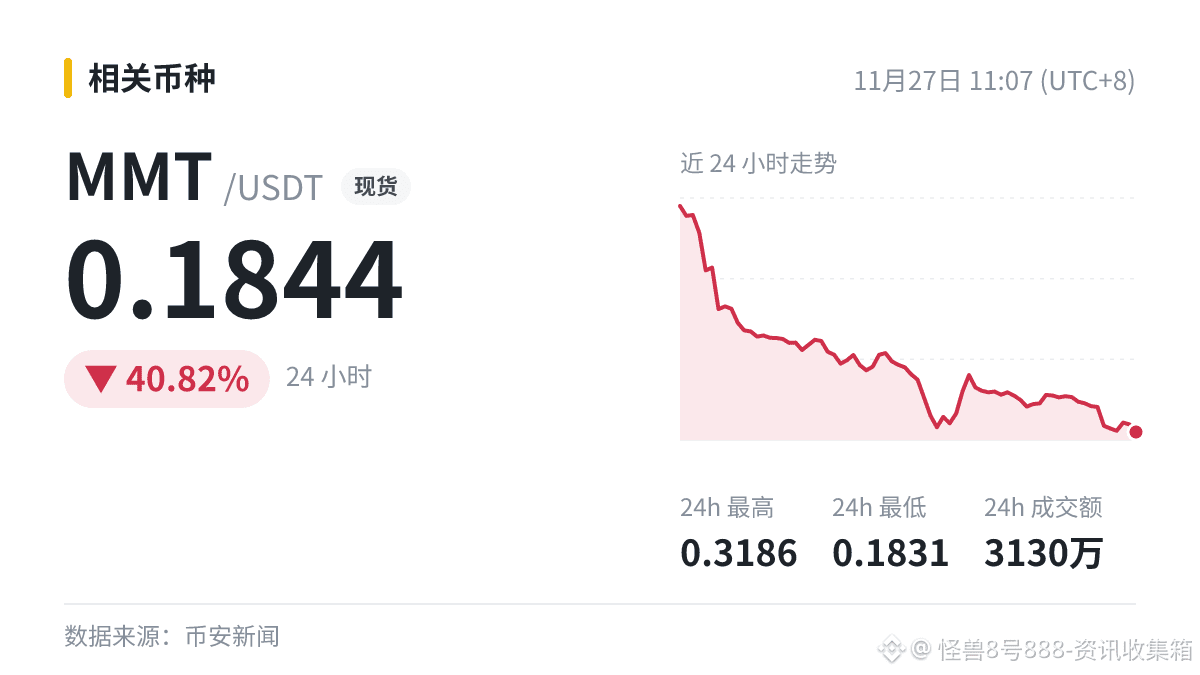
🔎 Let’s take a look at the market: $MMT 0.1844|1h -0.91%|4h -10%|24h -40.82%|Volume 31.3 million
Background: RootData: MMT tokens worth approximately $3.29 million will be unlocked in one week
Prices are trending down. Could the news turn things around? Let’s see how funds react.
Are you joining in or staying on the sidelines?
The above is for informational purposes only and does not constitute investment advice.
1
The latest updates, with an old crypto hand helping you sort through the key signals from the past hour.
Markets and Fund Flows
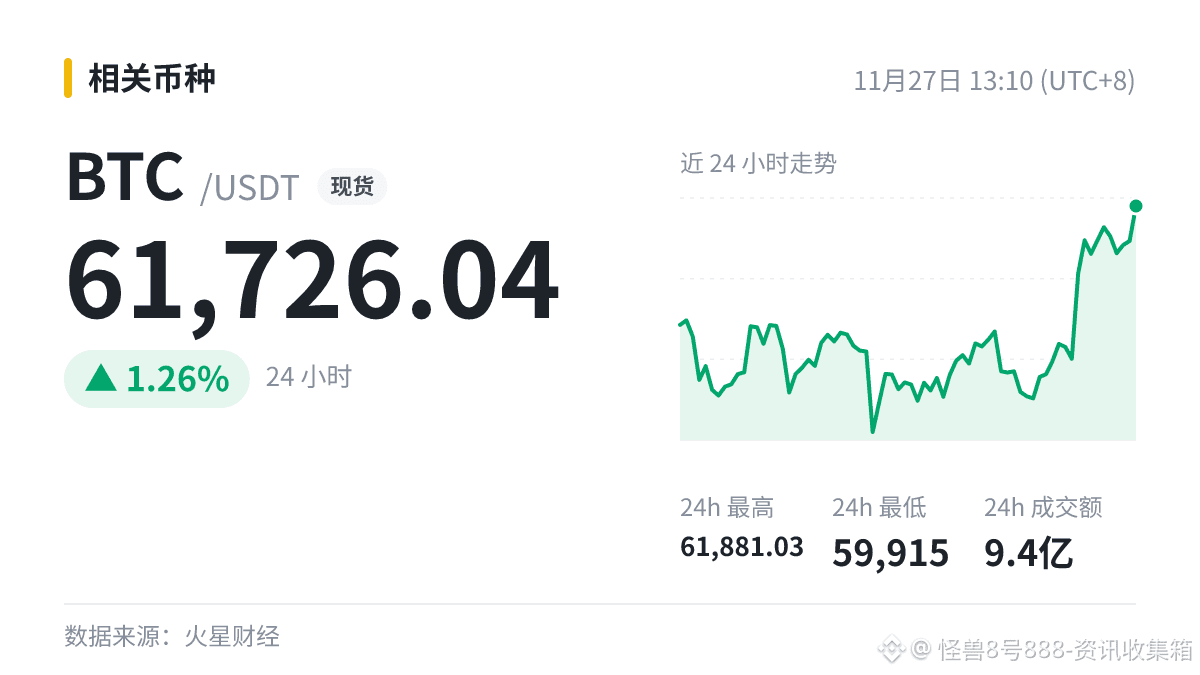
$BTC climbed above $61,000, up 0.3% on the day. Analyst Killa says the densest cluster of buy orders in this downturn sits between $56,000 and $64,000, and the crash-protection crew has been steadily accumulating. This old crypto hand’s take: it looks more like someone is laying a net below—but don’t mistake “someone’s buying” for “it can’t fall.” A break below that range would still hurt.
One address allegedly accumulated 8,000 $ETH three hours ago, worth about $13.64 million. But four months ago, this same address transferred 7,346.7 $ETH to an exchange at an average price of $1,788.7, meaning it missed the rally that followed. When it comes to holding coins, it’s not about who’s quickest—it’s about who can hold on.
Risk Case
One die-hard bull spent 30 days stubbornly trading BTC, VVV, and ZEC on Hyperliquid: 18 long positions and one short, with a win rate of just 21% and cumulative losses of $8.29 million. They’re still holding long positions worth over $5.06 million, including an unrealized loss of $2.86 million on ZEC alone. A cautionary tale: when you’re too fixated on a direction, even a terrible win rate won’t stop you from trading. One hit from a volatile coin like ZEC is enough to make you suffer.
On the security front, Velocity is back up and running. It had proactively paused operations because of a gap in its insurance fund protection, and confirmed that no user funds were lost. Spotting a problem and shutting things down first is a lot more respectable than trying to patch things up afterward.
Institutions and Infrastructure
Singapore’s TB Ventures has held the first close of its $30 million crypto-equity hybrid fund. It focuses on active protocols with on-chain revenue—the fund is still picking targets with real income.
Sources say Abraxas was much larger than people imagined, and exited HYPE because its size made it difficult to turn a profit. When a whale enters a small pond, getting out is hard too.
Ethereum core developers have reached several agreements on the Glamsterdam upgrade, with a coordination meeting set for December 15, 2026. The ETH narrative is still moving forward, little by little.
Traditional Assets and AI
Spot silver rose more than 4% on the day to $43.07 per ounce, while gold gained $50 to $3,616.59 per ounce. There’s a noticeable risk-off feel in the air.
Nvidia B200 and B300 rental prices are diverging. B200 is at $9.74 per card-hour, up 6.2% for the week, while B300 is at $10.82 per card-hour. Customers are keener to snap up B200 capacity—the computing-power business is starting to care about value for money too.
What do you most want to know: is this wave of concentrated buying genuine support, or just a false move?
34
It's pumping, fam! $BULLA 5 minutes +14.79%, trading at 0.0547.
A healthy rally needs both price and volume to rise. If the price climbs but trading volume doesn't keep up, its staying power is questionable.
In a highly volatile market, risk management comes first.
It's pumping, fam! $BULLA 5 minutes +14.79%, trading at 0.0547.
A healthy rally needs both price and volume to rise. If the price climbs but trading volume doesn't keep up, its staying power is questionable.
In a highly volatile market, risk management comes first.
A healthy rally needs both price and volume to rise. If the price climbs but trading volume doesn't keep up, its staying power is questionable.
In a highly volatile market, risk management comes first.
30
Article
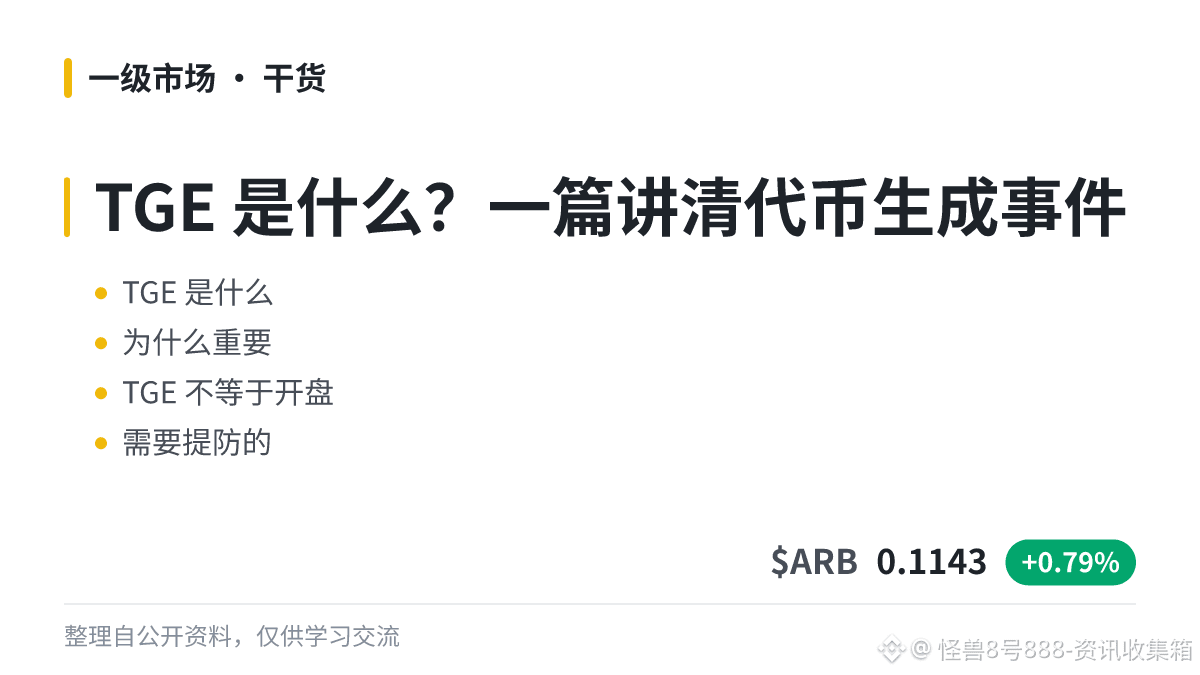
What Is TGE? A Clear Guide to Token Generation EventsWhen reading announcements about new projects, you’ll often come across an abbreviation: TGE. When an airdrop starts, when the team’s tokens unlock, and the initial circulating supply are all key details that revolve around this point in time.
Related token: $ARB Current price: 0.1143 (24h +0.79%).
■ What Is TGE?
TGE stands for Token Generation Event. It refers to the point when tokens are first generated on-chain and distribution to various parties begins.
Before the TGE, the team, investors, and community often only have “paper allocations.” After the TGE, these allocations become real assets that exist on-chain and are gradually released according to their respective rules.
What Is TGE? A Clear Guide to Token Generation Events
When reading announcements about new projects, you’ll often come across an abbreviation: TGE. When an airdrop starts, when the team’s tokens unlock, and the initial circulating supply are all key details that revolve around this point in time.
Related token: $ARB Current price: 0.1143 (24h +0.79%).
■ What Is TGE?
TGE stands for Token Generation Event. It refers to the point when tokens are first generated on-chain and distribution to various parties begins.
Before the TGE, the team, investors, and community often only have “paper allocations.” After the TGE, these allocations become real assets that exist on-chain and are gradually released according to their respective rules.
41
A roundup of the latest news and key takeaways, organized by topic:
I. Trading Platforms and Business Changes
Bluefin will discontinue its Bluefin Perps perpetual futures service at 5:00 a.m. Beijing time on December 5, and shift its focus to spot trading and RWA business. Takeaway: Derivatives traders in the Sui ecosystem should close their positions in advance. A strategic pivot is more practical than trying to hold on.
II. Crypto Security and Fund Tracking
Reuters reports that more than $600 million of funds stolen in the Binance hack have been routed through THORChain, and the FBI is pressuring node operators. Takeaway: Cross-chain protocols have become channels for funds to flow out, and on-chain compliance pressure will only keep growing.
III. Regulatory Developments
Japan’s Financial Services Agency has released a discussion paper proposing a cooling-off period for transfers from new accounts to individuals’ self-custody wallets. Takeaway: Regulatory oversight is reaching the moment funds leave a platform. Self-custody users will need to get used to slower transfers.
IV. Institutional Activity and On-Chain Movements
Tudor Investment increased its holdings of BlackRock IBIT shares by 98% in the third quarter, bringing its position to $64.6 million. Takeaway: Macro-focused institutional investors are still adding to $BTC spot ETFs; their allocation rationale hasn’t changed.
Abraxas Capital withdrew approximately 1,700 $BTC from Kraken over the past 9 hours, worth about $103 million. Takeaway: Large withdrawals are happening frequently, so the funds’ subsequent on-chain movements are worth watching.
V. Market Data and Product Watch
OKX’s tokenized U.S. stock market recorded approximately $8.9 million in trading volume over three days, but 99.85% came from just two addresses. Takeaway: Impressive trading figures don’t necessarily indicate genuine demand; the possibility of wash trading should be questioned.
VI. Traditional Markets and News
U.S. stock index futures edged higher, with the Dow up 0.55%, the S&P 500 up 0.64%, and the Nasdaq up 0.55%. Over-the-counter contract prices for AI and crypto stocks also rose. Takeaway: Risk appetite is recovering, but contract prices are volatile—don’t mistake short-term moves for a trend.
Elon Musk said he would give every child in the United States one additional share of SpaceX stock each year, having previously pledged two shares per person. Takeaway: The marketing angle is unmistakable, but $SPCX is not publicly listed, and how this would actually be fulfilled remains to be seen.
Which of these news items do you think will have the biggest impact on market sentiment?
55
Folks, there’s action: a 2.82% surge over $PIEVERSE 5 minutes.
Volatility is pretty high, so keep leverage in check.
#PIEVERSE
This is just a market update; make your own trading decisions.
Folks, there’s action: a 2.82% surge over $PIEVERSE 5 minutes.
Volatility is pretty high, so keep leverage in check.
#PIEVERSE
This is just a market update; make your own trading decisions.
Volatility is pretty high, so keep leverage in check.
#PIEVERSE
This is just a market update; make your own trading decisions.
76
Latest News
【Macroeconomic Policy】
The probability of a 25-basis-point Fed rate hike in December is currently 99.5%. Analysis: CME data shows that the market has almost fully priced in a rate hike. Expectations for macro liquidity continue to tighten, putting pressure on risk assets.
【Market Moves and Sentiment】
Over the past 24 hours, $360 million in positions were liquidated across the crypto market, mostly short positions. Analysis: Short liquidations totaled $274 million, far exceeding the $85.73 million in long liquidations. This points to some short-term push and pull, but overall volatility risk remains elevated.
JPMorgan: Strategy’s mNAV ratio has fallen to a record low, signaling “capitulation selling” in the $BTC market. Analysis: Institutions use valuation metrics to gauge sentiment at its lowest point, but whether “capitulation” means a bottom has been reached still needs to be confirmed by subsequent price and volume action.
【On-Chain and Fund Flows】
The dormant supply of $BTC is rising, showing characteristics of historical bear-market bottoming periods. Analysis: The amount of $BTC that has not moved for at least a year is increasing, resembling patterns seen during previous bottoming periods. Long-term holders have yet to budge.
The Coinbase BTC Premium Index has been negative for 64 consecutive days, most recently at -0.13%. Analysis: The persistent discount reflects weak buying power in the U.S. market, and a recovery in demand remains to be seen.
【Other】
An Iranian military spokesperson denied that Iran had attacked key facilities in Kuwait. Analysis: Geopolitical tensions have not escalated further, but their potential impact on energy markets and risk sentiment is worth watching.
Discussion: Which are you watching more closely: on-chain signals that BTC is forming a bottom, or the U.S. market premium turning positive as an indicator of demand?
5
The latest news—let’s connect a few dots and see what they tell us.
First, on-chain signals. The dormant supply of $BTC is rising, with more coins that haven’t moved in at least a year. This trend looks a lot like previous bear-market bottoming periods. Seasoned crypto investors know the drill: underwater holders go quiet, and long-term holders refuse to let go. That’s often one sign that market sentiment is bottoming out—but remember, it’s “one” sign, not a signal to buy the dip.
Now let’s look at buying activity in the U.S. The Coinbase Bitcoin Premium Index has been negative for 64 straight days, most recently at -0.13%, suggesting that buying power in the U.S. market remains weak. Put that together with the first signal and things look a little contradictory: long-term holders are accumulating, but U.S. buyers aren’t showing up. For the market to make a smooth recovery, “sitting tight and not selling” isn’t enough.
The macro picture calls for even more caution. CME data puts the odds of the Fed raising rates by 25 basis points in December at 99.5%, with just a 0.5% chance of no change. Tightening is practically a foregone conclusion, and risk assets face considerable short-term pressure. $BTC is still a long way—about halfway—from its all-time high, so don’t focus only on bottoming signals and forget the storm clouds overhead.
In short: on-chain conditions are quietly improving, but macro factors and buying activity haven’t fallen into place yet. This is a time to watch more and act on impulse less. Managing your position is always more important than guessing the direction.
Do you think this rise in “dormant supply” is a genuine bottom, or just another round of holders going quiet? Let’s talk in the comments.
2
The latest news, a quick rundown of a few stories.
On the regulatory front, the Central Bank of Russia has approved rules for its first test program for crypto investors. Whether or not they qualify, investors must pass a knowledge test before buying crypto, and the test is free. In effect, this moves the entry barrier further upstream. The intent to bring the market into compliance is clear, but it’s not particularly favorable for new capital in the short term. Meanwhile, Injective has submitted a 22-page policy proposal to the U.S. SEC, calling for the exemption framework for tokenized stocks to be extended to on-chain order books. The $INJ ecosystem is leaning into the RWA narrative, and the regulatory battle is only just beginning.
On the traditional finance side, a Nasdaq executive called at an EU roundtable for a dedicated legal framework for tokenized securities, warning against fragmented rules. Traditional exchanges actively pushing tokenization shows that it’s becoming impossible to ignore.
Two notable market moves. $BTC briefly fell below $60,000 and is now at $60,232, with its 24-hour gain narrowing to 3.9%. $ZEC fell below $675 and is now at $674.85, down 12.66% on the day. The decline has accelerated noticeably, so be mindful of volatility risks.
Keep an eye on capital flows. CryptoQuant data shows that the USDT supply has fallen by $8.1 billion over the past 60 days, its biggest drop since August 2022, with almost all of the decline coming from the Ethereum network. The last time liquidity flowed out like this, BTC was in the late stages of a bear market. This signal shouldn’t be taken lightly.
Product and people updates. Okto Wallet has announced that it will cease operations on December 22, 2026. Its iOS, Android, and web services, as well as its API/SDK, will all be shut down, and no token will be issued. Users should export their recovery phrases and private keys in advance. Telegram founder Pavel Durov said that Telegram Gifts will officially move peer-to-peer trading on-chain this week, and emphasized that it is currently the only NFT that remains active. Its price has risen 2.5 times since launch, even through the crypto winter. Separately, Tom Lee told CNBC that U.S. stocks may have already bottomed, and that a rebound could come before the Fed pivots. That’s his view, for reference only.
One last question: With the USDT supply contracting like this, do you think capital is pulling out, or waiting for a better entry point?
5
Seeing this, my hands are already itching to make a move. Good thing my wallet held them back.
$ETH 1700.1, keep an eye on USDT inflows and outflows to see whether over-the-counter funds are entering the market because of this.
For reference only, not trading advice.
Seeing this, my hands are already itching to make a move. Good thing my wallet held them back.
$ETH 1700.1, keep an eye on USDT inflows and outflows to see whether over-the-counter funds are entering the market because of this.
For reference only, not trading advice.
$ETH 1700.1, keep an eye on USDT inflows and outflows to see whether over-the-counter funds are entering the market because of this.
For reference only, not trading advice.
5
The latest news—here are a few stories that make for an interesting picture when viewed together.
On the macro policy front, Trump is speaking up again: he questioned whether the economic data released before the election was “padded,” saying that the third-quarter GDP growth rate was revised up to 4.3%, higher than the previous 3.4%, and that an investigation would be launched. Takeaway: When the data changes, so does the narrative. Politics and statistics are getting mixed together, so it’s best to watch without rushing to conclusions. Meanwhile, sources familiar with the matter say that Bank for International Settlements General Manager Agustín Carstens will succeed Christine Lagarde as president of the European Central Bank, with the Netherlands having switched its support. Takeaway: A change in leadership at the helm of European monetary policy is imminent. The new direction will be worth watching, but expectations are just expectations—things could still change before it’s official.
On crypto regulation, Spain has given its anti-money laundering agency, Sepblac, the green light to freeze cryptocurrency accounts for up to five business days without a judge’s approval. Takeaway: Tighter compliance is the trend. Users doing business in Spain should get their source-of-funds documentation and transaction trails in order, rather than waiting until their accounts are frozen to think about it.
As for projects and institutions, onchain perpetuals platform Extended has announced its $XTEN airdrop plans. After token distribution begins, the $XTEN/$USDC spot trading pair will open at 23:00 Beijing time on November 30, with staking to follow. Takeaway: Airdrop season is always lively, but think carefully about what to do after claiming your tokens, and don’t bite off more than you can chew—you don’t want to give back what you got “for free.” QRT plans to fold the $2 billion crypto fund Moebius into its flagship strategy in early 2027. Takeaway: When major traditional institutions bring their crypto positions into their core strategies, it shows they’re taking this business seriously.
On markets and fund flows, U.S. stock markets are closed for Thanksgiving. On Trade.xyz, onchain U.S. stock assets were generally weaker than at Wednesday’s close, with a modest lower open expected before Friday’s session. Takeaway: Traditional markets may be on holiday, but onchain markets are still working overtime to price assets. Overnight moves in assets like SPCX can be a useful reference, but shouldn’t be treated as definitive. South Korea’s story is more straightforward: investors are selling stocks, bonds, and crypto assets to raise cash for home purchases, with the total surpassing 10 trillion won for the first time. Takeaway: The property market is soaking up capital while retail investors in stocks take a beating. Money votes with its feet—this is a real-life “great asset migration.”
One final question: If data can be revised, accounts can be frozen, and capital can move, what kind of asset do you think is most important to hold on to? Feel free to share your thoughts, but remember: managing risk should always come before chasing returns.
5
Binance Blockchain Week to Feature a Dedicated Session on Financial Evolution
The more hyped the headline sounds, the more I want to pour myself a glass of water first. I guess that's a side effect of having been schooled by the market.
$BNB 24h +2.52%, do you think this one is overvalued?
For record-keeping only, not investment advice.
The more hyped the headline sounds, the more I want to pour myself a glass of water first. I guess that's a side effect of having been schooled by the market.
$BNB 24h +2.52%, do you think this one is overvalued?
For record-keeping only, not investment advice.
2
The latest news: your seasoned trader is here to help you sort through the headlines from the past hour and pick out what matters.
On macro policy, both the Fed and the European Central Bank are wrestling with a dilemma. Reporter Nick Timiraos, often called the “Fed’s mouthpiece,” points out that the tech-stock sell-off is pushing Fed Chair Warsh into a tough spot: keep raising rates to honor his commitment to fighting inflation, or listen to the other side. It could determine whether he ends up disagreeing with his 2018 self. Meanwhile, minutes from the ECB meeting warned that rates will still need to rise unless the inflation outlook improves “significantly.” Officials are also concerned that the 2% inflation target may not be reached until after 2028. My take: both sides are talking tough, but the market has already cast its vote. Don’t treat officials’ words as a script—treat them as variables.
On the economic data front, Trump says U.S. third-quarter GDP growth was just revised up to 4.3%, nearly double the second quarter’s 2.2%. A reminder from your seasoned trader: the data may look good, but tech stocks are still being sold. The macro narrative and what’s happening on the trading floor are often two different things.
Stay alert on crypto security. On-chain monitoring shows that the Binance hacker has moved another approximately $35.52 million in $ETH and still holds about 461,980 $ETH and 18,350 $BTC. This saga isn’t over, and the activity of related addresses is worth watching. Separately, CZ advised 1Password users to change their passwords. 1Password responded that user passwords had not been exposed and didn’t need to be changed, but warned users to watch out for phishing emails. The lesson is simple: your wallet and passwords are your responsibility.
On the ecosystem and market front, BNB Chain has released a white paper for a new L1 network focused on high-frequency trading, payments, privacy-focused finance, and autonomous AI agents. It uses a SubBlocks mechanism to push transactions in batches ahead of time. My view: the direction makes sense, but there are several bull and bear cycles between a white paper and something people actually use. “Big Brother Ma” Huang Licheng’s address is back on Hyperliquid, opening a 25x leveraged long on 1,290 ETH at an average entry price of $1,665.27, with a current unrealized profit of $52,000. Just watch this kind of high-leverage play—copying him would be digging your own hole.
One last question: the Fed is talking about rate hikes while tech stocks are being sold. Are you betting on the data or the sentiment with your current positions?
The latest news: your seasoned trader is here to help you sort through the headlines from the past hour and pick out what matters.
On macro policy, both the Fed and the European Central Bank are wrestling with a dilemma. Reporter Nick Timiraos, often called the “Fed’s mouthpiece,” points out that the tech-stock sell-off is pushing Fed Chair Warsh into a tough spot: keep raising rates to honor his commitment to fighting inflation, or listen to the other side. It could determine whether he ends up disagreeing with his 2018 self. Meanwhile, minutes from the ECB meeting warned that rates will still need to rise unless the inflation outlook improves “significantly.” Officials are also concerned that the 2% inflation target may not be reached until after 2028. My take: both sides are talking tough, but the market has already cast its vote. Don’t treat officials’ words as a script—treat them as variables.
On the economic data front, Trump says U.S. third-quarter GDP growth was just revised up to 4.3%, nearly double the second quarter’s 2.2%. A reminder from your seasoned trader: the data may look good, but tech stocks are still being sold. The macro narrative and what’s happening on the trading floor are often two different things.
Stay alert on crypto security. On-chain monitoring shows that the Binance hacker has moved another approximately $35.52 million in $ETH and still holds about 461,980 $ETH and 18,350 $BTC . This saga isn’t over, and the activity of related addresses is worth watching. Separately, CZ advised 1Password users to change their passwords. 1Password responded that user passwords had not been exposed and didn’t need to be changed, but warned users to watch out for phishing emails. The lesson is simple: your wallet and passwords are your responsibility.
On the ecosystem and market front, BNB Chain has released a white paper for a new L1 network focused on high-frequency trading, payments, privacy-focused finance, and autonomous AI agents. It uses a SubBlocks mechanism to push transactions in batches ahead of time. My view: the direction makes sense, but there are several bull and bear cycles between a white paper and something people actually use. “Big Brother Ma” Huang Licheng’s address is back on Hyperliquid, opening a 25x leveraged long on 1,290 ETH at an average entry price of $1,665.27, with a current unrealized profit of $52,000. Just watch this kind of high-leverage play—copying him would be digging your own hole.
One last question: the Fed is talking about rate hikes while tech stocks are being sold. Are you betting on the data or the sentiment with your current positions?
3
The latest news, with a few brief updates organized by topic.
On macro policy, OPEC+ is considering extending its current oil production quotas through January amid uncertainties including the conflict involving Iran. The group will meet on Sunday to discuss new targets for 2027. Takeaway: Oil-producing countries are choosing to hold steady, suggesting they fear geopolitical risks more than they want to expand production and grab market share. The Bank of England is keeping its countercyclical capital buffer at 2% and plans to lower banks’ capital requirements, while warning that global stock valuations remain high and AI financing is becoming increasingly complex and opaque. Takeaway: Regulators are easing capital requirements while explicitly flagging AI financing risks—a combination worth watching.
On institutional views, Schroders’ economists wrote that the recent stock sell-off is unlikely to ease just because the Federal Reserve pauses its tightening. Takeaway: The old logic of “if markets fall far enough, just wait for the Fed to bail them out” may not work this time.
On crypto security, Zodia Custody, the crypto custodian owned by Standard Chartered, suffered a security incident that exposed customer names, email addresses, and other information. It is not yet clear whether crypto assets such as $BTC were affected. Takeaway: When a custodian loses customer information, the cost to rebuild trust is harder to make up for than lost coins.
On market moves, trader AguilaTrades, who rolls over positions, closed a long position of 1,548.7 $BTC , worth about $94.11 million, for a profit of $1.82 million. Their cumulative profit over the past month has reached $11 million. Takeaway: Cashing out of a long position worth nearly $100 million shows that some traders are taking profits at this level—not blindly betting on a rise. High-leverage trades like this may look exciting, but the risks for ordinary investors who follow suit are very different. Don’t focus only on the profit figure.
Two stories from the AI sector. Google has launched a Workspace MCP server and command-line tool, setting restrictions on third-party AI access to Gmail, Drive, and Calendar. The playbook of first pushing out an open-source developer and then launching a paid version is pretty clear. Takeaway: When you control the gateway, ecosystem openness is just a slogan; the paywall is the business. Meanwhile, an organization has offered $10 million to acquire bankrupt Character.AI, while attorneys general from 42 states oppose the sale of users’ private data. Takeaway: User data has become the most valuable—and most sensitive—part of the bankruptcy estate.
Which story matters more to you: the large holder’s move to take profits on $BTC , or Google’s latest restrictions on third-party AI?
5
Here's something that just happened: $XMR 1-hour sharp drop of 3.8%.
The candlestick chart is drawing roller coasters again—the downhill kind.
#XMR
Make your own trading decisions; don't follow the crowd.
Here's something that just happened: $XMR 1-hour sharp drop of 3.8%.
The candlestick chart is drawing roller coasters again—the downhill kind.
#XMR
Make your own trading decisions; don't follow the crowd.
The candlestick chart is drawing roller coasters again—the downhill kind.
#XMR
Make your own trading decisions; don't follow the crowd.
4
Log in to explore more content
Join global crypto users on Binance Square
⚡️ Get latest and useful information about crypto.
💬 Trusted by the world’s largest crypto exchange.
👍 Discover real insights from verified creators.
Email / Phone number
Trending Topics
EvolveAtBinanceBlockchainWeek
920,414 views
11,461 Discussing
Binance Blockchain Week 2026 is coming to Bangkok! 🌍
On November 28–29, industry leaders, builders and community members from around the world will come together.
This year’s theme is Evolve. From technological innovation to real-world applications, we’ll explore the future of blockchain and crypto. Whether you’re joining us in person or following online, your voice is part of the conversation!
Starting today, follow this account and post on Binance Square using #EvolveAtBinanceBlockchainWeek . Include an image and share what you’re looking forward to, your perspectives on the industry, or the ideas and moments that stand out during the event. 🎉🙌
🎁 We’ll select 20 users who post with the hashtag to receive 50 USDT each! The cutoff for draw entries is November 29 at 23:59 (UTC).
Let’s be part of this evolution and explore what’s possible together!
Binance Blockchain Week
·570 Likes
·486.9k views
CanMarketsReboundAfterThanksgiving?
260,790 views
2,321 Discussing
Nasdaq100FiveDayAvgIntradayVolatilityHits3.8%
8,776 views
113 Discussing