
NamWrite12
132 Posts

NamWrite12
Report
Block User
40 Following
46 Followers
107 Liked
Posts
All
Quotes
·
--
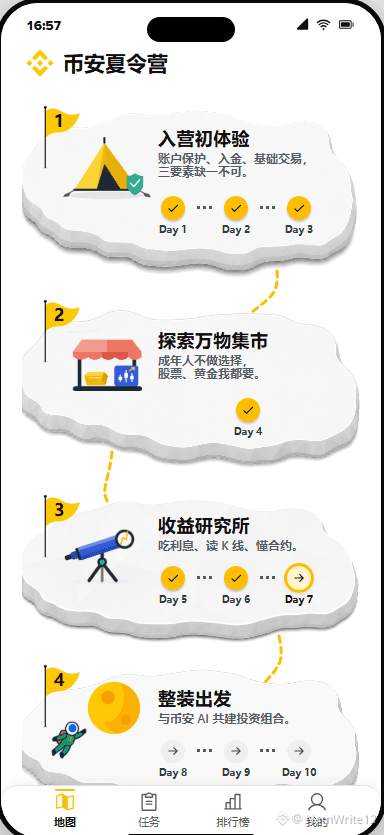
Attending the Binance Summer Camp made it clear how the traditional finance sector (TradFi) is increasingly adopting the core components of decentralized finance (DeFi)—especially yield-generating real-world assets (RWA) and automated liquidity management mechanisms. It showed how traditional financial institutions use blockchain technology to tokenize traditional financial instruments, thereby enabling round-the-clock liquidity, instant settlement, and the division of assets—while also ensuring compliance with laws and regulations.
The Binance Summer Camp clearly confirmed that the traditional finance sector is actively adopting the core technologies of DeFi.
The interactive discussion session demonstrated how financial institutions use blockchain to tokenize real-world assets (RWA) and automate liquidity management workflows. This makes possible trading around the clock, instant settlement, and asset partitioning—all of which strictly comply with laws and regulations.
#币安夏令营
Attending the Binance Summer Camp made it clear how the traditional finance sector (TradFi) is increasingly adopting the core components of decentralized finance (DeFi)—especially yield-generating real-world assets (RWA) and automated liquidity management mechanisms. It showed how traditional financial institutions use blockchain technology to tokenize traditional financial instruments, thereby enabling round-the-clock liquidity, instant settlement, and the division of assets—while also ensuring compliance with laws and regulations.
The Binance Summer Camp clearly confirmed that the traditional finance sector is actively adopting the core technologies of DeFi.
The interactive discussion session demonstrated how financial institutions use blockchain to tokenize real-world assets (RWA) and automate liquidity management workflows. This makes possible trading around the clock, instant settlement, and asset partitioning—all of which strictly comply with laws and regulations.
#币安夏令营
The Binance Summer Camp clearly confirmed that the traditional finance sector is actively adopting the core technologies of DeFi.
The interactive discussion session demonstrated how financial institutions use blockchain to tokenize real-world assets (RWA) and automate liquidity management workflows. This makes possible trading around the clock, instant settlement, and asset partitioning—all of which strictly comply with laws and regulations.
#币安夏令营
156
·
--
Crypto doesn't operate in a vacuum—traditional finance (TradFi) is its driving force!
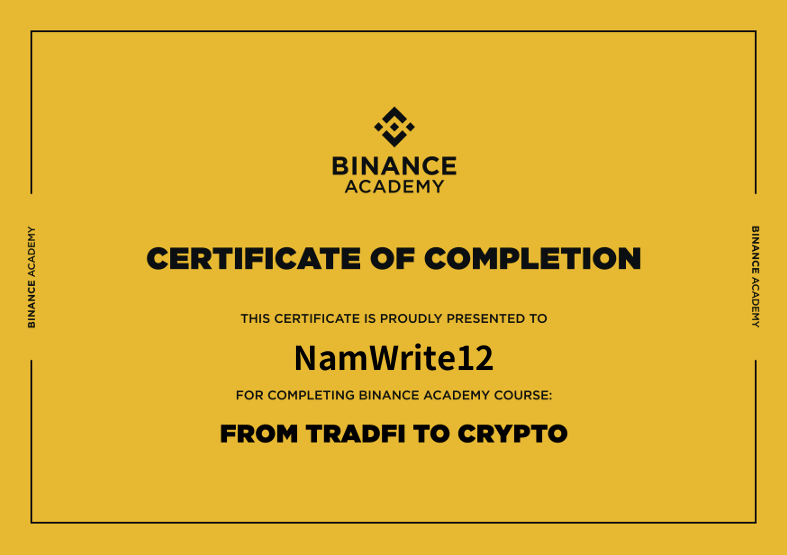
The "From TradFi to Crypto" course on Binance Academy offers valuable insights:
- Macro factors rule everything: Central bank interest rates and Federal Reserve policies directly control the flow of liquidity into the crypto market.
- Refined mechanisms: Crypto has adopted TradFi derivatives and optimized them—for instance, using the "Funding Rate" to power perpetual futures contracts that operate 24/7.
- Avoid the trap of isolated signals: Never trade based solely on a single news headline; always look for alignment between macro signals and on-chain data.
#BinanceAcademyCourse
Crypto doesn't operate in a vacuum—traditional finance (TradFi) is its driving force!
The "From TradFi to Crypto" course on Binance Academy offers valuable insights:
- Macro factors rule everything: Central bank interest rates and Federal Reserve policies directly control the flow of liquidity into the crypto market.
- Refined mechanisms: Crypto has adopted TradFi derivatives and optimized them—for instance, using the "Funding Rate" to power perpetual futures contracts that operate 24/7.
- Avoid the trap of isolated signals: Never trade based solely on a single news headline; always look for alignment between macro signals and on-chain data.
#BinanceAcademyCourse
The "From TradFi to Crypto" course on Binance Academy offers valuable insights:
- Macro factors rule everything: Central bank interest rates and Federal Reserve policies directly control the flow of liquidity into the crypto market.
- Refined mechanisms: Crypto has adopted TradFi derivatives and optimized them—for instance, using the "Funding Rate" to power perpetual futures contracts that operate 24/7.
- Avoid the trap of isolated signals: Never trade based solely on a single news headline; always look for alignment between macro signals and on-chain data.
#BinanceAcademyCourse


Binance Academy
·
--
🎓 Learn the course “From TradFi to Crypto”, share the certificate, and win Binance swag.
Campaign period: Sep 16, 2026, 9:00 AM (UTC) – Sep 27, 2026, 9:00 AM (UTC)
🔸Complete the course From TradFi to Crypto & earn your certificate:
🔸Follow @Binance Academy on Square
🔸Share your certificate with hashtag #BinanceAcademyCourse
🔸Fill in the shipping info
🔸Wait for results!
10 winners will be announced on Sep 28, 2026, chosen based on creativity and relevance in sharing their certificate and learning journey. Make your post stand out. 🏆
Note: Campaign unavailable in certain regions due to compliance requirements.
Campaign period: Sep 16, 2026, 9:00 AM (UTC) – Sep 27, 2026, 9:00 AM (UTC)
🔸Complete the course From TradFi to Crypto & earn your certificate:
🔸Follow @Binance Academy on Square
🔸Share your certificate with hashtag #BinanceAcademyCourse
🔸Fill in the shipping info
🔸Wait for results!
10 winners will be announced on Sep 28, 2026, chosen based on creativity and relevance in sharing their certificate and learning journey. Make your post stand out. 🏆
Note: Campaign unavailable in certain regions due to compliance requirements.
91
·
--
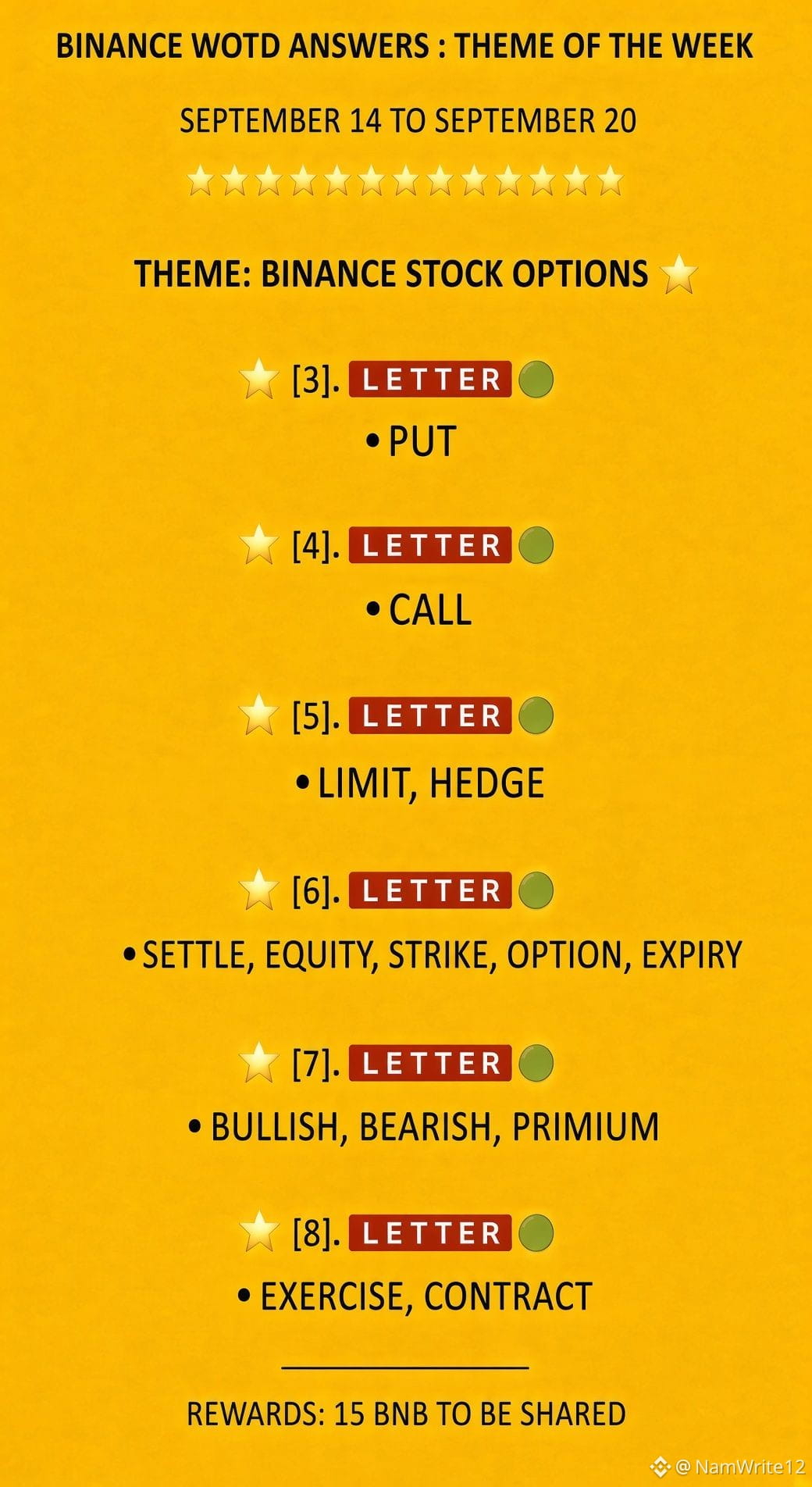
WODL Binance - Weekly word guessing game of Binance
Round 2026-09-14 to 2026-09-20
Share 10,000 USDC
Link: [https://www.binance.com/activity/word-of-the-day/Binance-Stock-Options?ref=CPA_00NENB4FBU](https://www.binance.com/activity/word-of-the-day/Binance-Stock-Options?ref=CPA_00NENB4FBU)
On the app: More ->WOTD
Each round lasts 1 week (from Monday to Sunday). Complete more rewards to get bigger rewards (at least 5 times/week to be eligible for rewards)
Hints from:
3️⃣ PUT
4⃣ CALL
5️⃣ LIMIT, HEDGE
6️⃣ SETTLE, EQUITY, STRIKE, OPTION, EXPIRY
7️⃣ BULLISH, BEARISH, PRIMIUM
8️⃣ EXERCISE, CONTRACT
WODL Binance - Weekly word guessing game of Binance
Round 2026-09-14 to 2026-09-20
Share 10,000 USDC
Link: https://www.binance.com/activity/word-of-the-day/Binance-Stock-Options?ref=CPA_00NENB4FBU
On the app: More ->WOTD
Each round lasts 1 week (from Monday to Sunday). Complete more rewards to get bigger rewards (at least 5 times/week to be eligible for rewards)
Hints from:
3️⃣ PUT
4⃣ CALL
5️⃣ LIMIT, HEDGE
6️⃣ SETTLE, EQUITY, STRIKE, OPTION, EXPIRY
7️⃣ BULLISH, BEARISH, PRIMIUM
8️⃣ EXERCISE, CONTRACT
Round 2026-09-14 to 2026-09-20
Share 10,000 USDC
Link: https://www.binance.com/activity/word-of-the-day/Binance-Stock-Options?ref=CPA_00NENB4FBU
On the app: More ->WOTD
Each round lasts 1 week (from Monday to Sunday). Complete more rewards to get bigger rewards (at least 5 times/week to be eligible for rewards)
Hints from:
3️⃣ PUT
4⃣ CALL
5️⃣ LIMIT, HEDGE
6️⃣ SETTLE, EQUITY, STRIKE, OPTION, EXPIRY
7️⃣ BULLISH, BEARISH, PRIMIUM
8️⃣ EXERCISE, CONTRACT
6
·
--
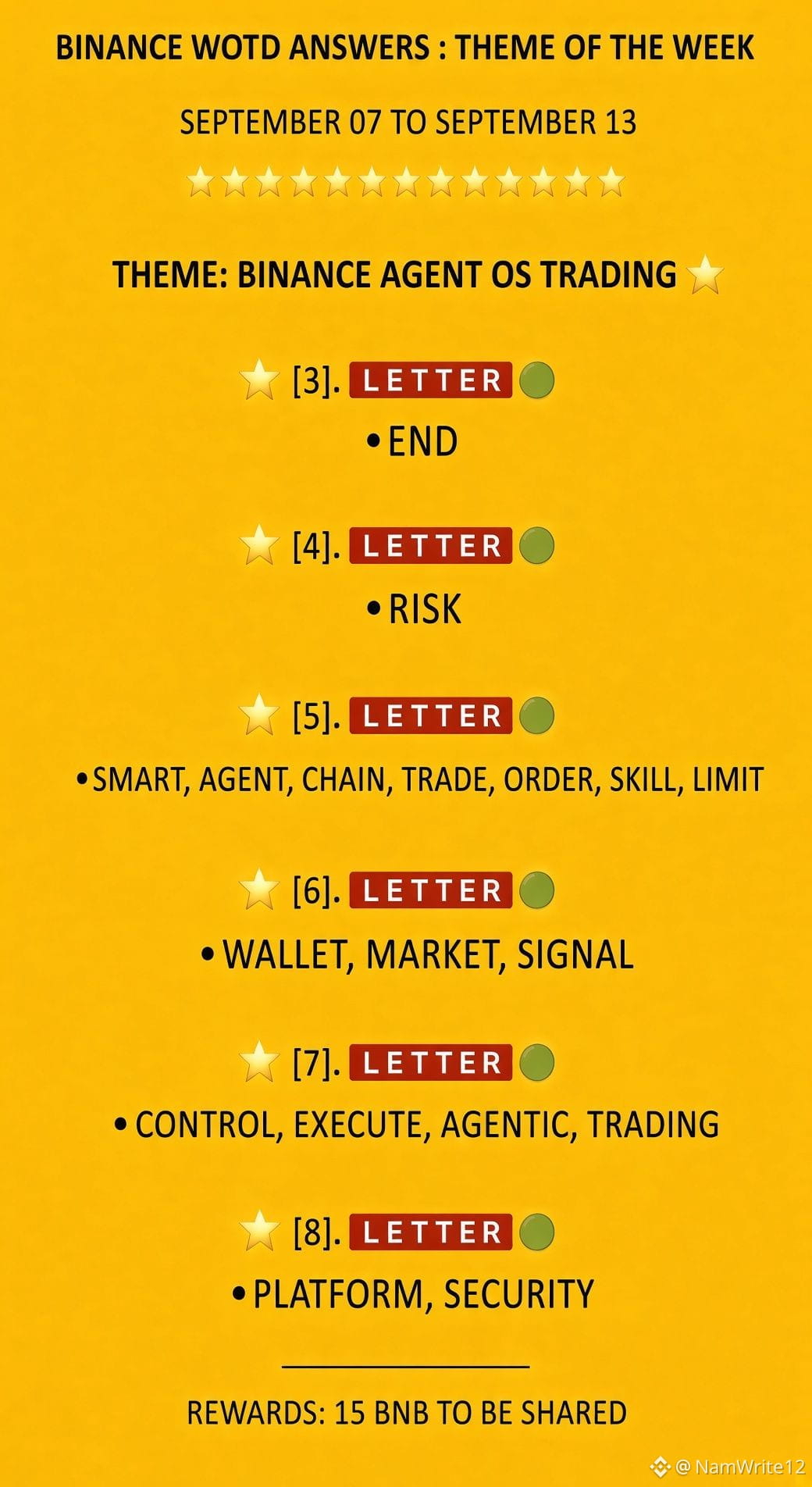
WODL Binance - Weekly word-guessing game of Binance
Round 2026-09-07 to 2026-09-13
Share 10,000 $USDC
Link: [https://www.binance.com/activity/word-of-the-day/Binance-Agent-OS-Trading?ref=CPA_00NENB4FBU](https://www.binance.com/activity/word-of-the-day/Binance-Agent-OS-Trading?ref=CPA_00NENB4FBU)
On the app: More ->WOTD
Each round lasts 1 week (from Monday to Sunday). The more rewards you complete, the bigger the rewards (at least 5 times/week to be eligible to receive rewards)
Hints from:
3️⃣ END
4⃣ RISK
5️⃣ SMART, AGENT, CHAIN, TRADE, ORDER, SKILL, LIMIT
6️⃣ WALLET, MARKET, SIGNAL
7️⃣ CONTROL, EXECUTE, AGENTIC, TRADING
{spot}(BNBUSDT)
WODL Binance - Weekly word-guessing game of Binance
Round 2026-09-07 to 2026-09-13
Share 10,000 $USDC
Link: https://www.binance.com/activity/word-of-the-day/Binance-Agent-OS-Trading?ref=CPA_00NENB4FBU
On the app: More ->WOTD
Each round lasts 1 week (from Monday to Sunday). The more rewards you complete, the bigger the rewards (at least 5 times/week to be eligible to receive rewards)
Hints from:
3️⃣ END
4⃣ RISK
5️⃣ SMART, AGENT, CHAIN, TRADE, ORDER, SKILL, LIMIT
6️⃣ WALLET, MARKET, SIGNAL
7️⃣ CONTROL, EXECUTE, AGENTIC, TRADING
Round 2026-09-07 to 2026-09-13
Share 10,000 $USDC
Link: https://www.binance.com/activity/word-of-the-day/Binance-Agent-OS-Trading?ref=CPA_00NENB4FBU
On the app: More ->WOTD
Each round lasts 1 week (from Monday to Sunday). The more rewards you complete, the bigger the rewards (at least 5 times/week to be eligible to receive rewards)
Hints from:
3️⃣ END
4⃣ RISK
5️⃣ SMART, AGENT, CHAIN, TRADE, ORDER, SKILL, LIMIT
6️⃣ WALLET, MARKET, SIGNAL
7️⃣ CONTROL, EXECUTE, AGENTIC, TRADING
119
·
--
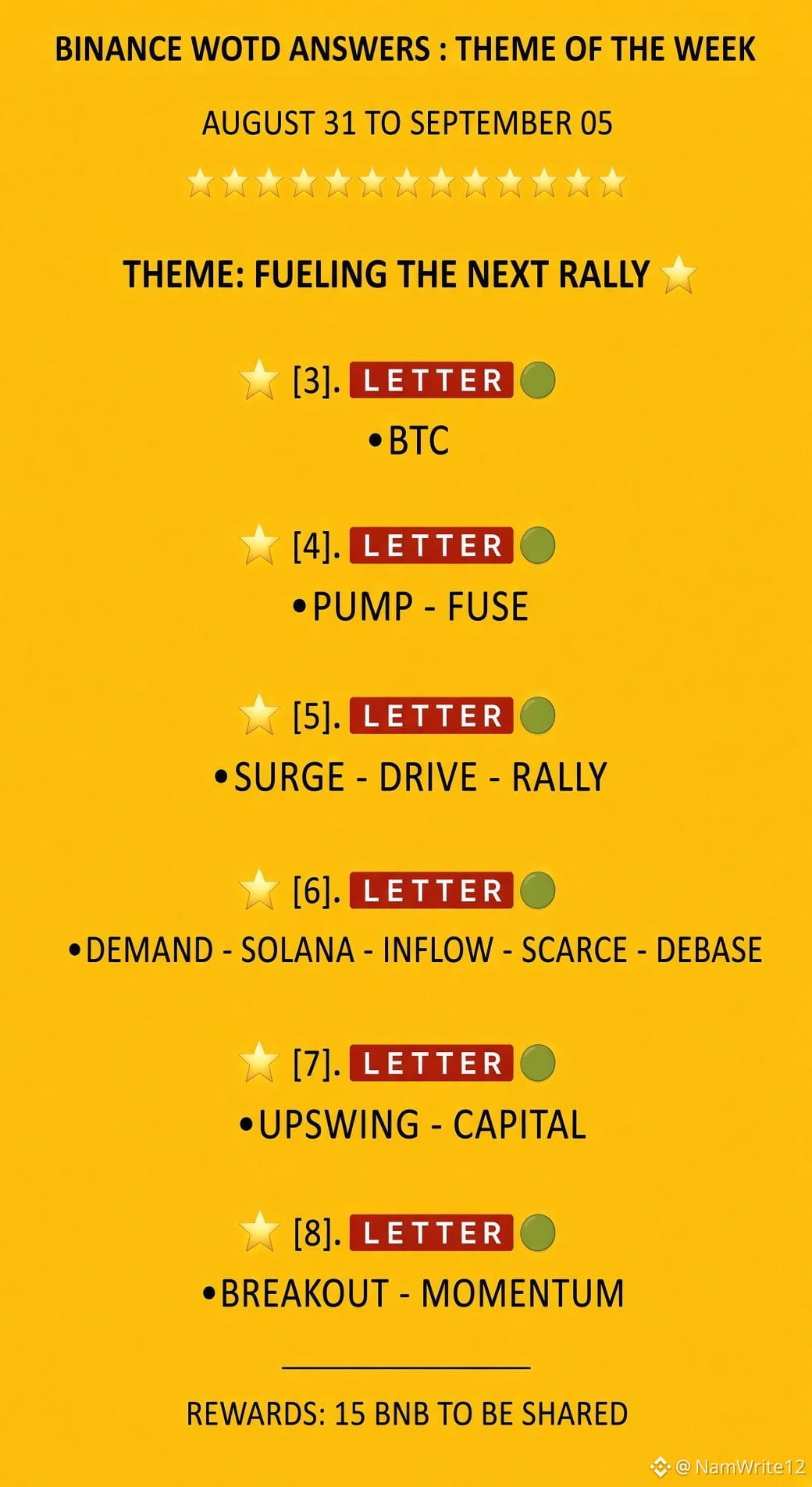
WODL Binance - Binance weekly word guessing game
Round 2026-08-31 to 2026-09-05
Share 15 BNB
Link:
[https://binance.com/activity/word-of-the-day/Fueling-the-Next-Rally?ref=CPA_00NENB4FBU](https://binance.com/activity/word-of-the-day/Fueling-the-Next-Rally?ref=CPA_00NENB4FBU)
In the app: More ->WOTD
Each round lasts 1 week (from Monday to Sunday). The more rewards you complete, the bigger they are (minimum 5 times/week to be eligible for rewards)
Hints from:
🌟3 Letters
BTC
🌟4 Letters
PUMP - FUSE
🌟5 Letters
SURGE - DRIVE - RALLY
🌟6 Letters
DEMAND - SOLANA - INFLOW - SCARCE - DEBASE
🌟7 Letters
UPSWING - CAPITAL
🌟8 Letters
BREAKOUT - MOMENTUM
WODL Binance - Binance weekly word guessing game
Round 2026-08-31 to 2026-09-05
Share 15 BNB
Link:
https://binance.com/activity/word-of-the-day/Fueling-the-Next-Rally?ref=CPA_00NENB4FBU
In the app: More ->WOTD
Each round lasts 1 week (from Monday to Sunday). The more rewards you complete, the bigger they are (minimum 5 times/week to be eligible for rewards)
Hints from:
🌟3 Letters
BTC
🌟4 Letters
PUMP - FUSE
🌟5 Letters
SURGE - DRIVE - RALLY
🌟6 Letters
DEMAND - SOLANA - INFLOW - SCARCE - DEBASE
🌟7 Letters
UPSWING - CAPITAL
🌟8 Letters
BREAKOUT - MOMENTUM
Round 2026-08-31 to 2026-09-05
Share 15 BNB
Link:
https://binance.com/activity/word-of-the-day/Fueling-the-Next-Rally?ref=CPA_00NENB4FBU
In the app: More ->WOTD
Each round lasts 1 week (from Monday to Sunday). The more rewards you complete, the bigger they are (minimum 5 times/week to be eligible for rewards)
Hints from:
🌟3 Letters
BTC
🌟4 Letters
PUMP - FUSE
🌟5 Letters
SURGE - DRIVE - RALLY
🌟6 Letters
DEMAND - SOLANA - INFLOW - SCARCE - DEBASE
🌟7 Letters
UPSWING - CAPITAL
🌟8 Letters
BREAKOUT - MOMENTUM
246
·
--
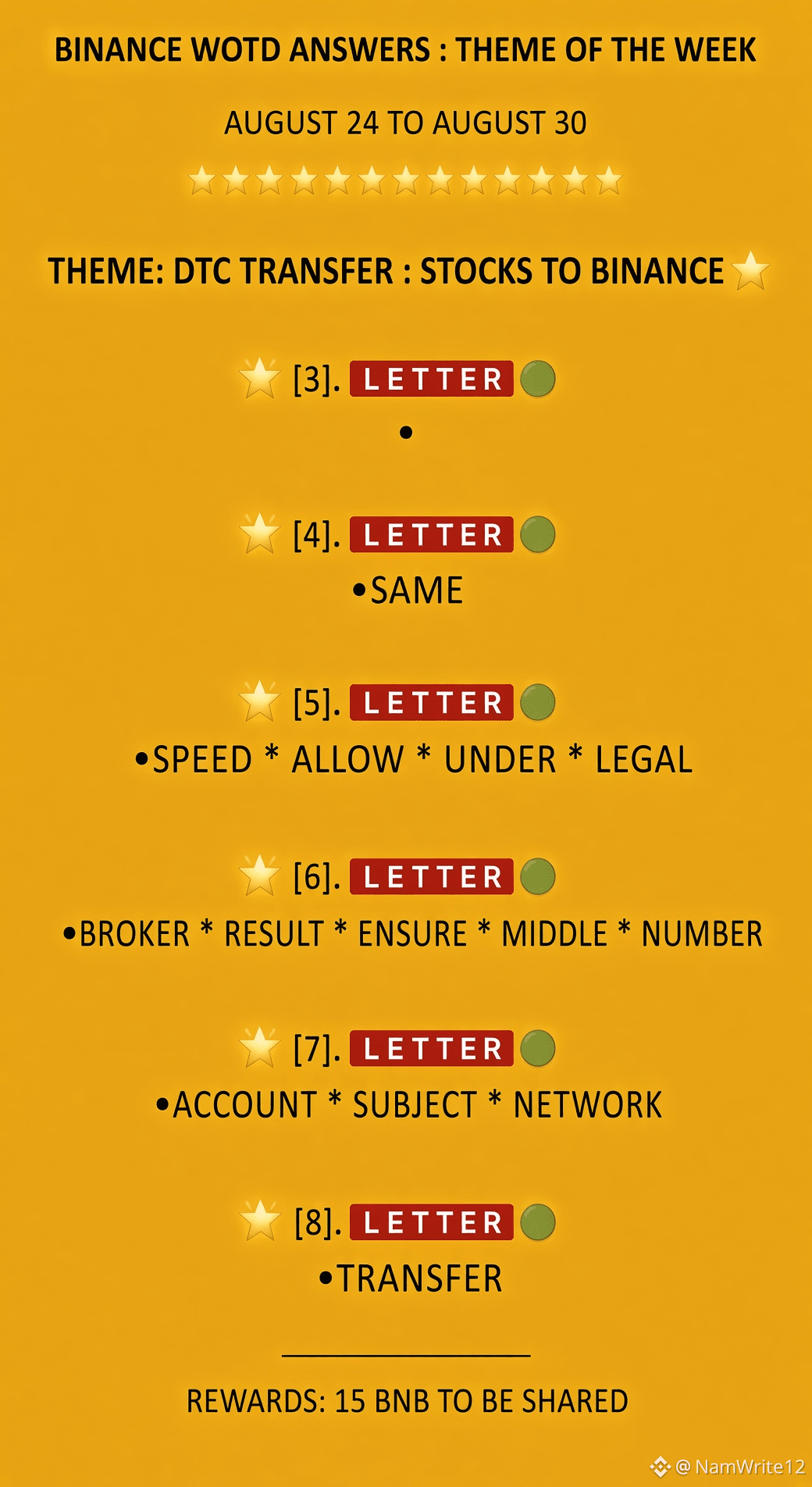
WODL Binance - Binance's weekly word guessing game
Round 2026-08-24 to 2026-08-30
Share 15 BNB
Link: [https://www.binance.com/activity/word-of-the-day/Gen-Z-Investing?ref=CPA_00NENB4FBU](https://www.binance.com/activity/word-of-the-day/Gen-Z-Investing?ref=CPA_00NENB4FBU)
On the app: More ->WOTD
Each round lasts 1 week (from Monday to Sunday). The more rewards you complete, the bigger the rewards (at least 5 times/week to be eligible for rewards)
Hints from:
3️⃣
4️⃣ SAME
5️⃣ SPEED * ALLOW * UNDER * LEGAL
6️⃣ BROKER * RESULT * ENSURE * MIDDLE * NUMBER
7️⃣ ACCOUNT * SUBJECT * NETWORK
8️⃣ TRANSFER
WODL Binance - Binance's weekly word guessing game
Round 2026-08-24 to 2026-08-30
Share 15 BNB
Link: https://www.binance.com/activity/word-of-the-day/Gen-Z-Investing?ref=CPA_00NENB4FBU
On the app: More ->WOTD
Each round lasts 1 week (from Monday to Sunday). The more rewards you complete, the bigger the rewards (at least 5 times/week to be eligible for rewards)
Hints from:
3️⃣
4️⃣ SAME
5️⃣ SPEED * ALLOW * UNDER * LEGAL
6️⃣ BROKER * RESULT * ENSURE * MIDDLE * NUMBER
7️⃣ ACCOUNT * SUBJECT * NETWORK
8️⃣ TRANSFER
Round 2026-08-24 to 2026-08-30
Share 15 BNB
Link: https://www.binance.com/activity/word-of-the-day/Gen-Z-Investing?ref=CPA_00NENB4FBU
On the app: More ->WOTD
Each round lasts 1 week (from Monday to Sunday). The more rewards you complete, the bigger the rewards (at least 5 times/week to be eligible for rewards)
Hints from:
3️⃣
4️⃣ SAME
5️⃣ SPEED * ALLOW * UNDER * LEGAL
6️⃣ BROKER * RESULT * ENSURE * MIDDLE * NUMBER
7️⃣ ACCOUNT * SUBJECT * NETWORK
8️⃣ TRANSFER
77
·
--
Fixed-Interest Rate Tokenization Mechanism
TermMax introduces a fixed-interest rate tokenization mechanism, representing a breakthrough in how lending and borrowing operate within the decentralized finance (DeFi) sector. By combining specialized tokens with smart contract logic, TermMax ensures stable, predictable returns for lenders while offering transparent and flexible borrowing costs for borrowers. This section delves into the core components and processes underpinning TermMax’s fixed-interest rate tokenization mechanism, providing users with a comprehensive understanding of the system's operation.
* Core Market Definitions
Each fixed-interest rate lending and borrowing market on TermMax is defined by three fundamental elements:
- Debt Token: The asset being borrowed or lent (e.g., USDC). This token represents the principal amount of the loan.
- Collateral Token: The asset provided by the borrower to secure the loan (e.g., ETH). An over-collateralization mechanism ensures that the value of the collateral always exceeds the debt, thereby minimizing risk for lenders.
- Maturity Date: The specific point in time when the borrower must repay the debt and when the lender can realize their returns. This date marks the conclusion of the loan term.
#termmax @termmax
Fixed-Interest Rate Tokenization Mechanism
TermMax introduces a fixed-interest rate tokenization mechanism, representing a breakthrough in how lending and borrowing operate within the decentralized finance (DeFi) sector. By combining specialized tokens with smart contract logic, TermMax ensures stable, predictable returns for lenders while offering transparent and flexible borrowing costs for borrowers. This section delves into the core components and processes underpinning TermMax’s fixed-interest rate tokenization mechanism, providing users with a comprehensive understanding of the system's operation.
* Core Market Definitions
Each fixed-interest rate lending and borrowing market on TermMax is defined by three fundamental elements:
- Debt Token: The asset being borrowed or lent (e.g., USDC). This token represents the principal amount of the loan.
- Collateral Token: The asset provided by the borrower to secure the loan (e.g., ETH). An over-collateralization mechanism ensures that the value of the collateral always exceeds the debt, thereby minimizing risk for lenders.
- Maturity Date: The specific point in time when the borrower must repay the debt and when the lender can realize their returns. This date marks the conclusion of the loan term.
#termmax @TermMax
TermMax introduces a fixed-interest rate tokenization mechanism, representing a breakthrough in how lending and borrowing operate within the decentralized finance (DeFi) sector. By combining specialized tokens with smart contract logic, TermMax ensures stable, predictable returns for lenders while offering transparent and flexible borrowing costs for borrowers. This section delves into the core components and processes underpinning TermMax’s fixed-interest rate tokenization mechanism, providing users with a comprehensive understanding of the system's operation.
* Core Market Definitions
Each fixed-interest rate lending and borrowing market on TermMax is defined by three fundamental elements:
- Debt Token: The asset being borrowed or lent (e.g., USDC). This token represents the principal amount of the loan.
- Collateral Token: The asset provided by the borrower to secure the loan (e.g., ETH). An over-collateralization mechanism ensures that the value of the collateral always exceeds the debt, thereby minimizing risk for lenders.
- Maturity Date: The specific point in time when the borrower must repay the debt and when the lender can realize their returns. This date marks the conclusion of the loan term.
#termmax @TermMax
1
74
·
--
good
good

Binance Africa
·
--
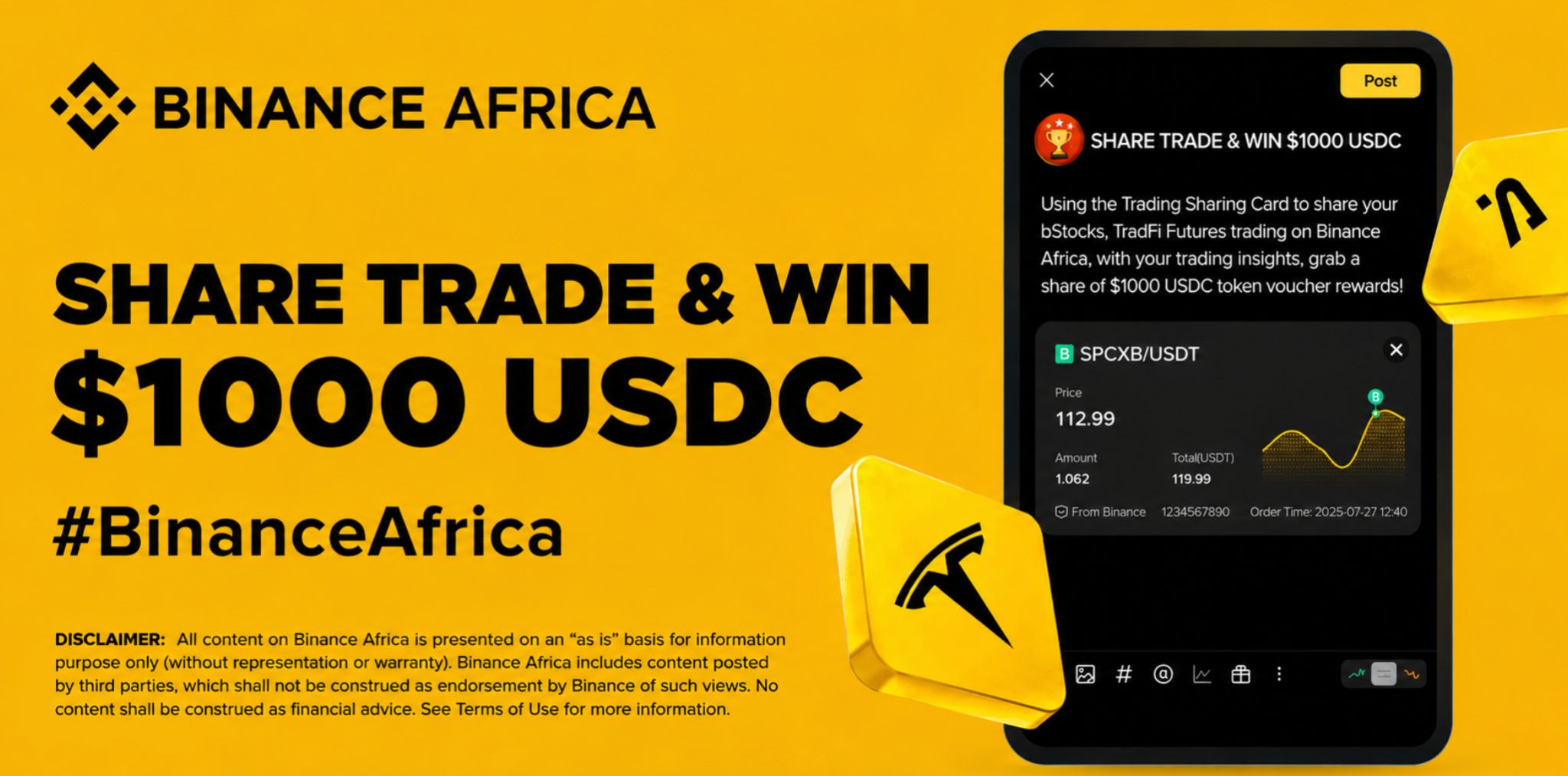
🚀 Flash Quest: Stocks Are Moving Fast on Binance! The markets are on the move. 📈
Trade your favourite stocks on Binance, then share your trade on Binance Square for a chance to win rewards from our $ 1,000 USDC Prize pool
How to Participate:
🔸 Follow @Binance Africa
🔸 Like this post and repost
🔸 Share your bStocks trades on Square using the tradingcard with hashtag #TradebStocks #BinanceAfrica
🔸 Fill in this survey 👉🏾 Click on the Link to Participate Prizes: A total of 200 winners will receive 5 USDC each.
🔸 📆 Period: Aug 13, 2026 10:00 UTC – Aug 23, 2026 23:59 UTC
$TSLAB
Trade your favourite stocks on Binance, then share your trade on Binance Square for a chance to win rewards from our $ 1,000 USDC Prize pool
How to Participate:
🔸 Follow @Binance Africa
🔸 Like this post and repost
🔸 Share your bStocks trades on Square using the tradingcard with hashtag #TradebStocks #BinanceAfrica
🔸 Fill in this survey 👉🏾 Click on the Link to Participate Prizes: A total of 200 winners will receive 5 USDC each.
🔸 📆 Period: Aug 13, 2026 10:00 UTC – Aug 23, 2026 23:59 UTC
$TSLAB
2
·
--
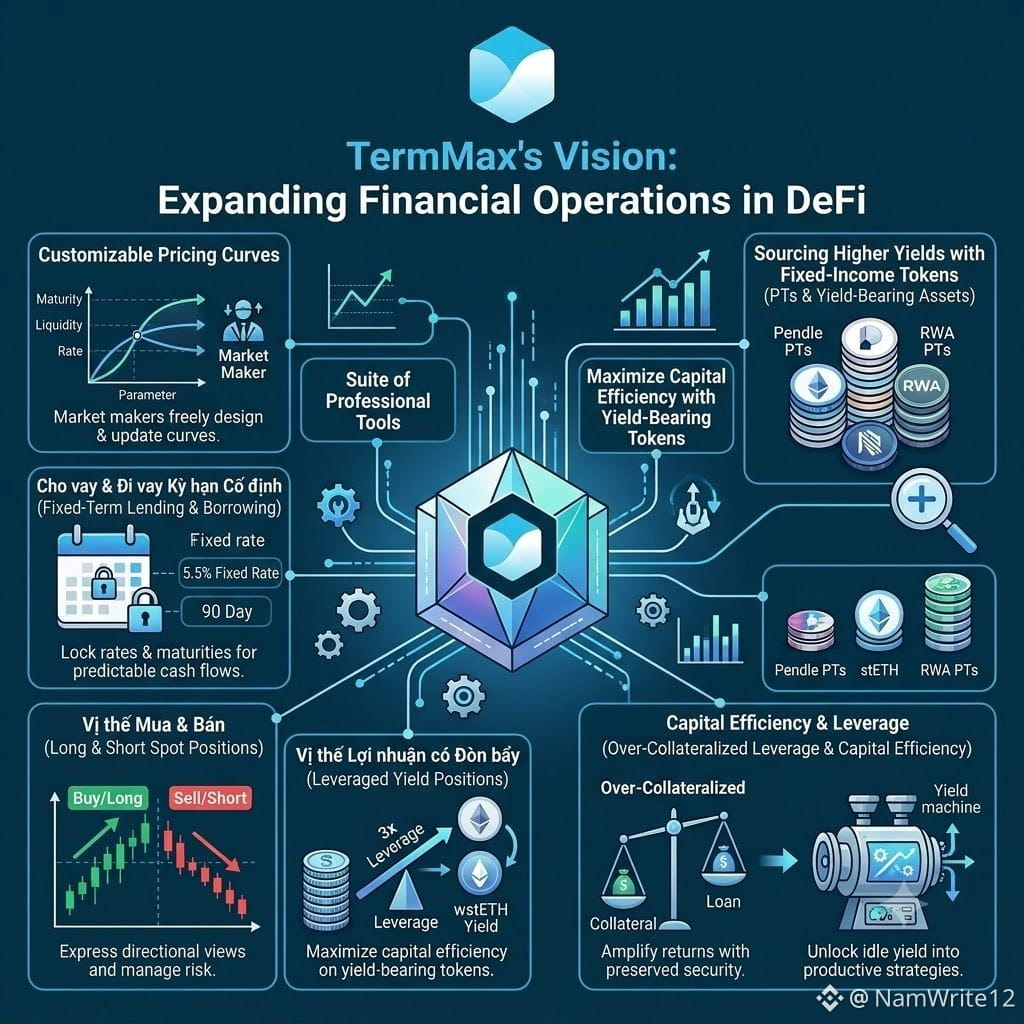
TermMax’s Vision
Expanding Financial Operations in DeFi
To build a truly sustainable fixed-income market in DeFi, a complete suite of professional-grade financial tools is essential. TermMax delivers exactly that through:
- Customizable Pricing Curves – Market makers can freely design and update their own AMM pricing curves within the same markets for both borrowing and lending, ensuring deep liquidity and efficient execution for all participants.
- Fixed-Term Lending & Borrowing – Users can lock in fixed rates and maturities, gaining predictable cash flows and precise risk control.
- Long & Short Positions on Spot Assets – Investors can express directional views or hedge exposure with seamless long and short strategies.
- Leveraged Yield Positions – Capital efficiency is maximized by enabling leveraged long or short exposure on the yields of yield-bearing tokens.
TermMax realizes this vision through a fully decentralized fixed-rate borrowing and lending protocol with predetermined maturity dates. An intuitive interface further empowers curators to initialize and fine-tune pricing curves for any market, unlocking a wide range of sophisticated strategies previously unavailable in DeFi.
Unlocking Higher Yields with Fixed-Income Tokens
By accepting Principal Tokens (PTs) from Pendle Finance and other yield-bearing assets as collateral, TermMax enables users to:
- Amplify returns through transparent, over-collateralized leverage while preserving full on-chain security.
- Maximize capital efficiency by expanding the collateral universe to include yield-bearing tokens and Real-World Assets (RWAs), turning idle yield into productive, leveraged strategies.
TermMax is building the fixed-income primitive that DeFi has long needed—predictable, capital-efficient, and fully composable.
#termmax @termmax
TermMax’s Vision
Expanding Financial Operations in DeFi
To build a truly sustainable fixed-income market in DeFi, a complete suite of professional-grade financial tools is essential. TermMax delivers exactly that through:
- Customizable Pricing Curves – Market makers can freely design and update their own AMM pricing curves within the same markets for both borrowing and lending, ensuring deep liquidity and efficient execution for all participants.
- Fixed-Term Lending & Borrowing – Users can lock in fixed rates and maturities, gaining predictable cash flows and precise risk control.
- Long & Short Positions on Spot Assets – Investors can express directional views or hedge exposure with seamless long and short strategies.
- Leveraged Yield Positions – Capital efficiency is maximized by enabling leveraged long or short exposure on the yields of yield-bearing tokens.
TermMax realizes this vision through a fully decentralized fixed-rate borrowing and lending protocol with predetermined maturity dates. An intuitive interface further empowers curators to initialize and fine-tune pricing curves for any market, unlocking a wide range of sophisticated strategies previously unavailable in DeFi.
Unlocking Higher Yields with Fixed-Income Tokens
By accepting Principal Tokens (PTs) from Pendle Finance and other yield-bearing assets as collateral, TermMax enables users to:
- Amplify returns through transparent, over-collateralized leverage while preserving full on-chain security.
- Maximize capital efficiency by expanding the collateral universe to include yield-bearing tokens and Real-World Assets (RWAs), turning idle yield into productive, leveraged strategies.
TermMax is building the fixed-income primitive that DeFi has long needed—predictable, capital-efficient, and fully composable.
#termmax @TermMax
Expanding Financial Operations in DeFi
To build a truly sustainable fixed-income market in DeFi, a complete suite of professional-grade financial tools is essential. TermMax delivers exactly that through:
- Customizable Pricing Curves – Market makers can freely design and update their own AMM pricing curves within the same markets for both borrowing and lending, ensuring deep liquidity and efficient execution for all participants.
- Fixed-Term Lending & Borrowing – Users can lock in fixed rates and maturities, gaining predictable cash flows and precise risk control.
- Long & Short Positions on Spot Assets – Investors can express directional views or hedge exposure with seamless long and short strategies.
- Leveraged Yield Positions – Capital efficiency is maximized by enabling leveraged long or short exposure on the yields of yield-bearing tokens.
TermMax realizes this vision through a fully decentralized fixed-rate borrowing and lending protocol with predetermined maturity dates. An intuitive interface further empowers curators to initialize and fine-tune pricing curves for any market, unlocking a wide range of sophisticated strategies previously unavailable in DeFi.
Unlocking Higher Yields with Fixed-Income Tokens
By accepting Principal Tokens (PTs) from Pendle Finance and other yield-bearing assets as collateral, TermMax enables users to:
- Amplify returns through transparent, over-collateralized leverage while preserving full on-chain security.
- Maximize capital efficiency by expanding the collateral universe to include yield-bearing tokens and Real-World Assets (RWAs), turning idle yield into productive, leveraged strategies.
TermMax is building the fixed-income primitive that DeFi has long needed—predictable, capital-efficient, and fully composable.
#termmax @TermMax
1
108
·
--
New campaign on Binance Wallet - @termmax Booster Campaign
Link: [https://web3.binance.com/referral?ref=UPIX3MI1](https://web3.binance.com/referral?ref=UPIX3MI1)
App: Discovery -> Booster
Web: Reward -> Booster
Complete simple social tasks
Quiz:
1. What is TermMax?
A decentralized fixed-rate borrowing/lending and options trading protocol
2. What can users do on TermMax?
Borrow and lend crypto assets and trade options
3. Which of the following best describes TermMax borrowing and lending?
Fixed-rate and fixed-term
4. What is the native token of TermMax?
TMX
5. What is TMX used for in the TermMax ecosystem?
Governance and ecosystem utility
Final task for the top 1000 creators: requires posting at least 1 article about Termmax on Binance Square. If there are conditions for you to complete the task, finish it. If you reach the top 1000, you will receive an additional reward of 300,000 TMX
End: 24/8, pay out immediately when TGE starts on 25/5
#TermMax
New campaign on Binance Wallet - @TermMax Booster Campaign
Link: https://web3.binance.com/referral?ref=UPIX3MI1
App: Discovery -> Booster
Web: Reward -> Booster
Complete simple social tasks
Quiz:
1. What is TermMax?
A decentralized fixed-rate borrowing/lending and options trading protocol
2. What can users do on TermMax?
Borrow and lend crypto assets and trade options
3. Which of the following best describes TermMax borrowing and lending?
Fixed-rate and fixed-term
4. What is the native token of TermMax?
TMX
5. What is TMX used for in the TermMax ecosystem?
Governance and ecosystem utility
Final task for the top 1000 creators: requires posting at least 1 article about Termmax on Binance Square. If there are conditions for you to complete the task, finish it. If you reach the top 1000, you will receive an additional reward of 300,000 TMX
End: 24/8, pay out immediately when TGE starts on 25/5
#TermMax
Link: https://web3.binance.com/referral?ref=UPIX3MI1
App: Discovery -> Booster
Web: Reward -> Booster
Complete simple social tasks
Quiz:
1. What is TermMax?
A decentralized fixed-rate borrowing/lending and options trading protocol
2. What can users do on TermMax?
Borrow and lend crypto assets and trade options
3. Which of the following best describes TermMax borrowing and lending?
Fixed-rate and fixed-term
4. What is the native token of TermMax?
TMX
5. What is TMX used for in the TermMax ecosystem?
Governance and ecosystem utility
Final task for the top 1000 creators: requires posting at least 1 article about Termmax on Binance Square. If there are conditions for you to complete the task, finish it. If you reach the top 1000, you will receive an additional reward of 300,000 TMX
End: 24/8, pay out immediately when TGE starts on 25/5
#TermMax
1
85
·
--
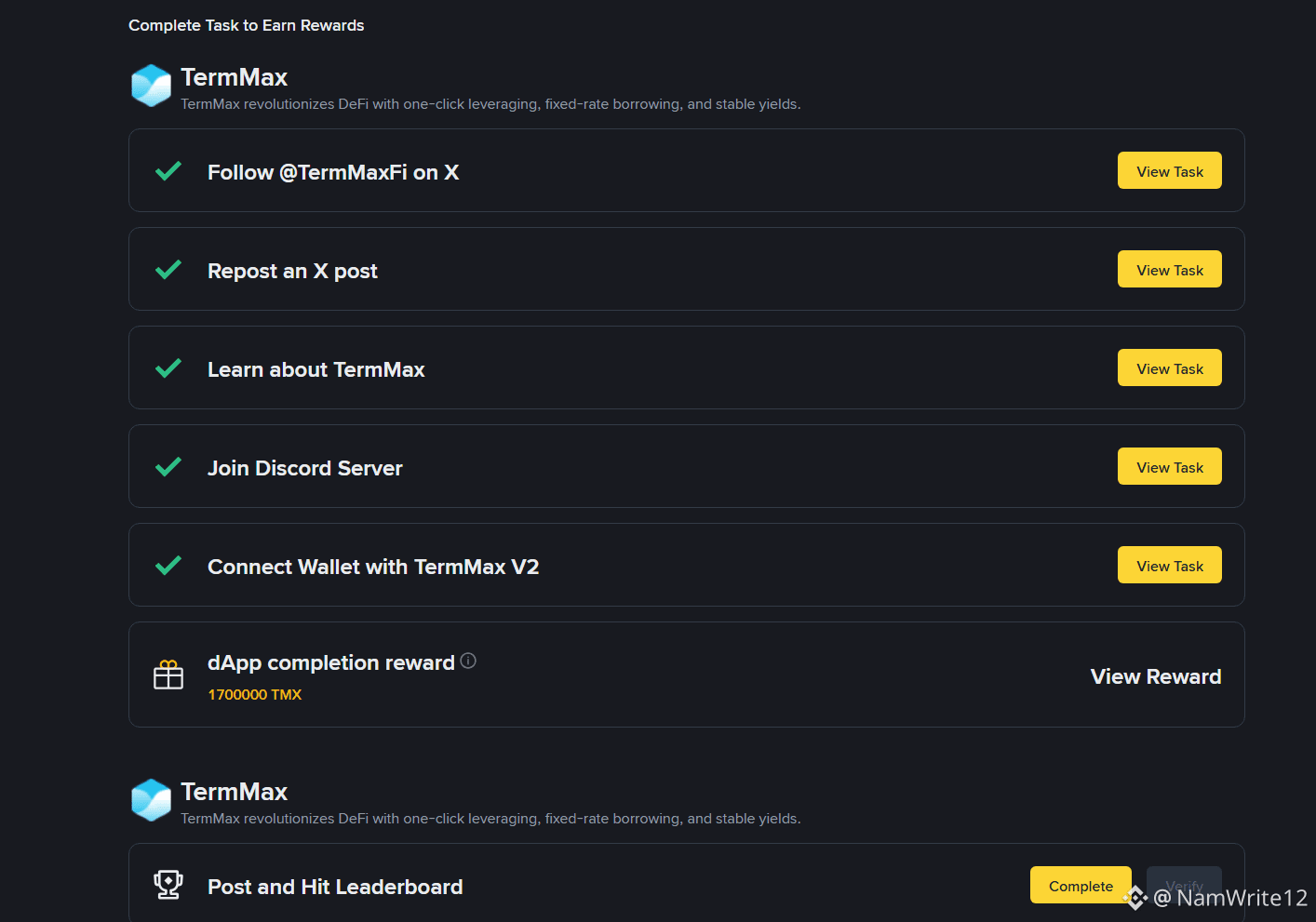
There is a new campaign on Binance Wallet for you guys
Link: [https://web3.binance.com/referral?ref=UPIX3MI1](https://web3.binance.com/referral?ref=UPIX3MI1)
App: Discovery -> Booster
Web: Reward -> Booster
Complete simple social tasks
End: 24/8 (80,000 slots)
Quiz:
1. What is TermMax?
A decentralized fixed-rate borrowing/lending and options trading protocol
2. What can users do on TermMax?
Borrow and lend crypto assets and trade options
3. Which of the following best describes TermMax borrowing and lending?
Fixed-rate and fixed-term
4. What is the native token of TermMax?
TMX
5. What is TMX used for in the TermMax ecosystem?
Governance and ecosystem utility
There is a new campaign on Binance Wallet for you guys
Link: https://web3.binance.com/referral?ref=UPIX3MI1
App: Discovery -> Booster
Web: Reward -> Booster
Complete simple social tasks
End: 24/8 (80,000 slots)
Quiz:
1. What is TermMax?
A decentralized fixed-rate borrowing/lending and options trading protocol
2. What can users do on TermMax?
Borrow and lend crypto assets and trade options
3. Which of the following best describes TermMax borrowing and lending?
Fixed-rate and fixed-term
4. What is the native token of TermMax?
TMX
5. What is TMX used for in the TermMax ecosystem?
Governance and ecosystem utility
Link: https://web3.binance.com/referral?ref=UPIX3MI1
App: Discovery -> Booster
Web: Reward -> Booster
Complete simple social tasks
End: 24/8 (80,000 slots)
Quiz:
1. What is TermMax?
A decentralized fixed-rate borrowing/lending and options trading protocol
2. What can users do on TermMax?
Borrow and lend crypto assets and trade options
3. Which of the following best describes TermMax borrowing and lending?
Fixed-rate and fixed-term
4. What is the native token of TermMax?
TMX
5. What is TMX used for in the TermMax ecosystem?
Governance and ecosystem utility
1
65
·
--
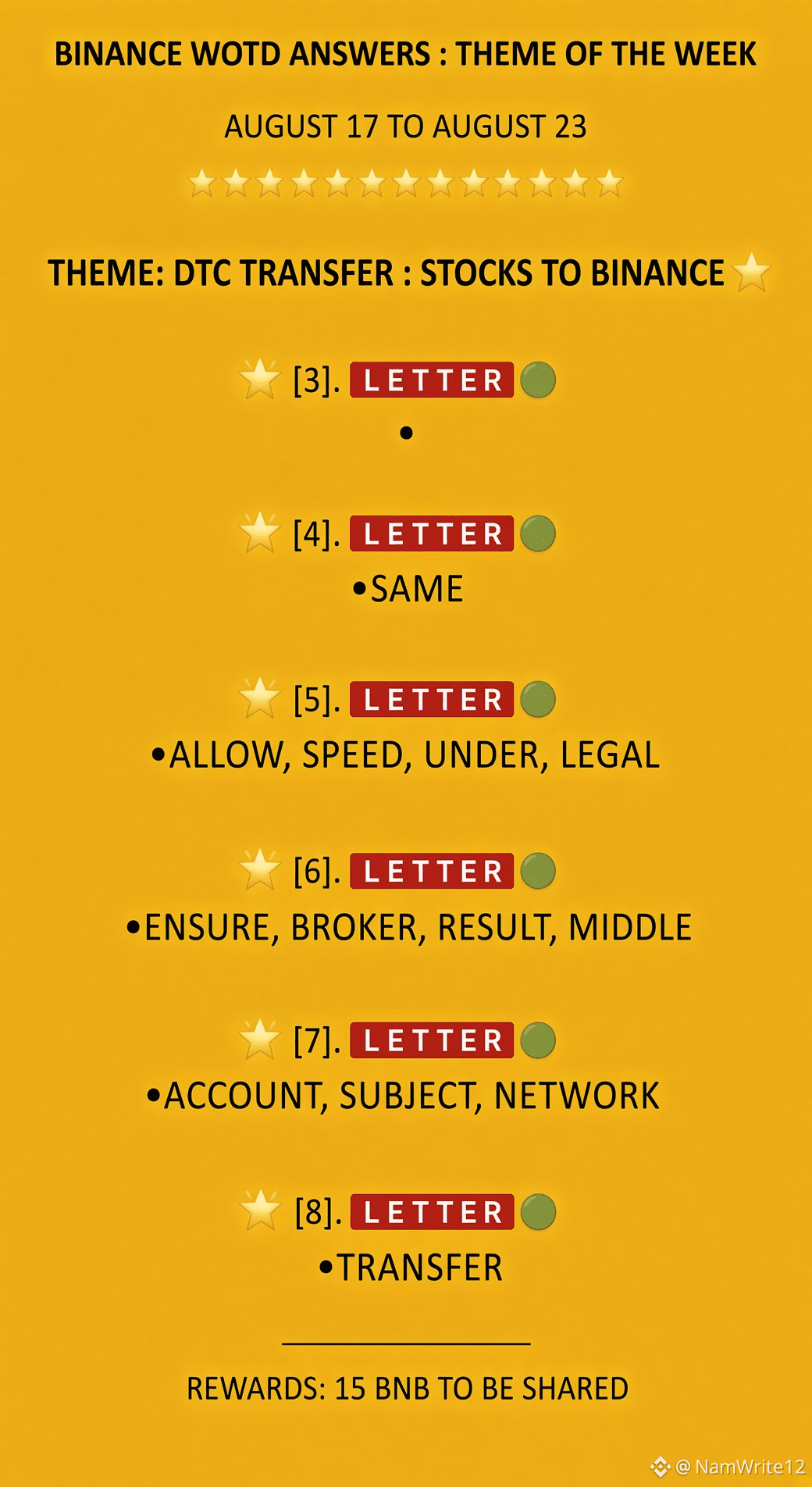
WODL Binance - Binance weekly word guessing game
Share 15 $BNB
Join link: [https://www.binance.com/activity/word-of-the-day/DTC-Transfer?ref=CPA_00NENB4FBU](https://www.binance.com/activity/word-of-the-day/DTC-Transfer?ref=CPA_00NENB4FBU)
On the app: More ->WOTD
Each round lasts 1 week (from Monday to Sunday). You only need to complete 5 times/week to be eligible for rewards
Hints from:
3️⃣
4⃣ SAME
5️⃣ ALLOW, SPEED, UNDER, LEGAL
6️⃣ ENSURE, BROKER, RESULT, MIDDLE
7️⃣ ACCOUNT, SUBJECT, NETWORK
8️⃣ TRANSFER
{spot}(BNBUSDT)
WODL Binance - Binance weekly word guessing game
Share 15 $BNB
Join link: https://www.binance.com/activity/word-of-the-day/DTC-Transfer?ref=CPA_00NENB4FBU
On the app: More ->WOTD
Each round lasts 1 week (from Monday to Sunday). You only need to complete 5 times/week to be eligible for rewards
Hints from:
3️⃣
4⃣ SAME
5️⃣ ALLOW, SPEED, UNDER, LEGAL
6️⃣ ENSURE, BROKER, RESULT, MIDDLE
7️⃣ ACCOUNT, SUBJECT, NETWORK
8️⃣ TRANSFER
Share 15 $BNB
Join link: https://www.binance.com/activity/word-of-the-day/DTC-Transfer?ref=CPA_00NENB4FBU
On the app: More ->WOTD
Each round lasts 1 week (from Monday to Sunday). You only need to complete 5 times/week to be eligible for rewards
Hints from:
3️⃣
4⃣ SAME
5️⃣ ALLOW, SPEED, UNDER, LEGAL
6️⃣ ENSURE, BROKER, RESULT, MIDDLE
7️⃣ ACCOUNT, SUBJECT, NETWORK
8️⃣ TRANSFER
79
·
--
* Common Binance P2P issues & how to handle them
- Buyer forgets to click "Paid": The order may be automatically canceled. Message the counterparty to request the receipt and file a complaint in time.
- Seller doesn’t release the coins: Recheck the recipient name. Take a screenshot of the receipt and click Appeal to ask Binance for support.
- Fake receipt: Only release coins when the money has truly arrived in your bank account.
- Account is frozen: It may be due to getting involved with "dirty" funds. Keep a record of the chat history and transaction images for follow-up with the bank and the police.
- Mistaken transfer / Request to return money to another account: Signs of swap scam/chargeback. Never transfer money to accounts outside the platform under any circumstances.
* Safe Binance P2P trading rules
- Choose reputable merchants: Prioritize accounts with verification badges, a high completion rate (~100%), and a large number of orders.
- Use the account owner’s KYC: The bank account holder’s name must match 100% with the name verified on Binance. Never trade through a third party.
- Check the real balance: Log in to the banking app to confirm the funds have arrived. Don’t trust SMS or receipts sent by the buyer.
- Keep communication on the platform: Only message within the Binance P2P chat window—do not move to external apps.
- Don’t release early: Click Release (Unlock) only after you have received all the money in your account.
#binancep2pantoan @Binance_Vietnam
* Common Binance P2P issues & how to handle them
- Buyer forgets to click "Paid": The order may be automatically canceled. Message the counterparty to request the receipt and file a complaint in time.
- Seller doesn’t release the coins: Recheck the recipient name. Take a screenshot of the receipt and click Appeal to ask Binance for support.
- Fake receipt: Only release coins when the money has truly arrived in your bank account.
- Account is frozen: It may be due to getting involved with "dirty" funds. Keep a record of the chat history and transaction images for follow-up with the bank and the police.
- Mistaken transfer / Request to return money to another account: Signs of swap scam/chargeback. Never transfer money to accounts outside the platform under any circumstances.
* Safe Binance P2P trading rules
- Choose reputable merchants: Prioritize accounts with verification badges, a high completion rate (~100%), and a large number of orders.
- Use the account owner’s KYC: The bank account holder’s name must match 100% with the name verified on Binance. Never trade through a third party.
- Check the real balance: Log in to the banking app to confirm the funds have arrived. Don’t trust SMS or receipts sent by the buyer.
- Keep communication on the platform: Only message within the Binance P2P chat window—do not move to external apps.
- Don’t release early: Click Release (Unlock) only after you have received all the money in your account.
#binancep2pantoan @Binance Vietnam
- Buyer forgets to click "Paid": The order may be automatically canceled. Message the counterparty to request the receipt and file a complaint in time.
- Seller doesn’t release the coins: Recheck the recipient name. Take a screenshot of the receipt and click Appeal to ask Binance for support.
- Fake receipt: Only release coins when the money has truly arrived in your bank account.
- Account is frozen: It may be due to getting involved with "dirty" funds. Keep a record of the chat history and transaction images for follow-up with the bank and the police.
- Mistaken transfer / Request to return money to another account: Signs of swap scam/chargeback. Never transfer money to accounts outside the platform under any circumstances.
* Safe Binance P2P trading rules
- Choose reputable merchants: Prioritize accounts with verification badges, a high completion rate (~100%), and a large number of orders.
- Use the account owner’s KYC: The bank account holder’s name must match 100% with the name verified on Binance. Never trade through a third party.
- Check the real balance: Log in to the banking app to confirm the funds have arrived. Don’t trust SMS or receipts sent by the buyer.
- Keep communication on the platform: Only message within the Binance P2P chat window—do not move to external apps.
- Don’t release early: Click Release (Unlock) only after you have received all the money in your account.
#binancep2pantoan @Binance Vietnam
2
80
·
--
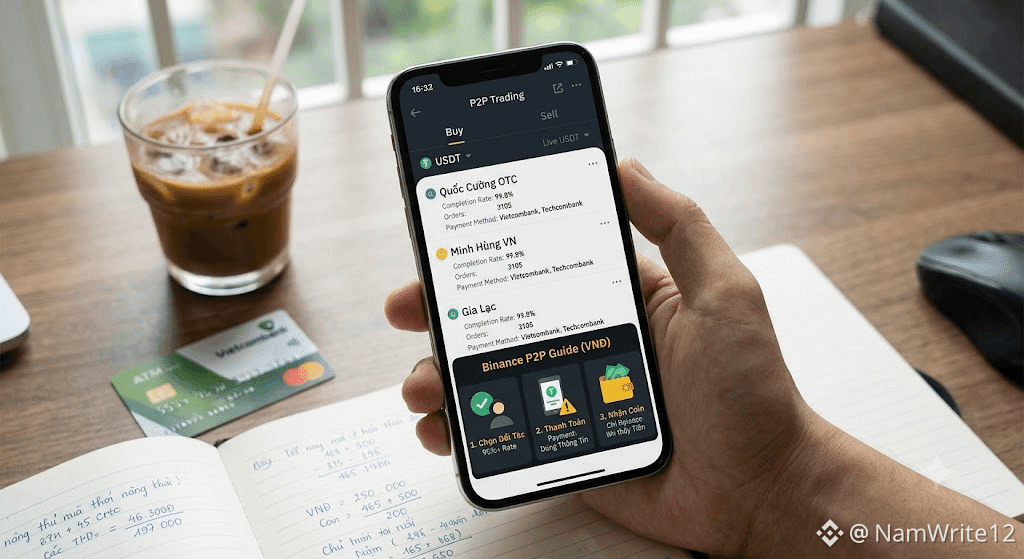
Binance P2P is a direct peer-to-peer trading platform in VND for buying/selling various coins (USDT, BTC, ETH...). Binance acts as a secure and free escrow intermediary (0% trading fees) for regular users.
* 4 Basic Trading Steps
1. Open the App: Log in to Binance $\rightarrow$ then select P2P Trading.
2. Choose an Order & Counterparty: Choose Buy/Sell, the coin type, and the VND currency. Prioritize merchants with a completion rate > 95% and a high number of orders.
3. Payment: Transfer the exact amount, account number, and do not include any keywords related to Crypto in the payment content. Then click "Paid, notify the seller".
4. Receive Coin: Wait for the counterparty to confirm the payment has arrived, and then the system will release the coin to your wallet.
* Important Safety Notes
🛑 Only release coins when the money is ALREADY visible in your bank account. Do not trust screenshots or SMS messages.
💳 Account holder (KYC): Your bank account name must match 100% with the name verified on Binance.
📱 100% Trading within the App: Do not transfer money outside the app or exchange via Zalo/Telegram so Binance can always protect you in case of disputes.
#binancep2pantoan @Binance_Vietnam
Binance P2P is a direct peer-to-peer trading platform in VND for buying/selling various coins (USDT, BTC, ETH...). Binance acts as a secure and free escrow intermediary (0% trading fees) for regular users.
* 4 Basic Trading Steps
1. Open the App: Log in to Binance $\rightarrow$ then select P2P Trading.
2. Choose an Order & Counterparty: Choose Buy/Sell, the coin type, and the VND currency. Prioritize merchants with a completion rate > 95% and a high number of orders.
3. Payment: Transfer the exact amount, account number, and do not include any keywords related to Crypto in the payment content. Then click "Paid, notify the seller".
4. Receive Coin: Wait for the counterparty to confirm the payment has arrived, and then the system will release the coin to your wallet.
* Important Safety Notes
🛑 Only release coins when the money is ALREADY visible in your bank account. Do not trust screenshots or SMS messages.
💳 Account holder (KYC): Your bank account name must match 100% with the name verified on Binance.
📱 100% Trading within the App: Do not transfer money outside the app or exchange via Zalo/Telegram so Binance can always protect you in case of disputes.
#binancep2pantoan @Binance Vietnam
* 4 Basic Trading Steps
1. Open the App: Log in to Binance $\rightarrow$ then select P2P Trading.
2. Choose an Order & Counterparty: Choose Buy/Sell, the coin type, and the VND currency. Prioritize merchants with a completion rate > 95% and a high number of orders.
3. Payment: Transfer the exact amount, account number, and do not include any keywords related to Crypto in the payment content. Then click "Paid, notify the seller".
4. Receive Coin: Wait for the counterparty to confirm the payment has arrived, and then the system will release the coin to your wallet.
* Important Safety Notes
🛑 Only release coins when the money is ALREADY visible in your bank account. Do not trust screenshots or SMS messages.
💳 Account holder (KYC): Your bank account name must match 100% with the name verified on Binance.
📱 100% Trading within the App: Do not transfer money outside the app or exchange via Zalo/Telegram so Binance can always protect you in case of disputes.
#binancep2pantoan @Binance Vietnam
57
·
--
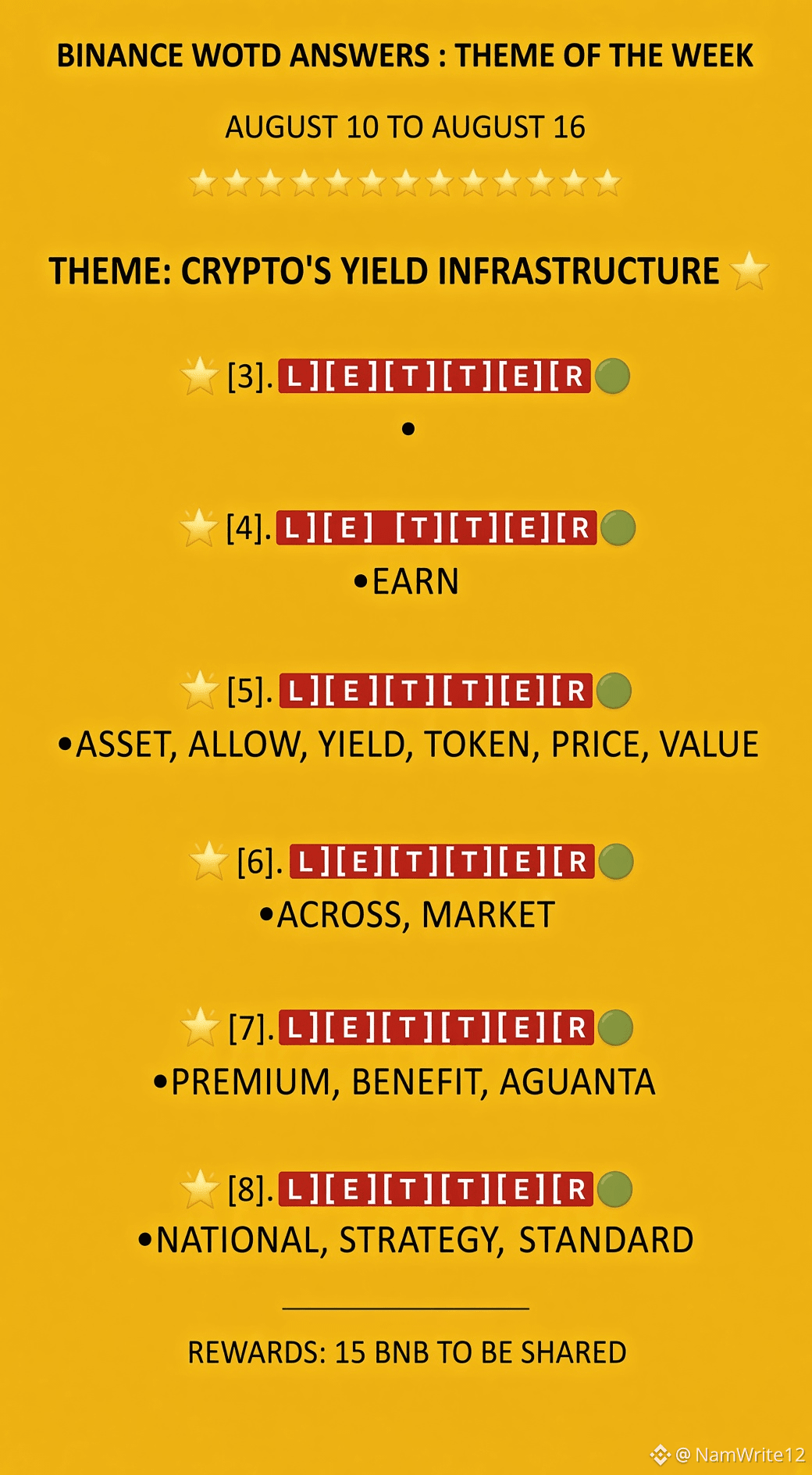
WODL Binance - Binance weekly word guessing game
Round 2026-08-10 to 2026-08-16
Share 15 BNB
Link: [https://www.binance.com/activity/word-of-the-day/Crypto-Yield-Infrastructure?ref=CPA_00NENB4FBU](https://www.binance.com/activity/word-of-the-day/Crypto-Yield-Infrastructure?ref=CPA_00NENB4FBU)
On the app: More ->WOTD
Each round lasts 1 week (from Monday to Sunday). Finish as many rewards as possible to get bigger rewards (minimum 5 times/week to be eligible)
Hints from:
3️⃣
4⃣ EARN
5️⃣ ASSET, ALLOW, YIELD, TOKEN, PRICE, VALUE
6️⃣ ACROSS, MARKET
7️⃣ PREMIUM, BENEFIT, AGUANTA
8️⃣ NATIONAL, STRATEGY, STANDARD
WODL Binance - Binance weekly word guessing game
Round 2026-08-10 to 2026-08-16
Share 15 BNB
Link: https://www.binance.com/activity/word-of-the-day/Crypto-Yield-Infrastructure?ref=CPA_00NENB4FBU
On the app: More ->WOTD
Each round lasts 1 week (from Monday to Sunday). Finish as many rewards as possible to get bigger rewards (minimum 5 times/week to be eligible)
Hints from:
3️⃣
4⃣ EARN
5️⃣ ASSET, ALLOW, YIELD, TOKEN, PRICE, VALUE
6️⃣ ACROSS, MARKET
7️⃣ PREMIUM, BENEFIT, AGUANTA
8️⃣ NATIONAL, STRATEGY, STANDARD
Round 2026-08-10 to 2026-08-16
Share 15 BNB
Link: https://www.binance.com/activity/word-of-the-day/Crypto-Yield-Infrastructure?ref=CPA_00NENB4FBU
On the app: More ->WOTD
Each round lasts 1 week (from Monday to Sunday). Finish as many rewards as possible to get bigger rewards (minimum 5 times/week to be eligible)
Hints from:
3️⃣
4⃣ EARN
5️⃣ ASSET, ALLOW, YIELD, TOKEN, PRICE, VALUE
6️⃣ ACROSS, MARKET
7️⃣ PREMIUM, BENEFIT, AGUANTA
8️⃣ NATIONAL, STRATEGY, STANDARD
NamWrite12
·
--
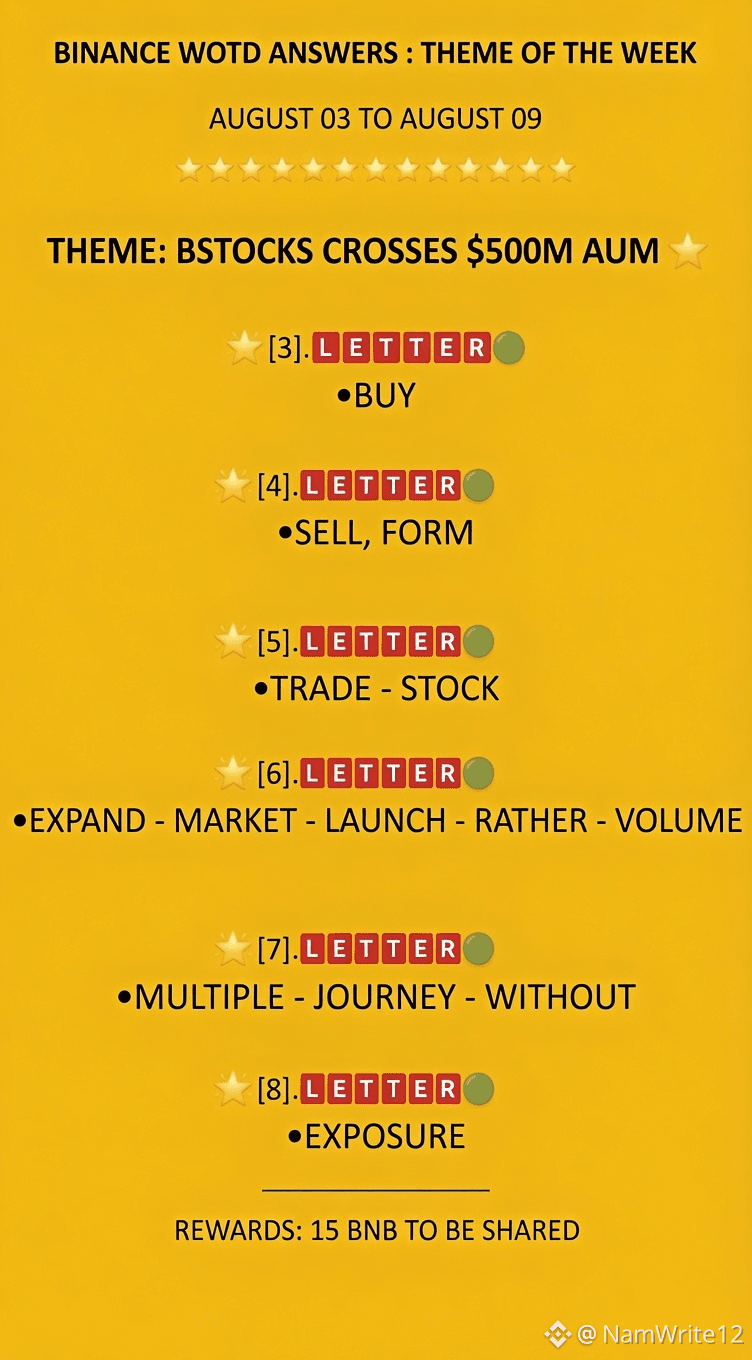
WODL Binance - Binance's weekly word-guessing game
Round 2026-08-03 to 2026-07-09
Share 15 $BNB
Link: https://www.binance.com/activity/word-of-the-day/bStocks-Crosses-500M-AUM?ref=CPA_00NENB4FBU
In the app: More ->WOTD Each round lasts 1 week (from Monday to Sunday). You only need to complete 3 times/week to be eligible for rewards
Hints from:
3️⃣ BUY
4⃣ SELL, FORM
5️⃣ TRADE, STOCK
6️⃣ EXPAND, MARKET, LAUNCH, RATHER, VOLUME
7️⃣ MULTIPLE, JOURNEY, WITHOUT
8️⃣ EXPOSURE
Round 2026-08-03 to 2026-07-09
Share 15 $BNB
Link: https://www.binance.com/activity/word-of-the-day/bStocks-Crosses-500M-AUM?ref=CPA_00NENB4FBU
In the app: More ->WOTD Each round lasts 1 week (from Monday to Sunday). You only need to complete 3 times/week to be eligible for rewards
Hints from:
3️⃣ BUY
4⃣ SELL, FORM
5️⃣ TRADE, STOCK
6️⃣ EXPAND, MARKET, LAUNCH, RATHER, VOLUME
7️⃣ MULTIPLE, JOURNEY, WITHOUT
8️⃣ EXPOSURE
1
81
·
--
Binance P2P Safe Trading Guide
Binance P2P is a platform to buy and sell cryptocurrencies (USDT, BTC...) directly in VND between users with a 0% fee. Binance acts as an intermediary by holding escrow to protect your assets.
1. 4-Step Trading Process
- Select an order: Go to P2P Trading, choose Buy/Sell, select the coin type and VND. Prioritize merchants with a high completion rate.
- Pay/Receive money: Transfer money via the bank according to the information shown on the app (if Buying) or wait to receive the money (if Selling).
- Confirm: Tap "I have transferred" (Buyer) or check your bank account (Seller).
- Complete: Receive the coin, or tap "Release" the coin to the counterparty.
2. Common Risks
- Receiving dirty money: Your bank account may be at risk of being frozen due to receiving funds from scam sources.
- Fake payment slips: Scammers send images of fake transfers and urge you to unlock the coins.
- Being lured into off-platform transactions: You may be pulled into Zalo/Telegram to trade, causing the escrow system to become ineffective.
- Legal risk: The legal framework for cryptocurrencies is not fully established in some areas.
3. The Ultimate Safety Rules
- Check in your banking app: Only release coins after the money has truly arrived in your account. Never trust screenshots of payment slips.
- 100% match KYC name: The account holder’s name on your bank must match the name verified on Binance. Do not accept payments from third parties.
- Transfer content: Only write the order code. Do not include sensitive terms such as USDT, BTC, Binance, Crypto...
- 100% in-app trading: Do not redirect to messages or trade outside the app.
- File a complaint promptly: Save invoices, chat history, and tap Appeal immediately when a dispute arises.
#binancep2pantoan @Binance_Vietnam
Binance P2P Safe Trading Guide
Binance P2P is a platform to buy and sell cryptocurrencies (USDT, BTC...) directly in VND between users with a 0% fee. Binance acts as an intermediary by holding escrow to protect your assets.
1. 4-Step Trading Process
- Select an order: Go to P2P Trading, choose Buy/Sell, select the coin type and VND. Prioritize merchants with a high completion rate.
- Pay/Receive money: Transfer money via the bank according to the information shown on the app (if Buying) or wait to receive the money (if Selling).
- Confirm: Tap "I have transferred" (Buyer) or check your bank account (Seller).
- Complete: Receive the coin, or tap "Release" the coin to the counterparty.
2. Common Risks
- Receiving dirty money: Your bank account may be at risk of being frozen due to receiving funds from scam sources.
- Fake payment slips: Scammers send images of fake transfers and urge you to unlock the coins.
- Being lured into off-platform transactions: You may be pulled into Zalo/Telegram to trade, causing the escrow system to become ineffective.
- Legal risk: The legal framework for cryptocurrencies is not fully established in some areas.
3. The Ultimate Safety Rules
- Check in your banking app: Only release coins after the money has truly arrived in your account. Never trust screenshots of payment slips.
- 100% match KYC name: The account holder’s name on your bank must match the name verified on Binance. Do not accept payments from third parties.
- Transfer content: Only write the order code. Do not include sensitive terms such as USDT, BTC, Binance, Crypto...
- 100% in-app trading: Do not redirect to messages or trade outside the app.
- File a complaint promptly: Save invoices, chat history, and tap Appeal immediately when a dispute arises.
#binancep2pantoan @Binance Vietnam
Binance P2P is a platform to buy and sell cryptocurrencies (USDT, BTC...) directly in VND between users with a 0% fee. Binance acts as an intermediary by holding escrow to protect your assets.
1. 4-Step Trading Process
- Select an order: Go to P2P Trading, choose Buy/Sell, select the coin type and VND. Prioritize merchants with a high completion rate.
- Pay/Receive money: Transfer money via the bank according to the information shown on the app (if Buying) or wait to receive the money (if Selling).
- Confirm: Tap "I have transferred" (Buyer) or check your bank account (Seller).
- Complete: Receive the coin, or tap "Release" the coin to the counterparty.
2. Common Risks
- Receiving dirty money: Your bank account may be at risk of being frozen due to receiving funds from scam sources.
- Fake payment slips: Scammers send images of fake transfers and urge you to unlock the coins.
- Being lured into off-platform transactions: You may be pulled into Zalo/Telegram to trade, causing the escrow system to become ineffective.
- Legal risk: The legal framework for cryptocurrencies is not fully established in some areas.
3. The Ultimate Safety Rules
- Check in your banking app: Only release coins after the money has truly arrived in your account. Never trust screenshots of payment slips.
- 100% match KYC name: The account holder’s name on your bank must match the name verified on Binance. Do not accept payments from third parties.
- Transfer content: Only write the order code. Do not include sensitive terms such as USDT, BTC, Binance, Crypto...
- 100% in-app trading: Do not redirect to messages or trade outside the app.
- File a complaint promptly: Save invoices, chat history, and tap Appeal immediately when a dispute arises.
#binancep2pantoan @Binance Vietnam
68
·
--
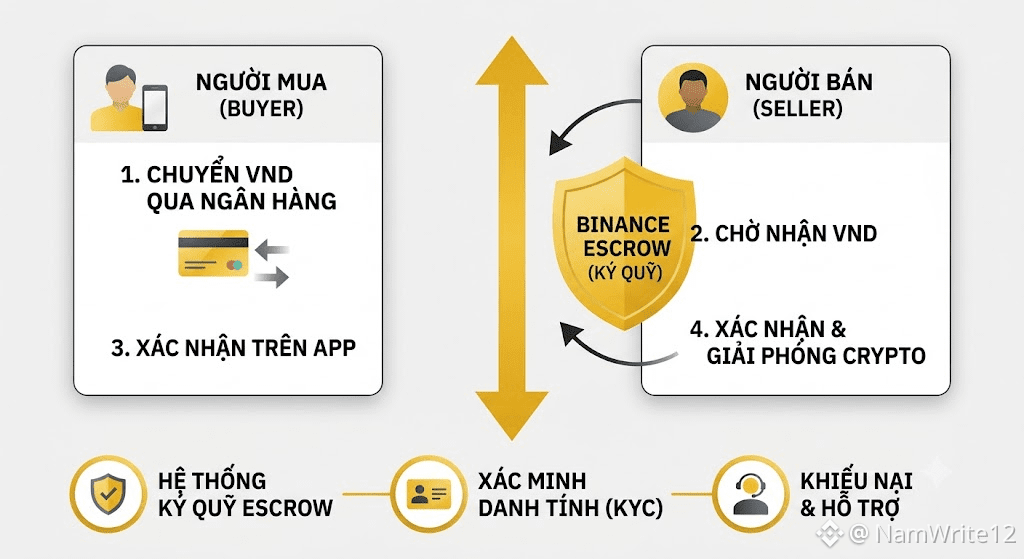
P2P Trading on Binance
P2P trading (Peer-to-Peer) on Binance is a model where individuals buy and sell crypto directly using VND via their bank accounts. Binance acts as a safe intermediary thanks to the Escrow system (it automatically locks the crypto until both parties complete the payment).
1. Basic Trading Process
- Preparation: Register a Binance account, Verify identity (KYC), Add your own bank account.
- How to Buy (VND -> Crypto): Select the Buy tab, Choose a reputable merchant, Transfer the bank payment with the correct information, and click "I have transferred" to receive crypto into the Funding wallet.
- How to Sell (Crypto -> VND): Transfer crypto to the Funding wallet, Select the Sell tab, Wait to receive the money in your bank account, Check the actual balance, and click "Confirm that payment has been received".
2. Safety Level & Risk Management
- P2P trading is relatively safe due to the Escrow mechanism; however, risks still exist:
- Risks: Scams using fake payment slips, risk of the bank account being frozen (due to the partner’s funds being involved in fraud), or being tricked into trading outside the application.
3. How to Prevent Risks:
- Always check the bank app directly before releasing the crypto (do not rely on screenshots).
- Never trade outside the Binance platform.
- Use a separate bank account, enable 2FA, keep proof of transfers, and use the Appeal/Dispute button immediately when something is abnormal.
#binancep2pantoan @Binance_Vietnam
P2P Trading on Binance
P2P trading (Peer-to-Peer) on Binance is a model where individuals buy and sell crypto directly using VND via their bank accounts. Binance acts as a safe intermediary thanks to the Escrow system (it automatically locks the crypto until both parties complete the payment).
1. Basic Trading Process
- Preparation: Register a Binance account, Verify identity (KYC), Add your own bank account.
- How to Buy (VND -> Crypto): Select the Buy tab, Choose a reputable merchant, Transfer the bank payment with the correct information, and click "I have transferred" to receive crypto into the Funding wallet.
- How to Sell (Crypto -> VND): Transfer crypto to the Funding wallet, Select the Sell tab, Wait to receive the money in your bank account, Check the actual balance, and click "Confirm that payment has been received".
2. Safety Level & Risk Management
- P2P trading is relatively safe due to the Escrow mechanism; however, risks still exist:
- Risks: Scams using fake payment slips, risk of the bank account being frozen (due to the partner’s funds being involved in fraud), or being tricked into trading outside the application.
3. How to Prevent Risks:
- Always check the bank app directly before releasing the crypto (do not rely on screenshots).
- Never trade outside the Binance platform.
- Use a separate bank account, enable 2FA, keep proof of transfers, and use the Appeal/Dispute button immediately when something is abnormal.
#binancep2pantoan @Binance Vietnam
P2P trading (Peer-to-Peer) on Binance is a model where individuals buy and sell crypto directly using VND via their bank accounts. Binance acts as a safe intermediary thanks to the Escrow system (it automatically locks the crypto until both parties complete the payment).
1. Basic Trading Process
- Preparation: Register a Binance account, Verify identity (KYC), Add your own bank account.
- How to Buy (VND -> Crypto): Select the Buy tab, Choose a reputable merchant, Transfer the bank payment with the correct information, and click "I have transferred" to receive crypto into the Funding wallet.
- How to Sell (Crypto -> VND): Transfer crypto to the Funding wallet, Select the Sell tab, Wait to receive the money in your bank account, Check the actual balance, and click "Confirm that payment has been received".
2. Safety Level & Risk Management
- P2P trading is relatively safe due to the Escrow mechanism; however, risks still exist:
- Risks: Scams using fake payment slips, risk of the bank account being frozen (due to the partner’s funds being involved in fraud), or being tricked into trading outside the application.
3. How to Prevent Risks:
- Always check the bank app directly before releasing the crypto (do not rely on screenshots).
- Never trade outside the Binance platform.
- Use a separate bank account, enable 2FA, keep proof of transfers, and use the Appeal/Dispute button immediately when something is abnormal.
#binancep2pantoan @Binance Vietnam
81
·
--
* Main risks on Binance P2P
- Risk of receiving dirty money: The buyer transfers payment to you from a bank account showing signs of using illicit funds, putting your bank account at risk of being frozen by authorities.
- Fake payment slips/receipts: Scammers send images of fake bank transactions and urge you to unlock the coins before the money has actually been credited to your account.
- Off-platform transactions: Fraudsters persuade you to move the transaction to separate messaging apps or to conduct it directly to scam you, where Binance P2P’s escrow mechanism cannot protect you.
- Legal risk: Peer-to-peer trading of digital assets may face restrictive regulations or may not be fully legally recognized in certain local jurisdictions.
* Safety prevention measures:
- Account name: Always verify that the real name of the person making the transfer matches exactly the name verified on the buyer’s Binance profile.
- Check the actual received amount: Log directly into your banking app to confirm the funds that have been received; absolutely do not rely on receipt images provided by the other party.
- Never leave the platform: Keep all chats and the entire transaction process completely within Binance’s system as evidence in case of a dispute.
- Don’t use sensitive terms: Avoid including content related to cryptocurrencies, USDT, or exchange names in the bank transfer memo.
- Save your order history and bank transfer receipts; contact support by clicking on the dispute/complaint option immediately when a payment dispute occurs or coin release is delayed.
#binancep2pantoan @Binance_Vietnam
* Main risks on Binance P2P
- Risk of receiving dirty money: The buyer transfers payment to you from a bank account showing signs of using illicit funds, putting your bank account at risk of being frozen by authorities.
- Fake payment slips/receipts: Scammers send images of fake bank transactions and urge you to unlock the coins before the money has actually been credited to your account.
- Off-platform transactions: Fraudsters persuade you to move the transaction to separate messaging apps or to conduct it directly to scam you, where Binance P2P’s escrow mechanism cannot protect you.
- Legal risk: Peer-to-peer trading of digital assets may face restrictive regulations or may not be fully legally recognized in certain local jurisdictions.
* Safety prevention measures:
- Account name: Always verify that the real name of the person making the transfer matches exactly the name verified on the buyer’s Binance profile.
- Check the actual received amount: Log directly into your banking app to confirm the funds that have been received; absolutely do not rely on receipt images provided by the other party.
- Never leave the platform: Keep all chats and the entire transaction process completely within Binance’s system as evidence in case of a dispute.
- Don’t use sensitive terms: Avoid including content related to cryptocurrencies, USDT, or exchange names in the bank transfer memo.
- Save your order history and bank transfer receipts; contact support by clicking on the dispute/complaint option immediately when a payment dispute occurs or coin release is delayed.
#binancep2pantoan @Binance Vietnam
- Risk of receiving dirty money: The buyer transfers payment to you from a bank account showing signs of using illicit funds, putting your bank account at risk of being frozen by authorities.
- Fake payment slips/receipts: Scammers send images of fake bank transactions and urge you to unlock the coins before the money has actually been credited to your account.
- Off-platform transactions: Fraudsters persuade you to move the transaction to separate messaging apps or to conduct it directly to scam you, where Binance P2P’s escrow mechanism cannot protect you.
- Legal risk: Peer-to-peer trading of digital assets may face restrictive regulations or may not be fully legally recognized in certain local jurisdictions.
* Safety prevention measures:
- Account name: Always verify that the real name of the person making the transfer matches exactly the name verified on the buyer’s Binance profile.
- Check the actual received amount: Log directly into your banking app to confirm the funds that have been received; absolutely do not rely on receipt images provided by the other party.
- Never leave the platform: Keep all chats and the entire transaction process completely within Binance’s system as evidence in case of a dispute.
- Don’t use sensitive terms: Avoid including content related to cryptocurrencies, USDT, or exchange names in the bank transfer memo.
- Save your order history and bank transfer receipts; contact support by clicking on the dispute/complaint option immediately when a payment dispute occurs or coin release is delayed.
#binancep2pantoan @Binance Vietnam
NamWrite12
·
--
Binance P2P is a peer-to-peer trading platform that allows you to buy and sell cryptocurrencies (such as USDT, BTC, ETH, ...) directly with other users using Vietnamese fiat currency (VND).
The platform (Binance P2P) acts as an intermediary, holding escrow to ensure safe transactions, with a basic fee for regular buyers/sellers of 0%.
* Basic transaction steps
1. Open the app: Log in to Binance, then select the P2P Trading section.
2. Choose an order: Select Buy or Sell, choose the coin type and currency unit.
Select a counterparty: Filter for reputable sellers/buyers (based on completion rate, number of orders).
3. Payment: Transfer money via bank or wallet according to the information provided in the app.
4. Receive the coins: Confirm that you have made the transfer and wait for the counterparty to release the coins from the escrow system.
* Safety notes when trading on P2P:
- Double-check the funds: Only click the coin release button when the money has actually appeared in your bank account. DO NOT just rely on the receipt due to the risk of fake proof.
- Match real names: The name of the person transferring money must match exactly with the name verified through KYC on Binance.
- Trade within the app: Under no circumstances should you make separate transfers or coordinate via channels outside the app, because if anything goes wrong outside, Binance will not be able to protect you.
- Keep a record of your order history and bank transfer receipts, and contact support immediately if a payment dispute occurs or coin release is delayed.
#binancep2pantoan @Binance Vietnam
The platform (Binance P2P) acts as an intermediary, holding escrow to ensure safe transactions, with a basic fee for regular buyers/sellers of 0%.
* Basic transaction steps
1. Open the app: Log in to Binance, then select the P2P Trading section.
2. Choose an order: Select Buy or Sell, choose the coin type and currency unit.
Select a counterparty: Filter for reputable sellers/buyers (based on completion rate, number of orders).
3. Payment: Transfer money via bank or wallet according to the information provided in the app.
4. Receive the coins: Confirm that you have made the transfer and wait for the counterparty to release the coins from the escrow system.
* Safety notes when trading on P2P:
- Double-check the funds: Only click the coin release button when the money has actually appeared in your bank account. DO NOT just rely on the receipt due to the risk of fake proof.
- Match real names: The name of the person transferring money must match exactly with the name verified through KYC on Binance.
- Trade within the app: Under no circumstances should you make separate transfers or coordinate via channels outside the app, because if anything goes wrong outside, Binance will not be able to protect you.
- Keep a record of your order history and bank transfer receipts, and contact support immediately if a payment dispute occurs or coin release is delayed.
#binancep2pantoan @Binance Vietnam
70
·
--
Binance P2P is a peer-to-peer trading platform that allows you to buy and sell cryptocurrencies (such as USDT, BTC, ETH, ...) directly with other users using Vietnamese fiat currency (VND).
The platform (Binance P2P) acts as an intermediary, holding escrow to ensure safe transactions, with a basic fee for regular buyers/sellers of 0%.
* Basic transaction steps
1. Open the app: Log in to Binance, then select the P2P Trading section.
2. Choose an order: Select Buy or Sell, choose the coin type and currency unit.
Select a counterparty: Filter for reputable sellers/buyers (based on completion rate, number of orders).
3. Payment: Transfer money via bank or wallet according to the information provided in the app.
4. Receive the coins: Confirm that you have made the transfer and wait for the counterparty to release the coins from the escrow system.
* Safety notes when trading on P2P:
- Double-check the funds: Only click the coin release button when the money has actually appeared in your bank account. DO NOT just rely on the receipt due to the risk of fake proof.
- Match real names: The name of the person transferring money must match exactly with the name verified through KYC on Binance.
- Trade within the app: Under no circumstances should you make separate transfers or coordinate via channels outside the app, because if anything goes wrong outside, Binance will not be able to protect you.
- Keep a record of your order history and bank transfer receipts, and contact support immediately if a payment dispute occurs or coin release is delayed.
#binancep2pantoan @Binance_Vietnam
Binance P2P is a peer-to-peer trading platform that allows you to buy and sell cryptocurrencies (such as USDT, BTC, ETH, ...) directly with other users using Vietnamese fiat currency (VND).
The platform (Binance P2P) acts as an intermediary, holding escrow to ensure safe transactions, with a basic fee for regular buyers/sellers of 0%.
* Basic transaction steps
1. Open the app: Log in to Binance, then select the P2P Trading section.
2. Choose an order: Select Buy or Sell, choose the coin type and currency unit.
Select a counterparty: Filter for reputable sellers/buyers (based on completion rate, number of orders).
3. Payment: Transfer money via bank or wallet according to the information provided in the app.
4. Receive the coins: Confirm that you have made the transfer and wait for the counterparty to release the coins from the escrow system.
* Safety notes when trading on P2P:
- Double-check the funds: Only click the coin release button when the money has actually appeared in your bank account. DO NOT just rely on the receipt due to the risk of fake proof.
- Match real names: The name of the person transferring money must match exactly with the name verified through KYC on Binance.
- Trade within the app: Under no circumstances should you make separate transfers or coordinate via channels outside the app, because if anything goes wrong outside, Binance will not be able to protect you.
- Keep a record of your order history and bank transfer receipts, and contact support immediately if a payment dispute occurs or coin release is delayed.
#binancep2pantoan @Binance Vietnam
The platform (Binance P2P) acts as an intermediary, holding escrow to ensure safe transactions, with a basic fee for regular buyers/sellers of 0%.
* Basic transaction steps
1. Open the app: Log in to Binance, then select the P2P Trading section.
2. Choose an order: Select Buy or Sell, choose the coin type and currency unit.
Select a counterparty: Filter for reputable sellers/buyers (based on completion rate, number of orders).
3. Payment: Transfer money via bank or wallet according to the information provided in the app.
4. Receive the coins: Confirm that you have made the transfer and wait for the counterparty to release the coins from the escrow system.
* Safety notes when trading on P2P:
- Double-check the funds: Only click the coin release button when the money has actually appeared in your bank account. DO NOT just rely on the receipt due to the risk of fake proof.
- Match real names: The name of the person transferring money must match exactly with the name verified through KYC on Binance.
- Trade within the app: Under no circumstances should you make separate transfers or coordinate via channels outside the app, because if anything goes wrong outside, Binance will not be able to protect you.
- Keep a record of your order history and bank transfer receipts, and contact support immediately if a payment dispute occurs or coin release is delayed.
#binancep2pantoan @Binance Vietnam
1
1
70
·
--
WODL Binance - Binance's weekly word-guessing game
Round 2026-08-03 to 2026-07-09
Share 15 $BNB
Link: [https://www.binance.com/activity/word-of-the-day/bStocks-Crosses-500M-AUM?ref=CPA_00NENB4FBU](https://www.binance.com/activity/word-of-the-day/bStocks-Crosses-500M-AUM?ref=CPA_00NENB4FBU)
In the app: More ->WOTD Each round lasts 1 week (from Monday to Sunday). You only need to complete 3 times/week to be eligible for rewards
Hints from:
3️⃣ BUY
4⃣ SELL, FORM
5️⃣ TRADE, STOCK
6️⃣ EXPAND, MARKET, LAUNCH, RATHER, VOLUME
7️⃣ MULTIPLE, JOURNEY, WITHOUT
8️⃣ EXPOSURE
{spot}(BNBUSDT)
WODL Binance - Binance's weekly word-guessing game
Round 2026-08-03 to 2026-07-09
Share 15 $BNB
Link: https://www.binance.com/activity/word-of-the-day/bStocks-Crosses-500M-AUM?ref=CPA_00NENB4FBU
In the app: More ->WOTD Each round lasts 1 week (from Monday to Sunday). You only need to complete 3 times/week to be eligible for rewards
Hints from:
3️⃣ BUY
4⃣ SELL, FORM
5️⃣ TRADE, STOCK
6️⃣ EXPAND, MARKET, LAUNCH, RATHER, VOLUME
7️⃣ MULTIPLE, JOURNEY, WITHOUT
8️⃣ EXPOSURE
Round 2026-08-03 to 2026-07-09
Share 15 $BNB
Link: https://www.binance.com/activity/word-of-the-day/bStocks-Crosses-500M-AUM?ref=CPA_00NENB4FBU
In the app: More ->WOTD Each round lasts 1 week (from Monday to Sunday). You only need to complete 3 times/week to be eligible for rewards
Hints from:
3️⃣ BUY
4⃣ SELL, FORM
5️⃣ TRADE, STOCK
6️⃣ EXPAND, MARKET, LAUNCH, RATHER, VOLUME
7️⃣ MULTIPLE, JOURNEY, WITHOUT
8️⃣ EXPOSURE
1
76
Log in to explore more content
Join global crypto users on Binance Square
⚡️ Get latest and useful information about crypto.
💬 Trusted by the world’s largest crypto exchange.
👍 Discover real insights from verified creators.
Email / Phone number
Trending Topics
SaylorHintsStrategyBitcoinBuy
2.3M views
12,339 Discussing
#saylorhintsstrategybitcoinbuy
🚨 SAYLOR JUST DROPPED THE SUNDAY $BTC HINT 👀
Michael Saylor reposted his usual Bitcoin chart again.
If history repeats, those orange dots could be signaling another Strategy BTC purchase is coming. 🟠
And when Saylor buys, the market watches.
🐋 Massive BTC holdings
💰 Continued accumulation strategy
📈 Potential short-term sentiment boost
But here’s the key:
A repost is NOT confirmation of a purchase.
The real signal comes when Strategy officially reports the transaction.
🔥 If another major BTC buy is announced, will the market react this time?
Or is Saylor’s accumulation becoming so routine that traders barely react anymore?
👀 Watch the announcement.
$MSTRB
#BTC #strategy #crypto #BitcoinNews
sdatta
·5 Likes
·5.9k views
BOJRaisesRatesTo31YearHigh
244,924 views
3,224 Discussing
BuffettStepsDownAsBerkshireChairman
118,279 views
1,728 Discussing