

Aylinx
4.7k Posts

Aylinx
Report
Block User
Future Trader in the Making📊 Understanding indicators, RSI, & price action🚀 Just a beginner exploring the crypto space💡 Here to learn, grow, and connect
440 Following
6.7K+ Followers
6.8K+ Liked
Posts
All
Quotes
·
--
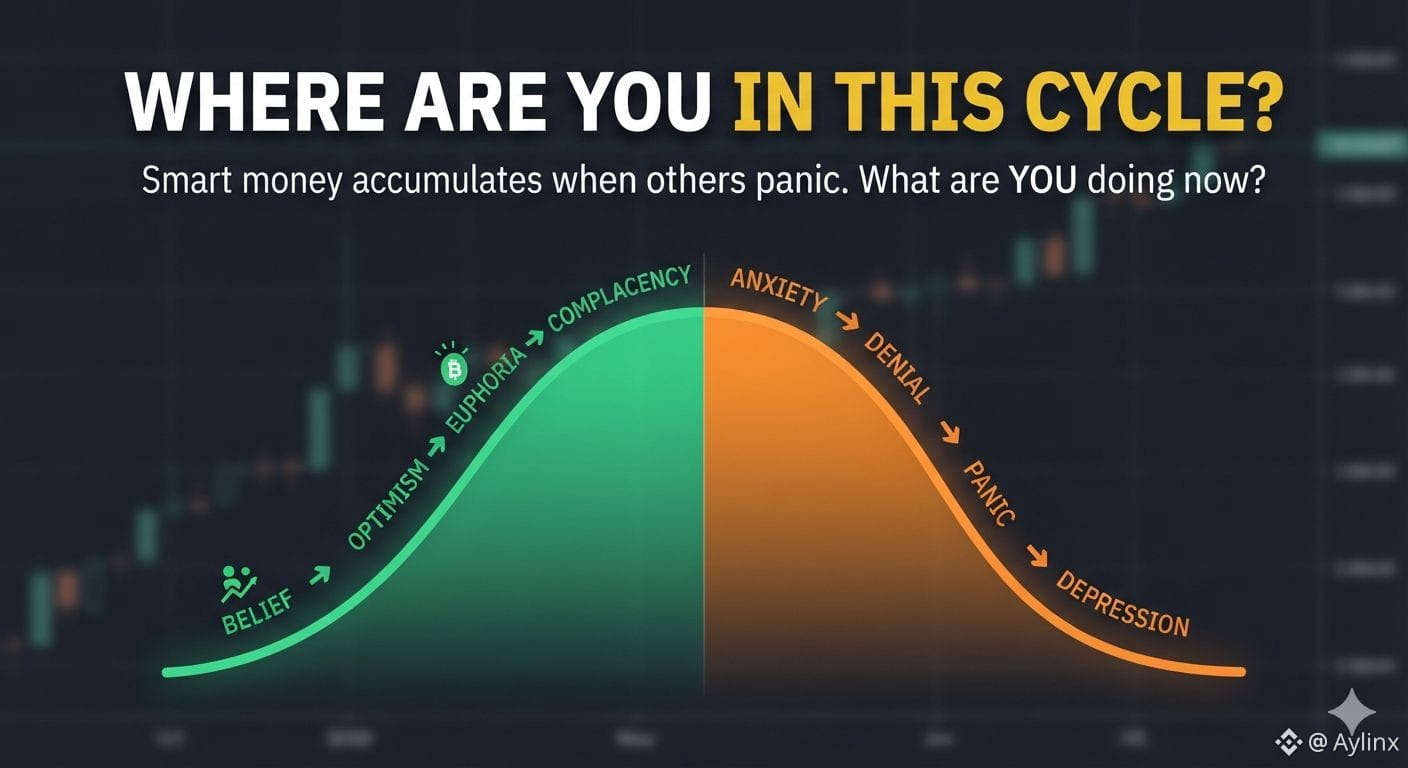
Understanding market cycles is one of the most important skills for surviving long-term in crypto.
The biggest trap for beginners is buying when the market is deep in euphoria and everyone is celebrating gains, then panic-selling when sentiment turns negative.
The cycle usually moves through different emotions: belief → optimism → euphoria → complacency → anxiety → panic.
Right now, with Bitcoin recovering strongly and market sentiment sitting in the Greed zone, I think we're somewhere around the optimism/euphoria side of the cycle rather than maximum fear. �
charliedesk +1
That doesn't automatically mean “sell.” It means manage risk, avoid FOMO, and stay aware of where we are in the cycle.
Where do you think we are right now?
Optimism, Euphoria, Complacency — or something else?
#CryptoPsychology #MarketCycles #bitcoin #Binance $BTC
Understanding market cycles is one of the most important skills for surviving long-term in crypto.
The biggest trap for beginners is buying when the market is deep in euphoria and everyone is celebrating gains, then panic-selling when sentiment turns negative.
The cycle usually moves through different emotions: belief → optimism → euphoria → complacency → anxiety → panic.
Right now, with Bitcoin recovering strongly and market sentiment sitting in the Greed zone, I think we're somewhere around the optimism/euphoria side of the cycle rather than maximum fear. �
charliedesk +1
That doesn't automatically mean “sell.” It means manage risk, avoid FOMO, and stay aware of where we are in the cycle.
Where do you think we are right now?
Optimism, Euphoria, Complacency — or something else?
#CryptoPsychology #MarketCycles #bitcoin #Binance $BTC
The biggest trap for beginners is buying when the market is deep in euphoria and everyone is celebrating gains, then panic-selling when sentiment turns negative.
The cycle usually moves through different emotions: belief → optimism → euphoria → complacency → anxiety → panic.
Right now, with Bitcoin recovering strongly and market sentiment sitting in the Greed zone, I think we're somewhere around the optimism/euphoria side of the cycle rather than maximum fear. �
charliedesk +1
That doesn't automatically mean “sell.” It means manage risk, avoid FOMO, and stay aware of where we are in the cycle.
Where do you think we are right now?
Optimism, Euphoria, Complacency — or something else?
#CryptoPsychology #MarketCycles #bitcoin #Binance $BTC
3
185
·
--
$ASTER is showing an interesting setup here.
Price pulled back into the 0.695–0.700 zone without breaking the broader structure, and buyers are starting to step back in.
Entry: 0.695–0.700
TP1: 0.732
TP2: 0.764
TP3: 0.795
SL: 0.662
The key for me is whether buyers can defend the current zone and push price toward the next resistance levels.
Watching this one closely.
#ASTER #Write2Earn #Binance
{spot}(ASTERUSDT)
#crypto
$ASTER is showing an interesting setup here.
Price pulled back into the 0.695–0.700 zone without breaking the broader structure, and buyers are starting to step back in.
Entry: 0.695–0.700
TP1: 0.732
TP2: 0.764
TP3: 0.795
SL: 0.662
The key for me is whether buyers can defend the current zone and push price toward the next resistance levels.
Watching this one closely.
#ASTER #Write2Earn #Binance
#crypto
Price pulled back into the 0.695–0.700 zone without breaking the broader structure, and buyers are starting to step back in.
Entry: 0.695–0.700
TP1: 0.732
TP2: 0.764
TP3: 0.795
SL: 0.662
The key for me is whether buyers can defend the current zone and push price toward the next resistance levels.
Watching this one closely.
#ASTER #Write2Earn #Binance
#crypto
2
292
·
--
When I started looking into Dusk, I thought the privacy part would be the thing I’d keep coming back to.
It wasn’t.
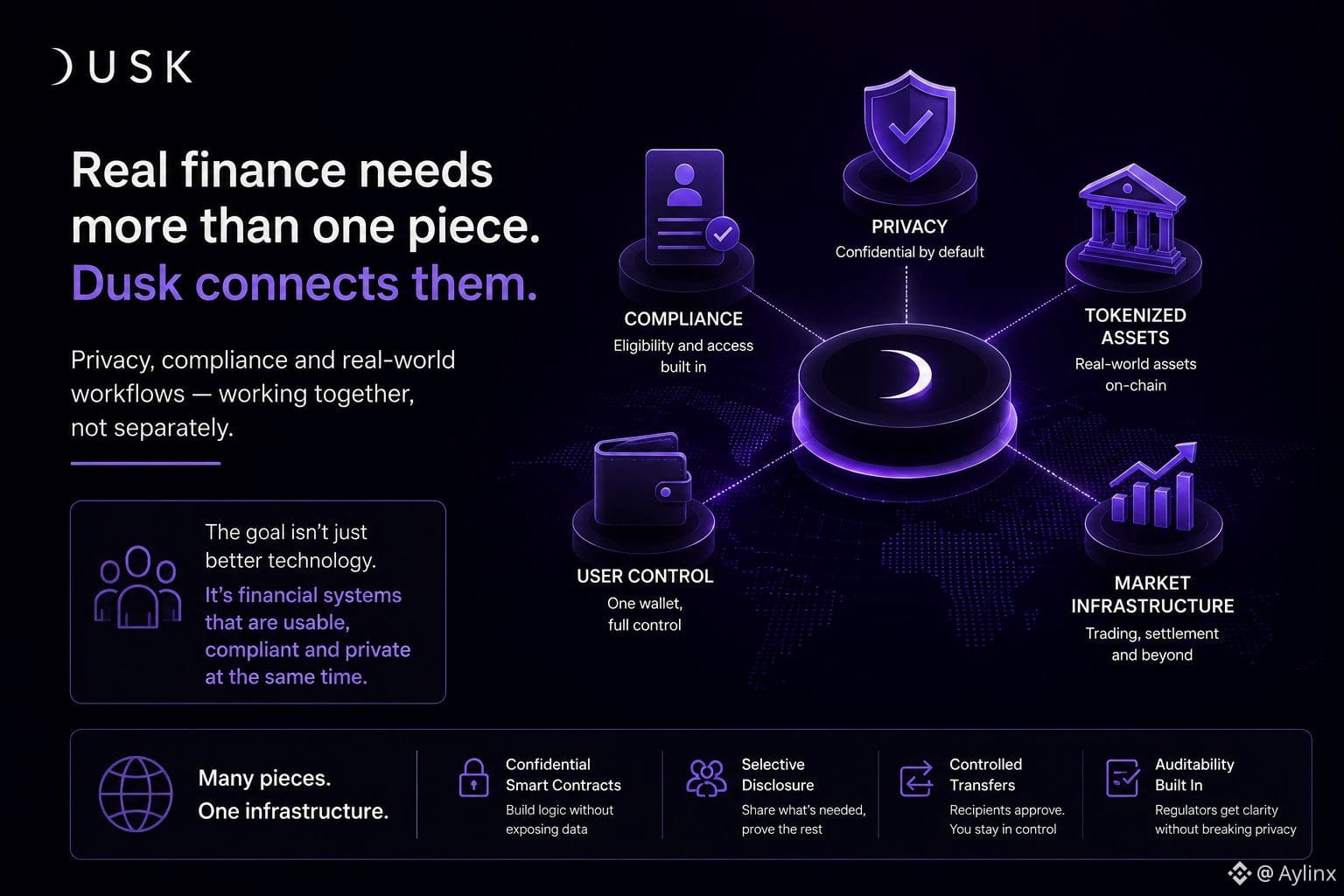
After going through the network, staking mechanics, wallets, smart contracts and the way Dusk approaches regulated assets, I ended up thinking more about something less flashy: how many separate problems have to work together before a financial asset is actually usable on-chain.
Privacy alone doesn’t solve eligibility.
Tokenization alone doesn’t create a market.
A fast settlement layer doesn’t answer who is allowed to receive an asset.
And compliance by itself doesn’t make the user experience simple.
That changed the way I look at Dusk.
What interests me now isn’t whether one feature is better than another. It’s whether all these pieces can actually work together without making regulated finance more complicated than it already is.
I still don’t think the architecture proves that by itself.
The real test is adoption.
After following Dusk through this campaign, that’s probably the question I’m leaving with:
Can all of this infrastructure feel simple enough for the people who actually need it?
That’s the part I’ll be watching after the campaign ends.
$DUSK @Dusk_Foundation #dusk #RWA #Privacy
When I started looking into Dusk, I thought the privacy part would be the thing I’d keep coming back to.
It wasn’t.
After going through the network, staking mechanics, wallets, smart contracts and the way Dusk approaches regulated assets, I ended up thinking more about something less flashy: how many separate problems have to work together before a financial asset is actually usable on-chain.
Privacy alone doesn’t solve eligibility.
Tokenization alone doesn’t create a market.
A fast settlement layer doesn’t answer who is allowed to receive an asset.
And compliance by itself doesn’t make the user experience simple.
That changed the way I look at Dusk.
What interests me now isn’t whether one feature is better than another. It’s whether all these pieces can actually work together without making regulated finance more complicated than it already is.
I still don’t think the architecture proves that by itself.
The real test is adoption.
After following Dusk through this campaign, that’s probably the question I’m leaving with:
Can all of this infrastructure feel simple enough for the people who actually need it?
That’s the part I’ll be watching after the campaign ends.
$DUSK @Dusk #dusk #RWA #Privacy
It wasn’t.
After going through the network, staking mechanics, wallets, smart contracts and the way Dusk approaches regulated assets, I ended up thinking more about something less flashy: how many separate problems have to work together before a financial asset is actually usable on-chain.
Privacy alone doesn’t solve eligibility.
Tokenization alone doesn’t create a market.
A fast settlement layer doesn’t answer who is allowed to receive an asset.
And compliance by itself doesn’t make the user experience simple.
That changed the way I look at Dusk.
What interests me now isn’t whether one feature is better than another. It’s whether all these pieces can actually work together without making regulated finance more complicated than it already is.
I still don’t think the architecture proves that by itself.
The real test is adoption.
After following Dusk through this campaign, that’s probably the question I’m leaving with:
Can all of this infrastructure feel simple enough for the people who actually need it?
That’s the part I’ll be watching after the campaign ends.
$DUSK @Dusk #dusk #RWA #Privacy
68
45
596
·
--
#dusk $DUSK @Dusk_Foundation
One thing about regulated finance started making more sense to me after looking at Dusk more closely.
I used to think compliance was basically a gate at the entrance of every financial application.
You prove who you are, get approved, and then that application knows what you’re allowed to do.
But if the same investor wants to use several regulated assets or applications, doing that over and over starts to sound like the exact kind of friction blockchain was supposed to remove.
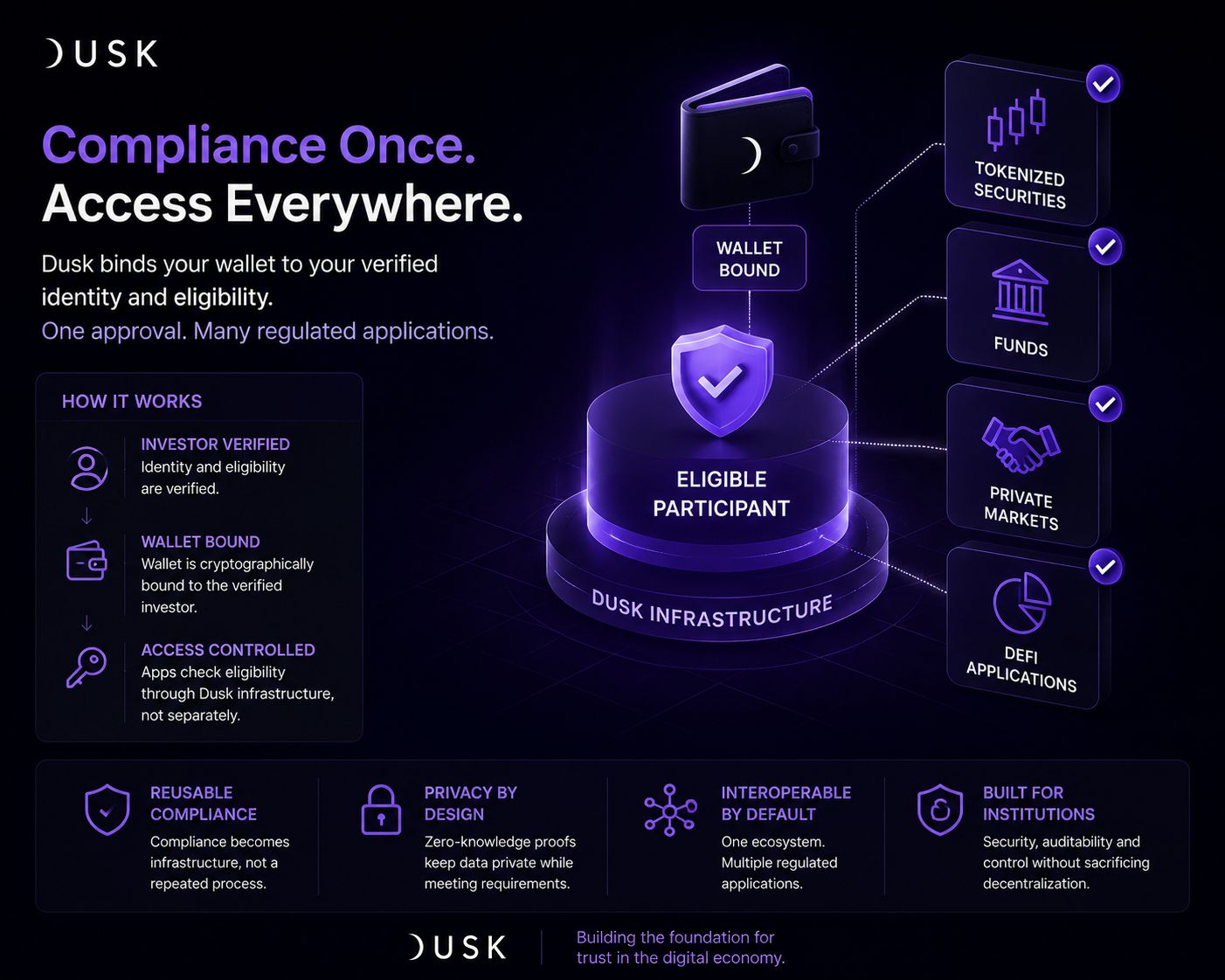
That’s where Dusk’s idea of binding a wallet to an eligible participant caught my attention.
The interesting part isn’t just proving that someone is allowed to hold an asset.
It’s what happens if that eligibility can become part of the infrastructure instead of being rebuilt by every application separately.
That could make a regulated ecosystem feel less like a collection of isolated platforms and more like one connected market.
But there’s a catch I keep thinking about.
The more reusable the compliance layer becomes, the more important it is to get the identity and access rules right.
Because once compliance becomes infrastructure, a mistake there isn’t just a bad onboarding experience.
It could affect everything built on top of it.
That trade-off is probably more interesting to me than another privacy headline.
#dusk $DUSK @Dusk
One thing about regulated finance started making more sense to me after looking at Dusk more closely.
I used to think compliance was basically a gate at the entrance of every financial application.
You prove who you are, get approved, and then that application knows what you’re allowed to do.
But if the same investor wants to use several regulated assets or applications, doing that over and over starts to sound like the exact kind of friction blockchain was supposed to remove.
That’s where Dusk’s idea of binding a wallet to an eligible participant caught my attention.
The interesting part isn’t just proving that someone is allowed to hold an asset.
It’s what happens if that eligibility can become part of the infrastructure instead of being rebuilt by every application separately.
That could make a regulated ecosystem feel less like a collection of isolated platforms and more like one connected market.
But there’s a catch I keep thinking about.
The more reusable the compliance layer becomes, the more important it is to get the identity and access rules right.
Because once compliance becomes infrastructure, a mistake there isn’t just a bad onboarding experience.
It could affect everything built on top of it.
That trade-off is probably more interesting to me than another privacy headline.
One thing about regulated finance started making more sense to me after looking at Dusk more closely.
I used to think compliance was basically a gate at the entrance of every financial application.
You prove who you are, get approved, and then that application knows what you’re allowed to do.
But if the same investor wants to use several regulated assets or applications, doing that over and over starts to sound like the exact kind of friction blockchain was supposed to remove.
That’s where Dusk’s idea of binding a wallet to an eligible participant caught my attention.
The interesting part isn’t just proving that someone is allowed to hold an asset.
It’s what happens if that eligibility can become part of the infrastructure instead of being rebuilt by every application separately.
That could make a regulated ecosystem feel less like a collection of isolated platforms and more like one connected market.
But there’s a catch I keep thinking about.
The more reusable the compliance layer becomes, the more important it is to get the identity and access rules right.
Because once compliance becomes infrastructure, a mistake there isn’t just a bad onboarding experience.
It could affect everything built on top of it.
That trade-off is probably more interesting to me than another privacy headline.
36
39
382
·
--
#dusk $DUSK @Dusk_Foundation
I didn’t expect a wallet update to make me think about infrastructure.
When I hear “new wallet” in crypto, I usually expect another interface, another connection button, another signing screen.
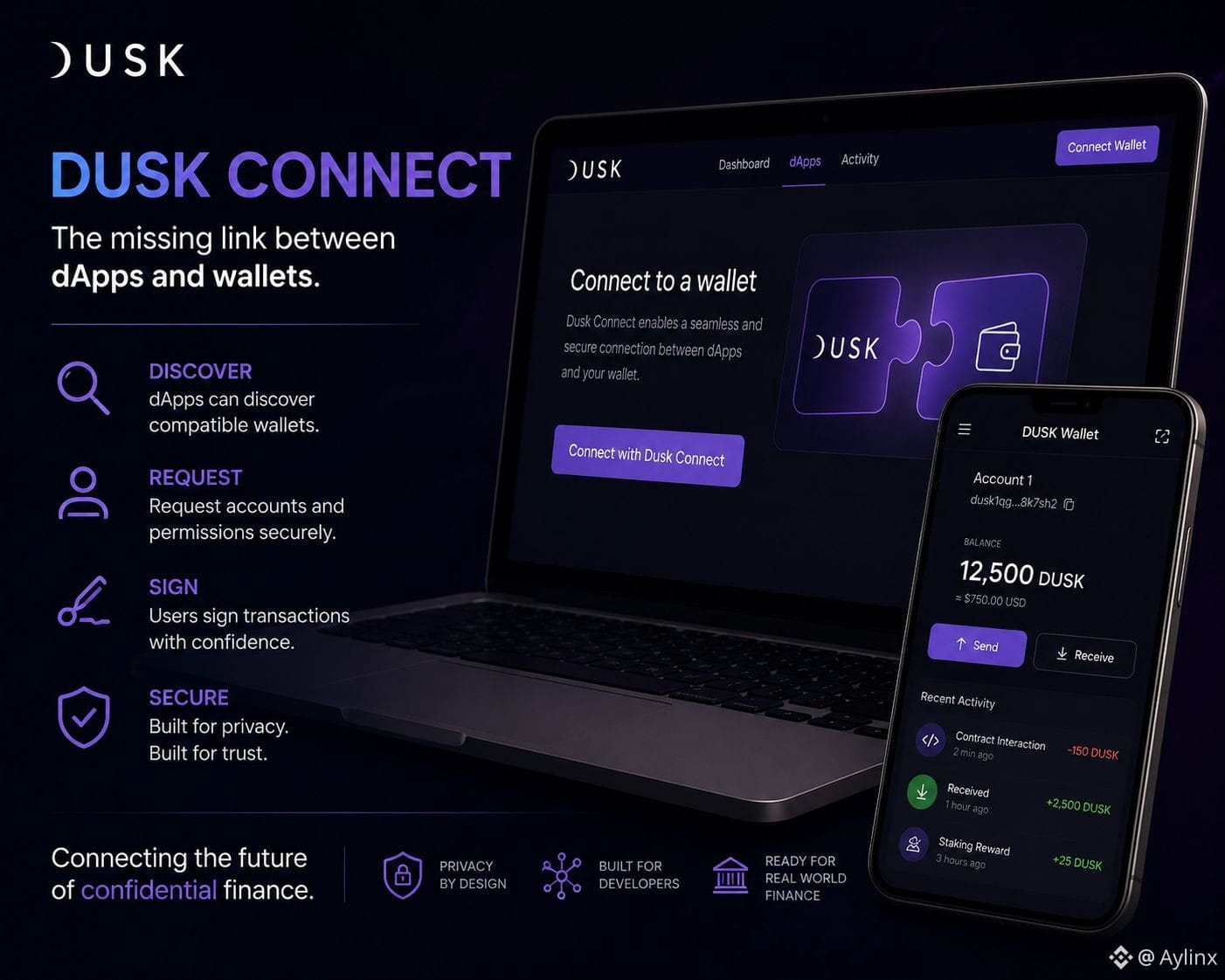
Then I looked at Dusk Connect.
What stood out to me is that Dusk can have the network and smart-contract side working, but developers still need a simple way for dApps to discover wallets, request accounts and get transactions signed.
That sounds like a small missing piece.
It probably isn’t.
A blockchain can have impressive technology underneath, but if the application layer still feels disconnected from the user, the infrastructure isn’t really complete.
I actually find these boring pieces more interesting than another flashy feature announcement.
Because now I’m wondering something else:
When Dusk talks about financial applications running on-chain, how much of that challenge is actually the blockchain—and how much is everything around it that makes people able to use it?
Maybe the boring infrastructure is where the real test begins.
#dusk $DUSK @Dusk
I didn’t expect a wallet update to make me think about infrastructure.
When I hear “new wallet” in crypto, I usually expect another interface, another connection button, another signing screen.
Then I looked at Dusk Connect.
What stood out to me is that Dusk can have the network and smart-contract side working, but developers still need a simple way for dApps to discover wallets, request accounts and get transactions signed.
That sounds like a small missing piece.
It probably isn’t.
A blockchain can have impressive technology underneath, but if the application layer still feels disconnected from the user, the infrastructure isn’t really complete.
I actually find these boring pieces more interesting than another flashy feature announcement.
Because now I’m wondering something else:
When Dusk talks about financial applications running on-chain, how much of that challenge is actually the blockchain—and how much is everything around it that makes people able to use it?
Maybe the boring infrastructure is where the real test begins.
I didn’t expect a wallet update to make me think about infrastructure.
When I hear “new wallet” in crypto, I usually expect another interface, another connection button, another signing screen.
Then I looked at Dusk Connect.
What stood out to me is that Dusk can have the network and smart-contract side working, but developers still need a simple way for dApps to discover wallets, request accounts and get transactions signed.
That sounds like a small missing piece.
It probably isn’t.
A blockchain can have impressive technology underneath, but if the application layer still feels disconnected from the user, the infrastructure isn’t really complete.
I actually find these boring pieces more interesting than another flashy feature announcement.
Because now I’m wondering something else:
When Dusk talks about financial applications running on-chain, how much of that challenge is actually the blockchain—and how much is everything around it that makes people able to use it?
Maybe the boring infrastructure is where the real test begins.
14
16
189
·
--
#dusk $DUSK @Dusk_Foundation
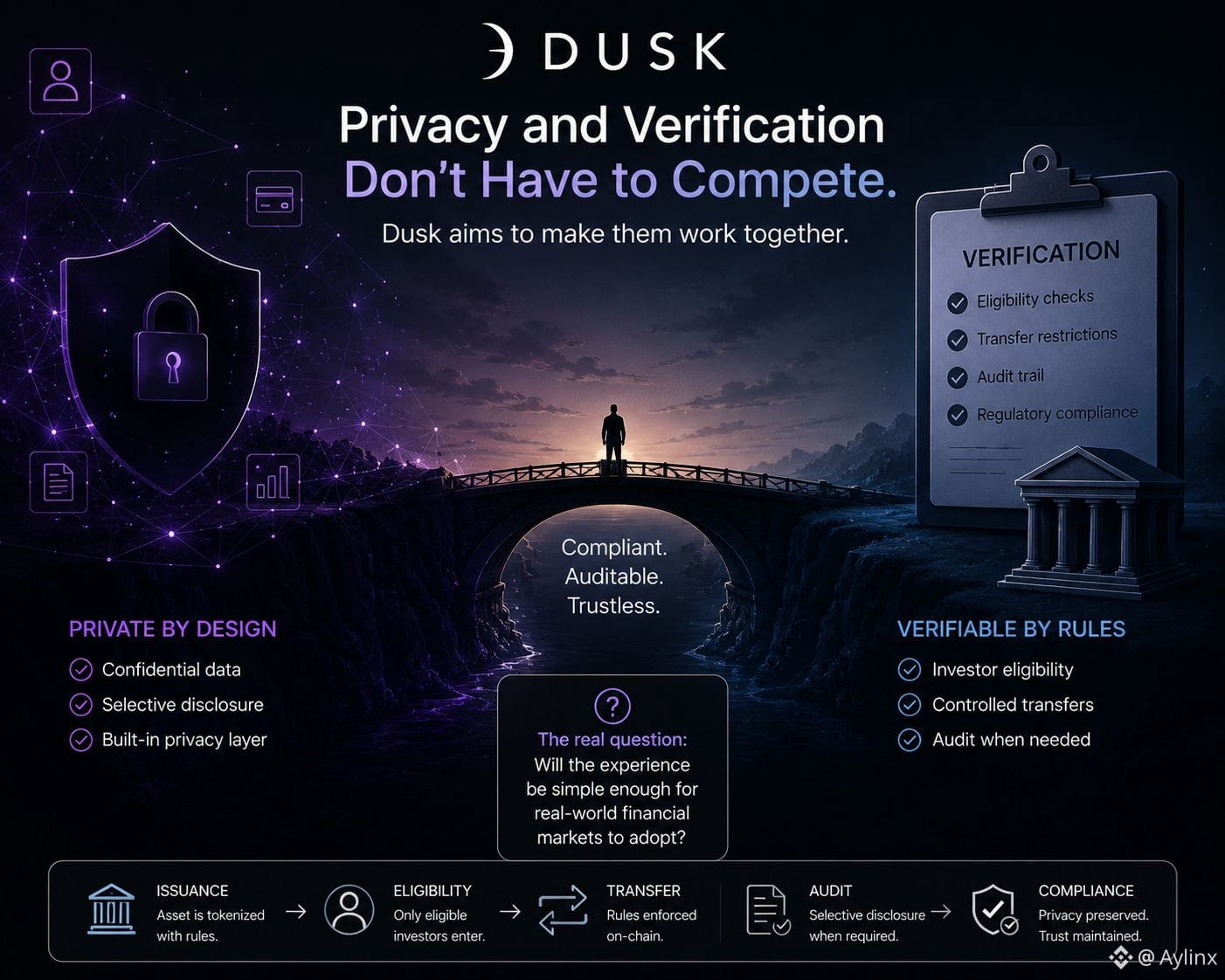
I almost dismissed Dusk’s compliance side as something that would only matter to regulators.
Then I started thinking about what actually happens when a real financial asset changes hands.
With a normal crypto transfer, the important question is usually whether the transaction is valid and the sender has the funds.
A regulated security has another layer of questions.
Is the buyer allowed to hold it? Has the right information been checked? Can the transfer be restricted when the rules require it? And if someone needs to verify the transaction later, how much information should they actually get to see?
That changed how I look at Dusk’s privacy approach.
The interesting part isn’t simply keeping financial data hidden. It’s trying to make privacy and verification work together instead of forcing one to disappear for the other to exist.
I think that distinction matters more than the usual “private blockchain” label.
But there’s still something I’m unsure about.
The architecture can define these rules, but will real issuers and investors find the process simple enough to use?
Because for me, that’s where the technology stops being an interesting design and starts becoming actual financial infrastructure.
#dusk $DUSK @Dusk
I almost dismissed Dusk’s compliance side as something that would only matter to regulators.
Then I started thinking about what actually happens when a real financial asset changes hands.
With a normal crypto transfer, the important question is usually whether the transaction is valid and the sender has the funds.
A regulated security has another layer of questions.
Is the buyer allowed to hold it? Has the right information been checked? Can the transfer be restricted when the rules require it? And if someone needs to verify the transaction later, how much information should they actually get to see?
That changed how I look at Dusk’s privacy approach.
The interesting part isn’t simply keeping financial data hidden. It’s trying to make privacy and verification work together instead of forcing one to disappear for the other to exist.
I think that distinction matters more than the usual “private blockchain” label.
But there’s still something I’m unsure about.
The architecture can define these rules, but will real issuers and investors find the process simple enough to use?
Because for me, that’s where the technology stops being an interesting design and starts becoming actual financial infrastructure.
I almost dismissed Dusk’s compliance side as something that would only matter to regulators.
Then I started thinking about what actually happens when a real financial asset changes hands.
With a normal crypto transfer, the important question is usually whether the transaction is valid and the sender has the funds.
A regulated security has another layer of questions.
Is the buyer allowed to hold it? Has the right information been checked? Can the transfer be restricted when the rules require it? And if someone needs to verify the transaction later, how much information should they actually get to see?
That changed how I look at Dusk’s privacy approach.
The interesting part isn’t simply keeping financial data hidden. It’s trying to make privacy and verification work together instead of forcing one to disappear for the other to exist.
I think that distinction matters more than the usual “private blockchain” label.
But there’s still something I’m unsure about.
The architecture can define these rules, but will real issuers and investors find the process simple enough to use?
Because for me, that’s where the technology stops being an interesting design and starts becoming actual financial infrastructure.
37
32
313
·
--
#dusk $DUSK @Dusk_Foundation
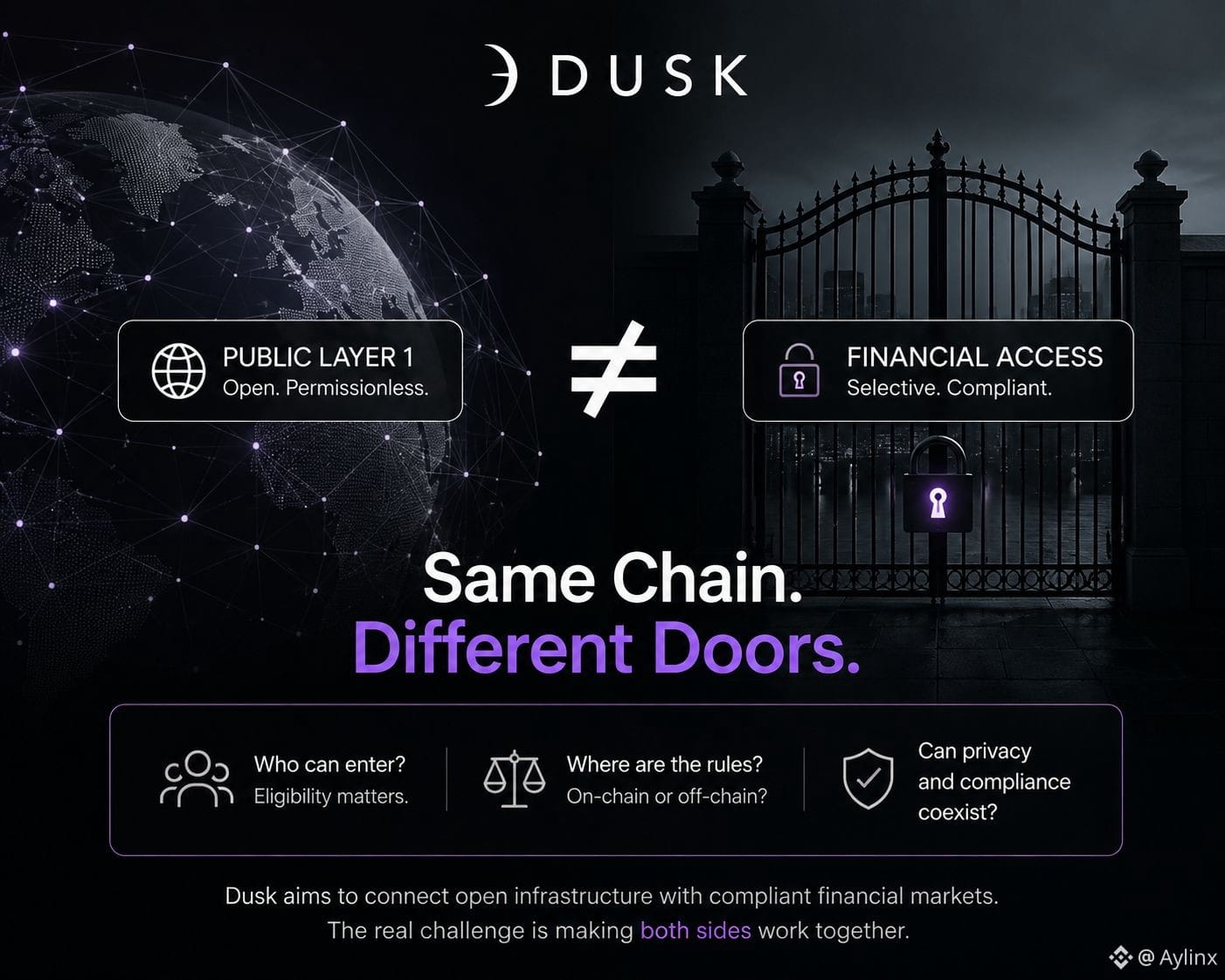
The thing that made me pause wasn’t Dusk Trade itself. It was the gap between building the infrastructure and actually letting people use it.
Dusk can be a public Layer 1 while the financial markets built on top of it still need controlled access. That sounds contradictory at first, but the more I think about regulated assets, the more it makes sense.
A bond or private-market investment can’t be treated like a random token where anyone can buy, transfer, or hold it without checking eligibility.
So Dusk is trying to solve two very different problems at once.
The base network needs to stay open.
The financial application built on it needs to know who is allowed through the door.
That distinction is actually more interesting to me than the usual privacy narrative.
Because if the infrastructure is permissionless but the asset itself has rules, then the real question becomes where those rules live and whether they can work without turning the whole blockchain into a permissioned system.
Dusk Trade is still being built, so I don’t think the answer is proven yet.
But I’ll be watching that boundary closely.
A public blockchain with controlled financial markets on top sounds simple when you say it quickly.
Making those two things work together probably isn’t.
#dusk $DUSK @Dusk
The thing that made me pause wasn’t Dusk Trade itself. It was the gap between building the infrastructure and actually letting people use it.
Dusk can be a public Layer 1 while the financial markets built on top of it still need controlled access. That sounds contradictory at first, but the more I think about regulated assets, the more it makes sense.
A bond or private-market investment can’t be treated like a random token where anyone can buy, transfer, or hold it without checking eligibility.
So Dusk is trying to solve two very different problems at once.
The base network needs to stay open.
The financial application built on it needs to know who is allowed through the door.
That distinction is actually more interesting to me than the usual privacy narrative.
Because if the infrastructure is permissionless but the asset itself has rules, then the real question becomes where those rules live and whether they can work without turning the whole blockchain into a permissioned system.
Dusk Trade is still being built, so I don’t think the answer is proven yet.
But I’ll be watching that boundary closely.
A public blockchain with controlled financial markets on top sounds simple when you say it quickly.
Making those two things work together probably isn’t.
The thing that made me pause wasn’t Dusk Trade itself. It was the gap between building the infrastructure and actually letting people use it.
Dusk can be a public Layer 1 while the financial markets built on top of it still need controlled access. That sounds contradictory at first, but the more I think about regulated assets, the more it makes sense.
A bond or private-market investment can’t be treated like a random token where anyone can buy, transfer, or hold it without checking eligibility.
So Dusk is trying to solve two very different problems at once.
The base network needs to stay open.
The financial application built on it needs to know who is allowed through the door.
That distinction is actually more interesting to me than the usual privacy narrative.
Because if the infrastructure is permissionless but the asset itself has rules, then the real question becomes where those rules live and whether they can work without turning the whole blockchain into a permissioned system.
Dusk Trade is still being built, so I don’t think the answer is proven yet.
But I’ll be watching that boundary closely.
A public blockchain with controlled financial markets on top sounds simple when you say it quickly.
Making those two things work together probably isn’t.
23
18
237
·
--
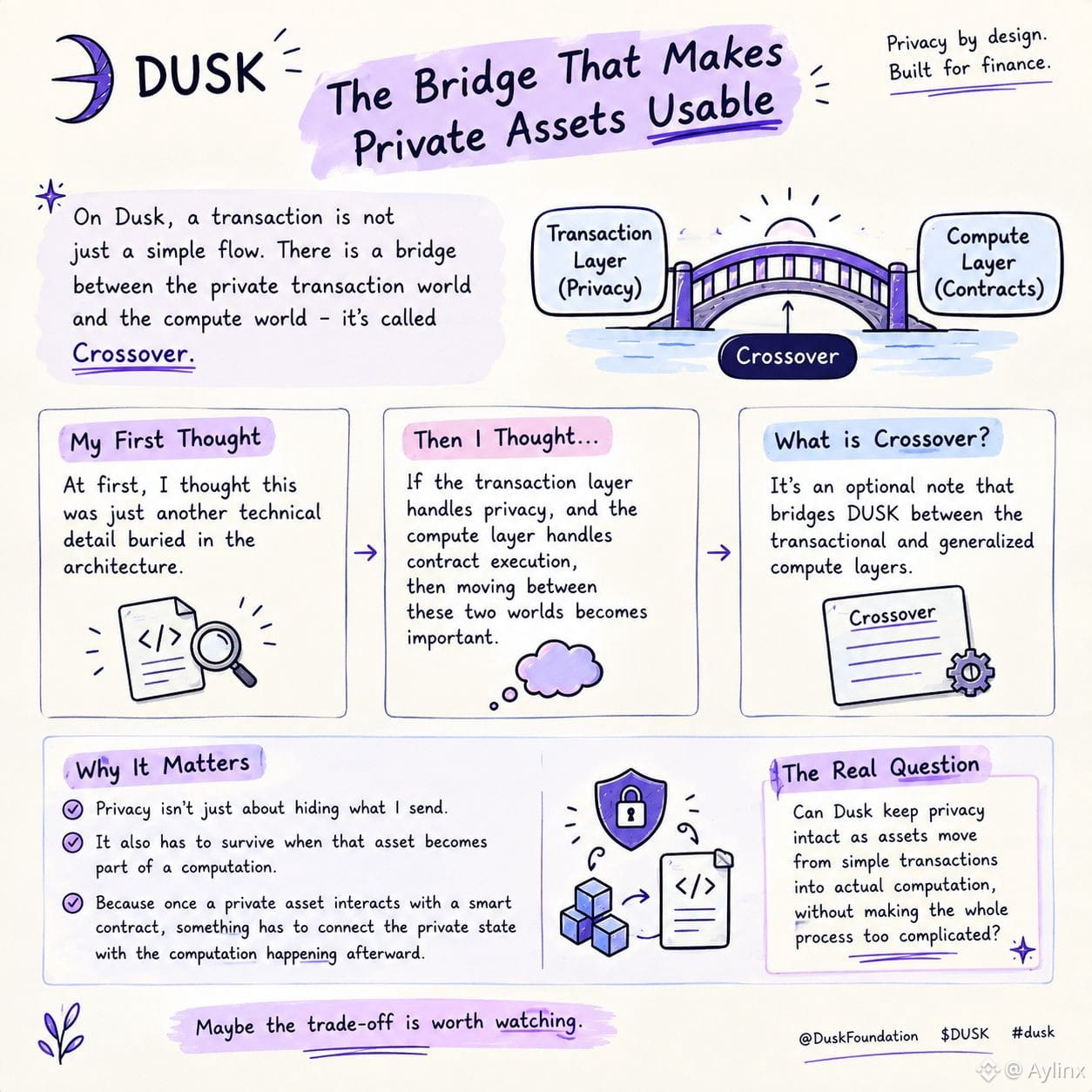
#dusk $DUSK @Dusk_Foundation One small detail in Dusk made me rethink what a “private transaction” actually means.
I normally picture a blockchain transaction as one simple flow: you have an asset, you send it, the network checks it, and that’s it.
But Dusk separates the native DUSK transaction side from the general compute layer. And when a transaction needs to interact with a contract, there’s this thing called a Crossover that acts as a bridge between the two.
At first, I honestly thought this was just another technical detail buried in the architecture.
Then I started thinking about why it exists.
If the transaction layer is handling privacy, while the compute layer is handling contract execution, moving between those two worlds becomes important. The Crossover carries the connection without simply treating everything as one transparent flow. The whitepaper even describes it as an optional note that bridges DUSK between the transactional and generalized compute layers.
That made me look at Dusk a little differently.
Privacy isn’t only about hiding what I send. It also has to survive when that asset becomes part of a computation.
And that feels like a much harder problem.
Because once a private asset interacts with a smart contract, something has to connect the private transaction state with the computation happening afterward.
I’m still not sure how much complexity this adds in real-world use.
Maybe that’s the trade-off I’d want to watch: can Dusk keep privacy intact as assets move from simple transactions into actual computation, without making the whole process too complicated?
#dusk $DUSK @Dusk One small detail in Dusk made me rethink what a “private transaction” actually means.
I normally picture a blockchain transaction as one simple flow: you have an asset, you send it, the network checks it, and that’s it.
But Dusk separates the native DUSK transaction side from the general compute layer. And when a transaction needs to interact with a contract, there’s this thing called a Crossover that acts as a bridge between the two.
At first, I honestly thought this was just another technical detail buried in the architecture.
Then I started thinking about why it exists.
If the transaction layer is handling privacy, while the compute layer is handling contract execution, moving between those two worlds becomes important. The Crossover carries the connection without simply treating everything as one transparent flow. The whitepaper even describes it as an optional note that bridges DUSK between the transactional and generalized compute layers.
That made me look at Dusk a little differently.
Privacy isn’t only about hiding what I send. It also has to survive when that asset becomes part of a computation.
And that feels like a much harder problem.
Because once a private asset interacts with a smart contract, something has to connect the private transaction state with the computation happening afterward.
I’m still not sure how much complexity this adds in real-world use.
Maybe that’s the trade-off I’d want to watch: can Dusk keep privacy intact as assets move from simple transactions into actual computation, without making the whole process too complicated?
I normally picture a blockchain transaction as one simple flow: you have an asset, you send it, the network checks it, and that’s it.
But Dusk separates the native DUSK transaction side from the general compute layer. And when a transaction needs to interact with a contract, there’s this thing called a Crossover that acts as a bridge between the two.
At first, I honestly thought this was just another technical detail buried in the architecture.
Then I started thinking about why it exists.
If the transaction layer is handling privacy, while the compute layer is handling contract execution, moving between those two worlds becomes important. The Crossover carries the connection without simply treating everything as one transparent flow. The whitepaper even describes it as an optional note that bridges DUSK between the transactional and generalized compute layers.
That made me look at Dusk a little differently.
Privacy isn’t only about hiding what I send. It also has to survive when that asset becomes part of a computation.
And that feels like a much harder problem.
Because once a private asset interacts with a smart contract, something has to connect the private transaction state with the computation happening afterward.
I’m still not sure how much complexity this adds in real-world use.
Maybe that’s the trade-off I’d want to watch: can Dusk keep privacy intact as assets move from simple transactions into actual computation, without making the whole process too complicated?
85
37
361
·
--
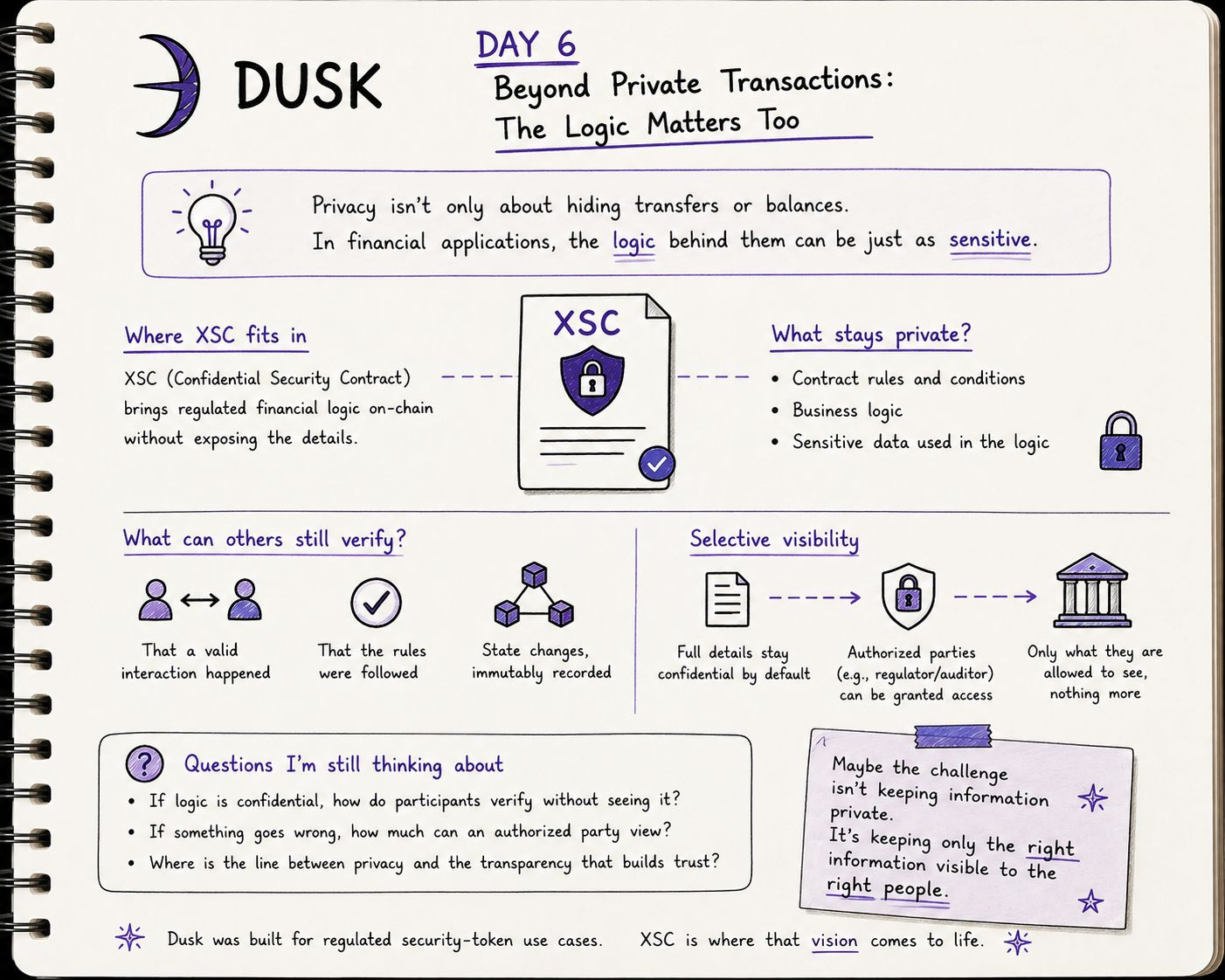
#dusk $DUSK @Dusk_Foundation The part of “privacy” I kept overlooking wasn’t the transaction itself. It was everything happening behind it.
A private transfer is one thing. But if the application handling a financial asset has rules, conditions and sensitive logic of its own, hiding the transaction doesn’t solve the whole problem.
That’s what made Dusk’s XSC approach more interesting to me.
The idea of putting regulated financial logic into confidential smart contracts feels different from simply making balances or transfers private. The contract itself can be part of the privacy problem.
But then I get stuck on the part that matters most.
If the logic is confidential, what can another participant actually verify?
And if something goes wrong, how much can an authorized party see without exposing everything to everyone else?
That balance feels harder than just saying “make it private.”
Dusk was designed around regulated security-token use cases, so I can understand why this distinction matters. But I’m still trying to picture what it would actually feel like in a real financial workflow.
Maybe the interesting part isn’t whether Dusk can keep information private.
It’s how much information it can keep private while still making the system verifiable enough to trust.
#dusk $DUSK @Dusk The part of “privacy” I kept overlooking wasn’t the transaction itself. It was everything happening behind it.
A private transfer is one thing. But if the application handling a financial asset has rules, conditions and sensitive logic of its own, hiding the transaction doesn’t solve the whole problem.
That’s what made Dusk’s XSC approach more interesting to me.
The idea of putting regulated financial logic into confidential smart contracts feels different from simply making balances or transfers private. The contract itself can be part of the privacy problem.
But then I get stuck on the part that matters most.
If the logic is confidential, what can another participant actually verify?
And if something goes wrong, how much can an authorized party see without exposing everything to everyone else?
That balance feels harder than just saying “make it private.”
Dusk was designed around regulated security-token use cases, so I can understand why this distinction matters. But I’m still trying to picture what it would actually feel like in a real financial workflow.
Maybe the interesting part isn’t whether Dusk can keep information private.
It’s how much information it can keep private while still making the system verifiable enough to trust.
A private transfer is one thing. But if the application handling a financial asset has rules, conditions and sensitive logic of its own, hiding the transaction doesn’t solve the whole problem.
That’s what made Dusk’s XSC approach more interesting to me.
The idea of putting regulated financial logic into confidential smart contracts feels different from simply making balances or transfers private. The contract itself can be part of the privacy problem.
But then I get stuck on the part that matters most.
If the logic is confidential, what can another participant actually verify?
And if something goes wrong, how much can an authorized party see without exposing everything to everyone else?
That balance feels harder than just saying “make it private.”
Dusk was designed around regulated security-token use cases, so I can understand why this distinction matters. But I’m still trying to picture what it would actually feel like in a real financial workflow.
Maybe the interesting part isn’t whether Dusk can keep information private.
It’s how much information it can keep private while still making the system verifiable enough to trust.
106
1
64
539
·
--
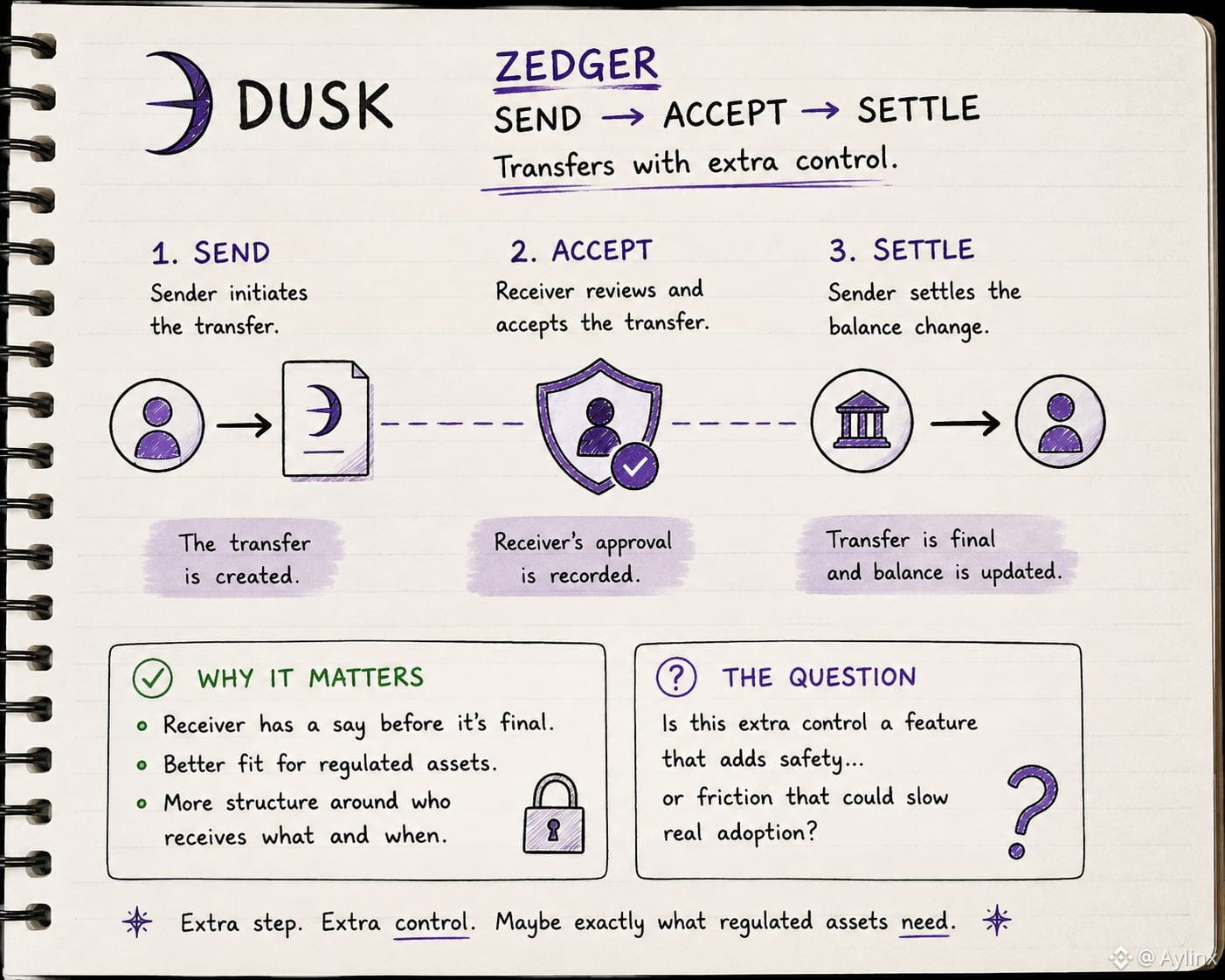
#dusk $DUSK @Dusk_Foundation One thing I’m starting to notice with Dusk is that it doesn’t always try to make a transaction feel faster. Sometimes it seems more interested in making the process more controlled.
I was looking at Zedger and the SEND, ACCEPT and SETTLE flow caught me. The sender can start a transfer, but the receiver has to accept it before the sender can settle the balance change.
My first reaction was basically: why add another step?
In normal crypto, I’m used to sending something and waiting for confirmation. Done. Here, the receiver has an actual role in the process before the transfer is fully settled.
The more I thought about it, the more I could see why this might matter for regulated assets. If I’m dealing with something like a security token, knowing that the receiving side has accepted the transfer could be more useful than simply making the transaction as quick as possible.
But I still don’t know how this feels in real use.
For an institutional workflow, that extra control might be helpful. For an everyday user, it could easily feel like unnecessary friction. And that difference is probably going to matter if Dusk wants activity beyond a small group of specialized users.
So I’m not sure yet whether I’d call the ACCEPT step a feature or a trade-off.
Maybe that’s the more interesting question: when financial assets become more regulated, how much extra friction are users actually willing to accept?
@DuskFoundation
#dusk $DUSK @Dusk One thing I’m starting to notice with Dusk is that it doesn’t always try to make a transaction feel faster. Sometimes it seems more interested in making the process more controlled.
I was looking at Zedger and the SEND, ACCEPT and SETTLE flow caught me. The sender can start a transfer, but the receiver has to accept it before the sender can settle the balance change.
My first reaction was basically: why add another step?
In normal crypto, I’m used to sending something and waiting for confirmation. Done. Here, the receiver has an actual role in the process before the transfer is fully settled.
The more I thought about it, the more I could see why this might matter for regulated assets. If I’m dealing with something like a security token, knowing that the receiving side has accepted the transfer could be more useful than simply making the transaction as quick as possible.
But I still don’t know how this feels in real use.
For an institutional workflow, that extra control might be helpful. For an everyday user, it could easily feel like unnecessary friction. And that difference is probably going to matter if Dusk wants activity beyond a small group of specialized users.
So I’m not sure yet whether I’d call the ACCEPT step a feature or a trade-off.
Maybe that’s the more interesting question: when financial assets become more regulated, how much extra friction are users actually willing to accept?
@DuskFoundation
I was looking at Zedger and the SEND, ACCEPT and SETTLE flow caught me. The sender can start a transfer, but the receiver has to accept it before the sender can settle the balance change.
My first reaction was basically: why add another step?
In normal crypto, I’m used to sending something and waiting for confirmation. Done. Here, the receiver has an actual role in the process before the transfer is fully settled.
The more I thought about it, the more I could see why this might matter for regulated assets. If I’m dealing with something like a security token, knowing that the receiving side has accepted the transfer could be more useful than simply making the transaction as quick as possible.
But I still don’t know how this feels in real use.
For an institutional workflow, that extra control might be helpful. For an everyday user, it could easily feel like unnecessary friction. And that difference is probably going to matter if Dusk wants activity beyond a small group of specialized users.
So I’m not sure yet whether I’d call the ACCEPT step a feature or a trade-off.
Maybe that’s the more interesting question: when financial assets become more regulated, how much extra friction are users actually willing to accept?
@DuskFoundation
72
27
254
·
--
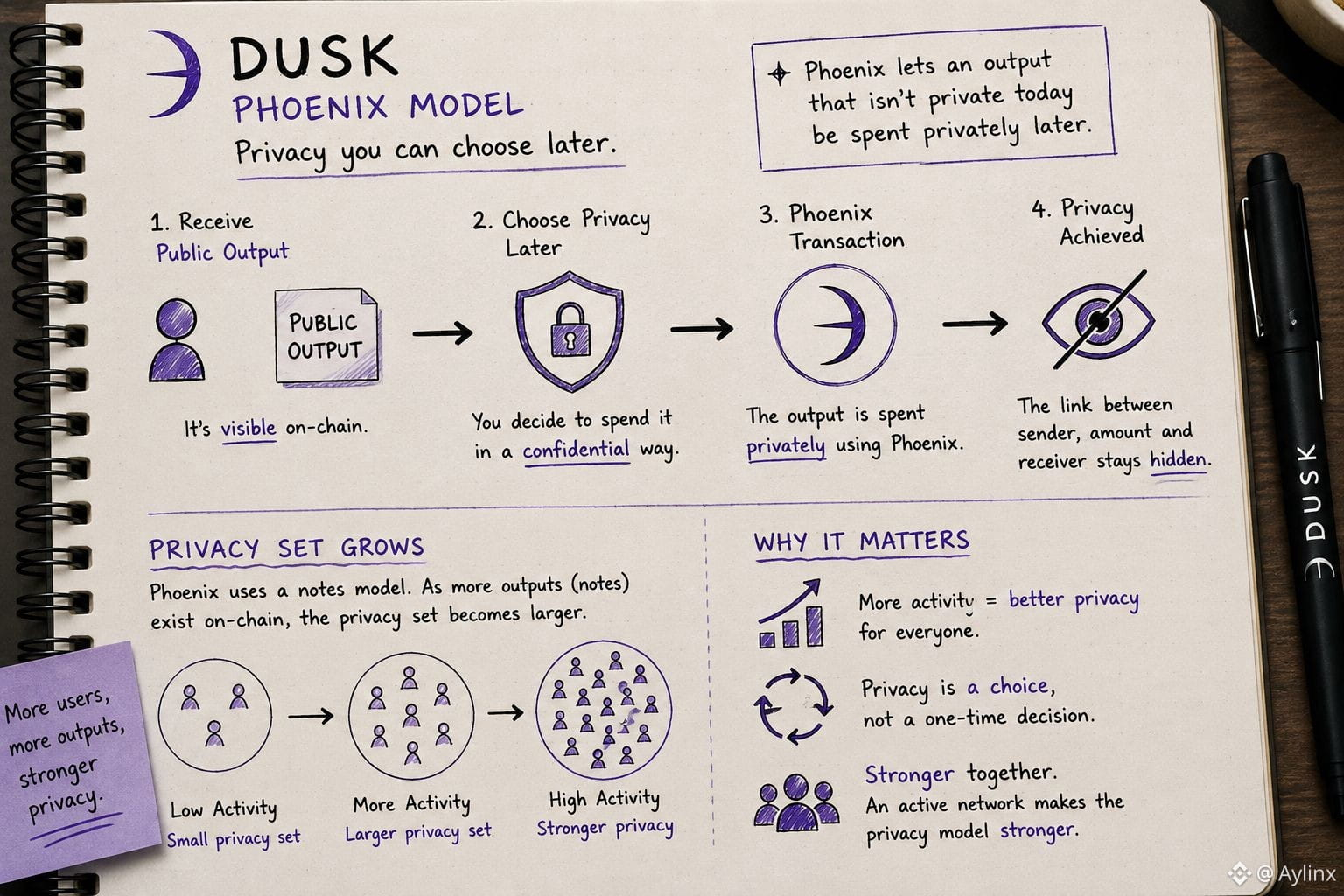
I was looking through a few Dusk transactions today and ended up stuck on something I hadn’t really thought about before.
Dusk’s Phoenix model lets an output that isn’t private today be spent privately later. So privacy isn’t only a choice you make at the start. You can decide to use it when you actually spend the output.
What got me thinking more is how the privacy set grows as more outputs exist on-chain. That means the strength of this privacy model is also connected to how active the network becomes.
That made me step back a little.
A privacy system can be well designed, but if there isn’t enough real activity, does it actually give users the level of privacy I expect from it? More users and more outputs could make the model more useful, but that also means adoption becomes part of the privacy equation.
I like that idea, but it also leaves me with a question. If network activity is important for making the privacy set stronger, then Dusk needs more than good privacy technology. It needs enough people actually using it.
So now I’m less interested in just asking whether Phoenix works, and more interested in what happens to it as activity grows.
Does Dusk first need real activity before one of its biggest advantages becomes truly meaningful?
@Dusk_Foundation $DUSK #dusk
I was looking through a few Dusk transactions today and ended up stuck on something I hadn’t really thought about before.
Dusk’s Phoenix model lets an output that isn’t private today be spent privately later. So privacy isn’t only a choice you make at the start. You can decide to use it when you actually spend the output.
What got me thinking more is how the privacy set grows as more outputs exist on-chain. That means the strength of this privacy model is also connected to how active the network becomes.
That made me step back a little.
A privacy system can be well designed, but if there isn’t enough real activity, does it actually give users the level of privacy I expect from it? More users and more outputs could make the model more useful, but that also means adoption becomes part of the privacy equation.
I like that idea, but it also leaves me with a question. If network activity is important for making the privacy set stronger, then Dusk needs more than good privacy technology. It needs enough people actually using it.
So now I’m less interested in just asking whether Phoenix works, and more interested in what happens to it as activity grows.
Does Dusk first need real activity before one of its biggest advantages becomes truly meaningful?
@Dusk $DUSK #dusk
Dusk’s Phoenix model lets an output that isn’t private today be spent privately later. So privacy isn’t only a choice you make at the start. You can decide to use it when you actually spend the output.
What got me thinking more is how the privacy set grows as more outputs exist on-chain. That means the strength of this privacy model is also connected to how active the network becomes.
That made me step back a little.
A privacy system can be well designed, but if there isn’t enough real activity, does it actually give users the level of privacy I expect from it? More users and more outputs could make the model more useful, but that also means adoption becomes part of the privacy equation.
I like that idea, but it also leaves me with a question. If network activity is important for making the privacy set stronger, then Dusk needs more than good privacy technology. It needs enough people actually using it.
So now I’m less interested in just asking whether Phoenix works, and more interested in what happens to it as activity grows.
Does Dusk first need real activity before one of its biggest advantages becomes truly meaningful?
@Dusk $DUSK #dusk
78
42
509
·
--
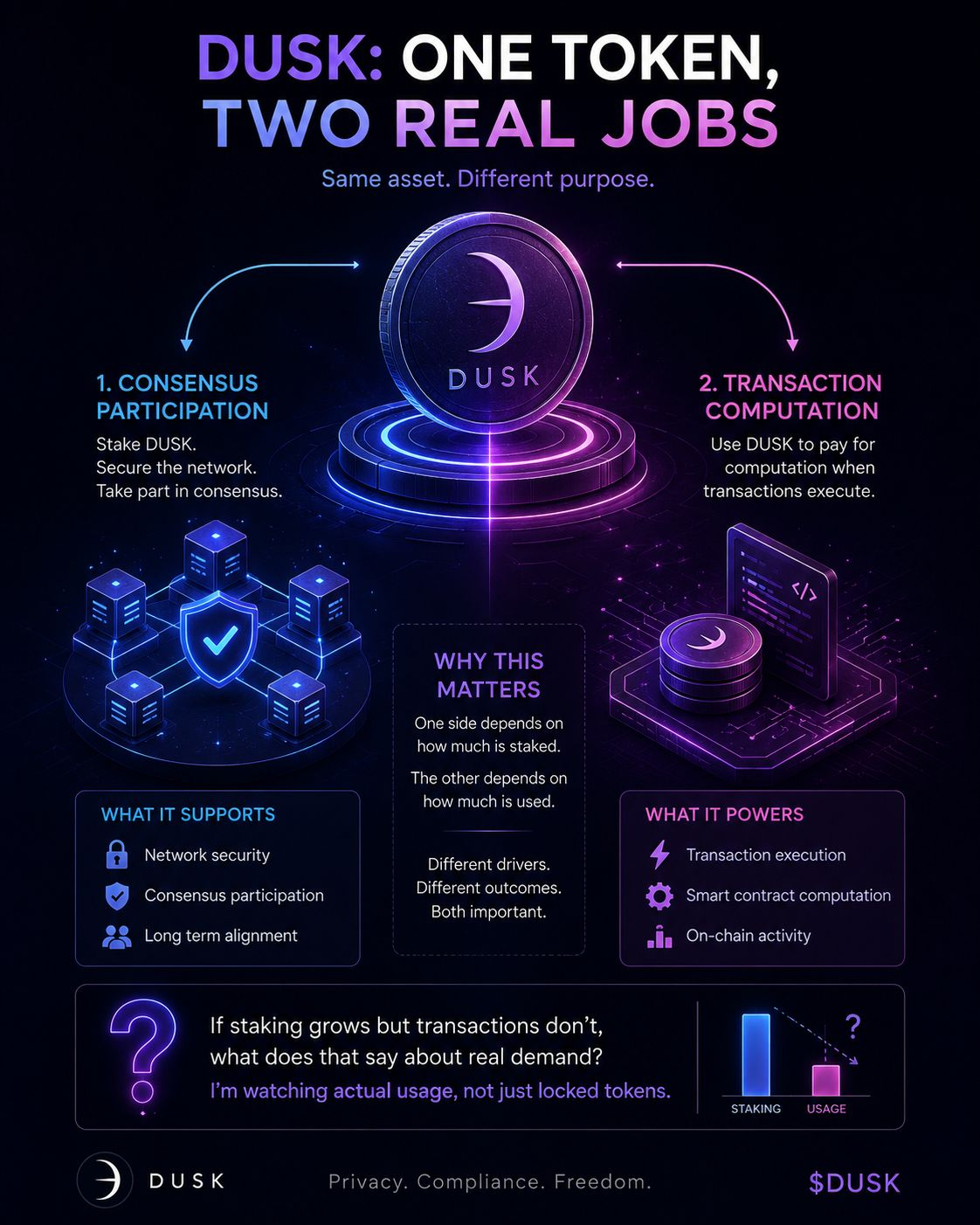
I kept looking at DUSK itself today instead of jumping straight back into the privacy features, and one thing started bothering me a little.
The token has two pretty different jobs inside the network. It can be used as part of consensus participation, but it’s also the asset used to pay for computation when transactions execute. At first that sounds like a simple token-utility point. The more I thought about it, the more I wondered whether those two uses actually create demand in the same way.
Staking is about locking capital to participate in securing the network. Transaction fees are completely different. They depend on people actually doing things on-chain.
That distinction matters to me because a network can have people holding and staking an asset without having much real execution happening around it. In that situation, the token can have a clear protocol role while still not seeing the kind of usage I’d normally associate with a busy network.
And I think this is where I’m still trying to understand Dusk.
If confidential applications eventually bring more transactions onto the chain, then the computational side of DUSK’s utility becomes much more interesting to me. But if activity stays mostly tied to consensus participation, then I’m not sure staking alone tells me very much about actual ecosystem demand.
Maybe I’m looking at the token too narrowly, but I’d rather watch how much DUSK gets used for actual computation over time than just look at how much is locked in staking.
That’s the number I’m curious about now.
#dusk $DUSK @Dusk_Foundation
I kept looking at DUSK itself today instead of jumping straight back into the privacy features, and one thing started bothering me a little.
The token has two pretty different jobs inside the network. It can be used as part of consensus participation, but it’s also the asset used to pay for computation when transactions execute. At first that sounds like a simple token-utility point. The more I thought about it, the more I wondered whether those two uses actually create demand in the same way.
Staking is about locking capital to participate in securing the network. Transaction fees are completely different. They depend on people actually doing things on-chain.
That distinction matters to me because a network can have people holding and staking an asset without having much real execution happening around it. In that situation, the token can have a clear protocol role while still not seeing the kind of usage I’d normally associate with a busy network.
And I think this is where I’m still trying to understand Dusk.
If confidential applications eventually bring more transactions onto the chain, then the computational side of DUSK’s utility becomes much more interesting to me. But if activity stays mostly tied to consensus participation, then I’m not sure staking alone tells me very much about actual ecosystem demand.
Maybe I’m looking at the token too narrowly, but I’d rather watch how much DUSK gets used for actual computation over time than just look at how much is locked in staking.
That’s the number I’m curious about now.
#dusk $DUSK @Dusk
The token has two pretty different jobs inside the network. It can be used as part of consensus participation, but it’s also the asset used to pay for computation when transactions execute. At first that sounds like a simple token-utility point. The more I thought about it, the more I wondered whether those two uses actually create demand in the same way.
Staking is about locking capital to participate in securing the network. Transaction fees are completely different. They depend on people actually doing things on-chain.
That distinction matters to me because a network can have people holding and staking an asset without having much real execution happening around it. In that situation, the token can have a clear protocol role while still not seeing the kind of usage I’d normally associate with a busy network.
And I think this is where I’m still trying to understand Dusk.
If confidential applications eventually bring more transactions onto the chain, then the computational side of DUSK’s utility becomes much more interesting to me. But if activity stays mostly tied to consensus participation, then I’m not sure staking alone tells me very much about actual ecosystem demand.
Maybe I’m looking at the token too narrowly, but I’d rather watch how much DUSK gets used for actual computation over time than just look at how much is locked in staking.
That’s the number I’m curious about now.
#dusk $DUSK @Dusk
71
50
728
·
--
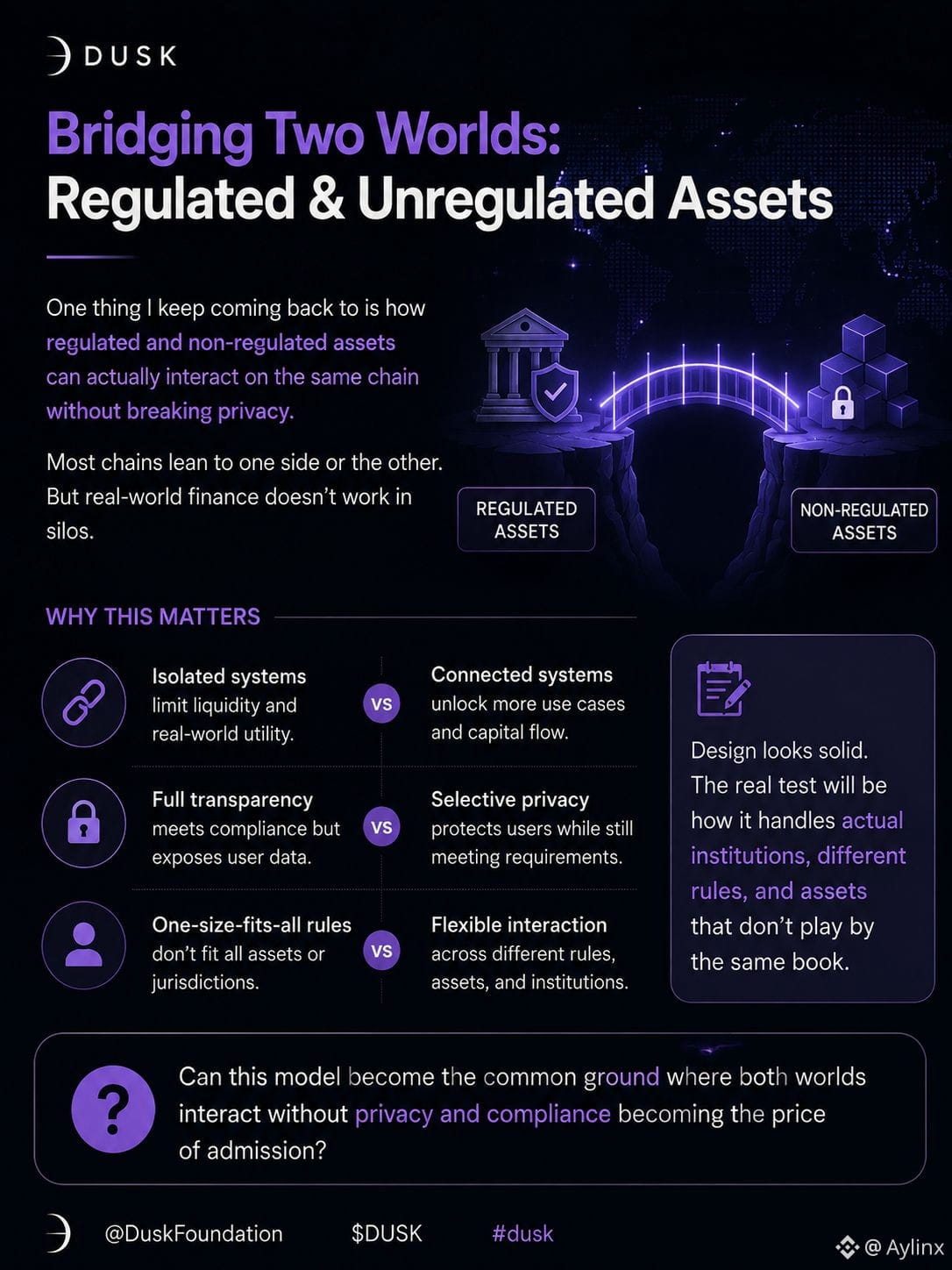
I kept thinking about one thing while looking at Dusk today: regulated and non-regulated assets probably can’t stay in completely separate worlds forever.
Most blockchains are pretty comfortable with permissionless assets. Traditional finance is obviously much more careful about who can access what, what information has to be available, and where compliance comes into the picture. The annoying part is that putting these two environments together usually means giving something up.
Dusk’s approach caught my attention because it tries to let different types of assets interact while keeping the transaction details from becoming completely exposed. I can see why that matters. If tokenized securities ever become a serious part of on-chain finance, I don’t think institutions will suddenly become comfortable putting every piece of sensitive information on a public ledger just because the technology is available.
But there’s a gap I keep noticing.
Making regulated and non-regulated assets technically compatible is one problem. Getting actual issuers, venues and users to interact with them in meaningful volume is another. The design can support the interaction, but the network still needs enough real activity for that compatibility to matter.
And I’m not sure yet how complicated this becomes once different assets, jurisdictions and compliance requirements start meeting each other.
So I keep wondering whether interoperability is actually the easier part, and the harder challenge is getting both sides to trust the same environment enough to use it?
@Dusk_Foundation $DUSK
{spot}(DUSKUSDT)
#dusk
I kept thinking about one thing while looking at Dusk today: regulated and non-regulated assets probably can’t stay in completely separate worlds forever.
Most blockchains are pretty comfortable with permissionless assets. Traditional finance is obviously much more careful about who can access what, what information has to be available, and where compliance comes into the picture. The annoying part is that putting these two environments together usually means giving something up.
Dusk’s approach caught my attention because it tries to let different types of assets interact while keeping the transaction details from becoming completely exposed. I can see why that matters. If tokenized securities ever become a serious part of on-chain finance, I don’t think institutions will suddenly become comfortable putting every piece of sensitive information on a public ledger just because the technology is available.
But there’s a gap I keep noticing.
Making regulated and non-regulated assets technically compatible is one problem. Getting actual issuers, venues and users to interact with them in meaningful volume is another. The design can support the interaction, but the network still needs enough real activity for that compatibility to matter.
And I’m not sure yet how complicated this becomes once different assets, jurisdictions and compliance requirements start meeting each other.
So I keep wondering whether interoperability is actually the easier part, and the harder challenge is getting both sides to trust the same environment enough to use it?
@Dusk $DUSK
#dusk
Most blockchains are pretty comfortable with permissionless assets. Traditional finance is obviously much more careful about who can access what, what information has to be available, and where compliance comes into the picture. The annoying part is that putting these two environments together usually means giving something up.
Dusk’s approach caught my attention because it tries to let different types of assets interact while keeping the transaction details from becoming completely exposed. I can see why that matters. If tokenized securities ever become a serious part of on-chain finance, I don’t think institutions will suddenly become comfortable putting every piece of sensitive information on a public ledger just because the technology is available.
But there’s a gap I keep noticing.
Making regulated and non-regulated assets technically compatible is one problem. Getting actual issuers, venues and users to interact with them in meaningful volume is another. The design can support the interaction, but the network still needs enough real activity for that compatibility to matter.
And I’m not sure yet how complicated this becomes once different assets, jurisdictions and compliance requirements start meeting each other.
So I keep wondering whether interoperability is actually the easier part, and the harder challenge is getting both sides to trust the same environment enough to use it?
@Dusk $DUSK
#dusk
126
78
6.1k
·
--
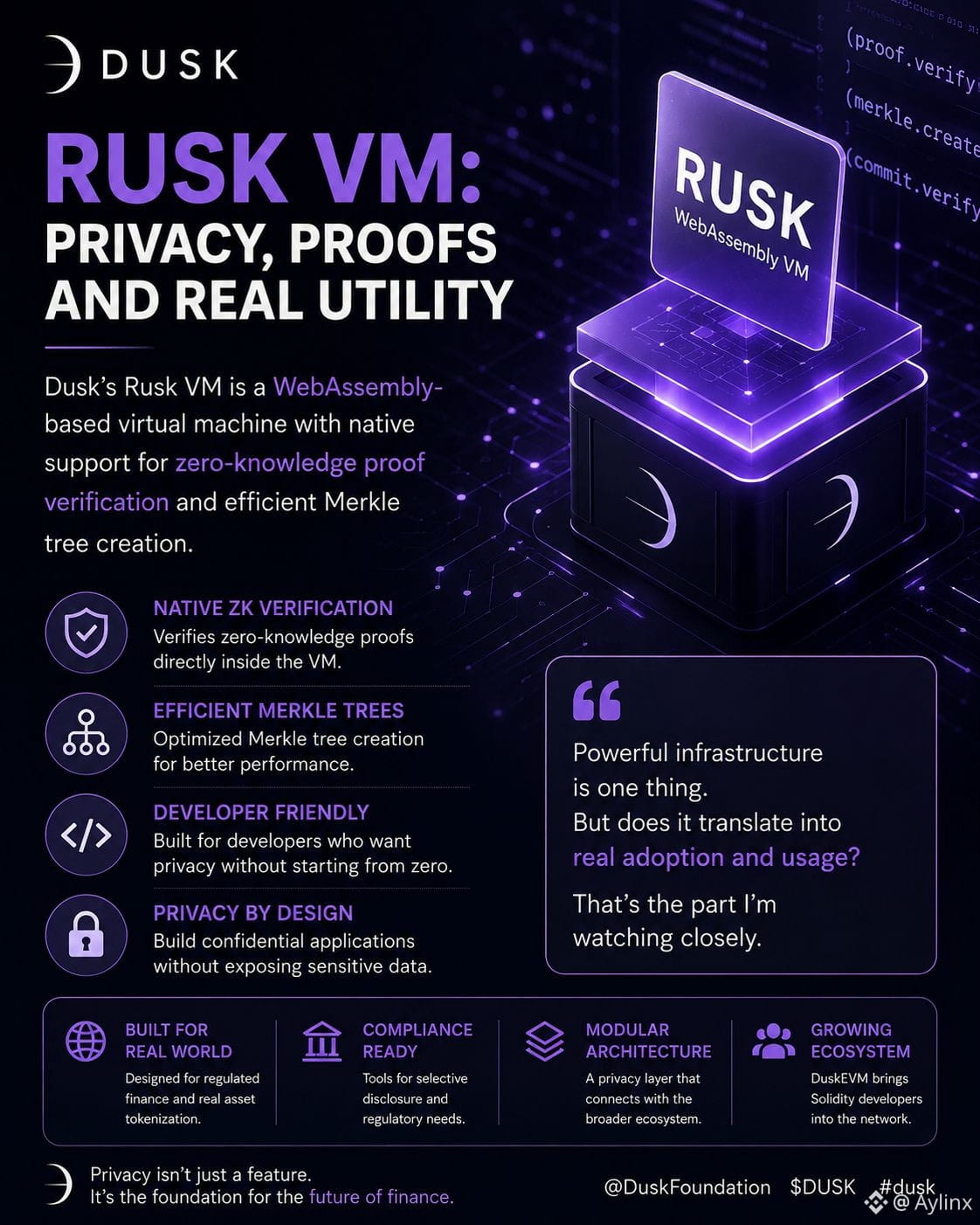
I kept coming back to the developer side of Dusk today, mostly because I think I’ve been looking at the project too much from the asset and privacy angle.
The part I found myself reading about was Rusk, Dusk’s WebAssembly-based virtual machine. What caught my attention isn’t just that it’s another execution layer. The whitepaper describes native support for zero-knowledge proof verification and efficient Merkle tree creation inside the VM. That sounds like a small implementation detail until I think about what it could mean for developers building applications where proving something without exposing everything is actually part of the problem.
I’m still trying to decide how much of this matters outside the technical design, though. Crypto has no shortage of infrastructure that sounds impressive when you read the architecture and then feels much less important when you look for people actually building and using it.
That’s probably why I’m more interested in the developer experience than the feature list. If the cryptographic tools are built into the execution environment, does that genuinely make private applications easier to build, or does the complexity just move somewhere else?
And there’s another thing I’d want to watch: whether developers who already know the EVM ecosystem find enough reason to experiment with Dusk instead of staying where the tooling and users already are.
I’m curious which side wins in practice: better native privacy tooling, or the convenience of an already established developer ecosystem?
@Dusk_Foundation $DUSK #dusk
I kept coming back to the developer side of Dusk today, mostly because I think I’ve been looking at the project too much from the asset and privacy angle.
The part I found myself reading about was Rusk, Dusk’s WebAssembly-based virtual machine. What caught my attention isn’t just that it’s another execution layer. The whitepaper describes native support for zero-knowledge proof verification and efficient Merkle tree creation inside the VM. That sounds like a small implementation detail until I think about what it could mean for developers building applications where proving something without exposing everything is actually part of the problem.
I’m still trying to decide how much of this matters outside the technical design, though. Crypto has no shortage of infrastructure that sounds impressive when you read the architecture and then feels much less important when you look for people actually building and using it.
That’s probably why I’m more interested in the developer experience than the feature list. If the cryptographic tools are built into the execution environment, does that genuinely make private applications easier to build, or does the complexity just move somewhere else?
And there’s another thing I’d want to watch: whether developers who already know the EVM ecosystem find enough reason to experiment with Dusk instead of staying where the tooling and users already are.
I’m curious which side wins in practice: better native privacy tooling, or the convenience of an already established developer ecosystem?
@Dusk $DUSK #dusk
The part I found myself reading about was Rusk, Dusk’s WebAssembly-based virtual machine. What caught my attention isn’t just that it’s another execution layer. The whitepaper describes native support for zero-knowledge proof verification and efficient Merkle tree creation inside the VM. That sounds like a small implementation detail until I think about what it could mean for developers building applications where proving something without exposing everything is actually part of the problem.
I’m still trying to decide how much of this matters outside the technical design, though. Crypto has no shortage of infrastructure that sounds impressive when you read the architecture and then feels much less important when you look for people actually building and using it.
That’s probably why I’m more interested in the developer experience than the feature list. If the cryptographic tools are built into the execution environment, does that genuinely make private applications easier to build, or does the complexity just move somewhere else?
And there’s another thing I’d want to watch: whether developers who already know the EVM ecosystem find enough reason to experiment with Dusk instead of staying where the tooling and users already are.
I’m curious which side wins in practice: better native privacy tooling, or the convenience of an already established developer ecosystem?
@Dusk $DUSK #dusk
95
53
320
·
--
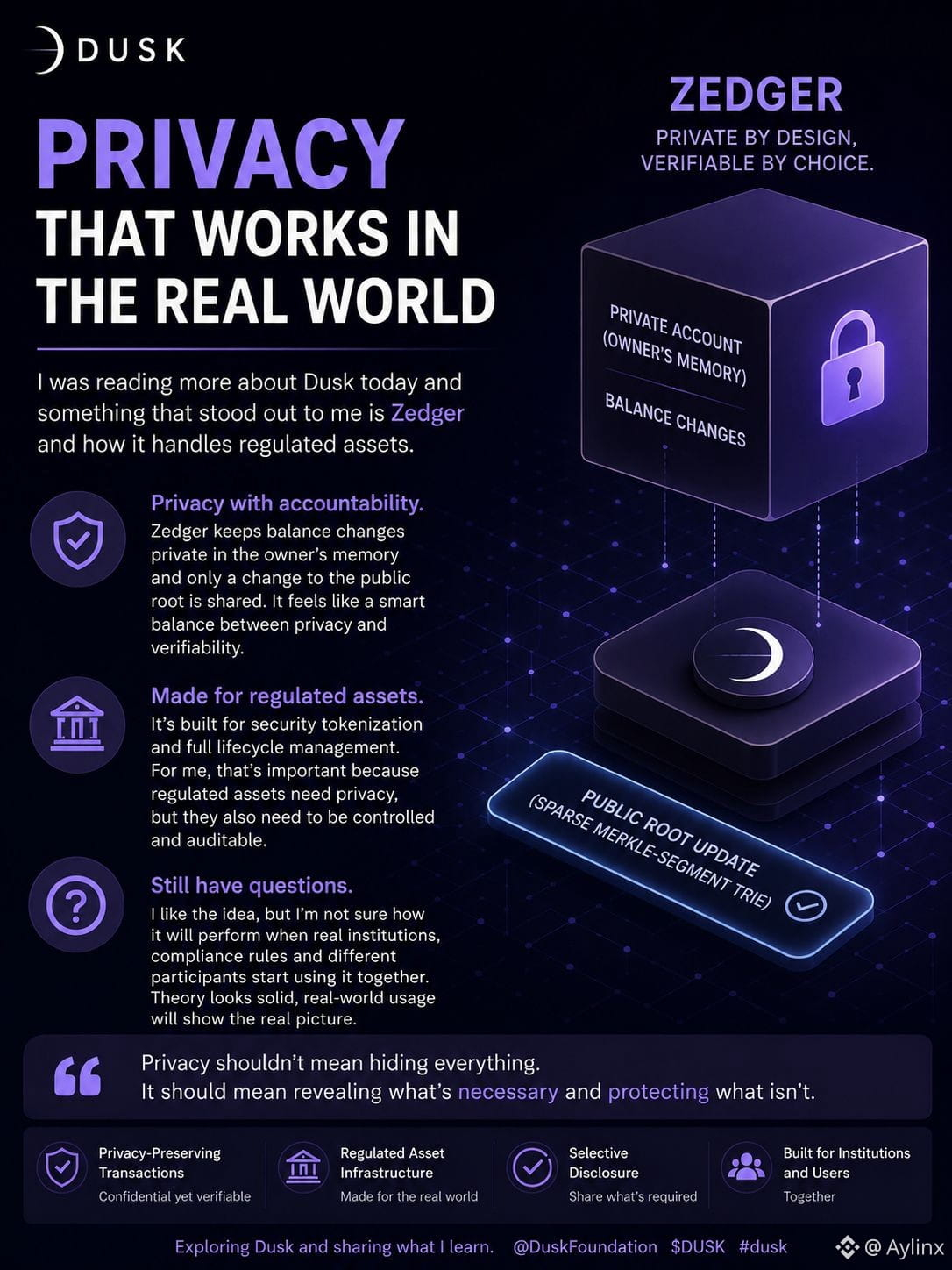
#dusk $DUSK I was reading more about Dusk today and ended up spending more time on Zedger than I expected. I think I initially looked at privacy in a pretty simple way: either transaction details are public or they’re hidden. Zedger made that view feel a bit too basic.
What I find interesting is how Dusk approaches account information. Balance changes can stay private in the account owner’s memory, while a change to the public root can still be revealed. I’m still getting my head around the technical side of it, but I like the idea behind the separation. Privacy doesn’t necessarily have to mean that nobody can verify anything.
This makes more sense to me when I think about regulated assets. If you’re dealing with security tokens and financial activity, putting every detail in public probably isn’t practical. At the same time, making everything completely private creates its own problems when verification or compliance is needed. Dusk seems to be trying to sit somewhere between those two extremes.
I do have a question though: how well does this actually work once real institutions, compliance requirements and different users are involved? A model can make sense technically, but the real test for me is whether people can use it without creating another layer of complexity.
I’m curious to see what that looks like when the system is being used at real scale. @Dusk_Foundation
#dusk $DUSK I was reading more about Dusk today and ended up spending more time on Zedger than I expected. I think I initially looked at privacy in a pretty simple way: either transaction details are public or they’re hidden. Zedger made that view feel a bit too basic.
What I find interesting is how Dusk approaches account information. Balance changes can stay private in the account owner’s memory, while a change to the public root can still be revealed. I’m still getting my head around the technical side of it, but I like the idea behind the separation. Privacy doesn’t necessarily have to mean that nobody can verify anything.
This makes more sense to me when I think about regulated assets. If you’re dealing with security tokens and financial activity, putting every detail in public probably isn’t practical. At the same time, making everything completely private creates its own problems when verification or compliance is needed. Dusk seems to be trying to sit somewhere between those two extremes.
I do have a question though: how well does this actually work once real institutions, compliance requirements and different users are involved? A model can make sense technically, but the real test for me is whether people can use it without creating another layer of complexity.
I’m curious to see what that looks like when the system is being used at real scale. @Dusk
What I find interesting is how Dusk approaches account information. Balance changes can stay private in the account owner’s memory, while a change to the public root can still be revealed. I’m still getting my head around the technical side of it, but I like the idea behind the separation. Privacy doesn’t necessarily have to mean that nobody can verify anything.
This makes more sense to me when I think about regulated assets. If you’re dealing with security tokens and financial activity, putting every detail in public probably isn’t practical. At the same time, making everything completely private creates its own problems when verification or compliance is needed. Dusk seems to be trying to sit somewhere between those two extremes.
I do have a question though: how well does this actually work once real institutions, compliance requirements and different users are involved? A model can make sense technically, but the real test for me is whether people can use it without creating another layer of complexity.
I’m curious to see what that looks like when the system is being used at real scale. @Dusk
72
35
386
·
--
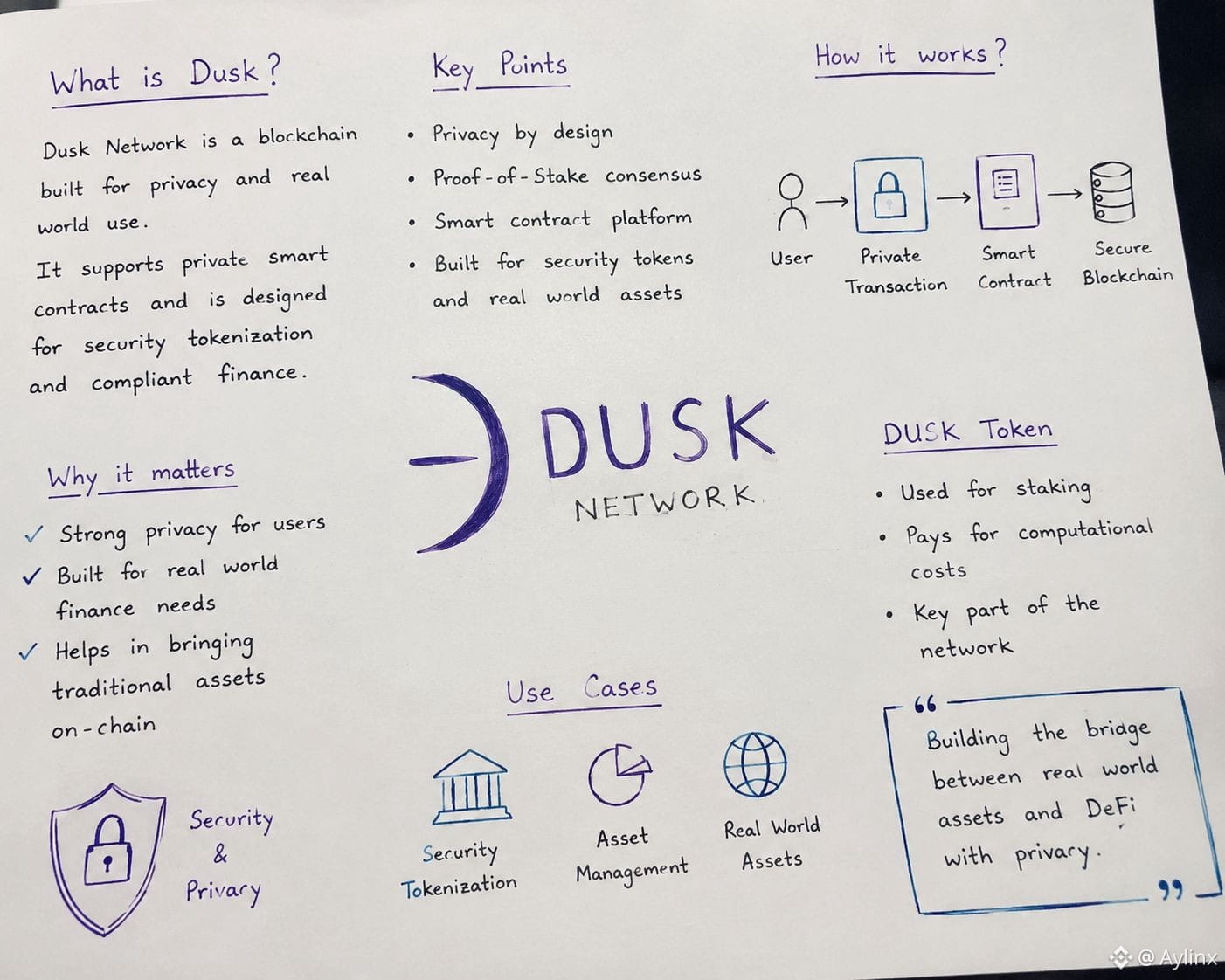
I only started looking into Dusk today, and honestly, I expected the privacy side to be the thing that caught my attention first. Instead, I ended up looking more closely at what DUSK actually does inside the network.
One thing that caught my attention is that DUSK isn’t just another token sitting alongside the network. It’s used for staking and for reimbursing computational costs, so it has a direct role in how the protocol operates. That made me look at the staking design a little differently.
Dusk uses Segregated Byzantine Agreement, a permissionless Proof-of-Stake mechanism, with Proof-of-Blind Bid used for privacy-preserving leader selection. I can see why that matters. If leader selection is less predictable, it potentially gives the network another layer of protection.
Still, I’m only getting into Dusk now, so I don’t want to pretend I’ve already formed a strong opinion. I want to watch how staking participation, validator distribution and network activity develop in practice.
I’m curious whether the design holds up as actual network usage grows. @Dusk_Foundation $DUSK #dusk
I only started looking into Dusk today, and honestly, I expected the privacy side to be the thing that caught my attention first. Instead, I ended up looking more closely at what DUSK actually does inside the network.
One thing that caught my attention is that DUSK isn’t just another token sitting alongside the network. It’s used for staking and for reimbursing computational costs, so it has a direct role in how the protocol operates. That made me look at the staking design a little differently.
Dusk uses Segregated Byzantine Agreement, a permissionless Proof-of-Stake mechanism, with Proof-of-Blind Bid used for privacy-preserving leader selection. I can see why that matters. If leader selection is less predictable, it potentially gives the network another layer of protection.
Still, I’m only getting into Dusk now, so I don’t want to pretend I’ve already formed a strong opinion. I want to watch how staking participation, validator distribution and network activity develop in practice.
I’m curious whether the design holds up as actual network usage grows. @Dusk $DUSK #dusk
One thing that caught my attention is that DUSK isn’t just another token sitting alongside the network. It’s used for staking and for reimbursing computational costs, so it has a direct role in how the protocol operates. That made me look at the staking design a little differently.
Dusk uses Segregated Byzantine Agreement, a permissionless Proof-of-Stake mechanism, with Proof-of-Blind Bid used for privacy-preserving leader selection. I can see why that matters. If leader selection is less predictable, it potentially gives the network another layer of protection.
Still, I’m only getting into Dusk now, so I don’t want to pretend I’ve already formed a strong opinion. I want to watch how staking participation, validator distribution and network activity develop in practice.
I’m curious whether the design holds up as actual network usage grows. @Dusk $DUSK #dusk
107
44
559
·
--
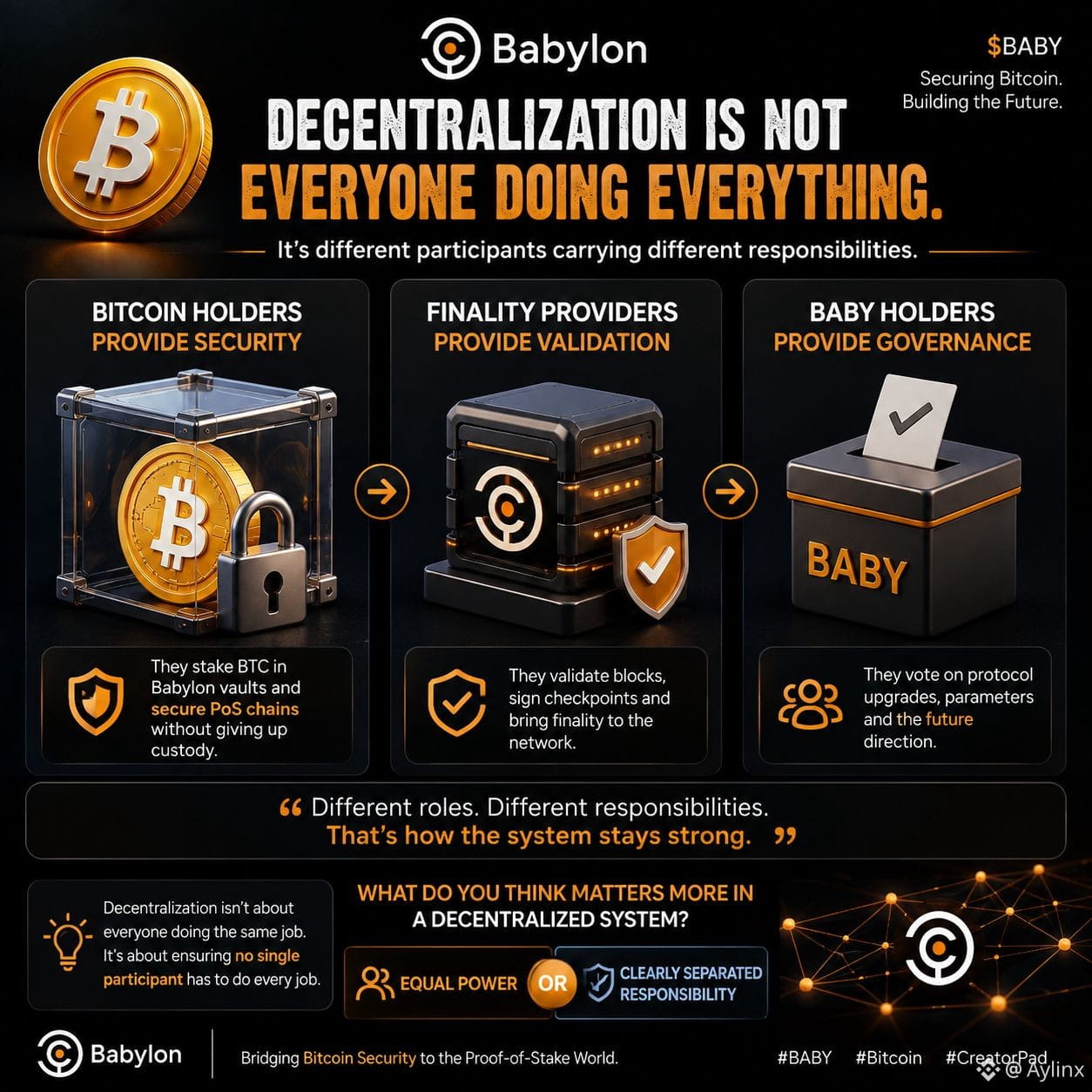
I changed my mind about one thing today.
For the longest time, I thought decentralization meant everyone should have the same level of control.
The more I looked into Babylon, the more I realized that isn't necessarily true.
Some participants secure the network.
Some help finalize it.
Others take part in governance.
At first, that separation felt strange.
Then I started asking myself a different question.
Maybe a decentralized system doesn't need everyone doing the same job.
Maybe it just needs every role to be clear enough that no single group can quietly take over everything.
That's a very different way of looking at decentralization, and honestly, I hadn't thought about it like that before.
I'm not saying it's the perfect model.
Mainnet will be the real test.
But I do think it's an interesting design choice, and it's one I'll be watching closely.
If you were designing a decentralized network, would you rather give everyone the same responsibilities, or split them across different participants?
@babylonlabs_io
$BABY $BTC
#Bitcoin #baby #creatorpad
I changed my mind about one thing today.
For the longest time, I thought decentralization meant everyone should have the same level of control.
The more I looked into Babylon, the more I realized that isn't necessarily true.
Some participants secure the network.
Some help finalize it.
Others take part in governance.
At first, that separation felt strange.
Then I started asking myself a different question.
Maybe a decentralized system doesn't need everyone doing the same job.
Maybe it just needs every role to be clear enough that no single group can quietly take over everything.
That's a very different way of looking at decentralization, and honestly, I hadn't thought about it like that before.
I'm not saying it's the perfect model.
Mainnet will be the real test.
But I do think it's an interesting design choice, and it's one I'll be watching closely.
If you were designing a decentralized network, would you rather give everyone the same responsibilities, or split them across different participants?
@BabylonLabs_io
$BABY $BTC
#Bitcoin #baby #creatorpad
For the longest time, I thought decentralization meant everyone should have the same level of control.
The more I looked into Babylon, the more I realized that isn't necessarily true.
Some participants secure the network.
Some help finalize it.
Others take part in governance.
At first, that separation felt strange.
Then I started asking myself a different question.
Maybe a decentralized system doesn't need everyone doing the same job.
Maybe it just needs every role to be clear enough that no single group can quietly take over everything.
That's a very different way of looking at decentralization, and honestly, I hadn't thought about it like that before.
I'm not saying it's the perfect model.
Mainnet will be the real test.
But I do think it's an interesting design choice, and it's one I'll be watching closely.
If you were designing a decentralized network, would you rather give everyone the same responsibilities, or split them across different participants?
@BabylonLabs_io
$BABY $BTC
#Bitcoin #baby #creatorpad
93
59
517
·
--
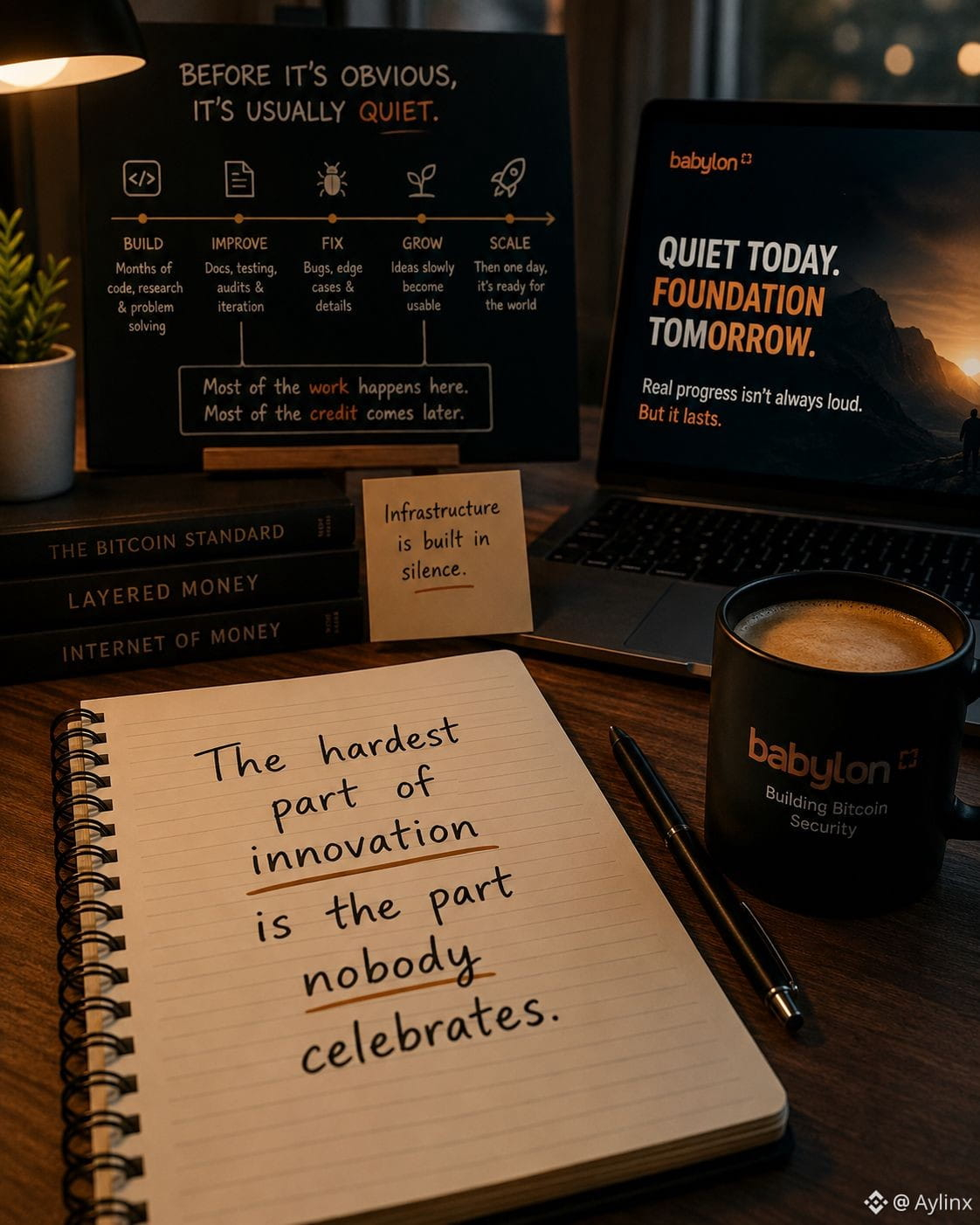
I think crypto communities have an interesting habit.
We celebrate announcements.
We celebrate launches.
We celebrate new products.
But the quiet months, the ones where almost nobody is paying attention, are usually where the real work happens.
That's when developers keep building, documentation improves, bugs get fixed, and ideas slowly become something people can actually use.
Looking at Babylon, I keep wondering if those quiet months are actually the most important part of the journey.
Not because they're exciting.
Because that's usually where long-term infrastructure is built.
By the time everyone starts calling something "the next standard," most of the hard work has already disappeared into the background.
Maybe that's why real progress often feels boring before it feels obvious.
I'm curious...
Do you think crypto pays enough attention to slow progress, or only to big announcements?
@babylonlabs_io
$BABY $BTC
#baby #Bitcoin #createrpad
I think crypto communities have an interesting habit.
We celebrate announcements.
We celebrate launches.
We celebrate new products.
But the quiet months, the ones where almost nobody is paying attention, are usually where the real work happens.
That's when developers keep building, documentation improves, bugs get fixed, and ideas slowly become something people can actually use.
Looking at Babylon, I keep wondering if those quiet months are actually the most important part of the journey.
Not because they're exciting.
Because that's usually where long-term infrastructure is built.
By the time everyone starts calling something "the next standard," most of the hard work has already disappeared into the background.
Maybe that's why real progress often feels boring before it feels obvious.
I'm curious...
Do you think crypto pays enough attention to slow progress, or only to big announcements?
@BabylonLabs_io
$BABY $BTC
#baby #Bitcoin #createrpad
We celebrate announcements.
We celebrate launches.
We celebrate new products.
But the quiet months, the ones where almost nobody is paying attention, are usually where the real work happens.
That's when developers keep building, documentation improves, bugs get fixed, and ideas slowly become something people can actually use.
Looking at Babylon, I keep wondering if those quiet months are actually the most important part of the journey.
Not because they're exciting.
Because that's usually where long-term infrastructure is built.
By the time everyone starts calling something "the next standard," most of the hard work has already disappeared into the background.
Maybe that's why real progress often feels boring before it feels obvious.
I'm curious...
Do you think crypto pays enough attention to slow progress, or only to big announcements?
@BabylonLabs_io
$BABY $BTC
#baby #Bitcoin #createrpad
154
71
762
·
--
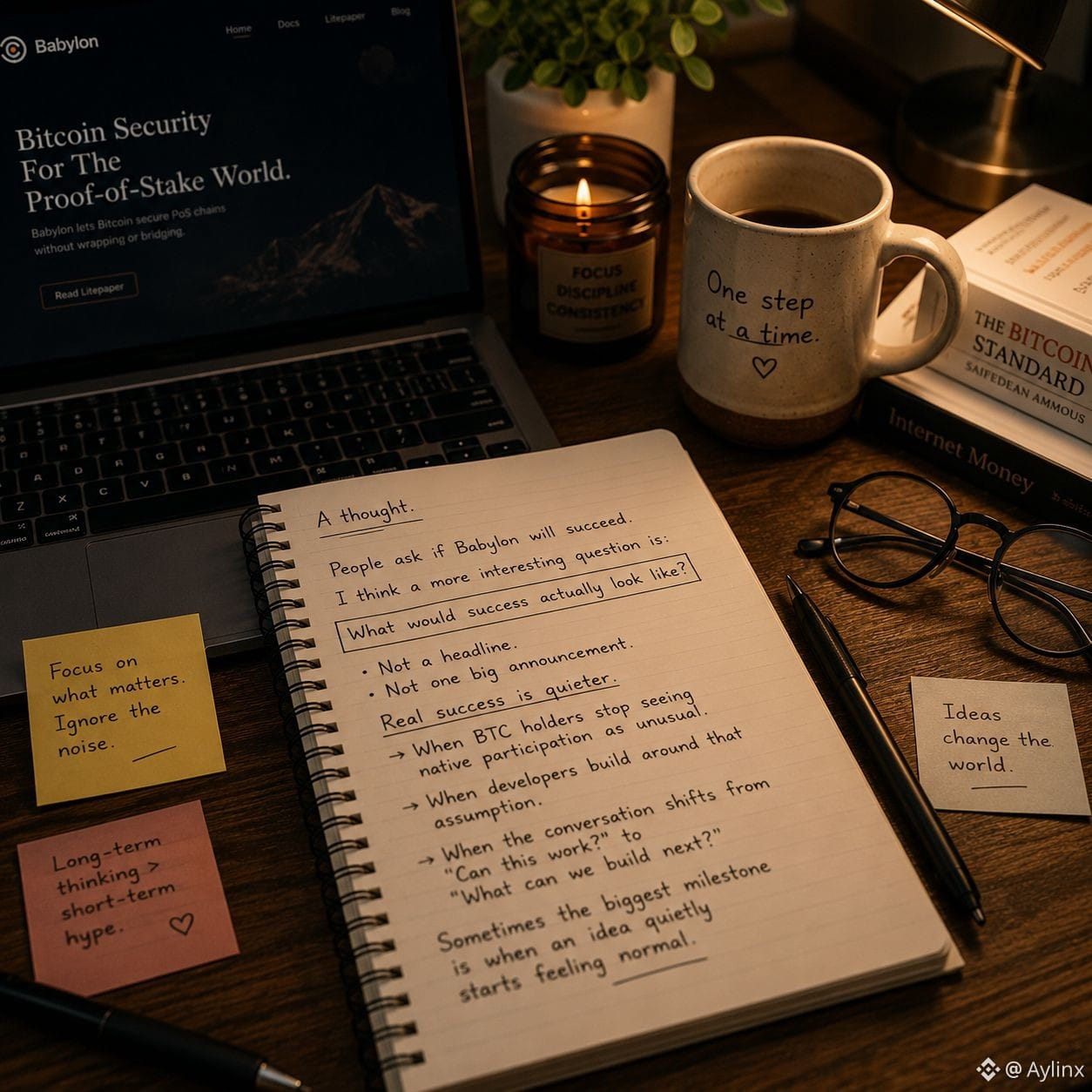
People often ask whether Babylon will succeed.
I think a more interesting question is:
What would success actually look like?
It probably won't be a headline.
It won't be one big announcement either.
Real success is quieter than that.
It's when Bitcoin holders stop seeing native BTC participation as something unusual.
It's when developers start building around that assumption instead of explaining it.
And it's when discussions slowly shift from "Can this work?" to "What can we build next?"
That's the kind of progress I like watching.
Not because it's loud...
Because it changes expectations without most people even noticing.
Sometimes the biggest milestone isn't a new feature.
It's when an idea quietly starts feeling normal.
What do you think will be the clearest sign that Babylon has reached that point?
@babylonlabs_io
$BABY $BTC
#baby #bitcoin #creatorpad
People often ask whether Babylon will succeed.
I think a more interesting question is:
What would success actually look like?
It probably won't be a headline.
It won't be one big announcement either.
Real success is quieter than that.
It's when Bitcoin holders stop seeing native BTC participation as something unusual.
It's when developers start building around that assumption instead of explaining it.
And it's when discussions slowly shift from "Can this work?" to "What can we build next?"
That's the kind of progress I like watching.
Not because it's loud...
Because it changes expectations without most people even noticing.
Sometimes the biggest milestone isn't a new feature.
It's when an idea quietly starts feeling normal.
What do you think will be the clearest sign that Babylon has reached that point?
@BabylonLabs_io
$BABY $BTC
#baby #bitcoin #creatorpad
I think a more interesting question is:
What would success actually look like?
It probably won't be a headline.
It won't be one big announcement either.
Real success is quieter than that.
It's when Bitcoin holders stop seeing native BTC participation as something unusual.
It's when developers start building around that assumption instead of explaining it.
And it's when discussions slowly shift from "Can this work?" to "What can we build next?"
That's the kind of progress I like watching.
Not because it's loud...
Because it changes expectations without most people even noticing.
Sometimes the biggest milestone isn't a new feature.
It's when an idea quietly starts feeling normal.
What do you think will be the clearest sign that Babylon has reached that point?
@BabylonLabs_io
$BABY $BTC
#baby #bitcoin #creatorpad
113
47
749
·
--
I expected the borrowing flow to be the most interesting part of Babylon's Public Testnet.
It wasn't.
What stayed with me was a much simpler question:
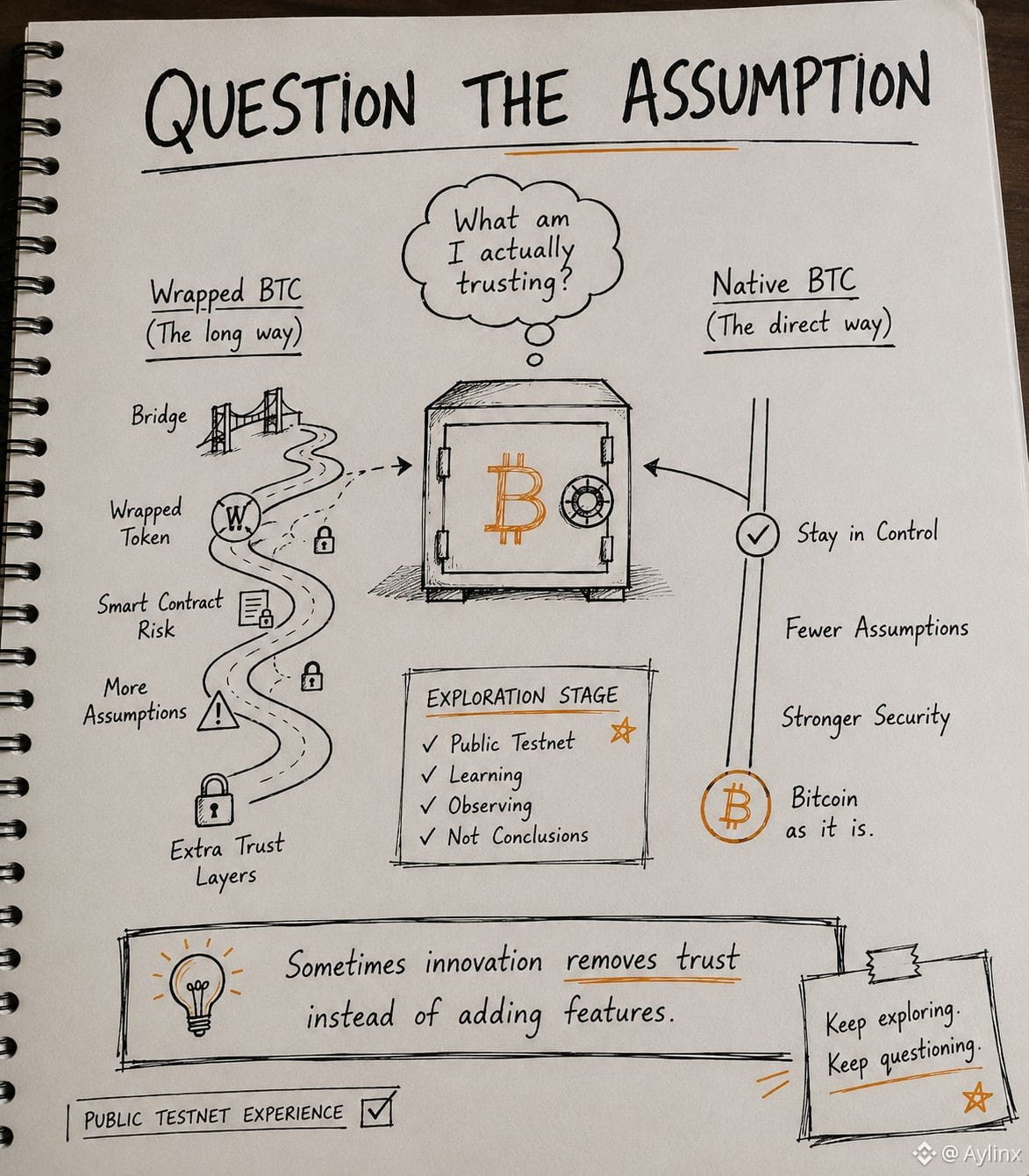
How many extra trust assumptions have we quietly accepted as "normal" just to use Bitcoin in DeFi?
For years, wrapping BTC or moving it through another system felt like the obvious starting point. I rarely stopped to ask whether that was the only path.
Exploring Babylon's Public Testnet made me think about that differently.
The experience isn't just about borrowing against Bitcoin. It's about questioning whether Bitcoin really needs to become something else before it can participate in a broader financial ecosystem.
Of course, this is still a testnet.
Mainnet liquidity, real market conditions, and user behavior will be the real test.
That's why I'm treating this as an exploration rather than a conclusion.
The biggest takeaway for me wasn't that every answer is already there.
It was realizing that removing a trust assumption can sometimes be more meaningful than adding another feature.
I'll be paying much closer attention as Babylon moves toward mainnet.
@babylonlabs_io
$BABY #bitcoin #baby #creatorpad $BTC
I expected the borrowing flow to be the most interesting part of Babylon's Public Testnet.
It wasn't.
What stayed with me was a much simpler question:
How many extra trust assumptions have we quietly accepted as "normal" just to use Bitcoin in DeFi?
For years, wrapping BTC or moving it through another system felt like the obvious starting point. I rarely stopped to ask whether that was the only path.
Exploring Babylon's Public Testnet made me think about that differently.
The experience isn't just about borrowing against Bitcoin. It's about questioning whether Bitcoin really needs to become something else before it can participate in a broader financial ecosystem.
Of course, this is still a testnet.
Mainnet liquidity, real market conditions, and user behavior will be the real test.
That's why I'm treating this as an exploration rather than a conclusion.
The biggest takeaway for me wasn't that every answer is already there.
It was realizing that removing a trust assumption can sometimes be more meaningful than adding another feature.
I'll be paying much closer attention as Babylon moves toward mainnet.
@BabylonLabs_io
$BABY #bitcoin #baby #creatorpad $BTC
It wasn't.
What stayed with me was a much simpler question:
How many extra trust assumptions have we quietly accepted as "normal" just to use Bitcoin in DeFi?
For years, wrapping BTC or moving it through another system felt like the obvious starting point. I rarely stopped to ask whether that was the only path.
Exploring Babylon's Public Testnet made me think about that differently.
The experience isn't just about borrowing against Bitcoin. It's about questioning whether Bitcoin really needs to become something else before it can participate in a broader financial ecosystem.
Of course, this is still a testnet.
Mainnet liquidity, real market conditions, and user behavior will be the real test.
That's why I'm treating this as an exploration rather than a conclusion.
The biggest takeaway for me wasn't that every answer is already there.
It was realizing that removing a trust assumption can sometimes be more meaningful than adding another feature.
I'll be paying much closer attention as Babylon moves toward mainnet.
@BabylonLabs_io
$BABY #bitcoin #baby #creatorpad $BTC
175
61
713
Log in to explore more content
Join global crypto users on Binance Square
⚡️ Get latest and useful information about crypto.
💬 Trusted by the world’s largest crypto exchange.
👍 Discover real insights from verified creators.
Email / Phone number
Trending Topics
FedMinutesFocusOnOctoberPause
212,442 views
1,435 Discussing
🚨 HIGH ALERT ‼️ PLEASE DON’T TRADE BLINDLY FOR THE NEXT HOUR 🚨
Guys, we have FOMC Minutes coming in less than 1 hour.
And after the kind of volatility we already saw today, I really don’t want anyone opening random high-leverage positions just before this release.
The biggest reaction I’m watching will be in Gold (XAU), Silver (XAG), BTC and ETH. Then coins like SOL and other highly leveraged mid/low-cap alts can exaggerate whatever move BTC makes.
Gold and Silver are especially sensitive tonight because the market is already reacting to the US dollar + Treasury yields, and both metals have been under heavy pressure ahead of the Fed minutes.
Briefly speaking
📉Hawkish Fed Minutes → Dollar/yields can push higher → pressure on BTC, crypto, Gold & silver
📈Dovish Fed Minutes → Dollar/yields can cool → BTC, Gold, Silver and risk assets can bounce hard.
And please remember the first candle can be a trap. We can get a pump, immediate dump, liquidations on both sides, and then the real direction.
So for now, protect your positions, reduce unnecessary leverage and don’t FOMO into the first move.
Tonight I’m watching $XAU , $XAG and $BTC first. These will tell us very quickly how the market is reading the Fed.
I will Update you guys on time
Follow @Panda Traders and Turn on Your notifications right now
#FedMinutesFocusOnOctoberPause
Panda Traders
·19 Likes
·4.3k views
BinanceLaunchesBinanceIntelligence
1.2M views
6,617 Discussing
EvernorthDelaysNasdaqDebutToOct12
19,401 views
336 Discussing