
REXY
270 Posts

REXY
19 Following
3.2K+ Followers
256 Liked
Posts
All
Quotes
Live
When $SKR , $0G , $HEMI all spike 30%+ in 24h on a day the Fed just signaled rate hikes—that's not FOMO.
That's capital running from something.
Bitcoin won't break $80k, so money's hunting volatility in the alts. Liquidity's thin on these tokens. One coordinated buy moves price 40%. One coordinated sell erases it.
Question: is this institutional rotation into small-cap optionality? Or retail chasing momentum into a trap?
The tape will tell us in 23 hours when these run ends.
📊 Structural hedge into alts?
📊 Momentum trap closing soon?
That's capital running from something.
Bitcoin won't break $80k, so money's hunting volatility in the alts. Liquidity's thin on these tokens. One coordinated buy moves price 40%. One coordinated sell erases it.
Question: is this institutional rotation into small-cap optionality? Or retail chasing momentum into a trap?
The tape will tell us in 23 hours when these run ends.
📊 Structural hedge into alts?
📊 Momentum trap closing soon?
$SKR
$0G
&Hemi
8 hr(s) left
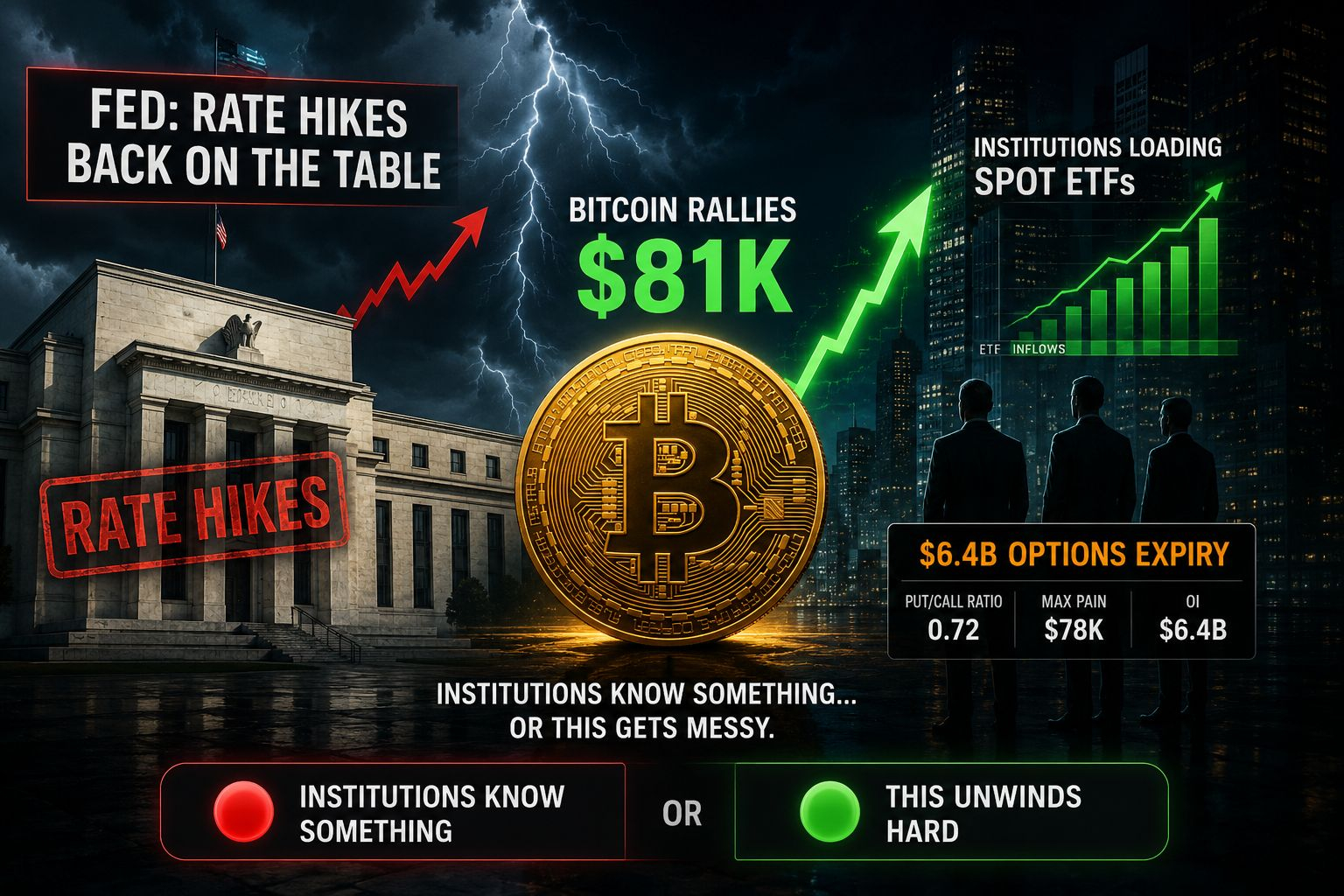
Fed just signaled rate hikes are back on the table.
$BTC rallied to $81k anyway.
Institutions loading spot ETFs like the Warsh speech didn't happen.
Either they know something about macro we don't, or this gets messy when $6.4B in options expire.
Which outcome are you pricing in?
🔴 Institutions know something
🟢 This unwinds hard
$SKR (64.66%)
$0G (41.16%)
$BTC rallied to $81k anyway.
Institutions loading spot ETFs like the Warsh speech didn't happen.
Either they know something about macro we don't, or this gets messy when $6.4B in options expire.
Which outcome are you pricing in?
🔴 Institutions know something
🟢 This unwinds hard
$SKR (64.66%)
$0G (41.16%)
@Dusk #dusk $DUSK
The more I researched the operational layer of privacy infrastructure, the less it looked like the technical problem was the hard part.
Most analysis of Dusk focuses on the protocol: Moonlight consensus, privacy cryptography, validator set mechanics. These are the things that get written about. But I kept finding myself asking something simpler: if you actually scale this network, how does it move money in and out of the ecosystem without becoming a single point of failure?
Bridges are the unglamorous answer. And I don't think most investors are serious about what happens when a bridge becomes the bottleneck.
Here's the pattern I noticed: the privacy promise only matters if money can get to and from Dusk reliably. But reliable bridges require centralized operators, insurance mechanisms, or liquidity pools that introduce new attack surfaces. You can have perfect privacy inside a network and still lose everything if the bridge gets compromised or the operator disappears. It's the same vulnerability that's haunted every cross-chain bridge.
What surprised me is how little this seems to factor into infrastructure valuations. The protocol is hard. The bridge is just a necessary evil. Except the bridge is where real capital lives during onboarding. It's where institutional money actually enters or exits. It's where risk concentrates while the privacy protocol does nothing.
I found myself wondering: what's the actual operational cost of maintaining a bridge infrastructure that doesn't introduce new trust assumptions? Can validators profitably operate bridges? Is this even a problem Dusk can solve, or is it something every privacy network has to accept?
Most posts talk about scaling Dusk. Nobody really discusses what happens to security and decentralization claims when bridges need to move billions through third parties.
Are you thinking about Dusk's bridge architecture when you evaluate risk, or is that considered a solved problem at this stage?
$BMT
$STAR
The more I researched the operational layer of privacy infrastructure, the less it looked like the technical problem was the hard part.
Most analysis of Dusk focuses on the protocol: Moonlight consensus, privacy cryptography, validator set mechanics. These are the things that get written about. But I kept finding myself asking something simpler: if you actually scale this network, how does it move money in and out of the ecosystem without becoming a single point of failure?
Bridges are the unglamorous answer. And I don't think most investors are serious about what happens when a bridge becomes the bottleneck.
Here's the pattern I noticed: the privacy promise only matters if money can get to and from Dusk reliably. But reliable bridges require centralized operators, insurance mechanisms, or liquidity pools that introduce new attack surfaces. You can have perfect privacy inside a network and still lose everything if the bridge gets compromised or the operator disappears. It's the same vulnerability that's haunted every cross-chain bridge.
What surprised me is how little this seems to factor into infrastructure valuations. The protocol is hard. The bridge is just a necessary evil. Except the bridge is where real capital lives during onboarding. It's where institutional money actually enters or exits. It's where risk concentrates while the privacy protocol does nothing.
I found myself wondering: what's the actual operational cost of maintaining a bridge infrastructure that doesn't introduce new trust assumptions? Can validators profitably operate bridges? Is this even a problem Dusk can solve, or is it something every privacy network has to accept?
Most posts talk about scaling Dusk. Nobody really discusses what happens to security and decentralization claims when bridges need to move billions through third parties.
Are you thinking about Dusk's bridge architecture when you evaluate risk, or is that considered a solved problem at this stage?
$BMT
$STAR
$UAI $PROM
@Dusk #dusk $DUSK
I think most people are measuring Dusk's progress against the wrong metric.
Everyone talks about regulatory clarity and institutional adoption as if they're prerequisites for Dusk to matter.
Compliance tooling enables institutions, institutions drive volume, volume justifies privacy infrastructure. It sounds logical. But the deeper I went into how privacy actually gets adopted in finance, the less convinced I became that institutions are the bottleneck.
Here's what I kept noticing: the projects that scaled privacy weren't the ones chasing institutional demand. They were the ones who solved privacy for people who already had a reason to need it. Monero didn't wait for bank compliance. It worked first, gained users who valued anonymity, and then built from there. The demand came before the institutional blessing.
What surprised me most about Dusk is how much energy seems focused on enabling the thing that institutions want (audit trails, compliance delegation, governance transparency) when the actual constraint might be simpler: does the privacy actually work at scale without breaking the economics? Can validators run it profitably? Can developers build on it without sacrificing the core promise?
I found myself wondering if the real adoption curve looks different. Start with builders who want privacy infrastructure that works. Let them build. Let real use cases emerge. Then institutions show up because the infrastructure already has liquidity and developer velocity, not because they were invited first.
The institutional angle isn't wrong. It's just maybe the effect, not the cause.
What's your read on this? Are you watching Dusk more for regulatory wins or for the strength of its technical foundation and actual developer adoption?
@Dusk #dusk $DUSK
I think most people are measuring Dusk's progress against the wrong metric.
Everyone talks about regulatory clarity and institutional adoption as if they're prerequisites for Dusk to matter.
Compliance tooling enables institutions, institutions drive volume, volume justifies privacy infrastructure. It sounds logical. But the deeper I went into how privacy actually gets adopted in finance, the less convinced I became that institutions are the bottleneck.
Here's what I kept noticing: the projects that scaled privacy weren't the ones chasing institutional demand. They were the ones who solved privacy for people who already had a reason to need it. Monero didn't wait for bank compliance. It worked first, gained users who valued anonymity, and then built from there. The demand came before the institutional blessing.
What surprised me most about Dusk is how much energy seems focused on enabling the thing that institutions want (audit trails, compliance delegation, governance transparency) when the actual constraint might be simpler: does the privacy actually work at scale without breaking the economics? Can validators run it profitably? Can developers build on it without sacrificing the core promise?
I found myself wondering if the real adoption curve looks different. Start with builders who want privacy infrastructure that works. Let them build. Let real use cases emerge. Then institutions show up because the infrastructure already has liquidity and developer velocity, not because they were invited first.
The institutional angle isn't wrong. It's just maybe the effect, not the cause.
What's your read on this? Are you watching Dusk more for regulatory wins or for the strength of its technical foundation and actual developer adoption?
@Dusk #dusk $DUSK
I've been digging into Dusk's architecture, and what struck me first is how openly they discuss something most privacy projects try to obscure: you can't actually have maximum privacy AND maximum smart contract functionality at the same time.
Everyone talks about privacy blockchains like it's one thing. But Dusk forces an actual architectural choice—confidential smart contracts versus confidential transactions. This isn't academic. It determines what developers can build and what users can do.
I kept asking myself why this matters. Confidential smart contracts let you hide what your code actually does. That's powerful for certain applications. But it's also a compliance nightmare, and the computational overhead is brutal. Confidential transactions hide amounts and addresses, but your smart contract logic stays visible. That's the opposite problem.
What surprised me most was realizing this tension isn't new—it's just rarely stated this directly. Monero chose one path, Zcash chose another. But Dusk actually structures the protocol around this choice rather than avoiding it. That feels different to me.
The deeper I went into their documentation, the more I started thinking about infrastructure economics. Privacy execution costs real resources. Someone has to bear that. Either you price it into every transaction, or you build incentive structures that subsidize it. Dusk's developer incentive approach suggests they're betting on the latter. That's a long-term sustainability bet I don't think gets discussed enough.
What I'm genuinely uncertain about: does solving for developer-friendly privacy actually solve for user privacy? Or does it create a privacy-theater situation where some things are hidden and others aren't?
$SPK
$MORPHO
How are you thinking about this trade-off?
I've been digging into Dusk's architecture, and what struck me first is how openly they discuss something most privacy projects try to obscure: you can't actually have maximum privacy AND maximum smart contract functionality at the same time.
Everyone talks about privacy blockchains like it's one thing. But Dusk forces an actual architectural choice—confidential smart contracts versus confidential transactions. This isn't academic. It determines what developers can build and what users can do.
I kept asking myself why this matters. Confidential smart contracts let you hide what your code actually does. That's powerful for certain applications. But it's also a compliance nightmare, and the computational overhead is brutal. Confidential transactions hide amounts and addresses, but your smart contract logic stays visible. That's the opposite problem.
What surprised me most was realizing this tension isn't new—it's just rarely stated this directly. Monero chose one path, Zcash chose another. But Dusk actually structures the protocol around this choice rather than avoiding it. That feels different to me.
The deeper I went into their documentation, the more I started thinking about infrastructure economics. Privacy execution costs real resources. Someone has to bear that. Either you price it into every transaction, or you build incentive structures that subsidize it. Dusk's developer incentive approach suggests they're betting on the latter. That's a long-term sustainability bet I don't think gets discussed enough.
What I'm genuinely uncertain about: does solving for developer-friendly privacy actually solve for user privacy? Or does it create a privacy-theater situation where some things are hidden and others aren't?
$SPK
$MORPHO
How are you thinking about this trade-off?
@Dusk $DUSK #dusk
The Privacy vs. Compliance Trap That DUSK Thinks It Solved
I think most people misunderstand what DUSK is actually trying to solve. They see "privacy blockchain" and assume it's another Monero competitor. But spending time with the documentation made me realize the real target is something completely different.
The problem isn't privacy itself. It's that financial institutions need privacy and compliance simultaneously, and no existing infrastructure handles both. Traditional chains are too transparent, which prevents institutional adoption. Privacy chains are too opaque, which regulators won't allow. You're forced to choose between surveillance or restriction.
DUSK's architecture tries to split this open using zero-knowledge proofs. You prove a transaction follows compliance rules without revealing the transaction itself. Regulators see proof of legitimacy. Competitors don't see your strategy. It's a fundamentally different product than privacy chains built around anonymity.
What surprised me most was how narrow the actual market is. This isn't for retail users hiding transactions. It's for institutions that have real compliance obligations and competitive concerns blockchain can actually solve. That's a much smaller audience than privacy maximalists imagine. But it's also a much more economically sustainable one.
The trade-off that worries me is the trust assumption around the proving mechanism. If the zero-knowledge implementation has a flaw, you've created the worst case: privacy users who thought they were compliant and institutions who thought they were private. The cryptography becomes the single point of failure.
What do you think determines whether institutions actually adopt this versus just building private infrastructure they control anyway?
$TUT
$TRUMP
The Privacy vs. Compliance Trap That DUSK Thinks It Solved
I think most people misunderstand what DUSK is actually trying to solve. They see "privacy blockchain" and assume it's another Monero competitor. But spending time with the documentation made me realize the real target is something completely different.
The problem isn't privacy itself. It's that financial institutions need privacy and compliance simultaneously, and no existing infrastructure handles both. Traditional chains are too transparent, which prevents institutional adoption. Privacy chains are too opaque, which regulators won't allow. You're forced to choose between surveillance or restriction.
DUSK's architecture tries to split this open using zero-knowledge proofs. You prove a transaction follows compliance rules without revealing the transaction itself. Regulators see proof of legitimacy. Competitors don't see your strategy. It's a fundamentally different product than privacy chains built around anonymity.
What surprised me most was how narrow the actual market is. This isn't for retail users hiding transactions. It's for institutions that have real compliance obligations and competitive concerns blockchain can actually solve. That's a much smaller audience than privacy maximalists imagine. But it's also a much more economically sustainable one.
The trade-off that worries me is the trust assumption around the proving mechanism. If the zero-knowledge implementation has a flaw, you've created the worst case: privacy users who thought they were compliant and institutions who thought they were private. The cryptography becomes the single point of failure.
What do you think determines whether institutions actually adopt this versus just building private infrastructure they control anyway?
$TUT
$TRUMP
@Dusk #dusk $DUSK
Why the Architecture Split Matters More Than Expected
I found myself wondering why Dusk built a three-layer architecture when most protocols stick with one settlement layer.
The answer exposed something about how financial infrastructure actually works. Trading involves multiple steps: order matching, settlement, custody, broadcast. Most blockchains treat these as one continuous process. Dusk separated them. The settlement layer handles finality and privacy. The execution layer handles everything else. This matters because different parts have different requirements.
When you bundle everything together, you create compromises. The privacy tech slows execution. The execution requirements bloat the privacy layer. Dusk decided to isolate them.
What I initially dismissed as "just engineering" turned out to reveal a different market psychology. Ethereum developers can integrate with DuskEVM immediately because it's EVM-compatible. They don't learn a new virtual machine. But the settlement layer can stay focused on what it actually needs to do: guarantee that a transaction is final, private, and compliant. Nothing else.
The deeper I looked into their roadmap, the less it looked like typical blockchain feature additions. Zedger is a privacy-preserving RWA platform. But Lightspeed is an EVM-compatible layer 2. They're not building one platform. They're building infrastructure pieces that traditional finance can actually plug into existing workflows.
This modular approach also hints at a longer-term play. They can upgrade the execution layer without touching settlement. That's genuinely valuable for regulated markets, where protocol changes need governance alignment.
The trade-off is complexity for developers. But for the first use case of an actual mainstream financial institution, that architectural separation might be exactly what makes adoption possible.
How much of Dusk's success depends on developers actually caring about this separation? Or does the market care more about which centralized exchange lists it?
$ENA
$BLESS
Why the Architecture Split Matters More Than Expected
I found myself wondering why Dusk built a three-layer architecture when most protocols stick with one settlement layer.
The answer exposed something about how financial infrastructure actually works. Trading involves multiple steps: order matching, settlement, custody, broadcast. Most blockchains treat these as one continuous process. Dusk separated them. The settlement layer handles finality and privacy. The execution layer handles everything else. This matters because different parts have different requirements.
When you bundle everything together, you create compromises. The privacy tech slows execution. The execution requirements bloat the privacy layer. Dusk decided to isolate them.
What I initially dismissed as "just engineering" turned out to reveal a different market psychology. Ethereum developers can integrate with DuskEVM immediately because it's EVM-compatible. They don't learn a new virtual machine. But the settlement layer can stay focused on what it actually needs to do: guarantee that a transaction is final, private, and compliant. Nothing else.
The deeper I looked into their roadmap, the less it looked like typical blockchain feature additions. Zedger is a privacy-preserving RWA platform. But Lightspeed is an EVM-compatible layer 2. They're not building one platform. They're building infrastructure pieces that traditional finance can actually plug into existing workflows.
This modular approach also hints at a longer-term play. They can upgrade the execution layer without touching settlement. That's genuinely valuable for regulated markets, where protocol changes need governance alignment.
The trade-off is complexity for developers. But for the first use case of an actual mainstream financial institution, that architectural separation might be exactly what makes adoption possible.
How much of Dusk's success depends on developers actually caring about this separation? Or does the market care more about which centralized exchange lists it?
$ENA
$BLESS
BULLISH 🐂
100%
BEARISH 🐻
0%
2 votes • Voting closed
@Dusk #dusk $DUSK
I think most people are looking at Dusk from the wrong angle. They see another "privacy coin" and move on. But Dusk isn't competing with Monero or Zcash. It's trying to solve a problem those chains never touched: how does a regulated financial institution put securities on a public blockchain without exposing every trade to competitors?
That's a narrower problem, but a much bigger market.
The deeper I went into how Dusk actually works, the more it looked like an engineering compromise rather than an ideology. Full transparency kills institutional adoption because no trading desk wants its position sizes visible to everyone. Full privacy kills regulatory approval because no regulator will license a black box. Dusk's zero-knowledge design tries to thread that needle by keeping transaction details hidden from the public while still letting authorized regulators verify what happened.
What surprised me is how much of this is already live rather than theoretical. The NPEX partnership in the Netherlands isn't a pilot announcement, it's a licensed exchange actually moving real securities onto Dusk's infrastructure. And with DuskEVM bringing Solidity compatibility, existing Ethereum-based RWA and DeFi teams can port over without rewriting their stack from scratch.
The trade-off I keep coming back to is dependency. Dusk's entire thesis rests on regulators staying comfortable with selective disclosure as a category. If MiCA or similar frameworks shift, or if a competing standard gets adopted faster, the "compliant privacy" moat narrows fast.
I don't think this gets discussed enough: infrastructure chains built around one regulatory framework carry political risk, not just technical risk.
Am I overlooking something here, or i
s regulatory dependency the real risk everyone's underpricing on Dusk?
$AVAAI
$ONG
I think most people are looking at Dusk from the wrong angle. They see another "privacy coin" and move on. But Dusk isn't competing with Monero or Zcash. It's trying to solve a problem those chains never touched: how does a regulated financial institution put securities on a public blockchain without exposing every trade to competitors?
That's a narrower problem, but a much bigger market.
The deeper I went into how Dusk actually works, the more it looked like an engineering compromise rather than an ideology. Full transparency kills institutional adoption because no trading desk wants its position sizes visible to everyone. Full privacy kills regulatory approval because no regulator will license a black box. Dusk's zero-knowledge design tries to thread that needle by keeping transaction details hidden from the public while still letting authorized regulators verify what happened.
What surprised me is how much of this is already live rather than theoretical. The NPEX partnership in the Netherlands isn't a pilot announcement, it's a licensed exchange actually moving real securities onto Dusk's infrastructure. And with DuskEVM bringing Solidity compatibility, existing Ethereum-based RWA and DeFi teams can port over without rewriting their stack from scratch.
The trade-off I keep coming back to is dependency. Dusk's entire thesis rests on regulators staying comfortable with selective disclosure as a category. If MiCA or similar frameworks shift, or if a competing standard gets adopted faster, the "compliant privacy" moat narrows fast.
I don't think this gets discussed enough: infrastructure chains built around one regulatory framework carry political risk, not just technical risk.
Am I overlooking something here, or i
s regulatory dependency the real risk everyone's underpricing on Dusk?
$AVAAI
$ONG
@Dusk #dusk $DUSK
Why Privacy Infrastructure Isn't Actually What It Seems
I think most people are looking at DUSK wrong.
When you hear "privacy blockchain," you assume the story is about technology. Better zero-knowledge proofs. Faster confidential transactions. The usual infrastructure narrative. But spending time in DUSK's positioning, I realized the real problem being solved is entirely different.
Privacy-focused blockchains face a strange paradox. The more perfect your privacy, the less useful you become to actual enterprise. A bank doesn't want perfect anonymity. It wants selective transparency, auditability for regulators, and the ability to prove things happened without exposing underlying data. That's not the same as hiding everything.
DUSK seems to understand this. Their approach targets regulated markets where companies need to transact confidentially without becoming regulatory nightmares. It's not about hiding from authorities. It's about compartmentalizing information so different stakeholders see exactly what they need to see, nothing more.
What surprised me most was realizing this actually narrows the addressable market compared to how DUSK gets discussed. Enterprise privacy has specific requirements. You can't just be "more private than Ethereum." You need to solve actual compliance, custody, and audit trail problems that don't exist in crypto circles.
The infrastructure itself seems solid. But I keep wondering whether privacy infrastructure adoption follows the same curve as other blockchain tech. Enterprise moves slowly. Privacy adds complexity. Every additional layer of confidentiality increases operational overhead.
I don't think DUSK gets discussed enough in terms of what kinds of enterprises would actually migrate. Not "what could theoretically use this," but who actually saves money or gains competitive advantage today.
And does the privacy tech itself matter more than solving the organizational complexity of adoption?
$BTW $VELVET
Why Privacy Infrastructure Isn't Actually What It Seems
I think most people are looking at DUSK wrong.
When you hear "privacy blockchain," you assume the story is about technology. Better zero-knowledge proofs. Faster confidential transactions. The usual infrastructure narrative. But spending time in DUSK's positioning, I realized the real problem being solved is entirely different.
Privacy-focused blockchains face a strange paradox. The more perfect your privacy, the less useful you become to actual enterprise. A bank doesn't want perfect anonymity. It wants selective transparency, auditability for regulators, and the ability to prove things happened without exposing underlying data. That's not the same as hiding everything.
DUSK seems to understand this. Their approach targets regulated markets where companies need to transact confidentially without becoming regulatory nightmares. It's not about hiding from authorities. It's about compartmentalizing information so different stakeholders see exactly what they need to see, nothing more.
What surprised me most was realizing this actually narrows the addressable market compared to how DUSK gets discussed. Enterprise privacy has specific requirements. You can't just be "more private than Ethereum." You need to solve actual compliance, custody, and audit trail problems that don't exist in crypto circles.
The infrastructure itself seems solid. But I keep wondering whether privacy infrastructure adoption follows the same curve as other blockchain tech. Enterprise moves slowly. Privacy adds complexity. Every additional layer of confidentiality increases operational overhead.
I don't think DUSK gets discussed enough in terms of what kinds of enterprises would actually migrate. Not "what could theoretically use this," but who actually saves money or gains competitive advantage today.
And does the privacy tech itself matter more than solving the organizational complexity of adoption?
$BTW $VELVET
Nobody warned me that @Dusk has TWO addresses for the SAME wallet and picking the wrong one is a whole thing 💀
Phoenix address = shielded, private, the whole point of Dusk. Moonlight address = public, basically an Ethereum-style account. same wallet, two totally different transaction types, and the app expects you to know which one you actually want before you send.
send to the wrong one and your "private" balance is now sitting in a public account looking exactly like every other transparent chain. nothing broke, nothing got lost, it's just... not private anymore. and you don't find out unless you actually check which address type you copied.
what gets me is this is Dusk's entire pitch. privacy where you need it, transparency where you don't. but that only works if the person sending the transaction actually understands the difference, and right now that's on the user, not the protocol.
not saying it's bad design. saying "compliance ready privacy chain" and "intuitive enough for someone bridging from MetaMask" are two different design goals and Dusk is trying to hit both at once.
$ACE $EDEN
#dusk $DUSK
Curious which one you think matters more right now:
Phoenix address = shielded, private, the whole point of Dusk. Moonlight address = public, basically an Ethereum-style account. same wallet, two totally different transaction types, and the app expects you to know which one you actually want before you send.
send to the wrong one and your "private" balance is now sitting in a public account looking exactly like every other transparent chain. nothing broke, nothing got lost, it's just... not private anymore. and you don't find out unless you actually check which address type you copied.
what gets me is this is Dusk's entire pitch. privacy where you need it, transparency where you don't. but that only works if the person sending the transaction actually understands the difference, and right now that's on the user, not the protocol.
not saying it's bad design. saying "compliance ready privacy chain" and "intuitive enough for someone bridging from MetaMask" are two different design goals and Dusk is trying to hit both at once.
$ACE $EDEN
#dusk $DUSK
Curious which one you think matters more right now:
protect user from themselve
0%
leave it as is
0%
0 votes • Voting closed
@Dusk #dusk $DUSK
I used to think privacy on a blockchain meant hiding from accountability. Dusk made me reconsider that.
Institutions don't avoid public ledgers because they dislike oversight. They avoid them because broadcasting trade size, timing, and counterparties to the whole market is a competitive liability, not a compliance one. That's a different problem than most privacy coins are solving.
Dusk runs two transaction models instead of picking a side. Moonlight is public and account based, useful when transparency itself is the requirement. Phoenix is shielded, built for cases where balances need to stay confidential while still being provable to whoever is authorized to check them.
What surprised me is that hiding data isn't the hard part. Any database can do that. The hard part is proving a hidden transaction still satisfies a rule, like eligibility or reporting, without exposing the data itself. That's what the zero-knowledge layer is actually doing here, not decorating a privacy narrative.
The NPEX integration is the only real evidence I found that this works outside a whitepaper, with a regulated platform settling tokenized securities on Dusk. One data point, not a trend.
The open risk is whether institutions actually settle on shared infrastructure they don't control, or eventually build proprietary versions of the same idea once it's proven viable.
Would regulated finance prefer rails it can't fully see, if it means compliance without full exposure, or does institutional trust require owning the infrastructure outright?
$GPS $STAR
I used to think privacy on a blockchain meant hiding from accountability. Dusk made me reconsider that.
Institutions don't avoid public ledgers because they dislike oversight. They avoid them because broadcasting trade size, timing, and counterparties to the whole market is a competitive liability, not a compliance one. That's a different problem than most privacy coins are solving.
Dusk runs two transaction models instead of picking a side. Moonlight is public and account based, useful when transparency itself is the requirement. Phoenix is shielded, built for cases where balances need to stay confidential while still being provable to whoever is authorized to check them.
What surprised me is that hiding data isn't the hard part. Any database can do that. The hard part is proving a hidden transaction still satisfies a rule, like eligibility or reporting, without exposing the data itself. That's what the zero-knowledge layer is actually doing here, not decorating a privacy narrative.
The NPEX integration is the only real evidence I found that this works outside a whitepaper, with a regulated platform settling tokenized securities on Dusk. One data point, not a trend.
The open risk is whether institutions actually settle on shared infrastructure they don't control, or eventually build proprietary versions of the same idea once it's proven viable.
Would regulated finance prefer rails it can't fully see, if it means compliance without full exposure, or does institutional trust require owning the infrastructure outright?
$GPS $STAR
@Dusk #dusk
ok I did not expect withdrawing $DUSK from DuskEVM to feel like a puzzle but here we are 😭
so you bridge your DUSK back from DuskEVM to Dusk L1, expecting it to just show up right. nope. it sits "in transit," not usable yet. then it needs a proof submitted on L1. then a separate finalization step. three stages before you can actually touch it.
here's the part that got me: finalizing the withdrawal costs L1 gas... paid in DUSK. but the DUSK you're trying to unlock is literally the thing that's still stuck mid-withdrawal. so if you don't already have a small reserve of unshielded DUSK sitting on L1 beforehand, your own withdrawal can't pay to finish itself.
not a bug, just nobody tells you upfront. you find out when your funds are just floating there and you're refreshing the explorer wondering what you did wrong.
honestly this is the kind of friction that either gets fixed with better wallet UX, or quietly trains people to always keep a small DUSK buffer on L1 just in case.
$PORTAL
$CYS
ok I did not expect withdrawing $DUSK from DuskEVM to feel like a puzzle but here we are 😭
so you bridge your DUSK back from DuskEVM to Dusk L1, expecting it to just show up right. nope. it sits "in transit," not usable yet. then it needs a proof submitted on L1. then a separate finalization step. three stages before you can actually touch it.
here's the part that got me: finalizing the withdrawal costs L1 gas... paid in DUSK. but the DUSK you're trying to unlock is literally the thing that's still stuck mid-withdrawal. so if you don't already have a small reserve of unshielded DUSK sitting on L1 beforehand, your own withdrawal can't pay to finish itself.
not a bug, just nobody tells you upfront. you find out when your funds are just floating there and you're refreshing the explorer wondering what you did wrong.
honestly this is the kind of friction that either gets fixed with better wallet UX, or quietly trains people to always keep a small DUSK buffer on L1 just in case.
$PORTAL
$CYS
LC everyone
$PORTAL
$HEMI
$PORTAL
$HEMI

AnYYá
·
--
@Dusk #dusk $DUSK
I used to think privacy on a blockchain meant hiding from accountability. Dusk made me reconsider that.
Institutions don't avoid public ledgers because they dislike oversight. They avoid them because broadcasting trade size, timing, and counterparties to the whole market is a competitive liability, not a compliance one. That's a different problem than most privacy coins are solving.
Dusk runs two transaction models instead of picking a side. Moonlight is public and account based, useful when transparency itself is the requirement. Phoenix is shielded, built for cases where balances need to stay confidential while still being provable to whoever is authorized to check them.
What surprised me is that hiding data isn't the hard part. Any database can do that. The hard part is proving a hidden transaction still satisfies a rule, like eligibility or reporting, without exposing the data itself. That's what the zero-knowledge layer is actually doing here, not decorating a privacy narrative.
The NPEX integration is the only real evidence I found that this works outside a whitepaper, with a regulated platform settling tokenized securities on Dusk. One data point, not a trend.
The open risk is whether institutions actually settle on shared infrastructure they don't control, or eventually build proprietary versions of the same idea once it's proven viable.
Would regulated finance prefer rails it can't fully see, if it means compliance without full exposure, or does institutional trust require owning the infrastructure outright?
$PORTAL
$SIREN
I used to think privacy on a blockchain meant hiding from accountability. Dusk made me reconsider that.
Institutions don't avoid public ledgers because they dislike oversight. They avoid them because broadcasting trade size, timing, and counterparties to the whole market is a competitive liability, not a compliance one. That's a different problem than most privacy coins are solving.
Dusk runs two transaction models instead of picking a side. Moonlight is public and account based, useful when transparency itself is the requirement. Phoenix is shielded, built for cases where balances need to stay confidential while still being provable to whoever is authorized to check them.
What surprised me is that hiding data isn't the hard part. Any database can do that. The hard part is proving a hidden transaction still satisfies a rule, like eligibility or reporting, without exposing the data itself. That's what the zero-knowledge layer is actually doing here, not decorating a privacy narrative.
The NPEX integration is the only real evidence I found that this works outside a whitepaper, with a regulated platform settling tokenized securities on Dusk. One data point, not a trend.
The open risk is whether institutions actually settle on shared infrastructure they don't control, or eventually build proprietary versions of the same idea once it's proven viable.
Would regulated finance prefer rails it can't fully see, if it means compliance without full exposure, or does institutional trust require owning the infrastructure outright?
$PORTAL
$SIREN
Everyone keeps comparing DUSK to other privacy chains. I think that's the wrong comparison.
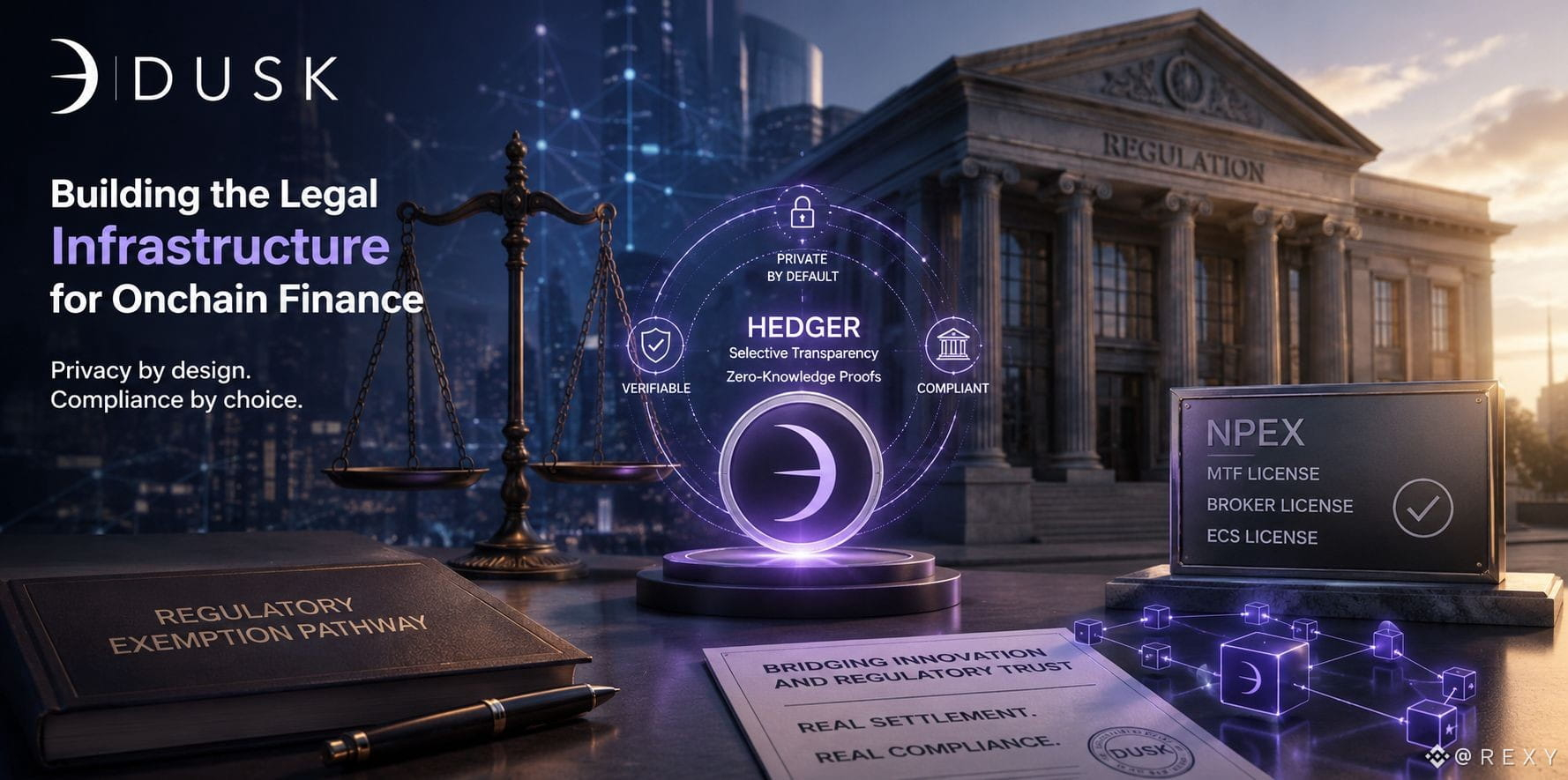
Most privacy projects ship the cryptography first and hope regulators eventually adapt to it. DUSK has spent real time on something far less exciting to talk about: pursuing an actual regulatory exemption pathway alongside its NPEX partnership in the Netherlands, where NPEX already holds an MTF license, a broker license, and an ECS license.
That distinction matters more than it sounds. Flawless zero-knowledge proofs don't make a chain usable for a regulated securities venue if there's no legal pathway for the settlement to be recognized in the first place. DUSK's Hedger component, which keeps transaction data opaque externally while letting authorized parties verify it, only becomes meaningful once a licensed entity is willing to plug it into real settlement flows.
That's a different kind of moat than throughput or proof size. A competitor can't copy it by shipping a similar feature next quarter, because it depends on legal groundwork and regulator relationships that take years, not sprints.
The tokenization narrative usually assumes cryptography is the hard part. I'd argue the harder part is getting a regulator to treat a blockchain settlement layer as equivalent to infrastructure they already trust. $DUSK is one of the few projects actually testing that assumption in production instead of in a whitepaper.
Is legal infrastructure a more durable edge than technical infrastructure, or does it just relocate the bottleneck to something slower to unblock?
@Dusk #dusk
$COW
$CYS
Most privacy projects ship the cryptography first and hope regulators eventually adapt to it. DUSK has spent real time on something far less exciting to talk about: pursuing an actual regulatory exemption pathway alongside its NPEX partnership in the Netherlands, where NPEX already holds an MTF license, a broker license, and an ECS license.
That distinction matters more than it sounds. Flawless zero-knowledge proofs don't make a chain usable for a regulated securities venue if there's no legal pathway for the settlement to be recognized in the first place. DUSK's Hedger component, which keeps transaction data opaque externally while letting authorized parties verify it, only becomes meaningful once a licensed entity is willing to plug it into real settlement flows.
That's a different kind of moat than throughput or proof size. A competitor can't copy it by shipping a similar feature next quarter, because it depends on legal groundwork and regulator relationships that take years, not sprints.
The tokenization narrative usually assumes cryptography is the hard part. I'd argue the harder part is getting a regulator to treat a blockchain settlement layer as equivalent to infrastructure they already trust. $DUSK is one of the few projects actually testing that assumption in production instead of in a whitepaper.
Is legal infrastructure a more durable edge than technical infrastructure, or does it just relocate the bottleneck to something slower to unblock?
@Dusk #dusk
$COW
$CYS
AnYYá
·
--
@Dusk #dusk $DUSK
The part of Dusk that actually made me pause wasn't the privacy layer. It was the licensing.
Dusk isn't just writing code and hoping regulators eventually catch up. It positioned itself to operate as a licensed settlement entity in the EU, which is a completely different strategy than most L1s take. Most projects build the chain first and treat compliance as a problem for later. Dusk seems to have reversed the order.
That changes the whole incentive structure. A regular L1 needs developers and liquidity first, regulation second. A chain built around licensed securities settlement needs the legal wrapper first, because without it, no institution can legally touch the asset regardless of how good the tech is. I found myself wondering if this is actually the harder path, even though it looks slower from the outside.
The trade-off is adoption speed versus adoption quality. Retail chains can bootstrap activity through incentives and speculation almost overnight. A settlement layer for regulated securities can't fake its way to relevance. Every integration requires actual legal review, actual custody agreements, actual institutional sign-off. That's a much smaller pool of potential users, but each one represents real capital, not mercenary liquidity that leaves the moment incentives dry up.
What I don't see discussed enough is developer incentive design here. Building confidential smart contracts for regulated assets is a niche skill set. Dusk has to attract a very specific kind of builder, not the general DeFi crowd chasing whatever chain has the highest yield this month.
Does a narrow, compliance-first developer base end up being a strength or a long-term bottleneck for network growth?
$AKE $VELVET
Biggest constraint on Dusk's growth?
The part of Dusk that actually made me pause wasn't the privacy layer. It was the licensing.
Dusk isn't just writing code and hoping regulators eventually catch up. It positioned itself to operate as a licensed settlement entity in the EU, which is a completely different strategy than most L1s take. Most projects build the chain first and treat compliance as a problem for later. Dusk seems to have reversed the order.
That changes the whole incentive structure. A regular L1 needs developers and liquidity first, regulation second. A chain built around licensed securities settlement needs the legal wrapper first, because without it, no institution can legally touch the asset regardless of how good the tech is. I found myself wondering if this is actually the harder path, even though it looks slower from the outside.
The trade-off is adoption speed versus adoption quality. Retail chains can bootstrap activity through incentives and speculation almost overnight. A settlement layer for regulated securities can't fake its way to relevance. Every integration requires actual legal review, actual custody agreements, actual institutional sign-off. That's a much smaller pool of potential users, but each one represents real capital, not mercenary liquidity that leaves the moment incentives dry up.
What I don't see discussed enough is developer incentive design here. Building confidential smart contracts for regulated assets is a niche skill set. Dusk has to attract a very specific kind of builder, not the general DeFi crowd chasing whatever chain has the highest yield this month.
Does a narrow, compliance-first developer base end up being a strength or a long-term bottleneck for network growth?
$AKE $VELVET
Biggest constraint on Dusk's growth?
I think most people evaluating @Dusk are asking the wrong question. They want to know if it's "the next privacy coin." It isn't trying to be one.
#dusk $DUSK
What struck me while going through the documentation is how much of the design is built around a problem nobody talks about: regulated finance can't run on fully transparent chains, but it also can't run on chains where privacy means anonymity from regulators too. Every transaction on a public blockchain exposes counterparties, balances, and trading strategy. That's fine for retail speculation. It's a dealbreaker for a bank issuing securities or a fund managing client positions.
Most privacy solutions solve this by hiding everything from everyone. Dusk's zero-knowledge architecture instead tries to let institutions prove compliance without revealing the underlying data. That's a narrower, harder problem, and I don't think it gets discussed enough compared to flashier privacy narratives.
The trade-off is obvious once you sit with it. Building for compliance means slower adoption, more legal groundwork, and less viral attention than a memecoin-adjacent L1. What surprised me is that this might actually be the point. Infrastructure aimed at institutions doesn't need Twitter hype cycles, it needs regulatory relationships and working pilots, which move on completely different timelines than retail sentiment.
The real risk isn't technical. It's whether real institutions actually migrate settlement infrastructure onto new rails, or whether they keep using blockchain as a marketing layer on top of legacy systems.
Curious how others read this. Does regulated on-chain finance actually need a purpose-built L1, or does it eventually get absorbed into general-purpose chains with better tooling?
$ACE $AKE
#dusk $DUSK
What struck me while going through the documentation is how much of the design is built around a problem nobody talks about: regulated finance can't run on fully transparent chains, but it also can't run on chains where privacy means anonymity from regulators too. Every transaction on a public blockchain exposes counterparties, balances, and trading strategy. That's fine for retail speculation. It's a dealbreaker for a bank issuing securities or a fund managing client positions.
Most privacy solutions solve this by hiding everything from everyone. Dusk's zero-knowledge architecture instead tries to let institutions prove compliance without revealing the underlying data. That's a narrower, harder problem, and I don't think it gets discussed enough compared to flashier privacy narratives.
The trade-off is obvious once you sit with it. Building for compliance means slower adoption, more legal groundwork, and less viral attention than a memecoin-adjacent L1. What surprised me is that this might actually be the point. Infrastructure aimed at institutions doesn't need Twitter hype cycles, it needs regulatory relationships and working pilots, which move on completely different timelines than retail sentiment.
The real risk isn't technical. It's whether real institutions actually migrate settlement infrastructure onto new rails, or whether they keep using blockchain as a marketing layer on top of legacy systems.
Curious how others read this. Does regulated on-chain finance actually need a purpose-built L1, or does it eventually get absorbed into general-purpose chains with better tooling?
$ACE $AKE
@Dusk $DUSK #dusk
I noticed something odd while reading through Dusk's recent updates: the project barely talks about price. Most of its announcements read like compliance filings, not crypto marketing. That's what pulled me in.
For years, privacy chains and regulated finance seemed incompatible. Regulators want visibility, users want confidentiality, and most blockchains pick one side. Dusk's answer, called Hedger, tries to hold both truths at once: transactions stay opaque to outsiders but remain provable to an authorized auditor when needed. I kept asking myself whether that's real innovation or just clever framing. The more I dug in, the more it looked like a genuine architectural bet, not a slogan.
What convinced me was DuskTrade, built with NPEX, a licensed Dutch exchange. Over €300 million in traditional securities have reportedly moved onto Dusk's rails there. That's not a testnet demo, it's regulated capital touching real infrastructure. Pairing that with DuskEVM, a Solidity-compatible execution layer, means existing Ethereum teams could theoretically plug into privacy-preserving settlement without rewriting their stack.
Still, I don't think this removes the risk. A January bridge exploit drained tokens through a compromised signing wallet, a reminder that even well-designed protocols inherit the weakest link in their surrounding infrastructure. And regulated finance moves slowly by nature. Institutional adoption isn't measured in market cycles, it's measured in years of legal groundwork.
What changed my thinking is this: Dusk isn't optimizing for retail attention, it's optimizing for institutional trust, which is a much harder, slower thing to build.
Do you think regulated-privacy chains like Dusk can actually outcompete general-purpose L1s for real-world assets, or does compliance-first design limit them to a niche forever?
$AKE $ACU
Dusk's regulated-privacy approach for RWAs —
I noticed something odd while reading through Dusk's recent updates: the project barely talks about price. Most of its announcements read like compliance filings, not crypto marketing. That's what pulled me in.
For years, privacy chains and regulated finance seemed incompatible. Regulators want visibility, users want confidentiality, and most blockchains pick one side. Dusk's answer, called Hedger, tries to hold both truths at once: transactions stay opaque to outsiders but remain provable to an authorized auditor when needed. I kept asking myself whether that's real innovation or just clever framing. The more I dug in, the more it looked like a genuine architectural bet, not a slogan.
What convinced me was DuskTrade, built with NPEX, a licensed Dutch exchange. Over €300 million in traditional securities have reportedly moved onto Dusk's rails there. That's not a testnet demo, it's regulated capital touching real infrastructure. Pairing that with DuskEVM, a Solidity-compatible execution layer, means existing Ethereum teams could theoretically plug into privacy-preserving settlement without rewriting their stack.
Still, I don't think this removes the risk. A January bridge exploit drained tokens through a compromised signing wallet, a reminder that even well-designed protocols inherit the weakest link in their surrounding infrastructure. And regulated finance moves slowly by nature. Institutional adoption isn't measured in market cycles, it's measured in years of legal groundwork.
What changed my thinking is this: Dusk isn't optimizing for retail attention, it's optimizing for institutional trust, which is a much harder, slower thing to build.
Do you think regulated-privacy chains like Dusk can actually outcompete general-purpose L1s for real-world assets, or does compliance-first design limit them to a niche forever?
$AKE $ACU
Dusk's regulated-privacy approach for RWAs —
Bullish
50%
Bearish
50%
Too early to tell
0%
2 votes • Voting closed
@BabylonLabs_io #baby
Someone in a dev group asked me yesterday why they'd bother building on a Bitcoin-security chain if it meant leaving their whole Ethereum toolkit behind — MetaMask, Solidity, everything they already know.
Fair question. And it turns out Babylon is answering it directly: adding EVM support alongside its existing CosmWasm environment, so it runs as a dual-VM chain instead of forcing developers to pick a lane.
That's a quieter kind of announcement — no price chart moves on "EVM compatibility." But it's the difference between Bitcoin security staying a niche feature and it actually becoming something builders default to, because they don't have to relearn their stack to use it.
I keep noticing this pattern with Babylon: the interesting updates aren't the loud ones. They're the ones that remove a reason not to build here.
What's a feature like that in crypto — unglamorous, but actually the thing that decided whether you used a protocol or not?
$BABY
$HEI
$BLESS
Someone in a dev group asked me yesterday why they'd bother building on a Bitcoin-security chain if it meant leaving their whole Ethereum toolkit behind — MetaMask, Solidity, everything they already know.
Fair question. And it turns out Babylon is answering it directly: adding EVM support alongside its existing CosmWasm environment, so it runs as a dual-VM chain instead of forcing developers to pick a lane.
That's a quieter kind of announcement — no price chart moves on "EVM compatibility." But it's the difference between Bitcoin security staying a niche feature and it actually becoming something builders default to, because they don't have to relearn their stack to use it.
I keep noticing this pattern with Babylon: the interesting updates aren't the loud ones. They're the ones that remove a reason not to build here.
What's a feature like that in crypto — unglamorous, but actually the thing that decided whether you used a protocol or not?
$BABY
$HEI
$BLESS
@BabylonLabs_io #baby $BABY
Bitcoin has spent seventeen years being the safest, laziest asset in finance. Trillions sitting there, fully secure, doing absolutely nothing for anyone but its holder. Babylon Labs is quietly ending that era, and most people are still evaluating it like a yield farm instead of what it actually is: a redistribution of Bitcoin's dormant security budget.
Here's the mental model that changed how I see it. Picture Bitcoin as a landlord who owns the most valuable building in the city but has never once rented out a room. Babylon doesn't ask the landlord to sell the building or hand over the keys. It builds a lease structure where the building's mere existence, its unforgeable scarcity, becomes collateral that other networks can borrow security from, while the landlord never leaves.
The detail most threads skip: a single BTC deposit can back multiple Bitcoin Supercharged Networks at once, coins never leaving Bitcoin's own chain, no wrapping, no bridging, no custody handoff. That's not incremental yield engineering. That's Bitcoin's security becoming an exportable primitive other chains inherit, the same way validators inherit stake risk, except the underlying asset never moves.
If dormant BTC can now underwrite consensus for entire ecosystems without touching a bridge, the real question isn't whether Babylon succeeds. It's whether "secure but idle" was ever a permanent feature of Bitcoin, or just a temporary limitation of the tooling around it.
What's really holding Bitcoin's capital back?
$BLESS
$HOME
Bitcoin has spent seventeen years being the safest, laziest asset in finance. Trillions sitting there, fully secure, doing absolutely nothing for anyone but its holder. Babylon Labs is quietly ending that era, and most people are still evaluating it like a yield farm instead of what it actually is: a redistribution of Bitcoin's dormant security budget.
Here's the mental model that changed how I see it. Picture Bitcoin as a landlord who owns the most valuable building in the city but has never once rented out a room. Babylon doesn't ask the landlord to sell the building or hand over the keys. It builds a lease structure where the building's mere existence, its unforgeable scarcity, becomes collateral that other networks can borrow security from, while the landlord never leaves.
The detail most threads skip: a single BTC deposit can back multiple Bitcoin Supercharged Networks at once, coins never leaving Bitcoin's own chain, no wrapping, no bridging, no custody handoff. That's not incremental yield engineering. That's Bitcoin's security becoming an exportable primitive other chains inherit, the same way validators inherit stake risk, except the underlying asset never moves.
If dormant BTC can now underwrite consensus for entire ecosystems without touching a bridge, the real question isn't whether Babylon succeeds. It's whether "secure but idle" was ever a permanent feature of Bitcoin, or just a temporary limitation of the tooling around it.
What's really holding Bitcoin's capital back?
$BLESS
$HOME
Lack of yield infrastructure
0%
Custodial trust concerns
100%
Regulatory uncertainty
0%
1 votes • Voting closed
@BabylonLabs_io $BABY #baby
I think most people evaluate Babylon as just another staking protocol, and that framing misses what's actually being solved.
Bitcoin has always had a strange problem. It's the most secure and most liquid asset in crypto, yet almost none of that security gets reused anywhere else. Ethereum's economic security backs its own validators and countless restaking protocols. Bitcoin's economic security backs nothing but itself. That's over a trillion dollars sitting idle from a security standpoint.
The reason nobody solved this earlier isn't laziness. It's that Bitcoin's scripting language deliberately avoids the kind of programmability that makes staking easy. You can't just write a smart contract that slashes BTC the way you would on an EVM chain. Babylon's actual contribution is a timestamping and slashing mechanism that works within Bitcoin's constraints instead of trying to bypass them with a wrapped token or custodian.
What surprised me most is how much of the design is about minimizing new trust assumptions rather than adding features. Staked BTC never leaves Bitcoin. There's no bridge, no synthetic asset, no multisig custodian holding user funds. The security comes from Bitcoin timestamps and a slashing condition enforced through cryptographic proofs, not from a committee's honesty.
The trade-off is real though. Finality assumptions and unbonding periods depend on how honestly the PoS chains being secured behave, and that layer is newer and less battle tested than Bitcoin itself. You're extending Bitcoin's security outward, but the chains receiving it still carry their own risk.
What part of this trust model do you think matters most as more chains plug into it?
$IDOL
$BLESS
I think most people evaluate Babylon as just another staking protocol, and that framing misses what's actually being solved.
Bitcoin has always had a strange problem. It's the most secure and most liquid asset in crypto, yet almost none of that security gets reused anywhere else. Ethereum's economic security backs its own validators and countless restaking protocols. Bitcoin's economic security backs nothing but itself. That's over a trillion dollars sitting idle from a security standpoint.
The reason nobody solved this earlier isn't laziness. It's that Bitcoin's scripting language deliberately avoids the kind of programmability that makes staking easy. You can't just write a smart contract that slashes BTC the way you would on an EVM chain. Babylon's actual contribution is a timestamping and slashing mechanism that works within Bitcoin's constraints instead of trying to bypass them with a wrapped token or custodian.
What surprised me most is how much of the design is about minimizing new trust assumptions rather than adding features. Staked BTC never leaves Bitcoin. There's no bridge, no synthetic asset, no multisig custodian holding user funds. The security comes from Bitcoin timestamps and a slashing condition enforced through cryptographic proofs, not from a committee's honesty.
The trade-off is real though. Finality assumptions and unbonding periods depend on how honestly the PoS chains being secured behave, and that layer is newer and less battle tested than Bitcoin itself. You're extending Bitcoin's security outward, but the chains receiving it still carry their own risk.
What part of this trust model do you think matters most as more chains plug into it?
$IDOL
$BLESS
Log in to explore more content