

浩哥加密日记
5.6k Posts

浩哥加密日记
Report
Block User
🔍公众号:浩哥看盘 🔍聊天室ID:haoge666 推特:@18816610Xue 合约精通,深耕市场多年,擅长从K线褶皱里洞悉脉络,只分享能落地的交易干货!
Occasional Trader
1 Years
16 Following
938 Followers
2.3K+ Liked
Posts
All
Quotes
·
--

Article
If you want the highest click-through and repost rates, choose the 1st or the 4th;This is an original post I rewrote from your own core of “run-for-your-life vs. trader.” The persona is a veteran crypto analyst blogger, plain-spoken with emotion. The similarity score has been reduced. It can be posted on the Binance Square, and the three tickers are also embedded. Take a look and tell me if it’s usable; if not, I’ll revise it.
(Don’t take the script for a comeback—fill the gaps in the market’s teeth)
I’ve been in this business a long time. I look more at people than at the candlestick chart.
Look at those traders who truly live long. Before placing an order, they can’t be bothered to guess, “Will it go up or not?” They only ask one question: is the payout worth it? Are the stop-loss levels actually set? Does the position let you sleep at night? Their relationship with the market is like doing business—extend the duration, scrape up small gains, and over a year the account climbs at a slant. Not exciting, but steady.
If you want the highest click-through and repost rates, choose the 1st or the 4th;
This is an original post I rewrote from your own core of “run-for-your-life vs. trader.” The persona is a veteran crypto analyst blogger, plain-spoken with emotion. The similarity score has been reduced. It can be posted on the Binance Square, and the three tickers are also embedded. Take a look and tell me if it’s usable; if not, I’ll revise it.
(Don’t take the script for a comeback—fill the gaps in the market’s teeth)
I’ve been in this business a long time. I look more at people than at the candlestick chart.
Look at those traders who truly live long. Before placing an order, they can’t be bothered to guess, “Will it go up or not?” They only ask one question: is the payout worth it? Are the stop-loss levels actually set? Does the position let you sleep at night? Their relationship with the market is like doing business—extend the duration, scrape up small gains, and over a year the account climbs at a slant. Not exciting, but steady.
(Don’t take the script for a comeback—fill the gaps in the market’s teeth)
I’ve been in this business a long time. I look more at people than at the candlestick chart.
Look at those traders who truly live long. Before placing an order, they can’t be bothered to guess, “Will it go up or not?” They only ask one question: is the payout worth it? Are the stop-loss levels actually set? Does the position let you sleep at night? Their relationship with the market is like doing business—extend the duration, scrape up small gains, and over a year the account climbs at a slant. Not exciting, but steady.
1
351
·
--

Article
Being alone is also pretty good, but the market won’t coddle youTo be honest, lately I’ve chatted with quite a few friends and noticed an interesting phenomenon—
More and more of my female friends tell me they feel men are optional.
It’s not that I don’t want someone to rely on. It’s just that as I walked along, I realized many men aren’t reliable at all—instead, they become a burden.
No arguments, no betrayal, no tears. Sometimes you might feel a bit lonely, but at least it’s peaceful.
Tired of cooking, too lazy to clean—money is earned and spent on your own, no need to look at anyone’s mood, and no need to force yourself to accommodate everyone.
After I finished listening, I laughed a bit and said: Your current state is kind of similar to how it is when I trade.
When I first entered this circle, I always felt I needed to find a “big shot” to guide me—following a certain teacher, a specific signal group—hoping someone else would point me in the right direction.
Being alone is also pretty good, but the market won’t coddle you
To be honest, lately I’ve chatted with quite a few friends and noticed an interesting phenomenon—
More and more of my female friends tell me they feel men are optional.
It’s not that I don’t want someone to rely on. It’s just that as I walked along, I realized many men aren’t reliable at all—instead, they become a burden.
No arguments, no betrayal, no tears. Sometimes you might feel a bit lonely, but at least it’s peaceful.
Tired of cooking, too lazy to clean—money is earned and spent on your own, no need to look at anyone’s mood, and no need to force yourself to accommodate everyone.
After I finished listening, I laughed a bit and said: Your current state is kind of similar to how it is when I trade.
When I first entered this circle, I always felt I needed to find a “big shot” to guide me—following a certain teacher, a specific signal group—hoping someone else would point me in the right direction.
More and more of my female friends tell me they feel men are optional.
It’s not that I don’t want someone to rely on. It’s just that as I walked along, I realized many men aren’t reliable at all—instead, they become a burden.
No arguments, no betrayal, no tears. Sometimes you might feel a bit lonely, but at least it’s peaceful.
Tired of cooking, too lazy to clean—money is earned and spent on your own, no need to look at anyone’s mood, and no need to force yourself to accommodate everyone.
After I finished listening, I laughed a bit and said: Your current state is kind of similar to how it is when I trade.
When I first entered this circle, I always felt I needed to find a “big shot” to guide me—following a certain teacher, a specific signal group—hoping someone else would point me in the right direction.
1
95
·
--
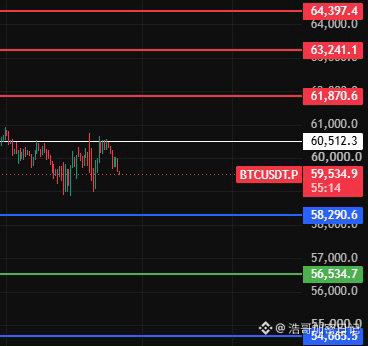
$BTC 2026-6-30 Market Overview Today: For BTC today, keep an eye on the 60,500 level. Only if the 4-hour timeframe closes above this level with upward momentum is it more likely to continue. Look for short entries near the levels 61,870–63,240–64,400.
If today’s 4-hour rebound cannot break above the 60,500 level, that suggests the rebound lacks strength. Then first look for a drop toward around 58,300. If it doesn’t break below (on a smaller timeframe), it is still likely to rebound. If it breaks, then go long near 56,500–54,600–52,500.
#BTC走势分析
【Daily Needle Pin Point Levels: Long/Short ideas are for reference only. Manage your position size. If trading with light leverage, use about 0.5% position size. At resistance or support levels, split orders and allocate only 1% per level. Place limit orders at each price with 100x leverage; do not exceed 2% of total position size, so you leave room to add to your position. If your position is heavy, use the previous high/low on the 1-hour or 2-hour swing as your stop-loss, or use a fixed stop-loss. For BTC, it’s around 1500 USDT; for ETH, around 30 USDT. If you still don’t know how to trade, or you don’t know how to choose coins, how to enter, or how to set take-profit/stop-loss, follow @Square-Creator-e8bd5958e9473 . As long as you’re willing to execute according to the plan and not mess around, I’ll accompany you and move forward steadily—slowly rolling small capital into larger amounts!】
$BTC 2026-6-30 Market Overview Today: For BTC today, keep an eye on the 60,500 level. Only if the 4-hour timeframe closes above this level with upward momentum is it more likely to continue. Look for short entries near the levels 61,870–63,240–64,400.
If today’s 4-hour rebound cannot break above the 60,500 level, that suggests the rebound lacks strength. Then first look for a drop toward around 58,300. If it doesn’t break below (on a smaller timeframe), it is still likely to rebound. If it breaks, then go long near 56,500–54,600–52,500.
#BTC走势分析
【Daily Needle Pin Point Levels: Long/Short ideas are for reference only. Manage your position size. If trading with light leverage, use about 0.5% position size. At resistance or support levels, split orders and allocate only 1% per level. Place limit orders at each price with 100x leverage; do not exceed 2% of total position size, so you leave room to add to your position. If your position is heavy, use the previous high/low on the 1-hour or 2-hour swing as your stop-loss, or use a fixed stop-loss. For BTC, it’s around 1500 USDT; for ETH, around 30 USDT. If you still don’t know how to trade, or you don’t know how to choose coins, how to enter, or how to set take-profit/stop-loss, follow @浩哥加密日记 . As long as you’re willing to execute according to the plan and not mess around, I’ll accompany you and move forward steadily—slowly rolling small capital into larger amounts!】
If today’s 4-hour rebound cannot break above the 60,500 level, that suggests the rebound lacks strength. Then first look for a drop toward around 58,300. If it doesn’t break below (on a smaller timeframe), it is still likely to rebound. If it breaks, then go long near 56,500–54,600–52,500.
#BTC走势分析
【Daily Needle Pin Point Levels: Long/Short ideas are for reference only. Manage your position size. If trading with light leverage, use about 0.5% position size. At resistance or support levels, split orders and allocate only 1% per level. Place limit orders at each price with 100x leverage; do not exceed 2% of total position size, so you leave room to add to your position. If your position is heavy, use the previous high/low on the 1-hour or 2-hour swing as your stop-loss, or use a fixed stop-loss. For BTC, it’s around 1500 USDT; for ETH, around 30 USDT. If you still don’t know how to trade, or you don’t know how to choose coins, how to enter, or how to set take-profit/stop-loss, follow @浩哥加密日记 . As long as you’re willing to execute according to the plan and not mess around, I’ll accompany you and move forward steadily—slowly rolling small capital into larger amounts!】
227
·
--
It's about making U for life, not just making U for a lifetime❗️
Started trading at 25, and now at 33, that’s a solid 8 years.
2021-2022 were my turning points; my account first hit 8 figures. #CryptoRich
$2000 a night for a hotel, didn’t even blink. Decked out in crypto symbols.
Our generation can afford the premium, it's all about efficiency. No need to grind through the supply chain or chase receivables. My time is reserved for high-value battlegrounds.
People often ask me: what's the secret to trading crypto? $BICO
After some thought, it’s really simple—mindset first, skills second.
Over the years, I’ve figured out some “mental strategies,” sharing them with my fellow traders:
BTC+ is always the boss. If you want to be in the game, you gotta keep an eye on it. If it pumps, altcoins have a shot; if it dumps, the little guys follow suit. Occasionally ETH+ might make its own moves, but don’t expect altcoins to hold up against the market.
BTC and USDT+ are like a seesaw. Remember this: if USDT pumps, be cautious with Bitcoin; if Bitcoin is on a tear, stash some USDT for safety.
Two key timeframes:
Midnight to 1 AM, watch out for “wicking,” placing orders before bed can often snag you some free gains; $BTC
Morning from 6 to 8 AM, it’s a bellwether for the day’s trend:
If it dips in the early hours, and those two hours still drop, just close your eyes and DCA, there’s a high chance it’ll bounce back that day;
If it pumps in the early hours, and those two hours keep climbing, better run, it’s likely to drop later. $BOME
5 PM, don’t lose focus. Due to time zone differences, US money is just entering the market, so big volatility is likely.
“Black Friday+”? Don’t be too superstitious. Fridays have dropped, but they’ve also pumped and ranged; it’s really all about the news.
The most practical advice:
As long as it’s not a shitcoin and has trading volume, if it dips, don’t panic. In three to five days, or a month, it’ll often come back.
If you have spare cash, add to your position in batches to lower your cost; if you’re strapped for cash, just hold tight, it’s usually not a big issue.
My proudest trade: got in at 0.085 for Dogecoin, held on through thick and thin, and it’s up over 20x now.
It’s proven: in crypto, it’s all about patience in the end.
It's about making U for life, not just making U for a lifetime❗️
Started trading at 25, and now at 33, that’s a solid 8 years.
2021-2022 were my turning points; my account first hit 8 figures. #CryptoRich
$2000 a night for a hotel, didn’t even blink. Decked out in crypto symbols.
Our generation can afford the premium, it's all about efficiency. No need to grind through the supply chain or chase receivables. My time is reserved for high-value battlegrounds.
People often ask me: what's the secret to trading crypto? $BICO
After some thought, it’s really simple—mindset first, skills second.
Over the years, I’ve figured out some “mental strategies,” sharing them with my fellow traders:
BTC+ is always the boss. If you want to be in the game, you gotta keep an eye on it. If it pumps, altcoins have a shot; if it dumps, the little guys follow suit. Occasionally ETH+ might make its own moves, but don’t expect altcoins to hold up against the market.
BTC and USDT+ are like a seesaw. Remember this: if USDT pumps, be cautious with Bitcoin; if Bitcoin is on a tear, stash some USDT for safety.
Two key timeframes:
Midnight to 1 AM, watch out for “wicking,” placing orders before bed can often snag you some free gains; $BTC
Morning from 6 to 8 AM, it’s a bellwether for the day’s trend:
If it dips in the early hours, and those two hours still drop, just close your eyes and DCA, there’s a high chance it’ll bounce back that day;
If it pumps in the early hours, and those two hours keep climbing, better run, it’s likely to drop later. $BOME
5 PM, don’t lose focus. Due to time zone differences, US money is just entering the market, so big volatility is likely.
“Black Friday+”? Don’t be too superstitious. Fridays have dropped, but they’ve also pumped and ranged; it’s really all about the news.
The most practical advice:
As long as it’s not a shitcoin and has trading volume, if it dips, don’t panic. In three to five days, or a month, it’ll often come back.
If you have spare cash, add to your position in batches to lower your cost; if you’re strapped for cash, just hold tight, it’s usually not a big issue.
My proudest trade: got in at 0.085 for Dogecoin, held on through thick and thin, and it’s up over 20x now.
It’s proven: in crypto, it’s all about patience in the end.
Started trading at 25, and now at 33, that’s a solid 8 years.
2021-2022 were my turning points; my account first hit 8 figures. #CryptoRich
$2000 a night for a hotel, didn’t even blink. Decked out in crypto symbols.
Our generation can afford the premium, it's all about efficiency. No need to grind through the supply chain or chase receivables. My time is reserved for high-value battlegrounds.
People often ask me: what's the secret to trading crypto? $BICO
After some thought, it’s really simple—mindset first, skills second.
Over the years, I’ve figured out some “mental strategies,” sharing them with my fellow traders:
BTC+ is always the boss. If you want to be in the game, you gotta keep an eye on it. If it pumps, altcoins have a shot; if it dumps, the little guys follow suit. Occasionally ETH+ might make its own moves, but don’t expect altcoins to hold up against the market.
BTC and USDT+ are like a seesaw. Remember this: if USDT pumps, be cautious with Bitcoin; if Bitcoin is on a tear, stash some USDT for safety.
Two key timeframes:
Midnight to 1 AM, watch out for “wicking,” placing orders before bed can often snag you some free gains; $BTC
Morning from 6 to 8 AM, it’s a bellwether for the day’s trend:
If it dips in the early hours, and those two hours still drop, just close your eyes and DCA, there’s a high chance it’ll bounce back that day;
If it pumps in the early hours, and those two hours keep climbing, better run, it’s likely to drop later. $BOME
5 PM, don’t lose focus. Due to time zone differences, US money is just entering the market, so big volatility is likely.
“Black Friday+”? Don’t be too superstitious. Fridays have dropped, but they’ve also pumped and ranged; it’s really all about the news.
The most practical advice:
As long as it’s not a shitcoin and has trading volume, if it dips, don’t panic. In three to five days, or a month, it’ll often come back.
If you have spare cash, add to your position in batches to lower your cost; if you’re strapped for cash, just hold tight, it’s usually not a big issue.
My proudest trade: got in at 0.085 for Dogecoin, held on through thick and thin, and it’s up over 20x now.
It’s proven: in crypto, it’s all about patience in the end.


41
·
--
If you don’t have under 5,000 USDT to spare, don’t go messing with those flashy operations. Let me tell you something straight from Haoge: the real things that can keep you alive and gradually grow your capital are actually the following four “stupid methods.” #币圈生存法则
Many of my followers started from a five-figure account and reached seven figures—not by luck, but by discipline. The method is simple. The simpler it is, the easier it is to stick to, and the more thoroughly you can execute.
Step one: when choosing coins, look at only one signal—daily MACD golden cross. Ideally, it should appear above the zero line. Technical indicators are more reliable than any news. Don’t get distracted by market noise.
Step two: when trading, follow only one line—the daily moving average line. If the price is above the line, hold it. If it’s below the line, leave. The moment price breaks the line, exit the next second—this is a hard rule, not a suggestion. $BTC
Step three: for entries and exits, capture two points—price + volume. When the price stands above the moving average and the trading volume surges to break through, then follow in with full position. For take-profit, keep the rules: after a 40% rise, sell part; after an 80% rise, sell the rest; if the price falls below the moving average, clear out everything. Don’t ask why—just do it. $BICO
Step four: stop-loss is one sentence: if the closing price falls below the moving average, you leave the next day no matter what. One lucky break can wipe out all your profits. Missing out isn’t scary. Wait for the price to stand back above the moving average, then buy again.
This method is “stupid,” but retail traders can execute it best—and it’s the least likely to get you eliminated. Just like that earlier PIPPIN move: once the signal came out, you followed decisively and easily captured a big chunk of profit. #加密市场回调
The crypto market is never short of opportunities. What’s missing is clear, simple trading discipline. If you still don’t know how to choose coins, build positions, and set take-profit/stop-loss, follow Haoge—I’ll keep you executing according to the plan. Don’t mess around. Grow small capital steadily. #币圈暴富
If you don’t have under 5,000 USDT to spare, don’t go messing with those flashy operations. Let me tell you something straight from Haoge: the real things that can keep you alive and gradually grow your capital are actually the following four “stupid methods.” #币圈生存法则
Many of my followers started from a five-figure account and reached seven figures—not by luck, but by discipline. The method is simple. The simpler it is, the easier it is to stick to, and the more thoroughly you can execute.
Step one: when choosing coins, look at only one signal—daily MACD golden cross. Ideally, it should appear above the zero line. Technical indicators are more reliable than any news. Don’t get distracted by market noise.
Step two: when trading, follow only one line—the daily moving average line. If the price is above the line, hold it. If it’s below the line, leave. The moment price breaks the line, exit the next second—this is a hard rule, not a suggestion. $BTC
Step three: for entries and exits, capture two points—price + volume. When the price stands above the moving average and the trading volume surges to break through, then follow in with full position. For take-profit, keep the rules: after a 40% rise, sell part; after an 80% rise, sell the rest; if the price falls below the moving average, clear out everything. Don’t ask why—just do it. $BICO
Step four: stop-loss is one sentence: if the closing price falls below the moving average, you leave the next day no matter what. One lucky break can wipe out all your profits. Missing out isn’t scary. Wait for the price to stand back above the moving average, then buy again.
This method is “stupid,” but retail traders can execute it best—and it’s the least likely to get you eliminated. Just like that earlier PIPPIN move: once the signal came out, you followed decisively and easily captured a big chunk of profit. #加密市场回调
The crypto market is never short of opportunities. What’s missing is clear, simple trading discipline. If you still don’t know how to choose coins, build positions, and set take-profit/stop-loss, follow Haoge—I’ll keep you executing according to the plan. Don’t mess around. Grow small capital steadily. #币圈暴富
Many of my followers started from a five-figure account and reached seven figures—not by luck, but by discipline. The method is simple. The simpler it is, the easier it is to stick to, and the more thoroughly you can execute.
Step one: when choosing coins, look at only one signal—daily MACD golden cross. Ideally, it should appear above the zero line. Technical indicators are more reliable than any news. Don’t get distracted by market noise.
Step two: when trading, follow only one line—the daily moving average line. If the price is above the line, hold it. If it’s below the line, leave. The moment price breaks the line, exit the next second—this is a hard rule, not a suggestion. $BTC
Step three: for entries and exits, capture two points—price + volume. When the price stands above the moving average and the trading volume surges to break through, then follow in with full position. For take-profit, keep the rules: after a 40% rise, sell part; after an 80% rise, sell the rest; if the price falls below the moving average, clear out everything. Don’t ask why—just do it. $BICO
Step four: stop-loss is one sentence: if the closing price falls below the moving average, you leave the next day no matter what. One lucky break can wipe out all your profits. Missing out isn’t scary. Wait for the price to stand back above the moving average, then buy again.
This method is “stupid,” but retail traders can execute it best—and it’s the least likely to get you eliminated. Just like that earlier PIPPIN move: once the signal came out, you followed decisively and easily captured a big chunk of profit. #加密市场回调
The crypto market is never short of opportunities. What’s missing is clear, simple trading discipline. If you still don’t know how to choose coins, build positions, and set take-profit/stop-loss, follow Haoge—I’ll keep you executing according to the plan. Don’t mess around. Grow small capital steadily. #币圈暴富


126
·
--
A # crypto-currency newcomer with less than 600U in trading capital—listen to D0’er’s honest words: don’t rush into trades yet.
Crypto isn’t a place to bet on up and down moves; it’s a strategy game. The less capital you have, the more you need to engrave “stability” into your mind—like an old hunter, stay calm and patient.
$BICO
I once helped a friend. He started with 500U. When placing orders, his hands were shaking—he was scared that one wrong move would wipe him out. I told him: don’t panic. Follow discipline. Even with a small account, you can still grow it.
Guess what happened? In one month, his account reached 5,000U; in three months, it surged to 18,000U—no liquidation throughout.
Some people say it was luck. I’ll tell you the truth—it was only three unbreakable iron rules.
First rule: split your money into three parts and keep a way out
150U for intraday—only watch Bitcoin and Ethereum, exit when volatility moves 3–5%, and don’t be greedy;
150U for swing trades—wait for clear signals before acting, and hold for about 3–5 days for stability;
The remaining 200U is your ace card—don’t touch it even if the sky falls.
People who go all-in at once get swept away when it rises or panic when it dips. They can’t go far. Real winners understand leaving money on the sidelines—that’s the confidence to turn things around.
Second rule: follow the trend, don’t waste time in choppy ranges
The market is in consolidation about 70% of the time. If you’re trading in it every day, you’re basically paying the exchange’s fees. Wait when there’s no signal—don’t get itchy. When the trend appears, be decisive.
Take out half the profit once you’ve made 12%—securing gains is the real way.
Experts are always like: “do nothing unless the time is right; once you move, you hit.” When my friend doubled his account, he never chased the rally in a rush. You think that’s being timid? No—that’s what someone learns from having been burned.
Third rule: set the rules and control your hands
Here are three red lines—memorize them:
· If a single trade loses 2%, you’re out—no hesitation for even a second
· If you gain 4% or more, cut your position by half first, and let the rest run
You don’t need to be right about every market moment, but you must follow every rule.
Making money, plain and simple, is using a system to restrain those fragile emotions in you.
Lastly, let me tell you what’s on my mind: having little capital isn’t scary. What’s scary is having your whole brain focused on “one-shot to flip the game.”
From 500U to 18,000U isn’t luck—it’s rules, patience, and discipline that doesn’t break. Do it this way, and you can turn from someone who only keeps sending money into the market… into someone who truly takes profit #合约带单
A # crypto-currency newcomer with less than 600U in trading capital—listen to D0’er’s honest words: don’t rush into trades yet.
Crypto isn’t a place to bet on up and down moves; it’s a strategy game. The less capital you have, the more you need to engrave “stability” into your mind—like an old hunter, stay calm and patient.
$BICO
I once helped a friend. He started with 500U. When placing orders, his hands were shaking—he was scared that one wrong move would wipe him out. I told him: don’t panic. Follow discipline. Even with a small account, you can still grow it.
Guess what happened? In one month, his account reached 5,000U; in three months, it surged to 18,000U—no liquidation throughout.
Some people say it was luck. I’ll tell you the truth—it was only three unbreakable iron rules.
First rule: split your money into three parts and keep a way out
150U for intraday—only watch Bitcoin and Ethereum, exit when volatility moves 3–5%, and don’t be greedy;
150U for swing trades—wait for clear signals before acting, and hold for about 3–5 days for stability;
The remaining 200U is your ace card—don’t touch it even if the sky falls.
People who go all-in at once get swept away when it rises or panic when it dips. They can’t go far. Real winners understand leaving money on the sidelines—that’s the confidence to turn things around.
Second rule: follow the trend, don’t waste time in choppy ranges
The market is in consolidation about 70% of the time. If you’re trading in it every day, you’re basically paying the exchange’s fees. Wait when there’s no signal—don’t get itchy. When the trend appears, be decisive.
Take out half the profit once you’ve made 12%—securing gains is the real way.
Experts are always like: “do nothing unless the time is right; once you move, you hit.” When my friend doubled his account, he never chased the rally in a rush. You think that’s being timid? No—that’s what someone learns from having been burned.
Third rule: set the rules and control your hands
Here are three red lines—memorize them:
· If a single trade loses 2%, you’re out—no hesitation for even a second
· If you gain 4% or more, cut your position by half first, and let the rest run
You don’t need to be right about every market moment, but you must follow every rule.
Making money, plain and simple, is using a system to restrain those fragile emotions in you.
Lastly, let me tell you what’s on my mind: having little capital isn’t scary. What’s scary is having your whole brain focused on “one-shot to flip the game.”
From 500U to 18,000U isn’t luck—it’s rules, patience, and discipline that doesn’t break. Do it this way, and you can turn from someone who only keeps sending money into the market… into someone who truly takes profit #合约带单
Crypto isn’t a place to bet on up and down moves; it’s a strategy game. The less capital you have, the more you need to engrave “stability” into your mind—like an old hunter, stay calm and patient.
$BICO
I once helped a friend. He started with 500U. When placing orders, his hands were shaking—he was scared that one wrong move would wipe him out. I told him: don’t panic. Follow discipline. Even with a small account, you can still grow it.
Guess what happened? In one month, his account reached 5,000U; in three months, it surged to 18,000U—no liquidation throughout.
Some people say it was luck. I’ll tell you the truth—it was only three unbreakable iron rules.
First rule: split your money into three parts and keep a way out
150U for intraday—only watch Bitcoin and Ethereum, exit when volatility moves 3–5%, and don’t be greedy;
150U for swing trades—wait for clear signals before acting, and hold for about 3–5 days for stability;
The remaining 200U is your ace card—don’t touch it even if the sky falls.
People who go all-in at once get swept away when it rises or panic when it dips. They can’t go far. Real winners understand leaving money on the sidelines—that’s the confidence to turn things around.
Second rule: follow the trend, don’t waste time in choppy ranges
The market is in consolidation about 70% of the time. If you’re trading in it every day, you’re basically paying the exchange’s fees. Wait when there’s no signal—don’t get itchy. When the trend appears, be decisive.
Take out half the profit once you’ve made 12%—securing gains is the real way.
Experts are always like: “do nothing unless the time is right; once you move, you hit.” When my friend doubled his account, he never chased the rally in a rush. You think that’s being timid? No—that’s what someone learns from having been burned.
Third rule: set the rules and control your hands
Here are three red lines—memorize them:
· If a single trade loses 2%, you’re out—no hesitation for even a second
· If you gain 4% or more, cut your position by half first, and let the rest run
You don’t need to be right about every market moment, but you must follow every rule.
Making money, plain and simple, is using a system to restrain those fragile emotions in you.
Lastly, let me tell you what’s on my mind: having little capital isn’t scary. What’s scary is having your whole brain focused on “one-shot to flip the game.”
From 500U to 18,000U isn’t luck—it’s rules, patience, and discipline that doesn’t break. Do it this way, and you can turn from someone who only keeps sending money into the market… into someone who truly takes profit #合约带单


28
·
--
A lot of folks ask me, 'Hey, Hao Ge, how are you able to travel everywhere and live freely? Your capital must be huge, right?'
$BinanceLife
I always smile and say, 'Nope, I started with just 2000 bucks and even dipped down to only 1000.'
Like all the newbies diving into crypto, I was dreaming of 'getting rich overnight'—chasing pumps and dumps, using high leverage, and going all-in on altcoins until my account was nearly zeroed out.
It was during one sleepless night that I truly woke up: the crypto space isn’t a casino; to survive and profit, you’ve got to understand the rules.
I condensed the lessons learned from that loss into six survival rules, and it’s thanks to these that I bounced back from 1000 bucks and rolled into my first pot of gold:
#CryptoSurvivalRules
① Rapid rises and slow declines often mean accumulation of $BICO.
If it pumps and doesn’t dump right away, and the retracement is on low volume, it’s likely just a shakeout. Keep your cool; the real market action is usually still ahead.
② Sharp drops are hard to bounce back from; beware of distributing.
If there's a rebound after a crash but it’s weak, it signifies low buying interest. Don’t daydream; exit decisively.
③ High volume at the top isn’t necessarily a peak, but low volume at highs means you should exit.
Volume spikes might indicate new funds entering, and if the trend isn't broken, you can hold; but if there's low volume on the rise, it’s usually a signal to leave.
④ Volume at the bottom needs a second confirmation.
One volume spike isn’t enough to declare a reversal; consistent gentle increases in volume are a reliable sign of funds entering.
⑤ Emotions are hidden in the volume.
Don’t just trust technical indicators. Volume is the thermometer for market sentiment—where the sentiment is, the market will follow.
⑥ Cultivate a 'calm mind.'
Don’t be greedy or fearful, don’t rush or fidget; those who can learn to sit on the sidelines and wait are the true long-term winners in this market.
Real talk for small capital:
Split your capital into 10 parts; use one part each time with 3x leverage, and only trade mainstream coins.
Take profits first; lock your capital and don’t touch it.
Roll slowly and steadily.
In trading, you’ll find that your true enemy is never the news or the policies, but your own mindset.
Follow Hao Ge—no bragging, no fairy tales, just sharing real experiences that can help you survive in the market. There are still spots in the squad; whether you join is up to you? #加密市场观察
A lot of folks ask me, 'Hey, Hao Ge, how are you able to travel everywhere and live freely? Your capital must be huge, right?'
$BinanceLife
I always smile and say, 'Nope, I started with just 2000 bucks and even dipped down to only 1000.'
Like all the newbies diving into crypto, I was dreaming of 'getting rich overnight'—chasing pumps and dumps, using high leverage, and going all-in on altcoins until my account was nearly zeroed out.
It was during one sleepless night that I truly woke up: the crypto space isn’t a casino; to survive and profit, you’ve got to understand the rules.
I condensed the lessons learned from that loss into six survival rules, and it’s thanks to these that I bounced back from 1000 bucks and rolled into my first pot of gold:
#CryptoSurvivalRules
① Rapid rises and slow declines often mean accumulation of $BICO .
If it pumps and doesn’t dump right away, and the retracement is on low volume, it’s likely just a shakeout. Keep your cool; the real market action is usually still ahead.
② Sharp drops are hard to bounce back from; beware of distributing.
If there's a rebound after a crash but it’s weak, it signifies low buying interest. Don’t daydream; exit decisively.
③ High volume at the top isn’t necessarily a peak, but low volume at highs means you should exit.
Volume spikes might indicate new funds entering, and if the trend isn't broken, you can hold; but if there's low volume on the rise, it’s usually a signal to leave.
④ Volume at the bottom needs a second confirmation.
One volume spike isn’t enough to declare a reversal; consistent gentle increases in volume are a reliable sign of funds entering.
⑤ Emotions are hidden in the volume.
Don’t just trust technical indicators. Volume is the thermometer for market sentiment—where the sentiment is, the market will follow.
⑥ Cultivate a 'calm mind.'
Don’t be greedy or fearful, don’t rush or fidget; those who can learn to sit on the sidelines and wait are the true long-term winners in this market.
Real talk for small capital:
Split your capital into 10 parts; use one part each time with 3x leverage, and only trade mainstream coins.
Take profits first; lock your capital and don’t touch it.
Roll slowly and steadily.
In trading, you’ll find that your true enemy is never the news or the policies, but your own mindset.
Follow Hao Ge—no bragging, no fairy tales, just sharing real experiences that can help you survive in the market. There are still spots in the squad; whether you join is up to you? #加密市场观察
$BinanceLife
I always smile and say, 'Nope, I started with just 2000 bucks and even dipped down to only 1000.'
Like all the newbies diving into crypto, I was dreaming of 'getting rich overnight'—chasing pumps and dumps, using high leverage, and going all-in on altcoins until my account was nearly zeroed out.
It was during one sleepless night that I truly woke up: the crypto space isn’t a casino; to survive and profit, you’ve got to understand the rules.
I condensed the lessons learned from that loss into six survival rules, and it’s thanks to these that I bounced back from 1000 bucks and rolled into my first pot of gold:
#CryptoSurvivalRules
① Rapid rises and slow declines often mean accumulation of $BICO .
If it pumps and doesn’t dump right away, and the retracement is on low volume, it’s likely just a shakeout. Keep your cool; the real market action is usually still ahead.
② Sharp drops are hard to bounce back from; beware of distributing.
If there's a rebound after a crash but it’s weak, it signifies low buying interest. Don’t daydream; exit decisively.
③ High volume at the top isn’t necessarily a peak, but low volume at highs means you should exit.
Volume spikes might indicate new funds entering, and if the trend isn't broken, you can hold; but if there's low volume on the rise, it’s usually a signal to leave.
④ Volume at the bottom needs a second confirmation.
One volume spike isn’t enough to declare a reversal; consistent gentle increases in volume are a reliable sign of funds entering.
⑤ Emotions are hidden in the volume.
Don’t just trust technical indicators. Volume is the thermometer for market sentiment—where the sentiment is, the market will follow.
⑥ Cultivate a 'calm mind.'
Don’t be greedy or fearful, don’t rush or fidget; those who can learn to sit on the sidelines and wait are the true long-term winners in this market.
Real talk for small capital:
Split your capital into 10 parts; use one part each time with 3x leverage, and only trade mainstream coins.
Take profits first; lock your capital and don’t touch it.
Roll slowly and steadily.
In trading, you’ll find that your true enemy is never the news or the policies, but your own mindset.
Follow Hao Ge—no bragging, no fairy tales, just sharing real experiences that can help you survive in the market. There are still spots in the squad; whether you join is up to you? #加密市场观察


113
·
--
If you've been trading crypto for over a year and haven't hit a million yet, check this out and hit up Dore at #新手感言 . I've been trading for eight years and have raked in over 10 million. Today, I’m sharing ten key lessons from all the pitfalls, blown accounts, and blood I’ve spilled on my journey to financial freedom:
1. If your capital is small (like under 10k), don’t always think about going all in. Just catching one major bull run a year is enough. Before the market shows up, patience is your strongest weapon. $BTC
2. You can never earn more than your understanding. Before hitting the live market, practice your mindset and courage with a demo account. A demo lets you fail as many times as you want, but one big mistake in the real market can kick you out. $SYN
3. Remember: good news becoming real is bad news. If major positive news drops and you haven’t sold on the day, if it opens high the next day, it’s wise to sell quickly, or you could get trapped.
4. Always be cautious during holidays. History has shown time and again that reducing your holdings or even going flat before a holiday is the smart move; “Holidays always drop” isn’t just talk. $BOME
5. The essence of medium to long-term trading is keeping enough cash, selling high and buying low, and rolling your positions. Don’t think you can ride the whole wave; that’s a game for the whales, not something retail traders should dream about.
6. For short-term trades, only pick coins with active volume and significant price swings. Avoid inactive ones; they just waste your time and wear down your mindset.
7. If the market is slowly declining, rebounds will be frustrating; but if the drop accelerates, rebounds often come quicker. Timing is crucial.
8. If you make a bad buy, own up to it and cut your losses immediately. As long as your capital is intact, opportunities will always be there—that’s the essence of survival.
9. If you're day trading, definitely pay attention to the 15-minute candlestick charts along with the KDJ indicator; it can help you find plenty of golden entry and exit points.
10. There are countless trading techniques out there; you don’t need to master them all. Being skilled in one or two methods is enough; the key is to perfect them!
Each of these ten tips is a lesson I learned with real money. Avoiding mistakes is already a way to profit. If you’re still lost, why not reach out to Dore? Hao can help you break free from your struggles!
Follow Hao; he doesn’t boast or make empty promises, just shares practical experiences that help you survive in the space. The team still has spots open; whether you join or not is up to you. #加密市场观察
If you've been trading crypto for over a year and haven't hit a million yet, check this out and hit up Dore at #新手感言 . I've been trading for eight years and have raked in over 10 million. Today, I’m sharing ten key lessons from all the pitfalls, blown accounts, and blood I’ve spilled on my journey to financial freedom:
1. If your capital is small (like under 10k), don’t always think about going all in. Just catching one major bull run a year is enough. Before the market shows up, patience is your strongest weapon. $BTC
2. You can never earn more than your understanding. Before hitting the live market, practice your mindset and courage with a demo account. A demo lets you fail as many times as you want, but one big mistake in the real market can kick you out. $SYN
3. Remember: good news becoming real is bad news. If major positive news drops and you haven’t sold on the day, if it opens high the next day, it’s wise to sell quickly, or you could get trapped.
4. Always be cautious during holidays. History has shown time and again that reducing your holdings or even going flat before a holiday is the smart move; “Holidays always drop” isn’t just talk. $BOME
5. The essence of medium to long-term trading is keeping enough cash, selling high and buying low, and rolling your positions. Don’t think you can ride the whole wave; that’s a game for the whales, not something retail traders should dream about.
6. For short-term trades, only pick coins with active volume and significant price swings. Avoid inactive ones; they just waste your time and wear down your mindset.
7. If the market is slowly declining, rebounds will be frustrating; but if the drop accelerates, rebounds often come quicker. Timing is crucial.
8. If you make a bad buy, own up to it and cut your losses immediately. As long as your capital is intact, opportunities will always be there—that’s the essence of survival.
9. If you're day trading, definitely pay attention to the 15-minute candlestick charts along with the KDJ indicator; it can help you find plenty of golden entry and exit points.
10. There are countless trading techniques out there; you don’t need to master them all. Being skilled in one or two methods is enough; the key is to perfect them!
Each of these ten tips is a lesson I learned with real money. Avoiding mistakes is already a way to profit. If you’re still lost, why not reach out to Dore? Hao can help you break free from your struggles!
Follow Hao; he doesn’t boast or make empty promises, just shares practical experiences that help you survive in the space. The team still has spots open; whether you join or not is up to you. #加密市场观察
1. If your capital is small (like under 10k), don’t always think about going all in. Just catching one major bull run a year is enough. Before the market shows up, patience is your strongest weapon. $BTC
2. You can never earn more than your understanding. Before hitting the live market, practice your mindset and courage with a demo account. A demo lets you fail as many times as you want, but one big mistake in the real market can kick you out. $SYN
3. Remember: good news becoming real is bad news. If major positive news drops and you haven’t sold on the day, if it opens high the next day, it’s wise to sell quickly, or you could get trapped.
4. Always be cautious during holidays. History has shown time and again that reducing your holdings or even going flat before a holiday is the smart move; “Holidays always drop” isn’t just talk. $BOME
5. The essence of medium to long-term trading is keeping enough cash, selling high and buying low, and rolling your positions. Don’t think you can ride the whole wave; that’s a game for the whales, not something retail traders should dream about.
6. For short-term trades, only pick coins with active volume and significant price swings. Avoid inactive ones; they just waste your time and wear down your mindset.
7. If the market is slowly declining, rebounds will be frustrating; but if the drop accelerates, rebounds often come quicker. Timing is crucial.
8. If you make a bad buy, own up to it and cut your losses immediately. As long as your capital is intact, opportunities will always be there—that’s the essence of survival.
9. If you're day trading, definitely pay attention to the 15-minute candlestick charts along with the KDJ indicator; it can help you find plenty of golden entry and exit points.
10. There are countless trading techniques out there; you don’t need to master them all. Being skilled in one or two methods is enough; the key is to perfect them!
Each of these ten tips is a lesson I learned with real money. Avoiding mistakes is already a way to profit. If you’re still lost, why not reach out to Dore? Hao can help you break free from your struggles!
Follow Hao; he doesn’t boast or make empty promises, just shares practical experiences that help you survive in the space. The team still has spots open; whether you join or not is up to you. #加密市场观察


72
·
--
I've been trading crypto for 8 years, turning 7000 bucks into over 30 million. My core strategy has always been one: 50% position, steady and solid.
#币圈生存法则
This mindset has kept my monthly returns steady at 70%, and it even helped my apprentice double his investment in three months. Today I'm sharing it; how much you can grasp depends on you. $DEXE
1. Split your capital into 5 parts, and only enter with one-fifth at a time.
Set a stop loss at 10%, so if you make one wrong move, you'll only lose 2% of your total capital. You'd need to be wrong 5 times to lose 10%. If you're right, set a take profit of over 10%—are you still worried about getting caught?
2. Go with the trend, don’t try to catch the bottom.
In a downtrend, every bounce is a trap; in an uptrend, every pullback is a golden opportunity. Buying low is always easier than bottom fishing.
3. Don't touch coins that have surged in the short term.
Whether it's mainstream or altcoins, after a sharp rise, it's hard to sustain the growth. A stagnation at high prices is a signal to exit; don’t bet on “it can still go up.” $LAYER
4. Use MACD to determine entry and exit.
A golden cross below the zero line breaking upwards is a solid entry point; a death cross above the zero line heading down is a signal to reduce your position.
5. Never add to your position while in a loss.
Averaging down is the biggest pitfall for retail traders. Only add to your position when you're in profit, let your gains run.
6. Volume is the soul of the crypto world.
Pay attention to volume breaks at low levels, and decisively exit when there's high volume stagnation at high levels.
7. Only trade in an uptrend.
Use the 3-day line for short-term trades, the 30-day line for medium-term trades, the 84-day line for major rallies, and the 120-day line for long-term trades—trading with the trend gives you the highest win rate.
8. Review each trade.
Check your holding logic and weekly direction, and adjust your strategy in a timely manner.
#加密市场回暖
Every single one of these points has cost me real money to learn.
If you want to turn your situation around steadily, follow me, Hao Ge sets the rules, you take the profits, spots in the trading team are running low, action is the only answer! #币圈暴富
I've been trading crypto for 8 years, turning 7000 bucks into over 30 million. My core strategy has always been one: 50% position, steady and solid.
#币圈生存法则
This mindset has kept my monthly returns steady at 70%, and it even helped my apprentice double his investment in three months. Today I'm sharing it; how much you can grasp depends on you. $DEXE
1. Split your capital into 5 parts, and only enter with one-fifth at a time.
Set a stop loss at 10%, so if you make one wrong move, you'll only lose 2% of your total capital. You'd need to be wrong 5 times to lose 10%. If you're right, set a take profit of over 10%—are you still worried about getting caught?
2. Go with the trend, don’t try to catch the bottom.
In a downtrend, every bounce is a trap; in an uptrend, every pullback is a golden opportunity. Buying low is always easier than bottom fishing.
3. Don't touch coins that have surged in the short term.
Whether it's mainstream or altcoins, after a sharp rise, it's hard to sustain the growth. A stagnation at high prices is a signal to exit; don’t bet on “it can still go up.” $LAYER
4. Use MACD to determine entry and exit.
A golden cross below the zero line breaking upwards is a solid entry point; a death cross above the zero line heading down is a signal to reduce your position.
5. Never add to your position while in a loss.
Averaging down is the biggest pitfall for retail traders. Only add to your position when you're in profit, let your gains run.
6. Volume is the soul of the crypto world.
Pay attention to volume breaks at low levels, and decisively exit when there's high volume stagnation at high levels.
7. Only trade in an uptrend.
Use the 3-day line for short-term trades, the 30-day line for medium-term trades, the 84-day line for major rallies, and the 120-day line for long-term trades—trading with the trend gives you the highest win rate.
8. Review each trade.
Check your holding logic and weekly direction, and adjust your strategy in a timely manner.
#加密市场回暖
Every single one of these points has cost me real money to learn.
If you want to turn your situation around steadily, follow me, Hao Ge sets the rules, you take the profits, spots in the trading team are running low, action is the only answer! #币圈暴富
#币圈生存法则
This mindset has kept my monthly returns steady at 70%, and it even helped my apprentice double his investment in three months. Today I'm sharing it; how much you can grasp depends on you. $DEXE
1. Split your capital into 5 parts, and only enter with one-fifth at a time.
Set a stop loss at 10%, so if you make one wrong move, you'll only lose 2% of your total capital. You'd need to be wrong 5 times to lose 10%. If you're right, set a take profit of over 10%—are you still worried about getting caught?
2. Go with the trend, don’t try to catch the bottom.
In a downtrend, every bounce is a trap; in an uptrend, every pullback is a golden opportunity. Buying low is always easier than bottom fishing.
3. Don't touch coins that have surged in the short term.
Whether it's mainstream or altcoins, after a sharp rise, it's hard to sustain the growth. A stagnation at high prices is a signal to exit; don’t bet on “it can still go up.” $LAYER
4. Use MACD to determine entry and exit.
A golden cross below the zero line breaking upwards is a solid entry point; a death cross above the zero line heading down is a signal to reduce your position.
5. Never add to your position while in a loss.
Averaging down is the biggest pitfall for retail traders. Only add to your position when you're in profit, let your gains run.
6. Volume is the soul of the crypto world.
Pay attention to volume breaks at low levels, and decisively exit when there's high volume stagnation at high levels.
7. Only trade in an uptrend.
Use the 3-day line for short-term trades, the 30-day line for medium-term trades, the 84-day line for major rallies, and the 120-day line for long-term trades—trading with the trend gives you the highest win rate.
8. Review each trade.
Check your holding logic and weekly direction, and adjust your strategy in a timely manner.
#加密市场回暖
Every single one of these points has cost me real money to learn.
If you want to turn your situation around steadily, follow me, Hao Ge sets the rules, you take the profits, spots in the trading team are running low, action is the only answer! #币圈暴富


76
·
--
$SEI The distress voice message at 2 AM made me realize the true pitfall of going 'all-in'
At 2 AM, my phone kept buzzing. A friend from Jiangxi kept sending voice messages, his tone changed:
'Bro, I put 10k USDT, went all-in with 10x leverage, and after a 3% pullback, how come my account is empty?'
I asked him to send over his trade history—he went all in with 9500 USDT, and didn't even set a stop-loss.
Many people think 'all-in = more resilient to downturns.'
Wrong. Misusing an all-in strategy can lead to losses faster than a partial position.
1. The key to all-in liquidation isn't the leverage, it's how much principal you bet. #币圈生存法则
Let's do the math:
If your account has 1000 USDT and you use 900 USDT to open a position at 10x leverage, a 5% price reversal will wipe you out.
The same 1000 USDT, if you only use 100 USDT at 10x leverage, would require a 50% price reversal to liquidate you.
My friend made the most typical mistake: betting 95% of his capital all-in, with 10x leverage; a slight market shake and he was out.
2. I rely on 3 principles and haven't faced liquidation in six months, and even doubled my capital.
No single trade should exceed 20% of total capital.
For a 10k USDT account, only risk up to 2000 USDT per trade.
Even if the direction is wrong, with a strict 10% stop-loss, you only lose 200 USDT, keeping your capital intact for the next trade.
No single loss should exceed 3% of total capital.
For example, if you risk 2000 USDT at 10x leverage, set a 1.5% stop-loss in advance, capping your loss at 300 USDT, which is exactly 3% of your total capital.
Even if you get it wrong three to five times in a row, your account can still handle it.
Avoid trading in sideways markets, and don't add to your position when in profit.
Only trade when clear trends emerge; no matter how tempting it seems, don't touch $RE.
After opening a position, don’t add more; keep emotions from turning your trade into gambling.
3. The real use of going all-in is to give you room for error, not to gamble your life away.
The original intent of an all-in strategy is to provide more cushion for trend trading, provided you do light position sizing + strict risk management.
There was a follower who kept facing liquidation every month. After following these three rules for three months, he grew his account from 5000 USDT to 8000 USDT.
He told me something I always remember:
'I used to think going all-in was about gambling my life away, but now I understand: going all-in is to survive more steadily.'
In the crypto world, it’s never about who makes the most in one go, but who can still stay at the table #币圈暴富
$SEI The distress voice message at 2 AM made me realize the true pitfall of going 'all-in'
At 2 AM, my phone kept buzzing. A friend from Jiangxi kept sending voice messages, his tone changed:
'Bro, I put 10k USDT, went all-in with 10x leverage, and after a 3% pullback, how come my account is empty?'
I asked him to send over his trade history—he went all in with 9500 USDT, and didn't even set a stop-loss.
Many people think 'all-in = more resilient to downturns.'
Wrong. Misusing an all-in strategy can lead to losses faster than a partial position.
1. The key to all-in liquidation isn't the leverage, it's how much principal you bet. #币圈生存法则
Let's do the math:
If your account has 1000 USDT and you use 900 USDT to open a position at 10x leverage, a 5% price reversal will wipe you out.
The same 1000 USDT, if you only use 100 USDT at 10x leverage, would require a 50% price reversal to liquidate you.
My friend made the most typical mistake: betting 95% of his capital all-in, with 10x leverage; a slight market shake and he was out.
2. I rely on 3 principles and haven't faced liquidation in six months, and even doubled my capital.
No single trade should exceed 20% of total capital.
For a 10k USDT account, only risk up to 2000 USDT per trade.
Even if the direction is wrong, with a strict 10% stop-loss, you only lose 200 USDT, keeping your capital intact for the next trade.
No single loss should exceed 3% of total capital.
For example, if you risk 2000 USDT at 10x leverage, set a 1.5% stop-loss in advance, capping your loss at 300 USDT, which is exactly 3% of your total capital.
Even if you get it wrong three to five times in a row, your account can still handle it.
Avoid trading in sideways markets, and don't add to your position when in profit.
Only trade when clear trends emerge; no matter how tempting it seems, don't touch $RE.
After opening a position, don’t add more; keep emotions from turning your trade into gambling.
3. The real use of going all-in is to give you room for error, not to gamble your life away.
The original intent of an all-in strategy is to provide more cushion for trend trading, provided you do light position sizing + strict risk management.
There was a follower who kept facing liquidation every month. After following these three rules for three months, he grew his account from 5000 USDT to 8000 USDT.
He told me something I always remember:
'I used to think going all-in was about gambling my life away, but now I understand: going all-in is to survive more steadily.'
In the crypto world, it’s never about who makes the most in one go, but who can still stay at the table #币圈暴富
At 2 AM, my phone kept buzzing. A friend from Jiangxi kept sending voice messages, his tone changed:
'Bro, I put 10k USDT, went all-in with 10x leverage, and after a 3% pullback, how come my account is empty?'
I asked him to send over his trade history—he went all in with 9500 USDT, and didn't even set a stop-loss.
Many people think 'all-in = more resilient to downturns.'
Wrong. Misusing an all-in strategy can lead to losses faster than a partial position.
1. The key to all-in liquidation isn't the leverage, it's how much principal you bet. #币圈生存法则
Let's do the math:
If your account has 1000 USDT and you use 900 USDT to open a position at 10x leverage, a 5% price reversal will wipe you out.
The same 1000 USDT, if you only use 100 USDT at 10x leverage, would require a 50% price reversal to liquidate you.
My friend made the most typical mistake: betting 95% of his capital all-in, with 10x leverage; a slight market shake and he was out.
2. I rely on 3 principles and haven't faced liquidation in six months, and even doubled my capital.
No single trade should exceed 20% of total capital.
For a 10k USDT account, only risk up to 2000 USDT per trade.
Even if the direction is wrong, with a strict 10% stop-loss, you only lose 200 USDT, keeping your capital intact for the next trade.
No single loss should exceed 3% of total capital.
For example, if you risk 2000 USDT at 10x leverage, set a 1.5% stop-loss in advance, capping your loss at 300 USDT, which is exactly 3% of your total capital.
Even if you get it wrong three to five times in a row, your account can still handle it.
Avoid trading in sideways markets, and don't add to your position when in profit.
Only trade when clear trends emerge; no matter how tempting it seems, don't touch $RE.
After opening a position, don’t add more; keep emotions from turning your trade into gambling.
3. The real use of going all-in is to give you room for error, not to gamble your life away.
The original intent of an all-in strategy is to provide more cushion for trend trading, provided you do light position sizing + strict risk management.
There was a follower who kept facing liquidation every month. After following these three rules for three months, he grew his account from 5000 USDT to 8000 USDT.
He told me something I always remember:
'I used to think going all-in was about gambling my life away, but now I understand: going all-in is to survive more steadily.'
In the crypto world, it’s never about who makes the most in one go, but who can still stay at the table #币圈暴富


65
·
--
From two thousand to one hundred thousand, it's not luck, it's the experience gained from losses #币圈
There's a buddy who got liquidated seven times, and at his lowest, his account was down to two thousand RMB. Everyone around him advised him to quit, saying he wasn’t cut out for this game. He didn’t listen and pressed on. Three months later, that two thousand turned into one hundred thousand.
It's not luck, it's not just catching a trend; it’s a simple strategy: roll the capital and control the position. $BTC
The core points are three:
First, always start with just three times the principal for testing the waters; if it works, scale up, if not, stop. No FOMO.
Second, take partial profits when the gains are around seven to eight percent, and keep rolling the money. Each time you double up, take out half the profit, and leave the principal untouched.
Third, only use two times leverage, don’t be greedy. If one trade nets you 8-9%, after ten rounds, that's a double up. It’s slow at first like a snail, but later the snowball just keeps getting bigger. $RE
He said, getting liquidated seven times wasn’t in vain; after each loss, he carefully reviewed and corrected his mistakes. This “experience from losses” is more solid than any strategy.
The most crucial thing in the crypto space isn’t how many opportunities you catch, but whether you can still be around to wait for the next one. If you're looking to take it slow and steady, come chat with me. I’ll help you establish some discipline. #币圈生存法则
From two thousand to one hundred thousand, it's not luck, it's the experience gained from losses #币圈
There's a buddy who got liquidated seven times, and at his lowest, his account was down to two thousand RMB. Everyone around him advised him to quit, saying he wasn’t cut out for this game. He didn’t listen and pressed on. Three months later, that two thousand turned into one hundred thousand.
It's not luck, it's not just catching a trend; it’s a simple strategy: roll the capital and control the position. $BTC
The core points are three:
First, always start with just three times the principal for testing the waters; if it works, scale up, if not, stop. No FOMO.
Second, take partial profits when the gains are around seven to eight percent, and keep rolling the money. Each time you double up, take out half the profit, and leave the principal untouched.
Third, only use two times leverage, don’t be greedy. If one trade nets you 8-9%, after ten rounds, that's a double up. It’s slow at first like a snail, but later the snowball just keeps getting bigger. $RE
He said, getting liquidated seven times wasn’t in vain; after each loss, he carefully reviewed and corrected his mistakes. This “experience from losses” is more solid than any strategy.
The most crucial thing in the crypto space isn’t how many opportunities you catch, but whether you can still be around to wait for the next one. If you're looking to take it slow and steady, come chat with me. I’ll help you establish some discipline. #币圈生存法则
There's a buddy who got liquidated seven times, and at his lowest, his account was down to two thousand RMB. Everyone around him advised him to quit, saying he wasn’t cut out for this game. He didn’t listen and pressed on. Three months later, that two thousand turned into one hundred thousand.
It's not luck, it's not just catching a trend; it’s a simple strategy: roll the capital and control the position. $BTC
The core points are three:
First, always start with just three times the principal for testing the waters; if it works, scale up, if not, stop. No FOMO.
Second, take partial profits when the gains are around seven to eight percent, and keep rolling the money. Each time you double up, take out half the profit, and leave the principal untouched.
Third, only use two times leverage, don’t be greedy. If one trade nets you 8-9%, after ten rounds, that's a double up. It’s slow at first like a snail, but later the snowball just keeps getting bigger. $RE
He said, getting liquidated seven times wasn’t in vain; after each loss, he carefully reviewed and corrected his mistakes. This “experience from losses” is more solid than any strategy.
The most crucial thing in the crypto space isn’t how many opportunities you catch, but whether you can still be around to wait for the next one. If you're looking to take it slow and steady, come chat with me. I’ll help you establish some discipline. #币圈生存法则


48
·
--
$ATM If you’ve been trading coins for over a year and still haven’t earned 1 million, read this article and then come find Hao Ge to chat. I’ve been trading coins for eight years, and my cumulative profit is over 10 million. Today, I’m going to share ten lessons I summed up from the traps I stepped into along the way, the positions I got blown out of, the times I pulled myself back from the red—up to achieving financial freedom for the first time:
1. Capital isn’t big (like within 10,000). Don’t always think about going all-in. If the market only gives you one chance to catch a major upswing, that’s enough in a year. Before the trend arrives, patience is your strongest weapon. $BTC
2. People can never earn money beyond their level of understanding. Before going live, practice your mindset and nerve with a paper trading account. Paper trading lets you fail infinite times, but in real trading, one big mistake can get you kicked out.
3. Remember: when good news is realized, it becomes bad news. If a major positive catalyst doesn’t get you out on the day it lands, and the next day it opens higher, it’s recommended to sell in time—otherwise you can easily get trapped.
4. During holidays, be sure to stay alert. History repeatedly proves that reducing positions before holidays—even going flat—is the wise move. “Markets must fall during holidays” isn’t just something people say casually. $RE
5. The essence of medium- to long-term trading is keeping enough cash, selling high and buying low, and running rolling operations. Don’t always think you can eat it all in one wave—that’s the market maker’s game, not the kind of dream retail traders should chase.
6. For short-term trades, only choose coins with active trading volume and big chart fluctuations. Don’t touch inactive ones; you’ll waste time and wear down your mindset.
7. If the market is slowly drifting down, rebounds will be especially painful and grindy; but if the selloff accelerates, rebounds usually come even faster. Timing the rhythm is crucial.
8. If you buy the wrong thing, you must admit it and cut losses immediately. As long as your principal is still there, opportunities will always be there—this is the foundation of survival.
9. If you’re glued to the screen for short-term trading, be sure to look at the 15-minute K-line charts more often, and pair that with the KDJ indicator—it can help you find many good “buy/sell” points.
10. There are countless techniques for trading coins. You don’t need to master them all. Being proficient in one or two methods is enough—the key is to drill them to the extreme!
Those ten practical tips above are all the lessons I paid for with real money. Avoiding detours is, in itself, making money. If you’re still wandering in confusion, why not come find Hao Ge? Hao Ge will help you break out of the mess!
Follow Hao Ge—no bragging, no empty promises—just real-world trading experience you can use to stay alive in the circle. The team still has spots—whether you join is up to you? #加密市场观察 #合约带单
$ATM If you’ve been trading coins for over a year and still haven’t earned 1 million, read this article and then come find Hao Ge to chat. I’ve been trading coins for eight years, and my cumulative profit is over 10 million. Today, I’m going to share ten lessons I summed up from the traps I stepped into along the way, the positions I got blown out of, the times I pulled myself back from the red—up to achieving financial freedom for the first time:
1. Capital isn’t big (like within 10,000). Don’t always think about going all-in. If the market only gives you one chance to catch a major upswing, that’s enough in a year. Before the trend arrives, patience is your strongest weapon. $BTC
2. People can never earn money beyond their level of understanding. Before going live, practice your mindset and nerve with a paper trading account. Paper trading lets you fail infinite times, but in real trading, one big mistake can get you kicked out.
3. Remember: when good news is realized, it becomes bad news. If a major positive catalyst doesn’t get you out on the day it lands, and the next day it opens higher, it’s recommended to sell in time—otherwise you can easily get trapped.
4. During holidays, be sure to stay alert. History repeatedly proves that reducing positions before holidays—even going flat—is the wise move. “Markets must fall during holidays” isn’t just something people say casually. $RE
5. The essence of medium- to long-term trading is keeping enough cash, selling high and buying low, and running rolling operations. Don’t always think you can eat it all in one wave—that’s the market maker’s game, not the kind of dream retail traders should chase.
6. For short-term trades, only choose coins with active trading volume and big chart fluctuations. Don’t touch inactive ones; you’ll waste time and wear down your mindset.
7. If the market is slowly drifting down, rebounds will be especially painful and grindy; but if the selloff accelerates, rebounds usually come even faster. Timing the rhythm is crucial.
8. If you buy the wrong thing, you must admit it and cut losses immediately. As long as your principal is still there, opportunities will always be there—this is the foundation of survival.
9. If you’re glued to the screen for short-term trading, be sure to look at the 15-minute K-line charts more often, and pair that with the KDJ indicator—it can help you find many good “buy/sell” points.
10. There are countless techniques for trading coins. You don’t need to master them all. Being proficient in one or two methods is enough—the key is to drill them to the extreme!
Those ten practical tips above are all the lessons I paid for with real money. Avoiding detours is, in itself, making money. If you’re still wandering in confusion, why not come find Hao Ge? Hao Ge will help you break out of the mess!
Follow Hao Ge—no bragging, no empty promises—just real-world trading experience you can use to stay alive in the circle. The team still has spots—whether you join is up to you? #加密市场观察 #合约带单
1. Capital isn’t big (like within 10,000). Don’t always think about going all-in. If the market only gives you one chance to catch a major upswing, that’s enough in a year. Before the trend arrives, patience is your strongest weapon. $BTC
2. People can never earn money beyond their level of understanding. Before going live, practice your mindset and nerve with a paper trading account. Paper trading lets you fail infinite times, but in real trading, one big mistake can get you kicked out.
3. Remember: when good news is realized, it becomes bad news. If a major positive catalyst doesn’t get you out on the day it lands, and the next day it opens higher, it’s recommended to sell in time—otherwise you can easily get trapped.
4. During holidays, be sure to stay alert. History repeatedly proves that reducing positions before holidays—even going flat—is the wise move. “Markets must fall during holidays” isn’t just something people say casually. $RE
5. The essence of medium- to long-term trading is keeping enough cash, selling high and buying low, and running rolling operations. Don’t always think you can eat it all in one wave—that’s the market maker’s game, not the kind of dream retail traders should chase.
6. For short-term trades, only choose coins with active trading volume and big chart fluctuations. Don’t touch inactive ones; you’ll waste time and wear down your mindset.
7. If the market is slowly drifting down, rebounds will be especially painful and grindy; but if the selloff accelerates, rebounds usually come even faster. Timing the rhythm is crucial.
8. If you buy the wrong thing, you must admit it and cut losses immediately. As long as your principal is still there, opportunities will always be there—this is the foundation of survival.
9. If you’re glued to the screen for short-term trading, be sure to look at the 15-minute K-line charts more often, and pair that with the KDJ indicator—it can help you find many good “buy/sell” points.
10. There are countless techniques for trading coins. You don’t need to master them all. Being proficient in one or two methods is enough—the key is to drill them to the extreme!
Those ten practical tips above are all the lessons I paid for with real money. Avoiding detours is, in itself, making money. If you’re still wandering in confusion, why not come find Hao Ge? Hao Ge will help you break out of the mess!
Follow Hao Ge—no bragging, no empty promises—just real-world trading experience you can use to stay alive in the circle. The team still has spots—whether you join is up to you? #加密市场观察 #合约带单


29
·
--
Why do you always get liquidated? I helped my followers turn 1200U into 50,000U, all while keeping it safe. In the crypto world, it's not just about the tech, but also about mindset and wisdom, and the hardest proof of this is: maintaining a 'zero liquidation' record throughout.
#币圈生存法则
Behind this, I have three iron rules that I’ve tested with real money. Today, I’m laying it all out.
First tip: Diversification strategy—survive first, then talk about making money.
All-in gamblers are just fodder for the market.
I had him split the 1200U into three parts, each 400U, with clear roles:
· 400U for day trading: Focus on just one position daily, grab the profits, and run—no lingering.
· 400U for swing trading: Lie low for ten days to half a month, then strike for the big gains. $ATM
· 400U for a base position: This is the ultimate safety net, won’t budge even if the sky falls.
The logic is simple: if you can’t protect your life, how can you expect to turn the tables?
Second tip: Hunting strategy—ignore the noise, only go for the juicy bits.
80% of the time in crypto is wasted time—sideways movement. Trading frequently in the noise is like giving the market your fees.
· My strategy boils down to two words: wait.
· If the trend isn't there, hold your position; when the trend comes, strike precisely.
· Once profits exceed 20%, immediately withdraw 30% of the gains. Money in your pocket is your money. $RE
Remember: true experts only make a few trades a year. But each one is enough to last six months.
Third tip: Emotional control—use rules to kill emotions.
Emotions are retail traders’ biggest downfall.
You must set a cold and hard set of rules for yourself:
· Stop-loss at 2%: Cut it immediately if it hits, don’t even blink.
· Take-profit at 4%: Scale down and lock in profits, don’t expect to sell at the peak.
· No adding to losing positions: Don’t dream of averaging down; that’s just digging your own grave.
The essence of making money is letting your funds roll within the rules, not being led by your greed and fear.
From 1200U to 50,000U, the secret is simple: lock in risks and let profits run. #币圈暴富
Why do you always get liquidated? I helped my followers turn 1200U into 50,000U, all while keeping it safe. In the crypto world, it's not just about the tech, but also about mindset and wisdom, and the hardest proof of this is: maintaining a 'zero liquidation' record throughout.
#币圈生存法则
Behind this, I have three iron rules that I’ve tested with real money. Today, I’m laying it all out.
First tip: Diversification strategy—survive first, then talk about making money.
All-in gamblers are just fodder for the market.
I had him split the 1200U into three parts, each 400U, with clear roles:
· 400U for day trading: Focus on just one position daily, grab the profits, and run—no lingering.
· 400U for swing trading: Lie low for ten days to half a month, then strike for the big gains. $ATM
· 400U for a base position: This is the ultimate safety net, won’t budge even if the sky falls.
The logic is simple: if you can’t protect your life, how can you expect to turn the tables?
Second tip: Hunting strategy—ignore the noise, only go for the juicy bits.
80% of the time in crypto is wasted time—sideways movement. Trading frequently in the noise is like giving the market your fees.
· My strategy boils down to two words: wait.
· If the trend isn't there, hold your position; when the trend comes, strike precisely.
· Once profits exceed 20%, immediately withdraw 30% of the gains. Money in your pocket is your money. $RE
Remember: true experts only make a few trades a year. But each one is enough to last six months.
Third tip: Emotional control—use rules to kill emotions.
Emotions are retail traders’ biggest downfall.
You must set a cold and hard set of rules for yourself:
· Stop-loss at 2%: Cut it immediately if it hits, don’t even blink.
· Take-profit at 4%: Scale down and lock in profits, don’t expect to sell at the peak.
· No adding to losing positions: Don’t dream of averaging down; that’s just digging your own grave.
The essence of making money is letting your funds roll within the rules, not being led by your greed and fear.
From 1200U to 50,000U, the secret is simple: lock in risks and let profits run. #币圈暴富
#币圈生存法则
Behind this, I have three iron rules that I’ve tested with real money. Today, I’m laying it all out.
First tip: Diversification strategy—survive first, then talk about making money.
All-in gamblers are just fodder for the market.
I had him split the 1200U into three parts, each 400U, with clear roles:
· 400U for day trading: Focus on just one position daily, grab the profits, and run—no lingering.
· 400U for swing trading: Lie low for ten days to half a month, then strike for the big gains. $ATM
· 400U for a base position: This is the ultimate safety net, won’t budge even if the sky falls.
The logic is simple: if you can’t protect your life, how can you expect to turn the tables?
Second tip: Hunting strategy—ignore the noise, only go for the juicy bits.
80% of the time in crypto is wasted time—sideways movement. Trading frequently in the noise is like giving the market your fees.
· My strategy boils down to two words: wait.
· If the trend isn't there, hold your position; when the trend comes, strike precisely.
· Once profits exceed 20%, immediately withdraw 30% of the gains. Money in your pocket is your money. $RE
Remember: true experts only make a few trades a year. But each one is enough to last six months.
Third tip: Emotional control—use rules to kill emotions.
Emotions are retail traders’ biggest downfall.
You must set a cold and hard set of rules for yourself:
· Stop-loss at 2%: Cut it immediately if it hits, don’t even blink.
· Take-profit at 4%: Scale down and lock in profits, don’t expect to sell at the peak.
· No adding to losing positions: Don’t dream of averaging down; that’s just digging your own grave.
The essence of making money is letting your funds roll within the rules, not being led by your greed and fear.
From 1200U to 50,000U, the secret is simple: lock in risks and let profits run. #币圈暴富


49
·
--
To earn U for a lifetime instead of just making U all the time❗️
I entered the game at 25, and now at 33, it's been a full 8 years.
2021—2022 were my turning points; my account hit 8 figures for the first time. #CryptoWealth
$2000 a night for a hotel, not even blinking. My gear is all decked out with crypto symbols.
Our generation can afford the premiums; we pay for efficiency. No need to grind out supply chains, no need to get tangled in receivables. My time is reserved for high-value battlefields.
People often ask me: What’s the secret to trading crypto? $GUA
After some thought, the answer is quite simple—mindset comes first, technique second.
Over the years, I’ve figured out some “mental strategies” to share with my fellow traders:
BTC+ is always the boss. If you want to be part of the scene, keep your eyes on it. When it rises, the market has a chance; when it drops, the little ones follow suit. Occasionally, ETH+ might have its own rally, but don’t expect altcoins to hold up against the market.
BTC and USDT+ are like a seesaw. Remember this: if USDT rises, watch out for Bitcoin; if Bitcoin skyrockets, stash some USDT to secure profits.
Two key timeframes:
Midnight 0-1 AM, easy to see “spikes,” placing orders before bed often yields free gains; $RE
Morning 6-8 AM, a litmus test for the day’s trend:
If it dropped in the first half of the night, and these two hours still drop, just close your eyes and buy more; likely it’ll pump that day;
If it rose in the first half of the night, and continues to rise in these two hours, then run fast, it’s likely to drop that day.
5 PM, don’t lose focus. Due to time zone differences, US money is just entering the market, and big volatility is most likely at this time.
“Black Friday+”? Don’t be too superstitious. Fridays have dropped, but they’ve also pumped and consolidated; it really depends on the news.
The most practical advice: $BICO
As long as it’s not a shitcoin and has trading volume, don’t panic when it drops. In three to five days, or a month, it will bounce back.
If you have spare cash, scale in gradually to lower your cost basis; if not, just hold on tight, it’s not a big deal.
The trade I’m most proud of: I bought Dogecoin at 0.085 and held on tight until now, it’s over 20x.
It’s proven that in crypto trading, what matters in the end is patience.
#币圈生存法则
To earn U for a lifetime instead of just making U all the time❗️
I entered the game at 25, and now at 33, it's been a full 8 years.
2021—2022 were my turning points; my account hit 8 figures for the first time. #CryptoWealth
$2000 a night for a hotel, not even blinking. My gear is all decked out with crypto symbols.
Our generation can afford the premiums; we pay for efficiency. No need to grind out supply chains, no need to get tangled in receivables. My time is reserved for high-value battlefields.
People often ask me: What’s the secret to trading crypto? $GUA
After some thought, the answer is quite simple—mindset comes first, technique second.
Over the years, I’ve figured out some “mental strategies” to share with my fellow traders:
BTC+ is always the boss. If you want to be part of the scene, keep your eyes on it. When it rises, the market has a chance; when it drops, the little ones follow suit. Occasionally, ETH+ might have its own rally, but don’t expect altcoins to hold up against the market.
BTC and USDT+ are like a seesaw. Remember this: if USDT rises, watch out for Bitcoin; if Bitcoin skyrockets, stash some USDT to secure profits.
Two key timeframes:
Midnight 0-1 AM, easy to see “spikes,” placing orders before bed often yields free gains; $RE
Morning 6-8 AM, a litmus test for the day’s trend:
If it dropped in the first half of the night, and these two hours still drop, just close your eyes and buy more; likely it’ll pump that day;
If it rose in the first half of the night, and continues to rise in these two hours, then run fast, it’s likely to drop that day.
5 PM, don’t lose focus. Due to time zone differences, US money is just entering the market, and big volatility is most likely at this time.
“Black Friday+”? Don’t be too superstitious. Fridays have dropped, but they’ve also pumped and consolidated; it really depends on the news.
The most practical advice: $BICO
As long as it’s not a shitcoin and has trading volume, don’t panic when it drops. In three to five days, or a month, it will bounce back.
If you have spare cash, scale in gradually to lower your cost basis; if not, just hold on tight, it’s not a big deal.
The trade I’m most proud of: I bought Dogecoin at 0.085 and held on tight until now, it’s over 20x.
It’s proven that in crypto trading, what matters in the end is patience.
#币圈生存法则
I entered the game at 25, and now at 33, it's been a full 8 years.
2021—2022 were my turning points; my account hit 8 figures for the first time. #CryptoWealth
$2000 a night for a hotel, not even blinking. My gear is all decked out with crypto symbols.
Our generation can afford the premiums; we pay for efficiency. No need to grind out supply chains, no need to get tangled in receivables. My time is reserved for high-value battlefields.
People often ask me: What’s the secret to trading crypto? $GUA
After some thought, the answer is quite simple—mindset comes first, technique second.
Over the years, I’ve figured out some “mental strategies” to share with my fellow traders:
BTC+ is always the boss. If you want to be part of the scene, keep your eyes on it. When it rises, the market has a chance; when it drops, the little ones follow suit. Occasionally, ETH+ might have its own rally, but don’t expect altcoins to hold up against the market.
BTC and USDT+ are like a seesaw. Remember this: if USDT rises, watch out for Bitcoin; if Bitcoin skyrockets, stash some USDT to secure profits.
Two key timeframes:
Midnight 0-1 AM, easy to see “spikes,” placing orders before bed often yields free gains; $RE
Morning 6-8 AM, a litmus test for the day’s trend:
If it dropped in the first half of the night, and these two hours still drop, just close your eyes and buy more; likely it’ll pump that day;
If it rose in the first half of the night, and continues to rise in these two hours, then run fast, it’s likely to drop that day.
5 PM, don’t lose focus. Due to time zone differences, US money is just entering the market, and big volatility is most likely at this time.
“Black Friday+”? Don’t be too superstitious. Fridays have dropped, but they’ve also pumped and consolidated; it really depends on the news.
The most practical advice: $BICO
As long as it’s not a shitcoin and has trading volume, don’t panic when it drops. In three to five days, or a month, it will bounce back.
If you have spare cash, scale in gradually to lower your cost basis; if not, just hold on tight, it’s not a big deal.
The trade I’m most proud of: I bought Dogecoin at 0.085 and held on tight until now, it’s over 20x.
It’s proven that in crypto trading, what matters in the end is patience.
#币圈生存法则


22
·
--
$BTC 2026-6-24 Today's market analysis: Right now, we're just seeing a 1-2 hour level bounce. The key level to watch is the white line; if we can't break above it, that indicates the small-level bounce lacks strength and we could retest previous lows. If yesterday's low holds, we might form a consolidation at the bottom. The longer we consolidate, the higher the probability of a bounce. But if we break below the previous low, we should look for buy orders near the direct support level.
Today, only if we close above the white line will we see any real upward momentum. Then we can set sell orders near the upper resistance levels. If you're feeling aggressive, you could even enter a light short position near the white line and add more later. For the more conservative traders, it's best to wait near the upper resistance levels!
For BTC, keep an eye on the 63200 level today. Only if we close above this level on the 4-hour chart will we see significant upward momentum, and we should set short orders near the 64500-65600-67250 levels.
If we can't close above 63200 on the 4-hour chart, that indicates the small-level bounce is weak, and we should look down towards the 61000-59100-57050 levels for buy orders! #BTC走势分析
Follow @Square-Creator-e8bd5958e9473 , not just a teacher who shouts slogans; every tip has been tested by me countless times in real trading. Our trading team still has a few spots open. If you want to learn the methods and turn your fortunes around, stop fumbling around and getting wrecked—join me and let's trade together!
$BTC 2026-6-24 Today's market analysis: Right now, we're just seeing a 1-2 hour level bounce. The key level to watch is the white line; if we can't break above it, that indicates the small-level bounce lacks strength and we could retest previous lows. If yesterday's low holds, we might form a consolidation at the bottom. The longer we consolidate, the higher the probability of a bounce. But if we break below the previous low, we should look for buy orders near the direct support level.
Today, only if we close above the white line will we see any real upward momentum. Then we can set sell orders near the upper resistance levels. If you're feeling aggressive, you could even enter a light short position near the white line and add more later. For the more conservative traders, it's best to wait near the upper resistance levels!
For BTC, keep an eye on the 63200 level today. Only if we close above this level on the 4-hour chart will we see significant upward momentum, and we should set short orders near the 64500-65600-67250 levels.
If we can't close above 63200 on the 4-hour chart, that indicates the small-level bounce is weak, and we should look down towards the 61000-59100-57050 levels for buy orders! #BTC走势分析
Follow @浩哥加密日记 , not just a teacher who shouts slogans; every tip has been tested by me countless times in real trading. Our trading team still has a few spots open. If you want to learn the methods and turn your fortunes around, stop fumbling around and getting wrecked—join me and let's trade together!
Today, only if we close above the white line will we see any real upward momentum. Then we can set sell orders near the upper resistance levels. If you're feeling aggressive, you could even enter a light short position near the white line and add more later. For the more conservative traders, it's best to wait near the upper resistance levels!
For BTC, keep an eye on the 63200 level today. Only if we close above this level on the 4-hour chart will we see significant upward momentum, and we should set short orders near the 64500-65600-67250 levels.
If we can't close above 63200 on the 4-hour chart, that indicates the small-level bounce is weak, and we should look down towards the 61000-59100-57050 levels for buy orders! #BTC走势分析
Follow @浩哥加密日记 , not just a teacher who shouts slogans; every tip has been tested by me countless times in real trading. Our trading team still has a few spots open. If you want to learn the methods and turn your fortunes around, stop fumbling around and getting wrecked—join me and let's trade together!
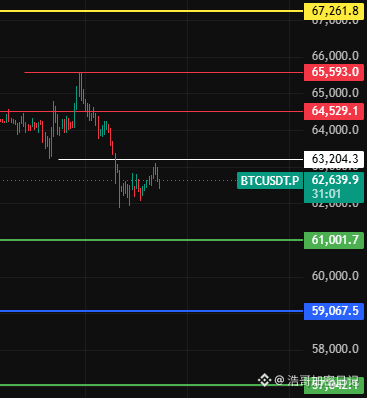
112
·
--
I'm Hao Ge, a seasoned vet in the crypto game. I'm 33 this year and have been grinding in the crypto space for eight years.
#币圈生存法则
Thanks to my deep dive into the contract trading system, my highest record was over ten million, but I've also seen some downturns.
Still, I'm doing great now. How have I managed to survive in this brutal market?
It's pretty simple, I stick to these six golden rules.
Six Survival Rules for Crypto, newbies take note:
① Sharp rises and slow drops often mean accumulation $LUMIA
If the market shoots up quickly and the pullbacks are slow, it usually means big players are quietly accumulating.
Don't let a few small red candles scare you away; the whales are trying to flush you out. Focus on the overall rhythm, not just one candlestick.
② Sudden drops are hard to recover from, watch for selling $RE
If there's a sudden plummet and the rebound lacks strength, it's likely that the big players are offloading.
At this point, don’t think about “catching the bottom”; you might just end up buying halfway down.
③ High volume at the top doesn’t always mean a peak
Many panic when they see high volume at the top, but sometimes it's just the prelude to another surge.
The real danger lies in low volume at high prices; if no one’s picking up the slack, that's a signal the market might be cooling off.
④ Volume at the bottom needs to be confirmed multiple times
If there's only one instance of high volume at the bottom, it could be a false move.
But if you see consistent high volume, that's a real consensus forming, making the market more stable.
⑤ The core is emotion; volume tells the story
Don't just stare at complex indicators; at its core, the market is a game of human nature.
Wherever the emotional consensus is, volume is the most honest. Understand volume, and you understand most of the market.
⑥ Cultivating a ‘no-mind’ state is key for longevity
If you want to go far in crypto, you need to learn to be “not greedy, not fearful.”
Those who can patiently stay in cash and wait for opportunities are the ones who can seize the big market moves. $BICO
🌸 In closing, let me say this:
The biggest enemy in trading isn’t news or policies, it’s your own mindset.
The market is always full of uncertainty, but opportunities are woven in as well. Stay calm, control your hands, and guard your heart; that’s how you make it to the end. #币圈起伏落袋为安
I'm Hao Ge, a seasoned vet in the crypto game. I'm 33 this year and have been grinding in the crypto space for eight years.
#币圈生存法则
Thanks to my deep dive into the contract trading system, my highest record was over ten million, but I've also seen some downturns.
Still, I'm doing great now. How have I managed to survive in this brutal market?
It's pretty simple, I stick to these six golden rules.
Six Survival Rules for Crypto, newbies take note:
① Sharp rises and slow drops often mean accumulation $LUMIA
If the market shoots up quickly and the pullbacks are slow, it usually means big players are quietly accumulating.
Don't let a few small red candles scare you away; the whales are trying to flush you out. Focus on the overall rhythm, not just one candlestick.
② Sudden drops are hard to recover from, watch for selling $RE
If there's a sudden plummet and the rebound lacks strength, it's likely that the big players are offloading.
At this point, don’t think about “catching the bottom”; you might just end up buying halfway down.
③ High volume at the top doesn’t always mean a peak
Many panic when they see high volume at the top, but sometimes it's just the prelude to another surge.
The real danger lies in low volume at high prices; if no one’s picking up the slack, that's a signal the market might be cooling off.
④ Volume at the bottom needs to be confirmed multiple times
If there's only one instance of high volume at the bottom, it could be a false move.
But if you see consistent high volume, that's a real consensus forming, making the market more stable.
⑤ The core is emotion; volume tells the story
Don't just stare at complex indicators; at its core, the market is a game of human nature.
Wherever the emotional consensus is, volume is the most honest. Understand volume, and you understand most of the market.
⑥ Cultivating a ‘no-mind’ state is key for longevity
If you want to go far in crypto, you need to learn to be “not greedy, not fearful.”
Those who can patiently stay in cash and wait for opportunities are the ones who can seize the big market moves. $BICO
🌸 In closing, let me say this:
The biggest enemy in trading isn’t news or policies, it’s your own mindset.
The market is always full of uncertainty, but opportunities are woven in as well. Stay calm, control your hands, and guard your heart; that’s how you make it to the end. #币圈起伏落袋为安
#币圈生存法则
Thanks to my deep dive into the contract trading system, my highest record was over ten million, but I've also seen some downturns.
Still, I'm doing great now. How have I managed to survive in this brutal market?
It's pretty simple, I stick to these six golden rules.
Six Survival Rules for Crypto, newbies take note:
① Sharp rises and slow drops often mean accumulation $LUMIA
If the market shoots up quickly and the pullbacks are slow, it usually means big players are quietly accumulating.
Don't let a few small red candles scare you away; the whales are trying to flush you out. Focus on the overall rhythm, not just one candlestick.
② Sudden drops are hard to recover from, watch for selling $RE
If there's a sudden plummet and the rebound lacks strength, it's likely that the big players are offloading.
At this point, don’t think about “catching the bottom”; you might just end up buying halfway down.
③ High volume at the top doesn’t always mean a peak
Many panic when they see high volume at the top, but sometimes it's just the prelude to another surge.
The real danger lies in low volume at high prices; if no one’s picking up the slack, that's a signal the market might be cooling off.
④ Volume at the bottom needs to be confirmed multiple times
If there's only one instance of high volume at the bottom, it could be a false move.
But if you see consistent high volume, that's a real consensus forming, making the market more stable.
⑤ The core is emotion; volume tells the story
Don't just stare at complex indicators; at its core, the market is a game of human nature.
Wherever the emotional consensus is, volume is the most honest. Understand volume, and you understand most of the market.
⑥ Cultivating a ‘no-mind’ state is key for longevity
If you want to go far in crypto, you need to learn to be “not greedy, not fearful.”
Those who can patiently stay in cash and wait for opportunities are the ones who can seize the big market moves. $BICO
🌸 In closing, let me say this:
The biggest enemy in trading isn’t news or policies, it’s your own mindset.
The market is always full of uncertainty, but opportunities are woven in as well. Stay calm, control your hands, and guard your heart; that’s how you make it to the end. #币圈起伏落袋为安


58
·
--
$RE Why do you always get liquidated? I helped my followers turn 1200U into 50,000U, all while keeping it safe. In crypto, it’s not just about the tech, but the mindset and wisdom. The most solid proof of this success is: maintaining a 'zero liquidation' record throughout.
#币圈生存法则
Behind this, I’ve tested three iron rules with real money. Today, I’m laying it all out.
First tactic: Segmentation Strategy — Survive first, then talk about making money.
All-in players are just fodder for the market.
I had him split 1200U into three parts, each 400U, with clear roles:
· 400U for day trading: Focus on one trade each day, take the profit immediately, never linger.
· 400U for swing trading: Lurk for ten days to half a month, when I strike, I aim for big gains. $BTC
· 400U as base capital: This is the last card, won’t budge even if the sky falls.
The logic is simple: if you can’t protect your life, how can you turn the tables?
Second tactic: Hunting Strategy — Ignore the noise, go for the juicy targets.
80% of the time in crypto is garbage time — sideways movements. Trading frequently in the noise is like giving the market transaction fees.
· My strategy is two words: wait.
· If the trend doesn’t come, stay put; when the trend arrives, strike precisely.
· When profits exceed 20%, immediately withdraw 30% of the gains. Money in your pocket is your money. $BICO
Remember: A true expert only trades a few times a year. But each time is enough to feed them for half a year.
Third tactic: Mindset Strategy — Use rules to eliminate emotions.
Emotions are the biggest bankrupting factor for retail traders.
You must set a cold set of rules for yourself:
· Stop-loss at 2%: Cut immediately when it hits, don’t even blink.
· Take-profit at 4%: Reduce position to lock in profits, don’t expect to sell at the peak.
· No averaging down on losses: Don’t fantasize about lowering your cost, that’s just digging your own grave.
The essence of making money is to let your funds roll automatically within the rules, not being led by your greed and fear.
From 1200U to 50,000U, the secret is simple: lock in the risks and let the profits run free. #币圈暴富
$RE Why do you always get liquidated? I helped my followers turn 1200U into 50,000U, all while keeping it safe. In crypto, it’s not just about the tech, but the mindset and wisdom. The most solid proof of this success is: maintaining a 'zero liquidation' record throughout.
#币圈生存法则
Behind this, I’ve tested three iron rules with real money. Today, I’m laying it all out.
First tactic: Segmentation Strategy — Survive first, then talk about making money.
All-in players are just fodder for the market.
I had him split 1200U into three parts, each 400U, with clear roles:
· 400U for day trading: Focus on one trade each day, take the profit immediately, never linger.
· 400U for swing trading: Lurk for ten days to half a month, when I strike, I aim for big gains. $BTC
· 400U as base capital: This is the last card, won’t budge even if the sky falls.
The logic is simple: if you can’t protect your life, how can you turn the tables?
Second tactic: Hunting Strategy — Ignore the noise, go for the juicy targets.
80% of the time in crypto is garbage time — sideways movements. Trading frequently in the noise is like giving the market transaction fees.
· My strategy is two words: wait.
· If the trend doesn’t come, stay put; when the trend arrives, strike precisely.
· When profits exceed 20%, immediately withdraw 30% of the gains. Money in your pocket is your money. $BICO
Remember: A true expert only trades a few times a year. But each time is enough to feed them for half a year.
Third tactic: Mindset Strategy — Use rules to eliminate emotions.
Emotions are the biggest bankrupting factor for retail traders.
You must set a cold set of rules for yourself:
· Stop-loss at 2%: Cut immediately when it hits, don’t even blink.
· Take-profit at 4%: Reduce position to lock in profits, don’t expect to sell at the peak.
· No averaging down on losses: Don’t fantasize about lowering your cost, that’s just digging your own grave.
The essence of making money is to let your funds roll automatically within the rules, not being led by your greed and fear.
From 1200U to 50,000U, the secret is simple: lock in the risks and let the profits run free. #币圈暴富
#币圈生存法则
Behind this, I’ve tested three iron rules with real money. Today, I’m laying it all out.
First tactic: Segmentation Strategy — Survive first, then talk about making money.
All-in players are just fodder for the market.
I had him split 1200U into three parts, each 400U, with clear roles:
· 400U for day trading: Focus on one trade each day, take the profit immediately, never linger.
· 400U for swing trading: Lurk for ten days to half a month, when I strike, I aim for big gains. $BTC
· 400U as base capital: This is the last card, won’t budge even if the sky falls.
The logic is simple: if you can’t protect your life, how can you turn the tables?
Second tactic: Hunting Strategy — Ignore the noise, go for the juicy targets.
80% of the time in crypto is garbage time — sideways movements. Trading frequently in the noise is like giving the market transaction fees.
· My strategy is two words: wait.
· If the trend doesn’t come, stay put; when the trend arrives, strike precisely.
· When profits exceed 20%, immediately withdraw 30% of the gains. Money in your pocket is your money. $BICO
Remember: A true expert only trades a few times a year. But each time is enough to feed them for half a year.
Third tactic: Mindset Strategy — Use rules to eliminate emotions.
Emotions are the biggest bankrupting factor for retail traders.
You must set a cold set of rules for yourself:
· Stop-loss at 2%: Cut immediately when it hits, don’t even blink.
· Take-profit at 4%: Reduce position to lock in profits, don’t expect to sell at the peak.
· No averaging down on losses: Don’t fantasize about lowering your cost, that’s just digging your own grave.
The essence of making money is to let your funds roll automatically within the rules, not being led by your greed and fear.
From 1200U to 50,000U, the secret is simple: lock in the risks and let the profits run free. #币圈暴富


25
·
--
It's about earning USDT for a lifetime, not just earning USDT for a lifetime❗️
I entered the game at 25, and now at 33, it's been a full 8 years.
2021-2022 were my turning points, when my account first hit 8 figures. #CryptoWealth
Spent 2000 on a hotel for a night without batting an eye. My outfit was dripping with crypto symbols.
Our generation can afford the premium; we pay for efficiency. No need to grind on the supply chain or get tangled up in receivables. My time is reserved for high-value battlegrounds.
People often ask me: What's the secret to trading crypto? $BICO
After thinking it over, the answer is actually pretty simple—mindset first, skills second.
Over the years, I've figured out some “mind hacks” that I share with my brothers in the community:
BTC+ is always the big boss. If you want to navigate the space, keep your eyes on it. When it pumps, the altcoins might have a chance; when it dumps, all the little guys follow suit. Occasionally, ETH+ might break out on its own, but don’t expect the altcoins to resist the market.
BTC and USDT+ are like a seesaw. Remember this: If USDT pumps, be cautious with Bitcoin; if Bitcoin is on a tear, stash some USDT to secure profits.
Two key timeframes:
Midnight to 1 AM, you can easily catch a “wick”; placing orders before bed often yields free gains; $BTC
Morning from 6 to 8 AM is a barometer for the day’s trend:
If it dips in the first half of the night, and still dips in these two hours, just close your eyes and average down; there's a good chance it will pump later in the day;
If it pumps in the first half of the night, and still pumps in these two hours, then run fast; it’s likely to drop later. $BOME
5 PM, don't lose focus. Due to the time difference, US funds just enter the market, and this is when big volatility usually happens.
“Black Friday+”? Don’t be too superstitious. Fridays have seen drops, but they've also pumped and consolidated; it ultimately depends on the news.
The most practical advice:
As long as it’s not a shitcoin and has trading volume, don’t panic if it drops. In three to five days, or a month, it will usually recover.
If you have spare cash, average down in batches to lower your cost and recover quickly; if not, just hold tight, it’s not a big deal.
My proudest trade: I bought Dogecoin at 0.085 and held on through thick and thin, and it’s over 20x now.
The fact is: In crypto trading, in the end, it’s all about patience.
#币圈生存法则
It's about earning USDT for a lifetime, not just earning USDT for a lifetime❗️
I entered the game at 25, and now at 33, it's been a full 8 years.
2021-2022 were my turning points, when my account first hit 8 figures. #CryptoWealth
Spent 2000 on a hotel for a night without batting an eye. My outfit was dripping with crypto symbols.
Our generation can afford the premium; we pay for efficiency. No need to grind on the supply chain or get tangled up in receivables. My time is reserved for high-value battlegrounds.
People often ask me: What's the secret to trading crypto? $BICO
After thinking it over, the answer is actually pretty simple—mindset first, skills second.
Over the years, I've figured out some “mind hacks” that I share with my brothers in the community:
BTC+ is always the big boss. If you want to navigate the space, keep your eyes on it. When it pumps, the altcoins might have a chance; when it dumps, all the little guys follow suit. Occasionally, ETH+ might break out on its own, but don’t expect the altcoins to resist the market.
BTC and USDT+ are like a seesaw. Remember this: If USDT pumps, be cautious with Bitcoin; if Bitcoin is on a tear, stash some USDT to secure profits.
Two key timeframes:
Midnight to 1 AM, you can easily catch a “wick”; placing orders before bed often yields free gains; $BTC
Morning from 6 to 8 AM is a barometer for the day’s trend:
If it dips in the first half of the night, and still dips in these two hours, just close your eyes and average down; there's a good chance it will pump later in the day;
If it pumps in the first half of the night, and still pumps in these two hours, then run fast; it’s likely to drop later. $BOME
5 PM, don't lose focus. Due to the time difference, US funds just enter the market, and this is when big volatility usually happens.
“Black Friday+”? Don’t be too superstitious. Fridays have seen drops, but they've also pumped and consolidated; it ultimately depends on the news.
The most practical advice:
As long as it’s not a shitcoin and has trading volume, don’t panic if it drops. In three to five days, or a month, it will usually recover.
If you have spare cash, average down in batches to lower your cost and recover quickly; if not, just hold tight, it’s not a big deal.
My proudest trade: I bought Dogecoin at 0.085 and held on through thick and thin, and it’s over 20x now.
The fact is: In crypto trading, in the end, it’s all about patience.
#币圈生存法则
I entered the game at 25, and now at 33, it's been a full 8 years.
2021-2022 were my turning points, when my account first hit 8 figures. #CryptoWealth
Spent 2000 on a hotel for a night without batting an eye. My outfit was dripping with crypto symbols.
Our generation can afford the premium; we pay for efficiency. No need to grind on the supply chain or get tangled up in receivables. My time is reserved for high-value battlegrounds.
People often ask me: What's the secret to trading crypto? $BICO
After thinking it over, the answer is actually pretty simple—mindset first, skills second.
Over the years, I've figured out some “mind hacks” that I share with my brothers in the community:
BTC+ is always the big boss. If you want to navigate the space, keep your eyes on it. When it pumps, the altcoins might have a chance; when it dumps, all the little guys follow suit. Occasionally, ETH+ might break out on its own, but don’t expect the altcoins to resist the market.
BTC and USDT+ are like a seesaw. Remember this: If USDT pumps, be cautious with Bitcoin; if Bitcoin is on a tear, stash some USDT to secure profits.
Two key timeframes:
Midnight to 1 AM, you can easily catch a “wick”; placing orders before bed often yields free gains; $BTC
Morning from 6 to 8 AM is a barometer for the day’s trend:
If it dips in the first half of the night, and still dips in these two hours, just close your eyes and average down; there's a good chance it will pump later in the day;
If it pumps in the first half of the night, and still pumps in these two hours, then run fast; it’s likely to drop later. $BOME
5 PM, don't lose focus. Due to the time difference, US funds just enter the market, and this is when big volatility usually happens.
“Black Friday+”? Don’t be too superstitious. Fridays have seen drops, but they've also pumped and consolidated; it ultimately depends on the news.
The most practical advice:
As long as it’s not a shitcoin and has trading volume, don’t panic if it drops. In three to five days, or a month, it will usually recover.
If you have spare cash, average down in batches to lower your cost and recover quickly; if not, just hold tight, it’s not a big deal.
My proudest trade: I bought Dogecoin at 0.085 and held on through thick and thin, and it’s over 20x now.
The fact is: In crypto trading, in the end, it’s all about patience.
#币圈生存法则


36
·
--
If you don't have at least 5000U, leave those flashy trades alone. Let me give you some real talk: the things that will actually help you survive and grow your capital are these four 'dumb methods.' #币圈生存法则
A lot of my followers have gone from five figures to seven figures—not through luck, but through discipline. The methods are simple: the simpler they are, the easier they are to stick to and execute.
Step one, when choosing coins, look for just one signal: a daily MACD golden cross. It's best if it appears above the zero line. Technical indicators are more reliable than any news; don’t get distracted by market noise.
Step two, trade only based on one line: the daily moving average. Hold when the price is above it, and exit when it dips below. If the price breaks the line, leave immediately—that's a hard rule, not a suggestion. $BTC
Step three, entry and exit focus on two points: price + volume. When the price breaks above the moving average and the volume surges, go all-in. For taking profits, stick to the rules: sell a portion at a 40% gain, another portion at 80%, and clear the rest if it breaks below the moving average. Don’t ask why, just do it. $BICO
Step four, for stop losses, the rule is simple: if the closing price dips below the moving average, exit the next day no matter what. A little luck could wipe out all your profits. Missing out isn’t scary; just wait until it’s back above the moving average to buy again.
These methods may seem dumb, but they are the easiest for retail traders to execute and the least likely to get you wiped out. Just like that previous PIPPIN wave, when the signal came out, we acted decisively and bagged a nice chunk of profit. #CryptoMarketCorrection
There are always opportunities in crypto; what’s lacking is clear, simple trading discipline. If you still don’t know how to choose coins, build positions, or manage profits and losses, follow me, and I’ll help you execute according to plan. No wild gambles—let’s steadily grow that small capital. #币圈暴富
If you don't have at least 5000U, leave those flashy trades alone. Let me give you some real talk: the things that will actually help you survive and grow your capital are these four 'dumb methods.' #币圈生存法则
A lot of my followers have gone from five figures to seven figures—not through luck, but through discipline. The methods are simple: the simpler they are, the easier they are to stick to and execute.
Step one, when choosing coins, look for just one signal: a daily MACD golden cross. It's best if it appears above the zero line. Technical indicators are more reliable than any news; don’t get distracted by market noise.
Step two, trade only based on one line: the daily moving average. Hold when the price is above it, and exit when it dips below. If the price breaks the line, leave immediately—that's a hard rule, not a suggestion. $BTC
Step three, entry and exit focus on two points: price + volume. When the price breaks above the moving average and the volume surges, go all-in. For taking profits, stick to the rules: sell a portion at a 40% gain, another portion at 80%, and clear the rest if it breaks below the moving average. Don’t ask why, just do it. $BICO
Step four, for stop losses, the rule is simple: if the closing price dips below the moving average, exit the next day no matter what. A little luck could wipe out all your profits. Missing out isn’t scary; just wait until it’s back above the moving average to buy again.
These methods may seem dumb, but they are the easiest for retail traders to execute and the least likely to get you wiped out. Just like that previous PIPPIN wave, when the signal came out, we acted decisively and bagged a nice chunk of profit. #CryptoMarketCorrection
There are always opportunities in crypto; what’s lacking is clear, simple trading discipline. If you still don’t know how to choose coins, build positions, or manage profits and losses, follow me, and I’ll help you execute according to plan. No wild gambles—let’s steadily grow that small capital. #币圈暴富
A lot of my followers have gone from five figures to seven figures—not through luck, but through discipline. The methods are simple: the simpler they are, the easier they are to stick to and execute.
Step one, when choosing coins, look for just one signal: a daily MACD golden cross. It's best if it appears above the zero line. Technical indicators are more reliable than any news; don’t get distracted by market noise.
Step two, trade only based on one line: the daily moving average. Hold when the price is above it, and exit when it dips below. If the price breaks the line, leave immediately—that's a hard rule, not a suggestion. $BTC
Step three, entry and exit focus on two points: price + volume. When the price breaks above the moving average and the volume surges, go all-in. For taking profits, stick to the rules: sell a portion at a 40% gain, another portion at 80%, and clear the rest if it breaks below the moving average. Don’t ask why, just do it. $BICO
Step four, for stop losses, the rule is simple: if the closing price dips below the moving average, exit the next day no matter what. A little luck could wipe out all your profits. Missing out isn’t scary; just wait until it’s back above the moving average to buy again.
These methods may seem dumb, but they are the easiest for retail traders to execute and the least likely to get you wiped out. Just like that previous PIPPIN wave, when the signal came out, we acted decisively and bagged a nice chunk of profit. #CryptoMarketCorrection
There are always opportunities in crypto; what’s lacking is clear, simple trading discipline. If you still don’t know how to choose coins, build positions, or manage profits and losses, follow me, and I’ll help you execute according to plan. No wild gambles—let’s steadily grow that small capital. #币圈暴富


35
·
--
If your capital is under 600U, like #币圈 , listen to Brother Hao—don’t rush into trades just yet.
The crypto scene isn’t a gamble on price swings; it’s a strategic battleground. The lower your capital, the more you need to engrain the word 'stability' in your mind; be like an experienced hunter and keep your cool. $BICO
Not long ago, I helped a friend who started with just 500U. He was so nervous placing orders, afraid that one wrong move could wipe him out. I told him: Stay calm, follow the rules, you can grow even with a small stake.
And guess what? In one month, his account soared to 5000U, and in three months, he hit 18,000U, all without blowing up his account.
Some say it’s luck, but I’ll tell you straight—there are three unbreakable rules.
First rule: Split your money into three parts, always have an exit strategy.
150U for day trading, focus only on Bitcoin and Ethereum; if it moves three to five points, take the profit—don’t be greedy;
150U for swing trading, wait for clear signals before acting, aim for a few days of stability;
The remaining 200U is your safety net—don’t touch it even if the sky falls.
Those who throw all their capital into trades, panic when prices rise or fall, and don’t go far. True winners know to keep some cash on the sidelines; that’s what gives you the confidence to rebound.
Second rule: Follow the trend, don’t waste time in sideways markets.
The market spends 70% of its time in consolidation; if you’re constantly trading in that, you’re just paying fees to the exchange. Wait for clear signals; don’t let impatience get the better of you. When the trend appears, jump in decisively. If you earn 12%, take out half right away; securing profits is what counts.
Experts are always “inactive until necessary, then they strike to win.” My friend, when he doubled his money, never chased the price up—think that’s cowardice? That’s wisdom from someone who’s learned the hard way.
Third rule: Set your rules and stick to them.
Here are three hard limits for you, memorize them:
· If you lose 2% on a single trade, exit immediately—don’t hesitate for a second.
· Once you gain over 4%, take out half your position; let the remaining profits run.
You don’t need to nail every market movement, but you must adhere to every rule. Making money is, at its core, about managing your emotions through a system.
Lastly, let me share a truth: Having little capital is not scary; what’s scary is having your head filled with thoughts of “hitting it big.”
Going from 500U to 18,000U isn’t about luck; it’s about rules, patience, and strict discipline. Follow this, and you too can transform from a newbie who just hands out money into someone who really eats well. #合约带单
If your capital is under 600U, like #币圈 , listen to Brother Hao—don’t rush into trades just yet.
The crypto scene isn’t a gamble on price swings; it’s a strategic battleground. The lower your capital, the more you need to engrain the word 'stability' in your mind; be like an experienced hunter and keep your cool. $BICO
Not long ago, I helped a friend who started with just 500U. He was so nervous placing orders, afraid that one wrong move could wipe him out. I told him: Stay calm, follow the rules, you can grow even with a small stake.
And guess what? In one month, his account soared to 5000U, and in three months, he hit 18,000U, all without blowing up his account.
Some say it’s luck, but I’ll tell you straight—there are three unbreakable rules.
First rule: Split your money into three parts, always have an exit strategy.
150U for day trading, focus only on Bitcoin and Ethereum; if it moves three to five points, take the profit—don’t be greedy;
150U for swing trading, wait for clear signals before acting, aim for a few days of stability;
The remaining 200U is your safety net—don’t touch it even if the sky falls.
Those who throw all their capital into trades, panic when prices rise or fall, and don’t go far. True winners know to keep some cash on the sidelines; that’s what gives you the confidence to rebound.
Second rule: Follow the trend, don’t waste time in sideways markets.
The market spends 70% of its time in consolidation; if you’re constantly trading in that, you’re just paying fees to the exchange. Wait for clear signals; don’t let impatience get the better of you. When the trend appears, jump in decisively. If you earn 12%, take out half right away; securing profits is what counts.
Experts are always “inactive until necessary, then they strike to win.” My friend, when he doubled his money, never chased the price up—think that’s cowardice? That’s wisdom from someone who’s learned the hard way.
Third rule: Set your rules and stick to them.
Here are three hard limits for you, memorize them:
· If you lose 2% on a single trade, exit immediately—don’t hesitate for a second.
· Once you gain over 4%, take out half your position; let the remaining profits run.
You don’t need to nail every market movement, but you must adhere to every rule. Making money is, at its core, about managing your emotions through a system.
Lastly, let me share a truth: Having little capital is not scary; what’s scary is having your head filled with thoughts of “hitting it big.”
Going from 500U to 18,000U isn’t about luck; it’s about rules, patience, and strict discipline. Follow this, and you too can transform from a newbie who just hands out money into someone who really eats well. #合约带单
The crypto scene isn’t a gamble on price swings; it’s a strategic battleground. The lower your capital, the more you need to engrain the word 'stability' in your mind; be like an experienced hunter and keep your cool. $BICO
Not long ago, I helped a friend who started with just 500U. He was so nervous placing orders, afraid that one wrong move could wipe him out. I told him: Stay calm, follow the rules, you can grow even with a small stake.
And guess what? In one month, his account soared to 5000U, and in three months, he hit 18,000U, all without blowing up his account.
Some say it’s luck, but I’ll tell you straight—there are three unbreakable rules.
First rule: Split your money into three parts, always have an exit strategy.
150U for day trading, focus only on Bitcoin and Ethereum; if it moves three to five points, take the profit—don’t be greedy;
150U for swing trading, wait for clear signals before acting, aim for a few days of stability;
The remaining 200U is your safety net—don’t touch it even if the sky falls.
Those who throw all their capital into trades, panic when prices rise or fall, and don’t go far. True winners know to keep some cash on the sidelines; that’s what gives you the confidence to rebound.
Second rule: Follow the trend, don’t waste time in sideways markets.
The market spends 70% of its time in consolidation; if you’re constantly trading in that, you’re just paying fees to the exchange. Wait for clear signals; don’t let impatience get the better of you. When the trend appears, jump in decisively. If you earn 12%, take out half right away; securing profits is what counts.
Experts are always “inactive until necessary, then they strike to win.” My friend, when he doubled his money, never chased the price up—think that’s cowardice? That’s wisdom from someone who’s learned the hard way.
Third rule: Set your rules and stick to them.
Here are three hard limits for you, memorize them:
· If you lose 2% on a single trade, exit immediately—don’t hesitate for a second.
· Once you gain over 4%, take out half your position; let the remaining profits run.
You don’t need to nail every market movement, but you must adhere to every rule. Making money is, at its core, about managing your emotions through a system.
Lastly, let me share a truth: Having little capital is not scary; what’s scary is having your head filled with thoughts of “hitting it big.”
Going from 500U to 18,000U isn’t about luck; it’s about rules, patience, and strict discipline. Follow this, and you too can transform from a newbie who just hands out money into someone who really eats well. #合约带单


31
Log in to explore more content
Join global crypto users on Binance Square
⚡️ Get latest and useful information about crypto.
💬 Trusted by the world’s largest crypto exchange.
👍 Discover real insights from verified creators.
Email / Phone number
Trending Topics
BitcoinClears$85200
9,507 views
199 Discussing
We got the move, and $BTC is standing exactly where we were before the data. That’s what actual patience for a trade looks like.
The data came in mixed but with some important numbers. ADP Non-Farm Employment Change came at 90K vs 73K forecast, while Core PCE came in at 0.2% vs 0.3% expected. Final GDP was also stronger at 2.2% vs 1.5% forecast, while Personal Spending came in at 0.9% vs 0.8% expected. At the same time, Personal Income missed at 0.2% vs 0.5% forecast.
BTC initially surged to $85,600 and is now back where it needs to be. I’m still looking toward the lower ranges at $82,759 and the $80,000 liquidity, because the overhead liquidity is done and dusted.
We had a live session during the data, and during that session we saw the market at $83,800, then $85,600, and then back toward $83,000 and we still didn’t enter a trade.
That’s what patience is.
We can’t force an entry when the market has no clear direction. The same range is still in focus, and we’ll wait for the market to give us the setup.
Let me know, guys, how was the session? And should we have more regular sessions with our respected members so we can have proper discussions regarding the market?
#BitcoinClears$85200 #AltcoinSeasonIndexHoldsAbove60For5Days #USADPAdds90000JobsInSeptember #BitcoinSlipsBelow$84000 #SECToClarifyOnChainFundraisingRules
Crypto_LUX
·24 Likes
·16.2k views
AltcoinSeasonIndexHoldsAbove60For5Days
48,450 views
1,079 Discussing
USADPAdds90000JobsInSeptember
22,593 views
610 Discussing