
drscastillor
19 Posts
drscastillor
Report
Block User
1 Following
1 Followers
1 Liked
Posts
All
Quotes
·
--
What really happened with #coldcard It wasn’t an “AI hack”—it was a 2021 firmware bug. The vulnerability was introduced in Coldcard firmware 4.0.0 in March 2021: devices bypassed their hardware random number generator and fell into key generation via software, predictable, seeded with non-secret chip data.  The specific error is in libngu: the guard uses #ifndef MICROPY_HW_ENABLE_RNG, which only checks whether the macro exists, not whether its value is different from zero.  Result: anyone can reproduce the seed candidates offline and derive addresses to compare them with the blockchain—without touching the device.
The figure keeps growing in waves: from an initial 594 BTC to 1.082 BTC (1,196 addresses) on July 31, then 1.158 BTC, and on August 2 a third wave brought the total to ~1.367 BTC (~$89M) from 4,585 addresses;  today people talk about a fourth wave. Coinkite released an emergency firmware on July 31 for all affected models, but installing it doesn’t fix an already-existing seed.  You must generate a new seed and move the funds. #HackerAlert #bitcoin $BTC
What really happened with #coldcard It wasn’t an “AI hack”—it was a 2021 firmware bug. The vulnerability was introduced in Coldcard firmware 4.0.0 in March 2021: devices bypassed their hardware random number generator and fell into key generation via software, predictable, seeded with non-secret chip data.  The specific error is in libngu: the guard uses #ifndef MICROPY_HW_ENABLE_RNG, which only checks whether the macro exists, not whether its value is different from zero.  Result: anyone can reproduce the seed candidates offline and derive addresses to compare them with the blockchain—without touching the device.
The figure keeps growing in waves: from an initial 594 BTC to 1.082 BTC (1,196 addresses) on July 31, then 1.158 BTC, and on August 2 a third wave brought the total to ~1.367 BTC (~$89M) from 4,585 addresses;  today people talk about a fourth wave. Coinkite released an emergency firmware on July 31 for all affected models, but installing it doesn’t fix an already-existing seed.  You must generate a new seed and move the funds. #HackerAlert #bitcoin $BTC
The figure keeps growing in waves: from an initial 594 BTC to 1.082 BTC (1,196 addresses) on July 31, then 1.158 BTC, and on August 2 a third wave brought the total to ~1.367 BTC (~$89M) from 4,585 addresses;  today people talk about a fourth wave. Coinkite released an emergency firmware on July 31 for all affected models, but installing it doesn’t fix an already-existing seed.  You must generate a new seed and move the funds. #HackerAlert #bitcoin $BTC
111
·
--
#baby $BABY Not everything is upside and it’s worth saying out loud. Trustless Bitcoin Vaults are a new, relatively unproven cryptographic construct over time, and there is a risk of smart contracts in the connections to external protocols. None of that disappears no matter how good the architecture is. That said, @babylonlabs_io it eliminates two of the vectors that have destroyed the most capital in the history of this market: the risk of centralized custody and the risk of bridges. Swapping known, catastrophic risks for limited and auditable risks seems like a reasonable trade-off. $BABY #baby
#baby $BABY Not everything is upside and it’s worth saying out loud. Trustless Bitcoin Vaults are a new, relatively unproven cryptographic construct over time, and there is a risk of smart contracts in the connections to external protocols. None of that disappears no matter how good the architecture is. That said, @BabylonLabs_io it eliminates two of the vectors that have destroyed the most capital in the history of this market: the risk of centralized custody and the risk of bridges. Swapping known, catastrophic risks for limited and auditable risks seems like a reasonable trade-off. $BABY #baby

1
333
·
--
#baby $BABY Lo relevant of Trustless Bitcoin Vaults is not the narrative, it’s how they solve an old technical problem. Bitcoin doesn’t support native covenants, so building programmable vaults has always been the bottleneck. @babylonlabs_io leverage BitVM3 and verified zero-knowledge proofs directly on the Bitcoin blockchain: the withdrawal is authorized only when the contract state on the external chain is cryptographically demonstrated. Everything is auditable, everything is on-chain. Peg-in times have dropped to about three hours and on-chain costs have been reduced several times. That separates an academic experiment from something usable. $BABY #baby #onchain
#baby $BABY Lo relevant of Trustless Bitcoin Vaults is not the narrative, it’s how they solve an old technical problem. Bitcoin doesn’t support native covenants, so building programmable vaults has always been the bottleneck. @BabylonLabs_io leverage BitVM3 and verified zero-knowledge proofs directly on the Bitcoin blockchain: the withdrawal is authorized only when the contract state on the external chain is cryptographically demonstrated. Everything is auditable, everything is on-chain. Peg-in times have dropped to about three hours and on-chain costs have been reduced several times. That separates an academic experiment from something usable. $BABY #baby #onchain
96
·
--
#baby $BABY Case study: I have BTC and need liquidity, but selling isn’t an option. With the Trustless Bitcoin Vaults of @babylonlabs_io I can lock my Bitcoin in a self-custodial way and borrow stablecoins against that position via integration with $AAVE . When I repay, the collateral is released. The BTC never leaves its chain and no custodian touches it. It’s Bitcoin no longer being a passive asset without ceasing to be Bitcoin. Watch out for the risks: it’s a new crypto construct and there’s smart-contract risk in the spokes. But the direction is the right one. $BABY #baby
#baby $BABY Case study: I have BTC and need liquidity, but selling isn’t an option. With the Trustless Bitcoin Vaults of @BabylonLabs_io I can lock my Bitcoin in a self-custodial way and borrow stablecoins against that position via integration with $AAVE . When I repay, the collateral is released. The BTC never leaves its chain and no custodian touches it. It’s Bitcoin no longer being a passive asset without ceasing to be Bitcoin. Watch out for the risks: it’s a new crypto construct and there’s smart-contract risk in the spokes. But the direction is the right one. $BABY #baby
247
·
--
#baby $BABY For years, BTC had two paths: sleep in cold storage without generating anything, or wrap itself into a synthetic token and cross a bridge trusting a third party. The Trustless Bitcoin Vaults of @babylonlabs_io break that false dichotomy: your BTC is locked in a Bitcoin script created by you, on the native chain, and can still support DeFi activity on other networks. No wrapping, no bridge, no custodian. The difference isn’t marketing—it’s architecture: whoever controls the keys is still you. $BABY #baby
#baby $BABY For years, BTC had two paths: sleep in cold storage without generating anything, or wrap itself into a synthetic token and cross a bridge trusting a third party. The Trustless Bitcoin Vaults of @BabylonLabs_io break that false dichotomy: your BTC is locked in a Bitcoin script created by you, on the native chain, and can still support DeFi activity on other networks. No wrapping, no bridge, no custodian. The difference isn’t marketing—it’s architecture: whoever controls the keys is still you. $BABY #baby
1
108
·
--
#baby $BABY buy a little bit of this in order to be able to participate in this new mission of #Binance I think it’s a good opportunity to have a system that allows generating profits with Bitcoin $BTC because keeping them in custody without doing any work at least bothers me. However, I think it’s still worth asking whether the risk outweighs the benefit of keeping Bitcoin only in a hold state versus putting it to work in babylon; I don’t know what you think? @BabylonLabs_io
#baby $BABY buy a little bit of this in order to be able to participate in this new mission of #Binance I think it’s a good opportunity to have a system that allows generating profits with Bitcoin $BTC because keeping them in custody without doing any work at least bothers me. However, I think it’s still worth asking whether the risk outweighs the benefit of keeping Bitcoin only in a hold state versus putting it to work in babylon; I don’t know what you think? @BabylonLabs_io
212
·
--
A little to invest $USDC do you like it more $USDT o $USDC ????
A little to invest $USDC do you like it more $USDT o $USDC ????
143
·
--
$BTC do we go all the way? Or do we have to wait until October?
$BTC do we go all the way? Or do we have to wait until October?

124
·
--
Bullish
Are we close to finishing the bearish market? $BTC
{spot}(BTCUSDT)
{stock_us}(BTCS.US)
Are we close to finishing the bearish market? $BTC
80
·
--
Bullish
$BTC $ETH
{spot}(BTCUSDT)
We're getting closer every day
$BTC $ETH
We're getting closer every day
We're getting closer every day
15
·
--
#Complete the 2 objectives and win up to 5,000 USDT in prizes. May 2026 Challenge – Exclusive for LATAM Affiliates https://www.binance.com/activity/trading-competition/LatamAffiliate0501?ref=LT1W9SKE$USDT
#Complete the 2 objectives and win up to 5,000 USDT in prizes. May 2026 Challenge – Exclusive for LATAM Affiliates https://www.binance.com/activity/trading-competition/LatamAffiliate0501?ref=LT1W9SKE$USDT
5
·
--
☹️
☹️

Venezolano1971
·
--
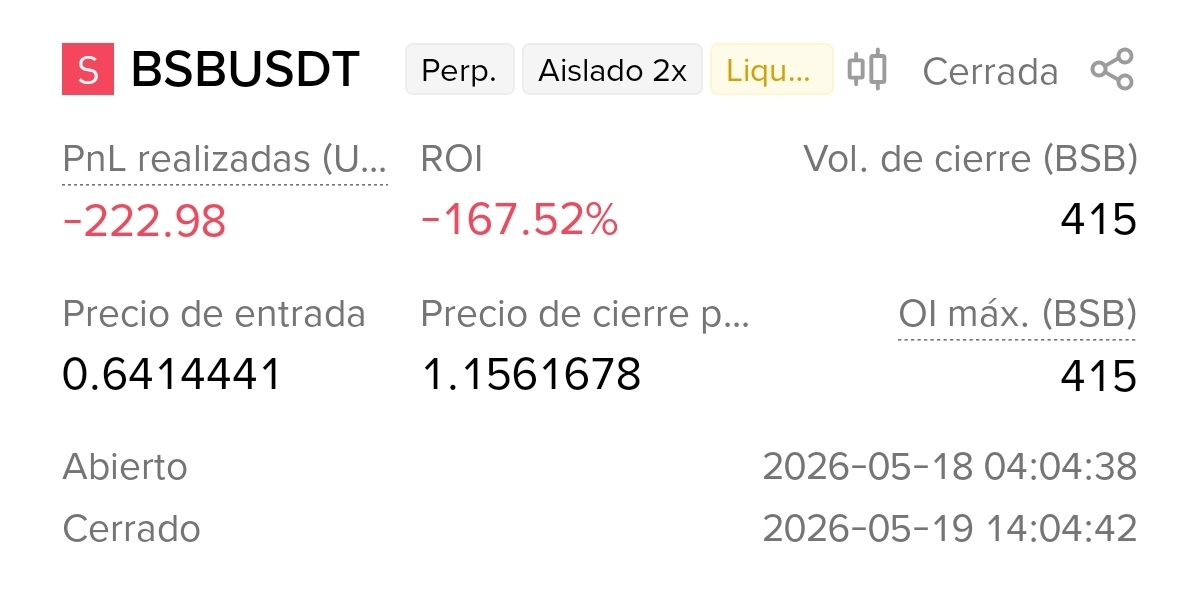
Hey everyone, I got liquidated. I had time and the order wasn't moving and it never dipped to close. In the process, I managed to go long and then short since I was keeping an eye on it and was able to recover a bit, but I lost more than half. The lesson is that memecoins are risky, and even if you have your liquidation order set far away, you can still get wrecked.
3
Log in to explore more content
Join global crypto users on Binance Square
⚡️ Get latest and useful information about crypto.
💬 Trusted by the world’s largest crypto exchange.
👍 Discover real insights from verified creators.
Email / Phone number
Trending Topics
BTCBreaks80K
9,917 views
296 Discussing
🚨 BITCOIN $80K IS BACK IN FOCUS! 🔥
BTC is pushing toward the $80,000 psychological resistance after reclaiming the $78K zone. A clean breakout and hold above $80K could bring $82K–$85K into focus next. 📈
But traders need to watch the rejection zone carefully — losing $77K–$78K could trigger another pullback.
🎯 Key levels:
• 🔥 Breakout: $80K
• 🚀 Next zone: $82K–$85K
• ⚠️ Support: $77K–$78K
$80K isn’t just a number — it’s the level bulls need to conquer.
Are we about to see the next BTC breakout? 👇
#bitcoin #BTC #BinanceSquare #btcbreaks80k
$BTC
ASHFAQ NAEEM
·2 Likes
·3k views
BuffettBecomesBerkshireChairmanEmeritus
9 views
17 Discussing
ZcashSpotETFTops$230MMonthlyInflow
184 views
20 Discussing