

Afraeem BNB
2.9k Posts

Afraeem BNB
Report
Block User
support me 🙏
428 Following
10.7K+ Followers
2.2K+ Liked
Posts
All
Quotes
Live
·
--
🎁🔥$BNB DON’T MISS THE RED PACKET! 🔥🎁
Want a chance to grab a surprise reward? 👀💰
I’m dropping Red Packets for active followers! 🚀
$BNB
👉 Follow me
❤️ Like this post
💬 Comment “READY”
🔁 Repost to support the community
Stay active — more surprises may be coming! 🍀🎁
#RedPacket #Giveaway #CryptoCommunity #BinanceSquare #CryptoFans
🎁🔥$BNB DON’T MISS THE RED PACKET! 🔥🎁
Want a chance to grab a surprise reward? 👀💰
I’m dropping Red Packets for active followers! 🚀
$BNB
👉 Follow me
❤️ Like this post
💬 Comment “READY”
🔁 Repost to support the community
Stay active — more surprises may be coming! 🍀🎁
#RedPacket #Giveaway #CryptoCommunity #BinanceSquare #CryptoFans
Want a chance to grab a surprise reward? 👀💰
I’m dropping Red Packets for active followers! 🚀
$BNB
👉 Follow me
❤️ Like this post
💬 Comment “READY”
🔁 Repost to support the community
Stay active — more surprises may be coming! 🍀🎁
#RedPacket #Giveaway #CryptoCommunity #BinanceSquare #CryptoFans

29
3
59
·
--
#baby $BABY
Babylon ($BABY ): Unlocking Bitcoin's Next Evolution
What if your Bitcoin could help secure the future of blockchain without ever leaving your wallet?
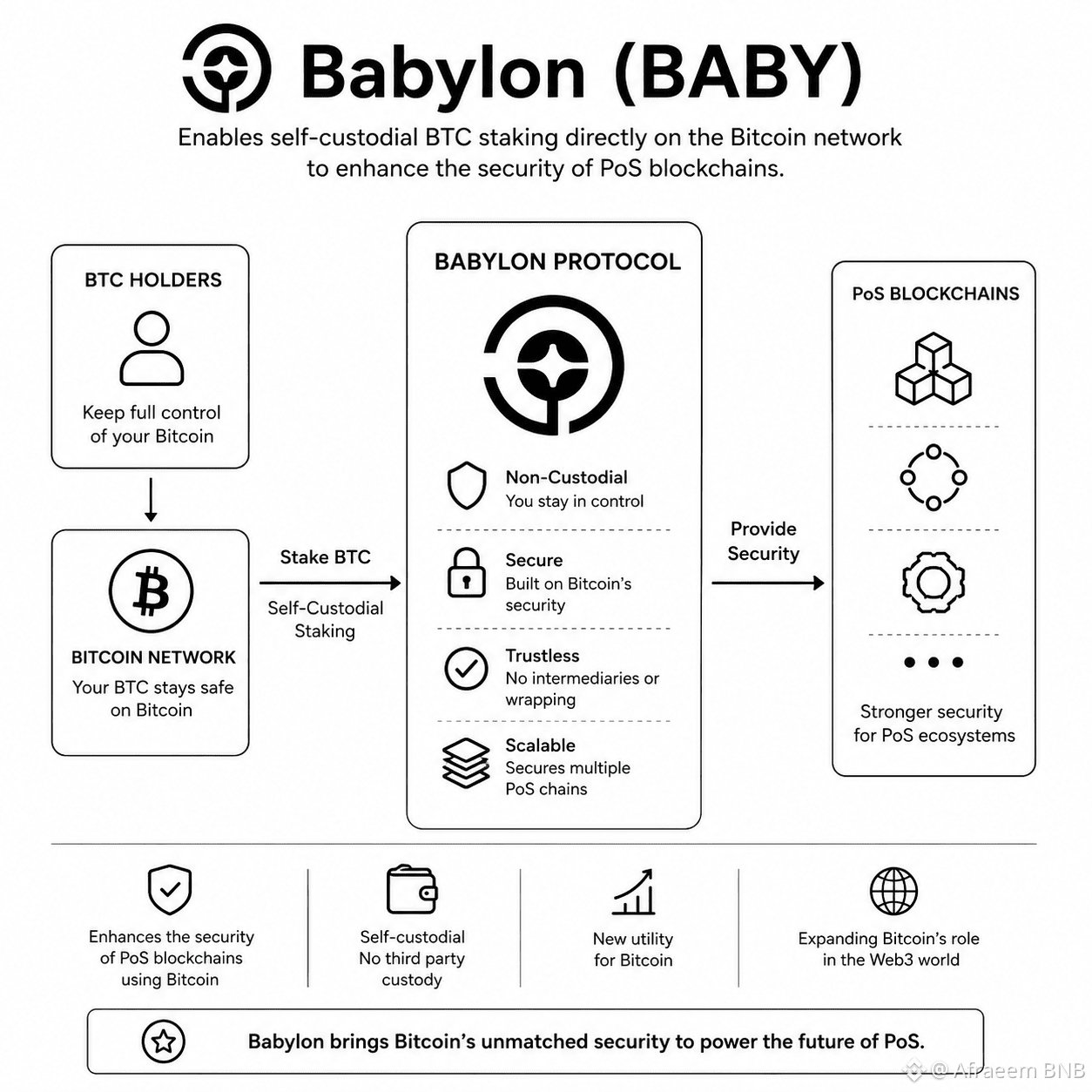
Babylon ($BABY ) makes that possible by introducing self-custodial BTC staking directly on the Bitcoin network. Instead of wrapping or bridging your BTC, you keep full control of your assets while contributing to the security of Proof-of-Stake (PoS) ecosystems.
Keep your Bitcoin in your own custody
Strengthen PoS blockchain security
No need to give up ownership of your BTC
A new utility layer for the world's most trusted cryptocurrency
Babylon is building a bridge between Bitcoin's unmatched security and the growing PoS ecosystem—unlocking new possibilities for BTC holders without compromising decentralization.
Bitcoin isn't just digital gold anymore—it can become the backbone of blockchain security.
#baby $BABY
Babylon ($BABY ): Unlocking Bitcoin's Next Evolution
What if your Bitcoin could help secure the future of blockchain without ever leaving your wallet?
Babylon ($BABY ) makes that possible by introducing self-custodial BTC staking directly on the Bitcoin network. Instead of wrapping or bridging your BTC, you keep full control of your assets while contributing to the security of Proof-of-Stake (PoS) ecosystems.
Keep your Bitcoin in your own custody
Strengthen PoS blockchain security
No need to give up ownership of your BTC
A new utility layer for the world's most trusted cryptocurrency
Babylon is building a bridge between Bitcoin's unmatched security and the growing PoS ecosystem—unlocking new possibilities for BTC holders without compromising decentralization.
Bitcoin isn't just digital gold anymore—it can become the backbone of blockchain security.
Babylon ($BABY ): Unlocking Bitcoin's Next Evolution
What if your Bitcoin could help secure the future of blockchain without ever leaving your wallet?
Babylon ($BABY ) makes that possible by introducing self-custodial BTC staking directly on the Bitcoin network. Instead of wrapping or bridging your BTC, you keep full control of your assets while contributing to the security of Proof-of-Stake (PoS) ecosystems.
Keep your Bitcoin in your own custody
Strengthen PoS blockchain security
No need to give up ownership of your BTC
A new utility layer for the world's most trusted cryptocurrency
Babylon is building a bridge between Bitcoin's unmatched security and the growing PoS ecosystem—unlocking new possibilities for BTC holders without compromising decentralization.
Bitcoin isn't just digital gold anymore—it can become the backbone of blockchain security.
131
·
--
Bullish
#baby $BABY
Babylon ($BABY ): Unlocking the True Potential of Bitcoin
Bitcoin has always been the world's most secure blockchain—but what if it could also secure Proof-of-Stake (PoS) networks without leaving your wallet?
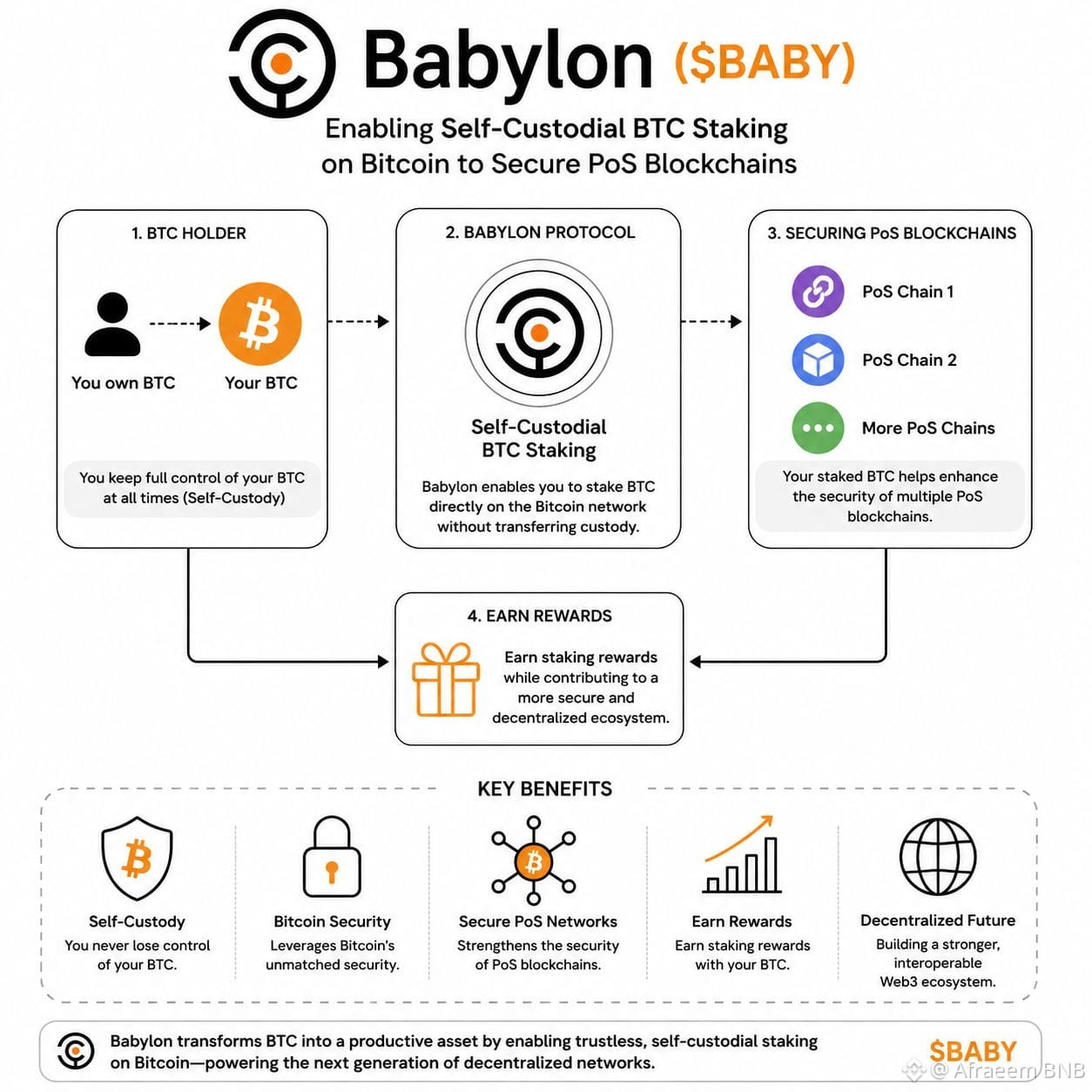
Babylon ($BABY ) makes this possible through self-custodial BTC staking directly on the Bitcoin network.
Keep full control of your BTC—no wrapped tokens or custodians.
Strengthen the security of PoS blockchains using Bitcoin's unmatched security.
Earn staking rewards while helping build a more decentralized ecosystem.
Babylon is redefining Bitcoin's role beyond being just a store of value. It transforms BTC into a productive asset while preserving its core principle of self-custody.
Could Babylon become one of the most important innovations in the Bitcoin ecosystem?
#baby $BABY
Babylon ($BABY ): Unlocking the True Potential of Bitcoin
Bitcoin has always been the world's most secure blockchain—but what if it could also secure Proof-of-Stake (PoS) networks without leaving your wallet?
Babylon ($BABY ) makes this possible through self-custodial BTC staking directly on the Bitcoin network.
Keep full control of your BTC—no wrapped tokens or custodians.
Strengthen the security of PoS blockchains using Bitcoin's unmatched security.
Earn staking rewards while helping build a more decentralized ecosystem.
Babylon is redefining Bitcoin's role beyond being just a store of value. It transforms BTC into a productive asset while preserving its core principle of self-custody.
Could Babylon become one of the most important innovations in the Bitcoin ecosystem?
Babylon ($BABY ): Unlocking the True Potential of Bitcoin
Bitcoin has always been the world's most secure blockchain—but what if it could also secure Proof-of-Stake (PoS) networks without leaving your wallet?
Babylon ($BABY ) makes this possible through self-custodial BTC staking directly on the Bitcoin network.
Keep full control of your BTC—no wrapped tokens or custodians.
Strengthen the security of PoS blockchains using Bitcoin's unmatched security.
Earn staking rewards while helping build a more decentralized ecosystem.
Babylon is redefining Bitcoin's role beyond being just a store of value. It transforms BTC into a productive asset while preserving its core principle of self-custody.
Could Babylon become one of the most important innovations in the Bitcoin ecosystem?
152
·
--
💸🚀 $SOL REWARD DROP LIVE NOW! 🚀💸
🎁 Surprise $SOL rewards are being shared with active supporters!
Want a chance to receive one? 👇
✅ Follow my profile
✅ Comment "OK" below
✅ Repost this post
⚡ The quicker you participate, the better your chances.
🎯 Rewards are reserved for active community members.
Let's grow together and celebrate the power of the $SOL ecosystem! 🚀💰
$SOL
#SOL #Giveaway #CryptoCommunity #Rewards #Follow 🚀
💸🚀 $SOL REWARD DROP LIVE NOW! 🚀💸
🎁 Surprise $SOL rewards are being shared with active supporters!
Want a chance to receive one? 👇
✅ Follow my profile
✅ Comment "OK" below
✅ Repost this post
⚡ The quicker you participate, the better your chances.
🎯 Rewards are reserved for active community members.
Let's grow together and celebrate the power of the $SOL ecosystem! 🚀💰
$SOL
#SOL #Giveaway #CryptoCommunity #Rewards #Follow 🚀
🎁 Surprise $SOL rewards are being shared with active supporters!
Want a chance to receive one? 👇
✅ Follow my profile
✅ Comment "OK" below
✅ Repost this post
⚡ The quicker you participate, the better your chances.
🎯 Rewards are reserved for active community members.
Let's grow together and celebrate the power of the $SOL ecosystem! 🚀💰
$SOL
#SOL #Giveaway #CryptoCommunity #Rewards #Follow 🚀

1.1k
3
58
1.1k
·
--
#genius $GENIUS
$GENIUS Terminal: The First Private and Final On-Chain Terminal
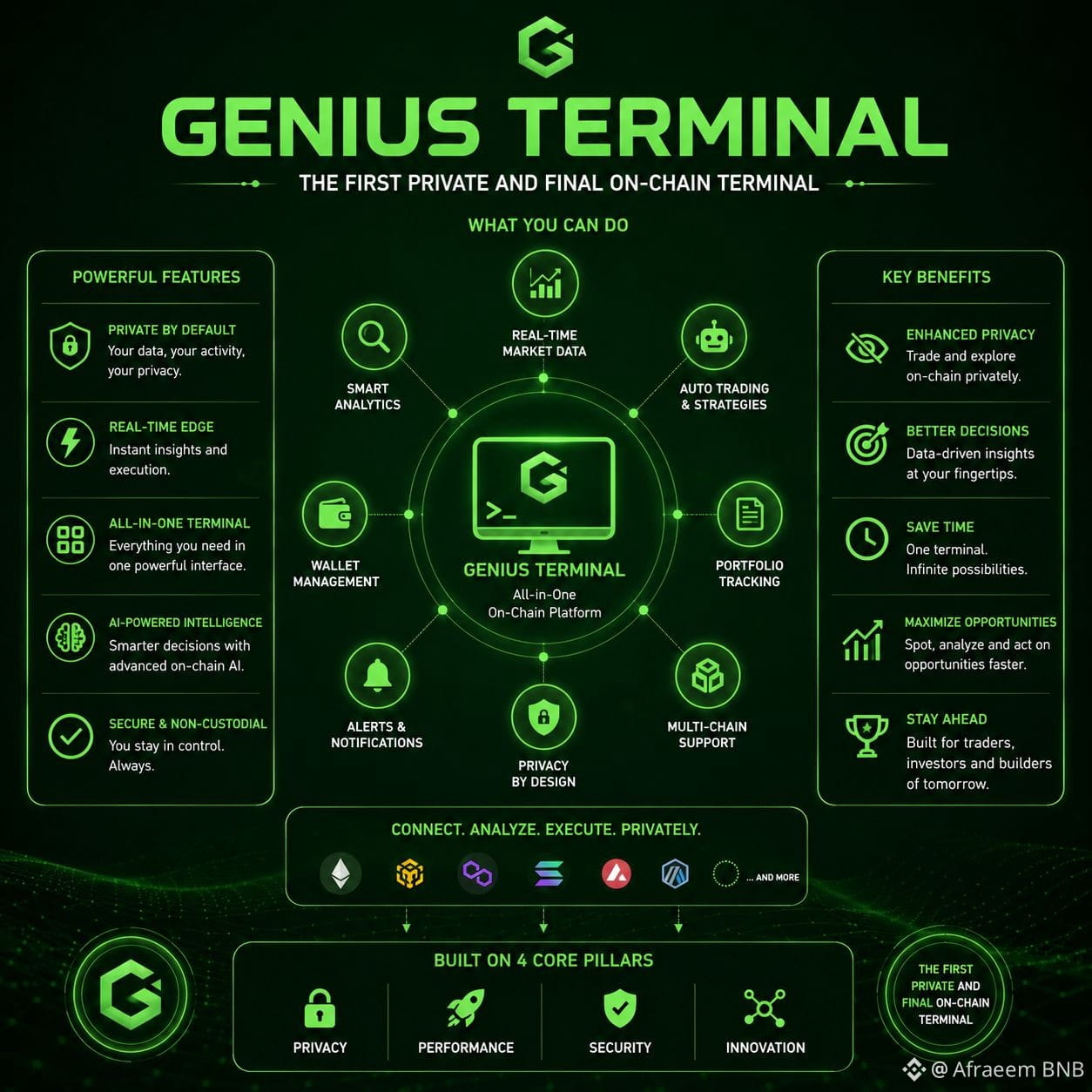
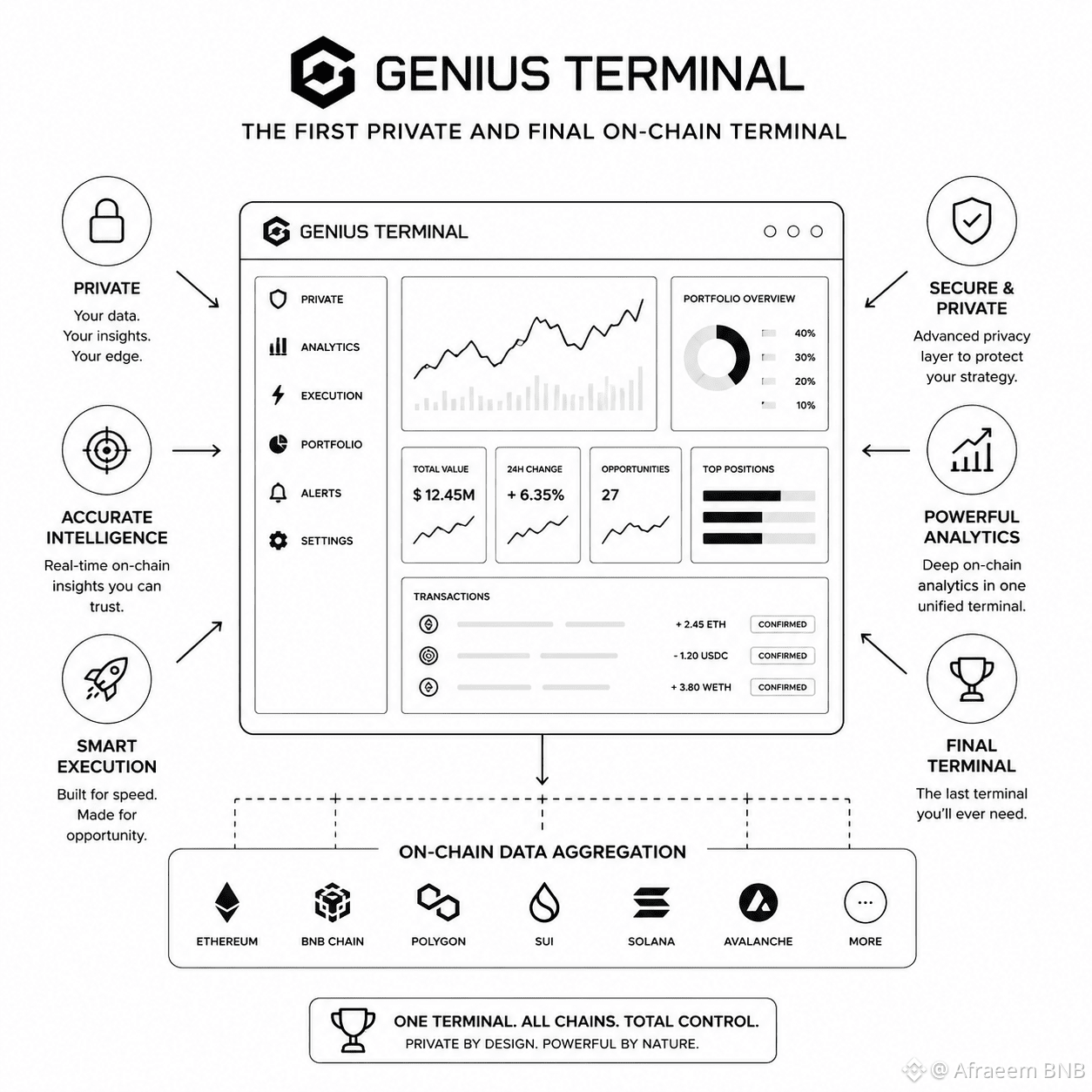
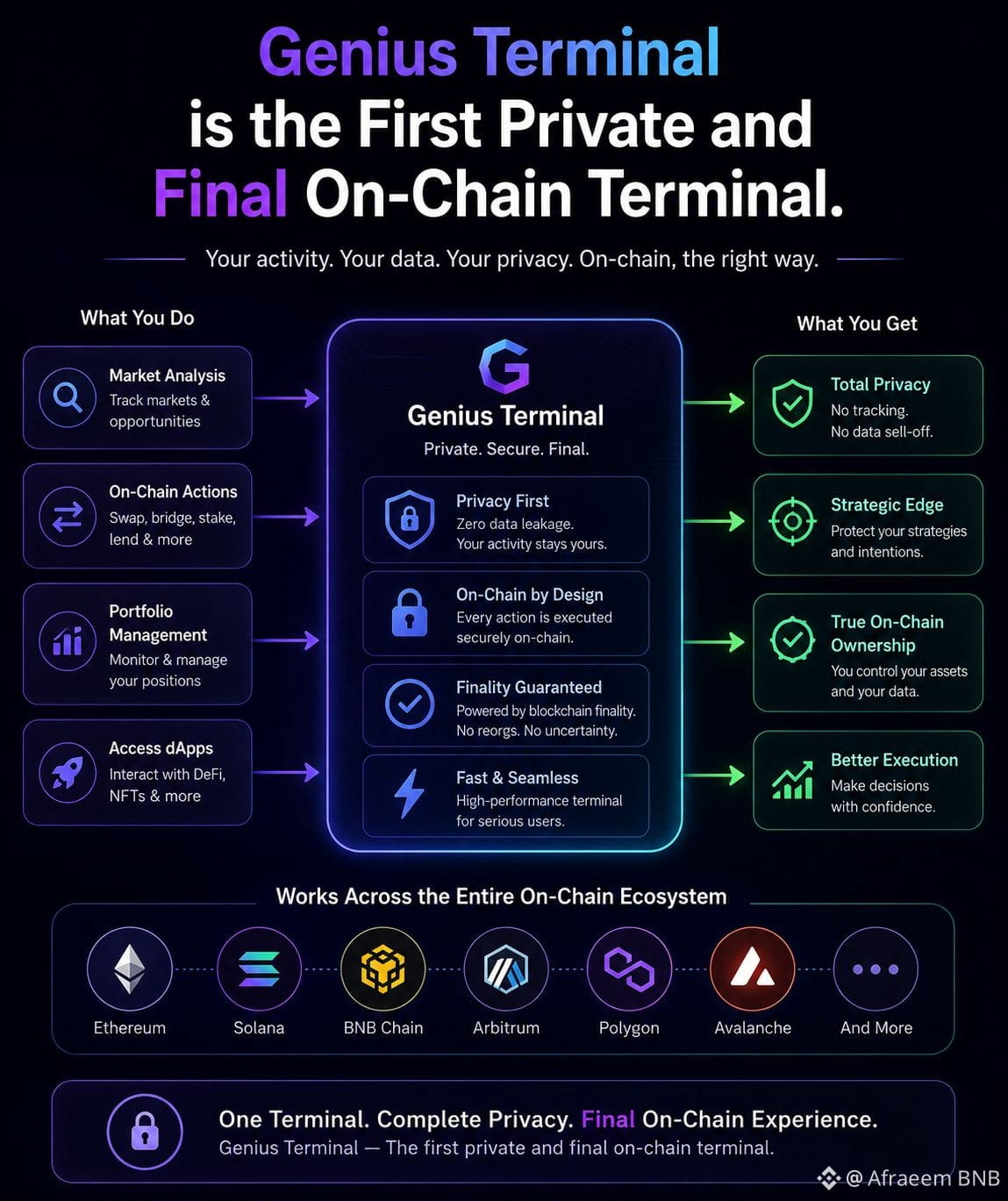
In a crypto world crowded with dashboards, bots, and fragmented tools, Genius Terminal aims to redefine how users interact with blockchain networks. Marketed as the first private and final on-chain terminal, it brings trading, analytics, automation, and on-chain intelligence into a single streamlined experience.
Privacy has become one of the most valuable assets in decentralized finance. Genius Terminal focuses on giving users access to powerful on-chain insights while maintaining greater control over their activity and data. Instead of switching between multiple platforms, traders and investors can access essential blockchain information from one terminal.
The vision is simple: make blockchain interaction faster, smarter, and more efficient. Whether tracking market trends, discovering opportunities, or managing on-chain activity, Genius Terminal seeks to provide the tools needed in a rapidly evolving crypto ecosystem.
As Web3 adoption grows, platforms that combine privacy, speed, and intelligence could become increasingly important. Genius Terminal is positioning itself as a solution for users who want a more advanced and unified on-chain experience.
What do you think? Could private on-chain terminals become the future of crypto trading and analytics?
#genius $GENIUS
$GENIUS Terminal: The First Private and Final On-Chain Terminal
In a crypto world crowded with dashboards, bots, and fragmented tools, Genius Terminal aims to redefine how users interact with blockchain networks. Marketed as the first private and final on-chain terminal, it brings trading, analytics, automation, and on-chain intelligence into a single streamlined experience.
Privacy has become one of the most valuable assets in decentralized finance. Genius Terminal focuses on giving users access to powerful on-chain insights while maintaining greater control over their activity and data. Instead of switching between multiple platforms, traders and investors can access essential blockchain information from one terminal.
The vision is simple: make blockchain interaction faster, smarter, and more efficient. Whether tracking market trends, discovering opportunities, or managing on-chain activity, Genius Terminal seeks to provide the tools needed in a rapidly evolving crypto ecosystem.
As Web3 adoption grows, platforms that combine privacy, speed, and intelligence could become increasingly important. Genius Terminal is positioning itself as a solution for users who want a more advanced and unified on-chain experience.
What do you think? Could private on-chain terminals become the future of crypto trading and analytics?
$GENIUS Terminal: The First Private and Final On-Chain Terminal
In a crypto world crowded with dashboards, bots, and fragmented tools, Genius Terminal aims to redefine how users interact with blockchain networks. Marketed as the first private and final on-chain terminal, it brings trading, analytics, automation, and on-chain intelligence into a single streamlined experience.
Privacy has become one of the most valuable assets in decentralized finance. Genius Terminal focuses on giving users access to powerful on-chain insights while maintaining greater control over their activity and data. Instead of switching between multiple platforms, traders and investors can access essential blockchain information from one terminal.
The vision is simple: make blockchain interaction faster, smarter, and more efficient. Whether tracking market trends, discovering opportunities, or managing on-chain activity, Genius Terminal seeks to provide the tools needed in a rapidly evolving crypto ecosystem.
As Web3 adoption grows, platforms that combine privacy, speed, and intelligence could become increasingly important. Genius Terminal is positioning itself as a solution for users who want a more advanced and unified on-chain experience.
What do you think? Could private on-chain terminals become the future of crypto trading and analytics?
137
·
--
#genius $GENIUS
Genius Terminal: The Future of Private On-Chain Trading
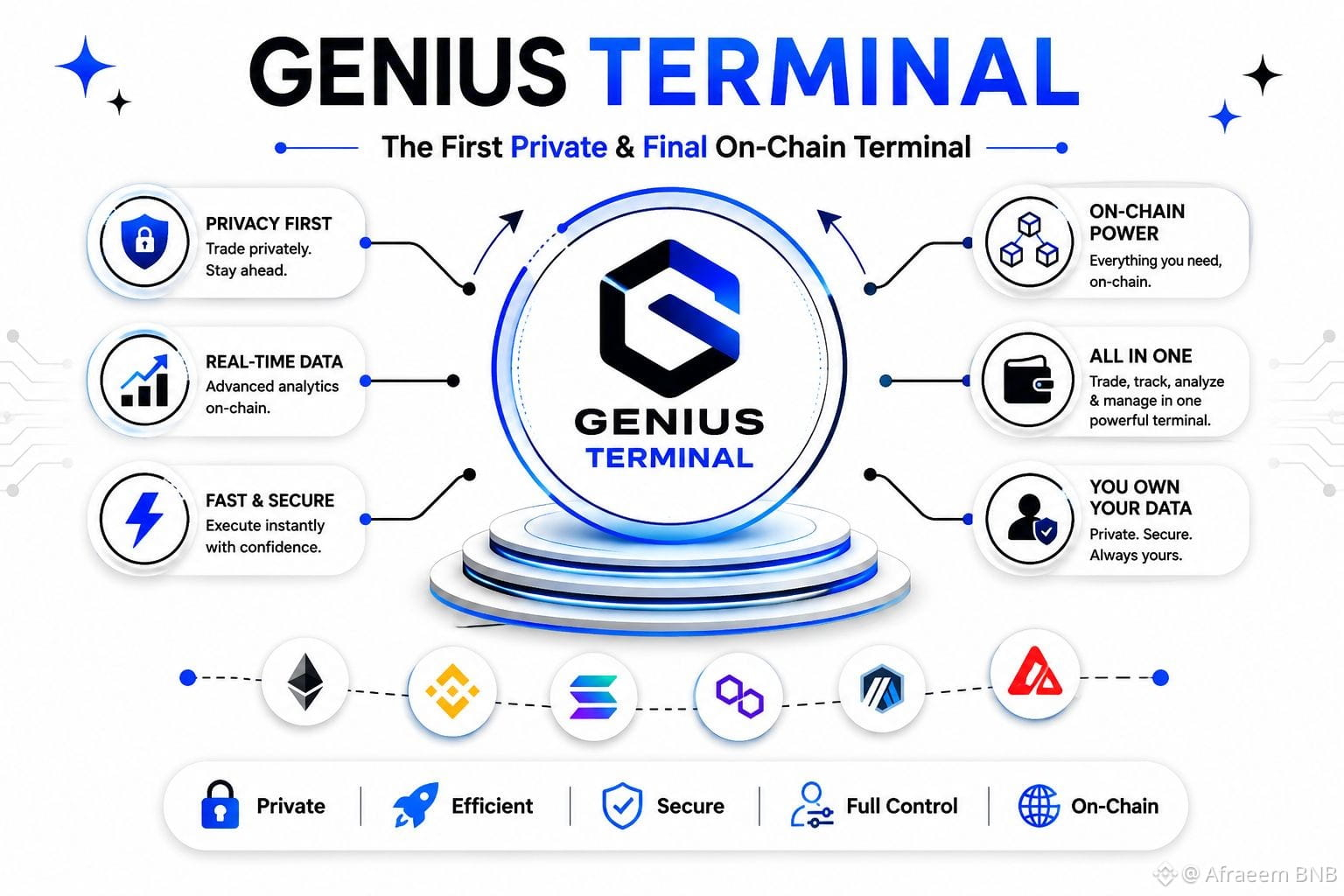
In a crypto market where transparency often comes at the cost of privacy, Genius Terminal is introducing a different approach. Known as the first private and final on-chain terminal, it aims to give traders and investors a more secure way to interact with blockchain networks without sacrificing efficiency.
The idea behind Genius Terminal is simple: provide a powerful platform where users can access on-chain data, execute transactions, and manage assets while maintaining greater privacy. As blockchain adoption grows, concerns around wallet tracking, front-running, and public transaction visibility continue to increase. Genius Terminal seeks to address these challenges by creating a more user-focused trading environment.
What makes the project interesting is its focus on combining advanced analytics, seamless execution, and privacy-first infrastructure into a single terminal. Instead of jumping between multiple tools, users can potentially manage their entire on-chain workflow from one place.
While the crypto space is full of ambitious promises, privacy remains one of the industry's biggest unmet needs. If Genius Terminal can deliver on its vision, it could become an important tool for traders who value both performance and discretion.
Privacy. Efficiency. Control. That’s the vision driving Genius Terminal forward.
#genius $GENIUS
Genius Terminal: The Future of Private On-Chain Trading
In a crypto market where transparency often comes at the cost of privacy, Genius Terminal is introducing a different approach. Known as the first private and final on-chain terminal, it aims to give traders and investors a more secure way to interact with blockchain networks without sacrificing efficiency.
The idea behind Genius Terminal is simple: provide a powerful platform where users can access on-chain data, execute transactions, and manage assets while maintaining greater privacy. As blockchain adoption grows, concerns around wallet tracking, front-running, and public transaction visibility continue to increase. Genius Terminal seeks to address these challenges by creating a more user-focused trading environment.
What makes the project interesting is its focus on combining advanced analytics, seamless execution, and privacy-first infrastructure into a single terminal. Instead of jumping between multiple tools, users can potentially manage their entire on-chain workflow from one place.
While the crypto space is full of ambitious promises, privacy remains one of the industry's biggest unmet needs. If Genius Terminal can deliver on its vision, it could become an important tool for traders who value both performance and discretion.
Privacy. Efficiency. Control. That’s the vision driving Genius Terminal forward.
Genius Terminal: The Future of Private On-Chain Trading
In a crypto market where transparency often comes at the cost of privacy, Genius Terminal is introducing a different approach. Known as the first private and final on-chain terminal, it aims to give traders and investors a more secure way to interact with blockchain networks without sacrificing efficiency.
The idea behind Genius Terminal is simple: provide a powerful platform where users can access on-chain data, execute transactions, and manage assets while maintaining greater privacy. As blockchain adoption grows, concerns around wallet tracking, front-running, and public transaction visibility continue to increase. Genius Terminal seeks to address these challenges by creating a more user-focused trading environment.
What makes the project interesting is its focus on combining advanced analytics, seamless execution, and privacy-first infrastructure into a single terminal. Instead of jumping between multiple tools, users can potentially manage their entire on-chain workflow from one place.
While the crypto space is full of ambitious promises, privacy remains one of the industry's biggest unmet needs. If Genius Terminal can deliver on its vision, it could become an important tool for traders who value both performance and discretion.
Privacy. Efficiency. Control. That’s the vision driving Genius Terminal forward.
136
·
--
#genius $GENIUS
Genius Terminal: The First Private and Final On-Chain Terminal
In a crypto market flooded with dashboards, bots, and analytics platforms, Genius Terminal is taking a different approach. Built as the first private and final on-chain terminal, it aims to give traders and researchers a powerful environment where blockchain data, market intelligence, and execution tools come together in one streamlined experience.
The vision is simple: reduce noise, increase efficiency, and help users make faster, smarter decisions. Instead of jumping between multiple platforms, Genius Terminal focuses on providing a unified command center for navigating the on-chain economy.
As blockchain ecosystems become more complex, the demand for privacy, speed, and actionable insights continues to grow. Projects that can simplify information while maintaining user control may play an important role in the next phase of crypto adoption.
Whether you're tracking trends, analyzing opportunities, or exploring emerging ecosystems, Genius Terminal is positioning itself as a tool designed for the future of on-chain intelligence.
#genius $GENIUS
Genius Terminal: The First Private and Final On-Chain Terminal
In a crypto market flooded with dashboards, bots, and analytics platforms, Genius Terminal is taking a different approach. Built as the first private and final on-chain terminal, it aims to give traders and researchers a powerful environment where blockchain data, market intelligence, and execution tools come together in one streamlined experience.
The vision is simple: reduce noise, increase efficiency, and help users make faster, smarter decisions. Instead of jumping between multiple platforms, Genius Terminal focuses on providing a unified command center for navigating the on-chain economy.
As blockchain ecosystems become more complex, the demand for privacy, speed, and actionable insights continues to grow. Projects that can simplify information while maintaining user control may play an important role in the next phase of crypto adoption.
Whether you're tracking trends, analyzing opportunities, or exploring emerging ecosystems, Genius Terminal is positioning itself as a tool designed for the future of on-chain intelligence.
Genius Terminal: The First Private and Final On-Chain Terminal
In a crypto market flooded with dashboards, bots, and analytics platforms, Genius Terminal is taking a different approach. Built as the first private and final on-chain terminal, it aims to give traders and researchers a powerful environment where blockchain data, market intelligence, and execution tools come together in one streamlined experience.
The vision is simple: reduce noise, increase efficiency, and help users make faster, smarter decisions. Instead of jumping between multiple platforms, Genius Terminal focuses on providing a unified command center for navigating the on-chain economy.
As blockchain ecosystems become more complex, the demand for privacy, speed, and actionable insights continues to grow. Projects that can simplify information while maintaining user control may play an important role in the next phase of crypto adoption.
Whether you're tracking trends, analyzing opportunities, or exploring emerging ecosystems, Genius Terminal is positioning itself as a tool designed for the future of on-chain intelligence.
123
·
--
#genius $GENIUS
Genius Terminal: The First Private and Final On-Chain Terminal
In a crypto industry crowded with dashboards, analytics tools, and trading platforms, very few products attempt to redefine how users interact with blockchain networks. Genius Terminal is positioning itself as something different — a platform that aims to become the first private and final on-chain terminal, bringing together data, intelligence, and execution into a single environment.
The idea behind Genius Terminal is simple but ambitious. Most crypto users today rely on multiple tools to complete their workflow. They use one platform for market analysis, another for wallet tracking, a third for discovering opportunities, and yet another for executing transactions. This fragmented experience often leads to inefficiency, information overload, and missed opportunities.
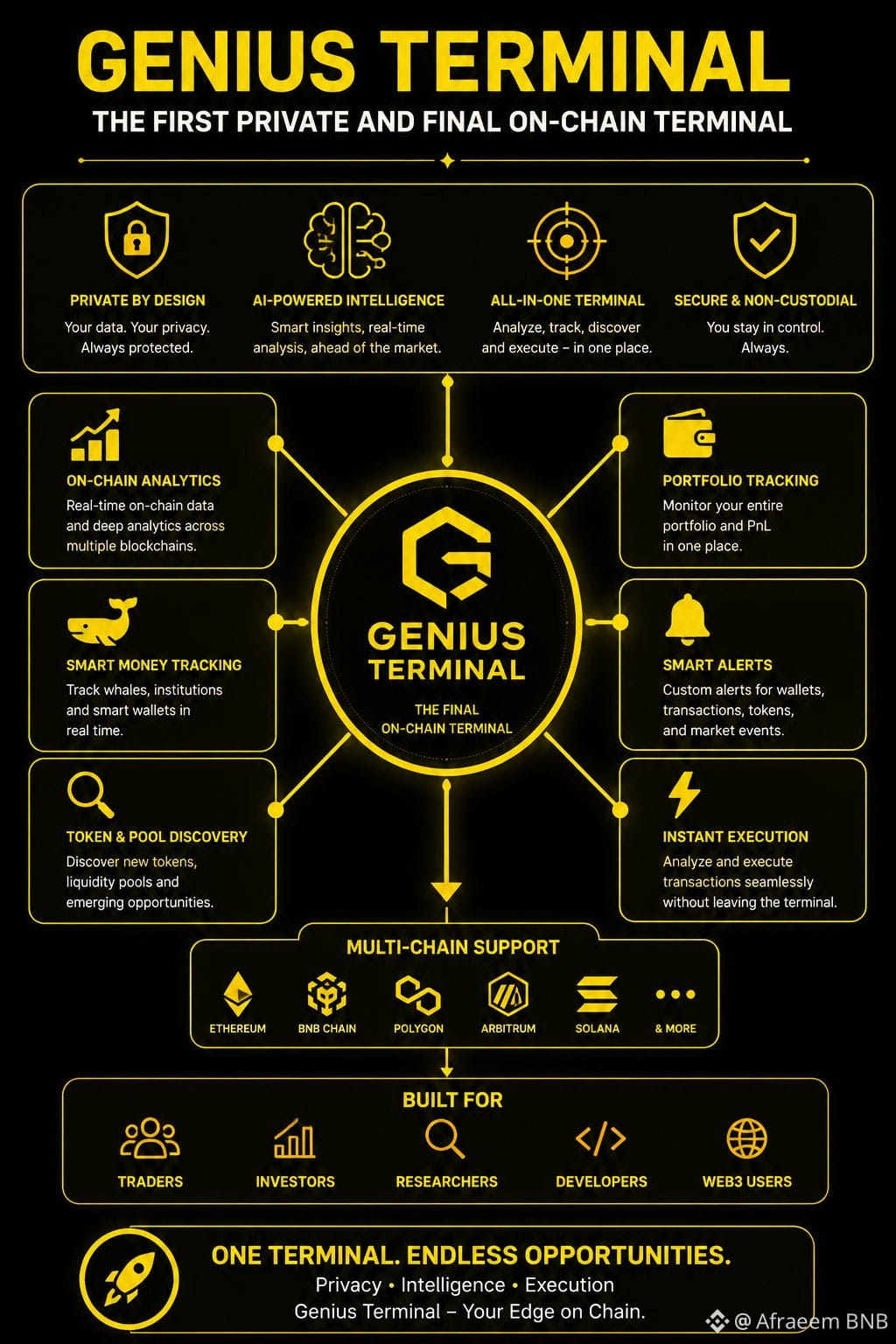
Genius Terminal seeks to solve this problem by creating a unified ecosystem where users can monitor on-chain activity, analyze trends, track smart money movements, and execute decisions without constantly switching between different applications. The goal is to provide everything needed for on-chain intelligence in one place.
What makes the project particularly interesting is its emphasis on privacy. As blockchain activity becomes increasingly transparent, many users are looking for ways to access insights and manage strategies without exposing unnecessary information. Genius Terminal aims to provide powerful analytics while maintaining a stronger focus on user privacy and security.
Another key aspect of the platform is the use of advanced intelligence systems. Modern crypto markets move at incredible speed, making it difficult for individual users to process large amounts of data manually. By integrating intelligent tools and automated analysis, Genius Terminal hopes to help users identify trends, detect opportunities, and make better-informed decisions before the broader market reacts.
#genius $GENIUS
Genius Terminal: The First Private and Final On-Chain Terminal
In a crypto industry crowded with dashboards, analytics tools, and trading platforms, very few products attempt to redefine how users interact with blockchain networks. Genius Terminal is positioning itself as something different — a platform that aims to become the first private and final on-chain terminal, bringing together data, intelligence, and execution into a single environment.
The idea behind Genius Terminal is simple but ambitious. Most crypto users today rely on multiple tools to complete their workflow. They use one platform for market analysis, another for wallet tracking, a third for discovering opportunities, and yet another for executing transactions. This fragmented experience often leads to inefficiency, information overload, and missed opportunities.
Genius Terminal seeks to solve this problem by creating a unified ecosystem where users can monitor on-chain activity, analyze trends, track smart money movements, and execute decisions without constantly switching between different applications. The goal is to provide everything needed for on-chain intelligence in one place.
What makes the project particularly interesting is its emphasis on privacy. As blockchain activity becomes increasingly transparent, many users are looking for ways to access insights and manage strategies without exposing unnecessary information. Genius Terminal aims to provide powerful analytics while maintaining a stronger focus on user privacy and security.
Another key aspect of the platform is the use of advanced intelligence systems. Modern crypto markets move at incredible speed, making it difficult for individual users to process large amounts of data manually. By integrating intelligent tools and automated analysis, Genius Terminal hopes to help users identify trends, detect opportunities, and make better-informed decisions before the broader market reacts.
Genius Terminal: The First Private and Final On-Chain Terminal
In a crypto industry crowded with dashboards, analytics tools, and trading platforms, very few products attempt to redefine how users interact with blockchain networks. Genius Terminal is positioning itself as something different — a platform that aims to become the first private and final on-chain terminal, bringing together data, intelligence, and execution into a single environment.
The idea behind Genius Terminal is simple but ambitious. Most crypto users today rely on multiple tools to complete their workflow. They use one platform for market analysis, another for wallet tracking, a third for discovering opportunities, and yet another for executing transactions. This fragmented experience often leads to inefficiency, information overload, and missed opportunities.
Genius Terminal seeks to solve this problem by creating a unified ecosystem where users can monitor on-chain activity, analyze trends, track smart money movements, and execute decisions without constantly switching between different applications. The goal is to provide everything needed for on-chain intelligence in one place.
What makes the project particularly interesting is its emphasis on privacy. As blockchain activity becomes increasingly transparent, many users are looking for ways to access insights and manage strategies without exposing unnecessary information. Genius Terminal aims to provide powerful analytics while maintaining a stronger focus on user privacy and security.
Another key aspect of the platform is the use of advanced intelligence systems. Modern crypto markets move at incredible speed, making it difficult for individual users to process large amounts of data manually. By integrating intelligent tools and automated analysis, Genius Terminal hopes to help users identify trends, detect opportunities, and make better-informed decisions before the broader market reacts.
110
·
--
#openledger $OPEN
Most AI + crypto projects focus on hype. OpenLedger seems focused on something less exciting—but potentially far more important.
The real challenge isn't creating another AI narrative. It's creating trust.
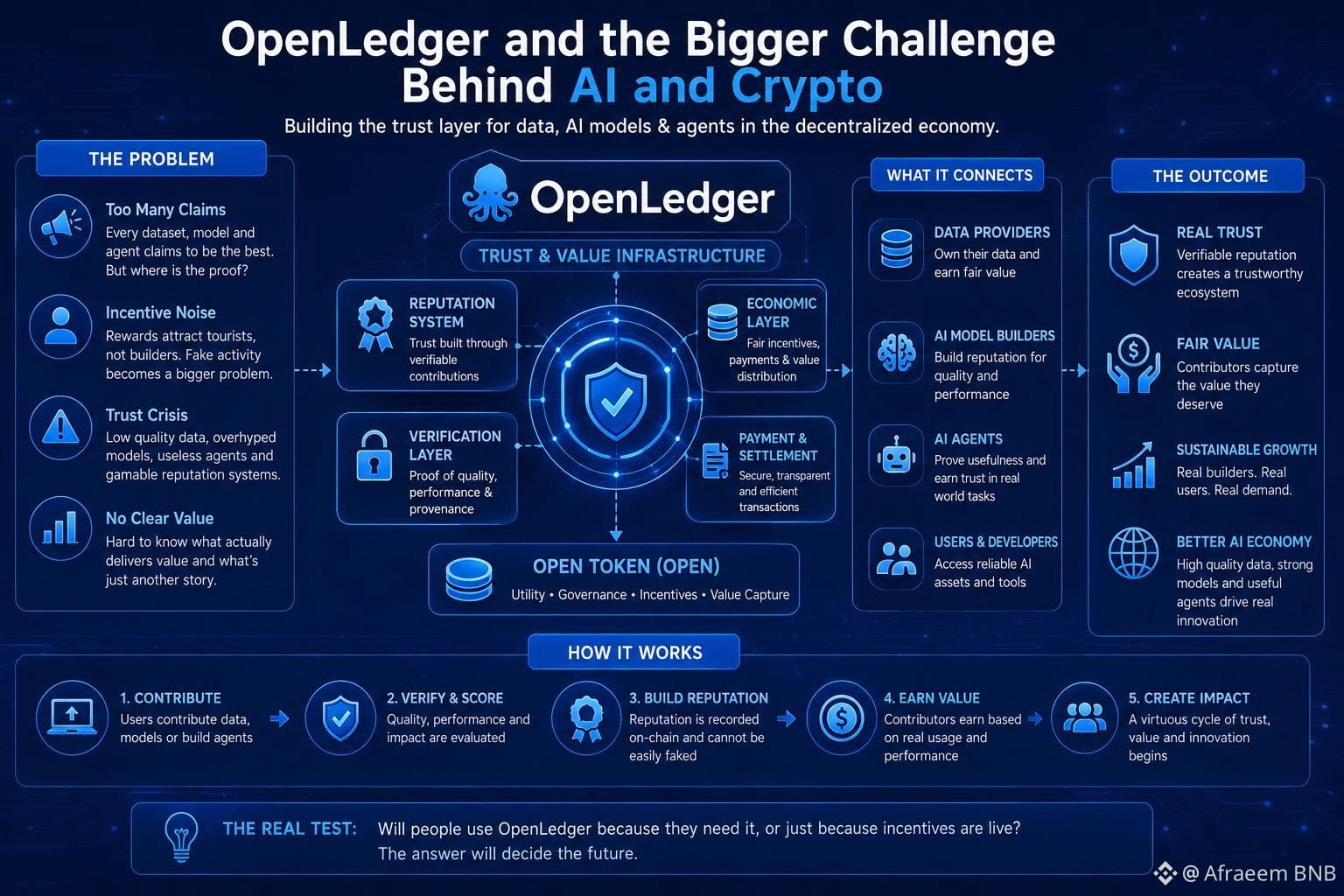
Today, anyone can claim their dataset is valuable, their AI model is powerful, or their agent can solve real problems. But where is the proof? How do users know what's actually worth paying for?
That's the problem OpenLedger is trying to solve.
By building systems for reputation, attribution, verification, and value tracking, OpenLedger aims to create an ecosystem where contributions can be measured instead of simply marketed.
Of course, the challenge is huge.
Crypto incentives often attract people chasing rewards rather than creating value. Reputation systems can be manipulated. Adoption can be difficult. And infrastructure projects rarely get the same attention as flashy narratives.
But the problem itself is real.
AI needs better trust mechanisms. Data creators deserve fair value. Model builders need credible reputations. Agents need proof of performance.
The future success of OpenLedger won't be determined by branding or buzzwords. It will be determined by behavior.
Are people using it because they need it?
Are AI assets earning value because they perform?
Is trust being created in a way that survives after the hype fades?
Those are the questions that matter.
OpenLedger isn't promising shortcuts. It's attempting to build the foundation that AI and crypto may eventually need.
And sometimes the most important innovation isn't what everyone is talking about—it's the infrastructure quietly making everything work.
#openledger $OPEN
Most AI + crypto projects focus on hype. OpenLedger seems focused on something less exciting—but potentially far more important.
The real challenge isn't creating another AI narrative. It's creating trust.
Today, anyone can claim their dataset is valuable, their AI model is powerful, or their agent can solve real problems. But where is the proof? How do users know what's actually worth paying for?
That's the problem OpenLedger is trying to solve.
By building systems for reputation, attribution, verification, and value tracking, OpenLedger aims to create an ecosystem where contributions can be measured instead of simply marketed.
Of course, the challenge is huge.
Crypto incentives often attract people chasing rewards rather than creating value. Reputation systems can be manipulated. Adoption can be difficult. And infrastructure projects rarely get the same attention as flashy narratives.
But the problem itself is real.
AI needs better trust mechanisms. Data creators deserve fair value. Model builders need credible reputations. Agents need proof of performance.
The future success of OpenLedger won't be determined by branding or buzzwords. It will be determined by behavior.
Are people using it because they need it?
Are AI assets earning value because they perform?
Is trust being created in a way that survives after the hype fades?
Those are the questions that matter.
OpenLedger isn't promising shortcuts. It's attempting to build the foundation that AI and crypto may eventually need.
And sometimes the most important innovation isn't what everyone is talking about—it's the infrastructure quietly making everything work.
Most AI + crypto projects focus on hype. OpenLedger seems focused on something less exciting—but potentially far more important.
The real challenge isn't creating another AI narrative. It's creating trust.
Today, anyone can claim their dataset is valuable, their AI model is powerful, or their agent can solve real problems. But where is the proof? How do users know what's actually worth paying for?
That's the problem OpenLedger is trying to solve.
By building systems for reputation, attribution, verification, and value tracking, OpenLedger aims to create an ecosystem where contributions can be measured instead of simply marketed.
Of course, the challenge is huge.
Crypto incentives often attract people chasing rewards rather than creating value. Reputation systems can be manipulated. Adoption can be difficult. And infrastructure projects rarely get the same attention as flashy narratives.
But the problem itself is real.
AI needs better trust mechanisms. Data creators deserve fair value. Model builders need credible reputations. Agents need proof of performance.
The future success of OpenLedger won't be determined by branding or buzzwords. It will be determined by behavior.
Are people using it because they need it?
Are AI assets earning value because they perform?
Is trust being created in a way that survives after the hype fades?
Those are the questions that matter.
OpenLedger isn't promising shortcuts. It's attempting to build the foundation that AI and crypto may eventually need.
And sometimes the most important innovation isn't what everyone is talking about—it's the infrastructure quietly making everything work.
133
·
--
Article
OpenLedger and the Bigger Challenge Behind AI and CryptoOpenLedger is one of those projects that makes me cautious rather than excited. In crypto, some of the biggest mistakes come from celebrating an idea before it has proven itself. The vision sounds straightforward: create a system where data, AI models, and autonomous agents can have ownership, reputation, and economic value attached to them. In reality, that challenge is anything but simple.
The crypto industry has seen this pattern many times.
A new trend emerges, attention floods in, and users begin chasing whatever incentives are available. Testnets, points, rewards, badges, and engagement campaigns attract massive participation. Later, projects discover that much of that activity came from people interested only in rewards, not from genuine users who believed in the product.
This is the environment OpenLedger must navigate.
Artificial intelligence already faces a trust problem. Every platform claims to have powerful models. Every dataset is advertised as valuable. Every AI agent promises productivity and efficiency. Yet very few systems provide a reliable way to verify those claims. How do we know which models truly perform? Which datasets actually deliver value? Which AI agents can consistently produce useful results?
That is where OpenLedger becomes interesting.
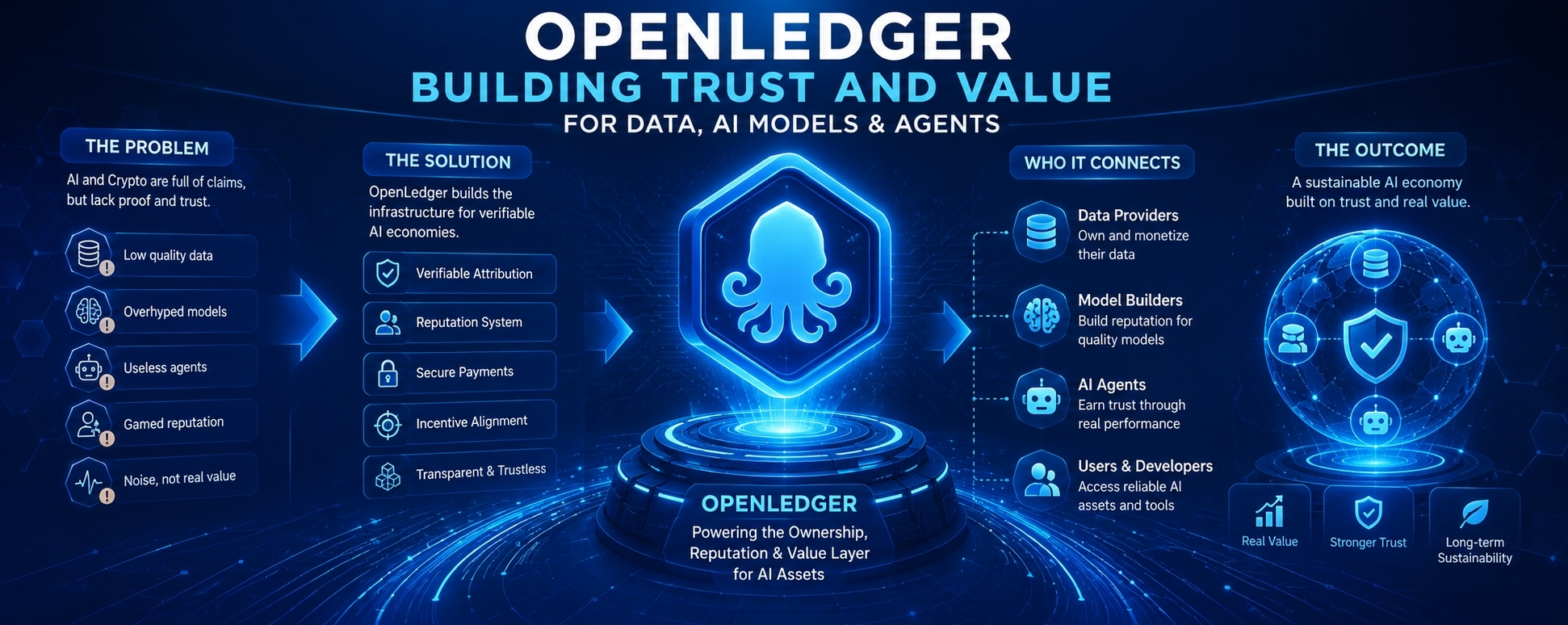
Instead of focusing on flashy AI marketing, it appears to be tackling the underlying infrastructure. The difficult work involves creating reputation systems, verification mechanisms, economic incentives, and payment networks that continue functioning even when users attempt to exploit them.
This is not the glamorous side of AI.
It is the foundation that supports everything else.
What makes OpenLedger stand out is that it is not simply presenting itself as another “AI blockchain.” That label has become common across the industry. The more important question is whether the platform can create an environment where AI-related assets are trustworthy enough for people to use, value, and pay for.
Trust remains one of the biggest weaknesses in today's AI ecosystem.
Datasets can be inaccurate. Models can be overrated. AI agents can look impressive in demonstrations while delivering little real-world value. Reputation systems can be manipulated. And in crypto, participants are often highly motivated to exploit any system that offers rewards.
Because of that, OpenLedger faces a significant challenge.
It must demonstrate that network activity represents genuine contribution rather than empty engagement. It must show that participants are creating measurable value. Most importantly, it must prove that the OPEN token serves a meaningful purpose within the ecosystem instead of existing solely for speculation.
That distinction is critical.
Many projects launch tokens first and spend years searching for a practical reason for them to exist. Sustainable value usually comes from utility, not from hype alone.
The opportunity OpenLedger is pursuing is certainly real. AI developers need better attribution systems. Data contributors deserve methods for capturing the value they create. Model builders need reputations that accurately reflect performance. AI agents require verifiable proof of usefulness rather than marketing claims.
However, transforming these needs into a functioning marketplace is extremely difficult.
Infrastructure projects often face a unique challenge. People agree that better systems are necessary, but adoption becomes difficult if those systems introduce complexity. Even a strong solution can struggle if builders find it inconvenient to use.
That remains one of the biggest risks.
Still, the motivation behind OpenLedger makes sense. Both crypto and AI suffer from a similar problem: an abundance of promises and a shortage of proof. OpenLedger appears to be focused on reducing that gap by creating mechanisms that measure trust, track contributions, and assign value more effectively.
Whether it succeeds remains uncertain.
The true evaluation will not come from marketing campaigns or industry narratives. It will come from behavior. Are users participating because they genuinely need the platform, or simply because incentives exist? Are AI models generating value because they perform well, or because they fit a popular story? Are agents building reputations that remain meaningful after market excitement fades?
Those questions will reveal the reality.
Not the branding.
Not the buzzwords.
The actual behavior of the network.
OpenLedger should not be viewed as a guaranteed success. Instead, it is a project attempting to solve a fundamental infrastructure problem that many people overlook until the system begins to fail. The work may be less exciting than the latest AI trend, but infrastructure often becomes the most important part when everything else depends on it.
The only thing that matters is whether it delivers on that promise.
@Openledger #OpenLedger $OPEN
OpenLedger and the Bigger Challenge Behind AI and Crypto
OpenLedger is one of those projects that makes me cautious rather than excited. In crypto, some of the biggest mistakes come from celebrating an idea before it has proven itself. The vision sounds straightforward: create a system where data, AI models, and autonomous agents can have ownership, reputation, and economic value attached to them. In reality, that challenge is anything but simple.
The crypto industry has seen this pattern many times.
A new trend emerges, attention floods in, and users begin chasing whatever incentives are available. Testnets, points, rewards, badges, and engagement campaigns attract massive participation. Later, projects discover that much of that activity came from people interested only in rewards, not from genuine users who believed in the product.
This is the environment OpenLedger must navigate.
Artificial intelligence already faces a trust problem. Every platform claims to have powerful models. Every dataset is advertised as valuable. Every AI agent promises productivity and efficiency. Yet very few systems provide a reliable way to verify those claims. How do we know which models truly perform? Which datasets actually deliver value? Which AI agents can consistently produce useful results?
That is where OpenLedger becomes interesting.
Instead of focusing on flashy AI marketing, it appears to be tackling the underlying infrastructure. The difficult work involves creating reputation systems, verification mechanisms, economic incentives, and payment networks that continue functioning even when users attempt to exploit them.
This is not the glamorous side of AI.
It is the foundation that supports everything else.
What makes OpenLedger stand out is that it is not simply presenting itself as another “AI blockchain.” That label has become common across the industry. The more important question is whether the platform can create an environment where AI-related assets are trustworthy enough for people to use, value, and pay for.
Trust remains one of the biggest weaknesses in today's AI ecosystem.
Datasets can be inaccurate. Models can be overrated. AI agents can look impressive in demonstrations while delivering little real-world value. Reputation systems can be manipulated. And in crypto, participants are often highly motivated to exploit any system that offers rewards.
Because of that, OpenLedger faces a significant challenge.
It must demonstrate that network activity represents genuine contribution rather than empty engagement. It must show that participants are creating measurable value. Most importantly, it must prove that the OPEN token serves a meaningful purpose within the ecosystem instead of existing solely for speculation.
That distinction is critical.
Many projects launch tokens first and spend years searching for a practical reason for them to exist. Sustainable value usually comes from utility, not from hype alone.
The opportunity OpenLedger is pursuing is certainly real. AI developers need better attribution systems. Data contributors deserve methods for capturing the value they create. Model builders need reputations that accurately reflect performance. AI agents require verifiable proof of usefulness rather than marketing claims.
However, transforming these needs into a functioning marketplace is extremely difficult.
Infrastructure projects often face a unique challenge. People agree that better systems are necessary, but adoption becomes difficult if those systems introduce complexity. Even a strong solution can struggle if builders find it inconvenient to use.
That remains one of the biggest risks.
Still, the motivation behind OpenLedger makes sense. Both crypto and AI suffer from a similar problem: an abundance of promises and a shortage of proof. OpenLedger appears to be focused on reducing that gap by creating mechanisms that measure trust, track contributions, and assign value more effectively.
Whether it succeeds remains uncertain.
The true evaluation will not come from marketing campaigns or industry narratives. It will come from behavior. Are users participating because they genuinely need the platform, or simply because incentives exist? Are AI models generating value because they perform well, or because they fit a popular story? Are agents building reputations that remain meaningful after market excitement fades?
Those questions will reveal the reality.
Not the branding.
Not the buzzwords.
The actual behavior of the network.
OpenLedger should not be viewed as a guaranteed success. Instead, it is a project attempting to solve a fundamental infrastructure problem that many people overlook until the system begins to fail. The work may be less exciting than the latest AI trend, but infrastructure often becomes the most important part when everything else depends on it.
The only thing that matters is whether it delivers on that promise.
@OpenLedger #OpenLedger $OPEN
The crypto industry has seen this pattern many times.
A new trend emerges, attention floods in, and users begin chasing whatever incentives are available. Testnets, points, rewards, badges, and engagement campaigns attract massive participation. Later, projects discover that much of that activity came from people interested only in rewards, not from genuine users who believed in the product.
This is the environment OpenLedger must navigate.
Artificial intelligence already faces a trust problem. Every platform claims to have powerful models. Every dataset is advertised as valuable. Every AI agent promises productivity and efficiency. Yet very few systems provide a reliable way to verify those claims. How do we know which models truly perform? Which datasets actually deliver value? Which AI agents can consistently produce useful results?
That is where OpenLedger becomes interesting.
Instead of focusing on flashy AI marketing, it appears to be tackling the underlying infrastructure. The difficult work involves creating reputation systems, verification mechanisms, economic incentives, and payment networks that continue functioning even when users attempt to exploit them.
This is not the glamorous side of AI.
It is the foundation that supports everything else.
What makes OpenLedger stand out is that it is not simply presenting itself as another “AI blockchain.” That label has become common across the industry. The more important question is whether the platform can create an environment where AI-related assets are trustworthy enough for people to use, value, and pay for.
Trust remains one of the biggest weaknesses in today's AI ecosystem.
Datasets can be inaccurate. Models can be overrated. AI agents can look impressive in demonstrations while delivering little real-world value. Reputation systems can be manipulated. And in crypto, participants are often highly motivated to exploit any system that offers rewards.
Because of that, OpenLedger faces a significant challenge.
It must demonstrate that network activity represents genuine contribution rather than empty engagement. It must show that participants are creating measurable value. Most importantly, it must prove that the OPEN token serves a meaningful purpose within the ecosystem instead of existing solely for speculation.
That distinction is critical.
Many projects launch tokens first and spend years searching for a practical reason for them to exist. Sustainable value usually comes from utility, not from hype alone.
The opportunity OpenLedger is pursuing is certainly real. AI developers need better attribution systems. Data contributors deserve methods for capturing the value they create. Model builders need reputations that accurately reflect performance. AI agents require verifiable proof of usefulness rather than marketing claims.
However, transforming these needs into a functioning marketplace is extremely difficult.
Infrastructure projects often face a unique challenge. People agree that better systems are necessary, but adoption becomes difficult if those systems introduce complexity. Even a strong solution can struggle if builders find it inconvenient to use.
That remains one of the biggest risks.
Still, the motivation behind OpenLedger makes sense. Both crypto and AI suffer from a similar problem: an abundance of promises and a shortage of proof. OpenLedger appears to be focused on reducing that gap by creating mechanisms that measure trust, track contributions, and assign value more effectively.
Whether it succeeds remains uncertain.
The true evaluation will not come from marketing campaigns or industry narratives. It will come from behavior. Are users participating because they genuinely need the platform, or simply because incentives exist? Are AI models generating value because they perform well, or because they fit a popular story? Are agents building reputations that remain meaningful after market excitement fades?
Those questions will reveal the reality.
Not the branding.
Not the buzzwords.
The actual behavior of the network.
OpenLedger should not be viewed as a guaranteed success. Instead, it is a project attempting to solve a fundamental infrastructure problem that many people overlook until the system begins to fail. The work may be less exciting than the latest AI trend, but infrastructure often becomes the most important part when everything else depends on it.
The only thing that matters is whether it delivers on that promise.
@OpenLedger #OpenLedger $OPEN
135
·
--
#genius $GENIUS
Genius Terminal Is the First Private and Final On-Chain Terminal
Most crypto tools still force users to choose between convenience and privacy. Every click, wallet interaction, and trading decision can leave a digital footprint that is visible to others. As blockchain adoption grows, the demand for privacy-focused infrastructure is becoming impossible to ignore.
This is where Genius Terminal is trying to stand out.
Rather than positioning itself as just another trading dashboard, Genius Terminal aims to become a fully private on-chain operating environment. The idea is simple but powerful: give users a place where they can analyze markets, interact with protocols, and execute on-chain actions without sacrificing privacy.
What makes the concept interesting is that privacy is no longer viewed as an optional feature. For serious traders, investors, and builders, privacy is becoming a necessity. Market participants often want to protect their strategies, research, and transaction activity from unnecessary exposure.
If Genius Terminal can successfully combine privacy, speed, and seamless blockchain interaction, it could fill a gap that many existing platforms still struggle to address.
The bigger question is execution. Crypto is full of ambitious promises, but long-term winners are usually the projects that deliver reliable products rather than the loudest marketing campaigns.
For now, Genius Terminal presents an intriguing vision: a future where users can operate on-chain with greater control, greater security, and greater privacy.
Sometimes the most important innovation isn't adding more features—it's giving users back ownership of their digital activity.
#genius $GENIUS
Genius Terminal Is the First Private and Final On-Chain Terminal
Most crypto tools still force users to choose between convenience and privacy. Every click, wallet interaction, and trading decision can leave a digital footprint that is visible to others. As blockchain adoption grows, the demand for privacy-focused infrastructure is becoming impossible to ignore.
This is where Genius Terminal is trying to stand out.
Rather than positioning itself as just another trading dashboard, Genius Terminal aims to become a fully private on-chain operating environment. The idea is simple but powerful: give users a place where they can analyze markets, interact with protocols, and execute on-chain actions without sacrificing privacy.
What makes the concept interesting is that privacy is no longer viewed as an optional feature. For serious traders, investors, and builders, privacy is becoming a necessity. Market participants often want to protect their strategies, research, and transaction activity from unnecessary exposure.
If Genius Terminal can successfully combine privacy, speed, and seamless blockchain interaction, it could fill a gap that many existing platforms still struggle to address.
The bigger question is execution. Crypto is full of ambitious promises, but long-term winners are usually the projects that deliver reliable products rather than the loudest marketing campaigns.
For now, Genius Terminal presents an intriguing vision: a future where users can operate on-chain with greater control, greater security, and greater privacy.
Sometimes the most important innovation isn't adding more features—it's giving users back ownership of their digital activity.
Genius Terminal Is the First Private and Final On-Chain Terminal
Most crypto tools still force users to choose between convenience and privacy. Every click, wallet interaction, and trading decision can leave a digital footprint that is visible to others. As blockchain adoption grows, the demand for privacy-focused infrastructure is becoming impossible to ignore.
This is where Genius Terminal is trying to stand out.
Rather than positioning itself as just another trading dashboard, Genius Terminal aims to become a fully private on-chain operating environment. The idea is simple but powerful: give users a place where they can analyze markets, interact with protocols, and execute on-chain actions without sacrificing privacy.
What makes the concept interesting is that privacy is no longer viewed as an optional feature. For serious traders, investors, and builders, privacy is becoming a necessity. Market participants often want to protect their strategies, research, and transaction activity from unnecessary exposure.
If Genius Terminal can successfully combine privacy, speed, and seamless blockchain interaction, it could fill a gap that many existing platforms still struggle to address.
The bigger question is execution. Crypto is full of ambitious promises, but long-term winners are usually the projects that deliver reliable products rather than the loudest marketing campaigns.
For now, Genius Terminal presents an intriguing vision: a future where users can operate on-chain with greater control, greater security, and greater privacy.
Sometimes the most important innovation isn't adding more features—it's giving users back ownership of their digital activity.
1
209
·
--
#openledger $OPEN
Everyone talks about AI.
Very few people talk about who actually creates the value behind it.
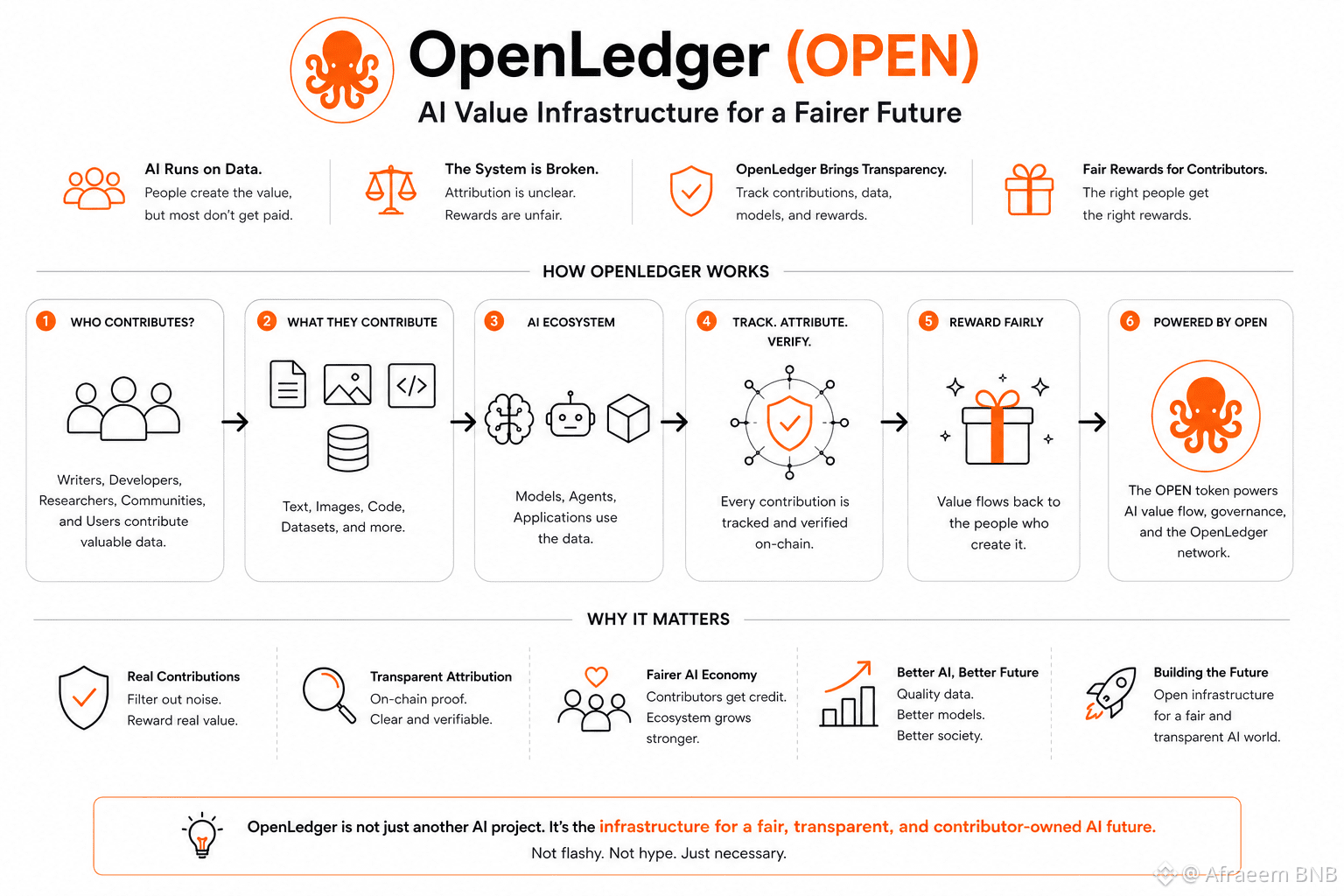
Every AI model is trained on data generated by real people—writers, researchers, developers, communities, and users. Yet most of those contributors never share in the rewards their work helps create.
That’s the problem OpenLedger is trying to solve.
Instead of building another flashy AI product, OpenLedger focuses on something less exciting but arguably more important: infrastructure.
The goal is simple in theory:
Track who contributes data
Verify where value comes from
Reward contributors fairly
Create transparency across AI systems
Sounds reasonable.
The challenge is that AI attribution is incredibly difficult. Data gets mixed together, models learn from millions of inputs, and once incentives are introduced, people inevitably try to game the system.
That’s why the real test for OpenLedger isn’t the idea.
It’s whether the network can separate genuine contributions from spam, manipulation, and low-quality activity.
Because crypto has seen this story before.
Reward systems attract builders, but they also attract farmers.
If OpenLedger can create a system where real value is recognized and rewarded, it could become an important piece of AI infrastructure.
If not, it risks becoming another project with a good narrative and weak execution.
Either way, it’s tackling a problem that deserves attention:
Who owns AI value?
Who created it?
And who should benefit from it?
The answers to those questions may become more important than the AI models themselves.
#openledger $OPEN
Everyone talks about AI.
Very few people talk about who actually creates the value behind it.
Every AI model is trained on data generated by real people—writers, researchers, developers, communities, and users. Yet most of those contributors never share in the rewards their work helps create.
That’s the problem OpenLedger is trying to solve.
Instead of building another flashy AI product, OpenLedger focuses on something less exciting but arguably more important: infrastructure.
The goal is simple in theory:
Track who contributes data
Verify where value comes from
Reward contributors fairly
Create transparency across AI systems
Sounds reasonable.
The challenge is that AI attribution is incredibly difficult. Data gets mixed together, models learn from millions of inputs, and once incentives are introduced, people inevitably try to game the system.
That’s why the real test for OpenLedger isn’t the idea.
It’s whether the network can separate genuine contributions from spam, manipulation, and low-quality activity.
Because crypto has seen this story before.
Reward systems attract builders, but they also attract farmers.
If OpenLedger can create a system where real value is recognized and rewarded, it could become an important piece of AI infrastructure.
If not, it risks becoming another project with a good narrative and weak execution.
Either way, it’s tackling a problem that deserves attention:
Who owns AI value?
Who created it?
And who should benefit from it?
The answers to those questions may become more important than the AI models themselves.
Everyone talks about AI.
Very few people talk about who actually creates the value behind it.
Every AI model is trained on data generated by real people—writers, researchers, developers, communities, and users. Yet most of those contributors never share in the rewards their work helps create.
That’s the problem OpenLedger is trying to solve.
Instead of building another flashy AI product, OpenLedger focuses on something less exciting but arguably more important: infrastructure.
The goal is simple in theory:
Track who contributes data
Verify where value comes from
Reward contributors fairly
Create transparency across AI systems
Sounds reasonable.
The challenge is that AI attribution is incredibly difficult. Data gets mixed together, models learn from millions of inputs, and once incentives are introduced, people inevitably try to game the system.
That’s why the real test for OpenLedger isn’t the idea.
It’s whether the network can separate genuine contributions from spam, manipulation, and low-quality activity.
Because crypto has seen this story before.
Reward systems attract builders, but they also attract farmers.
If OpenLedger can create a system where real value is recognized and rewarded, it could become an important piece of AI infrastructure.
If not, it risks becoming another project with a good narrative and weak execution.
Either way, it’s tackling a problem that deserves attention:
Who owns AI value?
Who created it?
And who should benefit from it?
The answers to those questions may become more important than the AI models themselves.
121
·
--
Article
OpenLedger Isn’t Exciting — And That Might Be Exactly Why It MattersMost crypto projects try to grab attention with big promises, flashy narratives, and endless hype. OpenLedger (OPEN) feels different.
In fact, it feels almost boring.
And that may be its strongest advantage.
We've all watched the same cycle repeat itself. A new trend appears, influencers start repeating the same buzzwords, and suddenly every project becomes "AI infrastructure" overnight. Investors rush in, speculation explodes, and months later most of those projects fade into irrelevance.
That is why OpenLedger caught my attention—not because it sounds revolutionary, but because it is focused on a problem that actually exists.
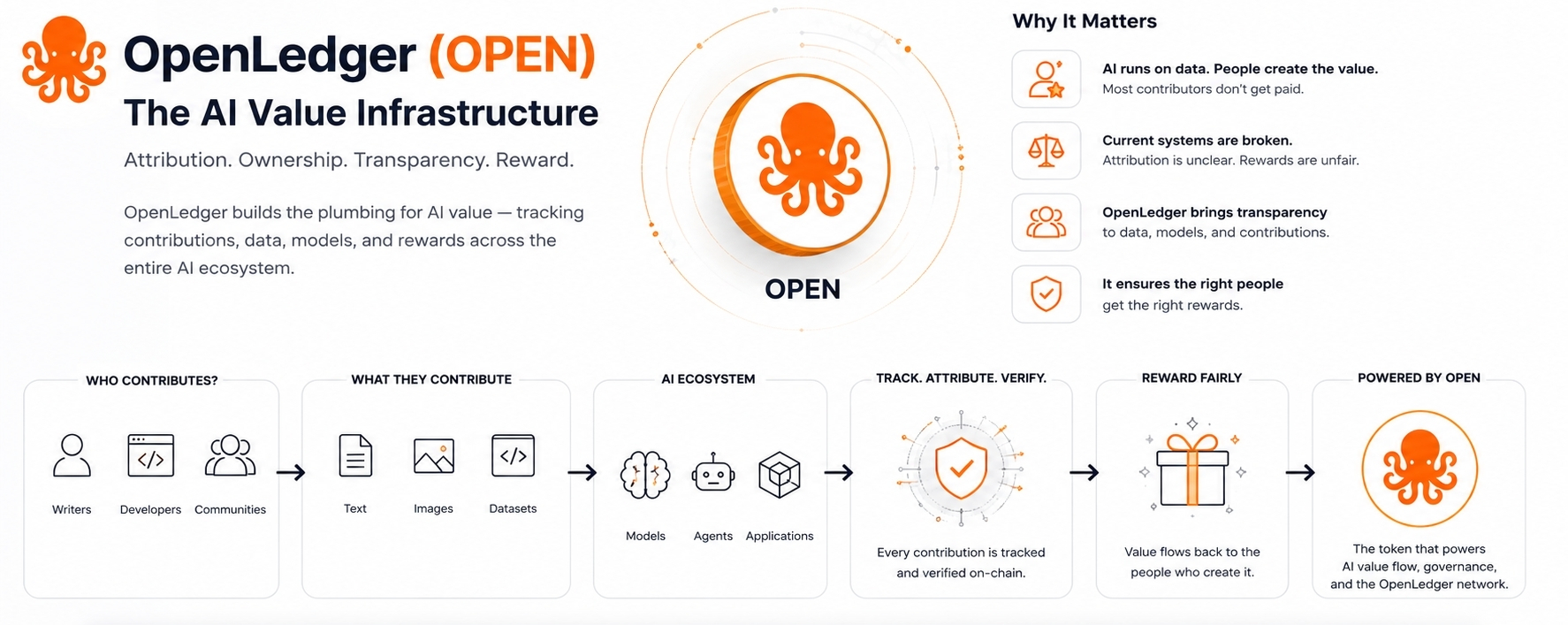
The reality is simple: AI runs on data.
Every model, agent, and application depends on information created by real people. Writers, researchers, developers, communities, moderators, and everyday users constantly generate the knowledge that powers modern AI systems.
Yet most of those contributors never receive a share of the value they help create.
Their work becomes training data.
The AI becomes more valuable.
Someone else captures the rewards.
That imbalance is becoming impossible to ignore.
Crypto has a similar problem.
Projects distribute rewards to users, but often struggle to identify who is genuinely contributing value. Airdrop farming, fake engagement, low-quality activity, and endless point systems have created ecosystems where noise frequently earns more than meaningful participation.
The loudest users get rewarded.
The most useful contributors often get overlooked.
OpenLedger is attempting to address both problems at the same time.
Its goal isn't to build another AI chatbot or launch another AI-themed token. Instead, it wants to create the infrastructure that tracks contribution, ownership, attribution, and value across AI systems.
In other words, it wants to build the plumbing.
Not the glamorous part.
The necessary part.
Questions like:
Who contributed the data?
Which models used it?
Which outputs generated value?
Who deserves compensation?
These questions sound straightforward until you try to answer them.
AI systems are incredibly complex. Data becomes mixed together, patterns are learned across millions of examples, and tracing the exact impact of a single contribution is extremely difficult.
That is where the challenge begins.
And once money enters the equation, crypto behavior follows.
People will look for shortcuts.
Some will submit low-quality content.
Others will copy existing work.
Many will attempt to exploit whatever reward system exists.
This isn't pessimism.
It's history.
Every open incentive network eventually attracts four groups: builders, users, farmers, and opportunists.
The long-term success of OpenLedger may depend on whether it can distinguish real value from manufactured activity.
Because if it cannot, the platform risks becoming just another reward machine disguised as innovation.
Despite those challenges, the underlying vision remains compelling.
AI is becoming increasingly centralized.
Data ownership remains unclear.
The value generated by models is difficult to track.
Smaller creators and developers struggle to compete with giant platforms.
Meanwhile, many of the people contributing to AI's growth remain invisible.
OpenLedger is trying to introduce accountability into that system.
That alone makes it worth watching.
However, blockchain is not a magic solution.
Recording information on-chain does not automatically make that information valuable or accurate.
Transparency is useful.
Verification is useful.
But neither can transform bad data into good data.
If someone uploads garbage, the blockchain simply creates a permanent record of garbage.
The technology works.
The data still doesn't.
That is why the real test for OpenLedger isn't the vision.
The real test comes when incentives go live and people begin pushing the system to its limits.
That is when crypto infrastructure proves whether it is truly resilient.
Not during launch announcements.
Not during community excitement.
Not during bullish market conditions.
When people become selfish.
When rewards matter.
When every loophole gets tested.
That is where the truth emerges.
The OPEN token faces a similar challenge.
Whether it's used for payments, governance, access, or rewards, the token ultimately needs genuine utility.
Crypto markets have already seen countless "utility tokens" that looked essential in theory but existed mainly for speculation.
A token should support the network.
It should not become the entire story.
Because when participants only arrive for rewards, they leave when rewards disappear.
When attention focuses solely on price action, product development becomes secondary.
And when token growth outpaces real adoption, the narrative becomes fragile.
OpenLedger cannot afford to become just another AI token riding a temporary trend.
It needs real users.
Real contributors.
Real developers.
Real demand.
Not just wallets completing tasks and waiting for the next pump.
Ironically, the least exciting parts of the project may be the most important.
The attribution engine.
The reward mechanisms.
The quality filters.
The anti-spam systems.
The developer experience.
The infrastructure nobody tweets about.
Those are the components that will determine whether OpenLedger becomes a foundational layer for AI value or simply another promising idea lost in the noise.
Maybe it succeeds.
Maybe it takes years.
Maybe the market loses patience before the infrastructure fully matures.
All of those outcomes are possible.
Crypto moves fast.
Infrastructure develops slowly.
AI remains messy.
Combining all three creates an enormous challenge.
But at least OpenLedger is attempting to solve a meaningful problem.
The invisible contributors.
The unpaid data layer.
The broken reward systems.
The difficulty of assigning value in an AI-driven world.
That doesn't make OpenLedger perfect.
It doesn't guarantee success.
But it does make it relevant.
For now, OpenLedger looks less like a shiny AI narrative and more like a set of tools designed to fix a broken foundation.
It's not glamorous.
It's not guaranteed.
But it might be necessary.
And in today's crypto market, something necessary is often far more interesting than something merely loud.
@Openledger #OpenLedger $OPEN
OpenLedger Isn’t Exciting — And That Might Be Exactly Why It Matters
Most crypto projects try to grab attention with big promises, flashy narratives, and endless hype. OpenLedger (OPEN) feels different.
In fact, it feels almost boring.
And that may be its strongest advantage.
We've all watched the same cycle repeat itself. A new trend appears, influencers start repeating the same buzzwords, and suddenly every project becomes "AI infrastructure" overnight. Investors rush in, speculation explodes, and months later most of those projects fade into irrelevance.
That is why OpenLedger caught my attention—not because it sounds revolutionary, but because it is focused on a problem that actually exists.
The reality is simple: AI runs on data.
Every model, agent, and application depends on information created by real people. Writers, researchers, developers, communities, moderators, and everyday users constantly generate the knowledge that powers modern AI systems.
Yet most of those contributors never receive a share of the value they help create.
Their work becomes training data.
The AI becomes more valuable.
Someone else captures the rewards.
That imbalance is becoming impossible to ignore.
Crypto has a similar problem.
Projects distribute rewards to users, but often struggle to identify who is genuinely contributing value. Airdrop farming, fake engagement, low-quality activity, and endless point systems have created ecosystems where noise frequently earns more than meaningful participation.
The loudest users get rewarded.
The most useful contributors often get overlooked.
OpenLedger is attempting to address both problems at the same time.
Its goal isn't to build another AI chatbot or launch another AI-themed token. Instead, it wants to create the infrastructure that tracks contribution, ownership, attribution, and value across AI systems.
In other words, it wants to build the plumbing.
Not the glamorous part.
The necessary part.
Questions like:
Who contributed the data?
Which models used it?
Which outputs generated value?
Who deserves compensation?
These questions sound straightforward until you try to answer them.
AI systems are incredibly complex. Data becomes mixed together, patterns are learned across millions of examples, and tracing the exact impact of a single contribution is extremely difficult.
That is where the challenge begins.
And once money enters the equation, crypto behavior follows.
People will look for shortcuts.
Some will submit low-quality content.
Others will copy existing work.
Many will attempt to exploit whatever reward system exists.
This isn't pessimism.
It's history.
Every open incentive network eventually attracts four groups: builders, users, farmers, and opportunists.
The long-term success of OpenLedger may depend on whether it can distinguish real value from manufactured activity.
Because if it cannot, the platform risks becoming just another reward machine disguised as innovation.
Despite those challenges, the underlying vision remains compelling.
AI is becoming increasingly centralized.
Data ownership remains unclear.
The value generated by models is difficult to track.
Smaller creators and developers struggle to compete with giant platforms.
Meanwhile, many of the people contributing to AI's growth remain invisible.
OpenLedger is trying to introduce accountability into that system.
That alone makes it worth watching.
However, blockchain is not a magic solution.
Recording information on-chain does not automatically make that information valuable or accurate.
Transparency is useful.
Verification is useful.
But neither can transform bad data into good data.
If someone uploads garbage, the blockchain simply creates a permanent record of garbage.
The technology works.
The data still doesn't.
That is why the real test for OpenLedger isn't the vision.
The real test comes when incentives go live and people begin pushing the system to its limits.
That is when crypto infrastructure proves whether it is truly resilient.
Not during launch announcements.
Not during community excitement.
Not during bullish market conditions.
When people become selfish.
When rewards matter.
When every loophole gets tested.
That is where the truth emerges.
The OPEN token faces a similar challenge.
Whether it's used for payments, governance, access, or rewards, the token ultimately needs genuine utility.
Crypto markets have already seen countless "utility tokens" that looked essential in theory but existed mainly for speculation.
A token should support the network.
It should not become the entire story.
Because when participants only arrive for rewards, they leave when rewards disappear.
When attention focuses solely on price action, product development becomes secondary.
And when token growth outpaces real adoption, the narrative becomes fragile.
OpenLedger cannot afford to become just another AI token riding a temporary trend.
It needs real users.
Real contributors.
Real developers.
Real demand.
Not just wallets completing tasks and waiting for the next pump.
Ironically, the least exciting parts of the project may be the most important.
The attribution engine.
The reward mechanisms.
The quality filters.
The anti-spam systems.
The developer experience.
The infrastructure nobody tweets about.
Those are the components that will determine whether OpenLedger becomes a foundational layer for AI value or simply another promising idea lost in the noise.
Maybe it succeeds.
Maybe it takes years.
Maybe the market loses patience before the infrastructure fully matures.
All of those outcomes are possible.
Crypto moves fast.
Infrastructure develops slowly.
AI remains messy.
Combining all three creates an enormous challenge.
But at least OpenLedger is attempting to solve a meaningful problem.
The invisible contributors.
The unpaid data layer.
The broken reward systems.
The difficulty of assigning value in an AI-driven world.
That doesn't make OpenLedger perfect.
It doesn't guarantee success.
But it does make it relevant.
For now, OpenLedger looks less like a shiny AI narrative and more like a set of tools designed to fix a broken foundation.
It's not glamorous.
It's not guaranteed.
But it might be necessary.
And in today's crypto market, something necessary is often far more interesting than something merely loud.
@OpenLedger #OpenLedger $OPEN
In fact, it feels almost boring.
And that may be its strongest advantage.
We've all watched the same cycle repeat itself. A new trend appears, influencers start repeating the same buzzwords, and suddenly every project becomes "AI infrastructure" overnight. Investors rush in, speculation explodes, and months later most of those projects fade into irrelevance.
That is why OpenLedger caught my attention—not because it sounds revolutionary, but because it is focused on a problem that actually exists.
The reality is simple: AI runs on data.
Every model, agent, and application depends on information created by real people. Writers, researchers, developers, communities, moderators, and everyday users constantly generate the knowledge that powers modern AI systems.
Yet most of those contributors never receive a share of the value they help create.
Their work becomes training data.
The AI becomes more valuable.
Someone else captures the rewards.
That imbalance is becoming impossible to ignore.
Crypto has a similar problem.
Projects distribute rewards to users, but often struggle to identify who is genuinely contributing value. Airdrop farming, fake engagement, low-quality activity, and endless point systems have created ecosystems where noise frequently earns more than meaningful participation.
The loudest users get rewarded.
The most useful contributors often get overlooked.
OpenLedger is attempting to address both problems at the same time.
Its goal isn't to build another AI chatbot or launch another AI-themed token. Instead, it wants to create the infrastructure that tracks contribution, ownership, attribution, and value across AI systems.
In other words, it wants to build the plumbing.
Not the glamorous part.
The necessary part.
Questions like:
Who contributed the data?
Which models used it?
Which outputs generated value?
Who deserves compensation?
These questions sound straightforward until you try to answer them.
AI systems are incredibly complex. Data becomes mixed together, patterns are learned across millions of examples, and tracing the exact impact of a single contribution is extremely difficult.
That is where the challenge begins.
And once money enters the equation, crypto behavior follows.
People will look for shortcuts.
Some will submit low-quality content.
Others will copy existing work.
Many will attempt to exploit whatever reward system exists.
This isn't pessimism.
It's history.
Every open incentive network eventually attracts four groups: builders, users, farmers, and opportunists.
The long-term success of OpenLedger may depend on whether it can distinguish real value from manufactured activity.
Because if it cannot, the platform risks becoming just another reward machine disguised as innovation.
Despite those challenges, the underlying vision remains compelling.
AI is becoming increasingly centralized.
Data ownership remains unclear.
The value generated by models is difficult to track.
Smaller creators and developers struggle to compete with giant platforms.
Meanwhile, many of the people contributing to AI's growth remain invisible.
OpenLedger is trying to introduce accountability into that system.
That alone makes it worth watching.
However, blockchain is not a magic solution.
Recording information on-chain does not automatically make that information valuable or accurate.
Transparency is useful.
Verification is useful.
But neither can transform bad data into good data.
If someone uploads garbage, the blockchain simply creates a permanent record of garbage.
The technology works.
The data still doesn't.
That is why the real test for OpenLedger isn't the vision.
The real test comes when incentives go live and people begin pushing the system to its limits.
That is when crypto infrastructure proves whether it is truly resilient.
Not during launch announcements.
Not during community excitement.
Not during bullish market conditions.
When people become selfish.
When rewards matter.
When every loophole gets tested.
That is where the truth emerges.
The OPEN token faces a similar challenge.
Whether it's used for payments, governance, access, or rewards, the token ultimately needs genuine utility.
Crypto markets have already seen countless "utility tokens" that looked essential in theory but existed mainly for speculation.
A token should support the network.
It should not become the entire story.
Because when participants only arrive for rewards, they leave when rewards disappear.
When attention focuses solely on price action, product development becomes secondary.
And when token growth outpaces real adoption, the narrative becomes fragile.
OpenLedger cannot afford to become just another AI token riding a temporary trend.
It needs real users.
Real contributors.
Real developers.
Real demand.
Not just wallets completing tasks and waiting for the next pump.
Ironically, the least exciting parts of the project may be the most important.
The attribution engine.
The reward mechanisms.
The quality filters.
The anti-spam systems.
The developer experience.
The infrastructure nobody tweets about.
Those are the components that will determine whether OpenLedger becomes a foundational layer for AI value or simply another promising idea lost in the noise.
Maybe it succeeds.
Maybe it takes years.
Maybe the market loses patience before the infrastructure fully matures.
All of those outcomes are possible.
Crypto moves fast.
Infrastructure develops slowly.
AI remains messy.
Combining all three creates an enormous challenge.
But at least OpenLedger is attempting to solve a meaningful problem.
The invisible contributors.
The unpaid data layer.
The broken reward systems.
The difficulty of assigning value in an AI-driven world.
That doesn't make OpenLedger perfect.
It doesn't guarantee success.
But it does make it relevant.
For now, OpenLedger looks less like a shiny AI narrative and more like a set of tools designed to fix a broken foundation.
It's not glamorous.
It's not guaranteed.
But it might be necessary.
And in today's crypto market, something necessary is often far more interesting than something merely loud.
@OpenLedger #OpenLedger $OPEN
170
·
--
#openledger $OPEN
Everyone is talking about AI and crypto, but very few people are talking about the trust problem hiding underneath all the hype.
That's why OpenLedger caught my attention.
The idea isn't just about another AI token or another blockchain claiming to revolutionize everything. It's trying to tackle a much bigger issue: how do we know which AI models, datasets, and agents actually create value?
Right now, anyone can make claims.
A model can claim to be smarter.
A dataset can claim to be valuable.
An AI agent can claim to be useful.
But who verifies those claims?
That's where things get interesting.
OpenLedger is attempting to build the infrastructure that connects reputation, ownership, attribution, and rewards into a single ecosystem. Instead of rewarding noise, the goal is to reward proven contributions.
Of course, that's easier said than done.
Crypto has a history of attracting users who chase incentives rather than utility. We've all seen projects flooded with point farmers, testnet hunters, and reward seekers. The real challenge is separating genuine value from artificial activity.
For OpenLedger, success won't be measured by marketing campaigns or community hype.
It will be measured by behavior.
Are people using it because they actually need it?
Are AI models earning value because they perform?
Are contributors building reputations that matter over the long term?
Those are the questions that matter.
I'm not calling OpenLedger a guaranteed winner.
But I do think it's working on a real problem.
And in a space filled with narratives, solving real problems is often more important than creating new ones.
#openledger $OPEN
Everyone is talking about AI and crypto, but very few people are talking about the trust problem hiding underneath all the hype.
That's why OpenLedger caught my attention.
The idea isn't just about another AI token or another blockchain claiming to revolutionize everything. It's trying to tackle a much bigger issue: how do we know which AI models, datasets, and agents actually create value?
Right now, anyone can make claims.
A model can claim to be smarter.
A dataset can claim to be valuable.
An AI agent can claim to be useful.
But who verifies those claims?
That's where things get interesting.
OpenLedger is attempting to build the infrastructure that connects reputation, ownership, attribution, and rewards into a single ecosystem. Instead of rewarding noise, the goal is to reward proven contributions.
Of course, that's easier said than done.
Crypto has a history of attracting users who chase incentives rather than utility. We've all seen projects flooded with point farmers, testnet hunters, and reward seekers. The real challenge is separating genuine value from artificial activity.
For OpenLedger, success won't be measured by marketing campaigns or community hype.
It will be measured by behavior.
Are people using it because they actually need it?
Are AI models earning value because they perform?
Are contributors building reputations that matter over the long term?
Those are the questions that matter.
I'm not calling OpenLedger a guaranteed winner.
But I do think it's working on a real problem.
And in a space filled with narratives, solving real problems is often more important than creating new ones.
Everyone is talking about AI and crypto, but very few people are talking about the trust problem hiding underneath all the hype.
That's why OpenLedger caught my attention.
The idea isn't just about another AI token or another blockchain claiming to revolutionize everything. It's trying to tackle a much bigger issue: how do we know which AI models, datasets, and agents actually create value?
Right now, anyone can make claims.
A model can claim to be smarter.
A dataset can claim to be valuable.
An AI agent can claim to be useful.
But who verifies those claims?
That's where things get interesting.
OpenLedger is attempting to build the infrastructure that connects reputation, ownership, attribution, and rewards into a single ecosystem. Instead of rewarding noise, the goal is to reward proven contributions.
Of course, that's easier said than done.
Crypto has a history of attracting users who chase incentives rather than utility. We've all seen projects flooded with point farmers, testnet hunters, and reward seekers. The real challenge is separating genuine value from artificial activity.
For OpenLedger, success won't be measured by marketing campaigns or community hype.
It will be measured by behavior.
Are people using it because they actually need it?
Are AI models earning value because they perform?
Are contributors building reputations that matter over the long term?
Those are the questions that matter.
I'm not calling OpenLedger a guaranteed winner.
But I do think it's working on a real problem.
And in a space filled with narratives, solving real problems is often more important than creating new ones.
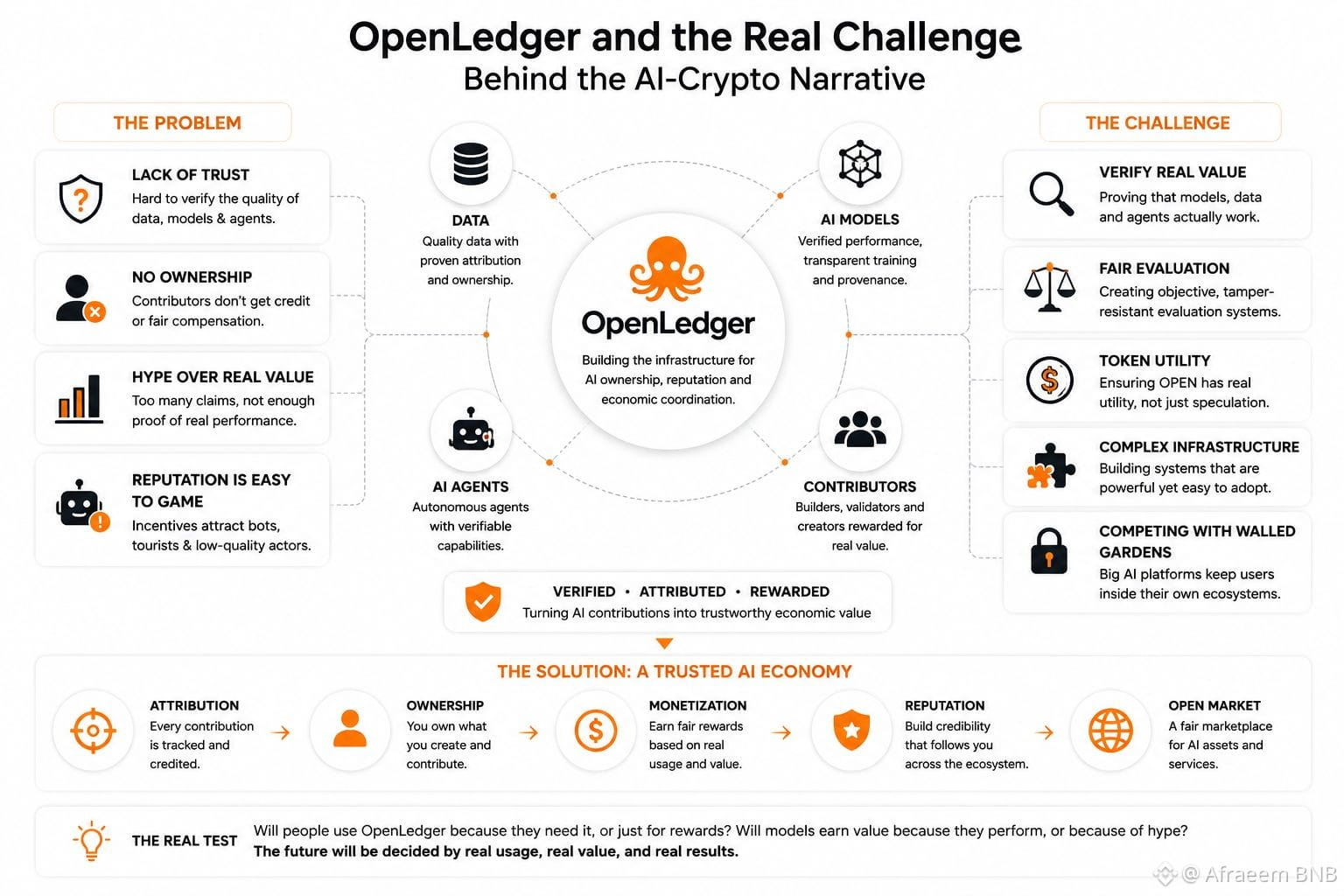
131
·
--
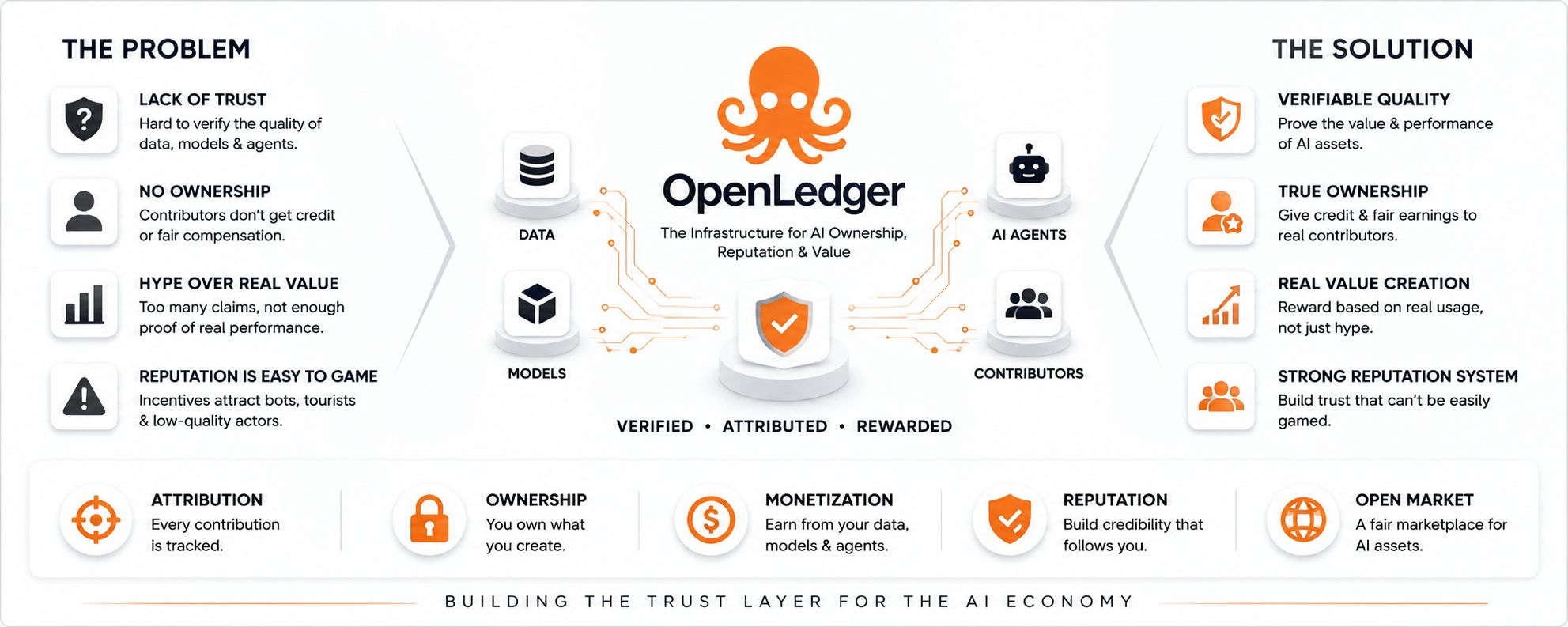
Article
OpenLedger and the Real Challenge Behind the AI-Crypto NarrativeOpenLedger is one of those projects that deserves caution before excitement. Crypto has a long history of turning promising ideas into overhyped stories, and many investors have learned the hard way that a good narrative is not the same as a working product.
At first glance, OpenLedger's vision seems straightforward. It wants AI models, datasets, and autonomous agents to have ownership, reputation, and economic value attached to them. The concept sounds logical. The execution, however, is where things become complicated.
The reality is that every major trend attracts opportunists.
We've seen it happen repeatedly. A new ecosystem launches, rewards appear, and users flood in. Points, badges, testnets, quests, social roles—people chase whatever generates potential profits. Eventually, projects discover that much of the activity was driven by incentives rather than genuine interest.
OpenLedger faces this exact challenge.
The AI industry already struggles with credibility issues. Countless models claim superior performance. Datasets are marketed as valuable assets. AI agents promise automation and productivity. Yet proving these claims is often difficult. Who verifies whether a dataset is truly useful? Who confirms that an AI model consistently delivers results? Who determines whether an autonomous agent provides real value beyond a carefully prepared demonstration?
These questions sit at the heart of OpenLedger's mission.
Rather than focusing on flashy AI marketing, the project is attempting to solve the less glamorous problems beneath the surface. It aims to build systems for verification, reputation, attribution, and economic coordination. While these components rarely attract headlines, they are essential for any sustainable AI ecosystem.
That is what makes the project more interesting than many so-called "AI blockchain" initiatives.
The industry does not necessarily need another blockchain branded with AI terminology. What it needs are mechanisms that allow people to trust digital assets, reward meaningful contributions, and distinguish quality from noise.
Trust remains one of the biggest weaknesses in today's AI landscape.
Low-quality data is everywhere. Model capabilities are often exaggerated. AI agents frequently fail outside controlled environments. Reputation systems can be manipulated. And within crypto, incentive structures often encourage users to exploit loopholes whenever possible.
Because of this, OpenLedger faces a difficult task.
The network must demonstrate that participation represents genuine contribution rather than artificial activity. It must establish methods for evaluating value fairly. Most importantly, it must show why the OPEN token is necessary within the ecosystem rather than simply existing as another speculative asset.
Crypto has seen countless examples of tokens searching for a purpose after launch.
To OpenLedger's credit, the problem it is targeting appears legitimate. Data creators deserve better ways to monetize their work. Model developers need reliable reputation systems. AI agents require transparent methods for proving effectiveness. The growing AI economy needs stronger attribution and accountability.
The challenge lies in transforming those needs into a functioning marketplace.
That process will not be easy.
Adoption may progress more slowly than market enthusiasm suggests. Large AI companies may continue operating within closed ecosystems. Developers may avoid complex infrastructure even if it provides long-term benefits. These are common obstacles for foundational technology projects.
Infrastructure often faces an ironic problem: everyone recognizes its importance, but few people get excited about using it.
Even so, the reason OpenLedger exists is understandable. Both AI and crypto suffer from a similar issue—an abundance of claims and a shortage of verifiable proof. OpenLedger is attempting to build the framework that connects reputation, ownership, and value to measurable outcomes.
Whether it succeeds remains uncertain.
The real evaluation will come from user behavior, not marketing campaigns.
Are participants engaging because the platform solves a genuine problem, or simply because incentives are available? Are AI models generating value because they perform effectively, or because they benefit from temporary hype? Are agents earning lasting reputations that remain meaningful after rewards and attention fade?
Those answers will reveal the project's true strength.
Not branding.
Not buzzwords.
Not narratives.
Results.
For now, I don't view OpenLedger as a guaranteed success story. Instead, I see it as a project attempting to build the infrastructure layer that many ecosystems overlook until weaknesses begin to appear. And in both AI and crypto, strong infrastructure may ultimately matter more than hype.
@Openledger #OpenLedger $OPEN
OpenLedger and the Real Challenge Behind the AI-Crypto Narrative
OpenLedger is one of those projects that deserves caution before excitement. Crypto has a long history of turning promising ideas into overhyped stories, and many investors have learned the hard way that a good narrative is not the same as a working product.
At first glance, OpenLedger's vision seems straightforward. It wants AI models, datasets, and autonomous agents to have ownership, reputation, and economic value attached to them. The concept sounds logical. The execution, however, is where things become complicated.
The reality is that every major trend attracts opportunists.
We've seen it happen repeatedly. A new ecosystem launches, rewards appear, and users flood in. Points, badges, testnets, quests, social roles—people chase whatever generates potential profits. Eventually, projects discover that much of the activity was driven by incentives rather than genuine interest.
OpenLedger faces this exact challenge.
The AI industry already struggles with credibility issues. Countless models claim superior performance. Datasets are marketed as valuable assets. AI agents promise automation and productivity. Yet proving these claims is often difficult. Who verifies whether a dataset is truly useful? Who confirms that an AI model consistently delivers results? Who determines whether an autonomous agent provides real value beyond a carefully prepared demonstration?
These questions sit at the heart of OpenLedger's mission.
Rather than focusing on flashy AI marketing, the project is attempting to solve the less glamorous problems beneath the surface. It aims to build systems for verification, reputation, attribution, and economic coordination. While these components rarely attract headlines, they are essential for any sustainable AI ecosystem.
That is what makes the project more interesting than many so-called "AI blockchain" initiatives.
The industry does not necessarily need another blockchain branded with AI terminology. What it needs are mechanisms that allow people to trust digital assets, reward meaningful contributions, and distinguish quality from noise.
Trust remains one of the biggest weaknesses in today's AI landscape.
Low-quality data is everywhere. Model capabilities are often exaggerated. AI agents frequently fail outside controlled environments. Reputation systems can be manipulated. And within crypto, incentive structures often encourage users to exploit loopholes whenever possible.
Because of this, OpenLedger faces a difficult task.
The network must demonstrate that participation represents genuine contribution rather than artificial activity. It must establish methods for evaluating value fairly. Most importantly, it must show why the OPEN token is necessary within the ecosystem rather than simply existing as another speculative asset.
Crypto has seen countless examples of tokens searching for a purpose after launch.
To OpenLedger's credit, the problem it is targeting appears legitimate. Data creators deserve better ways to monetize their work. Model developers need reliable reputation systems. AI agents require transparent methods for proving effectiveness. The growing AI economy needs stronger attribution and accountability.
The challenge lies in transforming those needs into a functioning marketplace.
That process will not be easy.
Adoption may progress more slowly than market enthusiasm suggests. Large AI companies may continue operating within closed ecosystems. Developers may avoid complex infrastructure even if it provides long-term benefits. These are common obstacles for foundational technology projects.
Infrastructure often faces an ironic problem: everyone recognizes its importance, but few people get excited about using it.
Even so, the reason OpenLedger exists is understandable. Both AI and crypto suffer from a similar issue—an abundance of claims and a shortage of verifiable proof. OpenLedger is attempting to build the framework that connects reputation, ownership, and value to measurable outcomes.
Whether it succeeds remains uncertain.
The real evaluation will come from user behavior, not marketing campaigns.
Are participants engaging because the platform solves a genuine problem, or simply because incentives are available? Are AI models generating value because they perform effectively, or because they benefit from temporary hype? Are agents earning lasting reputations that remain meaningful after rewards and attention fade?
Those answers will reveal the project's true strength.
Not branding.
Not buzzwords.
Not narratives.
Results.
For now, I don't view OpenLedger as a guaranteed success story. Instead, I see it as a project attempting to build the infrastructure layer that many ecosystems overlook until weaknesses begin to appear. And in both AI and crypto, strong infrastructure may ultimately matter more than hype.
@OpenLedger #OpenLedger $OPEN
At first glance, OpenLedger's vision seems straightforward. It wants AI models, datasets, and autonomous agents to have ownership, reputation, and economic value attached to them. The concept sounds logical. The execution, however, is where things become complicated.
The reality is that every major trend attracts opportunists.
We've seen it happen repeatedly. A new ecosystem launches, rewards appear, and users flood in. Points, badges, testnets, quests, social roles—people chase whatever generates potential profits. Eventually, projects discover that much of the activity was driven by incentives rather than genuine interest.
OpenLedger faces this exact challenge.
The AI industry already struggles with credibility issues. Countless models claim superior performance. Datasets are marketed as valuable assets. AI agents promise automation and productivity. Yet proving these claims is often difficult. Who verifies whether a dataset is truly useful? Who confirms that an AI model consistently delivers results? Who determines whether an autonomous agent provides real value beyond a carefully prepared demonstration?
These questions sit at the heart of OpenLedger's mission.
Rather than focusing on flashy AI marketing, the project is attempting to solve the less glamorous problems beneath the surface. It aims to build systems for verification, reputation, attribution, and economic coordination. While these components rarely attract headlines, they are essential for any sustainable AI ecosystem.
That is what makes the project more interesting than many so-called "AI blockchain" initiatives.
The industry does not necessarily need another blockchain branded with AI terminology. What it needs are mechanisms that allow people to trust digital assets, reward meaningful contributions, and distinguish quality from noise.
Trust remains one of the biggest weaknesses in today's AI landscape.
Low-quality data is everywhere. Model capabilities are often exaggerated. AI agents frequently fail outside controlled environments. Reputation systems can be manipulated. And within crypto, incentive structures often encourage users to exploit loopholes whenever possible.
Because of this, OpenLedger faces a difficult task.
The network must demonstrate that participation represents genuine contribution rather than artificial activity. It must establish methods for evaluating value fairly. Most importantly, it must show why the OPEN token is necessary within the ecosystem rather than simply existing as another speculative asset.
Crypto has seen countless examples of tokens searching for a purpose after launch.
To OpenLedger's credit, the problem it is targeting appears legitimate. Data creators deserve better ways to monetize their work. Model developers need reliable reputation systems. AI agents require transparent methods for proving effectiveness. The growing AI economy needs stronger attribution and accountability.
The challenge lies in transforming those needs into a functioning marketplace.
That process will not be easy.
Adoption may progress more slowly than market enthusiasm suggests. Large AI companies may continue operating within closed ecosystems. Developers may avoid complex infrastructure even if it provides long-term benefits. These are common obstacles for foundational technology projects.
Infrastructure often faces an ironic problem: everyone recognizes its importance, but few people get excited about using it.
Even so, the reason OpenLedger exists is understandable. Both AI and crypto suffer from a similar issue—an abundance of claims and a shortage of verifiable proof. OpenLedger is attempting to build the framework that connects reputation, ownership, and value to measurable outcomes.
Whether it succeeds remains uncertain.
The real evaluation will come from user behavior, not marketing campaigns.
Are participants engaging because the platform solves a genuine problem, or simply because incentives are available? Are AI models generating value because they perform effectively, or because they benefit from temporary hype? Are agents earning lasting reputations that remain meaningful after rewards and attention fade?
Those answers will reveal the project's true strength.
Not branding.
Not buzzwords.
Not narratives.
Results.
For now, I don't view OpenLedger as a guaranteed success story. Instead, I see it as a project attempting to build the infrastructure layer that many ecosystems overlook until weaknesses begin to appear. And in both AI and crypto, strong infrastructure may ultimately matter more than hype.
@OpenLedger #OpenLedger $OPEN
129
·
--
Short trade $XLM
Entry zone 0.1970-0.2070
SL 0.24
Target🎯
0.1870
0.1700
#TrumpAnnouncesHormuzBlockadeLifted #MorganStanleyBitcoinETF3500BTC #MorganStanleyBitcoinETF3500BTC #MorganStanleyBitcoinETF3500BTC
Short trade $XLM
Entry zone 0.1970-0.2070
SL 0.24
Target🎯
0.1870
0.1700
#TrumpAnnouncesHormuzBlockadeLifted #MorganStanleyBitcoinETF3500BTC #MorganStanleyBitcoinETF3500BTC #MorganStanleyBitcoinETF3500BTC
Entry zone 0.1970-0.2070
SL 0.24
Target🎯
0.1870
0.1700
#TrumpAnnouncesHormuzBlockadeLifted #MorganStanleyBitcoinETF3500BTC #MorganStanleyBitcoinETF3500BTC #MorganStanleyBitcoinETF3500BTC
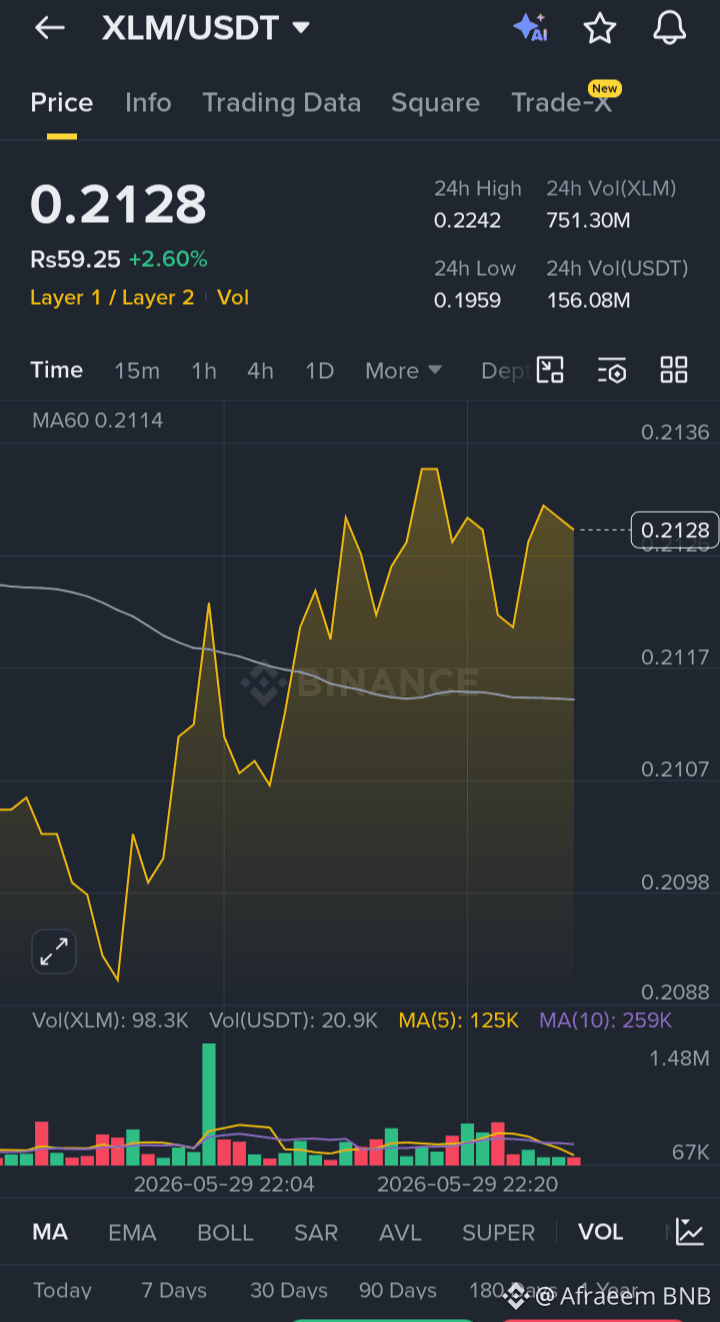
133
·
--
#openledger $OPEN
Everyone keeps talking about AI like it’s the future, but almost nobody talks about the biggest problem hiding underneath it:
Trust.
That’s why OpenLedger caught my attention.
Not because it’s another “AI crypto” project. We already have too many of those. Most are just narratives wrapped in buzzwords. But OpenLedger is trying to solve something much deeper — proving value inside AI systems.
Right now, anybody can claim their AI model is powerful. Anybody can say their data is valuable. Anybody can launch an AI agent with a clean UI and promise automation.
But who verifies any of it?
That’s the real issue.
Crypto already showed us what happens when rewards come before real utility. People farm points, fake activity, and exploit incentives until platforms can no longer tell the difference between genuine users and temporary opportunists.
AI is slowly walking into the same trap.
OpenLedger seems focused on building the infrastructure most people ignore: • reputation systems
• contribution tracking
• ownership layers
• attribution for AI data and models
• economic systems that reward actual value
And honestly, that matters more than flashy marketing.
Because without trust, AI markets become noise.
The hard part is that building this kind of infrastructure is difficult. Very difficult. It’s not exciting work, and users usually don’t appreciate infrastructure until everything breaks without it.
That’s why I’m not treating OpenLedger like a guaranteed winner.
The real test will come later:
Will people still use it when rewards disappear?
Will AI models earn value because they genuinely perform well?
Will reputation on the network actually mean something?
That’s where the truth always shows up — not in hype, not in branding, but in behavior.
Maybe OpenLedger succeeds. Maybe it doesn’t.
But at least it’s trying to solve a real problem instead of inventing a fake one for attention.
#openledger $OPEN
Everyone keeps talking about AI like it’s the future, but almost nobody talks about the biggest problem hiding underneath it:
Trust.
That’s why OpenLedger caught my attention.
Not because it’s another “AI crypto” project. We already have too many of those. Most are just narratives wrapped in buzzwords. But OpenLedger is trying to solve something much deeper — proving value inside AI systems.
Right now, anybody can claim their AI model is powerful. Anybody can say their data is valuable. Anybody can launch an AI agent with a clean UI and promise automation.
But who verifies any of it?
That’s the real issue.
Crypto already showed us what happens when rewards come before real utility. People farm points, fake activity, and exploit incentives until platforms can no longer tell the difference between genuine users and temporary opportunists.
AI is slowly walking into the same trap.
OpenLedger seems focused on building the infrastructure most people ignore: • reputation systems
• contribution tracking
• ownership layers
• attribution for AI data and models
• economic systems that reward actual value
And honestly, that matters more than flashy marketing.
Because without trust, AI markets become noise.
The hard part is that building this kind of infrastructure is difficult. Very difficult. It’s not exciting work, and users usually don’t appreciate infrastructure until everything breaks without it.
That’s why I’m not treating OpenLedger like a guaranteed winner.
The real test will come later:
Will people still use it when rewards disappear?
Will AI models earn value because they genuinely perform well?
Will reputation on the network actually mean something?
That’s where the truth always shows up — not in hype, not in branding, but in behavior.
Maybe OpenLedger succeeds. Maybe it doesn’t.
But at least it’s trying to solve a real problem instead of inventing a fake one for attention.
Everyone keeps talking about AI like it’s the future, but almost nobody talks about the biggest problem hiding underneath it:
Trust.
That’s why OpenLedger caught my attention.
Not because it’s another “AI crypto” project. We already have too many of those. Most are just narratives wrapped in buzzwords. But OpenLedger is trying to solve something much deeper — proving value inside AI systems.
Right now, anybody can claim their AI model is powerful. Anybody can say their data is valuable. Anybody can launch an AI agent with a clean UI and promise automation.
But who verifies any of it?
That’s the real issue.
Crypto already showed us what happens when rewards come before real utility. People farm points, fake activity, and exploit incentives until platforms can no longer tell the difference between genuine users and temporary opportunists.
AI is slowly walking into the same trap.
OpenLedger seems focused on building the infrastructure most people ignore: • reputation systems
• contribution tracking
• ownership layers
• attribution for AI data and models
• economic systems that reward actual value
And honestly, that matters more than flashy marketing.
Because without trust, AI markets become noise.
The hard part is that building this kind of infrastructure is difficult. Very difficult. It’s not exciting work, and users usually don’t appreciate infrastructure until everything breaks without it.
That’s why I’m not treating OpenLedger like a guaranteed winner.
The real test will come later:
Will people still use it when rewards disappear?
Will AI models earn value because they genuinely perform well?
Will reputation on the network actually mean something?
That’s where the truth always shows up — not in hype, not in branding, but in behavior.
Maybe OpenLedger succeeds. Maybe it doesn’t.
But at least it’s trying to solve a real problem instead of inventing a fake one for attention.
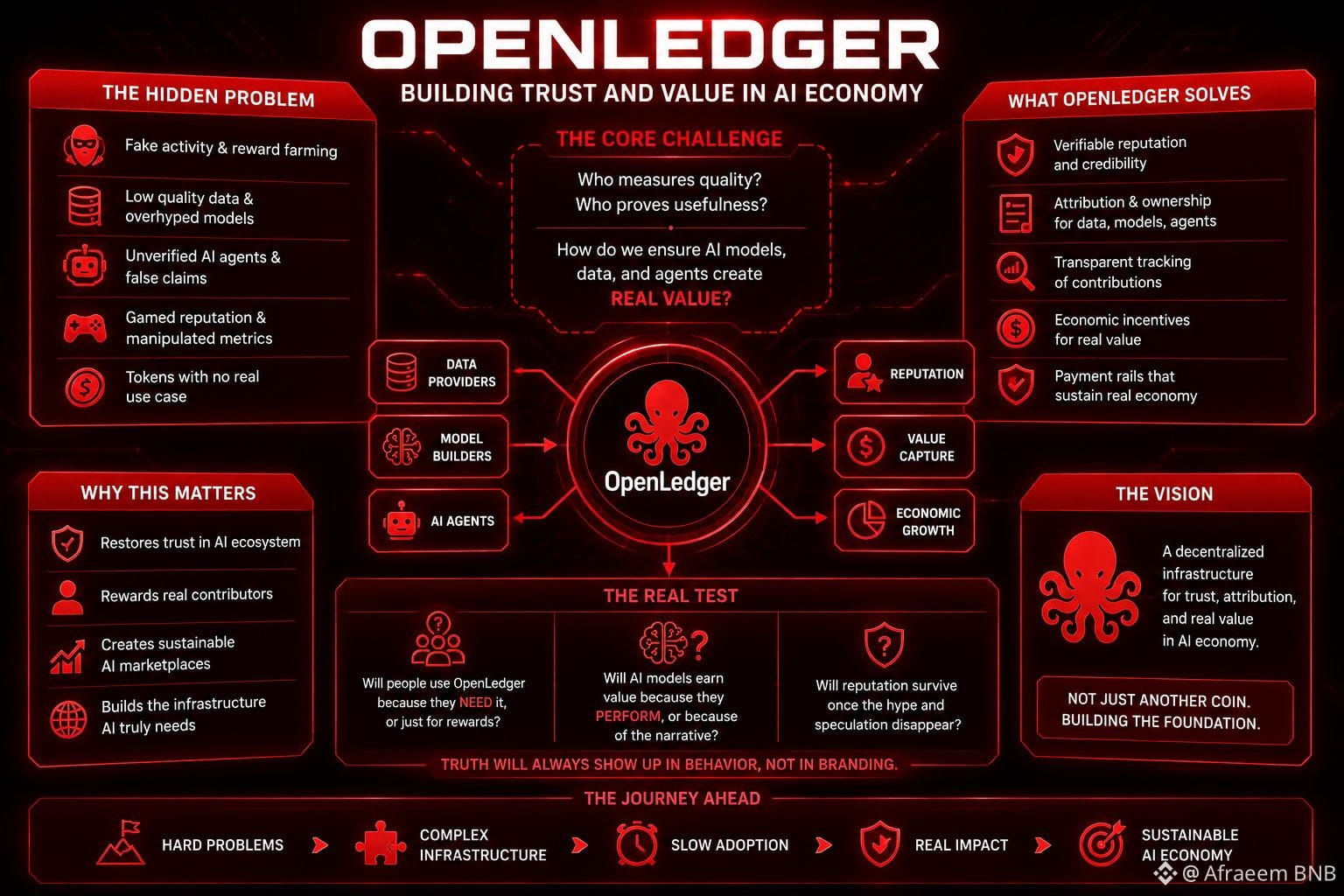
1
108
Log in to explore more content
Join global crypto users on Binance Square
⚡️ Get latest and useful information about crypto.
💬 Trusted by the world’s largest crypto exchange.
👍 Discover real insights from verified creators.
Email / Phone number