
中国扫地僧
3.5k Posts

中国扫地僧
Report
Block User
7 Following
52 Followers
46 Liked
Posts
·
--
Article
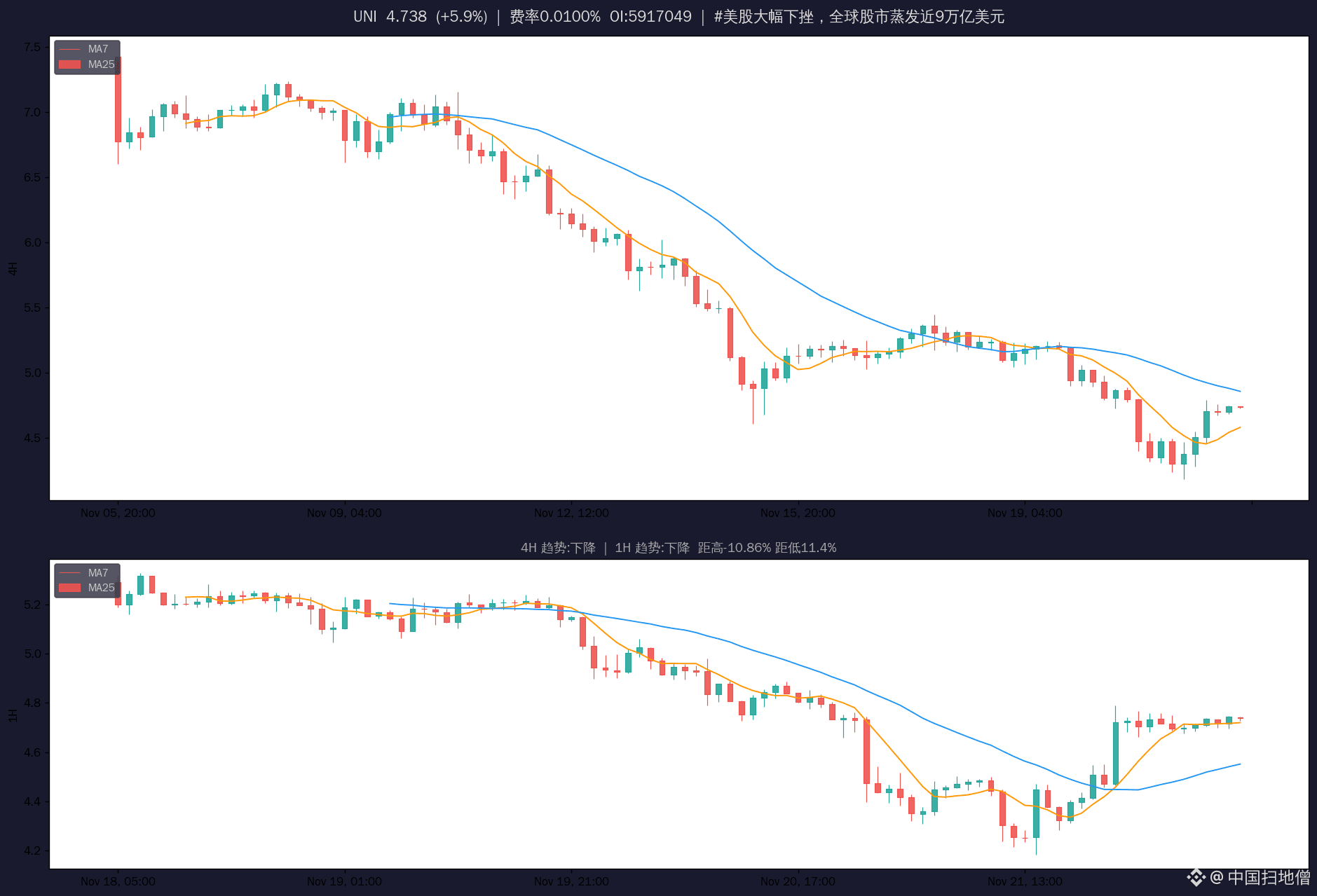
UNI Market Analysis 11/22U.S. stocks plunged and nearly $9 trillion was wiped off global equity markets. Risk aversion should have weighed on UNI, but it rose 5.9% in 24 hours. This divergence suggests on-chain buying is pushing back against macro sentiment. My view: short-term strength, but continued weakness in the medium term. The contradiction lies in the time-frame mismatch: trends on both the 1-hour and 4-hour charts are down, with the 4-hour price having pulled back 34.36% from its high. Yet the price rebounded from a low of 4.183 to 4.789, up 11.4% from the low, showing clear support at lower levels. The top 10 order-book levels show 33,000 in bids versus 38,000 in asks, with a bid-to-ask ratio of 0.86, so sellers still have the edge. The funding rate of 0.01% is relatively neutral, and the 5.917 million coin-margined open interest shows no sign of panic liquidations. This looks more like a standoff between bulls and bears than a one-way trend. Strategy: try a small long position on a pullback to 4.612, with a stop-loss at 4.487 and a target of 4.856. If the price rises to 4.873 and stalls, switch to a short position, with a stop-loss at 4.951 and a target of 4.668. Keep each position below 5% of your portfolio, and exit immediately if support breaks—don't hold on to a losing trade.
UNI Market Analysis 11/22
U.S. stocks plunged and nearly $9 trillion was wiped off global equity markets. Risk aversion should have weighed on UNI, but it rose 5.9% in 24 hours. This divergence suggests on-chain buying is pushing back against macro sentiment. My view: short-term strength, but continued weakness in the medium term. The contradiction lies in the time-frame mismatch: trends on both the 1-hour and 4-hour charts are down, with the 4-hour price having pulled back 34.36% from its high. Yet the price rebounded from a low of 4.183 to 4.789, up 11.4% from the low, showing clear support at lower levels. The top 10 order-book levels show 33,000 in bids versus 38,000 in asks, with a bid-to-ask ratio of 0.86, so sellers still have the edge. The funding rate of 0.01% is relatively neutral, and the 5.917 million coin-margined open interest shows no sign of panic liquidations. This looks more like a standoff between bulls and bears than a one-way trend. Strategy: try a small long position on a pullback to 4.612, with a stop-loss at 4.487 and a target of 4.856. If the price rises to 4.873 and stalls, switch to a short position, with a stop-loss at 4.951 and a target of 4.668. Keep each position below 5% of your portfolio, and exit immediately if support breaks—don't hold on to a losing trade.
5
·
--
Article
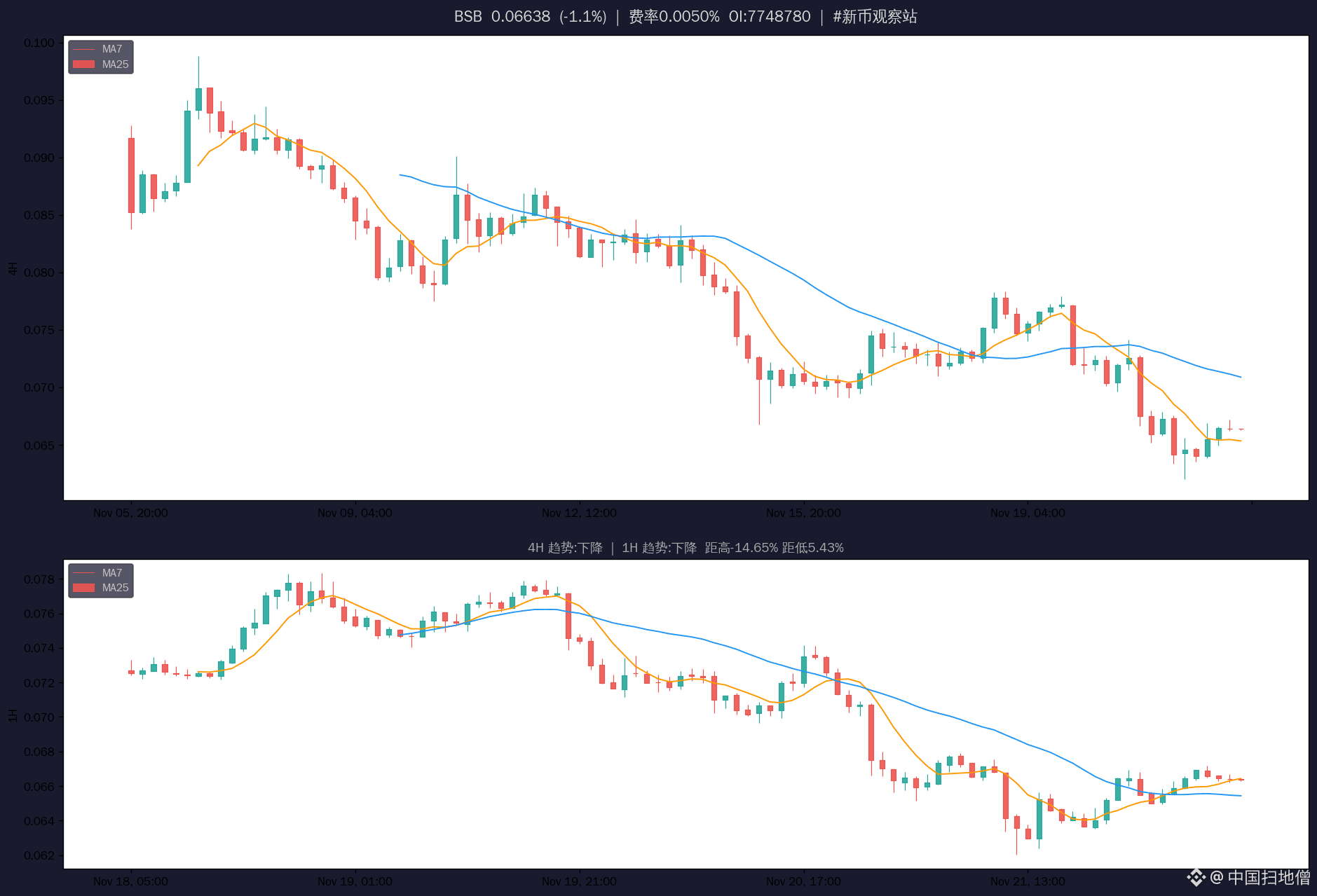
BSB Market Analysis 11/22BSB is worth keeping an eye on in the New Coin Watchlist: the short-term structure remains downward, but buyers are quietly accumulating. My view is that the weakness remains intact, though a rebound is possible. Discipline matters more than direction.
After falling 1.1% over 24 hours, the current price is 0.06638. It remains 30.85% below the 4-hour high, while the 1-hour price is just 5.43% above the low, and bearish momentum is clearly fading. The top 10 order-book levels show 6,942 in buy orders versus 3,132 in sell orders, giving buyers the edge with a buy/sell ratio of 2.22. The 0.0050% funding rate is relatively neutral, and there are no signs of panic exits among the 7.749 million coin-margined open interest. Trading volume of 1.002 million suggests that divergence is narrowing amid declining volume.
Do not chase shorts: place a long order on a pullback to 0.06472, with a stop-loss at 0.06238 and a target of 0.06915; if a rebound to 0.06955 meets resistance, consider a small short position, with a stop-loss at 0.07128 and a target of 0.06682. Keep each position below 20% of your portfolio. Exit as soon as the stop-loss is triggered; do not hold losing positions or add to them.
BSB Market Analysis 11/22
BSB is worth keeping an eye on in the New Coin Watchlist: the short-term structure remains downward, but buyers are quietly accumulating. My view is that the weakness remains intact, though a rebound is possible. Discipline matters more than direction.
After falling 1.1% over 24 hours, the current price is 0.06638. It remains 30.85% below the 4-hour high, while the 1-hour price is just 5.43% above the low, and bearish momentum is clearly fading. The top 10 order-book levels show 6,942 in buy orders versus 3,132 in sell orders, giving buyers the edge with a buy/sell ratio of 2.22. The 0.0050% funding rate is relatively neutral, and there are no signs of panic exits among the 7.749 million coin-margined open interest. Trading volume of 1.002 million suggests that divergence is narrowing amid declining volume.
Do not chase shorts: place a long order on a pullback to 0.06472, with a stop-loss at 0.06238 and a target of 0.06915; if a rebound to 0.06955 meets resistance, consider a small short position, with a stop-loss at 0.07128 and a target of 0.06682. Keep each position below 20% of your portfolio. Exit as soon as the stop-loss is triggered; do not hold losing positions or add to them.
29
·
--
Article
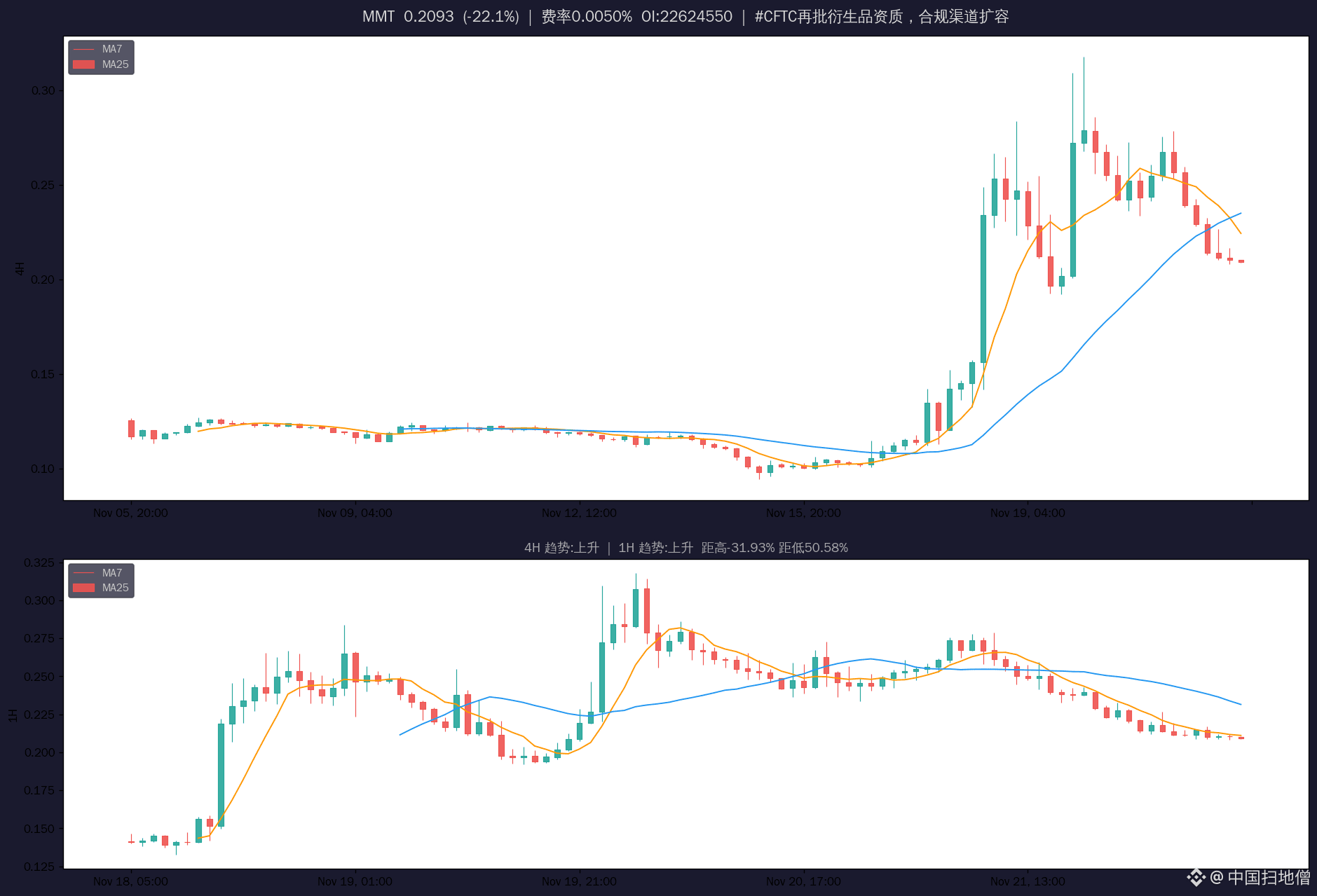
MMT Market Analysis 11/22The U.S. Commodity Futures Trading Commission has once again approved derivatives-related credentials, and compliant trading channels continue to expand. As a beneficiary of the derivatives sector, MMT is receiving sentiment support, but its short-term price action is clearly diverging from the news. My view is that the news is providing a floor, while the price is still absorbing selling pressure. Looking at the market, the 24-hour decline is 22.1%. The price plunged from 0.2786 to 0.2082 before stabilizing at 0.2093. Trading volume of 25.965 million indicates substantial selling. The top-10 order-book bid-to-ask ratio is 1.14, giving buyers a slight edge; the funding rate of 0.0050% is fairly neutral, and open interest of 22.625 million shows no significant reduction. This suggests that longs have not capitulated, but they are also reluctant to chase prices higher. For trading, consider opening a small long position on a pullback to 0.2073, with a stop-loss at 0.1986 and a target of 0.2318. If the price rebounds to around 0.2265 and stalls, consider a short-term short, with a stop-loss at 0.2382 and a target of 0.2114. Keep position size below 20%, and exit immediately if support breaks—do not hold and hope.
MMT Market Analysis 11/22
The U.S. Commodity Futures Trading Commission has once again approved derivatives-related credentials, and compliant trading channels continue to expand. As a beneficiary of the derivatives sector, MMT is receiving sentiment support, but its short-term price action is clearly diverging from the news. My view is that the news is providing a floor, while the price is still absorbing selling pressure. Looking at the market, the 24-hour decline is 22.1%. The price plunged from 0.2786 to 0.2082 before stabilizing at 0.2093. Trading volume of 25.965 million indicates substantial selling. The top-10 order-book bid-to-ask ratio is 1.14, giving buyers a slight edge; the funding rate of 0.0050% is fairly neutral, and open interest of 22.625 million shows no significant reduction. This suggests that longs have not capitulated, but they are also reluctant to chase prices higher. For trading, consider opening a small long position on a pullback to 0.2073, with a stop-loss at 0.1986 and a target of 0.2318. If the price rebounds to around 0.2265 and stalls, consider a short-term short, with a stop-loss at 0.2382 and a target of 0.2114. Keep position size below 20%, and exit immediately if support breaks—do not hold and hope.
28
·
--
Article
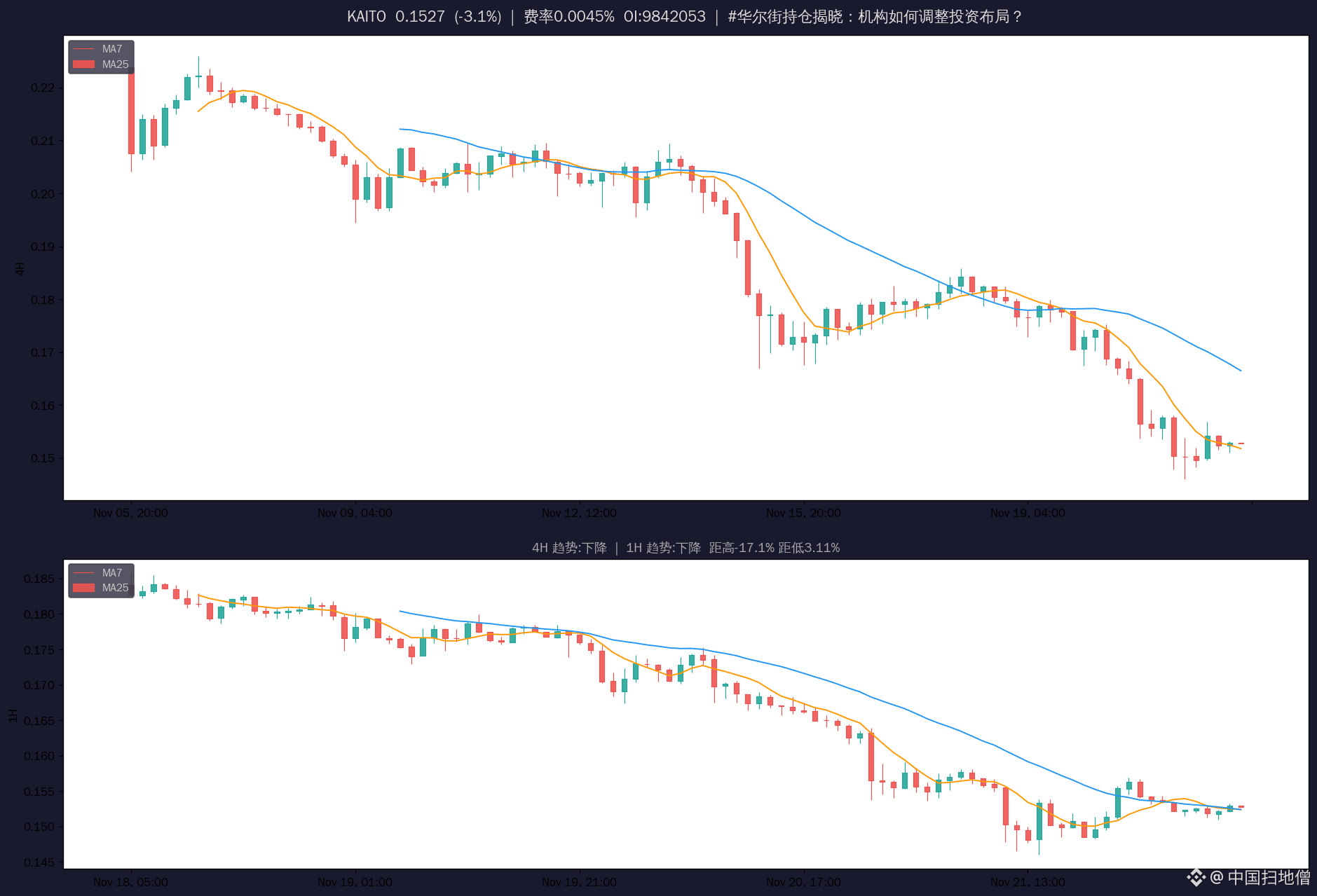
KAITO Market Analysis 11/22Wall Street Positions Revealed: How Are Institutions Adjusting Their Portfolios? KAITO has not caught the wave in this round of portfolio rebalancing, and I lean toward the view that it remains a speculative asset neglected by capital in the short term. On the charts, the price has pulled back from a high of 0.1577 to 0.1527, down 3.1% over 24 hours. The 1-hour and 4-hour trends have both weakened, and the price is already 31.28% below its 4-hour high, with clear bearish pressure. However, bids across the top 10 levels of the order book total 428,000, slightly exceeding asks at 419,000, for a bid-ask ratio of 1.02. Combined with a still-positive funding rate of 0.0045% and 9.842 million in coin-margined open interest, this suggests that bulls have not yet conceded; sentiment is conflicted rather than in a one-sided collapse. For trading, consider a small long position at 0.1493, with a stop-loss at 0.1447 and a target of 0.1589. If the price rebounds to 0.1583 and faces resistance, you could reverse into a short, with a stop-loss at 0.1621 and a target of 0.1481. Keep the position size below 20% and use strict stop-losses.
KAITO Market Analysis 11/22
Wall Street Positions Revealed: How Are Institutions Adjusting Their Portfolios? KAITO has not caught the wave in this round of portfolio rebalancing, and I lean toward the view that it remains a speculative asset neglected by capital in the short term. On the charts, the price has pulled back from a high of 0.1577 to 0.1527, down 3.1% over 24 hours. The 1-hour and 4-hour trends have both weakened, and the price is already 31.28% below its 4-hour high, with clear bearish pressure. However, bids across the top 10 levels of the order book total 428,000, slightly exceeding asks at 419,000, for a bid-ask ratio of 1.02. Combined with a still-positive funding rate of 0.0045% and 9.842 million in coin-margined open interest, this suggests that bulls have not yet conceded; sentiment is conflicted rather than in a one-sided collapse. For trading, consider a small long position at 0.1493, with a stop-loss at 0.1447 and a target of 0.1589. If the price rebounds to 0.1583 and faces resistance, you could reverse into a short, with a stop-loss at 0.1621 and a target of 0.1481. Keep the position size below 20% and use strict stop-losses.
46
·
--
Article
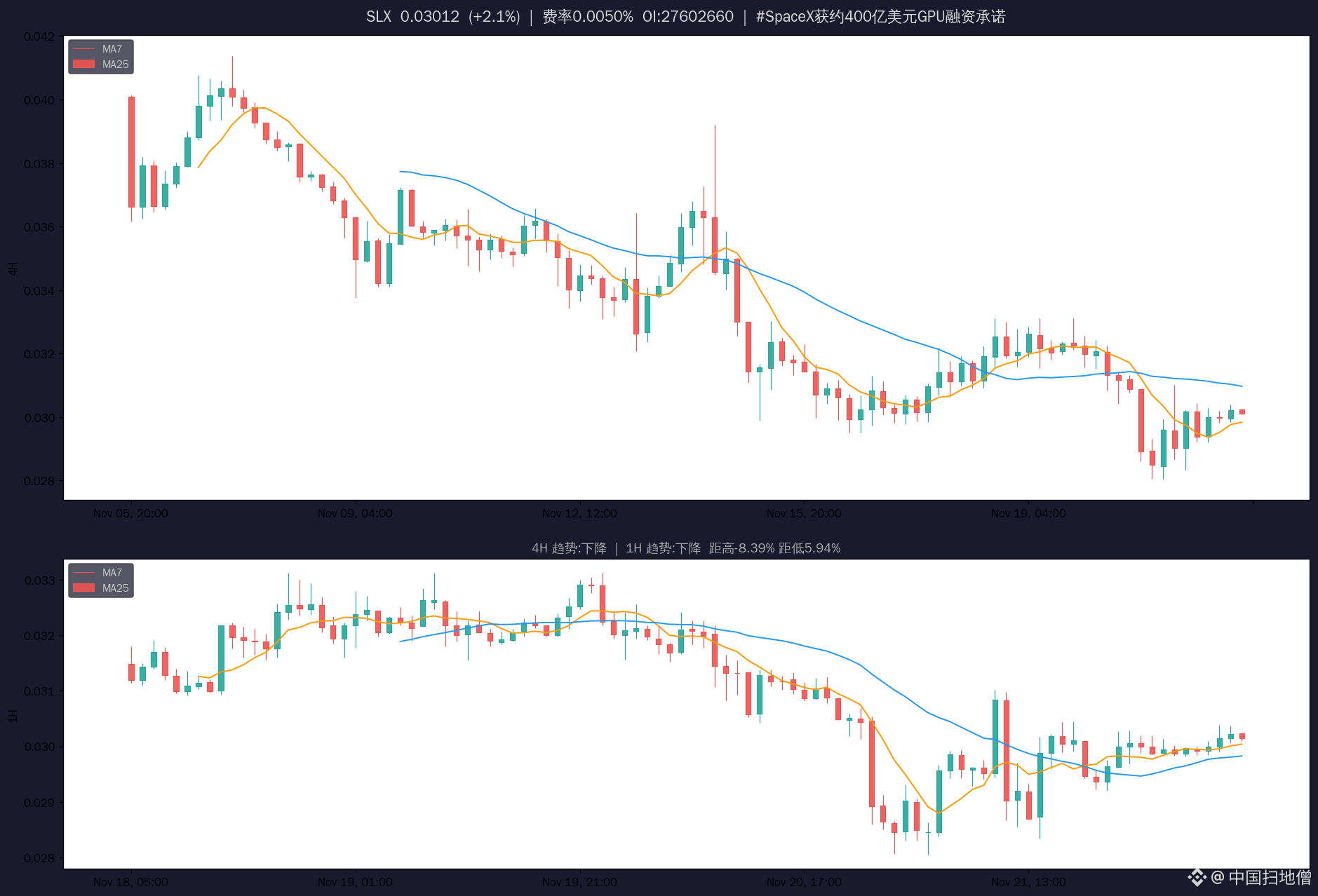
SLX Market Analysis 11/22SpaceX secured around $40 billion in GPU financing commitments, and the computing-power expansion narrative has spilled over into crypto markets. SLX, seen as a computing-power play, has gained a sentiment boost, but it remains in a downward channel on the 4-hour chart. I view the rebound as a correction, not a reversal.
SLX rose 2.1% to 0.03012 over the past 24 hours, with a trading range of over 9%. Trading volume of 6.662 million indicates moderate participation. Trends on both the 1-hour and 4-hour charts are downward, and the price has fallen 25.40% from the 4-hour high, with notable selling pressure overhead. The top 10 levels of the order book show a buy/sell ratio of 0.94, giving sellers a slight edge. The funding rate of 0.0050% is neutral, and open interest at 27.603 million shows no significant increase. Sentiment is cautious.
SLX Market Analysis 11/22
SpaceX secured around $40 billion in GPU financing commitments, and the computing-power expansion narrative has spilled over into crypto markets. SLX, seen as a computing-power play, has gained a sentiment boost, but it remains in a downward channel on the 4-hour chart. I view the rebound as a correction, not a reversal.
SLX rose 2.1% to 0.03012 over the past 24 hours, with a trading range of over 9%. Trading volume of 6.662 million indicates moderate participation. Trends on both the 1-hour and 4-hour charts are downward, and the price has fallen 25.40% from the 4-hour high, with notable selling pressure overhead. The top 10 levels of the order book show a buy/sell ratio of 0.94, giving sellers a slight edge. The funding rate of 0.0050% is neutral, and open interest at 27.603 million shows no significant increase. Sentiment is cautious.
62
·
--
Article
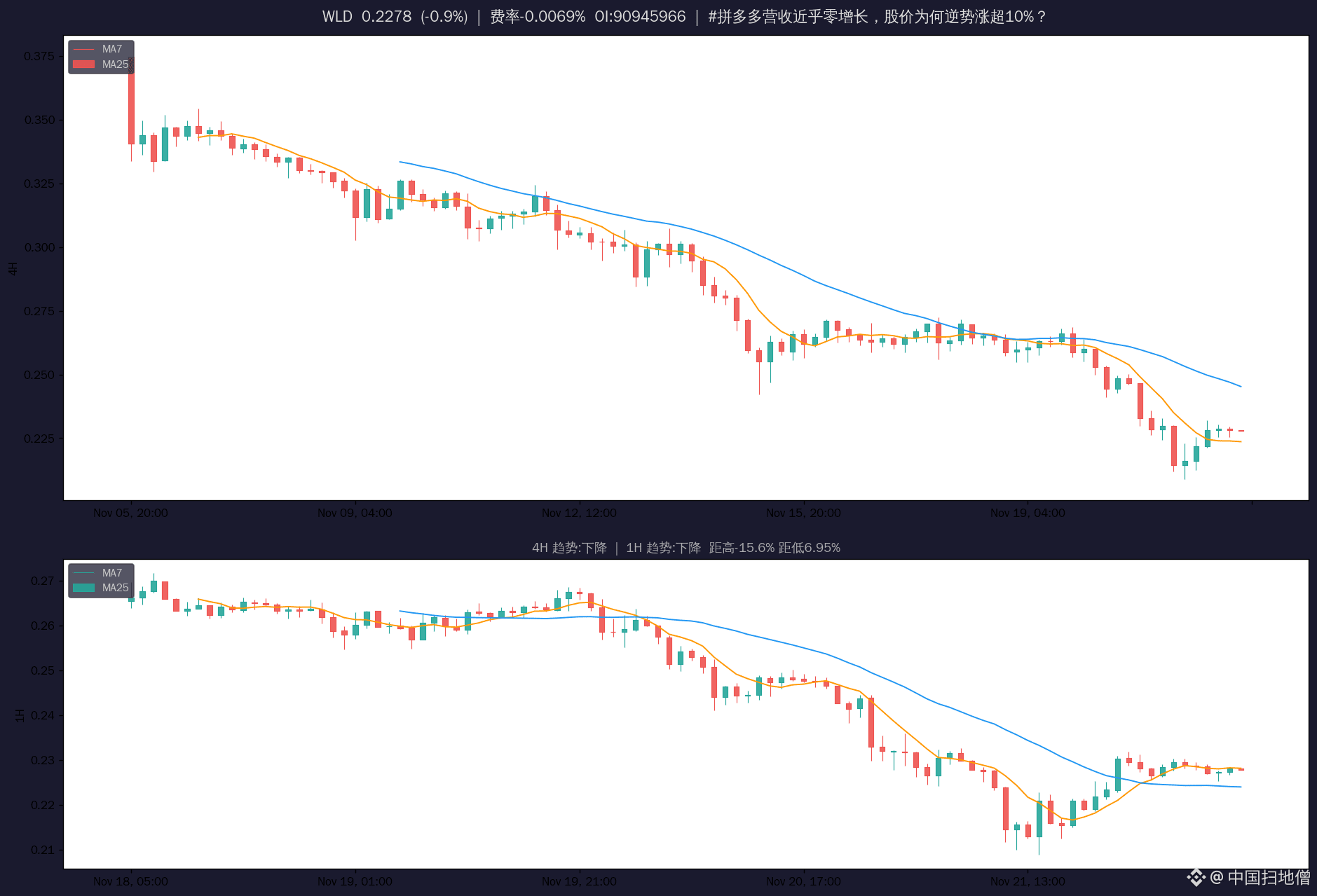
WLD Market Analysis 11/22Pinduoduo’s revenue was nearly flat, yet its share price rose more than 10% against the trend, showing that the market is willing to reward “marginal improvement against low expectations.” The same applies to WLD: for now, the focus should be on risk rather than the story. My view is that the weakness is not over, so preserve capital rather than go on the offensive. The current price is 0.2278, down 0.9% in 24 hours, and it has pulled back 34.45% from its 4-hour high. The 1-hour and 4-hour trends are both pointing down, and the rebound has limited strength. Buy orders in the top 10 levels total 1.40 million versus 1.46 million in sell orders, giving sellers a slight edge. The funding rate of -0.0069% shows that shorts are willing to pay, while open interest of 90.946 million coins indicates that disagreement remains. Strategy: consider a small short position on a rebound to around 0.2312, with a stop-loss at 0.2386 and a target of 0.2087. If the price falls to 0.2074 and stabilizes, consider a small long position, with a stop-loss at 0.1993 and a target of 0.2246. Keep the risk on any single trade below 1% of total capital; set the stop-loss before deciding on position size.
WLD Market Analysis 11/22
Pinduoduo’s revenue was nearly flat, yet its share price rose more than 10% against the trend, showing that the market is willing to reward “marginal improvement against low expectations.” The same applies to WLD: for now, the focus should be on risk rather than the story. My view is that the weakness is not over, so preserve capital rather than go on the offensive. The current price is 0.2278, down 0.9% in 24 hours, and it has pulled back 34.45% from its 4-hour high. The 1-hour and 4-hour trends are both pointing down, and the rebound has limited strength. Buy orders in the top 10 levels total 1.40 million versus 1.46 million in sell orders, giving sellers a slight edge. The funding rate of -0.0069% shows that shorts are willing to pay, while open interest of 90.946 million coins indicates that disagreement remains. Strategy: consider a small short position on a rebound to around 0.2312, with a stop-loss at 0.2386 and a target of 0.2087. If the price falls to 0.2074 and stabilizes, consider a small long position, with a stop-loss at 0.1993 and a target of 0.2246. Keep the risk on any single trade below 1% of total capital; set the stop-loss before deciding on position size.
78
·
--
Article
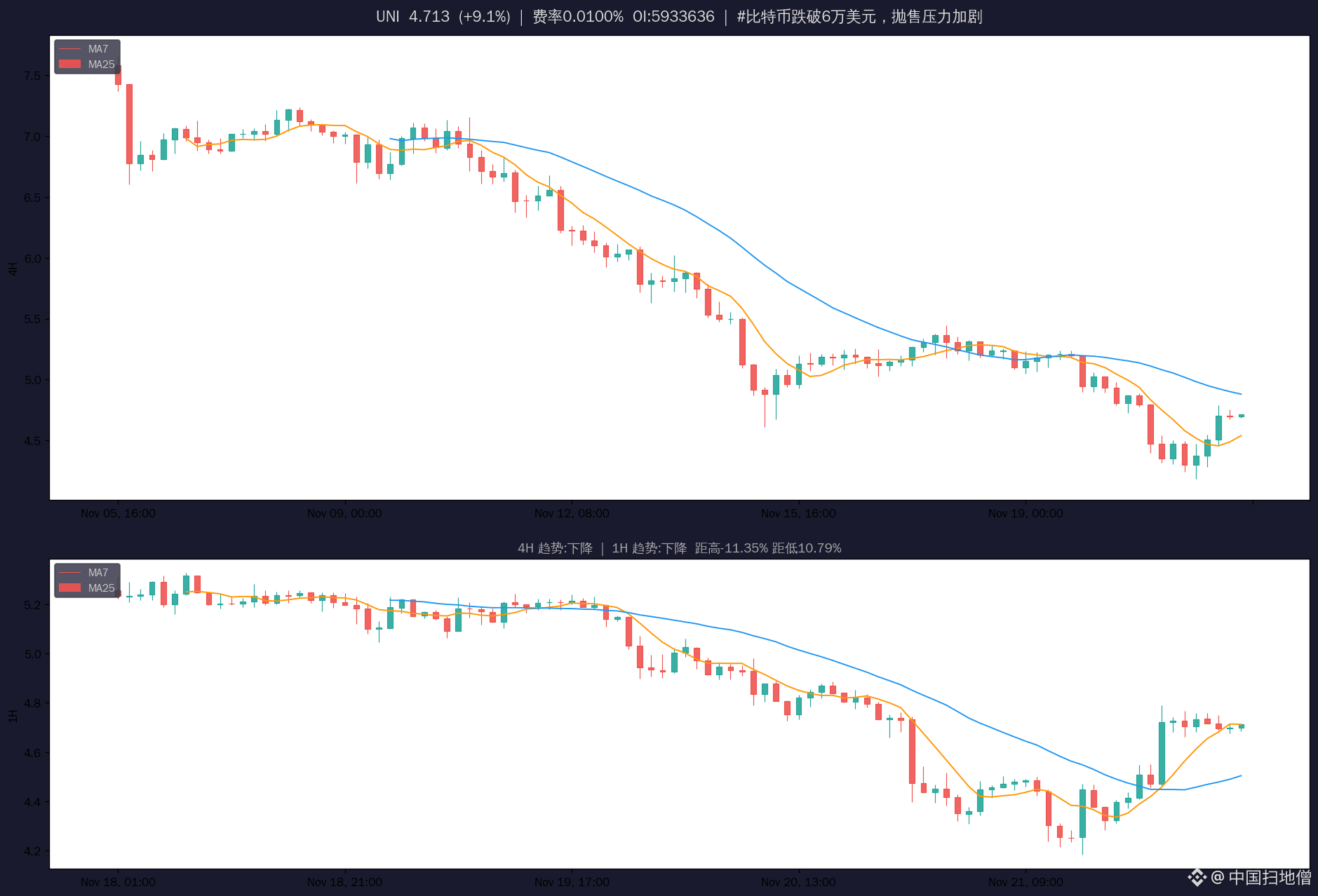
UNI Market Analysis 11/22Bitcoin has fallen below $60,000, selling pressure is intensifying, and broad declines in major coins have dragged UNI lower in tandem. However, UNI is up 9.1% on the day against the trend. I see this as a rebound rather than a reversal, so risk management takes priority over chasing longs. Trends on both the four-hour and one-hour charts are downward, and the price has retreated 36.53% from its four-hour high, casting doubt on the rebound’s strength. The order-book buy/sell ratio is 0.90, favoring sellers, while the 0.01% funding rate shows that longs are still paying to hold positions, suggesting sentiment is crowded. The 24-hour trading volume is only 23.125 million, insufficient to support a sustained move higher. Strategy: consider a small short on a rebound to 4.852, with a stop-loss at 4.973 and a target of 4.286. If the price retests 4.312 and holds, consider a small long, with a stop-loss at 4.168 and a target of 4.608. Keep each position below 5% of total capital. Exit immediately on a breakdown; do not average down or hold losing positions in defiance of the market.
UNI Market Analysis 11/22
Bitcoin has fallen below $60,000, selling pressure is intensifying, and broad declines in major coins have dragged UNI lower in tandem. However, UNI is up 9.1% on the day against the trend. I see this as a rebound rather than a reversal, so risk management takes priority over chasing longs. Trends on both the four-hour and one-hour charts are downward, and the price has retreated 36.53% from its four-hour high, casting doubt on the rebound’s strength. The order-book buy/sell ratio is 0.90, favoring sellers, while the 0.01% funding rate shows that longs are still paying to hold positions, suggesting sentiment is crowded. The 24-hour trading volume is only 23.125 million, insufficient to support a sustained move higher. Strategy: consider a small short on a rebound to 4.852, with a stop-loss at 4.973 and a target of 4.286. If the price retests 4.312 and holds, consider a small long, with a stop-loss at 4.168 and a target of 4.608. Keep each position below 5% of total capital. Exit immediately on a breakdown; do not average down or hold losing positions in defiance of the market.
5
·
--
Article
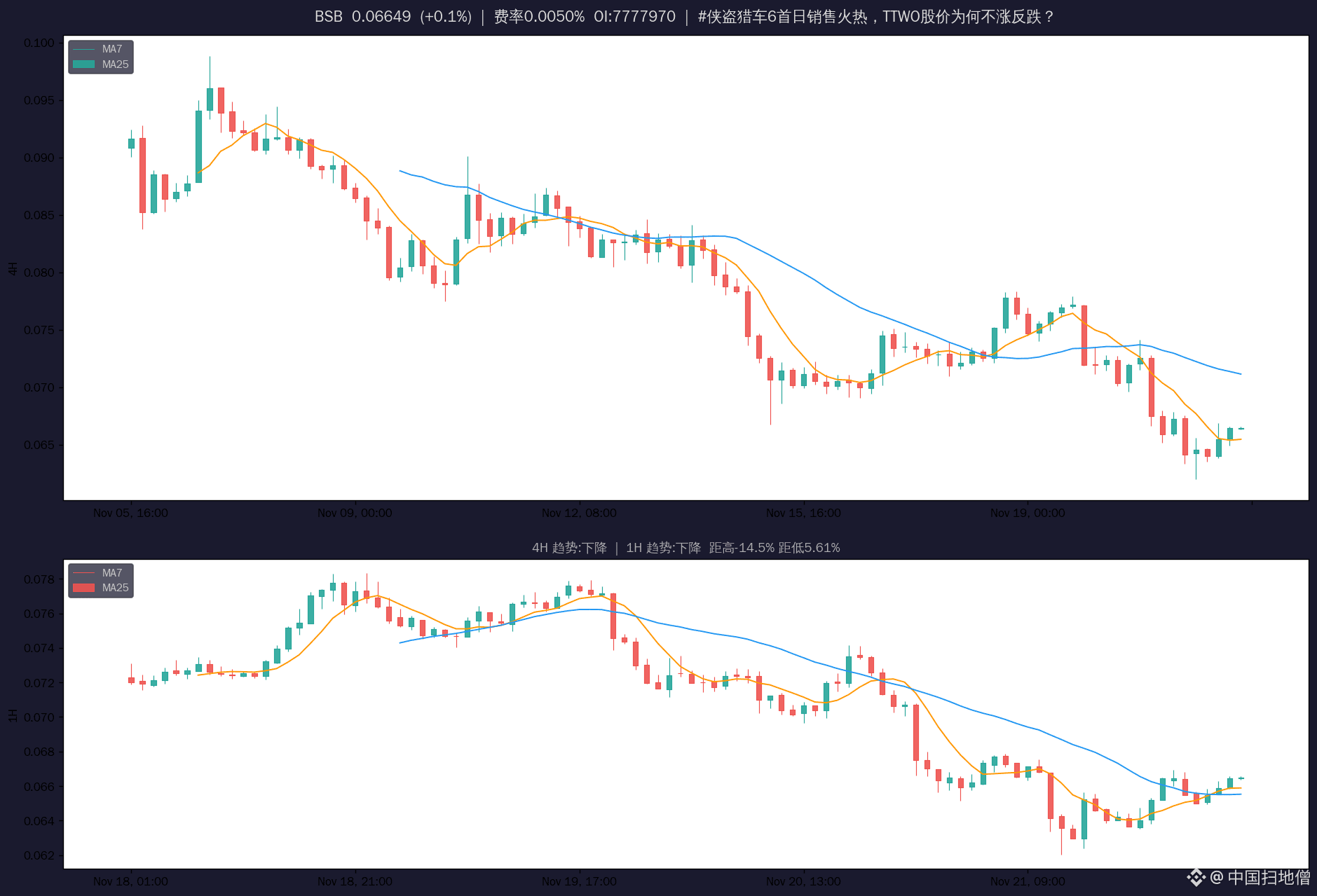
BSB Market Analysis 11/22#Grand Theft Auto 6 is off to a hot start in first-day sales, so why is TTWO stock falling instead of rising? The game’s popularity is diverging from its share price, much like BSB’s current low-volume consolidation: good news gets priced in and selling pressure follows. I expect short-term choppy weakness to continue, with a trend change approaching. The 24-hour range is nearly 6%, and the price is stuck at 0.06649. Both the 1-hour and 4-hour trends are pointing down. The price has pulled back 30.74% from the 4-hour high, but is only 3.89% above the low, with some support still holding below. The top 10 levels of the order book show 5,455 buy orders versus 4,795 sell orders, giving buyers a slight edge. The funding rate of 0.0050% is neutral, and open interest at 7.778 million shows no sign of panic-driven exits, suggesting both bulls and bears are waiting for a breakout signal. Strategy: if a rebound meets resistance at 0.06783, consider a small short position, with a stop-loss at 0.06921 and a target of 0.06347. If the price holds above 0.06712 on rising volume, reverse into a long position, with a stop-loss at 0.06588 and a target of 0.06976. Keep position size below 20%, and don’t chase trades before a breakout is confirmed.
BSB Market Analysis 11/22
#Grand Theft Auto 6 is off to a hot start in first-day sales, so why is TTWO stock falling instead of rising? The game’s popularity is diverging from its share price, much like BSB’s current low-volume consolidation: good news gets priced in and selling pressure follows. I expect short-term choppy weakness to continue, with a trend change approaching. The 24-hour range is nearly 6%, and the price is stuck at 0.06649. Both the 1-hour and 4-hour trends are pointing down. The price has pulled back 30.74% from the 4-hour high, but is only 3.89% above the low, with some support still holding below. The top 10 levels of the order book show 5,455 buy orders versus 4,795 sell orders, giving buyers a slight edge. The funding rate of 0.0050% is neutral, and open interest at 7.778 million shows no sign of panic-driven exits, suggesting both bulls and bears are waiting for a breakout signal. Strategy: if a rebound meets resistance at 0.06783, consider a small short position, with a stop-loss at 0.06921 and a target of 0.06347. If the price holds above 0.06712 on rising volume, reverse into a long position, with a stop-loss at 0.06588 and a target of 0.06976. Keep position size below 20%, and don’t chase trades before a breakout is confirmed.
1
·
--
Article
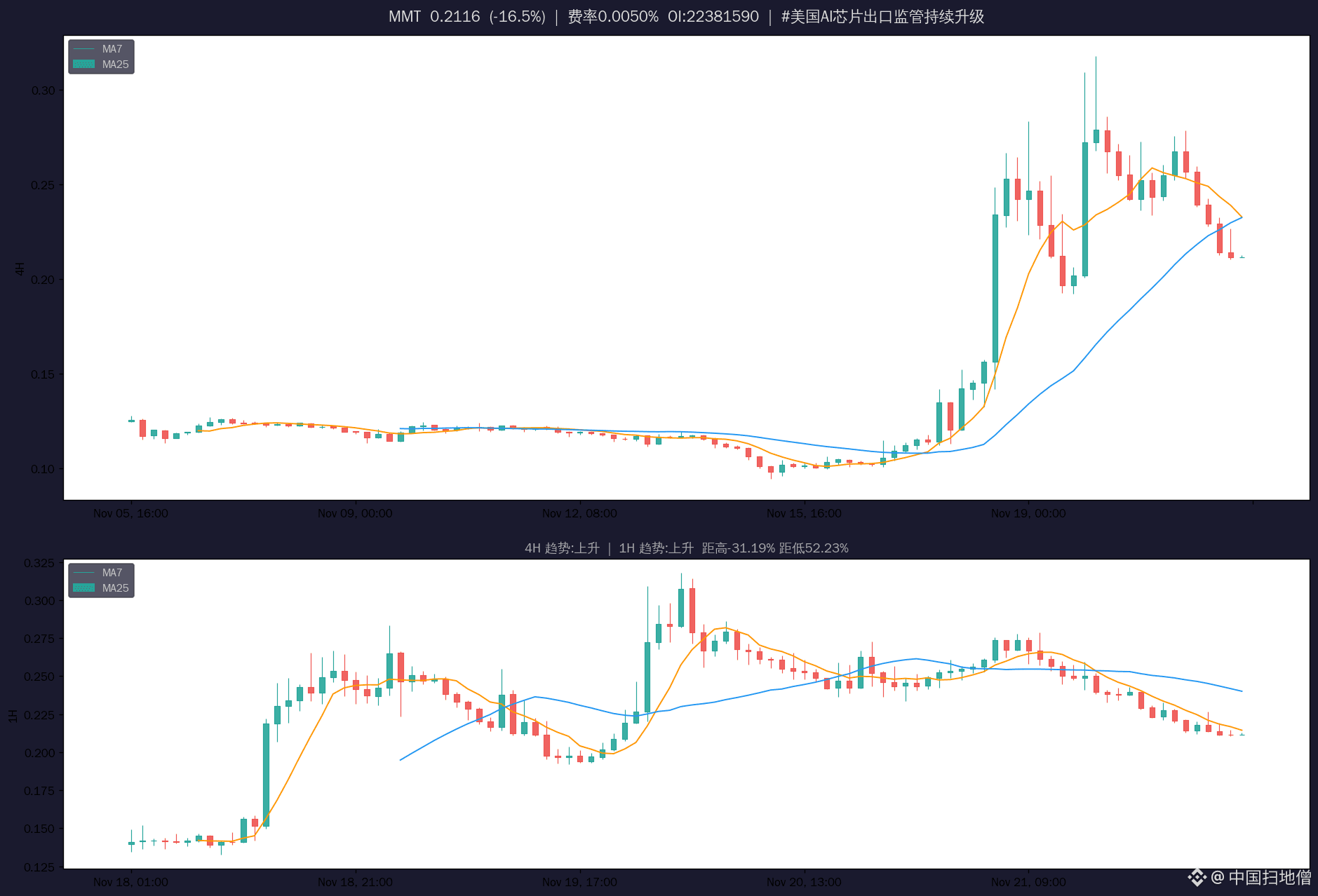
MMT Market Analysis 11/22U.S. AI chip export controls continue to tighten, putting risk appetite under pressure and weighing on computing-power tokens. MMT is no exception. My view is that the rebound is a corrective recovery, not a reversal; discipline should take priority over the urge to buy the dip. It fell 16.5% in 24 hours to 0.2116, with a low of 0.2104 approaching the previous low. Trading volume of 27.791 million shows that selling pressure has eased, but has not yet run its course. Although the one-hour and four-hour trends are upward, prices have pulled back 31.19% and 24.10% from their respective highs. The funding rate is a neutral-to-bullish 0.0050%, open interest is 22.382 million, and the order-book bid-to-ask ratio of 1.10 gives buyers a slight edge, but the rebound's momentum remains uncertain. Strategy: consider a small short on a rebound to 0.2237, with a stop-loss at 0.2318 and a target of 0.2043. If the price retests 0.2043 and holds, consider going long, with a stop-loss at 0.1976 and a target of 0.2189. Keep each position to no more than 5% of your portfolio; exit immediately if support breaks, and don't hold on hoping for a recovery.
MMT Market Analysis 11/22
U.S. AI chip export controls continue to tighten, putting risk appetite under pressure and weighing on computing-power tokens. MMT is no exception. My view is that the rebound is a corrective recovery, not a reversal; discipline should take priority over the urge to buy the dip. It fell 16.5% in 24 hours to 0.2116, with a low of 0.2104 approaching the previous low. Trading volume of 27.791 million shows that selling pressure has eased, but has not yet run its course. Although the one-hour and four-hour trends are upward, prices have pulled back 31.19% and 24.10% from their respective highs. The funding rate is a neutral-to-bullish 0.0050%, open interest is 22.382 million, and the order-book bid-to-ask ratio of 1.10 gives buyers a slight edge, but the rebound's momentum remains uncertain. Strategy: consider a small short on a rebound to 0.2237, with a stop-loss at 0.2318 and a target of 0.2043. If the price retests 0.2043 and holds, consider going long, with a stop-loss at 0.1976 and a target of 0.2189. Keep each position to no more than 5% of your portfolio; exit immediately if support breaks, and don't hold on hoping for a recovery.
2
·
--
Article
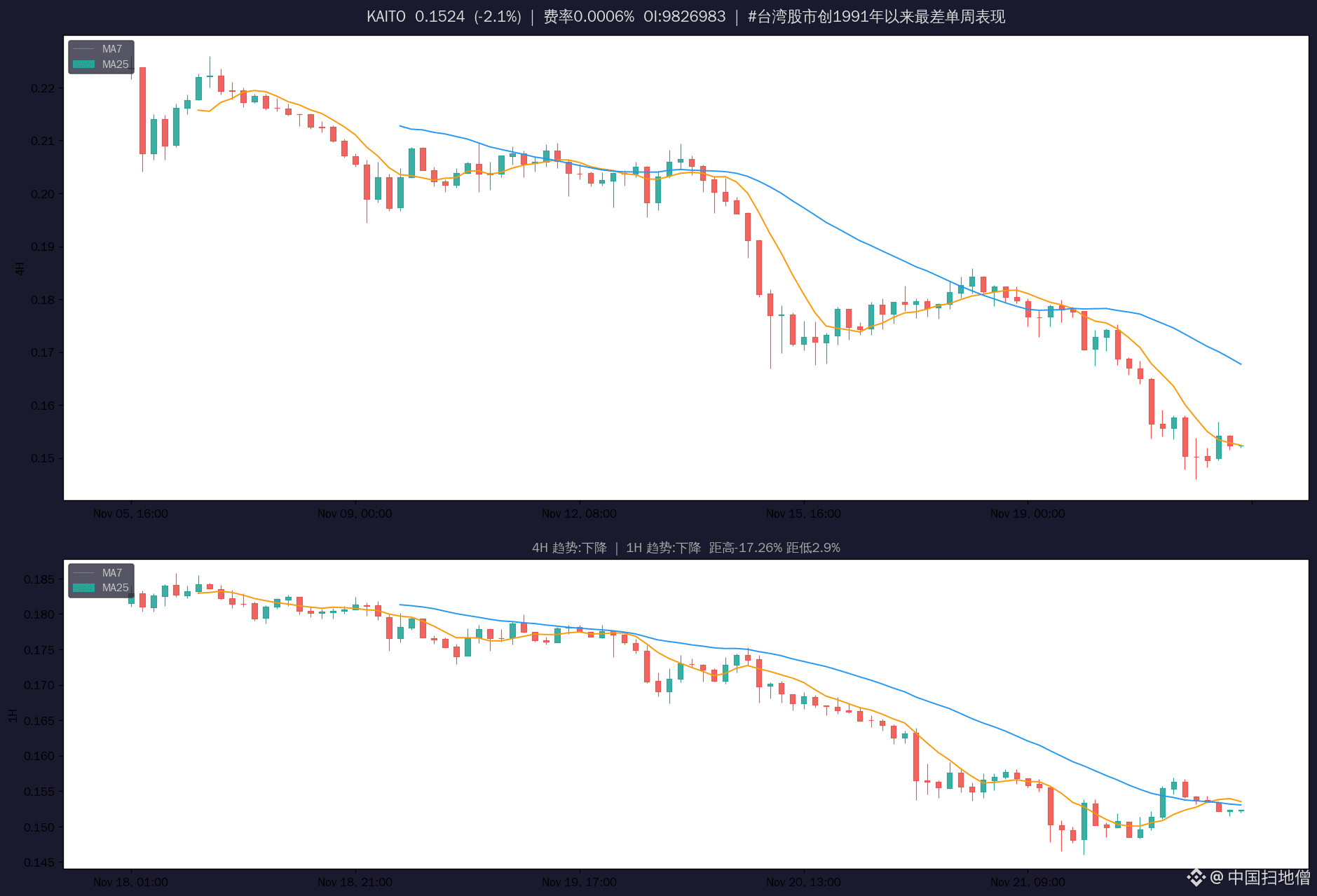
KAITO Market Analysis 11/22Taiwan’s stock market posted its worst weekly performance since 1991, and shrinking risk appetite is spilling over into crypto markets. KAITO is unlikely to be immune, and the short-term outlook remains weak. The current price is 0.1524, down 2.1% in 24 hours. It has retreated 31.87% from the 4-hour high, with both the 1-hour and 4-hour trends moving downward. It is just 2.90% and 1.87% above their respective lows. Bearish momentum has not faded, but the price is nearing support. Trading volume is 21.499 million; buy volume of 417,000 slightly exceeds sell volume of 392,000. The 1.06 ratio indicates some buying support at lower levels. The funding rate is only 0.0006%, with open interest at 9.827 million, suggesting muted bullish sentiment and no major increase in short positions. Strategy: consider a small long position at 0.1512, with a stop-loss at 0.1466 and a target of 0.1588. If a rebound is rejected at 0.1593, consider a short position, with a stop-loss at 0.1631 and a target of 0.1502. Keep each position to no more than 5%.
KAITO Market Analysis 11/22
Taiwan’s stock market posted its worst weekly performance since 1991, and shrinking risk appetite is spilling over into crypto markets. KAITO is unlikely to be immune, and the short-term outlook remains weak. The current price is 0.1524, down 2.1% in 24 hours. It has retreated 31.87% from the 4-hour high, with both the 1-hour and 4-hour trends moving downward. It is just 2.90% and 1.87% above their respective lows. Bearish momentum has not faded, but the price is nearing support. Trading volume is 21.499 million; buy volume of 417,000 slightly exceeds sell volume of 392,000. The 1.06 ratio indicates some buying support at lower levels. The funding rate is only 0.0006%, with open interest at 9.827 million, suggesting muted bullish sentiment and no major increase in short positions. Strategy: consider a small long position at 0.1512, with a stop-loss at 0.1466 and a target of 0.1588. If a rebound is rejected at 0.1593, consider a short position, with a stop-loss at 0.1631 and a target of 0.1502. Keep each position to no more than 5%.
6
·
--
Article
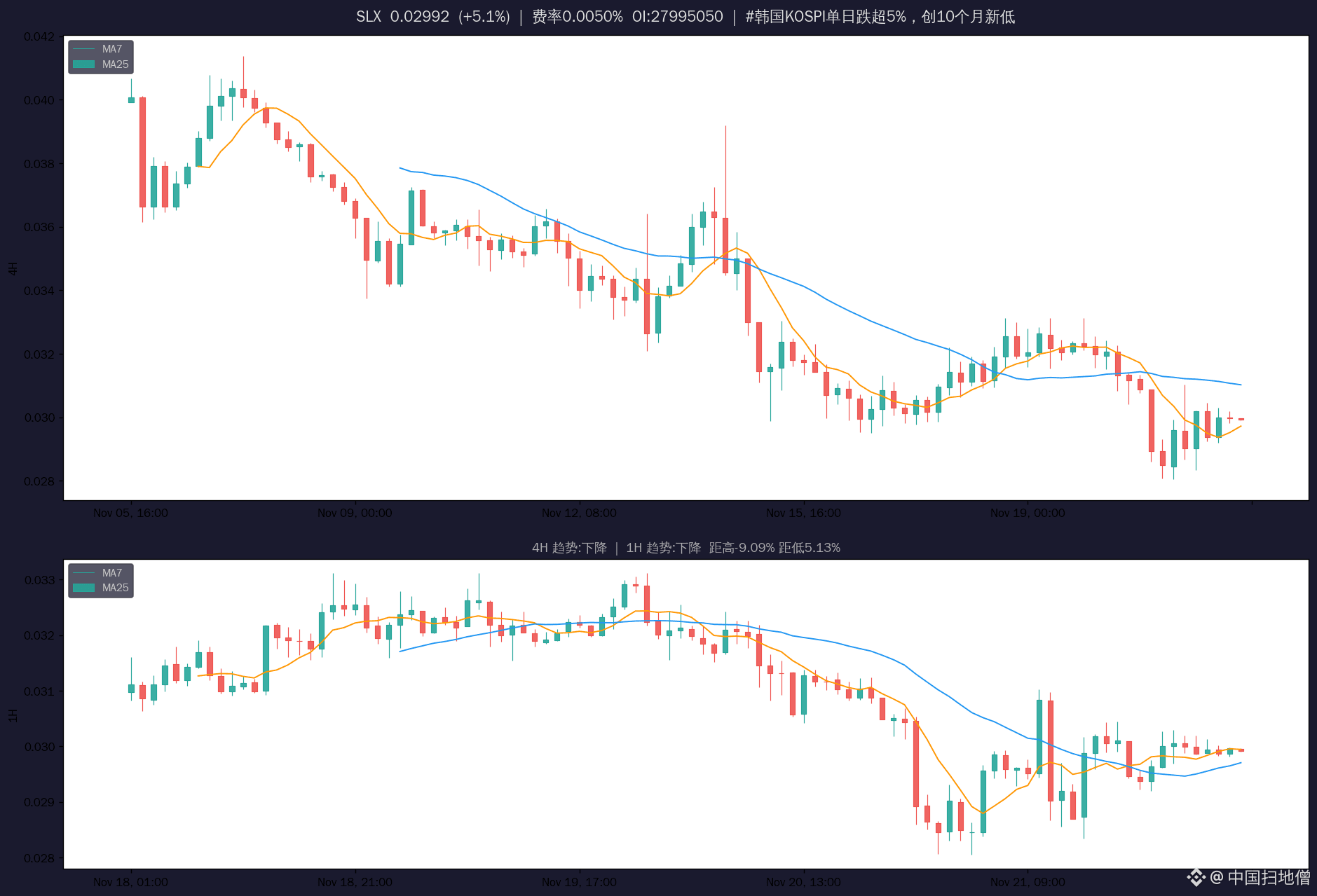
SLX Market Analysis 11/22South Korea’s stock market plunged more than 5% in a single day, hitting a ten-month low. The pullback in risk appetite has spilled over into crypto markets. SLX fell in sympathy but has not broken down; I view this as a sentiment shock rather than a trend reversal. The market is currently at 0.02992, down 5.1% over 24 hours, with both the 1-hour and 4-hour trends pointing down. It has retreated 25.87% from its 4-hour high, showing clear short-term pressure. Support lies at the intraday low of 0.02805, while 0.03102 is resistance. The top 10 order-book levels show 14,000 in bids versus 13,000 in asks, giving buyers a slight edge. The funding rate of 0.0050% is neutral, and open interest of 27.995 million shows no sign of panic-driven exits. For trading, consider a small long position on a pullback to 0.02865, with a stop-loss at 0.02795 and a target of 0.03085. If the price breaks below the stop-loss on increased volume, exit and wait on the sidelines. Keep your position size below 20% and don’t chase the price.
SLX Market Analysis 11/22
South Korea’s stock market plunged more than 5% in a single day, hitting a ten-month low. The pullback in risk appetite has spilled over into crypto markets. SLX fell in sympathy but has not broken down; I view this as a sentiment shock rather than a trend reversal. The market is currently at 0.02992, down 5.1% over 24 hours, with both the 1-hour and 4-hour trends pointing down. It has retreated 25.87% from its 4-hour high, showing clear short-term pressure. Support lies at the intraday low of 0.02805, while 0.03102 is resistance. The top 10 order-book levels show 14,000 in bids versus 13,000 in asks, giving buyers a slight edge. The funding rate of 0.0050% is neutral, and open interest of 27.995 million shows no sign of panic-driven exits. For trading, consider a small long position on a pullback to 0.02865, with a stop-loss at 0.02795 and a target of 0.03085. If the price breaks below the stop-loss on increased volume, exit and wait on the sidelines. Keep your position size below 20% and don’t chase the price.
2
·
--
Article
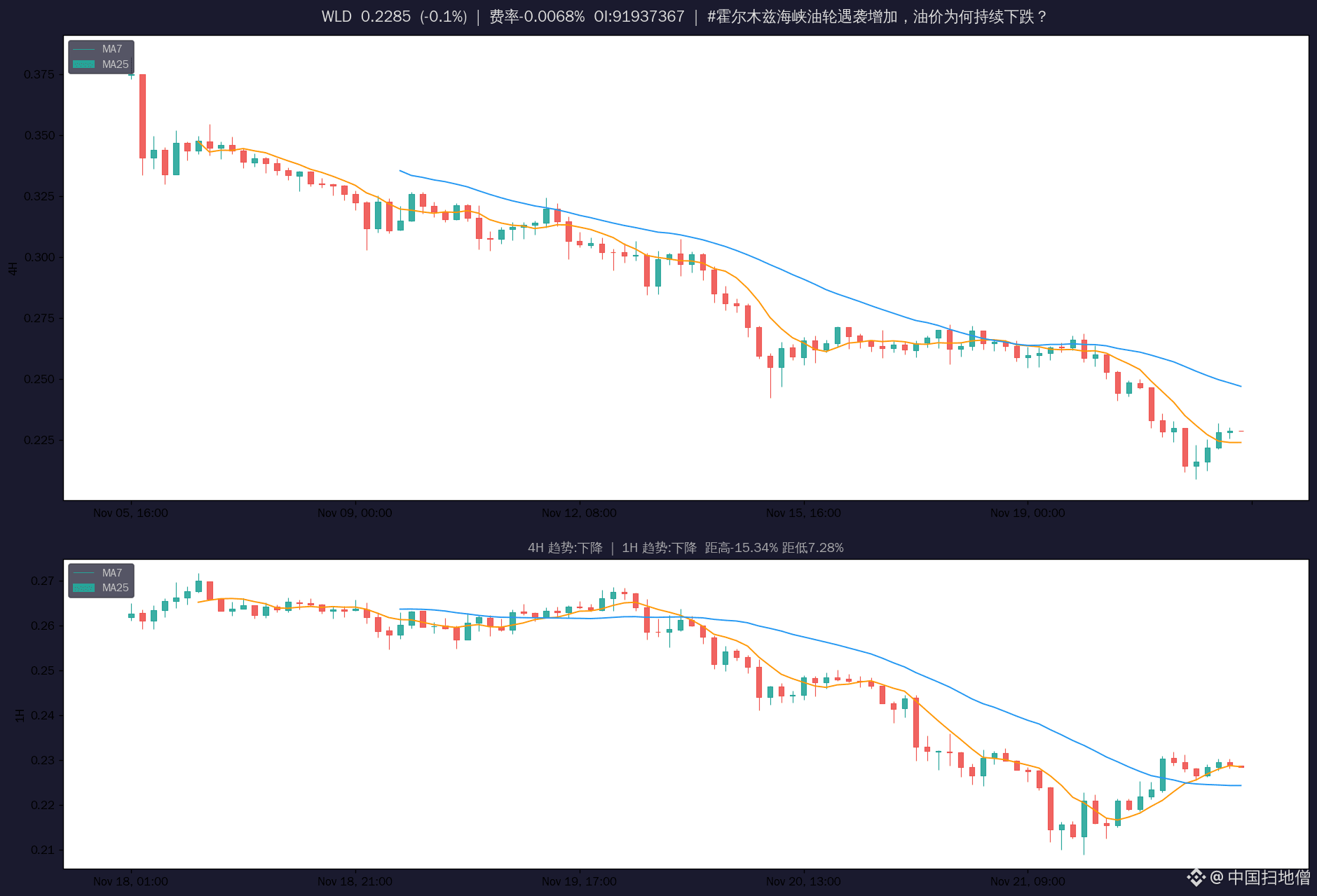
WLD Market Analysis 11/22Tanker attacks in the Strait of Hormuz are increasing, yet oil prices are falling rather than rising. The fading risk premium is weighing on risk appetite in crypto markets. WLD is under short-term pressure, but buyers are still present below. I see the current market as weak and range-bound rather than in a one-way collapse.
The conflicting signals stem from different timeframes: both the 1-hour and 4-hour charts are in downtrends, with the 4-hour price having retraced 39.01% from its high. However, bids in the top 10 order-book levels total 1.513 million versus 1.400 million in asks, giving buyers a slight edge. The funding rate of -0.0068% indicates that shorts are paying, while open interest of 91.937 million suggests the standoff has not subsided. The 24-hour low of 0.2089 is a key short-term support level, while 0.2327 is the resistance to watch for a rebound.
WLD Market Analysis 11/22
Tanker attacks in the Strait of Hormuz are increasing, yet oil prices are falling rather than rising. The fading risk premium is weighing on risk appetite in crypto markets. WLD is under short-term pressure, but buyers are still present below. I see the current market as weak and range-bound rather than in a one-way collapse.
The conflicting signals stem from different timeframes: both the 1-hour and 4-hour charts are in downtrends, with the 4-hour price having retraced 39.01% from its high. However, bids in the top 10 order-book levels total 1.513 million versus 1.400 million in asks, giving buyers a slight edge. The funding rate of -0.0068% indicates that shorts are paying, while open interest of 91.937 million suggests the standoff has not subsided. The 24-hour low of 0.2089 is a key short-term support level, while 0.2327 is the resistance to watch for a rebound.
6
·
--
Article
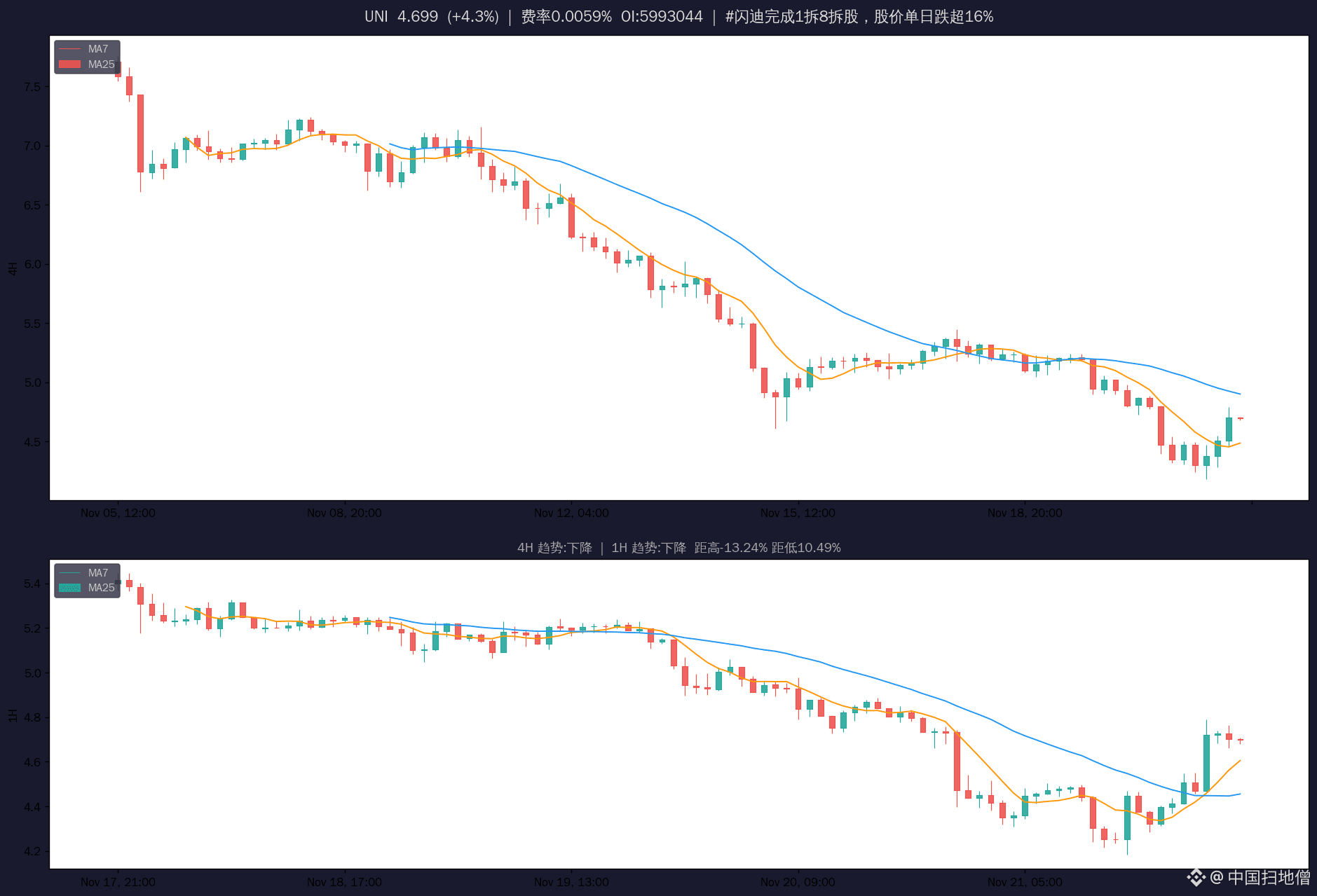
UNI Market Analysis 11/22After SanDisk completed a 1-for-8 stock split, its share price fell more than 16% in a single day. This kind of liquidity event reminds us that a split does not change value. UNI is currently going through a similar period of sentiment digestion. My overall view is that the short-term outlook is weak, and any rebound needs to be confirmed by volume. Over the past 24 hours, UNI rose 4.3% to 4.699, but both the 1-hour and 4-hour trends are downward. It has retraced 38.08% from its 4-hour high, while trading value of 25.838 million indicates limited appetite for chasing the price higher. The buy/sell ratio across the top 10 order-book levels is 0.95, giving sellers a slight edge. The funding rate of 0.0059% is fairly neutral, and there has been no significant unwinding of the 5.993 million in coin-margined open interest. Strategy: consider a small short on a rebound to 4.752, with a stop-loss at 4.812 and a target of 4.568. If the price retests 4.436 and holds, consider a short-term long, with a stop-loss at 4.378 and a target of 4.615. Keep each position below 20% of your allocation and exit immediately if support breaks.
UNI Market Analysis 11/22
After SanDisk completed a 1-for-8 stock split, its share price fell more than 16% in a single day. This kind of liquidity event reminds us that a split does not change value. UNI is currently going through a similar period of sentiment digestion. My overall view is that the short-term outlook is weak, and any rebound needs to be confirmed by volume. Over the past 24 hours, UNI rose 4.3% to 4.699, but both the 1-hour and 4-hour trends are downward. It has retraced 38.08% from its 4-hour high, while trading value of 25.838 million indicates limited appetite for chasing the price higher. The buy/sell ratio across the top 10 order-book levels is 0.95, giving sellers a slight edge. The funding rate of 0.0059% is fairly neutral, and there has been no significant unwinding of the 5.993 million in coin-margined open interest. Strategy: consider a small short on a rebound to 4.752, with a stop-loss at 4.812 and a target of 4.568. If the price retests 4.436 and holds, consider a short-term long, with a stop-loss at 4.378 and a target of 4.615. Keep each position below 20% of your allocation and exit immediately if support breaks.
6
·
--
Article
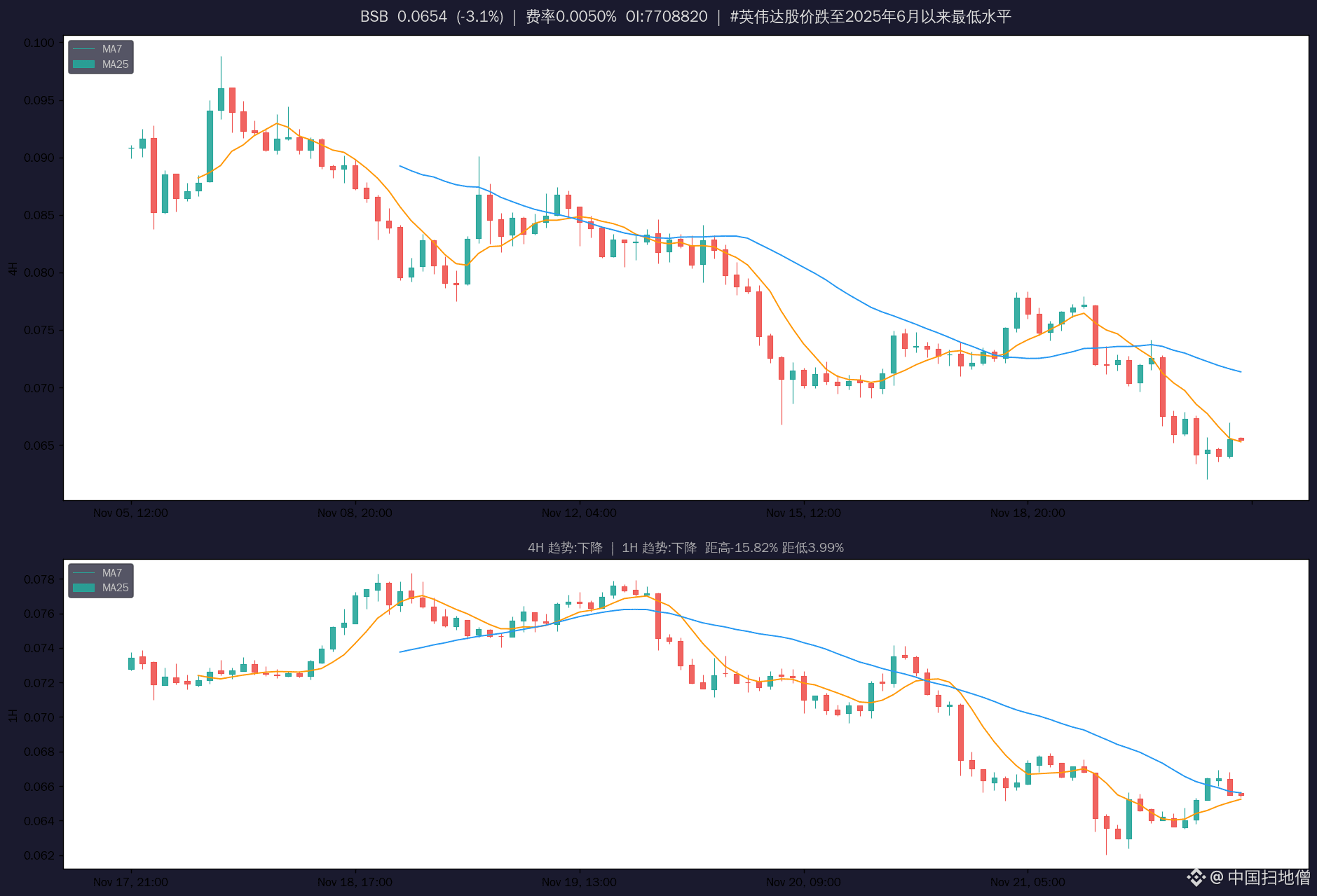
BSB Market Analysis 11/22Nvidia’s stock price has fallen to its lowest level since June 2025. Risk aversion is spreading to altcoins, and BSB is no exception. I expect it to remain weak in the short term, searching for a bottom, with rallies likely to face resistance. The current price is 0.0654, down 3.1% in 24 hours, with trading volume of just 1.222 million, indicating thin liquidity. The 1-hour and 4-hour trends are both moving lower; on the 4-hour chart, the price has fallen more than 30% from its high. The top 10 bids in the order book total 1592, versus 5017 in asks, giving a bid-to-ask ratio of 0.32, with sellers clearly in control. Although the funding rate is positive at 0.005%, open interest stands at 7.709 million coins, and crowded longs could be squeezed. Strategy: Consider a small short position on a rebound to around 0.06785, with a stop-loss at 0.06935 and a target of 0.06215. If the price breaks below 0.06185 on increased volume, consider following the trend with a short, setting a stop-loss at 0.06345 and a target of 0.05865. Keep each position below 3% of total capital and set strict stop-losses.
BSB Market Analysis 11/22
Nvidia’s stock price has fallen to its lowest level since June 2025. Risk aversion is spreading to altcoins, and BSB is no exception. I expect it to remain weak in the short term, searching for a bottom, with rallies likely to face resistance. The current price is 0.0654, down 3.1% in 24 hours, with trading volume of just 1.222 million, indicating thin liquidity. The 1-hour and 4-hour trends are both moving lower; on the 4-hour chart, the price has fallen more than 30% from its high. The top 10 bids in the order book total 1592, versus 5017 in asks, giving a bid-to-ask ratio of 0.32, with sellers clearly in control. Although the funding rate is positive at 0.005%, open interest stands at 7.709 million coins, and crowded longs could be squeezed. Strategy: Consider a small short position on a rebound to around 0.06785, with a stop-loss at 0.06935 and a target of 0.06215. If the price breaks below 0.06185 on increased volume, consider following the trend with a short, setting a stop-loss at 0.06345 and a target of 0.05865. Keep each position below 3% of total capital and set strict stop-losses.
3
·
--
Article
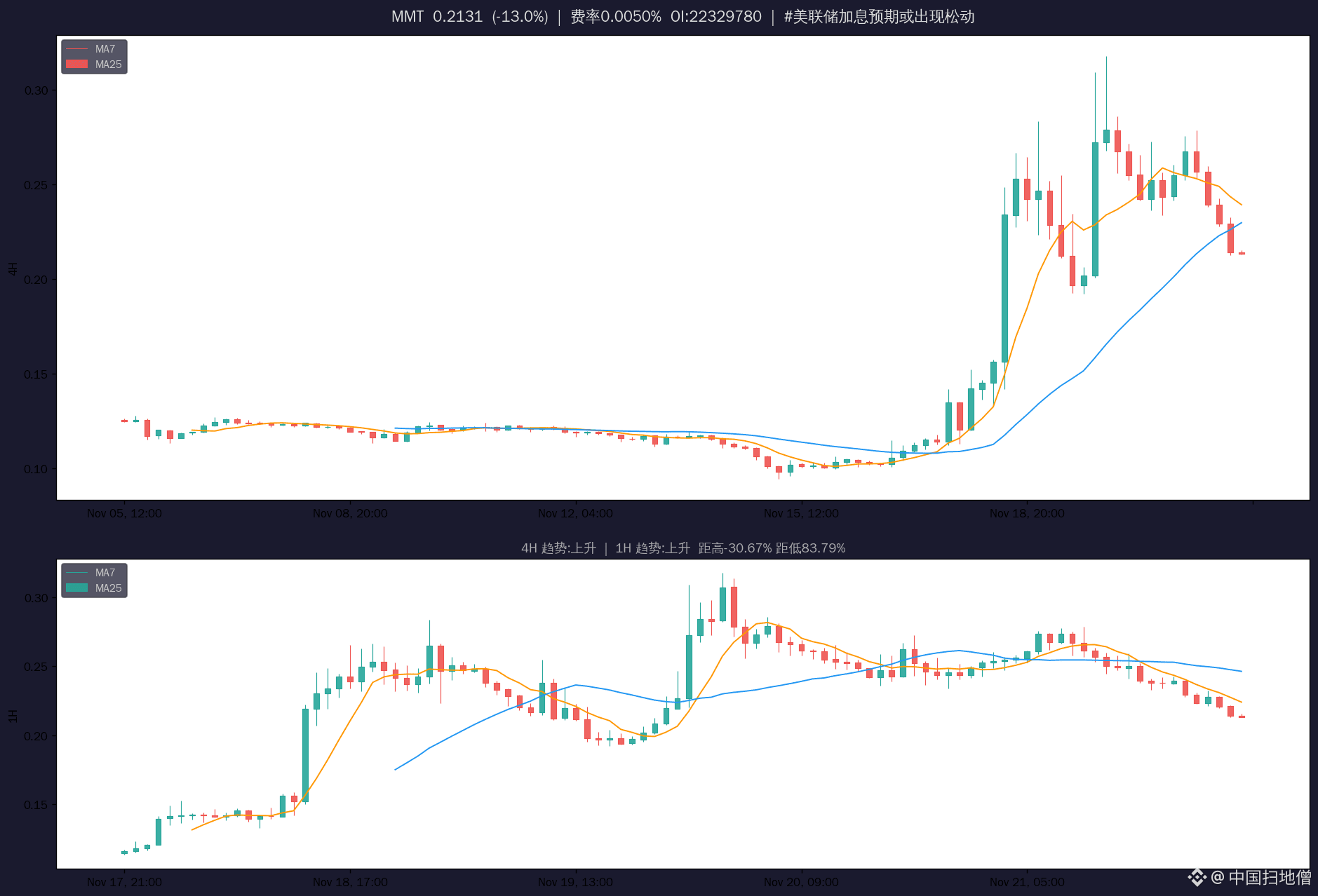
MMT Market Analysis 11/22Expectations of Fed rate hikes may be easing, and a recovery in risk appetite should normally benefit the crypto market. However, MMT has plunged independently, indicating that its own selling pressure far outweighs the macro narrative. My view is that a short-term rebound is unlikely to change the weak trend. MMT has fallen 13% in the past 24 hours, hitting a low of 0.2128. It remains 30.67% below its one-hour high, while having rebounded 83.79% from its low. The short-term uptrend conflicts sharply with the recovery following the plunge. The buy/sell ratio across the top 10 order-book levels is 0.96, giving sellers a slight edge. The 0.005% funding rate shows that longs are still paying to hold positions, so sentiment has not yet been fully washed out. Strategy: place a limit order to go long at 0.2085 to catch an oversold rebound, with a stop-loss at 0.1985 and a target of 0.2315. If the rebound meets resistance at 0.2385, consider a small short position, with a stop-loss at 0.2485 and a target of 0.2145. Keep each position below 20% of your portfolio.
MMT Market Analysis 11/22
Expectations of Fed rate hikes may be easing, and a recovery in risk appetite should normally benefit the crypto market. However, MMT has plunged independently, indicating that its own selling pressure far outweighs the macro narrative. My view is that a short-term rebound is unlikely to change the weak trend. MMT has fallen 13% in the past 24 hours, hitting a low of 0.2128. It remains 30.67% below its one-hour high, while having rebounded 83.79% from its low. The short-term uptrend conflicts sharply with the recovery following the plunge. The buy/sell ratio across the top 10 order-book levels is 0.96, giving sellers a slight edge. The 0.005% funding rate shows that longs are still paying to hold positions, so sentiment has not yet been fully washed out. Strategy: place a limit order to go long at 0.2085 to catch an oversold rebound, with a stop-loss at 0.1985 and a target of 0.2315. If the rebound meets resistance at 0.2385, consider a small short position, with a stop-loss at 0.2485 and a target of 0.2145. Keep each position below 20% of your portfolio.
5
·
--
Article
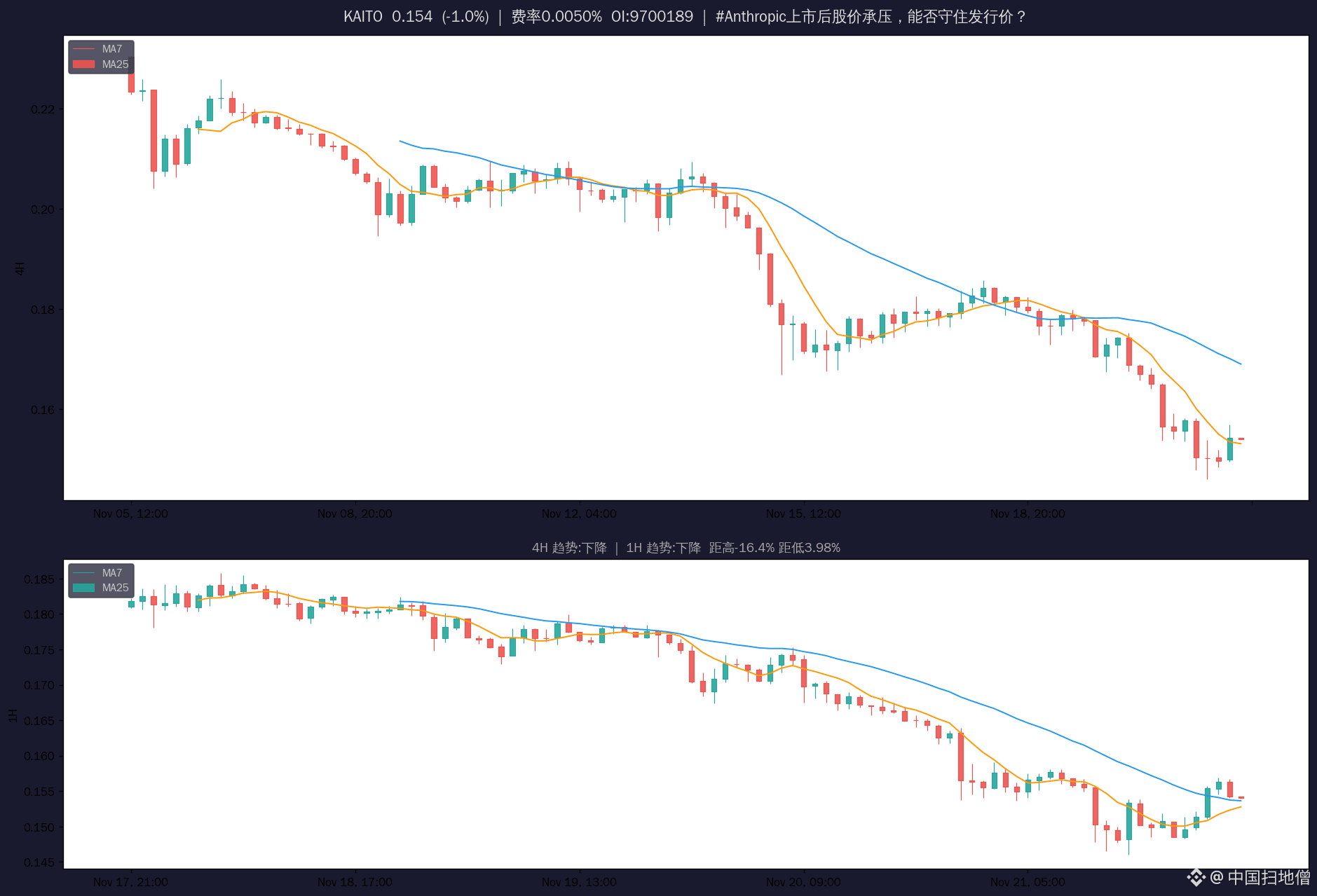
KAITO Market Analysis 11/22Anthropic’s share price has come under pressure since its listing. Can it hold above its IPO price? This reflects the market’s caution toward highly valued assets. KAITO faces a similar test, and my view is bearish in the short term: stay disciplined and don’t chase a rebound.
The current price is 0.154, down 1.0% over 24 hours. The 1-hour and 4-hour trends are both moving downward. The price has retreated 31.16% from the 4-hour high and is just 2.94% above the low; bearish momentum has not faded. Trading volume is 25.192 million. The order book’s buy/sell ratio is 1.00, but sellers have a slight edge. The funding rate of 0.0050% is fairly neutral, and open interest of 9.7 million contracts shows no sign of panic liquidations. Dip-buying sentiment remains, which actually adds to the risk.
KAITO Market Analysis 11/22
Anthropic’s share price has come under pressure since its listing. Can it hold above its IPO price? This reflects the market’s caution toward highly valued assets. KAITO faces a similar test, and my view is bearish in the short term: stay disciplined and don’t chase a rebound.
The current price is 0.154, down 1.0% over 24 hours. The 1-hour and 4-hour trends are both moving downward. The price has retreated 31.16% from the 4-hour high and is just 2.94% above the low; bearish momentum has not faded. Trading volume is 25.192 million. The order book’s buy/sell ratio is 1.00, but sellers have a slight edge. The funding rate of 0.0050% is fairly neutral, and open interest of 9.7 million contracts shows no sign of panic liquidations. Dip-buying sentiment remains, which actually adds to the risk.
·
--
Article
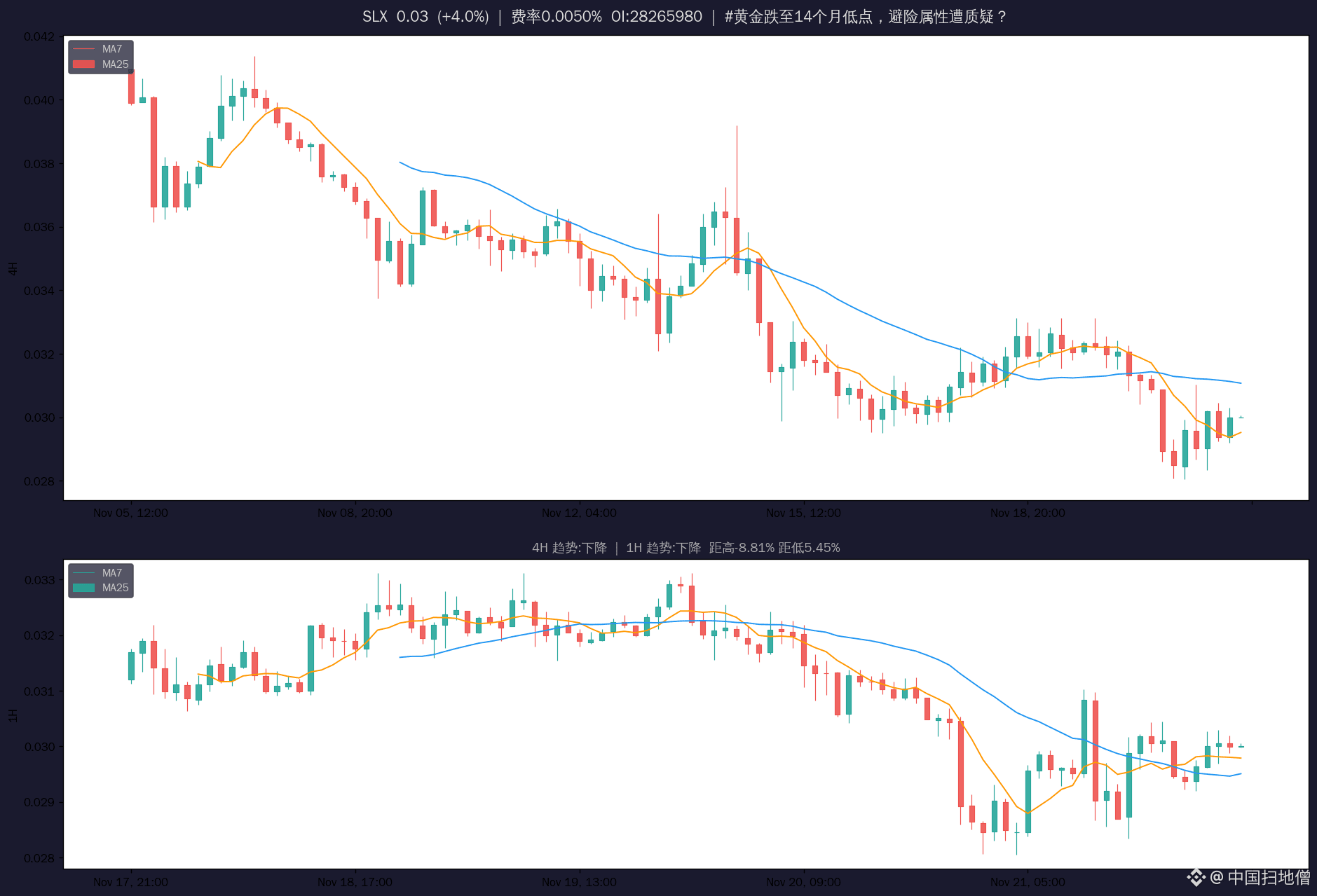
SLX Market Analysis 11/22As gold’s safe-haven shine fades, SLX, a highly volatile small-cap coin, is more vulnerable to liquidity outflows. My overall view is bearish in the short term, and any rebound should initially be treated as an opportunity to reduce exposure. It has retraced 25.67% from its four-hour high, and the one-hour downtrend remains intact. A break below the 0.02805 low would open up further downside. Above the current price of 0.03, 0.03102 is resistance. The top ten bids total just 14,000 versus 18,000 in asks; a bid-to-ask ratio of 0.79 shows sellers dominating the order book. The funding rate of 0.005% is fairly neutral, and open interest of 28.266 million tokens shows no signs of panic exits, suggesting longs are still holding on. Strategy: probe a short with a small position on a rebound to 0.03015, with a stop at 0.03135 and a target of 0.02815. If price breaks below 0.02805 on strong volume, don’t chase the move; wait for a pullback to 0.02875 before entering, with a stop at 0.02965 and a target of 0.02685. Keep each position below 20% of your allocation; exit immediately on a breakdown and don’t add to the position.
SLX Market Analysis 11/22
As gold’s safe-haven shine fades, SLX, a highly volatile small-cap coin, is more vulnerable to liquidity outflows. My overall view is bearish in the short term, and any rebound should initially be treated as an opportunity to reduce exposure. It has retraced 25.67% from its four-hour high, and the one-hour downtrend remains intact. A break below the 0.02805 low would open up further downside. Above the current price of 0.03, 0.03102 is resistance. The top ten bids total just 14,000 versus 18,000 in asks; a bid-to-ask ratio of 0.79 shows sellers dominating the order book. The funding rate of 0.005% is fairly neutral, and open interest of 28.266 million tokens shows no signs of panic exits, suggesting longs are still holding on. Strategy: probe a short with a small position on a rebound to 0.03015, with a stop at 0.03135 and a target of 0.02815. If price breaks below 0.02805 on strong volume, don’t chase the move; wait for a pullback to 0.02875 before entering, with a stop at 0.02965 and a target of 0.02685. Keep each position below 20% of your allocation; exit immediately on a breakdown and don’t add to the position.
·
--
Article
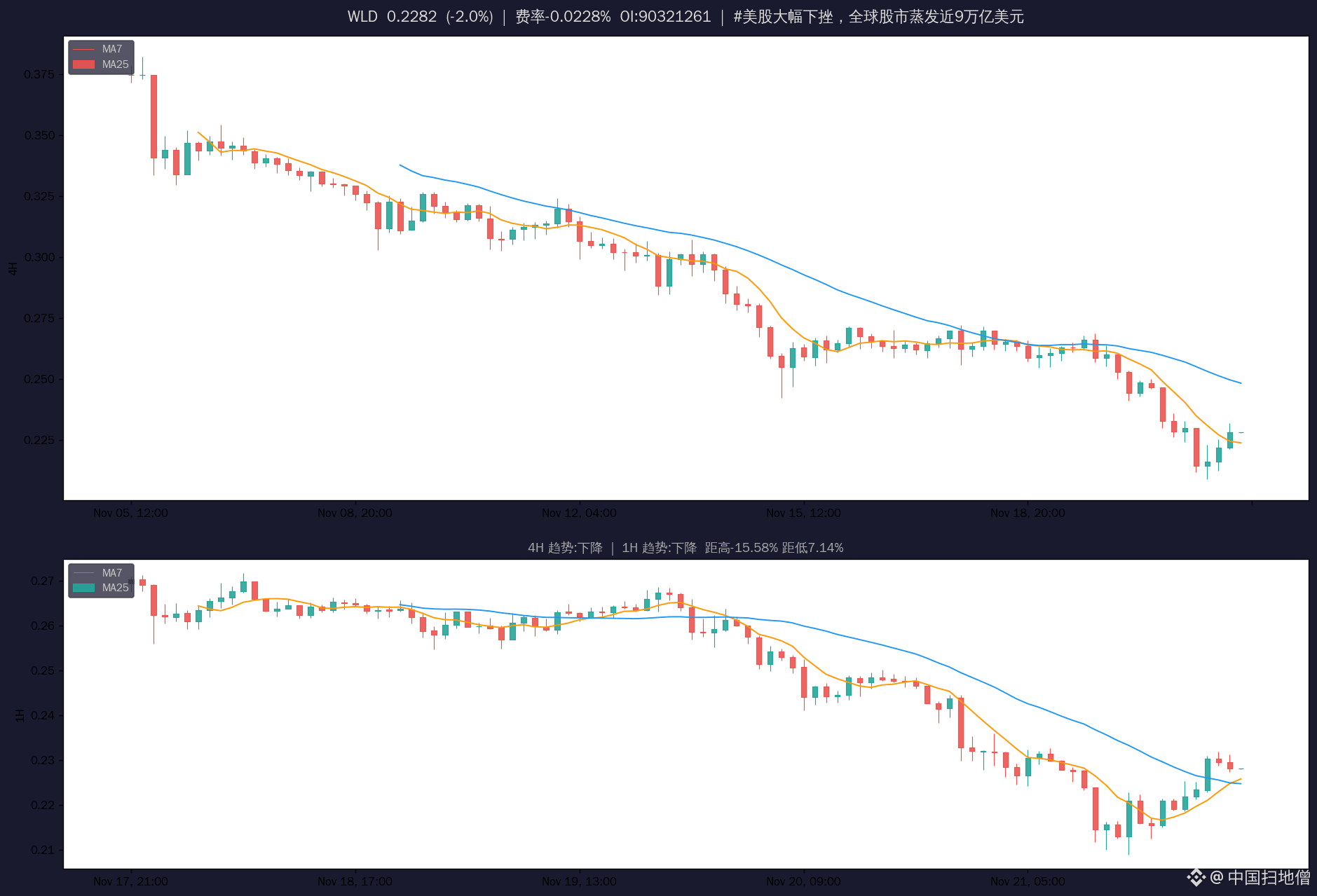
WLD Market Analysis 11/22U.S. stocks plunged, wiping nearly $9 trillion off global equity markets. Risk assets are under broad pressure, and Worldcoin (WLD) is no exception. I lean toward the view that the short-term weakness remains intact, making any rebound an opportunity to reduce positions. The market is trading at 0.2282, down 2.0% over 24 hours, with a high of 0.2359 and a low of 0.2089. Trading volume is 386 million. Both the one-hour and four-hour trends are downward, and the price has retreated 39.11% from its four-hour high. The funding rate of -0.0228% points to strong bearish sentiment, but the top-10 bid-to-ask ratio is 1.22, with 1.637 million in bids versus 1.337 million in asks. Shallow bids are relatively stronger, suggesting buyers are stepping in after the sharp drop. As a strategy, consider placing a long order at 0.2247, with a stop-loss at 0.2149 and a target of 0.2383, aiming to capture an oversold rebound. If the price rebounds to around 0.2371 and faces resistance, consider a small short position, with a stop-loss at 0.2433 and a target of 0.2191. Keep position size below 20% and exit decisively if the stop-loss is hit.
WLD Market Analysis 11/22
U.S. stocks plunged, wiping nearly $9 trillion off global equity markets. Risk assets are under broad pressure, and Worldcoin (WLD) is no exception. I lean toward the view that the short-term weakness remains intact, making any rebound an opportunity to reduce positions. The market is trading at 0.2282, down 2.0% over 24 hours, with a high of 0.2359 and a low of 0.2089. Trading volume is 386 million. Both the one-hour and four-hour trends are downward, and the price has retreated 39.11% from its four-hour high. The funding rate of -0.0228% points to strong bearish sentiment, but the top-10 bid-to-ask ratio is 1.22, with 1.637 million in bids versus 1.337 million in asks. Shallow bids are relatively stronger, suggesting buyers are stepping in after the sharp drop. As a strategy, consider placing a long order at 0.2247, with a stop-loss at 0.2149 and a target of 0.2383, aiming to capture an oversold rebound. If the price rebounds to around 0.2371 and faces resistance, consider a small short position, with a stop-loss at 0.2433 and a target of 0.2191. Keep position size below 20% and exit decisively if the stop-loss is hit.
7
·
--
Article
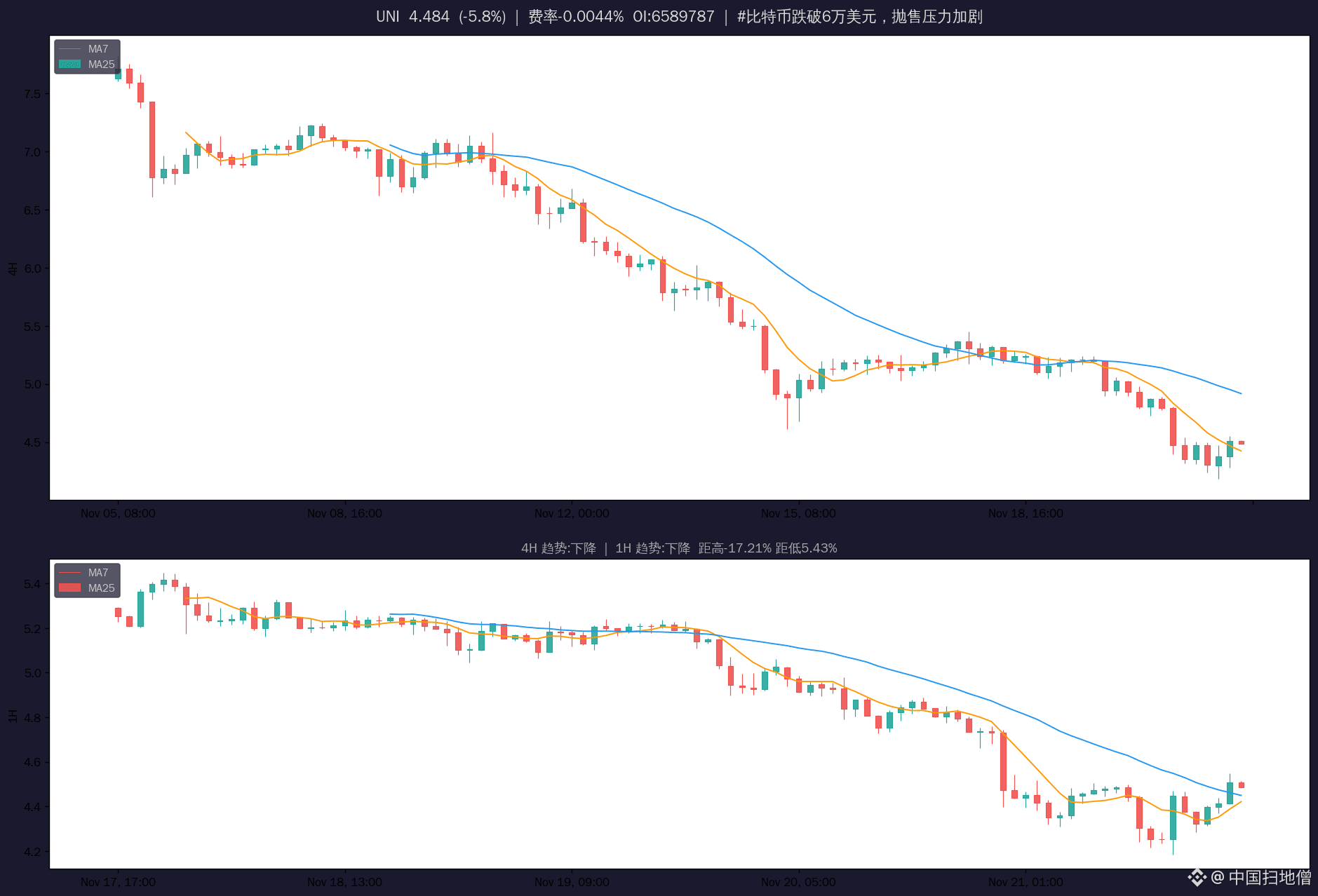
UNI Market Analysis 11/21Bitcoin has fallen below $60,000, intensifying selling pressure. Altcoins are bearing the brunt, and UNI is unlikely to be spared. My view: the short-term weakness is not over; any rebound is an opportunity to reduce positions, not a signal of a reversal.
The current price is 4.484, down 5.8% in 24 hours, with trading volume at just 25.997 million. The decline on falling volume suggests weak buying support. The price has retraced 41.79% from its four-hour high and is only 5.43% above its one-hour low; 4.183 is the last line of defense for the day. The order book's bid-to-ask ratio is 0.96, giving sellers a slight edge. The funding rate is -0.0044%, meaning shorts are paying; sentiment is bearish but not extreme. Open interest stands at 6.59 million coins, with no sign of panic liquidations, so the decline may not be over.
UNI Market Analysis 11/21
Bitcoin has fallen below $60,000, intensifying selling pressure. Altcoins are bearing the brunt, and UNI is unlikely to be spared. My view: the short-term weakness is not over; any rebound is an opportunity to reduce positions, not a signal of a reversal.
The current price is 4.484, down 5.8% in 24 hours, with trading volume at just 25.997 million. The decline on falling volume suggests weak buying support. The price has retraced 41.79% from its four-hour high and is only 5.43% above its one-hour low; 4.183 is the last line of defense for the day. The order book's bid-to-ask ratio is 0.96, giving sellers a slight edge. The funding rate is -0.0044%, meaning shorts are paying; sentiment is bearish but not extreme. Open interest stands at 6.59 million coins, with no sign of panic liquidations, so the decline may not be over.
11
·
--
Article
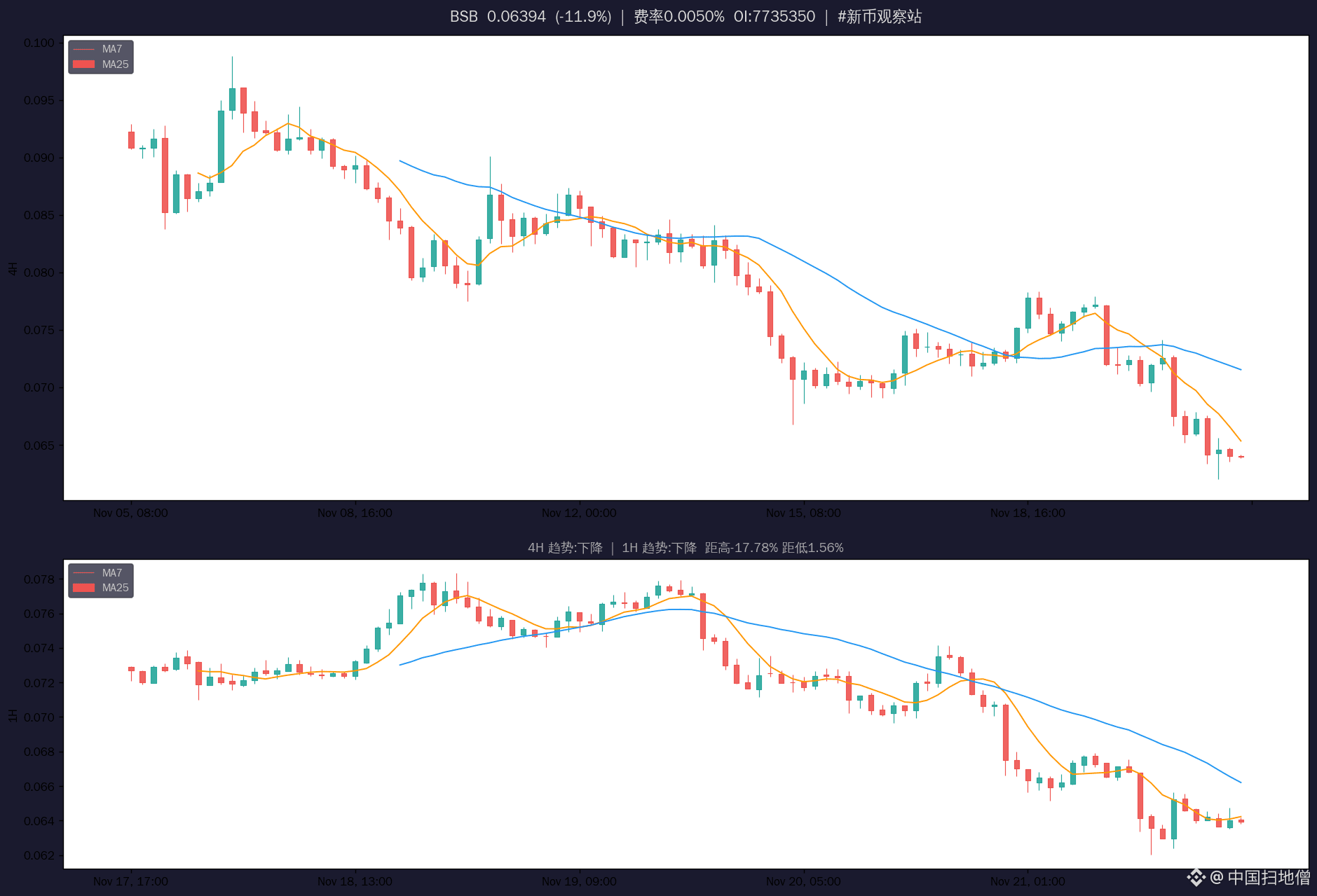
BSB Market Analysis 11/21New Coin Observatory has recently turned its attention to BSB. The asset is at a critical turning point after breaking down on the 4-hour timeframe. My overall assessment is that bearish momentum has not yet faded, and the rebound looks more like a corrective bounce than a reversal. The 11.9% drop over 24 hours drove the price from 0.07272 to 0.06202. Over the past hour, it has fallen 17.78% from its high and is just 1.56% above its low, with the trend structure clearly pointing downward. Trading volume of 1.378 million is relatively thin, while the funding rate is positive at 0.0050%—longs are still paying to hold their positions. Open interest of 7.735 million coins carries hidden liquidation risk, while the order book's 1.11 buy/sell ratio favors buyers, which is more likely to reflect passive dip-buying than aggressive long positioning. As a strategy, consider a small short position on a rebound to around 0.06685, with a stop-loss at 0.06895 and a target of 0.06115. If the price holds above 0.06482 on increased volume, treat it as a short-term breakout signal and consider reversing into a small long position targeting 0.06725, with a stop-loss at 0.06315. Keep position size below 20% and, given the thin order book, be sure to scale in and out and carefully manage slippage.
BSB Market Analysis 11/21
New Coin Observatory has recently turned its attention to BSB. The asset is at a critical turning point after breaking down on the 4-hour timeframe. My overall assessment is that bearish momentum has not yet faded, and the rebound looks more like a corrective bounce than a reversal. The 11.9% drop over 24 hours drove the price from 0.07272 to 0.06202. Over the past hour, it has fallen 17.78% from its high and is just 1.56% above its low, with the trend structure clearly pointing downward. Trading volume of 1.378 million is relatively thin, while the funding rate is positive at 0.0050%—longs are still paying to hold their positions. Open interest of 7.735 million coins carries hidden liquidation risk, while the order book's 1.11 buy/sell ratio favors buyers, which is more likely to reflect passive dip-buying than aggressive long positioning. As a strategy, consider a small short position on a rebound to around 0.06685, with a stop-loss at 0.06895 and a target of 0.06115. If the price holds above 0.06482 on increased volume, treat it as a short-term breakout signal and consider reversing into a small long position targeting 0.06725, with a stop-loss at 0.06315. Keep position size below 20% and, given the thin order book, be sure to scale in and out and carefully manage slippage.
Log in to explore more content
Join global crypto users on Binance Square
⚡️ Get latest and useful information about crypto.
💬 Trusted by the world’s largest crypto exchange.
👍 Discover real insights from verified creators.
Email / Phone number
Trending Topics
NvidiaLoses$2.7TrillionInMonthAndAHalf
28,023 views
159 Discussing
Nvidia’s $2.7 Trillion Wipeout: When Narrative Overrides Numbers 📉
Crypto With Faisal
·7 Likes
·6k views
CanBTCReboundAfterFallingBelow60K?
844,143 views
3,148 Discussing
GlobalStocksFaceLongestLosingStreakSince2023
316,231 views
2,112 Discussing