
laotiansi
74 Posts

laotiansi
Report
Block User
23 Following
51 Followers
219 Liked
Posts
All
Quotes
·
--
Tonight’s story is a classic “kicked it wide at the last minute” moment.
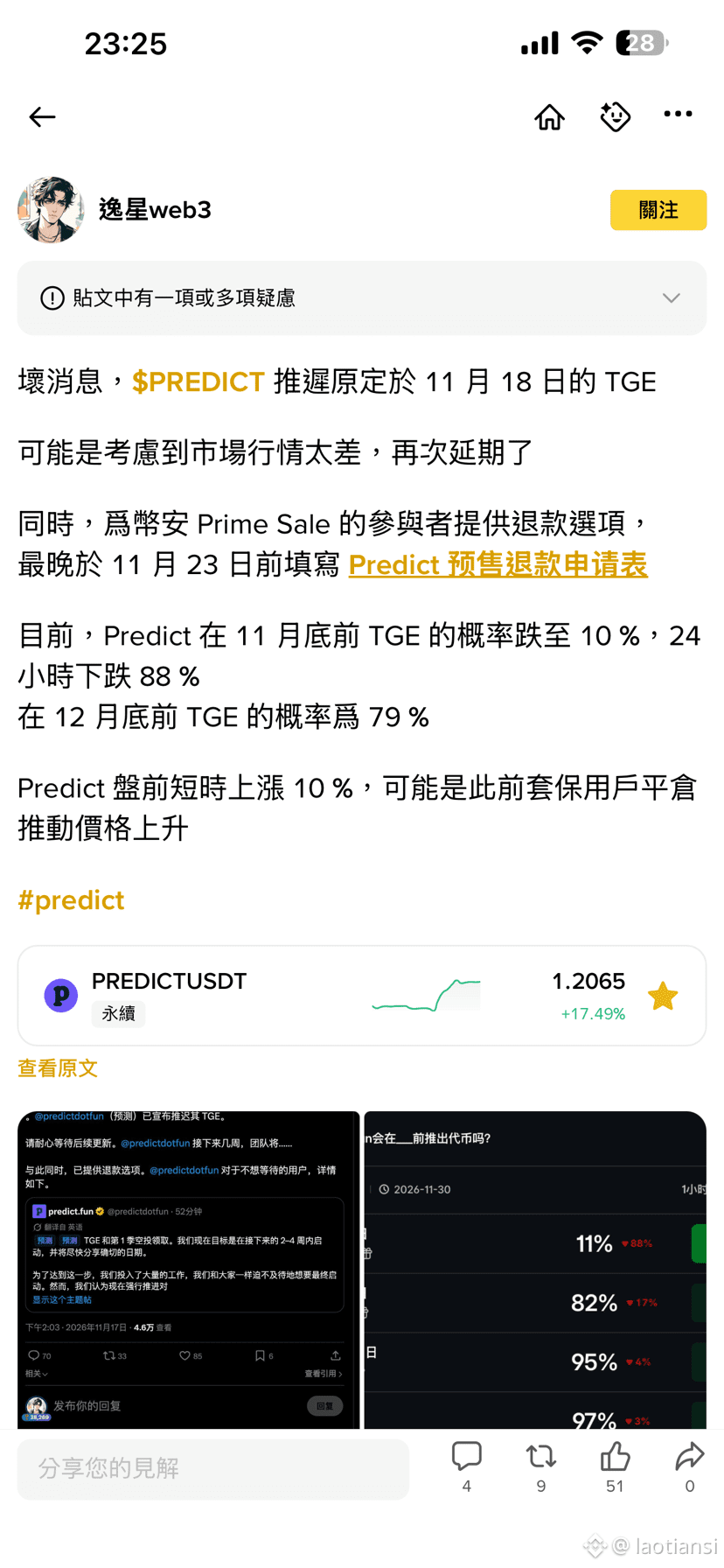
shturl.cc/O (PREDICT), originally scheduled to launch its token on November 18, announced today that it was postponing its TGE and Season 1 airdrop claims, with a new target of launching within the next 2–4 weeks. Binance Wallet has also given subscribers an option: if they don’t want to wait, they can request a refund.
Why postpone just one day before the token launch? The official explanation was “careful consideration.” But everyone knows the real reason: Bitcoin plunged from above $80,000 to $62,000 this week, and is now hovering around $64,000. Launching in this market would likely mean a poor price, leaving the project, the exchange, and subscribers all worse off. Waiting is actually the sensible choice.
To be fair, delays are common in crypto. What deserves criticism is the “delay + rule changes + no refunds” package. At least this time they’ve offered refunds, which is decent of them.
A few practical points:
1. The airdrop claim window will remain open until the TGE, but don’t assume your tokens will arrive automatically if you don’t claim them;
2. A refund and waiting for tokens are two different bets: a refund gets your principal back, while waiting means betting on the market 2–4 weeks from now;
3. A brief pre-market rally isn’t necessarily good news. It could also be short sellers who had hedged earlier closing their positions—don’t mistake short covering for buying pressure.
One last thing: the thing that gets people most hyped in crypto is “something that’s almost in their hands.” When it gets delayed, emotions crash first. Thinking through the worst-case scenario in advance is more useful than blaming the project afterward.
$PREDICT #空投 #TGE
289
·
--
Something happened on-chain today that's more worth watching than the candlestick chart.
According to MistTrack, the attacker address linked to Binance's hot wallet (starting with 0x79e7) had been inactive since October 30, but recently started moving funds—splitting the 34,279.66 ETH it received (about $60 million) across three newly created addresses. Whale Alert also reported that 12,009 ETH (about $18.78 million) was transferred from an address labeled “Binance Hacker 2026” to an unconfirmed wallet.
Why now? Because now is the perfect time to move.
The market just plunged to $64,000, and everyone's eyes are fixed on the candlestick chart. No one's checking the blockchain. Law enforcement and exchanges are busy putting out fires, handling compliance, and restoring withdrawals. Moving funds now is the best way to stay under the radar.
Here's the uncomfortable truth: hackers are better at timing than most retail investors. They don't bet on whether prices will rise or fall; they act when “no one's paying attention.”
Three reminders:
1. Don't accept USDT or ETH from unknown sources, especially funds from addresses making large transfers these days;
2. If “cheap supplies” suddenly appear on OTC markets, ask where they came from;
3. Leave fund recovery to law enforcement and blockchain analytics firms. What you can do is make sure you don't become the next link in the chain.
As for the market: BTC is hovering around $64,000, down 1.17% on the day; WTI crude is at $86, still near its highs.
$BTC #链上 #Security
176
·
--
At 8 a.m. this morning, the rankings for the first monthly leaderboard of Binance Pick were finalized, and the $500,000 prize pool was settled.
The campaign launched on October 21, with a total prize pool of $1 million. The idea is to earn points by making predictions: check in every day, post with a hashtag, trade $50, and answer questions at shturl.cc/L. You can then win a share of the prizes based on your points and profit and loss. The weekly leaderboard has $100,000, the monthly leaderboard has $500,000, and the participation rewards total $100,000.
Let’s be honest: this campaign is very cleverly designed. In exchange for $1 million in prizes, Binance gets three things—you check in every day (engagement), post every day (content for the community), and trade $50 every day (fees). The prize money is a marketing budget, not free money from the sky.
What can ordinary users get? The leaderboard prizes are pretty much out of reach—you have to rank among the top 20,000, and profit and loss matter too. The truly reliable option is the “participation reward”: complete five check-ins to share the $100,000 pool, with no betting required.
Three suggestions:
1. If you want to take part, complete your five check-ins first—that’s your guaranteed minimum;
2. Those 100 points for posting? You were going to write something anyway, so just add the hashtag;
3. Don’t force yourself to trade $50 just for 200 points—trading fees in exchange for points is like spending real money to buy game tokens.
One last reminder: questions like “Will BTC go up or down in five minutes?” have odds of 51% to 48%, which is basically the same as flipping a coin. Have fun, but don’t treat it as a trading strategy.
$BTC #BinancePick
3
·
--
A weekend recap, with something not so popular to say: the real sellers this week weren’t retail traders, but ETFs.
Let’s start with the numbers: Bitcoin fell nearly 15% this week, hitting a low of 62,000—the lowest in three months. Across the market, 330,000 traders were liquidated, totaling $2.1 billion, and 90% of those were long positions.
But liquidations are the result, not the cause. The real selling pressure came from U.S. spot Bitcoin ETFs, which saw net outflows of about $1.91 billion this week. IBIT saw an even more direct trend: 11 consecutive trading days of outflows since October 30, totaling $2.35 billion.
That’s the cost of “institutionalization.” ETFs are buyers on the way in, and a stampede on the way out. They don’t care about conviction; they only care about returns and risk budgets. So when prices break key levels, they reduce their positions according to the rules—and that selling creates new breakdowns.
What should we watch next week? I’m focused on one signal: can weekly ETF net flows turn positive? If they do, it means allocation buyers are coming back; if outflows continue, this rebound is merely technical.
Don’t be fooled by these two false signals: influencers calling a “bottom,” and the size of the rebound. Candlesticks can lie; fund flows can’t.
$BTC #币安神算子

1
·
--
Two episodes played out in a single day.
This morning, Bitcoin fell below 63,000, hitting a low of 62,006, down 7.89% on the day. Ethereum dropped 10% to 1,735, and SOL fell 11.5%. In 24 hours, 336,700 traders across the market were liquidated, totaling $2.123 billion. Of those, 93.3% were long positions. Binance accounted for 39.1%, and the largest single liquidation was a $16.17 million ETHUSDT position on Binance.
Then, a little after 5 p.m., Bitcoin climbed back above 66,000, turning green for the day with a 2.92% gain.
From 62,006 to 66,000—it all came back in a day. But the 336,700 traders liquidated this morning aren't coming back.
That's the brutal thing about leverage: you can get the direction right and still get wiped out. You bet on a rise, and in the end, it does rise—but your position can't last until then.
A lesson from an old crypto veteran: liquidations usually happen not because you got it wrong, but because you couldn't wait it out. So don't ask, “Will it go up?” First ask, “How far can it fall before I'm wiped out?”
Can your current position withstand another 5% drop?
$BTC
71
·
--
Adding a short note on how to “verify it yourself,” rather than just taking an announcement at its word.
A little after midnight today, a $9.42 million BTC long position on Binance was liquidated at $65,328; during the day, Bitcoin was still hovering around $66,000. Let’s set the market action aside for now.
Here’s something more practical: On November 13, Binance announced that it had fully replenished the $6.34 billion in assets that were hacked, and published a new Proof of Reserves (PoR) snapshot. After the zero-knowledge proof is generated, users can independently verify that their assets are backed at least 1:1.
No matter how polished an announcement sounds, what matters is whether you can verify it yourself. Three steps:
1. Go to the Proof of Reserves (PoR) page on Binance’s official website;
2. Use the zero-knowledge proof to check whether your balance is included in the snapshot;
3. Confirm that the snapshot is dated this time around (November), not an old version from October.
This may sound harsh, but it needs to be said: Replenishing assets is the exchange’s responsibility; getting liquidated is yours. Never confuse the two.
#BinanceOracle

·
--
Binance shared some genuinely good news today: withdrawals have been restored on 87 networks this week, with the goal of restoring all remaining networks and assets by the end of next week. It’s been 16 days since the hack on October 29.
But the market wasn’t impressed. Bitcoin fell below 66,000 today, down 3.46% on the day, with a low of 66,268. Just over ten days ago, it was still above 80,000. It’s fallen around 17% since then. The system is fixed, but the price has collapsed.
Put these two things together, and this is what’s most worth paying attention to tonight: withdrawals being restored doesn’t mean the market has recovered.
A veteran crypto trader’s take:
1. The biggest significance of an exchange restoring withdrawals isn’t that “you can get out”—it’s that your assets are truly back under your control. This is a return to the basic security baseline, not a buy signal;
2. Especially at a time like this, first withdraw the coins that belong in your own wallet instead of rushing to buy the dip;
3. After a 17% drop in a little over ten days, leveraged traders have probably already been wiped out in a round of liquidations. Don’t top up your margin now to gamble on a rebound.
Honestly, Binance took 16 days to fix 87 networks, while the market took a little over ten days to hammer Bitcoin from 80,000 down to 66,000. Fixing the system is easy; rebuilding confidence is hard.
Let’s hear it in the comments: now that withdrawals are back, would you withdraw your coins first or buy the dip?
285
·
--
I’ve lived through 94, 312, 519, 1220, Brexit, Luna, Three Arrows Capital, FTX, exchange crackdowns, mining rig crackdowns, notices issued by 10 and 12 ministries, U.S. stock market circuit breakers, the war in Ukraine, airstrikes in the Middle East, coins launched by adult film actresses, presidents, presidents’ wives, the richest man, the richest man’s wife, girlfriends, and sons, 1011 and 1030, Maduro, the Strait of Hormuz, BN getting targeted, the midterms turning into a total loss, the Ledger incident, Intel plunging 30% in a day, Jensen Huang’s affair…
I’ve lived through 94, 312, 519, 1220, Brexit, Luna, Three Arrows Capital, FTX, exchange crackdowns, mining rig crackdowns, notices issued by 10 and 12 ministries, U.S. stock market circuit breakers, the war in Ukraine, airstrikes in the Middle East, coins launched by adult film actresses, presidents, presidents’ wives, the richest man, the richest man’s wife, girlfriends, and sons, 1011 and 1030, Maduro, the Strait of Hormuz, BN getting targeted, the midterms turning into a total loss, the Ledger incident, Intel plunging 30% in a day, Jensen Huang’s affair…
79
·
--
I’ve lived through 94, 312, 519, 1220, Brexit, the Luna collapse, Three Arrows Capital’s collapse, FTX’s spectacular implosion, major exchanges kicking people out, mining rigs being forced out, notices from ten ministries, notices from twelve ministries, U.S. stock market circuit breakers, the war in Ukraine, airstrikes in the Middle East, Yua Mikami launching a token that rugged, Argentine President Milei launching a token that rugged, Trump’s wife launching a token that rugged, Biden’s son launching a token that rugged, Musk’s girlfriend launching a token that rugged, Musk’s son launching a token that rugged, 1011 and 1030, Maduro’s overnight trip to the U.S., the showdown in the Strait of Hormuz, BN getting hit, U.S. Republicans losing every midterm election for the first time in 20 years, the Ledger incident, Intel dropping 30% in a day, Jensen Huang cheating, Jensen Huang being removed. Anyway, what I’ve been through is a plot even Hongguo couldn’t make up. Other people don’t have as eventful a life as my few short years. #BinanceOracle
I’ve lived through 94, 312, 519, 1220, Brexit, the Luna collapse, Three Arrows Capital’s collapse, FTX’s spectacular implosion, major exchanges kicking people out, mining rigs being forced out, notices from ten ministries, notices from twelve ministries, U.S. stock market circuit breakers, the war in Ukraine, airstrikes in the Middle East, Yua Mikami launching a token that rugged, Argentine President Milei launching a token that rugged, Trump’s wife launching a token that rugged, Biden’s son launching a token that rugged, Musk’s girlfriend launching a token that rugged, Musk’s son launching a token that rugged, 1011 and 1030, Maduro’s overnight trip to the U.S., the showdown in the Strait of Hormuz, BN getting hit, U.S. Republicans losing every midterm election for the first time in 20 years, the Ledger incident, Intel dropping 30% in a day, Jensen Huang cheating, Jensen Huang being removed. Anyway, what I’ve been through is a plot even Hongguo couldn’t make up. Other people don’t have as eventful a life as my few short years. #BinanceOracle

13
·
--
BTC is dropping like Satoshi Nakamoto got caught cheating
#btc
BTC is dropping like Satoshi Nakamoto got caught cheating
#btc
#btc
4
·
--
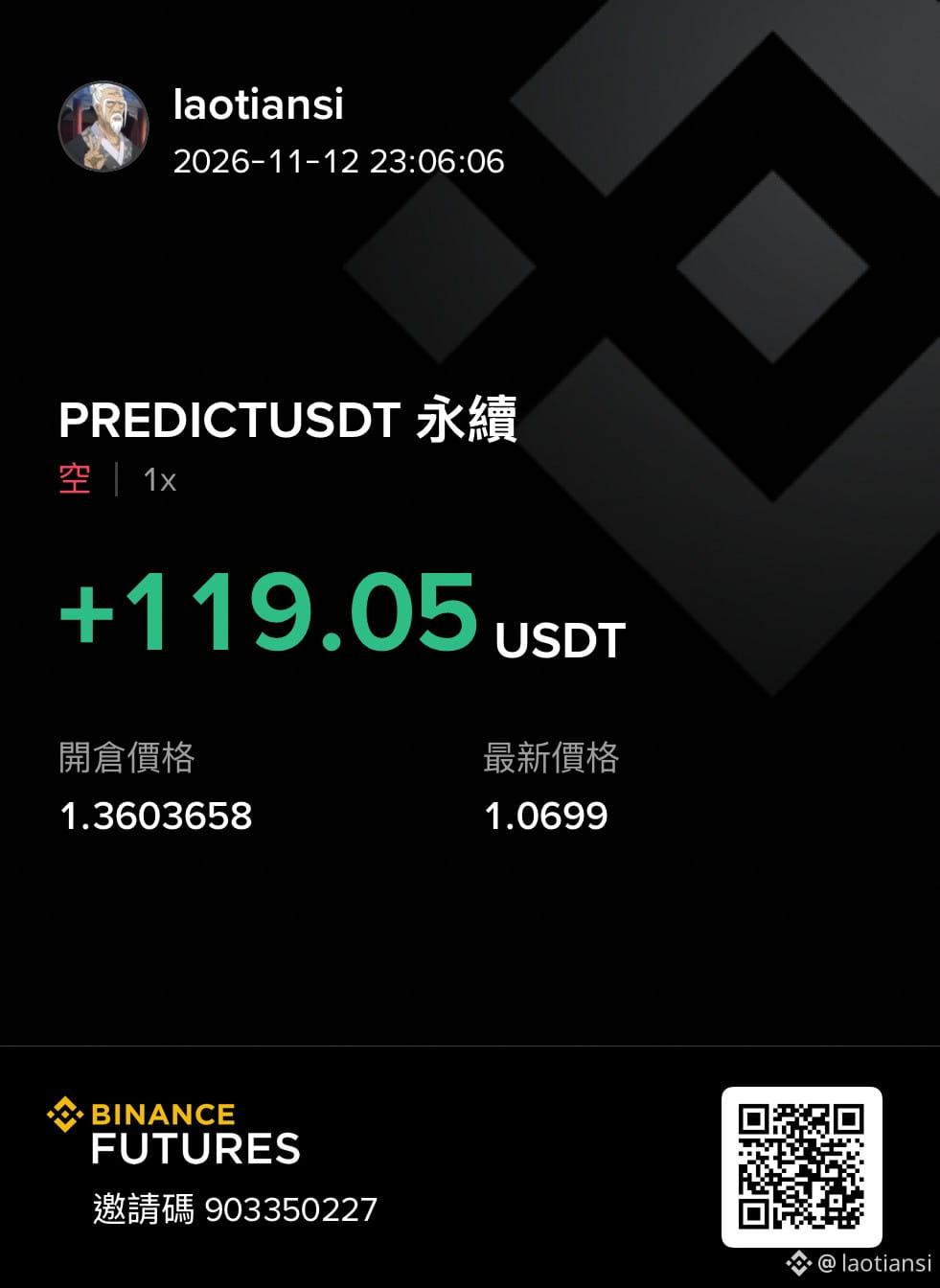
PREDICT goes live on November 18 at 9:00 AM!
Good thing I opened a hedge #PREDICT #ALPHA
PREDICT goes live on November 18 at 9:00 AM!
Good thing I opened a hedge #PREDICT #ALPHA
Good thing I opened a hedge #PREDICT #ALPHA
3
8
6.6k
·
--
Today’s market is behaving a little strangely.
Bitcoin fell steadily from 74,366 yesterday to 72,685, down 2.73%, after dipping as low as 72,270 and breaking straight below 73,000. Stranger still, gold crashed too. Spot gold first fell below 4,000, then 3,900 in a single day, trading around 3,896. This is the second time in November it has fallen below the 4,000 mark.
“Digital gold” is falling, and so is real gold. Why? Because oil prices are surging. Trump said the U.S. doesn’t need to reach a deal with Iran, sending oil prices sharply higher. Inflation expectations returned, and expectations for rate cuts were pushed back. When the market gets nervous, it sells everything and holds on to cash.
So the most valuable thing tonight isn’t a “buy-the-dip level”—it’s three words: don’t move yet.
Lessons from an old crypto hand:
1. Leveraging up in this kind of volatility is like handing your money over to oil prices;
2. When prices fall, don’t fixate on the drop—look at your positions. Can you handle another 10% down?
3. What truly protects you isn’t crypto or gold, but the cash in your account and your unused margin.
Honestly, this market never runs out of crashes. What’s rare is people who are still standing afterward.
Let’s talk in the comments: How much cash are you holding this time?
$BTC #币安神算子

·
--
Last night, on-chain monitoring platform Onchain Lens posted an update: around $891 million of the funds stolen in the October 29 Binance hack has been moved and may be getting laundered. Investigators have traced the funds as they flow through decentralized trading infrastructure.
To be clear: this doesn't affect your money. Binance had already pledged to cover the losses in full, and 98% of the affected assets have been replenished. The stolen funds belonged to Binance, not its users. That's why there was no bank run last night.
But the real significance isn't "who pays"—it's "recovering the stolen funds." At $6.34 billion, this is the largest heist in crypto history. $891 million has already been moved, and with every passing minute, recovering the rest gets harder. The blockchain is transparent, but laundering tools are becoming increasingly sophisticated: cross-DEX transfers, splitting transactions, and mixers. Tracking down a person is much harder than tracking a transaction.
Even more absurd was another announcement the same day: Binance is listing HYPEUSDC perpetual contracts today at 17:30, followed by TRXUSDC at 17:35, with up to 75x leverage.
On one side, a $6.3 billion hole remains unfilled, and $891 million in stolen funds is on the move; on the other, a new 75x leverage product is launching. This market never stops just because "someone got robbed." It only cares about "where the next opportunity is."
As a crypto veteran, I won't judge right or wrong. I'll just remember three things:
1. Keep your address clear of these "stolen funds on the move." If you receive USDT from an unknown source, freeze it and don't touch it. Don't rush to spend it.
2. Those "discounted coins" on OTC markets may be stolen funds that someone couldn't launder. Buy them, and you could end up taking the fall for someone else.
3. Leave recovering stolen funds to the professionals. Your job is to lock your own door.
As for the market, Bitcoin has climbed back above 74,000 today. It was trading at 74,366 shortly after 7 p.m., up 0.35%, and is still grinding higher.
Honestly, this market always has a new story—and someone is always left cleaning up after the last one. Veteran crypto traders survive not because they can predict the market, but because they know what concerns them and what doesn't.
Let's talk in the comments: the stolen funds haven't been recovered, but new contracts are already live. What do you think?
$BTC #BinanceOracle

2
·
--
There’s news today that matters far more than the candlesticks: Binance announced it will stop processing all transfers involving MEXC (Matcha) and its affiliated entities.
The reason is straightforward: the U.S. FinCEN has designated MEXC a “primary money laundering concern,” alleging that it was involved in approximately $16 billion in illicit transactions. Binance’s response is simple: deposits sent to MEXC will be rejected; funds transferred from MEXC will be held for compliance review. And it’s not just MEXC—12 affiliated entities were named as well.
A lot of crypto veterans will think: “What does that have to do with me? I don’t even use Matcha.”
But think about what you’ve done:
- Moved coins from Exchange A to Exchange B to arbitrage a price difference;
- Transferred funds to an exchange because a friend said, “The fees are lower there”;
- Accepted airdrop tokens or USDT from unknown sources without a second thought.
Starting today, any of these could be a landmine. Exchanges are no longer open ports for one another; they’re starting to blacklist each other. If your coins have any connection to a flagged entity, they could be temporarily frozen, reviewed, and you could be asked to explain where they came from—with no time limit.
This points to a bigger shift: regulators have moved from “overseeing exchanges” to “overseeing every transfer between exchanges.” It used to be “Which exchange are you on?” Now it’s “Where did your coins come from, and where are they going?”
A quick look at the market: Bitcoin is grinding between 74,500 and 74,750 today, spot ETFs are still seeing outflows, and market sentiment is cautious—capital is waiting for a clear signal.
Three things to keep in mind if you’re still in the game:
1. Before transferring, check whether the other platform is on the compliance list. Don’t land yourself in a review queue just to save a few bucks in fees;
2. Don’t chase a single cent of USDT from an unknown source or a bargain OTC deal—that’s someone else’s landmine, not a bargain for you;
3. Remember: a compliance review doesn’t last “a few days.” It could take “a few months,” and nobody will promise you a timeline.
The hard-earned lesson for crypto veterans: We used to fear the market; now we have to fear “addresses” too. This market is getting harder to navigate, but the ones who survive are those who treat risk as part of everyday life.
Let’s talk in the comments: Would you still dare to arbitrage across exchanges?
$BTC #BinanceOracle

2
·
--
Monday evening, Bitcoin is hovering around $74,000 (74,392, down 1.9%), while Ethereum is down 5%. The market has fallen about 2% over the past week.
But the reason for this drop is completely different from last week:
Last week was about “events”—a blowout jobs report and 238,600 liquidations. That was a sentiment-driven sell-off.
This week is about “money”—spot ETFs saw $1.28 billion in net outflows last week, institutions are pulling back, and uncertainty over the US crypto regulatory outlook is adding to it. Expectations of tougher regulation after the midterm elections are heating up.
Sentiment-driven sell-offs come fast and fade fast; money leaving is a chronic condition.
Here’s some honest advice from an old crypto hand: when ETFs were first approved, everyone was shouting, “The institutional bull run is here!” and “Institutions are here to buy the dip!” Now institutions have pulled $1.28 billion in a week—how many people have you heard mention it? Institutions aren’t here to catch your falling knife; they’re here to allocate assets. They can rebalance their portfolios whenever they want. They don’t need a reason, and they certainly don’t have feelings for you.
So stop treating “institutions are coming in” as an article of faith. Watch the money, not the stories.
Three indicators to tell whether “the money is still here” (not predictions, just reference points):
1. Weekly net inflows/outflows for Bitcoin spot ETFs—outflows for several consecutive weeks mean big money is heading out;
2. Total stablecoin market cap—if it’s shrinking, there’s less dry powder in the market;
3. BTC balances on exchanges—if balances are rising, it means people are moving coins back to exchanges to prepare to sell.
These three things are more reliable than any “guru.”
One update: Binance resumed withdrawals today for Alpha assets on four networks—BSC, Ethereum, Base, and Arbitrum. Withdrawals for the remaining assets are still being restored in batches. Being able to access your money matters more than the market.
One last thing: when the market drops, first figure out “who is selling.” Is it one person panicking, a crowd heading for the exits, or institutions rebalancing? The answer is different, so your response should be different too.
Let’s discuss in the comments: do you think this is a pullback, or a trend reversal?
#BinanceOracle

1
7
·
--
Sunday night: Bitcoin is at 75,800, back below 76,000 today, and down 2.7% for the week—SOL, HYPE, and ZEC fell too.
Many people only watch the charts, but what was really worth remembering this week was another chain of events:
On Thursday, U.S. tech stocks were suddenly hit by a sell-off, and Bitcoin fell 6% in a single day, tumbling from above 80,000 to 75,700;
On Friday, U.S. nonfarm payrolls blew past expectations—165,000, against a forecast of just 65,000—stoking expectations of a Fed rate hike in December. In 24 hours, 238,600 traders were liquidated and $1.254 billion evaporated;
That same week, international oil prices plunged more than 16%, and global risk assets all cooled off.
See the pattern? Bitcoin has never been an island. It moves with U.S. stocks, the dollar, and interest-rate expectations. You think you’re trading crypto, but really you’re trading the global macro environment.
The mistake seasoned crypto traders make most easily is treating “crypto stuff” and “world stuff” as separate. Binance being hacked last week was an industry issue; this week’s drop was a macro issue. The two collided, making for such a painful week.
So what should you watch next week? Three things—not predictions, just reminders:
1. Changes in expectations for a December Fed rate hike—after the jobs report, the market has already started repricing;
2. U.S. inflation data—if inflation doesn’t cooperate either, the pressure will continue;
3. Binance withdrawal progress—HYPE and APT withdrawals have resumed today; the rest are still being processed in batches. Don’t focus only on the market and forget about your own money.
One lesson from a seasoned crypto trader: you can’t change the macro environment, but you can decide how you position yourself in front of it. A little less exposure, a little less leverage, a little more time to process information—those three “littles” are worth more than any prediction.
It’s Monday again tomorrow. How are you planning to start the week?
#BinanceOracle

1
1
·
--
After years of trading crypto, one of the easiest assumptions to make is this: see “points” or “estimated earnings,” and your brain automatically turns them into cash.
Binance Alpha Points are not money. The official definition is that they’re activity points, used to measure how active you are in the Alpha / Wallet ecosystem and determine whether you can participate in events like TGEs and Alpha airdrops. They’re not a promise of earnings, either.
According to the official FAQ, they’re roughly calculated like this:
1. Your total score is based on a rolling window of about 15 days, adding up each day’s “balance points + trading volume points.”
2. Balance points are based on qualifying asset tiers, with a daily maximum; trading volume points only count purchases of Alpha tokens, not sales.
3. Each point expires after about 15 days. Points are used up when you confirm that you want to claim an airdrop or participate in a TGE on the event page. If you don’t want to participate, you can simply skip it—it’s optional.
The mistake I made early on was treating “estimated” amounts on the page as money in my pocket. Then I’d factor in fees, slippage, and tied-up capital, and get carried away before I’d even worked out the numbers. The value of new coins is uncertain; I’ve seen them fall below their launch price or even go to zero. For point thresholds and how many points are deducted for a given event, always check the current Binance event page—don’t trust screenshots from other people.
Have you participated in Alpha? What pitfalls have you run into?
1
93
·
--
Verified
Saturday night, 11:30 p.m. Bitcoin at 75,859, with a 24-hour high of just 76,241—a daily range of less than 1%, quiet as if nothing had happened.
But look back at everything that happened this week:
Monday: Binance was hacked for $6.3 billion, the biggest hack in history;
Late Wednesday night: the investigation report came out. The truth? It was a fake job interview scam that tricked an engineer into installing malicious code;
Thursday: U.S. nonfarm payrolls came in scorching hot, 238,600 traders were liquidated, and $1.254 billion evaporated;
By Saturday, the whole world had suddenly gone quiet.
This is what crypto is really like: when prices are surging or crashing, everyone’s an analyst. When things quiet down, that’s when the real gap starts to emerge.
And some good news: Binance is gradually restoring withdrawals, one batch per day. Today’s ninth batch update covered nine networks: BNB Chain, Base, Ethereum, Optimism, Polygon, Arbitrum, Avalanche, Tron, and Sui. SOL, USDT, and USDC on Solana are also working again. According to the announcement, HYPE, INJ, and APT are expected to be restored before the end of next weekend. So there’s no need to keep worrying that you “can’t withdraw”—just withdraw what you need, bit by bit.
A seasoned crypto hand’s experience: a quiet weekend is when you should be getting things done.
Three things are more useful than staring at charts:
1. Take stock of your assets. How much is on exchanges, how much is in wallets, and which assets are just other people’s “IOUs”? Make a list. If you don’t know how much you have, don’t talk about strategy.
2. Check your security. Is two-factor authentication on? Have you set up a withdrawal address whitelist? Are there any sketchy approvals in your wallet? (Especially from those “claim in one click” links you’ve clicked.)
3. Review the week. For each of these three events—the hack, the fake interview, and the liquidations—write down one thing you’ll do differently next time, and save it. That’s your own checklist.
Here’s the truth: when prices fall, you panic; when they rise, you get greedy; when they move sideways, you get bored. Three emotions, three ways to lose money. What can really save you is never the next candlestick—it’s the unglamorous work you do when things are quiet.
This weekend, are you watching the charts or reviewing your trades?
#非农就业数据推升加息预期
781
·
--
$15, and $2.5 billion swept away.
The real killer in the Binance case only came to light today: it wasn’t a fake interview or a leaked private key—it was an authorization.
Ethereum has an upgrade feature called EIP-7702 that lets a wallet authorize a program to “act on its behalf,” like setting up automatic payments from a bank card. A hacker got Binance’s hot wallet to sign an authorization like this. Then, in just 3 minutes and 24 seconds, 167,464 ETH and 63 different tokens were drained in one go.
The person stealing your money doesn’t need your private key. The authorization you signed yourself is enough.
This is where ordinary users are most likely to get caught out: authorization pages, signature pop-ups, connecting wallets—most people never read what’s on the screen. They just click Confirm.
Two things: reject any signature you don’t understand; revoke old authorizations regularly.
Don’t treat the Confirm button like the Enter key.
#BinanceOracle

1
1
·
--
On Wednesday they were still popping champagne; by Thursday, they were cleaning up the mess—the crypto market’s optimism lasted just one day.
From last night to this morning: Bitcoin plunged from above $80,000 to around $75,200, and is now hovering around $76,000. Ethereum fell more than 7%, briefly dipping just above $2,200.
CoinGlass’s data is even more sobering: over the past 24 hours, 238,600 traders were liquidated, wiping $1.254 billion off the market. Long positions accounted for $1.11 billion of that, while shorts made up just $140 million. Get the picture? Almost everyone who got liquidated was betting on prices going up.
The reason is a little darkly ironic: U.S. October nonfarm payrolls came in way too strong—165,000, against market expectations of just 65,000. Normally, strong data should send markets higher. But the market saw it differently: an overly strong jobs report means the Fed could raise rates in December, so risk assets fell first and asked questions later. U.S. tech stocks crashed, and crypto plunged right along with them.
So every old hand in crypto knows the rule: in this market, “good news” can turn bad at any moment, while “bad news” never gives you a heads-up.
A personal observation:
The day before yesterday, when I wrote about Binance getting hacked, Bitcoin was still at $77,000. Yesterday it bounced back above $80,000, and a bunch of people were shouting, “The reversal is here!” Today it’s at $75,200. If you chased longs above $80,000 yesterday and used leverage, there’s a good chance your name is on tonight’s liquidation list.
“Reversal” may be the two most expensive words in crypto. They’re also what analysts have been saying most today: don’t rush to call a reversal. A rebound only proves that volatility is high; it doesn’t prove the trend has changed.
One more thing to remember: Binance just announced today that it’s working to restore withdrawals for HYPE, INJ, APT, PLASMA, NEAR, and LTC by next weekend. So the first thing you should actually do right now isn’t stare at the charts—it’s open the app and check whether your coins are still there and whether you can withdraw them.
Three things to remember if you’re still in the game:
1. Your leverage multiple is roughly equivalent to your heartbeat. Don’t bet your life savings on a data release day.
2. A rebound isn’t a reversal. Rising back to $80,000 doesn’t mean the drop is over.
3. You’ll never be able to predict data, policy, or black swan events. The only things you can control are your position size and your mindset.
Let’s talk in the comments: Did this drop hurt you? How much leverage were you using?
#币安神算子

4
Log in to explore more content
Join global crypto users on Binance Square
⚡️ Get latest and useful information about crypto.
💬 Trusted by the world’s largest crypto exchange.
👍 Discover real insights from verified creators.
Email / Phone number
Trending Topics
NvidiaEarningsTonight:AIStocks’NextMove?
62,826 views
902 Discussing
Nvidia Earnings Day: Interim CEO's First Appearance — Can the AI Story Hold?
Binance News
·17 Likes
·7.8k views
A Packed Week of Earnings and Data Tests Markets
121,578 views
612 Discussing
AnthropicIPOTestsInvestorAppetiteForAI
267,522 views
2,609 Discussing