

Pixie Decor
437 Posts

Pixie Decor
Conozcamos más sobre todo el ecosistema Cripto y empapémonos de actualidad.
1.5K+ Following
459 Followers
249 Liked
Posts
All
Quotes
Live

CRIPTOMONEDAS Y ACCIONES
·
--
[Replay] 🎙️ SUNDAY OF WINNING 💜🌹🔥
01 h 37 m 25 s · 567 listens

Nuri-Crypto
·
--
[Replay] 🎙️ The Fantastic Traders: Differences Between SMA and EMA
03 h 26 m 46 s · 1.7k listens
CRIPTOMONEDAS Y ACCIONES
·
--
[Replay] 🎙️ NIGHT MARKET 🦁💜🌹🔥 FANTASTIC
01 h 55 m 29 s · 325 listens
CRIPTOMONEDAS Y ACCIONES
·
--
[Replay] 🎙️ NIGHT MARKET 🦁💜🌹🔥
02 h 14 m 59 s · 528 listens
CRIPTOMONEDAS Y ACCIONES
·
--
[Replay] 🎙️ Movement in the market? 💹💸
02 h 11 m 11 s · 1.1k listens

Nuri-Crypto
·
--
[Replay] 🎙️ The Fantastic World of Trading: Bollinger Bands
05 h 59 m 49 s · 7.3k listens
CRIPTOMONEDAS Y ACCIONES
·
--
[Replay] 🎙️ Market Days 💹💜🌹🔥
01 h 45 m 12 s · 375 listens
CRIPTOMONEDAS Y ACCIONES
·
--
[Replay] 🎙️ Market Night 💹
02 h 44 m 48 s · 645 listens
CRIPTOMONEDAS Y ACCIONES
·
--
[Replay] 🎙️ Let's look at and analyze the market 💹
01 h 11 m 54 s · 348 listens
CRIPTOMONEDAS Y ACCIONES
·
--
[Replay] 🎙️ And I started playing this melody 🎹🎶
01 h 20 m 33 s · 332 listens
CRIPTOMONEDAS Y ACCIONES
·
--
[Replay] 🎙️ DOMINGO 💜🌹🔥
01 h 34 m 06 s · 206 listens

MICHAEL MOORE
·
--
Fourteen days ago I started reading about @Dusk mostly out of curiosity. I didn't expect to still be reading two weeks later.
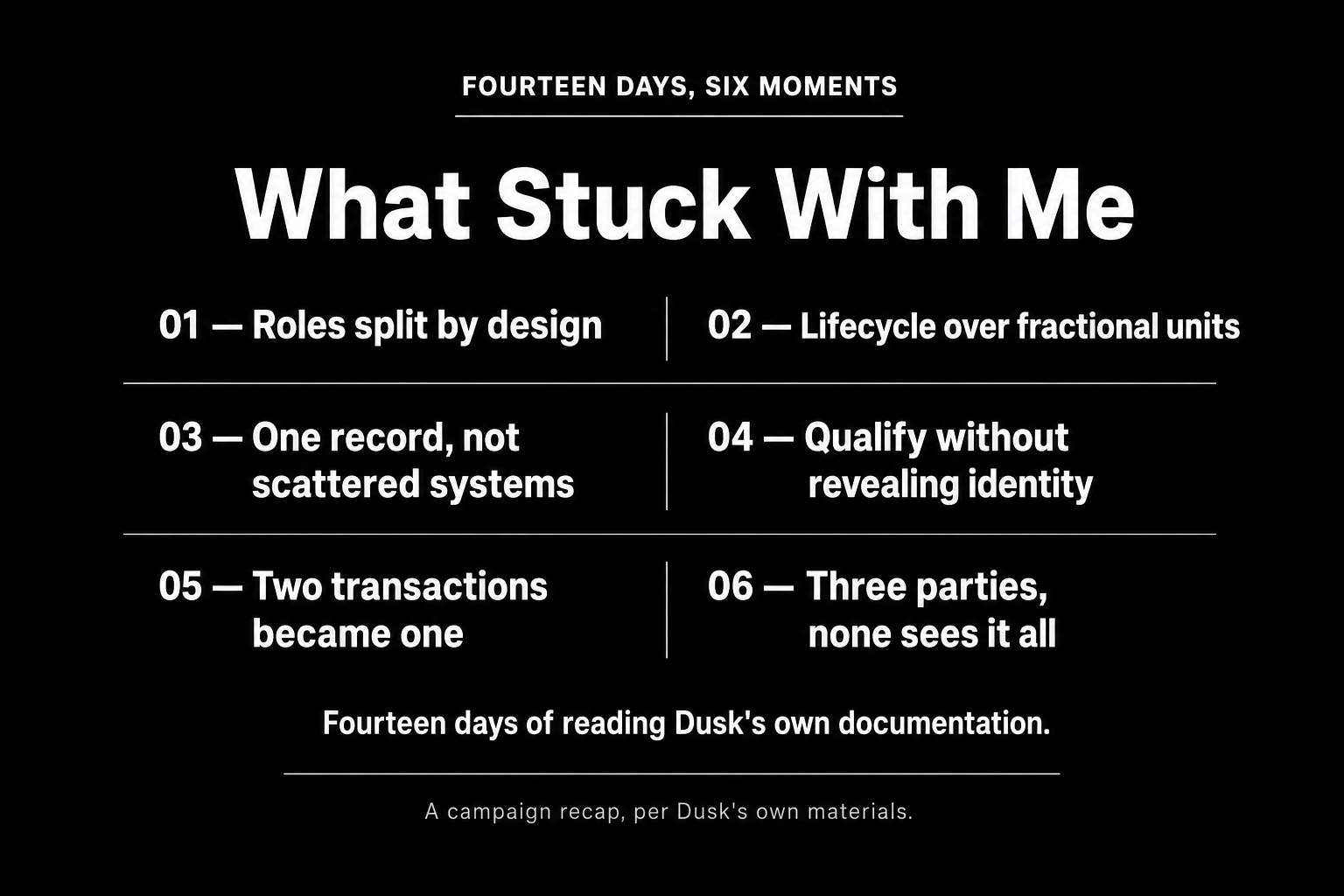
What kept pulling me back wasn't one big headline. It was how many small, specific design choices kept showing up once I actually looked for them. Zedger building dividend distribution and capped transfers directly into a security token, not bolted on after. Citadel letting someone prove they qualify without handing over who they are. A convert function that used to take two transactions to move between public and private, now down to one.
The one that stuck with me most was Dusk's own line pushing back on fractional ownership as the big selling point. Their materials said the real value was connecting the whole lifecycle, issuance to settlement, around one record. That's not a pitch I expected from a project selling tokenized securities.
Then the XSC standard itself, splitting power across three separate roles so no single party can see, approve, and reassign ownership all at once. And just this week, watching a bank, an exchange, and a custodian verify the same transaction while each stayed blind to the others' data.
None of this is loud. There's no single moment I'd call a breakthrough. It's fourteen quieter observations that, put together, describe a project treating privacy and regulation as the same design problem instead of opposites.
I don't have a tidy conclusion. What I have is a longer list of questions than I started with, and that feels like the more honest place to end this.
Fourteen days of reading someone else's documentation isn't usually how I'd describe time well spent, but this one was. Whatever comes next for this project, I'm glad I actually went looking instead of just scrolling past it.
#dusk $DUSK
What kept pulling me back wasn't one big headline. It was how many small, specific design choices kept showing up once I actually looked for them. Zedger building dividend distribution and capped transfers directly into a security token, not bolted on after. Citadel letting someone prove they qualify without handing over who they are. A convert function that used to take two transactions to move between public and private, now down to one.
The one that stuck with me most was Dusk's own line pushing back on fractional ownership as the big selling point. Their materials said the real value was connecting the whole lifecycle, issuance to settlement, around one record. That's not a pitch I expected from a project selling tokenized securities.
Then the XSC standard itself, splitting power across three separate roles so no single party can see, approve, and reassign ownership all at once. And just this week, watching a bank, an exchange, and a custodian verify the same transaction while each stayed blind to the others' data.
None of this is loud. There's no single moment I'd call a breakthrough. It's fourteen quieter observations that, put together, describe a project treating privacy and regulation as the same design problem instead of opposites.
I don't have a tidy conclusion. What I have is a longer list of questions than I started with, and that feels like the more honest place to end this.
Fourteen days of reading someone else's documentation isn't usually how I'd describe time well spent, but this one was. Whatever comes next for this project, I'm glad I actually went looking instead of just scrolling past it.
#dusk $DUSK
Nuri-Crypto
·
--
[Replay] 🎙️ The Fantastic Traders: Market Analysis
05 h 40 m 39 s · 2.8k listens
Log in to explore more content