

TRUE image
35 Posts

TRUE image
Report
Block User
6 Following
50 Followers
40 Liked
Posts
All
Quotes
·
--
30D trade $ASTER 699 USDT
$ASTER The core of Aster's fast listing is shifting listing decision power from internal teams to the chain, using economic incentives to drive validators to proactively uncover demand. It implements a public application system through two open standards, AOS-1 for spot and AOS-2 for perpetuals: the spot listing fee is 50,000 USDT, reduced to 20,000 for Binance Alpha projects; perpetual applicants must stake 1 million ASTER and lock it for four years, with no early exit option. After that, validators vote according to staking weight; spot listings are usually completed in T+3, and perpetuals can go live in just one working day after approval. Validators are deeply tied to the platform's long-term interests, giving them an incentive to quickly list projects with real demand. Listings no longer depend on an internal roadmap, but are decided by stakers voting with real money.
$ASTER The core of Aster's fast listing is shifting listing decision power from internal teams to the chain, using economic incentives to drive validators to proactively uncover demand. It implements a public application system through two open standards, AOS-1 for spot and AOS-2 for perpetuals: the spot listing fee is 50,000 USDT, reduced to 20,000 for Binance Alpha projects; perpetual applicants must stake 1 million ASTER and lock it for four years, with no early exit option. After that, validators vote according to staking weight; spot listings are usually completed in T+3, and perpetuals can go live in just one working day after approval. Validators are deeply tied to the platform's long-term interests, giving them an incentive to quickly list projects with real demand. Listings no longer depend on an internal roadmap, but are decided by stakers voting with real money.
145
·
--
RWA heat is shifting from conceptual hype to the practical implementation of real-asset on-chain issuance plus institutional settlement infrastructure.
$LINK Chainlink (LINK) — a leading RWA infrastructure provider; its CCIP protocol has been adopted by SWIFT and Coinbase. In Q1, it processed over $18.0 billion in transfer volume, with a market cap of about $5.89 billion.
$ONDO Ondo (ONDO) — a leader in tokenized U.S. Treasuries. Its flagship product, OUSG, has holdings exceeding $820 million, and USDY provides a 4.6% annualized yield on XRPL.
$ENA Ethena (ENA) — the issuer of synthetic dollar USDe. Governance is handled via a fee switch, and 95% of protocol net revenue will be used to buy back ENA, putting an end to the sell pressure from VC unlocks.
Pendle (PENDLE) — the core of the on-chain fixed-income market. The PT/YT mechanism turns RWA floating yields into fixed-rate instruments, with 66 new RWA-related markets launched in 2026.
Plume (PLUME) — an L1 built specifically for RWA. Its subsidiary obtained a Bermuda Class M license and SEC approval for a transfer agent, enabling the operation of the first regulated on-chain treasury worldwide.
Tether Gold (XAUT) — a leading gold-backed token. In Q1, its market cap surpassed $3.3 billion; the number of holders surged 173%. In times of geopolitical tension, large amounts of capital flow in as a safe-haven.
PAX Gold (PAXG) — another gold-backed token. Its market cap is about $2.3 billion, accounting for 41.8% of the tokenized gold market, and provides a 24/7 on-chain gold safe-haven exposure.
RWA heat is shifting from conceptual hype to the practical implementation of real-asset on-chain issuance plus institutional settlement infrastructure.
$LINK Chainlink (LINK) — a leading RWA infrastructure provider; its CCIP protocol has been adopted by SWIFT and Coinbase. In Q1, it processed over $18.0 billion in transfer volume, with a market cap of about $5.89 billion.
$ONDO Ondo (ONDO) — a leader in tokenized U.S. Treasuries. Its flagship product, OUSG, has holdings exceeding $820 million, and USDY provides a 4.6% annualized yield on XRPL.
$ENA Ethena (ENA) — the issuer of synthetic dollar USDe. Governance is handled via a fee switch, and 95% of protocol net revenue will be used to buy back ENA, putting an end to the sell pressure from VC unlocks.
Pendle (PENDLE) — the core of the on-chain fixed-income market. The PT/YT mechanism turns RWA floating yields into fixed-rate instruments, with 66 new RWA-related markets launched in 2026.
Plume (PLUME) — an L1 built specifically for RWA. Its subsidiary obtained a Bermuda Class M license and SEC approval for a transfer agent, enabling the operation of the first regulated on-chain treasury worldwide.
Tether Gold (XAUT) — a leading gold-backed token. In Q1, its market cap surpassed $3.3 billion; the number of holders surged 173%. In times of geopolitical tension, large amounts of capital flow in as a safe-haven.
PAX Gold (PAXG) — another gold-backed token. Its market cap is about $2.3 billion, accounting for 41.8% of the tokenized gold market, and provides a 24/7 on-chain gold safe-haven exposure.
$LINK Chainlink (LINK) — a leading RWA infrastructure provider; its CCIP protocol has been adopted by SWIFT and Coinbase. In Q1, it processed over $18.0 billion in transfer volume, with a market cap of about $5.89 billion.
$ONDO Ondo (ONDO) — a leader in tokenized U.S. Treasuries. Its flagship product, OUSG, has holdings exceeding $820 million, and USDY provides a 4.6% annualized yield on XRPL.
$ENA Ethena (ENA) — the issuer of synthetic dollar USDe. Governance is handled via a fee switch, and 95% of protocol net revenue will be used to buy back ENA, putting an end to the sell pressure from VC unlocks.
Pendle (PENDLE) — the core of the on-chain fixed-income market. The PT/YT mechanism turns RWA floating yields into fixed-rate instruments, with 66 new RWA-related markets launched in 2026.
Plume (PLUME) — an L1 built specifically for RWA. Its subsidiary obtained a Bermuda Class M license and SEC approval for a transfer agent, enabling the operation of the first regulated on-chain treasury worldwide.
Tether Gold (XAUT) — a leading gold-backed token. In Q1, its market cap surpassed $3.3 billion; the number of holders surged 173%. In times of geopolitical tension, large amounts of capital flow in as a safe-haven.
PAX Gold (PAXG) — another gold-backed token. Its market cap is about $2.3 billion, accounting for 41.8% of the tokenized gold market, and provides a 24/7 on-chain gold safe-haven exposure.
543
·
--
30D trade $ASTER 699 USDT
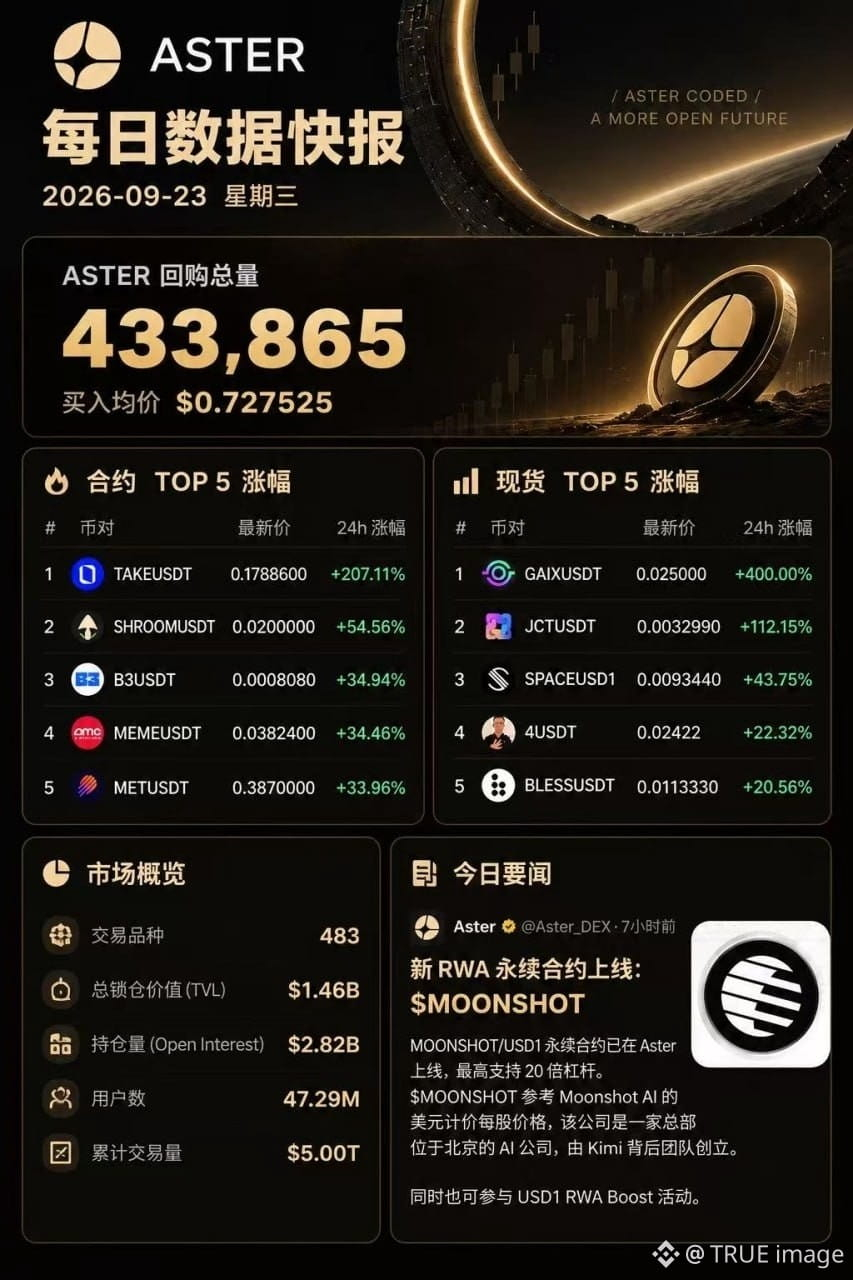
$ASTER Institutional-level cooperation is filling in the credit gaps that have been adopted. Deep integration with WLFI will establish USD1 stablecoin as the exclusive settlement asset for all of Aster’s RWA perpetual contracts. Meanwhile, the Binance wallet has been upgraded from an interface-integrated partner to an official validator node, directly participating in on-chain governance and listing votes. These moves shift Aster’s adoption logic from “retail traffic” to “institutional settlement infrastructure”.
$ASTER Institutional-level cooperation is filling in the credit gaps that have been adopted. Deep integration with WLFI will establish USD1 stablecoin as the exclusive settlement asset for all of Aster’s RWA perpetual contracts. Meanwhile, the Binance wallet has been upgraded from an interface-integrated partner to an official validator node, directly participating in on-chain governance and listing votes. These moves shift Aster’s adoption logic from “retail traffic” to “institutional settlement infrastructure”.
1
423
·
--
$VIRTUAL Decentralized AI Infrastructure: Bittensor (TAO)
TAO is often referred to as “Bitcoin of AI.” At its core is a decentralized machine learning network.
AI Agent Issuance and Coordination Platform: Virtuals Protocol (VIRTUAL)
Virtuals Protocol is a leading AI Agent issuance and tokenization platform on the Base chain. It is positioned as an “AI agent shared-ownership layer + launch platform.” Users don’t need technical backgrounds to create, tokenize, and monetize their own AI Agents. Each Agent has its own token and can be traded in pools such as Uniswap V3. The platform has already supported more than 15,800 AI projects, and the scale of AI Agent economic output (aGDP) reaches $477 million. Coinbase maps it as a coordination layer for “service discovery and agent-based commerce.”
🔐 Tokenized Inference and Execution Layer: Venice Token (VVV)
VVV is issued by privacy AI platform Venice.ai, using a dual-token model of “VVV + compute token DIEM.” Value is supported by real business revenue (used for token buyback and burning). Venice.ai focuses on the concept of privacy AI and offers features such as Agentic Chat. Coinbase research defines VVV as the value-capture point of “tokenized inference,” representing the tradable nature of AI inference services themselves.
AI-driven venture capital and autonomous organizations: ai16z (AI16Z/ELIZAOS)$AI16Z
ai16z is a decentralized venture capital firm in the Solana ecosystem that is managed by AI Agents. Its core AI is named Marc, responsible for managing the fund and making investment decisions. The project grew out of the “AI version of Degen Spartan” that the founder Shaw built—a sharp-talking AI Agent that gained attention on Twitter for its provocative statements, whose emergent behavior has overturned people’s stereotypes about AI. The ai16z token migrated to ELIZAOS in November 2025, expanding supply from about 6.6 billion tokens to 11 billion. It represents a frontier experiment where AI Agents act as economic actors, participating independently in investing and governance.
Decentralized GPU Compute Power Network: Render (RENDER)
$RENDER Render is a leading project in the decentralized GPU compute and AI infrastructure (DePIN) sector. It allows users to contribute GPU compute power for 3D rendering and AI model training in exchange for RENDER token rewards.
$VIRTUAL Decentralized AI Infrastructure: Bittensor (TAO)
TAO is often referred to as “Bitcoin of AI.” At its core is a decentralized machine learning network.
AI Agent Issuance and Coordination Platform: Virtuals Protocol (VIRTUAL)
Virtuals Protocol is a leading AI Agent issuance and tokenization platform on the Base chain. It is positioned as an “AI agent shared-ownership layer + launch platform.” Users don’t need technical backgrounds to create, tokenize, and monetize their own AI Agents. Each Agent has its own token and can be traded in pools such as Uniswap V3. The platform has already supported more than 15,800 AI projects, and the scale of AI Agent economic output (aGDP) reaches $477 million. Coinbase maps it as a coordination layer for “service discovery and agent-based commerce.”
🔐 Tokenized Inference and Execution Layer: Venice Token (VVV)
VVV is issued by privacy AI platform Venice.ai, using a dual-token model of “VVV + compute token DIEM.” Value is supported by real business revenue (used for token buyback and burning). Venice.ai focuses on the concept of privacy AI and offers features such as Agentic Chat. Coinbase research defines VVV as the value-capture point of “tokenized inference,” representing the tradable nature of AI inference services themselves.
AI-driven venture capital and autonomous organizations: ai16z (AI16Z/ELIZAOS)$AI16Z
ai16z is a decentralized venture capital firm in the Solana ecosystem that is managed by AI Agents. Its core AI is named Marc, responsible for managing the fund and making investment decisions. The project grew out of the “AI version of Degen Spartan” that the founder Shaw built—a sharp-talking AI Agent that gained attention on Twitter for its provocative statements, whose emergent behavior has overturned people’s stereotypes about AI. The ai16z token migrated to ELIZAOS in November 2025, expanding supply from about 6.6 billion tokens to 11 billion. It represents a frontier experiment where AI Agents act as economic actors, participating independently in investing and governance.
Decentralized GPU Compute Power Network: Render (RENDER)
$RENDER Render is a leading project in the decentralized GPU compute and AI infrastructure (DePIN) sector. It allows users to contribute GPU compute power for 3D rendering and AI model training in exchange for RENDER token rewards.
TAO is often referred to as “Bitcoin of AI.” At its core is a decentralized machine learning network.
AI Agent Issuance and Coordination Platform: Virtuals Protocol (VIRTUAL)
Virtuals Protocol is a leading AI Agent issuance and tokenization platform on the Base chain. It is positioned as an “AI agent shared-ownership layer + launch platform.” Users don’t need technical backgrounds to create, tokenize, and monetize their own AI Agents. Each Agent has its own token and can be traded in pools such as Uniswap V3. The platform has already supported more than 15,800 AI projects, and the scale of AI Agent economic output (aGDP) reaches $477 million. Coinbase maps it as a coordination layer for “service discovery and agent-based commerce.”
🔐 Tokenized Inference and Execution Layer: Venice Token (VVV)
VVV is issued by privacy AI platform Venice.ai, using a dual-token model of “VVV + compute token DIEM.” Value is supported by real business revenue (used for token buyback and burning). Venice.ai focuses on the concept of privacy AI and offers features such as Agentic Chat. Coinbase research defines VVV as the value-capture point of “tokenized inference,” representing the tradable nature of AI inference services themselves.
AI-driven venture capital and autonomous organizations: ai16z (AI16Z/ELIZAOS)$AI16Z
ai16z is a decentralized venture capital firm in the Solana ecosystem that is managed by AI Agents. Its core AI is named Marc, responsible for managing the fund and making investment decisions. The project grew out of the “AI version of Degen Spartan” that the founder Shaw built—a sharp-talking AI Agent that gained attention on Twitter for its provocative statements, whose emergent behavior has overturned people’s stereotypes about AI. The ai16z token migrated to ELIZAOS in November 2025, expanding supply from about 6.6 billion tokens to 11 billion. It represents a frontier experiment where AI Agents act as economic actors, participating independently in investing and governance.
Decentralized GPU Compute Power Network: Render (RENDER)
$RENDER Render is a leading project in the decentralized GPU compute and AI infrastructure (DePIN) sector. It allows users to contribute GPU compute power for 3D rendering and AI model training in exchange for RENDER token rewards.
333
·
--
$GLMR GLMR(Moonbeam)The core selling points of the token lie in the three strategic advantages it carries as a native asset of the “Moonbeam Network”: unparalleled Ethereum compatibility, cross-chain interoperability within the Polkadot ecosystem, and an ongoing strategic transformation into AI Agent economic infrastructure.$VIRTUAL $TAO
$GLMR GLMR(Moonbeam)The core selling points of the token lie in the three strategic advantages it carries as a native asset of the “Moonbeam Network”: unparalleled Ethereum compatibility, cross-chain interoperability within the Polkadot ecosystem, and an ongoing strategic transformation into AI Agent economic infrastructure.$VIRTUAL $TAO
88
·
--
$DOGE Meme coin going mainstream: the core lies in its ability to accurately capture and monetize the internet’s fleeting attention and emotions. $DOGE 、$PEPE 、$ “牛来” “牛来”
$DOGE Meme coin going mainstream: the core lies in its ability to accurately capture and monetize the internet’s fleeting attention and emotions. $DOGE 、$PEPE 、$ “牛来” “牛来”
744
·
--
$牛来 “Bull-Lured” token’s final destination is very likely going to be zero. It’s a hype bubble sparked by a “bad movie” going viral in reverse—after it was listed on Binance, market sentiment pushed it to a peak. The token has been completely detached from the film IP and has no fundamental support. Its surge in the short term is essentially a pump orchestrated by insiders using information asymmetry and retail investors’ emotions to ramp up prices and offload holdings.
$牛来 “Bull-Lured” token’s final destination is very likely going to be zero. It’s a hype bubble sparked by a “bad movie” going viral in reverse—after it was listed on Binance, market sentiment pushed it to a peak. The token has been completely detached from the film IP and has no fundamental support. Its surge in the short term is essentially a pump orchestrated by insiders using information asymmetry and retail investors’ emotions to ramp up prices and offload holdings.
344
·
--
Verified
$UNI 1. Uniswap — absolute king of spot DEXs. With $71.1 billion in trading volume over 30 days, it holds about 31% of the spot DEX market—more than twice PancakeSwap. Its permissionless token-listing mechanism listed 13.69 million tokens in 13 months, demonstrating the unique advantages of decentralized infrastructure.
$HYPE 2. Hyperliquid — a leading perpetual futures DEX. From August 2025 to January 2026, it accumulated $1.59 trillion in trading volume, making it the only DEX to enter the top ten in perpetual contracts volume, competing head-to-head with centralized exchanges.
$CAKE 3. PancakeSwap — one of the DEXs with the highest retail trading volume. In 2025 alone, it handled $2.36 trillion in trading volume, attracting over 35 million users. It holds about a 37.8% share in the DeFi market, and continues to dominate retail trading flow thanks to the low-fee advantages of the BNB Chain.
$UNI 1. Uniswap — absolute king of spot DEXs. With $71.1 billion in trading volume over 30 days, it holds about 31% of the spot DEX market—more than twice PancakeSwap. Its permissionless token-listing mechanism listed 13.69 million tokens in 13 months, demonstrating the unique advantages of decentralized infrastructure.
$HYPE 2. Hyperliquid — a leading perpetual futures DEX. From August 2025 to January 2026, it accumulated $1.59 trillion in trading volume, making it the only DEX to enter the top ten in perpetual contracts volume, competing head-to-head with centralized exchanges.
$CAKE 3. PancakeSwap — one of the DEXs with the highest retail trading volume. In 2025 alone, it handled $2.36 trillion in trading volume, attracting over 35 million users. It holds about a 37.8% share in the DeFi market, and continues to dominate retail trading flow thanks to the low-fee advantages of the BNB Chain.
$HYPE 2. Hyperliquid — a leading perpetual futures DEX. From August 2025 to January 2026, it accumulated $1.59 trillion in trading volume, making it the only DEX to enter the top ten in perpetual contracts volume, competing head-to-head with centralized exchanges.
$CAKE 3. PancakeSwap — one of the DEXs with the highest retail trading volume. In 2025 alone, it handled $2.36 trillion in trading volume, attracting over 35 million users. It holds about a 37.8% share in the DeFi market, and continues to dominate retail trading flow thanks to the low-fee advantages of the BNB Chain.
836
·
--
30D trade $ASTER 699 USDT
$ASTER CZ Supports Aster: We don’t pursue short-term returns; we only pursue long-term outperformance
On November 2, 2025, Binance founder CZ posted a tweet on the X platform that sent shockwaves through the market: “I used my own money to buy some ASTER on Binance. I’m not a trader—I buy and I hold.” The screenshot of his holdings shows that he purchased about 2.09 million ASTER tokens, worth nearly $2 million. This seemingly simple statement clearly draws a line between CZ and short-term speculators.
$ASTER CZ Supports Aster: We don’t pursue short-term returns; we only pursue long-term outperformance
On November 2, 2025, Binance founder CZ posted a tweet on the X platform that sent shockwaves through the market: “I used my own money to buy some ASTER on Binance. I’m not a trader—I buy and I hold.” The screenshot of his holdings shows that he purchased about 2.09 million ASTER tokens, worth nearly $2 million. This seemingly simple statement clearly draws a line between CZ and short-term speculators.
On November 2, 2025, Binance founder CZ posted a tweet on the X platform that sent shockwaves through the market: “I used my own money to buy some ASTER on Binance. I’m not a trader—I buy and I hold.” The screenshot of his holdings shows that he purchased about 2.09 million ASTER tokens, worth nearly $2 million. This seemingly simple statement clearly draws a line between CZ and short-term speculators.
2
1.2k
·
--
$DYDX DYDX token serves as the core governance and staking asset of the dYdX Chain. It distributes the real transaction fees generated by the protocol (in the form of USDC) to stakers, and through governance, uses 75% of the net protocol fees to buy back DYDX on the open market and stake it, creating a sustainable value loop of “fees generated from transactions → fee-repurchase tokens → token staking to ensure security.” This directly anchors token demand to the platform’s real business performance rather than inflationary incentives.
$DYDX DYDX token serves as the core governance and staking asset of the dYdX Chain. It distributes the real transaction fees generated by the protocol (in the form of USDC) to stakers, and through governance, uses 75% of the net protocol fees to buy back DYDX on the open market and stake it, creating a sustainable value loop of “fees generated from transactions → fee-repurchase tokens → token staking to ensure security.” This directly anchors token demand to the platform’s real business performance rather than inflationary incentives.
403
·
--
$FIL FIL:As the native asset of the Filecoin decentralized storage network, FIL converts real storage demand into deflationary scarcity value through payments, staking, slashing and burning, and supply contraction.
$QNT QNT:As the essential token for Quant Overledger’s enterprise-grade interoperability platform, QNT converts cross-chain interoperability demand into scarce value through fixed supply, enterprise license fee locking, and institutional partnerships.
$WLD WLD:As the native token of Worldcoin’s “proof of humanity” network, WLD transforms AI-era identity verification demand into deflationary value through a fixed cap, emission reduction, enterprise-paid burning, and “one person, one vote” governance.
$TAO TAO:TAO, as the native token of the Bittensor decentralized AI network, converts AI compute demand into scarce value through a hard cap, halving, staking lockups, and subnet revenue buybacks.
DOT:$DOT as the core asset of Polkadot’s shared security and interoperability layer: DOT converts multi-chain blockspace demand into token value through a hard cap, inflation reduction, Coretime purchases, and staking governance.
$FIL FIL:As the native asset of the Filecoin decentralized storage network, FIL converts real storage demand into deflationary scarcity value through payments, staking, slashing and burning, and supply contraction.
$QNT QNT:As the essential token for Quant Overledger’s enterprise-grade interoperability platform, QNT converts cross-chain interoperability demand into scarce value through fixed supply, enterprise license fee locking, and institutional partnerships.
$WLD WLD:As the native token of Worldcoin’s “proof of humanity” network, WLD transforms AI-era identity verification demand into deflationary value through a fixed cap, emission reduction, enterprise-paid burning, and “one person, one vote” governance.
$TAO TAO:TAO, as the native token of the Bittensor decentralized AI network, converts AI compute demand into scarce value through a hard cap, halving, staking lockups, and subnet revenue buybacks.
DOT:$DOT as the core asset of Polkadot’s shared security and interoperability layer: DOT converts multi-chain blockspace demand into token value through a hard cap, inflation reduction, Coretime purchases, and staking governance.
$QNT QNT:As the essential token for Quant Overledger’s enterprise-grade interoperability platform, QNT converts cross-chain interoperability demand into scarce value through fixed supply, enterprise license fee locking, and institutional partnerships.
$WLD WLD:As the native token of Worldcoin’s “proof of humanity” network, WLD transforms AI-era identity verification demand into deflationary value through a fixed cap, emission reduction, enterprise-paid burning, and “one person, one vote” governance.
$TAO TAO:TAO, as the native token of the Bittensor decentralized AI network, converts AI compute demand into scarce value through a hard cap, halving, staking lockups, and subnet revenue buybacks.
DOT:$DOT as the core asset of Polkadot’s shared security and interoperability layer: DOT converts multi-chain blockspace demand into token value through a hard cap, inflation reduction, Coretime purchases, and staking governance.
1
2k
·
--
Verified
$DOT DOT’s core advantage lies in rebuilding an economic model that shifts from infinite inflation to hard-cap scarcity, with a deep binding to the security architecture shared with Layer-0: in March 2026, a governance-activated hard-capped supply limit of 2.1 billion DOT sharply reduced the annual issuance from about 120 million to 55 million, compressing the inflation rate from nearly 10% to around 3.1%, and further cutting it by 13.14% every two years—fundamentally reversing long-term dilution expectations. At the same time, DOT is the only asset that connects to Polkadot’s shared security layer—65 parachains share the same validator set. Native cross-chain interoperability is enabled via XCM without needing external bridges. Developers purchase Coretime, stakers maintain network security, and holders participate in governance through OpenGov—all rely on DOT, anchoring demand to the ecosystem’s block-space consumption rather than speculation. Combined with Polkadot Hub’s EVM-compatible launch, value capture flows directly back to DOT; the staking unlock period is shortened from 28 days to 24–48 hours, and institutional channels open up with 21Shares spot ETF listings and growing attention from Grayscale. DOT is working to convert the “blockchain internet” foundational-layer narrative into quantifiable token-economic value, but its long-term realization still depends on whether the ecosystem can generate sustained demand for paid block space.
$DOT DOT’s core advantage lies in rebuilding an economic model that shifts from infinite inflation to hard-cap scarcity, with a deep binding to the security architecture shared with Layer-0: in March 2026, a governance-activated hard-capped supply limit of 2.1 billion DOT sharply reduced the annual issuance from about 120 million to 55 million, compressing the inflation rate from nearly 10% to around 3.1%, and further cutting it by 13.14% every two years—fundamentally reversing long-term dilution expectations. At the same time, DOT is the only asset that connects to Polkadot’s shared security layer—65 parachains share the same validator set. Native cross-chain interoperability is enabled via XCM without needing external bridges. Developers purchase Coretime, stakers maintain network security, and holders participate in governance through OpenGov—all rely on DOT, anchoring demand to the ecosystem’s block-space consumption rather than speculation. Combined with Polkadot Hub’s EVM-compatible launch, value capture flows directly back to DOT; the staking unlock period is shortened from 28 days to 24–48 hours, and institutional channels open up with 21Shares spot ETF listings and growing attention from Grayscale. DOT is working to convert the “blockchain internet” foundational-layer narrative into quantifiable token-economic value, but its long-term realization still depends on whether the ecosystem can generate sustained demand for paid block space.
1
522
·
--
$TAO TAO focuses on crafting a narrative of “Bitcoin in the AI space,” deeply tying Bitcoin-like extreme scarcity to the real economic demand of decentralized AI networks: by maintaining a hard cap of 21 million coins and completing the first halving in December 2025 (reducing day emissions from 7,200 to 3,600), supply is continuously compressed; meanwhile, about 73% of the circulating supply is locked via staking, creating structural scarcity of tradable tokens. At the same time, Bittensor’s 128 subnets have begun generating real commercial revenue; in 2026, estimated annualized ecosystem revenue is approximately $28 million to $35 million. Between 24 and 25 subnets achieve paid-customer revenue, and 14 subnets use their earnings to repurchase Alpha tokens—making token demand, for the first time, linked to external customer payments rather than purely speculation. Combined with institutional endorsements such as Grayscale having submitted an application for a TAO spot ETP and NVIDIA CEO publicly acknowledging it, TAO is attempting to convert the narrative of a “decentralized AI compute marketplace” into quantifiable token-economic value. However, its long-term realization still depends on whether external revenue can gradually replace token emissions as the primary economic support for the ecosystem.
$TAO TAO focuses on crafting a narrative of “Bitcoin in the AI space,” deeply tying Bitcoin-like extreme scarcity to the real economic demand of decentralized AI networks: by maintaining a hard cap of 21 million coins and completing the first halving in December 2025 (reducing day emissions from 7,200 to 3,600), supply is continuously compressed; meanwhile, about 73% of the circulating supply is locked via staking, creating structural scarcity of tradable tokens. At the same time, Bittensor’s 128 subnets have begun generating real commercial revenue; in 2026, estimated annualized ecosystem revenue is approximately $28 million to $35 million. Between 24 and 25 subnets achieve paid-customer revenue, and 14 subnets use their earnings to repurchase Alpha tokens—making token demand, for the first time, linked to external customer payments rather than purely speculation. Combined with institutional endorsements such as Grayscale having submitted an application for a TAO spot ETP and NVIDIA CEO publicly acknowledging it, TAO is attempting to convert the narrative of a “decentralized AI compute marketplace” into quantifiable token-economic value. However, its long-term realization still depends on whether external revenue can gradually replace token emissions as the primary economic support for the ecosystem.
397
·
--
Verified
$WLD WLD rests on a narrative of “proof of humanity,” tightly binding World ID’s verification requirements with tokenomics depth: create scarcity through a fixed maximum supply of 10 billion and a 43% reduction in emissions starting from July 2026; trigger token burning via World ID 4.0 enterprise-paid credential modes to form a deflationary closed loop; and leverage “one person, one vote” governance, zero-knowledge proof privacy verification, and AI-era identity infrastructure positioning to turn real commercial partnerships—such as Tinder, Zoom, and Visa—into token demand, while its long-term value still depends on global regulatory acceptance and the scalable adoption of the Orb network.
$WLD WLD rests on a narrative of “proof of humanity,” tightly binding World ID’s verification requirements with tokenomics depth: create scarcity through a fixed maximum supply of 10 billion and a 43% reduction in emissions starting from July 2026; trigger token burning via World ID 4.0 enterprise-paid credential modes to form a deflationary closed loop; and leverage “one person, one vote” governance, zero-knowledge proof privacy verification, and AI-era identity infrastructure positioning to turn real commercial partnerships—such as Tinder, Zoom, and Visa—into token demand, while its long-term value still depends on global regulatory acceptance and the scalable adoption of the Orb network.
1
511
·
--
$QNT QNT lies in its deep binding between enterprise-grade interoperability positioning and an extreme scarcity token economy. As the “pass” for the Overledger interoperability platform under Quant Network, QNT is a necessary asset for enterprises to access the network, pay licensing fees, and use services such as Fusion Rollup. Demand comes directly from institutions paying for real commercial services, not from market speculation. At the same time, QNT has a permanent fixed supply of about 14.6 million coins, and nearly all of it is circulating, with no inflationary pressure. When enterprises pay licensing fees, they also lock up tokens for several months, further tightening the circulating supply. This combination of “real demand + extreme scarcity,” together with its partnerships already implemented with major UK banks such as HSBC and Barclays, as well as US clearing houses (TCH), forms QNT’s distinctive advantage over most utility tokens.
$QNT QNT lies in its deep binding between enterprise-grade interoperability positioning and an extreme scarcity token economy. As the “pass” for the Overledger interoperability platform under Quant Network, QNT is a necessary asset for enterprises to access the network, pay licensing fees, and use services such as Fusion Rollup. Demand comes directly from institutions paying for real commercial services, not from market speculation. At the same time, QNT has a permanent fixed supply of about 14.6 million coins, and nearly all of it is circulating, with no inflationary pressure. When enterprises pay licensing fees, they also lock up tokens for several months, further tightening the circulating supply. This combination of “real demand + extreme scarcity,” together with its partnerships already implemented with major UK banks such as HSBC and Barclays, as well as US clearing houses (TCH), forms QNT’s distinctive advantage over most utility tokens.
317
·
--
$FIL FIL The token is both the core payment, staking, slashing, and governance asset of the Filecoin decentralized storage network, and—through mechanisms such as Gas burn, miner collateral locking, and a substantial reduction in issued supply after the end of the 2026 vesting period—helps create expectations of supply contraction and deflation. At the same time, Filecoin expands demand in real-world scenarios such as programmable storage and AI data archiving via the FVM, giving FIL multiple value propositions ranging from settlement for storage goods to ecosystem incentives. However, its long-term advantage ultimately still depends on whether the network can continuously generate genuine paid storage demand, rather than relying solely on token incentives.
$FIL FIL The token is both the core payment, staking, slashing, and governance asset of the Filecoin decentralized storage network, and—through mechanisms such as Gas burn, miner collateral locking, and a substantial reduction in issued supply after the end of the 2026 vesting period—helps create expectations of supply contraction and deflation. At the same time, Filecoin expands demand in real-world scenarios such as programmable storage and AI data archiving via the FVM, giving FIL multiple value propositions ranging from settlement for storage goods to ecosystem incentives. However, its long-term advantage ultimately still depends on whether the network can continuously generate genuine paid storage demand, rather than relying solely on token incentives.
2
1
927
·
--
30D trade $ASTER 699 USDT
The privacy difference between Zcash $ZEC and $ASTER Aster, at its core, lies in the divide between hiding transaction strategy and anonymizing payment identity: Zcash is “currency-level” privacy. It uses zk-SNARKs to completely seal the sender, recipient, and amount of a transfer inside a shielded pool. Its core goal is to make the flow of funds itself untraceable, but the trade-off is that its extreme anonymity keeps it under continuous pressure from exchange delistings and regulatory crackdowns. By contrast, Aster is “transaction-level” privacy. It uses ZK-encrypted orders and one-time stealth addresses to erase your position, open orders, and liquidation price from the public order book. Its core goal is to prevent market counterparties from seeing your trading intent so you’re not hunted—but the path of fund transfers still leaves room for compliant audits. In other words, Aster follows Zcash’s “selective disclosure” route from back then, except it swaps the anonymous entity from “who is paying” to “who is opening a position.”
The privacy difference between Zcash $ZEC and $ASTER Aster, at its core, lies in the divide between hiding transaction strategy and anonymizing payment identity: Zcash is “currency-level” privacy. It uses zk-SNARKs to completely seal the sender, recipient, and amount of a transfer inside a shielded pool. Its core goal is to make the flow of funds itself untraceable, but the trade-off is that its extreme anonymity keeps it under continuous pressure from exchange delistings and regulatory crackdowns. By contrast, Aster is “transaction-level” privacy. It uses ZK-encrypted orders and one-time stealth addresses to erase your position, open orders, and liquidation price from the public order book. Its core goal is to prevent market counterparties from seeing your trading intent so you’re not hunted—but the path of fund transfers still leaves room for compliant audits. In other words, Aster follows Zcash’s “selective disclosure” route from back then, except it swaps the anonymous entity from “who is paying” to “who is opening a position.”
519
·
--
$ONDO Ondo and Uni $UNI focus
Ondo does the dirty and labor-intensive work of “moving stocks onto the blockchain.” Its moat comes from licenses and custody relationships; Uniswap does the liquidity business of “making the tokenized stocks that have been moved onto the blockchain tradable.” Its moat comes from network effects of the protocol. The SEC’s five-year exemption order benefits both at the same time, but the paths are completely different—Ondo needs to prove that token holders can share the benefits of compliant growth, while Uniswap needs to prove that it can capture real value from the liquidity of “permissioned assets.”
$ONDO Ondo and Uni $UNI focus
Ondo does the dirty and labor-intensive work of “moving stocks onto the blockchain.” Its moat comes from licenses and custody relationships; Uniswap does the liquidity business of “making the tokenized stocks that have been moved onto the blockchain tradable.” Its moat comes from network effects of the protocol. The SEC’s five-year exemption order benefits both at the same time, but the paths are completely different—Ondo needs to prove that token holders can share the benefits of compliant growth, while Uniswap needs to prove that it can capture real value from the liquidity of “permissioned assets.”
Ondo does the dirty and labor-intensive work of “moving stocks onto the blockchain.” Its moat comes from licenses and custody relationships; Uniswap does the liquidity business of “making the tokenized stocks that have been moved onto the blockchain tradable.” Its moat comes from network effects of the protocol. The SEC’s five-year exemption order benefits both at the same time, but the paths are completely different—Ondo needs to prove that token holders can share the benefits of compliant growth, while Uniswap needs to prove that it can capture real value from the liquidity of “permissioned assets.”
1
595
·
--
$HYPE The core of the competition between Hyperliquid and $PUMP Pump.fun is a misaligned clash between “trust premium” and “revenue momentum”: Hyperliquid has built community trust through long-term delivery and keeping promises, allowing it to lead by a valuation gap of nearly $90 billion FDV even as its revenue has fallen for four consecutive quarters, down 43% from its peak; while Pump.fun, after achieving its first monthly revenue lead over Hyperliquid in August 2026 with about $55.9 million versus Hyperliquid’s $49.6 million, ended Hyperliquid’s 15-month reign, but its roughly $3.5 billion FDV is still not enough—at only 4% of HYPE’s. The market’s pricing anchor for HYPE is the certainty of “not betraying users,” whereas PUMP’s valuation is continually held back by unfulfilled airdrop promises, potential sell pressure from team unlocks, and the fragility of the Meme cycle.
$HYPE The core of the competition between Hyperliquid and $PUMP Pump.fun is a misaligned clash between “trust premium” and “revenue momentum”: Hyperliquid has built community trust through long-term delivery and keeping promises, allowing it to lead by a valuation gap of nearly $90 billion FDV even as its revenue has fallen for four consecutive quarters, down 43% from its peak; while Pump.fun, after achieving its first monthly revenue lead over Hyperliquid in August 2026 with about $55.9 million versus Hyperliquid’s $49.6 million, ended Hyperliquid’s 15-month reign, but its roughly $3.5 billion FDV is still not enough—at only 4% of HYPE’s. The market’s pricing anchor for HYPE is the certainty of “not betraying users,” whereas PUMP’s valuation is continually held back by unfulfilled airdrop promises, potential sell pressure from team unlocks, and the fragility of the Meme cycle.
1
509
·
--
$ASTER will leave $BNB and become worthless
aster’s value to Binance lies precisely in its “instrumental” rather than “foundational” nature. Aster is positioned as Binance’s “compliance agent” in the Perp DEX track—enabling Binance to bring CEX-level liquidity and user inflows into on-chain derivatives markets without directly taking regulatory responsibility. CZ himself has repeatedly clarified that his relationship with Aster is only advisory, and Binance has not officially participated in the project. Binance has even integrated the wallet directly with Aster to route traffic to it. In this relationship, Binance is the proactive party, while Aster is the receiving party.
Aster’s rise depends to a large extent on support from the Binance ecosystem: founded by former Binance employees; incubated with investment from YZi Labs (formerly Binance Labs); launched on Binance Alpha; and used Binance ecosystem assets such as asBNB as collateral to obtain enhanced Launchpool returns.
Aster’s trading volume has been widely questioned as being driven by airdrop incentives, with serious volume-inflation behavior. And once incentives decline, user retention will be put to the test. If Binance loses Aster, it only loses a peripheral ecosystem project; but if Aster loses Binance’s brand endorsement and liquidity routing, that is when it will truly face survival issues.
$ASTER will leave $BNB and become worthless
aster’s value to Binance lies precisely in its “instrumental” rather than “foundational” nature. Aster is positioned as Binance’s “compliance agent” in the Perp DEX track—enabling Binance to bring CEX-level liquidity and user inflows into on-chain derivatives markets without directly taking regulatory responsibility. CZ himself has repeatedly clarified that his relationship with Aster is only advisory, and Binance has not officially participated in the project. Binance has even integrated the wallet directly with Aster to route traffic to it. In this relationship, Binance is the proactive party, while Aster is the receiving party.
Aster’s rise depends to a large extent on support from the Binance ecosystem: founded by former Binance employees; incubated with investment from YZi Labs (formerly Binance Labs); launched on Binance Alpha; and used Binance ecosystem assets such as asBNB as collateral to obtain enhanced Launchpool returns.
Aster’s trading volume has been widely questioned as being driven by airdrop incentives, with serious volume-inflation behavior. And once incentives decline, user retention will be put to the test. If Binance loses Aster, it only loses a peripheral ecosystem project; but if Aster loses Binance’s brand endorsement and liquidity routing, that is when it will truly face survival issues.
aster’s value to Binance lies precisely in its “instrumental” rather than “foundational” nature. Aster is positioned as Binance’s “compliance agent” in the Perp DEX track—enabling Binance to bring CEX-level liquidity and user inflows into on-chain derivatives markets without directly taking regulatory responsibility. CZ himself has repeatedly clarified that his relationship with Aster is only advisory, and Binance has not officially participated in the project. Binance has even integrated the wallet directly with Aster to route traffic to it. In this relationship, Binance is the proactive party, while Aster is the receiving party.
Aster’s rise depends to a large extent on support from the Binance ecosystem: founded by former Binance employees; incubated with investment from YZi Labs (formerly Binance Labs); launched on Binance Alpha; and used Binance ecosystem assets such as asBNB as collateral to obtain enhanced Launchpool returns.
Aster’s trading volume has been widely questioned as being driven by airdrop incentives, with serious volume-inflation behavior. And once incentives decline, user retention will be put to the test. If Binance loses Aster, it only loses a peripheral ecosystem project; but if Aster loses Binance’s brand endorsement and liquidity routing, that is when it will truly face survival issues.
1
327
Log in to explore more content
Join global crypto users on Binance Square
⚡️ Get latest and useful information about crypto.
💬 Trusted by the world’s largest crypto exchange.
👍 Discover real insights from verified creators.
Email / Phone number
Trending Topics
BitwiseFilesFinalNEARSpotETFProspectus
8,553 views
350 Discussing
#bitwisefilesfinalnearspotetfprospectus 🏛️ Institutional Crypto Expansion: Bitwise Files Final NEAR Spot ETF Prospectus
The push for regulated altcoin investment products is accelerating rapidly. A major traditional asset manager has just taken a definitive step toward bringing the NEAR Protocol to traditional finance.
📰 The Core News
Bitwise, a prominent crypto asset manager, has officially filed the final prospectus for its proposed spot NEAR ETF. This critical regulatory milestone indicates that the fund is moving through the final stages of the review process, awaiting the green light from regulators before it can be listed and traded.
📊 Market Impact & Analysis
• 🏦 Institutional Validation This filing demonstrates growing institutional confidence in Layer-1 networks beyond the market leaders, recognizing NEAR's technological infrastructure and long-term viability.
• 💧 Potential Liquidity If approved, a spot ETF creates a regulated bridge, potentially introducing substantial traditional capital and new liquidity into the NEAR ecosystem.
• 📈 The Altcoin ETF Trend This move underscores a broader market shift. Asset managers are actively diversifying their regulated crypto product suites, expanding their focus to prominent altcoins following the regulatory precedents set by Bitcoin and Ethereum.
💭 Discussion
Do you believe the rollout of spot altcoin ETFs will successfully decentralize institutional capital across various Layer-1 blockchains, or will the majority of traditional inflows remain heavily concentrated in Bitcoin and Ethereum? Share your analysis in the comments! 👇
#NEAR #Bitwise #CryptoETF #InstitutionalCrypto #Layer1
This is for educational purposes only. Not Financial Advice (NFA). Always Do Your Own Research (DYOR).
$QNT $GLMR $QI
珍妮丝 kgf
·5 Likes
·3.8k views
BitgetHackerMoves$83MStolenXRP
13,570 views
83 Discussing
SOLSpotETFWeeklyInflow$188M
5,546 views
66 Discussing