

Meerking
26 Posts

Meerking
Report
Block User
13 Following
101 Followers
182 Liked
Posts
·
--
#BinanceToResumePhaseOneOfWithdrawals 225 Million XRP Back $152 Million in Loans as December Repayment Deadlines Approach
Maple holds 225 million $XRP against $152 million in loans
Two major $XRP-backed loans mature in December 2026
Repayments and refinancing could change $XRP collateral demand
Approximately 225 million $XRP, worth about $281 million, is backing $151.8 million in stablecoin loans through Maple Finance, with two major repayment deadlines approaching in December and a third scheduled for January 2027.
The positions, disclosed through Maple's syrupUSDC and syrupUSDT transparency dashboards, show how institutions can borrow dollars against $XRP holdings without immediately selling the cryptocurrency. However, the approaching maturities raise questions about how much collateral will remain committed to lending.
The figures highlight an emerging source of demand for $XRP beyond trading and payments, as institutional borrowers increasingly use digital assets to secure financing.
1
100
·
--
Article
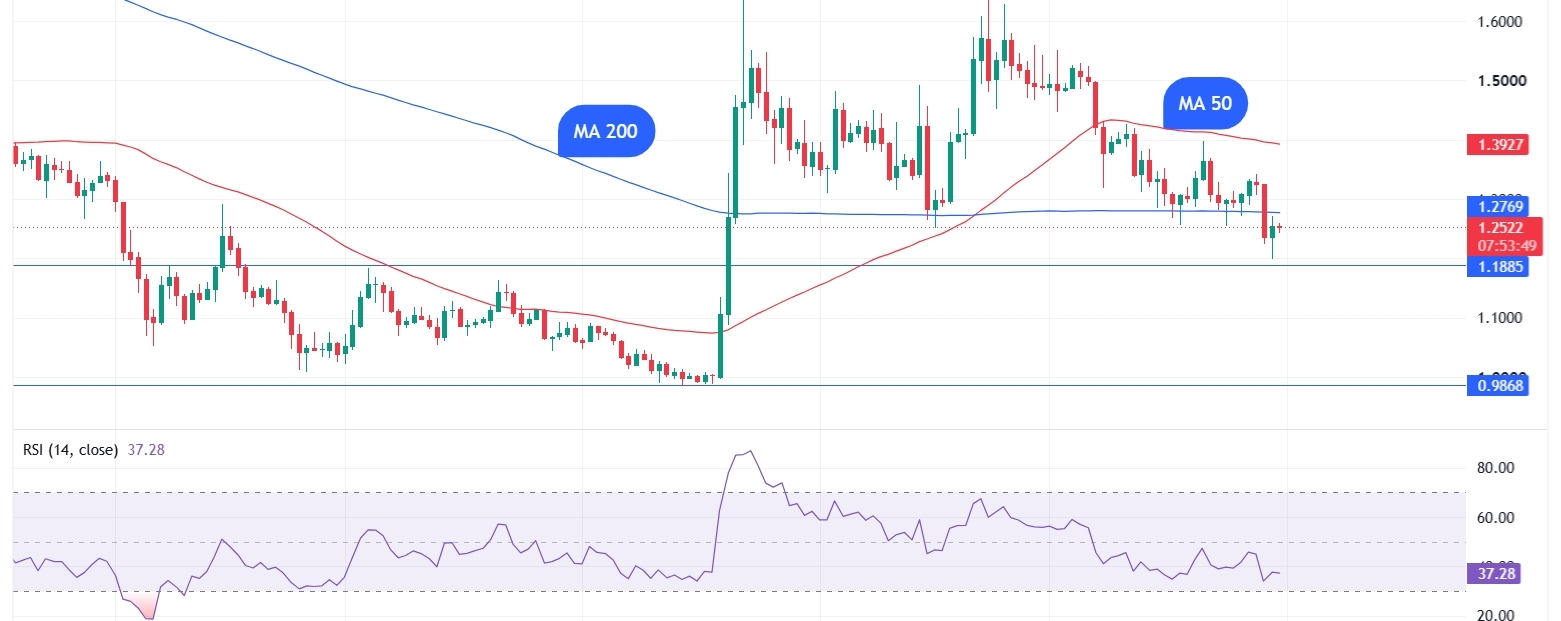
XRP Drops Key 2026 Support but Is Not Finished Yet$XRP is trading below its 200-day moving average (MA) for the first time since August 2026. Although it touched beneath this technical level in mid-September 2026 and twice in October, it was brief and didn't trade below it for long.
$XRP sharply fell on Thursday after news of the Binance heist, which impacted nearly $300 million in $XRP, surfaced. The Binance hack, which has affected $6.3 billion in client assets, is described as the largest crypto theft on record, with crypto prices dropping afterwards. $XRP fell to a low of $1.22, dropping below its 200 DMA shortly after.The decline continued on Friday, reaching a low of $1.19 as investors weighed a flurry of economic data and the Federal Reserve's latest interest rate decision of the week.
The key events, including the release of the personal consumption expenditures price index on Thursday, which rose 0.5% monthly and 3.6% year-over-year, exceeding the Fed's 2% target, had impacted the crypto markets alongside the news of Binance's attack, which came a day after the central bank decided to hold its key interest rate steady.
The drop to $1.19 on Friday was met with a rebound, but bulls still didn't gain enough strength to surpass the 200 DMA, with $XRP trading below it at press time.
XRP Drops Key 2026 Support but Is Not Finished Yet
$XRP is trading below its 200-day moving average (MA) for the first time since August 2026. Although it touched beneath this technical level in mid-September 2026 and twice in October, it was brief and didn't trade below it for long.
$XRP sharply fell on Thursday after news of the Binance heist, which impacted nearly $300 million in $XRP, surfaced. The Binance hack, which has affected $6.3 billion in client assets, is described as the largest crypto theft on record, with crypto prices dropping afterwards. $XRP fell to a low of $1.22, dropping below its 200 DMA shortly after.The decline continued on Friday, reaching a low of $1.19 as investors weighed a flurry of economic data and the Federal Reserve's latest interest rate decision of the week.
The key events, including the release of the personal consumption expenditures price index on Thursday, which rose 0.5% monthly and 3.6% year-over-year, exceeding the Fed's 2% target, had impacted the crypto markets alongside the news of Binance's attack, which came a day after the central bank decided to hold its key interest rate steady.
The drop to $1.19 on Friday was met with a rebound, but bulls still didn't gain enough strength to surpass the 200 DMA, with $XRP trading below it at press time.
1
74
·
--
Article
XRP ETFs see $8.43M in inflows after breach of $1.25 — November rally ahead? Is $XRP’s undervaluation finally catching up with institutional interest?
Technically, $XRP was one of the hardest hit high-cap assets after the Binance hack. It lost over 6.5% of its value and fell below the key $1.25-support level. What’s more, the breakdown dragged $XRP back to levels seen during mid-August, leaving STHs underwater and raising the chance of further downside.
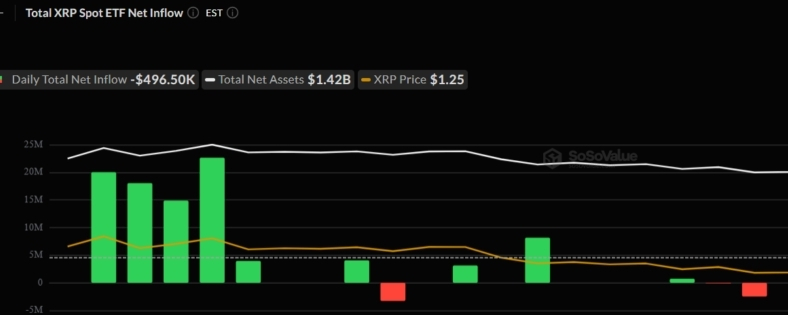
From an institutional standpoint, however, the chart below illustrates that Spot $XRP ETFs had the best single-day performance since 25th September, seeing net inflows of $8.43 million on 29th October.This puts them on course to exceed last week’s inflows, while their combined holdings now account for 1.87% of $XRP’s circulating supply.In essence, a divergence is taking shape between weakening technicals and rising institutional interest.
Usually, a setup like this raises one key question: Are institutions positioning ahead of a catalyst that the broader market hasn’t priced in yet? October has certainly been a big month for $XRP. BNY has included $XRP in corporate payments, Standard Chartered has launched $XRP custody, Ripple has secured final U.S approval for Ripple Bank, and Coinbase launched support for RLUSD.
Given that institutional positioning is now beginning to catch up with these developments, could this breakdown in $XRP be a classic rebound scenario? In turn, providing it with the momentum to break away from the overall market FUD ahead of November?
XRP ETFs see $8.43M in inflows after breach of $1.25 — November rally ahead?
Is $XRP ’s undervaluation finally catching up with institutional interest?
Technically, $XRP was one of the hardest hit high-cap assets after the Binance hack. It lost over 6.5% of its value and fell below the key $1.25-support level. What’s more, the breakdown dragged $XRP back to levels seen during mid-August, leaving STHs underwater and raising the chance of further downside.
From an institutional standpoint, however, the chart below illustrates that Spot $XRP ETFs had the best single-day performance since 25th September, seeing net inflows of $8.43 million on 29th October.This puts them on course to exceed last week’s inflows, while their combined holdings now account for 1.87% of $XRP ’s circulating supply.In essence, a divergence is taking shape between weakening technicals and rising institutional interest.
Usually, a setup like this raises one key question: Are institutions positioning ahead of a catalyst that the broader market hasn’t priced in yet? October has certainly been a big month for $XRP . BNY has included $XRP in corporate payments, Standard Chartered has launched $XRP custody, Ripple has secured final U.S approval for Ripple Bank, and Coinbase launched support for RLUSD.
Given that institutional positioning is now beginning to catch up with these developments, could this breakdown in $XRP be a classic rebound scenario? In turn, providing it with the momentum to break away from the overall market FUD ahead of November?
1
409
·
--
Article
XRP Hit First in Binance Hack: Five Wallets Drained in About Four Minutes#BinanceToResumePhaseOneOfWithdrawals Five Payments Consolidated $296 Million
Binance lost approximately $296 million in $XRP on Oct. 29, TRM Labs’ transaction tracing found. The blockchain intelligence firm investigates illicit cryptocurrency activity. It stated:
“The first theft of the night came on the $XRP Ledger. Between 20:05 and 20:09 UTC, five Binance wallets sent 233.46 million $XRP to a single attacker address, leaving each wallet with only its minimum balance.”
Onchain analytics firm Glassnode reported the same order, posting on X: “$XRP went first, then $SOL shortly after, then $BTC, $ETH, $USDT and TRX.” Blockchain analytics platform Arkham placed the attacker’s first $300 million on $XRP, ahead of $6 billion moved across 141 transfers on nine chains between 20:10 and 23:05 UTC.Xrplwin, an explorer displaying $XRP Ledger transactions and account activity, traced five transfers into one attacker-controlled address over four minutes and 20 seconds. The opening transfer accounted for approximately 79% of the total. Each wallet retained its required account reserve, $XRP that cannot be sent through ordinary payments. Investigators can follow subsequent transfers through public wallet balances and transaction histories.
XRP Hit First in Binance Hack: Five Wallets Drained in About Four Minutes
#BinanceToResumePhaseOneOfWithdrawals Five Payments Consolidated $296 Million
Binance lost approximately $296 million in $XRP on Oct. 29, TRM Labs’ transaction tracing found. The blockchain intelligence firm investigates illicit cryptocurrency activity. It stated:
“The first theft of the night came on the $XRP Ledger. Between 20:05 and 20:09 UTC, five Binance wallets sent 233.46 million $XRP to a single attacker address, leaving each wallet with only its minimum balance.”
Onchain analytics firm Glassnode reported the same order, posting on X: “$XRP went first, then $SOL shortly after, then $BTC, $ETH, $USDT and TRX.” Blockchain analytics platform Arkham placed the attacker’s first $300 million on $XRP, ahead of $6 billion moved across 141 transfers on nine chains between 20:10 and 23:05 UTC.Xrplwin, an explorer displaying $XRP Ledger transactions and account activity, traced five transfers into one attacker-controlled address over four minutes and 20 seconds. The opening transfer accounted for approximately 79% of the total. Each wallet retained its required account reserve, $XRP that cannot be sent through ordinary payments. Investigators can follow subsequent transfers through public wallet balances and transaction histories.
1
71
·
--
Verified

Article
Solana’s reward records leave stakers with a gap in validator fee data#BinanceToResumePhaseOneOfWithdrawals Solana’s staking payouts can remain visible while the validator fee, or commission, behind them becomes harder to verify. Agave leaves the commission-rate field empty in reward metadata when custom collectors are active, making a fee check depend on historical validator state as well as the $SOL received.
In an Oct. 30 report, staking provider P2P.org said the commission record disappeared from both voting and staking rewards from Sept. 8. It said commission continued to be charged and reward amounts still reconciled. The reporting problem concerns the evidence explaining a payout, rather than an identified shortfall in that payout.
P2P.org sells staking and reporting services, giving it a commercial interest in the issue.
Solana’s reward records leave stakers with a gap in validator fee data
#BinanceToResumePhaseOneOfWithdrawals Solana’s staking payouts can remain visible while the validator fee, or commission, behind them becomes harder to verify. Agave leaves the commission-rate field empty in reward metadata when custom collectors are active, making a fee check depend on historical validator state as well as the $SOL received.
In an Oct. 30 report, staking provider P2P.org said the commission record disappeared from both voting and staking rewards from Sept. 8. It said commission continued to be charged and reward amounts still reconciled. The reporting problem concerns the evidence explaining a payout, rather than an identified shortfall in that payout.
P2P.org sells staking and reporting services, giving it a commercial interest in the issue.
2
1.3k
·
--

Article
Bitcoin to $1.6 Million? Bitwise Raises 2036 Price Target Despite Brutal Market Downturn$BTC Bitwise has raised its 10-year Bitcoin price target from $1.3 million to $1.6 million by 2036, despite Bitcoin having a difficult year, marred by falling prices, weaker sentiment, and an uncertain macroeconomic environment.
In Bitwise’s updated Long-Term Capital Market Assumptions report, CIO Matt Hougan and Head of Research Ryan Rasmussen used the same model as last year but incorporated the latest market and economic data. Interestingly, rather than lowering their expectations after Bitcoin fell more than 50% between October 2025 and June 2026, reaching a low below $59,000, they ended up becoming more bullish.
The revised target also increases Bitcoin’s projected compound annual growth rate from 28.3% to 34.3%.
Bitcoin to $1.6 Million? Bitwise Raises 2036 Price Target Despite Brutal Market Downturn
$BTC Bitwise has raised its 10-year Bitcoin price target from $1.3 million to $1.6 million by 2036, despite Bitcoin having a difficult year, marred by falling prices, weaker sentiment, and an uncertain macroeconomic environment.
In Bitwise’s updated Long-Term Capital Market Assumptions report, CIO Matt Hougan and Head of Research Ryan Rasmussen used the same model as last year but incorporated the latest market and economic data. Interestingly, rather than lowering their expectations after Bitcoin fell more than 50% between October 2025 and June 2026, reaching a low below $59,000, they ended up becoming more bullish.
The revised target also increases Bitcoin’s projected compound annual growth rate from 28.3% to 34.3%.
1
71
·
--
Hedera Builders Expand into Gaming, Collectibles, and Music
Hedera builders are making notable progress in areas such as collectibles, gaming, and kids’ entertainment. This initiative was recently highlighted in a tweet from the Hedera account, showcasing their commitment to innovation and community engagement. As projects in these sectors gain traction, it may significantly impact Hedera’s market position and attract more developers and users to the platform.
Hedera builders are making notable progress in areas such as collectibles, gaming, and kids’ entertainment. This initiative was recently highlighted in a tweet from the Hedera account, showcasing their commitment to innovation and community engagement. As projects in these sectors gain traction, it may significantly impact Hedera’s market position and attract more developers and users to the platform.
2
48
·
--
Whales Sell $108 Million Worth of This Altcoin from Two Major Wallets
The activity of two large wallets holding Hyperliquid’s $HYPE token has become a topic of discussion for investors today. Lookonchain reported that the addresses it tracked sold approximately $108.81 million worth of $HYPE in total.
According to the platform’s statement, a wallet starting with “0x2685” liquidated 912,383 $HYPE tokens for approximately $82.09 million. It is estimated that these tokens were purchased about a month ago, resulting in a profit of over $10 million.
The second major transaction came from the address “0x648F”. This wallet reportedly sold 296,705 $HYPE for approximately $26.72 million. The profit calculated for the tokens purchased about 11 months ago was $16.5 million.
Related News In the Binance Hack, This Altcoin Remained in the Attackers' Possession—They Couldn't Sell It
Thus, the total profit from the two addresses exceeded $26.5 million, according to Lookonchain’s cost calculations. The owners of the wallets and the reasons for their decision to sell were not disclosed.
The price of $HYPE surged from around $78 to over $97 this week. It’s believed that whale wallets benefited from this rise. However, despite the increase, $HYPE failed to break its all-time high of $97.98.
$BTC
{future}(BTCUSDT)
Whales Sell $108 Million Worth of This Altcoin from Two Major Wallets
The activity of two large wallets holding Hyperliquid’s $HYPE token has become a topic of discussion for investors today. Lookonchain reported that the addresses it tracked sold approximately $108.81 million worth of $HYPE in total.
According to the platform’s statement, a wallet starting with “0x2685” liquidated 912,383 $HYPE tokens for approximately $82.09 million. It is estimated that these tokens were purchased about a month ago, resulting in a profit of over $10 million.
The second major transaction came from the address “0x648F”. This wallet reportedly sold 296,705 $HYPE for approximately $26.72 million. The profit calculated for the tokens purchased about 11 months ago was $16.5 million.
Related News In the Binance Hack, This Altcoin Remained in the Attackers' Possession—They Couldn't Sell It
Thus, the total profit from the two addresses exceeded $26.5 million, according to Lookonchain’s cost calculations. The owners of the wallets and the reasons for their decision to sell were not disclosed.
The price of $HYPE surged from around $78 to over $97 this week. It’s believed that whale wallets benefited from this rise. However, despite the increase, $HYPE failed to break its all-time high of $97.98.
$BTC
2
304
·
--

Article
Why November's +80% History Is a Statistical Flaw for XRP Holders$XRP $XRP's 15.7% drop in October has brought the token to the most unpredictable crossroads of the year. Historical data from thirteen years of observations promise the market harsh November volatility. However, behind the optimistic figures of past years lies a serious methodological flaw capable of disorienting investors amid the current pressure.
What is wrong with $XRP's November statistics
The main trap for the market is the asymmetry of returns. According to Cryptorank, $XRP's average November gain is an impressive +80.2%, but this figure is completely distorted by two isolated anomalies: a surge of +531.9% in 2013 and a rally of +281.7% in 2024. The month's median, a negative -10%, reflects reality much more accurately.
Historically, in most cycles, $XRP closed November in the red. The fourth quarter, which so far consists of October alone, is already down -16.3%, in line with the asset's seasonal tendency toward correction that the averaged statistics mask.
Why November's +80% History Is a Statistical Flaw for XRP Holders
$XRP $XRP 's 15.7% drop in October has brought the token to the most unpredictable crossroads of the year. Historical data from thirteen years of observations promise the market harsh November volatility. However, behind the optimistic figures of past years lies a serious methodological flaw capable of disorienting investors amid the current pressure.
What is wrong with $XRP 's November statistics
The main trap for the market is the asymmetry of returns. According to Cryptorank, $XRP 's average November gain is an impressive +80.2%, but this figure is completely distorted by two isolated anomalies: a surge of +531.9% in 2013 and a rally of +281.7% in 2024. The month's median, a negative -10%, reflects reality much more accurately.
Historically, in most cycles, $XRP closed November in the red. The fourth quarter, which so far consists of October alone, is already down -16.3%, in line with the asset's seasonal tendency toward correction that the averaged statistics mask.
3
3
1.1k
·
--

Article
Bitcoin stolen from Binance tops Tesla’s holdings and is over twice El Salvador’s reserve$BTC Hackers linked to North Korea took more bitcoin from Binance on Thursday than Tesla holds, and more than twice the amount in El Salvador’s national reserve.
The 18,270 $BTC stolen compares with Tesla’s 11,509 $BTC and about 7,820 $BTC in the reserve wallets published by El Salvador’s National Bitcoin Office as of Friday. At $78,500 per coin, the haul is worth roughly $1.4 billion.
It also comes within 442 $BTC of SpaceX’s 18,712 $BTC. Both companies disclosed their holdings as of Sept. 30 in quarterly filings published this month.
El Salvador began buying bitcoin in September 2021. The Binance attacker took roughly 2.3 times its current reserve in transfers confirmed in a single block.
Blockchain intelligence firm TRM Labs attributed the attack “with high confidence” to TraderTraitor, a North Korean state-sponsored hacking unit. The FBI blamed that group for the $1.5 billion Bybit theft in February 2025. Binance has not identified the attacker.
The bitcoin left Binance at about 4:20 p.m. ET on Thursday. A hot wallet, the internet-connected account an exchange uses to pay customer withdrawals, sent the coins to a new address in 11 transactions, according to mempool.space records.
The receiving address then split the money among 19 addresses. Seventeen held exactly 1,000 $BTC each, with the other two holding about 833 $BTC and 438 $BTC. None had spent its holdings as of 2:02 a.m. ET on Friday.
Bitcoin stolen from Binance tops Tesla’s holdings and is over twice El Salvador’s reserve
$BTC Hackers linked to North Korea took more bitcoin from Binance on Thursday than Tesla holds, and more than twice the amount in El Salvador’s national reserve.
The 18,270 $BTC stolen compares with Tesla’s 11,509 $BTC and about 7,820 $BTC in the reserve wallets published by El Salvador’s National Bitcoin Office as of Friday. At $78,500 per coin, the haul is worth roughly $1.4 billion.
It also comes within 442 $BTC of SpaceX’s 18,712 $BTC . Both companies disclosed their holdings as of Sept. 30 in quarterly filings published this month.
El Salvador began buying bitcoin in September 2021. The Binance attacker took roughly 2.3 times its current reserve in transfers confirmed in a single block.
Blockchain intelligence firm TRM Labs attributed the attack “with high confidence” to TraderTraitor, a North Korean state-sponsored hacking unit. The FBI blamed that group for the $1.5 billion Bybit theft in February 2025. Binance has not identified the attacker.
The bitcoin left Binance at about 4:20 p.m. ET on Thursday. A hot wallet, the internet-connected account an exchange uses to pay customer withdrawals, sent the coins to a new address in 11 transactions, according to mempool.space records.
The receiving address then split the money among 19 addresses. Seventeen held exactly 1,000 $BTC each, with the other two holding about 833 $BTC and 438 $BTC . None had spent its holdings as of 2:02 a.m. ET on Friday.
14
78
74.6k
·
--

Article
Bitcoin and Ethereum Declined, Whales Moved! They Made Millions of Dollars Worth of Moves During the#HKDollarStablecoinHKDAPToLaunchOnSolana $BTC The cryptocurrency market faced intense selling pressure following the Binance hack, which resulted in losses of approximately $6.3 billion, with major cryptocurrencies, particularly Bitcoin and Ethereum, losing value. Bitcoin fell by over 3%, dropping to around $76,000, while Ethereum also fell below $2,200.
While market activity continued after these declines, transfers made by whale wallets also attracted attention.
According to Lookonchain, a cryptocurrency analytics platform, a whale with the address “0x15a4” made a profit of over $20 million by closing long positions of 1,000 $BTC (worth approximately $78.18 million) and 10,000 $ETH (worth approximately $22.35 million) that it had held for four months.After taking profits, the whale went into a short position, opening a 13,000 $ETH (worth approximately $29 million) short position with 20x leverage.
According to Lookonchain, despite the market downturn, whales are still buying $BTC. In the last 24 hours, 9 newly created wallets purchased 1,900 $BTC (worth $148 million) from Galaxy Digital.
According to Lookonchain, legendary investor dimethyltryptamine.eth, who once bought 5.9 trillion $PEPE tokens by spending only 0.125 $ETH (approximately $251) and had an unrealized profit of around $100 million, purchased an additional 45.08 billion $PEPE tokens worth approximately $206,500 after the Binance hacker sold all of his $PEPE assets.
The large whale “58bro.eth (0x58bro)” sold 8,000 $ETH following the Binance hack news. After recovering over $17.96 million worth of $ETH from Aave, he transferred his funds in installments to OKX and has since withdrawn $10.5 million $USDT from the exchange to pay off his loans. Currently, the address still holds 4,911.05 WETH as collateral on Aave, with a debt of $2.51 million $USDT.
Finally, according to TradingBeats data, $BNB, after falling as low as $670.1 in Hyperliquid in the morning, recovered by 6.8% to rise to $715.8. However, its loss over the last 24 hours is still at 5.2%. At this point, during the market downturn, many large investors intensified their $BNB positions.
While the long position is prominent among large investors, seven major accounts hold a total of $12.07 million in long positions, compared to $3.24 million in short positions held by three accounts. Additionally, some large investors appear to have closed their short positions and moved into long positions.
Bitcoin and Ethereum Declined, Whales Moved! They Made Millions of Dollars Worth of Moves During the
#HKDollarStablecoinHKDAPToLaunchOnSolana $BTC The cryptocurrency market faced intense selling pressure following the Binance hack, which resulted in losses of approximately $6.3 billion, with major cryptocurrencies, particularly Bitcoin and Ethereum, losing value. Bitcoin fell by over 3%, dropping to around $76,000, while Ethereum also fell below $2,200.
While market activity continued after these declines, transfers made by whale wallets also attracted attention.
According to Lookonchain, a cryptocurrency analytics platform, a whale with the address “0x15a4” made a profit of over $20 million by closing long positions of 1,000 $BTC (worth approximately $78.18 million) and 10,000 $ETH (worth approximately $22.35 million) that it had held for four months.After taking profits, the whale went into a short position, opening a 13,000 $ETH (worth approximately $29 million) short position with 20x leverage.
According to Lookonchain, despite the market downturn, whales are still buying $BTC . In the last 24 hours, 9 newly created wallets purchased 1,900 $BTC (worth $148 million) from Galaxy Digital.
According to Lookonchain, legendary investor dimethyltryptamine.eth, who once bought 5.9 trillion $PEPE tokens by spending only 0.125 $ETH (approximately $251) and had an unrealized profit of around $100 million, purchased an additional 45.08 billion $PEPE tokens worth approximately $206,500 after the Binance hacker sold all of his $PEPE assets.
The large whale “58bro.eth (0x58bro)” sold 8,000 $ETH following the Binance hack news. After recovering over $17.96 million worth of $ETH from Aave, he transferred his funds in installments to OKX and has since withdrawn $10.5 million $USDT from the exchange to pay off his loans. Currently, the address still holds 4,911.05 WETH as collateral on Aave, with a debt of $2.51 million $USDT.
Finally, according to TradingBeats data, $BNB, after falling as low as $670.1 in Hyperliquid in the morning, recovered by 6.8% to rise to $715.8. However, its loss over the last 24 hours is still at 5.2%. At this point, during the market downturn, many large investors intensified their $BNB positions.
While the long position is prominent among large investors, seven major accounts hold a total of $12.07 million in long positions, compared to $3.24 million in short positions held by three accounts. Additionally, some large investors appear to have closed their short positions and moved into long positions.
1
143
·
--

Article
CZ and Elon Musk Clash After Binance Hack: Musk Responds with Emojis, CZ Reminds#$1.5BInLeveragedCryptoBetsLiquidated The Bitcoin and altcoin market is buzzing about the Binance hack, which resulted in losses of approximately $6.3 billion. While questions remain about whether user losses will be compensated, Binance founder CZ and Tesla CEO Elon Musk have clashed over the issue.
CZ’s Reaction to Elon Musk Regarding Binance!
Binance founder Changpeng Zhao (CZ) reacted to Elon Musk’s social media posts following the multi-billion dollar security breach at the cryptocurrency exchange. CZ asked Musk to show support instead of using sarcastic remarks about the incident.
The controversy began after Binance experienced a security breach on October 29th. Musk responded to CZ’s cybersecurity warnings and posts about the attack with fire and laughing emojis.Elon Musk also responded with a laughing emoji to a post comparing CZ’s promise to compensate for hack losses to FTX founder SBF’s statement that “FTX has sufficient reserves to cover all customer accounts.”
CZ then addressed Musk directly, stating that he retained his respect for him but that the incident should not be taken lightly.
CZ, in his post directed at Musk, said, “Elon, I have great respect for you, but this is a bad time to be making fun of things. Please stop. I would appreciate it if you showed some support.”
CZ also reminded Musk of the $500 million investment. The key point in CZ’s statement was Binance’s $500 million investment in Musk’s Twitter acquisition. CZ stated that the SpaceX shares acquired in return for this investment are worth over $1 billion, implying that these shares could be sold.
However, Binance co-CEO Yi He later stated that the company’s annual revenue was sufficient to cover the losses, and therefore there was no need to sell SpaceX shares.
CZ and Elon Musk Clash After Binance Hack: Musk Responds with Emojis, CZ Reminds
#$1.5BInLeveragedCryptoBetsLiquidated The Bitcoin and altcoin market is buzzing about the Binance hack, which resulted in losses of approximately $6.3 billion. While questions remain about whether user losses will be compensated, Binance founder CZ and Tesla CEO Elon Musk have clashed over the issue.
CZ’s Reaction to Elon Musk Regarding Binance!
Binance founder Changpeng Zhao (CZ) reacted to Elon Musk’s social media posts following the multi-billion dollar security breach at the cryptocurrency exchange. CZ asked Musk to show support instead of using sarcastic remarks about the incident.
The controversy began after Binance experienced a security breach on October 29th. Musk responded to CZ’s cybersecurity warnings and posts about the attack with fire and laughing emojis.Elon Musk also responded with a laughing emoji to a post comparing CZ’s promise to compensate for hack losses to FTX founder SBF’s statement that “FTX has sufficient reserves to cover all customer accounts.”
CZ then addressed Musk directly, stating that he retained his respect for him but that the incident should not be taken lightly.
CZ, in his post directed at Musk, said, “Elon, I have great respect for you, but this is a bad time to be making fun of things. Please stop. I would appreciate it if you showed some support.”
CZ also reminded Musk of the $500 million investment. The key point in CZ’s statement was Binance’s $500 million investment in Musk’s Twitter acquisition. CZ stated that the SpaceX shares acquired in return for this investment are worth over $1 billion, implying that these shares could be sold.
However, Binance co-CEO Yi He later stated that the company’s annual revenue was sufficient to cover the losses, and therefore there was no need to sell SpaceX shares.
2
104
·
--

Article
Binance uncovers wider breach in $6.3 billion exploit, targets Sunday withdrawal restart#UniswapA16zSeekDeFiExemptionFromIllinoisCryptoTax Binance’s investigation into the record $6.3 billion hack has uncovered additional security breaches beyond an initially suspected compromised employee laptop, co-CEO Richard Teng said Friday, adding details of the attack and setting a Sunday target to restore withdrawals.
In a video statement on X, Teng said the attackers used a self-destruct mechanism to erase evidence and exploited Ethereum’s EIP-7702 account-delegation feature to take control of a hot wallet without going through Binance’s normal approval procedures.
“This was a complex attack,” Teng said, adding that investigators had found additional points of breach but had yet to determine the full sequence of events.
CoinDesk’s earlier reporting detailed the account-delegation method, which examined how the attacker obtained wallet permissions and used malicious code to drain about $2.5 billion in minutes.
Binance has suspended withdrawals while rebuilding and testing its infrastructure. Teng said the exchange hopes to resume withdrawals by Sunday, within approximately 40 hours, and is reviewing its cloud systems, employee devices, private-key management and transaction-signing procedures.
Teng also reiterated Binance had committed to cover all $6.3 billion in losses using company funds. Binance has reserved more than $6.34 billion, including $5 billion already held in the affected cryptocurrencies, he said. The remaining assets are being purchased through exchanges and over-the-counter (OTC) markets.
He also said the attack targeted Binance’s own hot wallet rather than customer funds. A separate CoinDesk examination of Binance’s reserve data, however, found that the compromised wallets were previously included in a list detailing assets backing customer balances.
Binance plans to publish an initial proof-of-reserves update before releasing a full report Monday, Teng said, adding that the exchange is also working with law enforcement, blockchain investigators and token issuers to recover stolen assets.
Binance uncovers wider breach in $6.3 billion exploit, targets Sunday withdrawal restart
#UniswapA16zSeekDeFiExemptionFromIllinoisCryptoTax Binance’s investigation into the record $6.3 billion hack has uncovered additional security breaches beyond an initially suspected compromised employee laptop, co-CEO Richard Teng said Friday, adding details of the attack and setting a Sunday target to restore withdrawals.
In a video statement on X, Teng said the attackers used a self-destruct mechanism to erase evidence and exploited Ethereum’s EIP-7702 account-delegation feature to take control of a hot wallet without going through Binance’s normal approval procedures.
“This was a complex attack,” Teng said, adding that investigators had found additional points of breach but had yet to determine the full sequence of events.
CoinDesk’s earlier reporting detailed the account-delegation method, which examined how the attacker obtained wallet permissions and used malicious code to drain about $2.5 billion in minutes.
Binance has suspended withdrawals while rebuilding and testing its infrastructure. Teng said the exchange hopes to resume withdrawals by Sunday, within approximately 40 hours, and is reviewing its cloud systems, employee devices, private-key management and transaction-signing procedures.
Teng also reiterated Binance had committed to cover all $6.3 billion in losses using company funds. Binance has reserved more than $6.34 billion, including $5 billion already held in the affected cryptocurrencies, he said. The remaining assets are being purchased through exchanges and over-the-counter (OTC) markets.
He also said the attack targeted Binance’s own hot wallet rather than customer funds. A separate CoinDesk examination of Binance’s reserve data, however, found that the compromised wallets were previously included in a list detailing assets backing customer balances.
Binance plans to publish an initial proof-of-reserves update before releasing a full report Monday, Teng said, adding that the exchange is also working with law enforcement, blockchain investigators and token issuers to recover stolen assets.
1
12
7.5k
·
--
Article
10% to 56%: USDC’s remarkable rise in euro-paired stablecoin tradingSince December 2023, USD Coin [$USDC] has increased its market share of euro-paired stablecoin trade from 10% to 56% as of October.
While at the end of 2024, euro-paired stablecoin trade volume reached levels near $10 billion per month before declining in subsequent months.
As a result of MiCA restrictions on Tether [$USDT], the number of transactions using $USDC increased. This gave $USDC an advantage as it pushed more trading activity toward $USDC.Julia Kovalchuk, Head of B2B Product at Paybis, a MiCA-licensed crypto and fiat infrastructure provider, told AMBCrypto in an exclusive interview,
After MiCA, $USDC grew from about 21% to 75% of stablecoin volume among our payment-firm clients in a year. The US leans toward $USDC too, while $USDT still dominates trading and emerging markets. Winners are regional and split by use case – $USDC is the default choice for enterprise payment companies, traditional-finance on-ramps, and regulated custody in both the EU and the US.
Specifically, since Tether had been denied access to euro markets, euro-paired $USDC order books now have 40% more depth than those of $USDT/EUR order books.
Therefore, larger euro-paired stablecoin trades were able to be executed without causing as much price movement.
10% to 56%: USDC’s remarkable rise in euro-paired stablecoin trading
Since December 2023, USD Coin [$USDC] has increased its market share of euro-paired stablecoin trade from 10% to 56% as of October.
While at the end of 2024, euro-paired stablecoin trade volume reached levels near $10 billion per month before declining in subsequent months.
As a result of MiCA restrictions on Tether [$USDT], the number of transactions using $USDC increased. This gave $USDC an advantage as it pushed more trading activity toward $USDC.Julia Kovalchuk, Head of B2B Product at Paybis, a MiCA-licensed crypto and fiat infrastructure provider, told AMBCrypto in an exclusive interview,
After MiCA, $USDC grew from about 21% to 75% of stablecoin volume among our payment-firm clients in a year. The US leans toward $USDC too, while $USDT still dominates trading and emerging markets. Winners are regional and split by use case – $USDC is the default choice for enterprise payment companies, traditional-finance on-ramps, and regulated custody in both the EU and the US.
Specifically, since Tether had been denied access to euro markets, euro-paired $USDC order books now have 40% more depth than those of $USDT/EUR order books.
Therefore, larger euro-paired stablecoin trades were able to be executed without causing as much price movement.
1
44
·
--

Article
Hackers drain 9,400 SOL from bot wallets, and a copied key is blamedBitquery’s reconstruction reports that 48 wallets associated with Bloom, an automated trading service, lost 9,408 $SOL through transfers signed by the wallets’ own keys.
Bloom documents a lock that prevents changes to a user’s withdrawal destination, yet a copied key can authorize transfers outside that service interface.
In an Oct. 26 update, Bloom denied that private keys had been accessed or compromised. The account attributed the incident to a remote-code-execution vulnerability in a third-party module and said unaffected wallets were safe.Later on Oct. 26, Bloom announced that all nine affected users had been fully refunded, claiming a total of 9,408 $SOL and linking nine transactions.
That leaves two separate issues for users: compensation for the loss and the authority that could move funds from a wallet.
Hackers drain 9,400 SOL from bot wallets, and a copied key is blamed
Bitquery’s reconstruction reports that 48 wallets associated with Bloom, an automated trading service, lost 9,408 $SOL through transfers signed by the wallets’ own keys.
Bloom documents a lock that prevents changes to a user’s withdrawal destination, yet a copied key can authorize transfers outside that service interface.
In an Oct. 26 update, Bloom denied that private keys had been accessed or compromised. The account attributed the incident to a remote-code-execution vulnerability in a third-party module and said unaffected wallets were safe.Later on Oct. 26, Bloom announced that all nine affected users had been fully refunded, claiming a total of 9,408 $SOL and linking nine transactions.
That leaves two separate issues for users: compensation for the loss and the authority that could move funds from a wallet.
4
3.2k
·
--

Article
Binance hacker splits $1.4 billion of bitcoin into 19 wallets that no one can freezeThe attacker who drained Binance late on Thursday broke 18,270 stolen bitcoin $BTC$78,436.48 into 19 separate piles within minutes, then left them alone.
At 20:20 UTC, Binance’s hot wallet sent just over 18,270 $BTC to one address in 11 transactions, all confirmed in block 973,732. A hot wallet is the internet-connected wallet an exchange uses to pay out customer withdrawals. The coins were worth about $1.4 billion at early Friday prices, or more than two and a half times the 7,000 $BTC Binance lost in its 2019 hack (though bitcoin traded under $5,000 at the time).
The transactions that split the coins up were confirmed in block 973,732 too, right after the deposits into the receiving address.
CoinDesk followed every output using mempool.space data. The coins went through a so-called peel chain, where each transaction carves 1,000 $BTC off into a fresh address and passes the rest to the next hop.
Some leftovers were merged back together and split again. One last sweep gathered the odd amounts into a wallet holding 832.5 $BTC.
Twenty-eight minutes later, in block 973,738, a final 437.7 $BTC landed in a 19th address.
Seventeen wallets now hold exactly 1,000 $BTC each, one holds 832.5 $BTC and one holds 437.7 $BTC. As of 04:23 UTC Friday, none of the 19 had sent a single coin.
The only new activity is spam, as strangers have been sending the wallets tiny deposits worth a dollar or two since late Thursday.
The rest of the haul has gone very differently. Tether, Circle, Ripple and other stablecoin issuers control the contracts behind their tokens, so they could blacklist the attacker’s addresses within hours.
Bitcoin has no issuer to do that, so the coins can only be stopped once they reach an exchange, an over-the-counter desk or a swap service.
TRM Labs attributed the theft to TraderTraitor, North Korea’s elite hacking unit, with “high confidence.” After the $1.5 billion Bybit theft in February 2025, the same unit spent about 10 days turning stolen ether into bitcoin.
Binance hacker splits $1.4 billion of bitcoin into 19 wallets that no one can freeze
The attacker who drained Binance late on Thursday broke 18,270 stolen bitcoin $BTC$78,436.48 into 19 separate piles within minutes, then left them alone.
At 20:20 UTC, Binance’s hot wallet sent just over 18,270 $BTC to one address in 11 transactions, all confirmed in block 973,732. A hot wallet is the internet-connected wallet an exchange uses to pay out customer withdrawals. The coins were worth about $1.4 billion at early Friday prices, or more than two and a half times the 7,000 $BTC Binance lost in its 2019 hack (though bitcoin traded under $5,000 at the time).
The transactions that split the coins up were confirmed in block 973,732 too, right after the deposits into the receiving address.
CoinDesk followed every output using mempool.space data. The coins went through a so-called peel chain, where each transaction carves 1,000 $BTC off into a fresh address and passes the rest to the next hop.
Some leftovers were merged back together and split again. One last sweep gathered the odd amounts into a wallet holding 832.5 $BTC.
Twenty-eight minutes later, in block 973,738, a final 437.7 $BTC landed in a 19th address.
Seventeen wallets now hold exactly 1,000 $BTC each, one holds 832.5 $BTC and one holds 437.7 $BTC. As of 04:23 UTC Friday, none of the 19 had sent a single coin.
The only new activity is spam, as strangers have been sending the wallets tiny deposits worth a dollar or two since late Thursday.
The rest of the haul has gone very differently. Tether, Circle, Ripple and other stablecoin issuers control the contracts behind their tokens, so they could blacklist the attacker’s addresses within hours.
Bitcoin has no issuer to do that, so the coins can only be stopped once they reach an exchange, an over-the-counter desk or a swap service.
TRM Labs attributed the theft to TraderTraitor, North Korea’s elite hacking unit, with “high confidence.” After the $1.5 billion Bybit theft in February 2025, the same unit spent about 10 days turning stolen ether into bitcoin.
1
67
·
--

Article
Binance Halts Withdrawals Until Security Checks Are Complete! Here Are the DetailsCryptocurrency exchange Binance announced it has temporarily suspended withdrawals following a hot wallet attack that occurred overnight. Binance Co-CEO He Yi stated that withdrawals will not resume until security conditions are confirmed to be completely secure.
Related News BREAKING: Assets Stolen from Binance Reportedly Total $5.64 Billion – Here Is the List of Stolen Altcoins
In a statement made via the social media platform X, He Yi stated that withdrawal transactions were suspended to ensure user security.He Yi emphasized that transactions would not be reopened until the current security environment was ensured to be secure, and asked users for their understanding.
The decision was reportedly made after a Binance hot wallet was subjected to a cyberattack during the night.
Initial estimates suggest that up to $5.7 billion worth of crypto assets may have been stolen in the attack. However, there is no definitive, independent confirmation of this amount of loss yet.
Related News BREAKING: Assets Stolen from Binance Reportedly Total $5.64 Billion – Here Is the List of Stolen Altcoins
Hot wallets are digital asset storage systems that operate via the internet and are used for transferring cryptocurrencies.
While these wallets allow for fast transaction processing, their online connections expose them to various cybersecurity risks.
Binance’s decision to suspend withdrawals is seen as a temporary measure to assess the security of its existing systems following the attack.
However, the exchange did not share a specific date or time for when withdrawal services would resume.
The statement did not provide detailed information on the current status of other transaction services.
Binance users will be able to regain access to withdrawals depending on the completion of security reviews and the exchange’s verification that its systems are secure.
Binance Halts Withdrawals Until Security Checks Are Complete! Here Are the Details
Cryptocurrency exchange Binance announced it has temporarily suspended withdrawals following a hot wallet attack that occurred overnight. Binance Co-CEO He Yi stated that withdrawals will not resume until security conditions are confirmed to be completely secure.
Related News BREAKING: Assets Stolen from Binance Reportedly Total $5.64 Billion – Here Is the List of Stolen Altcoins
In a statement made via the social media platform X, He Yi stated that withdrawal transactions were suspended to ensure user security.He Yi emphasized that transactions would not be reopened until the current security environment was ensured to be secure, and asked users for their understanding.
The decision was reportedly made after a Binance hot wallet was subjected to a cyberattack during the night.
Initial estimates suggest that up to $5.7 billion worth of crypto assets may have been stolen in the attack. However, there is no definitive, independent confirmation of this amount of loss yet.
Related News BREAKING: Assets Stolen from Binance Reportedly Total $5.64 Billion – Here Is the List of Stolen Altcoins
Hot wallets are digital asset storage systems that operate via the internet and are used for transferring cryptocurrencies.
While these wallets allow for fast transaction processing, their online connections expose them to various cybersecurity risks.
Binance’s decision to suspend withdrawals is seen as a temporary measure to assess the security of its existing systems following the attack.
However, the exchange did not share a specific date or time for when withdrawal services would resume.
The statement did not provide detailed information on the current status of other transaction services.
Binance users will be able to regain access to withdrawals depending on the completion of security reviews and the exchange’s verification that its systems are secure.
Related News BREAKING: Assets Stolen from Binance Reportedly Total $5.64 Billion – Here Is the List of Stolen Altcoins
In a statement made via the social media platform X, He Yi stated that withdrawal transactions were suspended to ensure user security.He Yi emphasized that transactions would not be reopened until the current security environment was ensured to be secure, and asked users for their understanding.
The decision was reportedly made after a Binance hot wallet was subjected to a cyberattack during the night.
Initial estimates suggest that up to $5.7 billion worth of crypto assets may have been stolen in the attack. However, there is no definitive, independent confirmation of this amount of loss yet.
Related News BREAKING: Assets Stolen from Binance Reportedly Total $5.64 Billion – Here Is the List of Stolen Altcoins
Hot wallets are digital asset storage systems that operate via the internet and are used for transferring cryptocurrencies.
While these wallets allow for fast transaction processing, their online connections expose them to various cybersecurity risks.
Binance’s decision to suspend withdrawals is seen as a temporary measure to assess the security of its existing systems following the attack.
However, the exchange did not share a specific date or time for when withdrawal services would resume.
The statement did not provide detailed information on the current status of other transaction services.
Binance users will be able to regain access to withdrawals depending on the completion of security reviews and the exchange’s verification that its systems are secure.
2
1.8k
·
--

Article
Elon Musk Comments on Binance Attack: “Every Day is Day Zero”! Here are the DetailsTesla founder Elon Musk commented on the cyberattack targeting the cryptocurrency exchange Binance via the social media platform X. In his post regarding the attack, Musk used the phrase, “Every day is zeroday.”
Musk’s statement attracted attention at a time when cybersecurity risks in the cryptocurrency sector have resurfaced.
In cybersecurity, the term “zero-day” refers to a vulnerability in software or a system that is exploited by attackers before it is publicly disclosed or a related security update is released.These types of vulnerabilities can pose serious security risks because software developers may not have enough time to fix the problem.
Musk’s post was interpreted as an assessment of the security threats facing digital platforms following the Binance attack.
Meanwhile, Musk also reposted an article from The Kobeissi Letter, which shares analyses of financial markets, regarding the Binance attack.
The Kobeissi Letter claimed that approximately $5.7 billion in funds flowed out of Binance following the cyberattack. The platform described the incident as the largest cyberattack in cryptocurrency history.
However, it has not been confirmed that the entire reported $5.7 billion in fund outflows consisted of assets stolen by the attackers.
Fund outflows from exchanges can also include users transferring their assets to other platforms or personal wallets.
Therefore, the total outflow amount and the funds directly lost as a result of the attack need to be evaluated separately.
Musk’s statement and subsequent reposting of his assessment keep the security concerns raised in the cryptocurrency sector by the Binance attack on the agenda, while uncertainties regarding the financial dimension of the incident persist.
Elon Musk Comments on Binance Attack: “Every Day is Day Zero”! Here are the Details
Tesla founder Elon Musk commented on the cyberattack targeting the cryptocurrency exchange Binance via the social media platform X. In his post regarding the attack, Musk used the phrase, “Every day is zeroday.”
Musk’s statement attracted attention at a time when cybersecurity risks in the cryptocurrency sector have resurfaced.
In cybersecurity, the term “zero-day” refers to a vulnerability in software or a system that is exploited by attackers before it is publicly disclosed or a related security update is released.These types of vulnerabilities can pose serious security risks because software developers may not have enough time to fix the problem.
Musk’s post was interpreted as an assessment of the security threats facing digital platforms following the Binance attack.
Meanwhile, Musk also reposted an article from The Kobeissi Letter, which shares analyses of financial markets, regarding the Binance attack.
The Kobeissi Letter claimed that approximately $5.7 billion in funds flowed out of Binance following the cyberattack. The platform described the incident as the largest cyberattack in cryptocurrency history.
However, it has not been confirmed that the entire reported $5.7 billion in fund outflows consisted of assets stolen by the attackers.
Fund outflows from exchanges can also include users transferring their assets to other platforms or personal wallets.
Therefore, the total outflow amount and the funds directly lost as a result of the attack need to be evaluated separately.
Musk’s statement and subsequent reposting of his assessment keep the security concerns raised in the cryptocurrency sector by the Binance attack on the agenda, while uncertainties regarding the financial dimension of the incident persist.
12
3
58
57.2k
·
--
Your fridge could one day stake Ether, launch memecoins: CFTC chair
Commodity Futures Trading Commission Chair Michael Selig says it is “no longer science fiction” to imagine one’s refrigerator autonomously purchasing groceries with money earned from staking Ether — or even launching its own memecoin, raising questions about how regulators should oversee autonomous AI agents.
The colorful comment came during Selig’s remarks at the CFTC’s inaugural Frontier Forum in Washington, DC, on Wednesday, where he argued that regulators must adapt to a financial system where AI agents can hold assets and execute trades autonomously.
“We’re gathered here today to discuss a technology that’s rapidly transforming the financial markets. President Trump calls it ‘super intelligence,’ or SI, because ‘it’s not artificial.’ It’s as real as the printing press, the steam engine, and the internet,” he said.
Selig says the CFTC’s regulatory framework was developed around “identifiable market participants” performing specific financial functions, but autonomous software is raising questions about how those rules apply.
“Consider an SI agent that identifies trading opportunities and executes transactions on behalf of a user,” said Selig.
“Does the developer of that agent become subject to registration? Who is liable if the agent goes rogue? How can regulators know who the agent, or suite of agents, is trading on behalf of? Do we need a new flavor of know-your-customer, maybe KYA or know-your-agent?”
#FedWatch #Nasdaq100FuturesFall0.9%
1
1
·
--
Bitcoin Surpasses $81,000, Popular Memecoin Jumps 9%: What’s Behind the Rise?
Bitcoin surged to $81,400, driven by a rebound in technology stocks and a $176 million inflow into ETFs. $PEPE outperformed other major cryptocurrencies.
Bitcoin rebounded to $81,400 after falling below $80,000. During the same period, Ethereum gained 0.9%, while the CoinDesk Memecoin Index rose 1.3%. This movement coincided with a strong recovery in Asian technology stocks.
South Korea’s Kospi Index rose 6.6%, while AI chip maker SK Hynix gained nearly 11%. The company’s announcement of a sevenfold increase in profits boosted risk appetite in AI-related stocks. Nasdaq-100 futures also rose 0.5%.
1
1
Log in to explore more content
Join global crypto users on Binance Square
⚡️ Get latest and useful information about crypto.
💬 Trusted by the world’s largest crypto exchange.
👍 Discover real insights from verified creators.
Email / Phone number
Trending Topics
BinanceProcesses$4.65BWithdrawals
52,329 views
218 Discussing
Binance Processes $4.65 Billion in Withdrawals After Reopening, Net Outflow of $3.64 Billion Equals 2.1% of Its $171 Billion in Assets
Binance News
·56 Likes
·18.7k views
WithdrawalsBack: 15 networks live
11,505 views
171 Discussing
EthereumSurpasses$2300
420 views
37 Discussing