

渔歌趋势
5.8k Posts

渔歌趋势
Report
Block User
币安认证博主✅,公众号:起飞喵、
跟丹聊天室:yyds666 ,12年老交易员,穿越两轮牛熊,用实战经验分享,手握顶级资源,不讲神话,用结果说话。
0 Following
6.0K+ Followers
9.4K+ Liked
Posts
All
Quotes
Videos
PINNED
·
--
Want to follow the strategy fans ✨✨
You can save the QR code below, scan it using Binance’s Scan function. You can also type the chat ID in the chat room: yyds666. Add me as a friend, and then you can contact me here directly. I’ll guide you into the core of the blockchain and the path to financial freedom!
Strategy ID: 弓-重-浩-【起飞喵】
Want to follow the strategy fans ✨✨
You can save the QR code below, scan it using Binance’s Scan function. You can also type the chat ID in the chat room: yyds666. Add me as a friend, and then you can contact me here directly. I’ll guide you into the core of the blockchain and the path to financial freedom!
Strategy ID: 弓-重-浩-【起飞喵】
You can save the QR code below, scan it using Binance’s Scan function. You can also type the chat ID in the chat room: yyds666. Add me as a friend, and then you can contact me here directly. I’ll guide you into the core of the blockchain and the path to financial freedom!
Strategy ID: 弓-重-浩-【起飞喵】

4
1
14
933
·
--
When the sun sets behind the western hills, you’re nowhere to be seen. When I rise again in the east, who are you?
Not everyone can turn their fortunes around overnight. First, you have to learn to stand firm in the wind.
I turned 2,000U into 86,000 in five weeks. No liquidation, no risking it all. It wasn’t because I was some kind of genius. I finally understood that you can’t survive in crypto by relying on luck.
Back then, I was close to giving up too. I’d lost my way down from the highs until all I had left was 2,000U. I didn’t even dare open my account. But I couldn’t accept defeat. You can turn things around in this market—I’d just been all over the place: reckless methods, erratic timing, and no control over my position sizes.
After that, I focused on just two things.
Follow the swings. Don’t guess the market or try to catch a falling knife.
Control drawdowns. Don’t overleverage or get greedy—take a small profit and get out.
Put simply, I only make trades with an edge, a clear rhythm, and a high degree of certainty.
You can get the direction right and still lose money. Why? Because you got shaken out. You can’t cut your losses or hold on to your gains—it’s your emotions calling the shots.
I’ve been refining this compounding strategy since 2022, testing and adjusting it again and again. That’s how it’s become more and more reliable. A few friends who joined me this round did pretty well too: 500U to 15,000 in 30 days; 800U to 40,000, with a clean rhythm and almost no drawdown; 10,000 to 200,000 in 17 trades, wrapped up neatly.
It’s not that anyone is some kind of wizard. We’ve finally learned how to survive.
It’s not that you can’t make money in crypto; most people are just on the wrong path. You don’t need to get rich overnight. What you need is steady profits, disciplined profit-taking, and control over your pace. Build steadily, and compounding is the real magic.
A lone tree won’t make a forest; a solitary sail won’t travel far. Trading alone depends on luck; trading together as a team depends on a system. #ETH
The market is right before your eyes; the wind rises from the faintest breeze. I’ve been here all along, waiting for you to rejoin the team. @Square-Creator-58b326784
When the sun sets behind the western hills, you’re nowhere to be seen. When I rise again in the east, who are you?
Not everyone can turn their fortunes around overnight. First, you have to learn to stand firm in the wind.
I turned 2,000U into 86,000 in five weeks. No liquidation, no risking it all. It wasn’t because I was some kind of genius. I finally understood that you can’t survive in crypto by relying on luck.
Back then, I was close to giving up too. I’d lost my way down from the highs until all I had left was 2,000U. I didn’t even dare open my account. But I couldn’t accept defeat. You can turn things around in this market—I’d just been all over the place: reckless methods, erratic timing, and no control over my position sizes.
After that, I focused on just two things.
Follow the swings. Don’t guess the market or try to catch a falling knife.
Control drawdowns. Don’t overleverage or get greedy—take a small profit and get out.
Put simply, I only make trades with an edge, a clear rhythm, and a high degree of certainty.
You can get the direction right and still lose money. Why? Because you got shaken out. You can’t cut your losses or hold on to your gains—it’s your emotions calling the shots.
I’ve been refining this compounding strategy since 2022, testing and adjusting it again and again. That’s how it’s become more and more reliable. A few friends who joined me this round did pretty well too: 500U to 15,000 in 30 days; 800U to 40,000, with a clean rhythm and almost no drawdown; 10,000 to 200,000 in 17 trades, wrapped up neatly.
It’s not that anyone is some kind of wizard. We’ve finally learned how to survive.
It’s not that you can’t make money in crypto; most people are just on the wrong path. You don’t need to get rich overnight. What you need is steady profits, disciplined profit-taking, and control over your pace. Build steadily, and compounding is the real magic.
A lone tree won’t make a forest; a solitary sail won’t travel far. Trading alone depends on luck; trading together as a team depends on a system. #ETH
The market is right before your eyes; the wind rises from the faintest breeze. I’ve been here all along, waiting for you to rejoin the team. @渔歌趋势
Not everyone can turn their fortunes around overnight. First, you have to learn to stand firm in the wind.
I turned 2,000U into 86,000 in five weeks. No liquidation, no risking it all. It wasn’t because I was some kind of genius. I finally understood that you can’t survive in crypto by relying on luck.
Back then, I was close to giving up too. I’d lost my way down from the highs until all I had left was 2,000U. I didn’t even dare open my account. But I couldn’t accept defeat. You can turn things around in this market—I’d just been all over the place: reckless methods, erratic timing, and no control over my position sizes.
After that, I focused on just two things.
Follow the swings. Don’t guess the market or try to catch a falling knife.
Control drawdowns. Don’t overleverage or get greedy—take a small profit and get out.
Put simply, I only make trades with an edge, a clear rhythm, and a high degree of certainty.
You can get the direction right and still lose money. Why? Because you got shaken out. You can’t cut your losses or hold on to your gains—it’s your emotions calling the shots.
I’ve been refining this compounding strategy since 2022, testing and adjusting it again and again. That’s how it’s become more and more reliable. A few friends who joined me this round did pretty well too: 500U to 15,000 in 30 days; 800U to 40,000, with a clean rhythm and almost no drawdown; 10,000 to 200,000 in 17 trades, wrapped up neatly.
It’s not that anyone is some kind of wizard. We’ve finally learned how to survive.
It’s not that you can’t make money in crypto; most people are just on the wrong path. You don’t need to get rich overnight. What you need is steady profits, disciplined profit-taking, and control over your pace. Build steadily, and compounding is the real magic.
A lone tree won’t make a forest; a solitary sail won’t travel far. Trading alone depends on luck; trading together as a team depends on a system. #ETH
The market is right before your eyes; the wind rises from the faintest breeze. I’ve been here all along, waiting for you to rejoin the team. @渔歌趋势

95
·
--
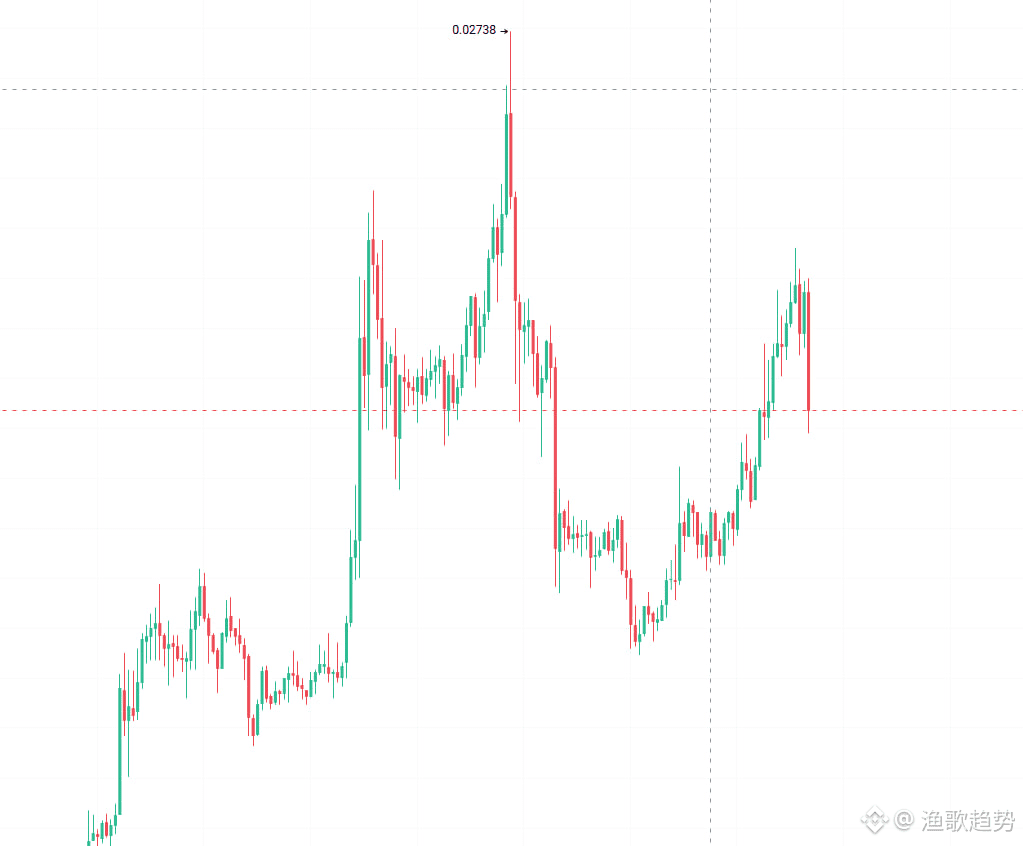
Is #collect ’s next move bullish or bearish? Can it rise back to 0.027? He bought at the top and got stuck!! Here’s the verdict first: no problem—it should take no more than 48 hours.
Based on the current candlestick pattern, the short-term trend looks choppy but relatively strong, with price rising while shaking out holders, taking one step forward and one step back.
Earlier, it hit a historical spike high of 0.02738, then quickly pulled back and formed a prolonged sideways consolidation in the mid-price range.
Recently, the market has rebounded again and is gradually approaching the upper edge of the previous consolidation range. Short-term bullish momentum is still building.
Overall, the candlesticks show a large price range, typical of highly volatile small-cap coins, where both rises and falls can happen very quickly.
Support: A large amount of trading activity accumulated in the lower consolidation range, creating solid support. As long as price does not decisively break below this range, the rebound is unlikely to end easily.
Resistance: 0.02738 was a spike high driven by extreme sentiment. Selling pressure will be heavy there, and a decisive breakout will require sufficient trading volume.
Uncertainty: Coins with this kind of high volatility are easily influenced by market sentiment. If interest in the current trend fades, the rebound could end quickly and the price could weaken again.
If it reaches around 0.027, the prudent move is to exit directly rather than gamble on a breakout at that level.
If it breaks through decisively, wait for a pullback to support before entering @Square-Creator-58b326784
Is #collect ’s next move bullish or bearish? Can it rise back to 0.027? He bought at the top and got stuck!! Here’s the verdict first: no problem—it should take no more than 48 hours.
Based on the current candlestick pattern, the short-term trend looks choppy but relatively strong, with price rising while shaking out holders, taking one step forward and one step back.
Earlier, it hit a historical spike high of 0.02738, then quickly pulled back and formed a prolonged sideways consolidation in the mid-price range.
Recently, the market has rebounded again and is gradually approaching the upper edge of the previous consolidation range. Short-term bullish momentum is still building.
Overall, the candlesticks show a large price range, typical of highly volatile small-cap coins, where both rises and falls can happen very quickly.
Support: A large amount of trading activity accumulated in the lower consolidation range, creating solid support. As long as price does not decisively break below this range, the rebound is unlikely to end easily.
Resistance: 0.02738 was a spike high driven by extreme sentiment. Selling pressure will be heavy there, and a decisive breakout will require sufficient trading volume.
Uncertainty: Coins with this kind of high volatility are easily influenced by market sentiment. If interest in the current trend fades, the rebound could end quickly and the price could weaken again.
If it reaches around 0.027, the prudent move is to exit directly rather than gamble on a breakout at that level.
If it breaks through decisively, wait for a pullback to support before entering @渔歌趋势
Based on the current candlestick pattern, the short-term trend looks choppy but relatively strong, with price rising while shaking out holders, taking one step forward and one step back.
Earlier, it hit a historical spike high of 0.02738, then quickly pulled back and formed a prolonged sideways consolidation in the mid-price range.
Recently, the market has rebounded again and is gradually approaching the upper edge of the previous consolidation range. Short-term bullish momentum is still building.
Overall, the candlesticks show a large price range, typical of highly volatile small-cap coins, where both rises and falls can happen very quickly.
Support: A large amount of trading activity accumulated in the lower consolidation range, creating solid support. As long as price does not decisively break below this range, the rebound is unlikely to end easily.
Resistance: 0.02738 was a spike high driven by extreme sentiment. Selling pressure will be heavy there, and a decisive breakout will require sufficient trading volume.
Uncertainty: Coins with this kind of high volatility are easily influenced by market sentiment. If interest in the current trend fades, the rebound could end quickly and the price could weaken again.
If it reaches around 0.027, the prudent move is to exit directly rather than gamble on a breakout at that level.
If it breaks through decisively, wait for a pullback to support before entering @渔歌趋势
145
·
--
700U small-capital rolling-to-200K practical playbook. A high-win-rate capital rotation path with small funds: #zec
Based on past cryptocurrency market boom-and-bust trends and wealth-creation cases, starting with 700U can absolutely roll up to 200K through compliant strategies. The core approach is a step-by-step ladder challenge with high-multiple futures contracts:
Each time, only use 100U to bet on hot, actively traded coins. Set a take-profit target of 100U to 200U (i.e., double). Strictly complete 3 consecutive “double-and-breakthrough” ladder challenges with stop-loss strictly enforced. After the principal jumps from 700U to 1100U, complete the first phase of accumulation, then switch to a combination of ultra-short trades + trend trades:
Ultra-short trades on the 15-minute timeframe only for major coins like BTC and ETH. Do at most 2–3 fast trades per day—quick strikes. When a larger-scale trend emerges, take a heavy position to catch the move and quickly achieve a layer-crossing jump.
⚠️ The risk-control baseline you must follow:
This strategy can yield extremely high returns, but the risk is also very high. You must never ignore the core rules:
You can only attempt the ladder challenge a maximum of 3 times—never do unlimited all-in. Avoid the scenario where you win 9 times and then one liquidation wipes you out due to excessive leverage. Leverage of only 75–100x should be used solely for small-position trial runs. Once the principal becomes larger, immediately reduce the leverage ratio. Write all take-profit and stop-loss levels in advance for every trade. Never allow a floating loss and then arbitrarily add to the position to average down—the underlying core logic of trading.
What’s hardest in crypto trading is never picking coins or timing buys and sells—it’s learning how to wait. Downtrends cleanse your impatience; uptrends test your discipline. The growth brought by trading must inevitably come with pain. This pain is precisely what comes from continuously fighting greed and impulsiveness within human nature, completing self-reinvention. Full-time trading and contract-based living: @Square-Creator-58b326784 #pumpbtc
700U small-capital rolling-to-200K practical playbook. A high-win-rate capital rotation path with small funds: #zec
Based on past cryptocurrency market boom-and-bust trends and wealth-creation cases, starting with 700U can absolutely roll up to 200K through compliant strategies. The core approach is a step-by-step ladder challenge with high-multiple futures contracts:
Each time, only use 100U to bet on hot, actively traded coins. Set a take-profit target of 100U to 200U (i.e., double). Strictly complete 3 consecutive “double-and-breakthrough” ladder challenges with stop-loss strictly enforced. After the principal jumps from 700U to 1100U, complete the first phase of accumulation, then switch to a combination of ultra-short trades + trend trades:
Ultra-short trades on the 15-minute timeframe only for major coins like BTC and ETH. Do at most 2–3 fast trades per day—quick strikes. When a larger-scale trend emerges, take a heavy position to catch the move and quickly achieve a layer-crossing jump.
⚠️ The risk-control baseline you must follow:
This strategy can yield extremely high returns, but the risk is also very high. You must never ignore the core rules:
You can only attempt the ladder challenge a maximum of 3 times—never do unlimited all-in. Avoid the scenario where you win 9 times and then one liquidation wipes you out due to excessive leverage. Leverage of only 75–100x should be used solely for small-position trial runs. Once the principal becomes larger, immediately reduce the leverage ratio. Write all take-profit and stop-loss levels in advance for every trade. Never allow a floating loss and then arbitrarily add to the position to average down—the underlying core logic of trading.
What’s hardest in crypto trading is never picking coins or timing buys and sells—it’s learning how to wait. Downtrends cleanse your impatience; uptrends test your discipline. The growth brought by trading must inevitably come with pain. This pain is precisely what comes from continuously fighting greed and impulsiveness within human nature, completing self-reinvention. Full-time trading and contract-based living: @渔歌趋势 #pumpbtc
Based on past cryptocurrency market boom-and-bust trends and wealth-creation cases, starting with 700U can absolutely roll up to 200K through compliant strategies. The core approach is a step-by-step ladder challenge with high-multiple futures contracts:
Each time, only use 100U to bet on hot, actively traded coins. Set a take-profit target of 100U to 200U (i.e., double). Strictly complete 3 consecutive “double-and-breakthrough” ladder challenges with stop-loss strictly enforced. After the principal jumps from 700U to 1100U, complete the first phase of accumulation, then switch to a combination of ultra-short trades + trend trades:
Ultra-short trades on the 15-minute timeframe only for major coins like BTC and ETH. Do at most 2–3 fast trades per day—quick strikes. When a larger-scale trend emerges, take a heavy position to catch the move and quickly achieve a layer-crossing jump.
⚠️ The risk-control baseline you must follow:
This strategy can yield extremely high returns, but the risk is also very high. You must never ignore the core rules:
You can only attempt the ladder challenge a maximum of 3 times—never do unlimited all-in. Avoid the scenario where you win 9 times and then one liquidation wipes you out due to excessive leverage. Leverage of only 75–100x should be used solely for small-position trial runs. Once the principal becomes larger, immediately reduce the leverage ratio. Write all take-profit and stop-loss levels in advance for every trade. Never allow a floating loss and then arbitrarily add to the position to average down—the underlying core logic of trading.
What’s hardest in crypto trading is never picking coins or timing buys and sells—it’s learning how to wait. Downtrends cleanse your impatience; uptrends test your discipline. The growth brought by trading must inevitably come with pain. This pain is precisely what comes from continuously fighting greed and impulsiveness within human nature, completing self-reinvention. Full-time trading and contract-based living: @渔歌趋势 #pumpbtc

435
·
--
Hold on, brothers. The roc rises with the wind in one day and soars ninety thousand miles. Along the way I lost money, got rich, lost money again, and got back up again. I’ve stepped into countless traps, and I’ve also developed my indestructible “Little Strong” personality. I’ve been trading crypto for 12 years, and from losing 8 million at the peak to living freely with no pressure, I’ve summed up 5 “unspoken rules of the crypto world” #ETH
First, let me introduce myself:
I’m an “old bagholder” who has been grinding in the crypto world for 12 years—no, now I should probably count as a free man who has “turned the tables and sung the song of the liberated peasant.”
Back then I entered with 8,000 yuan, got impulsive and went all-in on altcoins, and at the worst point I lost 8 million...
When I fell so low that I started doubting life, I even considered selling tea eggs. But the tea egg vendor told me: “You should keep trading crypto, don’t steal my job.”
Later, after surviving bull and bear markets and riding through countless crashes, I finally summed up a set of crypto rules that can keep you from getting slaughtered—and occasionally let you do the slaughtering.
1. The market is like romance—don’t go against it
When prices fall, someone always shouts, “Buy the dip, buy the dip!”... Don’t listen; that’s called baiting buyers.
When prices rise, a pullback happens and people start yelling, “It’s over, it’s going to crash!”... Actually, that’s the golden pit.
The market has its rhythm; go with it, don’t sing the opposite tune.
2. Get hyped when you see a price surge? You’re probably just asking to be cleanly and beautifully cut down
Don’t touch a coin that has surged 3x in the short term.
If it stalls at high levels, it will most likely plunge afterward; if you rush in, you’re just helping others break even.
3. MACD is an old friend—entries and exits all depend on it
No need to understand candlesticks in detail; learning MACD is enough:
Entry: DIF and DEA form a golden cross below the zero axis, then break above the zero axis—like a dog suddenly charging out of a mud pit, it might turn into a dark horse.
Reduce position: MACD forms a death cross above the zero axis and starts moving down—run!
MACD looks like a science experiment, but it’s actually a lifesaving candlestick tool.
4. Averaging down is for emotional traders; adding to winners is for professionals
Averaging down on a losing position: you’re emotional. The market falls and you fall even more; it never ends.
Adding to a winning position: this is trend-following thinking. Moving forward with the winners is the only way not to get lost.
The crypto world is not a paradise for office workers; it’s a battlefield for high-IQ players. @Square-Creator-58b326784 #pumpbtc
Hold on, brothers. The roc rises with the wind in one day and soars ninety thousand miles. Along the way I lost money, got rich, lost money again, and got back up again. I’ve stepped into countless traps, and I’ve also developed my indestructible “Little Strong” personality. I’ve been trading crypto for 12 years, and from losing 8 million at the peak to living freely with no pressure, I’ve summed up 5 “unspoken rules of the crypto world” #ETH
First, let me introduce myself:
I’m an “old bagholder” who has been grinding in the crypto world for 12 years—no, now I should probably count as a free man who has “turned the tables and sung the song of the liberated peasant.”
Back then I entered with 8,000 yuan, got impulsive and went all-in on altcoins, and at the worst point I lost 8 million...
When I fell so low that I started doubting life, I even considered selling tea eggs. But the tea egg vendor told me: “You should keep trading crypto, don’t steal my job.”
Later, after surviving bull and bear markets and riding through countless crashes, I finally summed up a set of crypto rules that can keep you from getting slaughtered—and occasionally let you do the slaughtering.
1. The market is like romance—don’t go against it
When prices fall, someone always shouts, “Buy the dip, buy the dip!”... Don’t listen; that’s called baiting buyers.
When prices rise, a pullback happens and people start yelling, “It’s over, it’s going to crash!”... Actually, that’s the golden pit.
The market has its rhythm; go with it, don’t sing the opposite tune.
2. Get hyped when you see a price surge? You’re probably just asking to be cleanly and beautifully cut down
Don’t touch a coin that has surged 3x in the short term.
If it stalls at high levels, it will most likely plunge afterward; if you rush in, you’re just helping others break even.
3. MACD is an old friend—entries and exits all depend on it
No need to understand candlesticks in detail; learning MACD is enough:
Entry: DIF and DEA form a golden cross below the zero axis, then break above the zero axis—like a dog suddenly charging out of a mud pit, it might turn into a dark horse.
Reduce position: MACD forms a death cross above the zero axis and starts moving down—run!
MACD looks like a science experiment, but it’s actually a lifesaving candlestick tool.
4. Averaging down is for emotional traders; adding to winners is for professionals
Averaging down on a losing position: you’re emotional. The market falls and you fall even more; it never ends.
Adding to a winning position: this is trend-following thinking. Moving forward with the winners is the only way not to get lost.
The crypto world is not a paradise for office workers; it’s a battlefield for high-IQ players. @渔歌趋势 #pumpbtc
First, let me introduce myself:
I’m an “old bagholder” who has been grinding in the crypto world for 12 years—no, now I should probably count as a free man who has “turned the tables and sung the song of the liberated peasant.”
Back then I entered with 8,000 yuan, got impulsive and went all-in on altcoins, and at the worst point I lost 8 million...
When I fell so low that I started doubting life, I even considered selling tea eggs. But the tea egg vendor told me: “You should keep trading crypto, don’t steal my job.”
Later, after surviving bull and bear markets and riding through countless crashes, I finally summed up a set of crypto rules that can keep you from getting slaughtered—and occasionally let you do the slaughtering.
1. The market is like romance—don’t go against it
When prices fall, someone always shouts, “Buy the dip, buy the dip!”... Don’t listen; that’s called baiting buyers.
When prices rise, a pullback happens and people start yelling, “It’s over, it’s going to crash!”... Actually, that’s the golden pit.
The market has its rhythm; go with it, don’t sing the opposite tune.
2. Get hyped when you see a price surge? You’re probably just asking to be cleanly and beautifully cut down
Don’t touch a coin that has surged 3x in the short term.
If it stalls at high levels, it will most likely plunge afterward; if you rush in, you’re just helping others break even.
3. MACD is an old friend—entries and exits all depend on it
No need to understand candlesticks in detail; learning MACD is enough:
Entry: DIF and DEA form a golden cross below the zero axis, then break above the zero axis—like a dog suddenly charging out of a mud pit, it might turn into a dark horse.
Reduce position: MACD forms a death cross above the zero axis and starts moving down—run!
MACD looks like a science experiment, but it’s actually a lifesaving candlestick tool.
4. Averaging down is for emotional traders; adding to winners is for professionals
Averaging down on a losing position: you’re emotional. The market falls and you fall even more; it never ends.
Adding to a winning position: this is trend-following thinking. Moving forward with the winners is the only way not to get lost.
The crypto world is not a paradise for office workers; it’s a battlefield for high-IQ players. @渔歌趋势 #pumpbtc

1
814
·
--
The landlord’s lights are on until three in the morning. The K-lines on the screen still flicker faintly, and the instant noodles on the table are already cold. After three days of grinding through a position last week, you finally took profit. The moment the account’s floating profit appeared, your first reaction wasn’t celebration—you picked up your phone and scoured your contacts, and in the end you quietly put it down #AINUSDT
No one can understand the way your heart races as floating profit falls from 20% to -5%. No one knows that to wait for a signal you could call certain, you’ve spent an entire week sleeping only four hours a night. When your family pushes the door open to tell you to go to bed, the words you almost say end up swallowed back. Even if you told them, they’d just think you’re going the wrong way.
What’s hidden inside the fireworks is the lack of understanding #zec
Last time you met up with friends for dinner, everyone talked about promotions at work and their kids’ admissions. When you casually mentioned your recent insights from trading, what you got in return was, “That’s not proper work—you’ll lose everything sooner or later.” You smiled and clinked glasses without arguing. No one knows that after you got liquidated last year, you hid on the balcony and smoked two full packs of cigarettes, and the next day you still sat down in front of the screen on time to review everything until dawn.
You long ago stopped arguing with people whether trading is “proper” work. Those nights you clenched your teeth and held on at the edge of liquidation—those processes that slowly sand down the greed and cowardice in human nature—have always only been something you can digest yourself.
Loneliness is the best medal #ETH
Later, you gradually got used to this state: you don’t need to explain your trading logic to anyone, and you don’t need to disrupt your own rhythm to meet other people’s expectations. You’ve seen the market’s cruelest side, and you’ve also relied on your own hands to piece back your shattered confidence bit by bit.
Those late nights you stayed up until the small hours—those grudges no one understood—eventually turned into the steady growth numbers in your account, and the calm, unshakable look you always have when the market moves #GTC
Loneliness has never been a shackle for trading. It’s the exclusive medal for walking a path that few take. Full-time trading coins. Contracts to support the family @Square-Creator-58b326784
The landlord’s lights are on until three in the morning. The K-lines on the screen still flicker faintly, and the instant noodles on the table are already cold. After three days of grinding through a position last week, you finally took profit. The moment the account’s floating profit appeared, your first reaction wasn’t celebration—you picked up your phone and scoured your contacts, and in the end you quietly put it down #AINUSDT
No one can understand the way your heart races as floating profit falls from 20% to -5%. No one knows that to wait for a signal you could call certain, you’ve spent an entire week sleeping only four hours a night. When your family pushes the door open to tell you to go to bed, the words you almost say end up swallowed back. Even if you told them, they’d just think you’re going the wrong way.
What’s hidden inside the fireworks is the lack of understanding #zec
Last time you met up with friends for dinner, everyone talked about promotions at work and their kids’ admissions. When you casually mentioned your recent insights from trading, what you got in return was, “That’s not proper work—you’ll lose everything sooner or later.” You smiled and clinked glasses without arguing. No one knows that after you got liquidated last year, you hid on the balcony and smoked two full packs of cigarettes, and the next day you still sat down in front of the screen on time to review everything until dawn.
You long ago stopped arguing with people whether trading is “proper” work. Those nights you clenched your teeth and held on at the edge of liquidation—those processes that slowly sand down the greed and cowardice in human nature—have always only been something you can digest yourself.
Loneliness is the best medal #ETH
Later, you gradually got used to this state: you don’t need to explain your trading logic to anyone, and you don’t need to disrupt your own rhythm to meet other people’s expectations. You’ve seen the market’s cruelest side, and you’ve also relied on your own hands to piece back your shattered confidence bit by bit.
Those late nights you stayed up until the small hours—those grudges no one understood—eventually turned into the steady growth numbers in your account, and the calm, unshakable look you always have when the market moves #GTC
Loneliness has never been a shackle for trading. It’s the exclusive medal for walking a path that few take. Full-time trading coins. Contracts to support the family @渔歌趋势
No one can understand the way your heart races as floating profit falls from 20% to -5%. No one knows that to wait for a signal you could call certain, you’ve spent an entire week sleeping only four hours a night. When your family pushes the door open to tell you to go to bed, the words you almost say end up swallowed back. Even if you told them, they’d just think you’re going the wrong way.
What’s hidden inside the fireworks is the lack of understanding #zec
Last time you met up with friends for dinner, everyone talked about promotions at work and their kids’ admissions. When you casually mentioned your recent insights from trading, what you got in return was, “That’s not proper work—you’ll lose everything sooner or later.” You smiled and clinked glasses without arguing. No one knows that after you got liquidated last year, you hid on the balcony and smoked two full packs of cigarettes, and the next day you still sat down in front of the screen on time to review everything until dawn.
You long ago stopped arguing with people whether trading is “proper” work. Those nights you clenched your teeth and held on at the edge of liquidation—those processes that slowly sand down the greed and cowardice in human nature—have always only been something you can digest yourself.
Loneliness is the best medal #ETH
Later, you gradually got used to this state: you don’t need to explain your trading logic to anyone, and you don’t need to disrupt your own rhythm to meet other people’s expectations. You’ve seen the market’s cruelest side, and you’ve also relied on your own hands to piece back your shattered confidence bit by bit.
Those late nights you stayed up until the small hours—those grudges no one understood—eventually turned into the steady growth numbers in your account, and the calm, unshakable look you always have when the market moves #GTC
Loneliness has never been a shackle for trading. It’s the exclusive medal for walking a path that few take. Full-time trading coins. Contracts to support the family @渔歌趋势

2
3
2.1k
·
--
Loneliness is the fate of a full-time trader; it is the refining of one’s mindset.
If you’re really planning to treat trading as a profession, this is worth spending a few minutes to read carefully.
Veterans who have spent years in the market understand this feeling well: you often bounce back and forth between the paradise of being profitable and the hell of liquidation. The pain of failure can only be silently digested by yourself. Even when you achieve large gains, there’s no one to share the joy with—you can at most raise your cup to invite the bright moon, and drink in its shadow alone, as if the world were split into three people.
It’s not that they’re unwilling to open up; it’s that all the returns are earned through your own replaying of the trade in countless late nights and surviving endless drawdowns—outsiders simply can’t empathize with the weight of it.
Not understanding from the outside is the norm.
Most family members find it hard to support the choice of becoming a full-time trader. From the very beginning, this path is destined to be full of thorns:
After slogging for three or five years and finally producing results, your family will likely just think you got lucky. They won’t see the pressure you endured while powering through over a hundred sleepless nights and surviving the brink of liquidation again and again.
If, unfortunately, the trading fails, your family may directly label you as “not doing your duty,” completely negating all the effort you’ve made in the past.
Trading is a remolding and trial of human nature.
At its core, trading is a constant battle with your own human nature. Over the course of a few years, you’ll experience swings far beyond what ordinary people go through in decades of life. It is a self-transformation that reshapes you from the inside out.
After years of grinding, your perspective on problems will reach straight to the essence. Your way of handling things will also be far more steady than that of most people. This insight—seeing through the underlying logic of things—will naturally make you gradually drift farther from those around you.
Just like an old soldier who crawls out of the trenches: you have seen firsthand how brutal the battlefield is. Those who haven’t lived through it can never truly feel the kind of life-and-death immediacy.
Since you’ve chosen to make a living from trading, you should make up your mind in advance to embrace loneliness. And I also wish you can move steadily and go far in the market@Square-Creator-58b326784 #zec
Keep watching today: Lobster, ZEC, ETH, BTC, AIN, SPORTFUN, ONE, SOL, SNDK
Loneliness is the fate of a full-time trader; it is the refining of one’s mindset.
If you’re really planning to treat trading as a profession, this is worth spending a few minutes to read carefully.
Veterans who have spent years in the market understand this feeling well: you often bounce back and forth between the paradise of being profitable and the hell of liquidation. The pain of failure can only be silently digested by yourself. Even when you achieve large gains, there’s no one to share the joy with—you can at most raise your cup to invite the bright moon, and drink in its shadow alone, as if the world were split into three people.
It’s not that they’re unwilling to open up; it’s that all the returns are earned through your own replaying of the trade in countless late nights and surviving endless drawdowns—outsiders simply can’t empathize with the weight of it.
Not understanding from the outside is the norm.
Most family members find it hard to support the choice of becoming a full-time trader. From the very beginning, this path is destined to be full of thorns:
After slogging for three or five years and finally producing results, your family will likely just think you got lucky. They won’t see the pressure you endured while powering through over a hundred sleepless nights and surviving the brink of liquidation again and again.
If, unfortunately, the trading fails, your family may directly label you as “not doing your duty,” completely negating all the effort you’ve made in the past.
Trading is a remolding and trial of human nature.
At its core, trading is a constant battle with your own human nature. Over the course of a few years, you’ll experience swings far beyond what ordinary people go through in decades of life. It is a self-transformation that reshapes you from the inside out.
After years of grinding, your perspective on problems will reach straight to the essence. Your way of handling things will also be far more steady than that of most people. This insight—seeing through the underlying logic of things—will naturally make you gradually drift farther from those around you.
Just like an old soldier who crawls out of the trenches: you have seen firsthand how brutal the battlefield is. Those who haven’t lived through it can never truly feel the kind of life-and-death immediacy.
Since you’ve chosen to make a living from trading, you should make up your mind in advance to embrace loneliness. And I also wish you can move steadily and go far in the market@渔歌趋势 #zec
Keep watching today: Lobster, ZEC, ETH, BTC, AIN, SPORTFUN, ONE, SOL, SNDK
If you’re really planning to treat trading as a profession, this is worth spending a few minutes to read carefully.
Veterans who have spent years in the market understand this feeling well: you often bounce back and forth between the paradise of being profitable and the hell of liquidation. The pain of failure can only be silently digested by yourself. Even when you achieve large gains, there’s no one to share the joy with—you can at most raise your cup to invite the bright moon, and drink in its shadow alone, as if the world were split into three people.
It’s not that they’re unwilling to open up; it’s that all the returns are earned through your own replaying of the trade in countless late nights and surviving endless drawdowns—outsiders simply can’t empathize with the weight of it.
Not understanding from the outside is the norm.
Most family members find it hard to support the choice of becoming a full-time trader. From the very beginning, this path is destined to be full of thorns:
After slogging for three or five years and finally producing results, your family will likely just think you got lucky. They won’t see the pressure you endured while powering through over a hundred sleepless nights and surviving the brink of liquidation again and again.
If, unfortunately, the trading fails, your family may directly label you as “not doing your duty,” completely negating all the effort you’ve made in the past.
Trading is a remolding and trial of human nature.
At its core, trading is a constant battle with your own human nature. Over the course of a few years, you’ll experience swings far beyond what ordinary people go through in decades of life. It is a self-transformation that reshapes you from the inside out.
After years of grinding, your perspective on problems will reach straight to the essence. Your way of handling things will also be far more steady than that of most people. This insight—seeing through the underlying logic of things—will naturally make you gradually drift farther from those around you.
Just like an old soldier who crawls out of the trenches: you have seen firsthand how brutal the battlefield is. Those who haven’t lived through it can never truly feel the kind of life-and-death immediacy.
Since you’ve chosen to make a living from trading, you should make up your mind in advance to embrace loneliness. And I also wish you can move steadily and go far in the market@渔歌趋势 #zec
Keep watching today: Lobster, ZEC, ETH, BTC, AIN, SPORTFUN, ONE, SOL, SNDK

406
·
--
I’m a post-1990s old-school hardcore crypto trader, 12 years in the coin market. I once watched A8 crash to rock bottom, and now my net worth is in the millions again!! Here’s the position management method I came up with—whoever uses it eats meat!
My university mentor built his own trading system from his 8 years of experience. Who uses it eats meat.
First, convert these 3,000 RMB into 400U. We’ll do it in two stages:
First step: Small-capital snowball (400U to 1100U). The玩法 is to take out 100U each time to trade. Pick the most popular varieties recently. Remember two things:
① If you double your money, take profit and leave (for example, 100 becomes 200—immediately put it in the bag as safe profit)
② If you lose 50U, cut your losses in time. If your luck is good and you hit three wins in a row, you can roll up to 800U (100→200~400~800). But if it’s good, take it! You can only play three rounds. Once you reach around 1100U, stop. This stage is heavily influenced by luck—don’t get greedy!
Second step: Once you reach (starting at 1100U, you split into multiple positions)
At this point, split into three tranches:
1. Quick-in quick-out type (100U) — trade 15-minute up/down moves, focusing on steadier coins like Bitcoin/Ethereum. For example, in the afternoon you see BTC suddenly spike up: immediately follow the move, make 3%-5%, then exit. It’s like street hawking—small profit, fast turnover.
2. Buddhist-style DCA type (15U per week). Every week you fixed-buy 15U of BTC spot (for example, now at 105k). Even if it drops, don’t panic—wait a year or two, and you’ll definitely eat meat. Suitable for people who don’t have time to watch the charts.
3. The main event: trend trading (all-in with the remaining amount). Only go in hard when you spot a big move! For example, if you find that the Federal Reserve is going to cut rates, BTC could surge massively—open a long position directly. But you must think ahead: how much profit to run for (for example, double), and how much loss you’re willing to accept (usually a 20% stop loss). This method requires knowing how to read the news and understanding technical analysis—don’t go in blindly as a beginner!
When you reach your target, take profit and lock it in. Don’t think “one more wave”!
Remember: everyone who flips their life around with this method is a tough one—tough on others, and even tougher on themselves! @Square-Creator-58b326784
Full-time crypto trading, contracts to bankroll the household #AIN
I’m a post-1990s old-school hardcore crypto trader, 12 years in the coin market. I once watched A8 crash to rock bottom, and now my net worth is in the millions again!! Here’s the position management method I came up with—whoever uses it eats meat!
My university mentor built his own trading system from his 8 years of experience. Who uses it eats meat.
First, convert these 3,000 RMB into 400U. We’ll do it in two stages:
First step: Small-capital snowball (400U to 1100U). The玩法 is to take out 100U each time to trade. Pick the most popular varieties recently. Remember two things:
① If you double your money, take profit and leave (for example, 100 becomes 200—immediately put it in the bag as safe profit)
② If you lose 50U, cut your losses in time. If your luck is good and you hit three wins in a row, you can roll up to 800U (100→200~400~800). But if it’s good, take it! You can only play three rounds. Once you reach around 1100U, stop. This stage is heavily influenced by luck—don’t get greedy!
Second step: Once you reach (starting at 1100U, you split into multiple positions)
At this point, split into three tranches:
1. Quick-in quick-out type (100U) — trade 15-minute up/down moves, focusing on steadier coins like Bitcoin/Ethereum. For example, in the afternoon you see BTC suddenly spike up: immediately follow the move, make 3%-5%, then exit. It’s like street hawking—small profit, fast turnover.
2. Buddhist-style DCA type (15U per week). Every week you fixed-buy 15U of BTC spot (for example, now at 105k). Even if it drops, don’t panic—wait a year or two, and you’ll definitely eat meat. Suitable for people who don’t have time to watch the charts.
3. The main event: trend trading (all-in with the remaining amount). Only go in hard when you spot a big move! For example, if you find that the Federal Reserve is going to cut rates, BTC could surge massively—open a long position directly. But you must think ahead: how much profit to run for (for example, double), and how much loss you’re willing to accept (usually a 20% stop loss). This method requires knowing how to read the news and understanding technical analysis—don’t go in blindly as a beginner!
When you reach your target, take profit and lock it in. Don’t think “one more wave”!
Remember: everyone who flips their life around with this method is a tough one—tough on others, and even tougher on themselves! @渔歌趋势
Full-time crypto trading, contracts to bankroll the household #AIN
My university mentor built his own trading system from his 8 years of experience. Who uses it eats meat.
First, convert these 3,000 RMB into 400U. We’ll do it in two stages:
First step: Small-capital snowball (400U to 1100U). The玩法 is to take out 100U each time to trade. Pick the most popular varieties recently. Remember two things:
① If you double your money, take profit and leave (for example, 100 becomes 200—immediately put it in the bag as safe profit)
② If you lose 50U, cut your losses in time. If your luck is good and you hit three wins in a row, you can roll up to 800U (100→200~400~800). But if it’s good, take it! You can only play three rounds. Once you reach around 1100U, stop. This stage is heavily influenced by luck—don’t get greedy!
Second step: Once you reach (starting at 1100U, you split into multiple positions)
At this point, split into three tranches:
1. Quick-in quick-out type (100U) — trade 15-minute up/down moves, focusing on steadier coins like Bitcoin/Ethereum. For example, in the afternoon you see BTC suddenly spike up: immediately follow the move, make 3%-5%, then exit. It’s like street hawking—small profit, fast turnover.
2. Buddhist-style DCA type (15U per week). Every week you fixed-buy 15U of BTC spot (for example, now at 105k). Even if it drops, don’t panic—wait a year or two, and you’ll definitely eat meat. Suitable for people who don’t have time to watch the charts.
3. The main event: trend trading (all-in with the remaining amount). Only go in hard when you spot a big move! For example, if you find that the Federal Reserve is going to cut rates, BTC could surge massively—open a long position directly. But you must think ahead: how much profit to run for (for example, double), and how much loss you’re willing to accept (usually a 20% stop loss). This method requires knowing how to read the news and understanding technical analysis—don’t go in blindly as a beginner!
When you reach your target, take profit and lock it in. Don’t think “one more wave”!
Remember: everyone who flips their life around with this method is a tough one—tough on others, and even tougher on themselves! @渔歌趋势
Full-time crypto trading, contracts to bankroll the household #AIN

98
·
--
Bullish
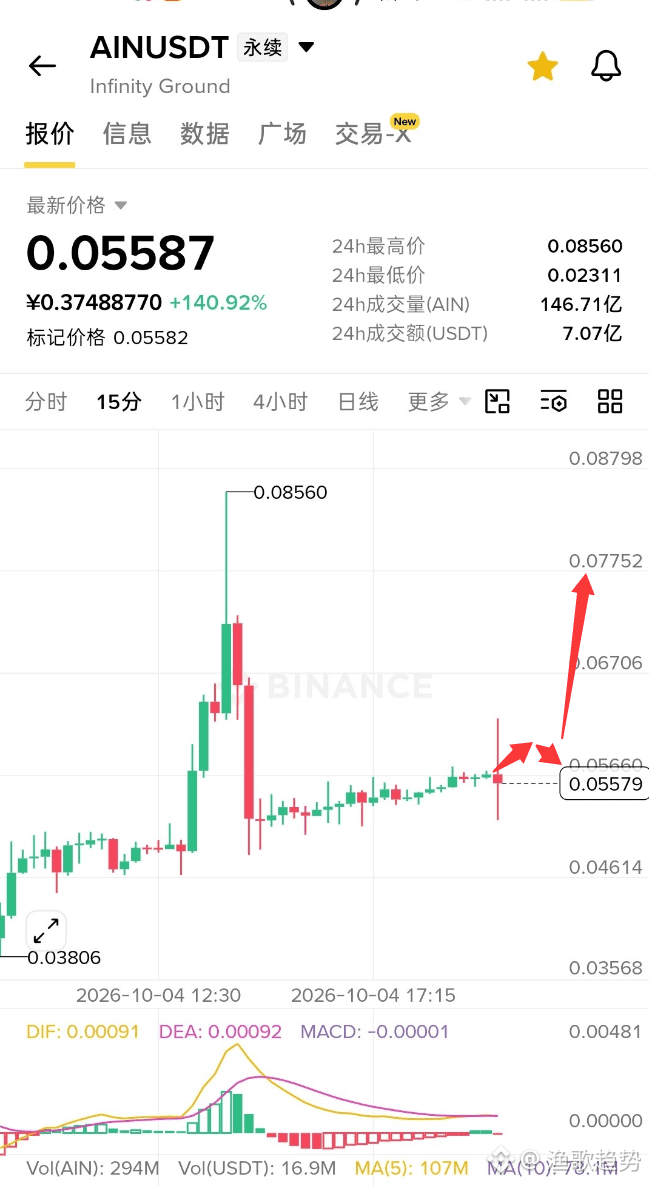
Come on, pull it up—foot on Bitcoin, fists on Ethereum.
Don’t drop it—brother, 0.03 liquidated, losing 500k.
Can we pump it up to 0.08 again? Boss
Come on, pull it up—foot on Bitcoin, fists on Ethereum.
Don’t drop it—brother, 0.03 liquidated, losing 500k.
Can we pump it up to 0.08 again? Boss
Don’t drop it—brother, 0.03 liquidated, losing 500k.
Can we pump it up to 0.08 again? Boss
2
898
·
--
Contract Trading: Extremely Practical Trade-Making Tips (Pure Insider Knowledge)
- Range-Bound Market: When price is moving sideways at a low level and making new lows, it’s time for heavy positioning to buy the dip; when price is moving sideways at a high level and surging again, decisively sell—don’t hesitate.
- Volatility: Sell when it spikes up; enter quickly when it drops suddenly. If it’s ranging, wait and observe to reduce trading. A sideways move means “sideways instead of falling”—hold your positions tightly; a new rally might be right around the corner. During a rapid surge, be alert for a sudden crash—be ready to lock in profits at any moment.
- Timing Tips for Buying/Selling: Buy when the market falls in the morning; sell when it rises in the morning. Don’t chase after it spikes in the afternoon. If it falls in the afternoon, buy the next day. Don’t panic-sell after a morning drop—if it doesn’t move up or down, rest. If you’re stuck in a position, average in to recover to break-even; excessive greed is not acceptable.
Besides these rhymes, I’ve also compiled several ultra-practical trade-making methods:
Range-Trading Method: Most market conditions are in a consolidation range. Use buying low/selling high between the box boundaries as the foundation for stable profits. With the help of the BOLL indicator and the box theory, combine technical indicators and chart patterns to pinpoint resistance and support. Follow the short-term trading rules—never be greedy.
Breakout After a Turning Point Method: After long periods of consolidation, the market will choose a direction. After the turning/breaking point, entering quickly can yield fast profits. But you must have accurate judgment of the turning point, keep a steady mindset, and stay neither greedy nor fearful.
Single-Direction Trend Method: Once the market breaks out of the range, it tends to form a single-direction trend. Trading with the trend is the key to making profits. Enter on pullbacks or rebounds, referring to K-line candlesticks, moving averages, BOLL, trendlines, and other indicators.
Resistance/Support Trading Method: When the market hits key resistance or support levels, it often gets rejected or gains support. In that moment, entering the trade is a commonly used strategy. Use trendlines, moving averages, the Bollinger bands, the parabolic indicator, etc., to accurately judge resistance/support levels.
Pullback/Rebound Trading Method: After a big rise or fall, there will be a temporary pullback or rebound. Seize the opportunity and you can profit easily. The main basis is K-line patterns, and good market feel helps you accurately catch the highs and lows.
Time-Window Trading Method: Morning and afternoon sessions have smaller fluctuations—suitable for conservative investors. Although the time to profit is longer, the advantage is that the market is easier to judge. Late-night and pre-dawn sessions have larger fluctuations—suitable for aggressive investors. You can profit quickly, but the difficulty is higher, requiring strict technical skills and judgment. If you’ve understood all this and still can’t make money, then “Yu Ge” is waiting for you at @Square-Creator-58b326784 #zec
Contract Trading: Extremely Practical Trade-Making Tips (Pure Insider Knowledge)
- Range-Bound Market: When price is moving sideways at a low level and making new lows, it’s time for heavy positioning to buy the dip; when price is moving sideways at a high level and surging again, decisively sell—don’t hesitate.
- Volatility: Sell when it spikes up; enter quickly when it drops suddenly. If it’s ranging, wait and observe to reduce trading. A sideways move means “sideways instead of falling”—hold your positions tightly; a new rally might be right around the corner. During a rapid surge, be alert for a sudden crash—be ready to lock in profits at any moment.
- Timing Tips for Buying/Selling: Buy when the market falls in the morning; sell when it rises in the morning. Don’t chase after it spikes in the afternoon. If it falls in the afternoon, buy the next day. Don’t panic-sell after a morning drop—if it doesn’t move up or down, rest. If you’re stuck in a position, average in to recover to break-even; excessive greed is not acceptable.
Besides these rhymes, I’ve also compiled several ultra-practical trade-making methods:
Range-Trading Method: Most market conditions are in a consolidation range. Use buying low/selling high between the box boundaries as the foundation for stable profits. With the help of the BOLL indicator and the box theory, combine technical indicators and chart patterns to pinpoint resistance and support. Follow the short-term trading rules—never be greedy.
Breakout After a Turning Point Method: After long periods of consolidation, the market will choose a direction. After the turning/breaking point, entering quickly can yield fast profits. But you must have accurate judgment of the turning point, keep a steady mindset, and stay neither greedy nor fearful.
Single-Direction Trend Method: Once the market breaks out of the range, it tends to form a single-direction trend. Trading with the trend is the key to making profits. Enter on pullbacks or rebounds, referring to K-line candlesticks, moving averages, BOLL, trendlines, and other indicators.
Resistance/Support Trading Method: When the market hits key resistance or support levels, it often gets rejected or gains support. In that moment, entering the trade is a commonly used strategy. Use trendlines, moving averages, the Bollinger bands, the parabolic indicator, etc., to accurately judge resistance/support levels.
Pullback/Rebound Trading Method: After a big rise or fall, there will be a temporary pullback or rebound. Seize the opportunity and you can profit easily. The main basis is K-line patterns, and good market feel helps you accurately catch the highs and lows.
Time-Window Trading Method: Morning and afternoon sessions have smaller fluctuations—suitable for conservative investors. Although the time to profit is longer, the advantage is that the market is easier to judge. Late-night and pre-dawn sessions have larger fluctuations—suitable for aggressive investors. You can profit quickly, but the difficulty is higher, requiring strict technical skills and judgment. If you’ve understood all this and still can’t make money, then “Yu Ge” is waiting for you at @渔歌趋势 #zec
- Range-Bound Market: When price is moving sideways at a low level and making new lows, it’s time for heavy positioning to buy the dip; when price is moving sideways at a high level and surging again, decisively sell—don’t hesitate.
- Volatility: Sell when it spikes up; enter quickly when it drops suddenly. If it’s ranging, wait and observe to reduce trading. A sideways move means “sideways instead of falling”—hold your positions tightly; a new rally might be right around the corner. During a rapid surge, be alert for a sudden crash—be ready to lock in profits at any moment.
- Timing Tips for Buying/Selling: Buy when the market falls in the morning; sell when it rises in the morning. Don’t chase after it spikes in the afternoon. If it falls in the afternoon, buy the next day. Don’t panic-sell after a morning drop—if it doesn’t move up or down, rest. If you’re stuck in a position, average in to recover to break-even; excessive greed is not acceptable.
Besides these rhymes, I’ve also compiled several ultra-practical trade-making methods:
Range-Trading Method: Most market conditions are in a consolidation range. Use buying low/selling high between the box boundaries as the foundation for stable profits. With the help of the BOLL indicator and the box theory, combine technical indicators and chart patterns to pinpoint resistance and support. Follow the short-term trading rules—never be greedy.
Breakout After a Turning Point Method: After long periods of consolidation, the market will choose a direction. After the turning/breaking point, entering quickly can yield fast profits. But you must have accurate judgment of the turning point, keep a steady mindset, and stay neither greedy nor fearful.
Single-Direction Trend Method: Once the market breaks out of the range, it tends to form a single-direction trend. Trading with the trend is the key to making profits. Enter on pullbacks or rebounds, referring to K-line candlesticks, moving averages, BOLL, trendlines, and other indicators.
Resistance/Support Trading Method: When the market hits key resistance or support levels, it often gets rejected or gains support. In that moment, entering the trade is a commonly used strategy. Use trendlines, moving averages, the Bollinger bands, the parabolic indicator, etc., to accurately judge resistance/support levels.
Pullback/Rebound Trading Method: After a big rise or fall, there will be a temporary pullback or rebound. Seize the opportunity and you can profit easily. The main basis is K-line patterns, and good market feel helps you accurately catch the highs and lows.
Time-Window Trading Method: Morning and afternoon sessions have smaller fluctuations—suitable for conservative investors. Although the time to profit is longer, the advantage is that the market is easier to judge. Late-night and pre-dawn sessions have larger fluctuations—suitable for aggressive investors. You can profit quickly, but the difficulty is higher, requiring strict technical skills and judgment. If you’ve understood all this and still can’t make money, then “Yu Ge” is waiting for you at @渔歌趋势 #zec

1
415
·
--
Many people always think they can “distribute” (sell) in a bull market and “bottom-fish” in a bear market.
In reality, whether it’s a bull market or a bear market is only confirmed after the fact. During the process, you can’t know it. It’s like trading futures/contracts. Many people say, “If only I had known about the crash—I should have opened a short at 2300, held it, and taken a 600-point drop.” Then when the price rises, they say, “Actually, you shouldn’t enter at that level—you should wait for it to go lower and get more.”
First of all, the market has to move in order for you to know what’s happening. You can review and analyze afterward, but obsessing and regretting won’t do anything except create inner friction. Second, even if you know it’s going to fall, you still don’t know which day it will fall. You might be shaken out after holding for just a day or two.
Because you don’t know the situation, there are no conditions for making such judgments—so the so-called idea of “distributing in a bull market” and “bottom-fishing in a bear market” is simply not something you can actually do.
Many people say, “How could anyone not know? 100k is the bull market, 70k is the bear market.” Then I ask you: what about 150k? 200k? And then when it drops to 50k or 60k—how do you explain that?
Based on the actions of “distributing in a bull market” and “bottom-fishing in a bear market,” whoever truly succeeds does it only by luck.
In crypto, the only things you can truly control are two actions—buying and selling—and how much you buy or sell. Everything else is outside your control.
When you look back afterward, you may think, “At 100k, I should have sold perfectly.” But when should you bottom-fish? You don’t know. By the time it falls to 50k, and then to 200k, you’ll think, “50k to 80k is the time to buy.” But if it never falls that low, or never rises to that point—at this moment, you will never know.
So whatever people say about “distributing in a bull market” and “bottom-fishing in a bear market” is a wrong concept. If the concept is wrong, your understanding is wrong. If your understanding is wrong, your actions are wrong. If your actions are wrong, making money becomes very difficult. This market will only allow 20% of people to profit. Keep it up, U guys! @Square-Creator-58b326784 #ATH.
Many people always think they can “distribute” (sell) in a bull market and “bottom-fish” in a bear market.
In reality, whether it’s a bull market or a bear market is only confirmed after the fact. During the process, you can’t know it. It’s like trading futures/contracts. Many people say, “If only I had known about the crash—I should have opened a short at 2300, held it, and taken a 600-point drop.” Then when the price rises, they say, “Actually, you shouldn’t enter at that level—you should wait for it to go lower and get more.”
First of all, the market has to move in order for you to know what’s happening. You can review and analyze afterward, but obsessing and regretting won’t do anything except create inner friction. Second, even if you know it’s going to fall, you still don’t know which day it will fall. You might be shaken out after holding for just a day or two.
Because you don’t know the situation, there are no conditions for making such judgments—so the so-called idea of “distributing in a bull market” and “bottom-fishing in a bear market” is simply not something you can actually do.
Many people say, “How could anyone not know? 100k is the bull market, 70k is the bear market.” Then I ask you: what about 150k? 200k? And then when it drops to 50k or 60k—how do you explain that?
Based on the actions of “distributing in a bull market” and “bottom-fishing in a bear market,” whoever truly succeeds does it only by luck.
In crypto, the only things you can truly control are two actions—buying and selling—and how much you buy or sell. Everything else is outside your control.
When you look back afterward, you may think, “At 100k, I should have sold perfectly.” But when should you bottom-fish? You don’t know. By the time it falls to 50k, and then to 200k, you’ll think, “50k to 80k is the time to buy.” But if it never falls that low, or never rises to that point—at this moment, you will never know.
So whatever people say about “distributing in a bull market” and “bottom-fishing in a bear market” is a wrong concept. If the concept is wrong, your understanding is wrong. If your understanding is wrong, your actions are wrong. If your actions are wrong, making money becomes very difficult. This market will only allow 20% of people to profit. Keep it up, U guys! @渔歌趋势 #ATH.
In reality, whether it’s a bull market or a bear market is only confirmed after the fact. During the process, you can’t know it. It’s like trading futures/contracts. Many people say, “If only I had known about the crash—I should have opened a short at 2300, held it, and taken a 600-point drop.” Then when the price rises, they say, “Actually, you shouldn’t enter at that level—you should wait for it to go lower and get more.”
First of all, the market has to move in order for you to know what’s happening. You can review and analyze afterward, but obsessing and regretting won’t do anything except create inner friction. Second, even if you know it’s going to fall, you still don’t know which day it will fall. You might be shaken out after holding for just a day or two.
Because you don’t know the situation, there are no conditions for making such judgments—so the so-called idea of “distributing in a bull market” and “bottom-fishing in a bear market” is simply not something you can actually do.
Many people say, “How could anyone not know? 100k is the bull market, 70k is the bear market.” Then I ask you: what about 150k? 200k? And then when it drops to 50k or 60k—how do you explain that?
Based on the actions of “distributing in a bull market” and “bottom-fishing in a bear market,” whoever truly succeeds does it only by luck.
In crypto, the only things you can truly control are two actions—buying and selling—and how much you buy or sell. Everything else is outside your control.
When you look back afterward, you may think, “At 100k, I should have sold perfectly.” But when should you bottom-fish? You don’t know. By the time it falls to 50k, and then to 200k, you’ll think, “50k to 80k is the time to buy.” But if it never falls that low, or never rises to that point—at this moment, you will never know.
So whatever people say about “distributing in a bull market” and “bottom-fishing in a bear market” is a wrong concept. If the concept is wrong, your understanding is wrong. If your understanding is wrong, your actions are wrong. If your actions are wrong, making money becomes very difficult. This market will only allow 20% of people to profit. Keep it up, U guys! @渔歌趋势 #ATH.

1
774
·
--
Losing trades “averaging down” is a major trap for retail traders.
I don’t know who invented the term “averaging down,” but it has trapped countless retail investors in the crypto market. Many people keep losing, so they add more; they add more, so they get trapped more; and in the end they burn through all their principal, pushing themselves straight into the dead-end of liquidation. This is absolutely one of the most deadly bad habits in crypto trading.
🎯 Core Trading Iron Law:
Never blindly average down when you’re in a loss. Instead, add to your position only after confirming the upward trend in profit.
Averaging down during a downtrend is, in essence, adding more capital to reinforce a wrong decision. It only makes losses grow exponentially. What started as a small loss can end up as a bottomless pit you can’t recover from.
Correct operating logic:
When the trend is right and your account already shows an unrealized profit, adding to your position in line with the trend is like using the profits you’ve made from the market to take on a larger move. This way, you won’t be forced to lose your principal, and you can amplify your returns. Both safety and win rate are much higher.
Many people have already fallen into the pit of averaging down on their trading journey. If you’re feeling confused right now and can’t find a breakthrough direction, feel free to leave a comment. Traders who think alike gather together, remind each other, and avoid detours. @Square-Creator-58b326784 #AIN
Losing trades “averaging down” is a major trap for retail traders.
I don’t know who invented the term “averaging down,” but it has trapped countless retail investors in the crypto market. Many people keep losing, so they add more; they add more, so they get trapped more; and in the end they burn through all their principal, pushing themselves straight into the dead-end of liquidation. This is absolutely one of the most deadly bad habits in crypto trading.
🎯 Core Trading Iron Law:
Never blindly average down when you’re in a loss. Instead, add to your position only after confirming the upward trend in profit.
Averaging down during a downtrend is, in essence, adding more capital to reinforce a wrong decision. It only makes losses grow exponentially. What started as a small loss can end up as a bottomless pit you can’t recover from.
Correct operating logic:
When the trend is right and your account already shows an unrealized profit, adding to your position in line with the trend is like using the profits you’ve made from the market to take on a larger move. This way, you won’t be forced to lose your principal, and you can amplify your returns. Both safety and win rate are much higher.
Many people have already fallen into the pit of averaging down on their trading journey. If you’re feeling confused right now and can’t find a breakthrough direction, feel free to leave a comment. Traders who think alike gather together, remind each other, and avoid detours. @渔歌趋势 #AIN
I don’t know who invented the term “averaging down,” but it has trapped countless retail investors in the crypto market. Many people keep losing, so they add more; they add more, so they get trapped more; and in the end they burn through all their principal, pushing themselves straight into the dead-end of liquidation. This is absolutely one of the most deadly bad habits in crypto trading.
🎯 Core Trading Iron Law:
Never blindly average down when you’re in a loss. Instead, add to your position only after confirming the upward trend in profit.
Averaging down during a downtrend is, in essence, adding more capital to reinforce a wrong decision. It only makes losses grow exponentially. What started as a small loss can end up as a bottomless pit you can’t recover from.
Correct operating logic:
When the trend is right and your account already shows an unrealized profit, adding to your position in line with the trend is like using the profits you’ve made from the market to take on a larger move. This way, you won’t be forced to lose your principal, and you can amplify your returns. Both safety and win rate are much higher.
Many people have already fallen into the pit of averaging down on their trading journey. If you’re feeling confused right now and can’t find a breakthrough direction, feel free to leave a comment. Traders who think alike gather together, remind each other, and avoid detours. @渔歌趋势 #AIN

1
721
·
--
Brothers, why do so many people keep playing even after the contract gets liquidated?
Let me put it this way: you have a job that earns you 10,000 RMB a month.
But in the contract market, you put 10,000 RMB of principal into a 100x leverage contract.
As long as it moves up by 1%, you can earn 10,000.
In the crypto world, when it comes to trading contracts, besides the pros who use small positions with large capital like spot trading,
there are only gamblers with small amounts trying to get rich through leverage.
In the crypto market, under extreme conditions,
price can move 1–2% in a single second.
So if you’re lucky, in one second you can make what you’d earn in a month.
Don’t say it’s just small-scale Ponzi schemes.
Even a blue-chip like BTC, a flagship benchmark,
if you’re in a bad mood, a minute dropping 3.4 percentage points is no big deal either.
And what’s most addictive about contracts is compounding.
The hardest part to control is your mindset.
Follow the fisher’s song—there’s no “master who always earns.”
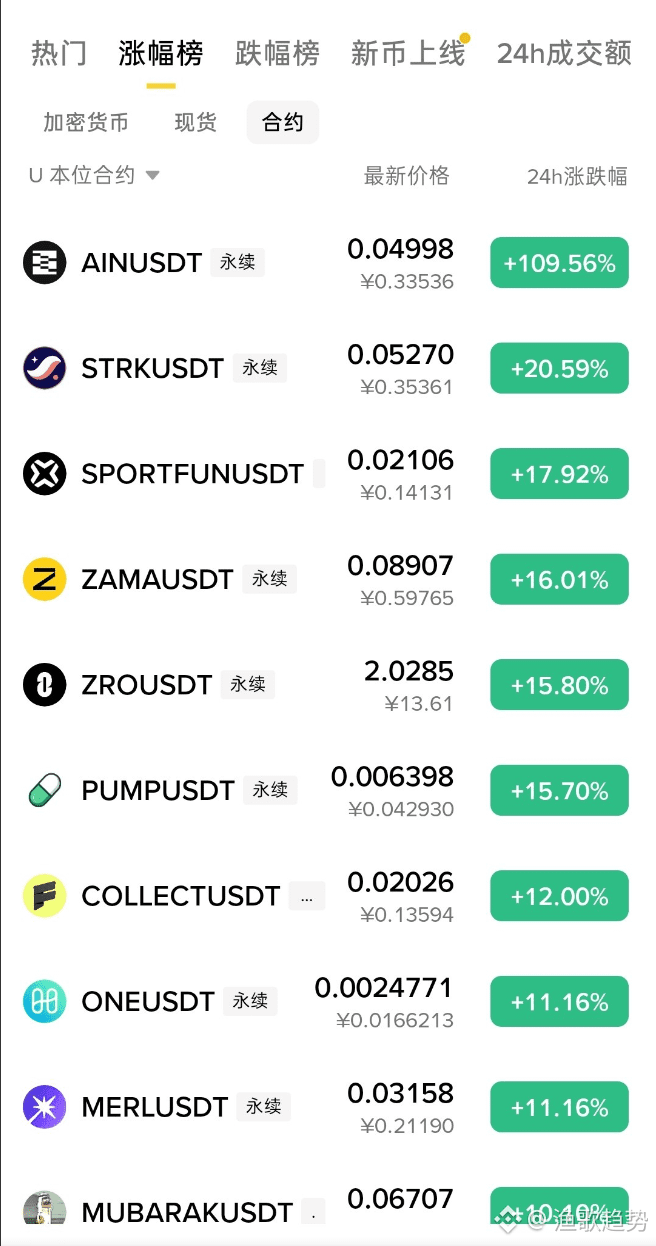
Only a journey of support for fellow traders, helping you cross bull and bear markets so you can dig up your first pot of gold in your lifetime in the crypto world.@Square-Creator-58b326784 #strk
Brothers, why do so many people keep playing even after the contract gets liquidated?
Let me put it this way: you have a job that earns you 10,000 RMB a month.
But in the contract market, you put 10,000 RMB of principal into a 100x leverage contract.
As long as it moves up by 1%, you can earn 10,000.
In the crypto world, when it comes to trading contracts, besides the pros who use small positions with large capital like spot trading,
there are only gamblers with small amounts trying to get rich through leverage.
In the crypto market, under extreme conditions,
price can move 1–2% in a single second.
So if you’re lucky, in one second you can make what you’d earn in a month.
Don’t say it’s just small-scale Ponzi schemes.
Even a blue-chip like BTC, a flagship benchmark,
if you’re in a bad mood, a minute dropping 3.4 percentage points is no big deal either.
And what’s most addictive about contracts is compounding.
The hardest part to control is your mindset.
Follow the fisher’s song—there’s no “master who always earns.”
Only a journey of support for fellow traders, helping you cross bull and bear markets so you can dig up your first pot of gold in your lifetime in the crypto world.@渔歌趋势 #strk
Let me put it this way: you have a job that earns you 10,000 RMB a month.
But in the contract market, you put 10,000 RMB of principal into a 100x leverage contract.
As long as it moves up by 1%, you can earn 10,000.
In the crypto world, when it comes to trading contracts, besides the pros who use small positions with large capital like spot trading,
there are only gamblers with small amounts trying to get rich through leverage.
In the crypto market, under extreme conditions,
price can move 1–2% in a single second.
So if you’re lucky, in one second you can make what you’d earn in a month.
Don’t say it’s just small-scale Ponzi schemes.
Even a blue-chip like BTC, a flagship benchmark,
if you’re in a bad mood, a minute dropping 3.4 percentage points is no big deal either.
And what’s most addictive about contracts is compounding.
The hardest part to control is your mindset.
Follow the fisher’s song—there’s no “master who always earns.”
Only a journey of support for fellow traders, helping you cross bull and bear markets so you can dig up your first pot of gold in your lifetime in the crypto world.@渔歌趋势 #strk
1
712
·
--
Brothers, are you also like me—when I first entered the coin circle, I was always convinced that making money depends on skills: studying candlestick chart indicators, chasing on-chain news, and hanging out in major communities to look for inside information. I thought if I could read the order book deeply enough, I could reliably catch every wave of the market. It wasn’t until I went through a few cycles of bull and bear markets that the lessons of liquidation losses and the regrets of giving back unrealized gains hit me that I realized: the hardest thing in the market is never discovering opportunities—it’s staying calm and holding onto your own composure amid waves of temptation everywhere.
The longer you stay in the coin circle, the more you understand these survival iron rules that get carved into your daily life:
First, capital always comes first. The market never lacks opportunities, but your capital only comes once. It’s okay to make money more slowly—what’s truly terrifying is one impulsive trade wiping out everything you’ve built over years. Your first goal in trading is never to get rich overnight; it’s to make sure you can stand firmly at the table first, and then wait for the next cycle of行情 that belongs to you.
Never fight the trend head-on. Many people lose terribly, not because they can’t read the charts, but because they’re too obsessed with “proving they’re right.” The trend has already turned down, yet they still stubbornly try to bottom-buy; the price action is still sprinting along the main uptrend, yet they keep thinking they can sell precisely at the highest point. Compared to arguing with the market, respecting the market’s direction is the prerequisite to keep living.
Accept small losses calmly, but never touch big losses. No one can be perfectly right every time. What truly widens the gap between traders is never the profit amount during wins—it’s how you handle mistakes. If you’re wrong on direction, cut losses decisively; if the trend is right, hold patiently. Don’t let a small oversight at the beginning turn into a huge pit you can’t ever make up.
Position size directly determines your survival timeline. Real experts who can get through bull and bear markets aren’t relying on one lucky spike from heavy leverage to get rich—they know exactly when to enter, when to exit, and when to stay in cash and wait patiently.
In the end, what you compete with is discipline. In a bull market, you can buy anything and it goes up—everyone calls themselves trading masters. The real test is always during the consolidation and downtrend phases: whether you can set aside emotions and execute strictly according to the plan you made. Restrain the greed that appears out of nowhere, steady yourself against sudden fear, and stick to your rules to the very end @Square-Creator-58b326784 #AIN
Brothers, are you also like me—when I first entered the coin circle, I was always convinced that making money depends on skills: studying candlestick chart indicators, chasing on-chain news, and hanging out in major communities to look for inside information. I thought if I could read the order book deeply enough, I could reliably catch every wave of the market. It wasn’t until I went through a few cycles of bull and bear markets that the lessons of liquidation losses and the regrets of giving back unrealized gains hit me that I realized: the hardest thing in the market is never discovering opportunities—it’s staying calm and holding onto your own composure amid waves of temptation everywhere.
The longer you stay in the coin circle, the more you understand these survival iron rules that get carved into your daily life:
First, capital always comes first. The market never lacks opportunities, but your capital only comes once. It’s okay to make money more slowly—what’s truly terrifying is one impulsive trade wiping out everything you’ve built over years. Your first goal in trading is never to get rich overnight; it’s to make sure you can stand firmly at the table first, and then wait for the next cycle of行情 that belongs to you.
Never fight the trend head-on. Many people lose terribly, not because they can’t read the charts, but because they’re too obsessed with “proving they’re right.” The trend has already turned down, yet they still stubbornly try to bottom-buy; the price action is still sprinting along the main uptrend, yet they keep thinking they can sell precisely at the highest point. Compared to arguing with the market, respecting the market’s direction is the prerequisite to keep living.
Accept small losses calmly, but never touch big losses. No one can be perfectly right every time. What truly widens the gap between traders is never the profit amount during wins—it’s how you handle mistakes. If you’re wrong on direction, cut losses decisively; if the trend is right, hold patiently. Don’t let a small oversight at the beginning turn into a huge pit you can’t ever make up.
Position size directly determines your survival timeline. Real experts who can get through bull and bear markets aren’t relying on one lucky spike from heavy leverage to get rich—they know exactly when to enter, when to exit, and when to stay in cash and wait patiently.
In the end, what you compete with is discipline. In a bull market, you can buy anything and it goes up—everyone calls themselves trading masters. The real test is always during the consolidation and downtrend phases: whether you can set aside emotions and execute strictly according to the plan you made. Restrain the greed that appears out of nowhere, steady yourself against sudden fear, and stick to your rules to the very end @渔歌趋势 #AIN
The longer you stay in the coin circle, the more you understand these survival iron rules that get carved into your daily life:
First, capital always comes first. The market never lacks opportunities, but your capital only comes once. It’s okay to make money more slowly—what’s truly terrifying is one impulsive trade wiping out everything you’ve built over years. Your first goal in trading is never to get rich overnight; it’s to make sure you can stand firmly at the table first, and then wait for the next cycle of行情 that belongs to you.
Never fight the trend head-on. Many people lose terribly, not because they can’t read the charts, but because they’re too obsessed with “proving they’re right.” The trend has already turned down, yet they still stubbornly try to bottom-buy; the price action is still sprinting along the main uptrend, yet they keep thinking they can sell precisely at the highest point. Compared to arguing with the market, respecting the market’s direction is the prerequisite to keep living.
Accept small losses calmly, but never touch big losses. No one can be perfectly right every time. What truly widens the gap between traders is never the profit amount during wins—it’s how you handle mistakes. If you’re wrong on direction, cut losses decisively; if the trend is right, hold patiently. Don’t let a small oversight at the beginning turn into a huge pit you can’t ever make up.
Position size directly determines your survival timeline. Real experts who can get through bull and bear markets aren’t relying on one lucky spike from heavy leverage to get rich—they know exactly when to enter, when to exit, and when to stay in cash and wait patiently.
In the end, what you compete with is discipline. In a bull market, you can buy anything and it goes up—everyone calls themselves trading masters. The real test is always during the consolidation and downtrend phases: whether you can set aside emotions and execute strictly according to the plan you made. Restrain the greed that appears out of nowhere, steady yourself against sudden fear, and stick to your rules to the very end @渔歌趋势 #AIN

603
·
--
$ETH Want to fight in the crypto market long-term, lose small and win big—definitely control your “loss aversion” mindset.
We’ll be officially back to work tomorrow.
$ETH Want to fight in the crypto market long-term, lose small and win big—definitely control your “loss aversion” mindset.
We’ll be officially back to work tomorrow.
We’ll be officially back to work tomorrow.

1
536
·
--
Garbage—walking down the road at night and even ran into a ghost!
Keep working again after October 4th
Even if you’re not happy, enjoy the holiday well—once a year
Garbage—walking down the road at night and even ran into a ghost!
Keep working again after October 4th
Even if you’re not happy, enjoy the holiday well—once a year
Keep working again after October 4th
Even if you’re not happy, enjoy the holiday well—once a year
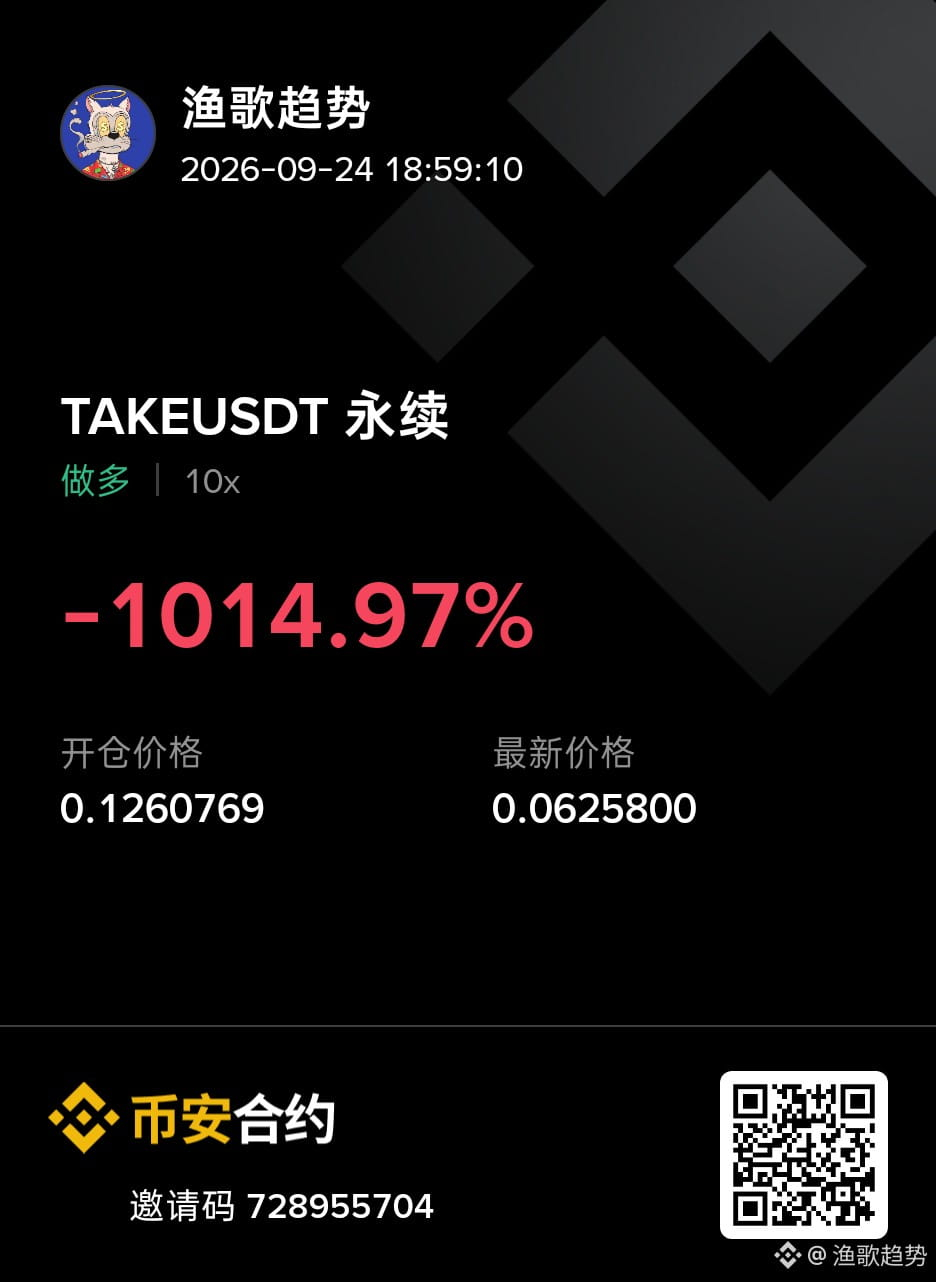
1
305
·
--
This kind of smashing style with $TAKE is too ruthless. The dog dealer ran out of money for the holidays and went for a one-time harvest, not even bothering to pretend!
This kind of smashing style with $TAKE is too ruthless. The dog dealer ran out of money for the holidays and went for a one-time harvest, not even bothering to pretend!
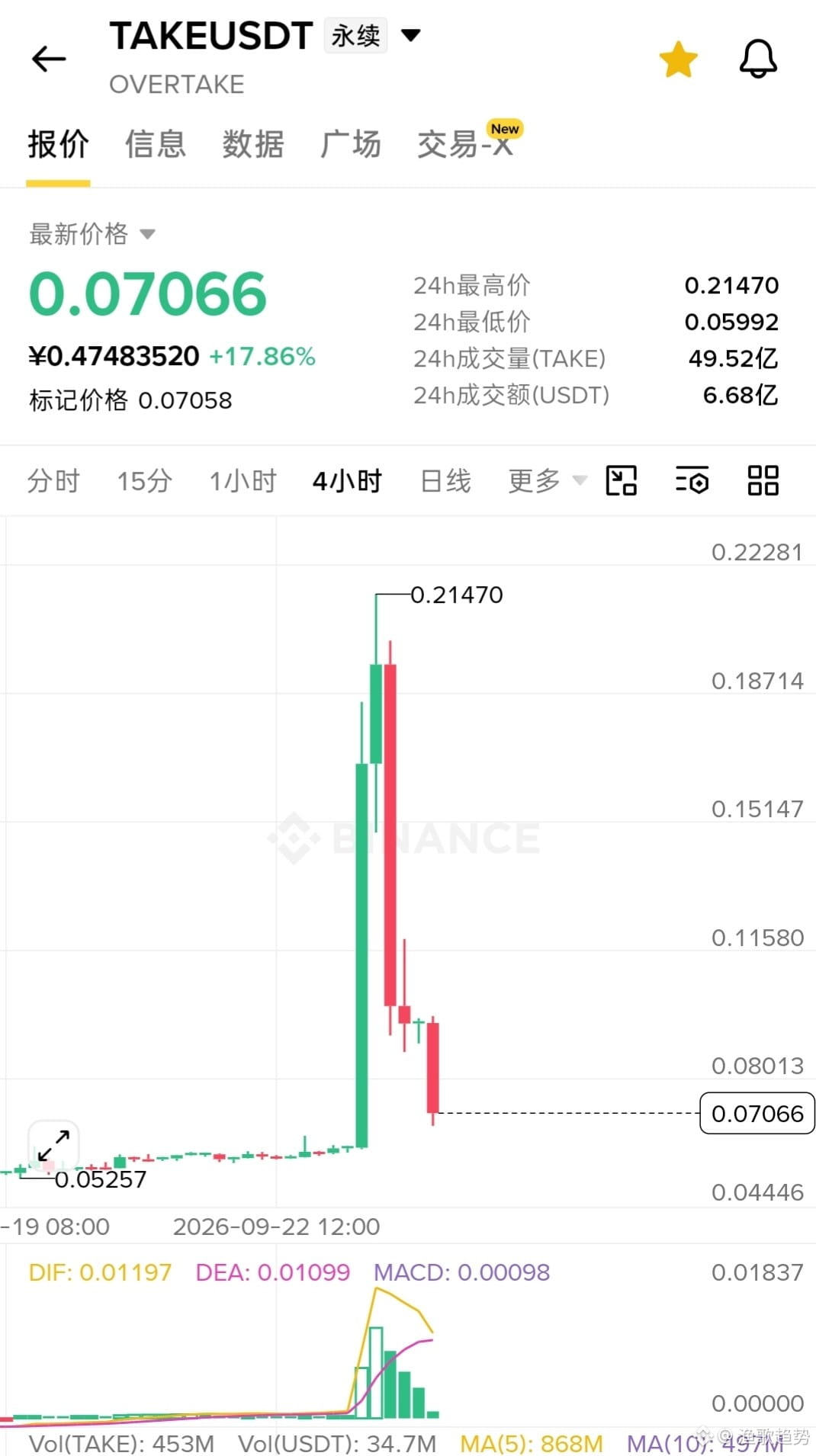
3
1.3k
·
--
500U from dumping to 100K—the strongest method. Rolling your position isn’t about “all-in gambling for a breakout,” but about rhythm, position control, and strong execution, step by step, steadily rolling out profits—locking liquidation risk in an extremely low range throughout.
6-step practical execution rules:
✅ Start position ≤ 50%: In the first trade, only allocate 200–300U to scout. The core goal is to achieve “no liquidation risk, maximum drawdown not exceeding 20%,” with survival prioritized.
✅ Only trade high-certainty setups: Participate only in instruments with clear support/resistance, a clean trend, and a risk-reward ratio ≥ 2:1. Trade one, stay alive—no pointless trades that waste capital.
✅ Pre-lock the stop-loss: Loss per trade must strictly be limited to 5%–7% of total account funds. For a 1000U account, single-trade stop-loss must never exceed 50–70U. Never adjust the stop-loss on the fly.
✅ Take-profit without greed: Capture 30–50 points on small swings. Eat 80–150 points on the bigger rhythm. For swing trades, the risk-reward ratio must be ≥ 3:1 to enter—don’t aim to sell at the absolute highest point.
✅ After 3000U, accelerate by adding: Once the account rolls to 3000U, increase per-trade position size to 800–1000U, compress single-trade risk to 3%–5% of account funds, with maximum drawdown controlled within 15%.
✅ Every doubling forces cash-out to lock profits: When rolling from 1000U to 3000U, proactively withdraw 500U profit first. Even if the account later experiences a drawdown, it will completely stabilize your trading mindset.
Rolling-position underlying logic:
In the small-money stage, prioritize survival. In the mid-money stage, steadily speed up. In the big-money stage, focus on protecting profits. As long as you can strictly follow this rhythm and execute it continuously for 30 days, your account equity curve will provide the most direct positive feedback—staying alive is the only prerequisite for turning over and making it.
Newbie traps to avoid:
Many people fail at rolling positions because, mid-way, they can’t resist breaking the rules and switching to a heavy “all-in” gamble. One extreme market move can wipe out all the rolling profits from dozens of earlier trades. Discipline is the key prerequisite for making this method work.
—Yu Ge, full-time crypto trader, contracts nurturing capital. @Square-Creator-58b326784 #TAKE
500U from dumping to 100K—the strongest method. Rolling your position isn’t about “all-in gambling for a breakout,” but about rhythm, position control, and strong execution, step by step, steadily rolling out profits—locking liquidation risk in an extremely low range throughout.
6-step practical execution rules:
✅ Start position ≤ 50%: In the first trade, only allocate 200–300U to scout. The core goal is to achieve “no liquidation risk, maximum drawdown not exceeding 20%,” with survival prioritized.
✅ Only trade high-certainty setups: Participate only in instruments with clear support/resistance, a clean trend, and a risk-reward ratio ≥ 2:1. Trade one, stay alive—no pointless trades that waste capital.
✅ Pre-lock the stop-loss: Loss per trade must strictly be limited to 5%–7% of total account funds. For a 1000U account, single-trade stop-loss must never exceed 50–70U. Never adjust the stop-loss on the fly.
✅ Take-profit without greed: Capture 30–50 points on small swings. Eat 80–150 points on the bigger rhythm. For swing trades, the risk-reward ratio must be ≥ 3:1 to enter—don’t aim to sell at the absolute highest point.
✅ After 3000U, accelerate by adding: Once the account rolls to 3000U, increase per-trade position size to 800–1000U, compress single-trade risk to 3%–5% of account funds, with maximum drawdown controlled within 15%.
✅ Every doubling forces cash-out to lock profits: When rolling from 1000U to 3000U, proactively withdraw 500U profit first. Even if the account later experiences a drawdown, it will completely stabilize your trading mindset.
Rolling-position underlying logic:
In the small-money stage, prioritize survival. In the mid-money stage, steadily speed up. In the big-money stage, focus on protecting profits. As long as you can strictly follow this rhythm and execute it continuously for 30 days, your account equity curve will provide the most direct positive feedback—staying alive is the only prerequisite for turning over and making it.
Newbie traps to avoid:
Many people fail at rolling positions because, mid-way, they can’t resist breaking the rules and switching to a heavy “all-in” gamble. One extreme market move can wipe out all the rolling profits from dozens of earlier trades. Discipline is the key prerequisite for making this method work.
—Yu Ge, full-time crypto trader, contracts nurturing capital. @渔歌趋势 #TAKE
6-step practical execution rules:
✅ Start position ≤ 50%: In the first trade, only allocate 200–300U to scout. The core goal is to achieve “no liquidation risk, maximum drawdown not exceeding 20%,” with survival prioritized.
✅ Only trade high-certainty setups: Participate only in instruments with clear support/resistance, a clean trend, and a risk-reward ratio ≥ 2:1. Trade one, stay alive—no pointless trades that waste capital.
✅ Pre-lock the stop-loss: Loss per trade must strictly be limited to 5%–7% of total account funds. For a 1000U account, single-trade stop-loss must never exceed 50–70U. Never adjust the stop-loss on the fly.
✅ Take-profit without greed: Capture 30–50 points on small swings. Eat 80–150 points on the bigger rhythm. For swing trades, the risk-reward ratio must be ≥ 3:1 to enter—don’t aim to sell at the absolute highest point.
✅ After 3000U, accelerate by adding: Once the account rolls to 3000U, increase per-trade position size to 800–1000U, compress single-trade risk to 3%–5% of account funds, with maximum drawdown controlled within 15%.
✅ Every doubling forces cash-out to lock profits: When rolling from 1000U to 3000U, proactively withdraw 500U profit first. Even if the account later experiences a drawdown, it will completely stabilize your trading mindset.
Rolling-position underlying logic:
In the small-money stage, prioritize survival. In the mid-money stage, steadily speed up. In the big-money stage, focus on protecting profits. As long as you can strictly follow this rhythm and execute it continuously for 30 days, your account equity curve will provide the most direct positive feedback—staying alive is the only prerequisite for turning over and making it.
Newbie traps to avoid:
Many people fail at rolling positions because, mid-way, they can’t resist breaking the rules and switching to a heavy “all-in” gamble. One extreme market move can wipe out all the rolling profits from dozens of earlier trades. Discipline is the key prerequisite for making this method work.
—Yu Ge, full-time crypto trader, contracts nurturing capital. @渔歌趋势 #TAKE

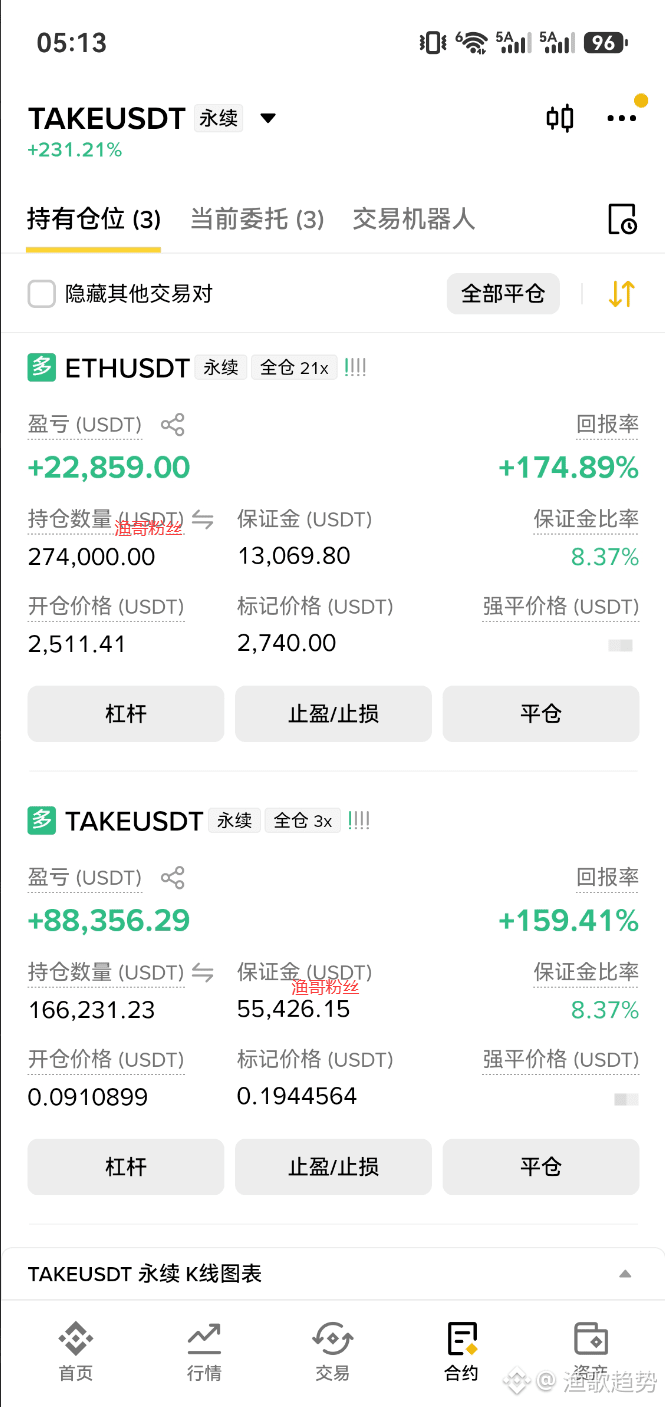
1
999
·
--
Brothers, do you feel the same? The more you watch the chart, the more exhausting it gets. The more you want to get your money back, the more you end up losing. Many people fall into this kind of trading predicament. I once guided a student named A-Qiang—a 35-year-old delivery worker—who lost 46,000 in just three days. He was so nervous his hands were shaking, and he couldn’t operate normally. He admitted that once the market drops he panics, and when it rises he’s eager to sell—this is exactly the typical behavior of a “greenhorn.”
I taught A-Qiang the “three-step game mindset method.” Unexpectedly, within half a year, he turned his 7,000 capital into more than 80,000.
Step one: refuse to go all-in. In the past, A-Qiang always thought, “One shot and I’ll get my money back.” As a result, he was frequently liquidated. I had him divide his principal into 6 parts, and each trade would use only 1 part—his position size would not exceed 17%. After that, when his first trade went wrong and he lost 900 yuan, he could stay calm. When he profited 700 yuan, he didn’t get overly excited. He gradually learned to control the trading rhythm.
Step two: keep a light position for observation. Previously, A-Qiang would often go all-in or stay completely out of the market. Even when a bull market started, he couldn’t catch it in time—by the time he reacted, the market had already risen by 28%. I suggested he keep a 25% position to observe the market. When BTC hourly charts show signals like a golden cross, he can use only an 8% position to try trading lightly. This way he can seize opportunities while avoiding the risks of heavy positions.
Step three: keep your position within a comfortable range. A simple way to judge whether your position size is reasonable: if a sudden piece of news wakes you up in the middle of the night, it means your position is too heavy. Now A-Qiang keeps his position size between 45% and 55%. When the market drops by 9%, it’s painful but he won’t act blindly. When it rises by 18%, he can stay rational and no longer be swayed by short-term fluctuations.
Some people misunderstand the “game mindset” as just lying flat—yet it’s not. It’s an efficient strategy that shifts your focus from “panic about getting your money back” to “staying focused on trading in the present.” When A-Qiang reviews his trades, he only summarizes successful experiences and stops dwelling on past losses. His trading strategy has become more and more precise. Last month, with “half-position trading + strict stop-loss,” he increased his 46,000 principal to 97,000.
The market and the trading instruments haven’t changed, but A-Qiang has transformed from a blindly losing “greenhorn” into a trader who profits steadily. Remember: don’t treat trading as your life. @Square-Creator-58b326784 #TAKE
Brothers, do you feel the same? The more you watch the chart, the more exhausting it gets. The more you want to get your money back, the more you end up losing. Many people fall into this kind of trading predicament. I once guided a student named A-Qiang—a 35-year-old delivery worker—who lost 46,000 in just three days. He was so nervous his hands were shaking, and he couldn’t operate normally. He admitted that once the market drops he panics, and when it rises he’s eager to sell—this is exactly the typical behavior of a “greenhorn.”
I taught A-Qiang the “three-step game mindset method.” Unexpectedly, within half a year, he turned his 7,000 capital into more than 80,000.
Step one: refuse to go all-in. In the past, A-Qiang always thought, “One shot and I’ll get my money back.” As a result, he was frequently liquidated. I had him divide his principal into 6 parts, and each trade would use only 1 part—his position size would not exceed 17%. After that, when his first trade went wrong and he lost 900 yuan, he could stay calm. When he profited 700 yuan, he didn’t get overly excited. He gradually learned to control the trading rhythm.
Step two: keep a light position for observation. Previously, A-Qiang would often go all-in or stay completely out of the market. Even when a bull market started, he couldn’t catch it in time—by the time he reacted, the market had already risen by 28%. I suggested he keep a 25% position to observe the market. When BTC hourly charts show signals like a golden cross, he can use only an 8% position to try trading lightly. This way he can seize opportunities while avoiding the risks of heavy positions.
Step three: keep your position within a comfortable range. A simple way to judge whether your position size is reasonable: if a sudden piece of news wakes you up in the middle of the night, it means your position is too heavy. Now A-Qiang keeps his position size between 45% and 55%. When the market drops by 9%, it’s painful but he won’t act blindly. When it rises by 18%, he can stay rational and no longer be swayed by short-term fluctuations.
Some people misunderstand the “game mindset” as just lying flat—yet it’s not. It’s an efficient strategy that shifts your focus from “panic about getting your money back” to “staying focused on trading in the present.” When A-Qiang reviews his trades, he only summarizes successful experiences and stops dwelling on past losses. His trading strategy has become more and more precise. Last month, with “half-position trading + strict stop-loss,” he increased his 46,000 principal to 97,000.
The market and the trading instruments haven’t changed, but A-Qiang has transformed from a blindly losing “greenhorn” into a trader who profits steadily. Remember: don’t treat trading as your life. @渔歌趋势 #TAKE
I taught A-Qiang the “three-step game mindset method.” Unexpectedly, within half a year, he turned his 7,000 capital into more than 80,000.
Step one: refuse to go all-in. In the past, A-Qiang always thought, “One shot and I’ll get my money back.” As a result, he was frequently liquidated. I had him divide his principal into 6 parts, and each trade would use only 1 part—his position size would not exceed 17%. After that, when his first trade went wrong and he lost 900 yuan, he could stay calm. When he profited 700 yuan, he didn’t get overly excited. He gradually learned to control the trading rhythm.
Step two: keep a light position for observation. Previously, A-Qiang would often go all-in or stay completely out of the market. Even when a bull market started, he couldn’t catch it in time—by the time he reacted, the market had already risen by 28%. I suggested he keep a 25% position to observe the market. When BTC hourly charts show signals like a golden cross, he can use only an 8% position to try trading lightly. This way he can seize opportunities while avoiding the risks of heavy positions.
Step three: keep your position within a comfortable range. A simple way to judge whether your position size is reasonable: if a sudden piece of news wakes you up in the middle of the night, it means your position is too heavy. Now A-Qiang keeps his position size between 45% and 55%. When the market drops by 9%, it’s painful but he won’t act blindly. When it rises by 18%, he can stay rational and no longer be swayed by short-term fluctuations.
Some people misunderstand the “game mindset” as just lying flat—yet it’s not. It’s an efficient strategy that shifts your focus from “panic about getting your money back” to “staying focused on trading in the present.” When A-Qiang reviews his trades, he only summarizes successful experiences and stops dwelling on past losses. His trading strategy has become more and more precise. Last month, with “half-position trading + strict stop-loss,” he increased his 46,000 principal to 97,000.
The market and the trading instruments haven’t changed, but A-Qiang has transformed from a blindly losing “greenhorn” into a trader who profits steadily. Remember: don’t treat trading as your life. @渔歌趋势 #TAKE

2
554
·
--
300U rolls to 280,000U — Five Contract Rules for Survival, ironclad discipline
In crypto, money comes fast and goes even faster. No mystical luck—just this extreme yet disciplined way of playing, and you can steadily live through high-multiplier contracts.
Split 300U into 10 portions. Each time, take only 30U and apply 100x leverage. If you get the direction right by even a single tick, you double. If you get it wrong, that capital is wiped out to zero. Throughout the entire process, you never endanger the core of your本金. You completely lock the risk of high leverage into a controllable range.
Five iron rules — execution guidelines:
✅ Cut when wrong—don’t stubbornly hold: When I first entered the market, I suffered losses from “waiting for a rebound” and got wrecked twice. The market never spares the lucky. When the stop-loss is hit, exit decisively. Admitting the loss is always stronger than pretending.
✅ Four straight wrong trades means you stop immediately: When the market is chaotic, grinding through it is just handing money to the market. Set a trading “circuit breaker.” If you get five consecutive wrong trades, shut down the computer and rest. The next day, the chart often becomes clear again.
✅ Withdraw forcibly after earning 3000U: Floating P&L numbers in your account are just illusions. If you don’t withdraw, they can vanish at any moment. After gaining 3000U, withdraw at least half. Only profits you withdraw truly belong to you.
✅ Trade trends only—don’t touch ranging markets: In a one-way trend, 100x leverage is a profit booster. In a choppy, range-bound market, it’s a meat grinder that harvests your capital. If there’s no clear direction, stay flat and wait. When the trend becomes clear, strike once and win.
✅ Position size never exceeds 10% of principal: Absolutely refuse full-cap “all-in roulette.” If you want to win, you must first ensure you can stay alive. Each time, risk only 30U. You’ll lose and still have room to win. With lighter positions, your mindset naturally stays steady, and your actions remain calm throughout.
Contracts are never a shortcut to overnight wealth—they’re a long, relentless battle. Don’t wait until you get liquidated and wiped out to regret it. Embed these five iron rules into your trading habits, and only then will you have the资格 to laugh last in the crypto market. @Square-Creator-58b326784 #zec
300U rolls to 280,000U — Five Contract Rules for Survival, ironclad discipline
In crypto, money comes fast and goes even faster. No mystical luck—just this extreme yet disciplined way of playing, and you can steadily live through high-multiplier contracts.
Split 300U into 10 portions. Each time, take only 30U and apply 100x leverage. If you get the direction right by even a single tick, you double. If you get it wrong, that capital is wiped out to zero. Throughout the entire process, you never endanger the core of your本金. You completely lock the risk of high leverage into a controllable range.
Five iron rules — execution guidelines:
✅ Cut when wrong—don’t stubbornly hold: When I first entered the market, I suffered losses from “waiting for a rebound” and got wrecked twice. The market never spares the lucky. When the stop-loss is hit, exit decisively. Admitting the loss is always stronger than pretending.
✅ Four straight wrong trades means you stop immediately: When the market is chaotic, grinding through it is just handing money to the market. Set a trading “circuit breaker.” If you get five consecutive wrong trades, shut down the computer and rest. The next day, the chart often becomes clear again.
✅ Withdraw forcibly after earning 3000U: Floating P&L numbers in your account are just illusions. If you don’t withdraw, they can vanish at any moment. After gaining 3000U, withdraw at least half. Only profits you withdraw truly belong to you.
✅ Trade trends only—don’t touch ranging markets: In a one-way trend, 100x leverage is a profit booster. In a choppy, range-bound market, it’s a meat grinder that harvests your capital. If there’s no clear direction, stay flat and wait. When the trend becomes clear, strike once and win.
✅ Position size never exceeds 10% of principal: Absolutely refuse full-cap “all-in roulette.” If you want to win, you must first ensure you can stay alive. Each time, risk only 30U. You’ll lose and still have room to win. With lighter positions, your mindset naturally stays steady, and your actions remain calm throughout.
Contracts are never a shortcut to overnight wealth—they’re a long, relentless battle. Don’t wait until you get liquidated and wiped out to regret it. Embed these five iron rules into your trading habits, and only then will you have the资格 to laugh last in the crypto market. @渔歌趋势 #zec
In crypto, money comes fast and goes even faster. No mystical luck—just this extreme yet disciplined way of playing, and you can steadily live through high-multiplier contracts.
Split 300U into 10 portions. Each time, take only 30U and apply 100x leverage. If you get the direction right by even a single tick, you double. If you get it wrong, that capital is wiped out to zero. Throughout the entire process, you never endanger the core of your本金. You completely lock the risk of high leverage into a controllable range.
Five iron rules — execution guidelines:
✅ Cut when wrong—don’t stubbornly hold: When I first entered the market, I suffered losses from “waiting for a rebound” and got wrecked twice. The market never spares the lucky. When the stop-loss is hit, exit decisively. Admitting the loss is always stronger than pretending.
✅ Four straight wrong trades means you stop immediately: When the market is chaotic, grinding through it is just handing money to the market. Set a trading “circuit breaker.” If you get five consecutive wrong trades, shut down the computer and rest. The next day, the chart often becomes clear again.
✅ Withdraw forcibly after earning 3000U: Floating P&L numbers in your account are just illusions. If you don’t withdraw, they can vanish at any moment. After gaining 3000U, withdraw at least half. Only profits you withdraw truly belong to you.
✅ Trade trends only—don’t touch ranging markets: In a one-way trend, 100x leverage is a profit booster. In a choppy, range-bound market, it’s a meat grinder that harvests your capital. If there’s no clear direction, stay flat and wait. When the trend becomes clear, strike once and win.
✅ Position size never exceeds 10% of principal: Absolutely refuse full-cap “all-in roulette.” If you want to win, you must first ensure you can stay alive. Each time, risk only 30U. You’ll lose and still have room to win. With lighter positions, your mindset naturally stays steady, and your actions remain calm throughout.
Contracts are never a shortcut to overnight wealth—they’re a long, relentless battle. Don’t wait until you get liquidated and wiped out to regret it. Embed these five iron rules into your trading habits, and only then will you have the资格 to laugh last in the crypto market. @渔歌趋势 #zec
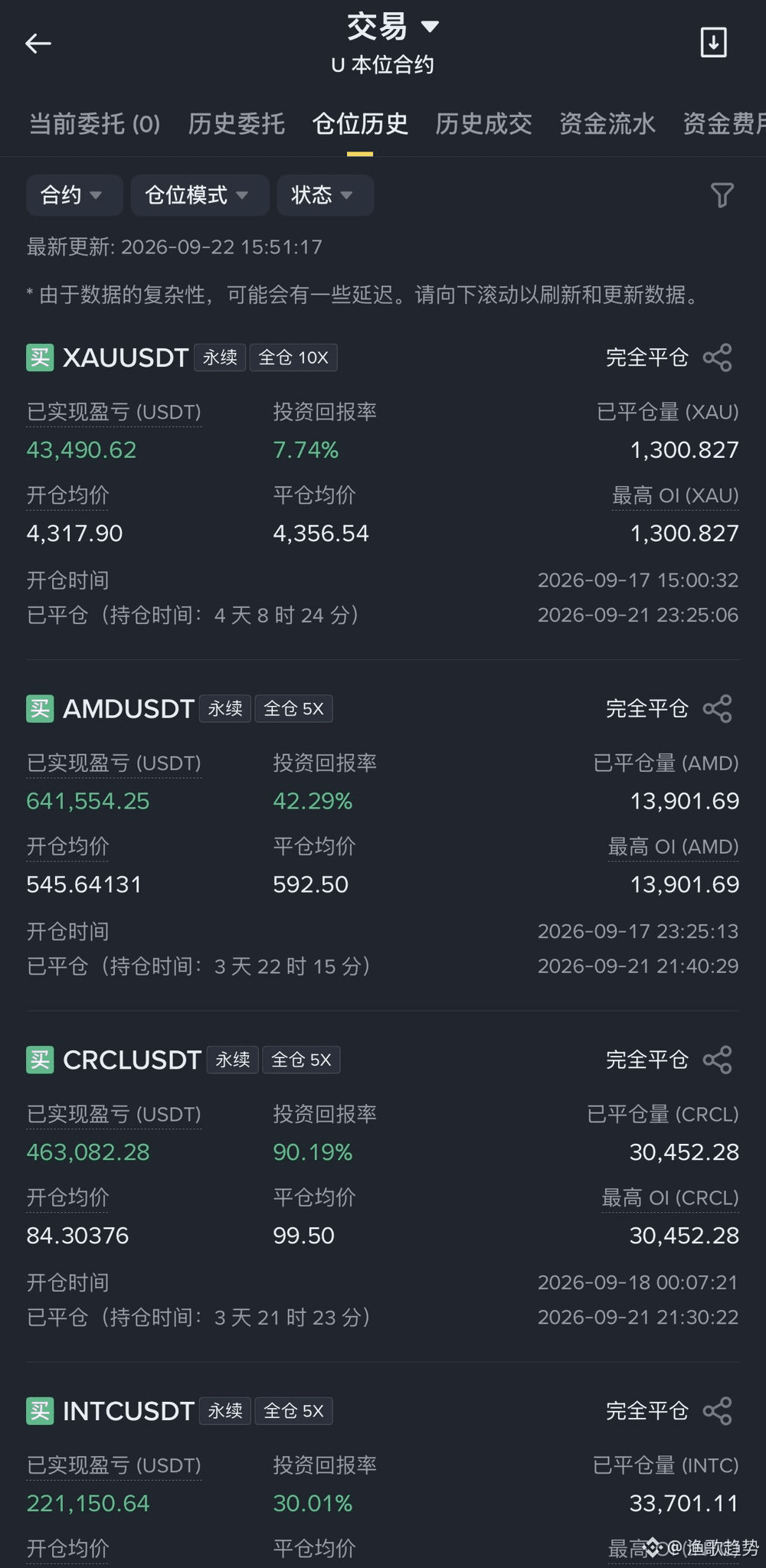
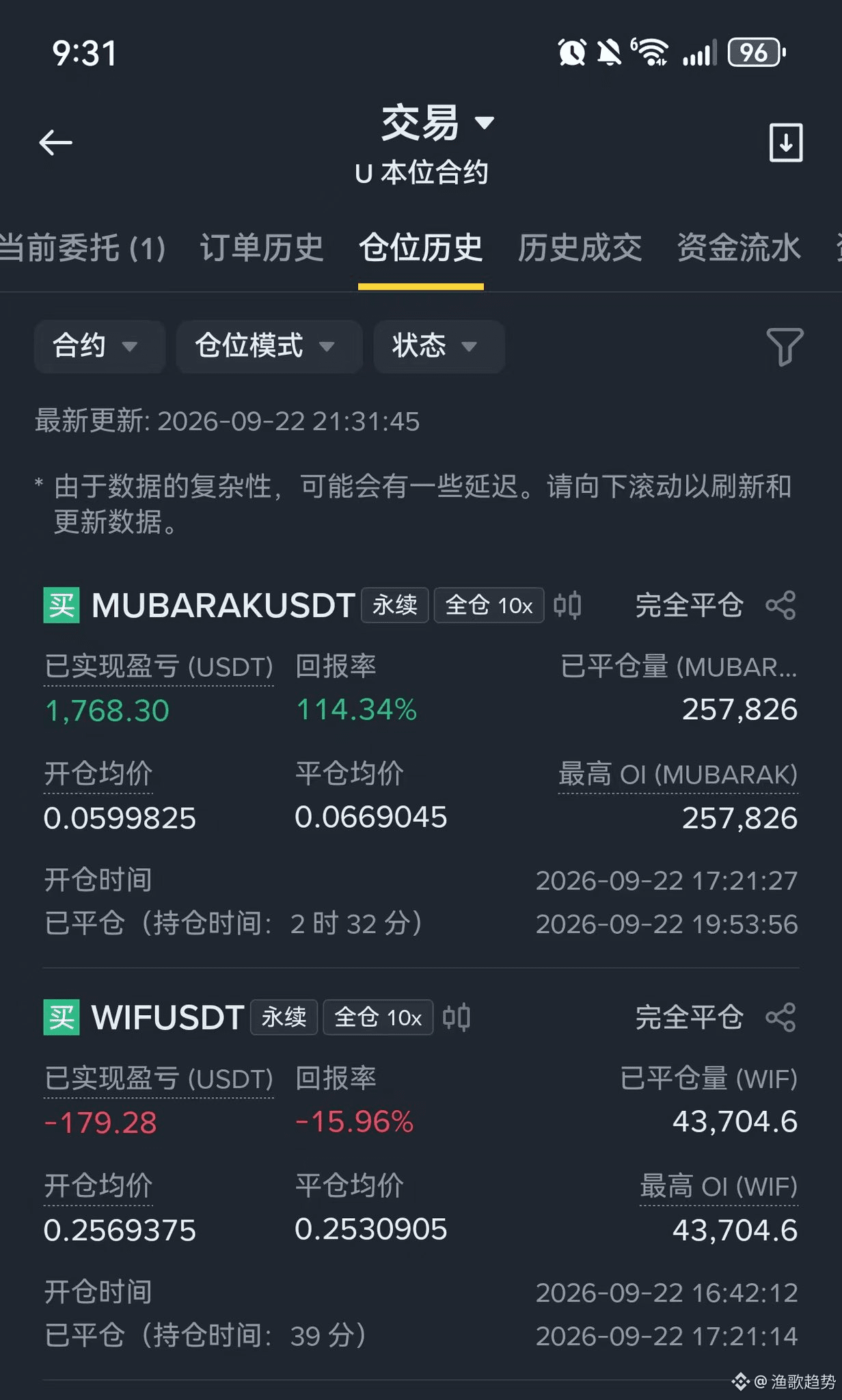
1
708
Log in to explore more content
Join global crypto users on Binance Square
⚡️ Get latest and useful information about crypto.
💬 Trusted by the world’s largest crypto exchange.
👍 Discover real insights from verified creators.
Email / Phone number
Trending Topics
Nikkei225Jumps2.5%ToThreeMonthHigh
17,403 views
372 Discussing
#Nikkei225Jumps2.5%ToThreeMonthHigh
🚀 Nikkei 225 Jumps 2.45% to Reach a 3-Month High!
Japan’s benchmark Nikkei 225 surged impressively on Monday, closing at 69,946.86 after briefly breaking above the milestone 70,000 level for the first time in three months.
💡 What’s Driving the Surge?
AI & Semiconductor Boom: Major tech leaders like Advantest and Tokyo Electron led the charge with robust gains.
Wall Street Momentum: Positive spillover from U.S. markets boosted overall investor confidence.
Macro Shifts: Cooler-than-expected U.S. jobs data eased fears, reducing expectations of an aggressive October Fed rate hike.
📊 Market Takeaway:
This powerful rally signals a strong resurgence of investor appetite for technology and AI-driven assets. However, traders should keep a close eye on elevated bond yields as an ongoing risk factor.
Do you think the Nikkei can successfully hold above 70,000 and power toward brand-new highs? Let us know your thoughts!
#JapanStocks #StockMarket" #AIStocks #Semiconductors #Investing #Nikkei225
$EWJ
Nurul Hasnat Samir
·0 Likes
·404 views
DriftHackVictimsBeginClaims
93,671 views
1,047 Discussing
SolanaTokenizedStockVolumeTops$4.4BInSeptember
8,834 views
98 Discussing