
Lavette Stamison
32 Posts

Lavette Stamison
Report
Block User
3 Following
27 Followers
54 Liked
Posts
·
--
Bullish
#termmax
Nobody opens the fee page, so I did it. @termmax publishes exact formulas and they're worth sixty seconds.
💰 Lending — fee rate = APR × 2% × (days to maturity ÷ 365). Lend 1,000 USDC at 10% APR for a full year → 0.2%, about 2 FT. Notice what that means: the fee scales with your yield and your term, not with size alone. Short maturity, tiny fee.
💰 Borrowing — [GT minting reference rate × 10% + matched borrow rate × 3%] × (days ÷ 365). Stablecoin reference sits at 6%, non-stables at 3%. Borrow 1,000 USDC at 5% for 90 days → 0.185%, roughly 1.85 FT.
💰 Leverage — same rate, applied only to the borrowed portion. Input 1,000 USDC at 4.8x, so you borrow 3,800 → about 7.31 FT to open the position. Under 0.2% for a near-5x in a single transaction.
I ran these before opening anything, because building a 4.8x loop by hand on a money market costs more in gas alone, never mind the rate drift between legs while you're clicking.
One caveat worth knowing: fees are denominated in FT, so what you actually pay depends on where FT is priced when you execute. Cheap on paper isn't always cheap at 3am. $TMX
Do you check protocol fees before entering, or find out afterwards?
#termmax
Nobody opens the fee page, so I did it. @TermMax publishes exact formulas and they're worth sixty seconds.
💰 Lending — fee rate = APR × 2% × (days to maturity ÷ 365). Lend 1,000 USDC at 10% APR for a full year → 0.2%, about 2 FT. Notice what that means: the fee scales with your yield and your term, not with size alone. Short maturity, tiny fee.
💰 Borrowing — [GT minting reference rate × 10% + matched borrow rate × 3%] × (days ÷ 365). Stablecoin reference sits at 6%, non-stables at 3%. Borrow 1,000 USDC at 5% for 90 days → 0.185%, roughly 1.85 FT.
💰 Leverage — same rate, applied only to the borrowed portion. Input 1,000 USDC at 4.8x, so you borrow 3,800 → about 7.31 FT to open the position. Under 0.2% for a near-5x in a single transaction.
I ran these before opening anything, because building a 4.8x loop by hand on a money market costs more in gas alone, never mind the rate drift between legs while you're clicking.
One caveat worth knowing: fees are denominated in FT, so what you actually pay depends on where FT is priced when you execute. Cheap on paper isn't always cheap at 3am. $TMX
Do you check protocol fees before entering, or find out afterwards?
Nobody opens the fee page, so I did it. @TermMax publishes exact formulas and they're worth sixty seconds.
💰 Lending — fee rate = APR × 2% × (days to maturity ÷ 365). Lend 1,000 USDC at 10% APR for a full year → 0.2%, about 2 FT. Notice what that means: the fee scales with your yield and your term, not with size alone. Short maturity, tiny fee.
💰 Borrowing — [GT minting reference rate × 10% + matched borrow rate × 3%] × (days ÷ 365). Stablecoin reference sits at 6%, non-stables at 3%. Borrow 1,000 USDC at 5% for 90 days → 0.185%, roughly 1.85 FT.
💰 Leverage — same rate, applied only to the borrowed portion. Input 1,000 USDC at 4.8x, so you borrow 3,800 → about 7.31 FT to open the position. Under 0.2% for a near-5x in a single transaction.
I ran these before opening anything, because building a 4.8x loop by hand on a money market costs more in gas alone, never mind the rate drift between legs while you're clicking.
One caveat worth knowing: fees are denominated in FT, so what you actually pay depends on where FT is priced when you execute. Cheap on paper isn't always cheap at 3am. $TMX
Do you check protocol fees before entering, or find out afterwards?
📖 Always read the fee page
100%
😬 Found out the hard way once
0%
⛽ Only care about gas
0%
🔍 Bookmarking this
0%
1 votes • Voting closed
1
81
#termmax Here's the @termmax detail I think is most underrated, and it has nothing to do with rates.
In most fixed-term protocols, capital that's been offered but not yet borrowed sits there earning zero. Dead weight. TermMax attacks that from three angles:
⚙️ Idle fund deployment — unborrowed capital is routed into floating-rate protocols like Aave, Morpho and Venus, so it earns while waiting for a taker.
⚙️ Atomic orders — before funds are borrowed, virtual liquidity can sit across several orders simultaneously instead of being locked into one. No fragmentation.
⚙️ Named curators — markets are run by actual liquidity managers: Keyrock, Hardcoded Lab, Edge Capital, AlphaPing, Origami Crypto. They set target APR ranges rather than accepting whatever a generic curve produces.
I pay attention to this because it's the gap between a protocol that looks good in a screenshot and one where capital efficiency was designed in from the start. The vaults are ERC-4626, with a guardian role and an asymmetric timelock: risk-reducing changes apply instantly, risk-increasing ones wait out the full period. Boring plumbing, and it's exactly what decides whether something survives a bad week.
Before depositing, read the vault: curators set their own performance fee, typically 10-20% of profits, and their own capacity limits. $TMX
Do you check who curates a vault, or just look at the headline APY?
#termmax Here's the @TermMax detail I think is most underrated, and it has nothing to do with rates.
In most fixed-term protocols, capital that's been offered but not yet borrowed sits there earning zero. Dead weight. TermMax attacks that from three angles:
⚙️ Idle fund deployment — unborrowed capital is routed into floating-rate protocols like Aave, Morpho and Venus, so it earns while waiting for a taker.
⚙️ Atomic orders — before funds are borrowed, virtual liquidity can sit across several orders simultaneously instead of being locked into one. No fragmentation.
⚙️ Named curators — markets are run by actual liquidity managers: Keyrock, Hardcoded Lab, Edge Capital, AlphaPing, Origami Crypto. They set target APR ranges rather than accepting whatever a generic curve produces.
I pay attention to this because it's the gap between a protocol that looks good in a screenshot and one where capital efficiency was designed in from the start. The vaults are ERC-4626, with a guardian role and an asymmetric timelock: risk-reducing changes apply instantly, risk-increasing ones wait out the full period. Boring plumbing, and it's exactly what decides whether something survives a bad week.
Before depositing, read the vault: curators set their own performance fee, typically 10-20% of profits, and their own capacity limits. $TMX
Do you check who curates a vault, or just look at the headline APY?
In most fixed-term protocols, capital that's been offered but not yet borrowed sits there earning zero. Dead weight. TermMax attacks that from three angles:
⚙️ Idle fund deployment — unborrowed capital is routed into floating-rate protocols like Aave, Morpho and Venus, so it earns while waiting for a taker.
⚙️ Atomic orders — before funds are borrowed, virtual liquidity can sit across several orders simultaneously instead of being locked into one. No fragmentation.
⚙️ Named curators — markets are run by actual liquidity managers: Keyrock, Hardcoded Lab, Edge Capital, AlphaPing, Origami Crypto. They set target APR ranges rather than accepting whatever a generic curve produces.
I pay attention to this because it's the gap between a protocol that looks good in a screenshot and one where capital efficiency was designed in from the start. The vaults are ERC-4626, with a guardian role and an asymmetric timelock: risk-reducing changes apply instantly, risk-increasing ones wait out the full period. Boring plumbing, and it's exactly what decides whether something survives a bad week.
Before depositing, read the vault: curators set their own performance fee, typically 10-20% of profits, and their own capacity limits. $TMX
Do you check who curates a vault, or just look at the headline APY?
🔍 I read the curator first
0%
📈 APY, then maybe
0%
⏱️ Timelock design is key
0%
🤷 Vault curators?
0%
0 votes • Voting closed
1
208
·
--
Bullish
I went looking for what the institutional filings actually say about the base asset behind $SPCXB. The feed read the headline: giant funds hold billions of it, so it must be solid. The filings say something else.
The mechanism. Quarterly US institutional disclosures are a photo of the last day of a quarter, published up to 45 days later. A sovereign fund reported 154,146,835 shares at 26.34 billion dollars. A separate filer reported 551.2 million shares at 94.2 billion. Divide both: 170.88 and 170.90. The same implied price, from two unrelated filers. That price is 30 June.
Then regional coverage valued that identical 154.1 million share position at 21.5 billion, using 139.50 per share. Same filing, same share count, 4.8 billion apart.
What you get. Two filers accidentally published the same mark, so you can now date almost any number you read.
What you pay. Three things.
1 You pay a live price against facts that are 49 days old. Your token reprices every second. A filing never reprices.
2 Nobody labels a mark as a mark. Both figures are true and sit 18 percent apart. A headline will not tell you which one you got.
3 The cheap bearish signal got expensive. Short interest as a percent fell partly because the pool it is measured against grew, not only because bears left. The borrow fee is a real price: 0.51 percent in late June, 2 to 3 percent now.
Honest limits. I did not measure anything on my own screen for this one. I read public disclosures as reported and did one division twice. The arithmetic is the whole finding, and you can redo it in ten seconds.
Before buying on a filing headline, find the date on the number.
@BinanceCIS could a bStock page show the timestamp of the reference price it quotes?
$SPCXB
#bstockscis
I went looking for what the institutional filings actually say about the base asset behind $SPCXB. The feed read the headline: giant funds hold billions of it, so it must be solid. The filings say something else.
The mechanism. Quarterly US institutional disclosures are a photo of the last day of a quarter, published up to 45 days later. A sovereign fund reported 154,146,835 shares at 26.34 billion dollars. A separate filer reported 551.2 million shares at 94.2 billion. Divide both: 170.88 and 170.90. The same implied price, from two unrelated filers. That price is 30 June.
Then regional coverage valued that identical 154.1 million share position at 21.5 billion, using 139.50 per share. Same filing, same share count, 4.8 billion apart.
What you get. Two filers accidentally published the same mark, so you can now date almost any number you read.
What you pay. Three things.
1 You pay a live price against facts that are 49 days old. Your token reprices every second. A filing never reprices.
2 Nobody labels a mark as a mark. Both figures are true and sit 18 percent apart. A headline will not tell you which one you got.
3 The cheap bearish signal got expensive. Short interest as a percent fell partly because the pool it is measured against grew, not only because bears left. The borrow fee is a real price: 0.51 percent in late June, 2 to 3 percent now.
Honest limits. I did not measure anything on my own screen for this one. I read public disclosures as reported and did one division twice. The arithmetic is the whole finding, and you can redo it in ten seconds.
Before buying on a filing headline, find the date on the number.
@BinanceCIS could a bStock page show the timestamp of the reference price it quotes?
$SPCXB
#bstockscis
The mechanism. Quarterly US institutional disclosures are a photo of the last day of a quarter, published up to 45 days later. A sovereign fund reported 154,146,835 shares at 26.34 billion dollars. A separate filer reported 551.2 million shares at 94.2 billion. Divide both: 170.88 and 170.90. The same implied price, from two unrelated filers. That price is 30 June.
Then regional coverage valued that identical 154.1 million share position at 21.5 billion, using 139.50 per share. Same filing, same share count, 4.8 billion apart.
What you get. Two filers accidentally published the same mark, so you can now date almost any number you read.
What you pay. Three things.
1 You pay a live price against facts that are 49 days old. Your token reprices every second. A filing never reprices.
2 Nobody labels a mark as a mark. Both figures are true and sit 18 percent apart. A headline will not tell you which one you got.
3 The cheap bearish signal got expensive. Short interest as a percent fell partly because the pool it is measured against grew, not only because bears left. The borrow fee is a real price: 0.51 percent in late June, 2 to 3 percent now.
Honest limits. I did not measure anything on my own screen for this one. I read public disclosures as reported and did one division twice. The arithmetic is the whole finding, and you can redo it in ten seconds.
Before buying on a filing headline, find the date on the number.
@BinanceCIS could a bStock page show the timestamp of the reference price it quotes?
$SPCXB
#bstockscis
Read 13F numbers as current
0%
Knew it was a June 30 mark
100%
Never checked the filing date
0%
I only trade my own screen
0%
2 votes • Voting closed
1
2
105
·
--
Bullish
#termmax
Fixed-rate DeFi stays abstract until someone runs the numbers, so here's the worked example straight out of the @termmax docs.
Market: USDC debt, ETH collateral, 1-year maturity, max LTV 0.8.
🧮 Borrower side — Alice locks 1 ETH at $1,000 into a GT. At 0.8 MLTV she mints 800 FT, meaning 800 USDC of debt. She sells that FT at a 20% discount, $0.80 each, and walks away with $640 today. Her cost is set. No reprice, no drift.
🧮 Lender side — deposit 640 USDC, receive 640 FT + 640 XT, and the contract swaps the XT into 160 more FT. Total 800 FT, each redeemable for 1 USDC at maturity → $800 back. Roughly 25% on the entry, decided on day one.
🧮 The part most people skip — Alice can repay in FT instead of USDC. If FT still trades near $0.80, buying 800 back costs about $640 to clear an 800 USDC debt. The discount cuts both ways.
That third point is what changed how I read these markets. A borrower isn't only paying a rate, they're holding a position against their own debt token.
To be clear, the 20% discount above is the docs' illustration, not a live rate — real discounts are whatever the curve and curators offer at that moment. And a fixed term means your capital has a date attached: exiting early means selling FT at market. $TMX
Fixed and locked for the term, or floating and free to leave whenever?
#termmax
Fixed-rate DeFi stays abstract until someone runs the numbers, so here's the worked example straight out of the @TermMax docs.
Market: USDC debt, ETH collateral, 1-year maturity, max LTV 0.8.
🧮 Borrower side — Alice locks 1 ETH at $1,000 into a GT. At 0.8 MLTV she mints 800 FT, meaning 800 USDC of debt. She sells that FT at a 20% discount, $0.80 each, and walks away with $640 today. Her cost is set. No reprice, no drift.
🧮 Lender side — deposit 640 USDC, receive 640 FT + 640 XT, and the contract swaps the XT into 160 more FT. Total 800 FT, each redeemable for 1 USDC at maturity → $800 back. Roughly 25% on the entry, decided on day one.
🧮 The part most people skip — Alice can repay in FT instead of USDC. If FT still trades near $0.80, buying 800 back costs about $640 to clear an 800 USDC debt. The discount cuts both ways.
That third point is what changed how I read these markets. A borrower isn't only paying a rate, they're holding a position against their own debt token.
To be clear, the 20% discount above is the docs' illustration, not a live rate — real discounts are whatever the curve and curators offer at that moment. And a fixed term means your capital has a date attached: exiting early means selling FT at market. $TMX
Fixed and locked for the term, or floating and free to leave whenever?
Fixed-rate DeFi stays abstract until someone runs the numbers, so here's the worked example straight out of the @TermMax docs.
Market: USDC debt, ETH collateral, 1-year maturity, max LTV 0.8.
🧮 Borrower side — Alice locks 1 ETH at $1,000 into a GT. At 0.8 MLTV she mints 800 FT, meaning 800 USDC of debt. She sells that FT at a 20% discount, $0.80 each, and walks away with $640 today. Her cost is set. No reprice, no drift.
🧮 Lender side — deposit 640 USDC, receive 640 FT + 640 XT, and the contract swaps the XT into 160 more FT. Total 800 FT, each redeemable for 1 USDC at maturity → $800 back. Roughly 25% on the entry, decided on day one.
🧮 The part most people skip — Alice can repay in FT instead of USDC. If FT still trades near $0.80, buying 800 back costs about $640 to clear an 800 USDC debt. The discount cuts both ways.
That third point is what changed how I read these markets. A borrower isn't only paying a rate, they're holding a position against their own debt token.
To be clear, the 20% discount above is the docs' illustration, not a live rate — real discounts are whatever the curve and curators offer at that moment. And a fixed term means your capital has a date attached: exiting early means selling FT at market. $TMX
Fixed and locked for the term, or floating and free to leave whenever?
🔒 Lock the rate take the date
0%
🚪 I need to exit anytime
0%
🧮 Depends on the discount
0%
🔍 Still learning FT/XT
100%
1 votes • Voting closed
2
81
·
--
Bullish
#termmax @termmax
#TermMax Most DeFi lending is a variable-rate mortgage nobody signed for. You deposit at 12% APY, come back three days later, it's 4%. Nothing broke — that's just how floating pools work.
@termmax goes the other way: every market has a fixed rate and a fixed maturity. Known rate, known term, known risk. Three tokens carry the whole design:
1️⃣ FT — a zero-coupon bond. Buy it below par, redeem it 1:1 for the debt token at maturity. Your yield is locked the second you enter.
2️⃣ XT — the other half. 1 FT + 1 XT = 1 debt token, always. Borrowers receive XT, sell it immediately, and their cost is fixed at entry.
3️⃣ GT — an NFT holding your entire leveraged position, collateral and debt in one object. One transaction instead of manually looping across three protocols.
What convinced me wasn't the yield, it was being able to write the number down before entering. I put a slice of stables into a fixed-term market and I know the figure I get back on the maturity date. Nothing to monitor, nothing to reprice.
It's live on Ethereum, BNB Chain, Base, Berachain, HyperEVM and more, so the same logic follows you across chains.
Do you actually track your lending APY, or just hope it's still good?
#termmax @TermMax
#TermMax Most DeFi lending is a variable-rate mortgage nobody signed for. You deposit at 12% APY, come back three days later, it's 4%. Nothing broke — that's just how floating pools work.
@TermMax goes the other way: every market has a fixed rate and a fixed maturity. Known rate, known term, known risk. Three tokens carry the whole design:
1️⃣ FT — a zero-coupon bond. Buy it below par, redeem it 1:1 for the debt token at maturity. Your yield is locked the second you enter.
2️⃣ XT — the other half. 1 FT + 1 XT = 1 debt token, always. Borrowers receive XT, sell it immediately, and their cost is fixed at entry.
3️⃣ GT — an NFT holding your entire leveraged position, collateral and debt in one object. One transaction instead of manually looping across three protocols.
What convinced me wasn't the yield, it was being able to write the number down before entering. I put a slice of stables into a fixed-term market and I know the figure I get back on the maturity date. Nothing to monitor, nothing to reprice.
It's live on Ethereum, BNB Chain, Base, Berachain, HyperEVM and more, so the same logic follows you across chains.
Do you actually track your lending APY, or just hope it's still good?
#TermMax Most DeFi lending is a variable-rate mortgage nobody signed for. You deposit at 12% APY, come back three days later, it's 4%. Nothing broke — that's just how floating pools work.
@TermMax goes the other way: every market has a fixed rate and a fixed maturity. Known rate, known term, known risk. Three tokens carry the whole design:
1️⃣ FT — a zero-coupon bond. Buy it below par, redeem it 1:1 for the debt token at maturity. Your yield is locked the second you enter.
2️⃣ XT — the other half. 1 FT + 1 XT = 1 debt token, always. Borrowers receive XT, sell it immediately, and their cost is fixed at entry.
3️⃣ GT — an NFT holding your entire leveraged position, collateral and debt in one object. One transaction instead of manually looping across three protocols.
What convinced me wasn't the yield, it was being able to write the number down before entering. I put a slice of stables into a fixed-term market and I know the figure I get back on the maturity date. Nothing to monitor, nothing to reprice.
It's live on Ethereum, BNB Chain, Base, Berachain, HyperEVM and more, so the same logic follows you across chains.
Do you actually track your lending APY, or just hope it's still good?
📌 I want a fixed number
0%
🎲 Floating works for me
0%
🤔 Never checked, honestly
0%
🔍 Just researching
100%
1 votes • Voting closed
2
59
·
--
Bullish
#bstockscis @BinanceCIS
The rule for these names is that the marker letter goes on the end
of the ordinary stock ticker. It sounds like the least interesting
fact about the product. After a week of reading this hashtag I think
it is the part that can cost a reader money.
Mechanism. The letter sits at the end, never at the front. Square
also auto links plain text that looks like a ticker, so a name
becomes a clickable instrument even when you did not mark it. For
one underlying company there can be three instruments with almost
the same letters: a perpetual futures contract, a bStock certificate
under the ADGM prospectus, and third party tokenized versions from
other issuers with their own suffix.
What you pay for. Three things.
1. The position of the letter. Front loaded forms do not exist here.
Put the letter first and you get nothing, or a match to something
else. I have read posts in this hashtag whose text was about a
backed certificate while the widget underneath pointed to a
perpetual futures contract. Same three letters, different product,
and one of them carries leverage.
2. The suffix is the issuer, not decoration. It tells you whose
prospectus you are under and how redemption works. Two tokens can
track the same company and hand you different rights.
3. The letters do not describe the underlying. $SPCXB follows one
single company that listed this June, not a broad index of five
hundred names, although a popular post here has said otherwise for
two days.
I did not learn this from documentation. In one of my own posts a
plain three letter word became a cashtag on its own, and the widget
below pointed away from the campaign asset. In a later post I
avoided those letters and described the asset in words. The same
widget appeared anyway.
Before your next order, check where the letter sits, then open the
instrument page and confirm the issuer rather than the company name.
@BinanceCIS is there one page mapping every bStock ticker to its
underlying and its issuer?
#bstockscis @BinanceCIS
The rule for these names is that the marker letter goes on the end
of the ordinary stock ticker. It sounds like the least interesting
fact about the product. After a week of reading this hashtag I think
it is the part that can cost a reader money.
Mechanism. The letter sits at the end, never at the front. Square
also auto links plain text that looks like a ticker, so a name
becomes a clickable instrument even when you did not mark it. For
one underlying company there can be three instruments with almost
the same letters: a perpetual futures contract, a bStock certificate
under the ADGM prospectus, and third party tokenized versions from
other issuers with their own suffix.
What you pay for. Three things.
1. The position of the letter. Front loaded forms do not exist here.
Put the letter first and you get nothing, or a match to something
else. I have read posts in this hashtag whose text was about a
backed certificate while the widget underneath pointed to a
perpetual futures contract. Same three letters, different product,
and one of them carries leverage.
2. The suffix is the issuer, not decoration. It tells you whose
prospectus you are under and how redemption works. Two tokens can
track the same company and hand you different rights.
3. The letters do not describe the underlying. $SPCXB follows one
single company that listed this June, not a broad index of five
hundred names, although a popular post here has said otherwise for
two days.
I did not learn this from documentation. In one of my own posts a
plain three letter word became a cashtag on its own, and the widget
below pointed away from the campaign asset. In a later post I
avoided those letters and described the asset in words. The same
widget appeared anyway.
Before your next order, check where the letter sits, then open the
instrument page and confirm the issuer rather than the company name.
@BinanceCIS is there one page mapping every bStock ticker to its
underlying and its issuer?
The rule for these names is that the marker letter goes on the end
of the ordinary stock ticker. It sounds like the least interesting
fact about the product. After a week of reading this hashtag I think
it is the part that can cost a reader money.
Mechanism. The letter sits at the end, never at the front. Square
also auto links plain text that looks like a ticker, so a name
becomes a clickable instrument even when you did not mark it. For
one underlying company there can be three instruments with almost
the same letters: a perpetual futures contract, a bStock certificate
under the ADGM prospectus, and third party tokenized versions from
other issuers with their own suffix.
What you pay for. Three things.
1. The position of the letter. Front loaded forms do not exist here.
Put the letter first and you get nothing, or a match to something
else. I have read posts in this hashtag whose text was about a
backed certificate while the widget underneath pointed to a
perpetual futures contract. Same three letters, different product,
and one of them carries leverage.
2. The suffix is the issuer, not decoration. It tells you whose
prospectus you are under and how redemption works. Two tokens can
track the same company and hand you different rights.
3. The letters do not describe the underlying. $SPCXB follows one
single company that listed this June, not a broad index of five
hundred names, although a popular post here has said otherwise for
two days.
I did not learn this from documentation. In one of my own posts a
plain three letter word became a cashtag on its own, and the widget
below pointed away from the campaign asset. In a later post I
avoided those letters and described the asset in words. The same
widget appeared anyway.
Before your next order, check where the letter sits, then open the
instrument page and confirm the issuer rather than the company name.
@BinanceCIS is there one page mapping every bStock ticker to its
underlying and its issuer?
I check the issuer first
0%
I go by the ticker name
33%
I clicked a widget by mistake
67%
I had not thought about it
0%
3 votes • Voting closed
1
2
459
Eleven days buying this campaign ticker and I never checked what happens to the share behind it. Today I looked. The number that matters is not on any screen in this app.
Setup. 16 August, 19:40 Kyiv, Sunday. The US market has been shut since Friday. I opened the $SPCXB book and the collateral page in the same minute.
Book: ask 139.87 on 6,489 tokens, bid 139.86 on 5,721. One tick apart. Day range 139.30 to 140.55, a 0.89 percent band across 65 hours with no reference market. Friday's close was 140.00, so the token sits a tenth of a percent under it. That part works.
Collateral page, 00:45 UTC today: 67 bStocks issued, every row 100 percent. I have my own snapshot of it from 11 August. One ticker's custody went 11,182 shares to 8,670, down 22 percent. Another went 5,474 to 6,125, up 12. Both read 100 on both days.
The page proves a ratio, and a ratio survives everything.
What you pay for. Three things.
The Multiplier is not a shield. It processes splits and dividend adjustments, so it moves your token count. Dilution moves value per share and leaves your count untouched. The mechanism this feed calls automatic protection is silent on the one risk already dated.
100 percent backed and down 39 percent are compatible. This same chart printed 229.94 at its high and 105.00 at its low. Coverage was 100 at both.
Your calendar is not the campaign calendar. The share listed 12 June with under 5 percent of the company trading. Roughly 911 million more unlocked on 6 August. Press coverage puts the next tranche around 21 August and the rest by 8 December. Zero maker fees end 31 August.
Honest limits. One account, one Sunday, one ticker. The unlock dates come from press coverage, not the filing itself, and dates move. Friday's close is public, not my measurement.
Do it yourself. Before Monday, look up the float and unlock schedule of the share behind your ticker. Then try to find either inside this app. Do not take my word for any of it.
@BinanceCIS where on a bStock page can a holder see the underlying's float?
$SPCXB
#bstockscis
Eleven days buying this campaign ticker and I never checked what happens to the share behind it. Today I looked. The number that matters is not on any screen in this app.
Setup. 16 August, 19:40 Kyiv, Sunday. The US market has been shut since Friday. I opened the $SPCXB book and the collateral page in the same minute.
Book: ask 139.87 on 6,489 tokens, bid 139.86 on 5,721. One tick apart. Day range 139.30 to 140.55, a 0.89 percent band across 65 hours with no reference market. Friday's close was 140.00, so the token sits a tenth of a percent under it. That part works.
Collateral page, 00:45 UTC today: 67 bStocks issued, every row 100 percent. I have my own snapshot of it from 11 August. One ticker's custody went 11,182 shares to 8,670, down 22 percent. Another went 5,474 to 6,125, up 12. Both read 100 on both days.
The page proves a ratio, and a ratio survives everything.
What you pay for. Three things.
The Multiplier is not a shield. It processes splits and dividend adjustments, so it moves your token count. Dilution moves value per share and leaves your count untouched. The mechanism this feed calls automatic protection is silent on the one risk already dated.
100 percent backed and down 39 percent are compatible. This same chart printed 229.94 at its high and 105.00 at its low. Coverage was 100 at both.
Your calendar is not the campaign calendar. The share listed 12 June with under 5 percent of the company trading. Roughly 911 million more unlocked on 6 August. Press coverage puts the next tranche around 21 August and the rest by 8 December. Zero maker fees end 31 August.
Honest limits. One account, one Sunday, one ticker. The unlock dates come from press coverage, not the filing itself, and dates move. Friday's close is public, not my measurement.
Do it yourself. Before Monday, look up the float and unlock schedule of the share behind your ticker. Then try to find either inside this app. Do not take my word for any of it.
@BinanceCIS where on a bStock page can a holder see the underlying's float?
$SPCXB
#bstockscis
Setup. 16 August, 19:40 Kyiv, Sunday. The US market has been shut since Friday. I opened the $SPCXB book and the collateral page in the same minute.
Book: ask 139.87 on 6,489 tokens, bid 139.86 on 5,721. One tick apart. Day range 139.30 to 140.55, a 0.89 percent band across 65 hours with no reference market. Friday's close was 140.00, so the token sits a tenth of a percent under it. That part works.
Collateral page, 00:45 UTC today: 67 bStocks issued, every row 100 percent. I have my own snapshot of it from 11 August. One ticker's custody went 11,182 shares to 8,670, down 22 percent. Another went 5,474 to 6,125, up 12. Both read 100 on both days.
The page proves a ratio, and a ratio survives everything.
What you pay for. Three things.
The Multiplier is not a shield. It processes splits and dividend adjustments, so it moves your token count. Dilution moves value per share and leaves your count untouched. The mechanism this feed calls automatic protection is silent on the one risk already dated.
100 percent backed and down 39 percent are compatible. This same chart printed 229.94 at its high and 105.00 at its low. Coverage was 100 at both.
Your calendar is not the campaign calendar. The share listed 12 June with under 5 percent of the company trading. Roughly 911 million more unlocked on 6 August. Press coverage puts the next tranche around 21 August and the rest by 8 December. Zero maker fees end 31 August.
Honest limits. One account, one Sunday, one ticker. The unlock dates come from press coverage, not the filing itself, and dates move. Friday's close is public, not my measurement.
Do it yourself. Before Monday, look up the float and unlock schedule of the share behind your ticker. Then try to find either inside this app. Do not take my word for any of it.
@BinanceCIS where on a bStock page can a holder see the underlying's float?
$SPCXB
#bstockscis
Didn't know about unlocks
0%
Knew it, I track the dates
100%
Thought Multiplier covers it
0%
I never check the underlying
0%
1 votes • Voting closed
1
200
·
--
Bullish
Eleven days I have placed the same five dollar buy in this campaign. Today I tried to place it at 4.50 and the exchange refused twice, for two different reasons. I had never checked the floor I was standing on.
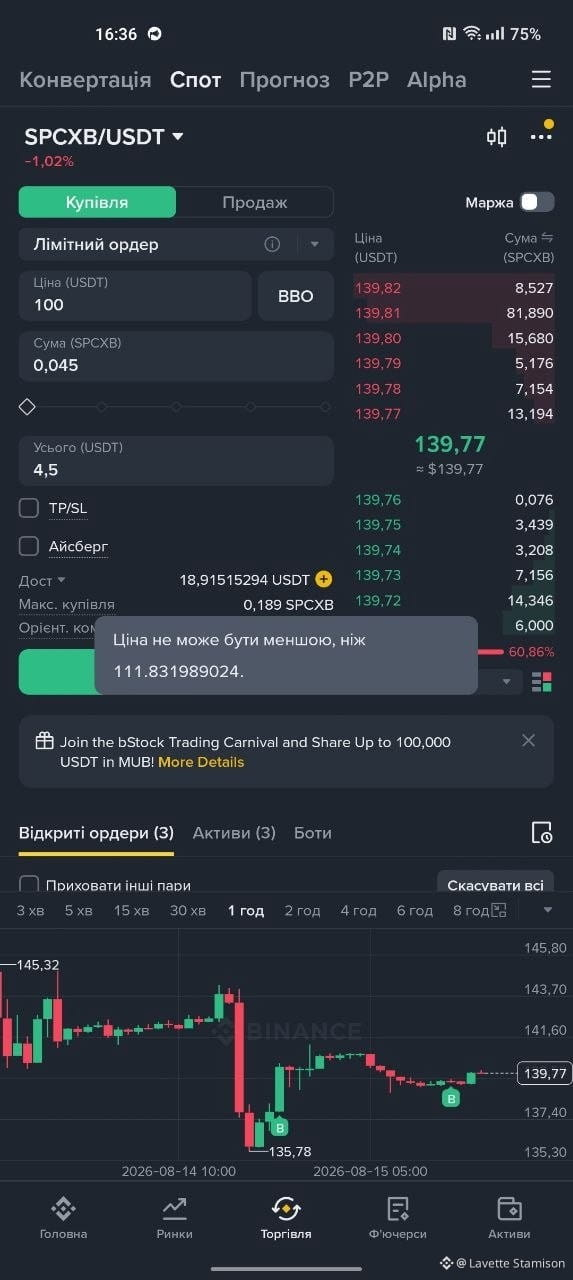
Setup. 15 August, 16:36 Kyiv time, phone app, $SPCXB order book, limit buy, my own account.
Attempt one. Price 100, size 0.045, total 4.50. Refused on price: "Price cannot be lower than 111.831989024." The reference at that second was 139.79. Divide that refusal number by 0.8 and you get 139.78998628. A twenty percent floor under the limit price I am allowed to name.
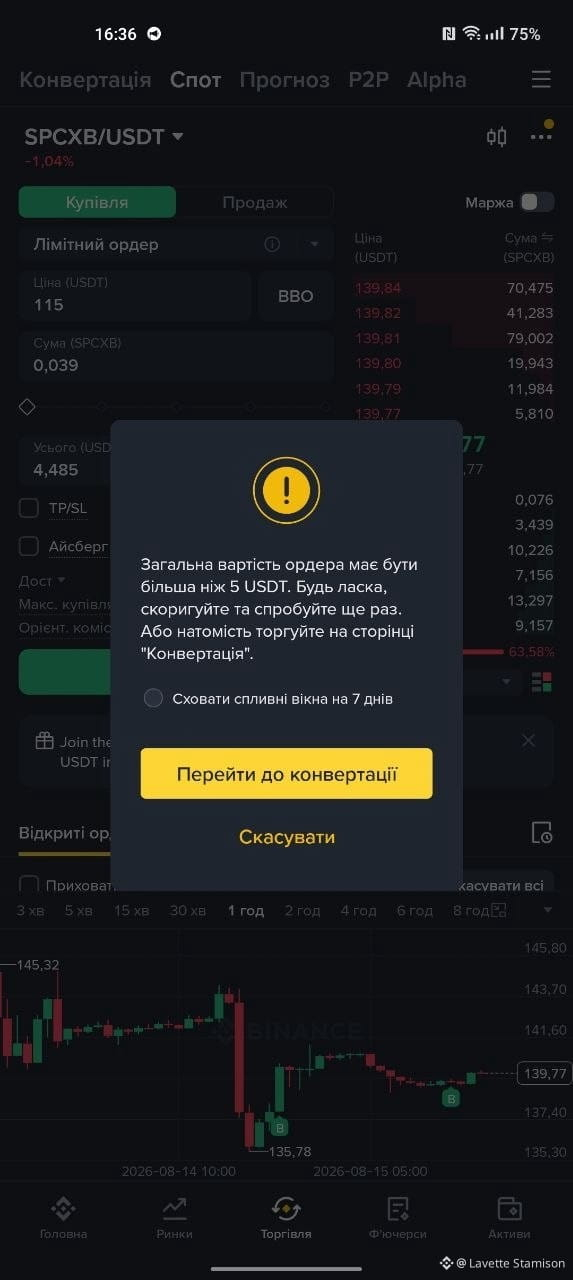
Attempt two. Price 115, size 0.039, total 4.485. Refused on size: total order value must be greater than 5 USDT. The only button on that window was Go to Convert.
Attempt three. Price 115, size 0.045, total 5.175. Accepted at 16:36:46.
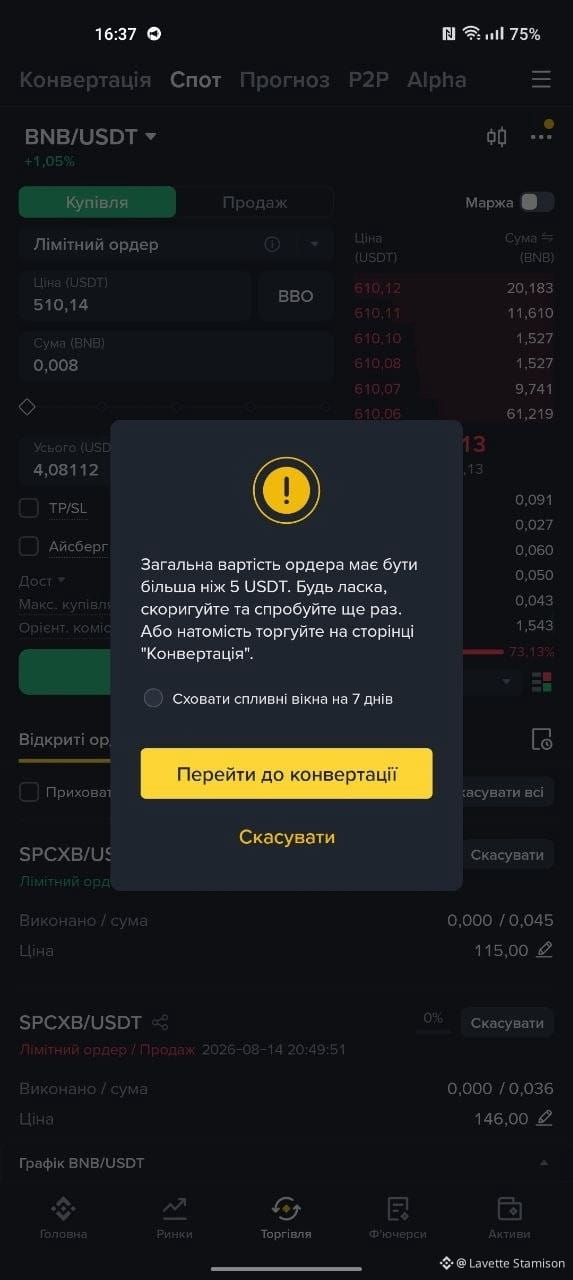
Control, 16:37, on the largest non stablecoin pair here, total 4.08. Identical window, identical wording.
So the floor is not five dollars. It sits above five dollars.
What you pay for. Three things.
The feed keeps saying fractions from 5 dollars. The wording on my screen says greater than 5, not at least 5. The campaign's own daily task is a 5 dollar trade. The threshold is set above the number everyone is told to trade.
Below the threshold you are not refused, you are redirected. Convert has no book and no limit price. You get a quote instead of a market.
The two limits stack on a small position. Your price is fenced into a band, your size is fenced from below. If the same floor applies on the way out, a five dollar position cannot be sold in halves at all.
Honest limits. One account, one minute, buy side only. I stopped at 4.485 and did not test exactly 5.00. I did not test the sell side, so the last point above is an inference, not a measurement. The band I measured on one pair at one price.
Do it yourself. Open the ticket, type 4.50, read what comes back. Do not take my word for any of this.
@BinanceCIS have you placed a bStock order at exactly the campaign amount?
$SPCXB
#bstockscis
Eleven days I have placed the same five dollar buy in this campaign. Today I tried to place it at 4.50 and the exchange refused twice, for two different reasons. I had never checked the floor I was standing on.
Setup. 15 August, 16:36 Kyiv time, phone app, $SPCXB order book, limit buy, my own account.
Attempt one. Price 100, size 0.045, total 4.50. Refused on price: "Price cannot be lower than 111.831989024." The reference at that second was 139.79. Divide that refusal number by 0.8 and you get 139.78998628. A twenty percent floor under the limit price I am allowed to name.
Attempt two. Price 115, size 0.039, total 4.485. Refused on size: total order value must be greater than 5 USDT. The only button on that window was Go to Convert.
Attempt three. Price 115, size 0.045, total 5.175. Accepted at 16:36:46.
Control, 16:37, on the largest non stablecoin pair here, total 4.08. Identical window, identical wording.
So the floor is not five dollars. It sits above five dollars.
What you pay for. Three things.
The feed keeps saying fractions from 5 dollars. The wording on my screen says greater than 5, not at least 5. The campaign's own daily task is a 5 dollar trade. The threshold is set above the number everyone is told to trade.
Below the threshold you are not refused, you are redirected. Convert has no book and no limit price. You get a quote instead of a market.
The two limits stack on a small position. Your price is fenced into a band, your size is fenced from below. If the same floor applies on the way out, a five dollar position cannot be sold in halves at all.
Honest limits. One account, one minute, buy side only. I stopped at 4.485 and did not test exactly 5.00. I did not test the sell side, so the last point above is an inference, not a measurement. The band I measured on one pair at one price.
Do it yourself. Open the ticket, type 4.50, read what comes back. Do not take my word for any of this.
@BinanceCIS have you placed a bStock order at exactly the campaign amount?
$SPCXB
#bstockscis
Setup. 15 August, 16:36 Kyiv time, phone app, $SPCXB order book, limit buy, my own account.
Attempt one. Price 100, size 0.045, total 4.50. Refused on price: "Price cannot be lower than 111.831989024." The reference at that second was 139.79. Divide that refusal number by 0.8 and you get 139.78998628. A twenty percent floor under the limit price I am allowed to name.
Attempt two. Price 115, size 0.039, total 4.485. Refused on size: total order value must be greater than 5 USDT. The only button on that window was Go to Convert.
Attempt three. Price 115, size 0.045, total 5.175. Accepted at 16:36:46.
Control, 16:37, on the largest non stablecoin pair here, total 4.08. Identical window, identical wording.
So the floor is not five dollars. It sits above five dollars.
What you pay for. Three things.
The feed keeps saying fractions from 5 dollars. The wording on my screen says greater than 5, not at least 5. The campaign's own daily task is a 5 dollar trade. The threshold is set above the number everyone is told to trade.
Below the threshold you are not refused, you are redirected. Convert has no book and no limit price. You get a quote instead of a market.
The two limits stack on a small position. Your price is fenced into a band, your size is fenced from below. If the same floor applies on the way out, a five dollar position cannot be sold in halves at all.
Honest limits. One account, one minute, buy side only. I stopped at 4.485 and did not test exactly 5.00. I did not test the sell side, so the last point above is an inference, not a measurement. The band I measured on one pair at one price.
Do it yourself. Open the ticket, type 4.50, read what comes back. Do not take my word for any of this.
@BinanceCIS have you placed a bStock order at exactly the campaign amount?
$SPCXB
#bstockscis
4
3
15
I have twice told you that liquidity on these tokens is thin. Tonight I measured it and I was wrong.
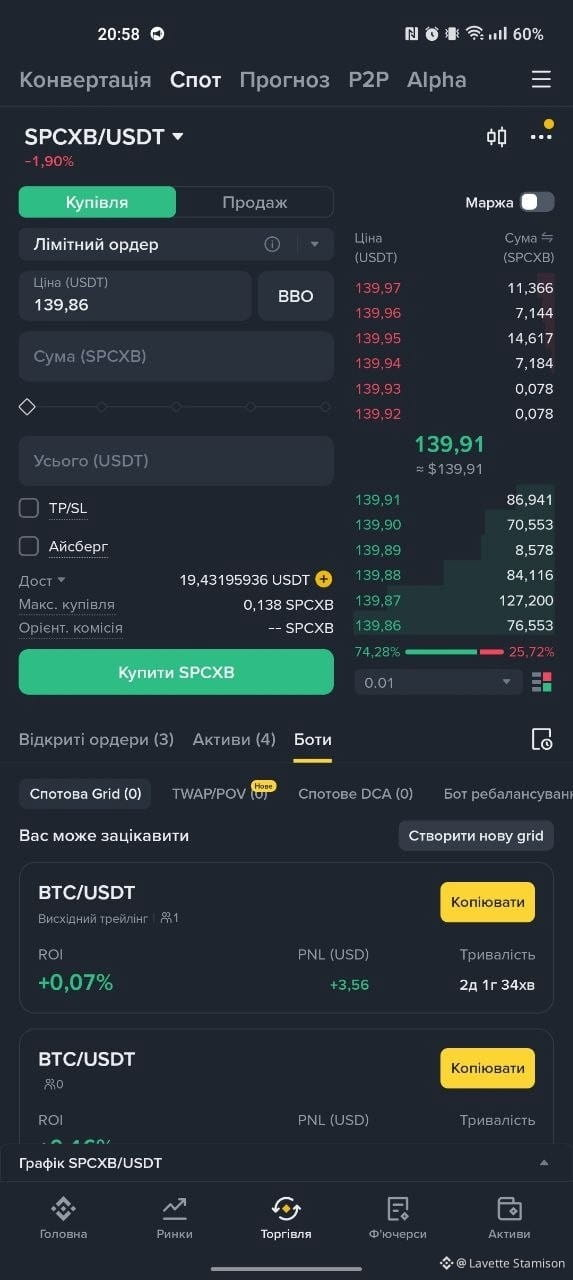
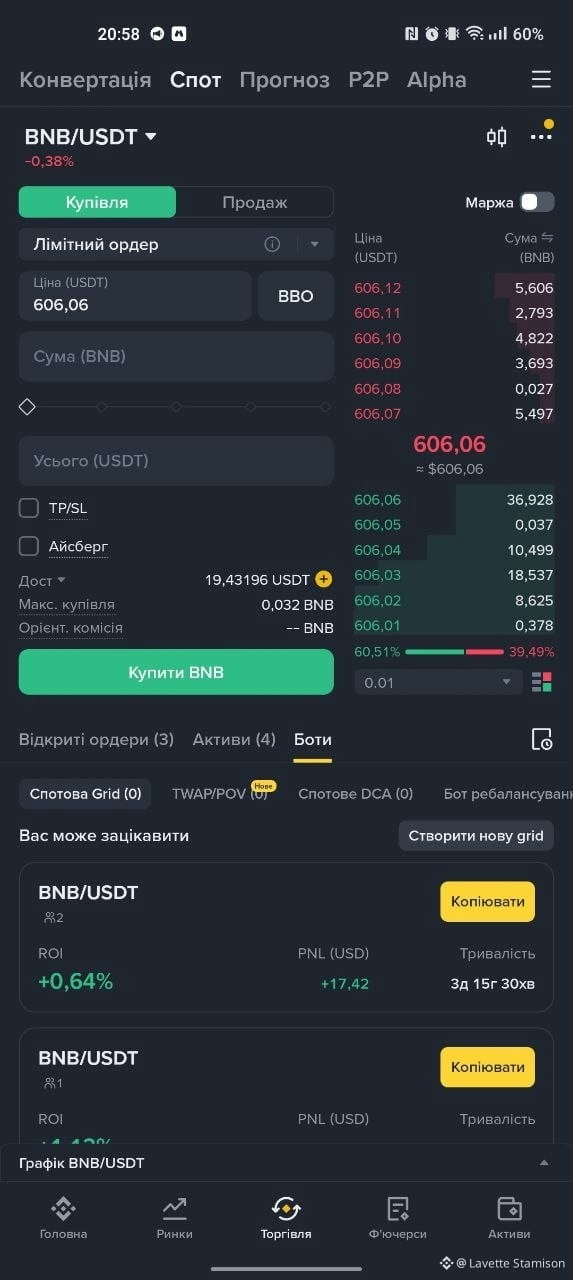
The setup. At 20:58 Kyiv, 13:58 New York, US session open, I opened SPCXB/USDT and BNB/USDT side by side and counted six price levels on each side of both books.
Bids, six levels deep. SPCXB: 453.9 tokens, about $63,500. BNB: 75.0 coins, about $45,500.
Asks, six levels deep. SPCXB: 40.5 tokens, about $5,660. BNB: 22.4 coins, about $13,600.
Spread: one tick on both, $0.01.
Order type menu: identical. Eight types each, TWAP and Scaled Order included.
The bid on a tokenized stock was deeper than the bid on BNB. I had been repeating a claim I never checked on this venue.
What you pay. Three things.
1️⃣ The book is lopsided. SPCXB sat near 11 to 1, bid over ask. BNB near 3 to 1. Buying slips more than selling, on the same screen, in the same second. That is the opposite of the story I had been telling.
2️⃣ A tick is not a tick. One cent on a $139.91 token is 0.007%. One cent on BNB at $606.06 is 0.0017%. Crossing the spread costs four times as much in relative terms, and no chart shows you that.
3️⃣ Scale. The whole visible ask side was $5,660. My campaign trade is $5. At that size none of this reaches me. Most of what gets written about depth here, mine included, is about a problem the writer does not have.
Honest limits: one snapshot, one minute, six levels, one ticker, mid session. Books move in seconds and I did not watch this one move. A deep bid at 21:00 says nothing about 03:00, when the underlying is shut.
Two posts of mine need this correction, so here it is. Before you believe anyone about liquidity on bStocks, open the two books in the same second and count. That includes not believing me.
@BinanceCIS is that bid depth market making, or is it flow?
$SPCXB
#bstockscis
I have twice told you that liquidity on these tokens is thin. Tonight I measured it and I was wrong.
The setup. At 20:58 Kyiv, 13:58 New York, US session open, I opened SPCXB/USDT and BNB/USDT side by side and counted six price levels on each side of both books.
Bids, six levels deep. SPCXB: 453.9 tokens, about $63,500. BNB: 75.0 coins, about $45,500.
Asks, six levels deep. SPCXB: 40.5 tokens, about $5,660. BNB: 22.4 coins, about $13,600.
Spread: one tick on both, $0.01.
Order type menu: identical. Eight types each, TWAP and Scaled Order included.
The bid on a tokenized stock was deeper than the bid on BNB. I had been repeating a claim I never checked on this venue.
What you pay. Three things.
1️⃣ The book is lopsided. SPCXB sat near 11 to 1, bid over ask. BNB near 3 to 1. Buying slips more than selling, on the same screen, in the same second. That is the opposite of the story I had been telling.
2️⃣ A tick is not a tick. One cent on a $139.91 token is 0.007%. One cent on BNB at $606.06 is 0.0017%. Crossing the spread costs four times as much in relative terms, and no chart shows you that.
3️⃣ Scale. The whole visible ask side was $5,660. My campaign trade is $5. At that size none of this reaches me. Most of what gets written about depth here, mine included, is about a problem the writer does not have.
Honest limits: one snapshot, one minute, six levels, one ticker, mid session. Books move in seconds and I did not watch this one move. A deep bid at 21:00 says nothing about 03:00, when the underlying is shut.
Two posts of mine need this correction, so here it is. Before you believe anyone about liquidity on bStocks, open the two books in the same second and count. That includes not believing me.
@BinanceCIS is that bid depth market making, or is it flow?
$SPCXB
#bstockscis
The setup. At 20:58 Kyiv, 13:58 New York, US session open, I opened SPCXB/USDT and BNB/USDT side by side and counted six price levels on each side of both books.
Bids, six levels deep. SPCXB: 453.9 tokens, about $63,500. BNB: 75.0 coins, about $45,500.
Asks, six levels deep. SPCXB: 40.5 tokens, about $5,660. BNB: 22.4 coins, about $13,600.
Spread: one tick on both, $0.01.
Order type menu: identical. Eight types each, TWAP and Scaled Order included.
The bid on a tokenized stock was deeper than the bid on BNB. I had been repeating a claim I never checked on this venue.
What you pay. Three things.
1️⃣ The book is lopsided. SPCXB sat near 11 to 1, bid over ask. BNB near 3 to 1. Buying slips more than selling, on the same screen, in the same second. That is the opposite of the story I had been telling.
2️⃣ A tick is not a tick. One cent on a $139.91 token is 0.007%. One cent on BNB at $606.06 is 0.0017%. Crossing the spread costs four times as much in relative terms, and no chart shows you that.
3️⃣ Scale. The whole visible ask side was $5,660. My campaign trade is $5. At that size none of this reaches me. Most of what gets written about depth here, mine included, is about a problem the writer does not have.
Honest limits: one snapshot, one minute, six levels, one ticker, mid session. Books move in seconds and I did not watch this one move. A deep bid at 21:00 says nothing about 03:00, when the underlying is shut.
Two posts of mine need this correction, so here it is. Before you believe anyone about liquidity on bStocks, open the two books in the same second and count. That includes not believing me.
@BinanceCIS is that bid depth market making, or is it flow?
$SPCXB
#bstockscis
2
1
107
·
--
Bullish
Every article about bStocks today quotes one number. I opened the page they all cite and it shows a different one.
The mechanism. Token Terminal's Market cap for tokenized stocks is value tokenized onchain, price times supply, grouped by issuer. Today's story: bStocks passed xStocks into second place behind Ondo.
What you get. An outside scoreboard on the product. Public, no login.
What you pay. Three things.
1️⃣ The rank is thin. At 15:16 Kyiv the page showed bStocks $622.6M and xStocks $605.5M. A $17.1M gap on $622.6M is 2.8%. It was $45M on 3 August, $9.4M on Tuesday.
2️⃣ The comparison is not like-for-like. On that page every bStock lists one chain. Each xStocks asset lists six. bStocks are BEP-20 on BNB Smart Chain, the only rail in and out.
3️⃣ The issuer is not your ticker. Four tokens hold about half of that $622.6M, and two of them are down over 30 days while the issuer total is up.
Honest limits: one snapshot, one afternoon. Market cap mixes price with supply, so a fall can be the stock, not redemptions.
Read the row for your ticker, not the rank of its issuer.
@BinanceCIS which chain besides BSC will bStocks settle on?
$SPCXB
#bstockscis
Every article about bStocks today quotes one number. I opened the page they all cite and it shows a different one.
The mechanism. Token Terminal's Market cap for tokenized stocks is value tokenized onchain, price times supply, grouped by issuer. Today's story: bStocks passed xStocks into second place behind Ondo.
What you get. An outside scoreboard on the product. Public, no login.
What you pay. Three things.
1️⃣ The rank is thin. At 15:16 Kyiv the page showed bStocks $622.6M and xStocks $605.5M. A $17.1M gap on $622.6M is 2.8%. It was $45M on 3 August, $9.4M on Tuesday.
2️⃣ The comparison is not like-for-like. On that page every bStock lists one chain. Each xStocks asset lists six. bStocks are BEP-20 on BNB Smart Chain, the only rail in and out.
3️⃣ The issuer is not your ticker. Four tokens hold about half of that $622.6M, and two of them are down over 30 days while the issuer total is up.
Honest limits: one snapshot, one afternoon. Market cap mixes price with supply, so a fall can be the stock, not redemptions.
Read the row for your ticker, not the rank of its issuer.
@BinanceCIS which chain besides BSC will bStocks settle on?
$SPCXB
#bstockscis
The mechanism. Token Terminal's Market cap for tokenized stocks is value tokenized onchain, price times supply, grouped by issuer. Today's story: bStocks passed xStocks into second place behind Ondo.
What you get. An outside scoreboard on the product. Public, no login.
What you pay. Three things.
1️⃣ The rank is thin. At 15:16 Kyiv the page showed bStocks $622.6M and xStocks $605.5M. A $17.1M gap on $622.6M is 2.8%. It was $45M on 3 August, $9.4M on Tuesday.
2️⃣ The comparison is not like-for-like. On that page every bStock lists one chain. Each xStocks asset lists six. bStocks are BEP-20 on BNB Smart Chain, the only rail in and out.
3️⃣ The issuer is not your ticker. Four tokens hold about half of that $622.6M, and two of them are down over 30 days while the issuer total is up.
Honest limits: one snapshot, one afternoon. Market cap mixes price with supply, so a fall can be the stock, not redemptions.
Read the row for your ticker, not the rank of its issuer.
@BinanceCIS which chain besides BSC will bStocks settle on?
$SPCXB
#bstockscis
I go by rankings
34%
I check my ticker's own row
33%
Didn't know it's one chain
0%
I track neither
33%
3 votes • Voting closed
2
3
552
·
--
Bullish
Today I went looking for what a bStock dividend actually pays and found two Binance pages that disagree.
The bStocks site promises the same economic entitlement as a shareholder. The Bahrain launch disclaimer says holders are not entitled to any dividends at all.
The mechanism. A dividend never reaches you as cash. The issuer collects it, withholding is applied, and the rest is rebased into your balance by the Multiplier.
What you get. Compounding with no action and no fee, on a fraction of a share.
What you pay. Three things.
1️⃣ Withholding. The standard US rate on dividends to a non-resident is 30% unless a treaty applies. Binance CIS published IBMB near 2.2% on 4 August. Net, closer to 1.5%.
2️⃣ The exit shuts. For Apple and IBM the snapshot was 10 August, 00:00 UTC, and conversion into the share was suspended from 8 August. The dividend lands while the door is shut.
3️⃣ No choice. You cannot take the cash instead. The issuer says the adjustment may not reflect the dividend's full value.
I read documents, not my own screen, and have never held a bStock through a dividend. Check the announcement for your ticker.
@BinanceCIS which rate applies to a CIS holder?
$IBMB
#bstockscis
Today I went looking for what a bStock dividend actually pays and found two Binance pages that disagree.
The bStocks site promises the same economic entitlement as a shareholder. The Bahrain launch disclaimer says holders are not entitled to any dividends at all.
The mechanism. A dividend never reaches you as cash. The issuer collects it, withholding is applied, and the rest is rebased into your balance by the Multiplier.
What you get. Compounding with no action and no fee, on a fraction of a share.
What you pay. Three things.
1️⃣ Withholding. The standard US rate on dividends to a non-resident is 30% unless a treaty applies. Binance CIS published IBMB near 2.2% on 4 August. Net, closer to 1.5%.
2️⃣ The exit shuts. For Apple and IBM the snapshot was 10 August, 00:00 UTC, and conversion into the share was suspended from 8 August. The dividend lands while the door is shut.
3️⃣ No choice. You cannot take the cash instead. The issuer says the adjustment may not reflect the dividend's full value.
I read documents, not my own screen, and have never held a bStock through a dividend. Check the announcement for your ticker.
@BinanceCIS which rate applies to a CIS holder?
$IBMB
#bstockscis
The bStocks site promises the same economic entitlement as a shareholder. The Bahrain launch disclaimer says holders are not entitled to any dividends at all.
The mechanism. A dividend never reaches you as cash. The issuer collects it, withholding is applied, and the rest is rebased into your balance by the Multiplier.
What you get. Compounding with no action and no fee, on a fraction of a share.
What you pay. Three things.
1️⃣ Withholding. The standard US rate on dividends to a non-resident is 30% unless a treaty applies. Binance CIS published IBMB near 2.2% on 4 August. Net, closer to 1.5%.
2️⃣ The exit shuts. For Apple and IBM the snapshot was 10 August, 00:00 UTC, and conversion into the share was suspended from 8 August. The dividend lands while the door is shut.
3️⃣ No choice. You cannot take the cash instead. The issuer says the adjustment may not reflect the dividend's full value.
I read documents, not my own screen, and have never held a bStock through a dividend. Check the announcement for your ticker.
@BinanceCIS which rate applies to a CIS holder?
$IBMB
#bstockscis
Didn't know about withholding
0%
Knew it, fine with it
0%
I avoid dividend tickers
0%
I exit before the snapshot
0%
0 votes • Voting closed
5
3
586
I went looking for the DeFi yield everyone promises on bStocks and found a pool paying 74,110% APR.
It holds $7.25.
Every thread this week ends the same way. Withdraw to your wallet, put it into DeFi, earn yield. None names a venue or a number.
Binance Research did. Its 8 July figures for PancakeSwap LP yields on bStocks top out at 228%.
I searched NVDAB on PancakeSwap myself, 15:00 Kyiv time. The first six results are all the same token on the same chain. The deepest quotes 324.70% APR on $1,002,026 of liquidity and did $5.38M in 24h. The 0.01% tier quotes 74,110% APR on $7.25 and traded nothing at all. A V2 pool shows 155.57% on $5.91.
Here is what I take from this. APR is a fraction, and on a dead pool the denominator writes the headline. The 228% from a month ago is not today's ceiling, but the loudest number on my screen was also the emptiest.
Read TVL first, APR second. A rate quoted on seven dollars tells you nothing about the rate you get on five hundred.
Honest limits: one ticker, one afternoon, one screen. These pools reprice constantly, so check before you size.
@BinanceCIS what APR were you shown when someone said bStocks earn yield?
#bstockscis $NVDAB
I went looking for the DeFi yield everyone promises on bStocks and found a pool paying 74,110% APR.
It holds $7.25.
Every thread this week ends the same way. Withdraw to your wallet, put it into DeFi, earn yield. None names a venue or a number.
Binance Research did. Its 8 July figures for PancakeSwap LP yields on bStocks top out at 228%.
I searched NVDAB on PancakeSwap myself, 15:00 Kyiv time. The first six results are all the same token on the same chain. The deepest quotes 324.70% APR on $1,002,026 of liquidity and did $5.38M in 24h. The 0.01% tier quotes 74,110% APR on $7.25 and traded nothing at all. A V2 pool shows 155.57% on $5.91.
Here is what I take from this. APR is a fraction, and on a dead pool the denominator writes the headline. The 228% from a month ago is not today's ceiling, but the loudest number on my screen was also the emptiest.
Read TVL first, APR second. A rate quoted on seven dollars tells you nothing about the rate you get on five hundred.
Honest limits: one ticker, one afternoon, one screen. These pools reprice constantly, so check before you size.
@BinanceCIS what APR were you shown when someone said bStocks earn yield?
#bstockscis $NVDAB
It holds $7.25.
Every thread this week ends the same way. Withdraw to your wallet, put it into DeFi, earn yield. None names a venue or a number.
Binance Research did. Its 8 July figures for PancakeSwap LP yields on bStocks top out at 228%.
I searched NVDAB on PancakeSwap myself, 15:00 Kyiv time. The first six results are all the same token on the same chain. The deepest quotes 324.70% APR on $1,002,026 of liquidity and did $5.38M in 24h. The 0.01% tier quotes 74,110% APR on $7.25 and traded nothing at all. A V2 pool shows 155.57% on $5.91.
Here is what I take from this. APR is a fraction, and on a dead pool the denominator writes the headline. The 228% from a month ago is not today's ceiling, but the loudest number on my screen was also the emptiest.
Read TVL first, APR second. A rate quoted on seven dollars tells you nothing about the rate you get on five hundred.
Honest limits: one ticker, one afternoon, one screen. These pools reprice constantly, so check before you size.
@BinanceCIS what APR were you shown when someone said bStocks earn yield?
#bstockscis $NVDAB
Never saw a number
100%
Under 20%
0%
Over 100%
0%
I check TVL first
0%
1 votes • Voting closed
1
1
92
·
--
Bullish
Verified
Zero maker fees on bStocks run until August 31. That reads as cheaper trading. There is a less obvious reading.
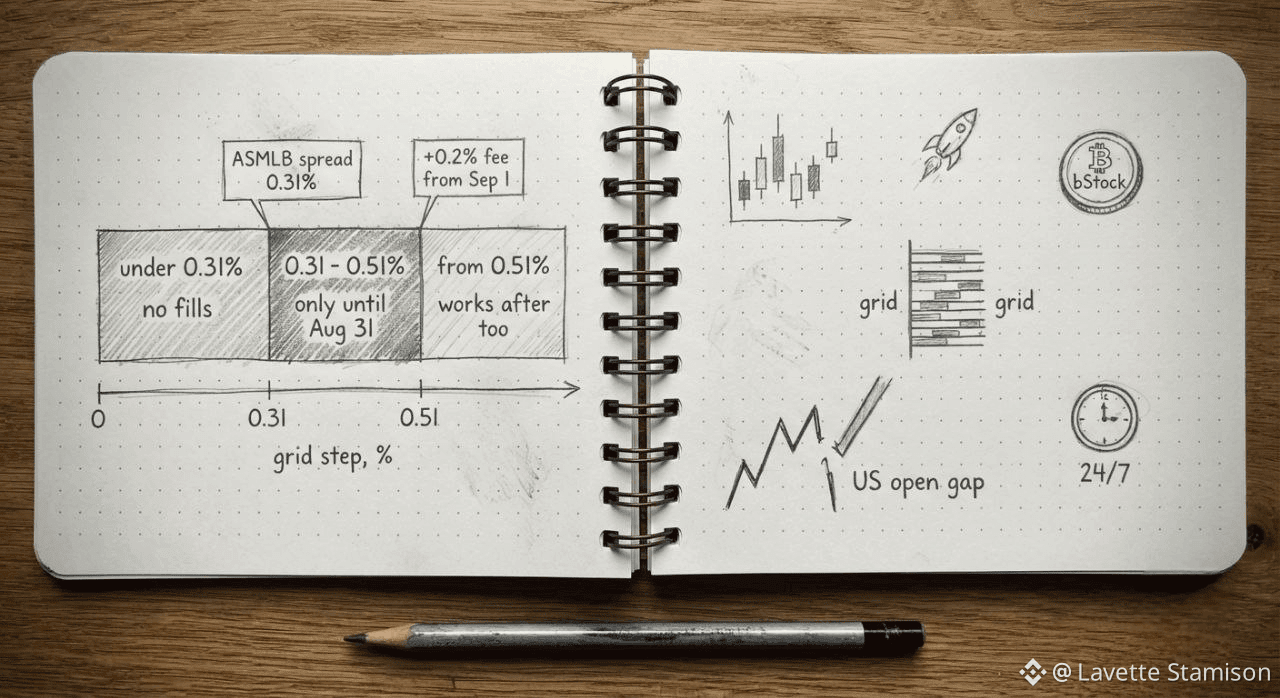
Mechanism. On August 5, with ten new pairs, Binance switched on Spot Algo Trading Bot. A grid bot works through limit orders, so it sits on the maker side nearly always. While the promo lasts, those orders fill free.
What that gives you. The underlying stock trades about six and a half hours a day. A bStock never stops. Most of the day the price moves in a thin market with no reference print from Nasdaq. That is working conditions for a grid: it does not guess direction, it harvests range.
What you pay for it. Three things.
Thin liquidity outside the US session widens the spread. What you save on fees can go into slippage.
A gap at the US open pushes the grid outside its range. The bot has no view on earnings or macro.
From September 1 the standard fee returns. Arithmetic that worked in August may not work in September.
I have not run a grid on a bStocks pair, only watched the ASMLB book: in the European session the spread held around a third of a percent. Before starting I would check that the grid step covers that spread.
$ASMLB
#bstockscis @BinanceCIS
Zero maker fees on bStocks run until August 31. That reads as cheaper trading. There is a less obvious reading.
Mechanism. On August 5, with ten new pairs, Binance switched on Spot Algo Trading Bot. A grid bot works through limit orders, so it sits on the maker side nearly always. While the promo lasts, those orders fill free.
What that gives you. The underlying stock trades about six and a half hours a day. A bStock never stops. Most of the day the price moves in a thin market with no reference print from Nasdaq. That is working conditions for a grid: it does not guess direction, it harvests range.
What you pay for it. Three things.
Thin liquidity outside the US session widens the spread. What you save on fees can go into slippage.
A gap at the US open pushes the grid outside its range. The bot has no view on earnings or macro.
From September 1 the standard fee returns. Arithmetic that worked in August may not work in September.
I have not run a grid on a bStocks pair, only watched the ASMLB book: in the European session the spread held around a third of a percent. Before starting I would check that the grid step covers that spread.
$ASMLB
#bstockscis @BinanceCIS
Mechanism. On August 5, with ten new pairs, Binance switched on Spot Algo Trading Bot. A grid bot works through limit orders, so it sits on the maker side nearly always. While the promo lasts, those orders fill free.
What that gives you. The underlying stock trades about six and a half hours a day. A bStock never stops. Most of the day the price moves in a thin market with no reference print from Nasdaq. That is working conditions for a grid: it does not guess direction, it harvests range.
What you pay for it. Three things.
Thin liquidity outside the US session widens the spread. What you save on fees can go into slippage.
A gap at the US open pushes the grid outside its range. The bot has no view on earnings or macro.
From September 1 the standard fee returns. Arithmetic that worked in August may not work in September.
I have not run a grid on a bStocks pair, only watched the ASMLB book: in the European session the spread held around a third of a percent. Before starting I would check that the grid step covers that spread.
$ASMLB
#bstockscis @BinanceCIS
2
101
Verified
What will happen to the bStocks volume on September 1, when the maker’s zero commission is switched off?
CoinDesk Data report for July, published on August 1: trading volume of tokenized stocks and ETFs — $11.3B, +288% month over month. bStocks accounted for $9.41B, or 83.3% of the market.
Out of those, one token, $QQQB (Invesco QQQ Trust, listed June 30 at 13:30 UTC), generated $9.27B — about 82% of the market. I subtracted: for the rest of the bStocks lineup, about $140M remains for July. The estimate is rough—this is the difference between rounded numbers—but the scale is about $4.5M per day for everything else.
Two dates explain it better than demand. QQQB trades with a zero maker’s fee until August 31. Since July 23, Binance has been calculating volume for stocks and bStocks with a 3x multiplier for promotion across VIP tiers.
Underlying asset: in July, QQQ fell by 6.6% and at one point was 10.2% below the June 30 close, while the Nasdaq Composite was down 3.2% and the S&P 500 was down 0.1%. Volume rose not because of price.
For me, that implies a condition. The other ETF in the lineup, $EWYB (iShares MSCI South Korea), is already sitting in that remaining pool. While the fee is zero, I’m trading with limit orders, and after August 31 I’ll check the spread to the order—not after.
{spot}(QQQBUSDT)
What will happen to bStocks volume after August 31?
#bstockscis @BinanceCIS
What will happen to the bStocks volume on September 1, when the maker’s zero commission is switched off?
CoinDesk Data report for July, published on August 1: trading volume of tokenized stocks and ETFs — $11.3B, +288% month over month. bStocks accounted for $9.41B, or 83.3% of the market.
Out of those, one token, $QQQB (Invesco QQQ Trust, listed June 30 at 13:30 UTC), generated $9.27B — about 82% of the market. I subtracted: for the rest of the bStocks lineup, about $140M remains for July. The estimate is rough—this is the difference between rounded numbers—but the scale is about $4.5M per day for everything else.
Two dates explain it better than demand. QQQB trades with a zero maker’s fee until August 31. Since July 23, Binance has been calculating volume for stocks and bStocks with a 3x multiplier for promotion across VIP tiers.
Underlying asset: in July, QQQ fell by 6.6% and at one point was 10.2% below the June 30 close, while the Nasdaq Composite was down 3.2% and the S&P 500 was down 0.1%. Volume rose not because of price.
For me, that implies a condition. The other ETF in the lineup, $EWYB (iShares MSCI South Korea), is already sitting in that remaining pool. While the fee is zero, I’m trading with limit orders, and after August 31 I’ll check the spread to the order—not after.
What will happen to bStocks volume after August 31?
#bstockscis @BinanceCIS
CoinDesk Data report for July, published on August 1: trading volume of tokenized stocks and ETFs — $11.3B, +288% month over month. bStocks accounted for $9.41B, or 83.3% of the market.
Out of those, one token, $QQQB (Invesco QQQ Trust, listed June 30 at 13:30 UTC), generated $9.27B — about 82% of the market. I subtracted: for the rest of the bStocks lineup, about $140M remains for July. The estimate is rough—this is the difference between rounded numbers—but the scale is about $4.5M per day for everything else.
Two dates explain it better than demand. QQQB trades with a zero maker’s fee until August 31. Since July 23, Binance has been calculating volume for stocks and bStocks with a 3x multiplier for promotion across VIP tiers.
Underlying asset: in July, QQQ fell by 6.6% and at one point was 10.2% below the June 30 close, while the Nasdaq Composite was down 3.2% and the S&P 500 was down 0.1%. Volume rose not because of price.
For me, that implies a condition. The other ETF in the lineup, $EWYB (iShares MSCI South Korea), is already sitting in that remaining pool. While the fee is zero, I’m trading with limit orders, and after August 31 I’ll check the spread to the order—not after.
What will happen to bStocks volume after August 31?
#bstockscis @BinanceCIS
Впаде помітно 📉
0%
Утримається ⚖️
100%
Виросте, річ не в комісії 📈
0%
1 votes • Voting closed
2
88
·
--
Bullish
Partly True
I opened [Proof of Collateral](https://www.binance.com/en/proof-of-collateral/bstocks) to check one number. It is not the number everyone repeats.
It says 66 bStocks are currently issued. Not 25, not 40.
It also settles a claim that still circulates: $METAB exists. The page shows 3,270 Meta shares in custody and exactly 3,270 METAB as BEP-20. Backing 100%, updated today at 00:46:22.
Then I opened the $ASMLB order book on Spot, 15:30 Kyiv time. Lowest ask 1,739.85, highest bid 1,734.48. Spread 5.37 USDT, or 0.31%.
24h volume - 14.09 tokens, about 24,569 USDT. Fourteen ASML shares in a full day.
Here is what I take from this. 1:1 backing and liquidity are different things. The first guarantees a share sits behind the token. The second decides the price you exit at. On a book this thin a market order costs more than the fee, which is zero until August 31 anyway. So limit orders, not market.
On PancakeSwap I checked a different ticker, $NFLXB : 100 USDT gives 1.366819 tokens. Next to the name sits a Scale 1.00x badge - looks like the same Multiplier.
Do you check the spread before entering, or just hit market?
#bstockscis @BinanceCIS
I opened Proof of Collateral to check one number. It is not the number everyone repeats.
It says 66 bStocks are currently issued. Not 25, not 40.
It also settles a claim that still circulates: $METAB exists. The page shows 3,270 Meta shares in custody and exactly 3,270 METAB as BEP-20. Backing 100%, updated today at 00:46:22.
Then I opened the $ASMLB order book on Spot, 15:30 Kyiv time. Lowest ask 1,739.85, highest bid 1,734.48. Spread 5.37 USDT, or 0.31%.
24h volume - 14.09 tokens, about 24,569 USDT. Fourteen ASML shares in a full day.
Here is what I take from this. 1:1 backing and liquidity are different things. The first guarantees a share sits behind the token. The second decides the price you exit at. On a book this thin a market order costs more than the fee, which is zero until August 31 anyway. So limit orders, not market.
On PancakeSwap I checked a different ticker, $NFLXB : 100 USDT gives 1.366819 tokens. Next to the name sits a Scale 1.00x badge - looks like the same Multiplier.
Do you check the spread before entering, or just hit market?
#bstockscis @BinanceCIS
It says 66 bStocks are currently issued. Not 25, not 40.
It also settles a claim that still circulates: $METAB exists. The page shows 3,270 Meta shares in custody and exactly 3,270 METAB as BEP-20. Backing 100%, updated today at 00:46:22.
Then I opened the $ASMLB order book on Spot, 15:30 Kyiv time. Lowest ask 1,739.85, highest bid 1,734.48. Spread 5.37 USDT, or 0.31%.
24h volume - 14.09 tokens, about 24,569 USDT. Fourteen ASML shares in a full day.
Here is what I take from this. 1:1 backing and liquidity are different things. The first guarantees a share sits behind the token. The second decides the price you exit at. On a book this thin a market order costs more than the fee, which is zero until August 31 anyway. So limit orders, not market.
On PancakeSwap I checked a different ticker, $NFLXB : 100 USDT gives 1.366819 tokens. Next to the name sits a Scale 1.00x badge - looks like the same Multiplier.
Do you check the spread before entering, or just hit market?
#bstockscis @BinanceCIS
I always check the spread
0%
Limit orders only
100%
I just hit market
0%
Haven't traded bStocks yet
0%
1 votes • Voting closed
2
149
·
--
Bullish
Verified
Guarantee 1:1 sound convincingly exactly until you ask: does the reverse path work?
That’s what distinguishes real coverage from a table entry.
bStock is a certificate issued by BTech Holdings, affiliated with Binance, and behind each one stands a real share in a 1:1 ratio. But the main difference is this: conversion works both ways. The direct share can be converted into bStock, and bStock back into the direct share—free of charge and at any time, without waiting for the exchange to open.
Every day I take $SPCXB to $5. At a price of around $113 that’s about 0.044 token. A fractional position backed by the same doors back.
I’ve never converted anything. But the very fact that the exit exists changes how you look at the position. One thing is holding a token that can only be sold for USDT. Another is holding one that has a pass-through to the underlying asset.
To be honest about the limitations: this is not direct ownership of a share, there’s no voting rights; regulatory-wise, it’s a certificate under the ADGM/FSRA rules. Conversion availability depends on the region and the account status.
And have you checked whether conversion is available specifically to you?
@BinanceCIS #bstockscis $SPCXB
Guarantee 1:1 sound convincingly exactly until you ask: does the reverse path work?
That’s what distinguishes real coverage from a table entry.
bStock is a certificate issued by BTech Holdings, affiliated with Binance, and behind each one stands a real share in a 1:1 ratio. But the main difference is this: conversion works both ways. The direct share can be converted into bStock, and bStock back into the direct share—free of charge and at any time, without waiting for the exchange to open.
Every day I take $SPCXB to $5. At a price of around $113 that’s about 0.044 token. A fractional position backed by the same doors back.
I’ve never converted anything. But the very fact that the exit exists changes how you look at the position. One thing is holding a token that can only be sold for USDT. Another is holding one that has a pass-through to the underlying asset.
To be honest about the limitations: this is not direct ownership of a share, there’s no voting rights; regulatory-wise, it’s a certificate under the ADGM/FSRA rules. Conversion availability depends on the region and the account status.
And have you checked whether conversion is available specifically to you?
@BinanceCIS #bstockscis $SPCXB
That’s what distinguishes real coverage from a table entry.
bStock is a certificate issued by BTech Holdings, affiliated with Binance, and behind each one stands a real share in a 1:1 ratio. But the main difference is this: conversion works both ways. The direct share can be converted into bStock, and bStock back into the direct share—free of charge and at any time, without waiting for the exchange to open.
Every day I take $SPCXB to $5. At a price of around $113 that’s about 0.044 token. A fractional position backed by the same doors back.
I’ve never converted anything. But the very fact that the exit exists changes how you look at the position. One thing is holding a token that can only be sold for USDT. Another is holding one that has a pass-through to the underlying asset.
To be honest about the limitations: this is not direct ownership of a share, there’s no voting rights; regulatory-wise, it’s a certificate under the ADGM/FSRA rules. Conversion availability depends on the region and the account status.
And have you checked whether conversion is available specifically to you?
@BinanceCIS #bstockscis $SPCXB
Так, доступна
67%
Ні, не перевіряв
33%
Ні, не знав про неї
0%
Ще не купував bStocks
0%
3 votes • Voting closed
2
218
Collateral 1:1 does not mean the price will be 1:1.
Did you know that about 58% of the volume of equity-related trades on Binance happens when Nasdaq and NYSE are already closed? That means most trading takes place in the thinnest order book. In my opinion, this is the most practical risk in bStocks that somehow doesn’t get talked about much.
Here are three things you should understand about the bStock price:
1. Premium and discount. Collateral guarantees that a real share backs the token, but the order book sets the price every second. Higher than the reference price of the underlying asset is a premium, lower is a discount. The reference price is a benchmark here, not a binding factor.
2. Spread. While the main session is open, the gap is narrow and closes quickly. Outside the session, there’s nothing to check in real time against: there are fewer orders, the spread is wider, and a market order may fill noticeably worse than what the chart shows.
3. Market makers. They hold quotes on both sides and squeeze the spread, but they do not eliminate it.
That’s why in 24/7 access there’s also the other side. You have to check the price yourself, because no one will do it for you at 3 a.m.
Not investment advice. DYOR.
$SPCXB @BinanceCIS #bstockscis
{spot}(SPCXBUSDT)
And what are you looking at before placing a trade outside the main session?
Collateral 1:1 does not mean the price will be 1:1.
Did you know that about 58% of the volume of equity-related trades on Binance happens when Nasdaq and NYSE are already closed? That means most trading takes place in the thinnest order book. In my opinion, this is the most practical risk in bStocks that somehow doesn’t get talked about much.
Here are three things you should understand about the bStock price:
1. Premium and discount. Collateral guarantees that a real share backs the token, but the order book sets the price every second. Higher than the reference price of the underlying asset is a premium, lower is a discount. The reference price is a benchmark here, not a binding factor.
2. Spread. While the main session is open, the gap is narrow and closes quickly. Outside the session, there’s nothing to check in real time against: there are fewer orders, the spread is wider, and a market order may fill noticeably worse than what the chart shows.
3. Market makers. They hold quotes on both sides and squeeze the spread, but they do not eliminate it.
That’s why in 24/7 access there’s also the other side. You have to check the price yourself, because no one will do it for you at 3 a.m.
Not investment advice. DYOR.
$SPCXB @BinanceCIS #bstockscis
And what are you looking at before placing a trade outside the main session?
Did you know that about 58% of the volume of equity-related trades on Binance happens when Nasdaq and NYSE are already closed? That means most trading takes place in the thinnest order book. In my opinion, this is the most practical risk in bStocks that somehow doesn’t get talked about much.
Here are three things you should understand about the bStock price:
1. Premium and discount. Collateral guarantees that a real share backs the token, but the order book sets the price every second. Higher than the reference price of the underlying asset is a premium, lower is a discount. The reference price is a benchmark here, not a binding factor.
2. Spread. While the main session is open, the gap is narrow and closes quickly. Outside the session, there’s nothing to check in real time against: there are fewer orders, the spread is wider, and a market order may fill noticeably worse than what the chart shows.
3. Market makers. They hold quotes on both sides and squeeze the spread, but they do not eliminate it.
That’s why in 24/7 access there’s also the other side. You have to check the price yourself, because no one will do it for you at 3 a.m.
Not investment advice. DYOR.
$SPCXB @BinanceCIS #bstockscis
And what are you looking at before placing a trade outside the main session?
Спред
0%
Премію або дисконт
0%
Тільки графік
100%
1 votes • Voting closed
259
#bstockscis @BinanceCIS
Recently I was talking with my friend and here is what I found out.
Fr - I was figuring out bStocks here and found an interesting point. You probably also thought that dividends for these tokens should just drop into USDT, right?
Me - Well of course, how else on a crypto exchange?
Fr - That's the whole point, listen. With bStocks everything is different. If a company pays dividends, the net amount after taxes is automatically reinvested by the issuer back into the underlying asset.
Me - Meaning there will be no "live money" in the spot wallet for bStocks?
Fr - Nope. The system calculates everything through a multiplier: the number of bStocks tokens might not change, but the balance on the screen will grow. Splits work the same way. So if you see discrepancies in the numbers on your bStocks — it's just the technical magic of blockchain and corporate actions, not missing funds.
Me - Wow, cool. Definitely something to think about, thanks!
Anyone already holding bStocks and ran into this in practice? Share your experience in the comments.
#bstockscis @BinanceCIS
Recently I was talking with my friend and here is what I found out.
Fr - I was figuring out bStocks here and found an interesting point. You probably also thought that dividends for these tokens should just drop into USDT, right?
Me - Well of course, how else on a crypto exchange?
Fr - That's the whole point, listen. With bStocks everything is different. If a company pays dividends, the net amount after taxes is automatically reinvested by the issuer back into the underlying asset.
Me - Meaning there will be no "live money" in the spot wallet for bStocks?
Fr - Nope. The system calculates everything through a multiplier: the number of bStocks tokens might not change, but the balance on the screen will grow. Splits work the same way. So if you see discrepancies in the numbers on your bStocks — it's just the technical magic of blockchain and corporate actions, not missing funds.
Me - Wow, cool. Definitely something to think about, thanks!
Anyone already holding bStocks and ran into this in practice? Share your experience in the comments.
Recently I was talking with my friend and here is what I found out.
Fr - I was figuring out bStocks here and found an interesting point. You probably also thought that dividends for these tokens should just drop into USDT, right?
Me - Well of course, how else on a crypto exchange?
Fr - That's the whole point, listen. With bStocks everything is different. If a company pays dividends, the net amount after taxes is automatically reinvested by the issuer back into the underlying asset.
Me - Meaning there will be no "live money" in the spot wallet for bStocks?
Fr - Nope. The system calculates everything through a multiplier: the number of bStocks tokens might not change, but the balance on the screen will grow. Splits work the same way. So if you see discrepancies in the numbers on your bStocks — it's just the technical magic of blockchain and corporate actions, not missing funds.
Me - Wow, cool. Definitely something to think about, thanks!
Anyone already holding bStocks and ran into this in practice? Share your experience in the comments.
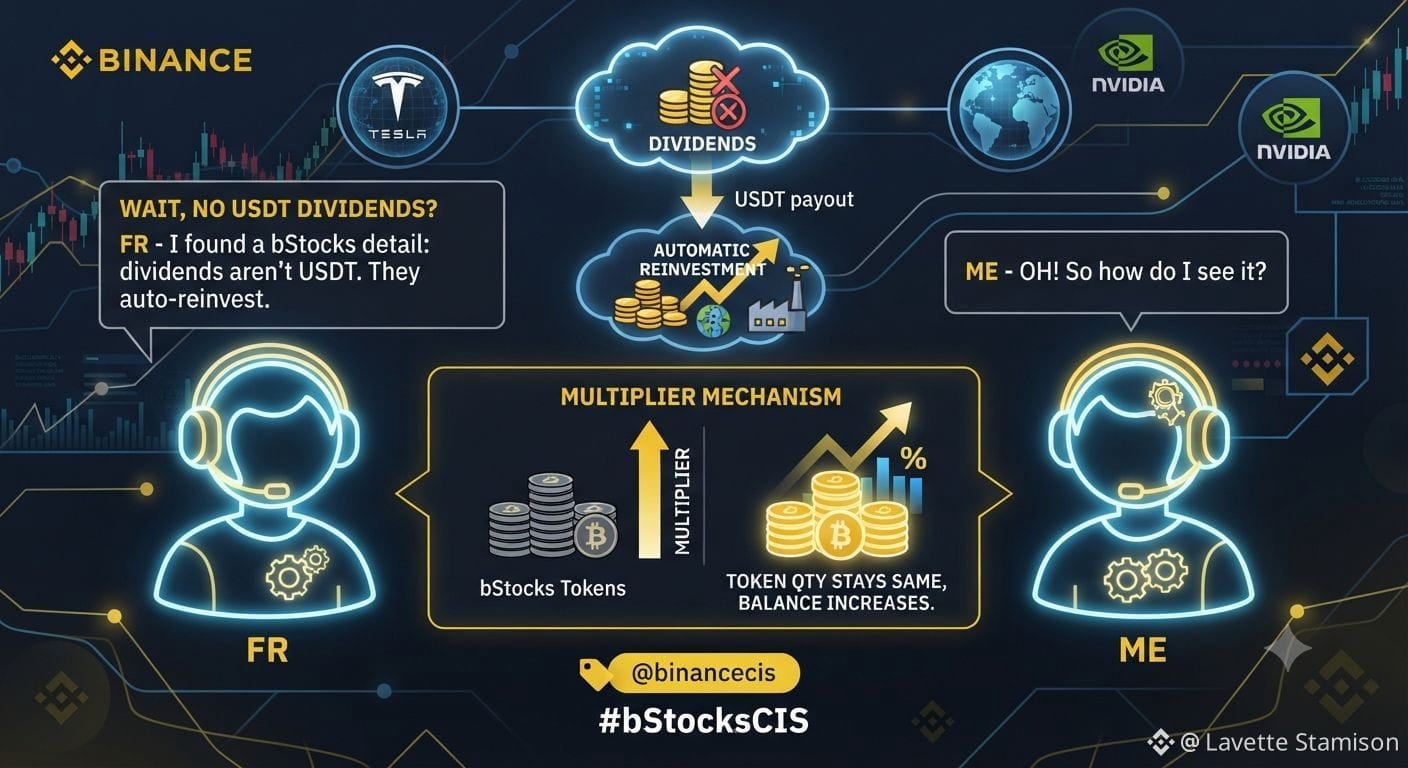
1
142
The world is getting digitalized, and even I, such an old guy, noticed it.
And it’s actually very good—everything becomes more accessible and gives the end user more control. Not long ago, I discovered bStocks.
If we keep it as simple as possible, they’re kind of like tokens that are essentially backed by real shares of different global companies (Tesla, NVIDIA, and so on). That is, buying one such token means you basically have one share in your hands.
What’s interesting is that we don’t need the open market or anything like that—everything works 24/7 right on the blockchain ($BNB Chain). So:
- We don’t wait for the market or anything—we can do everything 24/7.
- We can buy a piece of a share, even for 5 USDT. Imagine owning Tesla ($TSLAB ) for $5—like it’s nothing, but you’re already an investor, and that’s cool.
Where to find it and how to buy it on Binance?
1. Go to the Binance Spot Market section (or to the special bStocks section).
2. Enter the required ticker in the search, for example, $TSLAB (for Tesla shares) or others—the list is already quite large.
3. Purchase the asset with USDT just as easily as any crypto pair.
Have you already tested tokenized stocks in practice? Share your impressions and recommendations in the comments—we’ll learn together.
@BinanceCIS #bstockscis
The world is getting digitalized, and even I, such an old guy, noticed it.
And it’s actually very good—everything becomes more accessible and gives the end user more control. Not long ago, I discovered bStocks.
If we keep it as simple as possible, they’re kind of like tokens that are essentially backed by real shares of different global companies (Tesla, NVIDIA, and so on). That is, buying one such token means you basically have one share in your hands.
What’s interesting is that we don’t need the open market or anything like that—everything works 24/7 right on the blockchain ($BNB Chain). So:
- We don’t wait for the market or anything—we can do everything 24/7.
- We can buy a piece of a share, even for 5 USDT. Imagine owning Tesla ($TSLAB ) for $5—like it’s nothing, but you’re already an investor, and that’s cool.
Where to find it and how to buy it on Binance?
1. Go to the Binance Spot Market section (or to the special bStocks section).
2. Enter the required ticker in the search, for example, $TSLAB (for Tesla shares) or others—the list is already quite large.
3. Purchase the asset with USDT just as easily as any crypto pair.
Have you already tested tokenized stocks in practice? Share your impressions and recommendations in the comments—we’ll learn together.
@BinanceCIS #bstockscis
And it’s actually very good—everything becomes more accessible and gives the end user more control. Not long ago, I discovered bStocks.
If we keep it as simple as possible, they’re kind of like tokens that are essentially backed by real shares of different global companies (Tesla, NVIDIA, and so on). That is, buying one such token means you basically have one share in your hands.
What’s interesting is that we don’t need the open market or anything like that—everything works 24/7 right on the blockchain ($BNB Chain). So:
- We don’t wait for the market or anything—we can do everything 24/7.
- We can buy a piece of a share, even for 5 USDT. Imagine owning Tesla ($TSLAB ) for $5—like it’s nothing, but you’re already an investor, and that’s cool.
Where to find it and how to buy it on Binance?
1. Go to the Binance Spot Market section (or to the special bStocks section).
2. Enter the required ticker in the search, for example, $TSLAB (for Tesla shares) or others—the list is already quite large.
3. Purchase the asset with USDT just as easily as any crypto pair.
Have you already tested tokenized stocks in practice? Share your impressions and recommendations in the comments—we’ll learn together.
@BinanceCIS #bstockscis
1
93
Log in to explore more content
Join global crypto users on Binance Square
⚡️ Get latest and useful information about crypto.
💬 Trusted by the world’s largest crypto exchange.
👍 Discover real insights from verified creators.
Email / Phone number
Trending Topics
USWeighsPromotingDollarStablecoinsAbroad
1,047 views
94 Discussing
#USWeighsPromotingDollarStablecoinsAbroad
🚨 THE DOLLAR IS GOING DIGITAL — AND AMERICA WANTS THE WORLD TO USE IT!
🇺🇸 The United States is weighing ways to promote dollar-backed stablecoins overseas, potentially expanding the dollar's reach through blockchain technology.
💵 More global demand for USD stablecoins
🌍 Faster cross-border payments
🔗 Greater adoption of blockchain-based finance
📈 New opportunities for stablecoin issuers and crypto platforms
The dollar's next frontier may not be traditional banking — it could be the blockchain.
If the U.S. actively promotes dollar stablecoins abroad, it could accelerate global adoption of digital dollars and strengthen America's financial influence. For crypto markets, this may support stablecoin infrastructure, liquidity, and payment innovation. But regulatory challenges, competition from local currencies, and concerns over monetary sovereignty remain important factors to watch.
The future of money may be digital — but the currency could still be the dollar.
What do you think? Will dollar stablecoins dominate global digital payments? 👇
#Stablecoins #USDT #USDC #CryptoNews #Bitcoin #Blockchain #DigitalDollar #BinanceSquare
A_K Crypto
·0 Likes
·19 views
US10YTreasuryYieldHits19YearHigh
1,267 views
93 Discussing
SpotBitcoinETFsInflow$2.31BInFourDays
264 views
19 Discussing