
mai_33
5 Posts
Posts

·
--
Trading is actually very simple: when you reach the key points, look for signals to place orders. You don’t need to understand every single candlestick. Most people aren’t genius traders, and you can’t make money on every candlestick. KOLs analyze a bunch because they need to prove that their viewpoints are correct—no matter whether prices go up or down, they can find reasons. All kinds of theories get written out in thick volumes because they want to sell books and courses, and they hope to explain every candlestick clearly. But when you truly start placing orders, you’ll find that the market is ruthless—it won’t follow anyone’s analysis or ideas. Only in the key areas, the supply-demand/position exchange zones that have been repeatedly tested in real money, will you see a price reaction. What you can do in live trading is: at these key points, use stop-loss to experiment and iterate, and achieve a high reward-to-risk ratio. That’s the key to consistent profitability. Keep it up, genius traders!
Trading is actually very simple: when you reach the key points, look for signals to place orders. You don’t need to understand every single candlestick. Most people aren’t genius traders, and you can’t make money on every candlestick. KOLs analyze a bunch because they need to prove that their viewpoints are correct—no matter whether prices go up or down, they can find reasons. All kinds of theories get written out in thick volumes because they want to sell books and courses, and they hope to explain every candlestick clearly. But when you truly start placing orders, you’ll find that the market is ruthless—it won’t follow anyone’s analysis or ideas. Only in the key areas, the supply-demand/position exchange zones that have been repeatedly tested in real money, will you see a price reaction. What you can do in live trading is: at these key points, use stop-loss to experiment and iterate, and achieve a high reward-to-risk ratio. That’s the key to consistent profitability. Keep it up, genius traders!
87
·
--
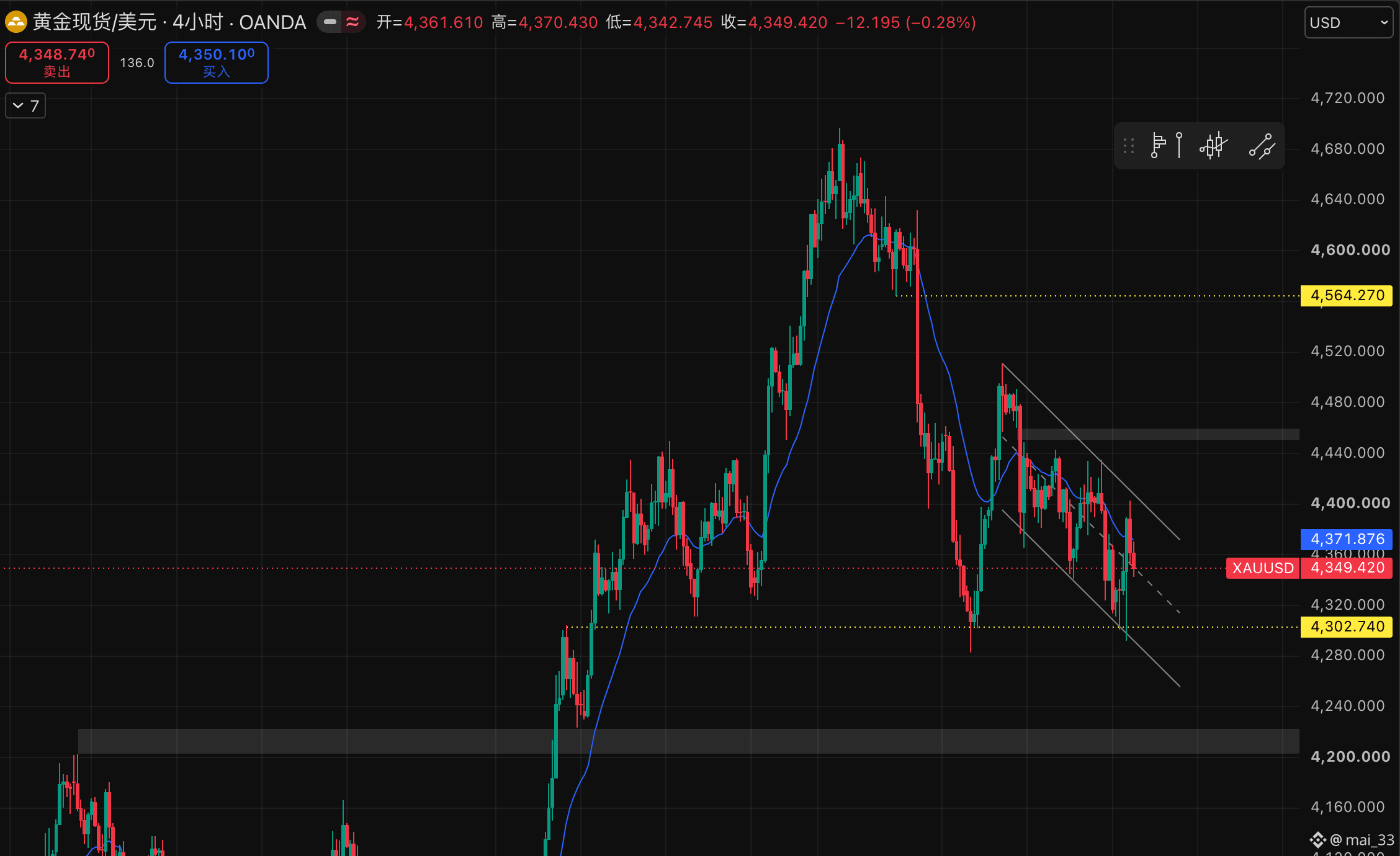
At the moment, gold is still ranging between 4450 and 4300. The area between 4430 and 4450 is a supply zone. I’ve tested this level three times: I made profit twice and once it broke even. Next, I’ll share my trading approach. Personally, I currently hold a short position at 4430. My preference is that price drops directly and breaks below 4300, which would allow us to see 4200. Then we can range between 4200 and 4300. If things don’t go the way I want and price rises instead, then I’ll look for sell signals in the 4430 to 4460 range. If the stop-loss is hit there, I’ll look for sell signals in the gap area below 4650. If I get stopped out again, then I accept the loss.
Although I’m bearish, the market can move however it wants—we can watch as many KOLs as we like, but it doesn’t matter. What matters is responding based on the market’s走势. Setting a plan is the most important.
My long-term trades can usually achieve a risk-reward ratio of 1:10. So if there’s a rebound and my loss is 2R, that’s still acceptable. The only part that feels uncomfortable is that my hedged long position was stopped out by a spike in Friday’s CPI data, which makes the operation a bit passive. If price goes up, profits will retreat. So if there’s a long signal near 4300—even though I’m bearish—I will still do the long hedge. That stop-loss would only cost 1R, and besides, the short position is currently in profit. If price rises, the profit could retreat by more than 1R. From a risk-reward ratio perspective, I will definitely take this hedge.
#黄金 #cpi
At the moment, gold is still ranging between 4450 and 4300. The area between 4430 and 4450 is a supply zone. I’ve tested this level three times: I made profit twice and once it broke even. Next, I’ll share my trading approach. Personally, I currently hold a short position at 4430. My preference is that price drops directly and breaks below 4300, which would allow us to see 4200. Then we can range between 4200 and 4300. If things don’t go the way I want and price rises instead, then I’ll look for sell signals in the 4430 to 4460 range. If the stop-loss is hit there, I’ll look for sell signals in the gap area below 4650. If I get stopped out again, then I accept the loss.
Although I’m bearish, the market can move however it wants—we can watch as many KOLs as we like, but it doesn’t matter. What matters is responding based on the market’s走势. Setting a plan is the most important.
My long-term trades can usually achieve a risk-reward ratio of 1:10. So if there’s a rebound and my loss is 2R, that’s still acceptable. The only part that feels uncomfortable is that my hedged long position was stopped out by a spike in Friday’s CPI data, which makes the operation a bit passive. If price goes up, profits will retreat. So if there’s a long signal near 4300—even though I’m bearish—I will still do the long hedge. That stop-loss would only cost 1R, and besides, the short position is currently in profit. If price rises, the profit could retreat by more than 1R. From a risk-reward ratio perspective, I will definitely take this hedge.
#黄金 #cpi
Although I’m bearish, the market can move however it wants—we can watch as many KOLs as we like, but it doesn’t matter. What matters is responding based on the market’s走势. Setting a plan is the most important.
My long-term trades can usually achieve a risk-reward ratio of 1:10. So if there’s a rebound and my loss is 2R, that’s still acceptable. The only part that feels uncomfortable is that my hedged long position was stopped out by a spike in Friday’s CPI data, which makes the operation a bit passive. If price goes up, profits will retreat. So if there’s a long signal near 4300—even though I’m bearish—I will still do the long hedge. That stop-loss would only cost 1R, and besides, the short position is currently in profit. If price rises, the profit could retreat by more than 1R. From a risk-reward ratio perspective, I will definitely take this hedge.
#黄金 #cpi
1.1k
Log in to explore more content
Join global crypto users on Binance Square
⚡️ Get latest and useful information about crypto.
💬 Trusted by the world’s largest crypto exchange.
👍 Discover real insights from verified creators.
Email / Phone number
Trending Topics
AnthropicCEOCallsForAISlowdown
16,058 views
314 Discussing
#anthropicceocallsforaislowdown Three of the world's top artificial intelligence companies' CEOs announced Saturday that they believe the industry needs to slow down
.
On Saturday, Dario Amodei of
Anthropic, Sam Altman of OpenAI and Elon Musk of xAI publicly backed a call to reduce the pace at which AI companies build more powerful models.$IOTX $WAXP $0G
Isabella-I
·1 Likes
·480 views
AnthropicChoosesNasdaqForPotentialIPO
3,766 views
90 Discussing
SECReceivesGrayscaleLitecoinTrustETFFiling
133,906 views
1,821 Discussing