
尤可欣Isadora
133 Posts

尤可欣Isadora
Report
Block User
Twitter:@isadora288881 野生博主
1 Following
338 Followers
716 Liked
Posts
All
Videos
·
--
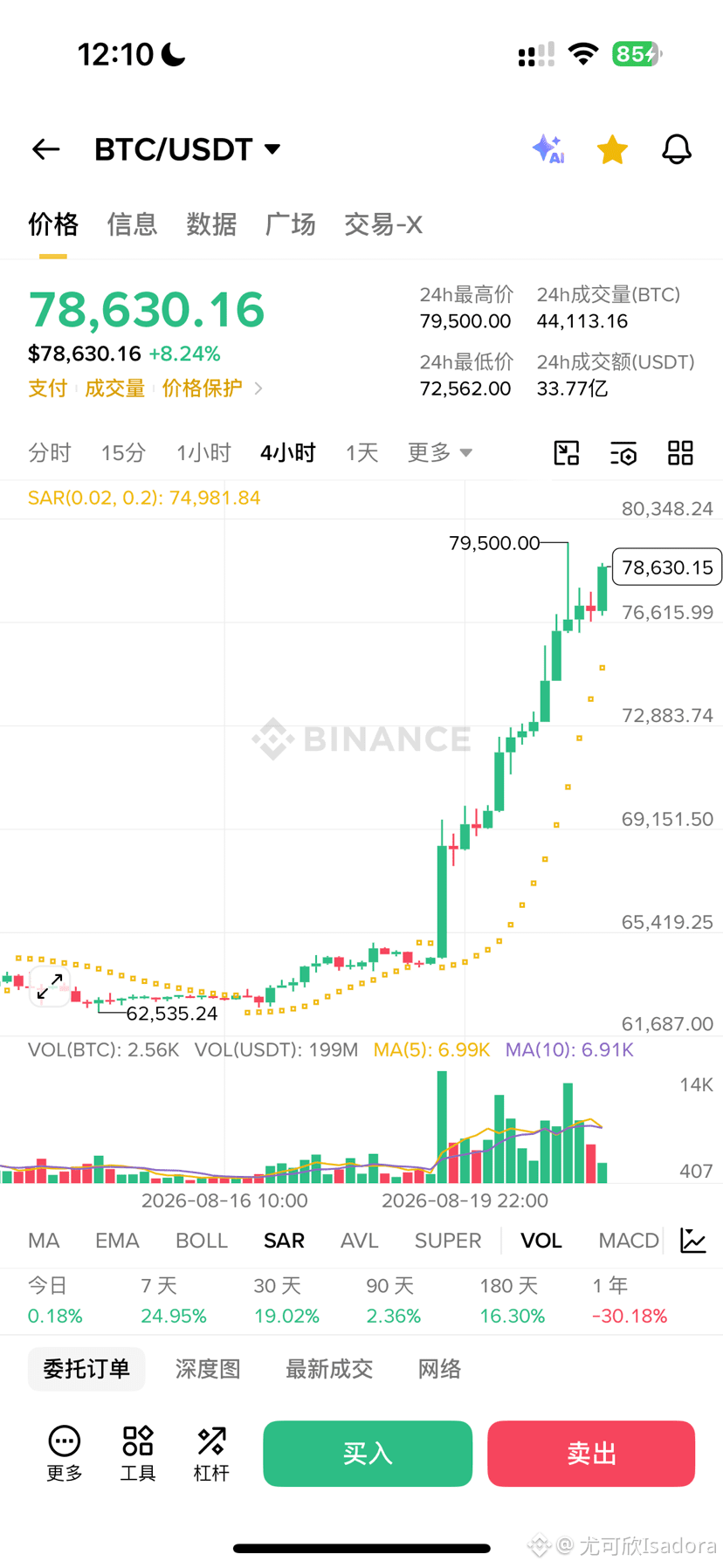
Institutions and big whales are arguing at the same price level, while we’re waiting for tomorrow’s medical check report.Today, BTC is trading around 78,000; over the past 24 hours it’s down 1%. ETH is stuck around 2,500. Global total market cap is 2.76 trillion, down 0.9%.
It looks like giving up and lying flat, but actually it’s being held back.
Let’s talk about the drivers of the gains and losses—there are three things weighing on everything at the same time.
First, tomorrow morning at 8:30 a.m., August CPI—July year-on-year is already 3.4% and it has been falling for two straight months, but nobody dares to bet on a third month.
Second, the day after CPI is released comes the FOMC on September 16. The market currently assigns a 60% probability to a 25bp rate hike. And this year, the words “rate hike” have been discussed so seriously for the first time.
Third, Brent oil is touching 99. Meanwhile, fighting is still going on in the Middle East—if crude moves even a little, inflation expectations move right along with it.
Institutions and big whales are arguing at the same price level, while we’re waiting for tomorrow’s medical check report.
Today, BTC is trading around 78,000; over the past 24 hours it’s down 1%. ETH is stuck around 2,500. Global total market cap is 2.76 trillion, down 0.9%.
It looks like giving up and lying flat, but actually it’s being held back.
Let’s talk about the drivers of the gains and losses—there are three things weighing on everything at the same time.
First, tomorrow morning at 8:30 a.m., August CPI—July year-on-year is already 3.4% and it has been falling for two straight months, but nobody dares to bet on a third month.
Second, the day after CPI is released comes the FOMC on September 16. The market currently assigns a 60% probability to a 25bp rate hike. And this year, the words “rate hike” have been discussed so seriously for the first time.
Third, Brent oil is touching 99. Meanwhile, fighting is still going on in the Middle East—if crude moves even a little, inflation expectations move right along with it.
It looks like giving up and lying flat, but actually it’s being held back.
Let’s talk about the drivers of the gains and losses—there are three things weighing on everything at the same time.
First, tomorrow morning at 8:30 a.m., August CPI—July year-on-year is already 3.4% and it has been falling for two straight months, but nobody dares to bet on a third month.
Second, the day after CPI is released comes the FOMC on September 16. The market currently assigns a 60% probability to a 25bp rate hike. And this year, the words “rate hike” have been discussed so seriously for the first time.
Third, Brent oil is touching 99. Meanwhile, fighting is still going on in the Middle East—if crude moves even a little, inflation expectations move right along with it.
254
·
--
Bitcoin is still halfway up the hill, but the money has already slipped into gold’s warm bed
First, look at the numbers. As of yesterday, Bitcoin has been hovering around $78,000. It dipped to about $58,000 at the end of June. Over more than two months, it’s rebounded more than thirty percent. It sounds very inspiring—but put it next to last October’s high of $126,000, and it still has almost forty percent of the road left to go. All figures are for that day.
Most people feel this way at this point. It’s like after a breakup—you finally get over it. You can eat, sleep, and go to work. But the moment someone mentions that name, there’s still a hollow spot in your chest.
But the market never waits for anyone to move on.
In the same period, RWA grew from 5.5 billion dollars at the start of 2025 to today’s level of around 30 billion. Tokenized U.S. Treasuries, private credit, and tokenized gold are all heading upward. Different groups may use slightly different counting methods, so don’t get too hung up on the exact numbers—but the direction is consistent. Especially gold: in just the first quarter of this year, spot trading volume alone reached around 90 billion dollars, directly surpassing all of 2025.
So what does that mean? It means the money isn’t gone—it just doesn’t want to “date” anymore. It wants something stable, something with returns it can calculate clearly.
The Fed is still fanning the flames. The market is currently pricing a probability of more than 60% for a 25-basis-point rate hike within the month. Rate hikes mean interest-free assets get blamed. Bitcoin doesn’t pay interest, and neither does Ethereum. But tokenized U.S. Treasuries do. And behind tokenized gold, at least there are real assets backing it. That’s why, on the same chain, some people are losing money while others are collecting rent.
My take is that this round isn’t a question of bull vs. bear—it’s an aesthetic shift. In the last cycle, everyone loved optionality. This cycle, everyone loves certainty. Like how at twenty you like poets who write; at thirty you prefer someone who pays rent.
It’s not that poets are bad. It’s just that bills don’t care about poetry.
So don’t rush to blame anyone for betraying their beliefs. Assets never had beliefs in the first place—they simply flow back to where returns are clearest.
If we’re going to be practical, what I’ve been watching lately isn’t price—it’s structure: which things on-chain truly generate cash flow, and which ones are merely telling the next narrative. Once you separate those two, a bear market isn’t that hard to endure.
No trade calls. No predictions. Your position is your responsibility. Take care of yourselves.
#Bitcoin #RWA #TokenizedGold #FederalReserve #CryptoMarket
Bitcoin is still halfway up the hill, but the money has already slipped into gold’s warm bed
First, look at the numbers. As of yesterday, Bitcoin has been hovering around $78,000. It dipped to about $58,000 at the end of June. Over more than two months, it’s rebounded more than thirty percent. It sounds very inspiring—but put it next to last October’s high of $126,000, and it still has almost forty percent of the road left to go. All figures are for that day.
Most people feel this way at this point. It’s like after a breakup—you finally get over it. You can eat, sleep, and go to work. But the moment someone mentions that name, there’s still a hollow spot in your chest.
But the market never waits for anyone to move on.
In the same period, RWA grew from 5.5 billion dollars at the start of 2025 to today’s level of around 30 billion. Tokenized U.S. Treasuries, private credit, and tokenized gold are all heading upward. Different groups may use slightly different counting methods, so don’t get too hung up on the exact numbers—but the direction is consistent. Especially gold: in just the first quarter of this year, spot trading volume alone reached around 90 billion dollars, directly surpassing all of 2025.
So what does that mean? It means the money isn’t gone—it just doesn’t want to “date” anymore. It wants something stable, something with returns it can calculate clearly.
The Fed is still fanning the flames. The market is currently pricing a probability of more than 60% for a 25-basis-point rate hike within the month. Rate hikes mean interest-free assets get blamed. Bitcoin doesn’t pay interest, and neither does Ethereum. But tokenized U.S. Treasuries do. And behind tokenized gold, at least there are real assets backing it. That’s why, on the same chain, some people are losing money while others are collecting rent.
My take is that this round isn’t a question of bull vs. bear—it’s an aesthetic shift. In the last cycle, everyone loved optionality. This cycle, everyone loves certainty. Like how at twenty you like poets who write; at thirty you prefer someone who pays rent.
It’s not that poets are bad. It’s just that bills don’t care about poetry.
So don’t rush to blame anyone for betraying their beliefs. Assets never had beliefs in the first place—they simply flow back to where returns are clearest.
If we’re going to be practical, what I’ve been watching lately isn’t price—it’s structure: which things on-chain truly generate cash flow, and which ones are merely telling the next narrative. Once you separate those two, a bear market isn’t that hard to endure.
No trade calls. No predictions. Your position is your responsibility. Take care of yourselves.
#Bitcoin #RWA #TokenizedGold #FederalReserve #CryptoMarket
First, look at the numbers. As of yesterday, Bitcoin has been hovering around $78,000. It dipped to about $58,000 at the end of June. Over more than two months, it’s rebounded more than thirty percent. It sounds very inspiring—but put it next to last October’s high of $126,000, and it still has almost forty percent of the road left to go. All figures are for that day.
Most people feel this way at this point. It’s like after a breakup—you finally get over it. You can eat, sleep, and go to work. But the moment someone mentions that name, there’s still a hollow spot in your chest.
But the market never waits for anyone to move on.
In the same period, RWA grew from 5.5 billion dollars at the start of 2025 to today’s level of around 30 billion. Tokenized U.S. Treasuries, private credit, and tokenized gold are all heading upward. Different groups may use slightly different counting methods, so don’t get too hung up on the exact numbers—but the direction is consistent. Especially gold: in just the first quarter of this year, spot trading volume alone reached around 90 billion dollars, directly surpassing all of 2025.
So what does that mean? It means the money isn’t gone—it just doesn’t want to “date” anymore. It wants something stable, something with returns it can calculate clearly.
The Fed is still fanning the flames. The market is currently pricing a probability of more than 60% for a 25-basis-point rate hike within the month. Rate hikes mean interest-free assets get blamed. Bitcoin doesn’t pay interest, and neither does Ethereum. But tokenized U.S. Treasuries do. And behind tokenized gold, at least there are real assets backing it. That’s why, on the same chain, some people are losing money while others are collecting rent.
My take is that this round isn’t a question of bull vs. bear—it’s an aesthetic shift. In the last cycle, everyone loved optionality. This cycle, everyone loves certainty. Like how at twenty you like poets who write; at thirty you prefer someone who pays rent.
It’s not that poets are bad. It’s just that bills don’t care about poetry.
So don’t rush to blame anyone for betraying their beliefs. Assets never had beliefs in the first place—they simply flow back to where returns are clearest.
If we’re going to be practical, what I’ve been watching lately isn’t price—it’s structure: which things on-chain truly generate cash flow, and which ones are merely telling the next narrative. Once you separate those two, a bear market isn’t that hard to endure.
No trade calls. No predictions. Your position is your responsibility. Take care of yourselves.
#Bitcoin #RWA #TokenizedGold #FederalReserve #CryptoMarket
993
·
--
Evening recap: It’s not that nobody plays the sideways market—everyone is waiting for that number on FridayToday’s candlestick—one word sums it up: pretending to be dead.
BTC traded sideways around 78,000 for the whole day. ETH 2484, SOL 103. Total market cap is 2.78 trillion. The market’s gains and losses are just hovering around the decimal point. The greed index is still in the greed zone—but no one really dares to get greedy.
First, let’s talk about why it hasn’t moved.
There are two stones pressing down above. One is oil. The situation around the U.S.-Iran side is still fighting—Hormuz is almost completely shut. Oil is sitting at a five-week high. When oil is expensive, inflation won’t cool. If inflation doesn’t fall, the Fed has to face the “keep-hiking” pressure. Now the market is pricing in a 60.4% probability of a 25bp rate hike on September 16. The odds of not cutting at all for the whole year are ridiculously high.
Evening recap: It’s not that nobody plays the sideways market—everyone is waiting for that number on Friday
Today’s candlestick—one word sums it up: pretending to be dead.
BTC traded sideways around 78,000 for the whole day. ETH 2484, SOL 103. Total market cap is 2.78 trillion. The market’s gains and losses are just hovering around the decimal point. The greed index is still in the greed zone—but no one really dares to get greedy.
First, let’s talk about why it hasn’t moved.
There are two stones pressing down above. One is oil. The situation around the U.S.-Iran side is still fighting—Hormuz is almost completely shut. Oil is sitting at a five-week high. When oil is expensive, inflation won’t cool. If inflation doesn’t fall, the Fed has to face the “keep-hiking” pressure. Now the market is pricing in a 60.4% probability of a 25bp rate hike on September 16. The odds of not cutting at all for the whole year are ridiculously high.
BTC traded sideways around 78,000 for the whole day. ETH 2484, SOL 103. Total market cap is 2.78 trillion. The market’s gains and losses are just hovering around the decimal point. The greed index is still in the greed zone—but no one really dares to get greedy.
First, let’s talk about why it hasn’t moved.
There are two stones pressing down above. One is oil. The situation around the U.S.-Iran side is still fighting—Hormuz is almost completely shut. Oil is sitting at a five-week high. When oil is expensive, inflation won’t cool. If inflation doesn’t fall, the Fed has to face the “keep-hiking” pressure. Now the market is pricing in a 60.4% probability of a 25bp rate hike on September 16. The odds of not cutting at all for the whole year are ridiculously high.
169
·
--
Verified

Article
What kind of concept is 30 billion US dollars?What kind of concept is 30 billion US dollars?
It means that in a span of 90 days, almost 4,000 US dollars are being traded every second
The total box office revenue sold by all movie theaters worldwide in one year adds up to about this amount
It’s about the size of Iceland’s GDP for a year
It’s equal to more than Moutai’s entire year’s revenue, and also equal to 300 tons of gold
-
And this data comes from bStocks’ trading volume over three months
Take another look at the stock market’s current situation
A 2004 vintage antique chip has increased in price
DDR2, an old item from more than twenty years ago
Now it’s being hyped up to nearly 1 US dollar
How big is the flood? Look at how many layers it has reached
It has flooded down to the archaeological layer 🙃
AI computing power is already so hot that it’s squeezing the upstream across the board
What kind of concept is 30 billion US dollars?
What kind of concept is 30 billion US dollars?
It means that in a span of 90 days, almost 4,000 US dollars are being traded every second
The total box office revenue sold by all movie theaters worldwide in one year adds up to about this amount
It’s about the size of Iceland’s GDP for a year
It’s equal to more than Moutai’s entire year’s revenue, and also equal to 300 tons of gold
-
And this data comes from bStocks’ trading volume over three months
Take another look at the stock market’s current situation
A 2004 vintage antique chip has increased in price
DDR2, an old item from more than twenty years ago
Now it’s being hyped up to nearly 1 US dollar
How big is the flood? Look at how many layers it has reached
It has flooded down to the archaeological layer 🙃
AI computing power is already so hot that it’s squeezing the upstream across the board
It means that in a span of 90 days, almost 4,000 US dollars are being traded every second
The total box office revenue sold by all movie theaters worldwide in one year adds up to about this amount
It’s about the size of Iceland’s GDP for a year
It’s equal to more than Moutai’s entire year’s revenue, and also equal to 300 tons of gold
-
And this data comes from bStocks’ trading volume over three months
Take another look at the stock market’s current situation
A 2004 vintage antique chip has increased in price
DDR2, an old item from more than twenty years ago
Now it’s being hyped up to nearly 1 US dollar
How big is the flood? Look at how many layers it has reached
It has flooded down to the archaeological layer 🙃
AI computing power is already so hot that it’s squeezing the upstream across the board
1k
·
--
BTC dips below 80,000, but the real signal isn’t in the candlestick chart—it’s that someone quietly changed the carNo need to say much about today’s market. BTC is hovering around 78,500. It closed yesterday at 79,116, down 1.54%. During today’s session it even probed lower. ETH closed at 2,491, down only 0.94%. SOL fell the hardest—103.87, down 2.43%. XRP was 1.3978, down 1.76%. (Intraday data is subject to real-time exchange feeds.)
First, explain why it’s falling
This pullback has nothing to do with crypto itself—it’s a money matter. U.S. employment data is insanely strong. The 10-year Treasury yield has risen to 4.80%, the highest since the end of 2023. The market went from expecting rate cuts at the start of the year to now betting on rate hikes instead, with the probability climbing all the way to over sixty percent.
And on top of that, the Middle East situation has made oil supply hard to come by. The most uncontrollable component of inflation is being kept under pressure—so even if the Fed wants to be gentle, it can’t be.
BTC dips below 80,000, but the real signal isn’t in the candlestick chart—it’s that someone quietly changed the car
No need to say much about today’s market. BTC is hovering around 78,500. It closed yesterday at 79,116, down 1.54%. During today’s session it even probed lower. ETH closed at 2,491, down only 0.94%. SOL fell the hardest—103.87, down 2.43%. XRP was 1.3978, down 1.76%. (Intraday data is subject to real-time exchange feeds.)
First, explain why it’s falling
This pullback has nothing to do with crypto itself—it’s a money matter. U.S. employment data is insanely strong. The 10-year Treasury yield has risen to 4.80%, the highest since the end of 2023. The market went from expecting rate cuts at the start of the year to now betting on rate hikes instead, with the probability climbing all the way to over sixty percent.
And on top of that, the Middle East situation has made oil supply hard to come by. The most uncontrollable component of inflation is being kept under pressure—so even if the Fed wants to be gentle, it can’t be.
First, explain why it’s falling
This pullback has nothing to do with crypto itself—it’s a money matter. U.S. employment data is insanely strong. The 10-year Treasury yield has risen to 4.80%, the highest since the end of 2023. The market went from expecting rate cuts at the start of the year to now betting on rate hikes instead, with the probability climbing all the way to over sixty percent.
And on top of that, the Middle East situation has made oil supply hard to come by. The most uncontrollable component of inflation is being kept under pressure—so even if the Fed wants to be gentle, it can’t be.
1
413
·
--
Nvidia has spent $12.9 billion to acquire Hugging Face—its 8-K filing is already done
Many people’s first reaction was “Old Huang is buying, buying, buying again.” But this deal is different. Hugging Face is the world’s largest open-source model and dataset distribution platform—essentially an “app store” for AI.
After selling shovels all the way to today, Huang suddenly bought the mine’s map as well. CUDA locks down the underlying compute power, while HF locks down the model distribution entry point. The moat has stretched from hardware all the way into the ecosystem.
The highest form of “catching up” isn’t sending flowers every day. It’s buying the shop she goes to every day, so wherever she goes, she can’t avoid you.
In the short term, compute power remains the hard currency—but keep in mind that delivery won’t be completed until the first half of 2027. Anti-monopoly review is the biggest variable.
The above is compiled from publicly available information and does not constitute investment advice
Nvidia has spent $12.9 billion to acquire Hugging Face—its 8-K filing is already done
Many people’s first reaction was “Old Huang is buying, buying, buying again.” But this deal is different. Hugging Face is the world’s largest open-source model and dataset distribution platform—essentially an “app store” for AI.
After selling shovels all the way to today, Huang suddenly bought the mine’s map as well. CUDA locks down the underlying compute power, while HF locks down the model distribution entry point. The moat has stretched from hardware all the way into the ecosystem.
The highest form of “catching up” isn’t sending flowers every day. It’s buying the shop she goes to every day, so wherever she goes, she can’t avoid you.
In the short term, compute power remains the hard currency—but keep in mind that delivery won’t be completed until the first half of 2027. Anti-monopoly review is the biggest variable.
The above is compiled from publicly available information and does not constitute investment advice
Many people’s first reaction was “Old Huang is buying, buying, buying again.” But this deal is different. Hugging Face is the world’s largest open-source model and dataset distribution platform—essentially an “app store” for AI.
After selling shovels all the way to today, Huang suddenly bought the mine’s map as well. CUDA locks down the underlying compute power, while HF locks down the model distribution entry point. The moat has stretched from hardware all the way into the ecosystem.
The highest form of “catching up” isn’t sending flowers every day. It’s buying the shop she goes to every day, so wherever she goes, she can’t avoid you.
In the short term, compute power remains the hard currency—but keep in mind that delivery won’t be completed until the first half of 2027. Anti-monopoly review is the biggest variable.
The above is compiled from publicly available information and does not constitute investment advice
52
·
--
Verified
ZEC climbs to 10th by market cap—up 370% in three months, pushing Dogecoin down
Many people ask how privacy coins suddenly became viable. Actually, it’s still the same ZEC. What changed is that it got an ID. Grayscale converted its trust into a spot ETF—institutions can now buy it legitimately and openly.
The pattern is pretty interesting. When something rises, it’s often not that it suddenly got stronger—it’s that it suddenly got permitted. Like certain relationships: it’s not that you improved; it’s that the other side finally agreed to acknowledge you publicly.
The privacy narrative has just caught fire. Don’t just treat it as a one-off squeeze—then keep an eye on whether the spot buy orders can hold up.
The above is a compilation of publicly available information and does not constitute investment advice
ZEC climbs to 10th by market cap—up 370% in three months, pushing Dogecoin down
Many people ask how privacy coins suddenly became viable. Actually, it’s still the same ZEC. What changed is that it got an ID. Grayscale converted its trust into a spot ETF—institutions can now buy it legitimately and openly.
The pattern is pretty interesting. When something rises, it’s often not that it suddenly got stronger—it’s that it suddenly got permitted. Like certain relationships: it’s not that you improved; it’s that the other side finally agreed to acknowledge you publicly.
The privacy narrative has just caught fire. Don’t just treat it as a one-off squeeze—then keep an eye on whether the spot buy orders can hold up.
The above is a compilation of publicly available information and does not constitute investment advice
Many people ask how privacy coins suddenly became viable. Actually, it’s still the same ZEC. What changed is that it got an ID. Grayscale converted its trust into a spot ETF—institutions can now buy it legitimately and openly.
The pattern is pretty interesting. When something rises, it’s often not that it suddenly got stronger—it’s that it suddenly got permitted. Like certain relationships: it’s not that you improved; it’s that the other side finally agreed to acknowledge you publicly.
The privacy narrative has just caught fire. Don’t just treat it as a one-off squeeze—then keep an eye on whether the spot buy orders can hold up.
The above is a compilation of publicly available information and does not constitute investment advice
1.1k
·
--
Don’t wait.
This kind of aggressive surge usually pulls all the way until you’re thinking about getting in but keep waiting for a pullback—waiting until your regrets turn your guts green. You want to get on the train but you’re afraid to. All you’re doing is waiting for a pullback.
But who knows? There wasn’t even a hint of a reversal—just nonstop brutal pumping with no end.
You tell yourself, “It’s fine. It will definitely pull back,” and you keep waiting.
Then it keeps surging day after day. Damn it—you finally realize, “Wow, it’s really going up!” You finally can’t hold back and you jump in.
And then… of course it’s time to drop. …. #btc
Don’t wait.
This kind of aggressive surge usually pulls all the way until you’re thinking about getting in but keep waiting for a pullback—waiting until your regrets turn your guts green. You want to get on the train but you’re afraid to. All you’re doing is waiting for a pullback.
But who knows? There wasn’t even a hint of a reversal—just nonstop brutal pumping with no end.
You tell yourself, “It’s fine. It will definitely pull back,” and you keep waiting.
Then it keeps surging day after day. Damn it—you finally realize, “Wow, it’s really going up!” You finally can’t hold back and you jump in.
And then… of course it’s time to drop. …. #btc
This kind of aggressive surge usually pulls all the way until you’re thinking about getting in but keep waiting for a pullback—waiting until your regrets turn your guts green. You want to get on the train but you’re afraid to. All you’re doing is waiting for a pullback.
But who knows? There wasn’t even a hint of a reversal—just nonstop brutal pumping with no end.
You tell yourself, “It’s fine. It will definitely pull back,” and you keep waiting.
Then it keeps surging day after day. Damn it—you finally realize, “Wow, it’s really going up!” You finally can’t hold back and you jump in.
And then… of course it’s time to drop. …. #btc
2
1
2.1k
·
--

Article
Cold knowledge: None of the 328,000-plus bitcoins in the U.S. government’s hands were boughtFirst, let me tell you a fact that most people don’t know
The U.S. government has those 328,000-plus bitcoins
Not a single one was bought
They’re all seized via investigations—drug dealers caught, darknet items one by one confiscated and handed over
This figure was first disclosed this May by White House digital asset adviser Witt: 328,372 bitcoins, then worth about $25.4 billion
Then over the past couple of days, Trump has been making remarks
At the White House, he met with crypto executives and said the U.S. is considering “large-scale” purchases of Bitcoin
Treasury Secretary Bessent also floated the idea of increasing holdings; the market is excited
But I want to break down this news into three layers for you to see
Cold knowledge: None of the 328,000-plus bitcoins in the U.S. government’s hands were bought
First, let me tell you a fact that most people don’t know
The U.S. government has those 328,000-plus bitcoins
Not a single one was bought
They’re all seized via investigations—drug dealers caught, darknet items one by one confiscated and handed over
This figure was first disclosed this May by White House digital asset adviser Witt: 328,372 bitcoins, then worth about $25.4 billion
Then over the past couple of days, Trump has been making remarks
At the White House, he met with crypto executives and said the U.S. is considering “large-scale” purchases of Bitcoin
Treasury Secretary Bessent also floated the idea of increasing holdings; the market is excited
But I want to break down this news into three layers for you to see
The U.S. government has those 328,000-plus bitcoins
Not a single one was bought
They’re all seized via investigations—drug dealers caught, darknet items one by one confiscated and handed over
This figure was first disclosed this May by White House digital asset adviser Witt: 328,372 bitcoins, then worth about $25.4 billion
Then over the past couple of days, Trump has been making remarks
At the White House, he met with crypto executives and said the U.S. is considering “large-scale” purchases of Bitcoin
Treasury Secretary Bessent also floated the idea of increasing holdings; the market is excited
But I want to break down this news into three layers for you to see
221
·
--
This week has gone insane—but the credit isn’t in the crypto world. It’s U.S. Treasuries, the quiet buyer.Today, at around midnight, BTC briefly touched 79,400—just $600 away from hitting 80,000. But once the U.S. session opened, it slid back to around 77,000. Within a single day, it gives you hope first, then leaves you with that aftertaste. A familiar recipe, the usual routine.
ETH has risen 25% over the past seven days, up and down around 2350—stronger than BTC. The ETH/BTC rate has already stuck right up against the old resistance line at 0.03 as it grinds, and grinds past it. In this round, ETH is the star.
Counting it for the whole week, this is BTC’s best week since 2023. Last week it was still in the cold palace; this week it’s gone straight back to the favored consort position.
As for why it’s going up—honestly, it’s not very romantic.
In one sentence, CoinShares research head Butterfill summed up what’s really going on: this wave is mainly a macro story, not one driven by crypto itself. The Treasury expanded bond buybacks; CPI came in below expectations; and nonfarm payrolls were weak. These three things lined up, giving rate expectations at the long end room to move lower. Risk assets collectively exhaled. Bitcoin was just the one that reacted most sharply.
This week has gone insane—but the credit isn’t in the crypto world. It’s U.S. Treasuries, the quiet buyer.
Today, at around midnight, BTC briefly touched 79,400—just $600 away from hitting 80,000. But once the U.S. session opened, it slid back to around 77,000. Within a single day, it gives you hope first, then leaves you with that aftertaste. A familiar recipe, the usual routine.
ETH has risen 25% over the past seven days, up and down around 2350—stronger than BTC. The ETH/BTC rate has already stuck right up against the old resistance line at 0.03 as it grinds, and grinds past it. In this round, ETH is the star.
Counting it for the whole week, this is BTC’s best week since 2023. Last week it was still in the cold palace; this week it’s gone straight back to the favored consort position.
As for why it’s going up—honestly, it’s not very romantic.
In one sentence, CoinShares research head Butterfill summed up what’s really going on: this wave is mainly a macro story, not one driven by crypto itself. The Treasury expanded bond buybacks; CPI came in below expectations; and nonfarm payrolls were weak. These three things lined up, giving rate expectations at the long end room to move lower. Risk assets collectively exhaled. Bitcoin was just the one that reacted most sharply.
ETH has risen 25% over the past seven days, up and down around 2350—stronger than BTC. The ETH/BTC rate has already stuck right up against the old resistance line at 0.03 as it grinds, and grinds past it. In this round, ETH is the star.
Counting it for the whole week, this is BTC’s best week since 2023. Last week it was still in the cold palace; this week it’s gone straight back to the favored consort position.
As for why it’s going up—honestly, it’s not very romantic.
In one sentence, CoinShares research head Butterfill summed up what’s really going on: this wave is mainly a macro story, not one driven by crypto itself. The Treasury expanded bond buybacks; CPI came in below expectations; and nonfarm payrolls were weak. These three things lined up, giving rate expectations at the long end room to move lower. Risk assets collectively exhaled. Bitcoin was just the one that reacted most sharply.
479
·
--
Some people’s spotlight moments are someone else’s highest buy-in priceUnitree rang the bell at the SSE last Friday. The opening price surged to more than six times—up 629%. At one point, its market value briefly touched 444.9 billion yuan. That day, every post in my朋友圈 (WeChat Moments) was full of screenshots. Stories of making several hundred thousand from signing the trade flew everywhere.
For all the excitement, what I want to talk about is another set of numbers. From the peak—around 1100—over the past two days, it gave back more than 20%. Now it’s around 800+. That means that for the people who were most thrilled on the day it rang the bell and bought at the highest price, they’re currently sitting on an unrealized loss of about 37.5%.
This scene feels all too familiar. The most glorious moment of a company is often not the moment worth buying. It’s precisely the most expensive moment instead. All good news is put on display, and every emotion reaches its peak. You think you’re getting on the train—but in fact, you’re just being asked to exit for someone else to take over.
Some people’s spotlight moments are someone else’s highest buy-in price
Unitree rang the bell at the SSE last Friday. The opening price surged to more than six times—up 629%. At one point, its market value briefly touched 444.9 billion yuan. That day, every post in my朋友圈 (WeChat Moments) was full of screenshots. Stories of making several hundred thousand from signing the trade flew everywhere.
For all the excitement, what I want to talk about is another set of numbers. From the peak—around 1100—over the past two days, it gave back more than 20%. Now it’s around 800+. That means that for the people who were most thrilled on the day it rang the bell and bought at the highest price, they’re currently sitting on an unrealized loss of about 37.5%.
This scene feels all too familiar. The most glorious moment of a company is often not the moment worth buying. It’s precisely the most expensive moment instead. All good news is put on display, and every emotion reaches its peak. You think you’re getting on the train—but in fact, you’re just being asked to exit for someone else to take over.
For all the excitement, what I want to talk about is another set of numbers. From the peak—around 1100—over the past two days, it gave back more than 20%. Now it’s around 800+. That means that for the people who were most thrilled on the day it rang the bell and bought at the highest price, they’re currently sitting on an unrealized loss of about 37.5%.
This scene feels all too familiar. The most glorious moment of a company is often not the moment worth buying. It’s precisely the most expensive moment instead. All good news is put on display, and every emotion reaches its peak. You think you’re getting on the train—but in fact, you’re just being asked to exit for someone else to take over.
82
·
--
DCA Is Like a Lukewarm Relationship—Only Those Who Can Endure Stay at the Trading TableI saw a particularly real example. A guy invests in a fixed amount every day—$300—sticking with it for 14 months. His holdings were 1.58 bitcoins, with an average price of 84,000. He was down about 26% recently, but after a big bullish candle, the loss narrowed immediately to 14%.
I stared at these numbers for a long time, and I felt that DCA—fixed-interval investing—was a lot like a calm, lukewarm relationship.
Usually it’s nothing dramatic at all. There’s no thrill of suddenly getting rich, and no heartbeat of going all-in. You even find yourself wondering every day whether this methodical, step-by-step approach is really worth it.
You can wait until the market really moves, then when you look back, you’ll see those people who are in endless ecstasy and despair, chasing highs and cutting lows—dancing in the trading arena every day—were washed out long ago. Instead, it’s you, the one who looks the most boring, who is still quietly staying at the table.
DCA Is Like a Lukewarm Relationship—Only Those Who Can Endure Stay at the Trading Table
I saw a particularly real example. A guy invests in a fixed amount every day—$300—sticking with it for 14 months. His holdings were 1.58 bitcoins, with an average price of 84,000. He was down about 26% recently, but after a big bullish candle, the loss narrowed immediately to 14%.
I stared at these numbers for a long time, and I felt that DCA—fixed-interval investing—was a lot like a calm, lukewarm relationship.
Usually it’s nothing dramatic at all. There’s no thrill of suddenly getting rich, and no heartbeat of going all-in. You even find yourself wondering every day whether this methodical, step-by-step approach is really worth it.
You can wait until the market really moves, then when you look back, you’ll see those people who are in endless ecstasy and despair, chasing highs and cutting lows—dancing in the trading arena every day—were washed out long ago. Instead, it’s you, the one who looks the most boring, who is still quietly staying at the table.
I stared at these numbers for a long time, and I felt that DCA—fixed-interval investing—was a lot like a calm, lukewarm relationship.
Usually it’s nothing dramatic at all. There’s no thrill of suddenly getting rich, and no heartbeat of going all-in. You even find yourself wondering every day whether this methodical, step-by-step approach is really worth it.
You can wait until the market really moves, then when you look back, you’ll see those people who are in endless ecstasy and despair, chasing highs and cutting lows—dancing in the trading arena every day—were washed out long ago. Instead, it’s you, the one who looks the most boring, who is still quietly staying at the table.
1k
·
--
It’s not the coins that are rising, it’s the expectation behind a single sentenceThese past two days the market has been like a rocket launch: BTC kicks through $75,000, ETH surges to 2400, XRP jumps more than ten percentage points in a day—everywhere you look it’s all bullish again.
But if you pull the camera back a bit, you’ll see this rally isn’t driven by fundamentals. It’s driven by that one line Trump said in the White House—urging Congress to pass the clear bill right away—then he conveniently announced the end of Chokepoint 2.0.
In one sentence, the market believes it.
The problem is that a real Senate vote has to wait until September 15. What’s rising right now is the expectation that the bill will be passed, not the fact that the bill has been passed.
This kind of expectation—I'm way too familiar with it.
It’s not the coins that are rising, it’s the expectation behind a single sentence
These past two days the market has been like a rocket launch: BTC kicks through $75,000, ETH surges to 2400, XRP jumps more than ten percentage points in a day—everywhere you look it’s all bullish again.
But if you pull the camera back a bit, you’ll see this rally isn’t driven by fundamentals. It’s driven by that one line Trump said in the White House—urging Congress to pass the clear bill right away—then he conveniently announced the end of Chokepoint 2.0.
In one sentence, the market believes it.
The problem is that a real Senate vote has to wait until September 15. What’s rising right now is the expectation that the bill will be passed, not the fact that the bill has been passed.
This kind of expectation—I'm way too familiar with it.
But if you pull the camera back a bit, you’ll see this rally isn’t driven by fundamentals. It’s driven by that one line Trump said in the White House—urging Congress to pass the clear bill right away—then he conveniently announced the end of Chokepoint 2.0.
In one sentence, the market believes it.
The problem is that a real Senate vote has to wait until September 15. What’s rising right now is the expectation that the bill will be passed, not the fact that the bill has been passed.
This kind of expectation—I'm way too familiar with it.
1
1
1.3k
·
--
From Panic to Greed in a Week: The Market Turns Faster Than a Love-Obsession Brain
A week ago, the sentiment index was still 29—panic. Now it’s over 70—greed.
This isn’t a price chart. It’s a love-obsession brain’s ECG.
The fuse was Clarity Act: Trump pushing Congress forward—moving things along with that bill that will clearly define whether crypto assets count as securities or commodities. Once the news broke, Bitcoin jumped 7.6% on the day, climbed above $74,600, and even touched $75,500 intraday. The total market cap returned to $2.56 trillion, with $128.7 billion in 24-hour trading volume. All figures are from August 20 to 21.
First, my take: this rally isn’t a move in prices—it’s a move in certainty.
In recent years, the industry’s most expensive cost was never gas fees. It was not knowing what the rules for tomorrow would look like. Projects didn’t dare build. Institutions didn’t dare allocate. Legal letters updated faster than the product itself. Now, regulation is finally willing to state things clearly. Even if the answer isn’t one you like, it’s still better than staying endlessly ambiguous.
This is especially similar to dating. The most exhausting part is never the breakup—it’s the kind where someone doesn’t give you a clear answer for half a year, yet keeps hitting “like” every day. All your time cost gets smashed into guessing. Once the other side finally says whether you’re together—or that it’s over—you can go arrange your life instead.
So I care more about whether this bill can truly land, not about how much the market has risen in these three days.
Quick reminder: sentiment moving from 29 to 70 in just a week is risk in itself. People picking up chips in the panic zone are sitting on gains now. Those chasing in the greed zone are betting on the next positive catalyst. And catalysts—usually—turn into negatives starting on the day they’re realized.
My approach is simple: a policy-driven market. Adjust position sizing according to legislative progress—not according to the K-line. When Congress holds a meeting, I check it. No matter how fierce the rally gets, I don’t add leverage. Policy can be pushed forward—or delayed indefinitely. Leverage, however, has no patience.
Also look at the structure: Bitcoin’s share is 57.8%, Ethereum is 11%. Money is still flowing toward the mainstream. The alt-season rotation hasn’t truly started yet. If you want to catch altcoins, wait a bit more. Don’t substitute your emotions for someone else’s inside the greed zone.
When the market is good, the hardest thing isn’t buying—it’s staying still.
peace
#Bitcoin #CryptoRegulation #MarketSentiment #MacroAnalysis
From Panic to Greed in a Week: The Market Turns Faster Than a Love-Obsession Brain
A week ago, the sentiment index was still 29—panic. Now it’s over 70—greed.
This isn’t a price chart. It’s a love-obsession brain’s ECG.
The fuse was Clarity Act: Trump pushing Congress forward—moving things along with that bill that will clearly define whether crypto assets count as securities or commodities. Once the news broke, Bitcoin jumped 7.6% on the day, climbed above $74,600, and even touched $75,500 intraday. The total market cap returned to $2.56 trillion, with $128.7 billion in 24-hour trading volume. All figures are from August 20 to 21.
First, my take: this rally isn’t a move in prices—it’s a move in certainty.
In recent years, the industry’s most expensive cost was never gas fees. It was not knowing what the rules for tomorrow would look like. Projects didn’t dare build. Institutions didn’t dare allocate. Legal letters updated faster than the product itself. Now, regulation is finally willing to state things clearly. Even if the answer isn’t one you like, it’s still better than staying endlessly ambiguous.
This is especially similar to dating. The most exhausting part is never the breakup—it’s the kind where someone doesn’t give you a clear answer for half a year, yet keeps hitting “like” every day. All your time cost gets smashed into guessing. Once the other side finally says whether you’re together—or that it’s over—you can go arrange your life instead.
So I care more about whether this bill can truly land, not about how much the market has risen in these three days.
Quick reminder: sentiment moving from 29 to 70 in just a week is risk in itself. People picking up chips in the panic zone are sitting on gains now. Those chasing in the greed zone are betting on the next positive catalyst. And catalysts—usually—turn into negatives starting on the day they’re realized.
My approach is simple: a policy-driven market. Adjust position sizing according to legislative progress—not according to the K-line. When Congress holds a meeting, I check it. No matter how fierce the rally gets, I don’t add leverage. Policy can be pushed forward—or delayed indefinitely. Leverage, however, has no patience.
Also look at the structure: Bitcoin’s share is 57.8%, Ethereum is 11%. Money is still flowing toward the mainstream. The alt-season rotation hasn’t truly started yet. If you want to catch altcoins, wait a bit more. Don’t substitute your emotions for someone else’s inside the greed zone.
When the market is good, the hardest thing isn’t buying—it’s staying still.
peace
#Bitcoin #CryptoRegulation #MarketSentiment #MacroAnalysis
A week ago, the sentiment index was still 29—panic. Now it’s over 70—greed.
This isn’t a price chart. It’s a love-obsession brain’s ECG.
The fuse was Clarity Act: Trump pushing Congress forward—moving things along with that bill that will clearly define whether crypto assets count as securities or commodities. Once the news broke, Bitcoin jumped 7.6% on the day, climbed above $74,600, and even touched $75,500 intraday. The total market cap returned to $2.56 trillion, with $128.7 billion in 24-hour trading volume. All figures are from August 20 to 21.
First, my take: this rally isn’t a move in prices—it’s a move in certainty.
In recent years, the industry’s most expensive cost was never gas fees. It was not knowing what the rules for tomorrow would look like. Projects didn’t dare build. Institutions didn’t dare allocate. Legal letters updated faster than the product itself. Now, regulation is finally willing to state things clearly. Even if the answer isn’t one you like, it’s still better than staying endlessly ambiguous.
This is especially similar to dating. The most exhausting part is never the breakup—it’s the kind where someone doesn’t give you a clear answer for half a year, yet keeps hitting “like” every day. All your time cost gets smashed into guessing. Once the other side finally says whether you’re together—or that it’s over—you can go arrange your life instead.
So I care more about whether this bill can truly land, not about how much the market has risen in these three days.
Quick reminder: sentiment moving from 29 to 70 in just a week is risk in itself. People picking up chips in the panic zone are sitting on gains now. Those chasing in the greed zone are betting on the next positive catalyst. And catalysts—usually—turn into negatives starting on the day they’re realized.
My approach is simple: a policy-driven market. Adjust position sizing according to legislative progress—not according to the K-line. When Congress holds a meeting, I check it. No matter how fierce the rally gets, I don’t add leverage. Policy can be pushed forward—or delayed indefinitely. Leverage, however, has no patience.
Also look at the structure: Bitcoin’s share is 57.8%, Ethereum is 11%. Money is still flowing toward the mainstream. The alt-season rotation hasn’t truly started yet. If you want to catch altcoins, wait a bit more. Don’t substitute your emotions for someone else’s inside the greed zone.
When the market is good, the hardest thing isn’t buying—it’s staying still.
peace
#Bitcoin #CryptoRegulation #MarketSentiment #MacroAnalysis
480
·
--
The White House shouted and the coin jumped 11%—but it’s really the Treasury that pays the bill | August 20 evening recapFirst, let’s look at today’s numbers.
BTC briefly returned to 71,834, the first time since early June that it has held above 70,000. Over the two days, it gained more than 11%. ETH is at 2,261, up more than 18% from Tuesday; SOL is up 11.5%; XRP is up 10.6%; BNB is up 4.3%; and DOGE is up 7.3%.
Over in the U.S. stock market, crypto stocks are even crazier: Canaan surged 20%, Circle jumped 8%, and Robinhood rose 5%.
News headlines all say: Trump called on Congress from the White House to pass the Clarity Act—and then the coin surged.
But let me say something that might not be very popular: today’s bullish candle—Trump is just the one who rings the doorbell. The one actually paying the rent is the Treasury.
First, let’s talk about what the Clarity Act is.
The White House shouted and the coin jumped 11%—but it’s really the Treasury that pays the bill | August 20 evening recap
First, let’s look at today’s numbers.
BTC briefly returned to 71,834, the first time since early June that it has held above 70,000. Over the two days, it gained more than 11%. ETH is at 2,261, up more than 18% from Tuesday; SOL is up 11.5%; XRP is up 10.6%; BNB is up 4.3%; and DOGE is up 7.3%.
Over in the U.S. stock market, crypto stocks are even crazier: Canaan surged 20%, Circle jumped 8%, and Robinhood rose 5%.
News headlines all say: Trump called on Congress from the White House to pass the Clarity Act—and then the coin surged.
But let me say something that might not be very popular: today’s bullish candle—Trump is just the one who rings the doorbell. The one actually paying the rent is the Treasury.
First, let’s talk about what the Clarity Act is.
BTC briefly returned to 71,834, the first time since early June that it has held above 70,000. Over the two days, it gained more than 11%. ETH is at 2,261, up more than 18% from Tuesday; SOL is up 11.5%; XRP is up 10.6%; BNB is up 4.3%; and DOGE is up 7.3%.
Over in the U.S. stock market, crypto stocks are even crazier: Canaan surged 20%, Circle jumped 8%, and Robinhood rose 5%.
News headlines all say: Trump called on Congress from the White House to pass the Clarity Act—and then the coin surged.
But let me say something that might not be very popular: today’s bullish candle—Trump is just the one who rings the doorbell. The one actually paying the rent is the Treasury.
First, let’s talk about what the Clarity Act is.
1
1
1.1k
·
--
Xu Jiyin was sentenced today (Aug. 20) in the Shenzhen Intermediate People’s Court for his first-instance judgment. Multiple charges were consolidated and he was given a life sentence; he was deprived of political rights for life; and all of his personal property was confiscated, with a total fine of 15.82 billion yuan imposed for the Evergrande group.
But on the day Xu Jiyin received a life sentence, I want to talk about something that very few people mention.
He may be the most thorough person among China’s private entrepreneurs in “buying insurance” for “failure.”
-
Take a look at the hedges he put in place in advance.
And the technical divorce from his longtime wife—so that, legally, she became an “independent third party.”
According to reports, he set up a massive offshore family trust overseas, with his son as the beneficiary, claiming it would provide bankruptcy-remote protection.
The son’s assets were transferred abroad early.
In the years before the blow-up, he repeatedly took money out under the guise of dividends—round after round. Today, this has been written into the judgment. The charge is embezzlement of office.
He didn’t not think about today.
He thought of it earlier than everyone else—and he made a complete set of preparations!
-
Then look at how these defensive lines collapsed layer by layer.
In September 2025, the High Court of Hong Kong pierced his offshore family trust. The liquidation administrators’ takeover scope directly included the assets inside the trust.
The court’s logic in one sentence: when a trust is used to evade liability for debts, it is no longer protected.
Today, the two sons received fixed-term prison sentences.
Today, the judgment states that all his personal property will be confiscated. Illegal proceeds will continue to be pursued, and if there is any shortfall, he is ordered to make restitution.
Every line of defense he designed for “failure” has failed completely.
Why?
Because he got one most fundamental thing wrong.
Trusts, divorce, offshore structures—these tools isolate business risks.
They are not tools that isolate criminal responsibility.
What the court found was that from 2016 to 2021, there was ongoing large-scale financial fraud—inflating assets, concealing liabilities—bribing and securing control of financial institutions, and extracting credit and insurance funds.
The money’s source is dirty. No matter how precise the container used to装 the money, it is still just packaging for stolen goods.
-
There’s another detail worth remembering.
The judgment is clear: the creditors’ rights of ordinary homebuyers will be given priority protection.
With 2.43 trillion yuan in liabilities, more than a thousand unfinished buildings, and 6 million property owners—
A life sentence can punish one person.
But that hole will take many people many years to fill.
So the real lesson of this case isn’t as shallow as “don’t falsify.”
It’s that asset-protection tools only protect clean money.
If you use it to hold dirty money, it will hand you over too.
Xu Jiyin got all the technical moves right.
But he was wrong on one assumption.
Xu Jiyin was sentenced today (Aug. 20) in the Shenzhen Intermediate People’s Court for his first-instance judgment. Multiple charges were consolidated and he was given a life sentence; he was deprived of political rights for life; and all of his personal property was confiscated, with a total fine of 15.82 billion yuan imposed for the Evergrande group.
But on the day Xu Jiyin received a life sentence, I want to talk about something that very few people mention.
He may be the most thorough person among China’s private entrepreneurs in “buying insurance” for “failure.”
-
Take a look at the hedges he put in place in advance.
And the technical divorce from his longtime wife—so that, legally, she became an “independent third party.”
According to reports, he set up a massive offshore family trust overseas, with his son as the beneficiary, claiming it would provide bankruptcy-remote protection.
The son’s assets were transferred abroad early.
In the years before the blow-up, he repeatedly took money out under the guise of dividends—round after round. Today, this has been written into the judgment. The charge is embezzlement of office.
He didn’t not think about today.
He thought of it earlier than everyone else—and he made a complete set of preparations!
-
Then look at how these defensive lines collapsed layer by layer.
In September 2025, the High Court of Hong Kong pierced his offshore family trust. The liquidation administrators’ takeover scope directly included the assets inside the trust.
The court’s logic in one sentence: when a trust is used to evade liability for debts, it is no longer protected.
Today, the two sons received fixed-term prison sentences.
Today, the judgment states that all his personal property will be confiscated. Illegal proceeds will continue to be pursued, and if there is any shortfall, he is ordered to make restitution.
Every line of defense he designed for “failure” has failed completely.
Why?
Because he got one most fundamental thing wrong.
Trusts, divorce, offshore structures—these tools isolate business risks.
They are not tools that isolate criminal responsibility.
What the court found was that from 2016 to 2021, there was ongoing large-scale financial fraud—inflating assets, concealing liabilities—bribing and securing control of financial institutions, and extracting credit and insurance funds.
The money’s source is dirty. No matter how precise the container used to装 the money, it is still just packaging for stolen goods.
-
There’s another detail worth remembering.
The judgment is clear: the creditors’ rights of ordinary homebuyers will be given priority protection.
With 2.43 trillion yuan in liabilities, more than a thousand unfinished buildings, and 6 million property owners—
A life sentence can punish one person.
But that hole will take many people many years to fill.
So the real lesson of this case isn’t as shallow as “don’t falsify.”
It’s that asset-protection tools only protect clean money.
If you use it to hold dirty money, it will hand you over too.
Xu Jiyin got all the technical moves right.
But he was wrong on one assumption.
But on the day Xu Jiyin received a life sentence, I want to talk about something that very few people mention.
He may be the most thorough person among China’s private entrepreneurs in “buying insurance” for “failure.”
-
Take a look at the hedges he put in place in advance.
And the technical divorce from his longtime wife—so that, legally, she became an “independent third party.”
According to reports, he set up a massive offshore family trust overseas, with his son as the beneficiary, claiming it would provide bankruptcy-remote protection.
The son’s assets were transferred abroad early.
In the years before the blow-up, he repeatedly took money out under the guise of dividends—round after round. Today, this has been written into the judgment. The charge is embezzlement of office.
He didn’t not think about today.
He thought of it earlier than everyone else—and he made a complete set of preparations!
-
Then look at how these defensive lines collapsed layer by layer.
In September 2025, the High Court of Hong Kong pierced his offshore family trust. The liquidation administrators’ takeover scope directly included the assets inside the trust.
The court’s logic in one sentence: when a trust is used to evade liability for debts, it is no longer protected.
Today, the two sons received fixed-term prison sentences.
Today, the judgment states that all his personal property will be confiscated. Illegal proceeds will continue to be pursued, and if there is any shortfall, he is ordered to make restitution.
Every line of defense he designed for “failure” has failed completely.
Why?
Because he got one most fundamental thing wrong.
Trusts, divorce, offshore structures—these tools isolate business risks.
They are not tools that isolate criminal responsibility.
What the court found was that from 2016 to 2021, there was ongoing large-scale financial fraud—inflating assets, concealing liabilities—bribing and securing control of financial institutions, and extracting credit and insurance funds.
The money’s source is dirty. No matter how precise the container used to装 the money, it is still just packaging for stolen goods.
-
There’s another detail worth remembering.
The judgment is clear: the creditors’ rights of ordinary homebuyers will be given priority protection.
With 2.43 trillion yuan in liabilities, more than a thousand unfinished buildings, and 6 million property owners—
A life sentence can punish one person.
But that hole will take many people many years to fill.
So the real lesson of this case isn’t as shallow as “don’t falsify.”
It’s that asset-protection tools only protect clean money.
If you use it to hold dirty money, it will hand you over too.
Xu Jiyin got all the technical moves right.
But he was wrong on one assumption.
1
140
·
--
Stuck for six weeks—this needle finally went into the shorts | Evening Recap, August 19Let’s look at the numbers first.
BTC 68772 up 6.10% intraday, pierced 68000 directly late at night. ETH 2095 up 9.31%, back above 2000. SOL 82.07 up 6.42%. XRP 1.07 up 6.32%. BNB 619 up 2.61%.
This afternoon I was still saying that BTC volatility has been squeezed to multi-year lows. The candlesticks move like an ECG that’s about to stop—it had to move after being held in too long. But then at night it moved. And the direction—most people guessed wrong.
Starting from July 8, BTC churned back and forth between 61,500 and 66,900 for a full six weeks—six weeks. You could have a relationship and break up twice. It churned on until nobody even cared anymore. The more shorts you stacked, the more comfortable it felt, like the market was just dead water.
Stuck for six weeks—this needle finally went into the shorts | Evening Recap, August 19
Let’s look at the numbers first.
BTC 68772 up 6.10% intraday, pierced 68000 directly late at night. ETH 2095 up 9.31%, back above 2000. SOL 82.07 up 6.42%. XRP 1.07 up 6.32%. BNB 619 up 2.61%.
This afternoon I was still saying that BTC volatility has been squeezed to multi-year lows. The candlesticks move like an ECG that’s about to stop—it had to move after being held in too long. But then at night it moved. And the direction—most people guessed wrong.
Starting from July 8, BTC churned back and forth between 61,500 and 66,900 for a full six weeks—six weeks. You could have a relationship and break up twice. It churned on until nobody even cared anymore. The more shorts you stacked, the more comfortable it felt, like the market was just dead water.
BTC 68772 up 6.10% intraday, pierced 68000 directly late at night. ETH 2095 up 9.31%, back above 2000. SOL 82.07 up 6.42%. XRP 1.07 up 6.32%. BNB 619 up 2.61%.
This afternoon I was still saying that BTC volatility has been squeezed to multi-year lows. The candlesticks move like an ECG that’s about to stop—it had to move after being held in too long. But then at night it moved. And the direction—most people guessed wrong.
Starting from July 8, BTC churned back and forth between 61,500 and 66,900 for a full six weeks—six weeks. You could have a relationship and break up twice. It churned on until nobody even cared anymore. The more shorts you stacked, the more comfortable it felt, like the market was just dead water.
2
1
3.8k
·
--
The Coin Price Stays Flat, While RWA Secretly Jumps More Than Two TimesThe market has been flat for a while. Bitcoin at 64,428 is up just 0.2% in a day—basically like it didn’t really rise. Ethereum is still stuck before the 1,900 threshold, repeatedly testing it. It’s just like that kind of ex who keeps saying they want to get back together every time, but once they reach the doorstep they turn around and walk back. Total market cap across the whole network is 2.29 trillion, up 0.5%. Trading volume is 45.6 billion. All of the above are day-of figures. Put simply, everyone is waiting—no one wants to move first.
But if you only stare at the candlestick chart, you’ll miss what’s been truly growing this year.
The RWA scale on Solana was around 1.4 billion at the start of the year, but by early July it had set a record at 3.62 billion. In a little over half a year it has grown about two and a half times, and yet the coin price hasn’t doubled along with it. That’s really interesting—it suggests that what’s coming in isn’t retail sentiment. It’s assets moving houses.
The Coin Price Stays Flat, While RWA Secretly Jumps More Than Two Times
The market has been flat for a while. Bitcoin at 64,428 is up just 0.2% in a day—basically like it didn’t really rise. Ethereum is still stuck before the 1,900 threshold, repeatedly testing it. It’s just like that kind of ex who keeps saying they want to get back together every time, but once they reach the doorstep they turn around and walk back. Total market cap across the whole network is 2.29 trillion, up 0.5%. Trading volume is 45.6 billion. All of the above are day-of figures. Put simply, everyone is waiting—no one wants to move first.
But if you only stare at the candlestick chart, you’ll miss what’s been truly growing this year.
The RWA scale on Solana was around 1.4 billion at the start of the year, but by early July it had set a record at 3.62 billion. In a little over half a year it has grown about two and a half times, and yet the coin price hasn’t doubled along with it. That’s really interesting—it suggests that what’s coming in isn’t retail sentiment. It’s assets moving houses.
But if you only stare at the candlestick chart, you’ll miss what’s been truly growing this year.
The RWA scale on Solana was around 1.4 billion at the start of the year, but by early July it had set a record at 3.62 billion. In a little over half a year it has grown about two and a half times, and yet the coin price hasn’t doubled along with it. That’s really interesting—it suggests that what’s coming in isn’t retail sentiment. It’s assets moving houses.
658
·
--
Everyone has been saying “it’s coming soon this week,” but “soon” never means “here yet.”Today’s market still looks the same old way: BTC opened at 62,800 and slowly ground its way up to around 63,800. ETH moved its feet a bit between 1,874 and 1,895. In the 62,000 to 65,000 range, it’s been locked in for a full week (data for August 17).
First, let’s talk about up or down. The gains today are pretty perfunctory—still down 3% for the week. It’s the kind of行情 where you watch it for half an hour and it barely moves; even the trading volume didn’t pick up. This isn’t the main players holding back a big move—it’s that nobody wants to act.
The real highlight is all on this week’s calendar.
The Wyoming Blockchain Summit opens today and runs through the 20th. Around five hundred investors and policymakers gather in Jackson Hole to discuss whether Bitcoin counts as a store-of-value asset and what direction regulation should take.
Everyone has been saying “it’s coming soon this week,” but “soon” never means “here yet.”
Today’s market still looks the same old way: BTC opened at 62,800 and slowly ground its way up to around 63,800. ETH moved its feet a bit between 1,874 and 1,895. In the 62,000 to 65,000 range, it’s been locked in for a full week (data for August 17).
First, let’s talk about up or down. The gains today are pretty perfunctory—still down 3% for the week. It’s the kind of行情 where you watch it for half an hour and it barely moves; even the trading volume didn’t pick up. This isn’t the main players holding back a big move—it’s that nobody wants to act.
The real highlight is all on this week’s calendar.
The Wyoming Blockchain Summit opens today and runs through the 20th. Around five hundred investors and policymakers gather in Jackson Hole to discuss whether Bitcoin counts as a store-of-value asset and what direction regulation should take.
First, let’s talk about up or down. The gains today are pretty perfunctory—still down 3% for the week. It’s the kind of行情 where you watch it for half an hour and it barely moves; even the trading volume didn’t pick up. This isn’t the main players holding back a big move—it’s that nobody wants to act.
The real highlight is all on this week’s calendar.
The Wyoming Blockchain Summit opens today and runs through the 20th. Around five hundred investors and policymakers gather in Jackson Hole to discuss whether Bitcoin counts as a store-of-value asset and what direction regulation should take.
1
251
·
--
What the hell is “Niu Lai,” but it might be the most honest lesson of the yearA few days ago, I asked in a group chat: “What the hell is ‘Niu Lai’?” The next thing I knew, dozens of people screenshot it.
Later, I went to watch it seriously, and the more I watched, the more it felt like—this isn’t funny at all. It kind of hits you where it hurts.
First, let me make it clear what it is: an animated movie called “Niu Lai.” The director and his mother made it by hand for five years. The visuals look so rough you’d think it’s from ten years ago—like a Flash from back then. During the first ten days after release, one day’s box office was 188 yuan—you didn’t read wrong, it was 188. The price of a movie ticket.
Then it got popular—not because it’s good-looking. Quite the opposite: because it’s so rough. Rough to the point that it became a catchphrase. The whole internet started using “Niu Lai” memes and expression packs. Box office earnings multiplied by thousands within a few days, surging to over 5 million.
What the hell is “Niu Lai,” but it might be the most honest lesson of the year
A few days ago, I asked in a group chat: “What the hell is ‘Niu Lai’?” The next thing I knew, dozens of people screenshot it.
Later, I went to watch it seriously, and the more I watched, the more it felt like—this isn’t funny at all. It kind of hits you where it hurts.
First, let me make it clear what it is: an animated movie called “Niu Lai.” The director and his mother made it by hand for five years. The visuals look so rough you’d think it’s from ten years ago—like a Flash from back then. During the first ten days after release, one day’s box office was 188 yuan—you didn’t read wrong, it was 188. The price of a movie ticket.
Then it got popular—not because it’s good-looking. Quite the opposite: because it’s so rough. Rough to the point that it became a catchphrase. The whole internet started using “Niu Lai” memes and expression packs. Box office earnings multiplied by thousands within a few days, surging to over 5 million.
Later, I went to watch it seriously, and the more I watched, the more it felt like—this isn’t funny at all. It kind of hits you where it hurts.
First, let me make it clear what it is: an animated movie called “Niu Lai.” The director and his mother made it by hand for five years. The visuals look so rough you’d think it’s from ten years ago—like a Flash from back then. During the first ten days after release, one day’s box office was 188 yuan—you didn’t read wrong, it was 188. The price of a movie ticket.
Then it got popular—not because it’s good-looking. Quite the opposite: because it’s so rough. Rough to the point that it became a catchphrase. The whole internet started using “Niu Lai” memes and expression packs. Box office earnings multiplied by thousands within a few days, surging to over 5 million.
180
Log in to explore more content
Join global crypto users on Binance Square
⚡️ Get latest and useful information about crypto.
💬 Trusted by the world’s largest crypto exchange.
👍 Discover real insights from verified creators.
Email / Phone number
Trending Topics
USAugustPPIRisesLessThanExpected
211 views
60 Discussing
#usaugustppiriseslessthanexpected August #PPI
moved up 0.4% seasonally adjusted. Final demand prices rose 0.1% in July and decreased 0.1% in June.
-> On an unadjusted basis, the index for final demand increased 5.4% for the 12 months ended in
August.$CYS $PUMP $PTB
Isabella-I
·0 Likes
·133 views
SECApprovesNasdaqTexasCommodityTrustRule
1,827 views
130 Discussing
ECBRaisesRatesSecondTimeTo2.5%
846 views
85 Discussing