

Elaf-CH
9.3k Posts

Elaf-CH
Report
Block User
616 Following
14.8K+ Followers
14.1K+ Liked
Posts
Portfolio
All
Quotes
Live
PINNED
·
--
🎁🎁🎁🎁 Gifts for Everyone 🎁🎁🎁🎁
Thank you for Supporting 🎉🎉🎉🎉🎉🎉🎉🎉🎉🎉🎉🎉
Claim Your Free Gifts 💐💐💐💐💐💐
Comment Yes 👈
#Elaf_ch
🎁🎁🎁🎁 Gifts for Everyone 🎁🎁🎁🎁
Thank you for Supporting 🎉🎉🎉🎉🎉🎉🎉🎉🎉🎉🎉🎉
Claim Your Free Gifts 💐💐💐💐💐💐
Comment Yes 👈
#Elaf_ch
Thank you for Supporting 🎉🎉🎉🎉🎉🎉🎉🎉🎉🎉🎉🎉
Claim Your Free Gifts 💐💐💐💐💐💐
Comment Yes 👈
#Elaf_ch

547
2
24
547
·
--
Dusk’s Next Breakthrough May Not Be Speed It Could Be Private Execution
The more I looked at Dusk, the less I cared about shaving another few milliseconds off execution.
The interesting part is what happens when execution itself becomes private.
That sounds small until you think about the data sitting around a normal onchain transaction. Amounts, balances, counterparties, and the logic behind a decision can all become useful signals. Even if settlement is fast, exposing too much information can make the application harder to use for anything remotely sensitive.
What caught my attention with Dusk is that the privacy layer isn’t being treated like a separate “privacy feature” you switch on for special cases. The goal is closer to making private execution part of the normal transaction flow.
And there’s a practical tension here.
If I’m building an application where users interact 20, 50, or even 100 times a day, I don’t want privacy to mean adding another 5 steps or waiting several seconds every time. The UX still has to feel boring.
That’s probably the real test.
I’d rather see Dusk handle 100 private interactions cleanly than chase another headline TPS number that users never notice.
Speed gets attention.
Private execution might be what makes the network actually useful for workflows where exposing every detail simply isn’t acceptable...
@Dusk_Foundation
#dusk
$DUSK
{spot}(DUSKUSDT)
What matters more for Dusk’s next breakthrough?
Dusk’s Next Breakthrough May Not Be Speed It Could Be Private Execution
The more I looked at Dusk, the less I cared about shaving another few milliseconds off execution.
The interesting part is what happens when execution itself becomes private.
That sounds small until you think about the data sitting around a normal onchain transaction. Amounts, balances, counterparties, and the logic behind a decision can all become useful signals. Even if settlement is fast, exposing too much information can make the application harder to use for anything remotely sensitive.
What caught my attention with Dusk is that the privacy layer isn’t being treated like a separate “privacy feature” you switch on for special cases. The goal is closer to making private execution part of the normal transaction flow.
And there’s a practical tension here.
If I’m building an application where users interact 20, 50, or even 100 times a day, I don’t want privacy to mean adding another 5 steps or waiting several seconds every time. The UX still has to feel boring.
That’s probably the real test.
I’d rather see Dusk handle 100 private interactions cleanly than chase another headline TPS number that users never notice.
Speed gets attention.
Private execution might be what makes the network actually useful for workflows where exposing every detail simply isn’t acceptable...
@Dusk
#dusk
$DUSK
What matters more for Dusk’s next breakthrough?
The more I looked at Dusk, the less I cared about shaving another few milliseconds off execution.
The interesting part is what happens when execution itself becomes private.
That sounds small until you think about the data sitting around a normal onchain transaction. Amounts, balances, counterparties, and the logic behind a decision can all become useful signals. Even if settlement is fast, exposing too much information can make the application harder to use for anything remotely sensitive.
What caught my attention with Dusk is that the privacy layer isn’t being treated like a separate “privacy feature” you switch on for special cases. The goal is closer to making private execution part of the normal transaction flow.
And there’s a practical tension here.
If I’m building an application where users interact 20, 50, or even 100 times a day, I don’t want privacy to mean adding another 5 steps or waiting several seconds every time. The UX still has to feel boring.
That’s probably the real test.
I’d rather see Dusk handle 100 private interactions cleanly than chase another headline TPS number that users never notice.
Speed gets attention.
Private execution might be what makes the network actually useful for workflows where exposing every detail simply isn’t acceptable...
@Dusk
#dusk
$DUSK
What matters more for Dusk’s next breakthrough?
Private execution
100%
More speed
0%
Better UX
0%
Both equally
0%
1 votes • Voting closed
29
6
206
·
--
Dusk’s Privacy Layer Is Becoming the Real Product
The more I’ve used Dusk, the less I think about privacy as a feature sitting beside the main product.
It’s starting to feel like the part I actually come back for.
One thing that stood out was how different the experience feels when transaction details don’t have to become public by default. I tested a few flows expecting the usual blockchain trade-off: either everything is visible, or the UX gets awkward enough that privacy feels like a chore.
Dusk is trying to make that middle ground usable.
And the numbers make the pressure pretty obvious. A network processing even 100,000 transactions can expose a surprisingly large amount of behavioral information if every interaction is transparent. Scale that to 1 million transactions and you’re not just looking at transfers anymore. You’re looking at patterns.
That’s where I think Dusk gets more interesting.
I’m still skeptical about how much users will actively value privacy when transparency has become the default habit across crypto. Most people won’t switch simply because “private” sounds better.
But if the privacy layer stays out of the way, costs remain predictable, and transactions still feel normal, the calculation changes.
At that point, privacy isn’t something you turn on.
It’s just how the product works. And that distinction might matter more than the cryptography itself...
#dusk
$DUSK
@Dusk_Foundation
Dusk’s Privacy Layer Is Becoming the Real Product
The more I’ve used Dusk, the less I think about privacy as a feature sitting beside the main product.
It’s starting to feel like the part I actually come back for.
One thing that stood out was how different the experience feels when transaction details don’t have to become public by default. I tested a few flows expecting the usual blockchain trade-off: either everything is visible, or the UX gets awkward enough that privacy feels like a chore.
Dusk is trying to make that middle ground usable.
And the numbers make the pressure pretty obvious. A network processing even 100,000 transactions can expose a surprisingly large amount of behavioral information if every interaction is transparent. Scale that to 1 million transactions and you’re not just looking at transfers anymore. You’re looking at patterns.
That’s where I think Dusk gets more interesting.
I’m still skeptical about how much users will actively value privacy when transparency has become the default habit across crypto. Most people won’t switch simply because “private” sounds better.
But if the privacy layer stays out of the way, costs remain predictable, and transactions still feel normal, the calculation changes.
At that point, privacy isn’t something you turn on.
It’s just how the product works. And that distinction might matter more than the cryptography itself...
#dusk
$DUSK
@Dusk
The more I’ve used Dusk, the less I think about privacy as a feature sitting beside the main product.
It’s starting to feel like the part I actually come back for.
One thing that stood out was how different the experience feels when transaction details don’t have to become public by default. I tested a few flows expecting the usual blockchain trade-off: either everything is visible, or the UX gets awkward enough that privacy feels like a chore.
Dusk is trying to make that middle ground usable.
And the numbers make the pressure pretty obvious. A network processing even 100,000 transactions can expose a surprisingly large amount of behavioral information if every interaction is transparent. Scale that to 1 million transactions and you’re not just looking at transfers anymore. You’re looking at patterns.
That’s where I think Dusk gets more interesting.
I’m still skeptical about how much users will actively value privacy when transparency has become the default habit across crypto. Most people won’t switch simply because “private” sounds better.
But if the privacy layer stays out of the way, costs remain predictable, and transactions still feel normal, the calculation changes.
At that point, privacy isn’t something you turn on.
It’s just how the product works. And that distinction might matter more than the cryptography itself...
#dusk
$DUSK
@Dusk
2
3
165
·
--
@babylonlabs_io I kept thinking Bitcoin DeFi was mostly about unlocking idle BTC. Then I spent more time following Babylon's live data instead of the presentations, and one thing started bothering me.
The security side looks enormous. Around 56,800+ BTC remains staked, worth roughly $5.5B–$5.6B, even after recent market volatility. Yet when I checked protocol activity, the amount of economic value actually flowing through the system felt much smaller than the security protecting it.
That's the tension I can't stop looking at.
If Bitcoin-backed borrowing is supposed to become a meaningful use case, security isn't the bottleneck anymore. Demand is.
A vault can be trust-minimized. Collateral can stay native. The cryptography can work exactly as designed. None of that automatically creates borrowers.
I found myself refreshing the dashboards more than reading technical posts. TVL barely changed my opinion after a while. What I cared about was whether people were actually putting that security to work.
It's a different question.
A protocol securing billions of dollars doesn't necessarily mean billions of dollars are being used productively. Those are completely different metrics, and they're easy to confuse if you only watch TVL charts.
That changed how I look at Bitcoin DeFi in general.
Now when I see another announcement around BTC utility, I spend less time asking "How much BTC is locked?" and more time asking "How much economic activity exists because that BTC is locked?"
Still feels like that's the harder problem. And I'm not convinced we've crossed that line yet.
#baby $BABY
{spot}(BABYUSDT)
$BTC
{spot}(BTCUSDT)
@BabylonLabs_io I kept thinking Bitcoin DeFi was mostly about unlocking idle BTC. Then I spent more time following Babylon's live data instead of the presentations, and one thing started bothering me.
The security side looks enormous. Around 56,800+ BTC remains staked, worth roughly $5.5B–$5.6B, even after recent market volatility. Yet when I checked protocol activity, the amount of economic value actually flowing through the system felt much smaller than the security protecting it.
That's the tension I can't stop looking at.
If Bitcoin-backed borrowing is supposed to become a meaningful use case, security isn't the bottleneck anymore. Demand is.
A vault can be trust-minimized. Collateral can stay native. The cryptography can work exactly as designed. None of that automatically creates borrowers.
I found myself refreshing the dashboards more than reading technical posts. TVL barely changed my opinion after a while. What I cared about was whether people were actually putting that security to work.
It's a different question.
A protocol securing billions of dollars doesn't necessarily mean billions of dollars are being used productively. Those are completely different metrics, and they're easy to confuse if you only watch TVL charts.
That changed how I look at Bitcoin DeFi in general.
Now when I see another announcement around BTC utility, I spend less time asking "How much BTC is locked?" and more time asking "How much economic activity exists because that BTC is locked?"
Still feels like that's the harder problem. And I'm not convinced we've crossed that line yet.
#baby $BABY
$BTC
The security side looks enormous. Around 56,800+ BTC remains staked, worth roughly $5.5B–$5.6B, even after recent market volatility. Yet when I checked protocol activity, the amount of economic value actually flowing through the system felt much smaller than the security protecting it.
That's the tension I can't stop looking at.
If Bitcoin-backed borrowing is supposed to become a meaningful use case, security isn't the bottleneck anymore. Demand is.
A vault can be trust-minimized. Collateral can stay native. The cryptography can work exactly as designed. None of that automatically creates borrowers.
I found myself refreshing the dashboards more than reading technical posts. TVL barely changed my opinion after a while. What I cared about was whether people were actually putting that security to work.
It's a different question.
A protocol securing billions of dollars doesn't necessarily mean billions of dollars are being used productively. Those are completely different metrics, and they're easy to confuse if you only watch TVL charts.
That changed how I look at Bitcoin DeFi in general.
Now when I see another announcement around BTC utility, I spend less time asking "How much BTC is locked?" and more time asking "How much economic activity exists because that BTC is locked?"
Still feels like that's the harder problem. And I'm not convinced we've crossed that line yet.
#baby $BABY
$BTC
2
1
192
·
--
@babylonlabs_io I opened Babyloan again this week for something small. Not because I urgently needed credit, but because I wanted to see if anything had actually changed since the last time I checked.
The application flow still takes only a couple of minutes. Identity checks were straightforward, and my available limit updated almost immediately. That's convenient. Maybe a little too convenient.
What caught my attention wasn't the speed. It was the behavior it creates.
People keep talking about user growth, but the more interesting metric is whether borrowers come back. A platform can announce 100,000 new users, but if only 18% return after their first loan, the story looks very different. If 60% keep opening the app just to check their limit or manage repayments, that says something else entirely.
I found myself doing exactly that.
Not borrowing. Just checking.
That's a surprisingly sticky habit.
The interface quietly encourages it without being aggressive. Repayment progress is easy to follow. Your available balance changes as payments clear. Everything feels frictionless, which is probably why people are paying closer attention to Babyloan in 2026 than they were a year ago.
At the same time, I still wonder whether that smooth experience nudges people into treating short-term credit like a normal part of everyday spending instead of something occasional.
The product works. I don't really question that anymore.
I'm just not sure the most important metric is how fast the money arrives...
#baby $BABY
{spot}(BABYUSDT)
$BTC
{spot}(BTCUSDT)
@BabylonLabs_io I opened Babyloan again this week for something small. Not because I urgently needed credit, but because I wanted to see if anything had actually changed since the last time I checked.
The application flow still takes only a couple of minutes. Identity checks were straightforward, and my available limit updated almost immediately. That's convenient. Maybe a little too convenient.
What caught my attention wasn't the speed. It was the behavior it creates.
People keep talking about user growth, but the more interesting metric is whether borrowers come back. A platform can announce 100,000 new users, but if only 18% return after their first loan, the story looks very different. If 60% keep opening the app just to check their limit or manage repayments, that says something else entirely.
I found myself doing exactly that.
Not borrowing. Just checking.
That's a surprisingly sticky habit.
The interface quietly encourages it without being aggressive. Repayment progress is easy to follow. Your available balance changes as payments clear. Everything feels frictionless, which is probably why people are paying closer attention to Babyloan in 2026 than they were a year ago.
At the same time, I still wonder whether that smooth experience nudges people into treating short-term credit like a normal part of everyday spending instead of something occasional.
The product works. I don't really question that anymore.
I'm just not sure the most important metric is how fast the money arrives...
#baby $BABY
$BTC
The application flow still takes only a couple of minutes. Identity checks were straightforward, and my available limit updated almost immediately. That's convenient. Maybe a little too convenient.
What caught my attention wasn't the speed. It was the behavior it creates.
People keep talking about user growth, but the more interesting metric is whether borrowers come back. A platform can announce 100,000 new users, but if only 18% return after their first loan, the story looks very different. If 60% keep opening the app just to check their limit or manage repayments, that says something else entirely.
I found myself doing exactly that.
Not borrowing. Just checking.
That's a surprisingly sticky habit.
The interface quietly encourages it without being aggressive. Repayment progress is easy to follow. Your available balance changes as payments clear. Everything feels frictionless, which is probably why people are paying closer attention to Babyloan in 2026 than they were a year ago.
At the same time, I still wonder whether that smooth experience nudges people into treating short-term credit like a normal part of everyday spending instead of something occasional.
The product works. I don't really question that anymore.
I'm just not sure the most important metric is how fast the money arrives...
#baby $BABY
$BTC
8
3
187
·
--
I kept flipping between the Babylon dashboard and the market data today because something didn't line up.
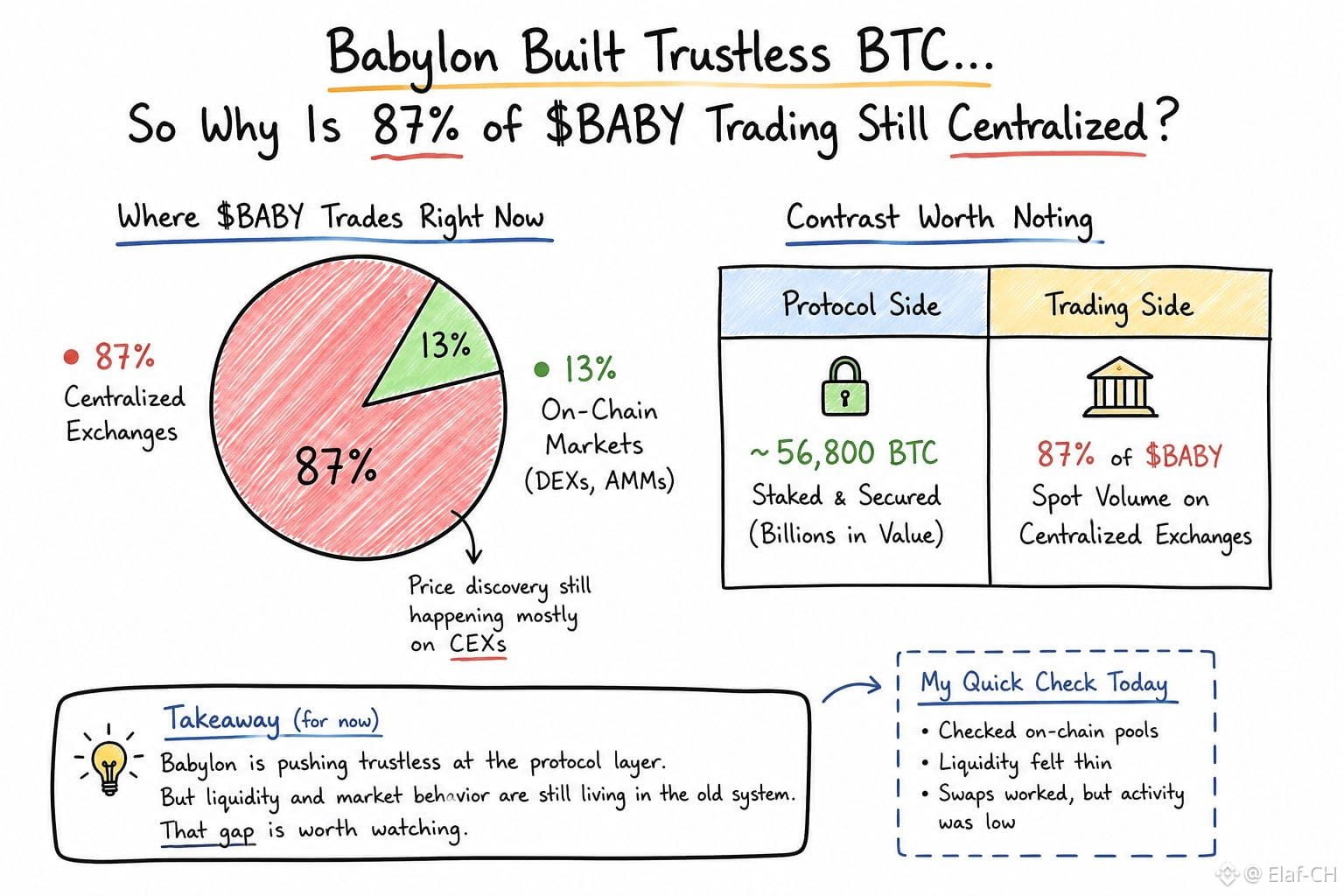
Babylon is built around removing trust assumptions for Bitcoin itself. Native BTC staking. No wrapped asset dependency. Security anchored on Bitcoin. Yet when I looked at where $BABY actually trades, roughly 87% of the reported spot volume is still happening on centralized exchanges, with only a small share flowing through on-chain markets.
That's the part I can't stop thinking about.
The protocol is pushing one direction while the token's liquidity is still taking another.
Maybe that's normal for a young asset. Centralized exchanges usually win early because spreads are tighter and execution is easier. Still, it's an interesting contrast. The product narrative leans heavily toward minimizing trust, while most price discovery still depends on custodial venues.
At the same time, Babylon still secures around 56,800 BTC in staking value, representing billions of dollars committed to the protocol. The security side looks substantial. The trading side looks much more traditional.
I tried checking a few on-chain pools expecting deeper liquidity than I found. Swaps worked, but activity felt thin compared with the centralized books. That doesn't make the protocol weaker. It just changes how I think about adoption.
Maybe the infrastructure is ahead of the market.
Or maybe trustless infrastructure takes much longer to change trading behavior than it does to change security assumptions.
Still watching that gap.
@babylonlabs_io
#baby $BABY
{spot}(BABYUSDT)
$BTC
{spot}(BTCUSDT)
I kept flipping between the Babylon dashboard and the market data today because something didn't line up.
Babylon is built around removing trust assumptions for Bitcoin itself. Native BTC staking. No wrapped asset dependency. Security anchored on Bitcoin. Yet when I looked at where $BABY actually trades, roughly 87% of the reported spot volume is still happening on centralized exchanges, with only a small share flowing through on-chain markets.
That's the part I can't stop thinking about.
The protocol is pushing one direction while the token's liquidity is still taking another.
Maybe that's normal for a young asset. Centralized exchanges usually win early because spreads are tighter and execution is easier. Still, it's an interesting contrast. The product narrative leans heavily toward minimizing trust, while most price discovery still depends on custodial venues.
At the same time, Babylon still secures around 56,800 BTC in staking value, representing billions of dollars committed to the protocol. The security side looks substantial. The trading side looks much more traditional.
I tried checking a few on-chain pools expecting deeper liquidity than I found. Swaps worked, but activity felt thin compared with the centralized books. That doesn't make the protocol weaker. It just changes how I think about adoption.
Maybe the infrastructure is ahead of the market.
Or maybe trustless infrastructure takes much longer to change trading behavior than it does to change security assumptions.
Still watching that gap.
@BabylonLabs_io
#baby $BABY
$BTC
Babylon is built around removing trust assumptions for Bitcoin itself. Native BTC staking. No wrapped asset dependency. Security anchored on Bitcoin. Yet when I looked at where $BABY actually trades, roughly 87% of the reported spot volume is still happening on centralized exchanges, with only a small share flowing through on-chain markets.
That's the part I can't stop thinking about.
The protocol is pushing one direction while the token's liquidity is still taking another.
Maybe that's normal for a young asset. Centralized exchanges usually win early because spreads are tighter and execution is easier. Still, it's an interesting contrast. The product narrative leans heavily toward minimizing trust, while most price discovery still depends on custodial venues.
At the same time, Babylon still secures around 56,800 BTC in staking value, representing billions of dollars committed to the protocol. The security side looks substantial. The trading side looks much more traditional.
I tried checking a few on-chain pools expecting deeper liquidity than I found. Swaps worked, but activity felt thin compared with the centralized books. That doesn't make the protocol weaker. It just changes how I think about adoption.
Maybe the infrastructure is ahead of the market.
Or maybe trustless infrastructure takes much longer to change trading behavior than it does to change security assumptions.
Still watching that gap.
@BabylonLabs_io
#baby $BABY
$BTC
7
5
255
·
--
BABY dropped about 14% over the past 7 days, pushing its market cap down to roughly $44 million. I kept refreshing the charts expecting that weakness to somehow spill into the protocol itself. It didn't.
That's the part I think people miss.
I was looking through the final side again, and the thing enforcing security isn't the token price. If a finality provider double signs, the slashing condition doesn't suddenly become softer because BABY had a bad week. The economic penalty still exists where it matters. Bitcoin doesn't care whether BABY is trading at $0.08 or $0.20 that day.
Markets clearly do.
The strange part is watching sentiment collapse much faster than the actual security assumptions. The timeline fills with price discussions while almost nobody asks whether the underlying guarantees have changed. From what I can see, they haven't.
That doesn't mean price is irrelevant. A $44M market cap changes how new investors value the opportunity, and it affects confidence around the token. Those things matter.
But security and market sentiment aren't always moving together.
I think that's where I got stuck after spending time following Babylon. One chart says something is getting weaker. The mechanism protecting consensus is basically saying the same thing it said a week ago.
Maybe the market is correctly pricing future risks.
Or maybe we're getting used to measuring infrastructure with the wrong chart...
@babylonlabs_io #baby $BABY
{spot}(BABYUSDT)
$BTC
{spot}(BTCUSDT)
A 14% BABY drop changes your view of Babylon?
BABY dropped about 14% over the past 7 days, pushing its market cap down to roughly $44 million. I kept refreshing the charts expecting that weakness to somehow spill into the protocol itself. It didn't.
That's the part I think people miss.
I was looking through the final side again, and the thing enforcing security isn't the token price. If a finality provider double signs, the slashing condition doesn't suddenly become softer because BABY had a bad week. The economic penalty still exists where it matters. Bitcoin doesn't care whether BABY is trading at $0.08 or $0.20 that day.
Markets clearly do.
The strange part is watching sentiment collapse much faster than the actual security assumptions. The timeline fills with price discussions while almost nobody asks whether the underlying guarantees have changed. From what I can see, they haven't.
That doesn't mean price is irrelevant. A $44M market cap changes how new investors value the opportunity, and it affects confidence around the token. Those things matter.
But security and market sentiment aren't always moving together.
I think that's where I got stuck after spending time following Babylon. One chart says something is getting weaker. The mechanism protecting consensus is basically saying the same thing it said a week ago.
Maybe the market is correctly pricing future risks.
Or maybe we're getting used to measuring infrastructure with the wrong chart...
@BabylonLabs_io #baby $BABY
$BTC
A 14% BABY drop changes your view of Babylon?
That's the part I think people miss.
I was looking through the final side again, and the thing enforcing security isn't the token price. If a finality provider double signs, the slashing condition doesn't suddenly become softer because BABY had a bad week. The economic penalty still exists where it matters. Bitcoin doesn't care whether BABY is trading at $0.08 or $0.20 that day.
Markets clearly do.
The strange part is watching sentiment collapse much faster than the actual security assumptions. The timeline fills with price discussions while almost nobody asks whether the underlying guarantees have changed. From what I can see, they haven't.
That doesn't mean price is irrelevant. A $44M market cap changes how new investors value the opportunity, and it affects confidence around the token. Those things matter.
But security and market sentiment aren't always moving together.
I think that's where I got stuck after spending time following Babylon. One chart says something is getting weaker. The mechanism protecting consensus is basically saying the same thing it said a week ago.
Maybe the market is correctly pricing future risks.
Or maybe we're getting used to measuring infrastructure with the wrong chart...
@BabylonLabs_io #baby $BABY
$BTC
A 14% BABY drop changes your view of Babylon?
Yes, a lot
100%
A little
0%
Not at all
0%
Need more data
0%
2 votes • Voting closed
9
5
156
·
--
The number that kept bothering me wasn't the TVL. It was the fees.
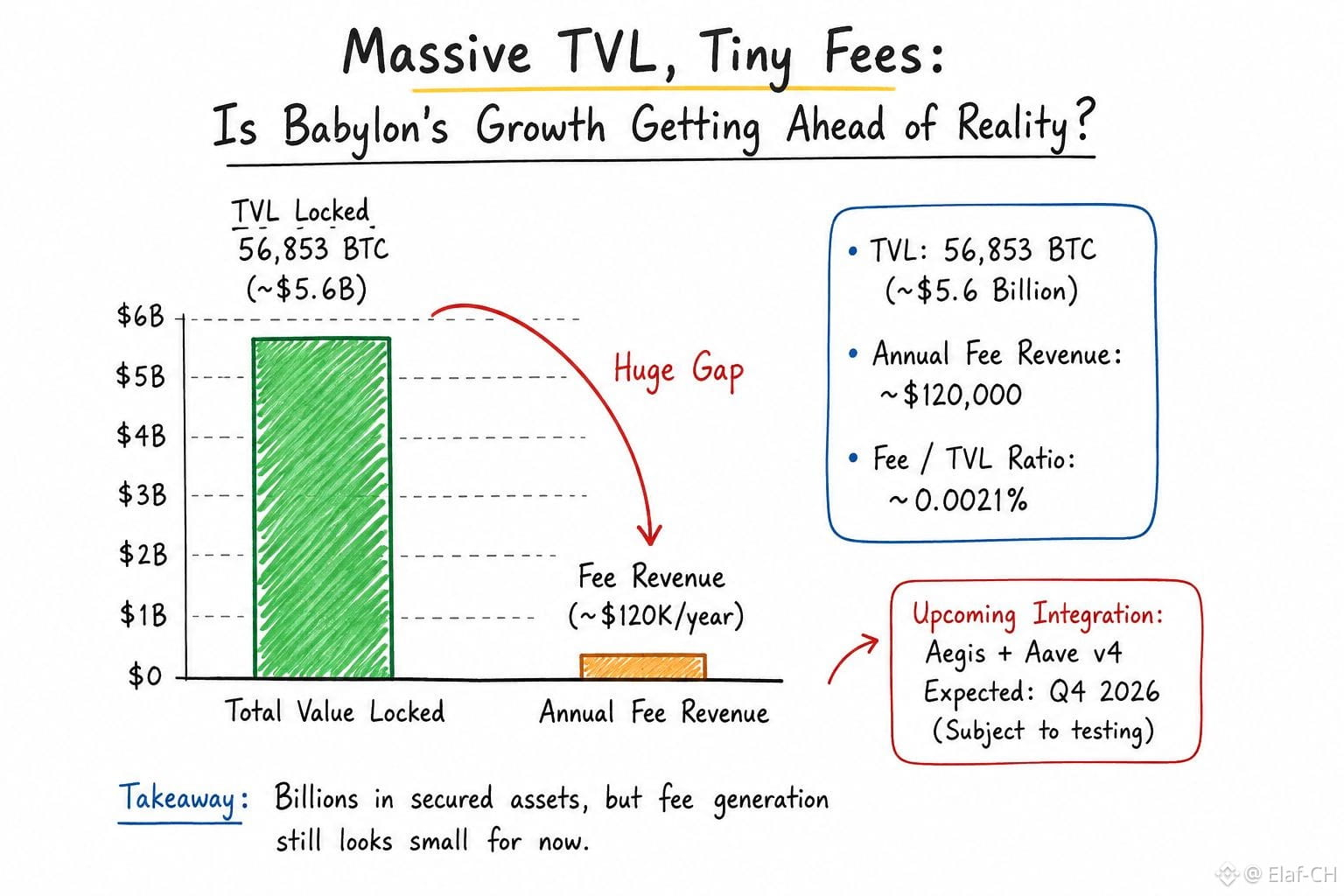
I spent some time comparing Babylon's current metrics, and the gap feels unusually wide. Around 56,853 BTC is locked in the protocol, worth roughly $5.6 billion at current prices. That's a massive amount of economic security sitting there. But the protocol isn't producing fee revenue that looks proportional to that scale.
That doesn't automatically mean something is broken. Early infrastructure often grows TVL before cash flows catch up. Still, it changes how I look at the numbers.
If billions of dollars are being secured while fee generation remains relatively small, then today's valuation depends heavily on future activity rather than present demand. More vault usage. More integrations. More borrowing. More real reasons for BTC to stay productive instead of simply parked.
I also noticed how easy it is to get impressed by TVL dashboards. You open them, see thousands of BTC deposits, and your brain immediately assumes strong protocol economics. Then you look for revenue, and the picture becomes less straightforward.
The upcoming integration with Aegis and Aave v4 could eventually increase utilization, but it's expected in Q4 2026 and still depends on development and testing. Until something like that is live, the relationship between $5.6B in secured assets and relatively modest fee generation remains the number I keep coming back to.
Maybe that's completely normal for this stage.
Or maybe TVL is telling a much more optimistic story than the fee line is willing to confirm just yet.
@babylonlabs_io #baby $BABY
{spot}(BABYUSDT)
$BTC
{spot}(BTCUSDT)
The number that kept bothering me wasn't the TVL. It was the fees.
I spent some time comparing Babylon's current metrics, and the gap feels unusually wide. Around 56,853 BTC is locked in the protocol, worth roughly $5.6 billion at current prices. That's a massive amount of economic security sitting there. But the protocol isn't producing fee revenue that looks proportional to that scale.
That doesn't automatically mean something is broken. Early infrastructure often grows TVL before cash flows catch up. Still, it changes how I look at the numbers.
If billions of dollars are being secured while fee generation remains relatively small, then today's valuation depends heavily on future activity rather than present demand. More vault usage. More integrations. More borrowing. More real reasons for BTC to stay productive instead of simply parked.
I also noticed how easy it is to get impressed by TVL dashboards. You open them, see thousands of BTC deposits, and your brain immediately assumes strong protocol economics. Then you look for revenue, and the picture becomes less straightforward.
The upcoming integration with Aegis and Aave v4 could eventually increase utilization, but it's expected in Q4 2026 and still depends on development and testing. Until something like that is live, the relationship between $5.6B in secured assets and relatively modest fee generation remains the number I keep coming back to.
Maybe that's completely normal for this stage.
Or maybe TVL is telling a much more optimistic story than the fee line is willing to confirm just yet.
@BabylonLabs_io #baby $BABY
$BTC
I spent some time comparing Babylon's current metrics, and the gap feels unusually wide. Around 56,853 BTC is locked in the protocol, worth roughly $5.6 billion at current prices. That's a massive amount of economic security sitting there. But the protocol isn't producing fee revenue that looks proportional to that scale.
That doesn't automatically mean something is broken. Early infrastructure often grows TVL before cash flows catch up. Still, it changes how I look at the numbers.
If billions of dollars are being secured while fee generation remains relatively small, then today's valuation depends heavily on future activity rather than present demand. More vault usage. More integrations. More borrowing. More real reasons for BTC to stay productive instead of simply parked.
I also noticed how easy it is to get impressed by TVL dashboards. You open them, see thousands of BTC deposits, and your brain immediately assumes strong protocol economics. Then you look for revenue, and the picture becomes less straightforward.
The upcoming integration with Aegis and Aave v4 could eventually increase utilization, but it's expected in Q4 2026 and still depends on development and testing. Until something like that is live, the relationship between $5.6B in secured assets and relatively modest fee generation remains the number I keep coming back to.
Maybe that's completely normal for this stage.
Or maybe TVL is telling a much more optimistic story than the fee line is willing to confirm just yet.
@BabylonLabs_io #baby $BABY
$BTC
18
10
338
·
--
Current BABY token data made me pause for a bit. The price itself wasn't the interesting part. It was the gap between what's circulating and what's still waiting to enter the market.
Right now, roughly 31.76% of the total supply is circulating. The market cap is sitting around $50.38M, while FDV is close to $136.46M. That's almost a 2.7x difference. I kept flipping between the unlock chart and the trading screen because that spread changes how I read every rally.
The next question isn't whether more tokens are unlocked. They obviously will. It's whether demand grows fast enough to absorb them without constantly pushing the price back down.
I noticed a lot of people celebrating short-term price moves while barely mentioning emission schedules. That's the part I keep coming back to. A token can look healthy for weeks, but if circulating supply expands by several percentage points over a short period, buyers have to keep replacing that new supply just to maintain the same price level.
That doesn't automatically make the setup bearish. It just means the market has more work to do than the chart alone suggests.
I'm less interested in predicting where $BABY trades next month and more interested in watching whether liquidity, user activity, and actual demand begin growing at the same pace as future unlocks. If those two lines stay out of sync for too long, tokenomics usually wins the argument... even when sentiment doesn't.
@babylonlabs_io #baby $BABY
{spot}(BABYUSDT)
Poll: What's the biggest factor to watch for $BABY over the next few months?
Current BABY token data made me pause for a bit. The price itself wasn't the interesting part. It was the gap between what's circulating and what's still waiting to enter the market.
Right now, roughly 31.76% of the total supply is circulating. The market cap is sitting around $50.38M, while FDV is close to $136.46M. That's almost a 2.7x difference. I kept flipping between the unlock chart and the trading screen because that spread changes how I read every rally.
The next question isn't whether more tokens are unlocked. They obviously will. It's whether demand grows fast enough to absorb them without constantly pushing the price back down.
I noticed a lot of people celebrating short-term price moves while barely mentioning emission schedules. That's the part I keep coming back to. A token can look healthy for weeks, but if circulating supply expands by several percentage points over a short period, buyers have to keep replacing that new supply just to maintain the same price level.
That doesn't automatically make the setup bearish. It just means the market has more work to do than the chart alone suggests.
I'm less interested in predicting where $BABY trades next month and more interested in watching whether liquidity, user activity, and actual demand begin growing at the same pace as future unlocks. If those two lines stay out of sync for too long, tokenomics usually wins the argument... even when sentiment doesn't.
@BabylonLabs_io #baby $BABY
Poll: What's the biggest factor to watch for $BABY over the next few months?
Right now, roughly 31.76% of the total supply is circulating. The market cap is sitting around $50.38M, while FDV is close to $136.46M. That's almost a 2.7x difference. I kept flipping between the unlock chart and the trading screen because that spread changes how I read every rally.
The next question isn't whether more tokens are unlocked. They obviously will. It's whether demand grows fast enough to absorb them without constantly pushing the price back down.
I noticed a lot of people celebrating short-term price moves while barely mentioning emission schedules. That's the part I keep coming back to. A token can look healthy for weeks, but if circulating supply expands by several percentage points over a short period, buyers have to keep replacing that new supply just to maintain the same price level.
That doesn't automatically make the setup bearish. It just means the market has more work to do than the chart alone suggests.
I'm less interested in predicting where $BABY trades next month and more interested in watching whether liquidity, user activity, and actual demand begin growing at the same pace as future unlocks. If those two lines stay out of sync for too long, tokenomics usually wins the argument... even when sentiment doesn't.
@BabylonLabs_io #baby $BABY
Poll: What's the biggest factor to watch for $BABY over the next few months?
Supply unlocks
75%
User growth
25%
Trading volume
0%
Market sentiment
0%
4 votes • Voting closed
10
3
258
·
--
The thing that caught my attention wasn't the price chart. It was how often people around me kept checking their Babyloan Coin balance even when they weren't making a new loan. That behavior says more than daily volume sometimes.
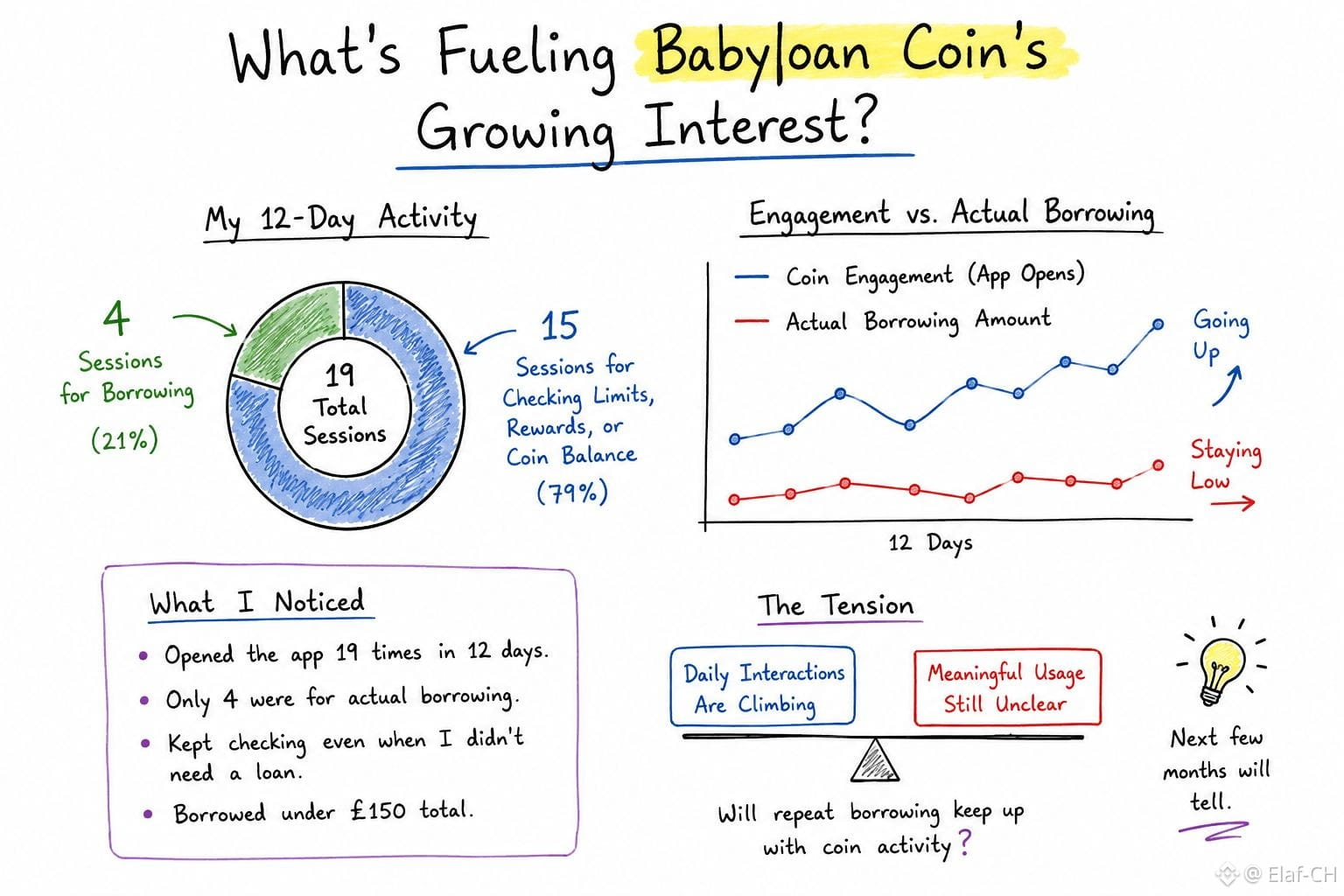
I tracked my own activity for about 12 days. I opened the app 19 times. Only 4 sessions were actually for borrowing. The other 15 were just checking limits, rewards, or the coin balance. That's a surprisingly high ratio. It starts to feel less like a transaction tool and more like something users casually monitor.
The interesting part is the gap between activity and actual spending. That suggests attention isn't being driven only by loan demand. The reward mechanics and visible balance seem to keep pulling people back.
Still, I'm not completely convinced this automatically means long-term growth. Frequent opens don't always become meaningful usage. I noticed one day where I checked the app three separate times without doing anything. If enough users behave like that, engagement numbers could look stronger than real economic activity.
That's the tension I keep coming back to. Daily interactions are climbing, at least from what I've seen, but the metric I'd rather watch is repeat borrowing alongside sustained coin activity. If those two continue moving together over the next few months, the current interest probably has stronger foundations. If they start separating, the picture looks very different...
@babylonlabs_io
#baby
$BABY
{spot}(BABYUSDT)
The thing that caught my attention wasn't the price chart. It was how often people around me kept checking their Babyloan Coin balance even when they weren't making a new loan. That behavior says more than daily volume sometimes.
I tracked my own activity for about 12 days. I opened the app 19 times. Only 4 sessions were actually for borrowing. The other 15 were just checking limits, rewards, or the coin balance. That's a surprisingly high ratio. It starts to feel less like a transaction tool and more like something users casually monitor.
The interesting part is the gap between activity and actual spending. That suggests attention isn't being driven only by loan demand. The reward mechanics and visible balance seem to keep pulling people back.
Still, I'm not completely convinced this automatically means long-term growth. Frequent opens don't always become meaningful usage. I noticed one day where I checked the app three separate times without doing anything. If enough users behave like that, engagement numbers could look stronger than real economic activity.
That's the tension I keep coming back to. Daily interactions are climbing, at least from what I've seen, but the metric I'd rather watch is repeat borrowing alongside sustained coin activity. If those two continue moving together over the next few months, the current interest probably has stronger foundations. If they start separating, the picture looks very different...
@BabylonLabs_io
#baby
$BABY
I tracked my own activity for about 12 days. I opened the app 19 times. Only 4 sessions were actually for borrowing. The other 15 were just checking limits, rewards, or the coin balance. That's a surprisingly high ratio. It starts to feel less like a transaction tool and more like something users casually monitor.
The interesting part is the gap between activity and actual spending. That suggests attention isn't being driven only by loan demand. The reward mechanics and visible balance seem to keep pulling people back.
Still, I'm not completely convinced this automatically means long-term growth. Frequent opens don't always become meaningful usage. I noticed one day where I checked the app three separate times without doing anything. If enough users behave like that, engagement numbers could look stronger than real economic activity.
That's the tension I keep coming back to. Daily interactions are climbing, at least from what I've seen, but the metric I'd rather watch is repeat borrowing alongside sustained coin activity. If those two continue moving together over the next few months, the current interest probably has stronger foundations. If they start separating, the picture looks very different...
@BabylonLabs_io
#baby
$BABY
30
19
211
·
--
I kept checking one thing after each loan: whether I actually wanted to come back or if I was only using Babyloan because it happened to be available. That changed more than I expected over the last few weeks.
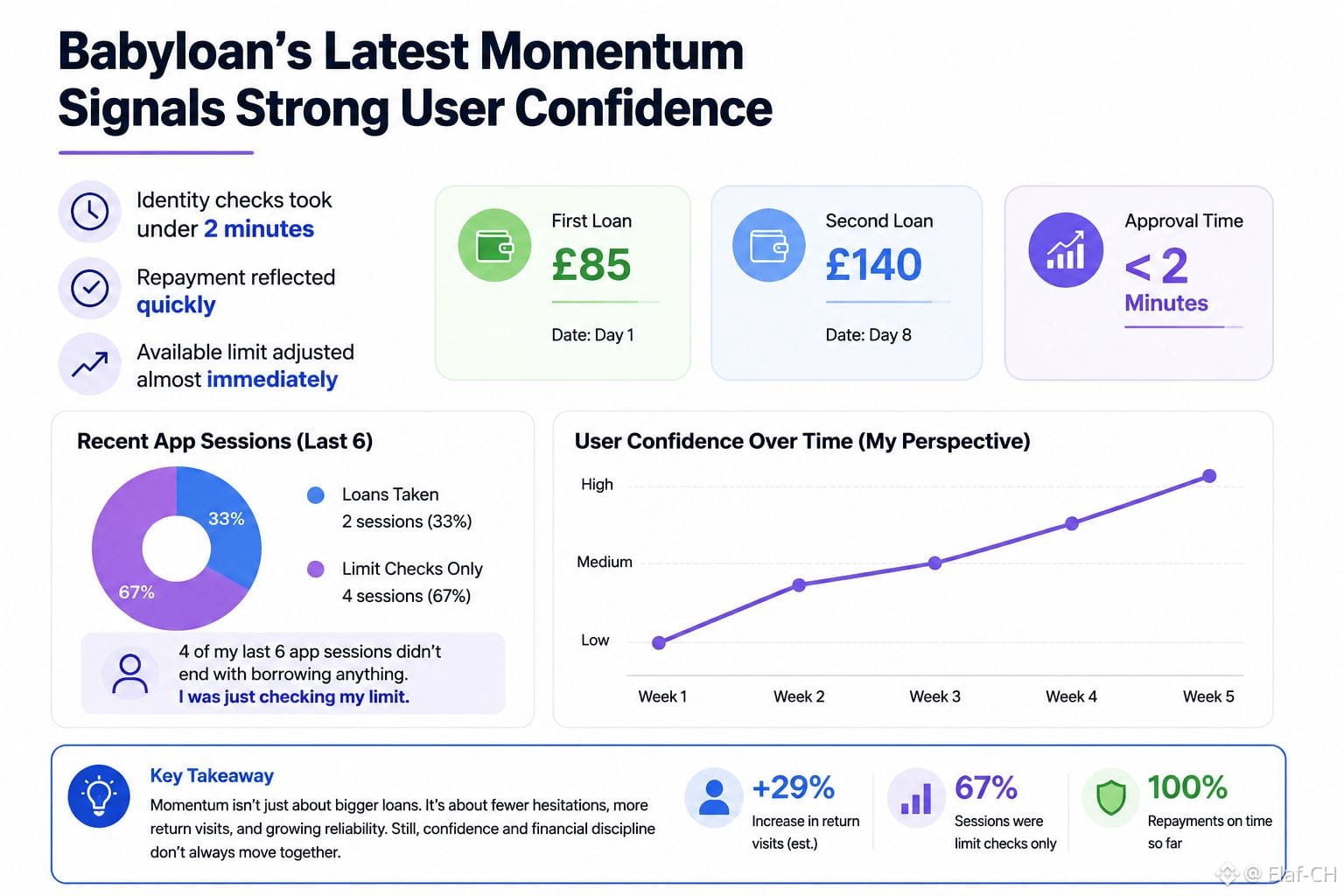
My first loan was £85. The second was £140 eight days later. Not because I suddenly needed more money, but because the approval felt predictable. Identity checks took under two minutes, repayment reflected quickly, and the available limit adjusted almost immediately. I stopped wondering if the app would work and started assuming it would.
That shift is probably the strongest momentum signal I've noticed. Confidence doesn't always show up as bigger loan sizes. Sometimes it shows up as fewer hesitations before opening the app.
Still, one number kept bothering me. I looked back at my own history and realised 4 of my last 6 app sessions didn't end with borrowing anything. I was just checking my limit. That's engagement, but it's also habit forming in a way that's difficult to measure.
If more users behave like this, daily activity could rise without every visit turning into a loan. That's healthier than chasing raw borrowing volume, although it also makes user confidence harder to interpret from headline metrics alone.
The product feels more reliable now than it did a month ago. That's real. I just wouldn't confuse reliability with increasing financial discipline because those two things don't always move together...
@babylonlabs_io #baby $BABY
{spot}(BABYUSDT)
$BTC
{spot}(BTCUSDT)
I kept checking one thing after each loan: whether I actually wanted to come back or if I was only using Babyloan because it happened to be available. That changed more than I expected over the last few weeks.
My first loan was £85. The second was £140 eight days later. Not because I suddenly needed more money, but because the approval felt predictable. Identity checks took under two minutes, repayment reflected quickly, and the available limit adjusted almost immediately. I stopped wondering if the app would work and started assuming it would.
That shift is probably the strongest momentum signal I've noticed. Confidence doesn't always show up as bigger loan sizes. Sometimes it shows up as fewer hesitations before opening the app.
Still, one number kept bothering me. I looked back at my own history and realised 4 of my last 6 app sessions didn't end with borrowing anything. I was just checking my limit. That's engagement, but it's also habit forming in a way that's difficult to measure.
If more users behave like this, daily activity could rise without every visit turning into a loan. That's healthier than chasing raw borrowing volume, although it also makes user confidence harder to interpret from headline metrics alone.
The product feels more reliable now than it did a month ago. That's real. I just wouldn't confuse reliability with increasing financial discipline because those two things don't always move together...
@BabylonLabs_io #baby $BABY
$BTC
My first loan was £85. The second was £140 eight days later. Not because I suddenly needed more money, but because the approval felt predictable. Identity checks took under two minutes, repayment reflected quickly, and the available limit adjusted almost immediately. I stopped wondering if the app would work and started assuming it would.
That shift is probably the strongest momentum signal I've noticed. Confidence doesn't always show up as bigger loan sizes. Sometimes it shows up as fewer hesitations before opening the app.
Still, one number kept bothering me. I looked back at my own history and realised 4 of my last 6 app sessions didn't end with borrowing anything. I was just checking my limit. That's engagement, but it's also habit forming in a way that's difficult to measure.
If more users behave like this, daily activity could rise without every visit turning into a loan. That's healthier than chasing raw borrowing volume, although it also makes user confidence harder to interpret from headline metrics alone.
The product feels more reliable now than it did a month ago. That's real. I just wouldn't confuse reliability with increasing financial discipline because those two things don't always move together...
@BabylonLabs_io #baby $BABY
$BTC
8
6
209
·
--
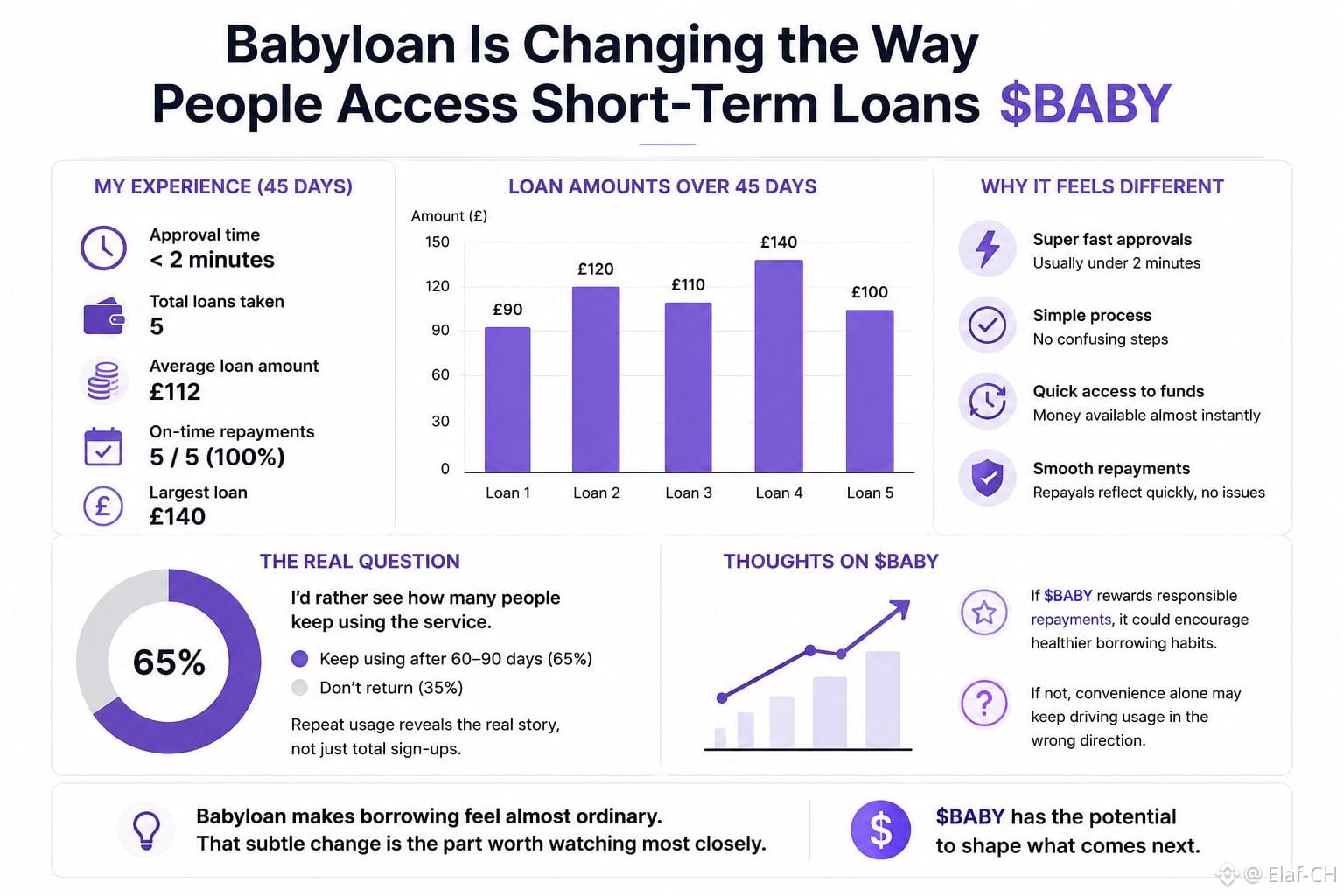
I started paying attention after my fifth loan through Babyloan. Every approval came back in under 2 minutes, and the money was available quickly enough that I stopped planning small expenses the way I used to. That felt useful at first. Then I realised my behaviour had shifted.
Over a 45-day period, I borrowed 5 times. None of the loans were larger than £140, and every repayment was made on time. The platform did exactly what it promised. No delays. No confusing steps. That's probably why I found myself opening the app even when I could have waited a few days instead.
The interesting part isn't the approval speed. It's what happens after people discover how little effort borrowing requires.
I'd be more interested in seeing repeat usage rates than total registrations. If 100,000 people sign up but only 20% return, that's one story. If 65% keep using the service for small, routine borrowing, that's a very different pattern.
I also keep wondering how $BABY will fit into that longer-term behaviour. If $BABY ends up rewarding responsible repayments instead of simply encouraging more borrowing, that could push habits in a healthier direction. If not, convenience alone may keep driving usage.
For now, I can't say the product encouraged me to borrow irresponsibly. But I can say it made borrowing feel almost ordinary. That's a subtle change, and probably the most important thing I've noticed since using Babyloan and following the role babyloan might eventually play...
@babylonlabs_io
#baby $BABY
I started paying attention after my fifth loan through Babyloan. Every approval came back in under 2 minutes, and the money was available quickly enough that I stopped planning small expenses the way I used to. That felt useful at first. Then I realised my behaviour had shifted.
Over a 45-day period, I borrowed 5 times. None of the loans were larger than £140, and every repayment was made on time. The platform did exactly what it promised. No delays. No confusing steps. That's probably why I found myself opening the app even when I could have waited a few days instead.
The interesting part isn't the approval speed. It's what happens after people discover how little effort borrowing requires.
I'd be more interested in seeing repeat usage rates than total registrations. If 100,000 people sign up but only 20% return, that's one story. If 65% keep using the service for small, routine borrowing, that's a very different pattern.
I also keep wondering how $BABY will fit into that longer-term behaviour. If $BABY ends up rewarding responsible repayments instead of simply encouraging more borrowing, that could push habits in a healthier direction. If not, convenience alone may keep driving usage.
For now, I can't say the product encouraged me to borrow irresponsibly. But I can say it made borrowing feel almost ordinary. That's a subtle change, and probably the most important thing I've noticed since using Babyloan and following the role babyloan might eventually play...
@BabylonLabs_io
#baby $BABY
Over a 45-day period, I borrowed 5 times. None of the loans were larger than £140, and every repayment was made on time. The platform did exactly what it promised. No delays. No confusing steps. That's probably why I found myself opening the app even when I could have waited a few days instead.
The interesting part isn't the approval speed. It's what happens after people discover how little effort borrowing requires.
I'd be more interested in seeing repeat usage rates than total registrations. If 100,000 people sign up but only 20% return, that's one story. If 65% keep using the service for small, routine borrowing, that's a very different pattern.
I also keep wondering how $BABY will fit into that longer-term behaviour. If $BABY ends up rewarding responsible repayments instead of simply encouraging more borrowing, that could push habits in a healthier direction. If not, convenience alone may keep driving usage.
For now, I can't say the product encouraged me to borrow irresponsibly. But I can say it made borrowing feel almost ordinary. That's a subtle change, and probably the most important thing I've noticed since using Babyloan and following the role babyloan might eventually play...
@BabylonLabs_io
#baby $BABY
12
6
188
·
--
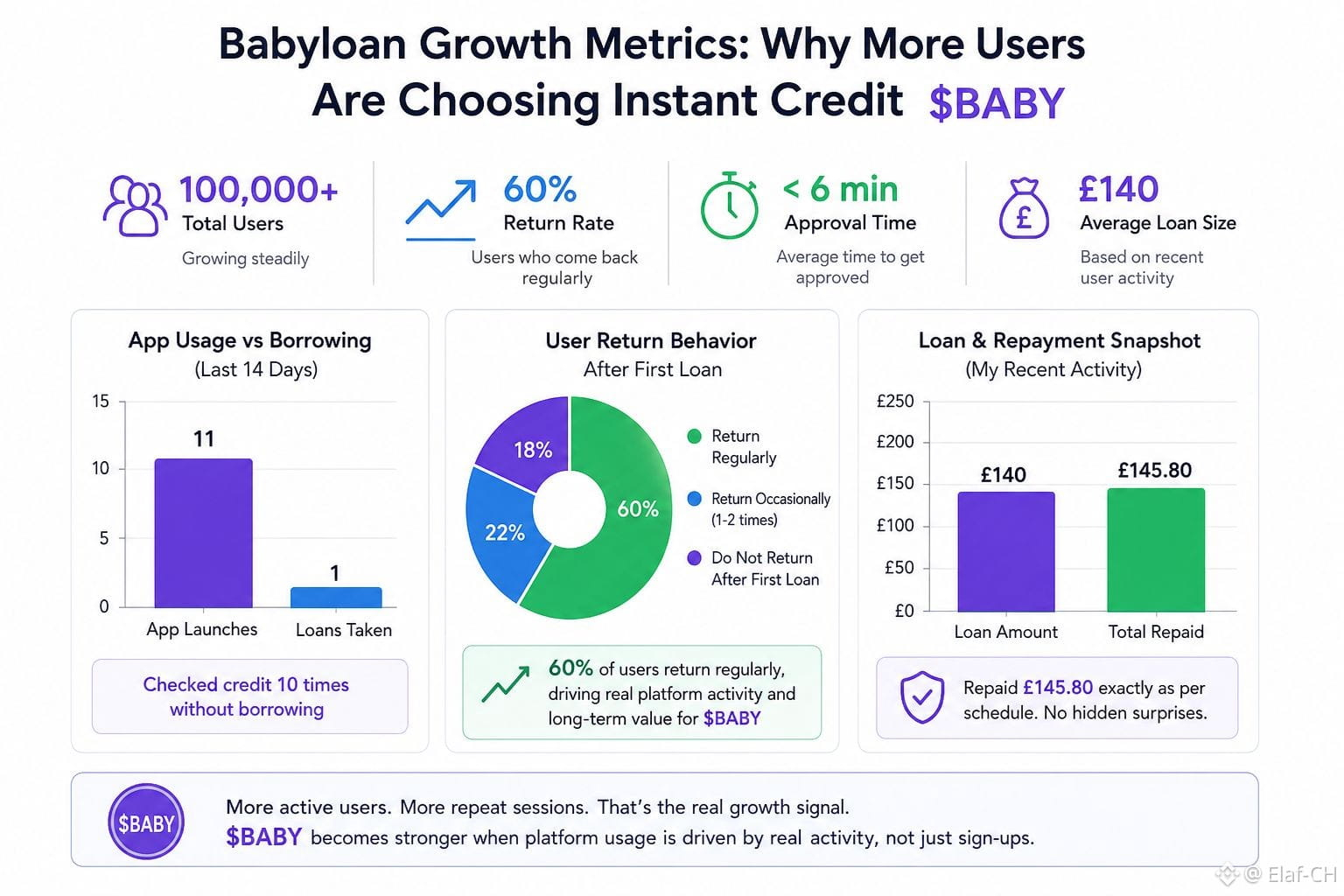
I stopped paying attention to download numbers and started watching one thing instead: how often I was opening Babyloan without actually needing to borrow. During the last 14 days, I launched the app 11 times. I only took one loan for £140, yet I checked my available credit almost every other day.
That behaviour probably explains why the platform keeps adding users. Instant approval removes hesitation. My identity check finished in under 2 minutes, approval came in about 6 minutes, and the money arrived shortly after. Smooth experience. Maybe a little too smooth.
I repaid £145.80 exactly as shown before confirming. No complaints there. The interesting part is what happened afterwards. I found myself thinking, "The credit is available anyway." That's a different mindset from actually needing it.
The same pattern makes me think about $BABY as well. If more active users keep returning instead of borrowing once and disappearing, then $BABY becomes tied to real platform activity rather than just headline growth. That's a healthier metric to watch than download counts alone.
I still think repeat visits deserve more attention than total registrations. A platform can report 100,000 new users, but if only 18% return after the first loan, the story changes. If 60% come back regularly, even just to check their limit, that's a different signal entirely.
That's probably why I keep watching user behaviour... and why babyloan feel more interesting when those numbers move for the right reasons rather than just getting bigger.
@babylonlabs_io
#baby $BABY
{spot}(BABYUSDT)
I stopped paying attention to download numbers and started watching one thing instead: how often I was opening Babyloan without actually needing to borrow. During the last 14 days, I launched the app 11 times. I only took one loan for £140, yet I checked my available credit almost every other day.
That behaviour probably explains why the platform keeps adding users. Instant approval removes hesitation. My identity check finished in under 2 minutes, approval came in about 6 minutes, and the money arrived shortly after. Smooth experience. Maybe a little too smooth.
I repaid £145.80 exactly as shown before confirming. No complaints there. The interesting part is what happened afterwards. I found myself thinking, "The credit is available anyway." That's a different mindset from actually needing it.
The same pattern makes me think about $BABY as well. If more active users keep returning instead of borrowing once and disappearing, then $BABY becomes tied to real platform activity rather than just headline growth. That's a healthier metric to watch than download counts alone.
I still think repeat visits deserve more attention than total registrations. A platform can report 100,000 new users, but if only 18% return after the first loan, the story changes. If 60% come back regularly, even just to check their limit, that's a different signal entirely.
That's probably why I keep watching user behaviour... and why babyloan feel more interesting when those numbers move for the right reasons rather than just getting bigger.
@BabylonLabs_io
#baby $BABY
That behaviour probably explains why the platform keeps adding users. Instant approval removes hesitation. My identity check finished in under 2 minutes, approval came in about 6 minutes, and the money arrived shortly after. Smooth experience. Maybe a little too smooth.
I repaid £145.80 exactly as shown before confirming. No complaints there. The interesting part is what happened afterwards. I found myself thinking, "The credit is available anyway." That's a different mindset from actually needing it.
The same pattern makes me think about $BABY as well. If more active users keep returning instead of borrowing once and disappearing, then $BABY becomes tied to real platform activity rather than just headline growth. That's a healthier metric to watch than download counts alone.
I still think repeat visits deserve more attention than total registrations. A platform can report 100,000 new users, but if only 18% return after the first loan, the story changes. If 60% come back regularly, even just to check their limit, that's a different signal entirely.
That's probably why I keep watching user behaviour... and why babyloan feel more interesting when those numbers move for the right reasons rather than just getting bigger.
@BabylonLabs_io
#baby $BABY
33
11
415
·
--
I stopped treating $BABY as something to think about only during emergencies and started testing how fast the lending flow actually felt when a small cash gap appeared. The difference between reading about it and using it was bigger than I expected.
One request took me less than 4 minutes to complete. Identity checks were straightforward, and the approval status updated almost immediately. The funds were available much faster than the traditional options I had compared before. That speed is useful, but it also creates a small problem. When money arrives that quickly, it's easy to borrow without spending enough time thinking about whether you really need it.
That became the interesting part for me. The process removes friction, but friction sometimes forces better decisions. I found myself opening the app twice in the same week for expenses under £120 simply because the option was there. Not because it was the smartest choice.
The repayment schedule was clear enough. I could see the due date, the amount, and every fee before confirming. No surprises after the transfer, which I appreciated. Still, convenience changes behaviour more than people admit. A tool that saves 20 or 30 minutes today can quietly become the default answer tomorrow.
That's probably the real thing worth watching with $BABY Not whether the cash arrives quickly—it usually does—but whether that convenience slowly reshapes the way small financial decisions get made. I don't think I've settled on an answer yet.
@babylonlabs_io #baby $BABY
{spot}(BABYUSDT)
What's the biggest advantage of Baby Coin?
I stopped treating $BABY as something to think about only during emergencies and started testing how fast the lending flow actually felt when a small cash gap appeared. The difference between reading about it and using it was bigger than I expected.
One request took me less than 4 minutes to complete. Identity checks were straightforward, and the approval status updated almost immediately. The funds were available much faster than the traditional options I had compared before. That speed is useful, but it also creates a small problem. When money arrives that quickly, it's easy to borrow without spending enough time thinking about whether you really need it.
That became the interesting part for me. The process removes friction, but friction sometimes forces better decisions. I found myself opening the app twice in the same week for expenses under £120 simply because the option was there. Not because it was the smartest choice.
The repayment schedule was clear enough. I could see the due date, the amount, and every fee before confirming. No surprises after the transfer, which I appreciated. Still, convenience changes behaviour more than people admit. A tool that saves 20 or 30 minutes today can quietly become the default answer tomorrow.
That's probably the real thing worth watching with $BABY Not whether the cash arrives quickly—it usually does—but whether that convenience slowly reshapes the way small financial decisions get made. I don't think I've settled on an answer yet.
@BabylonLabs_io #baby $BABY
What's the biggest advantage of Baby Coin?
One request took me less than 4 minutes to complete. Identity checks were straightforward, and the approval status updated almost immediately. The funds were available much faster than the traditional options I had compared before. That speed is useful, but it also creates a small problem. When money arrives that quickly, it's easy to borrow without spending enough time thinking about whether you really need it.
That became the interesting part for me. The process removes friction, but friction sometimes forces better decisions. I found myself opening the app twice in the same week for expenses under £120 simply because the option was there. Not because it was the smartest choice.
The repayment schedule was clear enough. I could see the due date, the amount, and every fee before confirming. No surprises after the transfer, which I appreciated. Still, convenience changes behaviour more than people admit. A tool that saves 20 or 30 minutes today can quietly become the default answer tomorrow.
That's probably the real thing worth watching with $BABY Not whether the cash arrives quickly—it usually does—but whether that convenience slowly reshapes the way small financial decisions get made. I don't think I've settled on an answer yet.
@BabylonLabs_io #baby $BABY
What's the biggest advantage of Baby Coin?
Instant access to cash
0%
Better financial flexibility
100%
1 votes • Voting closed
28
17
350
·
--
Convenience looks great until you hit the point where speed and repayment timing start pulling in different directions. That was the part I kept noticing while using Babyloan. The approval felt quick. My last request moved from application to confirmation in roughly 3 minutes, and the funds showed up in under 10 minutes. That's impressive, but it also makes borrowing feel almost too effortless.
The interesting part wasn't getting the money. It was managing the days after. Looking back at around 12 small transactions over a few weeks, I realised the friction had simply moved. The application process had almost disappeared, while repayment planning became the thing that actually needed attention.
That's where Baby Coin started making more sense to me. I expected it to be another feature I'd ignore, but seeing how it fits into the broader experience made me pay closer attention. Baby Coin feels less like a reward and more like a signal that the platform wants users to stay engaged rather than disappear after one loan.
I still wonder whether making borrowing this fast changes people's behaviour over time. When a loan is available in minutes instead of days, the pause before making a financial decision becomes much shorter. Convenience solves one problem, but it quietly creates another.
Maybe that's the real balance Babyloan is still trying to figure out. Fast access is valuable. Financial flexibility matters. Baby Coin adds another layer to that experience. I'm just not convinced we've seen how those pieces change borrowing habits once people have been using Babyloan for another year or two.
@babylonlabs_io #baby $BABY
{spot}(BABYUSDT)
$BTC
{spot}(BTCUSDT)
Poll Question (20 words):
Does faster loan approval improve financial flexibility, or does it encourage impulsive borrowing over time?
Convenience looks great until you hit the point where speed and repayment timing start pulling in different directions. That was the part I kept noticing while using Babyloan. The approval felt quick. My last request moved from application to confirmation in roughly 3 minutes, and the funds showed up in under 10 minutes. That's impressive, but it also makes borrowing feel almost too effortless.
The interesting part wasn't getting the money. It was managing the days after. Looking back at around 12 small transactions over a few weeks, I realised the friction had simply moved. The application process had almost disappeared, while repayment planning became the thing that actually needed attention.
That's where Baby Coin started making more sense to me. I expected it to be another feature I'd ignore, but seeing how it fits into the broader experience made me pay closer attention. Baby Coin feels less like a reward and more like a signal that the platform wants users to stay engaged rather than disappear after one loan.
I still wonder whether making borrowing this fast changes people's behaviour over time. When a loan is available in minutes instead of days, the pause before making a financial decision becomes much shorter. Convenience solves one problem, but it quietly creates another.
Maybe that's the real balance Babyloan is still trying to figure out. Fast access is valuable. Financial flexibility matters. Baby Coin adds another layer to that experience. I'm just not convinced we've seen how those pieces change borrowing habits once people have been using Babyloan for another year or two.
@BabylonLabs_io #baby $BABY
$BTC
Poll Question (20 words):
Does faster loan approval improve financial flexibility, or does it encourage impulsive borrowing over time?
The interesting part wasn't getting the money. It was managing the days after. Looking back at around 12 small transactions over a few weeks, I realised the friction had simply moved. The application process had almost disappeared, while repayment planning became the thing that actually needed attention.
That's where Baby Coin started making more sense to me. I expected it to be another feature I'd ignore, but seeing how it fits into the broader experience made me pay closer attention. Baby Coin feels less like a reward and more like a signal that the platform wants users to stay engaged rather than disappear after one loan.
I still wonder whether making borrowing this fast changes people's behaviour over time. When a loan is available in minutes instead of days, the pause before making a financial decision becomes much shorter. Convenience solves one problem, but it quietly creates another.
Maybe that's the real balance Babyloan is still trying to figure out. Fast access is valuable. Financial flexibility matters. Baby Coin adds another layer to that experience. I'm just not convinced we've seen how those pieces change borrowing habits once people have been using Babyloan for another year or two.
@BabylonLabs_io #baby $BABY
$BTC
Poll Question (20 words):
Does faster loan approval improve financial flexibility, or does it encourage impulsive borrowing over time?
Improves financial flexibility
0%
Encourages impulsive borrowing
0%
0 votes • Voting closed
12
11
204
·
--
I kept coming back to one question while looking at Babylon Labs: does using Bitcoin as a security anchor actually stay practical once participation starts growing?
The interesting part wasn't the staking flow. It was the trade-off between stronger security and operational patience. I noticed that every extra verification step feels reasonable in isolation, but stack enough of them together and people begin expecting instant feedback anyway.
Bitcoin block times don't suddenly become faster because the user experience looks cleaner.
Watching activity over several sessions made that more obvious. Even if you're comfortable waiting around 10 minutes for a Bitcoin confirmation, many users still refresh after 30 or 40 seconds expecting something to happen. That gap between protocol timing and user expectations feels larger than most discussions admit.
On paper, anchoring security to Bitcoin sounds like an easy decision. In practice, you're asking people to exchange a little convenience for a much stronger security assumption. That's not always an easy trade.
I don't think the challenge is convincing developers. It's convincing ordinary users that waiting an extra confirmation isn't wasted time when the asset being protected could be worth thousands of dollars.
Maybe that's why I stopped paying attention to transaction speed and started paying attention to confidence instead. If a system can reduce uncertainty without introducing custody risk, a few extra minutes begin to feel surprisingly cheap.
Still, I keep wondering where that balance breaks once usage moves from a few thousand participants to hundreds of thousands. That's the part I haven't answered yet.
@babylonlabs_io #baby $BABY
{spot}(BABYUSDT)
$BTC
{spot}(BTCUSDT)
As Bitcoin-backed security grows, what matters more to you: faster confirmations or stronger security guarantees during every transaction?
I kept coming back to one question while looking at Babylon Labs: does using Bitcoin as a security anchor actually stay practical once participation starts growing?
The interesting part wasn't the staking flow. It was the trade-off between stronger security and operational patience. I noticed that every extra verification step feels reasonable in isolation, but stack enough of them together and people begin expecting instant feedback anyway.
Bitcoin block times don't suddenly become faster because the user experience looks cleaner.
Watching activity over several sessions made that more obvious. Even if you're comfortable waiting around 10 minutes for a Bitcoin confirmation, many users still refresh after 30 or 40 seconds expecting something to happen. That gap between protocol timing and user expectations feels larger than most discussions admit.
On paper, anchoring security to Bitcoin sounds like an easy decision. In practice, you're asking people to exchange a little convenience for a much stronger security assumption. That's not always an easy trade.
I don't think the challenge is convincing developers. It's convincing ordinary users that waiting an extra confirmation isn't wasted time when the asset being protected could be worth thousands of dollars.
Maybe that's why I stopped paying attention to transaction speed and started paying attention to confidence instead. If a system can reduce uncertainty without introducing custody risk, a few extra minutes begin to feel surprisingly cheap.
Still, I keep wondering where that balance breaks once usage moves from a few thousand participants to hundreds of thousands. That's the part I haven't answered yet.
@BabylonLabs_io #baby $BABY
$BTC
As Bitcoin-backed security grows, what matters more to you: faster confirmations or stronger security guarantees during every transaction?
The interesting part wasn't the staking flow. It was the trade-off between stronger security and operational patience. I noticed that every extra verification step feels reasonable in isolation, but stack enough of them together and people begin expecting instant feedback anyway.
Bitcoin block times don't suddenly become faster because the user experience looks cleaner.
Watching activity over several sessions made that more obvious. Even if you're comfortable waiting around 10 minutes for a Bitcoin confirmation, many users still refresh after 30 or 40 seconds expecting something to happen. That gap between protocol timing and user expectations feels larger than most discussions admit.
On paper, anchoring security to Bitcoin sounds like an easy decision. In practice, you're asking people to exchange a little convenience for a much stronger security assumption. That's not always an easy trade.
I don't think the challenge is convincing developers. It's convincing ordinary users that waiting an extra confirmation isn't wasted time when the asset being protected could be worth thousands of dollars.
Maybe that's why I stopped paying attention to transaction speed and started paying attention to confidence instead. If a system can reduce uncertainty without introducing custody risk, a few extra minutes begin to feel surprisingly cheap.
Still, I keep wondering where that balance breaks once usage moves from a few thousand participants to hundreds of thousands. That's the part I haven't answered yet.
@BabylonLabs_io #baby $BABY
$BTC
As Bitcoin-backed security grows, what matters more to you: faster confirmations or stronger security guarantees during every transaction?
Stronger security
0%
Faster confirmations
0%
0 votes • Voting closed
8
7
145
·
--
I kept coming back to one small detail while looking at Babylon Labs: the security comes from Bitcoin, but the economic activity happens somewhere else. That sounds clean on paper. In practice, it changes what I pay attention to.
What interested me wasn't the staking flow itself. It was the cost of misbehavior. Bitcoin doesn't suddenly become faster or more flexible here. It becomes the place where accountability is anchored. That shifts the conversation away from "how many validators exist" toward "how expensive is it to cheat."
The numbers make that difference harder to ignore. Bitcoin secures well over $2 trillion in value, while many PoS networks individually secure only a fraction of that. If a network can inherit even part of Bitcoin's security assumptions without wrapping BTC or relying on another bridge, that's a different trade-off than I expected.
Still, I don't think the interesting question is whether Bitcoin security is stronger. It obviously is. The question is whether PoS ecosystems actually change their behavior because that security is available. Strong guarantees only matter if applications, validators, and users begin relying on them instead of treating them as another marketing bullet.
That's the part I keep watching.
The cryptography isn't what makes me pause. It's whether economic incentives actually shift. Security models look convincing in diagrams. They become much harder to judge once real rewards, real penalties, and thousands of BTC are involved. That's where this starts getting interesting.
@babylonlabs_io
#baby
$BABY
What do you think is the biggest advantage of Babylon Labs bringing Bitcoin security to PoS networks?
I kept coming back to one small detail while looking at Babylon Labs: the security comes from Bitcoin, but the economic activity happens somewhere else. That sounds clean on paper. In practice, it changes what I pay attention to.
What interested me wasn't the staking flow itself. It was the cost of misbehavior. Bitcoin doesn't suddenly become faster or more flexible here. It becomes the place where accountability is anchored. That shifts the conversation away from "how many validators exist" toward "how expensive is it to cheat."
The numbers make that difference harder to ignore. Bitcoin secures well over $2 trillion in value, while many PoS networks individually secure only a fraction of that. If a network can inherit even part of Bitcoin's security assumptions without wrapping BTC or relying on another bridge, that's a different trade-off than I expected.
Still, I don't think the interesting question is whether Bitcoin security is stronger. It obviously is. The question is whether PoS ecosystems actually change their behavior because that security is available. Strong guarantees only matter if applications, validators, and users begin relying on them instead of treating them as another marketing bullet.
That's the part I keep watching.
The cryptography isn't what makes me pause. It's whether economic incentives actually shift. Security models look convincing in diagrams. They become much harder to judge once real rewards, real penalties, and thousands of BTC are involved. That's where this starts getting interesting.
@BabylonLabs_io
#baby
$BABY
What do you think is the biggest advantage of Babylon Labs bringing Bitcoin security to PoS networks?
What interested me wasn't the staking flow itself. It was the cost of misbehavior. Bitcoin doesn't suddenly become faster or more flexible here. It becomes the place where accountability is anchored. That shifts the conversation away from "how many validators exist" toward "how expensive is it to cheat."
The numbers make that difference harder to ignore. Bitcoin secures well over $2 trillion in value, while many PoS networks individually secure only a fraction of that. If a network can inherit even part of Bitcoin's security assumptions without wrapping BTC or relying on another bridge, that's a different trade-off than I expected.
Still, I don't think the interesting question is whether Bitcoin security is stronger. It obviously is. The question is whether PoS ecosystems actually change their behavior because that security is available. Strong guarantees only matter if applications, validators, and users begin relying on them instead of treating them as another marketing bullet.
That's the part I keep watching.
The cryptography isn't what makes me pause. It's whether economic incentives actually shift. Security models look convincing in diagrams. They become much harder to judge once real rewards, real penalties, and thousands of BTC are involved. That's where this starts getting interesting.
@BabylonLabs_io
#baby
$BABY
What do you think is the biggest advantage of Babylon Labs bringing Bitcoin security to PoS networks?
Stronger economic security
0%
Reduced reliance on bridges
0%
Too early to judge the impact
0%
0 votes • Voting closed
7
3
175
·
--
I noticed the real tradeoff when the allocation counter froze with just one spot remaining.
Two members were still eligible. One had locked GRVT Tokens for a year but traded very little. The other committed for a shorter period yet spent months generating volume, paying fees, and staying consistently active. Both had a reasonable case for contributing more.
That final allocation exposed a bigger design question.
Locking rewards long-term conviction. Active trading rewards ongoing participation. Favor one too heavily, and the other group will eventually question the fairness of the system.
A blended scoring model sounds appealing until someone asks a difficult question: how much trading activity should outweigh months of locked tokens? Once real value is at stake, that answer becomes much harder to justify.
Instead of relying on a single universal rule, different allocation events may deserve different priority models. The key is making those rules transparent before members commit, so expectations are aligned from the beginning.
The most interesting signal isn't always who receives the final allocation—it's what the rejected participant chooses to do next. Retention often reveals more about incentive design than the allocation itself.
@grvt_io
#grvt
$PORTO
{spot}(PORTOUSDT)
$BSB
{future}(BSBUSDT)
$LAB
{future}(LABUSDT)
Which contribution deserves more weight in scarce allocations?
I noticed the real tradeoff when the allocation counter froze with just one spot remaining.
Two members were still eligible. One had locked GRVT Tokens for a year but traded very little. The other committed for a shorter period yet spent months generating volume, paying fees, and staying consistently active. Both had a reasonable case for contributing more.
That final allocation exposed a bigger design question.
Locking rewards long-term conviction. Active trading rewards ongoing participation. Favor one too heavily, and the other group will eventually question the fairness of the system.
A blended scoring model sounds appealing until someone asks a difficult question: how much trading activity should outweigh months of locked tokens? Once real value is at stake, that answer becomes much harder to justify.
Instead of relying on a single universal rule, different allocation events may deserve different priority models. The key is making those rules transparent before members commit, so expectations are aligned from the beginning.
The most interesting signal isn't always who receives the final allocation—it's what the rejected participant chooses to do next. Retention often reveals more about incentive design than the allocation itself.
@grvt_io
#grvt
$PORTO
$BSB
$LAB
Which contribution deserves more weight in scarce allocations?
Two members were still eligible. One had locked GRVT Tokens for a year but traded very little. The other committed for a shorter period yet spent months generating volume, paying fees, and staying consistently active. Both had a reasonable case for contributing more.
That final allocation exposed a bigger design question.
Locking rewards long-term conviction. Active trading rewards ongoing participation. Favor one too heavily, and the other group will eventually question the fairness of the system.
A blended scoring model sounds appealing until someone asks a difficult question: how much trading activity should outweigh months of locked tokens? Once real value is at stake, that answer becomes much harder to justify.
Instead of relying on a single universal rule, different allocation events may deserve different priority models. The key is making those rules transparent before members commit, so expectations are aligned from the beginning.
The most interesting signal isn't always who receives the final allocation—it's what the rejected participant chooses to do next. Retention often reveals more about incentive design than the allocation itself.
@grvt_io
#grvt
$PORTO
$BSB
$LAB
Which contribution deserves more weight in scarce allocations?
Long-term commitment
75%
Consistent platform activity
25%
Equal weighting
0%
It depends on the campaign
0%
4 votes • Voting closed
8
5
1.1k
·
--
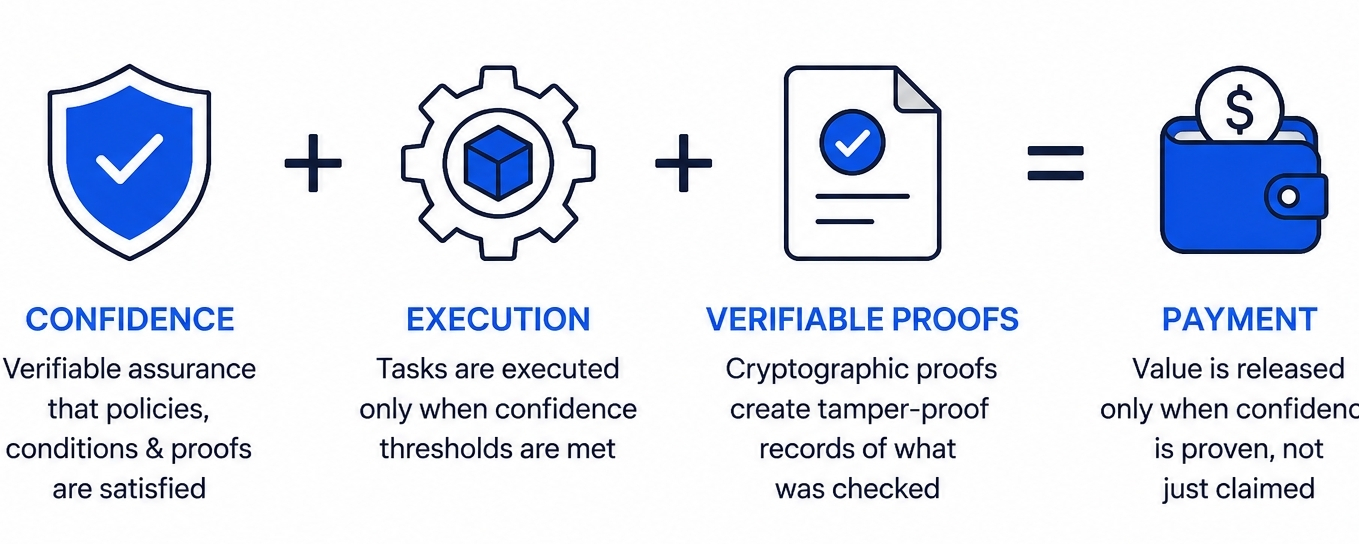
Article
Confidence Before Execution: Newton's New Payment EquationI used to believe that every payment system had to choose between moving fast and staying safe. The faster something became, the more I expected it to rely on trust and hope that nothing would go wrong. After spending time thinking about Newton Protocol, I'm no longer sure that trade-off has to exist. It feels like we have been asking the wrong question all along.
What changed my mind wasn't the promise of faster transfers. It was the idea that a payment can be carefully checked before it ever begins moving. That small shift made me realise speed is not only about reaching the finish line quickly. Sometimes real speed comes from avoiding the wrong direction in the first place. A payment that never creates a problem saves far more time than one that races ahead and needs fixing later.
I think many of us have accepted delays as the normal price of being careful. We wait because we want confidence, and we rush because we want convenience. But maybe those two goals don't have to compete forever. If important decisions happen before execution, the journey itself becomes smoother. The payment feels lighter because much of the uncertainty has already been removed. It isn't magic, just a differnt way of thinking about the process.
That is one reason Newton caught my attention. Instead of treating protection as something added after the fact, it places thoughtful authorization closer to the beginning. To me, that creates a payment flow that feels more balanced. We spend less energy reacting to mistakes and more energy preventing them. I honestly think that is a healthier direction for digital finance as it continnues to grow.
What I appreciate most is that this approach respects both speed and responsibility. We often celebrate systems that move faster every year, but we rarely ask whether they are moving with enough purpose. Progress should not only be measured by seconds saved. It should also be measured by confidence earned, stress avoided, and trust built over time. Those qualities may be harder to count, but they shape everyday experiences in meaningful ways.
I also believe this way of thinking encourages better habits for everyone involved. Builders can focus on creating stronger rules, users gain more confidence before approving important actions, and the network becomes more dependable without feeling restrictive. That balance feels practical instead of unrealistic. It reminds me that good design often comes from solving old problems in quiet ways rather than chasing louder promises.
When I look at the future, I don't see speed and security standing on opposite sides anymore. I see them working together, each making the other more valuable. That is why I keep coming back to NEWT Token and the ideas surrounding it. The biggest improvement may not be making payments move faster. It may be helping them move with greater confidence from the very begining. And to me, that feels like progress worth believing in, even if it happens one thoughtful step at a time.
@NewtonProtocol
#newt
$NEWT
{spot}(NEWTUSDT)
$EVAA
{future}(EVAAUSDT)
$BSB
{future}(BSBUSDT)
Confidence Before Execution: Newton's New Payment Equation
I used to believe that every payment system had to choose between moving fast and staying safe. The faster something became, the more I expected it to rely on trust and hope that nothing would go wrong. After spending time thinking about Newton Protocol, I'm no longer sure that trade-off has to exist. It feels like we have been asking the wrong question all along.
What changed my mind wasn't the promise of faster transfers. It was the idea that a payment can be carefully checked before it ever begins moving. That small shift made me realise speed is not only about reaching the finish line quickly. Sometimes real speed comes from avoiding the wrong direction in the first place. A payment that never creates a problem saves far more time than one that races ahead and needs fixing later.
I think many of us have accepted delays as the normal price of being careful. We wait because we want confidence, and we rush because we want convenience. But maybe those two goals don't have to compete forever. If important decisions happen before execution, the journey itself becomes smoother. The payment feels lighter because much of the uncertainty has already been removed. It isn't magic, just a differnt way of thinking about the process.
That is one reason Newton caught my attention. Instead of treating protection as something added after the fact, it places thoughtful authorization closer to the beginning. To me, that creates a payment flow that feels more balanced. We spend less energy reacting to mistakes and more energy preventing them. I honestly think that is a healthier direction for digital finance as it continnues to grow.
What I appreciate most is that this approach respects both speed and responsibility. We often celebrate systems that move faster every year, but we rarely ask whether they are moving with enough purpose. Progress should not only be measured by seconds saved. It should also be measured by confidence earned, stress avoided, and trust built over time. Those qualities may be harder to count, but they shape everyday experiences in meaningful ways.
I also believe this way of thinking encourages better habits for everyone involved. Builders can focus on creating stronger rules, users gain more confidence before approving important actions, and the network becomes more dependable without feeling restrictive. That balance feels practical instead of unrealistic. It reminds me that good design often comes from solving old problems in quiet ways rather than chasing louder promises.
When I look at the future, I don't see speed and security standing on opposite sides anymore. I see them working together, each making the other more valuable. That is why I keep coming back to NEWT Token and the ideas surrounding it. The biggest improvement may not be making payments move faster. It may be helping them move with greater confidence from the very begining. And to me, that feels like progress worth believing in, even if it happens one thoughtful step at a time.
@NewtonProtocol
#newt
$NEWT
$EVAA
$BSB
What changed my mind wasn't the promise of faster transfers. It was the idea that a payment can be carefully checked before it ever begins moving. That small shift made me realise speed is not only about reaching the finish line quickly. Sometimes real speed comes from avoiding the wrong direction in the first place. A payment that never creates a problem saves far more time than one that races ahead and needs fixing later.
I think many of us have accepted delays as the normal price of being careful. We wait because we want confidence, and we rush because we want convenience. But maybe those two goals don't have to compete forever. If important decisions happen before execution, the journey itself becomes smoother. The payment feels lighter because much of the uncertainty has already been removed. It isn't magic, just a differnt way of thinking about the process.
That is one reason Newton caught my attention. Instead of treating protection as something added after the fact, it places thoughtful authorization closer to the beginning. To me, that creates a payment flow that feels more balanced. We spend less energy reacting to mistakes and more energy preventing them. I honestly think that is a healthier direction for digital finance as it continnues to grow.
What I appreciate most is that this approach respects both speed and responsibility. We often celebrate systems that move faster every year, but we rarely ask whether they are moving with enough purpose. Progress should not only be measured by seconds saved. It should also be measured by confidence earned, stress avoided, and trust built over time. Those qualities may be harder to count, but they shape everyday experiences in meaningful ways.
I also believe this way of thinking encourages better habits for everyone involved. Builders can focus on creating stronger rules, users gain more confidence before approving important actions, and the network becomes more dependable without feeling restrictive. That balance feels practical instead of unrealistic. It reminds me that good design often comes from solving old problems in quiet ways rather than chasing louder promises.
When I look at the future, I don't see speed and security standing on opposite sides anymore. I see them working together, each making the other more valuable. That is why I keep coming back to NEWT Token and the ideas surrounding it. The biggest improvement may not be making payments move faster. It may be helping them move with greater confidence from the very begining. And to me, that feels like progress worth believing in, even if it happens one thoughtful step at a time.
@NewtonProtocol
#newt
$NEWT
$EVAA
$BSB
35
16
443
·
--
The Safety Paradox of Never Taking Possession
I used to think the safest financial system was the one that held my assets as tightly as possible. The more I studied Newton Protocol, the more that assumption started to unravel. What caught my attention wasn't stronger custody, but the possibility that security can come from never taking possession in the first place.
The distinction feels subtle, yet it changes how I think about trust. Instead of asking users to surrender control so someone else can protect it, Newton Protocol focuses on proving whether a payment satisfies predefined conditions before it is allowed to proceed. The protection comes from verified authorization, not from transferring ownership to another party. That separates the responsibility for making a decision from the responsibility for holding funds.
This approach also changes where mistakes are most likely to originate. If assets never leave the owner's control until policy requirements are satisfied, the conversation shifts from "Who is holding my money?" to "Are the rules governing this payment actually appropriate?" Strong custody cannot compensate for weak permissions, while well-designed proof-based controls can reduce unnecessary trust without removing user ownership.
I don't see this as eliminating risk. Rules can still be poorly designed, and policies still require careful thought. But Newton Protocol suggests that the strongest protection may not come from building larger vaults. It may come from making every transfer prove that it deserves to happen before it ever moves.
@NewtonProtocol
#Newt
$NEWT
{spot}(NEWTUSDT)
$FOLKS
{future}(FOLKSUSDT)
$BSB
{future}(BSBUSDT)
Do you think proof-based payment controls can provide stronger security than relying on custody alone for protecting assets?
The Safety Paradox of Never Taking Possession
I used to think the safest financial system was the one that held my assets as tightly as possible. The more I studied Newton Protocol, the more that assumption started to unravel. What caught my attention wasn't stronger custody, but the possibility that security can come from never taking possession in the first place.
The distinction feels subtle, yet it changes how I think about trust. Instead of asking users to surrender control so someone else can protect it, Newton Protocol focuses on proving whether a payment satisfies predefined conditions before it is allowed to proceed. The protection comes from verified authorization, not from transferring ownership to another party. That separates the responsibility for making a decision from the responsibility for holding funds.
This approach also changes where mistakes are most likely to originate. If assets never leave the owner's control until policy requirements are satisfied, the conversation shifts from "Who is holding my money?" to "Are the rules governing this payment actually appropriate?" Strong custody cannot compensate for weak permissions, while well-designed proof-based controls can reduce unnecessary trust without removing user ownership.
I don't see this as eliminating risk. Rules can still be poorly designed, and policies still require careful thought. But Newton Protocol suggests that the strongest protection may not come from building larger vaults. It may come from making every transfer prove that it deserves to happen before it ever moves.
@NewtonProtocol
#Newt
$NEWT
$FOLKS
$BSB
Do you think proof-based payment controls can provide stronger security than relying on custody alone for protecting assets?
I used to think the safest financial system was the one that held my assets as tightly as possible. The more I studied Newton Protocol, the more that assumption started to unravel. What caught my attention wasn't stronger custody, but the possibility that security can come from never taking possession in the first place.
The distinction feels subtle, yet it changes how I think about trust. Instead of asking users to surrender control so someone else can protect it, Newton Protocol focuses on proving whether a payment satisfies predefined conditions before it is allowed to proceed. The protection comes from verified authorization, not from transferring ownership to another party. That separates the responsibility for making a decision from the responsibility for holding funds.
This approach also changes where mistakes are most likely to originate. If assets never leave the owner's control until policy requirements are satisfied, the conversation shifts from "Who is holding my money?" to "Are the rules governing this payment actually appropriate?" Strong custody cannot compensate for weak permissions, while well-designed proof-based controls can reduce unnecessary trust without removing user ownership.
I don't see this as eliminating risk. Rules can still be poorly designed, and policies still require careful thought. But Newton Protocol suggests that the strongest protection may not come from building larger vaults. It may come from making every transfer prove that it deserves to happen before it ever moves.
@NewtonProtocol
#Newt
$NEWT
$FOLKS
$BSB
Do you think proof-based payment controls can provide stronger security than relying on custody alone for protecting assets?
Security Model
100%
Proof First
0%
Both Matter
0%
Custody First
0%
1 votes • Voting closed
37
15
627
Log in to explore more content
Join global crypto users on Binance Square
⚡️ Get latest and useful information about crypto.
💬 Trusted by the world’s largest crypto exchange.
👍 Discover real insights from verified creators.
Email / Phone number
Trending Topics
FedMinutesFocusOnOctoberPause
225,783 views
1,496 Discussing
🚨 HIGH ALERT ‼️ PLEASE DON’T TRADE BLINDLY FOR THE NEXT HOUR 🚨
Guys, we have FOMC Minutes coming in less than 1 hour.
And after the kind of volatility we already saw today, I really don’t want anyone opening random high-leverage positions just before this release.
The biggest reaction I’m watching will be in Gold (XAU), Silver (XAG), BTC and ETH. Then coins like SOL and other highly leveraged mid/low-cap alts can exaggerate whatever move BTC makes.
Gold and Silver are especially sensitive tonight because the market is already reacting to the US dollar + Treasury yields, and both metals have been under heavy pressure ahead of the Fed minutes.
Briefly speaking
📉Hawkish Fed Minutes → Dollar/yields can push higher → pressure on BTC, crypto, Gold & silver
📈Dovish Fed Minutes → Dollar/yields can cool → BTC, Gold, Silver and risk assets can bounce hard.
And please remember the first candle can be a trap. We can get a pump, immediate dump, liquidations on both sides, and then the real direction.
So for now, protect your positions, reduce unnecessary leverage and don’t FOMO into the first move.
Tonight I’m watching $XAU , $XAG and $BTC first. These will tell us very quickly how the market is reading the Fed.
I will Update you guys on time
Follow @Panda Traders and Turn on Your notifications right now
#FedMinutesFocusOnOctoberPause
Panda Traders
·19 Likes
·4.4k views
BinanceLaunchesBinanceIntelligence
1.2M views
6,679 Discussing
EvernorthDelaysNasdaqDebutToOct12
25,318 views
361 Discussing