
币圈茶水间
339 Posts

币圈茶水间
Report
Block User
币圈人的茶水间|进来喝杯茶,聊聊今天的盘|只观察不指挥
85 Following
57 Followers
86 Liked
Posts
·
--
It dipped back down yesterday, then surged back up today.
This morning, we were still talking about how Bitcoin had tested the $61,000 barrier 18 times. Then the 10 a.m. hourly candle pushed straight through it: Bitcoin $BTC rose about 1.5% in an hour to $61,593, peaking at $61,858 and briefly surpassing yesterday’s high of $61,603. Ethereum $ETH climbed too, up about 1.7% in an hour to around $1,730, while SOL is at $72.70.
This surge is interesting: Bitcoin’s 24-hour liquidations jumped from $29 million to $64 million in just one hour, with $35 million added in 15 minutes—the signs strongly suggest short positions were getting squeezed. There’s news on Ethereum, too: three hours ago, someone accumulated 8,000 ETH, worth about $13.64 million. Developers also reached consensus on the Glamsterdam upgrade, which will activate on the Hoodi testnet on December 16.
But don’t rush to conclusions: yesterday morning, prices surged in much the same way, only to fall back to $59,877 later that day. There’s still the $62,000 barrier to clear, and tonight’s U.S. stock market opening after Thanksgiving will be the real test.
Do you think it can hold this time?
120
·
--
Tonight, the $60K level got another pin
Today’s market had me doing a double take.
In the morning, people were talking about reclaiming $60K after breaking 61,000. By the afternoon, it looked like we might hold above it. Then at 11 p.m., a 15-minute candle suddenly wicked down to 59,877 before bouncing back to 60,212.
That makes this the twelfth tug-of-war at the $60K level today.
ETH was much the same: it peaked at 1,729 in the morning, bottomed at 1,667 tonight, and briefly reclaimed 1,700 before losing it again.
But one thing is pretty clear: BTC has rebounded about 4.9% from its low of 57,663; liquidations are still mostly short positions, with $153 million in BTC liquidations alone over the past 24 hours, affecting 12,415 traders; the broader market has 59 gainers and 8 losers, and SOL is still above 70.
So my take is: the rebound is real, but there’s no sign of a reversal yet. BTC hasn’t held above 61,000, ETH hasn’t held above 1,700, and the $60K level got another jab tonight.
U.S. markets will have a half-day tomorrow, and liquidity is already thin over the Thanksgiving holiday, so volatility could be even higher.
Are you watching to see if BTC can reclaim 61,000 tonight, or do you think the $60K level is going to get jabbed again?
$BTC $ETH
439
·
--
Today, there are two major whales in the $ETH circle: one made a fortune, while the other took a huge loss.
The one who made a fortune bought 100,000 ETH for $31,000 in 2015 and held it for 11 years. Today, they sold their remaining 45,000 ETH at an average price of $1,674, cashing out $75.35 million in a single day. That turns $31,000 into $87.21 million—a 2,804x return.
What’s interesting is that they sold half their ETH back in 2016 for $5.47 each, pocketing just $274,000. If only they’d held onto that half until today… But there are no “ifs”—they’re already the biggest winner in the room.
The one who took a huge loss sold 33,700 ETH over the counter through Galaxy Digital early this morning at an average price of $1,673. They had bought it at $3,026, so this investment is estimated to have resulted in a loss of about $45.6 million.
Two different outcomes on the same day. But ETH didn’t get dumped today; it’s still up 2.4% over the past 24 hours, trading at $1,690. It hasn’t managed to hold above $1,700 yet.
Are you planning to hold your ETH for 11 years, or 11 days?
(Data sources: on-chain analyst Ember and monitoring by Onchain Lens)
1.6k
·
--
Prices have bounced, but money is still flowing out of ETFs—the combination feels a little strange.
Yesterday (Nov. 25, U.S. Eastern Time), U.S. spot $BTC ETFs saw another $453 million in net outflows, marking the seventh consecutive trading day of outflows. That’s nearly double the $232 million outflow the day before. Just yesterday, we were saying outflows had slowed—and today they’ve nearly doubled.
BlackRock’s IBIT alone saw $330 million flow out, making it the biggest contributor to the outflows.
$ETH didn’t fare much better: spot ETFs saw $68.51 million in net outflows, their ninth consecutive day of outflows. BlackRock’s ETHA accounted for the entire amount.
Including yesterday, Bitcoin ETFs have seen more than $5.3 billion in cumulative outflows in November, setting a new monthly record.
What’s interesting is that prices have actually been bouncing back over the past two days: Bitcoin rebounded from a low of $57,663, climbed back above $61,000, and now stands at $61,005. But ETF money just keeps flowing out.
Is the rebound being driven by on-exchange buying and short covering while institutions remain on the sidelines? Or did institutions have little to do with this rally in the first place?
What do you think—can crypto prices hold above $60,000 with ETFs seeing consecutive outflows?
59
·
--
Good morning! Just got up and checked the charts—the market has pushed a little higher again ☕
In my post around midnight, I said, “Whether we can hold $60,000 during the day is key.” Turns out $BTC didn’t just hold it—it surged to $61,603 on the 8 a.m. hourly candle, and has now pulled back to just above $60,800. $ETH has reclaimed $1,700, peaked at $1,729, and is now at $1,704. SOL is holding at $71, and ZEC has climbed all the way to $776.
What’s interesting is that the Fear & Greed Index is still at 11 today—extreme fear. Prices are moving up, but sentiment is still frozen at rock bottom. I’ve seen this divergence before: often the market moves first, and sentiment catches on later.
Liquidation figures have climbed quickly over the past hour: BTC’s 24-hour liquidations rose from 231 million at 7:30 to 280 million, while ETH’s went from 107 million to 127 million. Prices are rising, and liquidations are rising too—that means short positions are being liquidated, with the bears adding fuel to the rally.
U.S. stock markets are closed for Thanksgiving, so today the crypto market is on its own. Liquidity is thin, and volatility could be higher than usual. We’ve just reclaimed the $60,000 level, but whether we can stay above it will depend on these next few hourly candles.
What do you think—is this a genuine rebound, or just a quick pop before prices turn back down?
94
·
--
Woke up to find Bitcoin back above $60,000.
The hourly candle at 11 p.m. last night dipped to a low of $57,663. When I checked before bed, it was still hovering around $57,000. But then it climbed steadily through the night: the 1 a.m. hourly candle rose 1.71%, the 4 a.m. candle closed at $60,243, and the 5 a.m. candle closed at $60,214—two hourly candles in a row above $60,000. That’s a rebound of about 4.5% from the low.
And it’s not just Bitcoin: SOL reclaimed $70 and is now at $70.47; ZEC rose to $757, holding above the $700 mark. ETH is still below $1,700 at $1,686, the only major coin today that hasn’t reclaimed a round-number level.
U.S. stocks also staged a reversal last night: the Nasdaq was down as much as 4.6% intraday, but closed down just 0.62%. Nvidia closed at $149.30, down 3.9%, failing to hold $150. Anthropic closed at $82.79, up a modest 1.1%, but still below its $83 IPO price. That makes two days in a row closing below the IPO price.
On Binance spot today, 43 coins are up and 23 are down, with most of the market in the green: BTC up 0.2%, ETH basically flat, BNB up 0.4%, XRP up 1.4%, and SOL up 1.0%.
It’s Thanksgiving today, so U.S. markets are closed. Liquidity tends to be thin over the holiday, so the market may still be volatile. Waking up, it looks like things have bounced back—but whether $60,000 can hold remains to be seen during the day. Do you think it can stay above that level this time?
$BTC $ETH
606
·
--
#Trump may revive tariff offensive, sending Bitcoin and U.S. stocks lower again
In the piece I wrote at noon, I said the rates hadn’t been set yet. By tonight, the details were out—
The Office of the U.S. Trade Representative proposed tonight tariffs of up to 20% on EU goods, at least 20% on Vietnamese goods, and up to 25% on goods from Cambodia, Indonesia, South Korea, and others. It also said the proposed tariffs would not be added on top of the 10% or 12.5% round from July.
In other words, the Section 301 route is really happening—it’s not just a trial balloon. The list still includes the same 16 trading partners: China, the EU, India, Japan, South Korea, Mexico, Vietnam, Taiwan, and others.
You’ve seen the market’s reaction today: Nasdaq futures are down, Nvidia fell more than 5% in premarket trading, and Bitcoin dropped 2.7% on the day, briefly sliding to 58,204. When the tariff pressure ramps up, risk assets are the first to take a hit.
My take: this is still just a “proposal.” The final rates and who gets exemptions haven’t been decided. But the direction is already clear—the tariff drama won’t be over anytime soon, and crypto investors should keep a close eye on it.
How high do you think the tariffs will end up? Let’s discuss in the comments.
395
·
--
Verified
#U.S. October core PCE is about to be released—how will rate hike expectations change?
The numbers just came out, and I had to look at them twice—
Core PCE was up 3.3% year over year, versus expectations of 3.2%, and 3.1% in September. It didn’t cool at all—in fact, it hit a three-year high. The 0.3% month-over-month reading was in line with expectations, but the year-over-year figure is what the Fed cares about most.
Headline PCE was up 3.8% year over year, in line with expectations; the revised third-quarter GDP figure was 3.4%, unchanged from the initial estimate; and initial jobless claims came in at 189,000, even lower than the expected figure of just over 200,000—the labor market hasn’t cooled either.
In other words, inflation is picking up again, and the economy is still strong. There’s no way the prospect of rate cuts is easing up. Markets are still pricing in a nearly 99.8% chance of a 25-basis-point rate hike in December—it’s practically a done deal.
In the two minutes after the data came out, $BTC slid from 58831 all the way to 58204, setting a new low once again. The price I’m seeing now is 58400, down 2.7% over the past 24 hours; $ETH 1637 is down 3.2%.
It’s not just crypto that’s falling. Gold dropped below $3,500, and silver fell below $40, down more than 6% in a day. Bitcoin was already down more than 2% during the day—and now the U.S. has proposed tariffs of up to 20% on the EU. With tariffs piling on top of inflation, risk assets are all taking a hit tonight.
My view is straightforward: with core PCE at 3.3% year over year, we’re still a long way from the Fed’s 2% target, so rate hike expectations aren’t going away anytime soon. Crypto could be in for another cold spell this winter.
Tomorrow is the Thanksgiving holiday, and U.S. markets will be closed. With liquidity even thinner, volatility could increase further. What do you think? After a rate hike in December, will there be another one in January?
772
·
--
I saw a piece of news today that made my heart skip a beat.
Nasdaq-listed Bit Digital just disclosed that it sold 29,825 ETH between November 15 and 23, at an average price of $1,676, raising about $50 million. The proceeds all went toward repaying a mortgage loan from Galaxy Digital, cutting its debt from $100 million straight down to $50 million.
This isn’t an isolated case. Glassnode data shows that publicly listed mining companies have sold nearly half of their Bitcoin reserves since January. MARA sold 1,713.9 BTC—worth about $121 million—just eight days after its earnings report. Today’s ChainCatcher analysis hits even harder: at an electricity cost of $0.06 per kWh, power bills for newer models such as the Antminer T21 already account for more than 97% of mining revenue, leaving miners barely breaking even. The Avalon A1466I has even fallen below its shutdown price.
Bitcoin prices fall, miners’ revenue shrinks, and they can only sell coins to repay debt; those sales then add further downward pressure on prices. That’s the “double whammy” described in the analysis’s headline: selling coins to repay debt while betting on a pivot to AI data centers—and neither has come at a good time.
Bitcoin is now hovering around $58,700, and it has fallen more than 20% in November. Do you think this wave of selling pressure from miners is the final shakeout at the end of the bear market, or the start of another decline?
$BTC $ETH
47
·
--
November isn’t over yet, but ETF outflows have already hit a record.
From November 1 to 24, U.S. spot Bitcoin ETFs saw cumulative net outflows of $4.94 billion, surpassing the previous monthly record of $4.51 billion. It’s the biggest month of outflows since they launched in January 2024.
Most of it came from BlackRock’s IBIT, which alone saw more than $4 billion flow out. It lost another $232 million on Tuesday, marking six straight days of outflows.
But here’s one detail: the pace of outflows is slowing. Monday saw $570 million flow out, compared with $232 million on Tuesday. People are still leaving, but they’re not rushing out as much as they were a few days ago.
Bitcoin’s price tells a similar story: $BTC is down about 23% this month and is now hovering around $58,600. It hasn’t recovered the $60,000 mark and could be its worst month since June 2022.
Core PCE for October is due out tonight at 21:30. I’ll be back then to see how it stacks up. When do you think ETF inflows will return?
39
·
--
While the broader market was falling, it surged more than 60% in a day. I got curious and dug into it—and what I found was far more interesting than the price itself.
$BIGTIME is currently at $0.0068, up 63.6% in 24 hours. Meanwhile, $BTC 58,992 USD (-1.4%), ETH at $1,646 (-2.4%), and SOL at $67.80 (-4.0%)—one gaming token was moving against the broader market. My first thought was that some positive news had come out. I looked around, but couldn’t find any project announcements.
So what was driving the surge? The derivatives data had the answer:
Perpetual futures trading volume hit $345 million in 24 hours, 40 times the previous day’s volume. Open interest jumped 730% in a single day to $23.66 million. The funding rate plunged to -2.04%, effectively rock bottom—meaning shorts were paying just to stay in their positions.
Liquidation data tells the same story: $1.8 million in short positions were liquidated over 24 hours, compared with just $790,000 in longs. Shorts kept getting squeezed, pushing the price up.
So this move wasn’t driven by fundamentals; it was a short squeeze. But here’s the reality check: the token is already down 79% so far this year, the top 100 addresses hold more than 98% of the supply, and 600 million tokens—12% of the maximum supply—are due to unlock on November 30. How far the squeeze can go depends on whether buyers keep stepping in.
Do you usually trade these small-cap coins that suddenly spike, or do you stick to the broader market?
495
·
--
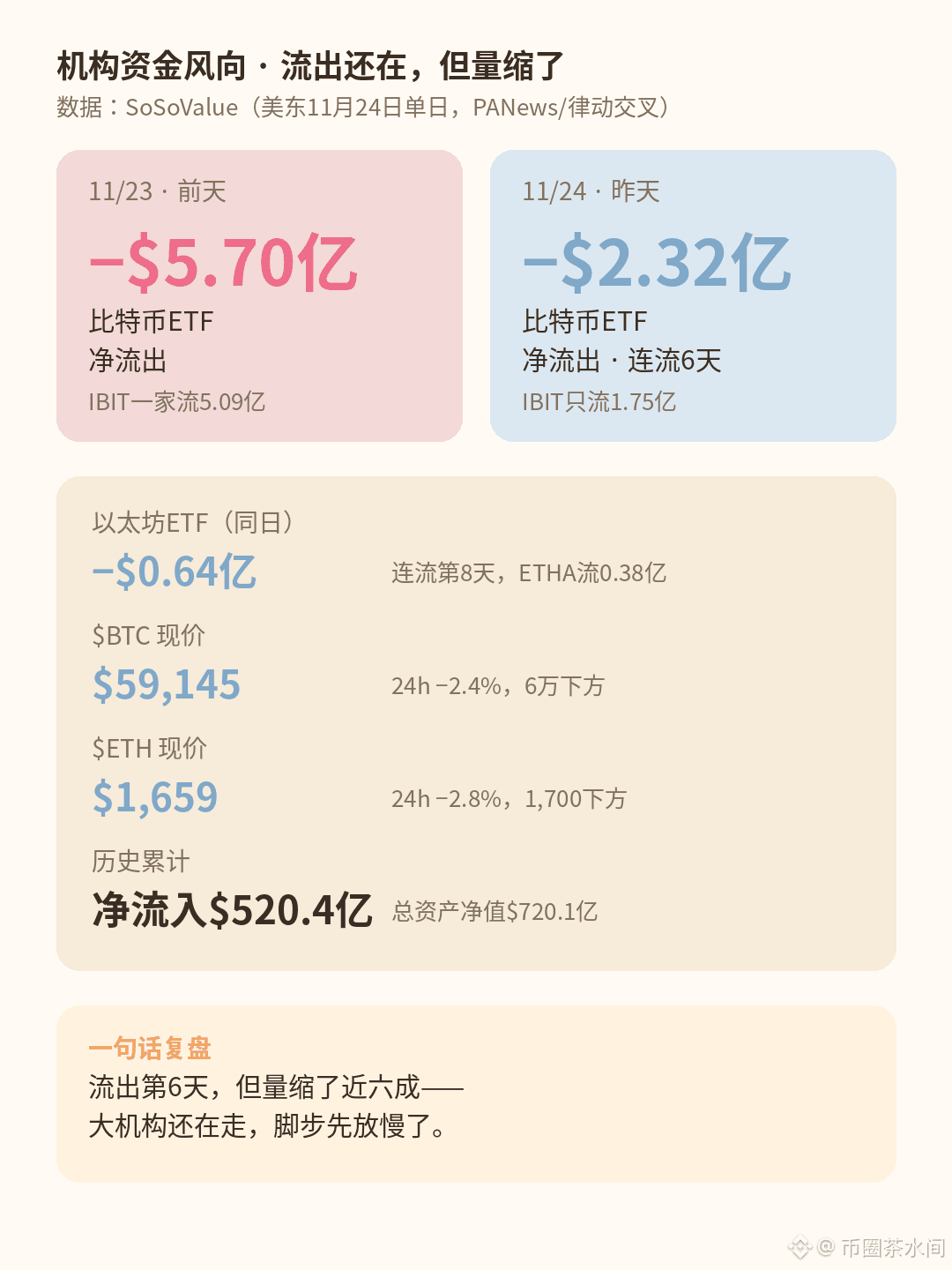
Outflows on day 6, but the amount is down nearly 60%—institutions are still leaving, just at a slower pace
Yesterday’s (November 24, U.S. time) data is out:
Bitcoin spot ETFs saw another $232 million in net outflows, marking six consecutive days of outflows. Ethereum spot ETFs also saw $64 million in net outflows, marking eight consecutive days.
But a closer look at the numbers is interesting:
Bitcoin ETFs saw $570 million leave in a single day the day before yesterday, compared with just $232 million yesterday—a drop of nearly 60%. BlackRock’s IBIT alone saw outflows of $509 million the day before yesterday, versus $175 million yesterday.
The same goes for Ethereum: BlackRock’s ETHA saw $91 million in outflows the day before yesterday, compared with $38 million yesterday.
Money is still flowing out, just not as urgently. As for prices, $BTC is still below 60,000, at $59,145, and $ETH 1,659 is also still below 1,700—the outflows have slowed, but prices haven’t recovered.
Do you think this is a sign that selling pressure is close to bottoming out, or just a breather after a steep drop?
81
·
--
#Trump may revive tariff offensive as Bitcoin and US stocks weaken again
The tariff issue is heating up again.
Reuters and The Wall Street Journal both reported that the Trump administration is preparing to announce the results of Section 301 investigations into 16 trading partners. The list includes China, the EU, India, Japan, South Korea, Mexico, Vietnam, and Taiwan. Tariff rates and the scope of exemptions have yet to be decided. The backdrop is the Supreme Court’s ruling in February this year that invalidated the round of global import tariffs. This time, the administration is turning to Section 301.
On the same day the news broke, US stocks and crypto markets weakened together: the Nasdaq fell 1.5% on Tuesday, while Nvidia dropped 5.86%, giving back about a quarter of its 31% gain from Monday. $BTC is now at $59,501, down 1.3% over 24 hours and back below $60,000, after touching a 24-hour low of $58,952.
I wouldn’t treat this as a simple case of “tariffs caused the drop”—there were already plenty of factors weighing on markets over the past couple of days. Anthropic just slipped below its offering price, and debate over an AI bubble hasn’t let up either. But whenever tariffs return to the table, risk assets usually react by pulling back first and waiting to see the details on rates and exemptions.
There are two things to watch this time: when the USTR formally announces its findings, and what tariff rates it sets. Until the details are finalized, the $60,000 level will probably remain a point of back-and-forth.
How long do you think it’ll take for this tariff fire to reach the crypto market?
239
·
--
#AI concept stocks broadly fell, with Anthropic dropping below its IPO price
Last night at the open, I was already saying “it’s below the IPO price.” By the close, it had fallen even further.
Anthropic closed at $81.91, down 6.5%, marking the first time it ended below its $83 IPO price. It touched a low of $75.61 intraday, and its market cap briefly fell below $1 trillion. Just four trading days after listing, it opened at $111.50, closed at $97.17 on its first day, ended Monday at $87.64, and closed yesterday at $81.91—it’s been going down every day.
Nvidia didn’t fare much better: it closed at $155.38, down 5.86%, giving back nearly a quarter of Monday’s 31% gain. Jensen Huang held an all-hands meeting at 4:30 a.m. and admitted he’d made some major mistakes, but the stock didn’t respond. Cathie Wood’s newly opened position is also sitting on a paper loss of nearly $28 million.
The Nasdaq closed down 1.5%, the S&P 500 fell 0.5%, and only the Dow rose, gaining 0.9%. Goldman Sachs added insult to injury, saying Monday’s surge was a classic bear-market rally, driven mainly by short covering.
Crypto didn’t escape either. Bitcoin has been fluctuating around $60,000 and is now at $60,017; Ethereum is at $1,686. The wind blowing over from the AI sector is still cold.
What do you think—is Anthropic’s IPO price too high, or is the whole AI story starting to be reassessed?$ANTB $NVDA
14
·
--
Verified
#Anthropic’s premarket losses widen; shares have fallen below the $83 IPO price
U.S. markets are open, so let’s check how things are going: all three major indexes opened lower, with the Nasdaq down 1.88%, the S&P 500 down 1.23%, and the Dow down 0.66%.
Anthropic fell below its IPO price right at the open. Its current price on Binance is $80.44, well below the $83 IPO price, and down more than 8% from Monday’s close of $87.64. But before the market opened, Oppenheimer gave it an Outperform rating with a $150 price target. Bulls and bears are sharply divided right now.
Nvidia hasn’t been spared either. It closed at $165.05 on Monday and is now trading around $154.8 shortly after the open, down more than 6%. It has given back about a quarter of Monday’s 31% gain, a steeper drop than the 5% decline before the market opened.
Bitcoin is still hovering around 60,000. The hourly candle at 21:00 closed $13 below 60,000, but it has now climbed back to around $60,320, with prices seesawing around 70, between $ETH 1,691 dollars and $SOL 69.7 dollars.
What do you think about tonight’s market—an opportunity to shake things out, or is it really heading lower?
552
·
--
#Bitcoin falls below $60,000 again, giving back last night's rebound gains
I just said it couldn't hold, and now it's back above 😅
Just an hour ago, I posted that two consecutive hourly candles, at 17:00 and 18:00, had closed below $60,000 (59,964 and 59,761). The 18:00 candle also dipped to a low of 59,366, breaking below the morning low of 59,428. My conclusion was: “It can't hold for now.”
Then the 19:00 candle closed right back above: it opened at 59,761, dipped to 59,496, then climbed back to close at 60,400, reclaiming $60,000.
The 20:00 candle is still forming. The current price is 60,192, with the low holding above 60,164—it hasn't fallen back down.
So Bitcoin has battled around $60,000 three times today: it fell below and recovered in the morning, fell below again in the afternoon, then recovered once more in the evening. The bears are trying to push it down, but the bulls aren't giving in.
$BTC Current price: 60,192, still about 6.8% below last night's high of 64,572; $ETH 1,695, still below 1,700; SOL is at 70.50, holding right at 70.
Honestly, in this kind of back-and-forth market, chasing rallies or selling off is the easiest way to get hit from both sides. I'll keep watching. If the 21:00 candle still holds at the close, I'll come back and compare notes with you.
Do you think $60,000 will hold through tonight's close?
16
·
--
#Bitcoin has fallen below $60,000 again, wiping out last night's rebound
In my post this afternoon, I asked whether $60,000 could hold tonight.
We now have an initial answer: the 5 p.m. candle closed at 59,964, and the 6 p.m. candle at 59,761. That's two consecutive hourly candles closing below $60,000—the first time today.
What's more, the 6 p.m. candle dipped below this morning's low, hitting 59,366.
This is the third time today that BTC has dropped below $60,000. It recovered the first two times, but neither of these last two hourly candles climbed back above it.
It's now at 59,867, still hovering below $60,000.
ETH is at 1,690 and hasn't reclaimed 1,700 either; SOL is at 70.29, just 20 cents above $70.
$370 million in BTC liquidations over the past 24 hours, affecting nearly 24,000 traders. Another $13.9 million was liquidated in the past hour alone. Long positions are getting slowly ground down below $60,000.
From last night's high of 64,572, BTC has already given back 7.3%.
Do you think it can get back above $60,000 tonight? Or is this time the level really not going to hold?
$BTC $ETH
4
·
--
#Bitcoin has fallen below $60,000 again, wiping out last night’s rebound
I wrote about the morning move: just after 11, it dipped to 59,428, then reclaimed 60,185 in just 15 minutes. At the time, I thought it had held that level.
The afternoon hourly candle closed at 60,602, and the 4 p.m. close was also at 60,222. It spent the whole afternoon grinding above $60,000.
But the 5 p.m. hourly candle pushed it back down, with a low of 59,731. It lost $60,000 again—but has now reclaimed 60,013.
It broke below the level twice in one day and reclaimed it both times, and this time the low was higher than this morning’s 59,428. ETH, meanwhile, also lost $1,700 and is now at 1,686; SOL is at 70.9, so $70 is getting close too.
From last night’s high of 64,572, this move has given back about 7.0%.
Do you think it can hold $60,000 tonight, or will the third time be the one it fails? 👀
$BTC $ETH
22
·
--
#Binance Blockchain Week: Evolution is up to You
On Saturday, November 28, the Bangkok leg of the Masters Tournament kicks off: 10 traders, a 90-minute showdown, and a total prize pool of $170,000, with $100,000 going to the winner. The whole event will be livestreamed on Binance Square.
I came across this while checking the charts. BTC is still hovering above $60,000, and ETH is seesawing around $1,700. The whole market seems to be waiting for a clear direction.
With the winner decided in 90 minutes, what do you think this kind of competition really comes down to: skill or mindset?
172
·
--
Monday’s ETF ledger is out, and money is still flowing out.
On November 23, U.S. Eastern Time, $BTC spot ETFs saw $570 million in net outflows for the day, marking the fifth consecutive day of outflows; $ETH spot ETFs saw about $85 million in net outflows, marking the seventh consecutive day. Combined, about $655 million flowed out in a single day.
What’s interesting is the divergence: BlackRock’s IBIT alone saw $509 million flow out, while Fidelity’s FBTC actually had net inflows of $13.29 million. The same pattern showed up with Ethereum: BlackRock’s ETHA saw $90.54 million in outflows, while Fidelity’s FETH had net inflows of $5.58 million.
Looking back a little further, Bitcoin ETFs saw $1.25 billion in net outflows last week, marking the third consecutive week with more than $1 billion in weekly outflows. As for prices, Bitcoin is now around $60,600—it briefly fell below $60,000 this morning before recovering—while Ethereum is at $1,706, with $1,700 still a battleground.
Money is flowing out, while prices are treading water. Do you think this wave of outflows means institutions are pulling back, or are they just waiting for Wednesday night’s core PCE report?
32
Log in to explore more content
Join global crypto users on Binance Square
⚡️ Get latest and useful information about crypto.
💬 Trusted by the world’s largest crypto exchange.
👍 Discover real insights from verified creators.
Email / Phone number