
币来财888
731 Posts
币来财888
Report
Block User
✅【公众号:币来财MAX】✅ 赚认知内之财,以文梳逻辑,聚同道共抬人生底。
4 Following
1.7K+ Followers
3.2K+ Liked
Posts
All
Quotes
PINNED
·
--
The dealer's manipulation is never really for your small gains.
Too many people curse the dealer when the price drops, thinking their holdings are being targeted, but the truth is — the dealer doesn't care about your few dozen or few hundred coins. They manipulate the market to be able to soar higher and run more steadily in the future.
Let me tell you an example I witnessed. There was a small coin called METIS, with an initial price of 1.2U, a small market cap, and a circulation of ten million, with sixty percent in retail hands.
A small team bought four million coins at the bottom, but they didn't dare to push the price up directly. Can you guess why? Because if they forcefully pushed it, as soon as the price reached 1.5U, early retail investors would panic sell, and the team wouldn't be able to absorb that selling pressure. In the end, they could only sing to themselves, with no one to support them.
So they had to manipulate the market, and they did it in a very rhythmic way.
The first stage is called “boiling frogs in warm water”.
The coin price slowly declined from 1.2U to 0.9U, with no volume and no news. Retail investors started to get anxious: “Is it dead?” “Quick, let's run before it really goes to zero.” So they all sold at a loss, while the dealer quietly accumulated near 0.9U.
The second stage is “panic drop to accumulate bottom”.
The coin price suddenly dropped to 0.7U, then quickly pulled back to 0.95U. Many people thought it had hit the bottom and rushed in to buy. As a result, the dealer dumped again, driving the price down to 0.65U. All the bottom buyers were buried, their mentality collapsed, and they could only sell at a loss.
The third stage is the most ruthless, called “manufacturing panic”.
With FUD news like “the project team is withdrawing liquidity” and “big investors are running away”, the coin price plummeted to 0.5U. The market was in despair, and retail investors completely gave up and capitulated. Meanwhile, the dealer was happily accumulating during this range.
The final step is called “V-shaped golden pit”. The dealer used a small amount of capital to quickly pull the coin price back to 1U, forming a strong bullish candlestick. Those who had previously sold at a loss dared not chase, while newcomers had their costs around 1U.
After this round of operations, the dealer's holdings increased from four million to six million coins, with an even lower average cost. The key point is that the weak hands were completely cleared out, and there was almost no selling pressure for the upcoming rally.
So you see, the essence of market manipulation is not to steal your coins, but to “change people” — to wash out low-cost retail investors and bring in a batch of high-cost, more reliable investors.
Once, a person was stumbling in the dark, and now the light is in my hands.
The light is always on, will you follow? @Square-Creator-28cfd94beb68d
The dealer's manipulation is never really for your small gains.
Too many people curse the dealer when the price drops, thinking their holdings are being targeted, but the truth is — the dealer doesn't care about your few dozen or few hundred coins. They manipulate the market to be able to soar higher and run more steadily in the future.
Let me tell you an example I witnessed. There was a small coin called METIS, with an initial price of 1.2U, a small market cap, and a circulation of ten million, with sixty percent in retail hands.
A small team bought four million coins at the bottom, but they didn't dare to push the price up directly. Can you guess why? Because if they forcefully pushed it, as soon as the price reached 1.5U, early retail investors would panic sell, and the team wouldn't be able to absorb that selling pressure. In the end, they could only sing to themselves, with no one to support them.
So they had to manipulate the market, and they did it in a very rhythmic way.
The first stage is called “boiling frogs in warm water”.
The coin price slowly declined from 1.2U to 0.9U, with no volume and no news. Retail investors started to get anxious: “Is it dead?” “Quick, let's run before it really goes to zero.” So they all sold at a loss, while the dealer quietly accumulated near 0.9U.
The second stage is “panic drop to accumulate bottom”.
The coin price suddenly dropped to 0.7U, then quickly pulled back to 0.95U. Many people thought it had hit the bottom and rushed in to buy. As a result, the dealer dumped again, driving the price down to 0.65U. All the bottom buyers were buried, their mentality collapsed, and they could only sell at a loss.
The third stage is the most ruthless, called “manufacturing panic”.
With FUD news like “the project team is withdrawing liquidity” and “big investors are running away”, the coin price plummeted to 0.5U. The market was in despair, and retail investors completely gave up and capitulated. Meanwhile, the dealer was happily accumulating during this range.
The final step is called “V-shaped golden pit”. The dealer used a small amount of capital to quickly pull the coin price back to 1U, forming a strong bullish candlestick. Those who had previously sold at a loss dared not chase, while newcomers had their costs around 1U.
After this round of operations, the dealer's holdings increased from four million to six million coins, with an even lower average cost. The key point is that the weak hands were completely cleared out, and there was almost no selling pressure for the upcoming rally.
So you see, the essence of market manipulation is not to steal your coins, but to “change people” — to wash out low-cost retail investors and bring in a batch of high-cost, more reliable investors.
Once, a person was stumbling in the dark, and now the light is in my hands.
The light is always on, will you follow? @币来财888
Too many people curse the dealer when the price drops, thinking their holdings are being targeted, but the truth is — the dealer doesn't care about your few dozen or few hundred coins. They manipulate the market to be able to soar higher and run more steadily in the future.
Let me tell you an example I witnessed. There was a small coin called METIS, with an initial price of 1.2U, a small market cap, and a circulation of ten million, with sixty percent in retail hands.
A small team bought four million coins at the bottom, but they didn't dare to push the price up directly. Can you guess why? Because if they forcefully pushed it, as soon as the price reached 1.5U, early retail investors would panic sell, and the team wouldn't be able to absorb that selling pressure. In the end, they could only sing to themselves, with no one to support them.
So they had to manipulate the market, and they did it in a very rhythmic way.
The first stage is called “boiling frogs in warm water”.
The coin price slowly declined from 1.2U to 0.9U, with no volume and no news. Retail investors started to get anxious: “Is it dead?” “Quick, let's run before it really goes to zero.” So they all sold at a loss, while the dealer quietly accumulated near 0.9U.
The second stage is “panic drop to accumulate bottom”.
The coin price suddenly dropped to 0.7U, then quickly pulled back to 0.95U. Many people thought it had hit the bottom and rushed in to buy. As a result, the dealer dumped again, driving the price down to 0.65U. All the bottom buyers were buried, their mentality collapsed, and they could only sell at a loss.
The third stage is the most ruthless, called “manufacturing panic”.
With FUD news like “the project team is withdrawing liquidity” and “big investors are running away”, the coin price plummeted to 0.5U. The market was in despair, and retail investors completely gave up and capitulated. Meanwhile, the dealer was happily accumulating during this range.
The final step is called “V-shaped golden pit”. The dealer used a small amount of capital to quickly pull the coin price back to 1U, forming a strong bullish candlestick. Those who had previously sold at a loss dared not chase, while newcomers had their costs around 1U.
After this round of operations, the dealer's holdings increased from four million to six million coins, with an even lower average cost. The key point is that the weak hands were completely cleared out, and there was almost no selling pressure for the upcoming rally.
So you see, the essence of market manipulation is not to steal your coins, but to “change people” — to wash out low-cost retail investors and bring in a batch of high-cost, more reliable investors.
Once, a person was stumbling in the dark, and now the light is in my hands.
The light is always on, will you follow? @币来财888

1
1
20
13k
·
--
On the smoky barbecue stall, someone handed me a cigarette: "I heard you got into crypto quite early?" I exhaled a puff of smoke and smiled: "I know a little, but I stopped playing a long time ago."
Behind this nonchalance lies a decade of ups and downs.
In the bull market of 2017, my close friend A Jie found me. I showed him K-line charts for three days and said "you might lose everything" ten times.
He threw down fifty thousand: "If I lose, I won't blame you." Three months later, his account ballooned to three hundred thousand, and he raised a glass to toast me: "You are my benefactor."
The bull market party eventually came to an end. When the assets shrank to eighty thousand, he called me late at night: "Why didn’t you tell me to cash out earlier?" Later I found out, he mortgaged his house to increase his investment.
The last message was: "I didn’t expect you to be a fraud too." A decade of friendship shattered in the sound of K-line collapse.
In the office, my colleague Xiao Wang accidentally caught a glimpse of the trading interface on my phone.
From then on, the break room became his consultation room: "Is this coin worth buying?" "When should I sell?" Later, he brought his relatives to surround me, and I became free customer service. After refusing three times, he circled around me at a dinner party.
The most ironic thing was the hundredfold return of Dogecoin in 2021. At a family gathering, slightly tipsy, I let it slip.
The next day, my aunt came to borrow money to buy a house, and my cousin wanted to raise money for surgery. After politely declining, news popped up in the family group: "You made so much money and don’t help your relatives, it’s disheartening."
These experiences made me understand that the crypto world is not just a game of numbers, but a trial of human nature.
When you profit, you are a divine being turning stone into gold; when you lose, you are the irredeemable fraud.
Your private time is invaded, becoming an emotional trash can.
Your wealth becomes a public resource in everyone’s eyes.
True investors ultimately learn to build a moat with silence.
Do not test human nature, because it cannot withstand the test.
Do not cross boundaries, because relationships cannot bear the weight of money.
Do not flaunt wealth, because greed always outruns kindness.
Now, when faced with probing questions, I still flick the ash: "I stopped playing a long time ago." This is not a perfunctory response, but the survival wisdom gained after a decade of struggles.
All the thrills, joys, and regrets are only suited for late-night snacks, enjoyed with a drink.
I used to stumble alone in the dark; now I hold the light.
The light is always on, will you follow? @Square-Creator-28cfd94beb68d
On the smoky barbecue stall, someone handed me a cigarette: "I heard you got into crypto quite early?" I exhaled a puff of smoke and smiled: "I know a little, but I stopped playing a long time ago."
Behind this nonchalance lies a decade of ups and downs.
In the bull market of 2017, my close friend A Jie found me. I showed him K-line charts for three days and said "you might lose everything" ten times.
He threw down fifty thousand: "If I lose, I won't blame you." Three months later, his account ballooned to three hundred thousand, and he raised a glass to toast me: "You are my benefactor."
The bull market party eventually came to an end. When the assets shrank to eighty thousand, he called me late at night: "Why didn’t you tell me to cash out earlier?" Later I found out, he mortgaged his house to increase his investment.
The last message was: "I didn’t expect you to be a fraud too." A decade of friendship shattered in the sound of K-line collapse.
In the office, my colleague Xiao Wang accidentally caught a glimpse of the trading interface on my phone.
From then on, the break room became his consultation room: "Is this coin worth buying?" "When should I sell?" Later, he brought his relatives to surround me, and I became free customer service. After refusing three times, he circled around me at a dinner party.
The most ironic thing was the hundredfold return of Dogecoin in 2021. At a family gathering, slightly tipsy, I let it slip.
The next day, my aunt came to borrow money to buy a house, and my cousin wanted to raise money for surgery. After politely declining, news popped up in the family group: "You made so much money and don’t help your relatives, it’s disheartening."
These experiences made me understand that the crypto world is not just a game of numbers, but a trial of human nature.
When you profit, you are a divine being turning stone into gold; when you lose, you are the irredeemable fraud.
Your private time is invaded, becoming an emotional trash can.
Your wealth becomes a public resource in everyone’s eyes.
True investors ultimately learn to build a moat with silence.
Do not test human nature, because it cannot withstand the test.
Do not cross boundaries, because relationships cannot bear the weight of money.
Do not flaunt wealth, because greed always outruns kindness.
Now, when faced with probing questions, I still flick the ash: "I stopped playing a long time ago." This is not a perfunctory response, but the survival wisdom gained after a decade of struggles.
All the thrills, joys, and regrets are only suited for late-night snacks, enjoyed with a drink.
I used to stumble alone in the dark; now I hold the light.
The light is always on, will you follow? @币来财888
Behind this nonchalance lies a decade of ups and downs.
In the bull market of 2017, my close friend A Jie found me. I showed him K-line charts for three days and said "you might lose everything" ten times.
He threw down fifty thousand: "If I lose, I won't blame you." Three months later, his account ballooned to three hundred thousand, and he raised a glass to toast me: "You are my benefactor."
The bull market party eventually came to an end. When the assets shrank to eighty thousand, he called me late at night: "Why didn’t you tell me to cash out earlier?" Later I found out, he mortgaged his house to increase his investment.
The last message was: "I didn’t expect you to be a fraud too." A decade of friendship shattered in the sound of K-line collapse.
In the office, my colleague Xiao Wang accidentally caught a glimpse of the trading interface on my phone.
From then on, the break room became his consultation room: "Is this coin worth buying?" "When should I sell?" Later, he brought his relatives to surround me, and I became free customer service. After refusing three times, he circled around me at a dinner party.
The most ironic thing was the hundredfold return of Dogecoin in 2021. At a family gathering, slightly tipsy, I let it slip.
The next day, my aunt came to borrow money to buy a house, and my cousin wanted to raise money for surgery. After politely declining, news popped up in the family group: "You made so much money and don’t help your relatives, it’s disheartening."
These experiences made me understand that the crypto world is not just a game of numbers, but a trial of human nature.
When you profit, you are a divine being turning stone into gold; when you lose, you are the irredeemable fraud.
Your private time is invaded, becoming an emotional trash can.
Your wealth becomes a public resource in everyone’s eyes.
True investors ultimately learn to build a moat with silence.
Do not test human nature, because it cannot withstand the test.
Do not cross boundaries, because relationships cannot bear the weight of money.
Do not flaunt wealth, because greed always outruns kindness.
Now, when faced with probing questions, I still flick the ash: "I stopped playing a long time ago." This is not a perfunctory response, but the survival wisdom gained after a decade of struggles.
All the thrills, joys, and regrets are only suited for late-night snacks, enjoyed with a drink.
I used to stumble alone in the dark; now I hold the light.
The light is always on, will you follow? @币来财888

5
820
·
--
For ten years of trading cryptocurrencies, I've long since become accustomed to the drastic fluctuations in my account. But at three in the morning, looking at the remaining 702U on the screen, my fingers still trembled uncontrollably.
Just three weeks ago, I was sharing a screenshot of my account with 28,000U in my social circle, and in the blink of an eye, a series of liquidations has brought me back to square one.
In these ten years, I have experienced seventeen liquidations. The most painful was with LUNA, where 680,000 evaporated overnight without a trace.
But this time is different—behind me are more than a dozen brothers who entrusted their savings to me. When my phone lit up, my partner Xiao Chen sent a message: "Brother Tian, how about we take a break for a while?" I stared at that sentence, unmoving for a full twenty minutes.
That night, I finished half a pack of cigarettes and ultimately made two decisions: to forever give up the fantasy of "recovering overnight" and to establish a set of trading rules that are simple to the extreme.
The new strategy is so straightforward that it raises doubts: only trade on daily charts, open positions not exceeding 10% at a time, take partial profits immediately when profits exceed 20%, and trade at most twice a day.
It is these seemingly conservative rules that have allowed us to create miracles.
Old Zhang started with 5,000U, strictly following the rules for 34 days, and his account grew to 72,000U;
Xiao Wang focused on short positions, turning 800U into 31,000U;
Brother Li from Wenzhou even grew 15,000U to 198,000U in just 19 days.
But what moved me the most was the message from Old Li yesterday: "Brother Tian, this is my first time in three years to have four consecutive weeks of profit. I finally had a good night's sleep last night."
Through ten years of ups and downs in the cryptocurrency market, I've seen too many genius traders appear only to fade away. 99% of failures are not due to losing to the market, but to succumbing to one's own greed and fear. Our team has survived not because of our analytical skills but because we have finally learned the word "restraint."
Now before placing any order, I always have my students answer three questions: How much are you willing to lose on this trade? At what profit level will you reduce your position? What conditions must be met to exit the trade?
No one can accurately predict the market, but everyone can control themselves.
After ten years of honing my skills, I've realized the true wealth code in the cryptocurrency circle: risk management and emotional control. These two fundamental principles are the talismans for navigating through bull and bear markets.
Before, I was stumbling around in the dark alone, but now the light is in my hands.
The light is always on; will you follow or not? @Square-Creator-28cfd94beb68d
For ten years of trading cryptocurrencies, I've long since become accustomed to the drastic fluctuations in my account. But at three in the morning, looking at the remaining 702U on the screen, my fingers still trembled uncontrollably.
Just three weeks ago, I was sharing a screenshot of my account with 28,000U in my social circle, and in the blink of an eye, a series of liquidations has brought me back to square one.
In these ten years, I have experienced seventeen liquidations. The most painful was with LUNA, where 680,000 evaporated overnight without a trace.
But this time is different—behind me are more than a dozen brothers who entrusted their savings to me. When my phone lit up, my partner Xiao Chen sent a message: "Brother Tian, how about we take a break for a while?" I stared at that sentence, unmoving for a full twenty minutes.
That night, I finished half a pack of cigarettes and ultimately made two decisions: to forever give up the fantasy of "recovering overnight" and to establish a set of trading rules that are simple to the extreme.
The new strategy is so straightforward that it raises doubts: only trade on daily charts, open positions not exceeding 10% at a time, take partial profits immediately when profits exceed 20%, and trade at most twice a day.
It is these seemingly conservative rules that have allowed us to create miracles.
Old Zhang started with 5,000U, strictly following the rules for 34 days, and his account grew to 72,000U;
Xiao Wang focused on short positions, turning 800U into 31,000U;
Brother Li from Wenzhou even grew 15,000U to 198,000U in just 19 days.
But what moved me the most was the message from Old Li yesterday: "Brother Tian, this is my first time in three years to have four consecutive weeks of profit. I finally had a good night's sleep last night."
Through ten years of ups and downs in the cryptocurrency market, I've seen too many genius traders appear only to fade away. 99% of failures are not due to losing to the market, but to succumbing to one's own greed and fear. Our team has survived not because of our analytical skills but because we have finally learned the word "restraint."
Now before placing any order, I always have my students answer three questions: How much are you willing to lose on this trade? At what profit level will you reduce your position? What conditions must be met to exit the trade?
No one can accurately predict the market, but everyone can control themselves.
After ten years of honing my skills, I've realized the true wealth code in the cryptocurrency circle: risk management and emotional control. These two fundamental principles are the talismans for navigating through bull and bear markets.
Before, I was stumbling around in the dark alone, but now the light is in my hands.
The light is always on; will you follow or not? @币来财888
Just three weeks ago, I was sharing a screenshot of my account with 28,000U in my social circle, and in the blink of an eye, a series of liquidations has brought me back to square one.
In these ten years, I have experienced seventeen liquidations. The most painful was with LUNA, where 680,000 evaporated overnight without a trace.
But this time is different—behind me are more than a dozen brothers who entrusted their savings to me. When my phone lit up, my partner Xiao Chen sent a message: "Brother Tian, how about we take a break for a while?" I stared at that sentence, unmoving for a full twenty minutes.
That night, I finished half a pack of cigarettes and ultimately made two decisions: to forever give up the fantasy of "recovering overnight" and to establish a set of trading rules that are simple to the extreme.
The new strategy is so straightforward that it raises doubts: only trade on daily charts, open positions not exceeding 10% at a time, take partial profits immediately when profits exceed 20%, and trade at most twice a day.
It is these seemingly conservative rules that have allowed us to create miracles.
Old Zhang started with 5,000U, strictly following the rules for 34 days, and his account grew to 72,000U;
Xiao Wang focused on short positions, turning 800U into 31,000U;
Brother Li from Wenzhou even grew 15,000U to 198,000U in just 19 days.
But what moved me the most was the message from Old Li yesterday: "Brother Tian, this is my first time in three years to have four consecutive weeks of profit. I finally had a good night's sleep last night."
Through ten years of ups and downs in the cryptocurrency market, I've seen too many genius traders appear only to fade away. 99% of failures are not due to losing to the market, but to succumbing to one's own greed and fear. Our team has survived not because of our analytical skills but because we have finally learned the word "restraint."
Now before placing any order, I always have my students answer three questions: How much are you willing to lose on this trade? At what profit level will you reduce your position? What conditions must be met to exit the trade?
No one can accurately predict the market, but everyone can control themselves.
After ten years of honing my skills, I've realized the true wealth code in the cryptocurrency circle: risk management and emotional control. These two fundamental principles are the talismans for navigating through bull and bear markets.
Before, I was stumbling around in the dark alone, but now the light is in my hands.
The light is always on; will you follow or not? @币来财888

1
967
·
--
After ten years of trading, what truly transformed me was that night when my fifth account hit zero.
When I first entered the market, like most people, I was obsessed with studying various technical indicators, staying up late to watch the market, trying to catch every fluctuation.
I thought that hard work could conquer the market, but the result was repeated liquidations. It was only after my fifth account was wiped out that I fully awakened: I had been trading in the wrong way all along.
I realized that the root of my liquidation was not a lack of technical skills, but rather three major psychological demons: frequent trading, which eroded profits due to fees and slippage;
emotional position sizing, where I couldn’t accept losses and kept averaging down, leading to a deeper abyss; refusing to set stop losses, clinging to a sense of luck, allowing small losses to turn into catastrophic disasters.
At that moment, I decided to completely change my strategy. My core transformation was just one principle: only engage in high win-rate trades. I set three iron rules for myself:
1. Only take action at key positions, do not guess tops or bottoms, only trade after confirming trends with breakouts or pullbacks;
2. Only add to positions when in profit, never average down to cover losses;
3. Set stop losses before opening a trade, with any single loss never exceeding 2% of the principal.
Execution is far more difficult than imagined. I forced myself to adapt to a new rhythm: 80% of the time observing with no positions, and 20% of the time capturing only the clearest signals.
I no longer pursued making money every day, but patiently waited for high-probability opportunities. My primary task after making a profit was to protect the principal and never let profits slip away.
With this method, my account achieved stable growth starting from 5000U.
After ten years of honing my skills, I deeply understand that trading is not gambling, but a game of probabilities and mindset. Opportunities in the market always exist; the highest-level strategy is to learn to wait.
If you are still lost in a loop, it might be time for a fundamental change: reduce trading frequency, strictly execute stop losses, and prevent small losses from turning into big disasters; maintain patience during profitable times and let profits run.
This path is not for the smartest, but for those who can control themselves and respect the market.
In the past, I stumbled alone in the dark; now the light is in my hands.
The light is always on, will you follow? @Square-Creator-28cfd94beb68d
After ten years of trading, what truly transformed me was that night when my fifth account hit zero.
When I first entered the market, like most people, I was obsessed with studying various technical indicators, staying up late to watch the market, trying to catch every fluctuation.
I thought that hard work could conquer the market, but the result was repeated liquidations. It was only after my fifth account was wiped out that I fully awakened: I had been trading in the wrong way all along.
I realized that the root of my liquidation was not a lack of technical skills, but rather three major psychological demons: frequent trading, which eroded profits due to fees and slippage;
emotional position sizing, where I couldn’t accept losses and kept averaging down, leading to a deeper abyss; refusing to set stop losses, clinging to a sense of luck, allowing small losses to turn into catastrophic disasters.
At that moment, I decided to completely change my strategy. My core transformation was just one principle: only engage in high win-rate trades. I set three iron rules for myself:
1. Only take action at key positions, do not guess tops or bottoms, only trade after confirming trends with breakouts or pullbacks;
2. Only add to positions when in profit, never average down to cover losses;
3. Set stop losses before opening a trade, with any single loss never exceeding 2% of the principal.
Execution is far more difficult than imagined. I forced myself to adapt to a new rhythm: 80% of the time observing with no positions, and 20% of the time capturing only the clearest signals.
I no longer pursued making money every day, but patiently waited for high-probability opportunities. My primary task after making a profit was to protect the principal and never let profits slip away.
With this method, my account achieved stable growth starting from 5000U.
After ten years of honing my skills, I deeply understand that trading is not gambling, but a game of probabilities and mindset. Opportunities in the market always exist; the highest-level strategy is to learn to wait.
If you are still lost in a loop, it might be time for a fundamental change: reduce trading frequency, strictly execute stop losses, and prevent small losses from turning into big disasters; maintain patience during profitable times and let profits run.
This path is not for the smartest, but for those who can control themselves and respect the market.
In the past, I stumbled alone in the dark; now the light is in my hands.
The light is always on, will you follow? @币来财888
When I first entered the market, like most people, I was obsessed with studying various technical indicators, staying up late to watch the market, trying to catch every fluctuation.
I thought that hard work could conquer the market, but the result was repeated liquidations. It was only after my fifth account was wiped out that I fully awakened: I had been trading in the wrong way all along.
I realized that the root of my liquidation was not a lack of technical skills, but rather three major psychological demons: frequent trading, which eroded profits due to fees and slippage;
emotional position sizing, where I couldn’t accept losses and kept averaging down, leading to a deeper abyss; refusing to set stop losses, clinging to a sense of luck, allowing small losses to turn into catastrophic disasters.
At that moment, I decided to completely change my strategy. My core transformation was just one principle: only engage in high win-rate trades. I set three iron rules for myself:
1. Only take action at key positions, do not guess tops or bottoms, only trade after confirming trends with breakouts or pullbacks;
2. Only add to positions when in profit, never average down to cover losses;
3. Set stop losses before opening a trade, with any single loss never exceeding 2% of the principal.
Execution is far more difficult than imagined. I forced myself to adapt to a new rhythm: 80% of the time observing with no positions, and 20% of the time capturing only the clearest signals.
I no longer pursued making money every day, but patiently waited for high-probability opportunities. My primary task after making a profit was to protect the principal and never let profits slip away.
With this method, my account achieved stable growth starting from 5000U.
After ten years of honing my skills, I deeply understand that trading is not gambling, but a game of probabilities and mindset. Opportunities in the market always exist; the highest-level strategy is to learn to wait.
If you are still lost in a loop, it might be time for a fundamental change: reduce trading frequency, strictly execute stop losses, and prevent small losses from turning into big disasters; maintain patience during profitable times and let profits run.
This path is not for the smartest, but for those who can control themselves and respect the market.
In the past, I stumbled alone in the dark; now the light is in my hands.
The light is always on, will you follow? @币来财888

1
388
·
--
After ten years of trading cryptocurrencies, I bought a bloody truth with 8 million.
At three in the morning, the K-line on the screen was still fluctuating. I stared at the curve that had tormented me repeatedly, and suddenly laughed out loud — on the 37th day after the third liquidation, I finally understood the hidden cards of the whale.
It was winter 2021, the moment Bitcoin surged to its historical high of $69,000, my account had an unrealized profit exceeding 4 million.
The chat group was boiling with excitement over 'breaking 100,000 soon,' but I was fixated on the MACD indicator — the price was hitting new highs, but the red energy bars had shrunk to half of what they were before. This kind of divergence felt like a bucket of ice water poured over my head.
When I cleared my positions at three in the morning, my hands were shaking so much I couldn't hold the mouse steady. The next day, the market crashed by 58%, and the liquidation alerts from the exchanges sounded like doomsday alarms.
After ten years of struggle, I summarized two iron laws. Divergence at the top is a signal for the whale's retreat:
When Dogecoin surged to $0.35 in 2023, the strength of the energy bars was only 30% of the previous high;
When PEPE had its first golden cross in 2024, the energy bar suddenly shrank by 20%. Whenever a new price high is accompanied by a shrinking energy bar, it is a clear instruction to reduce positions.
Conversely, divergence at the bottom is an opportunity in the undercurrents: when LUNA went to zero last year, the weekly chart showed a new price low, but the green energy bar was 60% shorter than the previous low, combined with data showing that large whales had been accumulating for 21 days on-chain. Three months later, the RWA concept exploded, and I precisely captured this market movement.
I distilled these lessons into three practical strategies.
Market observation requires three-cycle resonance: 30 minutes to set the direction, 4 hours to assess strength, daily to lock the trend.
The key to identifying golden cross traps lies in observing the secondary confirmation — the first golden cross is often a trap, and it must be combined with the movements of OKEx hot wallets.
The real opportunity appears when a secondary golden cross occurs with significant on-chain transfers.
Risk management is a lifeline: When a top divergence coincides with a net outflow of 5 million U from a whale, positions must be cut immediately;
A bottom divergence combined with a long-short ratio below 0.7 can allow for gradual position building.
After the liquidation, I did something crazy: I printed 100 classic divergence cases and plastered them all over the bathroom. Every night before bed, I compared the MACD changes of three cryptocurrencies and set an automatic alert for a 20% reduction in energy bars.
Now I can close my eyes and draw the full cycle energy bar pattern of SOL from $12 to $120 — this is not talent, but a survival instinct honed from an 8 million tuition.
Before, I stumbled alone in the dark; now the light is in my hands.
The light is always on, will you follow? @Square-Creator-28cfd94beb68d
After ten years of trading cryptocurrencies, I bought a bloody truth with 8 million.
At three in the morning, the K-line on the screen was still fluctuating. I stared at the curve that had tormented me repeatedly, and suddenly laughed out loud — on the 37th day after the third liquidation, I finally understood the hidden cards of the whale.
It was winter 2021, the moment Bitcoin surged to its historical high of $69,000, my account had an unrealized profit exceeding 4 million.
The chat group was boiling with excitement over 'breaking 100,000 soon,' but I was fixated on the MACD indicator — the price was hitting new highs, but the red energy bars had shrunk to half of what they were before. This kind of divergence felt like a bucket of ice water poured over my head.
When I cleared my positions at three in the morning, my hands were shaking so much I couldn't hold the mouse steady. The next day, the market crashed by 58%, and the liquidation alerts from the exchanges sounded like doomsday alarms.
After ten years of struggle, I summarized two iron laws. Divergence at the top is a signal for the whale's retreat:
When Dogecoin surged to $0.35 in 2023, the strength of the energy bars was only 30% of the previous high;
When PEPE had its first golden cross in 2024, the energy bar suddenly shrank by 20%. Whenever a new price high is accompanied by a shrinking energy bar, it is a clear instruction to reduce positions.
Conversely, divergence at the bottom is an opportunity in the undercurrents: when LUNA went to zero last year, the weekly chart showed a new price low, but the green energy bar was 60% shorter than the previous low, combined with data showing that large whales had been accumulating for 21 days on-chain. Three months later, the RWA concept exploded, and I precisely captured this market movement.
I distilled these lessons into three practical strategies.
Market observation requires three-cycle resonance: 30 minutes to set the direction, 4 hours to assess strength, daily to lock the trend.
The key to identifying golden cross traps lies in observing the secondary confirmation — the first golden cross is often a trap, and it must be combined with the movements of OKEx hot wallets.
The real opportunity appears when a secondary golden cross occurs with significant on-chain transfers.
Risk management is a lifeline: When a top divergence coincides with a net outflow of 5 million U from a whale, positions must be cut immediately;
A bottom divergence combined with a long-short ratio below 0.7 can allow for gradual position building.
After the liquidation, I did something crazy: I printed 100 classic divergence cases and plastered them all over the bathroom. Every night before bed, I compared the MACD changes of three cryptocurrencies and set an automatic alert for a 20% reduction in energy bars.
Now I can close my eyes and draw the full cycle energy bar pattern of SOL from $12 to $120 — this is not talent, but a survival instinct honed from an 8 million tuition.
Before, I stumbled alone in the dark; now the light is in my hands.
The light is always on, will you follow? @币来财888
At three in the morning, the K-line on the screen was still fluctuating. I stared at the curve that had tormented me repeatedly, and suddenly laughed out loud — on the 37th day after the third liquidation, I finally understood the hidden cards of the whale.
It was winter 2021, the moment Bitcoin surged to its historical high of $69,000, my account had an unrealized profit exceeding 4 million.
The chat group was boiling with excitement over 'breaking 100,000 soon,' but I was fixated on the MACD indicator — the price was hitting new highs, but the red energy bars had shrunk to half of what they were before. This kind of divergence felt like a bucket of ice water poured over my head.
When I cleared my positions at three in the morning, my hands were shaking so much I couldn't hold the mouse steady. The next day, the market crashed by 58%, and the liquidation alerts from the exchanges sounded like doomsday alarms.
After ten years of struggle, I summarized two iron laws. Divergence at the top is a signal for the whale's retreat:
When Dogecoin surged to $0.35 in 2023, the strength of the energy bars was only 30% of the previous high;
When PEPE had its first golden cross in 2024, the energy bar suddenly shrank by 20%. Whenever a new price high is accompanied by a shrinking energy bar, it is a clear instruction to reduce positions.
Conversely, divergence at the bottom is an opportunity in the undercurrents: when LUNA went to zero last year, the weekly chart showed a new price low, but the green energy bar was 60% shorter than the previous low, combined with data showing that large whales had been accumulating for 21 days on-chain. Three months later, the RWA concept exploded, and I precisely captured this market movement.
I distilled these lessons into three practical strategies.
Market observation requires three-cycle resonance: 30 minutes to set the direction, 4 hours to assess strength, daily to lock the trend.
The key to identifying golden cross traps lies in observing the secondary confirmation — the first golden cross is often a trap, and it must be combined with the movements of OKEx hot wallets.
The real opportunity appears when a secondary golden cross occurs with significant on-chain transfers.
Risk management is a lifeline: When a top divergence coincides with a net outflow of 5 million U from a whale, positions must be cut immediately;
A bottom divergence combined with a long-short ratio below 0.7 can allow for gradual position building.
After the liquidation, I did something crazy: I printed 100 classic divergence cases and plastered them all over the bathroom. Every night before bed, I compared the MACD changes of three cryptocurrencies and set an automatic alert for a 20% reduction in energy bars.
Now I can close my eyes and draw the full cycle energy bar pattern of SOL from $12 to $120 — this is not talent, but a survival instinct honed from an 8 million tuition.
Before, I stumbled alone in the dark; now the light is in my hands.
The light is always on, will you follow? @币来财888

1.4k
·
--
From Zero to Rebirth: My Survival Rules in the Crypto World
When Ajie sent me a screenshot of his account—balance 1800U, I knew he had once again walked to the edge of the cliff.
This was already his second liquidation in the crypto world. I seemed to see myself in 2017, from full of hope to deeply trapped in despair's cycle.
What I replied to him was not technical indicators, but three phrases: forget about recouping losses, just want to survive; cherish every bullet; remain calm amidst the noise.
I told him to divide his funds into three parts: 1000U as the "foundation fund," only to be used when the market panic index exceeds 85 and the price reaches key support, using 3x leverage to position in BTC or ETH;
500U as the "flexible fund," for short-term opportunities, with a single loss not exceeding 2% of total funds; finally, 300U should be deposited into a cold wallet, as "life-saving money" that must not be touched.
The real turning point happened at the end of last year. The market suddenly encountered a black swan event, and BTC plummeted by 10% in one day, with the panic index soaring to 88.
Ajie, in a panic, wanted to cut losses, and I reminded him to check the preset stop-loss line. When he found it hadn't been triggered, he gritted his teeth and held on.
The next day the market rebounded, and he strictly followed the take-profit strategy, ultimately making a small profit of 5%.
In March this year, a mainstream project encountered a trust crisis, and the token price halved.
This time Ajie did not hesitate and entered the market at the support level according to the established strategy.
Five days later, as market sentiment warmed, he calmly closed his position, earning a profit of 40%.
Now, Ajie's account has steadily grown to 20,000U.
He told me that his greatest gain was not how much money he made, but that he finally learned how not to lose money.
This experience deeply helped me understand: in the crypto world, the biggest enemy is not market volatility, but the greed and fear within.
The core of my teaching is not to impart some winning secret, but to help establish a defensive system against human weaknesses.
In this market full of temptation and risk, lasting longer is far more important than making quick money. True success comes from respecting risks and adhering to discipline.
Before, I was running around in the dark alone, now the light is in my hands.
The light has always been on, will you follow? @Square-Creator-28cfd94beb68d
From Zero to Rebirth: My Survival Rules in the Crypto World
When Ajie sent me a screenshot of his account—balance 1800U, I knew he had once again walked to the edge of the cliff.
This was already his second liquidation in the crypto world. I seemed to see myself in 2017, from full of hope to deeply trapped in despair's cycle.
What I replied to him was not technical indicators, but three phrases: forget about recouping losses, just want to survive; cherish every bullet; remain calm amidst the noise.
I told him to divide his funds into three parts: 1000U as the "foundation fund," only to be used when the market panic index exceeds 85 and the price reaches key support, using 3x leverage to position in BTC or ETH;
500U as the "flexible fund," for short-term opportunities, with a single loss not exceeding 2% of total funds; finally, 300U should be deposited into a cold wallet, as "life-saving money" that must not be touched.
The real turning point happened at the end of last year. The market suddenly encountered a black swan event, and BTC plummeted by 10% in one day, with the panic index soaring to 88.
Ajie, in a panic, wanted to cut losses, and I reminded him to check the preset stop-loss line. When he found it hadn't been triggered, he gritted his teeth and held on.
The next day the market rebounded, and he strictly followed the take-profit strategy, ultimately making a small profit of 5%.
In March this year, a mainstream project encountered a trust crisis, and the token price halved.
This time Ajie did not hesitate and entered the market at the support level according to the established strategy.
Five days later, as market sentiment warmed, he calmly closed his position, earning a profit of 40%.
Now, Ajie's account has steadily grown to 20,000U.
He told me that his greatest gain was not how much money he made, but that he finally learned how not to lose money.
This experience deeply helped me understand: in the crypto world, the biggest enemy is not market volatility, but the greed and fear within.
The core of my teaching is not to impart some winning secret, but to help establish a defensive system against human weaknesses.
In this market full of temptation and risk, lasting longer is far more important than making quick money. True success comes from respecting risks and adhering to discipline.
Before, I was running around in the dark alone, now the light is in my hands.
The light has always been on, will you follow? @币来财888
When Ajie sent me a screenshot of his account—balance 1800U, I knew he had once again walked to the edge of the cliff.
This was already his second liquidation in the crypto world. I seemed to see myself in 2017, from full of hope to deeply trapped in despair's cycle.
What I replied to him was not technical indicators, but three phrases: forget about recouping losses, just want to survive; cherish every bullet; remain calm amidst the noise.
I told him to divide his funds into three parts: 1000U as the "foundation fund," only to be used when the market panic index exceeds 85 and the price reaches key support, using 3x leverage to position in BTC or ETH;
500U as the "flexible fund," for short-term opportunities, with a single loss not exceeding 2% of total funds; finally, 300U should be deposited into a cold wallet, as "life-saving money" that must not be touched.
The real turning point happened at the end of last year. The market suddenly encountered a black swan event, and BTC plummeted by 10% in one day, with the panic index soaring to 88.
Ajie, in a panic, wanted to cut losses, and I reminded him to check the preset stop-loss line. When he found it hadn't been triggered, he gritted his teeth and held on.
The next day the market rebounded, and he strictly followed the take-profit strategy, ultimately making a small profit of 5%.
In March this year, a mainstream project encountered a trust crisis, and the token price halved.
This time Ajie did not hesitate and entered the market at the support level according to the established strategy.
Five days later, as market sentiment warmed, he calmly closed his position, earning a profit of 40%.
Now, Ajie's account has steadily grown to 20,000U.
He told me that his greatest gain was not how much money he made, but that he finally learned how not to lose money.
This experience deeply helped me understand: in the crypto world, the biggest enemy is not market volatility, but the greed and fear within.
The core of my teaching is not to impart some winning secret, but to help establish a defensive system against human weaknesses.
In this market full of temptation and risk, lasting longer is far more important than making quick money. True success comes from respecting risks and adhering to discipline.
Before, I was running around in the dark alone, now the light is in my hands.
The light has always been on, will you follow? @币来财888

1
1
156
·
--
Among the many students I have encountered, Xiao Li's story perhaps best illustrates the principle that 'slow is fast.'
He came to me with only 2500U and a broken-screen phone, and his first words were: 'Teacher, this is my last savings; I can't afford to lose anymore.'
I looked at the dense short-term trades in his transaction history—average holding time not exceeding half an hour, stop-losses like decorations, and profits that couldn't be held onto.
This state of being led by market noise, I refer to as 'the self-cultivation of retail investors.'
I gave him the simplest yet most difficult task: uninstall all market alert software and only open the trading platform three times a week.
In the first month, he was like a withdrawing addict. Missing a wave of rise made him pound his chest in frustration, and seeing others share profit screenshots made him anxious and sleepless.
But gradually, he discovered the charm of rhythm. When he no longer stared at the market every minute, the trends on the daily chart became clearer.
We began to practice the 'key level ambush': only setting traps near support and resistance levels at the weekly level, using limit orders instead of market orders, allowing the market to hit our stop-loss and take-profit levels, rather than chasing the market.
His first successful trade took two weeks. When Ethereum tested a historical strong support level, we built our position in batches.
When the price rebounded as expected, he experienced for the first time that 'the reward of waiting' is far sweeter than 'the punishment of impulse.'
More importantly, during this time, Bitcoin experienced multiple sharp fluctuations, and he avoided emotional interference by staying away from the market.
Three months later, his account grew to 9800U. There were no thrilling legends, only the tedious execution of discipline.
Now he runs a small studio, using this 'low-frequency high-quality' trading philosophy to help five relatives and friends earn steadily.
Recently, he sent me a photo: a new piano he bought for his daughter with his first profit. He said: 'Teacher, I now understand that making money steadily is much more joyful than the thrill of gambling.'
This story has no myths of sudden wealth, only the cultivation of ordinary people. What truly changes fate is never luck from becoming rich overnight, but the discipline of steady progress.
In the past, I was wandering alone in the dark; now the light is in my hands.
The light is always on; will you follow? @Square-Creator-28cfd94beb68d
Among the many students I have encountered, Xiao Li's story perhaps best illustrates the principle that 'slow is fast.'
He came to me with only 2500U and a broken-screen phone, and his first words were: 'Teacher, this is my last savings; I can't afford to lose anymore.'
I looked at the dense short-term trades in his transaction history—average holding time not exceeding half an hour, stop-losses like decorations, and profits that couldn't be held onto.
This state of being led by market noise, I refer to as 'the self-cultivation of retail investors.'
I gave him the simplest yet most difficult task: uninstall all market alert software and only open the trading platform three times a week.
In the first month, he was like a withdrawing addict. Missing a wave of rise made him pound his chest in frustration, and seeing others share profit screenshots made him anxious and sleepless.
But gradually, he discovered the charm of rhythm. When he no longer stared at the market every minute, the trends on the daily chart became clearer.
We began to practice the 'key level ambush': only setting traps near support and resistance levels at the weekly level, using limit orders instead of market orders, allowing the market to hit our stop-loss and take-profit levels, rather than chasing the market.
His first successful trade took two weeks. When Ethereum tested a historical strong support level, we built our position in batches.
When the price rebounded as expected, he experienced for the first time that 'the reward of waiting' is far sweeter than 'the punishment of impulse.'
More importantly, during this time, Bitcoin experienced multiple sharp fluctuations, and he avoided emotional interference by staying away from the market.
Three months later, his account grew to 9800U. There were no thrilling legends, only the tedious execution of discipline.
Now he runs a small studio, using this 'low-frequency high-quality' trading philosophy to help five relatives and friends earn steadily.
Recently, he sent me a photo: a new piano he bought for his daughter with his first profit. He said: 'Teacher, I now understand that making money steadily is much more joyful than the thrill of gambling.'
This story has no myths of sudden wealth, only the cultivation of ordinary people. What truly changes fate is never luck from becoming rich overnight, but the discipline of steady progress.
In the past, I was wandering alone in the dark; now the light is in my hands.
The light is always on; will you follow? @币来财888
He came to me with only 2500U and a broken-screen phone, and his first words were: 'Teacher, this is my last savings; I can't afford to lose anymore.'
I looked at the dense short-term trades in his transaction history—average holding time not exceeding half an hour, stop-losses like decorations, and profits that couldn't be held onto.
This state of being led by market noise, I refer to as 'the self-cultivation of retail investors.'
I gave him the simplest yet most difficult task: uninstall all market alert software and only open the trading platform three times a week.
In the first month, he was like a withdrawing addict. Missing a wave of rise made him pound his chest in frustration, and seeing others share profit screenshots made him anxious and sleepless.
But gradually, he discovered the charm of rhythm. When he no longer stared at the market every minute, the trends on the daily chart became clearer.
We began to practice the 'key level ambush': only setting traps near support and resistance levels at the weekly level, using limit orders instead of market orders, allowing the market to hit our stop-loss and take-profit levels, rather than chasing the market.
His first successful trade took two weeks. When Ethereum tested a historical strong support level, we built our position in batches.
When the price rebounded as expected, he experienced for the first time that 'the reward of waiting' is far sweeter than 'the punishment of impulse.'
More importantly, during this time, Bitcoin experienced multiple sharp fluctuations, and he avoided emotional interference by staying away from the market.
Three months later, his account grew to 9800U. There were no thrilling legends, only the tedious execution of discipline.
Now he runs a small studio, using this 'low-frequency high-quality' trading philosophy to help five relatives and friends earn steadily.
Recently, he sent me a photo: a new piano he bought for his daughter with his first profit. He said: 'Teacher, I now understand that making money steadily is much more joyful than the thrill of gambling.'
This story has no myths of sudden wealth, only the cultivation of ordinary people. What truly changes fate is never luck from becoming rich overnight, but the discipline of steady progress.
In the past, I was wandering alone in the dark; now the light is in my hands.
The light is always on; will you follow? @币来财888

86
·
--
In the deep night of April 2021, I received a strange private message:
"Teacher, I only have 50,000 left, can I turn it around?" The sender's name is A Jie, a post-90s who has been struggling in the cryptocurrency circle for two years.
I told him a story about a fisherman: a true fisherman knows when to go out to sea and when to repair his net.
The cryptocurrency market is the same; 80% of the profits come from 20% of the market movements, and the rest of the time you must learn to wait.
The first step is to stop the bleeding
A Jie's biggest problem was frequent trading. I told him to clear all his positions and only keep 10,000 USDT to test the waters.
In the first week, he couldn't help but want to chase the rise, but I forcibly held him back. That month we only made three trades, but each trade had its stop-loss set before opening the position.
At the end of the month, the yield was only 8%, but A Jie said it was his first profitable month in two years.
The second step is to learn to wait
In the great bear market of 2022, I told A Jie to divide his funds into ten parts, keeping only two parts in the market. Seeing others shouting to "buy the dip," he was anxious and restless.
I showed him my account: 85% in USDT financial products, 15% in positions. It wasn't until November of that year when FTX collapsed and the market was in panic that I said, "It's time to act." That time of buying the dip doubled his assets.
The most crucial third step is the art of position sizing
At the beginning of 2023, I taught him to use the "pyramid building method": after confirming the trend, first invest 10%, add 20% on a pullback, and add 30% after breaking the previous high.
Once, a heavily invested altcoin suddenly plummeted, but due to strict phased position building, the final loss was controlled within 5% of the total capital.
This year's Spring Festival, A Jie sent a screenshot of his account: 3.12 million. He said the thing he was most grateful for was not some precise dip buying, but the three habits he developed over the past three years: always setting stop-losses on every trade, not exceeding 10% of total capital in positions, and resolutely avoiding markets he doesn't understand.
Now A Jie has also started to teach apprentices, and he always says: "What I teach you is not how to make money, but how to avoid losing money."
This may just be the simplest truth of the cryptocurrency market: slow is fast, less is more.
True financial freedom is not about how many zeros are in your account, but about finally learning to coexist peacefully with the market.
Once I was bumping around in the dark alone, now I hold the light in my hand.
The light is always on; will you follow? @Square-Creator-28cfd94beb68d
In the deep night of April 2021, I received a strange private message:
"Teacher, I only have 50,000 left, can I turn it around?" The sender's name is A Jie, a post-90s who has been struggling in the cryptocurrency circle for two years.
I told him a story about a fisherman: a true fisherman knows when to go out to sea and when to repair his net.
The cryptocurrency market is the same; 80% of the profits come from 20% of the market movements, and the rest of the time you must learn to wait.
The first step is to stop the bleeding
A Jie's biggest problem was frequent trading. I told him to clear all his positions and only keep 10,000 USDT to test the waters.
In the first week, he couldn't help but want to chase the rise, but I forcibly held him back. That month we only made three trades, but each trade had its stop-loss set before opening the position.
At the end of the month, the yield was only 8%, but A Jie said it was his first profitable month in two years.
The second step is to learn to wait
In the great bear market of 2022, I told A Jie to divide his funds into ten parts, keeping only two parts in the market. Seeing others shouting to "buy the dip," he was anxious and restless.
I showed him my account: 85% in USDT financial products, 15% in positions. It wasn't until November of that year when FTX collapsed and the market was in panic that I said, "It's time to act." That time of buying the dip doubled his assets.
The most crucial third step is the art of position sizing
At the beginning of 2023, I taught him to use the "pyramid building method": after confirming the trend, first invest 10%, add 20% on a pullback, and add 30% after breaking the previous high.
Once, a heavily invested altcoin suddenly plummeted, but due to strict phased position building, the final loss was controlled within 5% of the total capital.
This year's Spring Festival, A Jie sent a screenshot of his account: 3.12 million. He said the thing he was most grateful for was not some precise dip buying, but the three habits he developed over the past three years: always setting stop-losses on every trade, not exceeding 10% of total capital in positions, and resolutely avoiding markets he doesn't understand.
Now A Jie has also started to teach apprentices, and he always says: "What I teach you is not how to make money, but how to avoid losing money."
This may just be the simplest truth of the cryptocurrency market: slow is fast, less is more.
True financial freedom is not about how many zeros are in your account, but about finally learning to coexist peacefully with the market.
Once I was bumping around in the dark alone, now I hold the light in my hand.
The light is always on; will you follow? @币来财888
"Teacher, I only have 50,000 left, can I turn it around?" The sender's name is A Jie, a post-90s who has been struggling in the cryptocurrency circle for two years.
I told him a story about a fisherman: a true fisherman knows when to go out to sea and when to repair his net.
The cryptocurrency market is the same; 80% of the profits come from 20% of the market movements, and the rest of the time you must learn to wait.
The first step is to stop the bleeding
A Jie's biggest problem was frequent trading. I told him to clear all his positions and only keep 10,000 USDT to test the waters.
In the first week, he couldn't help but want to chase the rise, but I forcibly held him back. That month we only made three trades, but each trade had its stop-loss set before opening the position.
At the end of the month, the yield was only 8%, but A Jie said it was his first profitable month in two years.
The second step is to learn to wait
In the great bear market of 2022, I told A Jie to divide his funds into ten parts, keeping only two parts in the market. Seeing others shouting to "buy the dip," he was anxious and restless.
I showed him my account: 85% in USDT financial products, 15% in positions. It wasn't until November of that year when FTX collapsed and the market was in panic that I said, "It's time to act." That time of buying the dip doubled his assets.
The most crucial third step is the art of position sizing
At the beginning of 2023, I taught him to use the "pyramid building method": after confirming the trend, first invest 10%, add 20% on a pullback, and add 30% after breaking the previous high.
Once, a heavily invested altcoin suddenly plummeted, but due to strict phased position building, the final loss was controlled within 5% of the total capital.
This year's Spring Festival, A Jie sent a screenshot of his account: 3.12 million. He said the thing he was most grateful for was not some precise dip buying, but the three habits he developed over the past three years: always setting stop-losses on every trade, not exceeding 10% of total capital in positions, and resolutely avoiding markets he doesn't understand.
Now A Jie has also started to teach apprentices, and he always says: "What I teach you is not how to make money, but how to avoid losing money."
This may just be the simplest truth of the cryptocurrency market: slow is fast, less is more.
True financial freedom is not about how many zeros are in your account, but about finally learning to coexist peacefully with the market.
Once I was bumping around in the dark alone, now I hold the light in my hand.
The light is always on; will you follow? @币来财888

121
·
--
In the winter of 2017, I was still delivering food, and my bike basket was always filled with cryptocurrency notes.
Once, I was complained about for being late delivering food in the rain. I squatted on the curb checking my accounts and found that my ETH position had earned me three months' salary. At that moment, I decided: I want to teach this clumsy method to ordinary people like me.
The first disciple was Xiao Chen, the owner of a milk tea shop. I had him divide the 30,000 he earned from opening his shop into ten parts, investing only 3,000 in each, with a stop-loss set at 300.
Later, he earned his first pot of gold using this "milk tea strategy" on Dogecoin. When he opened his branch, he said with teary eyes: "I used to think trading cryptocurrency was gambling; now I know it's a craftsman's job."
I follow three military rules when guiding people:
1. Use profits to cultivate courage
I oppose the theory of "holding on to losses" and invented the "stop-loss upgrade system": during the principal stage, each stop-loss is set at 1%, and after earning a 50% profit, it’s allowed to use 5% of the profits to bet on trends. Last year, when I led fans to trade ARB, someone used their initial profits to try three trades, losing twice but making back 300% on the third trade. He said: "I realized that small losses after making profits are just band-aids, not wounds."
2. Link position size with life
There was a mechanic fan who invested a fixed 2,000 monthly salary. I had him link his position size to his working hours: for every 10 cars repaired, invest 100, and for every 5 hours of overtime, add 50. Two years later, his account grew to 200,000. More importantly, he developed the habit of "exchanging labor for chips" and no longer FOMO chased after rises.
3. Use leverage as a safety rope
I designed the "leverage reduction method": leverage is prohibited before doubling the principal, allowed at 1x after doubling, and only given a 2x limit if profits exceed 100%. During the pandemic, I led 200 people to trade BTC, and one aunt strictly followed this rule. She avoided a disaster during the major drop at 312 due to leverage restrictions; now she tells everyone: "The rope around your neck must be held in your own hands."
What makes me most proud is the mother, Xiao Lin. I had her cash out her profits monthly: when she earned 10,000, she withdrew 3,000 for her child's extracurricular classes, while the rest went into a snowball effect. After three years, her account grew from 50,000 to 600,000, and she used the 150,000 she withdrew to take her whole family on vacation. Her husband, who initially opposed cryptocurrency trading, now actively helps her monitor the market.
This year on my birthday, fans pieced together a map for me — marking students from 28 provinces and cities with stars. I often tell them: trading cryptocurrency is not about guessing rises and falls; it’s about cultivating the heart. When you use profits as a shield and discipline as armor, the craziness of the market can't harm the life you want to protect.
Before, I was stumbling alone in the dark; now the light is in my hands.
The light is always on; will you follow? @Square-Creator-28cfd94beb68d
In the winter of 2017, I was still delivering food, and my bike basket was always filled with cryptocurrency notes.
Once, I was complained about for being late delivering food in the rain. I squatted on the curb checking my accounts and found that my ETH position had earned me three months' salary. At that moment, I decided: I want to teach this clumsy method to ordinary people like me.
The first disciple was Xiao Chen, the owner of a milk tea shop. I had him divide the 30,000 he earned from opening his shop into ten parts, investing only 3,000 in each, with a stop-loss set at 300.
Later, he earned his first pot of gold using this "milk tea strategy" on Dogecoin. When he opened his branch, he said with teary eyes: "I used to think trading cryptocurrency was gambling; now I know it's a craftsman's job."
I follow three military rules when guiding people:
1. Use profits to cultivate courage
I oppose the theory of "holding on to losses" and invented the "stop-loss upgrade system": during the principal stage, each stop-loss is set at 1%, and after earning a 50% profit, it’s allowed to use 5% of the profits to bet on trends. Last year, when I led fans to trade ARB, someone used their initial profits to try three trades, losing twice but making back 300% on the third trade. He said: "I realized that small losses after making profits are just band-aids, not wounds."
2. Link position size with life
There was a mechanic fan who invested a fixed 2,000 monthly salary. I had him link his position size to his working hours: for every 10 cars repaired, invest 100, and for every 5 hours of overtime, add 50. Two years later, his account grew to 200,000. More importantly, he developed the habit of "exchanging labor for chips" and no longer FOMO chased after rises.
3. Use leverage as a safety rope
I designed the "leverage reduction method": leverage is prohibited before doubling the principal, allowed at 1x after doubling, and only given a 2x limit if profits exceed 100%. During the pandemic, I led 200 people to trade BTC, and one aunt strictly followed this rule. She avoided a disaster during the major drop at 312 due to leverage restrictions; now she tells everyone: "The rope around your neck must be held in your own hands."
What makes me most proud is the mother, Xiao Lin. I had her cash out her profits monthly: when she earned 10,000, she withdrew 3,000 for her child's extracurricular classes, while the rest went into a snowball effect. After three years, her account grew from 50,000 to 600,000, and she used the 150,000 she withdrew to take her whole family on vacation. Her husband, who initially opposed cryptocurrency trading, now actively helps her monitor the market.
This year on my birthday, fans pieced together a map for me — marking students from 28 provinces and cities with stars. I often tell them: trading cryptocurrency is not about guessing rises and falls; it’s about cultivating the heart. When you use profits as a shield and discipline as armor, the craziness of the market can't harm the life you want to protect.
Before, I was stumbling alone in the dark; now the light is in my hands.
The light is always on; will you follow? @币来财888
Once, I was complained about for being late delivering food in the rain. I squatted on the curb checking my accounts and found that my ETH position had earned me three months' salary. At that moment, I decided: I want to teach this clumsy method to ordinary people like me.
The first disciple was Xiao Chen, the owner of a milk tea shop. I had him divide the 30,000 he earned from opening his shop into ten parts, investing only 3,000 in each, with a stop-loss set at 300.
Later, he earned his first pot of gold using this "milk tea strategy" on Dogecoin. When he opened his branch, he said with teary eyes: "I used to think trading cryptocurrency was gambling; now I know it's a craftsman's job."
I follow three military rules when guiding people:
1. Use profits to cultivate courage
I oppose the theory of "holding on to losses" and invented the "stop-loss upgrade system": during the principal stage, each stop-loss is set at 1%, and after earning a 50% profit, it’s allowed to use 5% of the profits to bet on trends. Last year, when I led fans to trade ARB, someone used their initial profits to try three trades, losing twice but making back 300% on the third trade. He said: "I realized that small losses after making profits are just band-aids, not wounds."
2. Link position size with life
There was a mechanic fan who invested a fixed 2,000 monthly salary. I had him link his position size to his working hours: for every 10 cars repaired, invest 100, and for every 5 hours of overtime, add 50. Two years later, his account grew to 200,000. More importantly, he developed the habit of "exchanging labor for chips" and no longer FOMO chased after rises.
3. Use leverage as a safety rope
I designed the "leverage reduction method": leverage is prohibited before doubling the principal, allowed at 1x after doubling, and only given a 2x limit if profits exceed 100%. During the pandemic, I led 200 people to trade BTC, and one aunt strictly followed this rule. She avoided a disaster during the major drop at 312 due to leverage restrictions; now she tells everyone: "The rope around your neck must be held in your own hands."
What makes me most proud is the mother, Xiao Lin. I had her cash out her profits monthly: when she earned 10,000, she withdrew 3,000 for her child's extracurricular classes, while the rest went into a snowball effect. After three years, her account grew from 50,000 to 600,000, and she used the 150,000 she withdrew to take her whole family on vacation. Her husband, who initially opposed cryptocurrency trading, now actively helps her monitor the market.
This year on my birthday, fans pieced together a map for me — marking students from 28 provinces and cities with stars. I often tell them: trading cryptocurrency is not about guessing rises and falls; it’s about cultivating the heart. When you use profits as a shield and discipline as armor, the craziness of the market can't harm the life you want to protect.
Before, I was stumbling alone in the dark; now the light is in my hands.
The light is always on; will you follow? @币来财888

1
70
·
--
Ten years of turmoil in the cryptocurrency world have transformed me from a speculative trader chasing hot trends into a disciplined guide.
The greatest lesson from this journey is understanding that leading others to achieve stable profits is far more valuable than personal short-term wealth.
I was once trapped in the maze of technical indicators, staying up late researching various chart patterns and chasing every popular concept.
Although I occasionally seized opportunities, my account funds always fluctuated dramatically. It wasn't until I endured several painful lessons that I realized: in this tempting market, simplicity and discipline are the true safeguards.
I established three iron rules for myself:
First, only participate in clearly defined trends and do not become a victim of choppy markets;
Second, each trade must have a preset stop-loss level, exiting immediately if losses exceed 5%;
Third, the position of a single asset should not exceed 10% of total capital, and never operate with a full position.
Once this method allowed me to achieve stable returns, I began sharing these insights within the community.
I never promise overnight wealth but emphasize risk control and long-termism.
We established a mutual accountability circle, reminding each other to stay calm during market frenzy and to seize opportunities together when they arise.
What makes me happiest is seeing the growth of my followers. Some have learned to patiently wait, no longer trading frequently;
Some have mastered position management, preserving their capital during market crashes; and others have achieved sustained profits for the first time by strictly adhering to discipline.
These tangible changes prove a simple yet profound truth: in this market, slow is fast, and less is more.
Today, I still analyze markets and develop strategies with community members every day. We are not pursuing short-term profits but instead striving through continuous learning and strict execution to help each participant build their own trading system.
This journey is still long, but I believe that as long as we stick to the right principles, we can all find our own path to wealth in this cryptocurrency world filled with opportunities and challenges.
In the past, I wandered aimlessly in the dark, but now the light is in my hands.
The light is always on, are you in or not? @Square-Creator-28cfd94beb68d
Ten years of turmoil in the cryptocurrency world have transformed me from a speculative trader chasing hot trends into a disciplined guide.
The greatest lesson from this journey is understanding that leading others to achieve stable profits is far more valuable than personal short-term wealth.
I was once trapped in the maze of technical indicators, staying up late researching various chart patterns and chasing every popular concept.
Although I occasionally seized opportunities, my account funds always fluctuated dramatically. It wasn't until I endured several painful lessons that I realized: in this tempting market, simplicity and discipline are the true safeguards.
I established three iron rules for myself:
First, only participate in clearly defined trends and do not become a victim of choppy markets;
Second, each trade must have a preset stop-loss level, exiting immediately if losses exceed 5%;
Third, the position of a single asset should not exceed 10% of total capital, and never operate with a full position.
Once this method allowed me to achieve stable returns, I began sharing these insights within the community.
I never promise overnight wealth but emphasize risk control and long-termism.
We established a mutual accountability circle, reminding each other to stay calm during market frenzy and to seize opportunities together when they arise.
What makes me happiest is seeing the growth of my followers. Some have learned to patiently wait, no longer trading frequently;
Some have mastered position management, preserving their capital during market crashes; and others have achieved sustained profits for the first time by strictly adhering to discipline.
These tangible changes prove a simple yet profound truth: in this market, slow is fast, and less is more.
Today, I still analyze markets and develop strategies with community members every day. We are not pursuing short-term profits but instead striving through continuous learning and strict execution to help each participant build their own trading system.
This journey is still long, but I believe that as long as we stick to the right principles, we can all find our own path to wealth in this cryptocurrency world filled with opportunities and challenges.
In the past, I wandered aimlessly in the dark, but now the light is in my hands.
The light is always on, are you in or not? @币来财888
The greatest lesson from this journey is understanding that leading others to achieve stable profits is far more valuable than personal short-term wealth.
I was once trapped in the maze of technical indicators, staying up late researching various chart patterns and chasing every popular concept.
Although I occasionally seized opportunities, my account funds always fluctuated dramatically. It wasn't until I endured several painful lessons that I realized: in this tempting market, simplicity and discipline are the true safeguards.
I established three iron rules for myself:
First, only participate in clearly defined trends and do not become a victim of choppy markets;
Second, each trade must have a preset stop-loss level, exiting immediately if losses exceed 5%;
Third, the position of a single asset should not exceed 10% of total capital, and never operate with a full position.
Once this method allowed me to achieve stable returns, I began sharing these insights within the community.
I never promise overnight wealth but emphasize risk control and long-termism.
We established a mutual accountability circle, reminding each other to stay calm during market frenzy and to seize opportunities together when they arise.
What makes me happiest is seeing the growth of my followers. Some have learned to patiently wait, no longer trading frequently;
Some have mastered position management, preserving their capital during market crashes; and others have achieved sustained profits for the first time by strictly adhering to discipline.
These tangible changes prove a simple yet profound truth: in this market, slow is fast, and less is more.
Today, I still analyze markets and develop strategies with community members every day. We are not pursuing short-term profits but instead striving through continuous learning and strict execution to help each participant build their own trading system.
This journey is still long, but I believe that as long as we stick to the right principles, we can all find our own path to wealth in this cryptocurrency world filled with opportunities and challenges.
In the past, I wandered aimlessly in the dark, but now the light is in my hands.
The light is always on, are you in or not? @币来财888

65
·
--
Why do I say that when trading short-term, you must set stop-losses properly?
I have been trading cryptocurrencies for ten years, and the most unforgettable time was the crazy summer of 2017.
At that time, I started with 50,000 capital and rolled it up to nearly 500,000 in less than two months.
That feeling was like standing at the top of the world—every day I woke up to a few more tens of thousands in my account. I started to get carried away, thinking I was the chosen one in the crypto world. But the end of inflation is often destruction.
I heavily invested in a meme coin called "Starlink Coin," which was skyrocketing at the time. Greed took over, and I removed all my stop-losses, thinking, "The trend is so good; isn't setting a stop-loss just delaying profits?" As a result, the project suddenly went under, and the coin's price plummeted by 98% within ten minutes.
I watched helplessly as my 500,000 turned back into 10,000, without a chance to click to confirm the sale.
That liquidation woke me up completely: trading short-term is about probability, not gambling with your life. Later, I set three iron rules for myself, which I have strictly followed to this day:
First, stop-loss must be mechanical. Don't rely on feelings; set a fixed percentage, like leaving unconditionally at a 10% drop. If the price breaks a key support level, don't hesitate.
Second, position determines mindset. No single trade should exceed 5% of total capital, no matter how good the asset looks. Heavy investment is like betting your life on luck, and luck is the least reliable.
Third, taking profits is as important as stop-loss. When you reach your target, take profits in batches—don’t always aim to sell at the highest point. Many of my stable profits later came from "eating the body of the fish" and letting go of the tail.
Over the years, I've seen too many tragedies: some have lost everything due to leveraged trading and jumped off buildings, while others lost their families due to borrowing to trade cryptocurrencies. The market is never short of stars, but there are very few survivors.
Short-term trading is essentially a probability game, and stop-loss is your talisman—it may not make you rich, but it can ensure you survive.
Remember, losing 50% means you need to gain 100% to break even; once deeply trapped, it's too hard to turn around.
I still keep a close watch on the market every day, but stop-loss orders are always my first command.
A day in the crypto world is like ten years in the human world; those who survive are not the smartest but the ones who respect risk the most.
If you haven't made stop-loss a habit yet, it's not too late to start now.
Once, I was bumping around in the dark alone; now I hold the light in my hand.
The light is always on, will you follow it? @Square-Creator-28cfd94beb68d
Why do I say that when trading short-term, you must set stop-losses properly?
I have been trading cryptocurrencies for ten years, and the most unforgettable time was the crazy summer of 2017.
At that time, I started with 50,000 capital and rolled it up to nearly 500,000 in less than two months.
That feeling was like standing at the top of the world—every day I woke up to a few more tens of thousands in my account. I started to get carried away, thinking I was the chosen one in the crypto world. But the end of inflation is often destruction.
I heavily invested in a meme coin called "Starlink Coin," which was skyrocketing at the time. Greed took over, and I removed all my stop-losses, thinking, "The trend is so good; isn't setting a stop-loss just delaying profits?" As a result, the project suddenly went under, and the coin's price plummeted by 98% within ten minutes.
I watched helplessly as my 500,000 turned back into 10,000, without a chance to click to confirm the sale.
That liquidation woke me up completely: trading short-term is about probability, not gambling with your life. Later, I set three iron rules for myself, which I have strictly followed to this day:
First, stop-loss must be mechanical. Don't rely on feelings; set a fixed percentage, like leaving unconditionally at a 10% drop. If the price breaks a key support level, don't hesitate.
Second, position determines mindset. No single trade should exceed 5% of total capital, no matter how good the asset looks. Heavy investment is like betting your life on luck, and luck is the least reliable.
Third, taking profits is as important as stop-loss. When you reach your target, take profits in batches—don’t always aim to sell at the highest point. Many of my stable profits later came from "eating the body of the fish" and letting go of the tail.
Over the years, I've seen too many tragedies: some have lost everything due to leveraged trading and jumped off buildings, while others lost their families due to borrowing to trade cryptocurrencies. The market is never short of stars, but there are very few survivors.
Short-term trading is essentially a probability game, and stop-loss is your talisman—it may not make you rich, but it can ensure you survive.
Remember, losing 50% means you need to gain 100% to break even; once deeply trapped, it's too hard to turn around.
I still keep a close watch on the market every day, but stop-loss orders are always my first command.
A day in the crypto world is like ten years in the human world; those who survive are not the smartest but the ones who respect risk the most.
If you haven't made stop-loss a habit yet, it's not too late to start now.
Once, I was bumping around in the dark alone; now I hold the light in my hand.
The light is always on, will you follow it? @币来财888
I have been trading cryptocurrencies for ten years, and the most unforgettable time was the crazy summer of 2017.
At that time, I started with 50,000 capital and rolled it up to nearly 500,000 in less than two months.
That feeling was like standing at the top of the world—every day I woke up to a few more tens of thousands in my account. I started to get carried away, thinking I was the chosen one in the crypto world. But the end of inflation is often destruction.
I heavily invested in a meme coin called "Starlink Coin," which was skyrocketing at the time. Greed took over, and I removed all my stop-losses, thinking, "The trend is so good; isn't setting a stop-loss just delaying profits?" As a result, the project suddenly went under, and the coin's price plummeted by 98% within ten minutes.
I watched helplessly as my 500,000 turned back into 10,000, without a chance to click to confirm the sale.
That liquidation woke me up completely: trading short-term is about probability, not gambling with your life. Later, I set three iron rules for myself, which I have strictly followed to this day:
First, stop-loss must be mechanical. Don't rely on feelings; set a fixed percentage, like leaving unconditionally at a 10% drop. If the price breaks a key support level, don't hesitate.
Second, position determines mindset. No single trade should exceed 5% of total capital, no matter how good the asset looks. Heavy investment is like betting your life on luck, and luck is the least reliable.
Third, taking profits is as important as stop-loss. When you reach your target, take profits in batches—don’t always aim to sell at the highest point. Many of my stable profits later came from "eating the body of the fish" and letting go of the tail.
Over the years, I've seen too many tragedies: some have lost everything due to leveraged trading and jumped off buildings, while others lost their families due to borrowing to trade cryptocurrencies. The market is never short of stars, but there are very few survivors.
Short-term trading is essentially a probability game, and stop-loss is your talisman—it may not make you rich, but it can ensure you survive.
Remember, losing 50% means you need to gain 100% to break even; once deeply trapped, it's too hard to turn around.
I still keep a close watch on the market every day, but stop-loss orders are always my first command.
A day in the crypto world is like ten years in the human world; those who survive are not the smartest but the ones who respect risk the most.
If you haven't made stop-loss a habit yet, it's not too late to start now.
Once, I was bumping around in the dark alone; now I hold the light in my hand.
The light is always on, will you follow it? @币来财888

103
·
--
Ten years ago, I entered the crypto world with 200,000 I saved from work. I experienced the madness of doubling my assets in 48 hours and also tasted the bitterness of LUNA collapsing overnight.
Now, not only have I achieved stable profits, but I also have a group of followers navigating through bull and bear markets. Today, I am sharing not a get-rich-quick scheme, but the six key insights that helped me survive.
What my first liquidation taught me
In 2019, when Bitcoin surged and then fell back, I suffered a 30% liquidation because I stubbornly held on without stopping losses.
This lesson made me realize: preserving the principal is more important than pursuing profits. Now, I keep any single loss within 2% of my total capital, just like a driver buckling their seatbelt—not always necessary, but it can save your life in critical moments.
Lessons from the "Simulated Trading Camp"
During the bull market in 2021, I organized followers to practice using simulated trading.
The result showed that those who practiced with virtual funds for over 3 months had an average win rate increase of 40% in real trading. This confirmed a principle: cognitive improvement requires time to settle, and simulated trading is the best buffer.
The "Fish Body Theory" of grasping trends
I do not strive to buy at the lowest point and sell at the highest.
For instance, in the 2023 rally of ORDI, I guided my followers to enter at $0.35 and take profits in batches at $1.2. Although I missed the subsequent rise, we firmly captured the most profitable segment. Grabbing 2-3 such opportunities a year is already quite impressive.
The art of position management
My holdings are always divided into three parts: 50% in mainstream coins, 30% in flexible hot sector funds, and 20% in cash.
This structure allows me to seize opportunities while retaining the ability to buy at the bottom. When Bitcoin dropped to 38,000 last December, it was thanks to the reserved cash that I successfully bought the dip.
Contrarian thinking regarding news
When all communities are discussing a particular coin, it is often a sign to exit.
In January of this year, many people chased ACE, while I advised my followers to take profits in batches.
Sure enough, three days later, the price fell back 30%. The market always digests good news in advance; one must remain clear-headed during the frenzy.
Simplifying technical indicators
I now only look at the weekly chart for direction and the 4-hour chart for entry points.
With volume verification, my win rate can stabilize above 65%. The simpler the indicator, the more effective it is; the key is to form your own trading system.
This market always has opportunities, but you need to survive until they arise. I regularly share real-time trading ideas in the community to help more people avoid the pitfalls I have encountered. @Square-Creator-28cfd94beb68d
Ten years ago, I entered the crypto world with 200,000 I saved from work. I experienced the madness of doubling my assets in 48 hours and also tasted the bitterness of LUNA collapsing overnight.
Now, not only have I achieved stable profits, but I also have a group of followers navigating through bull and bear markets. Today, I am sharing not a get-rich-quick scheme, but the six key insights that helped me survive.
What my first liquidation taught me
In 2019, when Bitcoin surged and then fell back, I suffered a 30% liquidation because I stubbornly held on without stopping losses.
This lesson made me realize: preserving the principal is more important than pursuing profits. Now, I keep any single loss within 2% of my total capital, just like a driver buckling their seatbelt—not always necessary, but it can save your life in critical moments.
Lessons from the "Simulated Trading Camp"
During the bull market in 2021, I organized followers to practice using simulated trading.
The result showed that those who practiced with virtual funds for over 3 months had an average win rate increase of 40% in real trading. This confirmed a principle: cognitive improvement requires time to settle, and simulated trading is the best buffer.
The "Fish Body Theory" of grasping trends
I do not strive to buy at the lowest point and sell at the highest.
For instance, in the 2023 rally of ORDI, I guided my followers to enter at $0.35 and take profits in batches at $1.2. Although I missed the subsequent rise, we firmly captured the most profitable segment. Grabbing 2-3 such opportunities a year is already quite impressive.
The art of position management
My holdings are always divided into three parts: 50% in mainstream coins, 30% in flexible hot sector funds, and 20% in cash.
This structure allows me to seize opportunities while retaining the ability to buy at the bottom. When Bitcoin dropped to 38,000 last December, it was thanks to the reserved cash that I successfully bought the dip.
Contrarian thinking regarding news
When all communities are discussing a particular coin, it is often a sign to exit.
In January of this year, many people chased ACE, while I advised my followers to take profits in batches.
Sure enough, three days later, the price fell back 30%. The market always digests good news in advance; one must remain clear-headed during the frenzy.
Simplifying technical indicators
I now only look at the weekly chart for direction and the 4-hour chart for entry points.
With volume verification, my win rate can stabilize above 65%. The simpler the indicator, the more effective it is; the key is to form your own trading system.
This market always has opportunities, but you need to survive until they arise. I regularly share real-time trading ideas in the community to help more people avoid the pitfalls I have encountered. @币来财888
Now, not only have I achieved stable profits, but I also have a group of followers navigating through bull and bear markets. Today, I am sharing not a get-rich-quick scheme, but the six key insights that helped me survive.
What my first liquidation taught me
In 2019, when Bitcoin surged and then fell back, I suffered a 30% liquidation because I stubbornly held on without stopping losses.
This lesson made me realize: preserving the principal is more important than pursuing profits. Now, I keep any single loss within 2% of my total capital, just like a driver buckling their seatbelt—not always necessary, but it can save your life in critical moments.
Lessons from the "Simulated Trading Camp"
During the bull market in 2021, I organized followers to practice using simulated trading.
The result showed that those who practiced with virtual funds for over 3 months had an average win rate increase of 40% in real trading. This confirmed a principle: cognitive improvement requires time to settle, and simulated trading is the best buffer.
The "Fish Body Theory" of grasping trends
I do not strive to buy at the lowest point and sell at the highest.
For instance, in the 2023 rally of ORDI, I guided my followers to enter at $0.35 and take profits in batches at $1.2. Although I missed the subsequent rise, we firmly captured the most profitable segment. Grabbing 2-3 such opportunities a year is already quite impressive.
The art of position management
My holdings are always divided into three parts: 50% in mainstream coins, 30% in flexible hot sector funds, and 20% in cash.
This structure allows me to seize opportunities while retaining the ability to buy at the bottom. When Bitcoin dropped to 38,000 last December, it was thanks to the reserved cash that I successfully bought the dip.
Contrarian thinking regarding news
When all communities are discussing a particular coin, it is often a sign to exit.
In January of this year, many people chased ACE, while I advised my followers to take profits in batches.
Sure enough, three days later, the price fell back 30%. The market always digests good news in advance; one must remain clear-headed during the frenzy.
Simplifying technical indicators
I now only look at the weekly chart for direction and the 4-hour chart for entry points.
With volume verification, my win rate can stabilize above 65%. The simpler the indicator, the more effective it is; the key is to form your own trading system.
This market always has opportunities, but you need to survive until they arise. I regularly share real-time trading ideas in the community to help more people avoid the pitfalls I have encountered. @币来财888

146
·
--
Looking at the remaining 1800U in the account, Ajie sent a desperate message:
"Brother Tian, this time I really can't hold on anymore." This was his second time blowing up in three years.
I seemed to see myself from a few years ago—the one who dropped from 500,000U to 30,000U during the altcoin frenzy in 2017, and lost the last hope in the leveraged betting game in 2020.
I didn't give trading strategies, but sent three lines: Forget about "recovering losses", just want to "stay alive"; Treat your money as the last bullet; When the market is at its craziest, it's the time you should be the calmest.
I had Ajie divide the 1800U into three parts. 1000U as the "foundation position", only trading BTC and ETH, following a simple "fear-greed" indicator: When the overall fear index exceeds 85 and the price is at a key support level, use 3x leverage to gradually enter, with stop losses set in the "vacuum zone" 3%-5% below the support level.
500U as the "mobile unit", used for short-term opportunities when volatility increases, with a strict loss limit of 2% per trade. Finally, 300U was withdrawn to a cold wallet, as an "immovable spark of resurrection".
The trial at the end of last year became a turning point. The market fluctuated due to macro news, with BTC plummeting 10% in a day, and the fear index soaring to 88.
Ajie trembled on the phone wanting to stop loss, and I reminded him: "Look at Principle One, is it the most fearful time in the market? Has the stop loss point been triggered?" He confirmed it hadn't and withstood the pressure. The next day the market rebounded, and he closed at the resistance level as planned, making a small profit of 5%.
In March this year, mainstream public chain projects faced technical skepticism, and token prices halved, with the fear index breaking 90.
Ajie's "foundation position" signal was triggered, and he decisively bought at the key support level. Five days later, the price recovered, and he steadily profited 40%.
Now Ajie's account has grown from 1800U to 20,000U. He said: "Before, it wasn't about trading coins, it was about gambling with my life. Now I understand, using rules to control my hands is ten thousand times more important than seizing every opportunity."
After ten years of ups and downs, my biggest gain is seeing the nemesis of retail investors—the self that always wants to get rich overnight.
I teach my disciples, not passing down secrets, but a set of "firewalls" to combat inner demons. In this market, living long is the only truth to laughing last.
Before, I was bumping around in the dark alone, now the light is in my hands.
The light is always on, will you follow? @Square-Creator-28cfd94beb68d
Looking at the remaining 1800U in the account, Ajie sent a desperate message:
"Brother Tian, this time I really can't hold on anymore." This was his second time blowing up in three years.
I seemed to see myself from a few years ago—the one who dropped from 500,000U to 30,000U during the altcoin frenzy in 2017, and lost the last hope in the leveraged betting game in 2020.
I didn't give trading strategies, but sent three lines: Forget about "recovering losses", just want to "stay alive"; Treat your money as the last bullet; When the market is at its craziest, it's the time you should be the calmest.
I had Ajie divide the 1800U into three parts. 1000U as the "foundation position", only trading BTC and ETH, following a simple "fear-greed" indicator: When the overall fear index exceeds 85 and the price is at a key support level, use 3x leverage to gradually enter, with stop losses set in the "vacuum zone" 3%-5% below the support level.
500U as the "mobile unit", used for short-term opportunities when volatility increases, with a strict loss limit of 2% per trade. Finally, 300U was withdrawn to a cold wallet, as an "immovable spark of resurrection".
The trial at the end of last year became a turning point. The market fluctuated due to macro news, with BTC plummeting 10% in a day, and the fear index soaring to 88.
Ajie trembled on the phone wanting to stop loss, and I reminded him: "Look at Principle One, is it the most fearful time in the market? Has the stop loss point been triggered?" He confirmed it hadn't and withstood the pressure. The next day the market rebounded, and he closed at the resistance level as planned, making a small profit of 5%.
In March this year, mainstream public chain projects faced technical skepticism, and token prices halved, with the fear index breaking 90.
Ajie's "foundation position" signal was triggered, and he decisively bought at the key support level. Five days later, the price recovered, and he steadily profited 40%.
Now Ajie's account has grown from 1800U to 20,000U. He said: "Before, it wasn't about trading coins, it was about gambling with my life. Now I understand, using rules to control my hands is ten thousand times more important than seizing every opportunity."
After ten years of ups and downs, my biggest gain is seeing the nemesis of retail investors—the self that always wants to get rich overnight.
I teach my disciples, not passing down secrets, but a set of "firewalls" to combat inner demons. In this market, living long is the only truth to laughing last.
Before, I was bumping around in the dark alone, now the light is in my hands.
The light is always on, will you follow? @币来财888
"Brother Tian, this time I really can't hold on anymore." This was his second time blowing up in three years.
I seemed to see myself from a few years ago—the one who dropped from 500,000U to 30,000U during the altcoin frenzy in 2017, and lost the last hope in the leveraged betting game in 2020.
I didn't give trading strategies, but sent three lines: Forget about "recovering losses", just want to "stay alive"; Treat your money as the last bullet; When the market is at its craziest, it's the time you should be the calmest.
I had Ajie divide the 1800U into three parts. 1000U as the "foundation position", only trading BTC and ETH, following a simple "fear-greed" indicator: When the overall fear index exceeds 85 and the price is at a key support level, use 3x leverage to gradually enter, with stop losses set in the "vacuum zone" 3%-5% below the support level.
500U as the "mobile unit", used for short-term opportunities when volatility increases, with a strict loss limit of 2% per trade. Finally, 300U was withdrawn to a cold wallet, as an "immovable spark of resurrection".
The trial at the end of last year became a turning point. The market fluctuated due to macro news, with BTC plummeting 10% in a day, and the fear index soaring to 88.
Ajie trembled on the phone wanting to stop loss, and I reminded him: "Look at Principle One, is it the most fearful time in the market? Has the stop loss point been triggered?" He confirmed it hadn't and withstood the pressure. The next day the market rebounded, and he closed at the resistance level as planned, making a small profit of 5%.
In March this year, mainstream public chain projects faced technical skepticism, and token prices halved, with the fear index breaking 90.
Ajie's "foundation position" signal was triggered, and he decisively bought at the key support level. Five days later, the price recovered, and he steadily profited 40%.
Now Ajie's account has grown from 1800U to 20,000U. He said: "Before, it wasn't about trading coins, it was about gambling with my life. Now I understand, using rules to control my hands is ten thousand times more important than seizing every opportunity."
After ten years of ups and downs, my biggest gain is seeing the nemesis of retail investors—the self that always wants to get rich overnight.
I teach my disciples, not passing down secrets, but a set of "firewalls" to combat inner demons. In this market, living long is the only truth to laughing last.
Before, I was bumping around in the dark alone, now the light is in my hands.
The light is always on, will you follow? @币来财888

2
625
·
--
When the phone vibrated for the third time, Sister Lin showed me the screen - a photo of the tiles sent by the construction team, accompanied by the final ultimatum: "The materials have been at the gate for three days, if you don't transfer the payment, we'll give it to someone else."
The Mediterranean arch in her homestay brochure is still at the design stage, while the altcoin account recommended by the cryptocurrency master has shrunk to 28,000 U, just enough to buy twenty sets of bedding.
This is a typical case I encountered in my tenth year of trading cryptocurrencies. Businesspeople always treat the K-line as a purchase order, wanting to stock up when prices drop in anticipation of a rebound. But the blockchain world has no expiration date; junk coins will only rot faster.
"It's still time to cut losses now," I pointed at her transfer record of 35,000 U to the "master," "The deposit you paid to the construction team is worth more than this."
In the moment of clearing out altcoins for stablecoins, her phone popped up a rejection reminder from the homestay booking platform - the peak season is approaching, but her guest rooms are still in a rough state.
In March, ETH was hovering between 2200-2500 dollars, and I had her treat the K-line as a cleaning schedule for the guest rooms: open a long position at 2300 dollars at 9 AM like putting on bed sheets, and open a short position at 2450 dollars at 8 PM like changing pillowcases.
Six thousand dollars entered in two batches, and five days later, the 4200 U earned was just enough to buy twenty goose down quilts. When she closed her position in front of the front desk computer, the construction team was installing chandeliers on the second floor.
In April, during the crucial BTC breakthrough battle, I used the oldest strategy in the futures market: fake breakouts to cut positions, real breakouts to add positions.
On the night when it oscillated around the 60,000 dollar mark, she was checking in guests while watching the market. When the confirming green K-line lit up, the 8,000 dollars in quadruple long positions instantly turned into a rocket heading towards 65,000 dollars.
When she closed her position, the profit was enough to pay the carpenter's salary for the entire year. She was more excited taking a photo to post in the construction group than receiving a five-star review.
At the end of May, the most thrilling moment, when DOT spiked to 29 dollars, she was changing curtains. I was watching the on-chain data and shouted "Add positions," and she trembled as she placed an order for five thousand dollars.
On the day it rebounded to 38 dollars, the newly installed solar water heater released its first stream of hot water, and the guests wrote in the guestbook, "The room is warm like an early summer."
Now her expanded homestay has a sign that says "29 dollars scenic room," this number is the lowest point we survived. The market always rewards those who decisively cut losses and punishes blindly stocking up gamblers.
Once, I was stumbling alone in the dark; now the light is in my hands. The light is always on, will you follow? @Square-Creator-28cfd94beb68d
When the phone vibrated for the third time, Sister Lin showed me the screen - a photo of the tiles sent by the construction team, accompanied by the final ultimatum: "The materials have been at the gate for three days, if you don't transfer the payment, we'll give it to someone else."
The Mediterranean arch in her homestay brochure is still at the design stage, while the altcoin account recommended by the cryptocurrency master has shrunk to 28,000 U, just enough to buy twenty sets of bedding.
This is a typical case I encountered in my tenth year of trading cryptocurrencies. Businesspeople always treat the K-line as a purchase order, wanting to stock up when prices drop in anticipation of a rebound. But the blockchain world has no expiration date; junk coins will only rot faster.
"It's still time to cut losses now," I pointed at her transfer record of 35,000 U to the "master," "The deposit you paid to the construction team is worth more than this."
In the moment of clearing out altcoins for stablecoins, her phone popped up a rejection reminder from the homestay booking platform - the peak season is approaching, but her guest rooms are still in a rough state.
In March, ETH was hovering between 2200-2500 dollars, and I had her treat the K-line as a cleaning schedule for the guest rooms: open a long position at 2300 dollars at 9 AM like putting on bed sheets, and open a short position at 2450 dollars at 8 PM like changing pillowcases.
Six thousand dollars entered in two batches, and five days later, the 4200 U earned was just enough to buy twenty goose down quilts. When she closed her position in front of the front desk computer, the construction team was installing chandeliers on the second floor.
In April, during the crucial BTC breakthrough battle, I used the oldest strategy in the futures market: fake breakouts to cut positions, real breakouts to add positions.
On the night when it oscillated around the 60,000 dollar mark, she was checking in guests while watching the market. When the confirming green K-line lit up, the 8,000 dollars in quadruple long positions instantly turned into a rocket heading towards 65,000 dollars.
When she closed her position, the profit was enough to pay the carpenter's salary for the entire year. She was more excited taking a photo to post in the construction group than receiving a five-star review.
At the end of May, the most thrilling moment, when DOT spiked to 29 dollars, she was changing curtains. I was watching the on-chain data and shouted "Add positions," and she trembled as she placed an order for five thousand dollars.
On the day it rebounded to 38 dollars, the newly installed solar water heater released its first stream of hot water, and the guests wrote in the guestbook, "The room is warm like an early summer."
Now her expanded homestay has a sign that says "29 dollars scenic room," this number is the lowest point we survived. The market always rewards those who decisively cut losses and punishes blindly stocking up gamblers.
Once, I was stumbling alone in the dark; now the light is in my hands. The light is always on, will you follow? @币来财888
The Mediterranean arch in her homestay brochure is still at the design stage, while the altcoin account recommended by the cryptocurrency master has shrunk to 28,000 U, just enough to buy twenty sets of bedding.
This is a typical case I encountered in my tenth year of trading cryptocurrencies. Businesspeople always treat the K-line as a purchase order, wanting to stock up when prices drop in anticipation of a rebound. But the blockchain world has no expiration date; junk coins will only rot faster.
"It's still time to cut losses now," I pointed at her transfer record of 35,000 U to the "master," "The deposit you paid to the construction team is worth more than this."
In the moment of clearing out altcoins for stablecoins, her phone popped up a rejection reminder from the homestay booking platform - the peak season is approaching, but her guest rooms are still in a rough state.
In March, ETH was hovering between 2200-2500 dollars, and I had her treat the K-line as a cleaning schedule for the guest rooms: open a long position at 2300 dollars at 9 AM like putting on bed sheets, and open a short position at 2450 dollars at 8 PM like changing pillowcases.
Six thousand dollars entered in two batches, and five days later, the 4200 U earned was just enough to buy twenty goose down quilts. When she closed her position in front of the front desk computer, the construction team was installing chandeliers on the second floor.
In April, during the crucial BTC breakthrough battle, I used the oldest strategy in the futures market: fake breakouts to cut positions, real breakouts to add positions.
On the night when it oscillated around the 60,000 dollar mark, she was checking in guests while watching the market. When the confirming green K-line lit up, the 8,000 dollars in quadruple long positions instantly turned into a rocket heading towards 65,000 dollars.
When she closed her position, the profit was enough to pay the carpenter's salary for the entire year. She was more excited taking a photo to post in the construction group than receiving a five-star review.
At the end of May, the most thrilling moment, when DOT spiked to 29 dollars, she was changing curtains. I was watching the on-chain data and shouted "Add positions," and she trembled as she placed an order for five thousand dollars.
On the day it rebounded to 38 dollars, the newly installed solar water heater released its first stream of hot water, and the guests wrote in the guestbook, "The room is warm like an early summer."
Now her expanded homestay has a sign that says "29 dollars scenic room," this number is the lowest point we survived. The market always rewards those who decisively cut losses and punishes blindly stocking up gamblers.
Once, I was stumbling alone in the dark; now the light is in my hands. The light is always on, will you follow? @币来财888
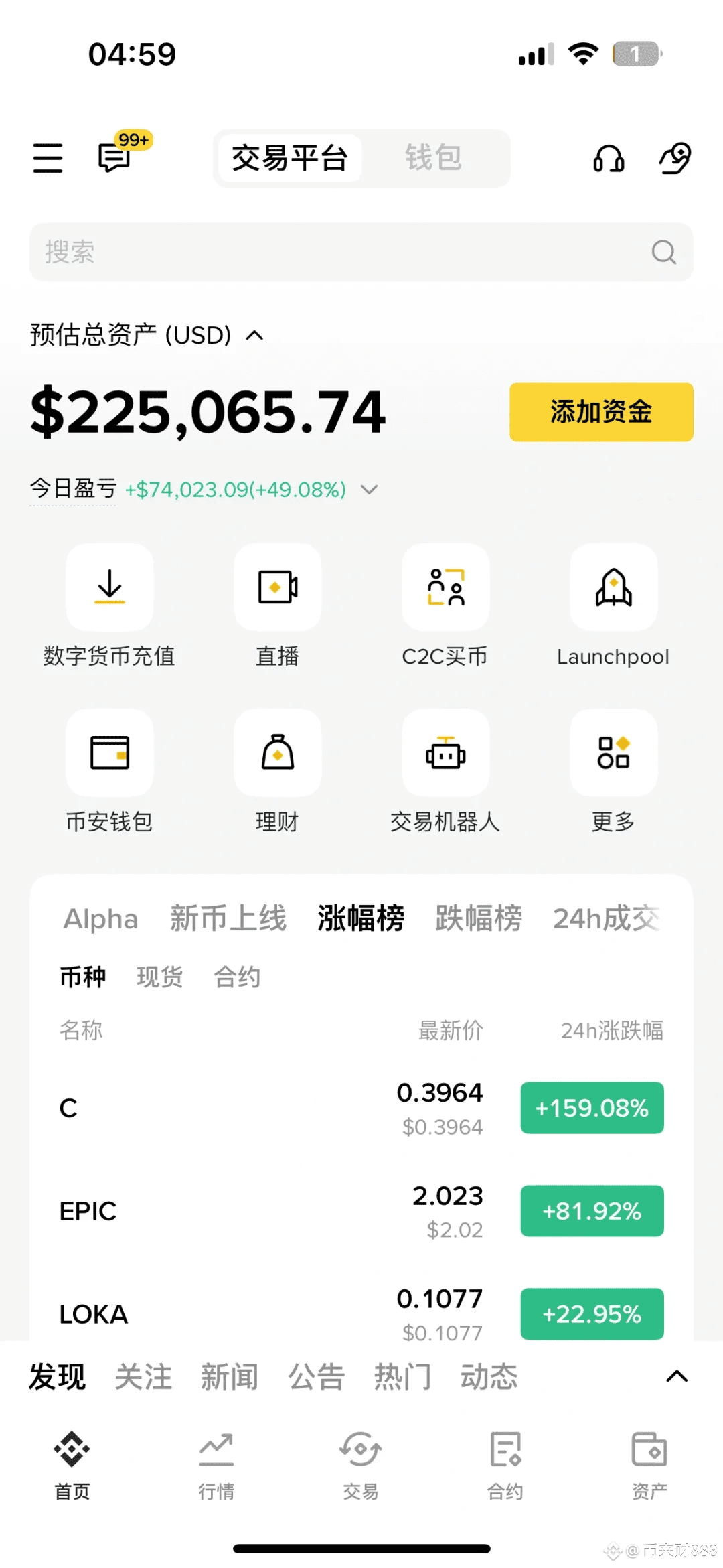
2
338
·
--
In ten years of cryptocurrency trading, what I am most grateful for is not that my account grew from five thousand to a million, but that after blowing up my account twice, I finally learned the "profit-based position management method".
This method can be summed up in one sentence: let profits take risks, and never gamble with the principal.
When I first entered the market in 2015, Bitcoin was only a little over two thousand. I always thought of quick money for a big turnaround, but with high leverage and stubbornly holding onto positions, I lost all my principal twice in two years.
The real turning point came in the bear market of 2018. I set three iron rules for myself: if I break one, I go back to zero:
Leverage never exceeds 3 times.
Having experienced significant losses in the early years. 20 times leverage seems exciting, but a single spike can wipe you out.
Now I only use 1-2 times leverage, and no matter how volatile it gets, I can sleep soundly.
Leverage is not a money printer; it is an amplifier—amplifying gains and even more so risks.
Never increase positions with the principal.
All additional positions rely solely on profits. It’s like fishing: using the caught fish as bait, losing doesn’t hurt the foundation.
In 2021, while trading ETH, I used floating profits to add positions five times in a row; even though I stopped loss three times along the way, the principal still increased steadily by 30%.
Single trade stop losses do not exceed 2% of total capital.
When at five thousand, I could lose a maximum of one hundred; at one hundred thousand, the maximum loss is two thousand.
This rule allowed me to withstand three consecutive losses while trading SOL last year without losing my vitality, and I made back three times on the fourth trade.
Those who stubbornly hold on often turn from shallow traps into deep pits.
From five thousand to a million, I took three steps:
From five thousand to fifty thousand relies on accumulating coins in a bear market.
I specifically bought BTC and ETH when they broke critical support, taking profits in batches after a 10% rebound. After rolling three rounds to twenty thousand, I only used 1x leverage for swing trading, and each position did not exceed 10% of the principal.
From fifty thousand to three hundred thousand relies on the bull market trend.
Wait for the daily line to stabilize above the 30-day moving average and increase the volume; I added positions with 30% of the floating profit every time I earned 15%.
In the bull market of 2021, I used this method to roll my position from 20% to 40%, turning fifty thousand into two hundred eighty thousand.
From three hundred thousand to a million relies on cycle conversion.
During the wave when BTC rose from fifteen thousand to sixty thousand, I initially built a position of 20%, increased it to 40% in the middle, and reduced it back to 10% at the end.
When it reached eight hundred thousand, I withdrew five hundred thousand to cash out, and what remained was the chip in the storm.
The most ironic thing about this industry is: slow is fast.
Holding onto a 2% stop-loss line and enduring the loneliness of a bear market allows you to go further than those who fidget.
There are always stars in the market, but the longevity belongs to those who let profits run and let the principal lie flat.
In the past, I stumbled around in the dark alone; now I have the light in my hands.
The light is always on; will you follow? @Square-Creator-28cfd94beb68d
In ten years of cryptocurrency trading, what I am most grateful for is not that my account grew from five thousand to a million, but that after blowing up my account twice, I finally learned the "profit-based position management method".
This method can be summed up in one sentence: let profits take risks, and never gamble with the principal.
When I first entered the market in 2015, Bitcoin was only a little over two thousand. I always thought of quick money for a big turnaround, but with high leverage and stubbornly holding onto positions, I lost all my principal twice in two years.
The real turning point came in the bear market of 2018. I set three iron rules for myself: if I break one, I go back to zero:
Leverage never exceeds 3 times.
Having experienced significant losses in the early years. 20 times leverage seems exciting, but a single spike can wipe you out.
Now I only use 1-2 times leverage, and no matter how volatile it gets, I can sleep soundly.
Leverage is not a money printer; it is an amplifier—amplifying gains and even more so risks.
Never increase positions with the principal.
All additional positions rely solely on profits. It’s like fishing: using the caught fish as bait, losing doesn’t hurt the foundation.
In 2021, while trading ETH, I used floating profits to add positions five times in a row; even though I stopped loss three times along the way, the principal still increased steadily by 30%.
Single trade stop losses do not exceed 2% of total capital.
When at five thousand, I could lose a maximum of one hundred; at one hundred thousand, the maximum loss is two thousand.
This rule allowed me to withstand three consecutive losses while trading SOL last year without losing my vitality, and I made back three times on the fourth trade.
Those who stubbornly hold on often turn from shallow traps into deep pits.
From five thousand to a million, I took three steps:
From five thousand to fifty thousand relies on accumulating coins in a bear market.
I specifically bought BTC and ETH when they broke critical support, taking profits in batches after a 10% rebound. After rolling three rounds to twenty thousand, I only used 1x leverage for swing trading, and each position did not exceed 10% of the principal.
From fifty thousand to three hundred thousand relies on the bull market trend.
Wait for the daily line to stabilize above the 30-day moving average and increase the volume; I added positions with 30% of the floating profit every time I earned 15%.
In the bull market of 2021, I used this method to roll my position from 20% to 40%, turning fifty thousand into two hundred eighty thousand.
From three hundred thousand to a million relies on cycle conversion.
During the wave when BTC rose from fifteen thousand to sixty thousand, I initially built a position of 20%, increased it to 40% in the middle, and reduced it back to 10% at the end.
When it reached eight hundred thousand, I withdrew five hundred thousand to cash out, and what remained was the chip in the storm.
The most ironic thing about this industry is: slow is fast.
Holding onto a 2% stop-loss line and enduring the loneliness of a bear market allows you to go further than those who fidget.
There are always stars in the market, but the longevity belongs to those who let profits run and let the principal lie flat.
In the past, I stumbled around in the dark alone; now I have the light in my hands.
The light is always on; will you follow? @币来财888
This method can be summed up in one sentence: let profits take risks, and never gamble with the principal.
When I first entered the market in 2015, Bitcoin was only a little over two thousand. I always thought of quick money for a big turnaround, but with high leverage and stubbornly holding onto positions, I lost all my principal twice in two years.
The real turning point came in the bear market of 2018. I set three iron rules for myself: if I break one, I go back to zero:
Leverage never exceeds 3 times.
Having experienced significant losses in the early years. 20 times leverage seems exciting, but a single spike can wipe you out.
Now I only use 1-2 times leverage, and no matter how volatile it gets, I can sleep soundly.
Leverage is not a money printer; it is an amplifier—amplifying gains and even more so risks.
Never increase positions with the principal.
All additional positions rely solely on profits. It’s like fishing: using the caught fish as bait, losing doesn’t hurt the foundation.
In 2021, while trading ETH, I used floating profits to add positions five times in a row; even though I stopped loss three times along the way, the principal still increased steadily by 30%.
Single trade stop losses do not exceed 2% of total capital.
When at five thousand, I could lose a maximum of one hundred; at one hundred thousand, the maximum loss is two thousand.
This rule allowed me to withstand three consecutive losses while trading SOL last year without losing my vitality, and I made back three times on the fourth trade.
Those who stubbornly hold on often turn from shallow traps into deep pits.
From five thousand to a million, I took three steps:
From five thousand to fifty thousand relies on accumulating coins in a bear market.
I specifically bought BTC and ETH when they broke critical support, taking profits in batches after a 10% rebound. After rolling three rounds to twenty thousand, I only used 1x leverage for swing trading, and each position did not exceed 10% of the principal.
From fifty thousand to three hundred thousand relies on the bull market trend.
Wait for the daily line to stabilize above the 30-day moving average and increase the volume; I added positions with 30% of the floating profit every time I earned 15%.
In the bull market of 2021, I used this method to roll my position from 20% to 40%, turning fifty thousand into two hundred eighty thousand.
From three hundred thousand to a million relies on cycle conversion.
During the wave when BTC rose from fifteen thousand to sixty thousand, I initially built a position of 20%, increased it to 40% in the middle, and reduced it back to 10% at the end.
When it reached eight hundred thousand, I withdrew five hundred thousand to cash out, and what remained was the chip in the storm.
The most ironic thing about this industry is: slow is fast.
Holding onto a 2% stop-loss line and enduring the loneliness of a bear market allows you to go further than those who fidget.
There are always stars in the market, but the longevity belongs to those who let profits run and let the principal lie flat.
In the past, I stumbled around in the dark alone; now I have the light in my hands.
The light is always on; will you follow? @币来财888

3
565
·
--
After ten years of trading cryptocurrencies, what I am most grateful for is that after the third liquidation, I truly understood MACD divergence. That was a lifesaver I bought with over three million as tuition.
In December 2017, BTC was approaching its historical high of twenty thousand dollars, and the whole network was in a frenzy. However, I noticed something strange on the four-hour chart: the price kept surging, but the MACD red energy bars were getting shorter.
At two in the morning, I stared at the top divergence screenshot of ETH from three years ago for a long time, and eventually closed all long positions. A week later, the market halved, and countless contract accounts vanished into thin air.
What really allowed me to systematically apply divergence was the "Black Thursday" in March 2020. At that time, the market was in extreme panic, but I found that BTC's weekly chart showed a bottom divergence: the price hit a new low for the year, but the green energy bars were more than thirty percent higher than the previous low point.
I quietly monitored a few whale addresses on-chain and found they were continuously accumulating. So, I gradually built my position, and later when Defi Summer exploded, my account value quadrupled.
These years I have summarized two iron rules:
Multi-cycle verification
A daily bottom divergence is just a signal; I must wait for a second golden cross on the four-hour chart, and the trading volume must increase more than three times before taking action.
Divergence failure mechanism
If the price consolidates for more than five cycles without a significant increase in the energy bars, it indicates that the main force is observing; at that point, it is better to miss out than to make a mistake.
The most thrilling moment was during the Dogecoin frenzy in 2021. At that time, Musk kept calling for buying, and the price soared to 0.7 dollars, but the MACD energy bars were not even half of the previous high. While the community was clamoring to "hit 1 dollar", I liquidated my position, and three days later, the coin price dropped by sixty percent.
Many people treat MACD as an ordinary indicator, but those who have truly experienced bull and bear markets know it is a thermometer for market sentiment. Top divergence is the fingerprint left by the main force when pushing the price up to sell, while bottom divergence is the white mist they exhale while quietly accumulating.
Now I only do three things every day: scan the weekly divergence signals of the top fifty coins, monitor large on-chain movements, and wait for the hitting point of multi-cycle resonance. This restraint allowed me to not only avoid losses in the bear market of 2022 but also profit by 60% from the bottom divergence layout of SOL.
Market sense is learned from losses, but the system is realized through understanding. MACD divergence taught me not only the technique but also how to coexist with human greed.
In the past, I was wandering alone in the dark; now the light is in my hands.
The light is always on; will you follow? @Square-Creator-28cfd94beb68d
After ten years of trading cryptocurrencies, what I am most grateful for is that after the third liquidation, I truly understood MACD divergence. That was a lifesaver I bought with over three million as tuition.
In December 2017, BTC was approaching its historical high of twenty thousand dollars, and the whole network was in a frenzy. However, I noticed something strange on the four-hour chart: the price kept surging, but the MACD red energy bars were getting shorter.
At two in the morning, I stared at the top divergence screenshot of ETH from three years ago for a long time, and eventually closed all long positions. A week later, the market halved, and countless contract accounts vanished into thin air.
What really allowed me to systematically apply divergence was the "Black Thursday" in March 2020. At that time, the market was in extreme panic, but I found that BTC's weekly chart showed a bottom divergence: the price hit a new low for the year, but the green energy bars were more than thirty percent higher than the previous low point.
I quietly monitored a few whale addresses on-chain and found they were continuously accumulating. So, I gradually built my position, and later when Defi Summer exploded, my account value quadrupled.
These years I have summarized two iron rules:
Multi-cycle verification
A daily bottom divergence is just a signal; I must wait for a second golden cross on the four-hour chart, and the trading volume must increase more than three times before taking action.
Divergence failure mechanism
If the price consolidates for more than five cycles without a significant increase in the energy bars, it indicates that the main force is observing; at that point, it is better to miss out than to make a mistake.
The most thrilling moment was during the Dogecoin frenzy in 2021. At that time, Musk kept calling for buying, and the price soared to 0.7 dollars, but the MACD energy bars were not even half of the previous high. While the community was clamoring to "hit 1 dollar", I liquidated my position, and three days later, the coin price dropped by sixty percent.
Many people treat MACD as an ordinary indicator, but those who have truly experienced bull and bear markets know it is a thermometer for market sentiment. Top divergence is the fingerprint left by the main force when pushing the price up to sell, while bottom divergence is the white mist they exhale while quietly accumulating.
Now I only do three things every day: scan the weekly divergence signals of the top fifty coins, monitor large on-chain movements, and wait for the hitting point of multi-cycle resonance. This restraint allowed me to not only avoid losses in the bear market of 2022 but also profit by 60% from the bottom divergence layout of SOL.
Market sense is learned from losses, but the system is realized through understanding. MACD divergence taught me not only the technique but also how to coexist with human greed.
In the past, I was wandering alone in the dark; now the light is in my hands.
The light is always on; will you follow? @币来财888
In December 2017, BTC was approaching its historical high of twenty thousand dollars, and the whole network was in a frenzy. However, I noticed something strange on the four-hour chart: the price kept surging, but the MACD red energy bars were getting shorter.
At two in the morning, I stared at the top divergence screenshot of ETH from three years ago for a long time, and eventually closed all long positions. A week later, the market halved, and countless contract accounts vanished into thin air.
What really allowed me to systematically apply divergence was the "Black Thursday" in March 2020. At that time, the market was in extreme panic, but I found that BTC's weekly chart showed a bottom divergence: the price hit a new low for the year, but the green energy bars were more than thirty percent higher than the previous low point.
I quietly monitored a few whale addresses on-chain and found they were continuously accumulating. So, I gradually built my position, and later when Defi Summer exploded, my account value quadrupled.
These years I have summarized two iron rules:
Multi-cycle verification
A daily bottom divergence is just a signal; I must wait for a second golden cross on the four-hour chart, and the trading volume must increase more than three times before taking action.
Divergence failure mechanism
If the price consolidates for more than five cycles without a significant increase in the energy bars, it indicates that the main force is observing; at that point, it is better to miss out than to make a mistake.
The most thrilling moment was during the Dogecoin frenzy in 2021. At that time, Musk kept calling for buying, and the price soared to 0.7 dollars, but the MACD energy bars were not even half of the previous high. While the community was clamoring to "hit 1 dollar", I liquidated my position, and three days later, the coin price dropped by sixty percent.
Many people treat MACD as an ordinary indicator, but those who have truly experienced bull and bear markets know it is a thermometer for market sentiment. Top divergence is the fingerprint left by the main force when pushing the price up to sell, while bottom divergence is the white mist they exhale while quietly accumulating.
Now I only do three things every day: scan the weekly divergence signals of the top fifty coins, monitor large on-chain movements, and wait for the hitting point of multi-cycle resonance. This restraint allowed me to not only avoid losses in the bear market of 2022 but also profit by 60% from the bottom divergence layout of SOL.
Market sense is learned from losses, but the system is realized through understanding. MACD divergence taught me not only the technique but also how to coexist with human greed.
In the past, I was wandering alone in the dark; now the light is in my hands.
The light is always on; will you follow? @币来财888
1
189
·
--
In the summer of 2015, I converted all the 50,000 yuan I had prepared to buy a car into Bitcoin, at a price of about 300 dollars.
Two years later, this money grew to 2 million. I opened champagne on the balcony of my hotel in Sanya, feeling like a child of destiny.
In the winter of 2018, my account shrank to 180,000. The champagne bottle still sat on the bookshelf, but I could no longer afford to stay in a star-rated hotel.
In these ten years, I encountered more pitfalls than the money I earned, summarizing four painful lessons:
First, only earn money within your understanding.
I once lost 300,000 in a single night due to FOMO (fear of missing out) chasing a certain DeFi project, only to realize I hadn't even finished reading its white paper.
Second, position management determines life and death.
I now divide my funds into three parts: 60% mainstream coins (BTC/ETH), 30% stable arbitrage, and 10% left for potentially worthless risks.
Third, not touching leverage is the bottom line.
After the liquidation in 2017, I deleted all contract trading software.
Fourth, the source of information determines success or failure.
Instead of listening to "experts" analyze, it's better to spend time reading code audit reports.
The thing I'm most grateful for is avoiding the BCH fork crisis in 2021.
At that time, everyone was optimistic, but after discovering the infighting within the development team through GitHub records, I immediately liquidated and avoided a subsequent 70% drop.
Now my goal is no longer to "get rich quick," but rather to achieve a stable return of 20% annually.
The deepest lesson from the crypto world is: quick money comes quickly and goes even faster; true wealth requires time to settle.
Finally, let’s talk about something practical:
There are no geniuses in this industry, only ordinary people who survive.
Don’t be deceived by stories of overnight wealth; the important thing is to find a rhythm that suits you.
The market is always there, opportunities are always available, but the principal can only happen once.
Before, I stumbled around in the dark alone; now the light is in my hands.
The light is always on, will you follow? @Square-Creator-28cfd94beb68d
In the summer of 2015, I converted all the 50,000 yuan I had prepared to buy a car into Bitcoin, at a price of about 300 dollars.
Two years later, this money grew to 2 million. I opened champagne on the balcony of my hotel in Sanya, feeling like a child of destiny.
In the winter of 2018, my account shrank to 180,000. The champagne bottle still sat on the bookshelf, but I could no longer afford to stay in a star-rated hotel.
In these ten years, I encountered more pitfalls than the money I earned, summarizing four painful lessons:
First, only earn money within your understanding.
I once lost 300,000 in a single night due to FOMO (fear of missing out) chasing a certain DeFi project, only to realize I hadn't even finished reading its white paper.
Second, position management determines life and death.
I now divide my funds into three parts: 60% mainstream coins (BTC/ETH), 30% stable arbitrage, and 10% left for potentially worthless risks.
Third, not touching leverage is the bottom line.
After the liquidation in 2017, I deleted all contract trading software.
Fourth, the source of information determines success or failure.
Instead of listening to "experts" analyze, it's better to spend time reading code audit reports.
The thing I'm most grateful for is avoiding the BCH fork crisis in 2021.
At that time, everyone was optimistic, but after discovering the infighting within the development team through GitHub records, I immediately liquidated and avoided a subsequent 70% drop.
Now my goal is no longer to "get rich quick," but rather to achieve a stable return of 20% annually.
The deepest lesson from the crypto world is: quick money comes quickly and goes even faster; true wealth requires time to settle.
Finally, let’s talk about something practical:
There are no geniuses in this industry, only ordinary people who survive.
Don’t be deceived by stories of overnight wealth; the important thing is to find a rhythm that suits you.
The market is always there, opportunities are always available, but the principal can only happen once.
Before, I stumbled around in the dark alone; now the light is in my hands.
The light is always on, will you follow? @币来财888
Two years later, this money grew to 2 million. I opened champagne on the balcony of my hotel in Sanya, feeling like a child of destiny.
In the winter of 2018, my account shrank to 180,000. The champagne bottle still sat on the bookshelf, but I could no longer afford to stay in a star-rated hotel.
In these ten years, I encountered more pitfalls than the money I earned, summarizing four painful lessons:
First, only earn money within your understanding.
I once lost 300,000 in a single night due to FOMO (fear of missing out) chasing a certain DeFi project, only to realize I hadn't even finished reading its white paper.
Second, position management determines life and death.
I now divide my funds into three parts: 60% mainstream coins (BTC/ETH), 30% stable arbitrage, and 10% left for potentially worthless risks.
Third, not touching leverage is the bottom line.
After the liquidation in 2017, I deleted all contract trading software.
Fourth, the source of information determines success or failure.
Instead of listening to "experts" analyze, it's better to spend time reading code audit reports.
The thing I'm most grateful for is avoiding the BCH fork crisis in 2021.
At that time, everyone was optimistic, but after discovering the infighting within the development team through GitHub records, I immediately liquidated and avoided a subsequent 70% drop.
Now my goal is no longer to "get rich quick," but rather to achieve a stable return of 20% annually.
The deepest lesson from the crypto world is: quick money comes quickly and goes even faster; true wealth requires time to settle.
Finally, let’s talk about something practical:
There are no geniuses in this industry, only ordinary people who survive.
Don’t be deceived by stories of overnight wealth; the important thing is to find a rhythm that suits you.
The market is always there, opportunities are always available, but the principal can only happen once.
Before, I stumbled around in the dark alone; now the light is in my hands.
The light is always on, will you follow? @币来财888

2
2
14
7.7k
·
--
36 years old, from Hunan, has settled in Shanghai. Two houses, one for parents to live in, one for myself.
This confidence is not based on luck, but on the blood and tears exchanged inch by inch over the past ten years in the cryptocurrency world.
When I first entered the market in 2015, I carried more than 200,000 saved from my job, thinking I could double it quickly through 'news' and 'short-term trading'.
As a result, in less than a year, only 50,000 was left in my account. That kind of despair still sends chills down my spine when I think about it now. But I didn't give up—not because I was particularly determined, but because I seemed to have no other choice.
What really kept me alive was not some advanced techniques, but a few simple rules. I printed them out, pasted them all over my room, and constantly reminded myself not to mess up.
1. Mindset is always the top priority.
When the market skyrockets, it's easy to get carried away; when it crashes, it's easy to panic. I've experienced Bitcoin doubling overnight and also witnessed LUNA drop to zero in a few days. Later, I understood: the market is not short of opportunities, but lacks those who can wait. As long as you seize a certain opportunity once a year, that's enough. With little money, you have to be frugal; never go all in.
2. Your understanding determines how much money you can keep.
In the early days, I made quick money by luck, but eventually lost it all back. Later, I started writing a trading journal, reviewing each operation. Practice on a simulated account for skills, and on a real account for mindset. Gradually, I understood: money earned outside your understanding will eventually be paid back.
3. Medium to long-term investment should be like planting trees, short-term trading should be like fishing.
For medium to long-term investments, I always keep enough liquid funds, buying in batches when prices drop and selling in batches when they rise, never greedy for the last penny. For short-term trading, I only choose coins with the top twenty trading volumes; no matter how enticing, I won't touch those with poor liquidity. I use 15-minute K-lines combined with KDJ and MACD indicators to find buy and sell points; if the direction is wrong, I immediately cut losses without any luck.
4. Understand the drops to be able to wait for the rises.
Sharp drops are often followed by quick rebounds, while gradual declines usually require a longer bottoming period. Understanding this rule can help avoid many pitfalls.
After ten years in the cryptocurrency world, climbing out of the 'seven losses, two breakevens, one profit' curse, I increasingly believe: making money relies on luck, but preserving wealth relies on a system.
Now my assets have reached eight figures, yet I'm even more cautious. Occasionally I mentor newcomers, but the first sentence is always: 'Think about how to survive first, then talk about making money.'
There are no shortcuts on this road; the only 'tip' may be: stick to your rules and wait for the wind to come. @Square-Creator-28cfd94beb68d
36 years old, from Hunan, has settled in Shanghai. Two houses, one for parents to live in, one for myself.
This confidence is not based on luck, but on the blood and tears exchanged inch by inch over the past ten years in the cryptocurrency world.
When I first entered the market in 2015, I carried more than 200,000 saved from my job, thinking I could double it quickly through 'news' and 'short-term trading'.
As a result, in less than a year, only 50,000 was left in my account. That kind of despair still sends chills down my spine when I think about it now. But I didn't give up—not because I was particularly determined, but because I seemed to have no other choice.
What really kept me alive was not some advanced techniques, but a few simple rules. I printed them out, pasted them all over my room, and constantly reminded myself not to mess up.
1. Mindset is always the top priority.
When the market skyrockets, it's easy to get carried away; when it crashes, it's easy to panic. I've experienced Bitcoin doubling overnight and also witnessed LUNA drop to zero in a few days. Later, I understood: the market is not short of opportunities, but lacks those who can wait. As long as you seize a certain opportunity once a year, that's enough. With little money, you have to be frugal; never go all in.
2. Your understanding determines how much money you can keep.
In the early days, I made quick money by luck, but eventually lost it all back. Later, I started writing a trading journal, reviewing each operation. Practice on a simulated account for skills, and on a real account for mindset. Gradually, I understood: money earned outside your understanding will eventually be paid back.
3. Medium to long-term investment should be like planting trees, short-term trading should be like fishing.
For medium to long-term investments, I always keep enough liquid funds, buying in batches when prices drop and selling in batches when they rise, never greedy for the last penny. For short-term trading, I only choose coins with the top twenty trading volumes; no matter how enticing, I won't touch those with poor liquidity. I use 15-minute K-lines combined with KDJ and MACD indicators to find buy and sell points; if the direction is wrong, I immediately cut losses without any luck.
4. Understand the drops to be able to wait for the rises.
Sharp drops are often followed by quick rebounds, while gradual declines usually require a longer bottoming period. Understanding this rule can help avoid many pitfalls.
After ten years in the cryptocurrency world, climbing out of the 'seven losses, two breakevens, one profit' curse, I increasingly believe: making money relies on luck, but preserving wealth relies on a system.
Now my assets have reached eight figures, yet I'm even more cautious. Occasionally I mentor newcomers, but the first sentence is always: 'Think about how to survive first, then talk about making money.'
There are no shortcuts on this road; the only 'tip' may be: stick to your rules and wait for the wind to come. @币来财888
This confidence is not based on luck, but on the blood and tears exchanged inch by inch over the past ten years in the cryptocurrency world.
When I first entered the market in 2015, I carried more than 200,000 saved from my job, thinking I could double it quickly through 'news' and 'short-term trading'.
As a result, in less than a year, only 50,000 was left in my account. That kind of despair still sends chills down my spine when I think about it now. But I didn't give up—not because I was particularly determined, but because I seemed to have no other choice.
What really kept me alive was not some advanced techniques, but a few simple rules. I printed them out, pasted them all over my room, and constantly reminded myself not to mess up.
1. Mindset is always the top priority.
When the market skyrockets, it's easy to get carried away; when it crashes, it's easy to panic. I've experienced Bitcoin doubling overnight and also witnessed LUNA drop to zero in a few days. Later, I understood: the market is not short of opportunities, but lacks those who can wait. As long as you seize a certain opportunity once a year, that's enough. With little money, you have to be frugal; never go all in.
2. Your understanding determines how much money you can keep.
In the early days, I made quick money by luck, but eventually lost it all back. Later, I started writing a trading journal, reviewing each operation. Practice on a simulated account for skills, and on a real account for mindset. Gradually, I understood: money earned outside your understanding will eventually be paid back.
3. Medium to long-term investment should be like planting trees, short-term trading should be like fishing.
For medium to long-term investments, I always keep enough liquid funds, buying in batches when prices drop and selling in batches when they rise, never greedy for the last penny. For short-term trading, I only choose coins with the top twenty trading volumes; no matter how enticing, I won't touch those with poor liquidity. I use 15-minute K-lines combined with KDJ and MACD indicators to find buy and sell points; if the direction is wrong, I immediately cut losses without any luck.
4. Understand the drops to be able to wait for the rises.
Sharp drops are often followed by quick rebounds, while gradual declines usually require a longer bottoming period. Understanding this rule can help avoid many pitfalls.
After ten years in the cryptocurrency world, climbing out of the 'seven losses, two breakevens, one profit' curse, I increasingly believe: making money relies on luck, but preserving wealth relies on a system.
Now my assets have reached eight figures, yet I'm even more cautious. Occasionally I mentor newcomers, but the first sentence is always: 'Think about how to survive first, then talk about making money.'
There are no shortcuts on this road; the only 'tip' may be: stick to your rules and wait for the wind to come. @币来财888

9
6
26
6.7k
·
--
10 years ago, I stepped into the cryptocurrency world with 50,000 yuan, fearless like a newborn calf, but almost lost everything in my first market baptism.
That experience was unforgettable, but it was also this "tuition fee" that allowed me to solidify a few iron rules earned with hard cash.
Now my account stands at ten million, and with a group of like-minded friends, we navigate through bull and bear markets, relying not on luck but on strict adherence to these principles.
Enduring the washout allows one to catch the main uptrend.
If, after a sharp rise, the market falls into a prolonged decline, it is often a signal of a washout, testing one's resolve to hold.
Just like last year's ORDI, which experienced a surge followed by two weeks of decline, washing out most of the impatient capital.
The reason we could hold on and eventually reap multiple gains is precisely because we understand: a rapid rise combined with a slow decline is often a method used by the main players to clean out floating capital, rather than the end of the market.
A rebound after a crash is often a disguise for a trap.
After a market crash, a single bullish candle can be highly tempting. The rebound the day after LUNA's collapse in 2022 led countless people to believe in a rebirth of opportunity, only to find themselves trapped.
We adhere to one principle: a true bottom requires time to form; a single day's rebound is more like a lure.
During such times, restraining the impulse to bottom-fish and observing more while acting less is the way to preserve capital.
3. High volume at peaks is not to be feared, but stagnation without volume is truly dangerous.
New price highs accompanied by sustained volume indicate that funds are still actively entering.
The real danger signal is when the price hovers at a high while trading volume continuously shrinks, indicating that funds are quietly leaving, with no one to take over, making a drop imminent.
4. Look at volume when the bottom starts; a gentle increase is gold.
If the market bottom suddenly experiences explosive volume and surges, it can easily lead to a misjudgment of a reversal and impulsive full investment.
We only recognize one reliable pattern: sustained, gentle volume increases with prices rising in a stepwise manner. This solid coordination of volume and price is the true stable signal for the market's real start.
5. Trading cryptocurrencies is trading consensus; volume is the leading indicator of consensus.
Candlestick charts tell the past, while trading volume indicates the future.
When an ecosystem (like this year's BLAST) sees an increase in on-chain activity, and trading volume quietly grows, it often signals the beginning of market consensus gathering.
Based on this, we positioned ourselves early and ultimately received generous returns.
These five points are the core philosophies I have learned from a decade of ups and downs in the cryptocurrency sea.
Bull markets still exist, but surviving allows one to laugh until the end @Square-Creator-28cfd94beb68d
10 years ago, I stepped into the cryptocurrency world with 50,000 yuan, fearless like a newborn calf, but almost lost everything in my first market baptism.
That experience was unforgettable, but it was also this "tuition fee" that allowed me to solidify a few iron rules earned with hard cash.
Now my account stands at ten million, and with a group of like-minded friends, we navigate through bull and bear markets, relying not on luck but on strict adherence to these principles.
Enduring the washout allows one to catch the main uptrend.
If, after a sharp rise, the market falls into a prolonged decline, it is often a signal of a washout, testing one's resolve to hold.
Just like last year's ORDI, which experienced a surge followed by two weeks of decline, washing out most of the impatient capital.
The reason we could hold on and eventually reap multiple gains is precisely because we understand: a rapid rise combined with a slow decline is often a method used by the main players to clean out floating capital, rather than the end of the market.
A rebound after a crash is often a disguise for a trap.
After a market crash, a single bullish candle can be highly tempting. The rebound the day after LUNA's collapse in 2022 led countless people to believe in a rebirth of opportunity, only to find themselves trapped.
We adhere to one principle: a true bottom requires time to form; a single day's rebound is more like a lure.
During such times, restraining the impulse to bottom-fish and observing more while acting less is the way to preserve capital.
3. High volume at peaks is not to be feared, but stagnation without volume is truly dangerous.
New price highs accompanied by sustained volume indicate that funds are still actively entering.
The real danger signal is when the price hovers at a high while trading volume continuously shrinks, indicating that funds are quietly leaving, with no one to take over, making a drop imminent.
4. Look at volume when the bottom starts; a gentle increase is gold.
If the market bottom suddenly experiences explosive volume and surges, it can easily lead to a misjudgment of a reversal and impulsive full investment.
We only recognize one reliable pattern: sustained, gentle volume increases with prices rising in a stepwise manner. This solid coordination of volume and price is the true stable signal for the market's real start.
5. Trading cryptocurrencies is trading consensus; volume is the leading indicator of consensus.
Candlestick charts tell the past, while trading volume indicates the future.
When an ecosystem (like this year's BLAST) sees an increase in on-chain activity, and trading volume quietly grows, it often signals the beginning of market consensus gathering.
Based on this, we positioned ourselves early and ultimately received generous returns.
These five points are the core philosophies I have learned from a decade of ups and downs in the cryptocurrency sea.
Bull markets still exist, but surviving allows one to laugh until the end @币来财888
That experience was unforgettable, but it was also this "tuition fee" that allowed me to solidify a few iron rules earned with hard cash.
Now my account stands at ten million, and with a group of like-minded friends, we navigate through bull and bear markets, relying not on luck but on strict adherence to these principles.
Enduring the washout allows one to catch the main uptrend.
If, after a sharp rise, the market falls into a prolonged decline, it is often a signal of a washout, testing one's resolve to hold.
Just like last year's ORDI, which experienced a surge followed by two weeks of decline, washing out most of the impatient capital.
The reason we could hold on and eventually reap multiple gains is precisely because we understand: a rapid rise combined with a slow decline is often a method used by the main players to clean out floating capital, rather than the end of the market.
A rebound after a crash is often a disguise for a trap.
After a market crash, a single bullish candle can be highly tempting. The rebound the day after LUNA's collapse in 2022 led countless people to believe in a rebirth of opportunity, only to find themselves trapped.
We adhere to one principle: a true bottom requires time to form; a single day's rebound is more like a lure.
During such times, restraining the impulse to bottom-fish and observing more while acting less is the way to preserve capital.
3. High volume at peaks is not to be feared, but stagnation without volume is truly dangerous.
New price highs accompanied by sustained volume indicate that funds are still actively entering.
The real danger signal is when the price hovers at a high while trading volume continuously shrinks, indicating that funds are quietly leaving, with no one to take over, making a drop imminent.
4. Look at volume when the bottom starts; a gentle increase is gold.
If the market bottom suddenly experiences explosive volume and surges, it can easily lead to a misjudgment of a reversal and impulsive full investment.
We only recognize one reliable pattern: sustained, gentle volume increases with prices rising in a stepwise manner. This solid coordination of volume and price is the true stable signal for the market's real start.
5. Trading cryptocurrencies is trading consensus; volume is the leading indicator of consensus.
Candlestick charts tell the past, while trading volume indicates the future.
When an ecosystem (like this year's BLAST) sees an increase in on-chain activity, and trading volume quietly grows, it often signals the beginning of market consensus gathering.
Based on this, we positioned ourselves early and ultimately received generous returns.
These five points are the core philosophies I have learned from a decade of ups and downs in the cryptocurrency sea.
Bull markets still exist, but surviving allows one to laugh until the end @币来财888

4
270
·
--
For ten years in cryptocurrency, I consider myself accustomed to the storms, but Lao Qin's message still made my heart skip a beat.
That night, he sent a screenshot; the 230,000 capital was down to 4,900 U, and the words 'owed 18,000' were blurred by water.
I immediately told him to switch to stablecoins, dividing it into six positions; this discipline was earned through countless liquidations.
Ten minutes later, he replied that he had sold the strawberries in the freezer to cover the fees. By 4 AM, he was already squatting at the wholesale market waiting for supplies.
I handwrote the strategy of 'buy one position when it drops 7%, sell one position when it rises 10%', took a photo, and sent it to him, asking him to remember it well. This was no longer just a trading strategy, but more like a lifeline.
Three days later, he actually paid the wholesaler 8,000 and even made a profit of 600 U.
In the photo, half a box of apples was on the counter, and he said, 'enough to sell for two days.'
I told him to replenish the position the next morning; our timeline began to be measured by the shelf life of fruits and the opening bell of the market.
In April's rainy weather, he asked the group to lend him a box of oranges.
In private chat, he confessed that his positions were full, but his son's tuition was still unsettled.
I told him to sell one position; half an hour later, the tuition issue was resolved.
At that moment, I realized that the candlestick techniques I taught were sustaining a family's operation.
In May, he speculated on new coins and incurred losses; the background noise on the phone was customers' chatter and his wife's anxious shouts: 'The watermelon is going bad!' I urged him to first handle the mess in reality.
In ten years of ups and downs in the cryptocurrency sea, I suddenly understood: the market changes rapidly, but a rotten watermelon won't wait for anyone.
In June, I recommended a platform coin, and he used his daughter's New Year's money.
After that, he only sent me the three words 'goods sold out' every day, concise like a secret signal.
I knew he was steadily repairing his positions and life with the solidity of selling fruits.
At the end of July in a video, his account balance had changed to 172,994 U.
He flipped to the last page, smiling and saying that the wholesaler's account had been cleared, and he had just received durians. In the background, his son was clamoring to buy a football, and his wife was nagging about fixing the refrigerator first.
After hanging up, he sent me an order for a small refrigerator he bought for his daughter, and the recipient was surprisingly the child's name.
After ten years of honing a sword, I finally understood that the most stable position is not in the exchange, but in the morning market, the refrigerator waiting to be repaired, and the orders filled with family names.
Before, I was stumbling alone in the dark; now the light is in my hands.
The light has always been on, will you follow? @Square-Creator-28cfd94beb68d
For ten years in cryptocurrency, I consider myself accustomed to the storms, but Lao Qin's message still made my heart skip a beat.
That night, he sent a screenshot; the 230,000 capital was down to 4,900 U, and the words 'owed 18,000' were blurred by water.
I immediately told him to switch to stablecoins, dividing it into six positions; this discipline was earned through countless liquidations.
Ten minutes later, he replied that he had sold the strawberries in the freezer to cover the fees. By 4 AM, he was already squatting at the wholesale market waiting for supplies.
I handwrote the strategy of 'buy one position when it drops 7%, sell one position when it rises 10%', took a photo, and sent it to him, asking him to remember it well. This was no longer just a trading strategy, but more like a lifeline.
Three days later, he actually paid the wholesaler 8,000 and even made a profit of 600 U.
In the photo, half a box of apples was on the counter, and he said, 'enough to sell for two days.'
I told him to replenish the position the next morning; our timeline began to be measured by the shelf life of fruits and the opening bell of the market.
In April's rainy weather, he asked the group to lend him a box of oranges.
In private chat, he confessed that his positions were full, but his son's tuition was still unsettled.
I told him to sell one position; half an hour later, the tuition issue was resolved.
At that moment, I realized that the candlestick techniques I taught were sustaining a family's operation.
In May, he speculated on new coins and incurred losses; the background noise on the phone was customers' chatter and his wife's anxious shouts: 'The watermelon is going bad!' I urged him to first handle the mess in reality.
In ten years of ups and downs in the cryptocurrency sea, I suddenly understood: the market changes rapidly, but a rotten watermelon won't wait for anyone.
In June, I recommended a platform coin, and he used his daughter's New Year's money.
After that, he only sent me the three words 'goods sold out' every day, concise like a secret signal.
I knew he was steadily repairing his positions and life with the solidity of selling fruits.
At the end of July in a video, his account balance had changed to 172,994 U.
He flipped to the last page, smiling and saying that the wholesaler's account had been cleared, and he had just received durians. In the background, his son was clamoring to buy a football, and his wife was nagging about fixing the refrigerator first.
After hanging up, he sent me an order for a small refrigerator he bought for his daughter, and the recipient was surprisingly the child's name.
After ten years of honing a sword, I finally understood that the most stable position is not in the exchange, but in the morning market, the refrigerator waiting to be repaired, and the orders filled with family names.
Before, I was stumbling alone in the dark; now the light is in my hands.
The light has always been on, will you follow? @币来财888
That night, he sent a screenshot; the 230,000 capital was down to 4,900 U, and the words 'owed 18,000' were blurred by water.
I immediately told him to switch to stablecoins, dividing it into six positions; this discipline was earned through countless liquidations.
Ten minutes later, he replied that he had sold the strawberries in the freezer to cover the fees. By 4 AM, he was already squatting at the wholesale market waiting for supplies.
I handwrote the strategy of 'buy one position when it drops 7%, sell one position when it rises 10%', took a photo, and sent it to him, asking him to remember it well. This was no longer just a trading strategy, but more like a lifeline.
Three days later, he actually paid the wholesaler 8,000 and even made a profit of 600 U.
In the photo, half a box of apples was on the counter, and he said, 'enough to sell for two days.'
I told him to replenish the position the next morning; our timeline began to be measured by the shelf life of fruits and the opening bell of the market.
In April's rainy weather, he asked the group to lend him a box of oranges.
In private chat, he confessed that his positions were full, but his son's tuition was still unsettled.
I told him to sell one position; half an hour later, the tuition issue was resolved.
At that moment, I realized that the candlestick techniques I taught were sustaining a family's operation.
In May, he speculated on new coins and incurred losses; the background noise on the phone was customers' chatter and his wife's anxious shouts: 'The watermelon is going bad!' I urged him to first handle the mess in reality.
In ten years of ups and downs in the cryptocurrency sea, I suddenly understood: the market changes rapidly, but a rotten watermelon won't wait for anyone.
In June, I recommended a platform coin, and he used his daughter's New Year's money.
After that, he only sent me the three words 'goods sold out' every day, concise like a secret signal.
I knew he was steadily repairing his positions and life with the solidity of selling fruits.
At the end of July in a video, his account balance had changed to 172,994 U.
He flipped to the last page, smiling and saying that the wholesaler's account had been cleared, and he had just received durians. In the background, his son was clamoring to buy a football, and his wife was nagging about fixing the refrigerator first.
After hanging up, he sent me an order for a small refrigerator he bought for his daughter, and the recipient was surprisingly the child's name.
After ten years of honing a sword, I finally understood that the most stable position is not in the exchange, but in the morning market, the refrigerator waiting to be repaired, and the orders filled with family names.
Before, I was stumbling alone in the dark; now the light is in my hands.
The light has always been on, will you follow? @币来财888

1
392
Log in to explore more content
Join global crypto users on Binance Square
⚡️ Get latest and useful information about crypto.
💬 Trusted by the world’s largest crypto exchange.
👍 Discover real insights from verified creators.
Email / Phone number
Trending Topics
AppleDebutsFoldablePhone
7,600 views
193 Discussing
#appledebutsfoldablephone I Got My Hands on the iPhone Duo, Apple’s First Foldable Phone. Here’s What Stands Out
The palm-size phone is Apple's boldest handset in years, with a 5.4-inch cover screen and a 7.6-inch main display. I spent some time with the Duo before its October launch.It’s finally here: Apple on Wednesday unveiled its first foldable iPhone, called the iPhone Duo.
iPhone Duo design and build
The iPhone Duo is compact, with a passport-size design. It has a 7.6-inch display on the inside and a 5.4-inch outer display. It fits squarely in my palm, with dimensions similar to Samsung’s Galaxy Z Fold 8, which has a 7.6-inch inner display and a 5.5-inch cover display.
Apple says the Duo is the thinnest iPhone ever when open, measuring 5.2mm. It’s 11.3mm thick when closed. A titanium frame keeps it lightweight at 254 grams.
One of the key differences in feel between Apple’s and Samsung’s phones is that the iPhone Duo has a matte, nano-textured finish on the inner display, which reduces the phone’s crease while also curbing reflections. It has a satisfying feel and really makes the crease virtually disappear when the screen is on. I find it even harder to notice than the Z Fold 8’s, which also has an anti-reflective display.$ONG $IMX $TAC
Isabella-I
·4 Likes
·888 views
EUExtendsCentralContactPointToCASPs
0 views
0 Discussing
US10YTreasuryYieldHitsHighestSinceNov2023
12,536 views
240 Discussing