
BunaByte
3 Posts
BunaByte
Report
Block User
"Crypto enthusiast & market learner. Here for tech, trends, and strategic trades."
0 Following
0 Followers
0 Liked
Posts
·
--
Article
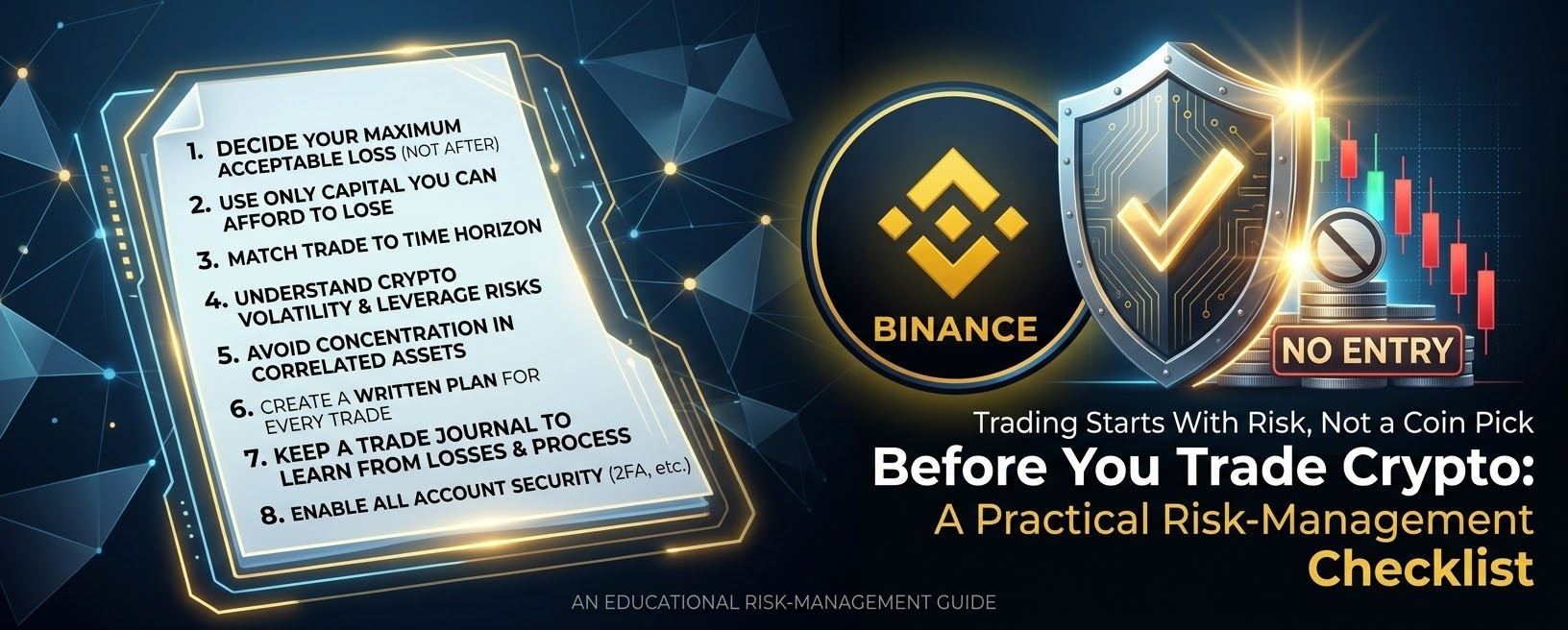
Before You Trade Crypto: A Practical Risk-Management ChecklistIntroduction: Trading Starts With Risk, Not a Coin Pick
It’s an undeniable reality: the crypto market can move sharply in either direction. While everyone hopes to catch the next big surge, fewer are prepared for the equally common downside. This is where a plan comes in. It’s crucial to understand that a risk-management plan does not eliminate losses. Instead, its purpose is to prevent a single trade, or a series of trades, from causing disproportionate damage to your portfolio. This guide is an educational checklist to help you develop a disciplined process—it is not a market prediction, trading advice, or financial instruction. Before you pick a coin, you must manage your risk.
1. Decide What Money Is Actually at Risk
The first step in any risk-management process is defining your capital.
Distinguish Essential vs. Speculative Capital: Separate essential money—the funds you need for rent, bills, or your emergency savings—from speculative capital. Only the latter should ever be considered for a crypto market.
The Problem With Borrowed Money: Explain why using borrowed money or money needed soon can amplify stress. This often leads to poor, emotional decisions when the market is volatile.
Define Your Personal Maximum Loss: Prompt yourself to define a specific maximum amount you are comfortable losing across all your crypto positions. This number will serve as your boundary.
2. Match the Trade to a Time Horizon
What is your objective for the trade? Are you a short-term trader, a swing trader, or a longer-term investor?
Define Short-Term Trading, Swing Trading, and Longer-Term Investing: Understand the difference between short-term (minutes to days), swing (days to weeks), and longer-term investing (months to years). Each horizon has its own risk profile.
Avoid Thesis Creep: Explain that a short-term idea should not quietly become a long-term holding simply because its price falls. Changing your thesis only to justify a losing position is a classic mistake.
Encourage Readers to Write it Down: Before you enter a position, write down your intended holding period. This keeps you accountable to your original plan.
3. Understand Volatility and Leverage
The crypto market is known for its volatility, which is very different from a small daily price movement in traditional assets.
Volatility Differs: Understand that crypto can be far more volatile than stocks or bonds. A sudden drop or spike is part of the landscape.
Describe Leverage as an Amplifier: Understand leverage as an amplifier of both gains and losses. Remember the liquidation risk—if you are highly leveraged, a relatively small adverse move can result in the loss of your entire margin.
Higher Leverage Means Less Room for Normal Market Fluctuations: Recognize that high leverage leaves very little room for normal, small market fluctuations that occur every day.
4. Set a Risk Budget Before Entering
Crucially, the time to decide your maximum acceptable loss is before a trade, not after it moves.
Set a Pre-Trade Risk Budget: Cover the factors you should consider when setting this budget: your total account size, existing exposure, current market volatility, and your personal risk tolerance.
Use Only a Clearly Labeled Hypothetical Example: Imagine, for instance, a hypothetical $10,000 simulated portfolio where you decide to risk no more than 2% ($200) on any single trade. If the price reaches the level where that trade represents a $200 loss, you would exit the trade to preserve your capital. This is a disciplined process.
5. Avoid Concentration Risk
You might feel diversified by holding several different tokens, but true risk management requires deeper analysis.
Define Token Concentration: Understand why holding multiple tokens can still be a concentrated position if all those tokens move together in a correlated manner with the broader crypto market.
Consider Sectors and Correlation: Discuss concentration risk in terms of individual assets, sectors, narratives, and, most importantly, correlation. If one single event, such as a major regulatory announcement for all crypto or a specific blockchain's issue, can affect most of your holdings at once, you have concentration risk.
6. Create a Written Trade Plan
A written plan separate planned decisions from emotional reactions. Consider using this compact template for every trade:
Written Trade Plan Template
Asset: (e.g., BTC)
Thesis/Reason for Interest: (e.g., strong fundamental on-chain data and a bullish technical breakout)
Time Horizon: (e.g., 2 weeks, swing trade)
Conditions That Would Support Thesis: (e.g., price remaining above a key technical level and favorable news)
Conditions That Would Weaken Thesis: (e.g., regulatory concerns or a reversal of technical indicators)
Maximum Loss Budget: (e.g., 1.5% of my total trading account, including all potential fees and slippage)
Target Exit Conditions: (e.g., target price 15% above my entry)
What Would Invalidate the Original Idea? (e.g., price falling 5% below my entry, which would signal that my technical breakout interpretation was incorrect)
7. Use a Pre-Trade Checklist
Before executing any trade, make sure you can answer these questions:
Do I Understand What I Am Buying or Trading? Do you know the basics of the project, its technology, and its risks?
Is This Money I Can Afford to Put at Risk? If this trade were to lose, would it cause you stress or affect your ability to pay essential bills?
Have I Accounted for Fees, Slippage, and Volatility? Have you considered all costs, the spread, and potential market volatility when setting your position size?
Am I Already Overexposed to Similar Assets? Will this trade add to a portfolio that is already heavy in that same sector or correlated assets?
What Would Make Me Reassess the Idea? Have you defined the conditions under which you would reconsider your thesis or exit the trade?
Am I Acting Because of Research—Or Fear of Missing Out (FOMO)? Are you entering based on a planned strategy and diligent research, or because you're worried about missing a rapid price surge?
Have I Enabled Account-Security Tools? Are your security protocols robust, including two-factor authentication (2FA) and anti-phishing protections?
8. Keep a Trade Journal
A trade journal helps track your decisions, not just your wins and losses.
Keep a Trade Journal: Track your original thesis, entry context (e.g., price, time, sentiment), emotions at the time, the result, and lessons learned.
Review Patterns, Not Outcomes: Review patterns of your behavior and strategy rather than judging everything by the outcome of a single trade.
profitable Trades with Poor Process and Losing Trades with Sound Process: Recognize that a profitable trade can still involve a poor, risky process, while a losing trade can follow sound risk management. The goal is long-term, repeatable discipline.
9. Common Risk-Management Mistakes
Avoid these pitfalls that can quickly erase profits:
Increasing Exposure After Losses Without a Predefined Plan: Increasing your exposure when you are already on a losing streak can be an emotional reaction and rarely works.
Treating Leverage as a Shortcut to Returns: Leverage is a powerful tool with high risks. Using it to try to get quick rich is a recipe for disaster.
Chasing Rapid Price Moves Driven by Social-Media Hype: Understand that chasing FOMO often means buying near the top of a speculative surge.
Ignoring Fees and Liquidity: Don’t underestimate the impact of trading fees or the difficulty of exiting a position in a less liquid market.
Failing to Secure the Account: All your risk-management efforts are in vain if you don't secure your account.
Changing a Plan Only Because of Emotion: Sticking to your pre-written plan keeps your emotions in check.
Conclusion: Process Over Prediction
A trade-management checklist can guarantee a specific result. The first goal in the crypto market is not to capture every single move, it's to remain able to participate in future opportunities. Therefore, risk management is about establishing a repeatable habit: defining your risk, documenting your plan, reviewing your outcomes, and protecting your account. Success in this market often comes from following a sound process, not from making lucky predictions.
#RiskAnalysis #CryptoPatience
Before You Trade Crypto: A Practical Risk-Management Checklist
Introduction: Trading Starts With Risk, Not a Coin Pick
It’s an undeniable reality: the crypto market can move sharply in either direction. While everyone hopes to catch the next big surge, fewer are prepared for the equally common downside. This is where a plan comes in. It’s crucial to understand that a risk-management plan does not eliminate losses. Instead, its purpose is to prevent a single trade, or a series of trades, from causing disproportionate damage to your portfolio. This guide is an educational checklist to help you develop a disciplined process—it is not a market prediction, trading advice, or financial instruction. Before you pick a coin, you must manage your risk.
1. Decide What Money Is Actually at Risk
The first step in any risk-management process is defining your capital.
Distinguish Essential vs. Speculative Capital: Separate essential money—the funds you need for rent, bills, or your emergency savings—from speculative capital. Only the latter should ever be considered for a crypto market.
The Problem With Borrowed Money: Explain why using borrowed money or money needed soon can amplify stress. This often leads to poor, emotional decisions when the market is volatile.
Define Your Personal Maximum Loss: Prompt yourself to define a specific maximum amount you are comfortable losing across all your crypto positions. This number will serve as your boundary.
2. Match the Trade to a Time Horizon
What is your objective for the trade? Are you a short-term trader, a swing trader, or a longer-term investor?
Define Short-Term Trading, Swing Trading, and Longer-Term Investing: Understand the difference between short-term (minutes to days), swing (days to weeks), and longer-term investing (months to years). Each horizon has its own risk profile.
Avoid Thesis Creep: Explain that a short-term idea should not quietly become a long-term holding simply because its price falls. Changing your thesis only to justify a losing position is a classic mistake.
Encourage Readers to Write it Down: Before you enter a position, write down your intended holding period. This keeps you accountable to your original plan.
3. Understand Volatility and Leverage
The crypto market is known for its volatility, which is very different from a small daily price movement in traditional assets.
Volatility Differs: Understand that crypto can be far more volatile than stocks or bonds. A sudden drop or spike is part of the landscape.
Describe Leverage as an Amplifier: Understand leverage as an amplifier of both gains and losses. Remember the liquidation risk—if you are highly leveraged, a relatively small adverse move can result in the loss of your entire margin.
Higher Leverage Means Less Room for Normal Market Fluctuations: Recognize that high leverage leaves very little room for normal, small market fluctuations that occur every day.
4. Set a Risk Budget Before Entering
Crucially, the time to decide your maximum acceptable loss is before a trade, not after it moves.
Set a Pre-Trade Risk Budget: Cover the factors you should consider when setting this budget: your total account size, existing exposure, current market volatility, and your personal risk tolerance.
Use Only a Clearly Labeled Hypothetical Example: Imagine, for instance, a hypothetical $10,000 simulated portfolio where you decide to risk no more than 2% ($200) on any single trade. If the price reaches the level where that trade represents a $200 loss, you would exit the trade to preserve your capital. This is a disciplined process.
5. Avoid Concentration Risk
You might feel diversified by holding several different tokens, but true risk management requires deeper analysis.
Define Token Concentration: Understand why holding multiple tokens can still be a concentrated position if all those tokens move together in a correlated manner with the broader crypto market.
Consider Sectors and Correlation: Discuss concentration risk in terms of individual assets, sectors, narratives, and, most importantly, correlation. If one single event, such as a major regulatory announcement for all crypto or a specific blockchain's issue, can affect most of your holdings at once, you have concentration risk.
6. Create a Written Trade Plan
A written plan separate planned decisions from emotional reactions. Consider using this compact template for every trade:
Written Trade Plan Template
Asset: (e.g., BTC)
Thesis/Reason for Interest: (e.g., strong fundamental on-chain data and a bullish technical breakout)
Time Horizon: (e.g., 2 weeks, swing trade)
Conditions That Would Support Thesis: (e.g., price remaining above a key technical level and favorable news)
Conditions That Would Weaken Thesis: (e.g., regulatory concerns or a reversal of technical indicators)
Maximum Loss Budget: (e.g., 1.5% of my total trading account, including all potential fees and slippage)
Target Exit Conditions: (e.g., target price 15% above my entry)
What Would Invalidate the Original Idea? (e.g., price falling 5% below my entry, which would signal that my technical breakout interpretation was incorrect)
7. Use a Pre-Trade Checklist
Before executing any trade, make sure you can answer these questions:
Do I Understand What I Am Buying or Trading? Do you know the basics of the project, its technology, and its risks?
Is This Money I Can Afford to Put at Risk? If this trade were to lose, would it cause you stress or affect your ability to pay essential bills?
Have I Accounted for Fees, Slippage, and Volatility? Have you considered all costs, the spread, and potential market volatility when setting your position size?
Am I Already Overexposed to Similar Assets? Will this trade add to a portfolio that is already heavy in that same sector or correlated assets?
What Would Make Me Reassess the Idea? Have you defined the conditions under which you would reconsider your thesis or exit the trade?
Am I Acting Because of Research—Or Fear of Missing Out (FOMO)? Are you entering based on a planned strategy and diligent research, or because you're worried about missing a rapid price surge?
Have I Enabled Account-Security Tools? Are your security protocols robust, including two-factor authentication (2FA) and anti-phishing protections?
8. Keep a Trade Journal
A trade journal helps track your decisions, not just your wins and losses.
Keep a Trade Journal: Track your original thesis, entry context (e.g., price, time, sentiment), emotions at the time, the result, and lessons learned.
Review Patterns, Not Outcomes: Review patterns of your behavior and strategy rather than judging everything by the outcome of a single trade.
profitable Trades with Poor Process and Losing Trades with Sound Process: Recognize that a profitable trade can still involve a poor, risky process, while a losing trade can follow sound risk management. The goal is long-term, repeatable discipline.
9. Common Risk-Management Mistakes
Avoid these pitfalls that can quickly erase profits:
Increasing Exposure After Losses Without a Predefined Plan: Increasing your exposure when you are already on a losing streak can be an emotional reaction and rarely works.
Treating Leverage as a Shortcut to Returns: Leverage is a powerful tool with high risks. Using it to try to get quick rich is a recipe for disaster.
Chasing Rapid Price Moves Driven by Social-Media Hype: Understand that chasing FOMO often means buying near the top of a speculative surge.
Ignoring Fees and Liquidity: Don’t underestimate the impact of trading fees or the difficulty of exiting a position in a less liquid market.
Failing to Secure the Account: All your risk-management efforts are in vain if you don't secure your account.
Changing a Plan Only Because of Emotion: Sticking to your pre-written plan keeps your emotions in check.
Conclusion: Process Over Prediction
A trade-management checklist can guarantee a specific result. The first goal in the crypto market is not to capture every single move, it's to remain able to participate in future opportunities. Therefore, risk management is about establishing a repeatable habit: defining your risk, documenting your plan, reviewing your outcomes, and protecting your account. Success in this market often comes from following a sound process, not from making lucky predictions.
#RiskAnalysis #CryptoPatience
85
·
--

Article
NAVIGATING THE VOLATILITY: A COMPREHENSIVE LOOK AT THE CURRENT CRYPTO LANDSCAPEThe cryptocurrency market in late 2026 presents a complex matrix of macroeconomic pressures, regulatory maturation, institutional integration, and shifting market dynamics. As digital assets navigate a period of heightened market sensitivity, understanding key structural shifts is essential for both retail traders and institutional market participants.
Below is an analysis highlighting the most notable developments shaping the current state of the crypto ecosystem.
Key Highlights of the Current Crypto Market
1. Macroeconomic Headwinds & Tech-Sector Coupling
Macro Pressure: Recent macroeconomic data—including unexpected U.S. inflation figures and monetary policy signals—has created cautious sentiment across risk assets.
Correlation with Tech/AI: Crypto markets have experienced tighter short-term correlation with global technology stocks and AI sector revaluations. Declines in broad equity indices often spark leverage washouts in digital asset derivatives.
2. Bitcoin Support Zones & Liquidation Cascades
Key Technical Levels: Bitcoin has tested pivotal support bands around the $73,000–$75,000 range, with market analysts watching the $80,000 threshold as major overhead resistance.
Derivatives Impact: Derivatives exchanges have witnessed substantial long position liquidations during sudden pullbacks, demonstrating how high open interest amplifies short-term price swings.
3. Altcoin Dispersion & Selective Accumulation
Diverging Paths: While major altcoins like Ethereum, Solana, and Cardano face broader market drag, narrative-driven protocols are decoupling.
Focus Areas: Tokenized real-world assets (RWAs), institutional block-space networks (e.g., Canton Network), and high-throughput Layer-1s (e.g., NEAR Protocol) continue to draw accumulation from long-term investors despite market dips.
4. Institutional Infrastructure & Tokenomics 2.0
Institutional Shift: Institutional engagement is shifting beyond simple asset accumulation to strategic infrastructure, such as Digital Asset Treasuries (DATs) and tokenized equity/bond settlement networks.
Durable Value Capture: Protocol tokenomics are increasingly prioritizing fee-sharing, buy-and-burn mechanics, and real revenue generation over purely speculative narratives.
Strategic Takeaway for Traders & Investors
The current environment underscores the importance of disciplined risk management over emotional trading. While short-term volatility remains prominent due to macroeconomic updates and leverage wipeouts, institutional participation and regulatory frameworks continue to lay the groundwork for long-term ecosystem maturity. Focusing on strong fundamentals, key support zones, and sound position sizing remains the most effective approach in navigating this market.
NAVIGATING THE VOLATILITY: A COMPREHENSIVE LOOK AT THE CURRENT CRYPTO LANDSCAPE
The cryptocurrency market in late 2026 presents a complex matrix of macroeconomic pressures, regulatory maturation, institutional integration, and shifting market dynamics. As digital assets navigate a period of heightened market sensitivity, understanding key structural shifts is essential for both retail traders and institutional market participants.
Below is an analysis highlighting the most notable developments shaping the current state of the crypto ecosystem.
Key Highlights of the Current Crypto Market
1. Macroeconomic Headwinds & Tech-Sector Coupling
Macro Pressure: Recent macroeconomic data—including unexpected U.S. inflation figures and monetary policy signals—has created cautious sentiment across risk assets.
Correlation with Tech/AI: Crypto markets have experienced tighter short-term correlation with global technology stocks and AI sector revaluations. Declines in broad equity indices often spark leverage washouts in digital asset derivatives.
2. Bitcoin Support Zones & Liquidation Cascades
Key Technical Levels: Bitcoin has tested pivotal support bands around the $73,000–$75,000 range, with market analysts watching the $80,000 threshold as major overhead resistance.
Derivatives Impact: Derivatives exchanges have witnessed substantial long position liquidations during sudden pullbacks, demonstrating how high open interest amplifies short-term price swings.
3. Altcoin Dispersion & Selective Accumulation
Diverging Paths: While major altcoins like Ethereum, Solana, and Cardano face broader market drag, narrative-driven protocols are decoupling.
Focus Areas: Tokenized real-world assets (RWAs), institutional block-space networks (e.g., Canton Network), and high-throughput Layer-1s (e.g., NEAR Protocol) continue to draw accumulation from long-term investors despite market dips.
4. Institutional Infrastructure & Tokenomics 2.0
Institutional Shift: Institutional engagement is shifting beyond simple asset accumulation to strategic infrastructure, such as Digital Asset Treasuries (DATs) and tokenized equity/bond settlement networks.
Durable Value Capture: Protocol tokenomics are increasingly prioritizing fee-sharing, buy-and-burn mechanics, and real revenue generation over purely speculative narratives.
Strategic Takeaway for Traders & Investors
The current environment underscores the importance of disciplined risk management over emotional trading. While short-term volatility remains prominent due to macroeconomic updates and leverage wipeouts, institutional participation and regulatory frameworks continue to lay the groundwork for long-term ecosystem maturity. Focusing on strong fundamentals, key support zones, and sound position sizing remains the most effective approach in navigating this market.
168
·
--
Market cycles teach us one thing: patience always pays off when strategy leads the way. 📈
Instead of chasing green candles, focus on risk management, clear entry strategies, and long-term targets. The key to staying ahead in crypto isn’t timing the market perfectly—it’s staying consistent through every phase.
What's your main trading focus this week? Share your thoughts below! 👇
#Bitcoin #RiskManagement
$BTC
{spot}(BTCUSDT)
Market cycles teach us one thing: patience always pays off when strategy leads the way. 📈
Instead of chasing green candles, focus on risk management, clear entry strategies, and long-term targets. The key to staying ahead in crypto isn’t timing the market perfectly—it’s staying consistent through every phase.
What's your main trading focus this week? Share your thoughts below! 👇
#Bitcoin #RiskManagement
$BTC
76
Log in to explore more content
Join global crypto users on Binance Square
⚡️ Get latest and useful information about crypto.
💬 Trusted by the world’s largest crypto exchange.
👍 Discover real insights from verified creators.
Email / Phone number
Trending Topics
A Packed Week of Earnings and Data Tests Markets
53,260 views
362 Discussing
🚨🇺🇸 BIG WEEK AHEAD FOR THE MARKETS!
Markets are pricing in a Fed rate hike in December and $BTC could see some big moves next week.
Here's what's coming:
• Monday: Fed Chair Warsh speaks
• Tuesday: US Retail Sales + $NVDA earnings
• Wednesday: FOMC Minutes
• Thursday: Jobless Claims + Philly Fed Index
• Friday: Consumer Sentiment + Fed speeches
All eyes on $BTC as another important week begins.
#bitcoin
Mookie
·15 Likes
·6.1k views
AnthropicIPOTestsInvestorAppetiteForAI
92,243 views
1,241 Discussing
BitcoinExtendsLosingStreakToSixWeeks
57,329 views
598 Discussing