

密讯
1k Posts

密讯
Report
Block User
币圈宏观大白话|不喊单|只聊看懂行情
123 Following
221 Followers
289 Liked
Posts
All
Quotes
Videos
·
--
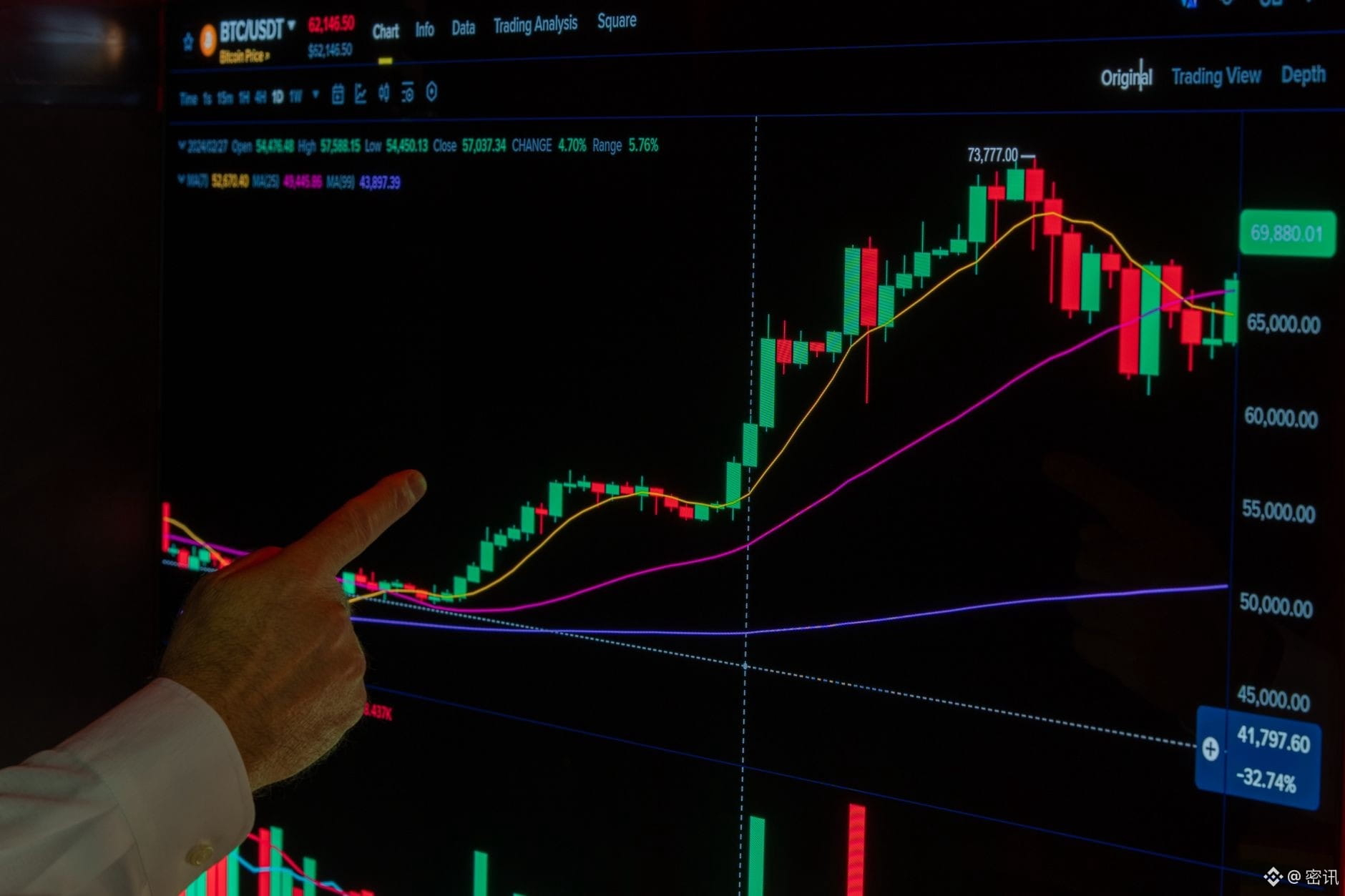
Bitcoin jumps more than 10% in a single day, rebounding nearly 50% year-to-date—has the underlying logic changed?
On February 15 in U.S. Eastern Time, the global crypto market saw a sharp volatility correction, with Bitcoin’s one-day gain breaking 10%. This strong rebound was not an isolated event—it marked a key turning point that pushed the cumulative gains since the beginning of the year to nearly 50%. After a deep sell-off driven by macro uncertainty earlier on, this round of rally quickly erased some of the market’s pessimism and rekindled institutional and retail interest in the long-term value of digital assets. However, amid the cheers, what’s worth thinking about more is this: beneath the apparent surface of extreme price fluctuations, has Bitcoin’s logic as a foundational asset undergone any fundamental change? Is the current rebound driven by a reassessment of fundamentals, or is it merely a technical correction after being oversold?
Follow me—my next post’s quick market read won’t be missed.
Bitcoin jumps more than 10% in a single day, rebounding nearly 50% year-to-date—has the underlying logic changed?
On February 15 in U.S. Eastern Time, the global crypto market saw a sharp volatility correction, with Bitcoin’s one-day gain breaking 10%. This strong rebound was not an isolated event—it marked a key turning point that pushed the cumulative gains since the beginning of the year to nearly 50%. After a deep sell-off driven by macro uncertainty earlier on, this round of rally quickly erased some of the market’s pessimism and rekindled institutional and retail interest in the long-term value of digital assets. However, amid the cheers, what’s worth thinking about more is this: beneath the apparent surface of extreme price fluctuations, has Bitcoin’s logic as a foundational asset undergone any fundamental change? Is the current rebound driven by a reassessment of fundamentals, or is it merely a technical correction after being oversold?
Follow me—my next post’s quick market read won’t be missed.
On February 15 in U.S. Eastern Time, the global crypto market saw a sharp volatility correction, with Bitcoin’s one-day gain breaking 10%. This strong rebound was not an isolated event—it marked a key turning point that pushed the cumulative gains since the beginning of the year to nearly 50%. After a deep sell-off driven by macro uncertainty earlier on, this round of rally quickly erased some of the market’s pessimism and rekindled institutional and retail interest in the long-term value of digital assets. However, amid the cheers, what’s worth thinking about more is this: beneath the apparent surface of extreme price fluctuations, has Bitcoin’s logic as a foundational asset undergone any fundamental change? Is the current rebound driven by a reassessment of fundamentals, or is it merely a technical correction after being oversold?
Follow me—my next post’s quick market read won’t be missed.
61
·
--
Non-Farm Payrolls Shock Rewrites the Rate-Hike Script: BTC in a 85,000-USD Standoff, With Slowing ETF Flows as the Core Contradiction
Market sentiment over the weekend feels somewhat heavy amid repeated swings in macro expectations. The tug-of-war for BTC near the $85,000 threshold, in essence, is a game between “pausing rate hikes” and “liquidity drying up.” The September NFP data came in as a surprise, completely rewriting the Fed’s near-term tightening roadmap and sharply lowering the probability of consecutive rate hikes in October. However, this macro tailwind has not immediately translated into strong spot buying on-chain. Instead, the most critical contradiction right now is the pronounced slowdown in ETF inflows alongside the continued contraction in the market value of USD-backed stablecoins. Under these circumstances, price is no longer driven purely by sentiment; it is constrained by the real depth of available funds. For traders, this setup is not the starting point of a one-way bull or bear move, but a structural consolidation period that demands extremely high patience. Any attempt to rush ahead in a low-liquidity weekend environment may face dual punishment from both slippage and heightened volatility.
From a macro fundamentals perspective, the Fed’s policy path is undergoing subtle but pivotal adjustments. In September, the NFP report added only 290,000 jobs, the unemployment rate rose to 4.2%, and the combined figures for the prior two months were revised down by 60,000. This cooling in the labor market directly weakens the urgency for the Fed to continue hiking in October. Institutions such as Goldman Sachs and Haitong Securities have pushed expectations for the second rate hike from October to December. The CME FedWatch tool shows the probability of keeping rates unchanged in October has risen to 77.9%; a week earlier, the probability of a hike was still above 60%. Although geopolitical risks—such as tensions between the U.S. and Iran in the Strait of Hormuz—triggered fierce one-day swings in BTC’s market value of $50 billion, the market is gradually treating these developments as inputs to inflation expectations rather than the root cause of panic. Still, it is important to stay clear-eyed: the uncertainty for December has not been resolved. Core PCE inflation remains above the Fed’s 2% target, meaning the market’s dominant pricing logic has become “pause in October, revisit in December.” Macro uncertainty remains, though the regime has shifted from “emergency tightening” to “watch-and-wait.”
Changes in liquidity reveal the attenuation of underlying market momentum. Although Bitcoin spot ETFs saw net inflows of about $2.95 billion over the past 30 days and the September monthly figure drew in roughly $2.65 billion, the marginal effect is diminishing. Recent weekly inflows have fallen sharply from the peak of $2.39 billion to roughly $83 million, indicating that incremental capital is not eager to enter. BlackRock’s IBIT, as the absolute pillar, accumulated net purchases of about $1.57 billion over the last month, holding more than 800,000 BTC, corresponding to a market value of approximately $67.87 billion. Its single-point buy pressure has supported the price floor. However, this support faces a severe challenge: since May 2026, the total market cap of USD-pegged tokens has cumulatively shrunk by about $14 billion. While September saw a slight rebound, so far the recovery is only about $4 billion, bringing the total to around $270 billion. The contraction in stablecoin market value implies that available liquidity and leverage room inside the crypto market remain tight. Whether IBIT’s continued buying can offset the overall liquidity shrinkage is a key variable in determining whether BTC can break above the $85,000 level.
On-chain data provides the most solid mid-term evidence for support. According to CryptoQuant, the total BTC balance across all exchanges has dropped to around 2.68 million BTC, a new low since September 2023. And since September 22, more than 40,000 BTC have flowed out of exchanges. This supply-dwindling trend spans multiple price cycles. Since the early-2024 peak of 3.2 million BTC, it has been steadily declining, which is often interpreted as a signal that long-term holders are locking up supply. Still, be cautious: a decrease in exchange balances does not directly equal “accumulation.” The same pattern can also be caused by transfers to cold wallets, OTC trading, and custodian movements. Therefore, on-chain supply tightness is a坚实 mid-term foundation for the bottom, but it is not a short-term catalyst for an explosive move. Meanwhile, the altcoin sector is showing structural rotation. Among the top-100 tokens by market cap, 80% have re-established their positions above the 50-day moving average. Assets with clear fundamental drivers, such as AAVE and NIGHT, have led the rally—but this is not a broad-based “rising together” market; it is a structural opportunity in selected assets. ETH’s sideways consolidation in the 2,680–2,720 range also suggests a directional breakout may be near. Coinglass data shows that bidirectional liquidation intensity totals $497 million; once a breakout occurs, volatility could be amplified significantly.
For the next steps, the core principle should be: “wait for confirmation, refuse to run ahead.” BTC is currently within a core range of $82,500–$87,000. Above, $85,480–$87,000 has strong sell pressure. If price breaks above $85,480 on increasing volume, it could be viewed toward $86,256 and even $87,373. If it falls below the $83,800 EMA-congested area, it may dip toward the $82,500 support. In particular, if BTC loses $80,405, the cumulative liquidation intensity of long positions across mainstream CEXs is as high as $1.999 billion, which could trigger a sharp cascade. JackYi, founder of Liquid Capital, noted that if it breaks below $82,000, then $79,000, $75,000, and $71,000 would be key support levels. Given thin weekend liquidity and the unresolved uncertainty around December rate hikes, it is recommended to avoid heavy, one-sided bets. Focus on observing ETH’s breakout signals above $2,815, as well as changes in trading volume around the $85,000 BTC level. On-chain supply exhaustion provides a safety margin, but in the short term price is still dominated by macro expectations and capital flows. Position management is better than directional judgment; waiting until the signal becomes clear before entering is the most prudent strategy right now.
Follow me—next post, I’ll provide a quick read of the market so you won’t miss the action.
Non-Farm Payrolls Shock Rewrites the Rate-Hike Script: BTC in a 85,000-USD Standoff, With Slowing ETF Flows as the Core Contradiction
Market sentiment over the weekend feels somewhat heavy amid repeated swings in macro expectations. The tug-of-war for BTC near the $85,000 threshold, in essence, is a game between “pausing rate hikes” and “liquidity drying up.” The September NFP data came in as a surprise, completely rewriting the Fed’s near-term tightening roadmap and sharply lowering the probability of consecutive rate hikes in October. However, this macro tailwind has not immediately translated into strong spot buying on-chain. Instead, the most critical contradiction right now is the pronounced slowdown in ETF inflows alongside the continued contraction in the market value of USD-backed stablecoins. Under these circumstances, price is no longer driven purely by sentiment; it is constrained by the real depth of available funds. For traders, this setup is not the starting point of a one-way bull or bear move, but a structural consolidation period that demands extremely high patience. Any attempt to rush ahead in a low-liquidity weekend environment may face dual punishment from both slippage and heightened volatility.
From a macro fundamentals perspective, the Fed’s policy path is undergoing subtle but pivotal adjustments. In September, the NFP report added only 290,000 jobs, the unemployment rate rose to 4.2%, and the combined figures for the prior two months were revised down by 60,000. This cooling in the labor market directly weakens the urgency for the Fed to continue hiking in October. Institutions such as Goldman Sachs and Haitong Securities have pushed expectations for the second rate hike from October to December. The CME FedWatch tool shows the probability of keeping rates unchanged in October has risen to 77.9%; a week earlier, the probability of a hike was still above 60%. Although geopolitical risks—such as tensions between the U.S. and Iran in the Strait of Hormuz—triggered fierce one-day swings in BTC’s market value of $50 billion, the market is gradually treating these developments as inputs to inflation expectations rather than the root cause of panic. Still, it is important to stay clear-eyed: the uncertainty for December has not been resolved. Core PCE inflation remains above the Fed’s 2% target, meaning the market’s dominant pricing logic has become “pause in October, revisit in December.” Macro uncertainty remains, though the regime has shifted from “emergency tightening” to “watch-and-wait.”
Changes in liquidity reveal the attenuation of underlying market momentum. Although Bitcoin spot ETFs saw net inflows of about $2.95 billion over the past 30 days and the September monthly figure drew in roughly $2.65 billion, the marginal effect is diminishing. Recent weekly inflows have fallen sharply from the peak of $2.39 billion to roughly $83 million, indicating that incremental capital is not eager to enter. BlackRock’s IBIT, as the absolute pillar, accumulated net purchases of about $1.57 billion over the last month, holding more than 800,000 BTC, corresponding to a market value of approximately $67.87 billion. Its single-point buy pressure has supported the price floor. However, this support faces a severe challenge: since May 2026, the total market cap of USD-pegged tokens has cumulatively shrunk by about $14 billion. While September saw a slight rebound, so far the recovery is only about $4 billion, bringing the total to around $270 billion. The contraction in stablecoin market value implies that available liquidity and leverage room inside the crypto market remain tight. Whether IBIT’s continued buying can offset the overall liquidity shrinkage is a key variable in determining whether BTC can break above the $85,000 level.
On-chain data provides the most solid mid-term evidence for support. According to CryptoQuant, the total BTC balance across all exchanges has dropped to around 2.68 million BTC, a new low since September 2023. And since September 22, more than 40,000 BTC have flowed out of exchanges. This supply-dwindling trend spans multiple price cycles. Since the early-2024 peak of 3.2 million BTC, it has been steadily declining, which is often interpreted as a signal that long-term holders are locking up supply. Still, be cautious: a decrease in exchange balances does not directly equal “accumulation.” The same pattern can also be caused by transfers to cold wallets, OTC trading, and custodian movements. Therefore, on-chain supply tightness is a坚实 mid-term foundation for the bottom, but it is not a short-term catalyst for an explosive move. Meanwhile, the altcoin sector is showing structural rotation. Among the top-100 tokens by market cap, 80% have re-established their positions above the 50-day moving average. Assets with clear fundamental drivers, such as AAVE and NIGHT, have led the rally—but this is not a broad-based “rising together” market; it is a structural opportunity in selected assets. ETH’s sideways consolidation in the 2,680–2,720 range also suggests a directional breakout may be near. Coinglass data shows that bidirectional liquidation intensity totals $497 million; once a breakout occurs, volatility could be amplified significantly.
For the next steps, the core principle should be: “wait for confirmation, refuse to run ahead.” BTC is currently within a core range of $82,500–$87,000. Above, $85,480–$87,000 has strong sell pressure. If price breaks above $85,480 on increasing volume, it could be viewed toward $86,256 and even $87,373. If it falls below the $83,800 EMA-congested area, it may dip toward the $82,500 support. In particular, if BTC loses $80,405, the cumulative liquidation intensity of long positions across mainstream CEXs is as high as $1.999 billion, which could trigger a sharp cascade. JackYi, founder of Liquid Capital, noted that if it breaks below $82,000, then $79,000, $75,000, and $71,000 would be key support levels. Given thin weekend liquidity and the unresolved uncertainty around December rate hikes, it is recommended to avoid heavy, one-sided bets. Focus on observing ETH’s breakout signals above $2,815, as well as changes in trading volume around the $85,000 BTC level. On-chain supply exhaustion provides a safety margin, but in the short term price is still dominated by macro expectations and capital flows. Position management is better than directional judgment; waiting until the signal becomes clear before entering is the most prudent strategy right now.
Follow me—next post, I’ll provide a quick read of the market so you won’t miss the action.
Market sentiment over the weekend feels somewhat heavy amid repeated swings in macro expectations. The tug-of-war for BTC near the $85,000 threshold, in essence, is a game between “pausing rate hikes” and “liquidity drying up.” The September NFP data came in as a surprise, completely rewriting the Fed’s near-term tightening roadmap and sharply lowering the probability of consecutive rate hikes in October. However, this macro tailwind has not immediately translated into strong spot buying on-chain. Instead, the most critical contradiction right now is the pronounced slowdown in ETF inflows alongside the continued contraction in the market value of USD-backed stablecoins. Under these circumstances, price is no longer driven purely by sentiment; it is constrained by the real depth of available funds. For traders, this setup is not the starting point of a one-way bull or bear move, but a structural consolidation period that demands extremely high patience. Any attempt to rush ahead in a low-liquidity weekend environment may face dual punishment from both slippage and heightened volatility.
From a macro fundamentals perspective, the Fed’s policy path is undergoing subtle but pivotal adjustments. In September, the NFP report added only 290,000 jobs, the unemployment rate rose to 4.2%, and the combined figures for the prior two months were revised down by 60,000. This cooling in the labor market directly weakens the urgency for the Fed to continue hiking in October. Institutions such as Goldman Sachs and Haitong Securities have pushed expectations for the second rate hike from October to December. The CME FedWatch tool shows the probability of keeping rates unchanged in October has risen to 77.9%; a week earlier, the probability of a hike was still above 60%. Although geopolitical risks—such as tensions between the U.S. and Iran in the Strait of Hormuz—triggered fierce one-day swings in BTC’s market value of $50 billion, the market is gradually treating these developments as inputs to inflation expectations rather than the root cause of panic. Still, it is important to stay clear-eyed: the uncertainty for December has not been resolved. Core PCE inflation remains above the Fed’s 2% target, meaning the market’s dominant pricing logic has become “pause in October, revisit in December.” Macro uncertainty remains, though the regime has shifted from “emergency tightening” to “watch-and-wait.”
Changes in liquidity reveal the attenuation of underlying market momentum. Although Bitcoin spot ETFs saw net inflows of about $2.95 billion over the past 30 days and the September monthly figure drew in roughly $2.65 billion, the marginal effect is diminishing. Recent weekly inflows have fallen sharply from the peak of $2.39 billion to roughly $83 million, indicating that incremental capital is not eager to enter. BlackRock’s IBIT, as the absolute pillar, accumulated net purchases of about $1.57 billion over the last month, holding more than 800,000 BTC, corresponding to a market value of approximately $67.87 billion. Its single-point buy pressure has supported the price floor. However, this support faces a severe challenge: since May 2026, the total market cap of USD-pegged tokens has cumulatively shrunk by about $14 billion. While September saw a slight rebound, so far the recovery is only about $4 billion, bringing the total to around $270 billion. The contraction in stablecoin market value implies that available liquidity and leverage room inside the crypto market remain tight. Whether IBIT’s continued buying can offset the overall liquidity shrinkage is a key variable in determining whether BTC can break above the $85,000 level.
On-chain data provides the most solid mid-term evidence for support. According to CryptoQuant, the total BTC balance across all exchanges has dropped to around 2.68 million BTC, a new low since September 2023. And since September 22, more than 40,000 BTC have flowed out of exchanges. This supply-dwindling trend spans multiple price cycles. Since the early-2024 peak of 3.2 million BTC, it has been steadily declining, which is often interpreted as a signal that long-term holders are locking up supply. Still, be cautious: a decrease in exchange balances does not directly equal “accumulation.” The same pattern can also be caused by transfers to cold wallets, OTC trading, and custodian movements. Therefore, on-chain supply tightness is a坚实 mid-term foundation for the bottom, but it is not a short-term catalyst for an explosive move. Meanwhile, the altcoin sector is showing structural rotation. Among the top-100 tokens by market cap, 80% have re-established their positions above the 50-day moving average. Assets with clear fundamental drivers, such as AAVE and NIGHT, have led the rally—but this is not a broad-based “rising together” market; it is a structural opportunity in selected assets. ETH’s sideways consolidation in the 2,680–2,720 range also suggests a directional breakout may be near. Coinglass data shows that bidirectional liquidation intensity totals $497 million; once a breakout occurs, volatility could be amplified significantly.
For the next steps, the core principle should be: “wait for confirmation, refuse to run ahead.” BTC is currently within a core range of $82,500–$87,000. Above, $85,480–$87,000 has strong sell pressure. If price breaks above $85,480 on increasing volume, it could be viewed toward $86,256 and even $87,373. If it falls below the $83,800 EMA-congested area, it may dip toward the $82,500 support. In particular, if BTC loses $80,405, the cumulative liquidation intensity of long positions across mainstream CEXs is as high as $1.999 billion, which could trigger a sharp cascade. JackYi, founder of Liquid Capital, noted that if it breaks below $82,000, then $79,000, $75,000, and $71,000 would be key support levels. Given thin weekend liquidity and the unresolved uncertainty around December rate hikes, it is recommended to avoid heavy, one-sided bets. Focus on observing ETH’s breakout signals above $2,815, as well as changes in trading volume around the $85,000 BTC level. On-chain supply exhaustion provides a safety margin, but in the short term price is still dominated by macro expectations and capital flows. Position management is better than directional judgment; waiting until the signal becomes clear before entering is the most prudent strategy right now.
Follow me—next post, I’ll provide a quick read of the market so you won’t miss the action.

253
·
--
Don’t be fooled by short-term fluctuations: Bitcoin won’t disappear—it will reshape the economy
When it comes to whether Bitcoin and the entire crypto industry will eventually die out, the market has long been haunted by a pessimistic narrative based on short-term price volatility. This view often treats crypto assets as a speculative bubble lacking intrinsic value, believing that as regulation tightens and market sentiment fades, this sector will ultimately go to zero just like the countless websites during the internet bubble era. However, when you shift your perspective from short-term trading games to the macro dimension of human economic history, this kind of linear extrapolation looks far too narrow. Over the past few centuries, in every truly structural technological revolution, the core logic was not to create new units of currency, but to continuously lower the cost of connection, expand the reach of transactions, and thereby improve the efficiency of resource allocation. From railroads reshaping the geography of logistics to shipping
Follow me—my next post will be a quick rundown of the chart so you won’t miss it.
Don’t be fooled by short-term fluctuations: Bitcoin won’t disappear—it will reshape the economy
When it comes to whether Bitcoin and the entire crypto industry will eventually die out, the market has long been haunted by a pessimistic narrative based on short-term price volatility. This view often treats crypto assets as a speculative bubble lacking intrinsic value, believing that as regulation tightens and market sentiment fades, this sector will ultimately go to zero just like the countless websites during the internet bubble era. However, when you shift your perspective from short-term trading games to the macro dimension of human economic history, this kind of linear extrapolation looks far too narrow. Over the past few centuries, in every truly structural technological revolution, the core logic was not to create new units of currency, but to continuously lower the cost of connection, expand the reach of transactions, and thereby improve the efficiency of resource allocation. From railroads reshaping the geography of logistics to shipping
Follow me—my next post will be a quick rundown of the chart so you won’t miss it.
When it comes to whether Bitcoin and the entire crypto industry will eventually die out, the market has long been haunted by a pessimistic narrative based on short-term price volatility. This view often treats crypto assets as a speculative bubble lacking intrinsic value, believing that as regulation tightens and market sentiment fades, this sector will ultimately go to zero just like the countless websites during the internet bubble era. However, when you shift your perspective from short-term trading games to the macro dimension of human economic history, this kind of linear extrapolation looks far too narrow. Over the past few centuries, in every truly structural technological revolution, the core logic was not to create new units of currency, but to continuously lower the cost of connection, expand the reach of transactions, and thereby improve the efficiency of resource allocation. From railroads reshaping the geography of logistics to shipping
Follow me—my next post will be a quick rundown of the chart so you won’t miss it.
22
·
--
Article
Ethereum to upgrade zkAPI Base to Cobalt; stablecoins push deeper into the Bitcoin layer; early projects accelerate clearing outThis week’s crypto market showed clear structural divergence. On one hand, institution-grade infrastructure and the move toward compliance are accelerating, stablecoin issuers are beginning to go deeper into Bitcoin’s native layer, and payment giants are also connecting the last mile of on-chain settlement with traditional finance. On the other hand, some early hot projects and Layer 2 networks are choosing to exit or scale down due to unsustainable economic models. This “keep the essentials and discard the rest” trend suggests the market is shifting from purely narrative-driven momentum to a more stringent evaluation of the practicality of underlying technology and overall financial health.
In terms of merging stablecoins with Bitcoin networks, the Utexo project supported by Tether has made key progress. The company has been approved to issue USDT natively on the Bitcoin network and plans to launch it this month. Unlike earlier approaches that relied on the Omni protocol or cross-chain bridges, Utexo is based on the RGB protocol and the Bitcoin UTXO model, aiming to keep most transaction data off-chain to improve privacy and efficiency. Its core use cases include privacy-preserving USDT transfers, direct swaps between native BTC and USDT, and BTC collateralized lending without the need for wrapping. This move marks an effort by stablecoin issuers to break free from sole reliance on single smart-contract chains such as Ethereum and Tron, and to build payment and financial infrastructure directly on Bitcoin as a value-store layer. In the future, Utexo also plans to extend the service to the Lightning Network, further lowering the barrier for micro-payments. This action not only strengthens Bitcoin’s potential as a settlement layer, but also provides traditional financial institutions with a more compliant, low-latency solution for native Bitcoin stablecoin access.
Ethereum to upgrade zkAPI Base to Cobalt; stablecoins push deeper into the Bitcoin layer; early projects accelerate clearing out
This week’s crypto market showed clear structural divergence. On one hand, institution-grade infrastructure and the move toward compliance are accelerating, stablecoin issuers are beginning to go deeper into Bitcoin’s native layer, and payment giants are also connecting the last mile of on-chain settlement with traditional finance. On the other hand, some early hot projects and Layer 2 networks are choosing to exit or scale down due to unsustainable economic models. This “keep the essentials and discard the rest” trend suggests the market is shifting from purely narrative-driven momentum to a more stringent evaluation of the practicality of underlying technology and overall financial health.
In terms of merging stablecoins with Bitcoin networks, the Utexo project supported by Tether has made key progress. The company has been approved to issue USDT natively on the Bitcoin network and plans to launch it this month. Unlike earlier approaches that relied on the Omni protocol or cross-chain bridges, Utexo is based on the RGB protocol and the Bitcoin UTXO model, aiming to keep most transaction data off-chain to improve privacy and efficiency. Its core use cases include privacy-preserving USDT transfers, direct swaps between native BTC and USDT, and BTC collateralized lending without the need for wrapping. This move marks an effort by stablecoin issuers to break free from sole reliance on single smart-contract chains such as Ethereum and Tron, and to build payment and financial infrastructure directly on Bitcoin as a value-store layer. In the future, Utexo also plans to extend the service to the Lightning Network, further lowering the barrier for micro-payments. This action not only strengthens Bitcoin’s potential as a settlement layer, but also provides traditional financial institutions with a more compliant, low-latency solution for native Bitcoin stablecoin access.
In terms of merging stablecoins with Bitcoin networks, the Utexo project supported by Tether has made key progress. The company has been approved to issue USDT natively on the Bitcoin network and plans to launch it this month. Unlike earlier approaches that relied on the Omni protocol or cross-chain bridges, Utexo is based on the RGB protocol and the Bitcoin UTXO model, aiming to keep most transaction data off-chain to improve privacy and efficiency. Its core use cases include privacy-preserving USDT transfers, direct swaps between native BTC and USDT, and BTC collateralized lending without the need for wrapping. This move marks an effort by stablecoin issuers to break free from sole reliance on single smart-contract chains such as Ethereum and Tron, and to build payment and financial infrastructure directly on Bitcoin as a value-store layer. In the future, Utexo also plans to extend the service to the Lightning Network, further lowering the barrier for micro-payments. This action not only strengthens Bitcoin’s potential as a settlement layer, but also provides traditional financial institutions with a more compliant, low-latency solution for native Bitcoin stablecoin access.
240
·
--
When you see a long post, do you first skim the title and swipe away, or do you click in first to take a look at the comments section?
When you see a long post, do you first skim the title and swipe away, or do you click in first to take a look at the comments section?
1
72
·
--
On Sundays, when you browse the square, do you prefer watching complaints and idle chatter, or having a proper discussion about macroeconomics for a couple of serious points?
On Sundays, when you browse the square, do you prefer watching complaints and idle chatter, or having a proper discussion about macroeconomics for a couple of serious points?
74
·
--
Ethereum transforms into a world computer; HSBC rolls out stablecoin; El Salvador implements it
Over the past week, global crypto asset markets have shown clear structural divergence driven by two factors: the reshaping of regulatory frameworks and the evolution of underlying technologies. On one hand, blockchain public-chain infrastructure represented by Ethereum is undergoing a paradigm shift from “blockchain” to a “cryptographic world computer.” The core narrative is moving from simply processing transactions to sampling data and verifying zero-knowledge proofs. On the other hand, traditional financial giants and sovereign states are accelerating the integration of stablecoins and tokenized assets into mainstream payment and credit systems. This parallel trend of “decentralization through technology deepening” and “centralized application in finance rolling out” signals that the crypto industry is moving from an early speculative narrative stage into the deep waters of compliance, infrastructure build-out, and assetization.
Follow me—my next post will be a quick read of the market so you won’t miss anything.
Ethereum transforms into a world computer; HSBC rolls out stablecoin; El Salvador implements it
Over the past week, global crypto asset markets have shown clear structural divergence driven by two factors: the reshaping of regulatory frameworks and the evolution of underlying technologies. On one hand, blockchain public-chain infrastructure represented by Ethereum is undergoing a paradigm shift from “blockchain” to a “cryptographic world computer.” The core narrative is moving from simply processing transactions to sampling data and verifying zero-knowledge proofs. On the other hand, traditional financial giants and sovereign states are accelerating the integration of stablecoins and tokenized assets into mainstream payment and credit systems. This parallel trend of “decentralization through technology deepening” and “centralized application in finance rolling out” signals that the crypto industry is moving from an early speculative narrative stage into the deep waters of compliance, infrastructure build-out, and assetization.
Follow me—my next post will be a quick read of the market so you won’t miss anything.
Over the past week, global crypto asset markets have shown clear structural divergence driven by two factors: the reshaping of regulatory frameworks and the evolution of underlying technologies. On one hand, blockchain public-chain infrastructure represented by Ethereum is undergoing a paradigm shift from “blockchain” to a “cryptographic world computer.” The core narrative is moving from simply processing transactions to sampling data and verifying zero-knowledge proofs. On the other hand, traditional financial giants and sovereign states are accelerating the integration of stablecoins and tokenized assets into mainstream payment and credit systems. This parallel trend of “decentralization through technology deepening” and “centralized application in finance rolling out” signals that the crypto industry is moving from an early speculative narrative stage into the deep waters of compliance, infrastructure build-out, and assetization.
Follow me—my next post will be a quick read of the market so you won’t miss anything.
392
·
--
Verified
Dogecoin says goodbye to pure speculation—DogeOS testnet goes live and ushers in the DeFi era
Dogecoin (DOGE) has long been regarded in the crypto market as a “pure asset” with abundant liquidity but limited real-world use cases. Its core value is often reduced to price volatility and community sentiment. However, this situation has changed meaningfully this week with the DogeOS team’s official launch of an Ethereum-compatible public testnet. The testnet allows developers to build transaction, lending, and stablecoin applications using test-version DOGE, aiming to transform DOGE from a mere store of value or a speculative target into a foundational asset with real financial functions. This move marks the Dogecoin ecosystem’s attempt to break out of its passive “just sitting in wallets” mode by redefining holding logic through the introduction of DeFi capabilities.
In terms of specific implementation details, the DogeOS testnet launched on Wednesday of this week. Developers can use familiar tooling to build applications directly. Transaction fees are paid in test DOGE. At present, lending services, trading platforms, and stablecoin projects supported by crypto assets are all in the development stage. Although DOGE’s market cap is about $13 billion, placing it among the top cryptocurrencies, its native chain currently supports only value transfer and cannot directly run complex financial smart contracts. DogeOS deploys the application layer on a separate system, enabling users to bridge DOGE to that environment to access financial services. This architecture means users must trust the new system’s bookkeeping honesty. Regarding its trust model, DogeOS plans to ultimately support trust through mathematical proofs and have the Dogecoin network itself participate in verification. But in the first version, the system still relies on authorized orderers selected by the team to determine transaction ordering. Validator nodes check proofs within a trusted execution environment (TEE), and a security committee oversees the process. In the short term, this means users still have to trust the correctness of these centralized operators and the hardware, and Dogecoin miners are currently not involved in verifying application proofs.
DogeOS’s launch backdrop is closely related to the market’s lukewarm performance toward the current Dogecoin ETF landscape. Created by the MyDoge wallet team, DogeOS’s founder Jordan Jefferson noted that attracting institutional investors requires stronger reasons to hold DOGE than simply buying DOGE. Data shows that in the past nearly 10 months, the three U.S. Dogecoin ETFs combined have attracted only about $12 million, and 166 out of 199 trading days saw zero net inflows. Especially when Bitwise announced it would close its Dogecoin ETF—its fund size was under $700,000. This market reality forces the Dogecoin ecosystem to seek new narrative anchors. Jefferson emphasized that no other digital asset has the kind of liquidity, community, and cultural influence that Dogecoin does, and that DogeOS aims to unlock its untapped potential by letting developers build applications on Dogecoin and reaching users directly through the MyDoge wallet. He believes that genuine economic activity built on Dogecoin is the key path to realizing the community’s long-term vision.
However, looking back at the history of meme-coin application chains, the challenges facing DogeOS cannot be underestimated. Dogechain, launched in 2022 with a similar narrative, attracted about $4.6 million in deposits at first, but the size of related financial applications tracked by DeFiLlama has since shrunk to under $300. Similarly, Shibarium, launched in the Shiba Inu camp in 2023, saw its financial application TVL drop sharply from a peak of around $6.4 million to roughly $140,000 today. These cases suggest that meme-coin application chains often follow a cycle of “high peak TVL, rapid collapse.” The difference with DogeOS is the supporting force behind it and its approach toward decentralization. The Dogecoin Foundation did not cut a deal this time; instead, it publicly backed DogeOS through board director Timothy Stebbing, stating that DogeOS is a way to “not change Dogecoin’s underlying layer, and directly add applications.” In addition, DogeOS plans to return verification power to miners through a proposal called OP_CHECKZKP (published in July 2025). The proposal aims to add rules that let the Dogecoin network verify external computation proofs. But as of December 2025, its actual implementation is still only a draft: the proof checker is merely a placeholder, and a large amount of development work is still needed before it can be formally enabled. Moreover, neither the mainnet launch date nor the upgrade enabling date has been announced.
For investors and developers, DogeOS’s short-term value lies in providing real use cases for DOGE and easing liquidity pressure caused by insufficient ETF demand. But in the long run, its decentralization promises still remain at the blueprint stage. The first version is fundamentally close to a centralized ledger, relying on specific operators and hardware—creating tension with the spirit of decentralization long advocated by the Dogecoin community. The implementation progress of the OP_CHECKZKP proposal will be a key metric. If it cannot complete the transition from draft to real implementation in the short term, DogeOS may repeat the fates of Dogechain and Shibarium: high initial hype followed by a rapid decline in the ecosystem. Therefore, the market should be wary of short-term narrative premiums, focusing instead on testnet developer activity, the security of cross-chain bridges, and code progress for the OP_CHECKZKP proposal. Whether Dogecoin can truly move from “meme” to “utility” depends on whether it can find a balance between its trust mechanisms and its level of decentralization—not just on community sentiment.
Follow me—my next post will be a quick market read so you won’t miss what matters.
Dogecoin says goodbye to pure speculation—DogeOS testnet goes live and ushers in the DeFi era
Dogecoin (DOGE) has long been regarded in the crypto market as a “pure asset” with abundant liquidity but limited real-world use cases. Its core value is often reduced to price volatility and community sentiment. However, this situation has changed meaningfully this week with the DogeOS team’s official launch of an Ethereum-compatible public testnet. The testnet allows developers to build transaction, lending, and stablecoin applications using test-version DOGE, aiming to transform DOGE from a mere store of value or a speculative target into a foundational asset with real financial functions. This move marks the Dogecoin ecosystem’s attempt to break out of its passive “just sitting in wallets” mode by redefining holding logic through the introduction of DeFi capabilities.
In terms of specific implementation details, the DogeOS testnet launched on Wednesday of this week. Developers can use familiar tooling to build applications directly. Transaction fees are paid in test DOGE. At present, lending services, trading platforms, and stablecoin projects supported by crypto assets are all in the development stage. Although DOGE’s market cap is about $13 billion, placing it among the top cryptocurrencies, its native chain currently supports only value transfer and cannot directly run complex financial smart contracts. DogeOS deploys the application layer on a separate system, enabling users to bridge DOGE to that environment to access financial services. This architecture means users must trust the new system’s bookkeeping honesty. Regarding its trust model, DogeOS plans to ultimately support trust through mathematical proofs and have the Dogecoin network itself participate in verification. But in the first version, the system still relies on authorized orderers selected by the team to determine transaction ordering. Validator nodes check proofs within a trusted execution environment (TEE), and a security committee oversees the process. In the short term, this means users still have to trust the correctness of these centralized operators and the hardware, and Dogecoin miners are currently not involved in verifying application proofs.
DogeOS’s launch backdrop is closely related to the market’s lukewarm performance toward the current Dogecoin ETF landscape. Created by the MyDoge wallet team, DogeOS’s founder Jordan Jefferson noted that attracting institutional investors requires stronger reasons to hold DOGE than simply buying DOGE. Data shows that in the past nearly 10 months, the three U.S. Dogecoin ETFs combined have attracted only about $12 million, and 166 out of 199 trading days saw zero net inflows. Especially when Bitwise announced it would close its Dogecoin ETF—its fund size was under $700,000. This market reality forces the Dogecoin ecosystem to seek new narrative anchors. Jefferson emphasized that no other digital asset has the kind of liquidity, community, and cultural influence that Dogecoin does, and that DogeOS aims to unlock its untapped potential by letting developers build applications on Dogecoin and reaching users directly through the MyDoge wallet. He believes that genuine economic activity built on Dogecoin is the key path to realizing the community’s long-term vision.
However, looking back at the history of meme-coin application chains, the challenges facing DogeOS cannot be underestimated. Dogechain, launched in 2022 with a similar narrative, attracted about $4.6 million in deposits at first, but the size of related financial applications tracked by DeFiLlama has since shrunk to under $300. Similarly, Shibarium, launched in the Shiba Inu camp in 2023, saw its financial application TVL drop sharply from a peak of around $6.4 million to roughly $140,000 today. These cases suggest that meme-coin application chains often follow a cycle of “high peak TVL, rapid collapse.” The difference with DogeOS is the supporting force behind it and its approach toward decentralization. The Dogecoin Foundation did not cut a deal this time; instead, it publicly backed DogeOS through board director Timothy Stebbing, stating that DogeOS is a way to “not change Dogecoin’s underlying layer, and directly add applications.” In addition, DogeOS plans to return verification power to miners through a proposal called OP_CHECKZKP (published in July 2025). The proposal aims to add rules that let the Dogecoin network verify external computation proofs. But as of December 2025, its actual implementation is still only a draft: the proof checker is merely a placeholder, and a large amount of development work is still needed before it can be formally enabled. Moreover, neither the mainnet launch date nor the upgrade enabling date has been announced.
For investors and developers, DogeOS’s short-term value lies in providing real use cases for DOGE and easing liquidity pressure caused by insufficient ETF demand. But in the long run, its decentralization promises still remain at the blueprint stage. The first version is fundamentally close to a centralized ledger, relying on specific operators and hardware—creating tension with the spirit of decentralization long advocated by the Dogecoin community. The implementation progress of the OP_CHECKZKP proposal will be a key metric. If it cannot complete the transition from draft to real implementation in the short term, DogeOS may repeat the fates of Dogechain and Shibarium: high initial hype followed by a rapid decline in the ecosystem. Therefore, the market should be wary of short-term narrative premiums, focusing instead on testnet developer activity, the security of cross-chain bridges, and code progress for the OP_CHECKZKP proposal. Whether Dogecoin can truly move from “meme” to “utility” depends on whether it can find a balance between its trust mechanisms and its level of decentralization—not just on community sentiment.
Follow me—my next post will be a quick market read so you won’t miss what matters.
Dogecoin (DOGE) has long been regarded in the crypto market as a “pure asset” with abundant liquidity but limited real-world use cases. Its core value is often reduced to price volatility and community sentiment. However, this situation has changed meaningfully this week with the DogeOS team’s official launch of an Ethereum-compatible public testnet. The testnet allows developers to build transaction, lending, and stablecoin applications using test-version DOGE, aiming to transform DOGE from a mere store of value or a speculative target into a foundational asset with real financial functions. This move marks the Dogecoin ecosystem’s attempt to break out of its passive “just sitting in wallets” mode by redefining holding logic through the introduction of DeFi capabilities.
In terms of specific implementation details, the DogeOS testnet launched on Wednesday of this week. Developers can use familiar tooling to build applications directly. Transaction fees are paid in test DOGE. At present, lending services, trading platforms, and stablecoin projects supported by crypto assets are all in the development stage. Although DOGE’s market cap is about $13 billion, placing it among the top cryptocurrencies, its native chain currently supports only value transfer and cannot directly run complex financial smart contracts. DogeOS deploys the application layer on a separate system, enabling users to bridge DOGE to that environment to access financial services. This architecture means users must trust the new system’s bookkeeping honesty. Regarding its trust model, DogeOS plans to ultimately support trust through mathematical proofs and have the Dogecoin network itself participate in verification. But in the first version, the system still relies on authorized orderers selected by the team to determine transaction ordering. Validator nodes check proofs within a trusted execution environment (TEE), and a security committee oversees the process. In the short term, this means users still have to trust the correctness of these centralized operators and the hardware, and Dogecoin miners are currently not involved in verifying application proofs.
DogeOS’s launch backdrop is closely related to the market’s lukewarm performance toward the current Dogecoin ETF landscape. Created by the MyDoge wallet team, DogeOS’s founder Jordan Jefferson noted that attracting institutional investors requires stronger reasons to hold DOGE than simply buying DOGE. Data shows that in the past nearly 10 months, the three U.S. Dogecoin ETFs combined have attracted only about $12 million, and 166 out of 199 trading days saw zero net inflows. Especially when Bitwise announced it would close its Dogecoin ETF—its fund size was under $700,000. This market reality forces the Dogecoin ecosystem to seek new narrative anchors. Jefferson emphasized that no other digital asset has the kind of liquidity, community, and cultural influence that Dogecoin does, and that DogeOS aims to unlock its untapped potential by letting developers build applications on Dogecoin and reaching users directly through the MyDoge wallet. He believes that genuine economic activity built on Dogecoin is the key path to realizing the community’s long-term vision.
However, looking back at the history of meme-coin application chains, the challenges facing DogeOS cannot be underestimated. Dogechain, launched in 2022 with a similar narrative, attracted about $4.6 million in deposits at first, but the size of related financial applications tracked by DeFiLlama has since shrunk to under $300. Similarly, Shibarium, launched in the Shiba Inu camp in 2023, saw its financial application TVL drop sharply from a peak of around $6.4 million to roughly $140,000 today. These cases suggest that meme-coin application chains often follow a cycle of “high peak TVL, rapid collapse.” The difference with DogeOS is the supporting force behind it and its approach toward decentralization. The Dogecoin Foundation did not cut a deal this time; instead, it publicly backed DogeOS through board director Timothy Stebbing, stating that DogeOS is a way to “not change Dogecoin’s underlying layer, and directly add applications.” In addition, DogeOS plans to return verification power to miners through a proposal called OP_CHECKZKP (published in July 2025). The proposal aims to add rules that let the Dogecoin network verify external computation proofs. But as of December 2025, its actual implementation is still only a draft: the proof checker is merely a placeholder, and a large amount of development work is still needed before it can be formally enabled. Moreover, neither the mainnet launch date nor the upgrade enabling date has been announced.
For investors and developers, DogeOS’s short-term value lies in providing real use cases for DOGE and easing liquidity pressure caused by insufficient ETF demand. But in the long run, its decentralization promises still remain at the blueprint stage. The first version is fundamentally close to a centralized ledger, relying on specific operators and hardware—creating tension with the spirit of decentralization long advocated by the Dogecoin community. The implementation progress of the OP_CHECKZKP proposal will be a key metric. If it cannot complete the transition from draft to real implementation in the short term, DogeOS may repeat the fates of Dogechain and Shibarium: high initial hype followed by a rapid decline in the ecosystem. Therefore, the market should be wary of short-term narrative premiums, focusing instead on testnet developer activity, the security of cross-chain bridges, and code progress for the OP_CHECKZKP proposal. Whether Dogecoin can truly move from “meme” to “utility” depends on whether it can find a balance between its trust mechanisms and its level of decentralization—not just on community sentiment.
Follow me—my next post will be a quick market read so you won’t miss what matters.

1
1
1.2k
·
--
Stablecoin Clearing: Of the Billion-Dollar Giants, Only Two Remain—What Does USDT Still Lack?
The stablecoin market is undergoing a brutal liquidation of existing supply, with the head effect becoming increasingly pronounced. According to statistics compiled by ARK Invest analyst Lorenzo Valente, stablecoin projects with a market capitalization exceeding $1 billion have grown from single digits to just 12 over four years; meanwhile, the giants with market caps above $10 billion have shrunk from four at the 2022 peak to just two today—leaving only Tether and Circle. This dramatic drop in players is not accidental; it follows the inherent logic of network-effect assets: exchanges, payment networks, and DeFi protocols rely heavily on scale as a form of endorsement when integrating. As thresholds rise one level higher, the tail
Follow me—my next market read-through won’t be missed.
Stablecoin Clearing: Of the Billion-Dollar Giants, Only Two Remain—What Does USDT Still Lack?
The stablecoin market is undergoing a brutal liquidation of existing supply, with the head effect becoming increasingly pronounced. According to statistics compiled by ARK Invest analyst Lorenzo Valente, stablecoin projects with a market capitalization exceeding $1 billion have grown from single digits to just 12 over four years; meanwhile, the giants with market caps above $10 billion have shrunk from four at the 2022 peak to just two today—leaving only Tether and Circle. This dramatic drop in players is not accidental; it follows the inherent logic of network-effect assets: exchanges, payment networks, and DeFi protocols rely heavily on scale as a form of endorsement when integrating. As thresholds rise one level higher, the tail
Follow me—my next market read-through won’t be missed.
The stablecoin market is undergoing a brutal liquidation of existing supply, with the head effect becoming increasingly pronounced. According to statistics compiled by ARK Invest analyst Lorenzo Valente, stablecoin projects with a market capitalization exceeding $1 billion have grown from single digits to just 12 over four years; meanwhile, the giants with market caps above $10 billion have shrunk from four at the 2022 peak to just two today—leaving only Tether and Circle. This dramatic drop in players is not accidental; it follows the inherent logic of network-effect assets: exchanges, payment networks, and DeFi protocols rely heavily on scale as a form of endorsement when integrating. As thresholds rise one level higher, the tail
Follow me—my next market read-through won’t be missed.
260
·
--
On weekends, reading posts related to market trends—do you prefer a couple of plainspoken sentences, or are you willing to slowly work through long articles? Just tell me your habit.
On weekends, reading posts related to market trends—do you prefer a couple of plainspoken sentences, or are you willing to slowly work through long articles? Just tell me your habit.
60
·
--
On Saturday morning at the square, do you prefer lying back and browsing idle posts, or chasing trending topics to argue a couple of points? I’m not taking sides—I just wonder how the comments section chooses.
On Saturday morning at the square, do you prefer lying back and browsing idle posts, or chasing trending topics to argue a couple of points? I’m not taking sides—I just wonder how the comments section chooses.
91
·
--
Bitcoin’s 86k euphoria: bull market confirmed or a cycle trap?
Bitcoin is consolidating around $86,000, and this level once again pushes market sentiment to a high point. Recently, voices across the market have been highly consistent: most interpret the current rally as a confirmation signal of the start of a new bull market, and believe that any discussion about pullbacks or staying at lower levels is a form of “FOMO-induced missing out” thinking or a deliberate attempt to be bearish. This emotional collective bullishness often obscures a rational review of cyclical patterns. In the crypto asset space, traders who can truly navigate bull and bear markets and generate stable profits are usually not those chasing short-term sentiment swings, but those who understand macro cycles and can keep a cool head amid market frenzy. Historical experience repeatedly proves that, aside from core assets like Bitcoin and Ethereum, the vast majority of altcoins struggle to withstand two full bull-bear cycles. Even if the current market is indeed in the bull-market initiation phase, the likelihood of a one-way, straight-line surge is extremely low. After any large-scale lift-off, the market typically undergoes a thorough and intense shakeout process—an unavoidable path where capital rotates and sentiment is released.
From a technical and volatility-pattern perspective, after this round of rally ends, Bitcoin’s normal retracement is often 20% or more. If we look at the volatility characteristics of this move, price will most likely retest the $65,000 to $70,000 range. For altcoins, the drawdowns are usually more severe—retracements of 40% to 50% are very common in history. Chasing at highs after an acceleration essentially means taking an extremely high “bag-holder” risk, with very poor risk-reward. The analysis above is based only on technical adjustment logic within the crypto ecosystem; if macro-level risks are layered on top, the downside room can open even further. Currently, U.S. Treasury yields remain high, a large amount of capital is parked in the U.S. stock market’s fixed-income sector, and overall risk appetite is weak. Meanwhile, repeated inflation data and a more hawkish stance from the Fed have reignited expectations of rate hikes. The market widely expects that the Fed will not just implement one hike, but may deliver multiple rounds. Those familiar with macro cycles know that the tail end of a rate-hike cycle is often accompanied by extremely pessimistic market sentiment—precisely the zone where crypto’s true major bottom tends to form. The bottom has never been a fixed number; it is always a range. If U.S. equities also experience a deep 20% to 30% correction, leading global risk assets to collectively compress valuations, Bitcoin’s downside could be fully exposed. In extreme conditions, touching $50,000 or even $40,000 is not far-fetched.
Based on the macro and technical logic above, the key judgment today is: the likely bottom of this intermediate correction is in the $50,000 to $55,000 range, and in extreme cases it could be lower. This is not a rigid point-in-time price prediction, but a composite scenario based on a dynamic macro environment, Treasury yields, Fed policy expectations, and market capital flows. In practice, investors should abandon the mistaken belief of “holding blindly without moving” or “perfectly catching the bottom,” and instead use strategies like staged positioning and averaging in across a price range. In the high-price zone—around $86,000 for Bitcoin and $2,600 to $2,700 for Ethereum—the rational approach is to take profits and exit, locking in gains from lower levels while avoiding the risks of chasing at highs. For futures trading, if you stage short positions around $86,400 and then increase position size as price pushes above $90,000, the first take-profit target can be set near $70,000. This is not a call to be bearish all the way down; it’s based on a conservative trading habit of taking profits. True trading comfort comes from executing discipline in predefined key zones, not from staring at charts every day or making frequent trades. Even if price consolidates around $60,000, it doesn’t change the logic of a bottom zone in $50,000 to $55,000. After that, as long as price keeps pulling back, you should gradually re-acquire the previously sold positions. Swing trading in a bull market is not redundant—it helps repeatedly lower your cost and increase your holdings over the holding cycle, making it easier to withstand drawdowns.
Looking ahead, the ultimate peak of this bull market is expected to be around $180,000 to $200,000. Before reaching that ultimate high, the market will likely intersperse multiple waves of range-bound swings; being blindly too bullish or blindly missing the move is an inefficient strategy. Market sentiment often polarizes: when the price rises, everyone across the network shouts “bull”; when it falls, everyone panics and looks for “bear.” Yet at truly critical highs and lows, most participants often make no move and can only mock different viewpoints afterward. The core of the crypto market is that choosing the right entry matters more than simply trying harder—your entry location, timing, and position management directly determine the final profit and loss outcome. Choose the wrong place, and no amount of effort will change the fact that you’re just running alongside the train. Therefore, the key to surviving the cycle is to respect the macro cycle, stay calm amid frenzy, and remain patient amid despair. Whether trading spot or futures, traders should focus on the big trend and broad ranges—not obsess over hitting every single high or low precisely. Time will ultimately validate the logic of this cycle’s rise and fall, and rational trading discipline is the only certainty for dealing with market uncertainty.
Follow me—my next post will be a quick market read so you don’t miss what matters.
Bitcoin’s 86k euphoria: bull market confirmed or a cycle trap?
Bitcoin is consolidating around $86,000, and this level once again pushes market sentiment to a high point. Recently, voices across the market have been highly consistent: most interpret the current rally as a confirmation signal of the start of a new bull market, and believe that any discussion about pullbacks or staying at lower levels is a form of “FOMO-induced missing out” thinking or a deliberate attempt to be bearish. This emotional collective bullishness often obscures a rational review of cyclical patterns. In the crypto asset space, traders who can truly navigate bull and bear markets and generate stable profits are usually not those chasing short-term sentiment swings, but those who understand macro cycles and can keep a cool head amid market frenzy. Historical experience repeatedly proves that, aside from core assets like Bitcoin and Ethereum, the vast majority of altcoins struggle to withstand two full bull-bear cycles. Even if the current market is indeed in the bull-market initiation phase, the likelihood of a one-way, straight-line surge is extremely low. After any large-scale lift-off, the market typically undergoes a thorough and intense shakeout process—an unavoidable path where capital rotates and sentiment is released.
From a technical and volatility-pattern perspective, after this round of rally ends, Bitcoin’s normal retracement is often 20% or more. If we look at the volatility characteristics of this move, price will most likely retest the $65,000 to $70,000 range. For altcoins, the drawdowns are usually more severe—retracements of 40% to 50% are very common in history. Chasing at highs after an acceleration essentially means taking an extremely high “bag-holder” risk, with very poor risk-reward. The analysis above is based only on technical adjustment logic within the crypto ecosystem; if macro-level risks are layered on top, the downside room can open even further. Currently, U.S. Treasury yields remain high, a large amount of capital is parked in the U.S. stock market’s fixed-income sector, and overall risk appetite is weak. Meanwhile, repeated inflation data and a more hawkish stance from the Fed have reignited expectations of rate hikes. The market widely expects that the Fed will not just implement one hike, but may deliver multiple rounds. Those familiar with macro cycles know that the tail end of a rate-hike cycle is often accompanied by extremely pessimistic market sentiment—precisely the zone where crypto’s true major bottom tends to form. The bottom has never been a fixed number; it is always a range. If U.S. equities also experience a deep 20% to 30% correction, leading global risk assets to collectively compress valuations, Bitcoin’s downside could be fully exposed. In extreme conditions, touching $50,000 or even $40,000 is not far-fetched.
Based on the macro and technical logic above, the key judgment today is: the likely bottom of this intermediate correction is in the $50,000 to $55,000 range, and in extreme cases it could be lower. This is not a rigid point-in-time price prediction, but a composite scenario based on a dynamic macro environment, Treasury yields, Fed policy expectations, and market capital flows. In practice, investors should abandon the mistaken belief of “holding blindly without moving” or “perfectly catching the bottom,” and instead use strategies like staged positioning and averaging in across a price range. In the high-price zone—around $86,000 for Bitcoin and $2,600 to $2,700 for Ethereum—the rational approach is to take profits and exit, locking in gains from lower levels while avoiding the risks of chasing at highs. For futures trading, if you stage short positions around $86,400 and then increase position size as price pushes above $90,000, the first take-profit target can be set near $70,000. This is not a call to be bearish all the way down; it’s based on a conservative trading habit of taking profits. True trading comfort comes from executing discipline in predefined key zones, not from staring at charts every day or making frequent trades. Even if price consolidates around $60,000, it doesn’t change the logic of a bottom zone in $50,000 to $55,000. After that, as long as price keeps pulling back, you should gradually re-acquire the previously sold positions. Swing trading in a bull market is not redundant—it helps repeatedly lower your cost and increase your holdings over the holding cycle, making it easier to withstand drawdowns.
Looking ahead, the ultimate peak of this bull market is expected to be around $180,000 to $200,000. Before reaching that ultimate high, the market will likely intersperse multiple waves of range-bound swings; being blindly too bullish or blindly missing the move is an inefficient strategy. Market sentiment often polarizes: when the price rises, everyone across the network shouts “bull”; when it falls, everyone panics and looks for “bear.” Yet at truly critical highs and lows, most participants often make no move and can only mock different viewpoints afterward. The core of the crypto market is that choosing the right entry matters more than simply trying harder—your entry location, timing, and position management directly determine the final profit and loss outcome. Choose the wrong place, and no amount of effort will change the fact that you’re just running alongside the train. Therefore, the key to surviving the cycle is to respect the macro cycle, stay calm amid frenzy, and remain patient amid despair. Whether trading spot or futures, traders should focus on the big trend and broad ranges—not obsess over hitting every single high or low precisely. Time will ultimately validate the logic of this cycle’s rise and fall, and rational trading discipline is the only certainty for dealing with market uncertainty.
Follow me—my next post will be a quick market read so you don’t miss what matters.
Bitcoin is consolidating around $86,000, and this level once again pushes market sentiment to a high point. Recently, voices across the market have been highly consistent: most interpret the current rally as a confirmation signal of the start of a new bull market, and believe that any discussion about pullbacks or staying at lower levels is a form of “FOMO-induced missing out” thinking or a deliberate attempt to be bearish. This emotional collective bullishness often obscures a rational review of cyclical patterns. In the crypto asset space, traders who can truly navigate bull and bear markets and generate stable profits are usually not those chasing short-term sentiment swings, but those who understand macro cycles and can keep a cool head amid market frenzy. Historical experience repeatedly proves that, aside from core assets like Bitcoin and Ethereum, the vast majority of altcoins struggle to withstand two full bull-bear cycles. Even if the current market is indeed in the bull-market initiation phase, the likelihood of a one-way, straight-line surge is extremely low. After any large-scale lift-off, the market typically undergoes a thorough and intense shakeout process—an unavoidable path where capital rotates and sentiment is released.
From a technical and volatility-pattern perspective, after this round of rally ends, Bitcoin’s normal retracement is often 20% or more. If we look at the volatility characteristics of this move, price will most likely retest the $65,000 to $70,000 range. For altcoins, the drawdowns are usually more severe—retracements of 40% to 50% are very common in history. Chasing at highs after an acceleration essentially means taking an extremely high “bag-holder” risk, with very poor risk-reward. The analysis above is based only on technical adjustment logic within the crypto ecosystem; if macro-level risks are layered on top, the downside room can open even further. Currently, U.S. Treasury yields remain high, a large amount of capital is parked in the U.S. stock market’s fixed-income sector, and overall risk appetite is weak. Meanwhile, repeated inflation data and a more hawkish stance from the Fed have reignited expectations of rate hikes. The market widely expects that the Fed will not just implement one hike, but may deliver multiple rounds. Those familiar with macro cycles know that the tail end of a rate-hike cycle is often accompanied by extremely pessimistic market sentiment—precisely the zone where crypto’s true major bottom tends to form. The bottom has never been a fixed number; it is always a range. If U.S. equities also experience a deep 20% to 30% correction, leading global risk assets to collectively compress valuations, Bitcoin’s downside could be fully exposed. In extreme conditions, touching $50,000 or even $40,000 is not far-fetched.
Based on the macro and technical logic above, the key judgment today is: the likely bottom of this intermediate correction is in the $50,000 to $55,000 range, and in extreme cases it could be lower. This is not a rigid point-in-time price prediction, but a composite scenario based on a dynamic macro environment, Treasury yields, Fed policy expectations, and market capital flows. In practice, investors should abandon the mistaken belief of “holding blindly without moving” or “perfectly catching the bottom,” and instead use strategies like staged positioning and averaging in across a price range. In the high-price zone—around $86,000 for Bitcoin and $2,600 to $2,700 for Ethereum—the rational approach is to take profits and exit, locking in gains from lower levels while avoiding the risks of chasing at highs. For futures trading, if you stage short positions around $86,400 and then increase position size as price pushes above $90,000, the first take-profit target can be set near $70,000. This is not a call to be bearish all the way down; it’s based on a conservative trading habit of taking profits. True trading comfort comes from executing discipline in predefined key zones, not from staring at charts every day or making frequent trades. Even if price consolidates around $60,000, it doesn’t change the logic of a bottom zone in $50,000 to $55,000. After that, as long as price keeps pulling back, you should gradually re-acquire the previously sold positions. Swing trading in a bull market is not redundant—it helps repeatedly lower your cost and increase your holdings over the holding cycle, making it easier to withstand drawdowns.
Looking ahead, the ultimate peak of this bull market is expected to be around $180,000 to $200,000. Before reaching that ultimate high, the market will likely intersperse multiple waves of range-bound swings; being blindly too bullish or blindly missing the move is an inefficient strategy. Market sentiment often polarizes: when the price rises, everyone across the network shouts “bull”; when it falls, everyone panics and looks for “bear.” Yet at truly critical highs and lows, most participants often make no move and can only mock different viewpoints afterward. The core of the crypto market is that choosing the right entry matters more than simply trying harder—your entry location, timing, and position management directly determine the final profit and loss outcome. Choose the wrong place, and no amount of effort will change the fact that you’re just running alongside the train. Therefore, the key to surviving the cycle is to respect the macro cycle, stay calm amid frenzy, and remain patient amid despair. Whether trading spot or futures, traders should focus on the big trend and broad ranges—not obsess over hitting every single high or low precisely. Time will ultimately validate the logic of this cycle’s rise and fall, and rational trading discipline is the only certainty for dealing with market uncertainty.
Follow me—my next post will be a quick market read so you don’t miss what matters.

398
·
--
The last session before the weekend—arguing in the comments and serious discussions. Which one do you want to see more?
The last session before the weekend—arguing in the comments and serious discussions. Which one do you want to see more?
28
·
--
On Friday noon at the square, do you prefer to start by checking the trending complaints, or to scroll through familiar faces in your following list?
On Friday noon at the square, do you prefer to start by checking the trending complaints, or to scroll through familiar faces in your following list?
41
·
--
10.2 The Truth Behind Bitcoin (BTC) Not Falling: It’s Not Strong Buying Pressure—It’s a Pricing Logic Rebuild
Recently, the crypto market has shown a seemingly contradictory operating state: macro-level negative factors have not disappeared. U.S. Treasury yields remain high, and repeated shifts in the Federal Reserve’s rate-hike expectations mean liquidity conditions are not loose, while market sentiment is far from full-on mania. Under traditional linear logic, the accumulation of negative news should put pressure on asset prices and push them downward. However, after a pullback, Bitcoin (BTC) has displayed unusual resilience—the price hasn’t seen a deep drop. This “can’t seem to fall” phenomenon has led the market to re-examine its pricing logic. Many investors are accustomed to simplifying market moves into a binary framework: “bad news means down, good news means up.” But recent price action suggests that the core variable behind short-term price fluctuations is not simply external con
10.2 The Truth Behind Bitcoin (BTC) Not Falling: It’s Not Strong Buying Pressure—It’s a Pricing Logic Rebuild
Recently, the crypto market has shown a seemingly contradictory operating state: macro-level negative factors have not disappeared. U.S. Treasury yields remain high, and repeated shifts in the Federal Reserve’s rate-hike expectations mean liquidity conditions are not loose, while market sentiment is far from full-on mania. Under traditional linear logic, the accumulation of negative news should put pressure on asset prices and push them downward. However, after a pullback, Bitcoin (BTC) has displayed unusual resilience—the price hasn’t seen a deep drop. This “can’t seem to fall” phenomenon has led the market to re-examine its pricing logic. Many investors are accustomed to simplifying market moves into a binary framework: “bad news means down, good news means up.” But recent price action suggests that the core variable behind short-term price fluctuations is not simply external con
Recently, the crypto market has shown a seemingly contradictory operating state: macro-level negative factors have not disappeared. U.S. Treasury yields remain high, and repeated shifts in the Federal Reserve’s rate-hike expectations mean liquidity conditions are not loose, while market sentiment is far from full-on mania. Under traditional linear logic, the accumulation of negative news should put pressure on asset prices and push them downward. However, after a pullback, Bitcoin (BTC) has displayed unusual resilience—the price hasn’t seen a deep drop. This “can’t seem to fall” phenomenon has led the market to re-examine its pricing logic. Many investors are accustomed to simplifying market moves into a binary framework: “bad news means down, good news means up.” But recent price action suggests that the core variable behind short-term price fluctuations is not simply external con
106
·
--
BTC 84,000-Pipeline Standoff: Options Expiration Collides With Nonfarm Night, Bulls and Bears Enter a Critical Point
On Friday, October 2, the Bitcoin price has been hovering around $84,600. This level sits right at a key technical inflection point in the ongoing tug-of-war between bulls and bears. Current market sentiment shows a classic standoff between “macro easing” and “fund outflows”: on the one hand, the pullback in long-end U.S. Treasury yields gives risk assets some breathing room; on the other hand, the marginal pressure from the spot ETF’s streak of net inflows ending after nine consecutive days makes short-term traders look hesitant in the $84,000–$85,000 range. The core contradiction in today’s tape is not simply whether price rises or falls, but two major variables due to land simultaneously tonight: a $2.2 billion Bitcoin options expiration and the September Nonfarm Employment data. The overlap of these events means tonight is not just the eye of the price-volatility storm, but a crucial moment when the market recalibrates December rate-hike expectations.
From the macro fundamentals perspective, the bond market’s trend is the key logic supporting Bitcoin’s rebound lately. The 10-year U.S. Treasury yield, though it briefly touched 5.342%—a new high since April 2002—has since fallen quickly to 5.251%, and the 30-year yield has cooled in tandem. This adjustment in rate expectations directly affects the valuation models for risk assets. More importantly, signals are coming from a shift in Federal Reserve policy expectations: Goldman Sachs has officially pushed back its second rate-hike forecast from October to December. Its rationale includes New York Fed President Williams’s “no need to act urgently” remarks, and after August core PCE came in below expectations, it expects Q4 core PCE year-over-year growth to be just 3.0%, clearly below the FOMC forecast median of 3.4%. CME FedWatch data further confirms this turn, showing the probability of holding rates unchanged in October has risen to 62.9%, while the probability of a 25 bps hike has dropped to 37.1%. In geopolitics, while the conflict between the U.S. and Iran continues, Iran’s submission of a ceasefire proposal and a weakening U.S. dollar provide macro bottom support for Bitcoin. Even Citigroup, going against the trend, raised its Bitcoin target price from $82,000 to $113,000.
However, changes at the margin in funding conditions pose the biggest near-term resistance. Bitcoin spot ETFs ended the earlier streak of nine consecutive trading days and roughly $3.1 billion in cumulative net inflows. On Wednesday, they recorded $148.7 million in net outflows, led by Fidelity selling. In parallel, Ethereum ETFs saw outflows of $59.60 million. The retreat of institutional capital alongside a divergence with on-chain data should be treated cautiously: the Bitcoin held on exchanges has fallen to a six-year low. Over the past seven days, the average daily net outflow is 16,100 BTC, and in the last 24 hours alone, 9,008 BTC flowed out of exchange wallets—worth about $901 million. Of that, Bitget accounted for 7,679 BTC flowing out, the highest among the platforms mentioned. The share of exchange supply has dropped to 16.5%, while Ethereum’s has fallen to below 12.7%. Although supply depletion is a structural support in the long run, ETF outflows indicate that institutional appetite for allocations is cooling in the short term. Meanwhile, the altcoin market is showing sharp differentiation: UNI surged about 40% on SEC innovation exemption news, while ARB, RAY, and others are up more than 20%. The altseason index briefly climbed to 74, approaching the 75 confirmation line, but then slipped back to around 62, suggesting that confirmation for “altseason” remains prone to reversals.
Tonight’s market focus will center on two specific time points and data releases. First is the $2.209 billion Bitcoin options expiration expiring at 5:00 PM (Korea time). Its key pain point price (Max Pain) is at $83,000. Options expirations often bring violent market-maker hedging-driven volatility, especially when the price approaches the pain point, where quick “needles” may appear to drive options toward zero or trigger adjustments. Second is the September Nonfarm Employment report released tonight—by far the most important input for judging whether the Fed will hike rates in December. If the data is strong, rate-hike expectations could heat up again and weigh on Bitcoin; if the data is weak, it would further favor risk assets. Currently, resistance for Bitcoin is concentrated in the $84,618–$85,000 zone, while key support is at $82,500. Trader Rekt Capital noted that price could still pull back toward $82,500, and if it holds after retesting, it would open room for continuation of the next phase trend.
For market participants, the core strategy right now is to “wait,” not “front-run.” Before options expiration and the Nonfarm data are released, the risk-reward for heavily betting on a specific direction is extremely low. On-chain supply depletion and delayed rate-hike expectations are mid-term positives, but weaker ETF fund flows and geopolitical risks are near-term headwinds. It is recommended to pay close attention to volatility around the $83,000 options pain point and the immediate reaction in Treasury yields after the Nonfarm report. If Bitcoin stabilizes in the $83,000–$84,000 range, altcoins could ride the momentum for another push; if it breaks below the $82,500 support, high-beta assets will be hit first and face downside pullback pressure. For Ethereum, Bitmine’s holdings have reached about 4.9% of total supply—close to a 5% target—with about 84% of it staked. Tom Lee reiterated a $150,000 Bitcoin target price and expects an AI-driven bull market. The ETH/BTC ratio remains near historic lows, so if money flows back in, there is still room for catch-up rallies—but it requires waiting for macro uncertainties to be cleared. In short, position management is superior to directional judgment: once tonight’s two major catalysts land, the market direction will become clearer, and decisions can be made afterward based on the “resonance” between price action and capital flows—this is the more稳健 choice.
Follow me—my next quick market read will be worth checking so you don’t miss what matters.
BTC 84,000-Pipeline Standoff: Options Expiration Collides With Nonfarm Night, Bulls and Bears Enter a Critical Point
On Friday, October 2, the Bitcoin price has been hovering around $84,600. This level sits right at a key technical inflection point in the ongoing tug-of-war between bulls and bears. Current market sentiment shows a classic standoff between “macro easing” and “fund outflows”: on the one hand, the pullback in long-end U.S. Treasury yields gives risk assets some breathing room; on the other hand, the marginal pressure from the spot ETF’s streak of net inflows ending after nine consecutive days makes short-term traders look hesitant in the $84,000–$85,000 range. The core contradiction in today’s tape is not simply whether price rises or falls, but two major variables due to land simultaneously tonight: a $2.2 billion Bitcoin options expiration and the September Nonfarm Employment data. The overlap of these events means tonight is not just the eye of the price-volatility storm, but a crucial moment when the market recalibrates December rate-hike expectations.
From the macro fundamentals perspective, the bond market’s trend is the key logic supporting Bitcoin’s rebound lately. The 10-year U.S. Treasury yield, though it briefly touched 5.342%—a new high since April 2002—has since fallen quickly to 5.251%, and the 30-year yield has cooled in tandem. This adjustment in rate expectations directly affects the valuation models for risk assets. More importantly, signals are coming from a shift in Federal Reserve policy expectations: Goldman Sachs has officially pushed back its second rate-hike forecast from October to December. Its rationale includes New York Fed President Williams’s “no need to act urgently” remarks, and after August core PCE came in below expectations, it expects Q4 core PCE year-over-year growth to be just 3.0%, clearly below the FOMC forecast median of 3.4%. CME FedWatch data further confirms this turn, showing the probability of holding rates unchanged in October has risen to 62.9%, while the probability of a 25 bps hike has dropped to 37.1%. In geopolitics, while the conflict between the U.S. and Iran continues, Iran’s submission of a ceasefire proposal and a weakening U.S. dollar provide macro bottom support for Bitcoin. Even Citigroup, going against the trend, raised its Bitcoin target price from $82,000 to $113,000.
However, changes at the margin in funding conditions pose the biggest near-term resistance. Bitcoin spot ETFs ended the earlier streak of nine consecutive trading days and roughly $3.1 billion in cumulative net inflows. On Wednesday, they recorded $148.7 million in net outflows, led by Fidelity selling. In parallel, Ethereum ETFs saw outflows of $59.60 million. The retreat of institutional capital alongside a divergence with on-chain data should be treated cautiously: the Bitcoin held on exchanges has fallen to a six-year low. Over the past seven days, the average daily net outflow is 16,100 BTC, and in the last 24 hours alone, 9,008 BTC flowed out of exchange wallets—worth about $901 million. Of that, Bitget accounted for 7,679 BTC flowing out, the highest among the platforms mentioned. The share of exchange supply has dropped to 16.5%, while Ethereum’s has fallen to below 12.7%. Although supply depletion is a structural support in the long run, ETF outflows indicate that institutional appetite for allocations is cooling in the short term. Meanwhile, the altcoin market is showing sharp differentiation: UNI surged about 40% on SEC innovation exemption news, while ARB, RAY, and others are up more than 20%. The altseason index briefly climbed to 74, approaching the 75 confirmation line, but then slipped back to around 62, suggesting that confirmation for “altseason” remains prone to reversals.
Tonight’s market focus will center on two specific time points and data releases. First is the $2.209 billion Bitcoin options expiration expiring at 5:00 PM (Korea time). Its key pain point price (Max Pain) is at $83,000. Options expirations often bring violent market-maker hedging-driven volatility, especially when the price approaches the pain point, where quick “needles” may appear to drive options toward zero or trigger adjustments. Second is the September Nonfarm Employment report released tonight—by far the most important input for judging whether the Fed will hike rates in December. If the data is strong, rate-hike expectations could heat up again and weigh on Bitcoin; if the data is weak, it would further favor risk assets. Currently, resistance for Bitcoin is concentrated in the $84,618–$85,000 zone, while key support is at $82,500. Trader Rekt Capital noted that price could still pull back toward $82,500, and if it holds after retesting, it would open room for continuation of the next phase trend.
For market participants, the core strategy right now is to “wait,” not “front-run.” Before options expiration and the Nonfarm data are released, the risk-reward for heavily betting on a specific direction is extremely low. On-chain supply depletion and delayed rate-hike expectations are mid-term positives, but weaker ETF fund flows and geopolitical risks are near-term headwinds. It is recommended to pay close attention to volatility around the $83,000 options pain point and the immediate reaction in Treasury yields after the Nonfarm report. If Bitcoin stabilizes in the $83,000–$84,000 range, altcoins could ride the momentum for another push; if it breaks below the $82,500 support, high-beta assets will be hit first and face downside pullback pressure. For Ethereum, Bitmine’s holdings have reached about 4.9% of total supply—close to a 5% target—with about 84% of it staked. Tom Lee reiterated a $150,000 Bitcoin target price and expects an AI-driven bull market. The ETH/BTC ratio remains near historic lows, so if money flows back in, there is still room for catch-up rallies—but it requires waiting for macro uncertainties to be cleared. In short, position management is superior to directional judgment: once tonight’s two major catalysts land, the market direction will become clearer, and decisions can be made afterward based on the “resonance” between price action and capital flows—this is the more稳健 choice.
Follow me—my next quick market read will be worth checking so you don’t miss what matters.
On Friday, October 2, the Bitcoin price has been hovering around $84,600. This level sits right at a key technical inflection point in the ongoing tug-of-war between bulls and bears. Current market sentiment shows a classic standoff between “macro easing” and “fund outflows”: on the one hand, the pullback in long-end U.S. Treasury yields gives risk assets some breathing room; on the other hand, the marginal pressure from the spot ETF’s streak of net inflows ending after nine consecutive days makes short-term traders look hesitant in the $84,000–$85,000 range. The core contradiction in today’s tape is not simply whether price rises or falls, but two major variables due to land simultaneously tonight: a $2.2 billion Bitcoin options expiration and the September Nonfarm Employment data. The overlap of these events means tonight is not just the eye of the price-volatility storm, but a crucial moment when the market recalibrates December rate-hike expectations.
From the macro fundamentals perspective, the bond market’s trend is the key logic supporting Bitcoin’s rebound lately. The 10-year U.S. Treasury yield, though it briefly touched 5.342%—a new high since April 2002—has since fallen quickly to 5.251%, and the 30-year yield has cooled in tandem. This adjustment in rate expectations directly affects the valuation models for risk assets. More importantly, signals are coming from a shift in Federal Reserve policy expectations: Goldman Sachs has officially pushed back its second rate-hike forecast from October to December. Its rationale includes New York Fed President Williams’s “no need to act urgently” remarks, and after August core PCE came in below expectations, it expects Q4 core PCE year-over-year growth to be just 3.0%, clearly below the FOMC forecast median of 3.4%. CME FedWatch data further confirms this turn, showing the probability of holding rates unchanged in October has risen to 62.9%, while the probability of a 25 bps hike has dropped to 37.1%. In geopolitics, while the conflict between the U.S. and Iran continues, Iran’s submission of a ceasefire proposal and a weakening U.S. dollar provide macro bottom support for Bitcoin. Even Citigroup, going against the trend, raised its Bitcoin target price from $82,000 to $113,000.
However, changes at the margin in funding conditions pose the biggest near-term resistance. Bitcoin spot ETFs ended the earlier streak of nine consecutive trading days and roughly $3.1 billion in cumulative net inflows. On Wednesday, they recorded $148.7 million in net outflows, led by Fidelity selling. In parallel, Ethereum ETFs saw outflows of $59.60 million. The retreat of institutional capital alongside a divergence with on-chain data should be treated cautiously: the Bitcoin held on exchanges has fallen to a six-year low. Over the past seven days, the average daily net outflow is 16,100 BTC, and in the last 24 hours alone, 9,008 BTC flowed out of exchange wallets—worth about $901 million. Of that, Bitget accounted for 7,679 BTC flowing out, the highest among the platforms mentioned. The share of exchange supply has dropped to 16.5%, while Ethereum’s has fallen to below 12.7%. Although supply depletion is a structural support in the long run, ETF outflows indicate that institutional appetite for allocations is cooling in the short term. Meanwhile, the altcoin market is showing sharp differentiation: UNI surged about 40% on SEC innovation exemption news, while ARB, RAY, and others are up more than 20%. The altseason index briefly climbed to 74, approaching the 75 confirmation line, but then slipped back to around 62, suggesting that confirmation for “altseason” remains prone to reversals.
Tonight’s market focus will center on two specific time points and data releases. First is the $2.209 billion Bitcoin options expiration expiring at 5:00 PM (Korea time). Its key pain point price (Max Pain) is at $83,000. Options expirations often bring violent market-maker hedging-driven volatility, especially when the price approaches the pain point, where quick “needles” may appear to drive options toward zero or trigger adjustments. Second is the September Nonfarm Employment report released tonight—by far the most important input for judging whether the Fed will hike rates in December. If the data is strong, rate-hike expectations could heat up again and weigh on Bitcoin; if the data is weak, it would further favor risk assets. Currently, resistance for Bitcoin is concentrated in the $84,618–$85,000 zone, while key support is at $82,500. Trader Rekt Capital noted that price could still pull back toward $82,500, and if it holds after retesting, it would open room for continuation of the next phase trend.
For market participants, the core strategy right now is to “wait,” not “front-run.” Before options expiration and the Nonfarm data are released, the risk-reward for heavily betting on a specific direction is extremely low. On-chain supply depletion and delayed rate-hike expectations are mid-term positives, but weaker ETF fund flows and geopolitical risks are near-term headwinds. It is recommended to pay close attention to volatility around the $83,000 options pain point and the immediate reaction in Treasury yields after the Nonfarm report. If Bitcoin stabilizes in the $83,000–$84,000 range, altcoins could ride the momentum for another push; if it breaks below the $82,500 support, high-beta assets will be hit first and face downside pullback pressure. For Ethereum, Bitmine’s holdings have reached about 4.9% of total supply—close to a 5% target—with about 84% of it staked. Tom Lee reiterated a $150,000 Bitcoin target price and expects an AI-driven bull market. The ETH/BTC ratio remains near historic lows, so if money flows back in, there is still room for catch-up rallies—but it requires waiting for macro uncertainties to be cleared. In short, position management is superior to directional judgment: once tonight’s two major catalysts land, the market direction will become clearer, and decisions can be made afterward based on the “resonance” between price action and capital flows—this is the more稳健 choice.
Follow me—my next quick market read will be worth checking so you don’t miss what matters.

276
·
--
Regulatory “Look-through” of Asset Quality: Year-End Update to Bank Interest Rate Risk Consultation and Crypto Exposure Standards
The regulatory logic governing the global banking industry is undergoing a deep restructuring—from a macro focus on liquidity coverage to a micro focus on look-through asset quality. Against the macro backdrop of an interest-rate cycle peaking and then falling, alongside sustained pressure on banks’ net interest margins, regulators have shown a subtle but critical shift in tolerance for non-traditional risk factors in bank book management. This initiative—consulting on a second-pillar guidance for banks’ interest rate risk in the banking book—and explicitly announcing an update by year-end to the prudential standards for banks’ crypto-asset exposures, signals that regulatory attention is no longer limited to traditional liquidity buffers, but has moved into the refined layer of asset risk measurement models. For market participants, this is not simply an increase in compliance costs; it represents a potential reshaping of how bank balance sheets are priced under digital-asset valuation mechanisms. With marginal tightening in macro liquidity and a downward shift in the valuation benchmark for risk assets, as the core intermediary of the financial system, a bank’s stance toward crypto assets—its holding attitude, measurement approach, and capital-occupation standards—will directly determine both the friction costs for funds entering this space and the upper limit on scale. This regulatory shift suggests that the “identity” of digital assets within the banking system is moving from marginalization as an alternative investment toward inclusion within a more stringent core risk management framework.
Concrete regulatory actions have already been set, and the timeline is clear. Relevant regulators have officially agreed to launch the consultation process on an additional second-pillar guidance for interest rate risk in the banking book. They also confirmed their commitment to complete, by the end of this year, targeted updates to the prudential standards for banks’ crypto-asset exposures. This clearly defined window implies that, before then, internal calibrations of risk models, reserved capital provisions, and adjustments to risk exposures by business units will enter an intensive operational period. Notably, this regulatory process is occurring in parallel with recent geopolitical risk events. On October 1, the Pakistan Ministry of Information and Broadcasting issued a statement saying that the Pakistan military carried out airstrikes on two “terrorist camps” in Afghanistan. Afghan government spokespersons subsequently confirmed that Pakistan’s early-morning airstrikes in eastern Kunar Province on the same day resulted in 9 deaths and 11 injuries. The Afghan government condemned the incident. Although this geopolitical conflict primarily affects conventional safe-haven sentiment, within the global risk-asset pricing framework it forms an unavoidable background noise—intensifying market concerns about tail risk and potentially indirectly reinforcing banks’ conservative tendencies in allocating risk assets. With both regulatory and geopolitical pressures bearing down simultaneously, when adjusting balance sheets banks must weigh more carefully the potential volatility risks introduced by crypto assets.
This regulatory development carries deep and specific implications for the crypto-asset market. The core of the consultation on banks’ interest rate risk in the banking book is to clarify how, under interest-rate volatility, banks can measure more accurately the potential losses of the assets they hold—including assets with potentially low liquidity. For crypto assets, their high volatility and low liquidity mean that traditional duration analysis and interest-rate sensitivity metrics cannot fully capture the essence of their risk. Therefore, the prudential standard review to be updated by year-end very likely will introduce more stringent stress-test scenarios and/or higher capital buffer requirements. If regulators lean toward treating crypto assets as high-risk, low-liquidity assets and impose additional second-pillar capital requirements, the cost for banks to hold or participate in related business would rise directly. This would dampen the willingness of traditional financial institutions to allocate crypto assets on a large scale through on-balance-sheet activities, instead driving business toward off-balance-sheet structures or regulated custodial services. For mainstream assets such as Bitcoin and Ethereum, this means that institutional entry thresholds are not reduced; instead, they become more complex from a compliance perspective. Stablecoins, as an important tool for interbank settlement, have a relatively solid regulatory status, but banks’ interest-rate risk measurement when holding stablecoin reserves will also be incorporated into the new guidance framework, which may affect banks’ expectations for pricing stablecoin yields. While risk-off sentiment triggered by geopolitical conflict may temporarily lift safe-haven assets such as gold, in an environment where overall risk appetite shrinks, the liquidity premium for high-risk assets like crypto currencies may widen, leading to greater price volatility. When adjusting risk exposures, banks may prioritize trimming high-risk, high-volatility digital assets to meet the new prudential standards, thereby creating near-term downward pressure on the market.
The market’s next focus should center on the draft prudential standards update to be released by year-end—especially the specific settings regarding crypto-asset risk weights, liquidity discount coefficients, and stress-test scenarios. If the new standards significantly raise the capital-occupation ratio for crypto assets, it would directly weaken the economic incentive for banks to participate in this market, thereby affecting the inflow speed of funds into institutional products such as ETFs. At the same time, it is important to observe how banks’ interest rate risk in the banking book guidance proposes adjusting duration for non-traditional assets (including digital assets), because this determines how banks re-evaluate the value of their crypto-asset positions when interest rates change. In addition, although the subsequent developments of geopolitical conflicts are not direct drivers, if they lead to disruptions in global supply chains or a surge in energy prices, they would intensify inflation expectations—pressuring central banks to maintain tighter policy for longer. This, in turn, would further compress risk-asset valuation space through the interest-rate channel. Investors should especially track public statements by major banks during the regulatory consultation period, and whether large banks begin adjusting their capital allocation strategies for digital-asset businesses. Before regulatory implementation of the detailed rules, the market may remain in a high-volatility state due to uncertainty, with institutional funding allocation possibly slowing until the new risk-measurement framework becomes clear. For traders, this implies that by year-end, trading strategies based on traditional expectations of bank funding inflows need to be more cautious, because rising regulatory friction costs may offset some of the positive effects from broader macro liquidity easing.
Follow me—don’t miss the quick read of the next market screen.
Regulatory “Look-through” of Asset Quality: Year-End Update to Bank Interest Rate Risk Consultation and Crypto Exposure Standards
The regulatory logic governing the global banking industry is undergoing a deep restructuring—from a macro focus on liquidity coverage to a micro focus on look-through asset quality. Against the macro backdrop of an interest-rate cycle peaking and then falling, alongside sustained pressure on banks’ net interest margins, regulators have shown a subtle but critical shift in tolerance for non-traditional risk factors in bank book management. This initiative—consulting on a second-pillar guidance for banks’ interest rate risk in the banking book—and explicitly announcing an update by year-end to the prudential standards for banks’ crypto-asset exposures, signals that regulatory attention is no longer limited to traditional liquidity buffers, but has moved into the refined layer of asset risk measurement models. For market participants, this is not simply an increase in compliance costs; it represents a potential reshaping of how bank balance sheets are priced under digital-asset valuation mechanisms. With marginal tightening in macro liquidity and a downward shift in the valuation benchmark for risk assets, as the core intermediary of the financial system, a bank’s stance toward crypto assets—its holding attitude, measurement approach, and capital-occupation standards—will directly determine both the friction costs for funds entering this space and the upper limit on scale. This regulatory shift suggests that the “identity” of digital assets within the banking system is moving from marginalization as an alternative investment toward inclusion within a more stringent core risk management framework.
Concrete regulatory actions have already been set, and the timeline is clear. Relevant regulators have officially agreed to launch the consultation process on an additional second-pillar guidance for interest rate risk in the banking book. They also confirmed their commitment to complete, by the end of this year, targeted updates to the prudential standards for banks’ crypto-asset exposures. This clearly defined window implies that, before then, internal calibrations of risk models, reserved capital provisions, and adjustments to risk exposures by business units will enter an intensive operational period. Notably, this regulatory process is occurring in parallel with recent geopolitical risk events. On October 1, the Pakistan Ministry of Information and Broadcasting issued a statement saying that the Pakistan military carried out airstrikes on two “terrorist camps” in Afghanistan. Afghan government spokespersons subsequently confirmed that Pakistan’s early-morning airstrikes in eastern Kunar Province on the same day resulted in 9 deaths and 11 injuries. The Afghan government condemned the incident. Although this geopolitical conflict primarily affects conventional safe-haven sentiment, within the global risk-asset pricing framework it forms an unavoidable background noise—intensifying market concerns about tail risk and potentially indirectly reinforcing banks’ conservative tendencies in allocating risk assets. With both regulatory and geopolitical pressures bearing down simultaneously, when adjusting balance sheets banks must weigh more carefully the potential volatility risks introduced by crypto assets.
This regulatory development carries deep and specific implications for the crypto-asset market. The core of the consultation on banks’ interest rate risk in the banking book is to clarify how, under interest-rate volatility, banks can measure more accurately the potential losses of the assets they hold—including assets with potentially low liquidity. For crypto assets, their high volatility and low liquidity mean that traditional duration analysis and interest-rate sensitivity metrics cannot fully capture the essence of their risk. Therefore, the prudential standard review to be updated by year-end very likely will introduce more stringent stress-test scenarios and/or higher capital buffer requirements. If regulators lean toward treating crypto assets as high-risk, low-liquidity assets and impose additional second-pillar capital requirements, the cost for banks to hold or participate in related business would rise directly. This would dampen the willingness of traditional financial institutions to allocate crypto assets on a large scale through on-balance-sheet activities, instead driving business toward off-balance-sheet structures or regulated custodial services. For mainstream assets such as Bitcoin and Ethereum, this means that institutional entry thresholds are not reduced; instead, they become more complex from a compliance perspective. Stablecoins, as an important tool for interbank settlement, have a relatively solid regulatory status, but banks’ interest-rate risk measurement when holding stablecoin reserves will also be incorporated into the new guidance framework, which may affect banks’ expectations for pricing stablecoin yields. While risk-off sentiment triggered by geopolitical conflict may temporarily lift safe-haven assets such as gold, in an environment where overall risk appetite shrinks, the liquidity premium for high-risk assets like crypto currencies may widen, leading to greater price volatility. When adjusting risk exposures, banks may prioritize trimming high-risk, high-volatility digital assets to meet the new prudential standards, thereby creating near-term downward pressure on the market.
The market’s next focus should center on the draft prudential standards update to be released by year-end—especially the specific settings regarding crypto-asset risk weights, liquidity discount coefficients, and stress-test scenarios. If the new standards significantly raise the capital-occupation ratio for crypto assets, it would directly weaken the economic incentive for banks to participate in this market, thereby affecting the inflow speed of funds into institutional products such as ETFs. At the same time, it is important to observe how banks’ interest rate risk in the banking book guidance proposes adjusting duration for non-traditional assets (including digital assets), because this determines how banks re-evaluate the value of their crypto-asset positions when interest rates change. In addition, although the subsequent developments of geopolitical conflicts are not direct drivers, if they lead to disruptions in global supply chains or a surge in energy prices, they would intensify inflation expectations—pressuring central banks to maintain tighter policy for longer. This, in turn, would further compress risk-asset valuation space through the interest-rate channel. Investors should especially track public statements by major banks during the regulatory consultation period, and whether large banks begin adjusting their capital allocation strategies for digital-asset businesses. Before regulatory implementation of the detailed rules, the market may remain in a high-volatility state due to uncertainty, with institutional funding allocation possibly slowing until the new risk-measurement framework becomes clear. For traders, this implies that by year-end, trading strategies based on traditional expectations of bank funding inflows need to be more cautious, because rising regulatory friction costs may offset some of the positive effects from broader macro liquidity easing.
Follow me—don’t miss the quick read of the next market screen.
The regulatory logic governing the global banking industry is undergoing a deep restructuring—from a macro focus on liquidity coverage to a micro focus on look-through asset quality. Against the macro backdrop of an interest-rate cycle peaking and then falling, alongside sustained pressure on banks’ net interest margins, regulators have shown a subtle but critical shift in tolerance for non-traditional risk factors in bank book management. This initiative—consulting on a second-pillar guidance for banks’ interest rate risk in the banking book—and explicitly announcing an update by year-end to the prudential standards for banks’ crypto-asset exposures, signals that regulatory attention is no longer limited to traditional liquidity buffers, but has moved into the refined layer of asset risk measurement models. For market participants, this is not simply an increase in compliance costs; it represents a potential reshaping of how bank balance sheets are priced under digital-asset valuation mechanisms. With marginal tightening in macro liquidity and a downward shift in the valuation benchmark for risk assets, as the core intermediary of the financial system, a bank’s stance toward crypto assets—its holding attitude, measurement approach, and capital-occupation standards—will directly determine both the friction costs for funds entering this space and the upper limit on scale. This regulatory shift suggests that the “identity” of digital assets within the banking system is moving from marginalization as an alternative investment toward inclusion within a more stringent core risk management framework.
Concrete regulatory actions have already been set, and the timeline is clear. Relevant regulators have officially agreed to launch the consultation process on an additional second-pillar guidance for interest rate risk in the banking book. They also confirmed their commitment to complete, by the end of this year, targeted updates to the prudential standards for banks’ crypto-asset exposures. This clearly defined window implies that, before then, internal calibrations of risk models, reserved capital provisions, and adjustments to risk exposures by business units will enter an intensive operational period. Notably, this regulatory process is occurring in parallel with recent geopolitical risk events. On October 1, the Pakistan Ministry of Information and Broadcasting issued a statement saying that the Pakistan military carried out airstrikes on two “terrorist camps” in Afghanistan. Afghan government spokespersons subsequently confirmed that Pakistan’s early-morning airstrikes in eastern Kunar Province on the same day resulted in 9 deaths and 11 injuries. The Afghan government condemned the incident. Although this geopolitical conflict primarily affects conventional safe-haven sentiment, within the global risk-asset pricing framework it forms an unavoidable background noise—intensifying market concerns about tail risk and potentially indirectly reinforcing banks’ conservative tendencies in allocating risk assets. With both regulatory and geopolitical pressures bearing down simultaneously, when adjusting balance sheets banks must weigh more carefully the potential volatility risks introduced by crypto assets.
This regulatory development carries deep and specific implications for the crypto-asset market. The core of the consultation on banks’ interest rate risk in the banking book is to clarify how, under interest-rate volatility, banks can measure more accurately the potential losses of the assets they hold—including assets with potentially low liquidity. For crypto assets, their high volatility and low liquidity mean that traditional duration analysis and interest-rate sensitivity metrics cannot fully capture the essence of their risk. Therefore, the prudential standard review to be updated by year-end very likely will introduce more stringent stress-test scenarios and/or higher capital buffer requirements. If regulators lean toward treating crypto assets as high-risk, low-liquidity assets and impose additional second-pillar capital requirements, the cost for banks to hold or participate in related business would rise directly. This would dampen the willingness of traditional financial institutions to allocate crypto assets on a large scale through on-balance-sheet activities, instead driving business toward off-balance-sheet structures or regulated custodial services. For mainstream assets such as Bitcoin and Ethereum, this means that institutional entry thresholds are not reduced; instead, they become more complex from a compliance perspective. Stablecoins, as an important tool for interbank settlement, have a relatively solid regulatory status, but banks’ interest-rate risk measurement when holding stablecoin reserves will also be incorporated into the new guidance framework, which may affect banks’ expectations for pricing stablecoin yields. While risk-off sentiment triggered by geopolitical conflict may temporarily lift safe-haven assets such as gold, in an environment where overall risk appetite shrinks, the liquidity premium for high-risk assets like crypto currencies may widen, leading to greater price volatility. When adjusting risk exposures, banks may prioritize trimming high-risk, high-volatility digital assets to meet the new prudential standards, thereby creating near-term downward pressure on the market.
The market’s next focus should center on the draft prudential standards update to be released by year-end—especially the specific settings regarding crypto-asset risk weights, liquidity discount coefficients, and stress-test scenarios. If the new standards significantly raise the capital-occupation ratio for crypto assets, it would directly weaken the economic incentive for banks to participate in this market, thereby affecting the inflow speed of funds into institutional products such as ETFs. At the same time, it is important to observe how banks’ interest rate risk in the banking book guidance proposes adjusting duration for non-traditional assets (including digital assets), because this determines how banks re-evaluate the value of their crypto-asset positions when interest rates change. In addition, although the subsequent developments of geopolitical conflicts are not direct drivers, if they lead to disruptions in global supply chains or a surge in energy prices, they would intensify inflation expectations—pressuring central banks to maintain tighter policy for longer. This, in turn, would further compress risk-asset valuation space through the interest-rate channel. Investors should especially track public statements by major banks during the regulatory consultation period, and whether large banks begin adjusting their capital allocation strategies for digital-asset businesses. Before regulatory implementation of the detailed rules, the market may remain in a high-volatility state due to uncertainty, with institutional funding allocation possibly slowing until the new risk-measurement framework becomes clear. For traders, this implies that by year-end, trading strategies based on traditional expectations of bank funding inflows need to be more cautious, because rising regulatory friction costs may offset some of the positive effects from broader macro liquidity easing.
Follow me—don’t miss the quick read of the next market screen.

4
·
--
PCE cools to 3.0%, yet BTC trades sideways at 83K: staying capital is the key
The release of the U.S. August core PCE data has provided a bit of breathing room for the macro “nervous system” that has been tightly wound in recent times. Year-over-year growth slowed to 3.0%, while month-over-month rose only slightly by 0.2%, both below the market’s earlier expectations of 3.3% and 0.3%. This data not only confirms a substantive easing of inflation pressure, but more importantly directly weakens the Federal Reserve’s rationale for maintaining a hawkish stance in October—or even continuing to hike rates. Market anxiety that had been building due to oil-price volatility, elevated Treasury yields, and remarks from Fed officials was partially relieved after the data came out. However, for the digital-asset market, looking at PCE alone as coming in below expectations is not enough to conclude that macro pressure has truly ended. The real turning point lies in whether the three long-term variables that suppress risk assets—inflation, rate expectations, and liquidity—have started loosening in sync. This marginal improvement in the macro backdrop is more structurally meaningful than a single data-point fluctuation. It indicates that market pricing logic is transitioning from “defensive risk aversion” to “reassessing the risk premium.”
While the macro backdrop is shifting more mildly, Bitcoin (BTC)’s market behavior shows a curious divergence. Even though the price has been ranging between $83,000 and $85,000 and has not broken above the prior high immediately, the behavior of market positioning reveals a deeper change in confidence. In sharp contrast to the sustained inflows into U.S. spot Bitcoin ETFs, a few months earlier price drops were often accompanied by capital leaving. Yet recently, even during price pullbacks, institutional funds have not exited in parallel. This “price falls, capital stays” phenomenon suggests that the bid-support structure at the market bottom is strengthening. At the same time, on-chain data has captured a similar signal: large addresses holding between 1,000 and 10,000 BTC have recently increased their holdings noticeably. While on-chain addresses are not one-to-one with specific entities—exchange or custody operations may distort data interpretation—combining ETF inflows with large-address accumulation allows us to infer that some long-term capital is positioning ahead of time. This accumulation behavior while price has not yet broken above the prior high is more indicative than simply focusing on the $85,000 level. It implies that market participants’ confidence in subsequent moves is driven more by judgments about macro trends and the long-term value of the assets, rather than short-term sentiment.
For Ethereum (ETH) and other major assets, market attention is shifting from purely narrative-driven speculation toward the real-world deployment capability of infrastructure. ETH is currently in a critical technical position: short-term fluctuations in ETF-related fund flows are not enough to change the long-term trend. A true breakout still depends on whether the price structure can effectively convert key pressure zones. Although some analysts have tried to project targets such as $3,300 for ETH or $98,000 for BTC by drawing analogies to the 2016–2017 cycle, the value of such historical comparisons in today’s market environment is limited. The crypto market now has ETFs, a massive stablecoin ecosystem, a more mature derivatives framework, and a more complex regulatory landscape—completely different from five years ago. History can only show that a certain structure existed, not that it must repeat. By contrast, projects like Zcash that focus on underlying technology upgrades are worth closer attention. The Udon module introduced by its development team is designed to integrate the Project Tachyon technology, with a long-term goal of pushing privacy-payment throughput beyond 50,000 transactions per second. It’s important to be clear: this is a long-term development objective that has not yet been achieved, not the current state. This shift from “telling stories” to “building infrastructure” captures the core logic of the industry entering a mature phase: the competitive focus has moved from marketing narratives to the accumulation of real users, assets, and cash flows. The development of DeFi protocols such as Chainlink and Aave should also be assessed by this standard—whether infrastructure creates genuine economic activity, rather than merely remaining at the level of partnership news.
On the policy and geopolitical front, developments in the South Korean market provide another important window. On September 30, a meeting took place between Jeong Jeom-sik, an intraparty lawmaker for the People Power Party, and the Minister of Economy and Finance, Lee Hyeong-il. They clearly proposed revisiting virtual-asset taxation policies, with the discussion scope including deferrals or even abolition. South Korea currently plans to implement a digital-asset income tax on January 1 of next year, but the side supporting re-evaluation emphasized that before正式征税, authorities must confirm the cost basis, overseas transaction records, and the completeness of the tax administration system. This political game indicates that Crypto taxation in South Korea is not yet set in stone—it is in a critical period of policy negotiation. Such uncertainty itself may become a short-term source of market sentiment disruption, but it also reflects regulators’ renewed recognition of the industry’s complexity. In addition, Tom Lee’s claim about the “biggest Crypto bull market in history” is not primarily based on seasonal cycles (Uptober), but rather on BTC moving above long-term moving averages, ongoing institutional fund inflows, and deep involvement from traditional financial giants such as BlackRock and JPMorgan in the tokenization of assets. This suggests that crypto assets are gradually shifting from a fringe speculative market to a foundational asset class for long-term allocation within the traditional financial system.
Looking ahead to October, the market should not rely too heavily on historical seasonality. The real driving force is whether macro variables can form a combined effect: whether inflation keeps falling, whether the 10-year U.S. Treasury yield declines, whether ETF capital flows remain positive, whether whales continue accumulating, whether stablecoin supply expands, and whether spot trading volume after BTC breaks out can keep up. If these conditions improve in sync, the so-called “Uptober” is just a result, not the cause. Conversely, if macro transmission is not smooth, historical average returns can’t provide protection. The current market state suggests that capital has not left—it is waiting for clearer macro signals. For investors, rather than trying to predict specific price targets, it’s more important to focus on the persistence of fund flows, the real progress of infrastructure, and where the final outcome of the policy negotiation lands. While interest rates and liquidity have not fully turned, staying sensitive to macro data and concentrating on assets that can truly create value is a rational strategy for dealing with the current sideways, range-bound conditions. The market is undergoing a transition period from sentiment-driven trading to fundamental validation. The process may be slow, but the foundation is much more solid.
Follow me—next time, I’ll do a quick scan of the charts so you don’t miss anything.
PCE cools to 3.0%, yet BTC trades sideways at 83K: staying capital is the key
The release of the U.S. August core PCE data has provided a bit of breathing room for the macro “nervous system” that has been tightly wound in recent times. Year-over-year growth slowed to 3.0%, while month-over-month rose only slightly by 0.2%, both below the market’s earlier expectations of 3.3% and 0.3%. This data not only confirms a substantive easing of inflation pressure, but more importantly directly weakens the Federal Reserve’s rationale for maintaining a hawkish stance in October—or even continuing to hike rates. Market anxiety that had been building due to oil-price volatility, elevated Treasury yields, and remarks from Fed officials was partially relieved after the data came out. However, for the digital-asset market, looking at PCE alone as coming in below expectations is not enough to conclude that macro pressure has truly ended. The real turning point lies in whether the three long-term variables that suppress risk assets—inflation, rate expectations, and liquidity—have started loosening in sync. This marginal improvement in the macro backdrop is more structurally meaningful than a single data-point fluctuation. It indicates that market pricing logic is transitioning from “defensive risk aversion” to “reassessing the risk premium.”
While the macro backdrop is shifting more mildly, Bitcoin (BTC)’s market behavior shows a curious divergence. Even though the price has been ranging between $83,000 and $85,000 and has not broken above the prior high immediately, the behavior of market positioning reveals a deeper change in confidence. In sharp contrast to the sustained inflows into U.S. spot Bitcoin ETFs, a few months earlier price drops were often accompanied by capital leaving. Yet recently, even during price pullbacks, institutional funds have not exited in parallel. This “price falls, capital stays” phenomenon suggests that the bid-support structure at the market bottom is strengthening. At the same time, on-chain data has captured a similar signal: large addresses holding between 1,000 and 10,000 BTC have recently increased their holdings noticeably. While on-chain addresses are not one-to-one with specific entities—exchange or custody operations may distort data interpretation—combining ETF inflows with large-address accumulation allows us to infer that some long-term capital is positioning ahead of time. This accumulation behavior while price has not yet broken above the prior high is more indicative than simply focusing on the $85,000 level. It implies that market participants’ confidence in subsequent moves is driven more by judgments about macro trends and the long-term value of the assets, rather than short-term sentiment.
For Ethereum (ETH) and other major assets, market attention is shifting from purely narrative-driven speculation toward the real-world deployment capability of infrastructure. ETH is currently in a critical technical position: short-term fluctuations in ETF-related fund flows are not enough to change the long-term trend. A true breakout still depends on whether the price structure can effectively convert key pressure zones. Although some analysts have tried to project targets such as $3,300 for ETH or $98,000 for BTC by drawing analogies to the 2016–2017 cycle, the value of such historical comparisons in today’s market environment is limited. The crypto market now has ETFs, a massive stablecoin ecosystem, a more mature derivatives framework, and a more complex regulatory landscape—completely different from five years ago. History can only show that a certain structure existed, not that it must repeat. By contrast, projects like Zcash that focus on underlying technology upgrades are worth closer attention. The Udon module introduced by its development team is designed to integrate the Project Tachyon technology, with a long-term goal of pushing privacy-payment throughput beyond 50,000 transactions per second. It’s important to be clear: this is a long-term development objective that has not yet been achieved, not the current state. This shift from “telling stories” to “building infrastructure” captures the core logic of the industry entering a mature phase: the competitive focus has moved from marketing narratives to the accumulation of real users, assets, and cash flows. The development of DeFi protocols such as Chainlink and Aave should also be assessed by this standard—whether infrastructure creates genuine economic activity, rather than merely remaining at the level of partnership news.
On the policy and geopolitical front, developments in the South Korean market provide another important window. On September 30, a meeting took place between Jeong Jeom-sik, an intraparty lawmaker for the People Power Party, and the Minister of Economy and Finance, Lee Hyeong-il. They clearly proposed revisiting virtual-asset taxation policies, with the discussion scope including deferrals or even abolition. South Korea currently plans to implement a digital-asset income tax on January 1 of next year, but the side supporting re-evaluation emphasized that before正式征税, authorities must confirm the cost basis, overseas transaction records, and the completeness of the tax administration system. This political game indicates that Crypto taxation in South Korea is not yet set in stone—it is in a critical period of policy negotiation. Such uncertainty itself may become a short-term source of market sentiment disruption, but it also reflects regulators’ renewed recognition of the industry’s complexity. In addition, Tom Lee’s claim about the “biggest Crypto bull market in history” is not primarily based on seasonal cycles (Uptober), but rather on BTC moving above long-term moving averages, ongoing institutional fund inflows, and deep involvement from traditional financial giants such as BlackRock and JPMorgan in the tokenization of assets. This suggests that crypto assets are gradually shifting from a fringe speculative market to a foundational asset class for long-term allocation within the traditional financial system.
Looking ahead to October, the market should not rely too heavily on historical seasonality. The real driving force is whether macro variables can form a combined effect: whether inflation keeps falling, whether the 10-year U.S. Treasury yield declines, whether ETF capital flows remain positive, whether whales continue accumulating, whether stablecoin supply expands, and whether spot trading volume after BTC breaks out can keep up. If these conditions improve in sync, the so-called “Uptober” is just a result, not the cause. Conversely, if macro transmission is not smooth, historical average returns can’t provide protection. The current market state suggests that capital has not left—it is waiting for clearer macro signals. For investors, rather than trying to predict specific price targets, it’s more important to focus on the persistence of fund flows, the real progress of infrastructure, and where the final outcome of the policy negotiation lands. While interest rates and liquidity have not fully turned, staying sensitive to macro data and concentrating on assets that can truly create value is a rational strategy for dealing with the current sideways, range-bound conditions. The market is undergoing a transition period from sentiment-driven trading to fundamental validation. The process may be slow, but the foundation is much more solid.
Follow me—next time, I’ll do a quick scan of the charts so you don’t miss anything.
The release of the U.S. August core PCE data has provided a bit of breathing room for the macro “nervous system” that has been tightly wound in recent times. Year-over-year growth slowed to 3.0%, while month-over-month rose only slightly by 0.2%, both below the market’s earlier expectations of 3.3% and 0.3%. This data not only confirms a substantive easing of inflation pressure, but more importantly directly weakens the Federal Reserve’s rationale for maintaining a hawkish stance in October—or even continuing to hike rates. Market anxiety that had been building due to oil-price volatility, elevated Treasury yields, and remarks from Fed officials was partially relieved after the data came out. However, for the digital-asset market, looking at PCE alone as coming in below expectations is not enough to conclude that macro pressure has truly ended. The real turning point lies in whether the three long-term variables that suppress risk assets—inflation, rate expectations, and liquidity—have started loosening in sync. This marginal improvement in the macro backdrop is more structurally meaningful than a single data-point fluctuation. It indicates that market pricing logic is transitioning from “defensive risk aversion” to “reassessing the risk premium.”
While the macro backdrop is shifting more mildly, Bitcoin (BTC)’s market behavior shows a curious divergence. Even though the price has been ranging between $83,000 and $85,000 and has not broken above the prior high immediately, the behavior of market positioning reveals a deeper change in confidence. In sharp contrast to the sustained inflows into U.S. spot Bitcoin ETFs, a few months earlier price drops were often accompanied by capital leaving. Yet recently, even during price pullbacks, institutional funds have not exited in parallel. This “price falls, capital stays” phenomenon suggests that the bid-support structure at the market bottom is strengthening. At the same time, on-chain data has captured a similar signal: large addresses holding between 1,000 and 10,000 BTC have recently increased their holdings noticeably. While on-chain addresses are not one-to-one with specific entities—exchange or custody operations may distort data interpretation—combining ETF inflows with large-address accumulation allows us to infer that some long-term capital is positioning ahead of time. This accumulation behavior while price has not yet broken above the prior high is more indicative than simply focusing on the $85,000 level. It implies that market participants’ confidence in subsequent moves is driven more by judgments about macro trends and the long-term value of the assets, rather than short-term sentiment.
For Ethereum (ETH) and other major assets, market attention is shifting from purely narrative-driven speculation toward the real-world deployment capability of infrastructure. ETH is currently in a critical technical position: short-term fluctuations in ETF-related fund flows are not enough to change the long-term trend. A true breakout still depends on whether the price structure can effectively convert key pressure zones. Although some analysts have tried to project targets such as $3,300 for ETH or $98,000 for BTC by drawing analogies to the 2016–2017 cycle, the value of such historical comparisons in today’s market environment is limited. The crypto market now has ETFs, a massive stablecoin ecosystem, a more mature derivatives framework, and a more complex regulatory landscape—completely different from five years ago. History can only show that a certain structure existed, not that it must repeat. By contrast, projects like Zcash that focus on underlying technology upgrades are worth closer attention. The Udon module introduced by its development team is designed to integrate the Project Tachyon technology, with a long-term goal of pushing privacy-payment throughput beyond 50,000 transactions per second. It’s important to be clear: this is a long-term development objective that has not yet been achieved, not the current state. This shift from “telling stories” to “building infrastructure” captures the core logic of the industry entering a mature phase: the competitive focus has moved from marketing narratives to the accumulation of real users, assets, and cash flows. The development of DeFi protocols such as Chainlink and Aave should also be assessed by this standard—whether infrastructure creates genuine economic activity, rather than merely remaining at the level of partnership news.
On the policy and geopolitical front, developments in the South Korean market provide another important window. On September 30, a meeting took place between Jeong Jeom-sik, an intraparty lawmaker for the People Power Party, and the Minister of Economy and Finance, Lee Hyeong-il. They clearly proposed revisiting virtual-asset taxation policies, with the discussion scope including deferrals or even abolition. South Korea currently plans to implement a digital-asset income tax on January 1 of next year, but the side supporting re-evaluation emphasized that before正式征税, authorities must confirm the cost basis, overseas transaction records, and the completeness of the tax administration system. This political game indicates that Crypto taxation in South Korea is not yet set in stone—it is in a critical period of policy negotiation. Such uncertainty itself may become a short-term source of market sentiment disruption, but it also reflects regulators’ renewed recognition of the industry’s complexity. In addition, Tom Lee’s claim about the “biggest Crypto bull market in history” is not primarily based on seasonal cycles (Uptober), but rather on BTC moving above long-term moving averages, ongoing institutional fund inflows, and deep involvement from traditional financial giants such as BlackRock and JPMorgan in the tokenization of assets. This suggests that crypto assets are gradually shifting from a fringe speculative market to a foundational asset class for long-term allocation within the traditional financial system.
Looking ahead to October, the market should not rely too heavily on historical seasonality. The real driving force is whether macro variables can form a combined effect: whether inflation keeps falling, whether the 10-year U.S. Treasury yield declines, whether ETF capital flows remain positive, whether whales continue accumulating, whether stablecoin supply expands, and whether spot trading volume after BTC breaks out can keep up. If these conditions improve in sync, the so-called “Uptober” is just a result, not the cause. Conversely, if macro transmission is not smooth, historical average returns can’t provide protection. The current market state suggests that capital has not left—it is waiting for clearer macro signals. For investors, rather than trying to predict specific price targets, it’s more important to focus on the persistence of fund flows, the real progress of infrastructure, and where the final outcome of the policy negotiation lands. While interest rates and liquidity have not fully turned, staying sensitive to macro data and concentrating on assets that can truly create value is a rational strategy for dealing with the current sideways, range-bound conditions. The market is undergoing a transition period from sentiment-driven trading to fundamental validation. The process may be slow, but the foundation is much more solid.
Follow me—next time, I’ll do a quick scan of the charts so you don’t miss anything.

44
Log in to explore more content
Join global crypto users on Binance Square
⚡️ Get latest and useful information about crypto.
💬 Trusted by the world’s largest crypto exchange.
👍 Discover real insights from verified creators.
Email / Phone number
Trending Topics
EthStakingExitQueueHits2026High
5 views
26 Discussing
Seeing #EthStakingExitQueueHits2026High trend always triggers panic, but an exit queue spike rarely means people are dumping ETH.
Most of the time, it’s just boring structural movement:
Chasing Yield: Validators unbonding to move funds into restaking or better DeFi APRs.
Pool Rebalancing: Big liquid staking providers and custodians cycling their validator nodes or handling regular redemptions.
Built-in Safety: The queue is literally designed to slow down withdrawals so the network stays completely stable during big capital shifts.
It’s capital rotation, not a mass exodus.
Are you guys adjusting your staking setups right now, or just letting it ride?
#EthStakingExitQueueHits2026High
aasho
·1 Likes
·16 views
FedOctoberHoldOdds82.3%
3 views
19 Discussing
Nikkei225Jumps2.5%ToThreeMonthHigh
24,113 views
453 Discussing