
北辰看市
58 Posts

北辰看市
Report
Block User
跟单加北辰ID:1216835429,官方交流更方便,主流山寨分析透彻,历经多轮牛熊,策略主打稳健,关注北辰一起把握机会!
3 Following
10 Followers
22 Liked
Posts
PINNED
·
--
There’s a kind of loss in crypto where you get the direction right, but still end up losing your money.
I’ve come to realize that the hardest part of trading isn’t predicting whether prices will rise or fall—it’s keeping your hands off the buttons.
$BTC When the market drops, you’re afraid of missing out, so you short. As soon as you get in, it suddenly rebounds, and you rush to cut your losses. When it starts falling again, you’re too afraid to get back in, and it just keeps going down without you.
In the end, you realize you’ve spent plenty of time watching the market, but you’ve lost plenty of money too.
So when I look at the charts now, I ask myself three questions first: $IOST Why is this a good place to enter? $SPCX Where will I admit I’m wrong? At what point should I take profits?
If I can’t answer those three questions, I’d rather sit it out.
There are opportunities in the market every day, but your capital isn’t unlimited. The people who last in crypto aren’t the ones who catch every move—they’re the ones who know which trades are theirs to take, and which markets they don’t understand well enough and should leave alone.
With trading, survive first; then talk about how much you can make. What do you think is the hardest part of trading: predicting the direction, or keeping your hands off the buttons?
#股票财报季 #比特币跌破8.4万美元


2
627
·
--
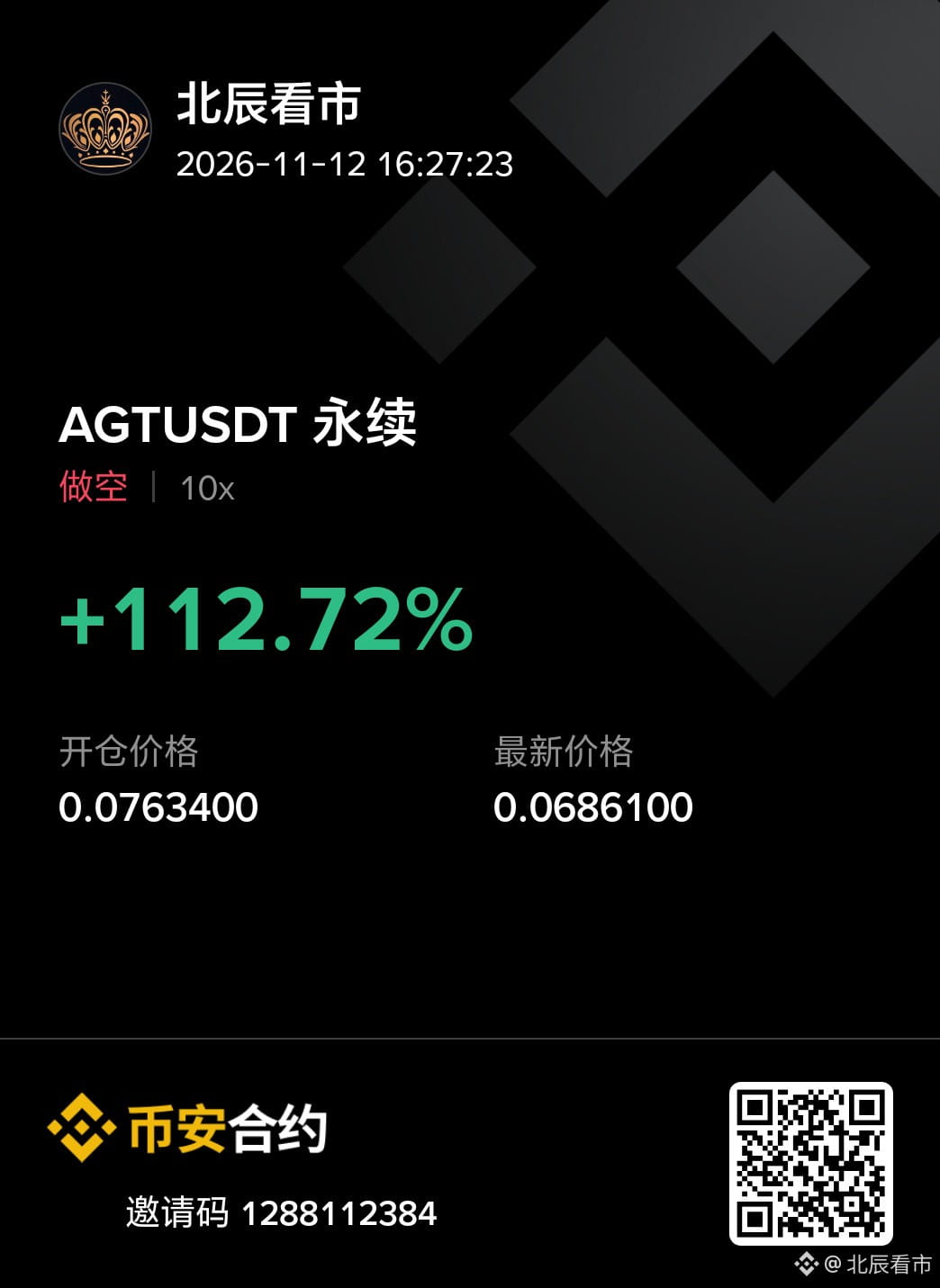
$AGT Two hours, and it dropped straight from the 0.0705 range to 0.0668. Northstar said that if it broke below 0.0700, the next level to watch would be 0.0620. It fell even faster than expected; it’s now at 0.0674, down 19% from its 0.083 peak.
But the real danger isn’t the price drop—it’s that the more it falls, the more open interest increases. Open interest rose from 583 million to 592 million. The price is falling, but positions are growing. There’s only one explanation for this pattern: longs are adding to their positions to lower their average cost. That kind of averaging down is often followed by a cascade of liquidations.
The funding rate is also still positive at +0.0212%, which means longs are still paying shorts. No one has given up yet. When the market truly bottoms, the rate will turn negative.
Here are the key levels. The 0.0705–0.0720 range has now become resistance. 0.0620 is the last meaningful support, and there’s nothing below it: the November 3 candlestick fell straight from 0.0619 to close at 0.0433. There’s almost a vacuum between 0.045 and 0.062, with no concentration of trading volume there. If the price drops into that zone, there won’t be any support.
My trade: I’m holding my short and moving the stop-loss down to 0.0720. If you haven’t entered, you can short a rebound to 0.0700–0.0720, with a stop-loss at 0.0750 and a target of 0.0620. Close half at 0.0620 and let the rest run toward 0.0450. Keep the position size at 10%; don’t add.
#Anthropic拒绝延期IPO,本周路演估值几何? #英伟达Q3财报将至:能否化解市场疑虑?
210
·
--
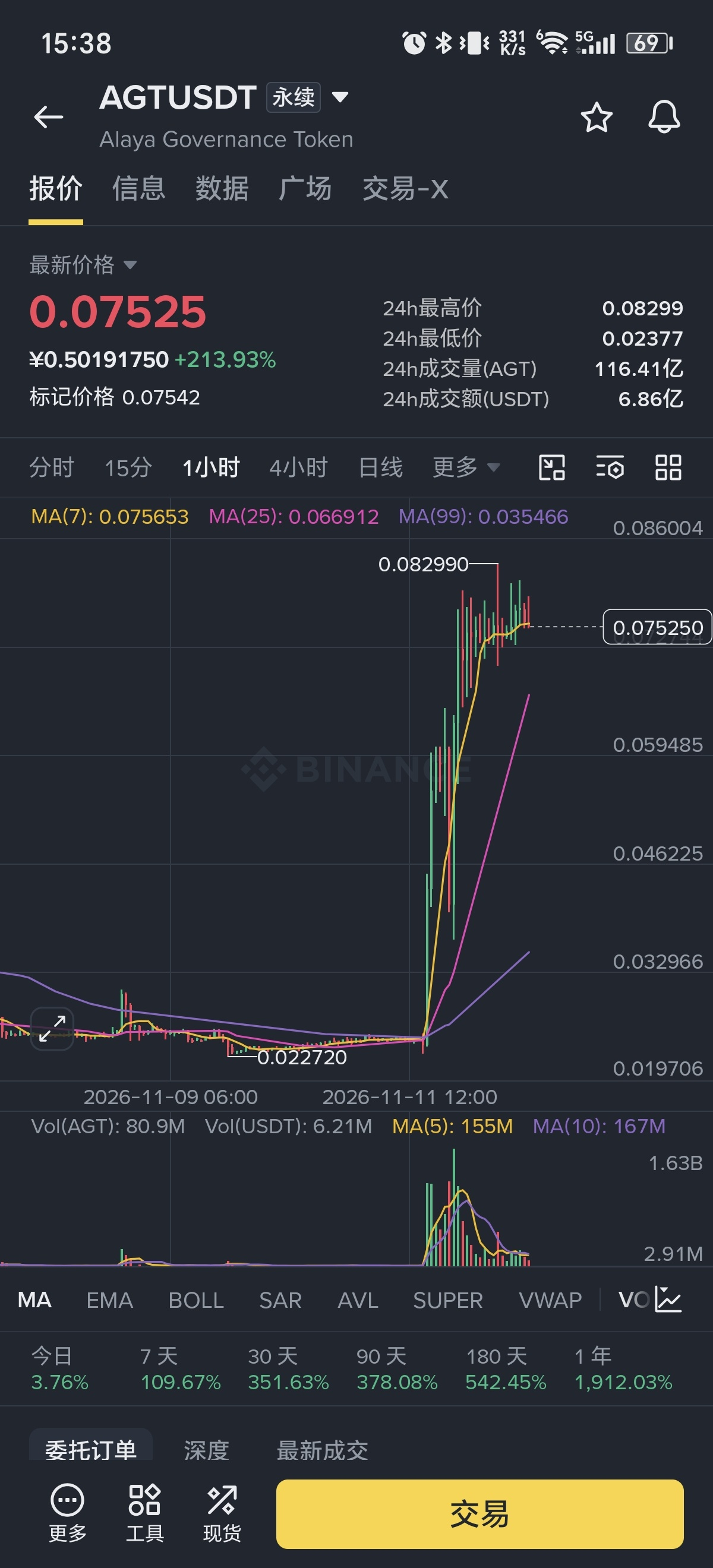
$AGT 0.0247 to 0.083, in one day, a 3.3x gain. In this market move, some people saw their accounts triple, while others had their short positions wiped out in three minutes, without even having time to react.
What really drove this rally was open interest. Open interest surged 789% in 24 hours, while trading volume skyrocketed from just over 5 million to 680 million. Simply put, money suddenly poured in and pushed the price straight up.
But one detail matters: after a 225% rise, the funding rate was only +0.0187%. This suggests that long positions aren't crowded. The rally wasn't driven by highly leveraged longs forcing the price up; instead, shorts were forced to close. Once short covering is over, the next leg up will need fresh money coming in.
The market is now moving sideways near the highs, between 0.0705 and 0.083, while volume has fallen from 576 million to 111 million. On a coin that's already up 3x, a low-volume sideways consolidation like this usually signals distribution, not accumulation.
My bias is bearish, but the position size should be small.
Scale into shorts between 0.0780 and 0.0820, with a stop-loss at 0.0850. First target: 0.0700; if it breaks below that, look to 0.0620. Keep the position size to no more than 10% of your portfolio. If the daily candle closes above 0.083, admit you're wrong and exit immediately—don't hold on.
#黄仁勋再被曝与下属婚外情,或遭董事会罢免 #Anthropic拒绝延期IPO,本周路演估值几何?
210
·
--
Verified
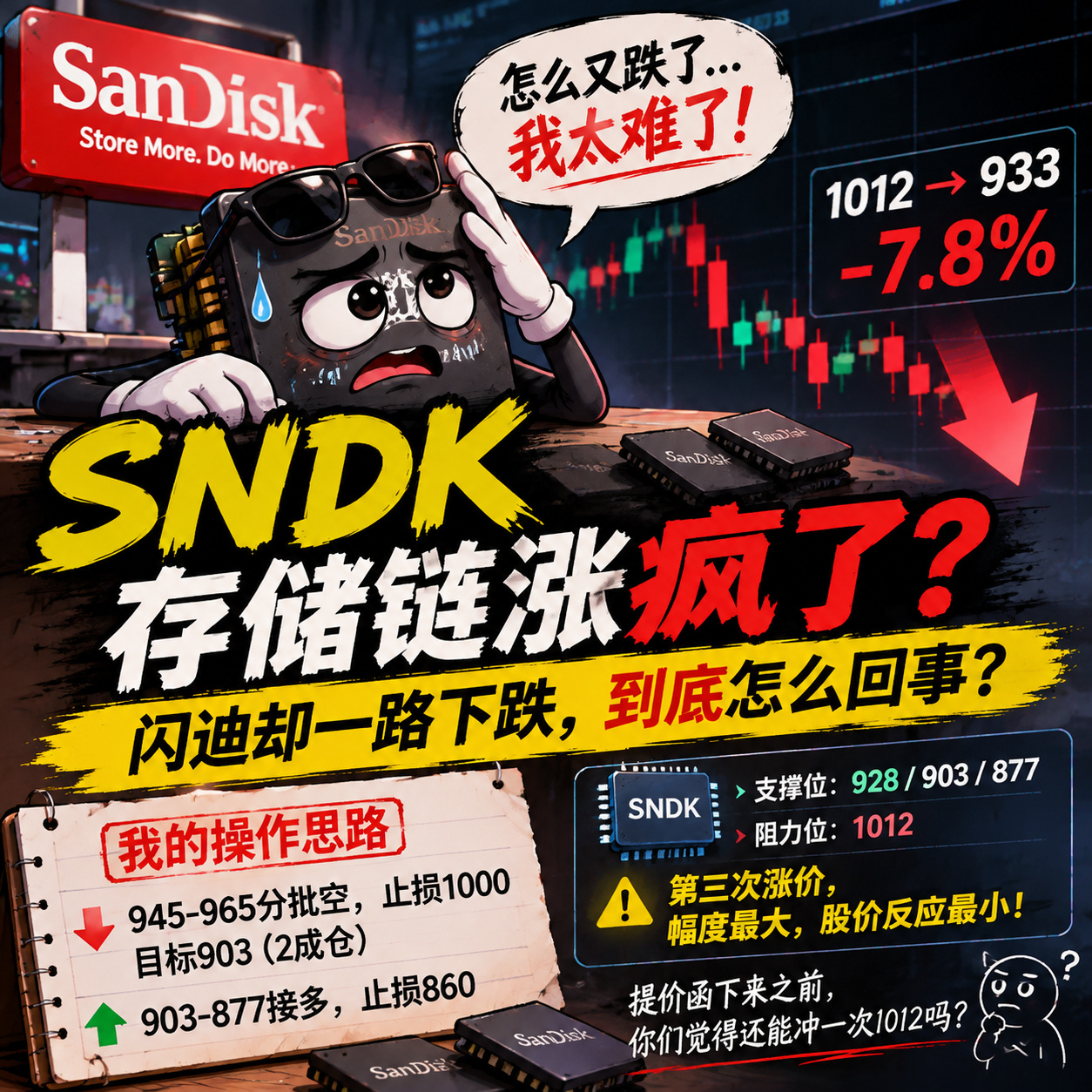
$SNDK A-share storage stocks went crazy today: Xianggang Technology hit the upper limit, and the semiconductor equipment index climbed 6% intraday. Meanwhile, Sandisk on Binance dropped all the way from 1,012 to 933.
A lot of people don’t get it, but it’s actually simple: the news had already been priced in on U.S. markets last night. Sandisk rose 13% overnight, Micron 9%, SK Hynix 8%, and Western Digital 8%. Today’s gains in A-shares are just catch-up moves, while the drop on our side shows that some people are starting to cash out.
And honestly, this round of price hikes feels a bit shaky. November NAND contract prices are up 50%—that sounds huge, and it’s the third increase this year—but so far it’s still only been communicated verbally. No official price-hike notices have been issued yet. Prices have already moved at the channel level, which means the market is counting unsigned contracts as profits. When the notices actually come out, that’ll be the time to sell the news.
I’m not denying the fundamentals: AI data centers consume a lot of storage, wafer capacity can’t be expanded quickly, and institutions are already looking ahead to 2028. So this drop is a pullback; the only question is where you get in.
Here are the levels. The current price is 945, just above the 38.2% retracement level (928) of the move from 794 to 1,012. If it breaks below 928, the next levels are 903, then 877.
My plan: scale into shorts between 945 and 965, with a stop at 1,000 and a target of 903, using 20% of your position. At 903–877, I’ll switch around and go long, with a stop at 860. I’m not chasing a long at the current price, and I’m not guessing whether it can make a new high right away.
The third price hike was the biggest, but the stock price reacted the least. Remember that.
Before the price-hike notices come out, do you think it can make another run at 1,012?
#黄仁勋再被曝与下属婚外情,或遭董事会罢免 #Anthropic拒绝延期IPO,本周路演估值几何? #CoreWeave营收增长168%股价涨10%
1
554
·
--
$NVDA Things have really taken a turn for the worse this time! The Huang Renxun controversy escalates—can Nvidia stay steady?
Nvidia news has been coming one after another these past few days. First, Huang Renxun admitted to an extramarital affair, and then reports surfaced that he had another relationship with a senior executive at the company. More troublingly, the first relationship was also said to be connected to a foreign intelligence investigation, and Nvidia’s board has launched an independent inquiry.
On November 11, media reports added that the board was discussing Huang Renxun’s future at the company. After the news broke, Nvidia shares fell more than 8% at one point in after-hours trading. However, there has been no official confirmation that he will be removed.
In my view, the real risk here isn’t his personal relationships, but the potential fallout involving corporate governance, trade secrets, and chip export controls. Huang Renxun has always been the driving force behind Nvidia. No matter how powerful its AI chips are, that won’t allay the market’s concerns about uncertainty in the company’s leadership.
My short-term view: I’m bearish on the NVDA token. Over the next few days, keep an eye on the results of the board’s investigation, whether Huang Renxun stays on, and whether Nvidia shares can stop falling. Until the news is confirmed, I won’t rush to buy the dip, and I definitely won’t blindly bet against it. If you’re unsure what to do, come chat with us at Beichen Crown House!
#黄仁勋再被曝与下属婚外情,或遭董事会罢免 #英伟达Q3财报将至:能否化解市场疑虑?

181
·
--
Verified
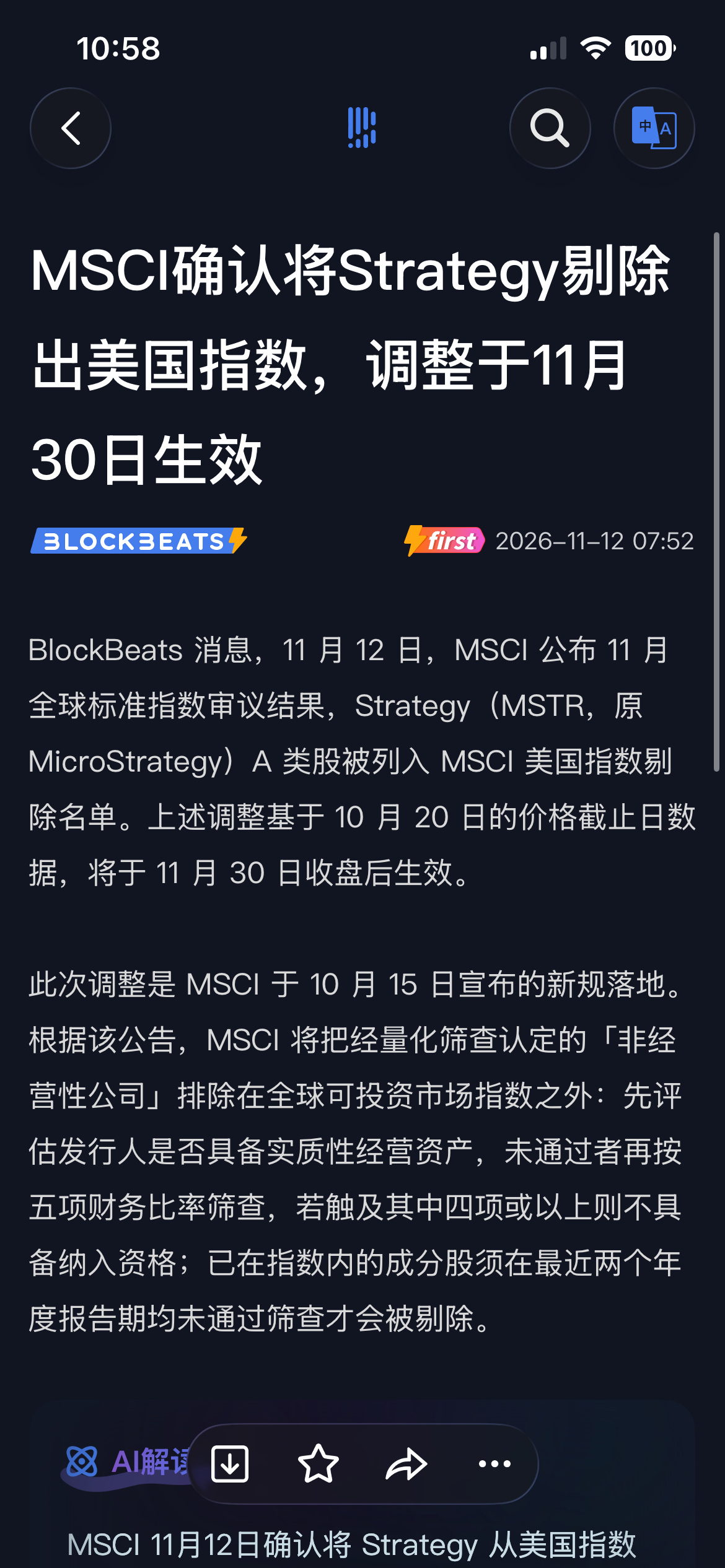
$MSTR Strategy officially removed from MSCI! The institutional investment thesis for BTC faces a test
On November 12, MSCI announced the results of its index review, adding Strategy to the list of constituents to be removed from the MSCI USA Index. The change will take effect after the market closes on November 30. This has three implications:
First, passive funds tracking the relevant index may need to sell MSTR, putting short-term pressure on its share price.
Second, the real concern is whether other index providers will follow suit. If similar rules are applied more broadly, Strategy may find it harder to attract institutional capital in the future.
Third, will Strategy sell its BTC? We shouldn't interpret it that way for now. Funds would be selling MSTR shares, not directly selling the BTC it holds. But the impact on its share price and ability to raise capital could make it harder to continue raising funds to buy coins in the future.
My view: clearly bearish on MSTR in the short term, and indirectly bearish on BTC.
What we should really be alert to this time is not Strategy immediately dumping its BTC, but the new pressure facing its business model of continuously buying coins by raising funds in the capital markets.
Next, keep a close eye on the change taking effect on November 30 and whether other index providers follow suit.
#黄仁勋再被曝与下属婚外情,或遭董事会罢免 #Anthropic拒绝延期IPO,本周路演估值几何? #英伟达Q3财报将至:能否化解市场疑虑?
126
·
--
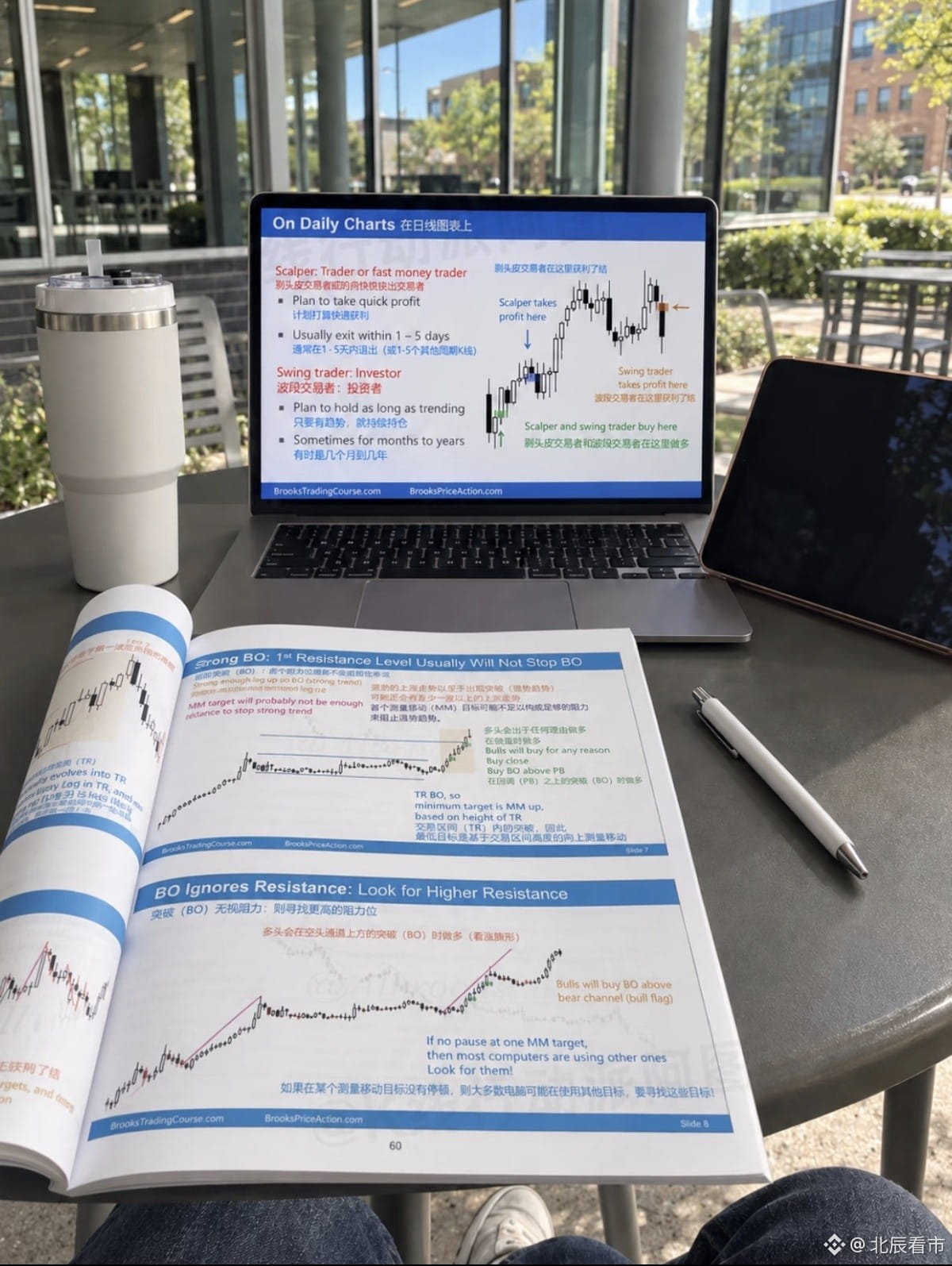
I'm increasingly convinced that the real opportunities in the next crypto cycle won't necessarily come from the projects with the best stories.
Over the past few years, the market has seen far too many hype waves. $ETH
DeFi, NFTs, GameFi, AI, Meme coins—whenever a new trend takes off, some people make a fortune, while others are left buying at the top.
But there's a question worth thinking about: $ERA
When the hype dies down, what will still be here?
I think there are three areas worth keeping a close eye on:
First, real-world applications. Are there actual users? Can they generate sustained demand? $NEAR
Second, infrastructure. Can it solve problems with speed, cost, liquidity, and security?
Third, access to capital. Can more mature connections be built between traditional finance, institutional funds, and on-chain assets?
Of course, a promising sector doesn't mean every token in it is worth investing in.
A project's development and its token's ability to capture value are two different things.
Don't just ask what the next big trend will be; look deeper into what truly remains after the hype.
There will always be new stories in the market, but what really stands the test of time usually takes time to prove itself.
#英伟达Q3财报将至:能否化解市场疑虑? #Anthropic拒绝延期IPO,本周路演估值几何? #Strategy或遭MSCI剔除,面临最高28亿美元卖盘
560
·
--
An altcoin rarely gives you advance warning before it really takes off.
$INIT
But some changes are worth keeping an eye on.
Here are a few things I personally watch:
1. The price moves sideways, but trading volume starts to recover gradually.
2. The price retests key support levels several times without breaking down significantly.
$ZEC
3. Spot buying picks up, rather than the price being driven up purely by futures trading.
4. Open interest increases moderately, without excessive leverage crowding in.
5. Selling pressure near key resistance levels is gradually absorbed.
Of course, these signals alone don’t prove that major players are accumulating, let alone guarantee that the price will rise.
$BTC
But if several of these conditions appear at once, it’s worth adding the coin to your watchlist.
What I like least is waiting until a coin is already up 50% before asking everyone why it’s going up.
Real research should happen before a rally takes off—not after everyone has already noticed.
When you’re choosing altcoins, what do you look at first: capital flows, technicals, or the project’s fundamentals?
#CPI高于预期,美股与BTC再度承压 #Strategy或遭MSCI剔除,面临最高28亿美元卖盘 #Anthropic拒绝延期IPO,本周路演估值几何?

885
·
--
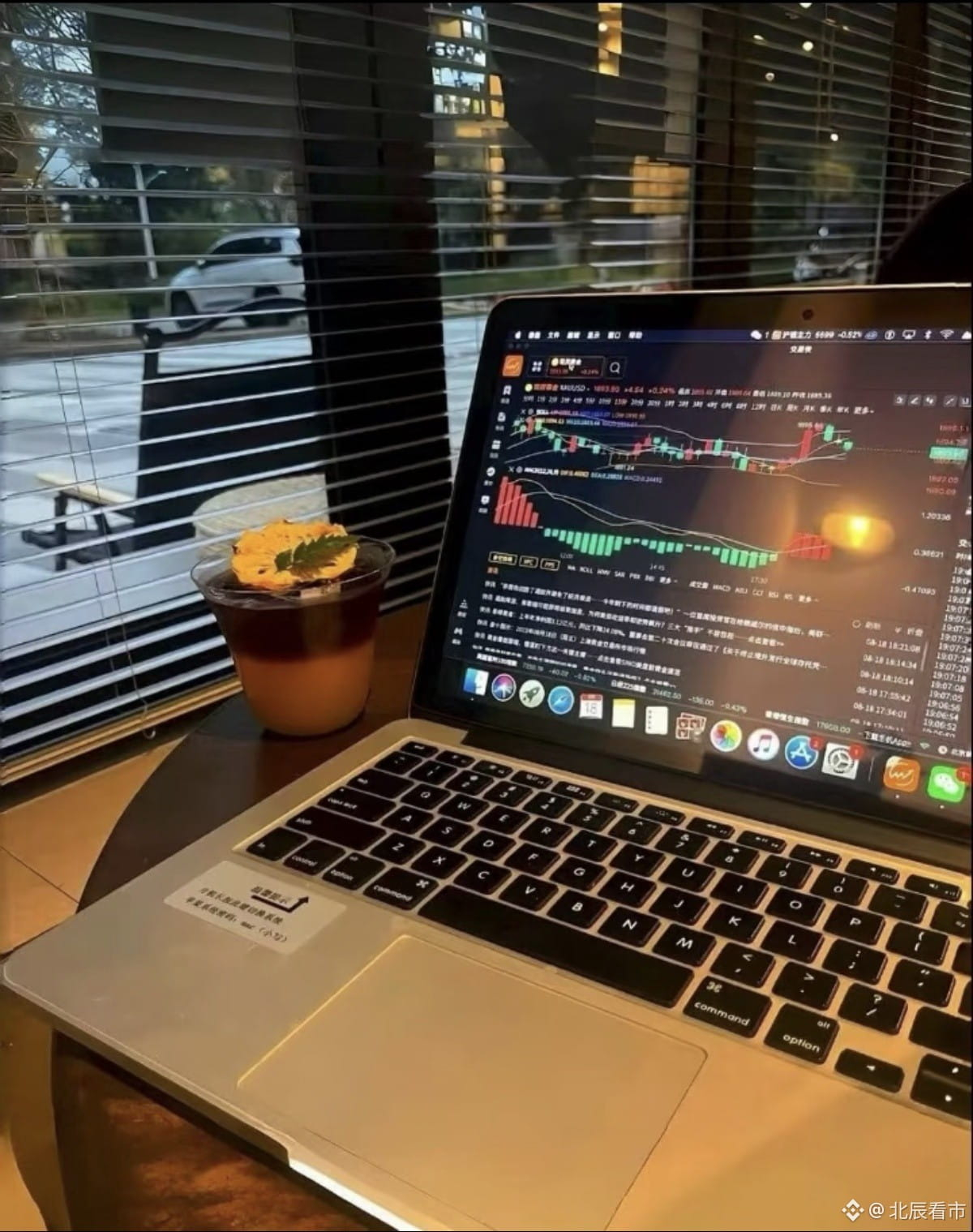
If you’ve just entered the crypto market, I sincerely recommend not rushing into highly leveraged futures. $SKHYNIX
It’s not that futures can’t make money, but they amplify all your weaknesses.
If you’re already prone to chasing rallies and selling in a panic, leverage will make you even more nervous.
If you’re already reluctant to cut your losses, leverage will make you pay the price sooner. $SNDK
If you already like trading frequently, leverage will make you feel that every price fluctuation is an opportunity.
In the end, it turns into this: $SNDK
You haven’t even figured out the market, and your position is already too much to handle.
I’ve always believed that the first things beginners should learn are how spot trading works, how to read candlestick charts, and how to understand trading volume and capital flows.
Once you really understand why prices rise and fall, then you can study futures funding rates, open interest, and liquidation mechanisms.
Don’t try to run a 100-meter sprint before you’ve learned to walk.
In the crypto market, staying in the game is always more important than getting rich overnight.
#CPI高于预期,美股与BTC再度承压 #Anthropic拒绝延期IPO,本周路演估值几何? #英伟达Q3财报将至:能否化解市场疑虑?
1
2
774
·
--
I’ve met quite a few traders who were actually pretty good at analysis, but still ended up failing to make money.
There was one person who really stuck with me. $KORU
Every day, he studied macroeconomic data, ETF fund flows, and the movements of on-chain whales. He was even more diligent than many professional analysts.
But he had one problem:
After every market analysis, he always felt he had to do something. $SOL
When he was bullish, he went long; when he was bearish, he went short. Even when the market was moving sideways, he still looked for opportunities.
After a month, he’d been right about the direction plenty of times, but his account balance kept shrinking.
Later, I realized something:
Being able to analyze doesn’t mean you know how to trade.
Analysis addresses where the market might go. Trading is about when to enter, how much risk to take, and when to exit. $ERA
These are two completely different skills.
That’s why I now value trade execution more than how many times a day someone predicts the market.
Turning one sound judgment into a well-planned trade is more valuable than sharing ten opinions every day.
#CPI高于预期,美股与BTC再度承压 #Anthropic拒绝延期IPO,本周路演估值几何? #英伟达Q3财报将至:能否化解市场疑虑?
1
753
·
--
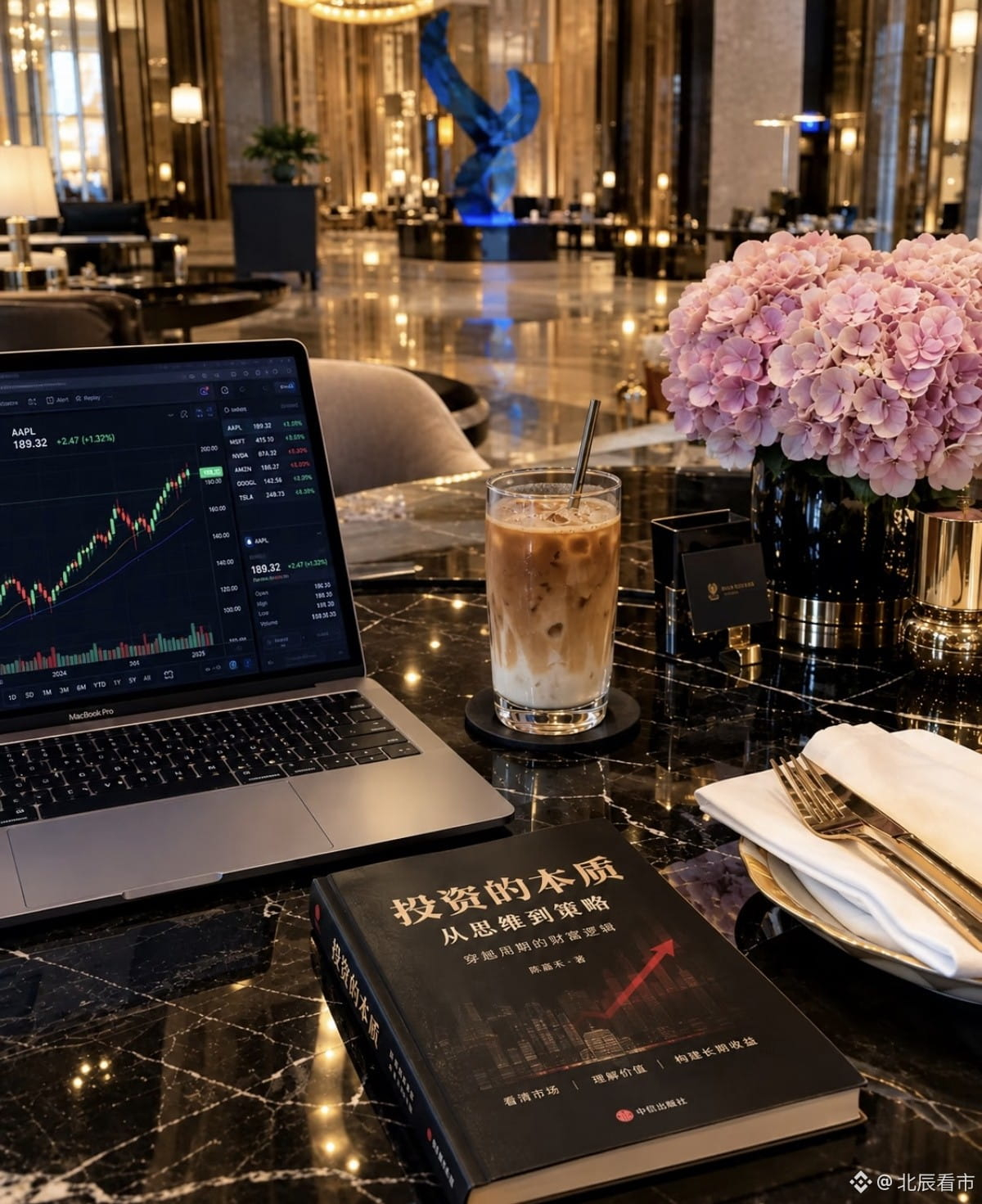
There’s a phenomenon in crypto that I think many beginners never truly understand: good news comes out, but the price drops instead.
Why does this happen?$SPCX
Because markets trade not just on the news itself, but also on expectations.
Here’s a simple example.
A project is about to announce a major partnership. Before the news comes out, investors have already bought in, and the price has risen quite a bit. $ZEC
Once the official announcement is made and everyone knows about it, those who bought in early may see it as a chance to take profits.
That’s what people mean by “selling the news.”
So when I follow the news, I pay close attention to three points in time:
Did the price move unusually before the news was announced?
Did trading volume and fund flows change significantly on the day of the announcement?
After the news came out, could the price keep rising?
Truly valuable good news doesn’t just make the price shoot up in a single green candle—it continues to attract capital. $NEAR
The next time you see major news, don’t rush to ask whether it’s bullish or bearish.
First ask yourself: Did the market already know about it?
#CPI高于预期,美股与BTC再度承压 #Anthropic拒绝延期IPO,本周路演估值几何? #Anthropic拒绝延期IPO,本周路演估值几何?
765
·
--
A bull market can easily create an illusion: everyone thinks they’re a trading genius. $ETH
Buy any coin, and it might go up.
Open any long position, and you might make money.
So some people start using leverage, some borrow money to get in, and others think they’ve already cracked the code to wealth.
But the real question is:
If the market turns, can you still maintain the same ability to make profits?
I’ve always felt that you can’t judge a trader’s skill just by how much they made in a bull market. $SKHYNIX
You also have to see whether they can control drawdowns in a choppy market and protect their capital in a bear market.
A bull market tests whether you can seize opportunities; a bear market tests whether you can survive. $BTC
Don’t overestimate yourself when the market is doing well, and don’t lose faith in yourself when it’s doing poorly.
Those who make it to the end are often not the ones who make money the fastest, but the ones who know best how to manage risk.
#CPI高于预期,美股与BTC再度承压 #Anthropic拒绝延期IPO,本周路演估值几何? #英伟达Q3财报将至:能否化解市场疑虑?

501
·
--
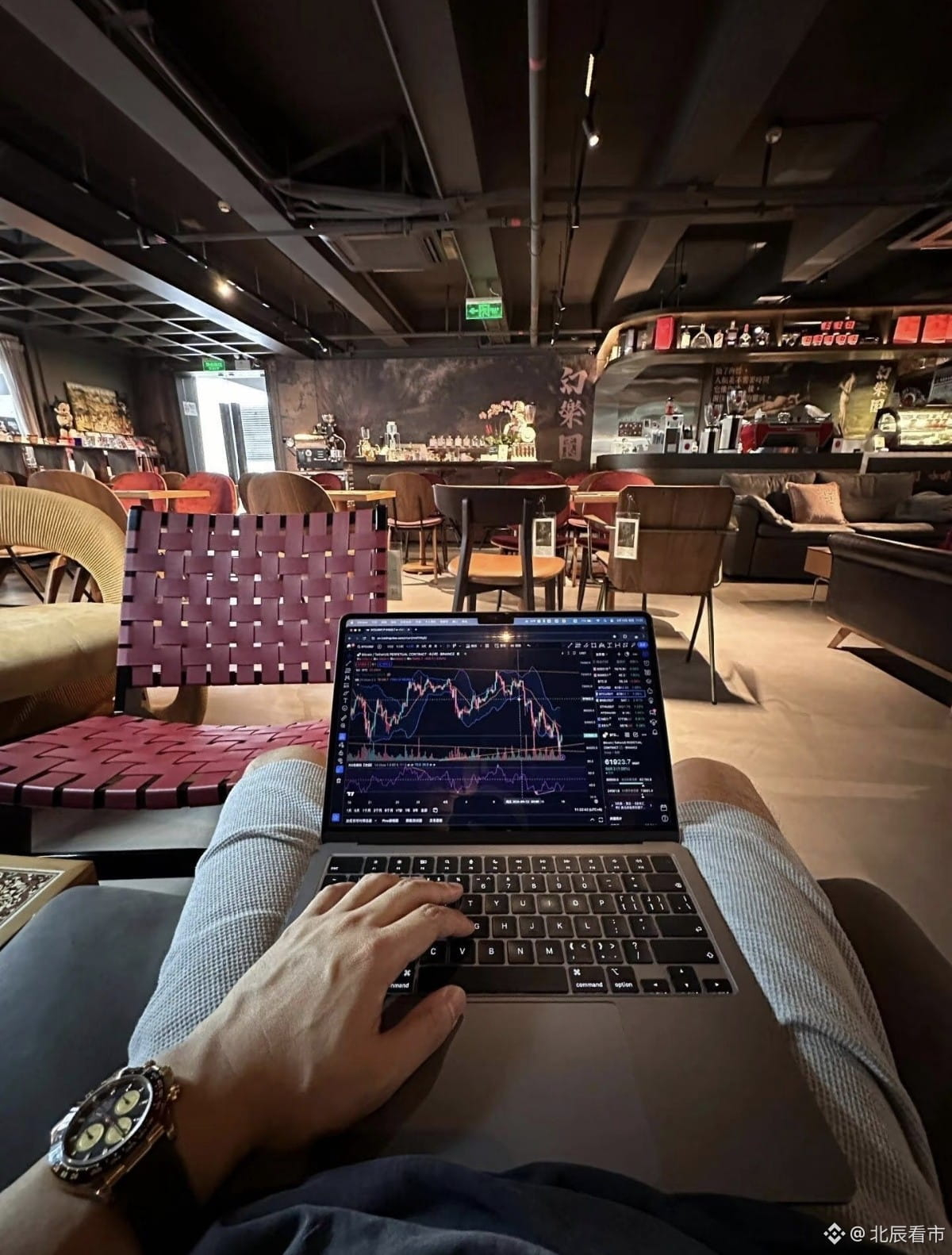
The livelier the market gets, the more I like to observe; the more panicked the market gets, the more I like to study it. $INIT
This isn’t an encouragement for everyone to blindly buy the dip.
It’s because extreme emotions often cause the market to reveal information that’s usually hidden.
For example, when prices suddenly plunge:
Is there a sustained outflow of spot assets?
Is contract OI falling rapidly? $SNDK
After large-scale liquidations, is there buying support for the price?
Has the funding rate become extremely bearish?
Only by looking at all these data points together can we judge whether this downturn is a normal correction or a leveraged liquidation cascade. $SKHYNIX
I’ve seen too many people desperately turn bullish when the market rises, then suddenly become staunch bears when it falls.
But the moments truly worth studying are precisely when market opinion is most unanimous.
When everyone thinks one direction is a foregone conclusion, I instead look for evidence to the contrary.
Trading doesn’t require going against the crowd, but you must have your own judgment.
#Strategy或遭MSCI剔除,面临最高28亿美元卖盘 #Anthropic拒绝延期IPO,本周路演估值几何? #英伟达Q3财报将至:能否化解市场疑虑?
160
·
--
Every day in crypto, people look for 100x coins, but I care more about one question: what justifies this coin going up 100x?$ONE
A project having a story doesn’t mean it has value.
A project having technology doesn’t mean there’s demand for it.
A project having a small market cap doesn’t mean it’s bound to have room to grow.
When I research altcoins, I usually look at a few things first:$INIT
First, what problem does the project actually solve, and does it have real users?
Second, how big is the gap between its circulating market cap and fully diluted valuation, and how much token-unlock pressure is still ahead?
Third, are the holdings of the top ten addresses concentrated, and is there an obvious risk of selling pressure?$JCT
Fourth, is there enough market depth for incoming funds to actually drive the price up?
Many people focus only on whether the market cap is small, while overlooking the tokenomics.
What’s truly worth researching isn’t a coin that’s cheap now, but a project that could generate sustained demand in the future.
Anyone can tell a 100x story. What really matters is whether they can deliver on it.
#CPI高于预期,美股与BTC再度承压 #Strategy或遭MSCI剔除,面临最高28亿美元卖盘 #Anthropic拒绝延期IPO,本周路演估值几何?
477
·
--
If I were a major player, the people I’d most like to prey on wouldn’t be those with poor technical skills, but those who think they’re clever.
$BTC
Why?
Because these people are especially easy to let their emotions control them.
When prices rise, they think they’ve spotted an opportunity and jump in.
When prices fall, they think they’ve figured out the big players’ shakeout and keep adding to their positions.
$AKE
At the slightest rebound, they start fantasizing about a new bull market.
What the big players may really need to do is create a little volatility, and retail traders with different emotional reactions will make the wrong choices all by themselves.
That’s why I never look at prices alone when I study the market.
$ETH
I also look at trading volume, changes in open interest, funding rates, and whether there’s genuine buying support when prices rise.
Prices can be deceptive, but changes in money flows and positions often provide more clues.
Remember this: don’t always try to guess what the big players will do next. First, ask yourself whether you’re already in the easiest position to be preyed on.
613
·
--
The strangest thing about crypto is: when losing money, you hold on more firmly than anyone; when making money, you run faster than anyone else.$BTC .
You buy a coin, and it drops 10%—you tell yourself you’re bullish in the long term.
It drops 20%, and you start researching the project’s fundamentals.
It drops 30%, and you even think this is a chance to buy the dip offered by the big players.$ETH
But as soon as it rises 5%, you immediately start agonizing over whether to sell.
Why?
Because most people fantasize about their losses but have no patience with their profits.
I used to be the same: I’d want to cash out after making a few hundred U, but when down a few thousand U, I’d always hope to break even.$SNDK
Only later did I realize that trading isn’t just about looking at your account’s unrealized gains and losses—you also have to ask whether the original rationale has changed.
Being able to hold when you should, and get out when you should—that’s what real trading skill looks like.
Have you noticed that you, too, often hold on through losses but can’t hold on to profits?
#CPI高于预期,美股与BTC再度承压 #Strategy或遭MSCI剔除,面临最高28亿美元卖盘 #Anthropic拒绝延期IPO,本周路演估值几何?

649
·
--
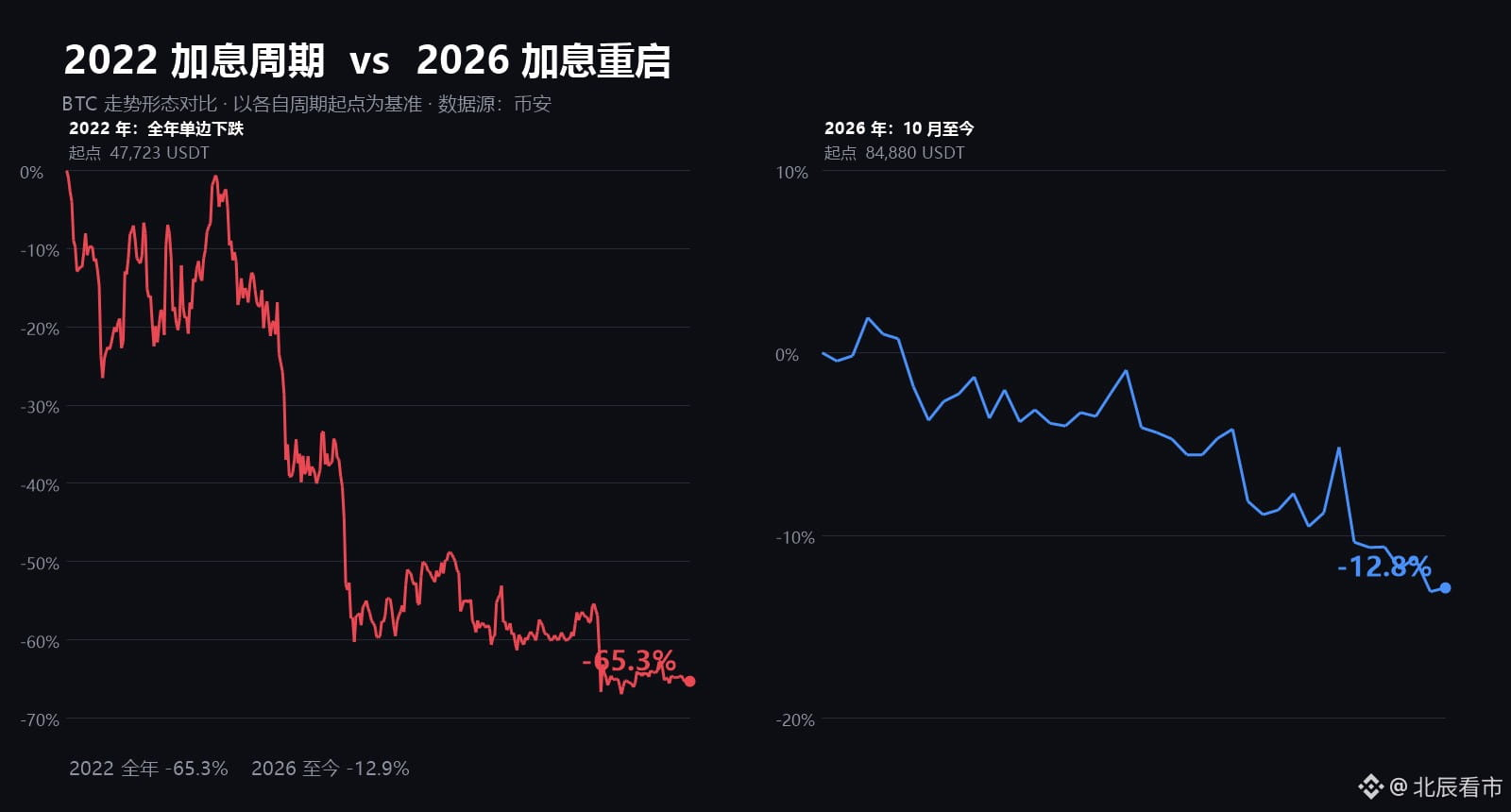
$BTC Rate hikes are back on. Will 2022 happen all over again?
The short answer: We won’t see a repeat of the 2022-style crash, but the pattern will look similar—a slow bleed, weak rebounds, and each high lower than the last.
First, here’s what’s similar.
A 25-basis-point rate hike in December is fully priced in, and the odds of a 50-basis-point hike are also rising. The last time we saw expectations flip from rate cuts to rate hikes was early 2022. That year, the Fed started hiking in March, raising rates by 425 basis points over the year. Bitcoin fell from 69,000 to 15,400—a 78% drop.
The market’s position is similar now, too: BTC fell from 81,196 to 72,727, down 10%; ETH broke below 2,100, and altcoins have broadly been cut in half.
But three things are different.
First, the starting point. In 2022, rates were going up from zero—that meant withdrawing “free money” and recalculating every valuation model. Now, policy is tightening again after a pause, and a 25-basis-point hike has a much smaller impact.
Second, the leverage structure. In 2022, there was a chain reaction: LUNA in May, Three Arrows in June, and FTX in November. This time, the market already went through a washout when Binance was hacked; the players that were going to blow up have already done so.
Third, the buyers. In 2022, there were no spot ETFs, so nobody stepped in to buy the dip. There are ETFs now. Although they’re seeing outflows, they act as a cushion, not an amplifier.
So my view is: this time it’s a slow knife, not a guillotine.
BTC will most likely grind between 72,700 and 75,600 until the December rate decision. If it breaks below 72,727, watch 70,000; only a hold above 75,600 would put a rebound in play. I’d sit out this stretch and wait for a breakdown or a breakout.
#CPI高于预期,美股与BTC再度承压 #Anthropic拒绝延期IPO,本周路演估值几何?
4
176
·
--
$AGT Up 128% in a single day today—what’s next?
AGT surged from 0.02302 to 0.05988 today, up 128.69%. It’s now around 0.056, and I couldn’t find any clear news to explain the rise. A sharp rally without any news usually comes down to one of two things: the project team is pumping the price, or traders are making a short-term play.
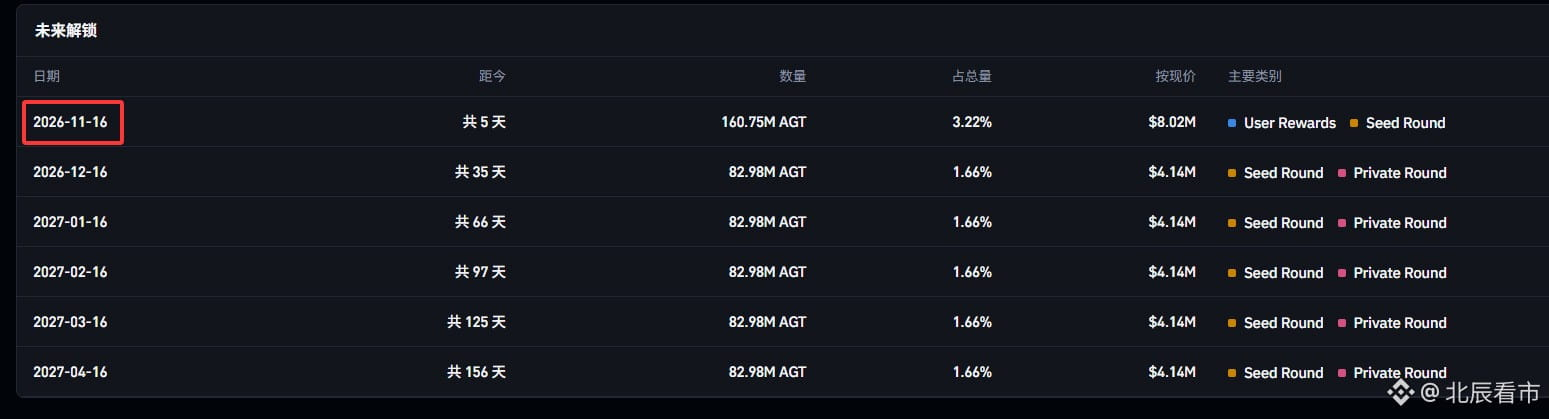
But one thing is certain: 160.75 million tokens will be unlocked on November 16. At the current price of 0.056, that batch is worth $9 million. And another 1.61 billion tokens are still waiting to be unlocked—32.2% of the total supply—with two unlocks in a single month.
That’s the contradiction. The higher the price climbs, the greater the selling pressure when the tokens unlock on the 16th. Because the first thing people do when they get tokens is sell. So this rally looks more like the final leg of the market run-up before the unlock.
Personally, Beichen thinks there may still be room for another surge before the 16th, but the closer we get to that date, the greater the risk. So we’re not chasing longs in the short term. A coin that’s up 128% in a day can easily see a 30% wick. If you want to short, wait for 0.06, set a stop-loss at 0.066, and target 0.045 first, then 0.035. The trend won’t count as reversed until it breaks below 0.045.
#CPI高于预期,美股与BTC再度承压 #Anthropic拒绝延期IPO,本周路演估值几何? #比特币连续五周下跌
1
390
·
--
$SNDK Up 11% in one day? Beichen chooses to short at this level!
Why am I willing to short it?
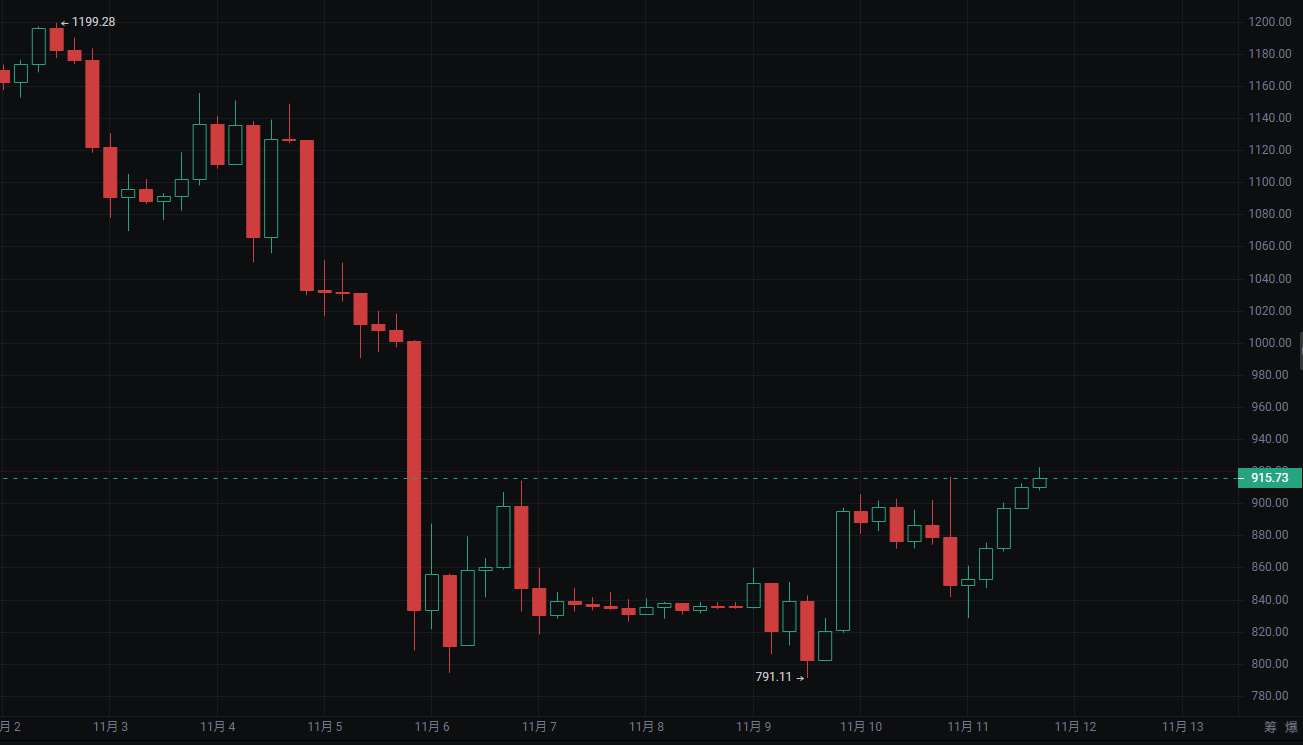
SanDisk rose from 827.77 to 921.50 today, up 11.3% in a single day. That’s an extreme move, even for the storage sector.
More importantly, look at where it is. Just above 921.50 is the crash zone from October 28 to November 4. That week, it plunged from 1,154 to 794. The entire 850-to-1,030 range is full of trapped holders. Now that the price has rebounded, their first instinct will be to get out.
Also, this rally is a technical rebound after an oversold decline. SanDisk fell 43%, from 1,388 to 794, so an 11% rebound is reasonable. But the fundamentals haven’t changed: concerns that the storage cycle has peaked remain, and institutions are reducing their holdings.
So my view is that this rally should stall near 950.
Trade plan:
Short in batches at 918–925, with a stop-loss at 940. First target: 880; second target: 858. Keep the position size to one-third of your usual amount.
Why set the stop-loss at 940? If it breaks above 940, that means this is more than just a rebound—it’s heading to fill the gap at 1,030. At that point, you have to admit the short trade was wrong!
#CPI高于预期,美股与BTC再度承压
2
494
·
--
Verified
$SPCX Today, a brother asked me what I thought of this rocket. It looks really strong—while the broader market has fallen so much, it’s still going up!
There are actually two main reasons the rocket has been gaining strength recently:
The first was something Elon Musk said at the Baron Investment Conference on November 6: SpaceX’s fourth-quarter revenue is expected to grow by about 70% quarter over quarter, putting its annualized revenue this quarter on track to exceed $100 billion.
Why does that carry so much weight? Look at its third-quarter figures: revenue was $14.6 billion, up 161% year over year, with annualized revenue already close to $60 billion. Now it’s targeting $100 billion, effectively telling the market that next year’s revenue will be even higher than the figure in last month’s earnings report. Wall Street acted that very day: the stock rose 8.62%, and institutional investors revised their valuation models overnight.
The second piece of news is Starship’s 15th flight, which will attempt a “double catch.”
It might sound like a tech demo, but it’s really about costs. If rockets can be reused, launch costs come down. Lower costs mean Starlink can be deployed faster, and commercial launch prices can be undercut. Musk himself said success was “more likely than not,” while a research report called it “the most important catalyst in more than 20 years.”
One piece of news boosts revenue; the other cuts costs. With both improving, valuations can only move higher. That’s why it’s been so strong recently. As for trading, you could wait for a pullback to 141–142 to enter a small long position, with a stop-loss at 137 and a target of 150. If the double catch fails and it falls below 137.07, reverse your position and target 130!
#SPCX
#CPI高于预期,美股与BTC再度承压

4
243
Log in to explore more content
Join global crypto users on Binance Square
⚡️ Get latest and useful information about crypto.
💬 Trusted by the world’s largest crypto exchange.
👍 Discover real insights from verified creators.
Email / Phone number
Trending Topics
HuangRisksOusterOverReportedAffairWithSubordinate
35,208 views
563 Discussing
Nvidia Board Meets to Decide Jensen Huang's Future as Crisis Deepens
Binance News
·28 Likes
·33.6k views
AnthropicRejectsIPODelayValuationinQuestion
482,149 views
3,988 Discussing
CoreWeaveJumps10%On168%RevenueGrowth
71,220 views
927 Discussing