
辣条味奶糖
63 Posts

辣条味奶糖
197 Following
6.1K+ Followers
779 Liked
Posts
Last night’s U.S. stocks signal to watch most: stocks are up, but it’s driven by a small group.
All three major indexes rose, with the Nasdaq leading up 0.66%. When you break it down, the real movers were $NVDA +2.19% and $META +1.97%. On the other hand, the three heavyweights $AAPL, $AMZN, and $GOOG edged lower. The money didn’t spread out—it all got pushed back into AI compute and cloud.
$NVDA is the strongest. It opened with a gap up of more than a point, held near the intraday high all day, and closed at 213—just short of the high of 214.73. Volume also expanded. This kind of gap-up-and-rally pattern suggests proactive buying; it wasn’t a late “paper pull.” Next, the key is whether it can hold above 210. The intraday low at 210.11 is the line in the sand.
meta isn’t weak either—up 1.97% to close at 570, clinging to the intraday high. Within big-tech in the broader market, it’s the second strongest. The ads business base is steady, and the market is still buying the AI story. If 570 can hold, the narrative can continue.
$MSFT is the most interesting. It opened lower but recovered. At the open it was still slightly down at 485, then flipped green into the close, ending at 491.71—just one step from the high at 492.44. Among the three it’s the most sluggish, but late in the day there’s clearly capital stepping in to add. The question is whether it can break above 492 with volume.
Next, you should focus more on breadth. Right now, the index is being propped up by a few heavyweights, while $AAPL, $AMZN, and $GOOG are still lagging. This is reshuffling within existing positions; there’s no real pickup in incremental demand. If the indexes keep moving higher but those consumption-tech names just stay pinned, then this is still a structural rally—not broad-based “everything up.”
In A-shares today, stocks opened lower and then rallied. The Shanghai Composite is +0.70% after touching 3917, and the Shenzhen Component is +1.20%. Hang Seng is +0.68%—no extreme action. On the crypto side, BTC is around 79,000 down 1.59%, and ETH down 1.11%, not keeping pace with U.S. markets—still weak.
The above is not investment advice—just a record of market observations.
All three major indexes rose, with the Nasdaq leading up 0.66%. When you break it down, the real movers were $NVDA +2.19% and $META +1.97%. On the other hand, the three heavyweights $AAPL, $AMZN, and $GOOG edged lower. The money didn’t spread out—it all got pushed back into AI compute and cloud.
$NVDA is the strongest. It opened with a gap up of more than a point, held near the intraday high all day, and closed at 213—just short of the high of 214.73. Volume also expanded. This kind of gap-up-and-rally pattern suggests proactive buying; it wasn’t a late “paper pull.” Next, the key is whether it can hold above 210. The intraday low at 210.11 is the line in the sand.
meta isn’t weak either—up 1.97% to close at 570, clinging to the intraday high. Within big-tech in the broader market, it’s the second strongest. The ads business base is steady, and the market is still buying the AI story. If 570 can hold, the narrative can continue.
$MSFT is the most interesting. It opened lower but recovered. At the open it was still slightly down at 485, then flipped green into the close, ending at 491.71—just one step from the high at 492.44. Among the three it’s the most sluggish, but late in the day there’s clearly capital stepping in to add. The question is whether it can break above 492 with volume.
Next, you should focus more on breadth. Right now, the index is being propped up by a few heavyweights, while $AAPL, $AMZN, and $GOOG are still lagging. This is reshuffling within existing positions; there’s no real pickup in incremental demand. If the indexes keep moving higher but those consumption-tech names just stay pinned, then this is still a structural rally—not broad-based “everything up.”
In A-shares today, stocks opened lower and then rallied. The Shanghai Composite is +0.70% after touching 3917, and the Shenzhen Component is +1.20%. Hang Seng is +0.68%—no extreme action. On the crypto side, BTC is around 79,000 down 1.59%, and ETH down 1.11%, not keeping pace with U.S. markets—still weak.
The above is not investment advice—just a record of market observations.
Last night in the U.S. stock market, chip stocks kept falling, while gold miners kept rising. $NVDA fell 2.9%, $AMD fell 3.5%, and the top of the gainers list was all gold mining companies.
The broader market was clearly split. The Dow rose 0.26%, the Nasdaq fell 0.76%, and the S&P 500 fell 0.28%. Tech is giving back gains; the VIX is only 15.85—still not in a panic zone.
$ETSY surged 7.4%, closing at $87. The earnings beat. The company is cutting jobs while also buying back shares, and BofA conveniently raised its target price. With earnings holding up, costs being cut, and cash returned to shareholders—this combination is actually becoming more appealing right now.
Gold small-cap miners led the way. $SA rose 9.5%, $NG rose 7.2%. Gold itself was up only 0.36%, so this is mainly smaller miners playing catch-up. Also, $SA’s KSM project is still in the approval wrangling with Indigenous communities—don’t just chase the rally.
$SNAP rose 5.5%, while Reddit fell. Social media stocks are starting to split; where ad budgets go is key. Snap and Meta are moving along one line, while Reddit and Pinterest are moving along another—both sides are behaving differently now.
In Shanghai, the SSE Composite (3,876) fell 0.14%, and Hang Seng (25,438) fell 0.31%—both are churning without any extreme moves. In crypto, BTC is up 4.2% over the past 24 hours, touching above $80k, while ETH is only up 1.9%, clearly not keeping up.
Next, take a look at Williams-Sonoma’s Q2 earnings. Whether consumers still have strength—that’s the question. It has already turned in its report.
The above does not constitute investment advice; it’s only a record of market observations.
The broader market was clearly split. The Dow rose 0.26%, the Nasdaq fell 0.76%, and the S&P 500 fell 0.28%. Tech is giving back gains; the VIX is only 15.85—still not in a panic zone.
$ETSY surged 7.4%, closing at $87. The earnings beat. The company is cutting jobs while also buying back shares, and BofA conveniently raised its target price. With earnings holding up, costs being cut, and cash returned to shareholders—this combination is actually becoming more appealing right now.
Gold small-cap miners led the way. $SA rose 9.5%, $NG rose 7.2%. Gold itself was up only 0.36%, so this is mainly smaller miners playing catch-up. Also, $SA’s KSM project is still in the approval wrangling with Indigenous communities—don’t just chase the rally.
$SNAP rose 5.5%, while Reddit fell. Social media stocks are starting to split; where ad budgets go is key. Snap and Meta are moving along one line, while Reddit and Pinterest are moving along another—both sides are behaving differently now.
In Shanghai, the SSE Composite (3,876) fell 0.14%, and Hang Seng (25,438) fell 0.31%—both are churning without any extreme moves. In crypto, BTC is up 4.2% over the past 24 hours, touching above $80k, while ETH is only up 1.9%, clearly not keeping up.
Next, take a look at Williams-Sonoma’s Q2 earnings. Whether consumers still have strength—that’s the question. It has already turned in its report.
The above does not constitute investment advice; it’s only a record of market observations.
Partly True
Don’t just focus on the S&P 500 and the Nasdaq.
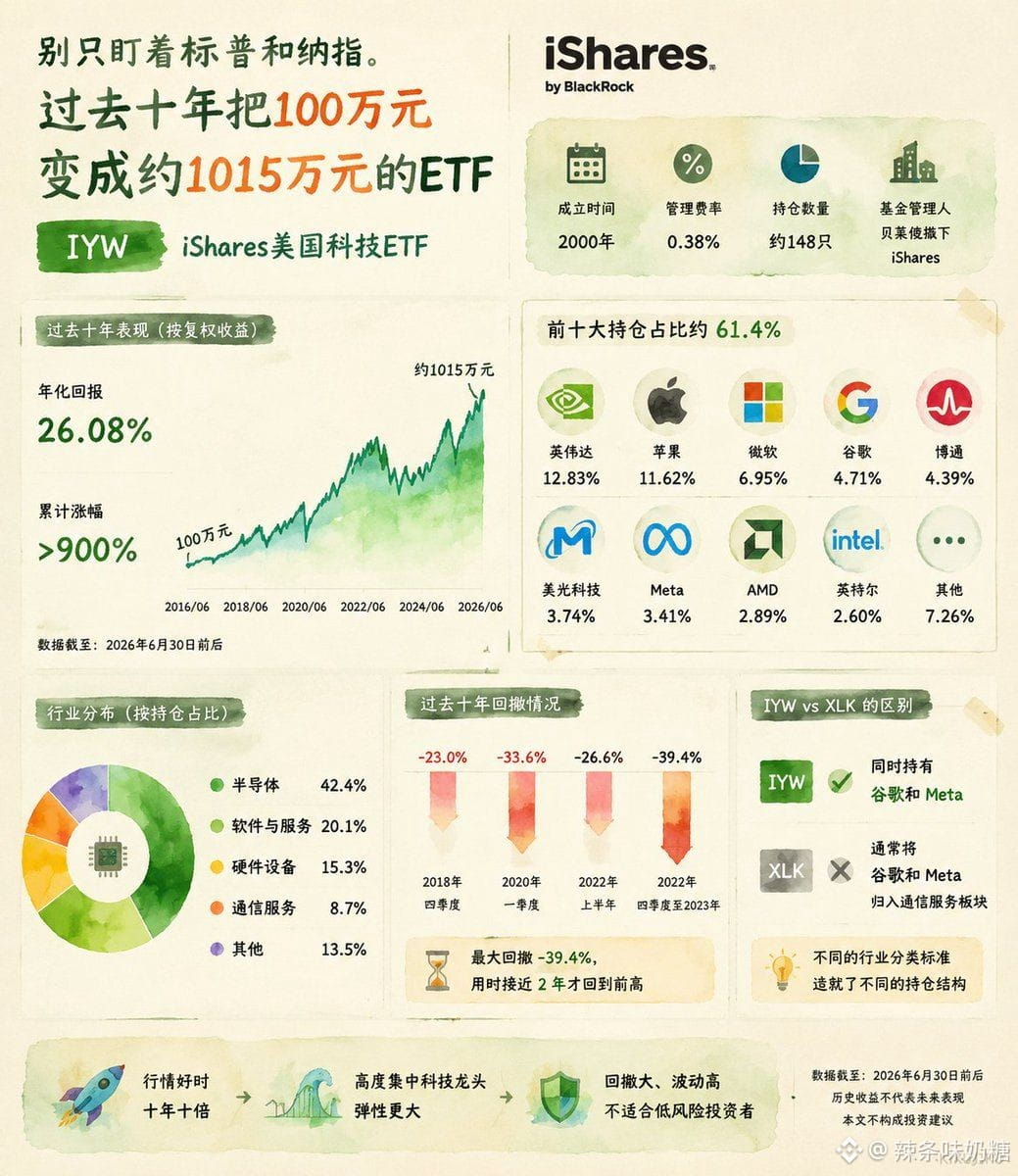
In addition, there’s another U.S. ETF. Over the past decade, it turned $1,000,000 into roughly $10,150,000.
That’s IYW.
Based on total return with reinvested dividends, IYW’s annualized return over the past ten years is about 26.08%, with a cumulative gain of over 900%.
IYW is managed by iShares, a subsidiary of BlackRock. It mainly invests in U.S. large-cap technology companies. The top ten holdings make up more than 60%; major tech leaders like NVIDIA, Apple, Microsoft, Google, Broadcom, and Meta are all included.
The biggest difference between IYW and XLK is that IYW also classifies Google and Meta as technology companies. Its semiconductor allocation is currently close to 39%, so the stronger the AI and chip rally in recent years, the faster IYW tends to run.
But a tenfold gain doesn’t come for free.
Over the past decade, IYW has experienced four drawdowns exceeding 20%. Its worst decline was about 39.4%, and it took nearly two years to get back to its previous high.
Can you still buy it now?
My view is: it can be considered for the long term, but it’s not suitable for a one-time, heavy allocation.
IYW is up about 24% this year, with a price-to-earnings (P/E) ratio around 38.6x. Although it has recently pulled back from the $260 range to about $248, the valuation still isn’t cheap. The optimistic expectations for AI and semiconductors have already been priced in to a large extent.
If you plan to hold it for more than 5 years, you could start by buying 20%—30% of your intended position, then add the rest gradually each month, or wait for a more obvious pullback.
In terms of allocation, I’d generally suggest using a broad-market ETF as the core holding, then allocating a smaller portion to IYW. This way, you can capture growth in the tech sector without giving your entire account to just a few big tech giants.
The companies IYW buys are great companies—but at today’s price, it’s no longer cheap.
If you’re bullish long term, you can consider entering in batches.
Past returns do not indicate future performance, and this article does not constitute investment advice.
In addition, there’s another U.S. ETF. Over the past decade, it turned $1,000,000 into roughly $10,150,000.
That’s IYW.
Based on total return with reinvested dividends, IYW’s annualized return over the past ten years is about 26.08%, with a cumulative gain of over 900%.
IYW is managed by iShares, a subsidiary of BlackRock. It mainly invests in U.S. large-cap technology companies. The top ten holdings make up more than 60%; major tech leaders like NVIDIA, Apple, Microsoft, Google, Broadcom, and Meta are all included.
The biggest difference between IYW and XLK is that IYW also classifies Google and Meta as technology companies. Its semiconductor allocation is currently close to 39%, so the stronger the AI and chip rally in recent years, the faster IYW tends to run.
But a tenfold gain doesn’t come for free.
Over the past decade, IYW has experienced four drawdowns exceeding 20%. Its worst decline was about 39.4%, and it took nearly two years to get back to its previous high.
Can you still buy it now?
My view is: it can be considered for the long term, but it’s not suitable for a one-time, heavy allocation.
IYW is up about 24% this year, with a price-to-earnings (P/E) ratio around 38.6x. Although it has recently pulled back from the $260 range to about $248, the valuation still isn’t cheap. The optimistic expectations for AI and semiconductors have already been priced in to a large extent.
If you plan to hold it for more than 5 years, you could start by buying 20%—30% of your intended position, then add the rest gradually each month, or wait for a more obvious pullback.
In terms of allocation, I’d generally suggest using a broad-market ETF as the core holding, then allocating a smaller portion to IYW. This way, you can capture growth in the tech sector without giving your entire account to just a few big tech giants.
The companies IYW buys are great companies—but at today’s price, it’s no longer cheap.
If you’re bullish long term, you can consider entering in batches.
Past returns do not indicate future performance, and this article does not constitute investment advice.
$HOOD In a single day it rose 13.7%, closing at 108. A trillion-dollar market cap jumping a dozen-plus points in one day—that itself is a signal of capital voting with its money.
The driver is one word: crypto. Bitcoin just wrapped up its most intense week in more than three years, and the narrative about the U.S. dollar depreciating has been reignited. Robinhood’s crypto trading fees move with volume—when crypto heats up, that benefits it most directly. Next, watch whether this wave of volume spills over into non-crypto businesses; don’t let it be crypto that’s doing all the heavy lifting.
The quantum sector flew as a whole. $IQM rose 14.8%, $RGTI 11.5%, $QBTS 8.5%, $QUBT 9.6%. Within one day, five or six names all jumped into double digits. This kind of move indicates capital is betting on a direction, not just one stock. Now we’ll see whether buying volume keeps up, and—more importantly—which companies have real revenue and which are still just telling stories.
Mining also moved. $UEC rose 14.4%, $USAR up 12.6%, $MP up 9.1%, $UUUU up 8.9%. Uranium and rare earths are being pulled up together—this is the key line tied to critical mineral supply. Even copper miners with trillion-dollar market caps like $SCCO are up 8.7% as well. Capital isn’t only dabbling in small caps. What to watch is whether the uranium price itself and the rare-earth supply chain have any real, substantive changes.
Both A-shares and Hong Kong stocks are green/greenish today—actually, they’re all green? Wait: the text says “都绿,” but then provides declines: Shanghai Composite 3877 down 0.71%, Shenzhen Component down 2.44%, Hang Seng 25465 down 2.09%. There’s no extreme—just broad-based selling. In Korea, Samsung fell 9% because shareholder returns didn’t meet expectations. Sentiment in Asia Pacific Technology is also pretty chilly today.
On the crypto side, BTC is above 77,000, up 0.8% in 24h; ETH is at 2444, up 2.76%. Sideways, waiting for direction—there isn’t much to elaborate.
This week, the two things that truly matter are Nvidia’s earnings report and Jackson Hole. The former determines whether the AI narrative keeps going; the latter determines where the interest-rate narrative heads. Everything else can be set aside for now.
The above does not constitute investment advice—just market observation notes.
The driver is one word: crypto. Bitcoin just wrapped up its most intense week in more than three years, and the narrative about the U.S. dollar depreciating has been reignited. Robinhood’s crypto trading fees move with volume—when crypto heats up, that benefits it most directly. Next, watch whether this wave of volume spills over into non-crypto businesses; don’t let it be crypto that’s doing all the heavy lifting.
The quantum sector flew as a whole. $IQM rose 14.8%, $RGTI 11.5%, $QBTS 8.5%, $QUBT 9.6%. Within one day, five or six names all jumped into double digits. This kind of move indicates capital is betting on a direction, not just one stock. Now we’ll see whether buying volume keeps up, and—more importantly—which companies have real revenue and which are still just telling stories.
Mining also moved. $UEC rose 14.4%, $USAR up 12.6%, $MP up 9.1%, $UUUU up 8.9%. Uranium and rare earths are being pulled up together—this is the key line tied to critical mineral supply. Even copper miners with trillion-dollar market caps like $SCCO are up 8.7% as well. Capital isn’t only dabbling in small caps. What to watch is whether the uranium price itself and the rare-earth supply chain have any real, substantive changes.
Both A-shares and Hong Kong stocks are green/greenish today—actually, they’re all green? Wait: the text says “都绿,” but then provides declines: Shanghai Composite 3877 down 0.71%, Shenzhen Component down 2.44%, Hang Seng 25465 down 2.09%. There’s no extreme—just broad-based selling. In Korea, Samsung fell 9% because shareholder returns didn’t meet expectations. Sentiment in Asia Pacific Technology is also pretty chilly today.
On the crypto side, BTC is above 77,000, up 0.8% in 24h; ETH is at 2444, up 2.76%. Sideways, waiting for direction—there isn’t much to elaborate.
This week, the two things that truly matter are Nvidia’s earnings report and Jackson Hole. The former determines whether the AI narrative keeps going; the latter determines where the interest-rate narrative heads. Everything else can be set aside for now.
The above does not constitute investment advice—just market observation notes.
Partly True
Last night, all three major U.S. stock indexes were green on the surface—it’s down. But beneath that, there’s a hidden bout of capital shuffling. Inside the semiconductor sector, firms are rotating positions: money is being pulled out from the equipment end and funneled into memory and storage.
$AMD is up 6.5%, and $NVDA has barely moved. $AVGO (Broadcom) fell nearly 6%. In the same sector, one leader is surging while another is lagging—this suggests the market is picking selectively, not blindly buying AI. If AMD can go it alone, then the explanation the tape offers is straightforward: its position in AI chips is being repriced. Going forward, watch for two things: first, whether it can hold steady without rolling over; second, whether trading volume truly follows through.
$STX (Seagate) is up 5.65%. It gained $52 in a single day. $WDC (Western Digital) is up 4.4% as well. The entire storage line is moving together—this isn’t a one-off anomaly. The signal is direct: as AI data centers heat up, demand for hard drives and storage is rising. The market is starting to treat storage as AI’s next stop.
$MU (Micron) is up 2.3%, the big boss in the memory segment. The story matches Seagate and Western Digital: betting that memory and storage prices will rise and that HBM supply will be tight. The key anchor to watch in this line is Micron’s next earnings report and spot memory prices. If spot prices don’t rise, then the story is empty.
The bearish signal is even more worth watching: the equipment side is all falling. $AMAT (Applied Materials) is down 5.12%, $KLA is down 2.7%, and $LRCX (Lam Research) is down 1.38%. While buying memory and storage, they’re selling chip-making machines. This contrast shows that capital is positioning for the next leg of money flowing into storage and HBM—not into capacity expansion.
Today in A-shares and Hong Kong stocks, things are also red. The Shanghai Composite is up 0.84% and has touched 3960. The ChiNext is up 1.33%, and the Hang Seng is up 1.61%, with no extreme moves. On the crypto side, $BTC is up 0.6% hovering around 63,000, and $ETH is up 1.1%—steady, nothing dramatic.
Tonight, don’t focus too much on broad-market up/down. Watch one line: memory and storage continuing to strengthen, while equipment stocks keep bleeding. Is this divergence still intact? It’s more useful than guessing the index direction.
The above does not constitute investment advice; it’s only a record of market observations.
$AMD is up 6.5%, and $NVDA has barely moved. $AVGO (Broadcom) fell nearly 6%. In the same sector, one leader is surging while another is lagging—this suggests the market is picking selectively, not blindly buying AI. If AMD can go it alone, then the explanation the tape offers is straightforward: its position in AI chips is being repriced. Going forward, watch for two things: first, whether it can hold steady without rolling over; second, whether trading volume truly follows through.
$STX (Seagate) is up 5.65%. It gained $52 in a single day. $WDC (Western Digital) is up 4.4% as well. The entire storage line is moving together—this isn’t a one-off anomaly. The signal is direct: as AI data centers heat up, demand for hard drives and storage is rising. The market is starting to treat storage as AI’s next stop.
$MU (Micron) is up 2.3%, the big boss in the memory segment. The story matches Seagate and Western Digital: betting that memory and storage prices will rise and that HBM supply will be tight. The key anchor to watch in this line is Micron’s next earnings report and spot memory prices. If spot prices don’t rise, then the story is empty.
The bearish signal is even more worth watching: the equipment side is all falling. $AMAT (Applied Materials) is down 5.12%, $KLA is down 2.7%, and $LRCX (Lam Research) is down 1.38%. While buying memory and storage, they’re selling chip-making machines. This contrast shows that capital is positioning for the next leg of money flowing into storage and HBM—not into capacity expansion.
Today in A-shares and Hong Kong stocks, things are also red. The Shanghai Composite is up 0.84% and has touched 3960. The ChiNext is up 1.33%, and the Hang Seng is up 1.61%, with no extreme moves. On the crypto side, $BTC is up 0.6% hovering around 63,000, and $ETH is up 1.1%—steady, nothing dramatic.
Tonight, don’t focus too much on broad-market up/down. Watch one line: memory and storage continuing to strengthen, while equipment stocks keep bleeding. Is this divergence still intact? It’s more useful than guessing the index direction.
The above does not constitute investment advice; it’s only a record of market observations.
Bitcoin’s most crowded trade may be a “waiting-for-the-October dip” strategy.
Analyst Ali Charts believes that $BTC , or a cycle bottom formed around October, could be in play; if the price enters the $48,000 to $62,000 range, you may consider dollar-cost averaging in batches rather than betting on one exact level.
Past cycles can provide coordinates, but they won’t guarantee a repeat.
When everyone sees the same bottom, it will either arrive early or simply won’t show up in the way everyone expects.
#BTC #Bitcoin #AliCharts
The analyst’s views are for reference only and do not constitute investment advice.
Analyst Ali Charts believes that $BTC , or a cycle bottom formed around October, could be in play; if the price enters the $48,000 to $62,000 range, you may consider dollar-cost averaging in batches rather than betting on one exact level.
Past cycles can provide coordinates, but they won’t guarantee a repeat.
When everyone sees the same bottom, it will either arrive early or simply won’t show up in the way everyone expects.
#BTC #Bitcoin #AliCharts
The analyst’s views are for reference only and do not constitute investment advice.
$WDAY.US up 17.78%, $RDDT up 12% after-hours, $AMAT ’s results beat expectations yet fell 2.5%. Last night, there were three U.S. stocks to watch—talking about the same thing: where the buying comes from.
$WDAY closed at 206.45, with volume expanding to nearly 4x the daily average. Silver Lake is discussing a going-private acquisition—paying cash to buy the company, not caring about valuation. Next, watch where the final acquisition price lands. The market pricing at 206 is about whether the deal gets done, not what the company is worth.
$RDDT only rose 3% during the day; after-hours, the news that the S&P 500 would be added was confirmed, and it jumped straight to 177.80. Index funds buy passively—whether it’s expensive or not doesn’t matter. Look at the trading volume around the effective date window.
$AMAT is the most interesting. EPS beat by over 3%, revenue beat by over 1%, but the stock fell 2.48% during the session and then dropped another 5% after-hours. Great earnings can’t save lofty expectations. In the semiconductor equipment space, what the market wants is a huge beat—meeting the target doesn’t count as good news.
In the A-share market at midday: the Shanghai Composite fell 0.21% to 3918, and the Shenzhen Component was basically flat. Hang Seng fell 0.93% to 25160—somewhat weak but not extreme. BTC at 63k, ETH at 1882—both have been moving sideways over the past 24 hours.
In one sentence: U.S. stocks are being bought, A-shares and Hong Kong shares are waiting, and crypto is sleeping.
The above does not constitute investment advice; it’s only a record of market observations.
$WDAY closed at 206.45, with volume expanding to nearly 4x the daily average. Silver Lake is discussing a going-private acquisition—paying cash to buy the company, not caring about valuation. Next, watch where the final acquisition price lands. The market pricing at 206 is about whether the deal gets done, not what the company is worth.
$RDDT only rose 3% during the day; after-hours, the news that the S&P 500 would be added was confirmed, and it jumped straight to 177.80. Index funds buy passively—whether it’s expensive or not doesn’t matter. Look at the trading volume around the effective date window.
$AMAT is the most interesting. EPS beat by over 3%, revenue beat by over 1%, but the stock fell 2.48% during the session and then dropped another 5% after-hours. Great earnings can’t save lofty expectations. In the semiconductor equipment space, what the market wants is a huge beat—meeting the target doesn’t count as good news.
In the A-share market at midday: the Shanghai Composite fell 0.21% to 3918, and the Shenzhen Component was basically flat. Hang Seng fell 0.93% to 25160—somewhat weak but not extreme. BTC at 63k, ETH at 1882—both have been moving sideways over the past 24 hours.
In one sentence: U.S. stocks are being bought, A-shares and Hong Kong shares are waiting, and crypto is sleeping.
The above does not constitute investment advice; it’s only a record of market observations.
Verified
Besides the Nasdaq and the S&P, there are actually other ETFs listed in China’s A-share market—such as the US 50 ETF.
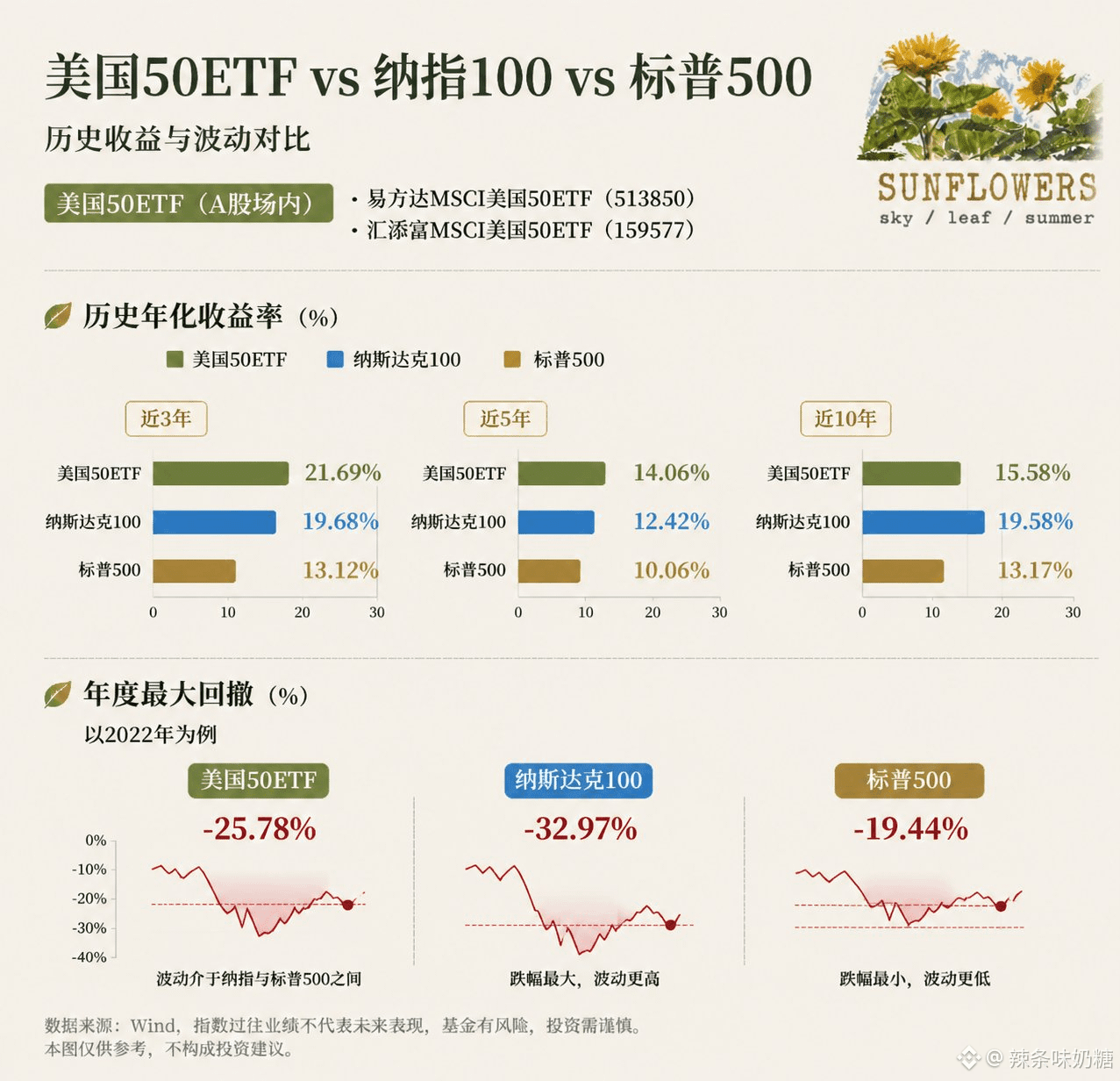
It tracks the MSCI USA 50 Index, buying only the 50 largest U.S. companies by free-float market capitalization. It’s not quite the same as the Nasdaq-100 or the S&P 500. The Nasdaq-100 has no financial sector, so it leans more tech-heavy;
while the S&P 500 covers a broader range, but its holdings are also diluted by many mid- and small-cap stocks.
The US 50 includes financials directly, with its portfolio concentrated in dozens of the largest U.S. companies.
At the moment, there are only two such ETFs available in the A-share market:
E-Fund MSCI USA 50 ETF (513850)
Harvest Fund MSCI USA 50 ETF (159577)
Its historical performance is quite interesting—basically in between the Nasdaq and the S&P.
Over the past 10 years, the annualized return is 15.58%, which is higher than the S&P 500’s 13.17%, but lower than the Nasdaq-100’s 19.58%.
In 2022, it fell 25.78%—less than the Nasdaq-100’s 32.97%, but more than the S&P 500’s 19.44%.
However, there’s one detail to pay attention to.
These data are all backtested index history, not the ETFs’ actual real-world performance.
Both US 50 ETFs have been established for less than three years, so they haven’t completed a full market cycle yet.
So what you’re seeing now is the index’s long-term performance, not the funds’ own historical results.
Compared with returns, I care more about the premium/discount rate.
When QDII fund demand is high, the trading price in the market tends to run above NAV.
But pay attention to the premium when buying—both of them currently have a premium above 5%.
E-Fund: 5.84%
Harvest Fund: 5.66%
A 5% premium isn’t the real issue—the real issue is not realizing that you’re already paying 5% more than NAV.
These are just data records and do not constitute investment advice.
It tracks the MSCI USA 50 Index, buying only the 50 largest U.S. companies by free-float market capitalization. It’s not quite the same as the Nasdaq-100 or the S&P 500. The Nasdaq-100 has no financial sector, so it leans more tech-heavy;
while the S&P 500 covers a broader range, but its holdings are also diluted by many mid- and small-cap stocks.
The US 50 includes financials directly, with its portfolio concentrated in dozens of the largest U.S. companies.
At the moment, there are only two such ETFs available in the A-share market:
E-Fund MSCI USA 50 ETF (513850)
Harvest Fund MSCI USA 50 ETF (159577)
Its historical performance is quite interesting—basically in between the Nasdaq and the S&P.
Over the past 10 years, the annualized return is 15.58%, which is higher than the S&P 500’s 13.17%, but lower than the Nasdaq-100’s 19.58%.
In 2022, it fell 25.78%—less than the Nasdaq-100’s 32.97%, but more than the S&P 500’s 19.44%.
However, there’s one detail to pay attention to.
These data are all backtested index history, not the ETFs’ actual real-world performance.
Both US 50 ETFs have been established for less than three years, so they haven’t completed a full market cycle yet.
So what you’re seeing now is the index’s long-term performance, not the funds’ own historical results.
Compared with returns, I care more about the premium/discount rate.
When QDII fund demand is high, the trading price in the market tends to run above NAV.
But pay attention to the premium when buying—both of them currently have a premium above 5%.
E-Fund: 5.84%
Harvest Fund: 5.66%
A 5% premium isn’t the real issue—the real issue is not realizing that you’re already paying 5% more than NAV.
These are just data records and do not constitute investment advice.
Verified
No one paid attention to it after the close the previous day, and the next day it surged straight up by 13.63%. $LITE
The earnings report has put the outlook for optical communications on the table.
In Q4, revenue was $1.01 billion, up 109% year over year. Demand for optical components for AI data centers is real and tangible—it’s not just a story. Lumentum makes optical modules and laser devices, essential components for data center interconnects. The more AI servers you stack, the more optical communications needs to keep flowing—like the unglamorous plumber’s work, not flashy but indispensable.
This optical communications theme has already been kicked off in the past by FSLR and COHR. This time, LITE is a confirmation from the earnings side, not purely emotion-driven.
Going forward, I’ll focus on two points: whether the growth rate next quarter can continue to be in the triple digits, and whether the “cool first, then hot” pattern seen after-hours will become the norm.
The above does not constitute investment advice; it’s only a record of market observations.
The earnings report has put the outlook for optical communications on the table.
In Q4, revenue was $1.01 billion, up 109% year over year. Demand for optical components for AI data centers is real and tangible—it’s not just a story. Lumentum makes optical modules and laser devices, essential components for data center interconnects. The more AI servers you stack, the more optical communications needs to keep flowing—like the unglamorous plumber’s work, not flashy but indispensable.
This optical communications theme has already been kicked off in the past by FSLR and COHR. This time, LITE is a confirmation from the earnings side, not purely emotion-driven.
Going forward, I’ll focus on two points: whether the growth rate next quarter can continue to be in the triple digits, and whether the “cool first, then hot” pattern seen after-hours will become the norm.
The above does not constitute investment advice; it’s only a record of market observations.
Verified
Last night, the three major U.S. stock indexes basically didn’t move much. The S&P 500 closed at 7,753, down less than 0.1%. On the surface it was calm, but underneath a few stocks were getting aggressively bid up.
Three worth breaking down.
$FSLY +20.86%
Fastly, doing CDN and edge security. Q2 revenue rose 23.3%, gross margin was 65.8%, and net retention was 117%—meaning not only new customers are coming in, but existing customers are also spending more. The company directly raised its full-year guidance.
The logic behind the surge is pretty straightforward: security business plus AI inference demand is pulling CDN usage higher. The more AI applications get deployed, the more edge distribution and WAF security become like plumbing—unsexy, but a real necessity.
Going forward, watch two things: first, whether the company can keep maintaining 20%+ growth in the next quarter; second, whether concentration among major customers improves. The biggest risk for SaaS stocks like this is always the same—those top two or three customers cutting budgets.
$DDOG.US +11.48%
Datadog: its previous Q2 earnings weren’t actually bad—revenue was $1.12B, up 36% year over year. But guidance was a bit conservative, and with the largest customer reducing spend, the stock got hammered down 19% on earnings day.
Yesterday’s 11% looks like the market was trying to repair that oversold move. $DDOG is a category leader in cloud observability; a $93B company up 11% isn’t something small money can push.
For stocks like this, my habit is: I don’t chase a bounce day. I wait one or two weeks to confirm there’s no second leg down, then decide whether it’s a real shift in sentiment. Whether that biggest customer can stay stable is the key.
Energy stocks爆发 across the board
$NESR.US R +23.33%, $CLMT +15%, $HP +13%, $APA +9%, $RIG +9%—from oilfield services to exploration, everything was up.
$NESR is earnings-driven. Q2 set a historical high, and the stock price also hit a new high. Crude oil is holding above 82, and the whole sector’s risk appetite has been lifted.
But the issue with energy stocks is never, “Can they go up?” It’s, “Can they hold the gains after they go up?” Whether oil can stay above 80 is more decisive for the next leg than any single-quarter earnings report.
---
In A-shares, the Shanghai Composite is 3,965 and the Hang Seng is 25,774—both are slightly down, nothing extremely dramatic. In crypto, BTC is at 64k and ETH at 1,878; both are down around 1% over the past 24 hours, grinding along just like the U.S. market.
Last night there wasn’t any major earnings pre-announcement. In the next few days later this week, you can keep an eye out for any new pre-announcements.
The above does not constitute investment advice—just market observation notes.
Three worth breaking down.
$FSLY +20.86%
Fastly, doing CDN and edge security. Q2 revenue rose 23.3%, gross margin was 65.8%, and net retention was 117%—meaning not only new customers are coming in, but existing customers are also spending more. The company directly raised its full-year guidance.
The logic behind the surge is pretty straightforward: security business plus AI inference demand is pulling CDN usage higher. The more AI applications get deployed, the more edge distribution and WAF security become like plumbing—unsexy, but a real necessity.
Going forward, watch two things: first, whether the company can keep maintaining 20%+ growth in the next quarter; second, whether concentration among major customers improves. The biggest risk for SaaS stocks like this is always the same—those top two or three customers cutting budgets.
$DDOG.US +11.48%
Datadog: its previous Q2 earnings weren’t actually bad—revenue was $1.12B, up 36% year over year. But guidance was a bit conservative, and with the largest customer reducing spend, the stock got hammered down 19% on earnings day.
Yesterday’s 11% looks like the market was trying to repair that oversold move. $DDOG is a category leader in cloud observability; a $93B company up 11% isn’t something small money can push.
For stocks like this, my habit is: I don’t chase a bounce day. I wait one or two weeks to confirm there’s no second leg down, then decide whether it’s a real shift in sentiment. Whether that biggest customer can stay stable is the key.
Energy stocks爆发 across the board
$NESR.US R +23.33%, $CLMT +15%, $HP +13%, $APA +9%, $RIG +9%—from oilfield services to exploration, everything was up.
$NESR is earnings-driven. Q2 set a historical high, and the stock price also hit a new high. Crude oil is holding above 82, and the whole sector’s risk appetite has been lifted.
But the issue with energy stocks is never, “Can they go up?” It’s, “Can they hold the gains after they go up?” Whether oil can stay above 80 is more decisive for the next leg than any single-quarter earnings report.
---
In A-shares, the Shanghai Composite is 3,965 and the Hang Seng is 25,774—both are slightly down, nothing extremely dramatic. In crypto, BTC is at 64k and ETH at 1,878; both are down around 1% over the past 24 hours, grinding along just like the U.S. market.
Last night there wasn’t any major earnings pre-announcement. In the next few days later this week, you can keep an eye out for any new pre-announcements.
The above does not constitute investment advice—just market observation notes.
Verified
S&P closed last Friday at 7,753, just 40 points short of the 52-week high of 7,793—near the new-high zone. Today is Monday in the U.S., and the market hasn’t opened yet, but last Friday’s action is actually confirming your core thesis.
The index inched down 0.06%, but internally <$SMCI I> +5.96% led on increased volume, <$NVDA > +2.27% was the top riser, and <$GOOGL > -0.96% pulled back. Below the new high, capital is relocating within the market; the dispersion is exactly what you illustrated in that chart in your notes.
After the VIX risk warning segment on gold, the overall logic has come full circle. The directional calls for the four rotations didn’t rely on day-to-day up or down— the framework itself is solid.
The index inched down 0.06%, but internally <$SMCI I> +5.96% led on increased volume, <$NVDA > +2.27% was the top riser, and <$GOOGL > -0.96% pulled back. Below the new high, capital is relocating within the market; the dispersion is exactly what you illustrated in that chart in your notes.
After the VIX risk warning segment on gold, the overall logic has come full circle. The directional calls for the four rotations didn’t rely on day-to-day up or down— the framework itself is solid.
On Thursday night’s earnings report bonanza, the three SaaS brothers taught the market one thing: profits matter more than growth rates. All three beat expectations on profitability, with growth being revised downward—yet the stocks went on an absolute rampage.
$TEAM.US rose 35%. Atlassian cut its growth guidance for next year to 18%—in the past, that would’ve been a bloodbath script. But gross margin beat expectations, operating margin moved up, and the market simply bought it. AI isn’t here to eat its lunch—it’s here to help it sell more seats. Next, keep an eye on one number: can the ARPU from that batch of cloud-migration customers continue to climb?
$TWLO.US rose 25%. Q2 revenue hit 1.5 billion, up 22% year over year, and full-year guidance was raised to 18%. Messaging and voice businesses are both rebounding, but even more worth watching is the magnitude of cash-flow improvement—after selling for three years in misery, this SaaS company has finally started making money, and its valuation anchor is shifting.
$ABNB.US rose 17%. The CEO said directly that AI is “the best thing.” Q2 revenue was 3.6 billion +17%, and EPS of 1.37 beat expectations. This isn’t just AI-concept hype—search, pricing, and customer service are all already integrated end-to-end. Among travel stocks, this is the one that looks most like a tech company.
SSE Composite 3947, Hang Seng 25842, mildly up with no extreme action. BTC at 65,000, ETH at 1918—up less than half a percent over 24h, and the market is consolidating into the weekend.
This week to watch: toward the tail end of earnings season, a few retail stocks still have to turn in their reports—the consumption data will determine the direction of the next narrative. The VIX is sitting at 14.9, and the options market isn’t panicking—but when things are too quiet, it’s actually worth taking another look.
The above does not constitute investment advice; it’s only a market observation log.
$TEAM.US rose 35%. Atlassian cut its growth guidance for next year to 18%—in the past, that would’ve been a bloodbath script. But gross margin beat expectations, operating margin moved up, and the market simply bought it. AI isn’t here to eat its lunch—it’s here to help it sell more seats. Next, keep an eye on one number: can the ARPU from that batch of cloud-migration customers continue to climb?
$TWLO.US rose 25%. Q2 revenue hit 1.5 billion, up 22% year over year, and full-year guidance was raised to 18%. Messaging and voice businesses are both rebounding, but even more worth watching is the magnitude of cash-flow improvement—after selling for three years in misery, this SaaS company has finally started making money, and its valuation anchor is shifting.
$ABNB.US rose 17%. The CEO said directly that AI is “the best thing.” Q2 revenue was 3.6 billion +17%, and EPS of 1.37 beat expectations. This isn’t just AI-concept hype—search, pricing, and customer service are all already integrated end-to-end. Among travel stocks, this is the one that looks most like a tech company.
SSE Composite 3947, Hang Seng 25842, mildly up with no extreme action. BTC at 65,000, ETH at 1918—up less than half a percent over 24h, and the market is consolidating into the weekend.
This week to watch: toward the tail end of earnings season, a few retail stocks still have to turn in their reports—the consumption data will determine the direction of the next narrative. The VIX is sitting at 14.9, and the options market isn’t panicking—but when things are too quiet, it’s actually worth taking another look.
The above does not constitute investment advice; it’s only a market observation log.
TEAMUS+0.94%
TWLOUS+0.68%
ABNBUS-1.23%
Partly True
Mag7 shows clear differentiation today. $NVDA up +2.27% and leads on higher volume, with $200 holding up; $236 is the next resistance. $TSLA up +2.83% follows higher; the FSD + Robotaxi narrative is reignited, and rate cuts ease financing costs. Pushing on both sides.
$AMZN up +0.82% on higher volume as cloud plus consumer turns into a dual engine; rate cuts directly get absorbed. $META +0.37%, $AAPL +0.29%, a steady follow-through. $MSFT is flat, hovering around the $500 level, with repeated back-and-forth at the threshold.
$GOOGL -0.96%, the only decliner. After the Q2 earnings report, profit-taking set in, and it has pulled back for three straight days. The long-term cloud + AI logic remains unchanged, with $350 holding.
Every day this week has major catalysts. After CPI come PPI, retail sales, and the AMAT earnings report.
VIX is 14.9—extremely low. Everyone is betting on a mildly positive CPI, and almost nobody is hedging. This asymmetric setup isn’t worth risking real money. Wait for right-side confirmation of direction before acting. Mild CPI favors tech growth; a hot CPI favors defensive value.
You may want to keep an eye on optical modules.
The above are personal trading notes and do not constitute investment advice.
$AMZN up +0.82% on higher volume as cloud plus consumer turns into a dual engine; rate cuts directly get absorbed. $META +0.37%, $AAPL +0.29%, a steady follow-through. $MSFT is flat, hovering around the $500 level, with repeated back-and-forth at the threshold.
$GOOGL -0.96%, the only decliner. After the Q2 earnings report, profit-taking set in, and it has pulled back for three straight days. The long-term cloud + AI logic remains unchanged, with $350 holding.
Every day this week has major catalysts. After CPI come PPI, retail sales, and the AMAT earnings report.
VIX is 14.9—extremely low. Everyone is betting on a mildly positive CPI, and almost nobody is hedging. This asymmetric setup isn’t worth risking real money. Wait for right-side confirmation of direction before acting. Mild CPI favors tech growth; a hot CPI favors defensive value.
You may want to keep an eye on optical modules.
The above are personal trading notes and do not constitute investment advice.
Partly True
QQQ +1.17%, SOXX +2.02%. Semiconductors outperformed the broader market by 85 basis points today, and internal tech capital is concentrating toward chips. Market beta is fine; the bias is bullish.
I picked out a few of the strongest signals. $SMCI today is up 5.96%, breaking out on increased volume. Behind it are AI server order backlogs that have surpassed $60 billion. The Q4 earnings report will be released in two days, and analysts expect the gross margin outlook to be revised upward. The PE is only 16.96, sitting near the 52-week lows—together with the $60B backlog, this contrast is worth a second look. All three signals are lining up—accelerating orders, improving profitability, and a breakout on volume—so this week’s most worth watching AI semiconductor name is it.
$NVDA is up 2.27%, with heavy volume breaking above $220. Rate-cut expectations compress valuations combined with AI compute demand; the structure looks healthy, with a PE of 34.3. $AVGO is up 1.71%, tracking higher. $MU is the only one in today’s group that fell, down 0.44%. Storage has been temporarily sidelined by capital, and within the camp, positioning is shifting from storage toward AI servers.
More surprisingly, SOXX outperformed QQQ by this much. In the first week after the rate cut landed, the market is choosing directions with real money—picking semiconductors.
The above is personal trading notes and does not constitute investment advice.
I picked out a few of the strongest signals. $SMCI today is up 5.96%, breaking out on increased volume. Behind it are AI server order backlogs that have surpassed $60 billion. The Q4 earnings report will be released in two days, and analysts expect the gross margin outlook to be revised upward. The PE is only 16.96, sitting near the 52-week lows—together with the $60B backlog, this contrast is worth a second look. All three signals are lining up—accelerating orders, improving profitability, and a breakout on volume—so this week’s most worth watching AI semiconductor name is it.
$NVDA is up 2.27%, with heavy volume breaking above $220. Rate-cut expectations compress valuations combined with AI compute demand; the structure looks healthy, with a PE of 34.3. $AVGO is up 1.71%, tracking higher. $MU is the only one in today’s group that fell, down 0.44%. Storage has been temporarily sidelined by capital, and within the camp, positioning is shifting from storage toward AI servers.
More surprisingly, SOXX outperformed QQQ by this much. In the first week after the rate cut landed, the market is choosing directions with real money—picking semiconductors.
The above is personal trading notes and does not constitute investment advice.
Partly True
The day after the rate cut landed, Mag7 reacted across the board.
$TSLA +2.83% led the way, with trading volume expanding and pushing toward the $330 level. The transmission chain of the rate cut is straightforward: falling credit costs lead to lower auto loan rates, and TSLA directly benefits. If there’s an effective breakout from the $320–$330 range, the structure will open up.
$NVDA +2.27% saw volume increase as it broke through the $220 level. The 20-day moving average at $218 has held firm for several days—this time the rate-cut move provided the push to send it higher. The AI compute-demand narrative combined with the rate cut removing valuation pressure creates a double catalyst.
$AMZN +0.82% climbed steadily in the $270–$275 range. The rate cut is supportive for consumer retail and cloud spending—two legs stepping right on target.
$META +0.37%, consolidating near its all-time high. AI ad monetization plus lower costs from the rate cut are both in play—two lines of logic running. Waiting for a breakout above $600.
$AAPL +0.29%, after seven consecutive up days, moved higher steadily but gently, with $310 holding. The AI phone narrative combined with the rate cut has helped revive demand for consumer electronics. The pace isn’t fast, but it’s steady.
$MSFT was nearly flat, with orders around $499.99. For five straight days it’s been trading in a tight range between $499 and $500. AI cloud revenue has already been priced in; we’ll wait for the next catalyst.
$GOOGL -0.96%, the only Mag7 decliner. For two consecutive days it has underperformed the sector. Ongoing concerns about AI search cost narratives and advertising competition have continued to weigh on it. $350 is the key support level.
The above are my personal trading notes and do not constitute investment advice.
$TSLA +2.83% led the way, with trading volume expanding and pushing toward the $330 level. The transmission chain of the rate cut is straightforward: falling credit costs lead to lower auto loan rates, and TSLA directly benefits. If there’s an effective breakout from the $320–$330 range, the structure will open up.
$NVDA +2.27% saw volume increase as it broke through the $220 level. The 20-day moving average at $218 has held firm for several days—this time the rate-cut move provided the push to send it higher. The AI compute-demand narrative combined with the rate cut removing valuation pressure creates a double catalyst.
$AMZN +0.82% climbed steadily in the $270–$275 range. The rate cut is supportive for consumer retail and cloud spending—two legs stepping right on target.
$META +0.37%, consolidating near its all-time high. AI ad monetization plus lower costs from the rate cut are both in play—two lines of logic running. Waiting for a breakout above $600.
$AAPL +0.29%, after seven consecutive up days, moved higher steadily but gently, with $310 holding. The AI phone narrative combined with the rate cut has helped revive demand for consumer electronics. The pace isn’t fast, but it’s steady.
$MSFT was nearly flat, with orders around $499.99. For five straight days it’s been trading in a tight range between $499 and $500. AI cloud revenue has already been priced in; we’ll wait for the next catalyst.
$GOOGL -0.96%, the only Mag7 decliner. For two consecutive days it has underperformed the sector. Ongoing concerns about AI search cost narratives and advertising competition have continued to weigh on it. $350 is the key support level.
The above are my personal trading notes and do not constitute investment advice.
Tonight at 8:30 PM, the Non-Farm Payrolls. The ultimate verdict for this week.
ADP came in at 44K versus the expected 68K, a very strong downside signal. Initial Jobless Claims were 199K, better than the expected 203K, pulling things back again. The two data points point in opposite directions— the market is being tugged from both ends.
The VIX is hanging around the mid-teens, extremely low. The whole market is pricing a soft landing. Any surprise in any direction will be amplified.
Three scenarios. If NFP is below 100K: recession trades—defense plus gold plus U.S. Treasuries. If NFP is between 120K and 160K: within expectations— the soft-landing narrative continues. If NFP is above 160K: soft-landing confirmed—next week chase value, the cycle, and small caps.
In Mag7, <$AAPL > is the only green; it’s up less than half a point. <$GOOGL > is down more than a point, the weakest. <$NVDA > is flat, with a 219-dollar mark posted. $AMD is down seven points, and $ALAB is down twelve points—an absolute bomb—but the SOX index is still up 0.33%. Chip stocks internally are diverging.
The U.S. dollar versus the Japanese yen fell to 155 on Monday, and today it’s back to 158. Japan hasn’t continued dumping large amounts of U.S. Treasuries to buy yen.
Tonight I’m not betting on direction. The low VIX has given options asymmetric returns. Wait for the data, then act.
Next week: Tuesday CPI, Wednesday PPI, Thursday retail sales. The Non-Farm Payrolls will determine the trading framework for the entire week.
The above are personal trading notes and do not constitute investment advice.
ADP came in at 44K versus the expected 68K, a very strong downside signal. Initial Jobless Claims were 199K, better than the expected 203K, pulling things back again. The two data points point in opposite directions— the market is being tugged from both ends.
The VIX is hanging around the mid-teens, extremely low. The whole market is pricing a soft landing. Any surprise in any direction will be amplified.
Three scenarios. If NFP is below 100K: recession trades—defense plus gold plus U.S. Treasuries. If NFP is between 120K and 160K: within expectations— the soft-landing narrative continues. If NFP is above 160K: soft-landing confirmed—next week chase value, the cycle, and small caps.
In Mag7, <$AAPL > is the only green; it’s up less than half a point. <$GOOGL > is down more than a point, the weakest. <$NVDA > is flat, with a 219-dollar mark posted. $AMD is down seven points, and $ALAB is down twelve points—an absolute bomb—but the SOX index is still up 0.33%. Chip stocks internally are diverging.
The U.S. dollar versus the Japanese yen fell to 155 on Monday, and today it’s back to 158. Japan hasn’t continued dumping large amounts of U.S. Treasuries to buy yen.
Tonight I’m not betting on direction. The low VIX has given options asymmetric returns. Wait for the data, then act.
Next week: Tuesday CPI, Wednesday PPI, Thursday retail sales. The Non-Farm Payrolls will determine the trading framework for the entire week.
The above are personal trading notes and do not constitute investment advice.
Revenue at 7.8 billion, doubling. Market cap evaporated by 210 billion in a single day. In SpaceX’s quarterly report, the numbers and the stock price each move in their own way.
Q2 revenue +92%, but capital expenditures were 18.4 billion, with 1 billion shares of internal stock unlocking. The results were explosive—unlocking shares hammered the market selloff, and the stock plunged 13.6% in one day. Meanwhile, AMD fell 7%, and Google dropped 4%. The Nasdaq overall was -0.83%. Nvidia, however, bucked the trend and rose more than 3%.
On the other side, spot gold +4.11% broke above 4,200, and silver also rose +4.12%. Falling real yields on U.S. Treasuries are driving this. The Dow +0.49% kept setting new highs, while the S&P was slightly down. The market is diverging—not broadly up or broadly down.
During earnings season, a few things worth watching: SanDisk’s Q4 revenue nearly quadrupled, with a 14 billion share repurchase plan, but guidance looked weaker and it fell 8% after hours. Western Digital fell 10% after hours; its AI hard-drive long-term supply agreement was extended out to 2031. Eli Lilly’s Q2 revenue +48%—demand for its weight-loss drugs is still climbing, and it raised its full-year guidance to 85–87 billion.
Meta rolled out its first AI programming agent, and Anthropic set up a self-developed chip team. Look at these two things together: AI arms-race spending is still being stepped up.
The above does not constitute investment advice—just market learning notes.
Q2 revenue +92%, but capital expenditures were 18.4 billion, with 1 billion shares of internal stock unlocking. The results were explosive—unlocking shares hammered the market selloff, and the stock plunged 13.6% in one day. Meanwhile, AMD fell 7%, and Google dropped 4%. The Nasdaq overall was -0.83%. Nvidia, however, bucked the trend and rose more than 3%.
On the other side, spot gold +4.11% broke above 4,200, and silver also rose +4.12%. Falling real yields on U.S. Treasuries are driving this. The Dow +0.49% kept setting new highs, while the S&P was slightly down. The market is diverging—not broadly up or broadly down.
During earnings season, a few things worth watching: SanDisk’s Q4 revenue nearly quadrupled, with a 14 billion share repurchase plan, but guidance looked weaker and it fell 8% after hours. Western Digital fell 10% after hours; its AI hard-drive long-term supply agreement was extended out to 2031. Eli Lilly’s Q2 revenue +48%—demand for its weight-loss drugs is still climbing, and it raised its full-year guidance to 85–87 billion.
Meta rolled out its first AI programming agent, and Anthropic set up a self-developed chip team. Look at these two things together: AI arms-race spending is still being stepped up.
The above does not constitute investment advice—just market learning notes.
Will Unitree’s IPO ignite the second wave of robotics? Breaking it down across 20 A-share companies along the industrial chain.
Institutions are already positioning themselves. Brokers such as Soochow Securities directly pointed out that after the July sector digests its bubble, two catalysts will resonate: Unitree’s listing + Tesla Optimus moving toward mass production. During July’s pullback, the robotics ETF (招商 560770) saw net subscriptions of RMB 261 million in a single month—buying more as prices fall.
Three things brought by Unitree’s IPO, mapped to specific targets.
Valuation anchor. Unitree is set to ship over 5,500 units in 2025 with a gross margin of 60.13%. After the listing, the entire industrial chain gains a reference point. The most direct beneficiaries are core component suppliers—Green Harmonic Drive 688017, whose harmonic reducers support smart grippers; Zhongda Lide 002896, the top supplier of reducers, also indirectly holds a stake; and Shuanghuan Transmission 002472, supplying heavy-duty joints. The depth of their linkage to Unitree determines how much their valuations can expand.
Capital picks people, not random money. After the July adjustment, the CSI Robotics Index’s PE is 51.79x, around the 49th percentile over the past three years—enough bubble digestion has largely happened. But capital still prioritizes companies with production-and-delivery capability. Examples include Wolong Electric Drive 600580, jointly developing joint module assemblies; Orbbec? (Orbbec?—assuming “奥比中光” is Orbbec) 688322, supplying 3D vision cameras; and Zhaowei Electric 003021, supplying gripper transmission components. Pure-concept small caps don’t get the funds. As for the five indirectly held names—Jingxing Paper 002067, Jihua Group 603980, and others—these are more about sentiment and momentum chasing, not something investors “pursue” aggressively.
On sentiment, chip and algorithm upside is the largest. Allwinner Technology 300458 provides main control chips for quadruped robots; iFlytek 002230 cooperates on interactive solutions; and ZHONGKE Chuangda 300496 works with partners to develop intelligent control algorithms. In the last round of the robotics market, algorithm and chip stocks typically led hardware by about one step.
Boundaries. This isn’t broad-based gains. If Unitree’s IPO pricing substantially exceeds expectations, the short term could be overdrawn. What happens next will depend on Tesla Optimus’s mass-production pace and how quickly robotics roll out for domestic automakers.
The above is for informational analysis of the industry only and is not investment advice.
Institutions are already positioning themselves. Brokers such as Soochow Securities directly pointed out that after the July sector digests its bubble, two catalysts will resonate: Unitree’s listing + Tesla Optimus moving toward mass production. During July’s pullback, the robotics ETF (招商 560770) saw net subscriptions of RMB 261 million in a single month—buying more as prices fall.
Three things brought by Unitree’s IPO, mapped to specific targets.
Valuation anchor. Unitree is set to ship over 5,500 units in 2025 with a gross margin of 60.13%. After the listing, the entire industrial chain gains a reference point. The most direct beneficiaries are core component suppliers—Green Harmonic Drive 688017, whose harmonic reducers support smart grippers; Zhongda Lide 002896, the top supplier of reducers, also indirectly holds a stake; and Shuanghuan Transmission 002472, supplying heavy-duty joints. The depth of their linkage to Unitree determines how much their valuations can expand.
Capital picks people, not random money. After the July adjustment, the CSI Robotics Index’s PE is 51.79x, around the 49th percentile over the past three years—enough bubble digestion has largely happened. But capital still prioritizes companies with production-and-delivery capability. Examples include Wolong Electric Drive 600580, jointly developing joint module assemblies; Orbbec? (Orbbec?—assuming “奥比中光” is Orbbec) 688322, supplying 3D vision cameras; and Zhaowei Electric 003021, supplying gripper transmission components. Pure-concept small caps don’t get the funds. As for the five indirectly held names—Jingxing Paper 002067, Jihua Group 603980, and others—these are more about sentiment and momentum chasing, not something investors “pursue” aggressively.
On sentiment, chip and algorithm upside is the largest. Allwinner Technology 300458 provides main control chips for quadruped robots; iFlytek 002230 cooperates on interactive solutions; and ZHONGKE Chuangda 300496 works with partners to develop intelligent control algorithms. In the last round of the robotics market, algorithm and chip stocks typically led hardware by about one step.
Boundaries. This isn’t broad-based gains. If Unitree’s IPO pricing substantially exceeds expectations, the short term could be overdrawn. What happens next will depend on Tesla Optimus’s mass-production pace and how quickly robotics roll out for domestic automakers.
The above is for informational analysis of the industry only and is not investment advice.
Partly True
Nasdaq 100 up 3.32%, closes at 29,733. AI and the chip sector led the gain.
$PLTR surged 29.5% after its earnings report; Philadelphia Semiconductor Index +6.6%, tech sector +4.1%. AMD revenue was $11.5B, up 50% year over year. Data center revenue doubled, but shares fell nearly 9% in after-hours—guidance didn’t impress the market.
Oil prices pulled back: WTI 75.77, and the 10-year U.S. Treasury yield fell to 4.62%. VIX rose 4.04%. Behind the rally, volatility didn’t decline—stay alert.
Tonight to watch: the ADP employment report, ISM Services PMI, and how SanDisk’s earnings may transmit to the storage sector.
The above is for personal opinion sharing only and not investment advice.
$PLTR surged 29.5% after its earnings report; Philadelphia Semiconductor Index +6.6%, tech sector +4.1%. AMD revenue was $11.5B, up 50% year over year. Data center revenue doubled, but shares fell nearly 9% in after-hours—guidance didn’t impress the market.
Oil prices pulled back: WTI 75.77, and the 10-year U.S. Treasury yield fell to 4.62%. VIX rose 4.04%. Behind the rally, volatility didn’t decline—stay alert.
Tonight to watch: the ADP employment report, ISM Services PMI, and how SanDisk’s earnings may transmit to the storage sector.
The above is for personal opinion sharing only and not investment advice.
Market index + individual stock trading log.
Index
The Nasdaq today tried again to attack the 60-day moving average. For ultra-short-term technicals, a pullback is likely. The S&P, on the other hand, is moving more cleanly—after consolidation it broke upward. This time, the hope is that the S&P first stabilizes, pulling the Nasdaq out of its downtrend and bringing it back into a rising cycle.
Individual stocks
$ANF.US and $PGY.US —congratulations first. Both completed their setups ahead of the index, and then continued to run stronger. Strong stocks often start before the index—textbook behavior.
I cleared a fair amount of leveraged positions today. I sold the $MSFU and $GGLL 2x first, locking in part of the rebound gains. A rebound isn’t a reversal—only what you take counts.
In the late session, I added $PLTR, betting that earnings can extend today’s market sentiment. Lately, I’ve heard plenty of positive feedback around PLTR’s business deployment—company demand is really starting to show up in a tangible way. If the sentiment can carry over, $ZETA may get a boost too.
$SEDG, $QBTS, $ORCL, $RDDT—four that I like long term, but they’re not suitable to chase right now. Wait for the pullback not to break, and for the technical setup to be rebuilt before considering entry.
$UMAC’s smaller timeframe setup has already played out and the technicals look good. Today’s move was too strong—I won’t chase. Tomorrow I’ll watch whether the index pulls back and look for a more comfortable entry level.
Continue tracking the momentum names. There’s only one rule for execution discipline: if the pullback doesn’t break → setup confirmed → then re-enter.
The above is for personal opinion sharing only and is not investment advice.
Index
The Nasdaq today tried again to attack the 60-day moving average. For ultra-short-term technicals, a pullback is likely. The S&P, on the other hand, is moving more cleanly—after consolidation it broke upward. This time, the hope is that the S&P first stabilizes, pulling the Nasdaq out of its downtrend and bringing it back into a rising cycle.
Individual stocks
$ANF.US and $PGY.US —congratulations first. Both completed their setups ahead of the index, and then continued to run stronger. Strong stocks often start before the index—textbook behavior.
I cleared a fair amount of leveraged positions today. I sold the $MSFU and $GGLL 2x first, locking in part of the rebound gains. A rebound isn’t a reversal—only what you take counts.
In the late session, I added $PLTR, betting that earnings can extend today’s market sentiment. Lately, I’ve heard plenty of positive feedback around PLTR’s business deployment—company demand is really starting to show up in a tangible way. If the sentiment can carry over, $ZETA may get a boost too.
$SEDG, $QBTS, $ORCL, $RDDT—four that I like long term, but they’re not suitable to chase right now. Wait for the pullback not to break, and for the technical setup to be rebuilt before considering entry.
$UMAC’s smaller timeframe setup has already played out and the technicals look good. Today’s move was too strong—I won’t chase. Tomorrow I’ll watch whether the index pulls back and look for a more comfortable entry level.
Continue tracking the momentum names. There’s only one rule for execution discipline: if the pullback doesn’t break → setup confirmed → then re-enter.
The above is for personal opinion sharing only and is not investment advice.
Log in to explore more content