
Sosotie
345 Posts

Sosotie
383 Following
38 Followers
26 Liked
Posts
All
Quotes



Sosotie
·
--
🔥 Crypto challenge today!
If someone gave you 100$ and told you: “Don’t sell for a whole year”… what would you choose? 👀
₿ BTC
🟣 SOL
🟡 BNB
♦️ ETH
Write your choice in the comments 👇
Let’s see which coin has the most community trust 🚀
❤️ If you benefited from the post, support the content with “Thanks” 🙏
If someone gave you 100$ and told you: “Don’t sell for a whole year”… what would you choose? 👀
₿ BTC
🟣 SOL
🟡 BNB
♦️ ETH
Write your choice in the comments 👇
Let’s see which coin has the most community trust 🚀
❤️ If you benefited from the post, support the content with “Thanks” 🙏


SANA p2b
·
--
Bullish🎁 RED PACKET DROP! 🔥
Jaldi claim karo 🚀
💰 Limited rewards available!
👇 Code/Link se claim karo
First come, first served! 🔥
Jaldi claim karo 🚀
💰 Limited rewards available!
👇 Code/Link se claim karo
First come, first served! 🔥



DK短线复刻
·
--
Reply to receive red packets 🎁🎁


小美琪 Meiqi
·
--
🎁🔴 $BNB RED PACKET GIVEAWAY 🔴🎁
🔥 Claim Your $BNB Now!
1️⃣ Follow @@小美琪 Meiqi
2️⃣ Repost 🔄
3️⃣ Join my Chat Channel 👇https://app.binance.com/uni-qr/9P7YHffB
🎁 Extra Rewards Waiting!
💬 Comment “$BNB” to Claim!
📌 Check Pinned Post for More Rewards ❤️
🔥 Claim Your $BNB Now!
1️⃣ Follow @@小美琪 Meiqi
2️⃣ Repost 🔄
3️⃣ Join my Chat Channel 👇https://app.binance.com/uni-qr/9P7YHffB
🎁 Extra Rewards Waiting!
💬 Comment “$BNB” to Claim!
📌 Check Pinned Post for More Rewards ❤️


路人1688luren
·
--
#全网爆仓6.74亿美元 $674 million wiped out overnight—this market is a brutal meat grinder for Taiwan traders.
Brothers, lately the chart has been stuck at 77,000, grinding back and forth. When the data came out, price immediately stabbed up and down—longs and shorts were both crushed. In these $674 million liquidations, there are no winners—only high-leverage cannon fodder.
Why did it blow up so badly?
First, macro conditions are too fractured. PPI and CPI came in above expectations, and the probability of a rate hike in September jumped to 70%. If the longs hesitated even a little, institutions sold aggressively and drove them out. Then, when they looked again, the data hadn’t cooled off fully yet—shorts were then carried away by a rebound.
Second, the chain-reaction moves between Saudi Arabia and Iran have made oil and inflation expectations swing like a roller coaster, so capital simply doesn’t dare to build a big position at the 77,000 level.
💡 As for trading, one heartfelt piece of advice:
In the next few days, keep your hands off. Don’t use high leverage to gamble on direction. This market isn’t rewarding bravery—it’s cleansing high-multiple leverage. Keep your U, wait for macro’s blade to land. Only when it truly smashes out a panic order block will be the moment for you to enter and pick up bloody, discounted chips. $BNB
Brothers, lately the chart has been stuck at 77,000, grinding back and forth. When the data came out, price immediately stabbed up and down—longs and shorts were both crushed. In these $674 million liquidations, there are no winners—only high-leverage cannon fodder.
Why did it blow up so badly?
First, macro conditions are too fractured. PPI and CPI came in above expectations, and the probability of a rate hike in September jumped to 70%. If the longs hesitated even a little, institutions sold aggressively and drove them out. Then, when they looked again, the data hadn’t cooled off fully yet—shorts were then carried away by a rebound.
Second, the chain-reaction moves between Saudi Arabia and Iran have made oil and inflation expectations swing like a roller coaster, so capital simply doesn’t dare to build a big position at the 77,000 level.
💡 As for trading, one heartfelt piece of advice:
In the next few days, keep your hands off. Don’t use high leverage to gamble on direction. This market isn’t rewarding bravery—it’s cleansing high-multiple leverage. Keep your U, wait for macro’s blade to land. Only when it truly smashes out a panic order block will be the moment for you to enter and pick up bloody, discounted chips. $BNB



白鲨观点
·
--
At noon I刷到 a post where someone asked: “If you could go back four years, what would you want to tell your past self?”
The comments were all over the place. Most people said things like “You must buy BTC,” “Sell the house and go all-in,” and so on. But after thinking about it, if I really could go back, what I’d want to tell my past self wouldn’t be that.
I would tell that version of myself: Don’t touch futures.
Four years ago, like many new people, I thought spot trading was too slow. Only ten-bag and hundred-bag leverage—that was considered exciting. Back then, I got lucky and caught a wave of the market. My account multiplied several times, and I was floating—thinking I was a chosen one, a trading genius. So what happened later? After a pullback, within a few days I gave back everything I had—principal plus interest—and even ended up losing money.
That period was really hard. I couldn’t sleep, every day I doubted myself. Later, I slowly figured out a lesson: money you make by luck will, sooner or later, be lost back by your own real ability.
As for futures—sure, in the short term it can make you rich quickly. But in the long run, almost nobody can consistently make money with futures. It’s not that the technology isn’t good; it’s that human nature isn’t. If you win ten times, just one loss could wipe out all your previous gains. And once someone wins a few big times, they can’t go back to small positions again.
If I truly went back, I wouldn’t tell myself what coins to buy, when to buy, or when to sell.
I would only say one thing: Don’t touch leverage—stick to spot, honestly.
It’s okay to be slower. At least I can make it to today.
$BTC #BinanceSquare #合约交易 #交易心得
The comments were all over the place. Most people said things like “You must buy BTC,” “Sell the house and go all-in,” and so on. But after thinking about it, if I really could go back, what I’d want to tell my past self wouldn’t be that.
I would tell that version of myself: Don’t touch futures.
Four years ago, like many new people, I thought spot trading was too slow. Only ten-bag and hundred-bag leverage—that was considered exciting. Back then, I got lucky and caught a wave of the market. My account multiplied several times, and I was floating—thinking I was a chosen one, a trading genius. So what happened later? After a pullback, within a few days I gave back everything I had—principal plus interest—and even ended up losing money.
That period was really hard. I couldn’t sleep, every day I doubted myself. Later, I slowly figured out a lesson: money you make by luck will, sooner or later, be lost back by your own real ability.
As for futures—sure, in the short term it can make you rich quickly. But in the long run, almost nobody can consistently make money with futures. It’s not that the technology isn’t good; it’s that human nature isn’t. If you win ten times, just one loss could wipe out all your previous gains. And once someone wins a few big times, they can’t go back to small positions again.
If I truly went back, I wouldn’t tell myself what coins to buy, when to buy, or when to sell.
I would only say one thing: Don’t touch leverage—stick to spot, honestly.
It’s okay to be slower. At least I can make it to today.
$BTC #BinanceSquare #合约交易 #交易心得

饼哥HODL
·
--
The 12 Chinese zodiac coins have been collected!🔥
🐉 Dragon = Lobster
🐂 Ox = Here comes the ox
🐎 Horse = I’m here, damn it
Mid-Autumn Festival is just around the corner 🌕
The next zodiac-coin wealth code—no need for me to spell it out, right?
🐉 Dragon = Lobster
🐂 Ox = Here comes the ox
🐎 Horse = I’m here, damn it
Mid-Autumn Festival is just around the corner 🌕
The next zodiac-coin wealth code—no need for me to spell it out, right?

灼见
·
--
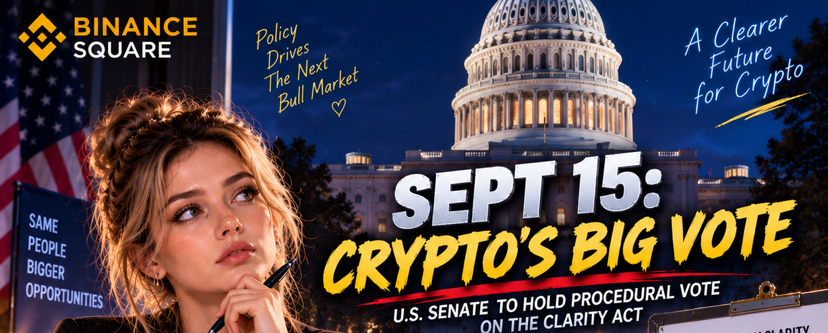
CLARITY Act: September 15 procedural vote
🚨 On September 15, Crypto may face the most important U.S. congressional vote of the year.
But first, let’s make it clear:
This is not the final passage of the CLARITY Act.
It’s the more critical first gate—
a Senate procedural vote.
Threshold: 60 votes.
The Republicans currently hold 53 seats.
That is to say, even if all Republicans support it, in theory at least 7 votes from across party lines are still needed to move the bill to the Senate for formal consideration.
Why should the entire Crypto market care about this?
Because what the CLARITY Act truly aims to solve is a long-standing issue that the U.S. Crypto industry has been arguing about for many years:
But first, let’s make it clear:
This is not the final passage of the CLARITY Act.
It’s the more critical first gate—
a Senate procedural vote.
Threshold: 60 votes.
The Republicans currently hold 53 seats.
That is to say, even if all Republicans support it, in theory at least 7 votes from across party lines are still needed to move the bill to the Senate for formal consideration.
Why should the entire Crypto market care about this?
Because what the CLARITY Act truly aims to solve is a long-standing issue that the U.S. Crypto industry has been arguing about for many years:

心月势不可挡
·
--
BullishBeaches, sea waves, and seafood—
turn everyday life into a vacation.
turn everyday life into a vacation.


SANA p2b
·
--
Bullish🎁 1 USDT RED PACKET QUIZ! 🔥
Binance ka native token kaunsa hai? 🤔
👇 Answer karo aur 5000 lucky gifts mein se ek claim karo!
Good luck everyone! 🚀
#Binance #bnb #crypto #RedPacket #quiz
Binance ka native token kaunsa hai? 🤔
👇 Answer karo aur 5000 lucky gifts mein se ek claim karo!
Good luck everyone! 🚀
#Binance #bnb #crypto #RedPacket #quiz
Quoted content has been removed

Bilawal Ashiq
·
--
🧧🧧 Clam Repost And Like Pls Gift 🎉🎉
$BNB
$BNB

白鲨观点马来西亚
·
--
Oil Breaks $100—This Could Be a More Important Inflation Signal Than the CPI
Everyone is watching tonight’s CPI,
but there’s one thing that may matter even more: crude oil prices have already broken $100.
Brent crude rose 7.5% yesterday, touching $108.
Tensions involving Iran and the Middle East have flared up again, and the shipping risk in the Strait of Hormuz has surged.
Why does oil matter so much?
Because crude oil is the “king of inflation”—
oil prices rise → transportation costs rise → prices rise → petrochemical products rise → costs for all kinds of goods rise → oil prices rise → energy bills rise → wage demands rise → an inflation spiral.
Yesterday’s PPI came in hotter than expected, and the biggest contributor was energy:
PPI commodity prices increased 1.1% month over month, with three-quarters of that driven by a 4.2% jump in energy prices.
Diesel prices jumped 24% in a single month—just one sub-item alone accounted for one-third of the total increase.
It’s like a pot of water: the more the fire (oil prices) burns,
the hotter the water (CPI) keeps getting.
Will CPI keep warming up?
What makes it worse is that oil price increases can’t be controlled by the Federal Reserve.
Rate hikes can curb demand, but they can’t control a war in the Middle East.
If geopolitical conditions continue to escalate, oil prices could surge to 120 or even 150,
and then it will be even harder to bring inflation back down.
Impact on the crypto market:
In the short term, it’s bearish—
heating up inflation expectations → rate hikes → pressure on risk assets.
But in the long run, it may actually be worth paying attention to—
when the fiat currency system becomes unstable due to the energy crisis and inflation,
BTC’s “digital gold” narrative could feel even more solid.
It’s like buying gold in chaotic times.
And now, signs of disorder are becoming more and more common.
In my chat room, I’ll keep tracking the link between oil, inflation, and crypto.
Once the oil price and CPI data are out, I’ll analyze the impact on BTC right away.
#BinanceSquare #原油 #通胀 #bitcoin #macroeconomics
Everyone is watching tonight’s CPI,
but there’s one thing that may matter even more: crude oil prices have already broken $100.
Brent crude rose 7.5% yesterday, touching $108.
Tensions involving Iran and the Middle East have flared up again, and the shipping risk in the Strait of Hormuz has surged.
Why does oil matter so much?
Because crude oil is the “king of inflation”—
oil prices rise → transportation costs rise → prices rise → petrochemical products rise → costs for all kinds of goods rise → oil prices rise → energy bills rise → wage demands rise → an inflation spiral.
Yesterday’s PPI came in hotter than expected, and the biggest contributor was energy:
PPI commodity prices increased 1.1% month over month, with three-quarters of that driven by a 4.2% jump in energy prices.
Diesel prices jumped 24% in a single month—just one sub-item alone accounted for one-third of the total increase.
It’s like a pot of water: the more the fire (oil prices) burns,
the hotter the water (CPI) keeps getting.
Will CPI keep warming up?
What makes it worse is that oil price increases can’t be controlled by the Federal Reserve.
Rate hikes can curb demand, but they can’t control a war in the Middle East.
If geopolitical conditions continue to escalate, oil prices could surge to 120 or even 150,
and then it will be even harder to bring inflation back down.
Impact on the crypto market:
In the short term, it’s bearish—
heating up inflation expectations → rate hikes → pressure on risk assets.
But in the long run, it may actually be worth paying attention to—
when the fiat currency system becomes unstable due to the energy crisis and inflation,
BTC’s “digital gold” narrative could feel even more solid.
It’s like buying gold in chaotic times.
And now, signs of disorder are becoming more and more common.
In my chat room, I’ll keep tracking the link between oil, inflation, and crypto.
Once the oil price and CPI data are out, I’ll analyze the impact on BTC right away.
#BinanceSquare #原油 #通胀 #bitcoin #macroeconomics

白鲨观点马来西亚
·
--
The market is calm before CPI— the calmer it looks, the more careful you need to be with your footing
There are only two days until CPI is released.
Right now, the market is like the sea before a storm—seemingly calm on the surface, while the undercurrents are already gathering strength.
BTC has been ranging between 78,000 and 80,000 for nearly a week,
with only about a $2,000 band between ups and downs; both bulls and bears are holding their breath.
So what’s the most common mistake to make in times like this?
It’s “predicting the market.”
If you think CPI will beat expectations, you short early;
if you think CPI will cool, you buy the dip early.
Then once the data comes out, the market moves the opposite of what you expected, and both sides end up embarrassing you.
After trading for so many years, I’ve summarized a pattern:
your position before the data is published is wrong in most cases—
not because your judgment is off, but because the market itself has no clear direction yet.
Everyone is waiting, guessing, and using small positions to test the waters.
If you insist on going all in on one direction early, that’s not bravery—it’s basically handing yourself over.
It’s like the exam before you insist on betting on likely questions:
getting it right is luck; missing it is the norm.
The truly smart move is to wait until the exam paper is handed out, then start answering.
My current approach is simple:
I cut my position down to half of my usual size. I don’t chase highs or try to catch bottoms. I wait until the data is out; I’ll act once the direction is clear.
It’s okay to make a little less profit,
what matters is not to fire off all your bullets before the big move arrives.
In my chat room these days, I’ve been reminding everyone to reduce positions and observe.
On the night CPI data is released, I’ll provide real-time interpretation and trading suggestions there.
If you don’t want to carry it alone, come in and wait together.
In the comments, tell me: what percentage is your position right now?
#BinanceSquare #交易心得 #cpi #Bitcoin
There are only two days until CPI is released.
Right now, the market is like the sea before a storm—seemingly calm on the surface, while the undercurrents are already gathering strength.
BTC has been ranging between 78,000 and 80,000 for nearly a week,
with only about a $2,000 band between ups and downs; both bulls and bears are holding their breath.
So what’s the most common mistake to make in times like this?
It’s “predicting the market.”
If you think CPI will beat expectations, you short early;
if you think CPI will cool, you buy the dip early.
Then once the data comes out, the market moves the opposite of what you expected, and both sides end up embarrassing you.
After trading for so many years, I’ve summarized a pattern:
your position before the data is published is wrong in most cases—
not because your judgment is off, but because the market itself has no clear direction yet.
Everyone is waiting, guessing, and using small positions to test the waters.
If you insist on going all in on one direction early, that’s not bravery—it’s basically handing yourself over.
It’s like the exam before you insist on betting on likely questions:
getting it right is luck; missing it is the norm.
The truly smart move is to wait until the exam paper is handed out, then start answering.
My current approach is simple:
I cut my position down to half of my usual size. I don’t chase highs or try to catch bottoms. I wait until the data is out; I’ll act once the direction is clear.
It’s okay to make a little less profit,
what matters is not to fire off all your bullets before the big move arrives.
In my chat room these days, I’ve been reminding everyone to reduce positions and observe.
On the night CPI data is released, I’ll provide real-time interpretation and trading suggestions there.
If you don’t want to carry it alone, come in and wait together.
In the comments, tell me: what percentage is your position right now?
#BinanceSquare #交易心得 #cpi #Bitcoin



Log in to explore more content