

Gourav-S
32k Posts

Gourav-S
 Square Verified
Report
Block User
Exploring the crypto world with smart trading, learning,and growing. Focused on building a diversified portfolio.Join me on this exciting digital asset journey!
Frequent Trader
3.4 Years
1.2K+ Following
34.6K+ Followers
76.9K+ Liked
Posts
All
Quotes
Videos
Live
·
--
$BTC
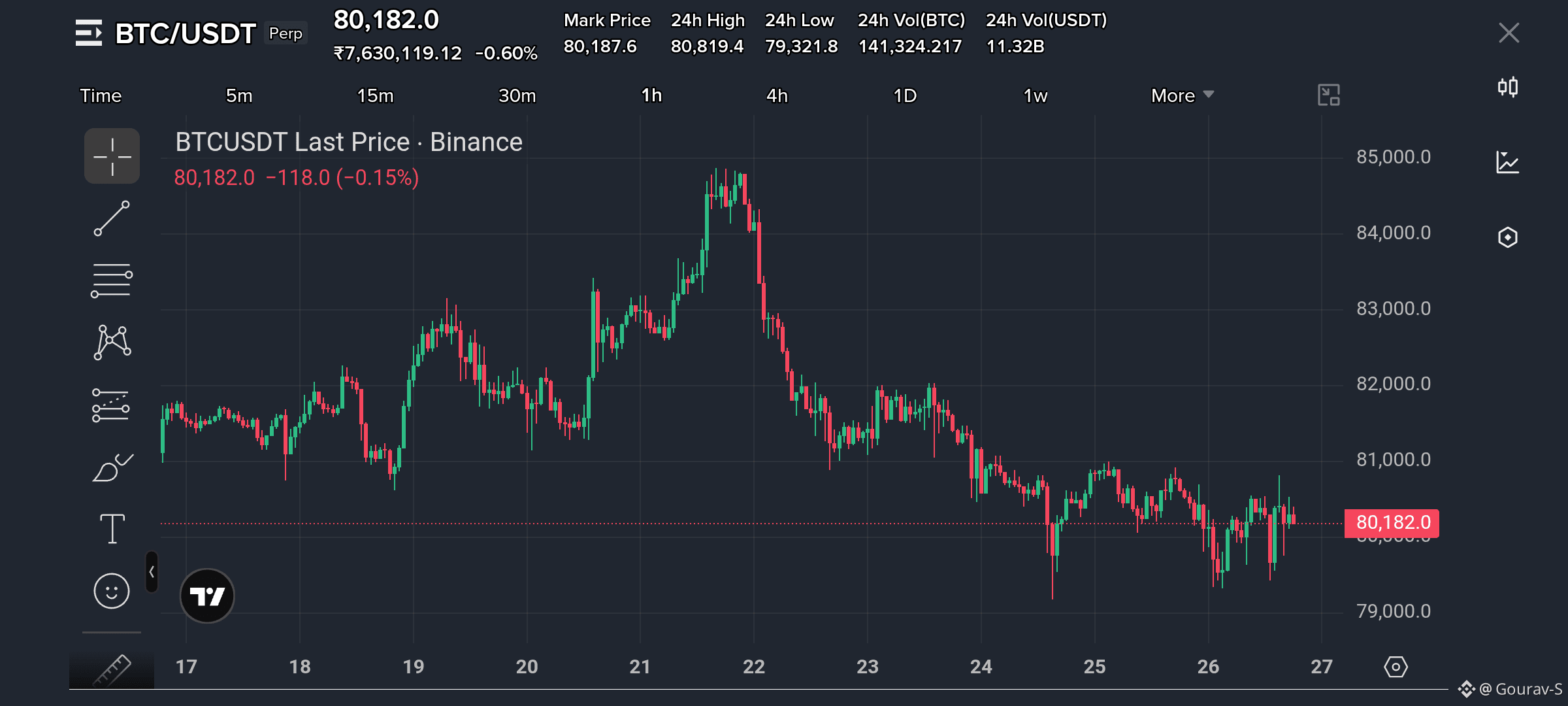
BTC is trading near 80,180, stuck in a range after the pump to 84,800 on 21-22 Oct. Lower highs are forming and price keeps bouncing off 79,300.
Support 79,200-79,300
Resistance 80,800-81,000, then 82,000
- Long: Entry 79,400-79,600 on a bullish bounce.
SL below 78,900.
Targets 80,800 / 81,500.
- Short: Only if a 1H candle closes below 79,200. Enter on retest, SL above 79,900. Target 78,000.
- No trade in the middle of the range (79,500-80,500).
Risk 1-2% per trade, low leverage, always use a stop-loss.
Educational purpose only, not financial advice. Do your own research.
#BTC #TradingSignals #TradingStrategies💼💰 #BinanceSquare #BinancePick
$BTC
{future}(BTCUSDT)
$BTC
BTC is trading near 80,180, stuck in a range after the pump to 84,800 on 21-22 Oct. Lower highs are forming and price keeps bouncing off 79,300.
Support 79,200-79,300
Resistance 80,800-81,000, then 82,000
- Long: Entry 79,400-79,600 on a bullish bounce.
SL below 78,900.
Targets 80,800 / 81,500.
- Short: Only if a 1H candle closes below 79,200. Enter on retest, SL above 79,900. Target 78,000.
- No trade in the middle of the range (79,500-80,500).
Risk 1-2% per trade, low leverage, always use a stop-loss.
Educational purpose only, not financial advice. Do your own research.
#BTC #TradingSignals #TradingStrategies💼💰 #BinanceSquare #BinancePick
$BTC
BTC is trading near 80,180, stuck in a range after the pump to 84,800 on 21-22 Oct. Lower highs are forming and price keeps bouncing off 79,300.
Support 79,200-79,300
Resistance 80,800-81,000, then 82,000
- Long: Entry 79,400-79,600 on a bullish bounce.
SL below 78,900.
Targets 80,800 / 81,500.
- Short: Only if a 1H candle closes below 79,200. Enter on retest, SL above 79,900. Target 78,000.
- No trade in the middle of the range (79,500-80,500).
Risk 1-2% per trade, low leverage, always use a stop-loss.
Educational purpose only, not financial advice. Do your own research.
#BTC #TradingSignals #TradingStrategies💼💰 #BinanceSquare #BinancePick
$BTC
2
179
·
--
Bullish
Bitcoin at $80.2K: Buyers Are Stepping In, But Is the Downtrend Really Over? 📉
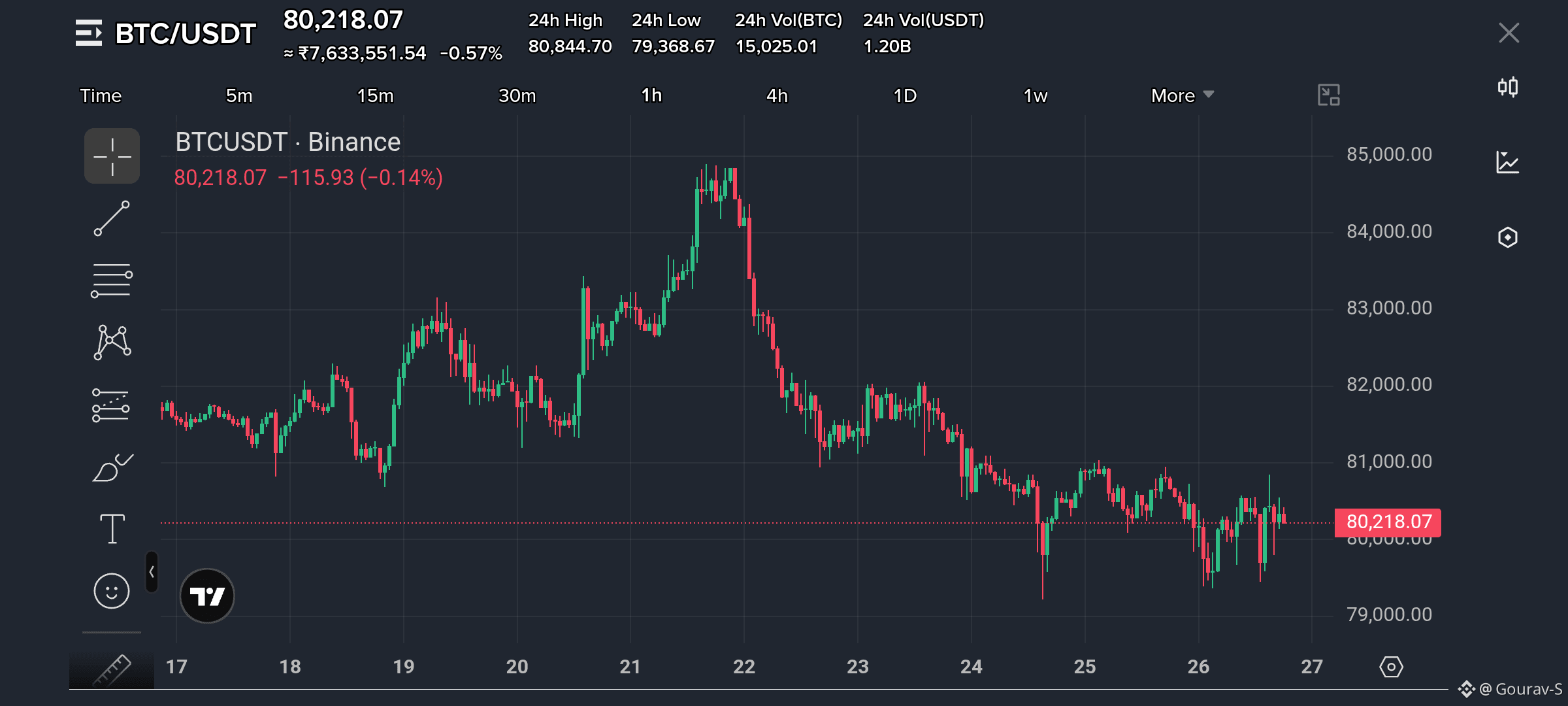
BTC is trading near $80,218, and the chart shows a clear pullback from the $84,700 area. The key question now is whether buyers can turn this bounce into a genuine recovery.
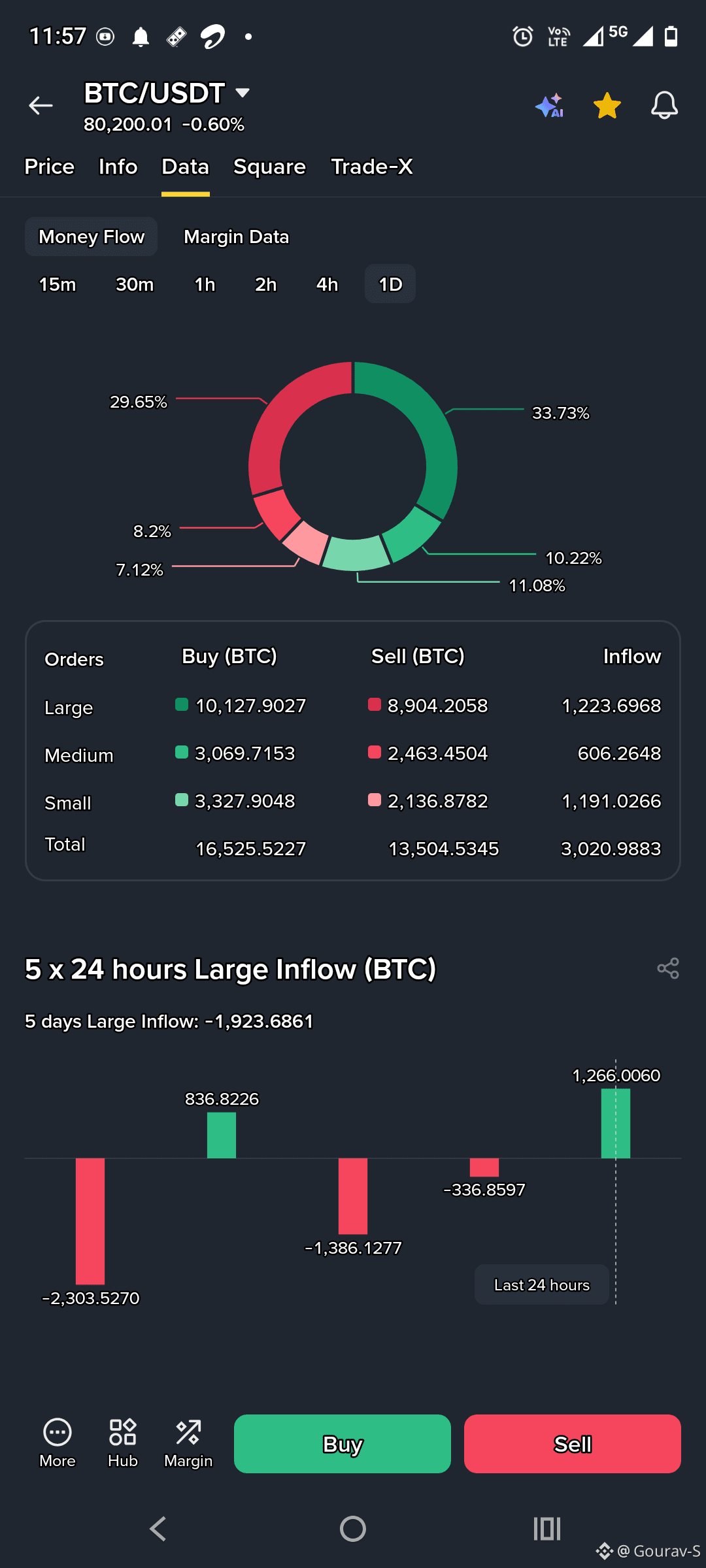
The money-flow gives a mixed signal. Total buy-side inflow is approximately 3,021 BTC in the 24-hour data, with large orders showing positive inflow. However, the five-day large-order flow remains negative at around 1,924 BTC. That means recent buying is encouraging, but it doesn’t yet confirm a sustained reversal.
Here’s what I’m watching:
- Resistance: $80,800–$81,000. A strong reclaim could improve short-term momentum.
- Support: Around $79,400, near the 24-hour low. A breakdown could invite another round of selling.
- Confirmation: Higher highs, stronger follow-through and sustained buying pressure.
My view: BTC remains under short-term pressure until price action confirms a recovery. Positive money flow alone isn’t enough to call a bottom.
What do you think comes next: a recovery above $81K or another test below $79.4K? Share your reasoning.
#bitcoin #BTC #CryptoMarket #BinanceSquare
$BTC
{spot}(BTCUSDT)
Bitcoin at $80.2K: Buyers Are Stepping In, But Is the Downtrend Really Over? 📉
BTC is trading near $80,218, and the chart shows a clear pullback from the $84,700 area. The key question now is whether buyers can turn this bounce into a genuine recovery.
The money-flow gives a mixed signal. Total buy-side inflow is approximately 3,021 BTC in the 24-hour data, with large orders showing positive inflow. However, the five-day large-order flow remains negative at around 1,924 BTC. That means recent buying is encouraging, but it doesn’t yet confirm a sustained reversal.
Here’s what I’m watching:
- Resistance: $80,800–$81,000. A strong reclaim could improve short-term momentum.
- Support: Around $79,400, near the 24-hour low. A breakdown could invite another round of selling.
- Confirmation: Higher highs, stronger follow-through and sustained buying pressure.
My view: BTC remains under short-term pressure until price action confirms a recovery. Positive money flow alone isn’t enough to call a bottom.
What do you think comes next: a recovery above $81K or another test below $79.4K? Share your reasoning.
#bitcoin #BTC #CryptoMarket #BinanceSquare
$BTC
BTC is trading near $80,218, and the chart shows a clear pullback from the $84,700 area. The key question now is whether buyers can turn this bounce into a genuine recovery.
The money-flow gives a mixed signal. Total buy-side inflow is approximately 3,021 BTC in the 24-hour data, with large orders showing positive inflow. However, the five-day large-order flow remains negative at around 1,924 BTC. That means recent buying is encouraging, but it doesn’t yet confirm a sustained reversal.
Here’s what I’m watching:
- Resistance: $80,800–$81,000. A strong reclaim could improve short-term momentum.
- Support: Around $79,400, near the 24-hour low. A breakdown could invite another round of selling.
- Confirmation: Higher highs, stronger follow-through and sustained buying pressure.
My view: BTC remains under short-term pressure until price action confirms a recovery. Positive money flow alone isn’t enough to call a bottom.
What do you think comes next: a recovery above $81K or another test below $79.4K? Share your reasoning.
#bitcoin #BTC #CryptoMarket #BinanceSquare
$BTC
1
149
·
--
#AnthropicTTMRevenueGrewAbout1200%
Anthropic’s TTM Revenue Explodes by Around 1,200% : AI Growth Is Accelerating! 🚀
Anthropic’s IPO filing reveals just how quickly the company behind Claude is scaling its business.
According to its S-1 filing, trailing-twelve-month revenue per employee increased from approximately $1.4 million in September 2025 to more than $6.6 million in September 2026. Combined with roughly 170% workforce growth, this points to estimated overall TTM revenue growth of around 1,200%.
The momentum is also visible in reported financials: Anthropic generated $16.3 billion in revenue during the first half of 2026, up from $1.16 billion in the same period last year.
My take: Enterprise adoption and demand for AI coding tools are becoming major growth drivers. But rapid revenue growth doesn’t automatically mean sustainable profitability. Anthropic reported a $693 million operating loss for the first half, while its $80.7 billion net loss was largely driven by accounting changes in the value of convertible notes and related instruments.
The big question: Can Anthropic turn extraordinary AI demand into sustainable profits?
#Anthropic #AI #IPO #TechStocks
#AnthropicTTMRevenueGrewAbout1200%
Anthropic’s TTM Revenue Explodes by Around 1,200% : AI Growth Is Accelerating! 🚀
Anthropic’s IPO filing reveals just how quickly the company behind Claude is scaling its business.
According to its S-1 filing, trailing-twelve-month revenue per employee increased from approximately $1.4 million in September 2025 to more than $6.6 million in September 2026. Combined with roughly 170% workforce growth, this points to estimated overall TTM revenue growth of around 1,200%.
The momentum is also visible in reported financials: Anthropic generated $16.3 billion in revenue during the first half of 2026, up from $1.16 billion in the same period last year.
My take: Enterprise adoption and demand for AI coding tools are becoming major growth drivers. But rapid revenue growth doesn’t automatically mean sustainable profitability. Anthropic reported a $693 million operating loss for the first half, while its $80.7 billion net loss was largely driven by accounting changes in the value of convertible notes and related instruments.
The big question: Can Anthropic turn extraordinary AI demand into sustainable profits?
#Anthropic #AI #IPO #TechStocks
Anthropic’s TTM Revenue Explodes by Around 1,200% : AI Growth Is Accelerating! 🚀
Anthropic’s IPO filing reveals just how quickly the company behind Claude is scaling its business.
According to its S-1 filing, trailing-twelve-month revenue per employee increased from approximately $1.4 million in September 2025 to more than $6.6 million in September 2026. Combined with roughly 170% workforce growth, this points to estimated overall TTM revenue growth of around 1,200%.
The momentum is also visible in reported financials: Anthropic generated $16.3 billion in revenue during the first half of 2026, up from $1.16 billion in the same period last year.
My take: Enterprise adoption and demand for AI coding tools are becoming major growth drivers. But rapid revenue growth doesn’t automatically mean sustainable profitability. Anthropic reported a $693 million operating loss for the first half, while its $80.7 billion net loss was largely driven by accounting changes in the value of convertible notes and related instruments.
The big question: Can Anthropic turn extraordinary AI demand into sustainable profits?
#Anthropic #AI #IPO #TechStocks
1
109
·
--
#AnthropicS1ExpectedToday
Anthropic Files Its S-1: The AI IPO Race Just Entered a New Phase 🚀
The maker of Claude is taking a major step toward becoming a publicly traded company.
Anthropic publicly filed its S-1 registration statement with the SEC on October 26, 2026, and plans to list on Nasdaq under the ticker $ANT. Its share price and the number of shares to be offered have not yet been announced.
The numbers tell an interesting story: first-half 2026 revenue reached $16.3 billion, up from $1.2 billion a year earlier. However, the company also reported a $693 million operating loss and an $80.7 billion net loss, largely driven by non-cash accounting adjustments tied to convertible debt.
My take: Anthropic’s revenue growth shows strong commercial demand for AI, but investors will need to examine profitability, infrastructure costs and valuation before judging the opportunity.
Would you invest in Anthropic at IPO, or wait for its first public earnings report?
#Anthropic #AI #IPO #TechStocks
#AnthropicS1ExpectedToday
Anthropic Files Its S-1: The AI IPO Race Just Entered a New Phase 🚀
The maker of Claude is taking a major step toward becoming a publicly traded company.
Anthropic publicly filed its S-1 registration statement with the SEC on October 26, 2026, and plans to list on Nasdaq under the ticker $ANT. Its share price and the number of shares to be offered have not yet been announced.
The numbers tell an interesting story: first-half 2026 revenue reached $16.3 billion, up from $1.2 billion a year earlier. However, the company also reported a $693 million operating loss and an $80.7 billion net loss, largely driven by non-cash accounting adjustments tied to convertible debt.
My take: Anthropic’s revenue growth shows strong commercial demand for AI, but investors will need to examine profitability, infrastructure costs and valuation before judging the opportunity.
Would you invest in Anthropic at IPO, or wait for its first public earnings report?
#Anthropic #AI #IPO #TechStocks
Anthropic Files Its S-1: The AI IPO Race Just Entered a New Phase 🚀
The maker of Claude is taking a major step toward becoming a publicly traded company.
Anthropic publicly filed its S-1 registration statement with the SEC on October 26, 2026, and plans to list on Nasdaq under the ticker $ANT. Its share price and the number of shares to be offered have not yet been announced.
The numbers tell an interesting story: first-half 2026 revenue reached $16.3 billion, up from $1.2 billion a year earlier. However, the company also reported a $693 million operating loss and an $80.7 billion net loss, largely driven by non-cash accounting adjustments tied to convertible debt.
My take: Anthropic’s revenue growth shows strong commercial demand for AI, but investors will need to examine profitability, infrastructure costs and valuation before judging the opportunity.
Would you invest in Anthropic at IPO, or wait for its first public earnings report?
#Anthropic #AI #IPO #TechStocks
1
84
·
--
#FranklinTempletonFilesForTwoDividendToBitcoinETFs
Franklin Templeton’s New ETF Strategy: Stock Dividends Flow Into Bitcoin! ₿
What if your stock portfolio could build Bitcoin exposure automatically through its dividend income?
Franklin Templeton has registered two proposed ETFs for Nasdaq: FBEQ (US Equity Bitcoin DRIP) and FIBT (US Innovation Bitcoin DRIP).
Their strategy combines US stocks with Bitcoin exposure funded by reinvesting dividends from the underlying equities. The innovation-focused fund tracks a technology-heavy index, while the other follows a broad US large-cap index. Annual operating expenses are listed at 0.09% for FBEQ and 0.19% for FIBT.
My take: this creates an interesting bridge between traditional equities and crypto. But dividend-funded Bitcoin exposure still carries BTC volatility, while stock prices and investment costs can affect returns.
The prospectuses are scheduled to become effective on October 27; that does not automatically mean trading has begun.
Would you prefer receiving cash dividends or using them to build Bitcoin exposure?
#bitcoin #BTC #ETFs #CryptoNews
#FranklinTempletonFilesForTwoDividendToBitcoinETFs
Franklin Templeton’s New ETF Strategy: Stock Dividends Flow Into Bitcoin! ₿
What if your stock portfolio could build Bitcoin exposure automatically through its dividend income?
Franklin Templeton has registered two proposed ETFs for Nasdaq: FBEQ (US Equity Bitcoin DRIP) and FIBT (US Innovation Bitcoin DRIP).
Their strategy combines US stocks with Bitcoin exposure funded by reinvesting dividends from the underlying equities. The innovation-focused fund tracks a technology-heavy index, while the other follows a broad US large-cap index. Annual operating expenses are listed at 0.09% for FBEQ and 0.19% for FIBT.
My take: this creates an interesting bridge between traditional equities and crypto. But dividend-funded Bitcoin exposure still carries BTC volatility, while stock prices and investment costs can affect returns.
The prospectuses are scheduled to become effective on October 27; that does not automatically mean trading has begun.
Would you prefer receiving cash dividends or using them to build Bitcoin exposure?
#bitcoin #BTC #ETFs #CryptoNews
Franklin Templeton’s New ETF Strategy: Stock Dividends Flow Into Bitcoin! ₿
What if your stock portfolio could build Bitcoin exposure automatically through its dividend income?
Franklin Templeton has registered two proposed ETFs for Nasdaq: FBEQ (US Equity Bitcoin DRIP) and FIBT (US Innovation Bitcoin DRIP).
Their strategy combines US stocks with Bitcoin exposure funded by reinvesting dividends from the underlying equities. The innovation-focused fund tracks a technology-heavy index, while the other follows a broad US large-cap index. Annual operating expenses are listed at 0.09% for FBEQ and 0.19% for FIBT.
My take: this creates an interesting bridge between traditional equities and crypto. But dividend-funded Bitcoin exposure still carries BTC volatility, while stock prices and investment costs can affect returns.
The prospectuses are scheduled to become effective on October 27; that does not automatically mean trading has begun.
Would you prefer receiving cash dividends or using them to build Bitcoin exposure?
#bitcoin #BTC #ETFs #CryptoNews
1
112
·
--
Canada Proposes 3-Day Stablecoin Redemptions : A Major Step for Crypto Payments? 🇨🇦Canada is moving toward clearer stablecoin rules, and one proposal deserves attention: issuers would have to process redemption requests within 3 business days.
Under draft regulations published on October 24, issuers would be required to redeem eligible stablecoins at a 1:1 value against their reference currency, accept requests regardless of the redemption amount, and cap redemption fees at 1%.
My take: this could strengthen confidence in stablecoins by making redemption rights more transparent and limiting excessive fees. However, the proposal allows daily redemption limits when liquidity shortages in reserve-asset markets prevent issuers from meeting all requests.
These rules are not yet in force. Public consultation runs until December 23, 2026, with implementation targeted for 2027.
The bigger question is whether stronger redemption protections will encourage wider stablecoin adoption for digital payments.
Would clearer regulations make you more confident in using stablecoins? Why or why not?
#CanadaProposesStablecoinRedemptionWithin3BusinessDays #Stablecoins #CryptoRegulation #bitcoin #BinanceSquare
Canada Proposes 3-Day Stablecoin Redemptions : A Major Step for Crypto Payments? 🇨🇦
Canada is moving toward clearer stablecoin rules, and one proposal deserves attention: issuers would have to process redemption requests within 3 business days.
Under draft regulations published on October 24, issuers would be required to redeem eligible stablecoins at a 1:1 value against their reference currency, accept requests regardless of the redemption amount, and cap redemption fees at 1%.
My take: this could strengthen confidence in stablecoins by making redemption rights more transparent and limiting excessive fees. However, the proposal allows daily redemption limits when liquidity shortages in reserve-asset markets prevent issuers from meeting all requests.
These rules are not yet in force. Public consultation runs until December 23, 2026, with implementation targeted for 2027.
The bigger question is whether stronger redemption protections will encourage wider stablecoin adoption for digital payments.
Would clearer regulations make you more confident in using stablecoins? Why or why not?
#CanadaProposesStablecoinRedemptionWithin3BusinessDays #Stablecoins #CryptoRegulation #bitcoin #BinanceSquare
Under draft regulations published on October 24, issuers would be required to redeem eligible stablecoins at a 1:1 value against their reference currency, accept requests regardless of the redemption amount, and cap redemption fees at 1%.
My take: this could strengthen confidence in stablecoins by making redemption rights more transparent and limiting excessive fees. However, the proposal allows daily redemption limits when liquidity shortages in reserve-asset markets prevent issuers from meeting all requests.
These rules are not yet in force. Public consultation runs until December 23, 2026, with implementation targeted for 2027.
The bigger question is whether stronger redemption protections will encourage wider stablecoin adoption for digital payments.
Would clearer regulations make you more confident in using stablecoins? Why or why not?
#CanadaProposesStablecoinRedemptionWithin3BusinessDays #Stablecoins #CryptoRegulation #bitcoin #BinanceSquare
1
101
·
--
#StrategyMSTRSurpassesNasdaqInMarketCap
Strategy ($MSTR ) Surpasses Nasdaq in Market Cap : Bitcoin’s Influence Is Getting Hard to Ignore! 📈
Strategy, the company known for its massive Bitcoin treasury, has reportedly moved ahead of Nasdaq, Inc. in market capitalization.
Market data for October 23 put Strategy at approximately $61.8 billion, compared with roughly $57.4 billion for Nasdaq, Inc. The gap reflects market valuations, not a comparison with the Nasdaq Composite Index.
My take: Strategy’s valuation shows how closely traditional equity markets can become connected to Bitcoin. Its large BTC holdings give investors indirect Bitcoin exposure through a publicly traded stock.
But there’s a risk investors shouldn’t ignore. MSTR is not the same as holding BTC directly. Its share price can be affected by Bitcoin volatility, financing costs, share issuance and changes in the premium investors assign to its Bitcoin holdings.
The big question: Is MSTR becoming a stronger Bitcoin proxy, or is its valuation too dependent on BTC sentiment?
Share your view below!
#MSTR #CryptoNews #BinanceSquare #Write2Earn!
#StrategyMSTRSurpassesNasdaqInMarketCap
Strategy ($MSTR ) Surpasses Nasdaq in Market Cap : Bitcoin’s Influence Is Getting Hard to Ignore! 📈
Strategy, the company known for its massive Bitcoin treasury, has reportedly moved ahead of Nasdaq, Inc. in market capitalization.
Market data for October 23 put Strategy at approximately $61.8 billion, compared with roughly $57.4 billion for Nasdaq, Inc. The gap reflects market valuations, not a comparison with the Nasdaq Composite Index.
My take: Strategy’s valuation shows how closely traditional equity markets can become connected to Bitcoin. Its large BTC holdings give investors indirect Bitcoin exposure through a publicly traded stock.
But there’s a risk investors shouldn’t ignore. MSTR is not the same as holding BTC directly. Its share price can be affected by Bitcoin volatility, financing costs, share issuance and changes in the premium investors assign to its Bitcoin holdings.
The big question: Is MSTR becoming a stronger Bitcoin proxy, or is its valuation too dependent on BTC sentiment?
Share your view below!
#MSTR #CryptoNews #BinanceSquare #Write2Earn!
Strategy ($MSTR ) Surpasses Nasdaq in Market Cap : Bitcoin’s Influence Is Getting Hard to Ignore! 📈
Strategy, the company known for its massive Bitcoin treasury, has reportedly moved ahead of Nasdaq, Inc. in market capitalization.
Market data for October 23 put Strategy at approximately $61.8 billion, compared with roughly $57.4 billion for Nasdaq, Inc. The gap reflects market valuations, not a comparison with the Nasdaq Composite Index.
My take: Strategy’s valuation shows how closely traditional equity markets can become connected to Bitcoin. Its large BTC holdings give investors indirect Bitcoin exposure through a publicly traded stock.
But there’s a risk investors shouldn’t ignore. MSTR is not the same as holding BTC directly. Its share price can be affected by Bitcoin volatility, financing costs, share issuance and changes in the premium investors assign to its Bitcoin holdings.
The big question: Is MSTR becoming a stronger Bitcoin proxy, or is its valuation too dependent on BTC sentiment?
Share your view below!
#MSTR #CryptoNews #BinanceSquare #Write2Earn!
1
167
·
--
#ElectrumWalletBugLetRogueServersStealFunds
Electrum Wallet Security Alert: A Fee Increase Could Put Your BTC at Risk ⚠️
A serious security flaw in Electrum exposed Bitcoin users to malicious servers that could manipulate pending transactions.
Here’s how the attack worked: a rogue server could replace a legitimate pending payment with a fake transaction directing funds to an attacker. If the user then tried to speed up the payment by increasing its fee, the wallet could sign the fraudulent replacement.
Electrum developers confirmed reports of the attack, including at least one case of lost funds. The good news: Electrum 4.8.3, released on October 24, fixes this specific vulnerability.
My takeaway: update your wallet, download updates only from the official Electrum website, and carefully verify the full recipient address and amount before signing any transaction or fee increase.
In crypto, security is not just about protecting private keys. It’s also about checking what you are actually authorizing.
Do you check the full transaction details before approving a Bitcoin fee increase?
#Bitcoin #BTC #CryptoSecurity
#ElectrumWalletBugLetRogueServersStealFunds
Electrum Wallet Security Alert: A Fee Increase Could Put Your BTC at Risk ⚠️
A serious security flaw in Electrum exposed Bitcoin users to malicious servers that could manipulate pending transactions.
Here’s how the attack worked: a rogue server could replace a legitimate pending payment with a fake transaction directing funds to an attacker. If the user then tried to speed up the payment by increasing its fee, the wallet could sign the fraudulent replacement.
Electrum developers confirmed reports of the attack, including at least one case of lost funds. The good news: Electrum 4.8.3, released on October 24, fixes this specific vulnerability.
My takeaway: update your wallet, download updates only from the official Electrum website, and carefully verify the full recipient address and amount before signing any transaction or fee increase.
In crypto, security is not just about protecting private keys. It’s also about checking what you are actually authorizing.
Do you check the full transaction details before approving a Bitcoin fee increase?
#Bitcoin #BTC #CryptoSecurity
Electrum Wallet Security Alert: A Fee Increase Could Put Your BTC at Risk ⚠️
A serious security flaw in Electrum exposed Bitcoin users to malicious servers that could manipulate pending transactions.
Here’s how the attack worked: a rogue server could replace a legitimate pending payment with a fake transaction directing funds to an attacker. If the user then tried to speed up the payment by increasing its fee, the wallet could sign the fraudulent replacement.
Electrum developers confirmed reports of the attack, including at least one case of lost funds. The good news: Electrum 4.8.3, released on October 24, fixes this specific vulnerability.
My takeaway: update your wallet, download updates only from the official Electrum website, and carefully verify the full recipient address and amount before signing any transaction or fee increase.
In crypto, security is not just about protecting private keys. It’s also about checking what you are actually authorizing.
Do you check the full transaction details before approving a Bitcoin fee increase?
#Bitcoin #BTC #CryptoSecurity
1
138
·
--
Verified
SK Hynix’s $12 Billion Dividend Buzz: A Major Signal for AI Chip Investors? 📊#SKHynixReportedlyPlansSpecialDividendFromKioxiaStakeSale
SK Hynix is reportedly considering a special dividend of around 16 trillion won ($12 billion), potentially funded by gains from its investment in Japanese memory-chip maker Kioxia.
That’s a huge figure, but there’s an important detail: the dividend has not been officially confirmed. SK Hynix says it is reviewing shareholder-return measures and plans to provide an update alongside its Q3 earnings on October 28.
My take: returning a portion of investment gains to shareholders could strengthen investor confidence, especially as demand for AI memory chips drives the industry. However, a one-time dividend is different from sustainable earnings growth. Investors should also watch AI demand, memory-chip pricing, margins and future capital spending.
The real story is not just how much cash shareholders might receive, but how SK Hynix balances shareholder returns with future growth.
Would you prefer a massive special dividend or more investment in AI chip production?
#KIOXIA #AIChips #Semiconductors #stockmarket
SK Hynix’s $12 Billion Dividend Buzz: A Major Signal for AI Chip Investors? 📊
#SKHynixReportedlyPlansSpecialDividendFromKioxiaStakeSale
SK Hynix is reportedly considering a special dividend of around 16 trillion won ($12 billion), potentially funded by gains from its investment in Japanese memory-chip maker Kioxia.
That’s a huge figure, but there’s an important detail: the dividend has not been officially confirmed. SK Hynix says it is reviewing shareholder-return measures and plans to provide an update alongside its Q3 earnings on October 28.
My take: returning a portion of investment gains to shareholders could strengthen investor confidence, especially as demand for AI memory chips drives the industry. However, a one-time dividend is different from sustainable earnings growth. Investors should also watch AI demand, memory-chip pricing, margins and future capital spending.
The real story is not just how much cash shareholders might receive, but how SK Hynix balances shareholder returns with future growth.
Would you prefer a massive special dividend or more investment in AI chip production?
#KIOXIA #AIChips #Semiconductors #stockmarket
SK Hynix is reportedly considering a special dividend of around 16 trillion won ($12 billion), potentially funded by gains from its investment in Japanese memory-chip maker Kioxia.
That’s a huge figure, but there’s an important detail: the dividend has not been officially confirmed. SK Hynix says it is reviewing shareholder-return measures and plans to provide an update alongside its Q3 earnings on October 28.
My take: returning a portion of investment gains to shareholders could strengthen investor confidence, especially as demand for AI memory chips drives the industry. However, a one-time dividend is different from sustainable earnings growth. Investors should also watch AI demand, memory-chip pricing, margins and future capital spending.
The real story is not just how much cash shareholders might receive, but how SK Hynix balances shareholder returns with future growth.
Would you prefer a massive special dividend or more investment in AI chip production?
#KIOXIA #AIChips #Semiconductors #stockmarket
2
552
·
--
#ArgentineCourtDismissesLIBRACaseAgainstMilei
Argentina Dismisses LIBRA Case Against Milei : What Does It Mean for Crypto?
A major development in the LIBRA memecoin controversy. 🇦🇷
An Argentine federal judge has dismissed the criminal case against President Javier Milei, his sister Karina Milei, and nine other individuals over the token’s promotion and subsequent crash. The judge concluded that the evidence did not establish a criminal offence. The decision followed a prosecutor’s request to dismiss the case.
But there’s an important distinction: dismissing a criminal case doesn’t erase the losses suffered by investors.
The $LIBRA episode highlights a critical lesson for crypto markets: prices can surge on publicity and market excitement, but that doesn’t replace due diligence, transparent tokenomics, and risk management.
For investors, the key takeaway remains the same: never buy a token solely because a prominent personality promotes it.
Do you think this ruling will change how investors view politically associated memecoins?
#LIBRA #CryptoNews #Memecoins #BinanceSquare
#ArgentineCourtDismissesLIBRACaseAgainstMilei
Argentina Dismisses LIBRA Case Against Milei : What Does It Mean for Crypto?
A major development in the LIBRA memecoin controversy. 🇦🇷
An Argentine federal judge has dismissed the criminal case against President Javier Milei, his sister Karina Milei, and nine other individuals over the token’s promotion and subsequent crash. The judge concluded that the evidence did not establish a criminal offence. The decision followed a prosecutor’s request to dismiss the case.
But there’s an important distinction: dismissing a criminal case doesn’t erase the losses suffered by investors.
The $LIBRA episode highlights a critical lesson for crypto markets: prices can surge on publicity and market excitement, but that doesn’t replace due diligence, transparent tokenomics, and risk management.
For investors, the key takeaway remains the same: never buy a token solely because a prominent personality promotes it.
Do you think this ruling will change how investors view politically associated memecoins?
#LIBRA #CryptoNews #Memecoins #BinanceSquare
Argentina Dismisses LIBRA Case Against Milei : What Does It Mean for Crypto?
A major development in the LIBRA memecoin controversy. 🇦🇷
An Argentine federal judge has dismissed the criminal case against President Javier Milei, his sister Karina Milei, and nine other individuals over the token’s promotion and subsequent crash. The judge concluded that the evidence did not establish a criminal offence. The decision followed a prosecutor’s request to dismiss the case.
But there’s an important distinction: dismissing a criminal case doesn’t erase the losses suffered by investors.
The $LIBRA episode highlights a critical lesson for crypto markets: prices can surge on publicity and market excitement, but that doesn’t replace due diligence, transparent tokenomics, and risk management.
For investors, the key takeaway remains the same: never buy a token solely because a prominent personality promotes it.
Do you think this ruling will change how investors view politically associated memecoins?
#LIBRA #CryptoNews #Memecoins #BinanceSquare
1
177
·
--
Microsoft Faces the AI Earnings Test: Can $MSFT Deliver Again? 📊
Microsoft’s next earnings report could reveal whether its massive AI investments are translating into sustainable growth.
Wall Street expects approximately $90.6 billion in quarterly revenue and $4.71 in adjusted EPS for the September quarter. Azure growth, Copilot adoption and AI infrastructure spending will be crucial areas to watch.
My prediction: Earnings Beat, cautiously bullish.
Strong cloud demand gives Microsoft a solid growth opportunity, but rising AI costs cannot be ignored. Even if earnings beat expectations, the stock could fall if Azure growth slows or forward guidance disappoints. For me, the real signal will be whether AI spending generates enough revenue to justify the investment.
What’s your call: Beat or Miss? Will $MSFT rise after earnings?
Share your reasoning in the comments!
#EarningsSeason #BinancePick $MSFT
{future}(MSFTUSDT)
{stock_us}(MSFT.US)
#EarningsSeason
Microsoft Faces the AI Earnings Test: Can $MSFT Deliver Again? 📊
Microsoft’s next earnings report could reveal whether its massive AI investments are translating into sustainable growth.
Wall Street expects approximately $90.6 billion in quarterly revenue and $4.71 in adjusted EPS for the September quarter. Azure growth, Copilot adoption and AI infrastructure spending will be crucial areas to watch.
My prediction: Earnings Beat, cautiously bullish.
Strong cloud demand gives Microsoft a solid growth opportunity, but rising AI costs cannot be ignored. Even if earnings beat expectations, the stock could fall if Azure growth slows or forward guidance disappoints. For me, the real signal will be whether AI spending generates enough revenue to justify the investment.
What’s your call: Beat or Miss? Will $MSFT rise after earnings?
Share your reasoning in the comments!
#EarningsSeason #BinancePick $MSFT
#EarningsSeason
Microsoft’s next earnings report could reveal whether its massive AI investments are translating into sustainable growth.
Wall Street expects approximately $90.6 billion in quarterly revenue and $4.71 in adjusted EPS for the September quarter. Azure growth, Copilot adoption and AI infrastructure spending will be crucial areas to watch.
My prediction: Earnings Beat, cautiously bullish.
Strong cloud demand gives Microsoft a solid growth opportunity, but rising AI costs cannot be ignored. Even if earnings beat expectations, the stock could fall if Azure growth slows or forward guidance disappoints. For me, the real signal will be whether AI spending generates enough revenue to justify the investment.
What’s your call: Beat or Miss? Will $MSFT rise after earnings?
Share your reasoning in the comments!
#EarningsSeason #BinancePick $MSFT
#EarningsSeason
MSFT+1.31%
MSFTUS+1.31%
2
279
·
--
#USQ3GDPAndSeptemberPCEDueNextWeek
US GDP and September PCE Next Week : A Critical Test for Bitcoin and Wall Street
Two major US economic reports arrive on October 29, and their combination could reshape market expectations for the Federal Reserve’s next policy moves. 👀
The Bureau of Economic Analysis is scheduled to release Q3 GDP and September PCE inflation at 8:30 AM ET. The latest Wall Street Journal survey points to annualized GDP growth of around 3.2%, while headline PCE inflation is expected to rise 0.5% month over month and 3.7% year over year. Core PCE is forecast at 0.3% monthly and 3.1% annually. These are forecasts, not confirmed results.
My take: The market faces a difficult balance. Strong GDP alongside hotter-than-expected inflation could strengthen the case for keeping interest rates restrictive, potentially pressuring Bitcoin and stocks through higher Treasury yields and a stronger dollar. Conversely, easing inflation could support risk assets, especially if economic growth remains healthy. The key is not just whether the numbers beat expectations, but how markets interpret the combination.
The Fed’s policy announcement comes on October 28, one day before these reports, so Thursday’s data may be especially important for expectations about December.
What matters more for BTC next week: GDP growth or core PCE inflation?
Follow me for more macro and crypto market analysis.
#BTC #PCEInflation #GDP #FederalReserve
#USQ3GDPAndSeptemberPCEDueNextWeek
US GDP and September PCE Next Week : A Critical Test for Bitcoin and Wall Street
Two major US economic reports arrive on October 29, and their combination could reshape market expectations for the Federal Reserve’s next policy moves. 👀
The Bureau of Economic Analysis is scheduled to release Q3 GDP and September PCE inflation at 8:30 AM ET. The latest Wall Street Journal survey points to annualized GDP growth of around 3.2%, while headline PCE inflation is expected to rise 0.5% month over month and 3.7% year over year. Core PCE is forecast at 0.3% monthly and 3.1% annually. These are forecasts, not confirmed results.
My take: The market faces a difficult balance. Strong GDP alongside hotter-than-expected inflation could strengthen the case for keeping interest rates restrictive, potentially pressuring Bitcoin and stocks through higher Treasury yields and a stronger dollar. Conversely, easing inflation could support risk assets, especially if economic growth remains healthy. The key is not just whether the numbers beat expectations, but how markets interpret the combination.
The Fed’s policy announcement comes on October 28, one day before these reports, so Thursday’s data may be especially important for expectations about December.
What matters more for BTC next week: GDP growth or core PCE inflation?
Follow me for more macro and crypto market analysis.
#BTC #PCEInflation #GDP #FederalReserve
US GDP and September PCE Next Week : A Critical Test for Bitcoin and Wall Street
Two major US economic reports arrive on October 29, and their combination could reshape market expectations for the Federal Reserve’s next policy moves. 👀
The Bureau of Economic Analysis is scheduled to release Q3 GDP and September PCE inflation at 8:30 AM ET. The latest Wall Street Journal survey points to annualized GDP growth of around 3.2%, while headline PCE inflation is expected to rise 0.5% month over month and 3.7% year over year. Core PCE is forecast at 0.3% monthly and 3.1% annually. These are forecasts, not confirmed results.
My take: The market faces a difficult balance. Strong GDP alongside hotter-than-expected inflation could strengthen the case for keeping interest rates restrictive, potentially pressuring Bitcoin and stocks through higher Treasury yields and a stronger dollar. Conversely, easing inflation could support risk assets, especially if economic growth remains healthy. The key is not just whether the numbers beat expectations, but how markets interpret the combination.
The Fed’s policy announcement comes on October 28, one day before these reports, so Thursday’s data may be especially important for expectations about December.
What matters more for BTC next week: GDP growth or core PCE inflation?
Follow me for more macro and crypto market analysis.
#BTC #PCEInflation #GDP #FederalReserve
2
393
·
--
South Korea Delays Crypto Income Tax Again : Is 2029 the New Target?
South Korea’s planned crypto tax is facing another delay, giving investors more time before the proposed tax rules take effect. But the legal change is not yet finalized. 👀
On October 25, South Korea’s presidential office reportedly decided to postpone the tax scheduled to begin on January 1, 2027. The proposal would tax annual crypto gains above 2.5 million won at a combined rate of 22%. Lawmakers have proposed pushing implementation to 2029, with a formal revision expected during November’s tax review. The government has cited incomplete tax-collection preparations and concerns about international transaction reporting.
My take: Repeated delays show how difficult it can be to build a fair crypto taxation system when investors use domestic exchanges, overseas platforms and decentralized exchanges. More preparation time could improve reporting accuracy and reduce uncertainty, but frequent postponements also make long-term planning harder for investors and businesses. Until the law is formally amended, investors should not assume the tax has been permanently cancelled.
Do you think South Korea should introduce crypto taxation in 2027 or wait until 2029?
Follow me for more crypto regulation updates.
#SouthKoreaDelaysCryptoIncomeTax #CryptoTax #CryptoRegulation #SouthKorea
South Korea Delays Crypto Income Tax Again : Is 2029 the New Target?
South Korea’s planned crypto tax is facing another delay, giving investors more time before the proposed tax rules take effect. But the legal change is not yet finalized. 👀
On October 25, South Korea’s presidential office reportedly decided to postpone the tax scheduled to begin on January 1, 2027. The proposal would tax annual crypto gains above 2.5 million won at a combined rate of 22%. Lawmakers have proposed pushing implementation to 2029, with a formal revision expected during November’s tax review. The government has cited incomplete tax-collection preparations and concerns about international transaction reporting.
My take: Repeated delays show how difficult it can be to build a fair crypto taxation system when investors use domestic exchanges, overseas platforms and decentralized exchanges. More preparation time could improve reporting accuracy and reduce uncertainty, but frequent postponements also make long-term planning harder for investors and businesses. Until the law is formally amended, investors should not assume the tax has been permanently cancelled.
Do you think South Korea should introduce crypto taxation in 2027 or wait until 2029?
Follow me for more crypto regulation updates.
#SouthKoreaDelaysCryptoIncomeTax #CryptoTax #CryptoRegulation #SouthKorea
South Korea’s planned crypto tax is facing another delay, giving investors more time before the proposed tax rules take effect. But the legal change is not yet finalized. 👀
On October 25, South Korea’s presidential office reportedly decided to postpone the tax scheduled to begin on January 1, 2027. The proposal would tax annual crypto gains above 2.5 million won at a combined rate of 22%. Lawmakers have proposed pushing implementation to 2029, with a formal revision expected during November’s tax review. The government has cited incomplete tax-collection preparations and concerns about international transaction reporting.
My take: Repeated delays show how difficult it can be to build a fair crypto taxation system when investors use domestic exchanges, overseas platforms and decentralized exchanges. More preparation time could improve reporting accuracy and reduce uncertainty, but frequent postponements also make long-term planning harder for investors and businesses. Until the law is formally amended, investors should not assume the tax has been permanently cancelled.
Do you think South Korea should introduce crypto taxation in 2027 or wait until 2029?
Follow me for more crypto regulation updates.
#SouthKoreaDelaysCryptoIncomeTax #CryptoTax #CryptoRegulation #SouthKorea
2
219
·
--
Electrum Fixes High-Risk Bitcoin Wallet Exploit : Older Versions Need Attention
A Bitcoin wallet security flaw has moved from a theoretical risk to a real-world threat, and users need to pay attention. ⚠️
On October 24, Electrum disclosed a high-severity vulnerability affecting every version before 4.8.3. A malicious Electrum server could hide a legitimate transaction and replace it in the wallet’s history with a conflicting transaction directing funds to an attacker. If the user then increased the fee using Replace-by-Fee (RBF), they could unknowingly sign the fraudulent transaction. Electrum reported two user cases, including one involving financial loss.
My take: This incident highlights an important lesson: a wallet’s security depends not only on protecting private keys but also on verifying transaction details before signing. If you use Electrum, update to version 4.8.3 through the official website. Until updated, carefully verify every recipient address and amount, especially when increasing transaction fees. Never approve a transaction simply because it appears in your wallet history.
Do you check the destination address every time you sign a Bitcoin transaction?
Follow me for more crypto security updates.
#ElectrumFixesHighRiskExploitInVersionsBefore4.8.3 #bitcoin #BTC #CryptoSecurity
Electrum Fixes High-Risk Bitcoin Wallet Exploit : Older Versions Need Attention
A Bitcoin wallet security flaw has moved from a theoretical risk to a real-world threat, and users need to pay attention. ⚠️
On October 24, Electrum disclosed a high-severity vulnerability affecting every version before 4.8.3. A malicious Electrum server could hide a legitimate transaction and replace it in the wallet’s history with a conflicting transaction directing funds to an attacker. If the user then increased the fee using Replace-by-Fee (RBF), they could unknowingly sign the fraudulent transaction. Electrum reported two user cases, including one involving financial loss.
My take: This incident highlights an important lesson: a wallet’s security depends not only on protecting private keys but also on verifying transaction details before signing. If you use Electrum, update to version 4.8.3 through the official website. Until updated, carefully verify every recipient address and amount, especially when increasing transaction fees. Never approve a transaction simply because it appears in your wallet history.
Do you check the destination address every time you sign a Bitcoin transaction?
Follow me for more crypto security updates.
#ElectrumFixesHighRiskExploitInVersionsBefore4.8.3 #bitcoin #BTC #CryptoSecurity
A Bitcoin wallet security flaw has moved from a theoretical risk to a real-world threat, and users need to pay attention. ⚠️
On October 24, Electrum disclosed a high-severity vulnerability affecting every version before 4.8.3. A malicious Electrum server could hide a legitimate transaction and replace it in the wallet’s history with a conflicting transaction directing funds to an attacker. If the user then increased the fee using Replace-by-Fee (RBF), they could unknowingly sign the fraudulent transaction. Electrum reported two user cases, including one involving financial loss.
My take: This incident highlights an important lesson: a wallet’s security depends not only on protecting private keys but also on verifying transaction details before signing. If you use Electrum, update to version 4.8.3 through the official website. Until updated, carefully verify every recipient address and amount, especially when increasing transaction fees. Never approve a transaction simply because it appears in your wallet history.
Do you check the destination address every time you sign a Bitcoin transaction?
Follow me for more crypto security updates.
#ElectrumFixesHighRiskExploitInVersionsBefore4.8.3 #bitcoin #BTC #CryptoSecurity
1
673
·
--
Bitcoin Lost $80K Before the Fed Meeting : What If Buyers Fail to Reclaim It?
Bitcoin has already breached the $80,000 level, and the money-flow data suggests buyers still have work to do.
BTC/USDT is trading near $79,892, down 2.14%. The 1-day money-flow data shows approximately 11,450 BTC in buying versus 13,686 BTC in selling, producing a net outflow of around 2,236 BTC. Large orders alone show a net outflow of nearly 1,397 BTC. The latest 24-hour large-order flow is also negative.
My take: The concern isn't simply that Bitcoin lost $80K; it's that selling pressure is outweighing buying pressure near a psychologically important level. The Federal Reserve meets on October 27–28, and uncertainty around its decision could keep volatility elevated. If BTC cannot reclaim and sustain $80K next week, I would remain cautious because the market may need to search for lower support. A quick recovery accompanied by stronger buying would challenge this bearish view.
For now, I would watch how BTC behaves around $80K rather than assume a reversal is coming.
Do you expect Bitcoin to reclaim $80K before the Fed decision, or will sellers push it lower?
Follow me for more BTC market analysis.
$BTC
{spot}(BTCUSDT)
#bitcoin #BTC #CryptoMarket #FedMeeting #Moneyflow
Bitcoin Lost $80K Before the Fed Meeting : What If Buyers Fail to Reclaim It?
Bitcoin has already breached the $80,000 level, and the money-flow data suggests buyers still have work to do.
BTC/USDT is trading near $79,892, down 2.14%. The 1-day money-flow data shows approximately 11,450 BTC in buying versus 13,686 BTC in selling, producing a net outflow of around 2,236 BTC. Large orders alone show a net outflow of nearly 1,397 BTC. The latest 24-hour large-order flow is also negative.
My take: The concern isn't simply that Bitcoin lost $80K; it's that selling pressure is outweighing buying pressure near a psychologically important level. The Federal Reserve meets on October 27–28, and uncertainty around its decision could keep volatility elevated. If BTC cannot reclaim and sustain $80K next week, I would remain cautious because the market may need to search for lower support. A quick recovery accompanied by stronger buying would challenge this bearish view.
For now, I would watch how BTC behaves around $80K rather than assume a reversal is coming.
Do you expect Bitcoin to reclaim $80K before the Fed decision, or will sellers push it lower?
Follow me for more BTC market analysis.
$BTC
#bitcoin #BTC #CryptoMarket #FedMeeting #Moneyflow
Bitcoin has already breached the $80,000 level, and the money-flow data suggests buyers still have work to do.
BTC/USDT is trading near $79,892, down 2.14%. The 1-day money-flow data shows approximately 11,450 BTC in buying versus 13,686 BTC in selling, producing a net outflow of around 2,236 BTC. Large orders alone show a net outflow of nearly 1,397 BTC. The latest 24-hour large-order flow is also negative.
My take: The concern isn't simply that Bitcoin lost $80K; it's that selling pressure is outweighing buying pressure near a psychologically important level. The Federal Reserve meets on October 27–28, and uncertainty around its decision could keep volatility elevated. If BTC cannot reclaim and sustain $80K next week, I would remain cautious because the market may need to search for lower support. A quick recovery accompanied by stronger buying would challenge this bearish view.
For now, I would watch how BTC behaves around $80K rather than assume a reversal is coming.
Do you expect Bitcoin to reclaim $80K before the Fed decision, or will sellers push it lower?
Follow me for more BTC market analysis.
$BTC
#bitcoin #BTC #CryptoMarket #FedMeeting #Moneyflow
4
737
·
--
Microsoft Earnings: Can AI Growth Beat Wall Street’s Expectations?
Microsoft’s next earnings report arrives on October 28. Analysts expect approximately $90.6 billion in revenue and $4.71 in adjusted EPS for the quarter.
I’m leaning toward a $BEAT because Azure cloud demand and enterprise AI adoption could continue supporting growth. But here’s the risk: AI infrastructure requires massive investment, and investors want to see those investments translate into real revenue and sustainable profits.
For me, the biggest signals will be Azure growth, profit margins, AI monetization, and forward guidance. Even if Microsoft beats estimates, $MSFT could fall if expectations are already too high or management disappoints investors.
My view: Cautiously bullish, with guidance deciding the stock’s reaction.
What’s your prediction: Beat or Miss? Will MSFT rise after earnings?
#BinancePick $MSFT
#EarningsSeason
Microsoft Earnings: Can AI Growth Beat Wall Street’s Expectations?
Microsoft’s next earnings report arrives on October 28. Analysts expect approximately $90.6 billion in revenue and $4.71 in adjusted EPS for the quarter.
I’m leaning toward a $BEAT because Azure cloud demand and enterprise AI adoption could continue supporting growth. But here’s the risk: AI infrastructure requires massive investment, and investors want to see those investments translate into real revenue and sustainable profits.
For me, the biggest signals will be Azure growth, profit margins, AI monetization, and forward guidance. Even if Microsoft beats estimates, $MSFT could fall if expectations are already too high or management disappoints investors.
My view: Cautiously bullish, with guidance deciding the stock’s reaction.
What’s your prediction: Beat or Miss? Will MSFT rise after earnings?
#BinancePick $MSFT
#EarningsSeason
Microsoft’s next earnings report arrives on October 28. Analysts expect approximately $90.6 billion in revenue and $4.71 in adjusted EPS for the quarter.
I’m leaning toward a $BEAT because Azure cloud demand and enterprise AI adoption could continue supporting growth. But here’s the risk: AI infrastructure requires massive investment, and investors want to see those investments translate into real revenue and sustainable profits.
For me, the biggest signals will be Azure growth, profit margins, AI monetization, and forward guidance. Even if Microsoft beats estimates, $MSFT could fall if expectations are already too high or management disappoints investors.
My view: Cautiously bullish, with guidance deciding the stock’s reaction.
What’s your prediction: Beat or Miss? Will MSFT rise after earnings?
#BinancePick $MSFT
#EarningsSeason
2
170
·
--
UK May Require FCA Authorization for Algorithmic Crypto Trading Apps : What Changes?Your trading algorithm may be doing more than executing orders. That distinction could determine whether its provider needs regulatory approval in the UK. 👀
On October 21, the UK Financial Conduct Authority (FCA) opened a consultation on draft guidance explaining which crypto businesses may require authorization under the incoming regulatory regime.
Apps that automatically select trading venues or execution routes based on price, liquidity, cost or speed could fall within rules covering the arrangement of crypto transactions. By contrast, software that simply transmits customer instructions without influencing execution may qualify for a technical-services exemption.
My take: This is an important development for DeFi aggregators, automated trading platforms and crypto software developers. Automation alone does not guarantee exemption from regulation. Businesses will need to examine how their algorithms make decisions and whether their services actually facilitate transactions. Clearer rules could strengthen consumer protection, but uncertainty over licensing could also increase compliance costs and slow some innovations.
The new regime is scheduled to take effect on October 25, 2027, while consultation responses are due by November 18, 2026.
Should algorithmic crypto apps face the same regulatory scrutiny as traditional financial intermediaries?
Follow me for more crypto regulation updates.
#UKAlgorithmicCryptoTradingAppsMayNeedFCAAuthorization #CryptoRegulation #FCA #DeFi! #AlgorithmicTrading
UK May Require FCA Authorization for Algorithmic Crypto Trading Apps : What Changes?
Your trading algorithm may be doing more than executing orders. That distinction could determine whether its provider needs regulatory approval in the UK. 👀
On October 21, the UK Financial Conduct Authority (FCA) opened a consultation on draft guidance explaining which crypto businesses may require authorization under the incoming regulatory regime.
Apps that automatically select trading venues or execution routes based on price, liquidity, cost or speed could fall within rules covering the arrangement of crypto transactions. By contrast, software that simply transmits customer instructions without influencing execution may qualify for a technical-services exemption.
My take: This is an important development for DeFi aggregators, automated trading platforms and crypto software developers. Automation alone does not guarantee exemption from regulation. Businesses will need to examine how their algorithms make decisions and whether their services actually facilitate transactions. Clearer rules could strengthen consumer protection, but uncertainty over licensing could also increase compliance costs and slow some innovations.
The new regime is scheduled to take effect on October 25, 2027, while consultation responses are due by November 18, 2026.
Should algorithmic crypto apps face the same regulatory scrutiny as traditional financial intermediaries?
Follow me for more crypto regulation updates.
#UKAlgorithmicCryptoTradingAppsMayNeedFCAAuthorization #CryptoRegulation #FCA #DeFi! #AlgorithmicTrading
On October 21, the UK Financial Conduct Authority (FCA) opened a consultation on draft guidance explaining which crypto businesses may require authorization under the incoming regulatory regime.
Apps that automatically select trading venues or execution routes based on price, liquidity, cost or speed could fall within rules covering the arrangement of crypto transactions. By contrast, software that simply transmits customer instructions without influencing execution may qualify for a technical-services exemption.
My take: This is an important development for DeFi aggregators, automated trading platforms and crypto software developers. Automation alone does not guarantee exemption from regulation. Businesses will need to examine how their algorithms make decisions and whether their services actually facilitate transactions. Clearer rules could strengthen consumer protection, but uncertainty over licensing could also increase compliance costs and slow some innovations.
The new regime is scheduled to take effect on October 25, 2027, while consultation responses are due by November 18, 2026.
Should algorithmic crypto apps face the same regulatory scrutiny as traditional financial intermediaries?
Follow me for more crypto regulation updates.
#UKAlgorithmicCryptoTradingAppsMayNeedFCAAuthorization #CryptoRegulation #FCA #DeFi! #AlgorithmicTrading
3
202
·
--
#MarketsPriceJust10%ChanceOfFedHikeNextWeek
Fed Hike Odds Fall to Just 10% : Is Wall Street Getting Some Relief?
The next Federal Reserve decision is approaching, but markets are not expecting another immediate rate hike. 👀
As of the October 23 market close, interest-rate futures priced in roughly a 10% chance of a 25-basis-point hike at the October 27–28 FOMC meeting, implying a 90% probability of rates remaining unchanged. The Fed raised its benchmark rate to 3.75%–4.00% in September, while inflation remains elevated.
My take: A pause could ease immediate pressure on risk assets such as stocks and Bitcoin, but it doesn't automatically mean the Fed is turning dovish. Rising oil prices and persistent inflation could keep future rate hikes on the table. The December outlook and the Fed's comments will matter just as much as the October decision. I'm watching Treasury yields, the US dollar and BTC's reaction for confirmation rather than trading on rate-hike odds alone.
What matters more to you: the Fed's October decision or its signal for December?
Follow me for more macro and crypto market analysis.
#FederalReserve #FedRates #stockmarket #Macro
#MarketsPriceJust10%ChanceOfFedHikeNextWeek
Fed Hike Odds Fall to Just 10% : Is Wall Street Getting Some Relief?
The next Federal Reserve decision is approaching, but markets are not expecting another immediate rate hike. 👀
As of the October 23 market close, interest-rate futures priced in roughly a 10% chance of a 25-basis-point hike at the October 27–28 FOMC meeting, implying a 90% probability of rates remaining unchanged. The Fed raised its benchmark rate to 3.75%–4.00% in September, while inflation remains elevated.
My take: A pause could ease immediate pressure on risk assets such as stocks and Bitcoin, but it doesn't automatically mean the Fed is turning dovish. Rising oil prices and persistent inflation could keep future rate hikes on the table. The December outlook and the Fed's comments will matter just as much as the October decision. I'm watching Treasury yields, the US dollar and BTC's reaction for confirmation rather than trading on rate-hike odds alone.
What matters more to you: the Fed's October decision or its signal for December?
Follow me for more macro and crypto market analysis.
#FederalReserve #FedRates #stockmarket #Macro
Fed Hike Odds Fall to Just 10% : Is Wall Street Getting Some Relief?
The next Federal Reserve decision is approaching, but markets are not expecting another immediate rate hike. 👀
As of the October 23 market close, interest-rate futures priced in roughly a 10% chance of a 25-basis-point hike at the October 27–28 FOMC meeting, implying a 90% probability of rates remaining unchanged. The Fed raised its benchmark rate to 3.75%–4.00% in September, while inflation remains elevated.
My take: A pause could ease immediate pressure on risk assets such as stocks and Bitcoin, but it doesn't automatically mean the Fed is turning dovish. Rising oil prices and persistent inflation could keep future rate hikes on the table. The December outlook and the Fed's comments will matter just as much as the October decision. I'm watching Treasury yields, the US dollar and BTC's reaction for confirmation rather than trading on rate-hike odds alone.
What matters more to you: the Fed's October decision or its signal for December?
Follow me for more macro and crypto market analysis.
#FederalReserve #FedRates #stockmarket #Macro
3
160
·
--
#DowDrops653Points
Dow Drops 653 Points as Oil Surges Above $116 : Should Investors Be Worried?
Wall Street ended Friday under pressure, and rising oil prices are adding another layer of uncertainty to an already nervous market.
On October 23, the Dow Jones Industrial Average fell 652.82 points (1.23%) to 52,215.16. The S&P 500 slipped 0.52%, while the Nasdaq Composite lost 0.21%. Brent crude jumped 3.1% to above $116 per barrel, its highest level since June 2022, while the 10-year US Treasury yield climbed to around 4.99%.
My take: The biggest concern is the combination of expensive oil, rising inflation risks and uncertainty over the returns on massive AI investments. Higher energy costs can squeeze company margins and consumer spending, while rising Treasury yields can make stocks less attractive. However, the Dow still gained 0.4% for the week, so one difficult session does not automatically signal a larger market breakdown.
The next signals to watch are crude oil prices, Treasury yields and upcoming earnings from major technology companies.
Do you think this is a temporary correction or the start of deeper selling?
Follow me for more market insights.
#DowJones #OilPrices #Inflation #WallStreet
#DowDrops653Points
Dow Drops 653 Points as Oil Surges Above $116 : Should Investors Be Worried?
Wall Street ended Friday under pressure, and rising oil prices are adding another layer of uncertainty to an already nervous market.
On October 23, the Dow Jones Industrial Average fell 652.82 points (1.23%) to 52,215.16. The S&P 500 slipped 0.52%, while the Nasdaq Composite lost 0.21%. Brent crude jumped 3.1% to above $116 per barrel, its highest level since June 2022, while the 10-year US Treasury yield climbed to around 4.99%.
My take: The biggest concern is the combination of expensive oil, rising inflation risks and uncertainty over the returns on massive AI investments. Higher energy costs can squeeze company margins and consumer spending, while rising Treasury yields can make stocks less attractive. However, the Dow still gained 0.4% for the week, so one difficult session does not automatically signal a larger market breakdown.
The next signals to watch are crude oil prices, Treasury yields and upcoming earnings from major technology companies.
Do you think this is a temporary correction or the start of deeper selling?
Follow me for more market insights.
#DowJones #OilPrices #Inflation #WallStreet
Dow Drops 653 Points as Oil Surges Above $116 : Should Investors Be Worried?
Wall Street ended Friday under pressure, and rising oil prices are adding another layer of uncertainty to an already nervous market.
On October 23, the Dow Jones Industrial Average fell 652.82 points (1.23%) to 52,215.16. The S&P 500 slipped 0.52%, while the Nasdaq Composite lost 0.21%. Brent crude jumped 3.1% to above $116 per barrel, its highest level since June 2022, while the 10-year US Treasury yield climbed to around 4.99%.
My take: The biggest concern is the combination of expensive oil, rising inflation risks and uncertainty over the returns on massive AI investments. Higher energy costs can squeeze company margins and consumer spending, while rising Treasury yields can make stocks less attractive. However, the Dow still gained 0.4% for the week, so one difficult session does not automatically signal a larger market breakdown.
The next signals to watch are crude oil prices, Treasury yields and upcoming earnings from major technology companies.
Do you think this is a temporary correction or the start of deeper selling?
Follow me for more market insights.
#DowJones #OilPrices #Inflation #WallStreet
2
504
·
--
Verified
Franklin Templeton Adds $150M to XRP Ledger : Is Tokenization Entering a New Phase?Traditional finance is moving deeper into blockchain, and this latest development deserves attention. 👀
Franklin Templeton has added approximately $150 million in tokenized money market fund shares to the XRP Ledger (XRPL). The addition nearly quadrupled the fund’s tokenized shares on the network, bringing the total to around 193 million shares, valued at approximately $200 million using the recorded transaction price.
These tokens, called sgBENJI, represent shares in a fund investing in short-term US dollar debt and money market instruments. Interestingly, all the shares on XRPL are currently held in a single wallet, although it remains unclear whether that wallet represents one investor or multiple clients.
My take: The bigger story is the growing use of blockchain to represent traditional financial assets. Tokenization could make fund ownership and settlement more efficient, while bringing established financial products onto digital infrastructure. However, this is not the same as Franklin Templeton investing $150 million directly in XRP. The development demonstrates activity on XRPL, but it does not guarantee that XRP’s market price will rise.
Do you believe tokenized real-world assets will become one of the biggest drivers of blockchain adoption?
Follow me for more crypto news and market analysis.
#FranklinTempletonAdds$150MFundSharesToXRPLedger #XRP #XRPL #Tokenization #RWA
Franklin Templeton Adds $150M to XRP Ledger : Is Tokenization Entering a New Phase?
Traditional finance is moving deeper into blockchain, and this latest development deserves attention. 👀
Franklin Templeton has added approximately $150 million in tokenized money market fund shares to the XRP Ledger (XRPL). The addition nearly quadrupled the fund’s tokenized shares on the network, bringing the total to around 193 million shares, valued at approximately $200 million using the recorded transaction price.
These tokens, called sgBENJI, represent shares in a fund investing in short-term US dollar debt and money market instruments. Interestingly, all the shares on XRPL are currently held in a single wallet, although it remains unclear whether that wallet represents one investor or multiple clients.
My take: The bigger story is the growing use of blockchain to represent traditional financial assets. Tokenization could make fund ownership and settlement more efficient, while bringing established financial products onto digital infrastructure. However, this is not the same as Franklin Templeton investing $150 million directly in XRP. The development demonstrates activity on XRPL, but it does not guarantee that XRP’s market price will rise.
Do you believe tokenized real-world assets will become one of the biggest drivers of blockchain adoption?
Follow me for more crypto news and market analysis.
#FranklinTempletonAdds$150MFundSharesToXRPLedger #XRP #XRPL #Tokenization #RWA
Franklin Templeton has added approximately $150 million in tokenized money market fund shares to the XRP Ledger (XRPL). The addition nearly quadrupled the fund’s tokenized shares on the network, bringing the total to around 193 million shares, valued at approximately $200 million using the recorded transaction price.
These tokens, called sgBENJI, represent shares in a fund investing in short-term US dollar debt and money market instruments. Interestingly, all the shares on XRPL are currently held in a single wallet, although it remains unclear whether that wallet represents one investor or multiple clients.
My take: The bigger story is the growing use of blockchain to represent traditional financial assets. Tokenization could make fund ownership and settlement more efficient, while bringing established financial products onto digital infrastructure. However, this is not the same as Franklin Templeton investing $150 million directly in XRP. The development demonstrates activity on XRPL, but it does not guarantee that XRP’s market price will rise.
Do you believe tokenized real-world assets will become one of the biggest drivers of blockchain adoption?
Follow me for more crypto news and market analysis.
#FranklinTempletonAdds$150MFundSharesToXRPLedger #XRP #XRPL #Tokenization #RWA
2
4
1.8k
Log in to explore more content
Join global crypto users on Binance Square
⚡️ Get latest and useful information about crypto.
💬 Trusted by the world’s largest crypto exchange.
👍 Discover real insights from verified creators.
Email / Phone number