

苏雨辰趋势交易
952 Posts

苏雨辰趋势交易
Report
Block User
X:@suyuchen520463 | 币安战略研究 | 交易记录者| 起步4000刀,现已A7-A8 | 前crypto业务负责人 | 币安钱包返佣邀请码:NGPZXZVZ
Open Trade

BNB Holder
Frequent Trader
2.5 Years
68 Following
9.1K+ Followers
4.2K+ Liked
Posts
Portfolio
All
Quotes
Videos
Live
PINNED
·
--
Bullish
Big event!!! Brothers, it may affect your future cost of trading on Binance Alpha.
The Binance Web3 wallet Alpha hasn't linked an invitation code yet, so you need to hurry and bind it, because the invitation mechanism has been released, and fees may start to be charged later.
Now you can bind this invitation code: NGPZXZVZ
Transaction fees can be immediately reduced by 10%, and I have already bound almost 5 codes here. The more people bind, the higher the discount rate I can offer.
Moreover, if you bind it, you can contact me for a monthly commission, your 💰 is still your 💰.
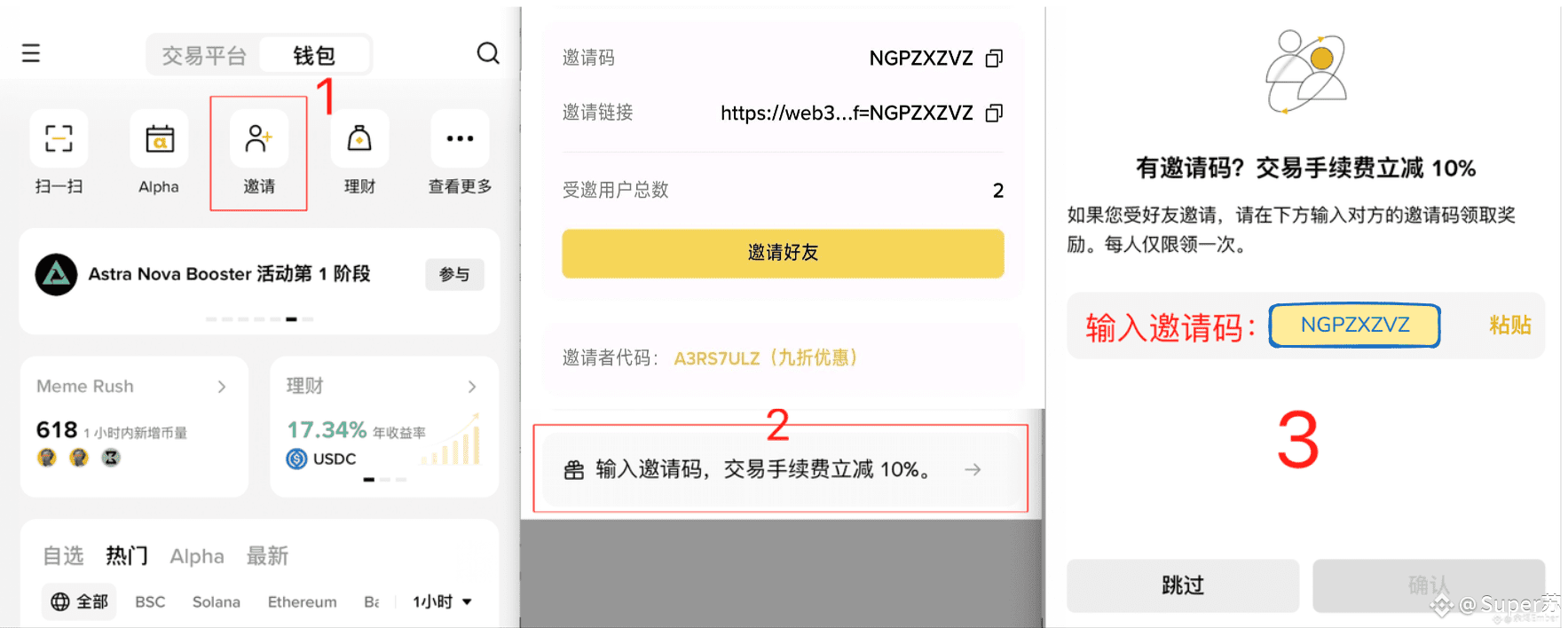
How to bind: On the Binance App wallet homepage, click "Invite" → click to enter the invitation code → copy the invitation code "NGPZXZVZ" and paste it, then click confirm, and you're good to go.
#币安HODLer空投FF
Big event!!! Brothers, it may affect your future cost of trading on Binance Alpha.
The Binance Web3 wallet Alpha hasn't linked an invitation code yet, so you need to hurry and bind it, because the invitation mechanism has been released, and fees may start to be charged later.
Now you can bind this invitation code: NGPZXZVZ
Transaction fees can be immediately reduced by 10%, and I have already bound almost 5 codes here. The more people bind, the higher the discount rate I can offer.
Moreover, if you bind it, you can contact me for a monthly commission, your 💰 is still your 💰.
How to bind: On the Binance App wallet homepage, click "Invite" → click to enter the invitation code → copy the invitation code "NGPZXZVZ" and paste it, then click confirm, and you're good to go.
#币安HODLer空投FF
The Binance Web3 wallet Alpha hasn't linked an invitation code yet, so you need to hurry and bind it, because the invitation mechanism has been released, and fees may start to be charged later.
Now you can bind this invitation code: NGPZXZVZ
Transaction fees can be immediately reduced by 10%, and I have already bound almost 5 codes here. The more people bind, the higher the discount rate I can offer.
Moreover, if you bind it, you can contact me for a monthly commission, your 💰 is still your 💰.
How to bind: On the Binance App wallet homepage, click "Invite" → click to enter the invitation code → copy the invitation code "NGPZXZVZ" and paste it, then click confirm, and you're good to go.
#币安HODLer空投FF
20
9
14
2.3k
·
--
Bullish
💡 Why won't we be discussing 'Gas Fees' in 2026? Let's talk about @plasma's infrastructure revolution.
Brothers, I've recently seen a rather painful question in the community: 'Why after ten years of Web3 development do I still have to research what Gwei is before transferring money to my friends?'
To be honest, if we're still holding onto this 'antique' experience in 2026, then Mass Adoption is a false proposition. What @plasma is doing is smoothing out this 'generation gap'.
From today’s perspective, the most hardcore logic of @plasma is actually **'financial-grade smoothness'**:
True zero cost for USDT: Through the Paymaster module, it directly makes Gas fees 'disappear' at the protocol level. In emerging markets, this means hundreds of millions of users can directly use stablecoins as digital cash without constantly worrying about 'fare' like they do on Ethereum or Tron.
Millisecond finality: Based on the design of PlasmaBFT, it solves the most dreaded 'waiting anxiety' in payment scenarios. Swiping cards, transferring, and clearing are all completed within a second, and this experience can now fully compete with Visa.
Bitcoin-level defense: The most clever part is that it locks this ultra-fast payment environment on top of Bitcoin's secure consensus through state anchoring.
If we say universal public chains are 'omni supermarkets', then @plasma is 'financial express'. When stablecoins are no longer 'dependent on others', their potential is truly unleashed.
Do you think that lowering the threshold for payment experiences will be the trigger point for the next bull market? 👇
@Plasma $XPL #plasma
💡 Why won't we be discussing 'Gas Fees' in 2026? Let's talk about @plasma's infrastructure revolution.
Brothers, I've recently seen a rather painful question in the community: 'Why after ten years of Web3 development do I still have to research what Gwei is before transferring money to my friends?'
To be honest, if we're still holding onto this 'antique' experience in 2026, then Mass Adoption is a false proposition. What @plasma is doing is smoothing out this 'generation gap'.
From today’s perspective, the most hardcore logic of @plasma is actually **'financial-grade smoothness'**:
True zero cost for USDT: Through the Paymaster module, it directly makes Gas fees 'disappear' at the protocol level. In emerging markets, this means hundreds of millions of users can directly use stablecoins as digital cash without constantly worrying about 'fare' like they do on Ethereum or Tron.
Millisecond finality: Based on the design of PlasmaBFT, it solves the most dreaded 'waiting anxiety' in payment scenarios. Swiping cards, transferring, and clearing are all completed within a second, and this experience can now fully compete with Visa.
Bitcoin-level defense: The most clever part is that it locks this ultra-fast payment environment on top of Bitcoin's secure consensus through state anchoring.
If we say universal public chains are 'omni supermarkets', then @plasma is 'financial express'. When stablecoins are no longer 'dependent on others', their potential is truly unleashed.
Do you think that lowering the threshold for payment experiences will be the trigger point for the next bull market? 👇
@Plasma $XPL #plasma
Brothers, I've recently seen a rather painful question in the community: 'Why after ten years of Web3 development do I still have to research what Gwei is before transferring money to my friends?'
To be honest, if we're still holding onto this 'antique' experience in 2026, then Mass Adoption is a false proposition. What @plasma is doing is smoothing out this 'generation gap'.
From today’s perspective, the most hardcore logic of @plasma is actually **'financial-grade smoothness'**:
True zero cost for USDT: Through the Paymaster module, it directly makes Gas fees 'disappear' at the protocol level. In emerging markets, this means hundreds of millions of users can directly use stablecoins as digital cash without constantly worrying about 'fare' like they do on Ethereum or Tron.
Millisecond finality: Based on the design of PlasmaBFT, it solves the most dreaded 'waiting anxiety' in payment scenarios. Swiping cards, transferring, and clearing are all completed within a second, and this experience can now fully compete with Visa.
Bitcoin-level defense: The most clever part is that it locks this ultra-fast payment environment on top of Bitcoin's secure consensus through state anchoring.
If we say universal public chains are 'omni supermarkets', then @plasma is 'financial express'. When stablecoins are no longer 'dependent on others', their potential is truly unleashed.
Do you think that lowering the threshold for payment experiences will be the trigger point for the next bull market? 👇
@Plasma $XPL #plasma
136
·
--
'Dual-Core Drive' Dimensionality Reduction Strike: The Chemical Reaction Between Reth and PlasmaBFTThis is a deep industry observation prepared for you in 2026. We elevate our perspective to discuss how @plasma, against the backdrop of stablecoin market capitalization reaching the $500 billion mark, defines the standards for the next generation of financial settlement with its unique 'dual-core drive' architecture.
🏷 2026 Payment Landscape: As stablecoins bid farewell to 'parasitism', how will sovereign settlement layers reshape the trillion-dollar ecosystem?
Tags: #PayFi #Stablecoin #Plasma #BitcoinSecurity #2026Outlook
Brothers, looking back from the beginning of 2026, you will find that the most profound changes in Web3 over the past year were not the birth of countless hundred-fold memes, but rather that stablecoins finally made a daring leap from 'assets' to 'infrastructure'.
'Dual-Core Drive' Dimensionality Reduction Strike: The Chemical Reaction Between Reth and PlasmaBFT
This is a deep industry observation prepared for you in 2026. We elevate our perspective to discuss how @plasma, against the backdrop of stablecoin market capitalization reaching the $500 billion mark, defines the standards for the next generation of financial settlement with its unique 'dual-core drive' architecture.
🏷 2026 Payment Landscape: As stablecoins bid farewell to 'parasitism', how will sovereign settlement layers reshape the trillion-dollar ecosystem?
Tags: #PayFi #Stablecoin #Plasma #BitcoinSecurity #2026Outlook
Brothers, looking back from the beginning of 2026, you will find that the most profound changes in Web3 over the past year were not the birth of countless hundred-fold memes, but rather that stablecoins finally made a daring leap from 'assets' to 'infrastructure'.
🏷 2026 Payment Landscape: As stablecoins bid farewell to 'parasitism', how will sovereign settlement layers reshape the trillion-dollar ecosystem?
Tags: #PayFi #Stablecoin #Plasma #BitcoinSecurity #2026Outlook
Brothers, looking back from the beginning of 2026, you will find that the most profound changes in Web3 over the past year were not the birth of countless hundred-fold memes, but rather that stablecoins finally made a daring leap from 'assets' to 'infrastructure'.
97
·
--
Vanar Chain: From 'On-Chain Laboratory' to 'AI Intelligent Foundation' for the Internet of EverythingIn the blockchain landscape of 2026, Vanar Chain is no longer just a newcomer in Layer 1; it is evolving into a comprehensive digital foundation that integrates AI-native architecture, PayFi (financial payments), and real-world assets (RWA).
If the early blockchain era was a competition about 'ledgers', then Vanar has opened a new era of 'intelligence' and 'implementation'.
1. Core Evolution: The 'brain' and 'memory' of Web3
As we step into 2026, Vanar's most notable breakthrough is the full implementation of its AI-native infrastructure. Unlike projects that simply hang onto the concept of AI, Vanar has built a five-layer intelligent architecture:
Vanar Chain: From 'On-Chain Laboratory' to 'AI Intelligent Foundation' for the Internet of Everything
In the blockchain landscape of 2026, Vanar Chain is no longer just a newcomer in Layer 1; it is evolving into a comprehensive digital foundation that integrates AI-native architecture, PayFi (financial payments), and real-world assets (RWA).
If the early blockchain era was a competition about 'ledgers', then Vanar has opened a new era of 'intelligence' and 'implementation'.
1. Core Evolution: The 'brain' and 'memory' of Web3
As we step into 2026, Vanar's most notable breakthrough is the full implementation of its AI-native infrastructure. Unlike projects that simply hang onto the concept of AI, Vanar has built a five-layer intelligent architecture:
If the early blockchain era was a competition about 'ledgers', then Vanar has opened a new era of 'intelligence' and 'implementation'.
1. Core Evolution: The 'brain' and 'memory' of Web3
As we step into 2026, Vanar's most notable breakthrough is the full implementation of its AI-native infrastructure. Unlike projects that simply hang onto the concept of AI, Vanar has built a five-layer intelligent architecture:
64
·
--
Bullish
Vanar Chain: The "Express Lane" from the Real World to Web3
Vanar Chain is redefining the value coordinates of Layer 1 blockchains: it is no longer an isolated geek laboratory but a digital foundation designed for large-scale applications in the real world.
Core Advantage: Industry Experience-Driven "Breakthrough" Tool
The soul of Vanar lies in its profound background in gaming, entertainment, and branding. Unlike obscure technical preaching, it understands how to serve the next 3 billion users better. Through its Virtua Metaverse and VGN gaming network, Vanar makes complex blockchain technology "invisible," allowing users to seamlessly enter Web3 in immersive entertainment.
Omni-Ecosystem: Cross-Track Business Engine
Comprehensive Coverage: Deeply integrates AI intelligence, environmental sustainability, and brand solutions to meet the stringent demands of enterprise-level applications.
Low-Carbon and Efficient: Focuses on green ecology, providing compliant and low-carbon access options for global brands pursuing sustainable development.
Value Carrier: The native token $VANRY serves as the core driving force, facilitating the value transfer from digital collectibles to AI applications.
In summary: Vanar does not create the most complex chain; it only creates the chain that understands mainstream users best. It is a solid bridge connecting traditional business with the future digital economy.
Would you like to know the latest updates from Vanar regarding brand partnerships or technical advancements?
@Vanar #Vanar $VANRY
Vanar Chain: The "Express Lane" from the Real World to Web3
Vanar Chain is redefining the value coordinates of Layer 1 blockchains: it is no longer an isolated geek laboratory but a digital foundation designed for large-scale applications in the real world.
Core Advantage: Industry Experience-Driven "Breakthrough" Tool
The soul of Vanar lies in its profound background in gaming, entertainment, and branding. Unlike obscure technical preaching, it understands how to serve the next 3 billion users better. Through its Virtua Metaverse and VGN gaming network, Vanar makes complex blockchain technology "invisible," allowing users to seamlessly enter Web3 in immersive entertainment.
Omni-Ecosystem: Cross-Track Business Engine
Comprehensive Coverage: Deeply integrates AI intelligence, environmental sustainability, and brand solutions to meet the stringent demands of enterprise-level applications.
Low-Carbon and Efficient: Focuses on green ecology, providing compliant and low-carbon access options for global brands pursuing sustainable development.
Value Carrier: The native token $VANRY serves as the core driving force, facilitating the value transfer from digital collectibles to AI applications.
In summary: Vanar does not create the most complex chain; it only creates the chain that understands mainstream users best. It is a solid bridge connecting traditional business with the future digital economy.
Would you like to know the latest updates from Vanar regarding brand partnerships or technical advancements?
@Vanar #Vanar $VANRY
Vanar Chain is redefining the value coordinates of Layer 1 blockchains: it is no longer an isolated geek laboratory but a digital foundation designed for large-scale applications in the real world.
Core Advantage: Industry Experience-Driven "Breakthrough" Tool
The soul of Vanar lies in its profound background in gaming, entertainment, and branding. Unlike obscure technical preaching, it understands how to serve the next 3 billion users better. Through its Virtua Metaverse and VGN gaming network, Vanar makes complex blockchain technology "invisible," allowing users to seamlessly enter Web3 in immersive entertainment.
Omni-Ecosystem: Cross-Track Business Engine
Comprehensive Coverage: Deeply integrates AI intelligence, environmental sustainability, and brand solutions to meet the stringent demands of enterprise-level applications.
Low-Carbon and Efficient: Focuses on green ecology, providing compliant and low-carbon access options for global brands pursuing sustainable development.
Value Carrier: The native token $VANRY serves as the core driving force, facilitating the value transfer from digital collectibles to AI applications.
In summary: Vanar does not create the most complex chain; it only creates the chain that understands mainstream users best. It is a solid bridge connecting traditional business with the future digital economy.
Would you like to know the latest updates from Vanar regarding brand partnerships or technical advancements?
@Vanar #Vanar $VANRY
134
·
--
vanar往事Vanar Chain: Reconstructing the Web3 narrative and creating a large-scale application engine for the real world
In the blockchain industry, we often hear about 'disruption' and 'revolution', but there is always a thin, yet insurmountable transparent wall between technological progress and the lives of the general public. Most Layer 1 public chains still resemble isolated digital islands, with their ecosystems often limited to the internal games of crypto natives.
The emergence of Vanar Chain aims to completely break this situation. It is not just a new technical protocol, but a paradigm shift regarding 'how blockchain can serve the real world'.
vanar往事
Vanar Chain: Reconstructing the Web3 narrative and creating a large-scale application engine for the real world
In the blockchain industry, we often hear about 'disruption' and 'revolution', but there is always a thin, yet insurmountable transparent wall between technological progress and the lives of the general public. Most Layer 1 public chains still resemble isolated digital islands, with their ecosystems often limited to the internal games of crypto natives.
The emergence of Vanar Chain aims to completely break this situation. It is not just a new technical protocol, but a paradigm shift regarding 'how blockchain can serve the real world'.
In the blockchain industry, we often hear about 'disruption' and 'revolution', but there is always a thin, yet insurmountable transparent wall between technological progress and the lives of the general public. Most Layer 1 public chains still resemble isolated digital islands, with their ecosystems often limited to the internal games of crypto natives.
The emergence of Vanar Chain aims to completely break this situation. It is not just a new technical protocol, but a paradigm shift regarding 'how blockchain can serve the real world'.
116
·
--
Vanar Chain: Making Blockchain "Invisible," Making Value "Visible"
Most public chains talk about algorithms, while Vanar Chain talks about implementation. As a Layer 1 platform tailored for real-world application scenarios, Vanar's mission is to bring Web3 from a geek's experimental playground to the lives of 3 billion mainstream users worldwide.
Core Logic: A Panoramic Ecology from Entertainment to Life
Vanar steers clear of obscure technical narratives and chooses to enter through the three most frequent fields of games, entertainment, and branding. Through its flagship products Virtua Metaverse and VGN Gaming Network, Vanar proves that blockchain can be both fun and simple.
Differentiation Advantages: Dual Friendliness of Brand and Environment
* Brand Preferred: Provides a one-stop solution that allows traditional brands to easily lay out Web3, just like opening a social media account.
* Intelligent and Green: Integrates AI to enhance network efficiency and adheres to a low-carbon environmental route, aligning with the global ESG development trend.
* Power Fuel: The native token $VANRY drives the entire ecosystem's cycle and value capture.
In summary: Vanar is not just another chain; it is the "translator" of Web3, turning complex underlying technologies into accessible digital experiences.
If you want to learn more in-depth, do you need me to list the well-known brand partners that Vanar has currently achieved?
#vanar $VANRY @Vanar
Vanar Chain: Making Blockchain "Invisible," Making Value "Visible"
Most public chains talk about algorithms, while Vanar Chain talks about implementation. As a Layer 1 platform tailored for real-world application scenarios, Vanar's mission is to bring Web3 from a geek's experimental playground to the lives of 3 billion mainstream users worldwide.
Core Logic: A Panoramic Ecology from Entertainment to Life
Vanar steers clear of obscure technical narratives and chooses to enter through the three most frequent fields of games, entertainment, and branding. Through its flagship products Virtua Metaverse and VGN Gaming Network, Vanar proves that blockchain can be both fun and simple.
Differentiation Advantages: Dual Friendliness of Brand and Environment
* Brand Preferred: Provides a one-stop solution that allows traditional brands to easily lay out Web3, just like opening a social media account.
* Intelligent and Green: Integrates AI to enhance network efficiency and adheres to a low-carbon environmental route, aligning with the global ESG development trend.
* Power Fuel: The native token $VANRY drives the entire ecosystem's cycle and value capture.
In summary: Vanar is not just another chain; it is the "translator" of Web3, turning complex underlying technologies into accessible digital experiences.
If you want to learn more in-depth, do you need me to list the well-known brand partners that Vanar has currently achieved?
#vanar $VANRY @Vanar
Most public chains talk about algorithms, while Vanar Chain talks about implementation. As a Layer 1 platform tailored for real-world application scenarios, Vanar's mission is to bring Web3 from a geek's experimental playground to the lives of 3 billion mainstream users worldwide.
Core Logic: A Panoramic Ecology from Entertainment to Life
Vanar steers clear of obscure technical narratives and chooses to enter through the three most frequent fields of games, entertainment, and branding. Through its flagship products Virtua Metaverse and VGN Gaming Network, Vanar proves that blockchain can be both fun and simple.
Differentiation Advantages: Dual Friendliness of Brand and Environment
* Brand Preferred: Provides a one-stop solution that allows traditional brands to easily lay out Web3, just like opening a social media account.
* Intelligent and Green: Integrates AI to enhance network efficiency and adheres to a low-carbon environmental route, aligning with the global ESG development trend.
* Power Fuel: The native token $VANRY drives the entire ecosystem's cycle and value capture.
In summary: Vanar is not just another chain; it is the "translator" of Web3, turning complex underlying technologies into accessible digital experiences.
If you want to learn more in-depth, do you need me to list the well-known brand partners that Vanar has currently achieved?
#vanar $VANRY @Vanar
146
·
--
Talking about plasmaThis time, standing at the time point of 2026, combined with the latest market data (such as $2B in liquidity locked, collaborations with Aave, etc.), we will deeply analyze from the perspective of 'infrastructure evolution' on @Plasma a.
🏷 Stablecoin 'Independence Day': Why does the digital dollar running on universal chains have no future?
Tags: #PayFi #Stablecoin #Plasma #Web3Infrastructure #2026CryptoTrend
Brothers, in the first few days of 2026, I have been reviewing the payment track of the past few years.
Do you remember three or four years ago when we had to buy Gas fees, calculate Gwei, and wait for confirmations to transfer money? Those days when 'engineer thinking' dominated products seem like we were dialing up to connect to the internet in the internet age.
Talking about plasma
This time, standing at the time point of 2026, combined with the latest market data (such as $2B in liquidity locked, collaborations with Aave, etc.), we will deeply analyze from the perspective of 'infrastructure evolution' on @Plasma a.
🏷 Stablecoin 'Independence Day': Why does the digital dollar running on universal chains have no future?
Tags: #PayFi #Stablecoin #Plasma #Web3Infrastructure #2026CryptoTrend
Brothers, in the first few days of 2026, I have been reviewing the payment track of the past few years.
Do you remember three or four years ago when we had to buy Gas fees, calculate Gwei, and wait for confirmations to transfer money? Those days when 'engineer thinking' dominated products seem like we were dialing up to connect to the internet in the internet age.
🏷 Stablecoin 'Independence Day': Why does the digital dollar running on universal chains have no future?
Tags: #PayFi #Stablecoin #Plasma #Web3Infrastructure #2026CryptoTrend
Brothers, in the first few days of 2026, I have been reviewing the payment track of the past few years.
Do you remember three or four years ago when we had to buy Gas fees, calculate Gwei, and wait for confirmations to transfer money? Those days when 'engineer thinking' dominated products seem like we were dialing up to connect to the internet in the internet age.
203
·
--
Bearish
#plasma $XPL
💡 The Endgame of Web3 Payments: Making Technology "Disappeared" and Bringing Back the Experience
After discussing so much @Plasma , I want to return to a fundamental question: what kind of infrastructure can retain users?
The current public chain track is too "inward-looking," competing on performance and narrative, but forgetting to compete on "common sense." And @plasma's common sense is: stablecoin payments should not have barriers.
Its most hardcore logic lies in **"decoupling"**:
* Decoupling security and execution: leveraging Bitcoin's security base for endorsement while using the high-performance environment of EVM (Reth) for execution. This resolves the contradiction of needing both absolute security and rapid response.
* Decoupling assets and costs: through the "stablecoin priority Gas" mechanism, allowing users to completely bid farewell to the routine of "having to buy coins to spend money."
I have always believed that true Mass Adoption is not about making 1 billion people learn to use wallet mnemonics but rather allowing 1 billion people to use @plasma for stablecoin settlements without even feeling the presence of blockchain.
When a technology becomes as natural as air and water, it has truly succeeded. What @plasma is doing is bringing this kind of "natural" into Web3.
If payments no longer have Gas fees, what do you most want to do with stablecoins? See you in the comments.
#plasma $XPL
💡 The Endgame of Web3 Payments: Making Technology "Disappeared" and Bringing Back the Experience
After discussing so much @Plasma , I want to return to a fundamental question: what kind of infrastructure can retain users?
The current public chain track is too "inward-looking," competing on performance and narrative, but forgetting to compete on "common sense." And @plasma's common sense is: stablecoin payments should not have barriers.
Its most hardcore logic lies in **"decoupling"**:
* Decoupling security and execution: leveraging Bitcoin's security base for endorsement while using the high-performance environment of EVM (Reth) for execution. This resolves the contradiction of needing both absolute security and rapid response.
* Decoupling assets and costs: through the "stablecoin priority Gas" mechanism, allowing users to completely bid farewell to the routine of "having to buy coins to spend money."
I have always believed that true Mass Adoption is not about making 1 billion people learn to use wallet mnemonics but rather allowing 1 billion people to use @plasma for stablecoin settlements without even feeling the presence of blockchain.
When a technology becomes as natural as air and water, it has truly succeeded. What @plasma is doing is bringing this kind of "natural" into Web3.
If payments no longer have Gas fees, what do you most want to do with stablecoins? See you in the comments.
💡 The Endgame of Web3 Payments: Making Technology "Disappeared" and Bringing Back the Experience
After discussing so much @Plasma , I want to return to a fundamental question: what kind of infrastructure can retain users?
The current public chain track is too "inward-looking," competing on performance and narrative, but forgetting to compete on "common sense." And @plasma's common sense is: stablecoin payments should not have barriers.
Its most hardcore logic lies in **"decoupling"**:
* Decoupling security and execution: leveraging Bitcoin's security base for endorsement while using the high-performance environment of EVM (Reth) for execution. This resolves the contradiction of needing both absolute security and rapid response.
* Decoupling assets and costs: through the "stablecoin priority Gas" mechanism, allowing users to completely bid farewell to the routine of "having to buy coins to spend money."
I have always believed that true Mass Adoption is not about making 1 billion people learn to use wallet mnemonics but rather allowing 1 billion people to use @plasma for stablecoin settlements without even feeling the presence of blockchain.
When a technology becomes as natural as air and water, it has truly succeeded. What @plasma is doing is bringing this kind of "natural" into Web3.
If payments no longer have Gas fees, what do you most want to do with stablecoins? See you in the comments.
137
·
--
Vanar: Opening a New Era of Web3 Worth Trillions
In this rapidly evolving digital age, Vanar is defining the future of Layer 1 blockchain as a leader. We are not just a technology platform; we are a solid bridge connecting real-world applications and the vision of Web3.
🚀 Core Advantages: Born for the Next 3 Billion Users
With a strong foundation in gaming, entertainment, and branding, Vanar is dedicated to breaking down technological barriers. Our vision is clear: to bring the next 3 billion mainstream users into a decentralized world through exceptional performance and ecological integration.
🌐 Full Track Layout, Reshaping Digital Life
Vanar is not a single-dimensional public chain but a comprehensive ecological system across mainstream tracks:
* Gaming and Metaverse: Leveraging well-known products Virtua and VGN gaming network to create immersive digital experiences.
* AI Driven: Integrating cutting-edge artificial intelligence technology to empower the intelligent transformation of applications.
* Green Ecology: Committed to a sustainable development path, constructing a low-carbon, efficient green blockchain.
* Brand Solutions: Providing a one-stop chain entry solution for top global brands, making value transfer simpler.
💎 Power Core: $VANRY
The entire Vanar ecosystem is driven by the VANRY token, which is not only a medium for value exchange but also the core driving force for technological innovation and community growth.
Join Vanar and witness Web3 move towards the mainstream with us. > Vanar: The New Power of On-Chain in the Real World.
$VANRY #Vanar @Vanar
{future}(VANRYUSDT)
Vanar: Opening a New Era of Web3 Worth Trillions
In this rapidly evolving digital age, Vanar is defining the future of Layer 1 blockchain as a leader. We are not just a technology platform; we are a solid bridge connecting real-world applications and the vision of Web3.
🚀 Core Advantages: Born for the Next 3 Billion Users
With a strong foundation in gaming, entertainment, and branding, Vanar is dedicated to breaking down technological barriers. Our vision is clear: to bring the next 3 billion mainstream users into a decentralized world through exceptional performance and ecological integration.
🌐 Full Track Layout, Reshaping Digital Life
Vanar is not a single-dimensional public chain but a comprehensive ecological system across mainstream tracks:
* Gaming and Metaverse: Leveraging well-known products Virtua and VGN gaming network to create immersive digital experiences.
* AI Driven: Integrating cutting-edge artificial intelligence technology to empower the intelligent transformation of applications.
* Green Ecology: Committed to a sustainable development path, constructing a low-carbon, efficient green blockchain.
* Brand Solutions: Providing a one-stop chain entry solution for top global brands, making value transfer simpler.
💎 Power Core: $VANRY
The entire Vanar ecosystem is driven by the VANRY token, which is not only a medium for value exchange but also the core driving force for technological innovation and community growth.
Join Vanar and witness Web3 move towards the mainstream with us. > Vanar: The New Power of On-Chain in the Real World.
$VANRY #Vanar @Vanar
In this rapidly evolving digital age, Vanar is defining the future of Layer 1 blockchain as a leader. We are not just a technology platform; we are a solid bridge connecting real-world applications and the vision of Web3.
🚀 Core Advantages: Born for the Next 3 Billion Users
With a strong foundation in gaming, entertainment, and branding, Vanar is dedicated to breaking down technological barriers. Our vision is clear: to bring the next 3 billion mainstream users into a decentralized world through exceptional performance and ecological integration.
🌐 Full Track Layout, Reshaping Digital Life
Vanar is not a single-dimensional public chain but a comprehensive ecological system across mainstream tracks:
* Gaming and Metaverse: Leveraging well-known products Virtua and VGN gaming network to create immersive digital experiences.
* AI Driven: Integrating cutting-edge artificial intelligence technology to empower the intelligent transformation of applications.
* Green Ecology: Committed to a sustainable development path, constructing a low-carbon, efficient green blockchain.
* Brand Solutions: Providing a one-stop chain entry solution for top global brands, making value transfer simpler.
💎 Power Core: $VANRY
The entire Vanar ecosystem is driven by the VANRY token, which is not only a medium for value exchange but also the core driving force for technological innovation and community growth.
Join Vanar and witness Web3 move towards the mainstream with us. > Vanar: The New Power of On-Chain in the Real World.
$VANRY #Vanar @Vanar
107
·
--

Article
Vanar: Building a trillion-dollar bridge between the real world and Web3Vanar: Building a trillion-dollar bridge between the real world and Web3
In the second half of the development of blockchain technology, the industry's focus is shifting from 'purely on-chain narratives' to 'real-world application implementation.' Vanar was born at this historical juncture as a Layer 1 blockchain. It not only represents a leap in performance but also a profound practice on how to bring Web3 to the mainstream.
1. Core Essence: A veteran team deeply rooted in entertainment and branding
The birth of Vanar is not a castle in the air; its core team possesses decades of industry experience in gaming, entertainment, and brand promotion. This profound background gives Vanar a unique perspective: they understand what mainstream users and global brands truly need.
Vanar: Building a trillion-dollar bridge between the real world and Web3
Vanar: Building a trillion-dollar bridge between the real world and Web3
In the second half of the development of blockchain technology, the industry's focus is shifting from 'purely on-chain narratives' to 'real-world application implementation.' Vanar was born at this historical juncture as a Layer 1 blockchain. It not only represents a leap in performance but also a profound practice on how to bring Web3 to the mainstream.
1. Core Essence: A veteran team deeply rooted in entertainment and branding
The birth of Vanar is not a castle in the air; its core team possesses decades of industry experience in gaming, entertainment, and brand promotion. This profound background gives Vanar a unique perspective: they understand what mainstream users and global brands truly need.
In the second half of the development of blockchain technology, the industry's focus is shifting from 'purely on-chain narratives' to 'real-world application implementation.' Vanar was born at this historical juncture as a Layer 1 blockchain. It not only represents a leap in performance but also a profound practice on how to bring Web3 to the mainstream.
1. Core Essence: A veteran team deeply rooted in entertainment and branding
The birth of Vanar is not a castle in the air; its core team possesses decades of industry experience in gaming, entertainment, and brand promotion. This profound background gives Vanar a unique perspective: they understand what mainstream users and global brands truly need.
128
·
--
Bullish
Vanar: Opening a New Era of Mainstream Web3 Worth Trillions
In this rapidly evolving digital age, Vanar is defining the future of Layer 1 blockchain as a leader. We are not just a technology platform, but a solid bridge connecting real-world applications with the vision of Web3.
🚀 Core Advantages: Born for the Next 3 Billion Users
Leveraging deep expertise in gaming, entertainment, and branding, Vanar is dedicated to breaking down technological barriers. Our vision is clear: to bring the next 3 billion mainstream users into a decentralized world through exceptional performance and ecosystem integration.
🌐 All-Track Layout, Reshaping Digital Life
Vanar is not a single-dimensional public chain; it is a versatile ecosystem across mainstream tracks:
* Gaming and Metaverse: Creating immersive digital experiences based on renowned products Virtua and VGN gaming network.
* AI Driven: Integrating cutting-edge artificial intelligence technologies to empower intelligent application transformation.
* Green Ecology: Committed to a sustainable development path, building a low-carbon and efficient green blockchain.
* Brand Solutions: Providing one-stop onboarding solutions for top global brands, making value transfer simpler.
💎 Power Core: $VANRY
The entire Vanar ecosystem is driven by the VANRY token, which is not only a medium for value exchange but also the core driving force for technological innovation and community growth.
Join Vanar and witness Web3 move towards the mainstream with us. > Vanar: The New Power of On-Chain in the Real World.
Do you need me to fine-tune the style of the copy for social media (like Twitter or Xiaohongshu) for you?
#vanar $VANRY @Vanar
Vanar: Opening a New Era of Mainstream Web3 Worth Trillions
In this rapidly evolving digital age, Vanar is defining the future of Layer 1 blockchain as a leader. We are not just a technology platform, but a solid bridge connecting real-world applications with the vision of Web3.
🚀 Core Advantages: Born for the Next 3 Billion Users
Leveraging deep expertise in gaming, entertainment, and branding, Vanar is dedicated to breaking down technological barriers. Our vision is clear: to bring the next 3 billion mainstream users into a decentralized world through exceptional performance and ecosystem integration.
🌐 All-Track Layout, Reshaping Digital Life
Vanar is not a single-dimensional public chain; it is a versatile ecosystem across mainstream tracks:
* Gaming and Metaverse: Creating immersive digital experiences based on renowned products Virtua and VGN gaming network.
* AI Driven: Integrating cutting-edge artificial intelligence technologies to empower intelligent application transformation.
* Green Ecology: Committed to a sustainable development path, building a low-carbon and efficient green blockchain.
* Brand Solutions: Providing one-stop onboarding solutions for top global brands, making value transfer simpler.
💎 Power Core: $VANRY
The entire Vanar ecosystem is driven by the VANRY token, which is not only a medium for value exchange but also the core driving force for technological innovation and community growth.
Join Vanar and witness Web3 move towards the mainstream with us. > Vanar: The New Power of On-Chain in the Real World.
Do you need me to fine-tune the style of the copy for social media (like Twitter or Xiaohongshu) for you?
#vanar $VANRY @Vanar
In this rapidly evolving digital age, Vanar is defining the future of Layer 1 blockchain as a leader. We are not just a technology platform, but a solid bridge connecting real-world applications with the vision of Web3.
🚀 Core Advantages: Born for the Next 3 Billion Users
Leveraging deep expertise in gaming, entertainment, and branding, Vanar is dedicated to breaking down technological barriers. Our vision is clear: to bring the next 3 billion mainstream users into a decentralized world through exceptional performance and ecosystem integration.
🌐 All-Track Layout, Reshaping Digital Life
Vanar is not a single-dimensional public chain; it is a versatile ecosystem across mainstream tracks:
* Gaming and Metaverse: Creating immersive digital experiences based on renowned products Virtua and VGN gaming network.
* AI Driven: Integrating cutting-edge artificial intelligence technologies to empower intelligent application transformation.
* Green Ecology: Committed to a sustainable development path, building a low-carbon and efficient green blockchain.
* Brand Solutions: Providing one-stop onboarding solutions for top global brands, making value transfer simpler.
💎 Power Core: $VANRY
The entire Vanar ecosystem is driven by the VANRY token, which is not only a medium for value exchange but also the core driving force for technological innovation and community growth.
Join Vanar and witness Web3 move towards the mainstream with us. > Vanar: The New Power of On-Chain in the Real World.
Do you need me to fine-tune the style of the copy for social media (like Twitter or Xiaohongshu) for you?
#vanar $VANRY @Vanar
1
104
·
--

Article
The Only 'Killer App' of Web3Brothers, recently when I was looking at on-chain data, I discovered a very magical reality.
Every day we debate on Twitter about which track is the Next Big Thing, is it AI? Is it RWA? Or is it DePIN? But if we set aside all the hype and return to the simplest data, you will find that Web3 has only one thing that has truly achieved Product-Market Fit—stablecoins.
Its total market value exceeds 170 billion USD, and its daily settlement volume often surpasses Visa.
But the magical part is that this 170 billion USD asset is actually running entirely on a public chain that was 'not designed for it'.
The Only 'Killer App' of Web3
Brothers, recently when I was looking at on-chain data, I discovered a very magical reality.
Every day we debate on Twitter about which track is the Next Big Thing, is it AI? Is it RWA? Or is it DePIN? But if we set aside all the hype and return to the simplest data, you will find that Web3 has only one thing that has truly achieved Product-Market Fit—stablecoins.
Its total market value exceeds 170 billion USD, and its daily settlement volume often surpasses Visa.
But the magical part is that this 170 billion USD asset is actually running entirely on a public chain that was 'not designed for it'.
Every day we debate on Twitter about which track is the Next Big Thing, is it AI? Is it RWA? Or is it DePIN? But if we set aside all the hype and return to the simplest data, you will find that Web3 has only one thing that has truly achieved Product-Market Fit—stablecoins.
Its total market value exceeds 170 billion USD, and its daily settlement volume often surpasses Visa.
But the magical part is that this 170 billion USD asset is actually running entirely on a public chain that was 'not designed for it'.
276
·
--
Bullish
Brothers, recently everyone has been rushing to invest in meme coins and watching K-line charts, but have you taken a moment to think: Where will the true mass adoption of Web3 really explode?
I believe it will not be Wall Street, but those emerging markets with severe fiat currency inflation. There, USDT is not a speculative tool, but a necessity for survival.
However, there is a huge bug: asking a common citizen who only wants to save a bit of money to combat inflation to understand, "To transfer 10U, you must first buy 0.001 ETH for Gas," is simply absurd.
This is why I have been paying attention to @plasma lately. It does not delve into those lofty concepts, but instead targets the most genuine need: how to allow ordinary people to use stablecoins as easily as they use Alipay.
@Plasma has made an extremely "down-to-earth" technological breakthrough: USDT transfers with 0 Gas fee.
This may seem simple, but it is revolutionary for the payment sector. Coupled with its underlying Bitcoin security mechanism and EVM (Reth) compatibility, it ensures the safety of funds (which are the life-saving money for ordinary people) while allowing existing applications to integrate seamlessly.
I believe @plasma is targeting those "high penetration markets" that are overlooked by mainstream narratives but have a large population base. When technology is no longer just a show-off, but begins to serve the everyday needs, that is when Web3 will truly change the world.
Do you think the end of cryptocurrency is speculation, or payments? Let's chat in the comments! 👇
#plasma $XPL
Brothers, recently everyone has been rushing to invest in meme coins and watching K-line charts, but have you taken a moment to think: Where will the true mass adoption of Web3 really explode?
I believe it will not be Wall Street, but those emerging markets with severe fiat currency inflation. There, USDT is not a speculative tool, but a necessity for survival.
However, there is a huge bug: asking a common citizen who only wants to save a bit of money to combat inflation to understand, "To transfer 10U, you must first buy 0.001 ETH for Gas," is simply absurd.
This is why I have been paying attention to @plasma lately. It does not delve into those lofty concepts, but instead targets the most genuine need: how to allow ordinary people to use stablecoins as easily as they use Alipay.
@Plasma has made an extremely "down-to-earth" technological breakthrough: USDT transfers with 0 Gas fee.
This may seem simple, but it is revolutionary for the payment sector. Coupled with its underlying Bitcoin security mechanism and EVM (Reth) compatibility, it ensures the safety of funds (which are the life-saving money for ordinary people) while allowing existing applications to integrate seamlessly.
I believe @plasma is targeting those "high penetration markets" that are overlooked by mainstream narratives but have a large population base. When technology is no longer just a show-off, but begins to serve the everyday needs, that is when Web3 will truly change the world.
Do you think the end of cryptocurrency is speculation, or payments? Let's chat in the comments! 👇
#plasma $XPL
I believe it will not be Wall Street, but those emerging markets with severe fiat currency inflation. There, USDT is not a speculative tool, but a necessity for survival.
However, there is a huge bug: asking a common citizen who only wants to save a bit of money to combat inflation to understand, "To transfer 10U, you must first buy 0.001 ETH for Gas," is simply absurd.
This is why I have been paying attention to @plasma lately. It does not delve into those lofty concepts, but instead targets the most genuine need: how to allow ordinary people to use stablecoins as easily as they use Alipay.
@Plasma has made an extremely "down-to-earth" technological breakthrough: USDT transfers with 0 Gas fee.
This may seem simple, but it is revolutionary for the payment sector. Coupled with its underlying Bitcoin security mechanism and EVM (Reth) compatibility, it ensures the safety of funds (which are the life-saving money for ordinary people) while allowing existing applications to integrate seamlessly.
I believe @plasma is targeting those "high penetration markets" that are overlooked by mainstream narratives but have a large population base. When technology is no longer just a show-off, but begins to serve the everyday needs, that is when Web3 will truly change the world.
Do you think the end of cryptocurrency is speculation, or payments? Let's chat in the comments! 👇
#plasma $XPL
169
·
--
The public chain track has changed: Instead of being a "jack of all trades," it's better to be a "specialist".
Recently, I've been pondering a question: Why are we still trying to use a Swiss Army knife (universal public chain) to solve all problems?
PayFi (payment finance) is becoming the new trend, but can the existing infrastructure really keep up? Using Ethereum for micro-payments is too expensive, and using high-performance chains for large settlements raises concerns about downtime. At this moment, @plasma, this kind of "specialist," appears just in time.
It doesn't aim for a broad narrative but focuses solely on one thing: a Layer 1 chain born for stablecoin settlement.
I am optimistic about @Plasma 's logic, which is mainly based on these three points of differentiated competition:
Refusing bloat, extreme efficiency: Using a fully EVM-compatible Reth client with sub-second finality (PlasmaBFT). This means it has industrial-level response speed, while developers can migrate at zero cost.
Institutional-level security foundation: Introducing Bitcoin's security mechanisms. For traditional financial institutions looking to enter the market, nothing is more attractive than the endorsement of "Bitcoin-level censorship resistance."
A dimensional reduction in the economic model: Stablecoin priority on Gas fees. This directly eliminates the exchange rate risk and funding costs for institutions maintaining multiple tokens.
In this era where everything can be "chain-reformed," I believe the future opportunities belong to those infrastructures that can solve specific, high-frequency pain points. What @plasma is laying down may be the most crucial mile for Web3 to move towards the real economy (Real World Adoption).
Can the PayFi track produce the next hundred billion level giant? What do you think? See you in the comments! 👇
#plasma $XPL
The public chain track has changed: Instead of being a "jack of all trades," it's better to be a "specialist".
Recently, I've been pondering a question: Why are we still trying to use a Swiss Army knife (universal public chain) to solve all problems?
PayFi (payment finance) is becoming the new trend, but can the existing infrastructure really keep up? Using Ethereum for micro-payments is too expensive, and using high-performance chains for large settlements raises concerns about downtime. At this moment, @plasma, this kind of "specialist," appears just in time.
It doesn't aim for a broad narrative but focuses solely on one thing: a Layer 1 chain born for stablecoin settlement.
I am optimistic about @Plasma 's logic, which is mainly based on these three points of differentiated competition:
Refusing bloat, extreme efficiency: Using a fully EVM-compatible Reth client with sub-second finality (PlasmaBFT). This means it has industrial-level response speed, while developers can migrate at zero cost.
Institutional-level security foundation: Introducing Bitcoin's security mechanisms. For traditional financial institutions looking to enter the market, nothing is more attractive than the endorsement of "Bitcoin-level censorship resistance."
A dimensional reduction in the economic model: Stablecoin priority on Gas fees. This directly eliminates the exchange rate risk and funding costs for institutions maintaining multiple tokens.
In this era where everything can be "chain-reformed," I believe the future opportunities belong to those infrastructures that can solve specific, high-frequency pain points. What @plasma is laying down may be the most crucial mile for Web3 to move towards the real economy (Real World Adoption).
Can the PayFi track produce the next hundred billion level giant? What do you think? See you in the comments! 👇
#plasma $XPL
Recently, I've been pondering a question: Why are we still trying to use a Swiss Army knife (universal public chain) to solve all problems?
PayFi (payment finance) is becoming the new trend, but can the existing infrastructure really keep up? Using Ethereum for micro-payments is too expensive, and using high-performance chains for large settlements raises concerns about downtime. At this moment, @plasma, this kind of "specialist," appears just in time.
It doesn't aim for a broad narrative but focuses solely on one thing: a Layer 1 chain born for stablecoin settlement.
I am optimistic about @Plasma 's logic, which is mainly based on these three points of differentiated competition:
Refusing bloat, extreme efficiency: Using a fully EVM-compatible Reth client with sub-second finality (PlasmaBFT). This means it has industrial-level response speed, while developers can migrate at zero cost.
Institutional-level security foundation: Introducing Bitcoin's security mechanisms. For traditional financial institutions looking to enter the market, nothing is more attractive than the endorsement of "Bitcoin-level censorship resistance."
A dimensional reduction in the economic model: Stablecoin priority on Gas fees. This directly eliminates the exchange rate risk and funding costs for institutions maintaining multiple tokens.
In this era where everything can be "chain-reformed," I believe the future opportunities belong to those infrastructures that can solve specific, high-frequency pain points. What @plasma is laying down may be the most crucial mile for Web3 to move towards the real economy (Real World Adoption).
Can the PayFi track produce the next hundred billion level giant? What do you think? See you in the comments! 👇
#plasma $XPL
174
·
--
Article
We are using a 'Swiss Army knife' to cut steakBrothers, if you carefully review this cycle, you will find a very interesting phenomenon: the narrative at the application layer is constantly rotating (from DeFi to NFT to Meme), but the logic at the bottom layer is becoming increasingly 'specialized'.
A few years ago, we were still debating who the 'Ethereum killer' was, with everyone comparing who had the higher TPS and who could support all the ecosystems. But today, we must admit a reality: no single chain can perfectly solve all problems. A chain suitable for trading memes may not be suitable for large financial settlements; a chain suitable for storing assets may not be suitable for high-frequency payments.
We are using a 'Swiss Army knife' to cut steak
Brothers, if you carefully review this cycle, you will find a very interesting phenomenon: the narrative at the application layer is constantly rotating (from DeFi to NFT to Meme), but the logic at the bottom layer is becoming increasingly 'specialized'.
A few years ago, we were still debating who the 'Ethereum killer' was, with everyone comparing who had the higher TPS and who could support all the ecosystems. But today, we must admit a reality: no single chain can perfectly solve all problems. A chain suitable for trading memes may not be suitable for large financial settlements; a chain suitable for storing assets may not be suitable for high-frequency payments.
A few years ago, we were still debating who the 'Ethereum killer' was, with everyone comparing who had the higher TPS and who could support all the ecosystems. But today, we must admit a reality: no single chain can perfectly solve all problems. A chain suitable for trading memes may not be suitable for large financial settlements; a chain suitable for storing assets may not be suitable for high-frequency payments.
167
·
--
Bullish
Don't let gas fees become the "stumbling block" for Web3 payments.
Brothers, let's talk about something direct today. We've been in this circle for a long time, haven't we gotten used to meticulously calculating gas fees for transfers and always keeping some ETH for transaction costs—this "inhumane" operation? To be honest, this kind of threshold is precisely the wall that hinders Web3 from truly reaching the masses (Mass Adoption).
Recently, I've been looking at @Plasma , and it excites me a bit. Because it doesn't do those flashy "universal chains" but focuses on one thing: an extreme stablecoin payment experience.
Simply put, here are three points that hit me:
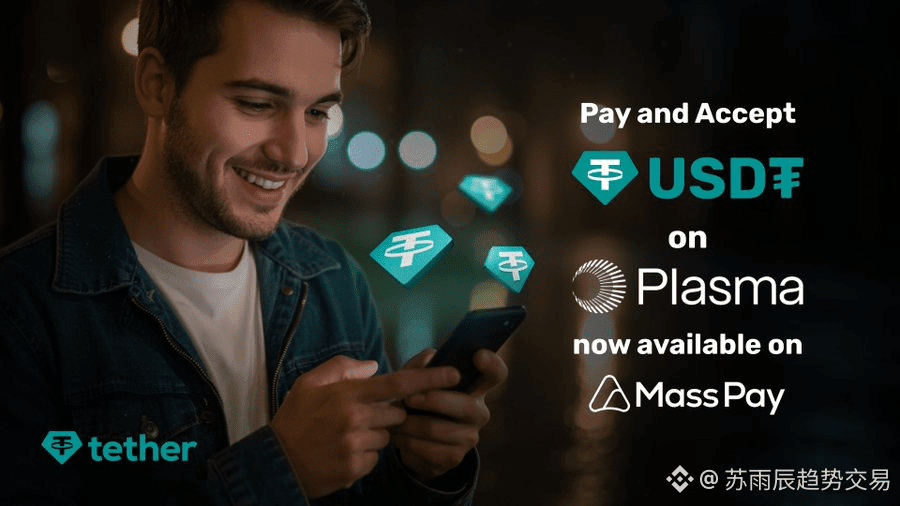
USDT transfers with no gas fees: This is the core killer feature of plasma. Just like you don't need to pay a "server fee" when using WeChat Pay, you can transfer with just U in your account. This is what payments should look like—smooth and seamless.
Sub-second confirmation: Based on PlasmaBFT technology, it's basically “click and it's in your account,” saying goodbye to the anxiety of on-chain congestion.
Bitcoin-level security: The underlying mechanism combines Bitcoin's security, offering the strongest consensus protection while being compatible with EVM (Reth), making it easy for developers and institutions to enter the field without pressure.
I think plasma is doing something very "sexy"—hiding the technology in the background and letting the experience return to simplicity. For us seasoned players, we might be used to complexity, but for new users outside the circle and traditional financial institutions, this kind of "invisible payment" is the reason they are willing to enter the arena.
The future of Web3 doesn't lie in overly complex nested gameplay, but in enabling ordinary people to use it with zero barriers.
What do you think about the future competition of public chains: is it about performance or experience? Let's chat in the comments below👇
#plasma $XPL @Plasma
Don't let gas fees become the "stumbling block" for Web3 payments.
Brothers, let's talk about something direct today. We've been in this circle for a long time, haven't we gotten used to meticulously calculating gas fees for transfers and always keeping some ETH for transaction costs—this "inhumane" operation? To be honest, this kind of threshold is precisely the wall that hinders Web3 from truly reaching the masses (Mass Adoption).
Recently, I've been looking at @Plasma , and it excites me a bit. Because it doesn't do those flashy "universal chains" but focuses on one thing: an extreme stablecoin payment experience.
Simply put, here are three points that hit me:
USDT transfers with no gas fees: This is the core killer feature of plasma. Just like you don't need to pay a "server fee" when using WeChat Pay, you can transfer with just U in your account. This is what payments should look like—smooth and seamless.
Sub-second confirmation: Based on PlasmaBFT technology, it's basically “click and it's in your account,” saying goodbye to the anxiety of on-chain congestion.
Bitcoin-level security: The underlying mechanism combines Bitcoin's security, offering the strongest consensus protection while being compatible with EVM (Reth), making it easy for developers and institutions to enter the field without pressure.
I think plasma is doing something very "sexy"—hiding the technology in the background and letting the experience return to simplicity. For us seasoned players, we might be used to complexity, but for new users outside the circle and traditional financial institutions, this kind of "invisible payment" is the reason they are willing to enter the arena.
The future of Web3 doesn't lie in overly complex nested gameplay, but in enabling ordinary people to use it with zero barriers.
What do you think about the future competition of public chains: is it about performance or experience? Let's chat in the comments below👇
#plasma $XPL @Plasma
Brothers, let's talk about something direct today. We've been in this circle for a long time, haven't we gotten used to meticulously calculating gas fees for transfers and always keeping some ETH for transaction costs—this "inhumane" operation? To be honest, this kind of threshold is precisely the wall that hinders Web3 from truly reaching the masses (Mass Adoption).
Recently, I've been looking at @Plasma , and it excites me a bit. Because it doesn't do those flashy "universal chains" but focuses on one thing: an extreme stablecoin payment experience.
Simply put, here are three points that hit me:
USDT transfers with no gas fees: This is the core killer feature of plasma. Just like you don't need to pay a "server fee" when using WeChat Pay, you can transfer with just U in your account. This is what payments should look like—smooth and seamless.
Sub-second confirmation: Based on PlasmaBFT technology, it's basically “click and it's in your account,” saying goodbye to the anxiety of on-chain congestion.
Bitcoin-level security: The underlying mechanism combines Bitcoin's security, offering the strongest consensus protection while being compatible with EVM (Reth), making it easy for developers and institutions to enter the field without pressure.
I think plasma is doing something very "sexy"—hiding the technology in the background and letting the experience return to simplicity. For us seasoned players, we might be used to complexity, but for new users outside the circle and traditional financial institutions, this kind of "invisible payment" is the reason they are willing to enter the arena.
The future of Web3 doesn't lie in overly complex nested gameplay, but in enabling ordinary people to use it with zero barriers.
What do you think about the future competition of public chains: is it about performance or experience? Let's chat in the comments below👇
#plasma $XPL @Plasma
1
322
·
--
Article
Why Do We Need a Layer 1 That Only Serves Stablecoins?Recently, I've been looking at data from various public chains, and there's an interesting phenomenon: We shout 'Mass Adoption' on Twitter every day, but when you actually want to transfer USDT to a friend who doesn't understand technology, explaining 'You need to buy some ETH/BNB/SOL for gas fees' often discourages 90% of people.
This makes me start to reflect: Is our current L1 really ready to support a trillion-level payment market?
Today, I want to talk to you about a project that is very 'counterintuitive' but logically coherent - @plasma.
Why is it said to be counterintuitive? Because while everyone is busy building 'universal chains,' it has chosen a very narrow but deep track: a Layer 1 specifically designed for stablecoin settlement.
Why Do We Need a Layer 1 That Only Serves Stablecoins?
Recently, I've been looking at data from various public chains, and there's an interesting phenomenon: We shout 'Mass Adoption' on Twitter every day, but when you actually want to transfer USDT to a friend who doesn't understand technology, explaining 'You need to buy some ETH/BNB/SOL for gas fees' often discourages 90% of people.
This makes me start to reflect: Is our current L1 really ready to support a trillion-level payment market?
Today, I want to talk to you about a project that is very 'counterintuitive' but logically coherent - @plasma.
Why is it said to be counterintuitive? Because while everyone is busy building 'universal chains,' it has chosen a very narrow but deep track: a Layer 1 specifically designed for stablecoin settlement.
This makes me start to reflect: Is our current L1 really ready to support a trillion-level payment market?
Today, I want to talk to you about a project that is very 'counterintuitive' but logically coherent - @plasma.
Why is it said to be counterintuitive? Because while everyone is busy building 'universal chains,' it has chosen a very narrow but deep track: a Layer 1 specifically designed for stablecoin settlement.
1
144
·
--
Bullish
Sorry, having money really allows you to do whatever you want
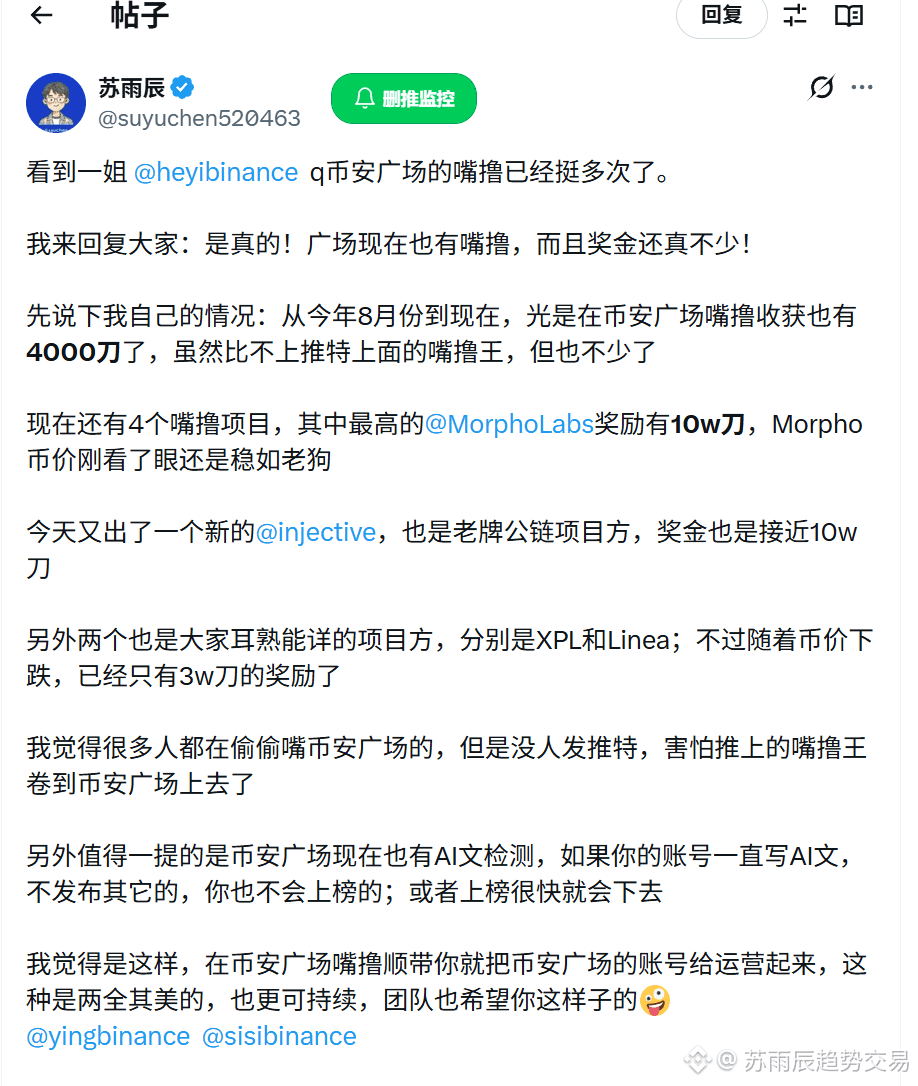
Binance Square has splurged $500,000 this time to reward creators. Previously, I also earned $4,000 in the Binance Square's mouth-looting event, so I can say that half of my small treasury is from Binance Square.
Just right, this time Kaito's API was also cut off by X, so mouth-looting on X has become a thing of the past; let's actively embrace Binance Square's mouth-looting!
Speaking of mouth-looting, you really need to create well. If you write those AI articles every day, trust me, no one will read them. The fans in the square aren't fools; why would they click on your mouth-looting article?
You still need to write some valuable content, share some insights, and express some thoughts; if you can't help the brothers in the square make money, at least you should provide some emotional value!
#plasma $XPL @Plasma
Sorry, having money really allows you to do whatever you want
Binance Square has splurged $500,000 this time to reward creators. Previously, I also earned $4,000 in the Binance Square's mouth-looting event, so I can say that half of my small treasury is from Binance Square.
Just right, this time Kaito's API was also cut off by X, so mouth-looting on X has become a thing of the past; let's actively embrace Binance Square's mouth-looting!
Speaking of mouth-looting, you really need to create well. If you write those AI articles every day, trust me, no one will read them. The fans in the square aren't fools; why would they click on your mouth-looting article?
You still need to write some valuable content, share some insights, and express some thoughts; if you can't help the brothers in the square make money, at least you should provide some emotional value!
#plasma $XPL @Plasma
Binance Square has splurged $500,000 this time to reward creators. Previously, I also earned $4,000 in the Binance Square's mouth-looting event, so I can say that half of my small treasury is from Binance Square.
Just right, this time Kaito's API was also cut off by X, so mouth-looting on X has become a thing of the past; let's actively embrace Binance Square's mouth-looting!
Speaking of mouth-looting, you really need to create well. If you write those AI articles every day, trust me, no one will read them. The fans in the square aren't fools; why would they click on your mouth-looting article?
You still need to write some valuable content, share some insights, and express some thoughts; if you can't help the brothers in the square make money, at least you should provide some emotional value!
#plasma $XPL @Plasma
2
314
·
--
Bearish
Spent the afternoon researching prediction market strategies—here's a bold take!
Prediction markets simply aren't suitable for small capital to pump volume. If you're a small investor looking to turn things around, you'd be better off trying your luck on Perpdex next door 🃏
1️⃣ Arbitrage actually drains your attention
Anyone claiming they can consistently profit from arbitrage between Op and Poly on the same event should be blocked immediately! They're misleading you. Anyone who's actually tried arbitrage on these platforms knows that due to bots,
there's essentially no arbitrage opportunity left. Either the arbitrage capital is minuscule, or the price differences are so tiny they don't even cover transaction fees.
So anyone still promoting arbitrage profits is likely just clickbait or trying to lure you into a community to use as cannon fodder.
2️⃣ Small capital pumping relies on capital mobility
Why can Perpdex support small capital volume pumping? Because its order book depth is sufficient, allowing quick entry and exit. In contrast, prediction markets have extremely poor order book depth—after you execute a trade, exiting usually means taking a significant discount loss.
This means once your small capital enters the order book, it's often stuck there—anywhere from a few days to a couple of months—before you can finally earn enough profit to cover fees and exit.
So for small capital, prediction markets may actually be less efficient than Perpdex. Prediction markets are better suited for large capital chasing APY returns and arbitrage, which is why so many KOLs are pushing this strategy for profit.
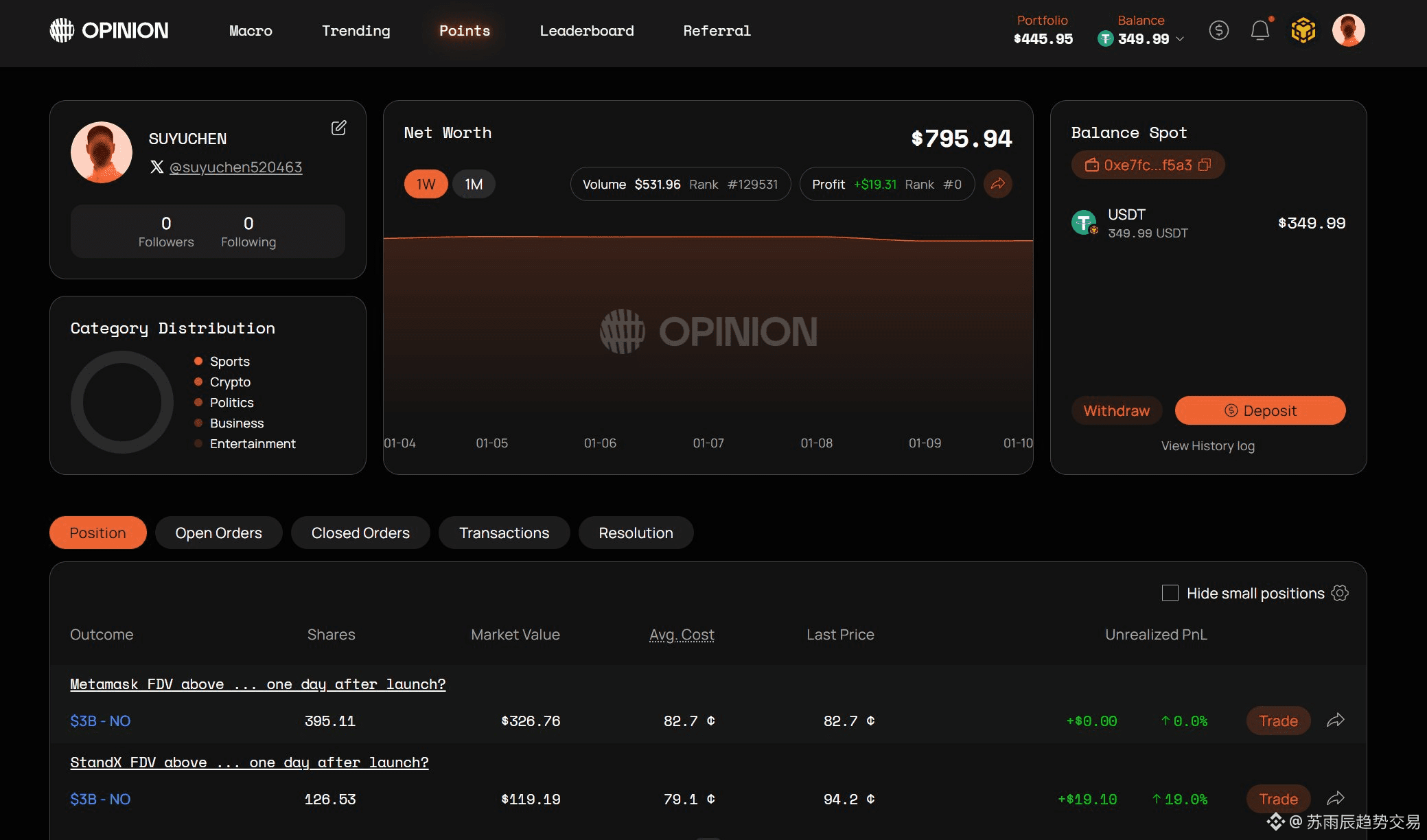
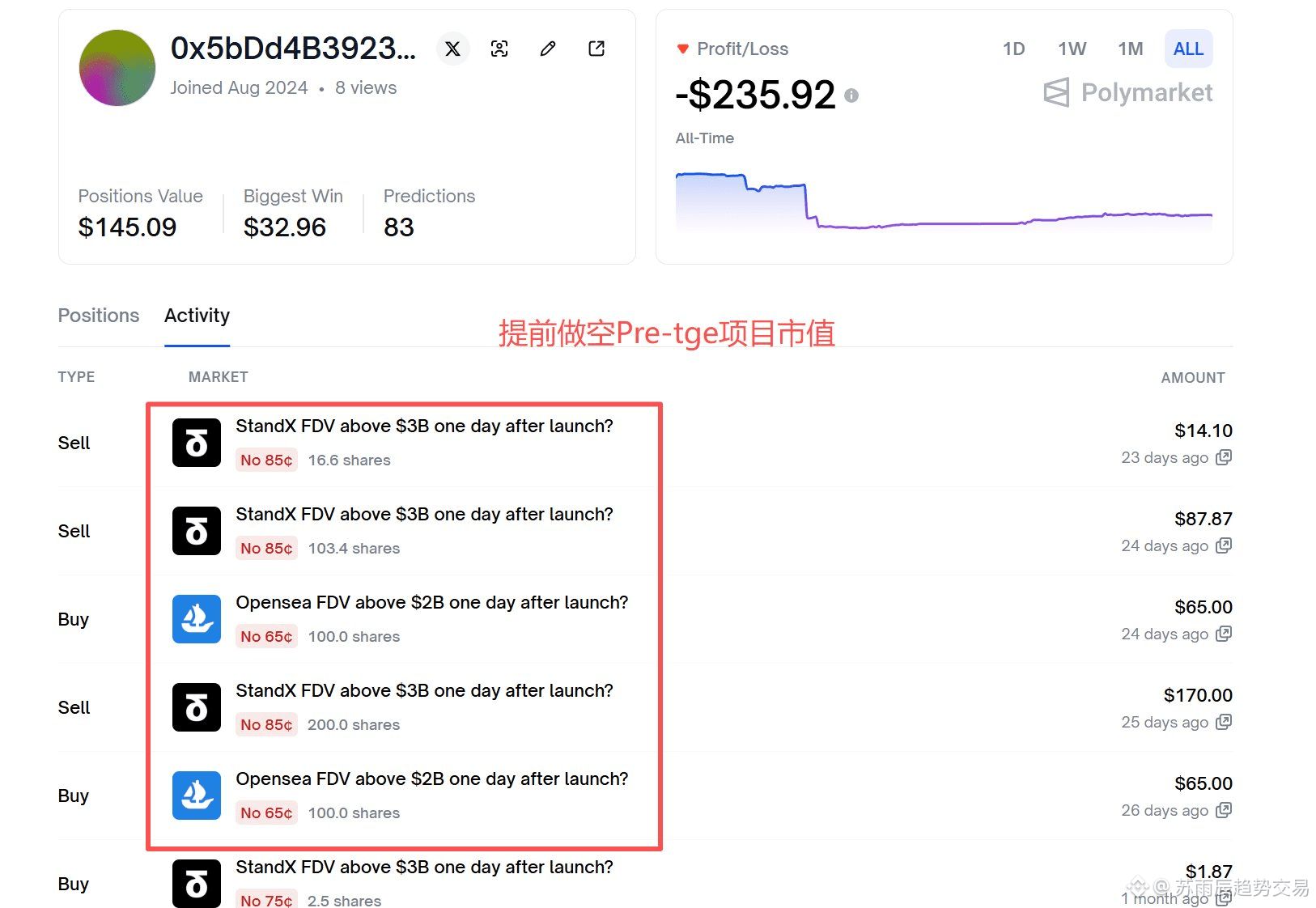
In short, you can play, but don't go in with the goal of pumping volume. Focus on making money instead. My current strategy is to short projects in the pre-TGE phase that are three tiers away from their true FDV—nothing else matters.
If you're a small investor chasing high capital efficiency and hoping to turn a small amount into big gains, head over to Perpdex. That’s where wealth might be closer.
#预测市场将如何发展?
Spent the afternoon researching prediction market strategies—here's a bold take!
Prediction markets simply aren't suitable for small capital to pump volume. If you're a small investor looking to turn things around, you'd be better off trying your luck on Perpdex next door 🃏
1️⃣ Arbitrage actually drains your attention
Anyone claiming they can consistently profit from arbitrage between Op and Poly on the same event should be blocked immediately! They're misleading you. Anyone who's actually tried arbitrage on these platforms knows that due to bots,
there's essentially no arbitrage opportunity left. Either the arbitrage capital is minuscule, or the price differences are so tiny they don't even cover transaction fees.
So anyone still promoting arbitrage profits is likely just clickbait or trying to lure you into a community to use as cannon fodder.
2️⃣ Small capital pumping relies on capital mobility
Why can Perpdex support small capital volume pumping? Because its order book depth is sufficient, allowing quick entry and exit. In contrast, prediction markets have extremely poor order book depth—after you execute a trade, exiting usually means taking a significant discount loss.
This means once your small capital enters the order book, it's often stuck there—anywhere from a few days to a couple of months—before you can finally earn enough profit to cover fees and exit.
So for small capital, prediction markets may actually be less efficient than Perpdex. Prediction markets are better suited for large capital chasing APY returns and arbitrage, which is why so many KOLs are pushing this strategy for profit.
In short, you can play, but don't go in with the goal of pumping volume. Focus on making money instead. My current strategy is to short projects in the pre-TGE phase that are three tiers away from their true FDV—nothing else matters.
If you're a small investor chasing high capital efficiency and hoping to turn a small amount into big gains, head over to Perpdex. That’s where wealth might be closer.
#预测市场将如何发展?
Prediction markets simply aren't suitable for small capital to pump volume. If you're a small investor looking to turn things around, you'd be better off trying your luck on Perpdex next door 🃏
1️⃣ Arbitrage actually drains your attention
Anyone claiming they can consistently profit from arbitrage between Op and Poly on the same event should be blocked immediately! They're misleading you. Anyone who's actually tried arbitrage on these platforms knows that due to bots,
there's essentially no arbitrage opportunity left. Either the arbitrage capital is minuscule, or the price differences are so tiny they don't even cover transaction fees.
So anyone still promoting arbitrage profits is likely just clickbait or trying to lure you into a community to use as cannon fodder.
2️⃣ Small capital pumping relies on capital mobility
Why can Perpdex support small capital volume pumping? Because its order book depth is sufficient, allowing quick entry and exit. In contrast, prediction markets have extremely poor order book depth—after you execute a trade, exiting usually means taking a significant discount loss.
This means once your small capital enters the order book, it's often stuck there—anywhere from a few days to a couple of months—before you can finally earn enough profit to cover fees and exit.
So for small capital, prediction markets may actually be less efficient than Perpdex. Prediction markets are better suited for large capital chasing APY returns and arbitrage, which is why so many KOLs are pushing this strategy for profit.
In short, you can play, but don't go in with the goal of pumping volume. Focus on making money instead. My current strategy is to short projects in the pre-TGE phase that are three tiers away from their true FDV—nothing else matters.
If you're a small investor chasing high capital efficiency and hoping to turn a small amount into big gains, head over to Perpdex. That’s where wealth might be closer.
#预测市场将如何发展?
1
263
Log in to explore more content
Join global crypto users on Binance Square
⚡️ Get latest and useful information about crypto.
💬 Trusted by the world’s largest crypto exchange.
👍 Discover real insights from verified creators.
Email / Phone number
Trending Topics
BitcoinRejectedAt$87K
24,882 views
58 Discussing
$BTC Update 🚨 🐼 Skip THIS Warning at Your Own Risk ⚠️
BTC is knocking on 87K like it already owns the place 😂Bulls are awake… but BTC usually likes to shake a few people out before the real move.
Overall, BTC is breaking out and the higher-timeframe picture is still bullish. The 4H and daily structure are strong, price is holding above the major averages, and momentum is still supporting the move.
83K was honestly a beautiful buy location. That was the area where risk/reward made sense. Anyone who bought there is already sitting enjoying profit
Now come to main
BTC is sitting right under the previous high around 87K. So I would not be surprised if we first see a little downside liquidity grab, flush some late longs, and then BTC decides whether it wants the real breakout.
For today’s scalp, This is my Plan 👇
BTC SHORT scalp Entry: 86,550–86,900
TP1: 85,650
TP2: 84,850
TP3: 84,050
SL: 87,800
I only like this if we get a proper rejection near the highs. No blind shorting.
For the bigger picture, I’m still bullish as long as the 82.5K–83K area keeps holding. If BTC gets a clean breakout and starts accepting above 87.4K, then this whole short idea is invalid and the next bullish leg becomes much more interesting.
SO BASICALLY OCTOBER HISTORICAL IS BULLISH MONTH FOR BITCOIN.
ALWAYS DYOR
Panda Traders
·31 Likes
·12.9k views
FedOctoberRateHikeOddsFallTo17%
17,330 views
305 Discussing
NvidiaHitsRecordHighUp2.4%
4,418 views
196 Discussing