
长安北一
252 Posts

长安北一
Report
Block User
ETH 、UNI 重仓中。不会交易,善于逻辑推演。喜欢发呆、睡觉、思考、赚钱,没啥物质欲,想一些有的无的、天马行空不切实际的事。

Top traders by profit in 7D

Top 30D Traders by Volume
Open Trade

ETH Holder
High-Frequency Trader
2.2 Years
44 Following
864 Followers
579 Liked
2 Badges
Posts
Portfolio
All
Quotes
Videos
PINNED
·
--
Record the current position holdings:
Super overweight: ETH
Overweight: UNI ZRO
Heavier positions: BNB BTC CRCL HOOD
_________Jungle (trading) positions___________
Two $100k target positions: OP Pendle
Lottery positions ($10k–$50k range): Linea BP W
Summary:
The portfolio structure is relatively simple, with no too many messy tokens. The approach is straightforward: if you believe in it, go all-in; if it’s a heavy position, go hard.
From a position standpoint, this bull cycle’s outcome mainly hinges on these three tokens: ETH, UNI, and ZRO. The former relies on position sizing to bet, while the latter two rely on upside potential and growth space—this really tests your own judgment and scenario-planning ability.
How about a vision?
Let ETH and UNI achieve single-token A9, and let ZRO achieve single-token A8. Haha~
17
1
12
17.4k
PINNED
·
--

Article
Some thoughts about UNISWAP$UNI Actually, I’m quite familiar with various coins in the crypto world, but in this round, for the altcoin portion I only picked one $UNI —it was decided after a lot of thinking.
For example, is Link or AAVE not good? Not really. From a fundamentals standpoint, Link is great and the moat is very deep, but the token utility is too weak. Also, a lot of whatever future value it had has already been priced in—so I don't think it's worth me entering.
AAVE is similar too. Even though the fundamentals are solid and the token utility is decent, compared with something like Uniswap—where there is direct, programmatic, automated buyback—doesn't it feel like it's a level behind?
Programmatic utility for tokens can help avoid incentive problems in DAO governance systems—for example, situations where “both hands” trade against each other, and issues like how to execute things, as well as corruption and improper benefit transfer.
Some thoughts about UNISWAP
$UNI Actually, I’m quite familiar with various coins in the crypto world, but in this round, for the altcoin portion I only picked one $UNI —it was decided after a lot of thinking.
For example, is Link or AAVE not good? Not really. From a fundamentals standpoint, Link is great and the moat is very deep, but the token utility is too weak. Also, a lot of whatever future value it had has already been priced in—so I don't think it's worth me entering.
AAVE is similar too. Even though the fundamentals are solid and the token utility is decent, compared with something like Uniswap—where there is direct, programmatic, automated buyback—doesn't it feel like it's a level behind?
Programmatic utility for tokens can help avoid incentive problems in DAO governance systems—for example, situations where “both hands” trade against each other, and issues like how to execute things, as well as corruption and improper benefit transfer.
11
2
10
6.9k
·
--
Partly True
I haven’t posted an update in a while. I checked in and was surprised to see a few fans still calling for one. I’m honored. Even better, I didn’t spot any snarky comments.
A quick update on how things have been lately:
1. My futures trades took a heavy loss. Luckily, I hadn’t given back all the gains from that lucky trade earlier, so I’m calling it quits on this game.
2. I still haven’t made any moves in spot—no additions, no reductions.
Why I haven’t posted lately:
1. There’s been a lot going on at home, and I’ve been traveling between a few cities to take care of things. On top of that, the market’s been poor, and I’ve gotten hooked on short dramas, so I stopped posting and making idle chatter.
If anyone would like investment suggestions:
If you’re trying to balance time, risk, and returns, I still recommend UNI, CRCL, and HOOD. Most importantly, the latter two are attractively priced right now and make good long-term spot holdings for anyone comfortable with risk.
High-volatility picks: ZRO, JUP
Other notes:
1. I haven’t mentioned BTC/ETH/BNB. Just pick whichever one you like best.
2. If you’re especially bullish on the RWA sector, SECZ is a good lottery ticket.
3. For established altcoins, the only ones I’d recommend are AAVE, LINK, and MORPHO.
4. If you have a large amount of capital that you haven’t invested yet, I personally recommend a Nasdaq ETF/QQQ. If you want something a little steadier, go with an S&P 500 ETF. The reasons are its high predictability and the fact that it’s low-maintenance and hassle-free. Also, 5x24-hour trading is launching in December, which will further draw in marginal capital from around the world—a structural positive for US stocks. And investing is all about not putting all your eggs in one basket. Even if you diversify within a single sector, it’s still just one basket, so this allocation is important for investors with a lot of capital.
I’m stopping here because of the word limit—and because I’m lazy. I’ve already said a lot of this before, and there aren’t many crypto assets worth choosing from these days anyway.
If you have a decent amount of capital and want predictability, I genuinely recommend a Nasdaq ETF. I’ve held this for over three years, and it’s been great. I often joke with friends: with the S&P 500 and the Nasdaq in your portfolio, it’s hard to end up poor.
16
9
4.6k
·
--
Two hot topics have been making waves both inside and outside the crypto world these past few days: 1. hardware wallets; 2. that brake pedal incident. Honestly, neither of them has made me feel much of anything.
Hardware wallets: I never planned to buy one. A friend got one a while back and offered it to me, but I turned it down and suggested he sell it on Xianyu if he wasn’t going to use it.
My crypto holdings aren’t exactly small—I’d count as a big player among retail investors—but I’ve never considered getting a hardware wallet. Even if I trust that the product itself is fine, I can’t guarantee that the one I receive is problem-free. Whenever the stakes are high enough, every step of the process carries risk.
Also, if I really needed cold storage, I’d rather use a clean old iPhone and a simple, clean, open-source wallet. If you still have an old iPhone lying around, like an iPhone 8, check whether it still turns on. It’s much more reliable than a hard drive or USB stick. Then I keep things strictly separate on my Mac: different browsers, wallets, and addresses; no random software or extensions. For me, that’s secure enough.
A lot of the so-called real risks come from people messing around recklessly themselves.
As for that brake pedal incident, I care even less. That includes all the online arguments about quickly assembled cars and old clunkers. I’ve never joined those debates online. We’re all adults: spend your own money how you want and buy whatever you like. Just be prepared to own the consequences of your choices and your own judgment. And, in a way, not casually getting involved in other people’s karma is a principle to live by, too.
5
6
6.5k
·
--
Although I’m very bullish on UNI’s future, if you’ve taken a really large position, I sincerely suggest you get out once you’ve made enough.
I can’t tell you exactly what “enough” means. For some people, it might be $10, $20, or $50; others may exit when this cycle is nearly over. It depends on your situation.
It takes time and a process for a great company to emerge. You could also look back at Apple, NVIDIA, Tesla, and so on.
So be sure to manage your position, clarify your investment rationale, and take it one step at a time…
That’s the advice I give to all my followers.
Always consider things in light of your own circumstances. To put it bluntly, anyone who blindly listens to everything others say is a fool.

只玩现货不碰合约呀
·
--
I’m heavily invested in UNI too, bro, but in spot. Remember to post when you decide to sell—I’ve been following you.
5
2
4.8k
·
--
What a bull market!
I have 3 BP w/ Linea in my lottery bag, and two have hit so far.
I have two degen positions too. They’re underperforming for now, but I’m already looking at other picks and may dump Pendle at any moment.
What a bull market!
I have 3 BP w/ Linea in my lottery bag, and two have hit so far.
I have two degen positions too. They’re underperforming for now, but I’m already looking at other picks and may dump Pendle at any moment.
I have 3 BP w/ Linea in my lottery bag, and two have hit so far.
I have two degen positions too. They’re underperforming for now, but I’m already looking at other picks and may dump Pendle at any moment.
长安北一
·
--
Record the current position holdings:
Super overweight: ETH
Overweight: UNI ZRO
Heavier positions: BNB BTC CRCL HOOD
_________Jungle (trading) positions___________
Two $100k target positions: OP Pendle
Lottery positions ($10k–$50k range): Linea BP W
Summary:
The portfolio structure is relatively simple, with no too many messy tokens. The approach is straightforward: if you believe in it, go all-in; if it’s a heavy position, go hard.
From a position standpoint, this bull cycle’s outcome mainly hinges on these three tokens: ETH, UNI, and ZRO. The former relies on position sizing to bet, while the latter two rely on upside potential and growth space—this really tests your own judgment and scenario-planning ability.
How about a vision?
Let ETH and UNI achieve single-token A9, and let ZRO achieve single-token A8. Haha~
Super overweight: ETH
Overweight: UNI ZRO
Heavier positions: BNB BTC CRCL HOOD
_________Jungle (trading) positions___________
Two $100k target positions: OP Pendle
Lottery positions ($10k–$50k range): Linea BP W
Summary:
The portfolio structure is relatively simple, with no too many messy tokens. The approach is straightforward: if you believe in it, go all-in; if it’s a heavy position, go hard.
From a position standpoint, this bull cycle’s outcome mainly hinges on these three tokens: ETH, UNI, and ZRO. The former relies on position sizing to bet, while the latter two rely on upside potential and growth space—this really tests your own judgment and scenario-planning ability.
How about a vision?
Let ETH and UNI achieve single-token A9, and let ZRO achieve single-token A8. Haha~
10
2
9
2.4k
·
--
$UNI This pullback wiped me out on UNI + ETH. I need this trade to break even.
$UNI This pullback wiped me out on UNI + ETH. I need this trade to break even.
16
12
12.1k
·
--
$PENDLE I wonder how Pendle holders are feeling right now. It’s not even doing as well as the four L2 laggards... Something must be wrong.
$PENDLE I wonder how Pendle holders are feeling right now. It’s not even doing as well as the four L2 laggards... Something must be wrong.
5
2
1.1k
·
--
$UNI Now spot entry is a very good value for money.
For example, for testing-stop-loss setups, using a stop-loss below brings limited loss, while the upside has much room.
Then, combined with BTC/ETH assisting trades: if BTC doesn't break below 8, and ETH hits 2400, and they break out again, then it’s definitely a failure. But currently they show signs of stabilizing after a drop. You can continue to keep an eye on it.
8
8
2.6k
·
--
$JUP —what should I do? It’s taken off, and I don’t own any.
…
There are some coins I don’t hold, but that doesn’t mean I’m bearish on them. It’s just that everyone has different personal capital allocations and risk appetites.
$JUP —what should I do? It’s taken off, and I don’t own any.
…
There are some coins I don’t hold, but that doesn’t mean I’m bearish on them. It’s just that everyone has different personal capital allocations and risk appetites.
…
There are some coins I don’t hold, but that doesn’t mean I’m bearish on them. It’s just that everyone has different personal capital allocations and risk appetites.
长安北一
·
--
$JUP Although I don’t have JUP right now, if I have any leftover funds, I would use it to build a position in it.
If you believe in SOL, there is a rationale for building a position in JUP.
Clearly, it’s a super gateway into the SOL ecosystem.
If you believe in SOL, there is a rationale for building a position in JUP.
Clearly, it’s a super gateway into the SOL ecosystem.
18
1
1.5k
·
--
$UNI
UNI has now entered a deep retracement zone. Key support is at 7.85–8.00. For a rebound, watch whether it can reclaim 8.45–8.75. If conditions worsen, the next lower structural zone to monitor is 7.45–7.65.
$UNI
UNI has now entered a deep retracement zone. Key support is at 7.85–8.00. For a rebound, watch whether it can reclaim 8.45–8.75. If conditions worsen, the next lower structural zone to monitor is 7.45–7.65.
UNI has now entered a deep retracement zone. Key support is at 7.85–8.00. For a rebound, watch whether it can reclaim 8.45–8.75. If conditions worsen, the next lower structural zone to monitor is 7.45–7.65.
10
1
15
23.1k
·
--
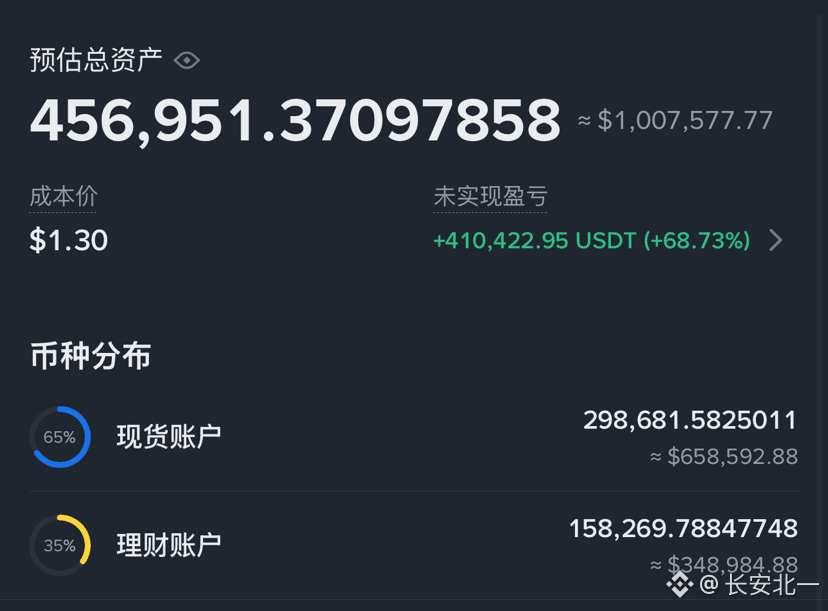
$ZRO The position is worth over $1 million now—not a huge amount, but not a small one either.
$ZRO The position is worth over $1 million now—not a huge amount, but not a small one either.
4
9
9.5k
·
--
Bullish
Holding $ZRO 977.9K USDT
$ZRO did really well. Thinking it over, my positioning this round was spot-on—there was nothing wrong with it at all.
Both altcoins I picked turned out to be winners. I must be blessed with incredible luck.
The only thing I still regret is not going in with a truly large position. Back when I started building my position in SKY, I went straight in with 30 million.
As for UNI, I couldn’t do much—the funds I had at the time were what they were.
With ZRO, I’d actually been buying in along the way. If I’d focused on it back then, I estimate I could’ve built up only another 200,000–300,000 tokens.
At the end of the day, ETH made up too much of my portfolio.
But I couldn’t get rid of ETH either, because I use collateralized borrowing, and borrowing against altcoins is capped, so it just doesn’t work.
Oh well...
5
2
5k
·
--
Verified
$UNI Two major Uniswap developments this week:
1. Japanese brokerage giant SMBC Nikko and Nethermind announced they are building DeFi Gateway, an onchain trading venue for Japanese investors on Uniswap v4.
2. The joint venture between OKX and Intercontinental Exchange (ICE, the parent company of the NYSE) filed with the U.S. SEC, planning to use a Uniswap v4 hook on OKX’s X Layer to create a 24/7 tokenized stock venue covering around 63 U.S. stocks. Trading and market making will be restricted to wallets holding compliant soulbound tokens.
These are just announcements, so they probably won’t do much for the token price in the short term. But for the long-term outlook on Uniswap, this is huge—absolutely huge.
5
24
20.1k
·
--
The biggest problem with $PONS is that there’s way too many chips from the early days that had almost zero cost. As long as those chips aren’t washed out, don’t expect prices to rise in the short term.
The biggest problem with $PONS is that there’s way too many chips from the early days that had almost zero cost. As long as those chips aren’t washed out, don’t expect prices to rise in the short term.
2
2k
·
--
$HOOD is also. 🤣
$HOOD is also. 🤣
长安北一
·
--
A quick reminder for everyone:
$CRCLB At the moment, for this round of callbacks, if you’re looking for something with relatively secure downside while still having upside potential, you can consider building positions gradually.
Investment is essentially about, within a certain time horizon, finding a balance between certainty/risk and flexibility/potential based on your own circumstances.
The underlying asset isn’t necessarily best because its potential is larger, nor is it best because its certainty is higher.
What truly matters is: whether the risk you take can be exchanged for sufficiently large potential returns.
1
660
·
--
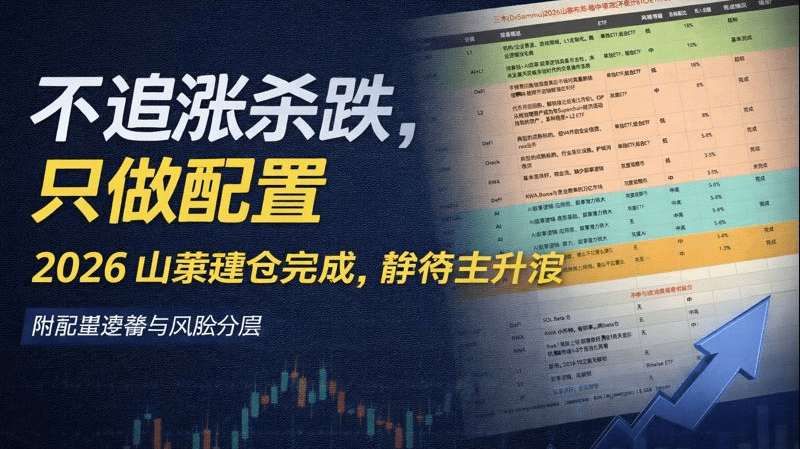
This is a counterfeit setup plan I published in January. Now let’s objectively review it.
If we look at this from the current stage, there aren’t really any major pitfalls. The counterfeit main portfolio positions—AVAX, UNI, and NEAR—two of the three ended up hitting, and I’m fairly satisfied with that result.
Also, based on statistics from the configuration table, it is definitely profitable. But honestly, OP and AVAX aren’t that impressive.
However, one thing is clear: if everyone wants to build a counterfeit position, you can totally use my configuration as a reference. Every item in here was carefully filtered by me at the time.
Now take them one by one and compare—see whether the bull coins from this round of rally are all included in it!
长安北一
·
--
Don't follow the crowd, just focus on allocation:山寨建仓 completed by 2026, waiting for trend realization
Allocation strategy: stable with a touch of aggression, covering L1, L2, AI, DeFi, DePIN, and RWA
"Stable" mainly revolves around product implementation and capital background, for example, AVAX in the chart. You can criticize its price, but you can't say its product is garbage or a bubble.
Because it has already become a dominant force in its designated field, with business collaborations already involving top-tier institutions such as JPMorgan Chase, Citibank, KKR (one of the world's largest investment firms), and the California Department of Motor Vehicles, and even games like Adventure Island are built on it, creating an extremely deep moat.
2
2.1k
·
--
Article
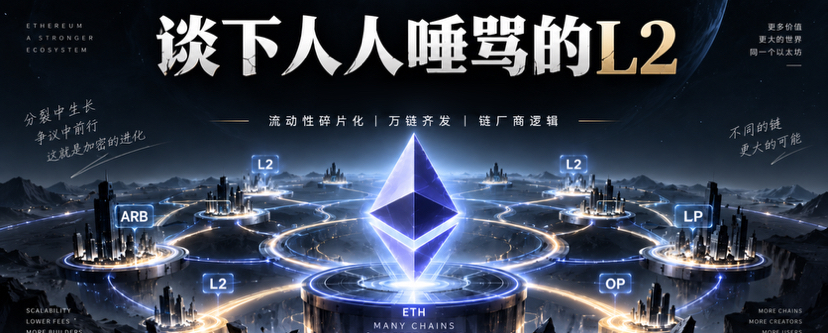
Let’s talk about the L2 everyone loves to denounceLet’s talk about the L2 that everyone loves to denounce.
Looking back at the views at the time: when people criticized L2, it was mostly because it caused liquidity fragmentation in the ETH ecosystem and made it difficult for value to flow back to ETH—this logic I do accept. But as for things like “using the emperor to command the princes,” or “vassal kings,” those are just nonsense, conclusions dreamed up by half-baked KOLs. The biggest value of ETH is security, decentralization, and its incredibly rich ecosystem—how could it be that easy to leave ETH? Later, some L1/L2 gradually went soft-dead, and there are even cases like Celo, an L1 that became an L2 for ETH—this also serves as evidence for part of my judgment.
Let’s talk about the L2 everyone loves to denounce
Let’s talk about the L2 that everyone loves to denounce.
Looking back at the views at the time: when people criticized L2, it was mostly because it caused liquidity fragmentation in the ETH ecosystem and made it difficult for value to flow back to ETH—this logic I do accept. But as for things like “using the emperor to command the princes,” or “vassal kings,” those are just nonsense, conclusions dreamed up by half-baked KOLs. The biggest value of ETH is security, decentralization, and its incredibly rich ecosystem—how could it be that easy to leave ETH? Later, some L1/L2 gradually went soft-dead, and there are even cases like Celo, an L1 that became an L2 for ETH—this also serves as evidence for part of my judgment.
Looking back at the views at the time: when people criticized L2, it was mostly because it caused liquidity fragmentation in the ETH ecosystem and made it difficult for value to flow back to ETH—this logic I do accept. But as for things like “using the emperor to command the princes,” or “vassal kings,” those are just nonsense, conclusions dreamed up by half-baked KOLs. The biggest value of ETH is security, decentralization, and its incredibly rich ecosystem—how could it be that easy to leave ETH? Later, some L1/L2 gradually went soft-dead, and there are even cases like Celo, an L1 that became an L2 for ETH—this also serves as evidence for part of my judgment.
1
1.9k
·
--
$JUP Although I don’t have JUP right now, if I have any leftover funds, I would use it to build a position in it.
If you believe in SOL, there is a rationale for building a position in JUP.
Clearly, it’s a super gateway into the SOL ecosystem.
$JUP Although I don’t have JUP right now, if I have any leftover funds, I would use it to build a position in it.
If you believe in SOL, there is a rationale for building a position in JUP.
Clearly, it’s a super gateway into the SOL ecosystem.
If you believe in SOL, there is a rationale for building a position in JUP.
Clearly, it’s a super gateway into the SOL ecosystem.
1
2
1.2k
Log in to explore more content
Join global crypto users on Binance Square
⚡️ Get latest and useful information about crypto.
💬 Trusted by the world’s largest crypto exchange.
👍 Discover real insights from verified creators.
Email / Phone number
Trending Topics
HotCPIDecemberHikePriced
14,964 views
486 Discussing
CPI Market Watch | US CPI Rises 0.4% in October, Hotter Than 0.3% Forecast
Binance News
·15 Likes
·23k views
AnthropicRejectsIPODelayValuationinQuestion
145,872 views
1,400 Discussing
NvidiaInvestigatesAfterHuang’sAffairApology
397,520 views
2,875 Discussing