
0xSamXBT
88 Posts

0xSamXBT

BNB Holder
High-Frequency Trader
3.8 Years
7 Following
58 Followers
102 Liked
Posts
All
Quotes
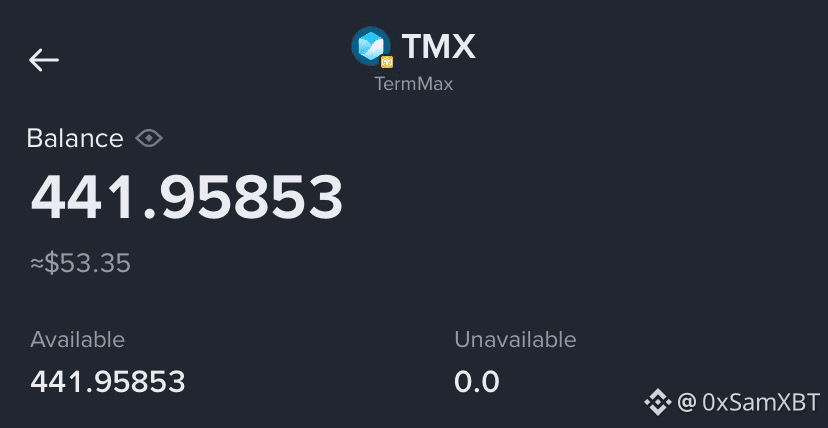
Update about my current holdings $TMX
From $80 to $50, It feels pain. Please team do something 😭
From $80 to $50, It feels pain. Please team do something 😭
0xSamXBT
·
--
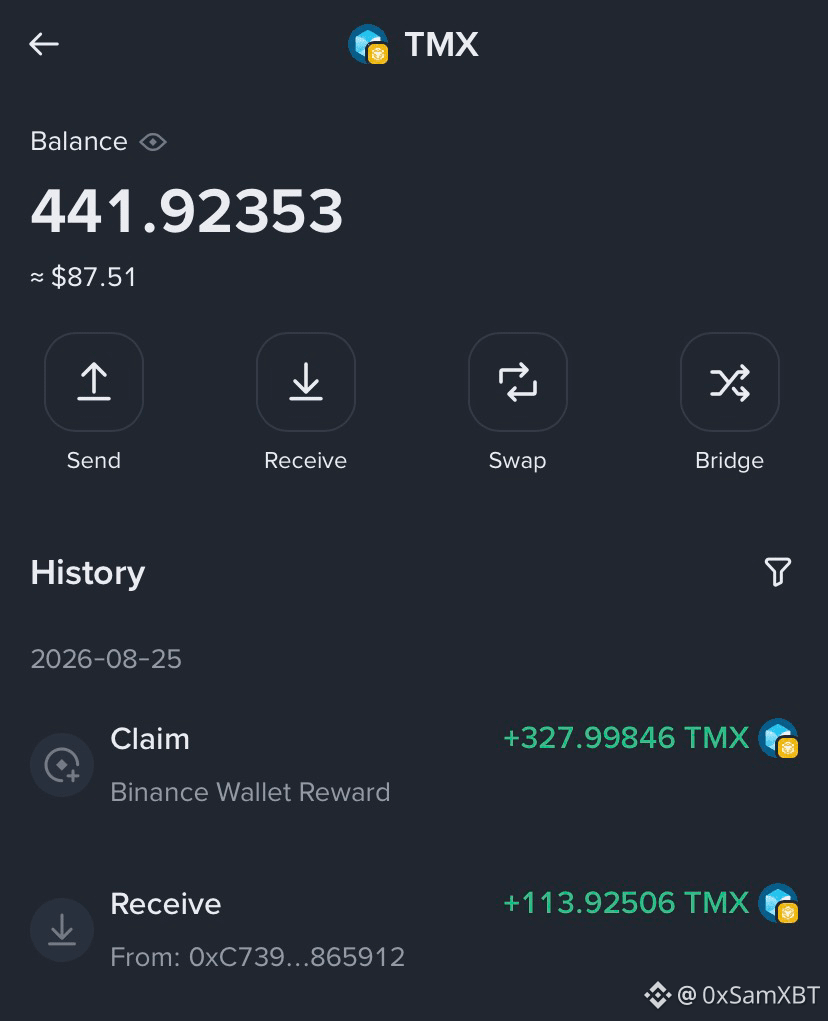
$TMX booster airdrop received
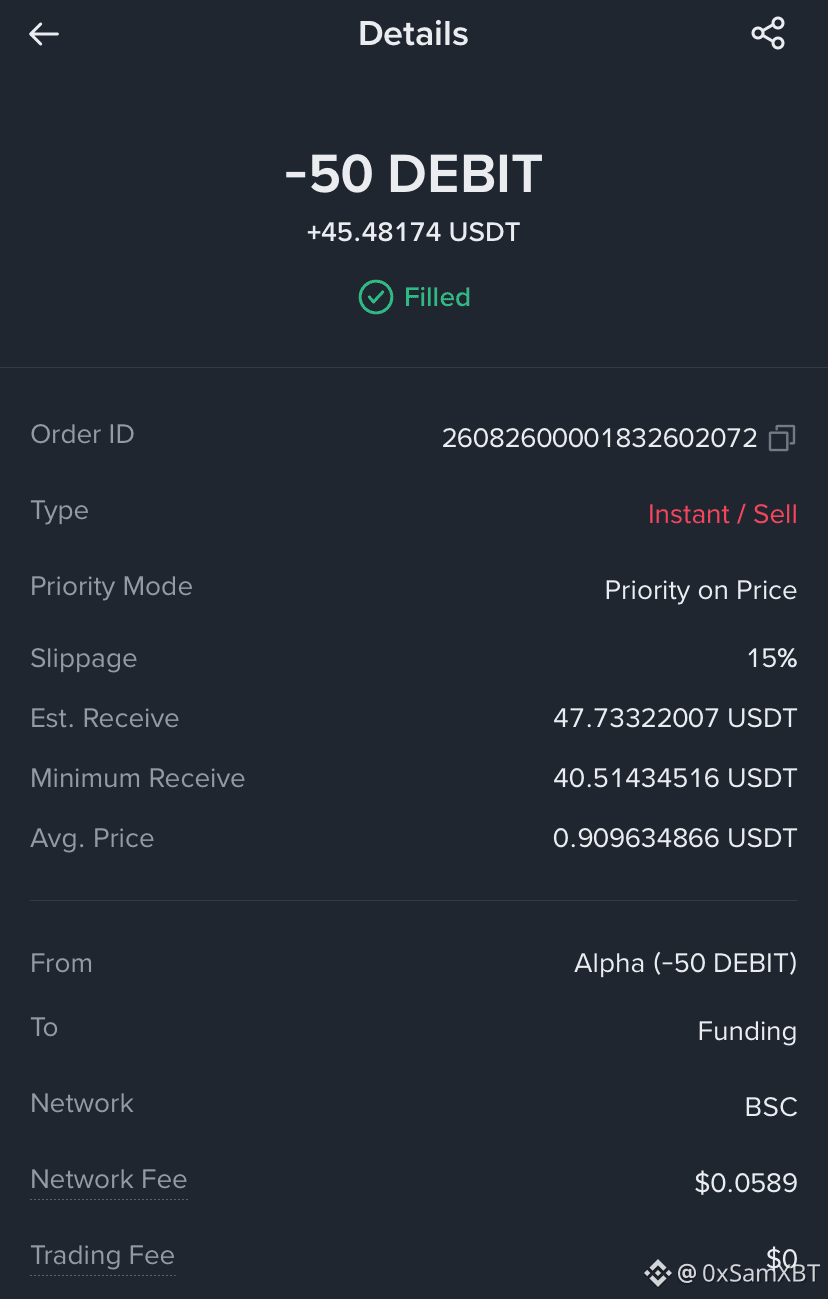
$DOS Trading competition result is out, I was got trap, almost fail, but still manage to win.
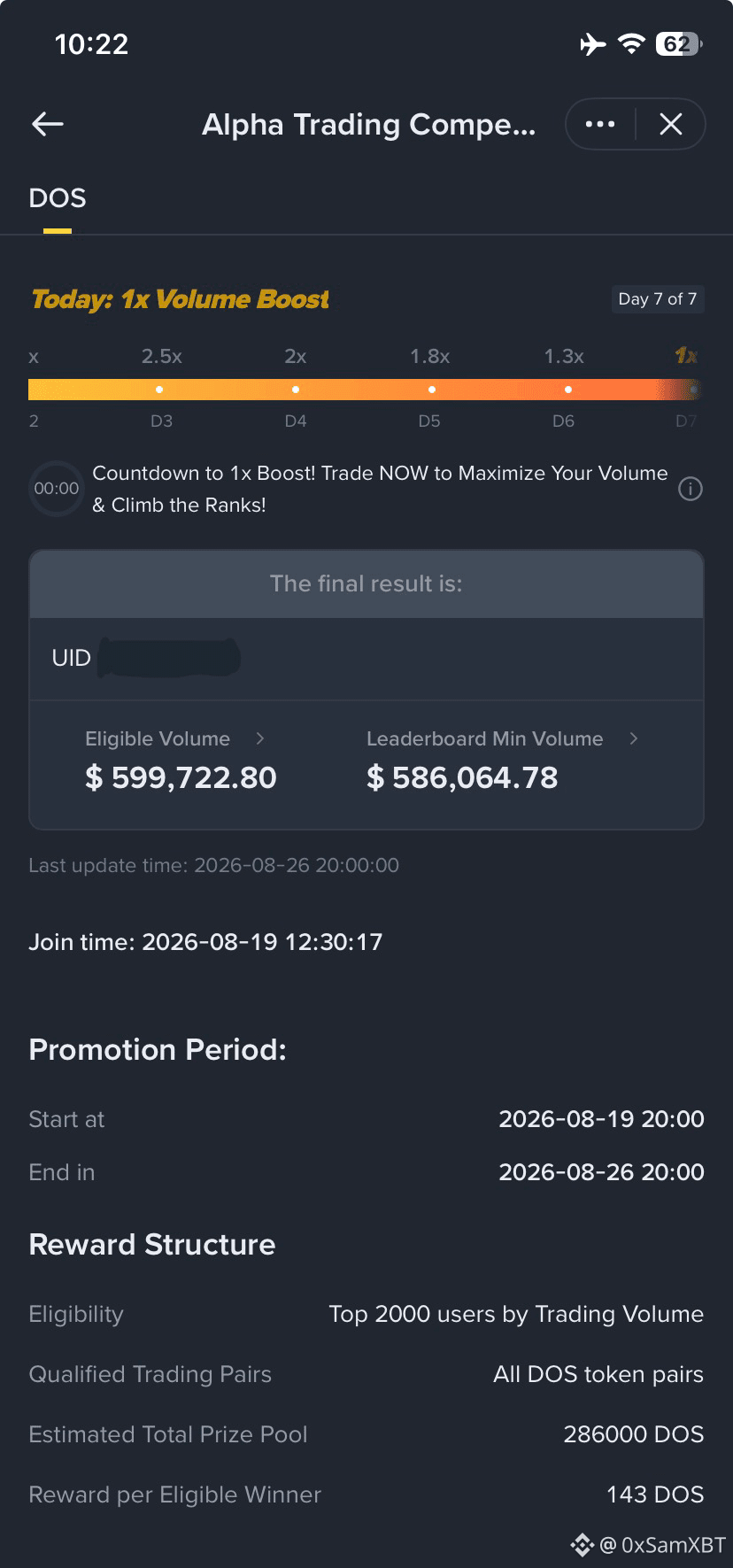
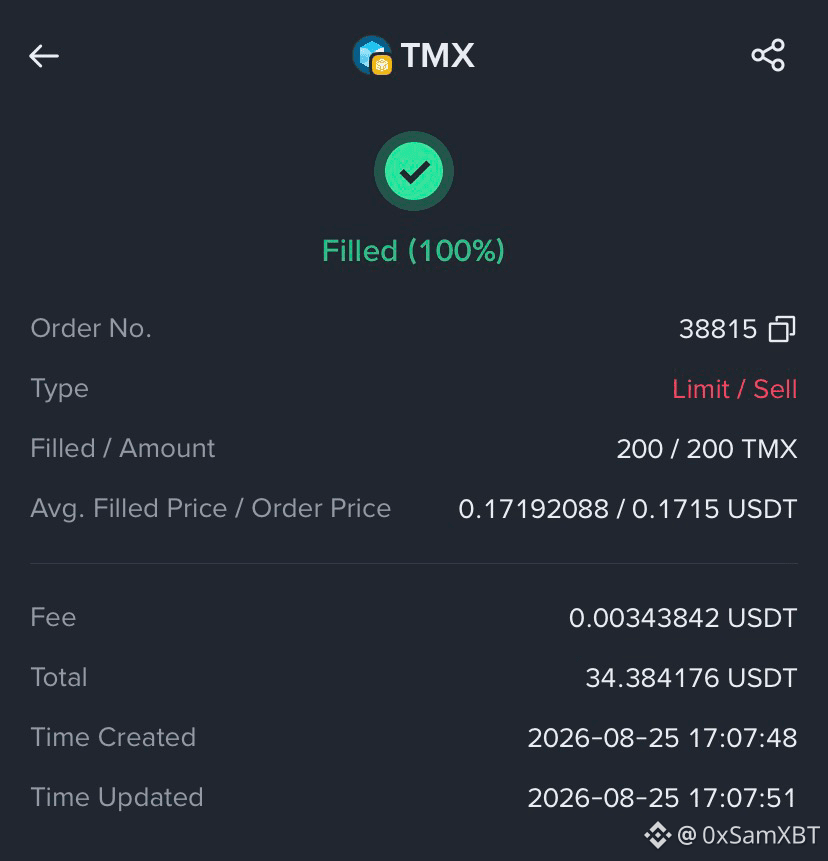
$TMX booster airdrop received
0xSamXBT
·
--
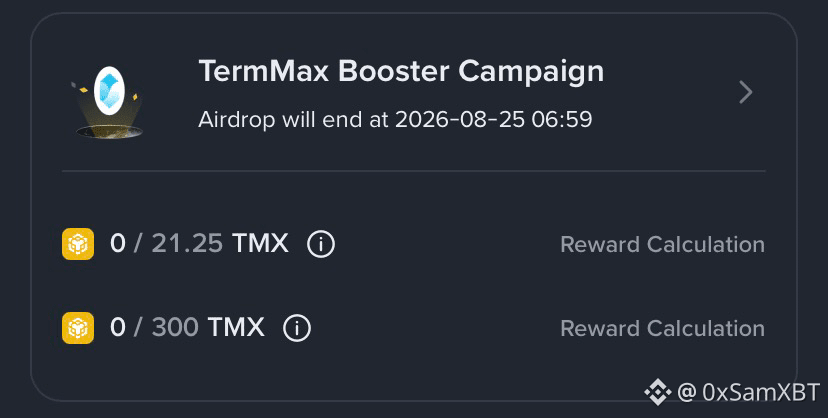
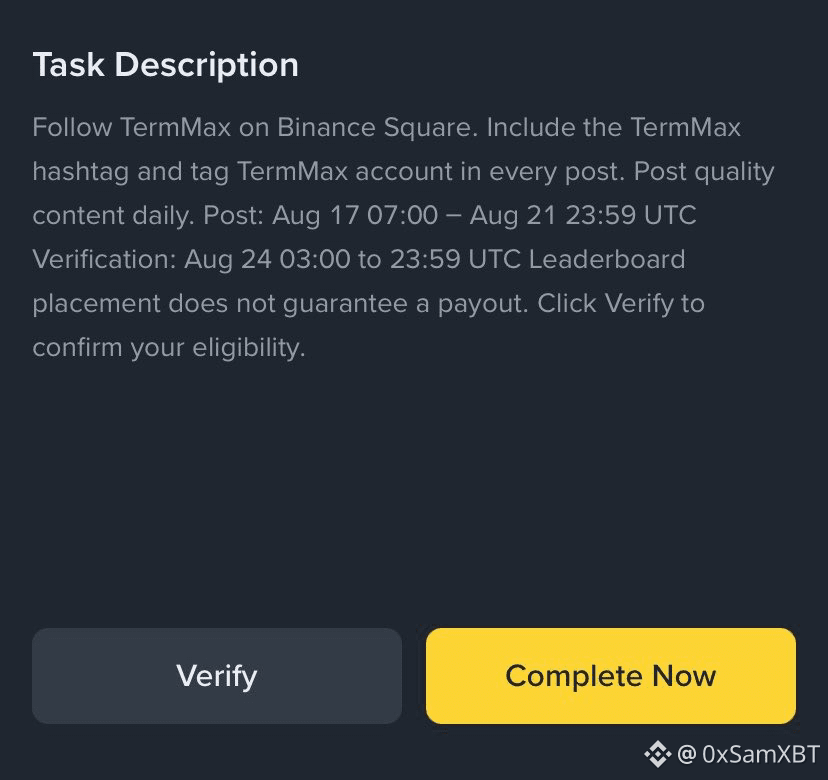
Successfully completed both tasks for $TMX
Current pre market $0.19
21.5+300 ~ $60
@TermMax #TermMax #BinanceAlpha
Current pre market $0.19
21.5+300 ~ $60
@TermMax #TermMax #BinanceAlpha
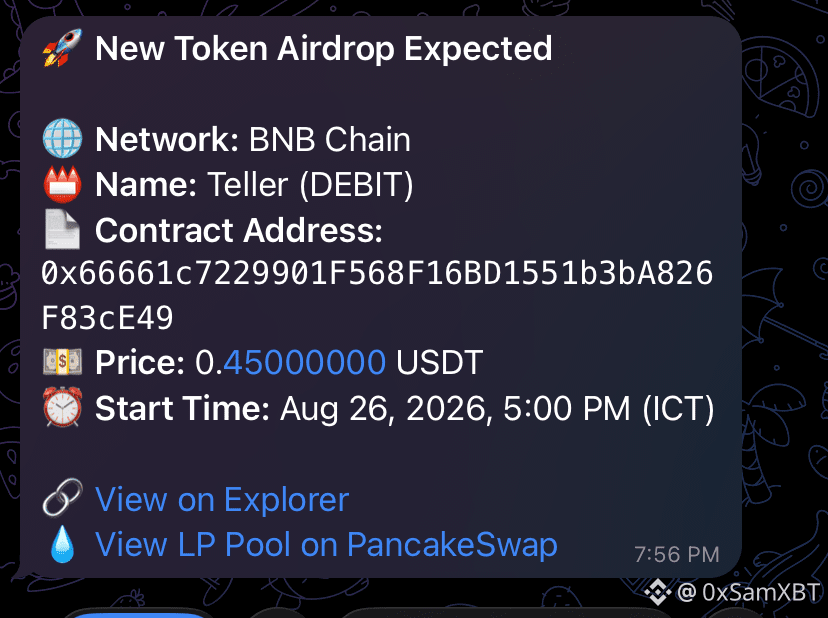
🚀 New Binance Alpha Token Airdrop Expected
🌐 Network: BNB Chain
📛 Name: Teller (DEBIT)
📄 Contract Address: 0x66661c7229901F568F16BD1551b3bA826F83cE49
💵 Price: 0.45000000 USDT
⏰ Start Time: Aug 26, 2026, 5:00 PM (ICT)
#BinanceAlpha
🌐 Network: BNB Chain
📛 Name: Teller (DEBIT)
📄 Contract Address: 0x66661c7229901F568F16BD1551b3bA826F83cE49
💵 Price: 0.45000000 USDT
⏰ Start Time: Aug 26, 2026, 5:00 PM (ICT)
#BinanceAlpha


Binance Square Official
·
--
Binance Square & Binance Wallet Booster: Grab a Share of 300,000 TMX Rewards on CreatorPad!
*The latest update on 2026-08-24, due to the discrepancy in reward distribution rules between TermMax CreatorPad campaign page and previous TermMax CreatorPad community notice, pending rewards shown in the Binance Wallet for the TermMax Booster Square task are temporarily calculated as an equal-split. Eligible Top 500 creators please visit your Binance Wallet and complete the TermMax Booster Square task verification before 2026-08-24 23:59 UTC. After TermMax completes its TGE on 2026-08-25, we will calculate the actual rewards based on the percentage of earned points, and will airdrop the remaining token difference between the percentage-point-based amount and the equal-split amount claimed to the eligible Binance Wallet of affected users. This update follows the 2026-08-23 announcement regarding the equal distribution of the prize pool among eligible winners.
Binance Square is pleased to introduce a new campaign on CreatorPad with Binance Wallet Booster. Verified users may complete simple tasks and verify Binance Square tasks in Binance Wallet Booster to unlock 300,000 TMX rewards.
CreatorPad Activity Period: 2026-08-17 07:00 (UTC) to 2026-08-21 23:59 (UTC)Booster Task Verification Period: 2026-08-24 03:00 (UTC) to 2026-08-24 23:59 (UTC)Token Rewards Distribution: At the project’s TGE
How to Participate:
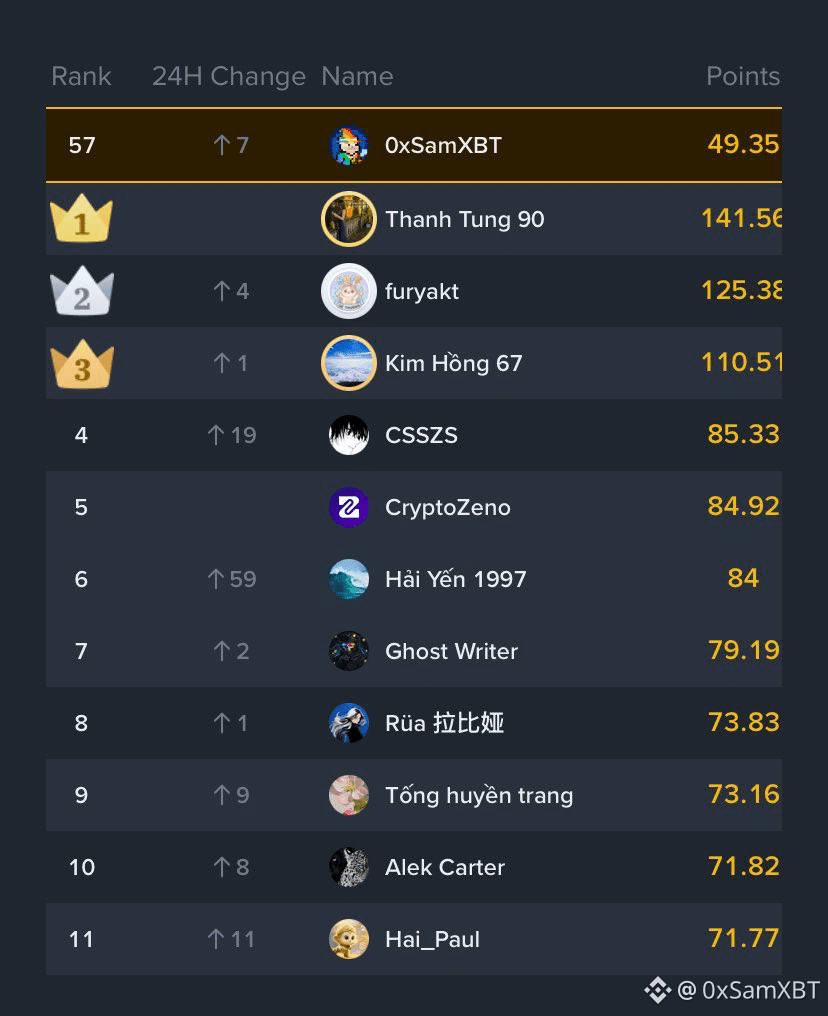
During the Activity Period, click “Join now” on the activity page and complete the tasks in the table to be ranked on the Top 500 leaderboard.
Notes:
Participation is open to all Binance Wallet (Keyless) users who have 2 or more Binance Alpha Points, and will consume 2 Alpha points to join.Required hashtag and account tag must be included in the first published version of the posts, editing tags or editing posts before T+1 23:59 UTC since the 1st publication with irrelevant content to farm traffic leading to 0 point.Red Packet/giveaway posts earn 0 points. Please complete the tasks above in accordance with the full requirements listed on the campaign page.Eligible users who have met the aforementioned criteria will earn points for each successfully completed task, which will be used to determine their rank on the leaderboard. In the circumstances with point related cases, please raise to Customer Service no later than 24 hours after the CreatorPad campaign ends. Please note that we are unable to change points after this 24-hour period.Users identified as risk users before 2026-08-21 will be deemed ineligible for rewards. This ineligibility applies regardless of any changes to the user’s risk status after the rewards have been distributed.Restricted regions apply, including USA & Territories, Canada (excluding Ontario), Ontario (province in Canada), Iran, Cuba, North Korea, Crimea Region, Donetsk People's Republic, Luhansk People's Republic, UK Falcon (Retail), Netherlands (EEA), Japan (Local Exc), Thailand (Local Ex.), UAE.
Reward Structure:
Eligible users are ranked based on the leaderboard result to qualify for the 300,000 TMX reward pool, as per the table below.
Note:
The project leaderboard displays data with a T+2 delay. For example, data of 2026-08-21 will be shown on the leaderboard page after 2026-08-23 09:00 (UTC). The “leaderboard snapshot date” refers to the cutoff date used to generate the leaderboard data. The leaderboard data is calculated up to that date, and the leaderboard is displayed T+2 days after the data cutoff.To qualify for rewards, participants need to meet the following criteria, Rank in the top 500 on the Leaderboard at the snapshot time. Complete Binance Square task verification in Binance Wallet from 2026-08-24 03:00 (UTC) to 2026-08-24 23:59 (UTC), by going to Binance Wallet > Discover > Booster > TermMax > Binance Square task and tapping the [Complete] & [Verify] button.Only the top 500 creators who complete this verification on time will be eligible to claim rewards after the project’s TGE via Binance Wallet > Discover > Booster. Users should make sure they have activated their Binance Keyless Wallet. Gas fees may apply for transactions and rewarding claims.*Chinese creators refer to users who predominantly (90%) produce content in Mandarin Chinese (Simplified and Traditional) within the last 90 days. For more information, please refer to the Terms and Conditions and CreatorPad FAQ.
Terms and Conditions
All eligible users are required to complete account verification (KYC) and activate Binance Keyless Wallet to receive rewards from this Activity.Verified project accounts on Binance Square are not eligible to participate.Illegally bulk-registered accounts or sub-accounts are not eligible to participate or receive any rewards. Users identified as risk users before 2026-08-21 will be deemed ineligible for rewards. This ineligibility applies regardless of any changes to the user’s risk status after the rewards have been distributed. In the circumstances with point appeals, please raise to Customer Service no later than 24 hours after the CreatorPad campaign ends. Please note that we are unable to change points after this 24-hour period.The user’s language preference is determined based on the predominant language used in the content they have created over the past 90 days. Please note that this setting cannot be changed manually.Posts involving Red Packets or giveaways will be deemed ineligible.Participants found engaging in suspicious views, interactions, or suspected use of automated bots will be disqualified from the Activity.Required hashtag and account tag must be included in the first published version of the posts, editing tags/tickers or editing posts before T+1 23:59 UTC since the 1st publication with irrelevant content to farm traffic leading to 0 point.Posts must align with the project and its talking points. Irrelevant view-farming content will reduce points; repeated abuse leads to disqualification.Only data from Binance Square posts will be taken into account for rewards calculation. Participants are required to keep their campaign-related posts published for a minimum of 30 days following the Activity end date. Deleting posts within this period is not permitted.Any posts found to violate Binance’s Community or Content Guidelines will be deemed ineligible for Activity rewards.Only participation via Binance master accounts will be eligible for rewards. Token rewards will be distributed at the project’s TGE, subject to the Binance Wallet Booster notification. Virtual Assets may lose their value in full or in part and are subject to extreme volatility.Binance reserves the right to cancel a user’s eligibility in this Activity if the account is involved in any behavior that breaches the Binance Square Community Management Guidelines or Binance Square Community Platform Terms and Conditions.Binance reserves the right to disqualify any participants who tamper with Binance program code, or interfere with the operation of Binance program code with other software.Binance reserves the right at any time in its sole and absolute discretion to determine and/or amend or vary these terms and conditions without prior notice, including but not limited to canceling, extending, terminating or suspending this activity, the eligibility terms and criteria, the selection and number of winners, and the timing of any act to be done, and all participants shall be bound by these amendments.Binance reserves the right of final interpretation of this Activity and other, including the spotlighting of specific content from time to time.Additional promotion terms and conditions can be accessed here.In compliance with MiCA requirements, unauthorized stablecoins are subject to certain restrictions for EEA users. For more information, please click here.There may be discrepancies between this original content in English and any translated versions. Please refer to the original English version for the most accurate information, in case any discrepancies arise.Any content published outside of Square must comply with the applicable policies and guidelines of the relevant social media platform(s). Where required by law, regulation, or platform rules, such content must be clearly and conspicuously disclosed as a paid collaboration (or equivalent disclosure). Square shall not be responsible or liable for any content published outside of Square.
Binance Square is pleased to introduce a new campaign on CreatorPad with Binance Wallet Booster. Verified users may complete simple tasks and verify Binance Square tasks in Binance Wallet Booster to unlock 300,000 TMX rewards.
CreatorPad Activity Period: 2026-08-17 07:00 (UTC) to 2026-08-21 23:59 (UTC)Booster Task Verification Period: 2026-08-24 03:00 (UTC) to 2026-08-24 23:59 (UTC)Token Rewards Distribution: At the project’s TGE
How to Participate:
During the Activity Period, click “Join now” on the activity page and complete the tasks in the table to be ranked on the Top 500 leaderboard.
Notes:
Participation is open to all Binance Wallet (Keyless) users who have 2 or more Binance Alpha Points, and will consume 2 Alpha points to join.Required hashtag and account tag must be included in the first published version of the posts, editing tags or editing posts before T+1 23:59 UTC since the 1st publication with irrelevant content to farm traffic leading to 0 point.Red Packet/giveaway posts earn 0 points. Please complete the tasks above in accordance with the full requirements listed on the campaign page.Eligible users who have met the aforementioned criteria will earn points for each successfully completed task, which will be used to determine their rank on the leaderboard. In the circumstances with point related cases, please raise to Customer Service no later than 24 hours after the CreatorPad campaign ends. Please note that we are unable to change points after this 24-hour period.Users identified as risk users before 2026-08-21 will be deemed ineligible for rewards. This ineligibility applies regardless of any changes to the user’s risk status after the rewards have been distributed.Restricted regions apply, including USA & Territories, Canada (excluding Ontario), Ontario (province in Canada), Iran, Cuba, North Korea, Crimea Region, Donetsk People's Republic, Luhansk People's Republic, UK Falcon (Retail), Netherlands (EEA), Japan (Local Exc), Thailand (Local Ex.), UAE.
Reward Structure:
Eligible users are ranked based on the leaderboard result to qualify for the 300,000 TMX reward pool, as per the table below.
Note:
The project leaderboard displays data with a T+2 delay. For example, data of 2026-08-21 will be shown on the leaderboard page after 2026-08-23 09:00 (UTC). The “leaderboard snapshot date” refers to the cutoff date used to generate the leaderboard data. The leaderboard data is calculated up to that date, and the leaderboard is displayed T+2 days after the data cutoff.To qualify for rewards, participants need to meet the following criteria, Rank in the top 500 on the Leaderboard at the snapshot time. Complete Binance Square task verification in Binance Wallet from 2026-08-24 03:00 (UTC) to 2026-08-24 23:59 (UTC), by going to Binance Wallet > Discover > Booster > TermMax > Binance Square task and tapping the [Complete] & [Verify] button.Only the top 500 creators who complete this verification on time will be eligible to claim rewards after the project’s TGE via Binance Wallet > Discover > Booster. Users should make sure they have activated their Binance Keyless Wallet. Gas fees may apply for transactions and rewarding claims.*Chinese creators refer to users who predominantly (90%) produce content in Mandarin Chinese (Simplified and Traditional) within the last 90 days. For more information, please refer to the Terms and Conditions and CreatorPad FAQ.
Terms and Conditions
All eligible users are required to complete account verification (KYC) and activate Binance Keyless Wallet to receive rewards from this Activity.Verified project accounts on Binance Square are not eligible to participate.Illegally bulk-registered accounts or sub-accounts are not eligible to participate or receive any rewards. Users identified as risk users before 2026-08-21 will be deemed ineligible for rewards. This ineligibility applies regardless of any changes to the user’s risk status after the rewards have been distributed. In the circumstances with point appeals, please raise to Customer Service no later than 24 hours after the CreatorPad campaign ends. Please note that we are unable to change points after this 24-hour period.The user’s language preference is determined based on the predominant language used in the content they have created over the past 90 days. Please note that this setting cannot be changed manually.Posts involving Red Packets or giveaways will be deemed ineligible.Participants found engaging in suspicious views, interactions, or suspected use of automated bots will be disqualified from the Activity.Required hashtag and account tag must be included in the first published version of the posts, editing tags/tickers or editing posts before T+1 23:59 UTC since the 1st publication with irrelevant content to farm traffic leading to 0 point.Posts must align with the project and its talking points. Irrelevant view-farming content will reduce points; repeated abuse leads to disqualification.Only data from Binance Square posts will be taken into account for rewards calculation. Participants are required to keep their campaign-related posts published for a minimum of 30 days following the Activity end date. Deleting posts within this period is not permitted.Any posts found to violate Binance’s Community or Content Guidelines will be deemed ineligible for Activity rewards.Only participation via Binance master accounts will be eligible for rewards. Token rewards will be distributed at the project’s TGE, subject to the Binance Wallet Booster notification. Virtual Assets may lose their value in full or in part and are subject to extreme volatility.Binance reserves the right to cancel a user’s eligibility in this Activity if the account is involved in any behavior that breaches the Binance Square Community Management Guidelines or Binance Square Community Platform Terms and Conditions.Binance reserves the right to disqualify any participants who tamper with Binance program code, or interfere with the operation of Binance program code with other software.Binance reserves the right at any time in its sole and absolute discretion to determine and/or amend or vary these terms and conditions without prior notice, including but not limited to canceling, extending, terminating or suspending this activity, the eligibility terms and criteria, the selection and number of winners, and the timing of any act to be done, and all participants shall be bound by these amendments.Binance reserves the right of final interpretation of this Activity and other, including the spotlighting of specific content from time to time.Additional promotion terms and conditions can be accessed here.In compliance with MiCA requirements, unauthorized stablecoins are subject to certain restrictions for EEA users. For more information, please click here.There may be discrepancies between this original content in English and any translated versions. Please refer to the original English version for the most accurate information, in case any discrepancies arise.Any content published outside of Square must comply with the applicable policies and guidelines of the relevant social media platform(s). Where required by law, regulation, or platform rules, such content must be clearly and conspicuously disclosed as a paid collaboration (or equivalent disclosure). Square shall not be responsible or liable for any content published outside of Square.
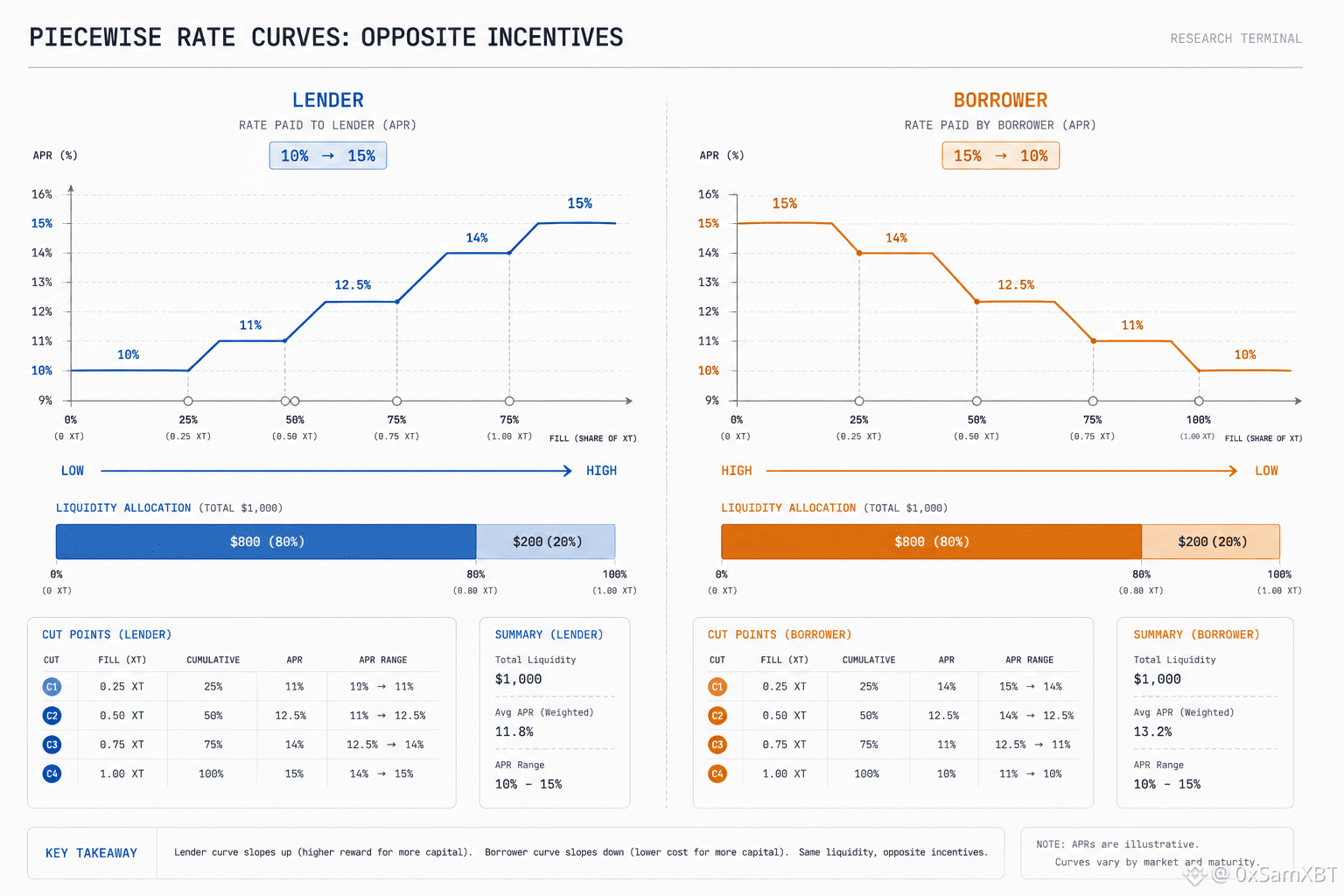
One detail in @TermMax ’s range orders caught my attention.
Borrowers and lenders get the same basic tool, but they want the curve to behave in opposite directions.
Officially, both sides can split their liquidity across different rate ranges instead of accepting one rate.
But the incentives are asymmetric.
For a borrower, earlier fills are preferable at a higher rate, so the borrowing curve moves from higher to lower rates as more liquidity is filled.
For a lender, it’s the opposite: earlier fills are preferable at a lower rate, so the lending curve moves from lower to higher rates.
That sounds like a small implementation detail.
I don't think it is.
Imagine a lender has $1,000:
▶ First $800: 10% APR
▶ Remaining $200: 15% APR
The lender is saying: “Give me the better rate first. I’ll accept a worse rate for the marginal liquidity.”
Now flip the perspective.
A borrower might structure:
▶ First $800: 15% APR
▶ Remaining $200: 10% APR
The borrower is saying: “I’m willing to take the more expensive liquidity first, but I want cheaper capital if I need more.”
Same range-order framework.
Opposite economic preference.
That’s the interesting part.
Most people probably see range orders as one feature.
But there are really two parallel mechanisms:
Lender: lower → higher rate
Borrower: higher → lower rate
And that asymmetry makes sense if you think about marginal willingness.
A lender is willing to deploy more capital only if compensation improves.
A borrower is willing to borrow more only if the marginal cost improves.
I like this design because it lets the curve express something a single APR cannot: how each side values additional liquidity.
But I’m genuinely not sure how much this matters in real markets.
If most orders are filled inside the first range anyway, the second and third cut points may not add much practical information.
The interesting metric for me would be the distribution of actual fills across those ranges.
@TermMax #TermMax $TMX $BTW
Borrowers and lenders get the same basic tool, but they want the curve to behave in opposite directions.
Officially, both sides can split their liquidity across different rate ranges instead of accepting one rate.
But the incentives are asymmetric.
For a borrower, earlier fills are preferable at a higher rate, so the borrowing curve moves from higher to lower rates as more liquidity is filled.
For a lender, it’s the opposite: earlier fills are preferable at a lower rate, so the lending curve moves from lower to higher rates.
That sounds like a small implementation detail.
I don't think it is.
Imagine a lender has $1,000:
▶ First $800: 10% APR
▶ Remaining $200: 15% APR
The lender is saying: “Give me the better rate first. I’ll accept a worse rate for the marginal liquidity.”
Now flip the perspective.
A borrower might structure:
▶ First $800: 15% APR
▶ Remaining $200: 10% APR
The borrower is saying: “I’m willing to take the more expensive liquidity first, but I want cheaper capital if I need more.”
Same range-order framework.
Opposite economic preference.
That’s the interesting part.
Most people probably see range orders as one feature.
But there are really two parallel mechanisms:
Lender: lower → higher rate
Borrower: higher → lower rate
And that asymmetry makes sense if you think about marginal willingness.
A lender is willing to deploy more capital only if compensation improves.
A borrower is willing to borrow more only if the marginal cost improves.
I like this design because it lets the curve express something a single APR cannot: how each side values additional liquidity.
But I’m genuinely not sure how much this matters in real markets.
If most orders are filled inside the first range anyway, the second and third cut points may not add much practical information.
The interesting metric for me would be the distribution of actual fills across those ranges.
@TermMax #TermMax $TMX $BTW
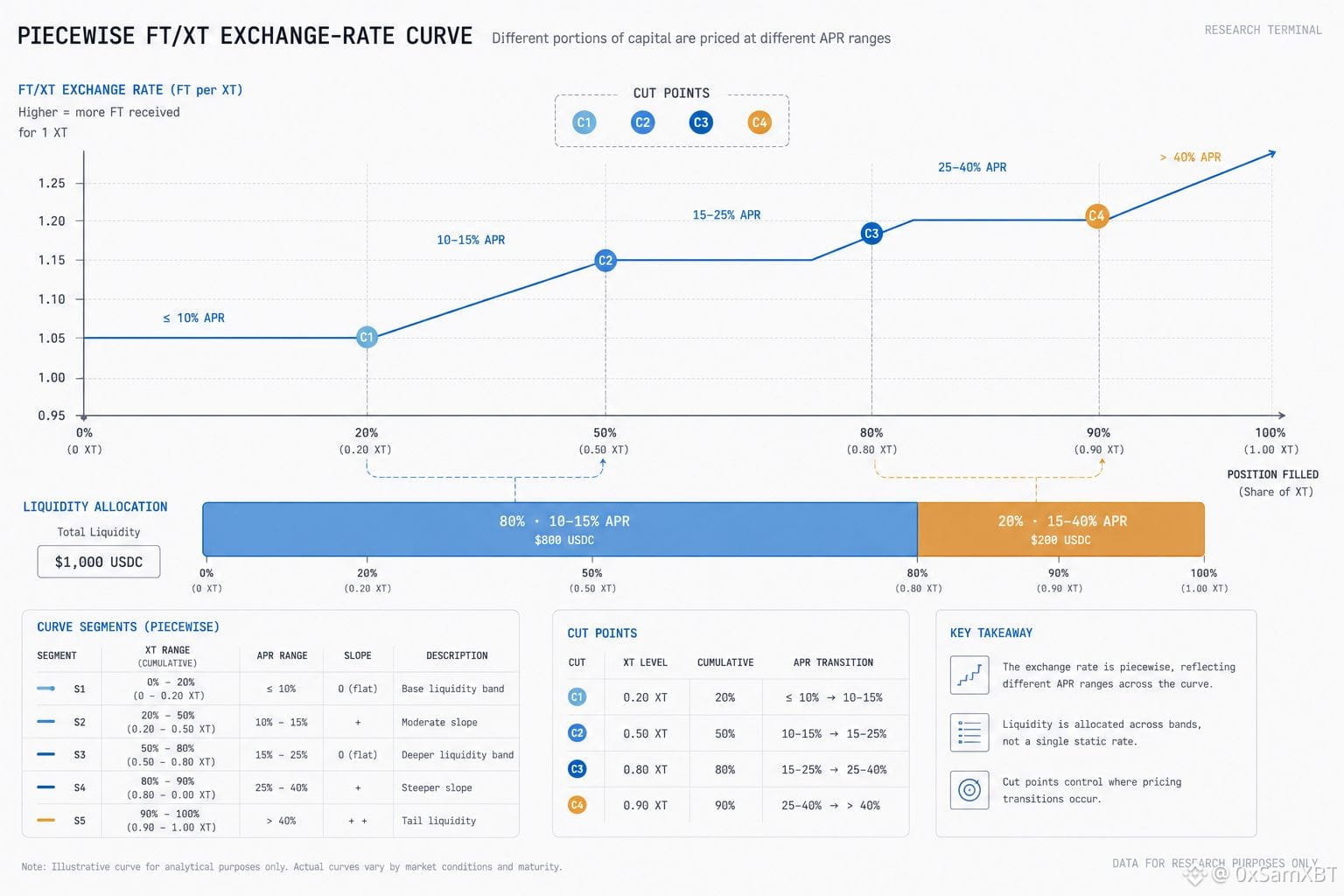
The more I read about @TermMax , the less I think “fixed rate” is the sleeper feature.
I’d argue the quieter innovation is the range-order pricing curve.
TermMax’s February 6, 2025 AMM paper describes a model inspired by Uniswap V3 concentrated liquidity, but applied to fixed-income tokens: FT and XT.
The important part is the cut points.
Instead of LPs accepting one static rate, they can define multiple cut points that create a piecewise FT/XT exchange-rate curve.
One example in the paper:
▶ $1,000 USDC to lend
▶ 80% allocated to a 10%–15% APR range
▶ 20% allocated to a 15%–40% APR range
▶ 3 cut points create 2 separate ranges
So the rate can change as more of the order gets filled.
That’s a pretty different mental model from:
“Here is the market rate. Take it or leave it.”
Most people looking at @TermMax are probably tracking the headline:
fixed-rate lending
But underneath that is another question:
How precisely can liquidity express its preferred rate?
That matters because fixed-income markets aren't really one price.
They’re a curve across risk, size and term.
TermMax’s range-order design tries to encode some of that directly into liquidity.
And this isn't just a marketing diagram. The paper specifies how each range stores its liquidity and reserve parameters, and how adjacent ranges are aligned at their cut points.
There’s also a time component.
The paper notes that as maturity approaches, FT and XT prices change even at the same APR, so the pricing curve is recalculated when transactions execute.
I think that’s the interesting part.
The “fixed” in fixed-rate lending doesn't mean the entire market has one fixed price.
It means each position can have a defined rate, while the market around those positions can still have a structured curve.
That’s genuinely clever.
What data would convince you that TermMax’s range-order curve is actually improving rate discovery?
@TermMax #TermMax $TMX $BTW
I’d argue the quieter innovation is the range-order pricing curve.
TermMax’s February 6, 2025 AMM paper describes a model inspired by Uniswap V3 concentrated liquidity, but applied to fixed-income tokens: FT and XT.
The important part is the cut points.
Instead of LPs accepting one static rate, they can define multiple cut points that create a piecewise FT/XT exchange-rate curve.
One example in the paper:
▶ $1,000 USDC to lend
▶ 80% allocated to a 10%–15% APR range
▶ 20% allocated to a 15%–40% APR range
▶ 3 cut points create 2 separate ranges
So the rate can change as more of the order gets filled.
That’s a pretty different mental model from:
“Here is the market rate. Take it or leave it.”
Most people looking at @TermMax are probably tracking the headline:
fixed-rate lending
But underneath that is another question:
How precisely can liquidity express its preferred rate?
That matters because fixed-income markets aren't really one price.
They’re a curve across risk, size and term.
TermMax’s range-order design tries to encode some of that directly into liquidity.
And this isn't just a marketing diagram. The paper specifies how each range stores its liquidity and reserve parameters, and how adjacent ranges are aligned at their cut points.
There’s also a time component.
The paper notes that as maturity approaches, FT and XT prices change even at the same APR, so the pricing curve is recalculated when transactions execute.
I think that’s the interesting part.
The “fixed” in fixed-rate lending doesn't mean the entire market has one fixed price.
It means each position can have a defined rate, while the market around those positions can still have a structured curve.
That’s genuinely clever.
What data would convince you that TermMax’s range-order curve is actually improving rate discovery?
@TermMax #TermMax $TMX $BTW
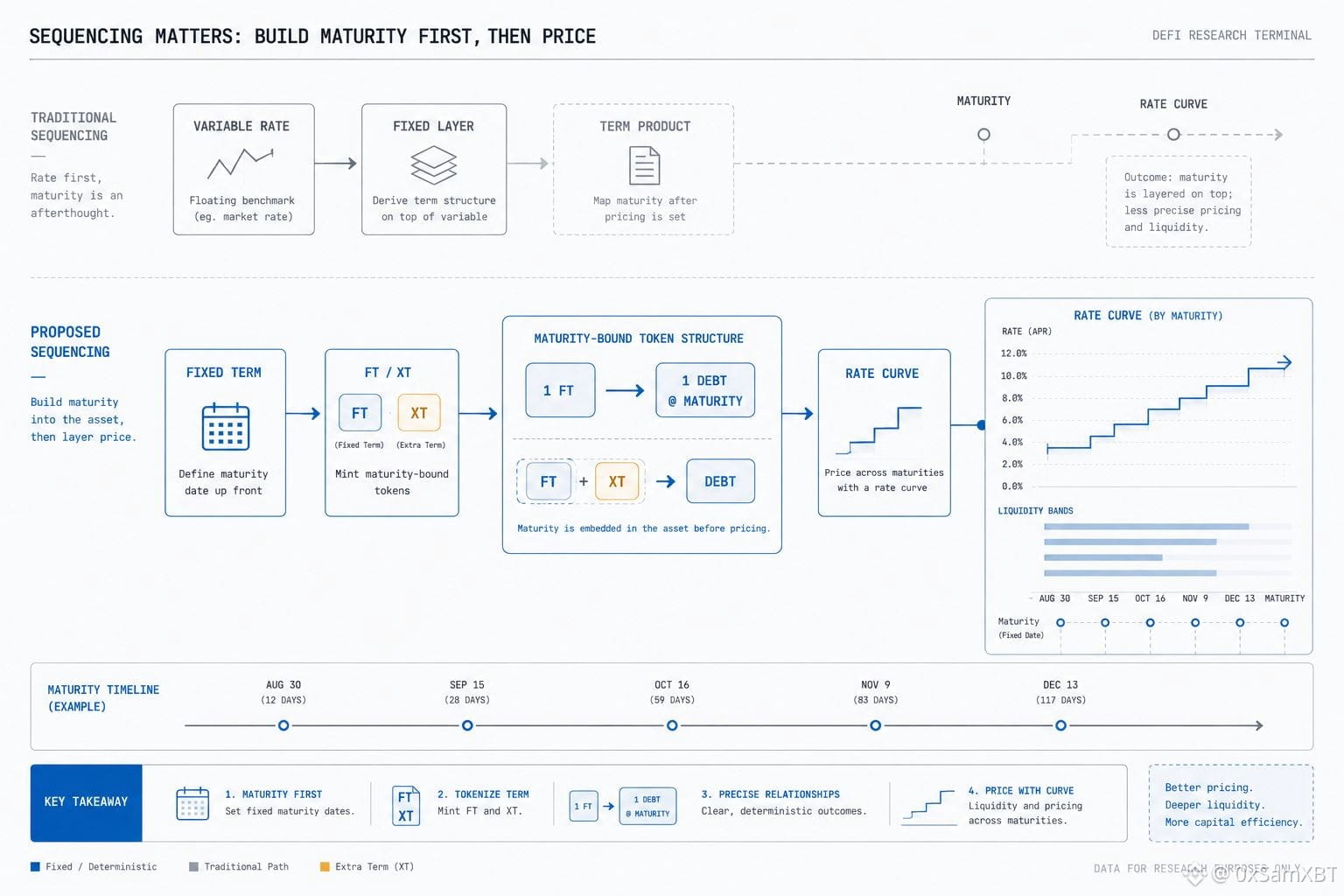
One thing about @TermMax feels easy to miss if you only look at the DeFi lending timeline.
Most DeFi lending started with variable-rate money markets. Fixed-rate products came later as an experiment layered on top.
@TermMax seems to start from the other direction.
Its core design is fixed-rate tokenization first: FT is a zero-coupon-style claim that can be redeemed 1:1 for the debt token at maturity.
Then the pricing layer sits on top.
@TermMax uses range orders where lenders and borrowers can define rate curves and liquidity amounts instead of relying on a single AMM pricing formula.
A few details make the sequencing pretty clear:
▶ Each market has a defined maturity date.
▶ 1 FT represents a claim on 1 debt token at maturity.
▶ 1 FT + 1 XT = 1 debt token before maturity.
▶ Range orders can set different rates across different liquidity portions.
That changes how I think about the protocol.
The interesting part isn't just “@TermMax has fixed rates.”
It's that the maturity is embedded into the asset itself, and the pricing mechanism is built around distributing liquidity across that term structure.
Most people probably track the visible part:
APR → TVL → borrowing volume
But there's another layer:
maturity → FT/XT structure → rate curve → liquidity matching
That's a different sequencing choice from simply taking a variable-rate money market and adding a fixed-rate product afterward.
And I think there's something genuinely legitimate here.
Tokenizing the future repayment claim makes fixed-rate positions composable and tradable, while range orders give liquidity providers control over where they are willing to price risk.
The question I'm less sure about is what happens at scale.
Does building around fixed terms from day one create a cleaner fixed-income market, or does it eventually create more fragmentation across maturities, rates, collateral and liquidity curves?
#TermMax $TMX $UNITREE
Most DeFi lending started with variable-rate money markets. Fixed-rate products came later as an experiment layered on top.
@TermMax seems to start from the other direction.
Its core design is fixed-rate tokenization first: FT is a zero-coupon-style claim that can be redeemed 1:1 for the debt token at maturity.
Then the pricing layer sits on top.
@TermMax uses range orders where lenders and borrowers can define rate curves and liquidity amounts instead of relying on a single AMM pricing formula.
A few details make the sequencing pretty clear:
▶ Each market has a defined maturity date.
▶ 1 FT represents a claim on 1 debt token at maturity.
▶ 1 FT + 1 XT = 1 debt token before maturity.
▶ Range orders can set different rates across different liquidity portions.
That changes how I think about the protocol.
The interesting part isn't just “@TermMax has fixed rates.”
It's that the maturity is embedded into the asset itself, and the pricing mechanism is built around distributing liquidity across that term structure.
Most people probably track the visible part:
APR → TVL → borrowing volume
But there's another layer:
maturity → FT/XT structure → rate curve → liquidity matching
That's a different sequencing choice from simply taking a variable-rate money market and adding a fixed-rate product afterward.
And I think there's something genuinely legitimate here.
Tokenizing the future repayment claim makes fixed-rate positions composable and tradable, while range orders give liquidity providers control over where they are willing to price risk.
The question I'm less sure about is what happens at scale.
Does building around fixed terms from day one create a cleaner fixed-income market, or does it eventually create more fragmentation across maturities, rates, collateral and liquidity curves?
#TermMax $TMX $UNITREE
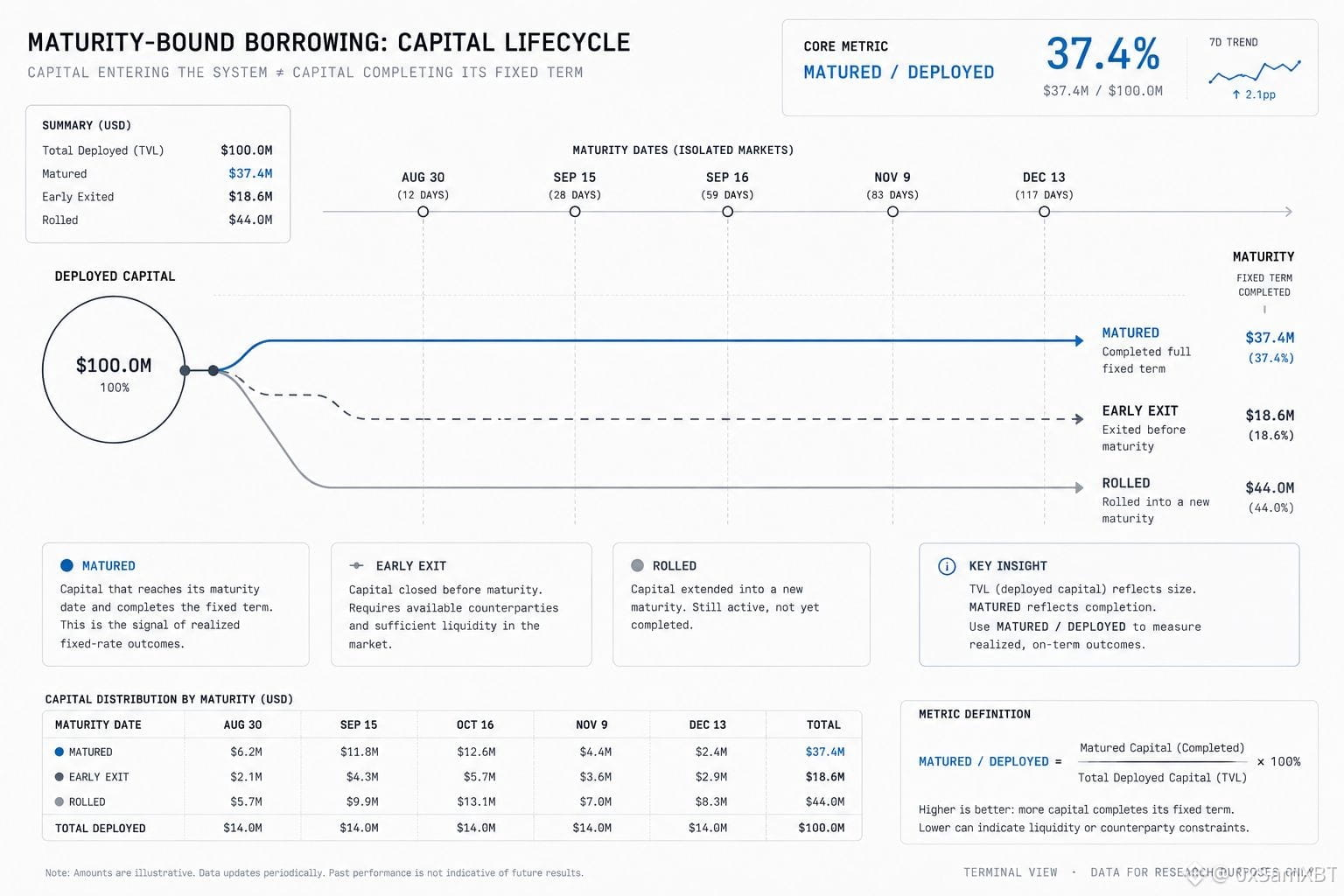
I’ve been looking at @TermMax , and one metric feels more interesting than TVL:
How much capital actually reaches maturity?
TermMax’s official model is fixed-rate, fixed-term lending and borrowing. Markets have explicit maturity dates, and lenders buy Fixed-Rate Tokens (FTs) at a discount, then redeem them for face value at maturity.
The live market page currently shows maturities like:
▶ Aug 30, 2026
▶ Sep 15, 2026
▶ Oct 16, 2026
▶ Nov 9, 2026
▶ Dec 13, 2026
And one live USDC/ynRWAx market, for example, shows 11.01% APY with maturity on Oct 16, 2026.
So when I see a big TVL number, I don’t think it tells the whole story.
The more diagnostic number might be:
Matured capital / total deployed capital
Because fixed-income liquidity has a time dimension.
A $10M position that gets rolled, exited, or replaced before maturity tells me something different from $10M that repeatedly survives the full term and settles as designed.
Most people track the first part of the system:
capital entering
I’d also track:
capital completing the term.
There’s a real reason to like this structure. Fixed-rate lending gives lenders a defined return, while the FT can be traded before maturity instead of forcing everyone to hold it to the end.
So I’m not saying early exits are bad.
I’m saying they change what TVL means.
A platform can have growing TVL while the underlying fixed-term capital is constantly rotating.
That’s why I’d want to see, over the next 3–6 months, how much capital actually reaches maturity, how much is withdrawn early, and how much gets rolled into a new maturity.
I’m genuinely not sure what the optimal number should be. It probably depends heavily on market type, maturity length, and whether users are lenders, borrowers, or vault allocators.
But if TermMax wants to prove that fixed-income liquidity works at scale, I think maturity completion rate is a much more interesting metric than headline TVL.
#TermMax $TMX $CYS
How much capital actually reaches maturity?
TermMax’s official model is fixed-rate, fixed-term lending and borrowing. Markets have explicit maturity dates, and lenders buy Fixed-Rate Tokens (FTs) at a discount, then redeem them for face value at maturity.
The live market page currently shows maturities like:
▶ Aug 30, 2026
▶ Sep 15, 2026
▶ Oct 16, 2026
▶ Nov 9, 2026
▶ Dec 13, 2026
And one live USDC/ynRWAx market, for example, shows 11.01% APY with maturity on Oct 16, 2026.
So when I see a big TVL number, I don’t think it tells the whole story.
The more diagnostic number might be:
Matured capital / total deployed capital
Because fixed-income liquidity has a time dimension.
A $10M position that gets rolled, exited, or replaced before maturity tells me something different from $10M that repeatedly survives the full term and settles as designed.
Most people track the first part of the system:
capital entering
I’d also track:
capital completing the term.
There’s a real reason to like this structure. Fixed-rate lending gives lenders a defined return, while the FT can be traded before maturity instead of forcing everyone to hold it to the end.
So I’m not saying early exits are bad.
I’m saying they change what TVL means.
A platform can have growing TVL while the underlying fixed-term capital is constantly rotating.
That’s why I’d want to see, over the next 3–6 months, how much capital actually reaches maturity, how much is withdrawn early, and how much gets rolled into a new maturity.
I’m genuinely not sure what the optimal number should be. It probably depends heavily on market type, maturity length, and whether users are lenders, borrowers, or vault allocators.
But if TermMax wants to prove that fixed-income liquidity works at scale, I think maturity completion rate is a much more interesting metric than headline TVL.
#TermMax $TMX $CYS
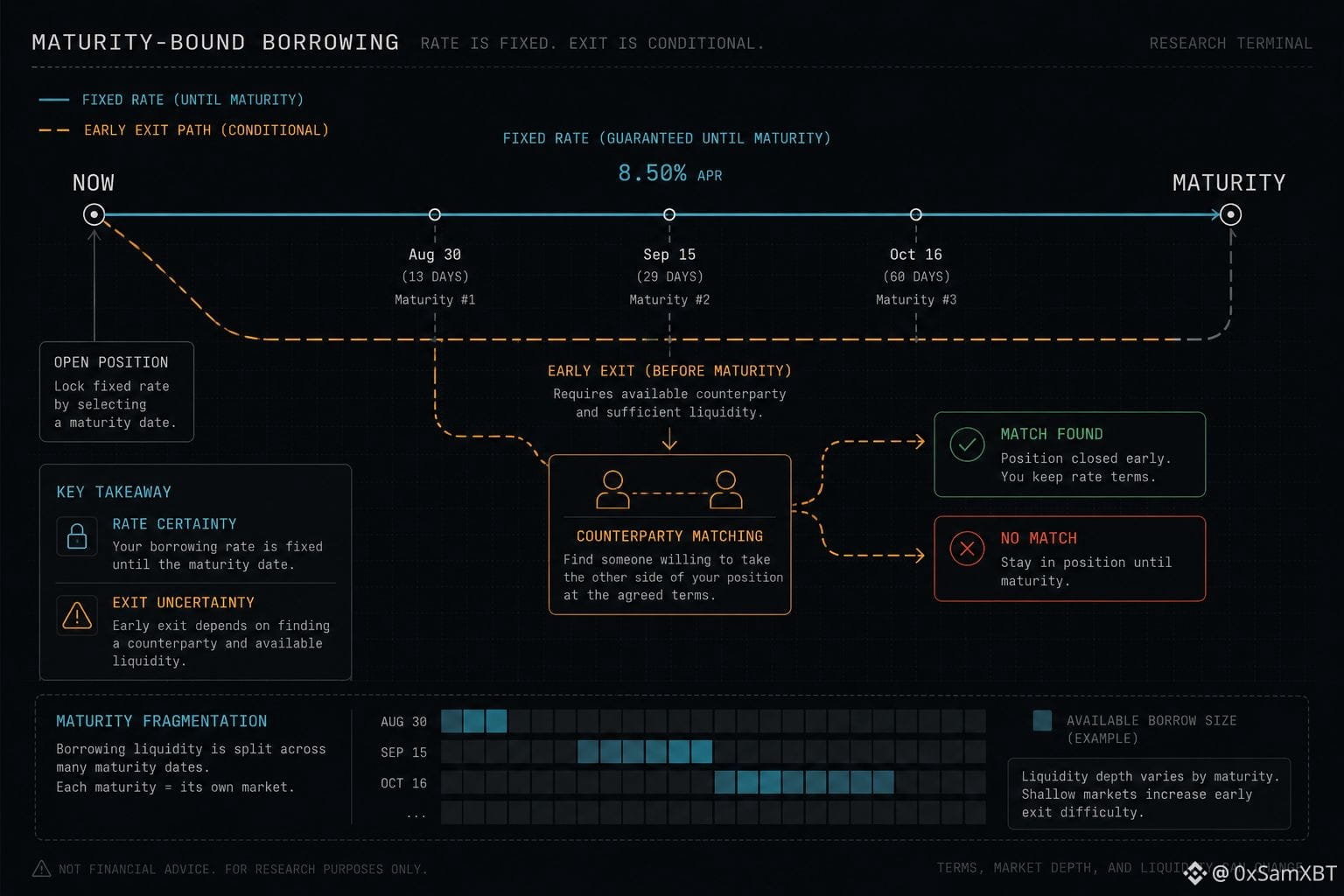
The phrase “fixed-rate borrowing” caught my attention.
It sounds like the rate is fixed, full stop.
@TermMax ’s official design is more specific: the borrowing rate is fixed until a defined maturity date. Borrowers lock collateral, issue FT/XT, receive liquidity, and owe the fixed debt amount at maturity.
That distinction matters.
A few concrete details:
▶ Markets have explicit maturity dates — for example, current markets include Aug 30, Sep 15, and Oct 16, 2026.
▶ A borrower can repay with debt tokens or buy back FTs from the market before maturity.
▶ The protocol says FT holders earn their fixed return by holding until maturity.
▶ TermMax’s docs also identify counterparty matching risk and maturity mismatch risk as risks.
So the hidden mechanic isn’t really the rate.
It’s the exit.
“Fixed rate” can be true while the position itself is not equally liquid at every point in time.
If you want to exit early, you may need to buy the corresponding FTs or find someone willing to take the other side. And @TermMax explicitly warns that liquidity is not guaranteed for positions that require an early counterparty.
Most people are probably tracking one part of the system:
rate certainty
But there’s a second variable:
exit liquidity.
That doesn’t make fixed-rate borrowing misleading. The maturity-bound structure is actually what makes predictable financing possible.
I’m genuinely not sure how this behaves at much larger scale.
Does deeper liquidity eventually make the maturity constraint almost invisible, or does growth create more fragmented maturities and counterparties to match?
Time will tell.
For those watching @TermMax , what data would you track over the next 3–6 months to measure whether fixed-rate liquidity is actually improving?
#TermMax $TMX $ACE
It sounds like the rate is fixed, full stop.
@TermMax ’s official design is more specific: the borrowing rate is fixed until a defined maturity date. Borrowers lock collateral, issue FT/XT, receive liquidity, and owe the fixed debt amount at maturity.
That distinction matters.
A few concrete details:
▶ Markets have explicit maturity dates — for example, current markets include Aug 30, Sep 15, and Oct 16, 2026.
▶ A borrower can repay with debt tokens or buy back FTs from the market before maturity.
▶ The protocol says FT holders earn their fixed return by holding until maturity.
▶ TermMax’s docs also identify counterparty matching risk and maturity mismatch risk as risks.
So the hidden mechanic isn’t really the rate.
It’s the exit.
“Fixed rate” can be true while the position itself is not equally liquid at every point in time.
If you want to exit early, you may need to buy the corresponding FTs or find someone willing to take the other side. And @TermMax explicitly warns that liquidity is not guaranteed for positions that require an early counterparty.
Most people are probably tracking one part of the system:
rate certainty
But there’s a second variable:
exit liquidity.
That doesn’t make fixed-rate borrowing misleading. The maturity-bound structure is actually what makes predictable financing possible.
I’m genuinely not sure how this behaves at much larger scale.
Does deeper liquidity eventually make the maturity constraint almost invisible, or does growth create more fragmented maturities and counterparties to match?
Time will tell.
For those watching @TermMax , what data would you track over the next 3–6 months to measure whether fixed-rate liquidity is actually improving?
#TermMax $TMX $ACE
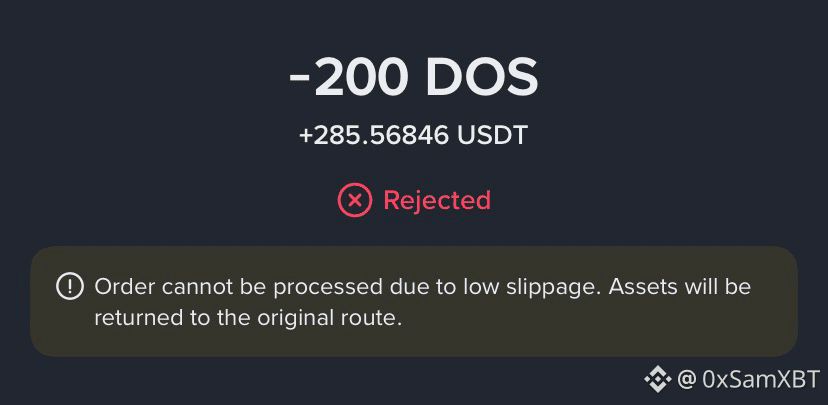
Can’t sell DOS. Really sad 😭
First I execute sell instant, the notification popup, I think it sold at $280, then I put my phone away, later I check my phone again and it really shock me, my order was rejected, now I can sold for only $50
First I execute sell instant, the notification popup, I think it sold at $280, then I put my phone away, later I check my phone again and it really shock me, my order was rejected, now I can sold for only $50
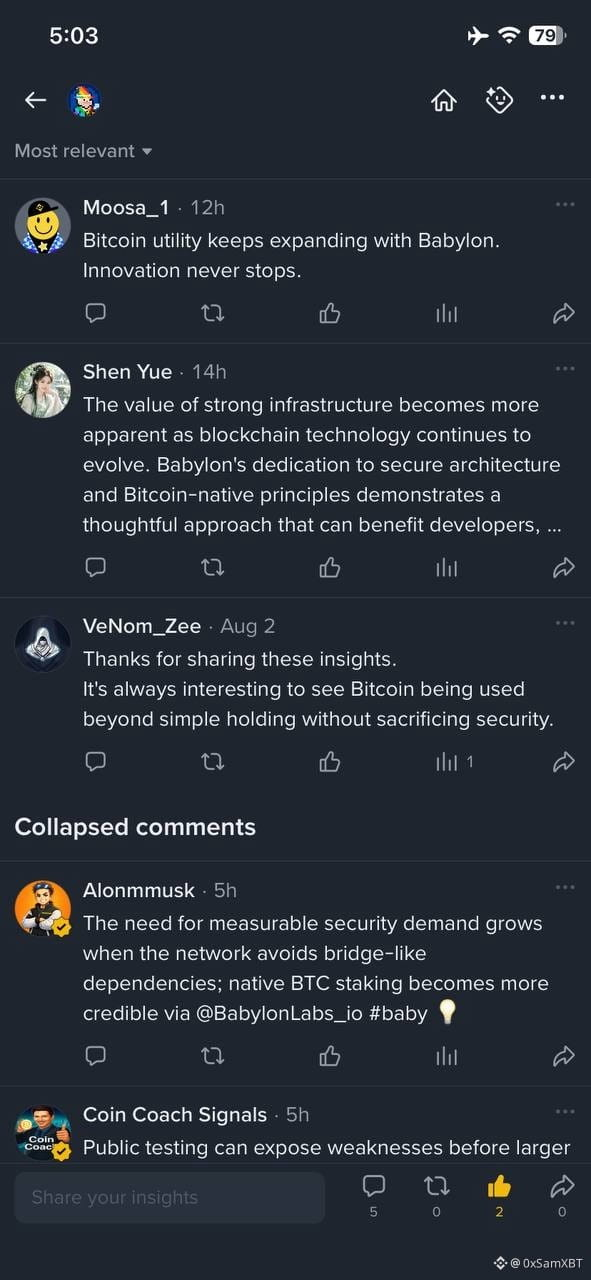
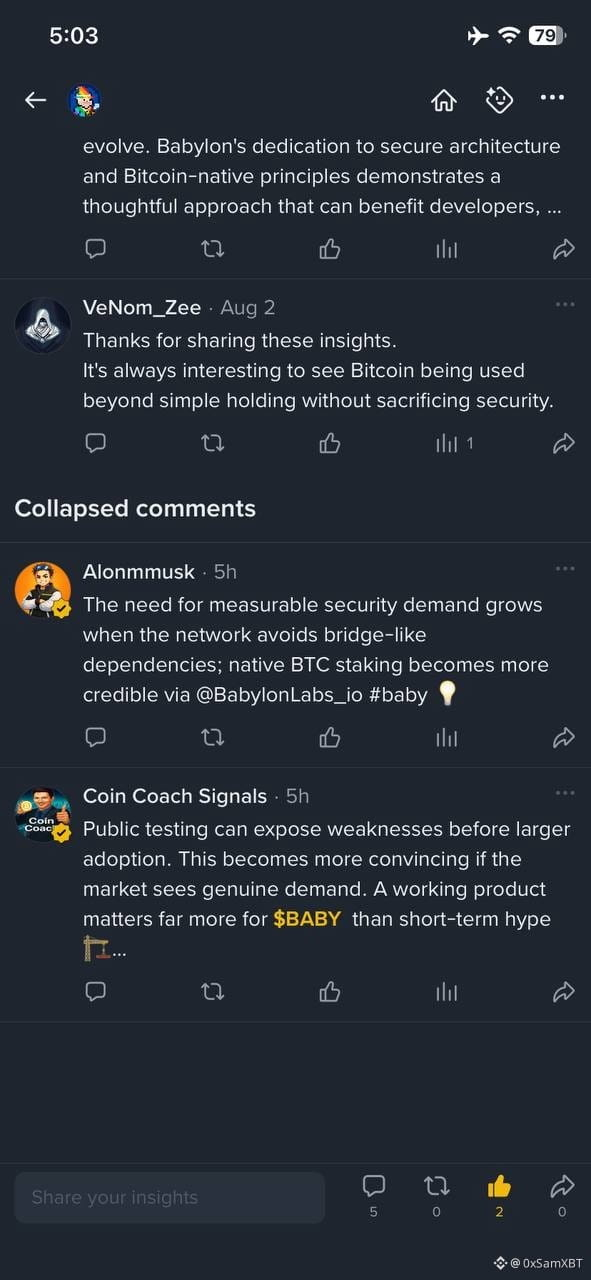
Noticed something weird under my last post about @BabylonLabs_io . accounts replying with generic praise that has nothing to do with what i actually wrote.
I have been working hard to research and writing about @BabylonLabs_io project, however these bot accounts got more reward points,
A question i don't have an answer to: does this kind of low-effort farming get more attention and reward than a real creator from Binance creator pad programm.
I hope @BabylonLabs_io @Binance Square Official @Yi He consider about reward system only for real value creator
#baby $BABY
I have been working hard to research and writing about @BabylonLabs_io project, however these bot accounts got more reward points,
A question i don't have an answer to: does this kind of low-effort farming get more attention and reward than a real creator from Binance creator pad programm.
I hope @BabylonLabs_io @Binance Square Official @Yi He consider about reward system only for real value creator
#baby $BABY
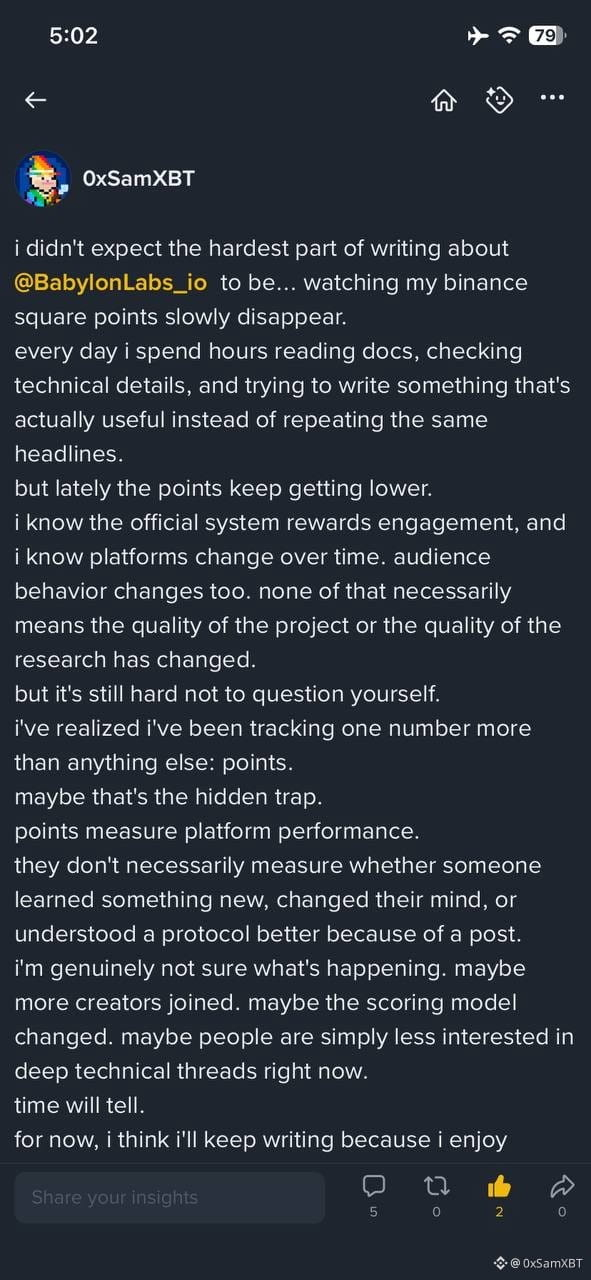
i didn't expect the hardest part of writing about @BabylonLabs_io to be... watching my binance square points slowly disappear.
every day i spend hours reading docs, checking technical details, and trying to write something that's actually useful instead of repeating the same headlines.
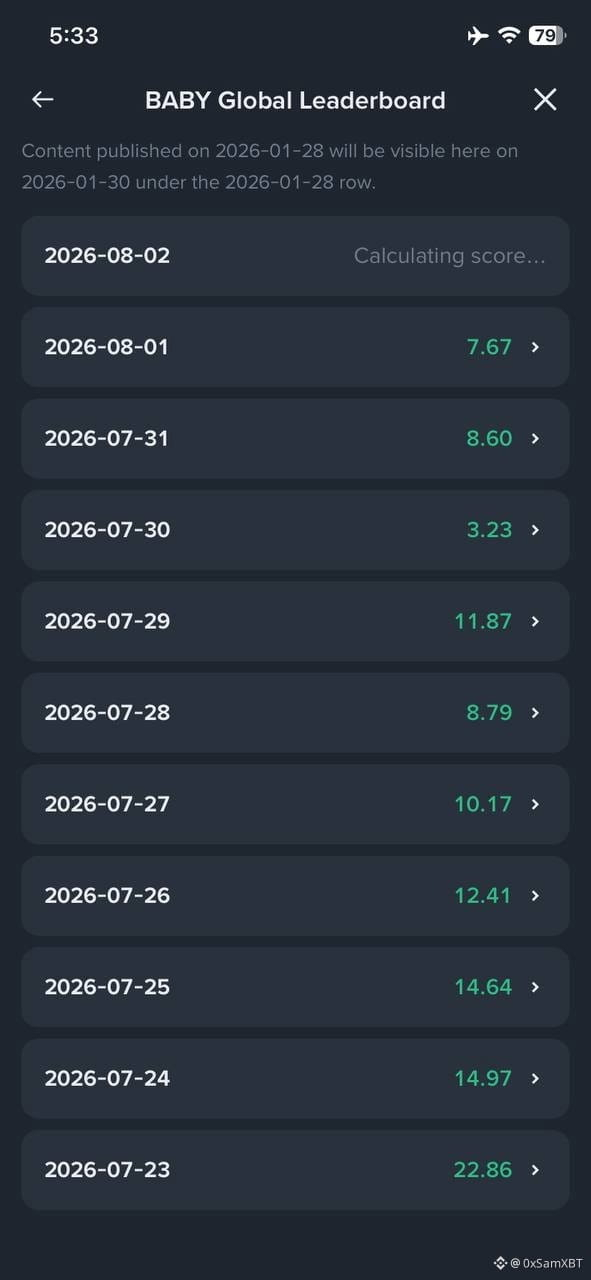
but lately the points keep getting lower.
i know the official system rewards engagement, and i know platforms change over time. audience behavior changes too. none of that necessarily means the quality of the project or the quality of the research has changed.
but it's still hard not to question yourself.
i've realized i've been tracking one number more than anything else: points.
maybe that's the hidden trap.
points measure platform performance.
they don't necessarily measure whether someone learned something new, changed their mind, or understood a protocol better because of a post.
i'm genuinely not sure what's happening. maybe more creators joined. maybe the scoring model changed. maybe people are simply less interested in deep technical threads right now.
time will tell.
for now, i think i'll keep writing because i enjoy understanding how these systems work. if the points recover, great. if not, at least i'll know the research itself wasn't wasted.
if you've been reading my babylon posts, i'd really appreciate honest feedback. what's one thing that would make you stop scrolling and read the next one?
@BabylonLabs_io #baby $BABY
every day i spend hours reading docs, checking technical details, and trying to write something that's actually useful instead of repeating the same headlines.
but lately the points keep getting lower.
i know the official system rewards engagement, and i know platforms change over time. audience behavior changes too. none of that necessarily means the quality of the project or the quality of the research has changed.
but it's still hard not to question yourself.
i've realized i've been tracking one number more than anything else: points.
maybe that's the hidden trap.
points measure platform performance.
they don't necessarily measure whether someone learned something new, changed their mind, or understood a protocol better because of a post.
i'm genuinely not sure what's happening. maybe more creators joined. maybe the scoring model changed. maybe people are simply less interested in deep technical threads right now.
time will tell.
for now, i think i'll keep writing because i enjoy understanding how these systems work. if the points recover, great. if not, at least i'll know the research itself wasn't wasted.
if you've been reading my babylon posts, i'd really appreciate honest feedback. what's one thing that would make you stop scrolling and read the next one?
@BabylonLabs_io #baby $BABY
📉 more creators
0%
🔄 scoring changes
0%
📰 less interest
0%
✍️ improve content
0%
0 votes • Voting closed
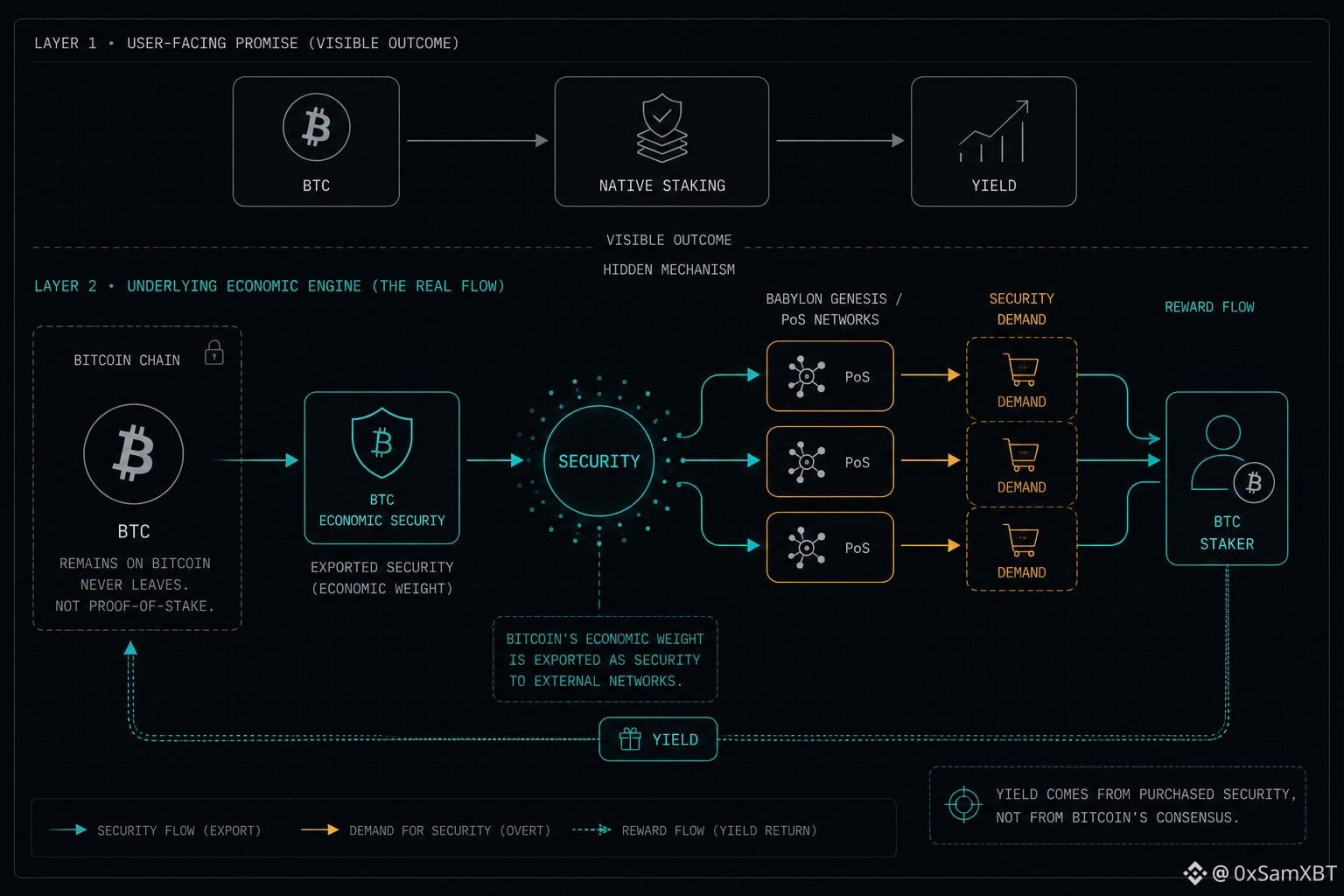
the phrase i kept coming back to was "bitcoin earns yield."
it's a good summary. but i don't think it's the mechanism.
the official design is that you stake native btc without bridging or wrapping it. that btc can help secure babylon genesis and other bitcoin supercharged networks, and stakers receive rewards for providing that security.
but here's the part i think gets lost.
bitcoin itself isn't changing its consensus. bitcoin blocks are still mined by proof of work. the yield doesn't appear because bitcoin suddenly became a proof-of-stake network.
it appears because proof-of-stake networks are willing to pay for bitcoin's economic security.
that's a very different economic story.
most people are only tracking the user side: "i stake btc and earn rewards." they're not tracking the other side of the market: someone has to create demand for that security and pay for it.
in other words, the real product might not be bitcoin yield.
it might be a marketplace where bitcoin security is exported and purchased by external networks.
i think that's a legitimate architecture. if bitcoin's security can be reused without moving btc off-chain, that's a genuinely new coordination model rather than just another yield product.
i'm genuinely not sure how pricing evolves over time. it probably depends on whether babylon genesis and bitcoin supercharged networks generate enough long-term demand to keep paying for external security instead of relying mostly on incentives in the early stages.
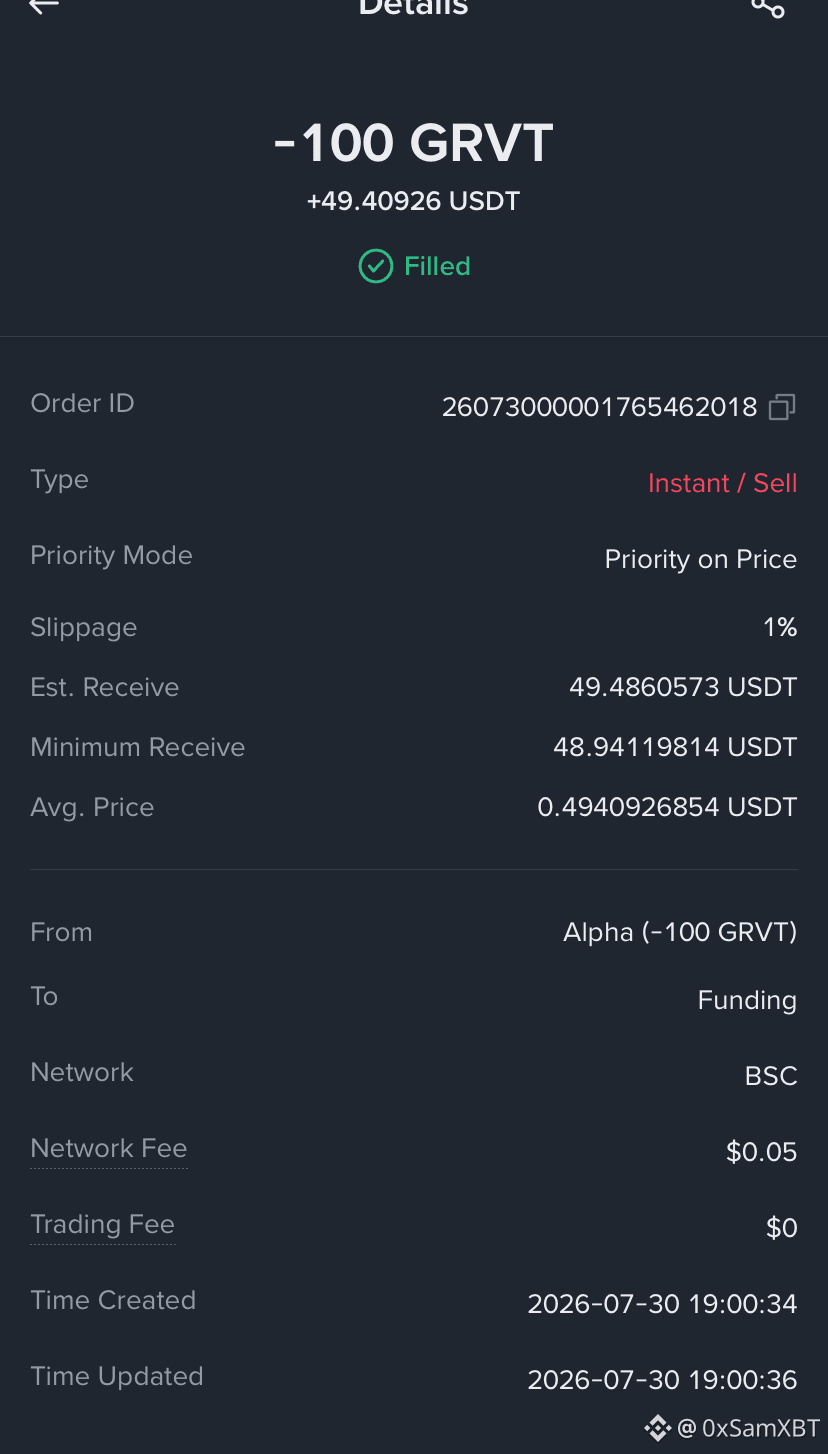
@BabylonLabs_io #baby $BABY $GRVT
it's a good summary. but i don't think it's the mechanism.
the official design is that you stake native btc without bridging or wrapping it. that btc can help secure babylon genesis and other bitcoin supercharged networks, and stakers receive rewards for providing that security.
but here's the part i think gets lost.
bitcoin itself isn't changing its consensus. bitcoin blocks are still mined by proof of work. the yield doesn't appear because bitcoin suddenly became a proof-of-stake network.
it appears because proof-of-stake networks are willing to pay for bitcoin's economic security.
that's a very different economic story.
most people are only tracking the user side: "i stake btc and earn rewards." they're not tracking the other side of the market: someone has to create demand for that security and pay for it.
in other words, the real product might not be bitcoin yield.
it might be a marketplace where bitcoin security is exported and purchased by external networks.
i think that's a legitimate architecture. if bitcoin's security can be reused without moving btc off-chain, that's a genuinely new coordination model rather than just another yield product.
i'm genuinely not sure how pricing evolves over time. it probably depends on whether babylon genesis and bitcoin supercharged networks generate enough long-term demand to keep paying for external security instead of relying mostly on incentives in the early stages.
@BabylonLabs_io #baby $BABY $GRVT
Verified
what caught my attention wasn't co-staking itself. it was when babylon decided to introduce it.
most restaking designs start by asking users to lock two assets from day one. the security model and the incentive model arrive together.
@BabylonLabs_io took a different path.
the official design is that native btc staking stands on its own. bitcoin can be staked without requiring a second token. co-staking comes later as an additional mechanism that lets btc staking be paired with the babylon token for extra incentives and security alignment. phase-1 introduced native bitcoin staking in 2024. co-staking belongs to the protocol's later evolution rather than its foundation.
i think the sequencing is more interesting than the feature.
most people are only tracking the extra rewards. but the order tells you what the protocol considered fundamental. first, prove that bitcoin-native staking works by itself. only then layer token incentives on top.
that's a different philosophy from building around a dual-token model from the beginning.
to me, that makes co-staking look less like a prerequisite and more like an extension. the core security model isn't rewritten when the second asset appears. it's expanded.
that seems like a legitimate design choice. separating the base security layer from the incentive layer could make each one easier to reason about. if incentives change later, the underlying btc staking mechanism doesn't necessarily have to.
i'm genuinely not sure whether that separation stays clean as adoption grows. it might depend on whether future rewards become important enough that users stop thinking of btc-only staking as the "default" path.
#baby
$BABY
$XRP
$ON
Curious what others think after watching the rollout.
most restaking designs start by asking users to lock two assets from day one. the security model and the incentive model arrive together.
@BabylonLabs_io took a different path.
the official design is that native btc staking stands on its own. bitcoin can be staked without requiring a second token. co-staking comes later as an additional mechanism that lets btc staking be paired with the babylon token for extra incentives and security alignment. phase-1 introduced native bitcoin staking in 2024. co-staking belongs to the protocol's later evolution rather than its foundation.
i think the sequencing is more interesting than the feature.
most people are only tracking the extra rewards. but the order tells you what the protocol considered fundamental. first, prove that bitcoin-native staking works by itself. only then layer token incentives on top.
that's a different philosophy from building around a dual-token model from the beginning.
to me, that makes co-staking look less like a prerequisite and more like an extension. the core security model isn't rewritten when the second asset appears. it's expanded.
that seems like a legitimate design choice. separating the base security layer from the incentive layer could make each one easier to reason about. if incentives change later, the underlying btc staking mechanism doesn't necessarily have to.
i'm genuinely not sure whether that separation stays clean as adoption grows. it might depend on whether future rewards become important enough that users stop thinking of btc-only staking as the "default" path.
#baby
$BABY
$XRP
$ON
Curious what others think after watching the rollout.
₿ btc first
0%
🎁 rewards first
100%
⚖️ both equal
0%
🔍 too early
0%
3 votes • Voting closed
Log in to explore more content