
po-po carpeto
668 Posts

po-po carpeto
please follow me
276 Following
5.6K+ Followers
402 Liked
Posts
All
Quotes
Live
#dusk $DUSK @Dusk Is regulatory compliance on-chain just a checkbox — or is it actually enforceable?"
I've seen a lot of projects claim they're "compliant by design." But when you peel back the layers, most of them just slap a KYC gate on a smart contract and call it a day. That's not compliance. That's a turnstile.
Dusk's architecture made me rethink this entirely.
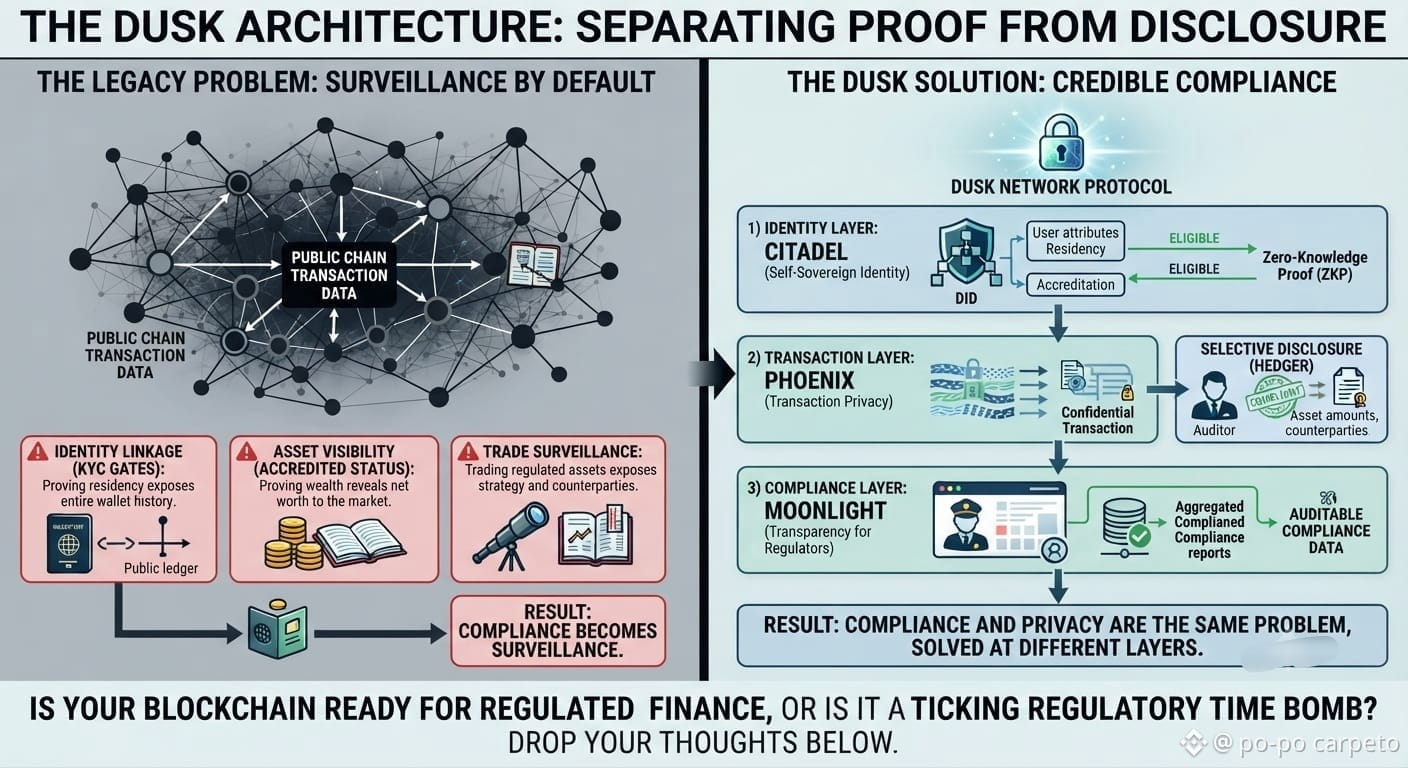
The insight that hit me hardest: Dusk separates proof from disclosure at the protocol level — not as an add-on, but as a first-class primitive . That's not just technical nuance. It's a completely different risk model.
Here's the problem with "compliance" on most public chains:
· You prove you're a US resident — now your entire wallet history is linked to your identity
· You prove you're accredited — now the whole market knows your net worth
· You trade a regulated asset — now your strategy, positions, and counterparties are visible to every competitor
Compliance becomes surveillance by default.
Dusk flips this with the Citadel layer, a built-in self-sovereign identity system that enables proving only the specific attribute required — residency, accreditation status, jurisdiction — without exposing anything else . You prove you're a US resident without showing your name or address. You prove you're accredited without revealing your bank balance. The verifier learns "eligible" and nothing more.
Selective disclosure at the application layer (via Hedger) extends this to transactions — an auditor can verify a trade was compliant without seeing the trading strategy behind it .
And here's where it gets interesting: Dusk's approach isn't just about privacy. It's about credibility. When a regulated entity knows their counterparties have been vetted without exposing everyone's identity, the entire system becomes institutionally viable .
The quiet insight is that compliance and privacy aren't trade-offs — they're actually the same problem, solved at different layers. Dusk separates identity (Citadel), transaction privacy (Phoenix), transparency (Moonlight), then lets $TMX $BTR
I've seen a lot of projects claim they're "compliant by design." But when you peel back the layers, most of them just slap a KYC gate on a smart contract and call it a day. That's not compliance. That's a turnstile.
Dusk's architecture made me rethink this entirely.
The insight that hit me hardest: Dusk separates proof from disclosure at the protocol level — not as an add-on, but as a first-class primitive . That's not just technical nuance. It's a completely different risk model.
Here's the problem with "compliance" on most public chains:
· You prove you're a US resident — now your entire wallet history is linked to your identity
· You prove you're accredited — now the whole market knows your net worth
· You trade a regulated asset — now your strategy, positions, and counterparties are visible to every competitor
Compliance becomes surveillance by default.
Dusk flips this with the Citadel layer, a built-in self-sovereign identity system that enables proving only the specific attribute required — residency, accreditation status, jurisdiction — without exposing anything else . You prove you're a US resident without showing your name or address. You prove you're accredited without revealing your bank balance. The verifier learns "eligible" and nothing more.
Selective disclosure at the application layer (via Hedger) extends this to transactions — an auditor can verify a trade was compliant without seeing the trading strategy behind it .
And here's where it gets interesting: Dusk's approach isn't just about privacy. It's about credibility. When a regulated entity knows their counterparties have been vetted without exposing everyone's identity, the entire system becomes institutionally viable .
The quiet insight is that compliance and privacy aren't trade-offs — they're actually the same problem, solved at different layers. Dusk separates identity (Citadel), transaction privacy (Phoenix), transparency (Moonlight), then lets $TMX $BTR
#dusk $DUSK @Dusk The more private the proof becomes, the more important the issuer's reputation becomes."
That line stopped me mid-scroll.
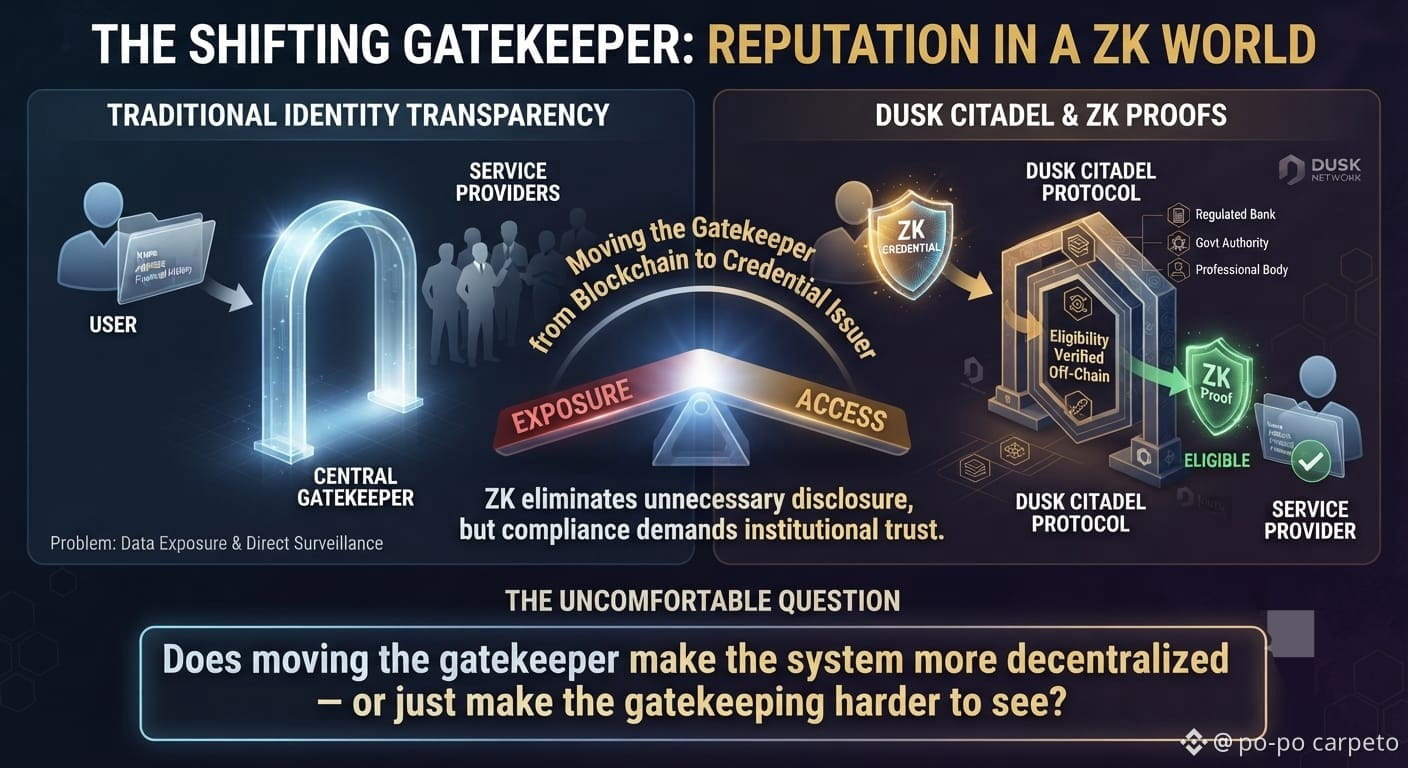
Because here's the uncomfortable question no one's asking: When we replace identity transparency with zero-knowledge proofs, who do we trust to vouch for us in the first place?
We think privacy tech eliminates gatekeepers. In reality, it just moves them.
I spent weeks assuming Citadel — Dusk's identity layer — was simply about "hiding your identity while proving eligibility." And technically, it does exactly that. A License Provider verifies attributes off-chain, issues a credential, and you later prove possession with a ZK proof. The service provider sees "eligible" — not your name, address, or financial history. Clean, elegant, privacy-preserving .
But then I looked closer at how it actually works.
Citadel doesn't decide whether a License Provider deserves trust. The service provider does. They choose which providers and attributes they accept, plus rules around expiry, revocation, and reuse .
That changes everything.
The decentralization problem doesn't disappear. It just shifts from "Who knows my identity?" to "Who gets trusted to define my eligibility?" .
And that's a fundamentally different risk.
If a public chain leaks your data, the problem is exposure. If a credential issuer on Dusk gets compromised, goes rogue, or loses reputation, the problem is access — you can't prove eligibility for anything that relies on that provider.
Dusk's architecture is brilliant. It reduces identity exposure without eliminating the institutional trust layer . That's not a flaw — it's a deliberate design choice for regulated markets. Privacy can remove unnecessary disclosure, but compliance still needs someone accountable for what a credential actually means .
So here's the real question I keep coming back to: Does moving the gatekeeper from the blockchain to the credential issuer actually make the system more decentralized — or does it just make the gatekeeping harder to see?$PENGU $AAPLB
That line stopped me mid-scroll.
Because here's the uncomfortable question no one's asking: When we replace identity transparency with zero-knowledge proofs, who do we trust to vouch for us in the first place?
We think privacy tech eliminates gatekeepers. In reality, it just moves them.
I spent weeks assuming Citadel — Dusk's identity layer — was simply about "hiding your identity while proving eligibility." And technically, it does exactly that. A License Provider verifies attributes off-chain, issues a credential, and you later prove possession with a ZK proof. The service provider sees "eligible" — not your name, address, or financial history. Clean, elegant, privacy-preserving .
But then I looked closer at how it actually works.
Citadel doesn't decide whether a License Provider deserves trust. The service provider does. They choose which providers and attributes they accept, plus rules around expiry, revocation, and reuse .
That changes everything.
The decentralization problem doesn't disappear. It just shifts from "Who knows my identity?" to "Who gets trusted to define my eligibility?" .
And that's a fundamentally different risk.
If a public chain leaks your data, the problem is exposure. If a credential issuer on Dusk gets compromised, goes rogue, or loses reputation, the problem is access — you can't prove eligibility for anything that relies on that provider.
Dusk's architecture is brilliant. It reduces identity exposure without eliminating the institutional trust layer . That's not a flaw — it's a deliberate design choice for regulated markets. Privacy can remove unnecessary disclosure, but compliance still needs someone accountable for what a credential actually means .
So here's the real question I keep coming back to: Does moving the gatekeeper from the blockchain to the credential issuer actually make the system more decentralized — or does it just make the gatekeeping harder to see?$PENGU $AAPLB
#dusk $DUSK @Dusk "Your supply chain is on-chain. Your supplier's identity? Still a liability."
I used to think blockchain would fix supply chain finance. Every payment tracked. Every delivery verified. No more fraud, no more disputes.
Then I saw how it actually works.
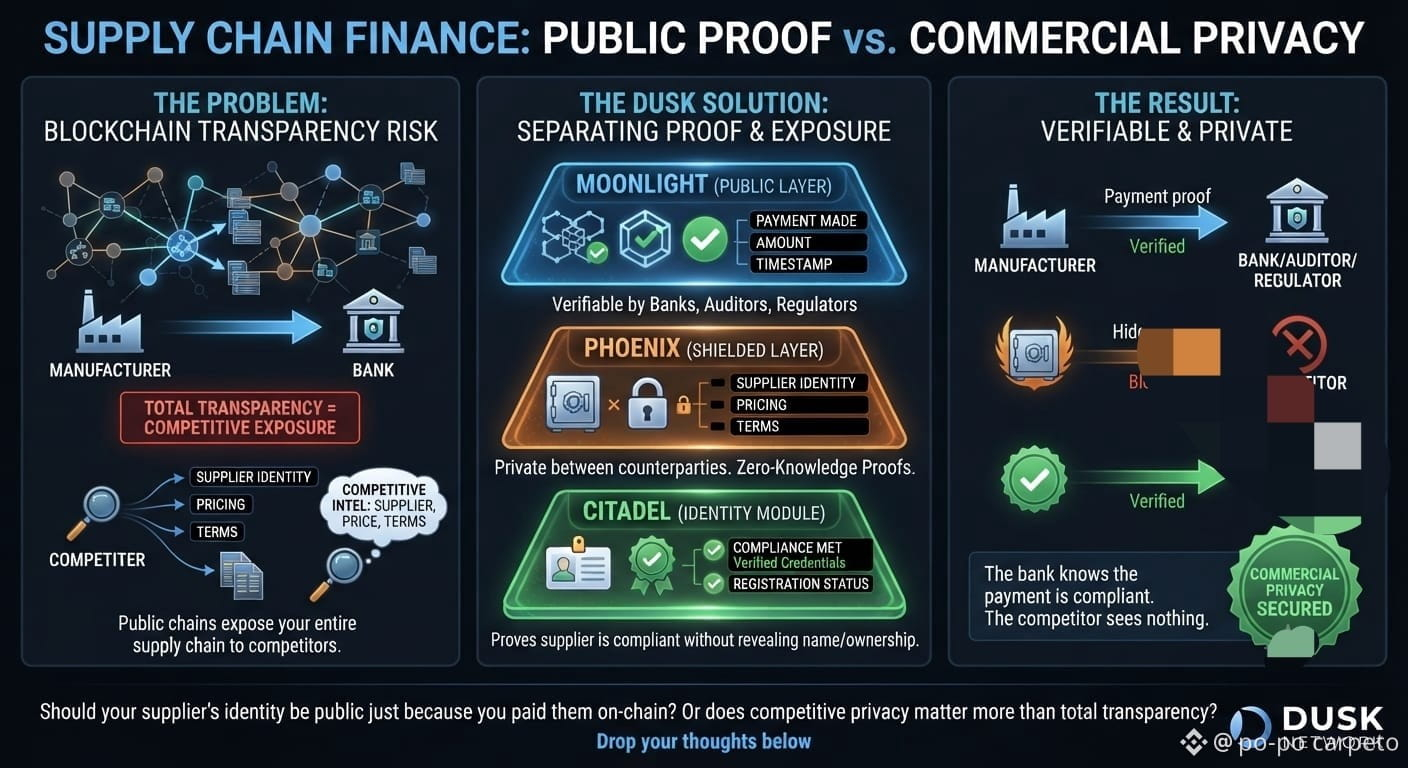
A manufacturer needs to prove to their bank that they paid a supplier in Vietnam. The bank needs to verify the payment. But here's the catch: the manufacturer doesn't want their competitors knowing exactly who they source from, at what price, and on what terms. That's competitive intelligence — and in manufacturing, that intel is worth millions.
So what happens? The bank runs a background check, manually. The supplier sends invoices, manually. The manufacturer reconciles records, manually. Everyone trusts PDFs and Excel sheets instead of code.
That's not efficiency. That's risk dressed up as process.
Dusk Network fixes this with a system that separates proof from exposure:
· Moonlight (public layer) — records that a payment was made, the amount, and the timestamp. Verifiable by banks, auditors, and regulators
· Phoenix (shielded layer) — keeps the supplier's identity, exact pricing, delivery terms, and contract details private between counterparties
But here's the subtle part — and this is where Dusk gets it right. The bank doesn't need to know who the supplier is. They only need to know that the supplier meets the compliance requirements. That's a completely different problem.
Dusk's Citadel layer handles identity as a separate module. A supplier proves they're a registered entity, accredited, and compliant — without exposing their name, address, or ownership structure.
The manufacturer proves they paid. The bank verifies the payment. The regulator confirms compliance. And the competitor? They see nothing.
The risk allocation is clear:
· Public chains — expose your entire supply chain to competitors
· Offchain systems — rely on trust and manual reconciliation
· Dusk — gives you verifiable proof without sacrificing commercial privacy...$SPK $ZRO
I used to think blockchain would fix supply chain finance. Every payment tracked. Every delivery verified. No more fraud, no more disputes.
Then I saw how it actually works.
A manufacturer needs to prove to their bank that they paid a supplier in Vietnam. The bank needs to verify the payment. But here's the catch: the manufacturer doesn't want their competitors knowing exactly who they source from, at what price, and on what terms. That's competitive intelligence — and in manufacturing, that intel is worth millions.
So what happens? The bank runs a background check, manually. The supplier sends invoices, manually. The manufacturer reconciles records, manually. Everyone trusts PDFs and Excel sheets instead of code.
That's not efficiency. That's risk dressed up as process.
Dusk Network fixes this with a system that separates proof from exposure:
· Moonlight (public layer) — records that a payment was made, the amount, and the timestamp. Verifiable by banks, auditors, and regulators
· Phoenix (shielded layer) — keeps the supplier's identity, exact pricing, delivery terms, and contract details private between counterparties
But here's the subtle part — and this is where Dusk gets it right. The bank doesn't need to know who the supplier is. They only need to know that the supplier meets the compliance requirements. That's a completely different problem.
Dusk's Citadel layer handles identity as a separate module. A supplier proves they're a registered entity, accredited, and compliant — without exposing their name, address, or ownership structure.
The manufacturer proves they paid. The bank verifies the payment. The regulator confirms compliance. And the competitor? They see nothing.
The risk allocation is clear:
· Public chains — expose your entire supply chain to competitors
· Offchain systems — rely on trust and manual reconciliation
· Dusk — gives you verifiable proof without sacrificing commercial privacy...$SPK $ZRO
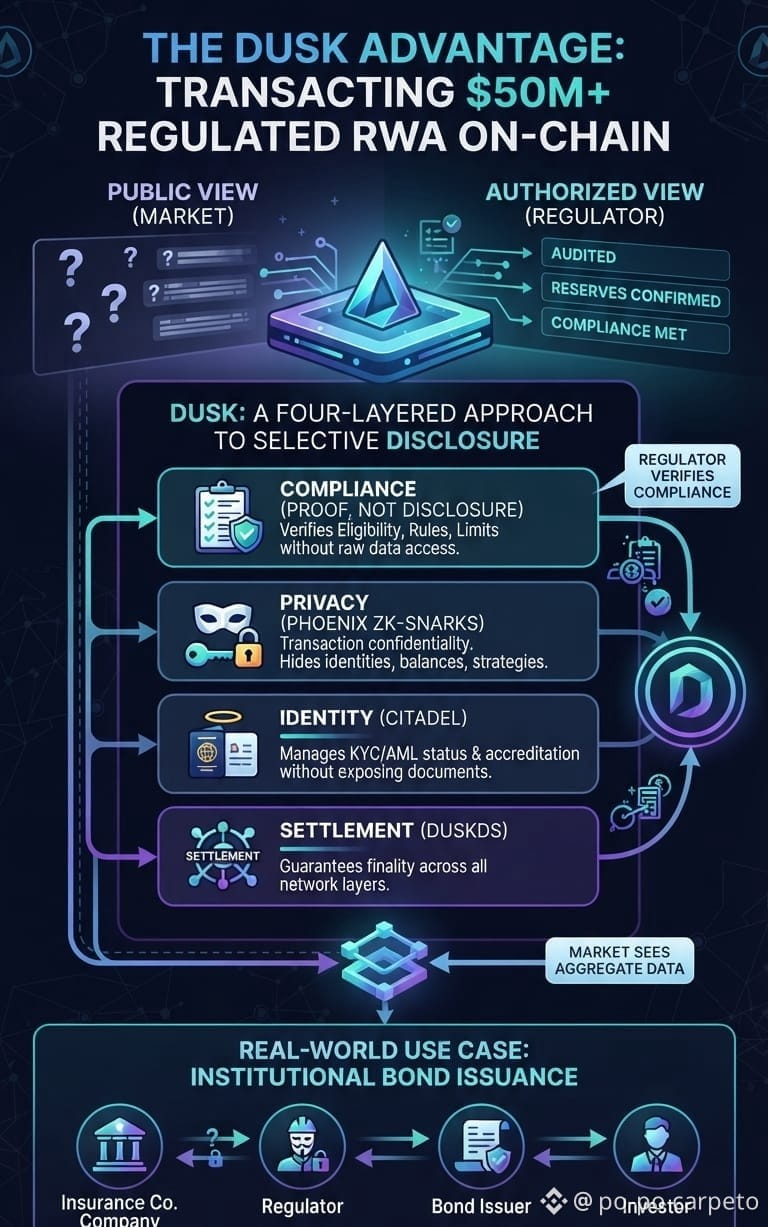
#dusk $DUSK @Dusk An insurance company just moved $50M in tokenized bonds on-chain. The regulator saw everything they needed. The market saw nothing."
That's not a hypothetical. That's how Dusk is quietly redefining what "transparent blockchain" actually means — and it might change how we think about the entire RWA narrative.
Here's what I found after digging into Dusk's architecture: privacy isn't the headline. Control over visibility is.
Most chains force you into a binary choice: everything public (Ethereum) or everything private (Monero). But regulated finance doesn't work in binaries. An insurance company needs to prove to regulators that they hold sufficient reserves — but they don't want competitors knowing their exact portfolio composition. A bond issuer needs to show compliance — but not expose every investor's identity.
Dusk solves this through what they call "selective disclosure." Here's the mechanism:
· Moonlight handles public, transparent transactions — think treasury reserves, aggregate settlement amounts, anything that needs to be visible
· Phoenix handles shielded transactions — investor identities, individual holdings, proprietary strategies
· Selective Disclosure lets authorized parties (regulators, auditors) verify specific information without seeing everything
But here's the part that really caught my attention: Dusk actually separates compliance, privacy, settlement, and execution into four distinct layers — instead of bundling them into one vague "privacy chain" promise.
Compliance is proof, not disclosure. A regulator can verify a rule was followed — eligibility, ownership limits, transfer restrictions — without seeing the raw transaction behind it.
Citadel handles identity separately — proving residency, accreditation, or KYC status without exposing the underlying documents.
Privacy (Phoenix) handles transaction confidentiality, independent of identity and asset rules.
Settlement (DuskDS) guarantees finality across all of them.
$TRUMP $SC
That's not a hypothetical. That's how Dusk is quietly redefining what "transparent blockchain" actually means — and it might change how we think about the entire RWA narrative.
Here's what I found after digging into Dusk's architecture: privacy isn't the headline. Control over visibility is.
Most chains force you into a binary choice: everything public (Ethereum) or everything private (Monero). But regulated finance doesn't work in binaries. An insurance company needs to prove to regulators that they hold sufficient reserves — but they don't want competitors knowing their exact portfolio composition. A bond issuer needs to show compliance — but not expose every investor's identity.
Dusk solves this through what they call "selective disclosure." Here's the mechanism:
· Moonlight handles public, transparent transactions — think treasury reserves, aggregate settlement amounts, anything that needs to be visible
· Phoenix handles shielded transactions — investor identities, individual holdings, proprietary strategies
· Selective Disclosure lets authorized parties (regulators, auditors) verify specific information without seeing everything
But here's the part that really caught my attention: Dusk actually separates compliance, privacy, settlement, and execution into four distinct layers — instead of bundling them into one vague "privacy chain" promise.
Compliance is proof, not disclosure. A regulator can verify a rule was followed — eligibility, ownership limits, transfer restrictions — without seeing the raw transaction behind it.
Citadel handles identity separately — proving residency, accreditation, or KYC status without exposing the underlying documents.
Privacy (Phoenix) handles transaction confidentiality, independent of identity and asset rules.
Settlement (DuskDS) guarantees finality across all of them.
$TRUMP $SC
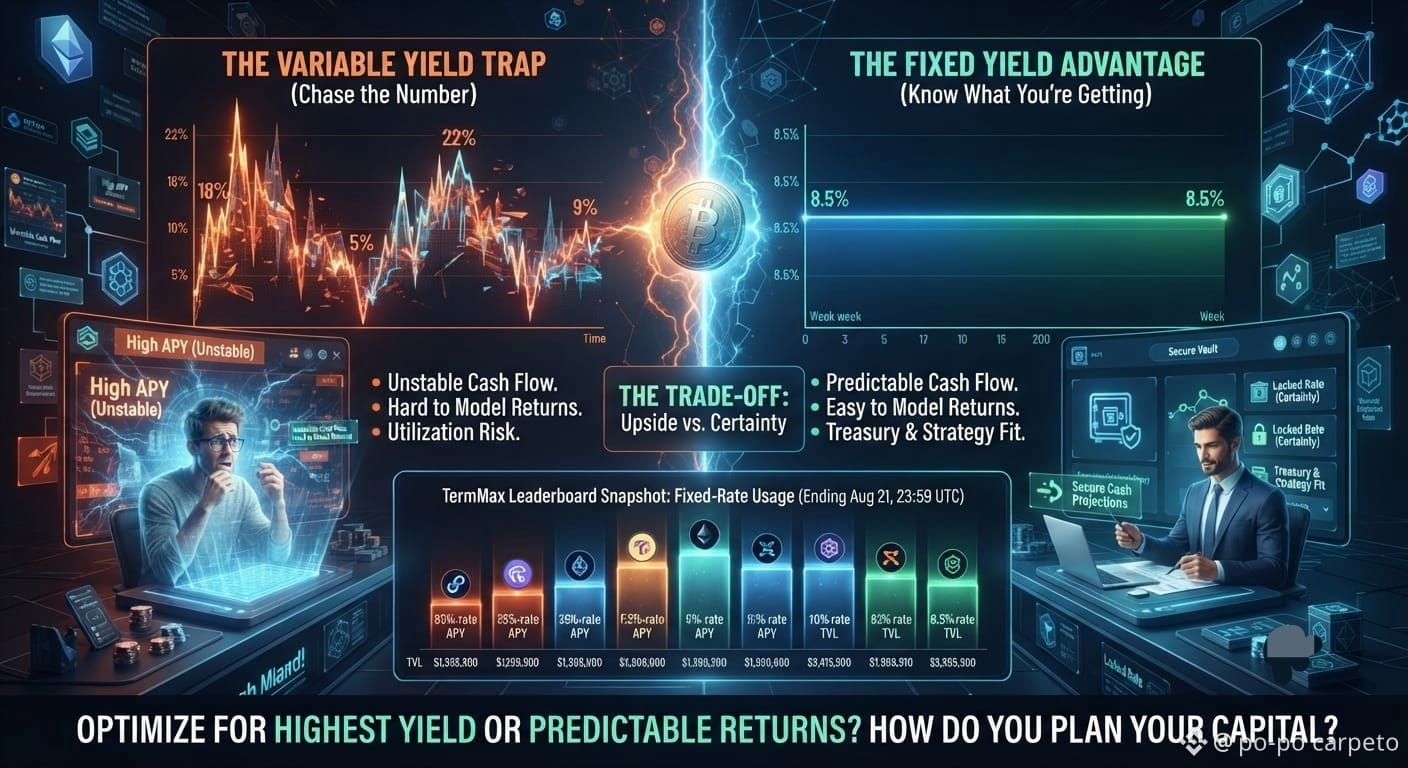
#termmax @TermMax Most DeFi yield still gets marketed on the number — "up to X% APY" — without much attention to how stable that number actually is week to week. Variable-rate markets can look attractive on a given day and then swing significantly once utilization shifts, which makes them hard to plan around if you're trying to model returns rather than just chase them.
Fixed-rate markets solve a narrower problem than "maximize yield" — they solve "know what I'm getting." That's a different value proposition, and it appeals to a different kind of capital: treasuries, structured strategies, anyone who needs to model cash flow rather than just hope for upside. It's arguably a less exciting pitch than a high variable APY, but it's a more useful one for anyone actually planning around the return.
The tradeoff is real too — locking a fixed rate means giving up the chance that variable rates move in your favor later. You're trading upside optionality for certainty. Whether that's the right trade depends entirely on what you're actually trying to do with the capital.
This is also the last stretch of TermMax's leaderboard snapshot period (through Aug 21, 23:59 UTC) — a fitting note to end the week's research on, since it's a decent test case for whether the fixed-rate thesis is finding real usage or just campaign-driven activity.
Do you optimize for the highest possible yield, or for the most predictable one — and has that preference ever changed based on what you were saving for? $ENA $ROBO $TUT
Fixed-rate markets solve a narrower problem than "maximize yield" — they solve "know what I'm getting." That's a different value proposition, and it appeals to a different kind of capital: treasuries, structured strategies, anyone who needs to model cash flow rather than just hope for upside. It's arguably a less exciting pitch than a high variable APY, but it's a more useful one for anyone actually planning around the return.
The tradeoff is real too — locking a fixed rate means giving up the chance that variable rates move in your favor later. You're trading upside optionality for certainty. Whether that's the right trade depends entirely on what you're actually trying to do with the capital.
This is also the last stretch of TermMax's leaderboard snapshot period (through Aug 21, 23:59 UTC) — a fitting note to end the week's research on, since it's a decent test case for whether the fixed-rate thesis is finding real usage or just campaign-driven activity.
Do you optimize for the highest possible yield, or for the most predictable one — and has that preference ever changed based on what you were saving for? $ENA $ROBO $TUT
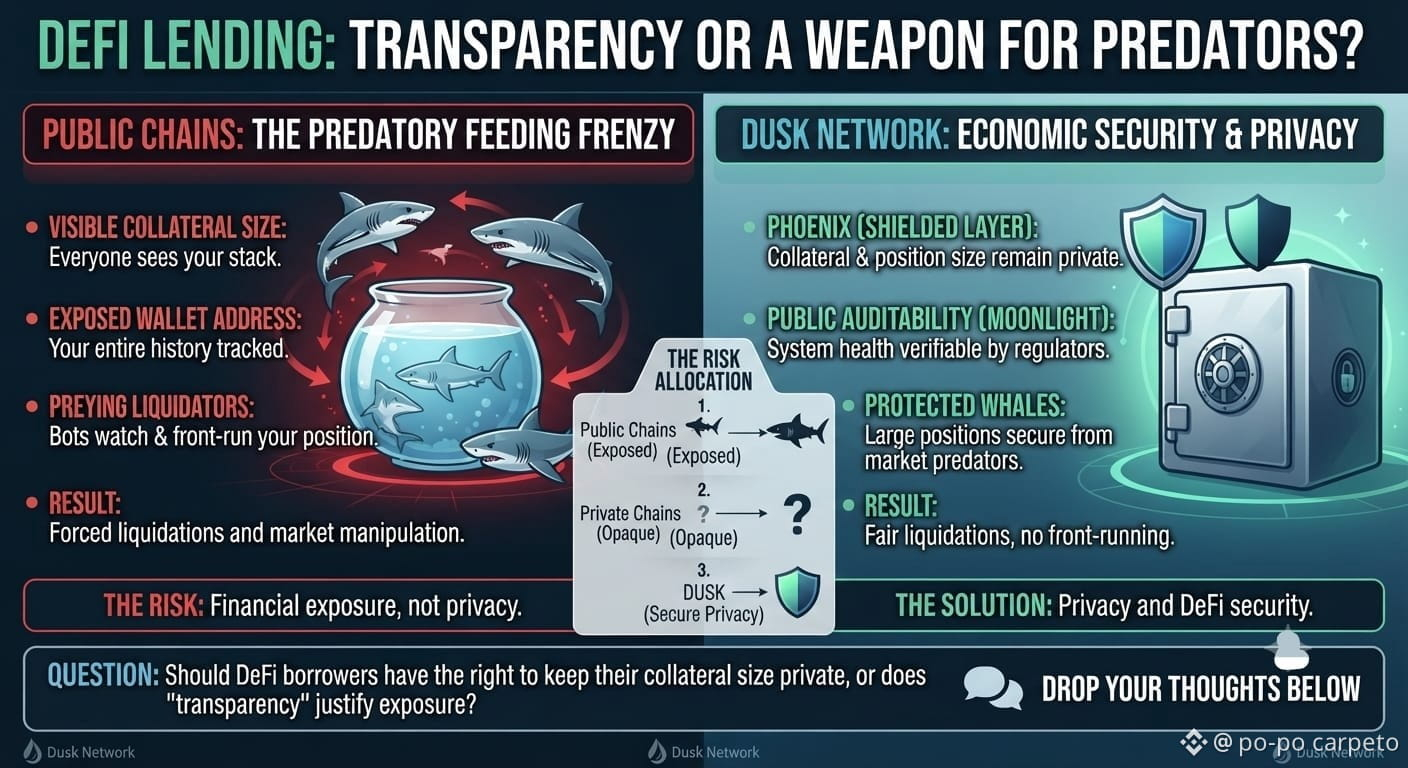
#dusk $DUSK @Dusk Your loan was liquidated. Your collateral? Still sitting there — visible to every predator on the chain."
I used to think that DeFi lending was better than traditional finance because everything was transparent. No hidden fees. No behind-the-scenes manipulation. Just clean, verifiable code.
But then I watched a friend get liquidated.
And I realized: transparency isn't always protection — sometimes it's a weapon.
Here's the ugly truth most lending protocols don't tell you:
When you take a loan, your collateral size, wallet address, and health factor are all public. Everyone can see exactly how much you're leveraged. And when the market drops, you're not just fighting price volatility — you're fighting predators who watch your position, wait for the right moment, and front-run your liquidation.
That's not DeFi. That's a feeding frenzy.
Dusk Network handles this differently:
· Moonlight (public layer) — records liquidation events and total protocol health, verifiable by regulators
· Phoenix (shielded layer) — keeps your collateral amount, position size, and wallet address fully private
A whale can take a multi-million dollar loan without exposing their entire portfolio to the world. Liquidators can still trigger liquidations when needed — but they can't prey on individual positions.
And here's the critical part: the system stays economically secure because the protocol can still verify collateral ratios without revealing the actual amount to the public.
The risk allocation is clear:
· Public chains — expose borrowers to front-running and predatory behavior
· Private chains — create opacity that institutions won't trust
· Dusk — gives you economic security and borrower privacy
So here's my question: Should DeFi borrowers have the right to keep their collateral size private, or does "transparency" justify exposing every position to the market?
Drop your thoughts below $ONG $MMT
I used to think that DeFi lending was better than traditional finance because everything was transparent. No hidden fees. No behind-the-scenes manipulation. Just clean, verifiable code.
But then I watched a friend get liquidated.
And I realized: transparency isn't always protection — sometimes it's a weapon.
Here's the ugly truth most lending protocols don't tell you:
When you take a loan, your collateral size, wallet address, and health factor are all public. Everyone can see exactly how much you're leveraged. And when the market drops, you're not just fighting price volatility — you're fighting predators who watch your position, wait for the right moment, and front-run your liquidation.
That's not DeFi. That's a feeding frenzy.
Dusk Network handles this differently:
· Moonlight (public layer) — records liquidation events and total protocol health, verifiable by regulators
· Phoenix (shielded layer) — keeps your collateral amount, position size, and wallet address fully private
A whale can take a multi-million dollar loan without exposing their entire portfolio to the world. Liquidators can still trigger liquidations when needed — but they can't prey on individual positions.
And here's the critical part: the system stays economically secure because the protocol can still verify collateral ratios without revealing the actual amount to the public.
The risk allocation is clear:
· Public chains — expose borrowers to front-running and predatory behavior
· Private chains — create opacity that institutions won't trust
· Dusk — gives you economic security and borrower privacy
So here's my question: Should DeFi borrowers have the right to keep their collateral size private, or does "transparency" justify exposing every position to the market?
Drop your thoughts below $ONG $MMT
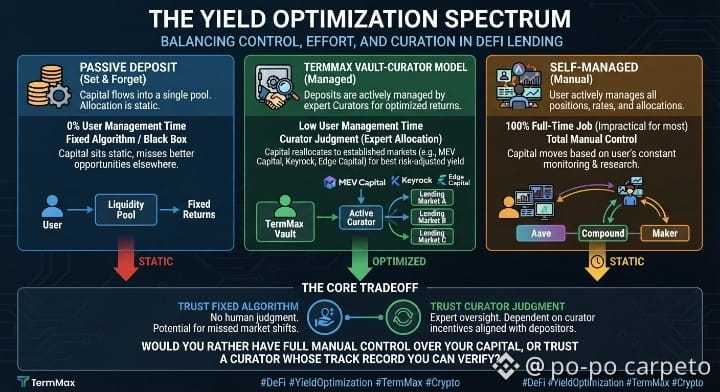
#termmax @TermMax Something worth sitting with: most people who deposit into a lending protocol never actually decide where their capital ends up. They pick a pool, deposit, and the rest is either a fixed algorithm or a black box.
The self-managed alternative — manually choosing markets, monitoring rates, reallocating as conditions shift — sounds more in-control, but in practice it's a full-time job most depositors don't have time for. So capital tends to sit static, earning whatever the original pool offers, even after better opportunities appear elsewhere.
TermMax's vault-curator model sits in between those two extremes. Curators (in this case backed by names like MEV Capital, Keyrock, and Edge Capital) actively manage where deposited funds are routed, including into other established lending markets when that's where the better risk-adjusted return is. The depositor isn't managing positions day-to-day, but they're also not stuck with a static allocation.
The tradeoff is obvious once you name it: you're trusting a curator's judgment instead of a fixed algorithm or your own. That's not automatically better — it depends entirely on whether the curator's incentives are actually aligned with depositors, or just with growing AUM.
Would you rather have full manual control over your capital, or trust a curator whose track record you can verify?$ONG $ACE
The self-managed alternative — manually choosing markets, monitoring rates, reallocating as conditions shift — sounds more in-control, but in practice it's a full-time job most depositors don't have time for. So capital tends to sit static, earning whatever the original pool offers, even after better opportunities appear elsewhere.
TermMax's vault-curator model sits in between those two extremes. Curators (in this case backed by names like MEV Capital, Keyrock, and Edge Capital) actively manage where deposited funds are routed, including into other established lending markets when that's where the better risk-adjusted return is. The depositor isn't managing positions day-to-day, but they're also not stuck with a static allocation.
The tradeoff is obvious once you name it: you're trusting a curator's judgment instead of a fixed algorithm or your own. That's not automatically better — it depends entirely on whether the curator's incentives are actually aligned with depositors, or just with growing AUM.
Would you rather have full manual control over your capital, or trust a curator whose track record you can verify?$ONG $ACE
#dusk $DUSK @Dusk Your NFT sold for 50 ETH. The buyer's identity? Still a mystery to everyone — including you."
I used to think that NFT ownership was simple — you buy it, you own it, the whole world can see it.
But then I realized something unsettling:
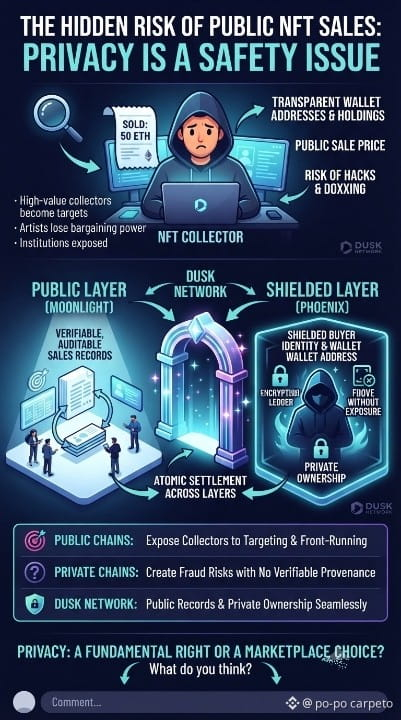
When you sell an NFT, the sale price is public. The wallet addresses are public. And with a little detective work, anyone can trace who bought it, what else they hold, and how much they're worth.
That's not just a privacy concern — it's a safety risk.
Here's the reality most marketplaces ignore:
· High-value collectors become targets for hacks and doxxing
· Artists lose bargaining power when buyers know each other's max bids
· Institutional buyers can't enter the market without exposing their entire portfolio strategy
Dusk Network changes this completely.
With Moonlight (public layer), the NFT sale price is recorded — verifiable, transparent, auditable.
With Phoenix (shielded layer), the buyer's identity and wallet address stay private — unless they choose to reveal themselves.
And the critical part: ownership transfers atomically between these layers. The buyer proves they have the funds, the artist proves they own the NFT, and the trade settles — all without exposing who's on theother side.
The risk allocation is clear:
· Public chains — expose collectors to targeting and front-running
· Private chains — create fraud risks with no verifiable provenance
· Dusk — gives you public sale records and private ownership in one seamless system
So here's my question: Should NFT buyers be forced to reveal their identities just to participate in the market, or should privacy be a fundamental right for collectors?
Let me know what you think 👇$AR $NES
I used to think that NFT ownership was simple — you buy it, you own it, the whole world can see it.
But then I realized something unsettling:
When you sell an NFT, the sale price is public. The wallet addresses are public. And with a little detective work, anyone can trace who bought it, what else they hold, and how much they're worth.
That's not just a privacy concern — it's a safety risk.
Here's the reality most marketplaces ignore:
· High-value collectors become targets for hacks and doxxing
· Artists lose bargaining power when buyers know each other's max bids
· Institutional buyers can't enter the market without exposing their entire portfolio strategy
Dusk Network changes this completely.
With Moonlight (public layer), the NFT sale price is recorded — verifiable, transparent, auditable.
With Phoenix (shielded layer), the buyer's identity and wallet address stay private — unless they choose to reveal themselves.
And the critical part: ownership transfers atomically between these layers. The buyer proves they have the funds, the artist proves they own the NFT, and the trade settles — all without exposing who's on theother side.
The risk allocation is clear:
· Public chains — expose collectors to targeting and front-running
· Private chains — create fraud risks with no verifiable provenance
· Dusk — gives you public sale records and private ownership in one seamless system
So here's my question: Should NFT buyers be forced to reveal their identities just to participate in the market, or should privacy be a fundamental right for collectors?
Let me know what you think 👇$AR $NES
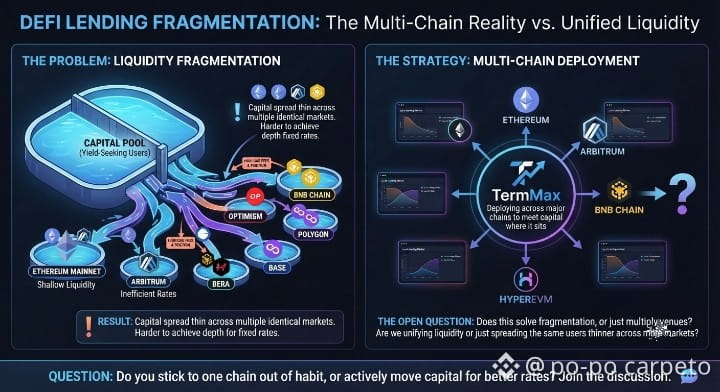
#termmax @TermMax One thing that doesn't get talked about enough in DeFi lending: liquidity doesn't actually live in one place anymore, but most protocols are still built as if it does.
A lending market deployed only on Ethereum mainnet is competing for capital against near-identical markets on Arbitrum, BNB Chain, and half a dozen L2s — all pulling from the same pool of yield-seeking users, just fragmented by gas costs and bridging friction. The result is usually shallower liquidity and less efficient rate discovery on any single chain than the aggregate activity would suggest.
TermMax's decision to deploy across Ethereum, Arbitrum, BNB Chain, Berachain, and HyperEVM reads less like "expansion for its own sake" and more like an attempt to meet capital where it already sits, rather than asking it to migrate. Fixed-rate markets in particular depend on enough depth to price a term structure reasonably — thin liquidity on a single chain makes that harder to sustain.
The open question is whether multi-chain deployment actually solves fragmentation, or whether it just multiplies the number of separate markets you now have to compare rates across. More venues isn't the same as more unified liquidity.
Do you find yourself sticking to one chain out of habit, or do you actively move capital to wherever the better rate is? $$RE $MUBARAK $HEMI
A lending market deployed only on Ethereum mainnet is competing for capital against near-identical markets on Arbitrum, BNB Chain, and half a dozen L2s — all pulling from the same pool of yield-seeking users, just fragmented by gas costs and bridging friction. The result is usually shallower liquidity and less efficient rate discovery on any single chain than the aggregate activity would suggest.
TermMax's decision to deploy across Ethereum, Arbitrum, BNB Chain, Berachain, and HyperEVM reads less like "expansion for its own sake" and more like an attempt to meet capital where it already sits, rather than asking it to migrate. Fixed-rate markets in particular depend on enough depth to price a term structure reasonably — thin liquidity on a single chain makes that harder to sustain.
The open question is whether multi-chain deployment actually solves fragmentation, or whether it just multiplies the number of separate markets you now have to compare rates across. More venues isn't the same as more unified liquidity.
Do you find yourself sticking to one chain out of habit, or do you actively move capital to wherever the better rate is? $$RE $MUBARAK $HEMI
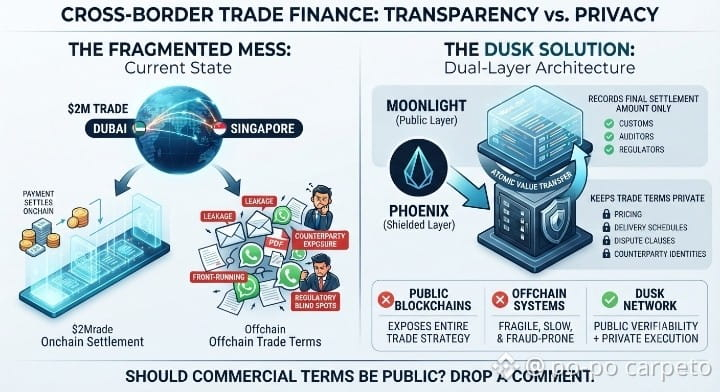
#dusk $DUSK @Dusk "Your cross-border trade settled onchain. Your trade terms? Still floating in an email thread."
I used to think that putting international trade on a blockchain meant everything moved onchain — payments, contracts, shipping docs, all transparent and verifiable.
But then I looked closer at how trade finance actually works.
Here's the uncomfortable truth:
When an importer in Dubai buys $2M worth of goods from a supplier in Singapore, the payment might settle onchain. But the terms — the pricing, delivery schedules, dispute clauses, counterparty identities — those still live in PDFs, emails, and WhatsApp threads.
That's not efficiency. That's a fragmented mess.
And it creates real risk:
· Leakage — competitors find out your pricing
· Front-running — bad actors trade ahead of your settlement
· Counterparty exposure — you can't verify if the other side actually has the funds
· Regulatory blind spots — customs and auditors can't verify the deal
Dusk Network solves this with its dual-system architecture:
· Moonlight (public layer) — records the final settlement amount, verifiable by customs, auditors, and regulators
· Phoenix (shielded layer) — keeps trade terms, pricing, delivery schedules, and counterparty details private — visible only to the involved parties
And here's the game-changer: value moves atomically between these layers. The importer can prove they settled the trade without revealing their margin or supplier identity.
The risk allocation is clear:
· Public blockchains — expose your entire trade strategy to the world
· Offchain systems — create reconciliation nightmares and fraud risks
· Dusk — gives you public verifiability and private execution in one seamless system
So here's my question: Should trade finance be fully transparent, or should businesses have the right to keep their commercial terms private while still proving settlement?
I'd love to hear your take. Drop a comment $TREE $MUBARAK
I used to think that putting international trade on a blockchain meant everything moved onchain — payments, contracts, shipping docs, all transparent and verifiable.
But then I looked closer at how trade finance actually works.
Here's the uncomfortable truth:
When an importer in Dubai buys $2M worth of goods from a supplier in Singapore, the payment might settle onchain. But the terms — the pricing, delivery schedules, dispute clauses, counterparty identities — those still live in PDFs, emails, and WhatsApp threads.
That's not efficiency. That's a fragmented mess.
And it creates real risk:
· Leakage — competitors find out your pricing
· Front-running — bad actors trade ahead of your settlement
· Counterparty exposure — you can't verify if the other side actually has the funds
· Regulatory blind spots — customs and auditors can't verify the deal
Dusk Network solves this with its dual-system architecture:
· Moonlight (public layer) — records the final settlement amount, verifiable by customs, auditors, and regulators
· Phoenix (shielded layer) — keeps trade terms, pricing, delivery schedules, and counterparty details private — visible only to the involved parties
And here's the game-changer: value moves atomically between these layers. The importer can prove they settled the trade without revealing their margin or supplier identity.
The risk allocation is clear:
· Public blockchains — expose your entire trade strategy to the world
· Offchain systems — create reconciliation nightmares and fraud risks
· Dusk — gives you public verifiability and private execution in one seamless system
So here's my question: Should trade finance be fully transparent, or should businesses have the right to keep their commercial terms private while still proving settlement?
I'd love to hear your take. Drop a comment $TREE $MUBARAK
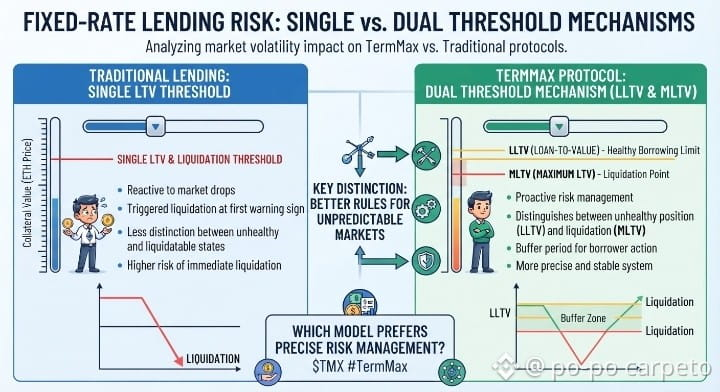
#termmax @TermMax The more I looked at fixed-rate lending, the more one question bothered me:
What happens when the market moves against the borrower?
At first, I thought the answer was simply “liquidation.” But digging into TermMax made me look at the risk structure differently.
A TermMax market doesn't rely on one LTV number. It uses LLTV and MLTV — two different thresholds that separate normal borrowing conditions from the point where a position becomes exposed to liquidation.
That distinction matters.
Imagine borrowing against ETH when everything looks comfortable. Then ETH drops sharply. A single threshold would make the system treat every stage of that decline almost the same.
With separate thresholds, the protocol can distinguish between the level at which a position becomes unhealthy and the level where stronger risk actions become necessary.
I think that's an important reason @TermMax chose this mechanism: fixed-rate lending isn't only about fixing the interest rate. It also needs a clearly defined way to manage collateral risk as market conditions change.
The interesting part is that predictable borrowing doesn't mean predictable markets.
It means the protocol needs better rules for dealing with the unpredictable ones.
Would you rather have a lending protocol with simpler risk rules, or one with more layers of risk parameters if they make the system more precise?
$TMX #TermMax $TUT $BNB
What happens when the market moves against the borrower?
At first, I thought the answer was simply “liquidation.” But digging into TermMax made me look at the risk structure differently.
A TermMax market doesn't rely on one LTV number. It uses LLTV and MLTV — two different thresholds that separate normal borrowing conditions from the point where a position becomes exposed to liquidation.
That distinction matters.
Imagine borrowing against ETH when everything looks comfortable. Then ETH drops sharply. A single threshold would make the system treat every stage of that decline almost the same.
With separate thresholds, the protocol can distinguish between the level at which a position becomes unhealthy and the level where stronger risk actions become necessary.
I think that's an important reason @TermMax chose this mechanism: fixed-rate lending isn't only about fixing the interest rate. It also needs a clearly defined way to manage collateral risk as market conditions change.
The interesting part is that predictable borrowing doesn't mean predictable markets.
It means the protocol needs better rules for dealing with the unpredictable ones.
Would you rather have a lending protocol with simpler risk rules, or one with more layers of risk parameters if they make the system more precise?
$TMX #TermMax $TUT $BNB
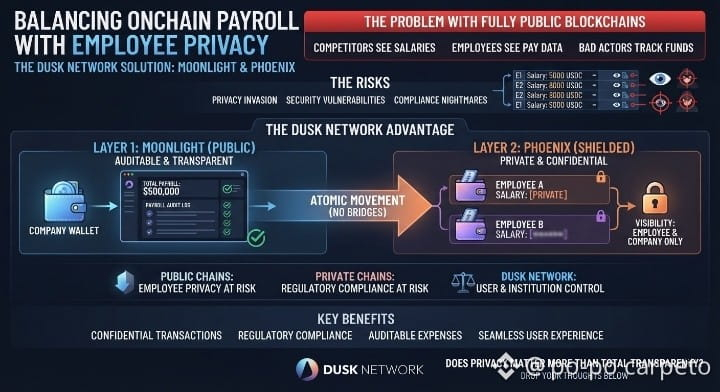
#dusk $DUSK @Dusk "Your payroll is onchain. Your employees' privacy? Still offchain."
I used to think that putting a company's payroll on a blockchain meant full transparency — every salary, every bonus, every transfer visible to anyone who cared to look.
But then I realized: transparency isn't always the goal. Sometimes, it's the problem.
Here's the reality most blockchains ignore:
When a company pays 500 employees in crypto, every single transaction is public. Competitors see salaries. Employees see each other's pay. Bad actors track who got paid what and when.
That's not just uncomfortable — it's a security risk and a compliance nightmare.
Dusk Network flips this completely.
With Moonlight (public layer), the company shows total payroll expense — auditable, transparent, verifiable.
With Phoenix (shielded layer), each employee's individual salary, wallet, and transfer history stay private — visible only to them and the company if needed.
And here's the critical part: the movement between these two layers is atomic. No bridges. No wrapped tokens. No extra fees. Just one seamless transaction.
The risk allocation here is clear:
· Public chains put employee privacy at risk
· Private chains put regulatory compliance at risk
· Dusk puts control where it belongs — with the user and the institution together
So here's my question: Should employee salaries be public just because they're onchain? Or does privacy at work matter more than total transparency?
Drop your thoughts below $TUT $GPS
I used to think that putting a company's payroll on a blockchain meant full transparency — every salary, every bonus, every transfer visible to anyone who cared to look.
But then I realized: transparency isn't always the goal. Sometimes, it's the problem.
Here's the reality most blockchains ignore:
When a company pays 500 employees in crypto, every single transaction is public. Competitors see salaries. Employees see each other's pay. Bad actors track who got paid what and when.
That's not just uncomfortable — it's a security risk and a compliance nightmare.
Dusk Network flips this completely.
With Moonlight (public layer), the company shows total payroll expense — auditable, transparent, verifiable.
With Phoenix (shielded layer), each employee's individual salary, wallet, and transfer history stay private — visible only to them and the company if needed.
And here's the critical part: the movement between these two layers is atomic. No bridges. No wrapped tokens. No extra fees. Just one seamless transaction.
The risk allocation here is clear:
· Public chains put employee privacy at risk
· Private chains put regulatory compliance at risk
· Dusk puts control where it belongs — with the user and the institution together
So here's my question: Should employee salaries be public just because they're onchain? Or does privacy at work matter more than total transparency?
Drop your thoughts below $TUT $GPS
#termmax @TermMax Ever taken out a loan, only for the interest rate to suddenly shoot up and completely throw off your financial planning? In the world of DeFi, variable rates often do the exact same thing.
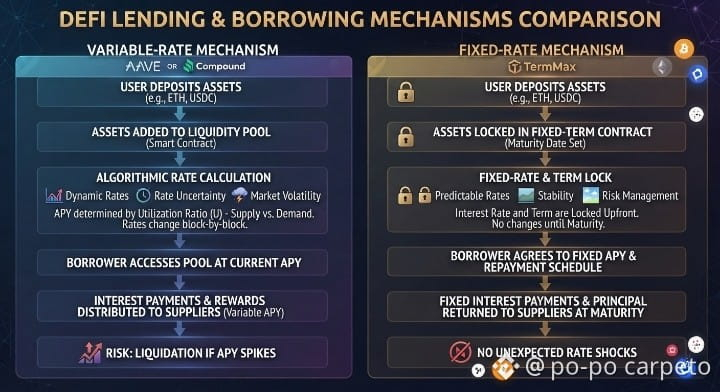
When you borrow or lend on protocols like Aave or Compound, the rates act a lot like a variable utility bill. Just like your electricity bill spikes when you run the AC all summer, your APY constantly shifts up and down based on market demand. You never really know what your final cost will look like.
On the flip side, TermMax takes a completely different approach. It works much like signing a fixed-rate contract upfront. You know your exact rate and maturity date from day one, meaning your rate stays locked no matter how wild the market gets.
At the end of the day, the real difference is simple: Aave and Compound offer floating rates driven by short-term supply and demand, which always carries the risk of a sudden rate shock. TermMax, meanwhile, gives you the predictability and peace of mind needed for solid financial planning.
What do you prefer in DeFi—the thrill of variable rates or the peace of mind of fixed rates like TermMax? Let me know your thoughts below!$AXTIB $GPS
When you borrow or lend on protocols like Aave or Compound, the rates act a lot like a variable utility bill. Just like your electricity bill spikes when you run the AC all summer, your APY constantly shifts up and down based on market demand. You never really know what your final cost will look like.
On the flip side, TermMax takes a completely different approach. It works much like signing a fixed-rate contract upfront. You know your exact rate and maturity date from day one, meaning your rate stays locked no matter how wild the market gets.
At the end of the day, the real difference is simple: Aave and Compound offer floating rates driven by short-term supply and demand, which always carries the risk of a sudden rate shock. TermMax, meanwhile, gives you the predictability and peace of mind needed for solid financial planning.
What do you prefer in DeFi—the thrill of variable rates or the peace of mind of fixed rates like TermMax? Let me know your thoughts below!$AXTIB $GPS
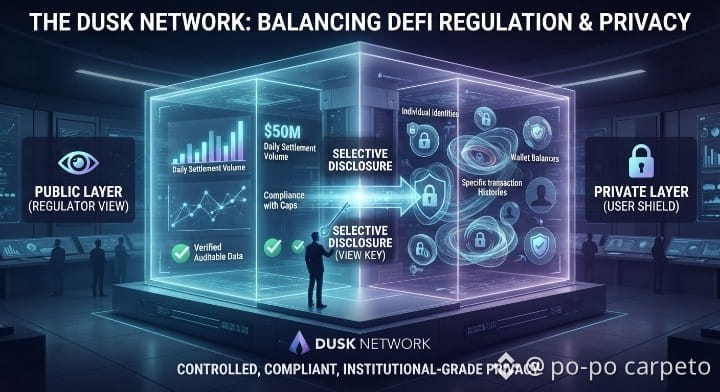
#dusk $DUSK @Dusk "Show me your books, but don't show me your customers."
That's the exact demand regulators are making of DeFi protocols today. And honestly? It's a fair ask.
But here's the catch — most blockchains can't do it.
If everything is public, you expose every user's identity, wallet, and transaction history to the world. If everything is private, regulators cry foul and call it a money-laundering haven.
Dusk Network says: Why choose?
Here's how they solve it on-chain, right now:
A DeFi protocol settles $50M in daily volume. Regulators need to audit — they want to see total settlement amounts, compliance with caps, and no suspicious patterns.
Dusk gives them exactly that — through Moonlight, the public layer. All aggregate data is visible, auditable, and verifiable.
But what about the users? Their individual identities, wallet balances, and trade histories? They stay shielded on Phoenix — private, encrypted, and accessible only to the user.
And if a regulator needs to investigate a specific address? Dusk provides selective disclosure — a view key that reveals only what's necessary, nothing more.
No full transparency. No full privacy. Just controlled, compliant, institutional-grade privacy.
This isn't a promise. This is how Dusk works today.
So here's my question to you: Should DeFi protocols prioritize user privacy or regulatory compliance — or can they have both?$TUT $GPS
That's the exact demand regulators are making of DeFi protocols today. And honestly? It's a fair ask.
But here's the catch — most blockchains can't do it.
If everything is public, you expose every user's identity, wallet, and transaction history to the world. If everything is private, regulators cry foul and call it a money-laundering haven.
Dusk Network says: Why choose?
Here's how they solve it on-chain, right now:
A DeFi protocol settles $50M in daily volume. Regulators need to audit — they want to see total settlement amounts, compliance with caps, and no suspicious patterns.
Dusk gives them exactly that — through Moonlight, the public layer. All aggregate data is visible, auditable, and verifiable.
But what about the users? Their individual identities, wallet balances, and trade histories? They stay shielded on Phoenix — private, encrypted, and accessible only to the user.
And if a regulator needs to investigate a specific address? Dusk provides selective disclosure — a view key that reveals only what's necessary, nothing more.
No full transparency. No full privacy. Just controlled, compliant, institutional-grade privacy.
This isn't a promise. This is how Dusk works today.
So here's my question to you: Should DeFi protocols prioritize user privacy or regulatory compliance — or can they have both?$TUT $GPS
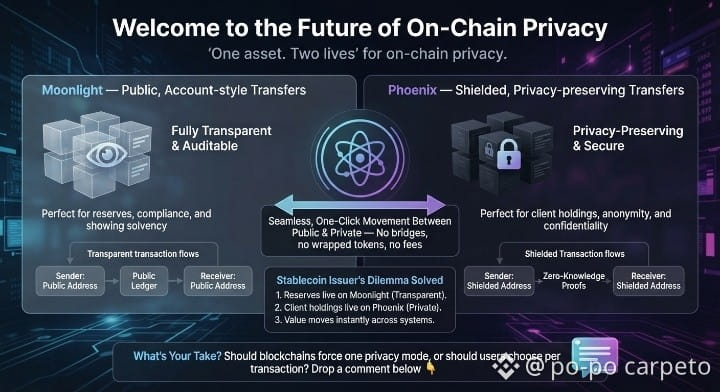
#dusk $DUSK @Dusk One asset. Two lives. Welcome to the future of on-chain privacy.
Imagine this: You're a stablecoin issuer. You want the world to see your reserves — proof of solvency, transparency for your users. But at the same time, you don't want every random blockchain scanner to track exactly who holds how much of your stablecoin, when they move it, or where it goes.
Sounds like a contradiction, right?
Not on Dusk Network.
Dusk runs two parallel transaction systems side by side:
· Moonlight — public, account-style transfers (think Ethereum, but optimized)
· Phoenix — shielded, privacy-preserving transfers (think Zcash, but smarter)
And here's the magic: You can move value between them atomically — no bridges, no wrapped tokens, no extra fees. Just seamless, one-click movement between public and private.
So that stablecoin issuer? They keep their reserves on Moonlight — fully transparent, auditable by anyone. But their clients' holdings stay on Phoenix — private, secure, visible only to the account holder and the issuer if needed.
This isn't theory. This is live. This is Dusk.
Now here's the real question: Should blockchains force everyone into one privacy mode, or should users have the freedom to choose per transaction?
I'd love to hear your take. Drop a comment below 👇$BNB $AAPL.US
Imagine this: You're a stablecoin issuer. You want the world to see your reserves — proof of solvency, transparency for your users. But at the same time, you don't want every random blockchain scanner to track exactly who holds how much of your stablecoin, when they move it, or where it goes.
Sounds like a contradiction, right?
Not on Dusk Network.
Dusk runs two parallel transaction systems side by side:
· Moonlight — public, account-style transfers (think Ethereum, but optimized)
· Phoenix — shielded, privacy-preserving transfers (think Zcash, but smarter)
And here's the magic: You can move value between them atomically — no bridges, no wrapped tokens, no extra fees. Just seamless, one-click movement between public and private.
So that stablecoin issuer? They keep their reserves on Moonlight — fully transparent, auditable by anyone. But their clients' holdings stay on Phoenix — private, secure, visible only to the account holder and the issuer if needed.
This isn't theory. This is live. This is Dusk.
Now here's the real question: Should blockchains force everyone into one privacy mode, or should users have the freedom to choose per transaction?
I'd love to hear your take. Drop a comment below 👇$BNB $AAPL.US
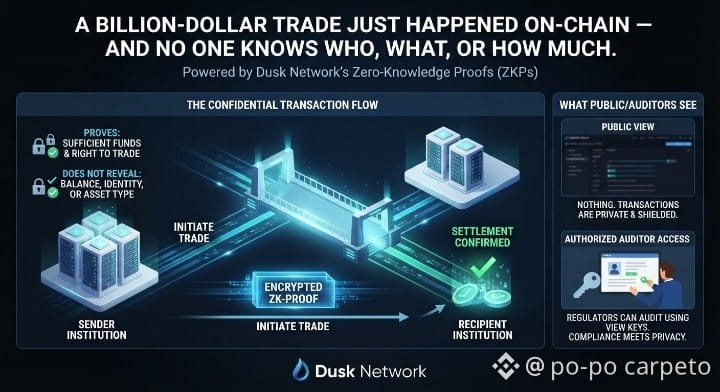
#dusk $DUSK @Dusk A billion-dollar trade just happened on-chain — and no one knows who, what, or how much."
Sounds like science fiction? It’s not. It’s happening right now on privacy-focused blockchains — and Dusk Network is leading the charge.
This week, an on-chain transaction settled confidentially between two institutional counterparties. No front-running. No miner extraction. No public mempool leaks. Just a clean, verified settlement — using Zero-Knowledge Proofs (ZKPs).
Here’s what actually happened under the hood:
The sender proved they had sufficient funds and the right to execute the trade — without revealing their balance, their identity, or even the asset type. The network validated the proof, not the data. That’s ZKPs in action.
Dusk doesn’t use ZKPs as a gimmick. They use them because compliance and privacy are not opposites — they’re partners. A regulator can still audit with a view key. A counterparty can still verify settlement. But the public sees nothing.
This isn’t theory. This is live on Dusk’s testnet, and soon on mainnet.
In a world where on-chain transparency is often confused with surveillance, Dusk is drawing a clear line:
Privacy is not secrecy. It’s control.$COW $ENSO
Sounds like science fiction? It’s not. It’s happening right now on privacy-focused blockchains — and Dusk Network is leading the charge.
This week, an on-chain transaction settled confidentially between two institutional counterparties. No front-running. No miner extraction. No public mempool leaks. Just a clean, verified settlement — using Zero-Knowledge Proofs (ZKPs).
Here’s what actually happened under the hood:
The sender proved they had sufficient funds and the right to execute the trade — without revealing their balance, their identity, or even the asset type. The network validated the proof, not the data. That’s ZKPs in action.
Dusk doesn’t use ZKPs as a gimmick. They use them because compliance and privacy are not opposites — they’re partners. A regulator can still audit with a view key. A counterparty can still verify settlement. But the public sees nothing.
This isn’t theory. This is live on Dusk’s testnet, and soon on mainnet.
In a world where on-chain transparency is often confused with surveillance, Dusk is drawing a clear line:
Privacy is not secrecy. It’s control.$COW $ENSO
#dusk $DUSK @Dusk Ever wondered who can actually see your smart contract transactions?
A friend of mine once made a private deal on Ethereum. A few months later, he found out that his entire transaction history was public — someone traced his identity, and his personal details got exposed. That day, I realized that in crypto, privacy isn’t just a 'nice-to-have' — it’s a necessity.
That realization led me to Dusk Network.
Dusk is a layer-1 blockchain that uses Confidential Smart Contracts (XSC). What does that mean? It means both the contract logic and the data stay encrypted — only the parties you authorize can see what's going on. No random scanners, no prying nodes — just you and your counterparty.
Now, why does Dusk do this?
Because Dusk wants real financial institutions to step into DeFi. Banks, asset managers, regulated entities — they’ll only come if they get both privacy and compliance. XSC gives them exactly that, without sacrificing transparency where it's actually needed.$ACE $2Z
A friend of mine once made a private deal on Ethereum. A few months later, he found out that his entire transaction history was public — someone traced his identity, and his personal details got exposed. That day, I realized that in crypto, privacy isn’t just a 'nice-to-have' — it’s a necessity.
That realization led me to Dusk Network.
Dusk is a layer-1 blockchain that uses Confidential Smart Contracts (XSC). What does that mean? It means both the contract logic and the data stay encrypted — only the parties you authorize can see what's going on. No random scanners, no prying nodes — just you and your counterparty.
Now, why does Dusk do this?
Because Dusk wants real financial institutions to step into DeFi. Banks, asset managers, regulated entities — they’ll only come if they get both privacy and compliance. XSC gives them exactly that, without sacrificing transparency where it's actually needed.$ACE $2Z
Smart Portfolio Strategy for Big 3 👇
Beginner: 50% $BTC | 30% $ETH | 20% $BNB
Balanced: 40% $BTC | 40% $ETH | 20% $BNB
Aggressive: 30% $BTC | 50% $ETH | 20% $BNB
Rule: Never invest more than you can lose
Rule 2: DCA every week, ignore the noise
What's your current split? Share below 👇
#BTC #ETH #BNB #Portfolio #CryptoTips
Beginner: 50% $BTC | 30% $ETH | 20% $BNB
Balanced: 40% $BTC | 40% $ETH | 20% $BNB
Aggressive: 30% $BTC | 50% $ETH | 20% $BNB
Rule: Never invest more than you can lose
Rule 2: DCA every week, ignore the noise
What's your current split? Share below 👇
#BTC #ETH #BNB #Portfolio #CryptoTips
Crypto News Flash ⚡
$BTC
holding strong above key levels
$ETH network upgrades improving speed
$BNB chain seeing new project launches
Market is moving. Are you watching or building?
What's the biggest news you saw today? 👇
#BTC #ETH #BNB #CryptoNews #MarketUpdate
$BTC
holding strong above key levels
$ETH network upgrades improving speed
$BNB chain seeing new project launches
Market is moving. Are you watching or building?
What's the biggest news you saw today? 👇
#BTC #ETH #BNB #CryptoNews #MarketUpdate
Log in to explore more content