
Rootstock Infrastructure_RIF
7 Posts

Rootstock Infrastructure_RIF
 Square Verified
Report
Block User
RIF is the Rootstock Infrastructure token. It unlocks more opportunities on Bitcoin through
Rootstock, from governance, stablecoins to digital identity & DeFi.
5 Following
10 Followers
13 Liked
Posts
All
Quotes
PINNED
Article
What Is $RIF, and Why Does It Matter for Bitcoin?Bitcoin is the world’s most secure financial network. But for many holders, its role still begins and ends with storing value.
Rootstock expands what Bitcoin can do by bringing smart contracts and programmable finance to the network. RIF, the Rootstock Infrastructure token, supports the infrastructure, incentives and community participation that help this ecosystem grow.
From governance and stablecoins to digital identity and DeFi, RIF is designed to make Bitcoin more useful for users, builders and institutions.
What is RIF?
RIF is the infrastructure token of the Rootstock ecosystem.
It is used across a growing set of products and protocols built on Rootstock, Bitcoin’s longest-running smart contract layer. Its role is not limited to a single application. Instead, RIF connects several parts of the ecosystem, including:
Decentralized governanceStablecoinsDigital identityDeFi participationBuilder incentivesEcosystem funding
The aim is simple: create more ways for people to build, participate and transact using Bitcoin-secured infrastructure.
1. Community governance through RootstockCollective
One of RIF’s key use cases is governance.
RIF holders can participate in RootstockCollective, a DAO focused on supporting the development of the Rootstock ecosystem.
By staking RIF, participants receive stRIF, which can be used to vote on proposals and influence which projects, initiatives and contributors receive support.
This gives the community a direct role in shaping how the ecosystem develops.
Rather than innovation being driven by a small group of decision-makers, builders and supporters can participate in deciding what gets funded and built.
2. Rewards for ecosystem participation
Governance participation can also generate rewards.
Through RootstockCollective, stRIF holders can vote on proposals and receive rewards in Bitcoin and RIF.
The model is designed to align builders with the people supporting them.
Builders gain access to funding and community backing. Participants gain exposure to the initiatives they help support. The wider ecosystem benefits from continued development and experimentation.
3. Stablecoins built on Bitcoin
RIF also plays a role in USDRIF, a decentralized stablecoin designed to maintain a 1:1 peg with the US dollar.
USDRIF gives users access to stable value while remaining within the Rootstock ecosystem.
Potential use cases include:
Cross-border paymentsProtection against local currency inflationOnchain savingsDeFi activityDollar-denominated transactions
RIF On Chain V3, released in May 2026, introduced multi-collateral support for USDRIF, expanding the assets that can support the system and increasing the flexibility of the protocol.
Learn more: https://rif.technology/content-hub/rif-on-chain-v3-multi-collateral-support-coming-21-may-2026/
This is part of a wider effort to build practical financial tools on top of Bitcoin.
4. Simpler digital identity with RNS
Crypto addresses are difficult to remember, easy to mistype and intimidating for new users.
RIF Naming Service, or RNS, addresses this problem by allowing users to replace long wallet addresses with simple .rsk names.
Instead of sharing a complicated string of letters and numbers, a user can share a readable identity.
This improves usability across wallets, payments and decentralized applications.
Better infrastructure is not only about adding more financial products. It is also about making those products easier and safer to use.
RIF’s role in Bitcoin DeFi
Bitcoin DeFi will require more than smart contracts alone.
It needs governance systems, stable assets, identity tools, incentives and funding mechanisms that allow developers to build and users to participate.
RIF connects these different layers of the Rootstock ecosystem.
Its value comes from the role it plays across that infrastructure: helping coordinate governance, support builders, power financial products and improve the user experience.
The bigger picture
Bitcoin adoption is evolving beyond simply buying and holding BTC.
As more applications are built on Bitcoin-secured networks, users will need infrastructure that allows them to borrow, save, transact, govern and build without leaving the Bitcoin economy.
Rootstock provides the smart contract layer.
RIF helps power the ecosystem growing around it.
That is why RIF matters: it is part of the infrastructure turning Bitcoin from a passive asset into the foundation of a programmable financial system.
What Is $RIF, and Why Does It Matter for Bitcoin?
Bitcoin is the world’s most secure financial network. But for many holders, its role still begins and ends with storing value.
Rootstock expands what Bitcoin can do by bringing smart contracts and programmable finance to the network. RIF, the Rootstock Infrastructure token, supports the infrastructure, incentives and community participation that help this ecosystem grow.
From governance and stablecoins to digital identity and DeFi, RIF is designed to make Bitcoin more useful for users, builders and institutions.
What is RIF?
RIF is the infrastructure token of the Rootstock ecosystem.
It is used across a growing set of products and protocols built on Rootstock, Bitcoin’s longest-running smart contract layer. Its role is not limited to a single application. Instead, RIF connects several parts of the ecosystem, including:
Decentralized governanceStablecoinsDigital identityDeFi participationBuilder incentivesEcosystem funding
The aim is simple: create more ways for people to build, participate and transact using Bitcoin-secured infrastructure.
1. Community governance through RootstockCollective
One of RIF’s key use cases is governance.
RIF holders can participate in RootstockCollective, a DAO focused on supporting the development of the Rootstock ecosystem.
By staking RIF, participants receive stRIF, which can be used to vote on proposals and influence which projects, initiatives and contributors receive support.
This gives the community a direct role in shaping how the ecosystem develops.
Rather than innovation being driven by a small group of decision-makers, builders and supporters can participate in deciding what gets funded and built.
2. Rewards for ecosystem participation
Governance participation can also generate rewards.
Through RootstockCollective, stRIF holders can vote on proposals and receive rewards in Bitcoin and RIF.
The model is designed to align builders with the people supporting them.
Builders gain access to funding and community backing. Participants gain exposure to the initiatives they help support. The wider ecosystem benefits from continued development and experimentation.
3. Stablecoins built on Bitcoin
RIF also plays a role in USDRIF, a decentralized stablecoin designed to maintain a 1:1 peg with the US dollar.
USDRIF gives users access to stable value while remaining within the Rootstock ecosystem.
Potential use cases include:
Cross-border paymentsProtection against local currency inflationOnchain savingsDeFi activityDollar-denominated transactions
RIF On Chain V3, released in May 2026, introduced multi-collateral support for USDRIF, expanding the assets that can support the system and increasing the flexibility of the protocol.
Learn more: https://rif.technology/content-hub/rif-on-chain-v3-multi-collateral-support-coming-21-may-2026/
This is part of a wider effort to build practical financial tools on top of Bitcoin.
4. Simpler digital identity with RNS
Crypto addresses are difficult to remember, easy to mistype and intimidating for new users.
RIF Naming Service, or RNS, addresses this problem by allowing users to replace long wallet addresses with simple .rsk names.
Instead of sharing a complicated string of letters and numbers, a user can share a readable identity.
This improves usability across wallets, payments and decentralized applications.
Better infrastructure is not only about adding more financial products. It is also about making those products easier and safer to use.
RIF’s role in Bitcoin DeFi
Bitcoin DeFi will require more than smart contracts alone.
It needs governance systems, stable assets, identity tools, incentives and funding mechanisms that allow developers to build and users to participate.
RIF connects these different layers of the Rootstock ecosystem.
Its value comes from the role it plays across that infrastructure: helping coordinate governance, support builders, power financial products and improve the user experience.
The bigger picture
Bitcoin adoption is evolving beyond simply buying and holding BTC.
As more applications are built on Bitcoin-secured networks, users will need infrastructure that allows them to borrow, save, transact, govern and build without leaving the Bitcoin economy.
Rootstock provides the smart contract layer.
RIF helps power the ecosystem growing around it.
That is why RIF matters: it is part of the infrastructure turning Bitcoin from a passive asset into the foundation of a programmable financial system.
Rootstock expands what Bitcoin can do by bringing smart contracts and programmable finance to the network. RIF, the Rootstock Infrastructure token, supports the infrastructure, incentives and community participation that help this ecosystem grow.
From governance and stablecoins to digital identity and DeFi, RIF is designed to make Bitcoin more useful for users, builders and institutions.
What is RIF?
RIF is the infrastructure token of the Rootstock ecosystem.
It is used across a growing set of products and protocols built on Rootstock, Bitcoin’s longest-running smart contract layer. Its role is not limited to a single application. Instead, RIF connects several parts of the ecosystem, including:
Decentralized governanceStablecoinsDigital identityDeFi participationBuilder incentivesEcosystem funding
The aim is simple: create more ways for people to build, participate and transact using Bitcoin-secured infrastructure.
1. Community governance through RootstockCollective
One of RIF’s key use cases is governance.
RIF holders can participate in RootstockCollective, a DAO focused on supporting the development of the Rootstock ecosystem.
By staking RIF, participants receive stRIF, which can be used to vote on proposals and influence which projects, initiatives and contributors receive support.
This gives the community a direct role in shaping how the ecosystem develops.
Rather than innovation being driven by a small group of decision-makers, builders and supporters can participate in deciding what gets funded and built.
2. Rewards for ecosystem participation
Governance participation can also generate rewards.
Through RootstockCollective, stRIF holders can vote on proposals and receive rewards in Bitcoin and RIF.
The model is designed to align builders with the people supporting them.
Builders gain access to funding and community backing. Participants gain exposure to the initiatives they help support. The wider ecosystem benefits from continued development and experimentation.
3. Stablecoins built on Bitcoin
RIF also plays a role in USDRIF, a decentralized stablecoin designed to maintain a 1:1 peg with the US dollar.
USDRIF gives users access to stable value while remaining within the Rootstock ecosystem.
Potential use cases include:
Cross-border paymentsProtection against local currency inflationOnchain savingsDeFi activityDollar-denominated transactions
RIF On Chain V3, released in May 2026, introduced multi-collateral support for USDRIF, expanding the assets that can support the system and increasing the flexibility of the protocol.
Learn more: https://rif.technology/content-hub/rif-on-chain-v3-multi-collateral-support-coming-21-may-2026/
This is part of a wider effort to build practical financial tools on top of Bitcoin.
4. Simpler digital identity with RNS
Crypto addresses are difficult to remember, easy to mistype and intimidating for new users.
RIF Naming Service, or RNS, addresses this problem by allowing users to replace long wallet addresses with simple .rsk names.
Instead of sharing a complicated string of letters and numbers, a user can share a readable identity.
This improves usability across wallets, payments and decentralized applications.
Better infrastructure is not only about adding more financial products. It is also about making those products easier and safer to use.
RIF’s role in Bitcoin DeFi
Bitcoin DeFi will require more than smart contracts alone.
It needs governance systems, stable assets, identity tools, incentives and funding mechanisms that allow developers to build and users to participate.
RIF connects these different layers of the Rootstock ecosystem.
Its value comes from the role it plays across that infrastructure: helping coordinate governance, support builders, power financial products and improve the user experience.
The bigger picture
Bitcoin adoption is evolving beyond simply buying and holding BTC.
As more applications are built on Bitcoin-secured networks, users will need infrastructure that allows them to borrow, save, transact, govern and build without leaving the Bitcoin economy.
Rootstock provides the smart contract layer.
RIF helps power the ecosystem growing around it.
That is why RIF matters: it is part of the infrastructure turning Bitcoin from a passive asset into the foundation of a programmable financial system.
2
4
350
$RIF
Rootstock Infrastructure Framework (RIF) is an open-source suite of protocols and tools built on Rootstock, a Bitcoin smart contract sidechain.
The native RIF utility token powers decentralized finance (DeFi) services, network governance, and scaling solutions within the Bitcoin economy.
$RIF
Rootstock Infrastructure Framework (RIF) is an open-source suite of protocols and tools built on Rootstock, a Bitcoin smart contract sidechain.
The native RIF utility token powers decentralized finance (DeFi) services, network governance, and scaling solutions within the Bitcoin economy.
Rootstock Infrastructure Framework (RIF) is an open-source suite of protocols and tools built on Rootstock, a Bitcoin smart contract sidechain.
The native RIF utility token powers decentralized finance (DeFi) services, network governance, and scaling solutions within the Bitcoin economy.
4
225
What next for Rootstock?
Unmissable chat with RootstockLabs CEO and Co-founder: https://www.youtube.com/watch?v=rqPvJxxa7cY
$RIF
What next for Rootstock?
Unmissable chat with RootstockLabs CEO and Co-founder: https://www.youtube.com/watch?v=rqPvJxxa7cY
$RIF
Unmissable chat with RootstockLabs CEO and Co-founder: https://www.youtube.com/watch?v=rqPvJxxa7cY
$RIF

2
721
👀 $RIF
👀 $RIF

Bit_Guru
·
--
Bit Guru Community, this one deserves your attention.
I’ve been keeping an eye on what Rootstock is building, and this updated roadmap gives a much clearer picture of where the project is heading.
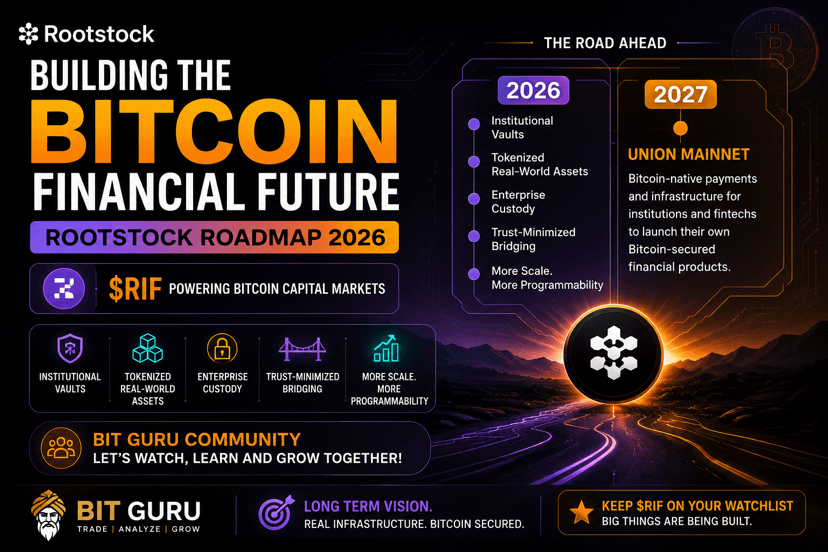
$RIF is focused on building infrastructure around Bitcoin capital markets, with plans covering institutional vaults, tokenized real-world assets, enterprise custody, trust-minimized bridging and greater scalability.
What really caught my attention is the longer-term vision. Rootstock is not just focusing on what is happening today, but building toward Bitcoin-native financial infrastructure for institutions and fintechs.
My community, keep $RIF on your watchlist and take a look at the updated roadmap.
I’ve been keeping an eye on what Rootstock is building, and this updated roadmap gives a much clearer picture of where the project is heading.
$RIF is focused on building infrastructure around Bitcoin capital markets, with plans covering institutional vaults, tokenized real-world assets, enterprise custody, trust-minimized bridging and greater scalability.
What really caught my attention is the longer-term vision. Rootstock is not just focusing on what is happening today, but building toward Bitcoin-native financial infrastructure for institutions and fintechs.
My community, keep $RIF on your watchlist and take a look at the updated roadmap.
131
The updates Rootstock roadmap is here. $RIF
Rootstock is building the infrastructure for Bitcoin capital markets 🚀
https://rootstock.io/roadmap/
The 2026 roadmap lays out what comes next:
• Institutional vaults
• Tokenized real-world assets
• Enterprise custody
• Trust-minimized bridging
• More scale. More programmability
All secured by Bitcoin. And the ambition extends beyond this year.
In 2027: Union on Mainnet, a Bitcoin-native payment rollup and infrastructure for institutions and fintechs to launch their own Bitcoin-secured financial products.
Some of it is already live. The rest is being built now.
The updates Rootstock roadmap is here. $RIF
Rootstock is building the infrastructure for Bitcoin capital markets 🚀
https://rootstock.io/roadmap/
The 2026 roadmap lays out what comes next:
• Institutional vaults
• Tokenized real-world assets
• Enterprise custody
• Trust-minimized bridging
• More scale. More programmability
All secured by Bitcoin. And the ambition extends beyond this year.
In 2027: Union on Mainnet, a Bitcoin-native payment rollup and infrastructure for institutions and fintechs to launch their own Bitcoin-secured financial products.
Some of it is already live. The rest is being built now.
Rootstock is building the infrastructure for Bitcoin capital markets 🚀
https://rootstock.io/roadmap/
The 2026 roadmap lays out what comes next:
• Institutional vaults
• Tokenized real-world assets
• Enterprise custody
• Trust-minimized bridging
• More scale. More programmability
All secured by Bitcoin. And the ambition extends beyond this year.
In 2027: Union on Mainnet, a Bitcoin-native payment rollup and infrastructure for institutions and fintechs to launch their own Bitcoin-secured financial products.
Some of it is already live. The rest is being built now.
1
2
381
Over 3,100 days of uninterrupted operations 🚀
But that is only part of the Rootstock story:
• +21 million transactions
• >40%+ share of total Bitcoin DeFi TVL
• $60M in tokenized RWA
• 118 real-world assets represented onchain
• Secured by >84% of Bitcoin’s hashrate
• 100% uptime since January 2018
• An ecosystem of 200+ partners 🧡
• Zero network security breaches
• Zero funds lost through the PowPeg
• rBTC backed 1:1 by BTC
• Full EVM compatibility
• Average 26-second block times
Built on Bitcoin. Secured by Bitcoin. Expanding what Bitcoin can do.
The BTCFi Layer.
$RIF
{spot}(RIFUSDT)
Over 3,100 days of uninterrupted operations 🚀
But that is only part of the Rootstock story:
• +21 million transactions
• >40%+ share of total Bitcoin DeFi TVL
• $60M in tokenized RWA
• 118 real-world assets represented onchain
• Secured by >84% of Bitcoin’s hashrate
• 100% uptime since January 2018
• An ecosystem of 200+ partners 🧡
• Zero network security breaches
• Zero funds lost through the PowPeg
• rBTC backed 1:1 by BTC
• Full EVM compatibility
• Average 26-second block times
Built on Bitcoin. Secured by Bitcoin. Expanding what Bitcoin can do.
The BTCFi Layer.
$RIF
But that is only part of the Rootstock story:
• +21 million transactions
• >40%+ share of total Bitcoin DeFi TVL
• $60M in tokenized RWA
• 118 real-world assets represented onchain
• Secured by >84% of Bitcoin’s hashrate
• 100% uptime since January 2018
• An ecosystem of 200+ partners 🧡
• Zero network security breaches
• Zero funds lost through the PowPeg
• rBTC backed 1:1 by BTC
• Full EVM compatibility
• Average 26-second block times
Built on Bitcoin. Secured by Bitcoin. Expanding what Bitcoin can do.
The BTCFi Layer.
$RIF
1
331
Log in to explore more content
Join global crypto users on Binance Square
⚡️ Get latest and useful information about crypto.
💬 Trusted by the world’s largest crypto exchange.
👍 Discover real insights from verified creators.
Email / Phone number
Trending Topics
AIStocksWhatNext
233,044 views
2,414 Discussing
Share & Win Traffic Reward in our Trending Hashtag Campaign
✨Topic: What Other Investment Opportunities Remain as AI Stocks Keep Rising?
👉How to Join:
Publish a short post or article with hashtag #AIStocksWhatNext
Share whether you’re bullish or bearish, and post your AI stock holdings or trade — using the trade widget may improve your eligibility.
You can also strengthen your post by sharing data or charts, and avoiding AI-generated images.
✍️Create content based on the below angles:
- Nvidia says chip sales will double next year, and top AI companies keep hitting record revenue, the compute spend behind it is just as staggering. Is AI demand really taking off? And how long can it last? AI stocks are up across the board. Is this a real breakout, or just a short-term bounce?
- Industry leaders are calling to slow down AI development, while Trump plans to build an “AI Force”, claiming AI could account for 25% of U.S. GDP in the future. Whose side are you on? Will state-level backing be a long-term win for AI stocks?
- Are you buying AI stocks? Share your AI-related trade/holdings with our trade sharing widget.
⏰Campaign Period:
- 2026-09-22 7:00 - 2026-09-24 4:00 UTC
🎁Reward:
- Qualified posts that comply with the above guidelines and contain more than 100 words will be reviewed and may receive a random traffic boost of 500 to 3,000 views. You will receive a notification from your feed secretary if your post is selected.
- Get a chance to have your article featured on Binance Square Official
Need ideas for your post? Visit the topic page #AIStocksWhatNext or the Square Guide on How to Post for Better Reach.
Binance Square Official
·311 Likes
·682.4k views
BitcoinBreaksAboveMayHighNears$86K
8,170 views
138 Discussing
DogecoinRises15%
20,652 views
730 Discussing