

情话再美只是谎
3 Following
14 Followers
10 Liked
Posts
All
Quotes


0xMoon
·
--
The best era for square creators has arrived
0xMoon
·
--
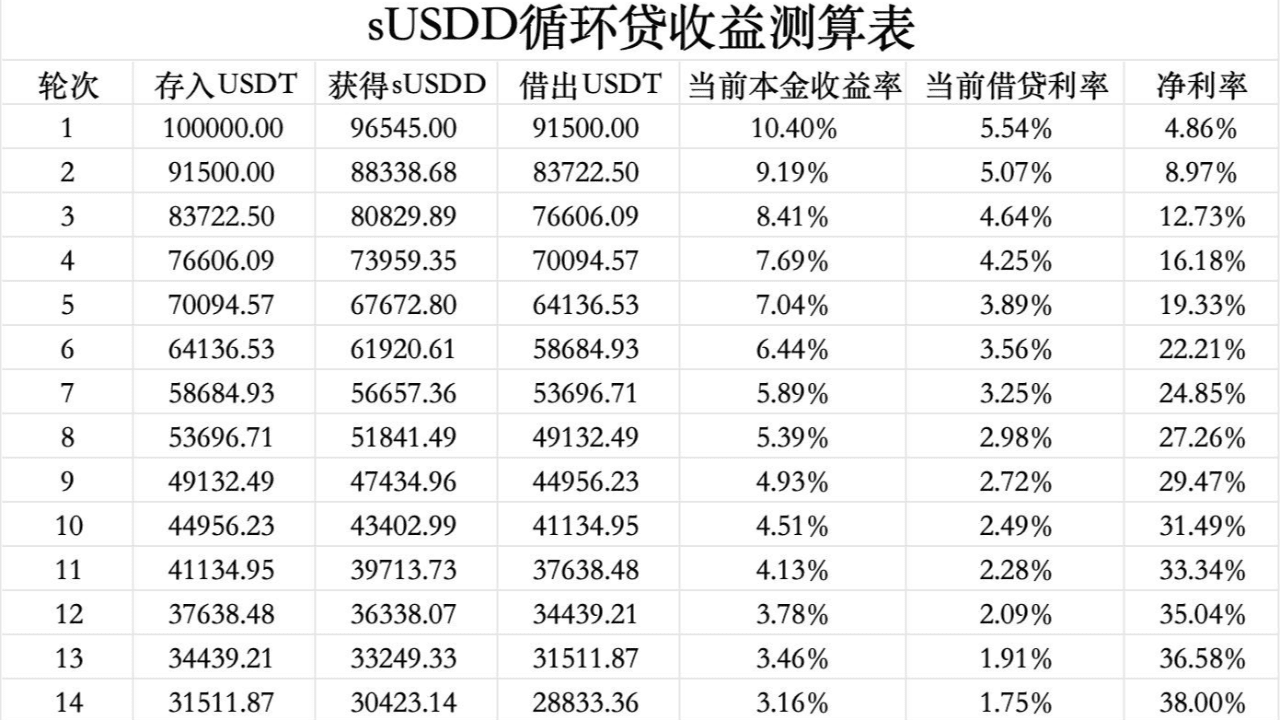
Binance Wallet sUSDD can achieve Circular Lending with 45% APY
Today I saw a tweet from the official USDD account, stating that the lending market for sUSDD/USDT has launched on Morpho. My first reaction was, isn't that invincible? Because this means that circular lending is possible.
Because depositing USDD into the official protocol yields sUSDD, and sUSDD does not need to be kept in a wallet to earn interest, it means that sUSDD can be deposited again to borrow USDT on Morpho, and USDT can again be exchanged for USDD at a 1:1 ratio without any loss, obtaining sUSDD again and again, compounding interest. This is circular lending.
Quickly, I went to check, and the current interest rate for depositing USDD in the Binance wallet activity is 10.4%. This includes an 8% fixed interest rate and a 2.4% reward interest rate, which is quite substantial.
0xMoon
·
--
Solv Protocol investment analysis/price prediction
Basic introduction about Solv
Solv Protocol is an on-chain DEFI ecosystem that, in addition to supporting Bitcoin staking, also has innovative financial NFTs and innovative features that allow users to create digital bonds.
SOLV PROTOCOL
About my understanding
I actually think that Solv Protocol is a brand new DEFI solution. In addition to amplifying Bitcoin liquidity and availability, it also promotes on-chain liquidity. Financial NFTs represent investment shares, bonds, or other financial instruments in the form of vNFTs, which enhances asset liquidity and trading flexibility. The financial instruments provided include user-creatable digital bonds and token locking tools, which greatly promote the development of on-chain liquidity and finance.
0xMoon
·
--
Solv Protocol investment analysis/price prediction
Basic introduction about Solv
Solv Protocol is an on-chain DEFI ecosystem that, in addition to supporting Bitcoin staking, also has innovative financial NFTs and innovative features that allow users to create digital bonds.
SOLV PROTOCOL
About my understanding
I actually think that Solv Protocol is a brand new DEFI solution. In addition to amplifying Bitcoin liquidity and availability, it also promotes on-chain liquidity. Financial NFTs represent investment shares, bonds, or other financial instruments in the form of vNFTs, which enhances asset liquidity and trading flexibility. The financial instruments provided include user-creatable digital bonds and token locking tools, which greatly promote the development of on-chain liquidity and finance.
Solv Protocol is an on-chain DEFI ecosystem that, in addition to supporting Bitcoin staking, also has innovative financial NFTs and innovative features that allow users to create digital bonds.
SOLV PROTOCOL
About my understanding
I actually think that Solv Protocol is a brand new DEFI solution. In addition to amplifying Bitcoin liquidity and availability, it also promotes on-chain liquidity. Financial NFTs represent investment shares, bonds, or other financial instruments in the form of vNFTs, which enhances asset liquidity and trading flexibility. The financial instruments provided include user-creatable digital bonds and token locking tools, which greatly promote the development of on-chain liquidity and finance.
Log in to explore more content