

precisox
9 Posts

precisox
 Square Verified
Report
Block User
Construyo sistemas trading
5 Following
24 Followers
13 Liked
Posts
·
--
Things you should have done in 2016:
- Buy Bitcoin and not sell at the first scare
- Buy Nvidia and hold on to it
- Learn to code before it was trendy
- Open a brokerage account
- Save something, even if it hurt
- Post videos when nobody was watching
Things you should be doing in 2026:
- Use AI to get work done, not to waste the afternoon
- Learn a skill people will pay for: coding, video, sales, data
- Show what you do, briefly, until people know you
- Learn English
- Contribute every month, without looking for a big win
- Sleep and work out as if they were part of the plan
- Talk to real people, not just followers
- Let the company pay for the company's tools
- Build something of your own, even if it's small
- Write down what you know while it's still yours
In 2032, you'll have two phrases.
“I'm so glad I started.”
Or “I wish I had done it.”
You can still choose today.
101
·
--
I’ll show you how to set up an agent to track your net worth for you this weekend.
You won’t write a single line of code.
Step 1: Create a new agent in Grok, Bot, or any AI agent and call it Net Worth.
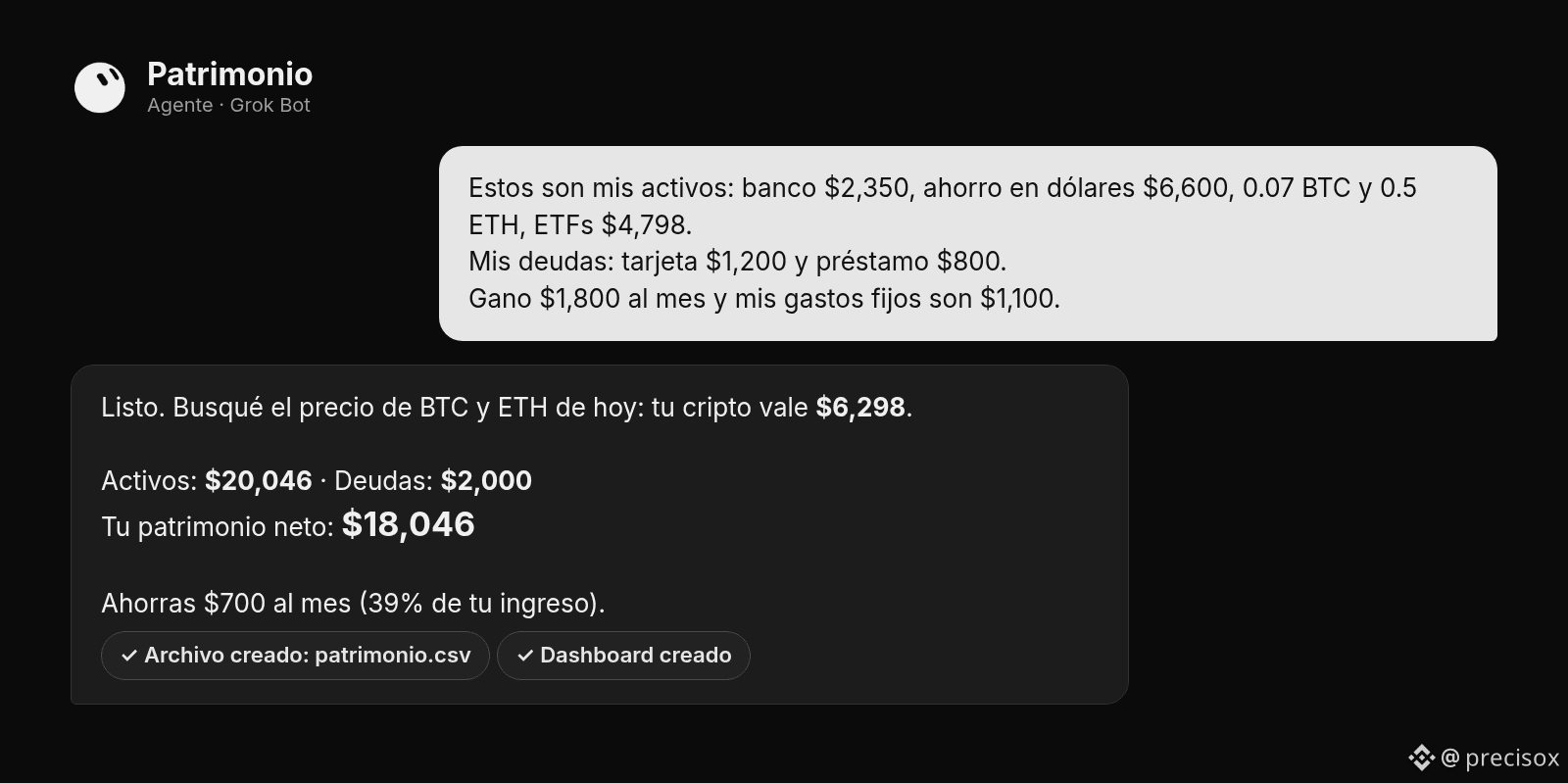
Step 2: Give it your financial snapshot for today
"Here are my assets: bank account, dollar savings, crypto, stocks, or ETFs.
Here are my debts: credit cards, loans, installments.
I earn X per month and my fixed expenses are Y."
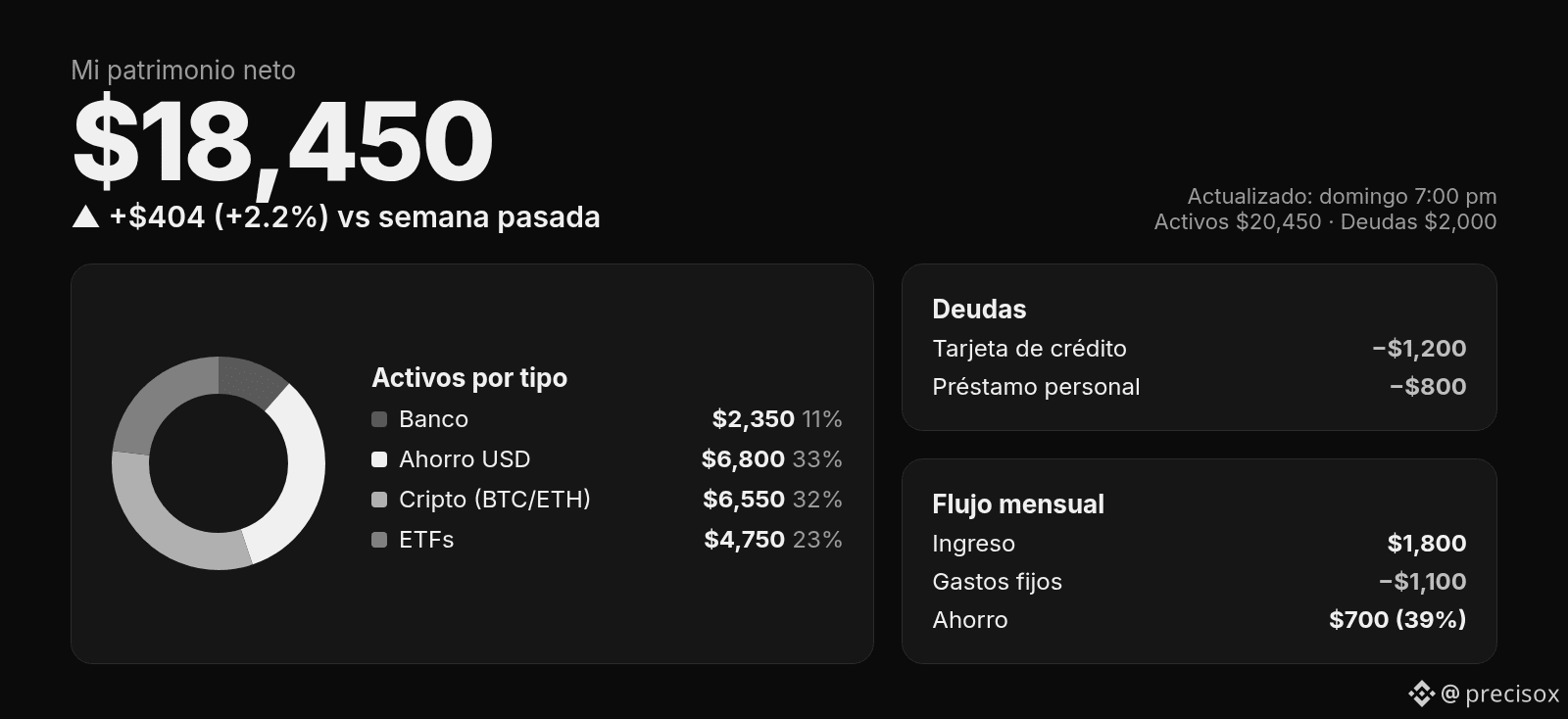
Step 3: Ask it to build the foundation
"Create a file with all my assets and debts. Calculate my net worth in dollars and build me a dashboard showing the total, breakdown by asset type, and my monthly cash flow."
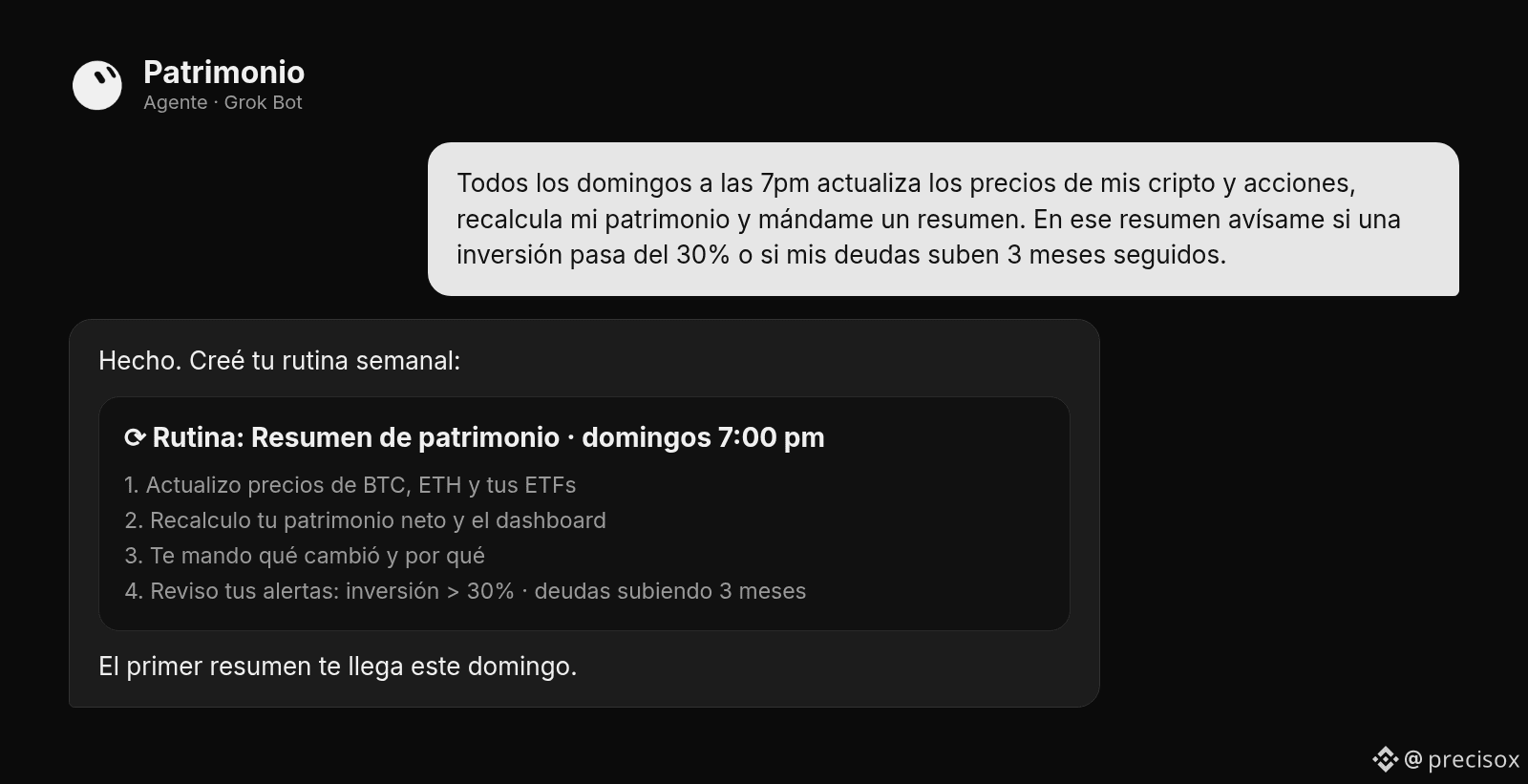
Step 4: Have it update automatically
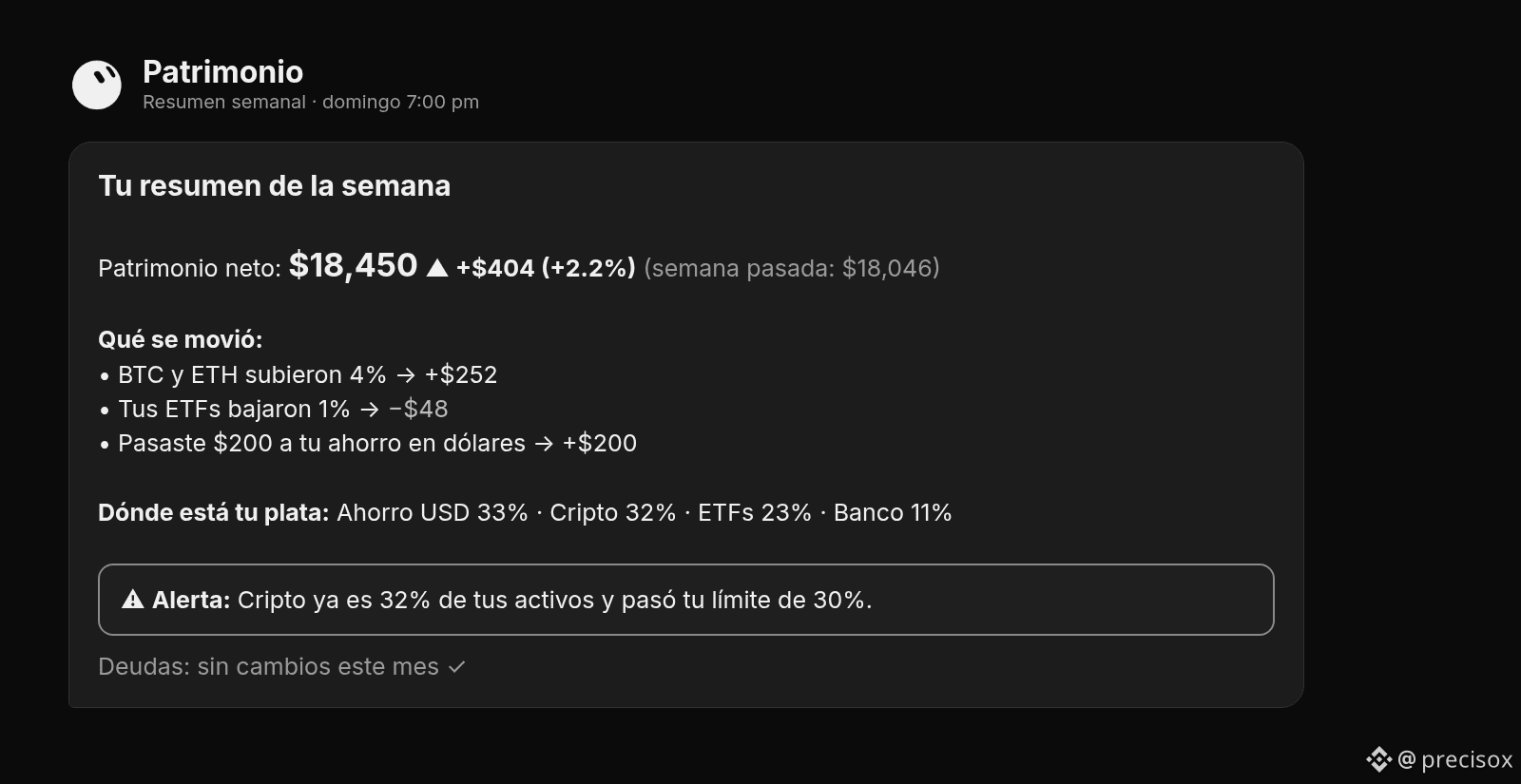
"Every Sunday at 7 p.m., update the prices of my crypto and stocks, recalculate my net worth, and send me a summary: how much it went up or down, why, and what percentage of my money is in each thing."
Step 5: Whenever something changes, tell it.
"I paid off my credit card." "I bought 0.01 BTC." "I got a raise."
It updates everything.
Step 6: Set up alerts
"In each Sunday’s summary, let me know if an investment exceeds 30% of my assets or if my debts increase for 3 months in a row."
You don’t give anyone your bank password.
You enter the data yourself.
After 3 months, you’ll see something your banking app never shows you: whether you’re actually getting richer or just moving money from one place to another.
Save this and set it up this weekend.
2
1.1k
·
--
10 finance projects to build this weekend (in increasing order of complexity):
1. Net worth tracker
Assets, debts, and monthly cash flow in a single dashboard.
2. Dividend projection tool
How much you’ll receive in 5, 10, or 20 years if you reinvest.
3. Budget vs. reality
Import your bank CSV and see where your money went.
4. Bond calculator
Yield to maturity, duration, and convexity, with charts.
5. Insider radar
What executives are buying and what the stock did afterward.
6. ETF overlap detector
You think you’re diversified. You own Apple three times over.
7. Corporate spread monitor
Corporate bonds vs. Treasuries. You can see market fear here before it shows up in prices.
8. Buyback analyzer
How much of EPS growth comes from the business and how much from buybacks.
9. IPO tracker
When the lock-up ends, when analysts start covering it, and how it performs afterward.
10. 13F fund clone
Copy a hedge fund’s portfolio, backtest it, and compare it against the S\u0026P.
Pick one and ask AI to guide you step by step on your computer.
Save it for the weekend.
Good luck!
1.5k
·
--
This week in the markets:
> Binance gets hacked and more than $5 billion is stolen
> probably the biggest crypto heist in history
> Google drops 12% in one day
> Amazon and Intel in the red
> the Nasdaq falls 1.4%
> Kyiv keeps getting bombed
> Polymarket gets hacked through a provider
> 5 days until the midterm elections
> your timeline is full of people panic-selling
> you expect Bitcoin to crash
> Bitcoin falls 4%
> and is still at $77k
Billions are stolen from the world's largest exchange, and bitcoin falls less than Google did after its earnings.
I don't know if it'll go up or down tomorrow.
But that tells you something about the market.
1
2
2.7k
·
--
AI trading in 2026.
Do yourself a favor.
- Learn to read a chart before using a bot
- Understand what a perp is and how funding works
- Learn risk management before strategies
- Define how much you’ll lose per trade, in numbers
- Keep a journal of every trade
- Learn just enough Python to read data
- Connect an exchange API, read-only first
- Get real historical data
- Backtest, and be skeptical of the results
- Include fees and slippage in the backtest
- Use an LLM to summarize news, not predict prices
- Set up alerts, not automated orders
- Move on to paper trading
- Then use a little real money
- Automate just one thing
- Set a stop the bot can’t bypass
- Review the logs every week
- Measure drawdown, not just profits
- Keep your collateral where you’re going to trade
- Turn off the bot when the market changes
- Go back to your journal
Stop looking for the bot that will make you rich.
Build the system that keeps you from losing too much.
Save this.
1
1
3
5.1k
·
--
Your strategy isn’t working.
Your backtest lied to you.
Before putting money into a strategy, run it through an AI agent with these 7 rules:
1. Turn on commissions and slippage. Without them, every backtest looks profitable.
2. Optimize on 2/3 of the historical data and validate on the final third. If it only works on the data you optimized it on, it’s overfit.
3. At least 100 trades. With 15 trades, you’re just lucky.
4. Maximum drawdown of 20%. If it wipes out your account before it makes money, it’s no good.
5. Profit factor above 1.1. Below that, the market will eat you alive.
6. It has to beat buy and hold. If not, you’re better off buying and sleeping easy.
7. 3 months of forward testing with no money on the line. That’s where most strategies die.
AI can build and test hundreds of strategies while you work.
But you’re the one who sets the rules.
Here’s the prompt:


4
3.2k
·
--
Bullish
Verified
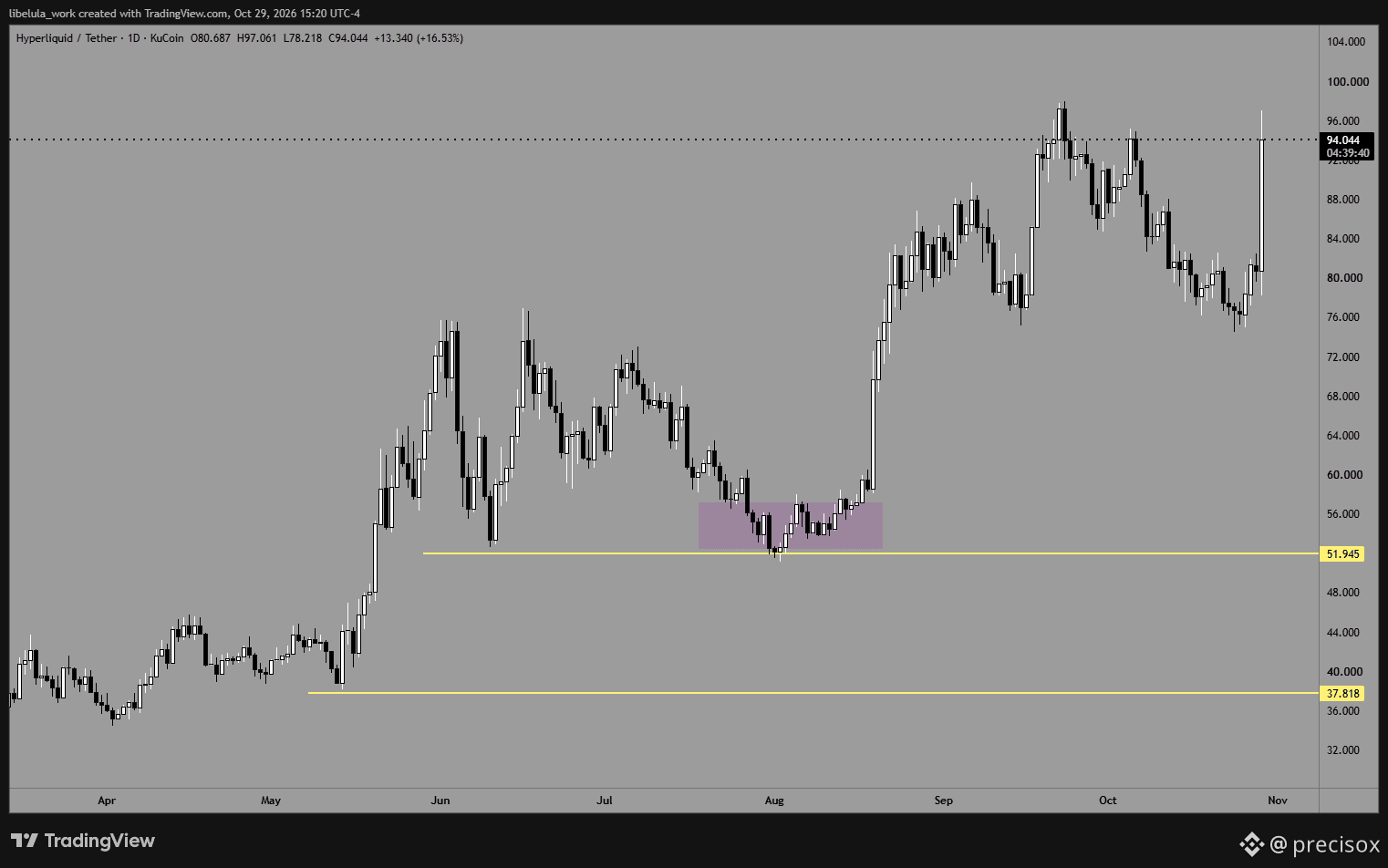
> 1792, the New York Stock Exchange is born
> opens at 9:30, closes at 4
> 230 years later, it’s still the same
> crypto invents 24/7 markets
> Wall Street says it’s a casino
> Hyperliquid arrives
> people start trading Nvidia, gold, and oil on a Sunday at 10 at night
> Wall Street is still closed on weekends
> October 2026, ICE, the owner of the NYSE, moderates a Hyperliquid panel at TOKEN2049
> 3 weeks later, ICE partners with trade(xyz) to bring those perpetuals to the United States
> Stan Druckenmiller comes in as an investor
> the same one who broke the pound in 1992
> the same one who bought Nvidia before the boom
> says he’s going to use it in his investment process
THE CRYPTO CASINO ENDED UP BEING THE FUTURE OF WALL STREET.
$HYPE
1
2
853
Log in to explore more content
Join global crypto users on Binance Square
⚡️ Get latest and useful information about crypto.
💬 Trusted by the world’s largest crypto exchange.
👍 Discover real insights from verified creators.
Email / Phone number
Trending Topics
UniswapA16zSeekDeFiExemptionFromIllinoisCryptoTax
24,328 views
749 Discussing
#CryptoTax 🚨 CRYPTO MARKET & REGULATORY UPDATE #HKDollarStablecoinHKDAPToLaunchOnSolana
#uniswapa16zseekdefiexemptionfromillinoiscryptotax UNISWAP, a16z & DeFi Education Fund Challenge Illinois Crypto Tax Rules
October 30, 2026 | Market Volatility & Industry Developments
📊 1. MARKET SNAPSHOT
Crypto markets are showing mixed signals, with selected assets posting sharp gains while several major cryptocurrencies remain under pressure.
📈 Top reported gainers
SOPH: +60.81% — $0.00238
BEAMX: +37.94% — $0.004701
SKDDB: +16.81% — $9.38
📉 Notable reported losers
INTWUSDT: −61.09% — $6.72
AKEUSDT: −31.47% — $0.013989
SNXXUSDT: −30.71% — $6.43
🔎 Major crypto assets under pressure
DOGE: −5.06%
PEPE: −4.91%
SUI: −4.83%
NEAR: −3.28%
XRP: −3.13%
Uniswap Labs, Andreessen Horowitz (a16z), and the DeFi Education Fund (DEF) are pushing for exemptions from Illinois’
#Uniswap #a16z #DeFi #CryptoRegulation #Illinois # #Web3 #BinanceSquare
#HKDollarStablecoinHKDAPToLaunchOnSolana #HKDAP #Stablecoin #CryptoNews #Blockchain #DeFi #DigitalPayments
⚖️ 3. UNISWAP, a16z & ILLINOIS CRYPTO TAX RULES
Uniswap Labs, Andreessen Horowitz (a16z), and the DeFi Education Fund are associated with efforts to seek exemptions proposed Illinois crypto tax requirements.
The debate highlights a key question: How should tax-reporting obligations apply to decentralized that may not operate like traditional financial intermediaries?
The outcome could influence DeFi compliance, developer obligations, and the future regulatory environment.
#BinanceSquare #CryptoNews #HKDAP #Stablecoin #Uniswap #a16z #DeFi #CryptoTax
CHASEPA SULUXù
·2 Likes
·185 views
HKDollarStablecoinHKDAPToLaunchOnSolana
18,721 views
471 Discussing
$1.5BInLeveragedCryptoBetsLiquidated
39,999 views
245 Discussing