

Orppa
43 Posts

Orppa
Report
Block User
3 Following
7 Followers
28 Liked
Posts
PINNED
·
--
The more I look at TermMax, the more I think its biggest challenge isn't creating markets.
it's making sure those markets actually matter.
TermMax can create a market around an asset with its own:
— collateral
— oracle
— LTV parameters
— maturity
— rate
that's powerful because a new asset doesn't have to wait for a large lending protocol to support it.
but there's a trade-off i don't see discussed enough.
creating a market is easy compared with creating two-sided demand.
you need borrowers who actually want that specific maturity and financing cost.
you need lenders willing to take the other side.
and you need enough activity for the market to remain useful after the initial liquidity arrives.
otherwise you can end up with something that looks impressive on a dashboard but doesn't generate much economic activity.
that's also why i think TermMax's fee model is worth watching.
if protocol revenue mainly comes from actual market activity rather than simply having capital deposited, then TVL alone becomes a weak measure of success.
i'd rather see:
capital → borrowing → trading → repayment → fees
happening repeatedly.
because that's the difference between a protocol that has liquidity and a protocol that actually has a business.
and this creates an interesting test for TermMax:
can permissionless market creation producemore useful markets—
or justmore markets?
i think that question will tell us much more about TermMax's long-term potential than another TVL screenshot.
#termmax @termmax
The more I look at TermMax, the more I think its biggest challenge isn't creating markets.
it's making sure those markets actually matter.
TermMax can create a market around an asset with its own:
— collateral
— oracle
— LTV parameters
— maturity
— rate
that's powerful because a new asset doesn't have to wait for a large lending protocol to support it.
but there's a trade-off i don't see discussed enough.
creating a market is easy compared with creating two-sided demand.
you need borrowers who actually want that specific maturity and financing cost.
you need lenders willing to take the other side.
and you need enough activity for the market to remain useful after the initial liquidity arrives.
otherwise you can end up with something that looks impressive on a dashboard but doesn't generate much economic activity.
that's also why i think TermMax's fee model is worth watching.
if protocol revenue mainly comes from actual market activity rather than simply having capital deposited, then TVL alone becomes a weak measure of success.
i'd rather see:
capital → borrowing → trading → repayment → fees
happening repeatedly.
because that's the difference between a protocol that has liquidity and a protocol that actually has a business.
and this creates an interesting test for TermMax:
can permissionless market creation producemore useful markets—
or justmore markets?
i think that question will tell us much more about TermMax's long-term potential than another TVL screenshot.
#termmax @TermMax
it's making sure those markets actually matter.
TermMax can create a market around an asset with its own:
— collateral
— oracle
— LTV parameters
— maturity
— rate
that's powerful because a new asset doesn't have to wait for a large lending protocol to support it.
but there's a trade-off i don't see discussed enough.
creating a market is easy compared with creating two-sided demand.
you need borrowers who actually want that specific maturity and financing cost.
you need lenders willing to take the other side.
and you need enough activity for the market to remain useful after the initial liquidity arrives.
otherwise you can end up with something that looks impressive on a dashboard but doesn't generate much economic activity.
that's also why i think TermMax's fee model is worth watching.
if protocol revenue mainly comes from actual market activity rather than simply having capital deposited, then TVL alone becomes a weak measure of success.
i'd rather see:
capital → borrowing → trading → repayment → fees
happening repeatedly.
because that's the difference between a protocol that has liquidity and a protocol that actually has a business.
and this creates an interesting test for TermMax:
can permissionless market creation producemore useful markets—
or justmore markets?
i think that question will tell us much more about TermMax's long-term potential than another TVL screenshot.
#termmax @TermMax

6
9
72
PINNED
·
--
I stopped looking at TermMax's TVL for a moment and asked a different question:
what actually makes the protocol money?
the answer is more interesting than i expected.
current data shows roughly $31M TVL and almost $28M in active loans.
but the part that caught my attention was the fee breakdown.
liquidation fees are tiny compared with normal protocol fees.
that tells me something important.
TermMax's economics don't appear to depend mainly on users getting liquidated.
the business is much more dependent on people actually using the markets.
borrowing.
lending.
opening positions.
moving capital through the system.
that's a healthier model in theory.
but it creates a different risk.
if activity falls sharply, the protocol doesn't have a huge liquidation-fee engine sitting underneath the business to compensate for weaker organic usage.
so i started thinking about TermMax's growth differently.
TVL tells me how much capital is sitting there.
active loans tell me how much capital is actually being used.
fees tell me whether that usage is producing an economic engine.
and those are three very different numbers.
the interesting test for TermMax isn't whether it can attract capital.
it's whether that capital keeps generating enough real activity after the incentives and attention around TMX fade.
because a protocol can have impressive TVL and still have a weak economic flywheel.
for me, that's the metric worth watching next:
how much sustainable fee activity can TermMax generate for every dollar of capital it attracts?
if that number keeps improving, the TVL starts meaning something very different.
#termmax @termmax
I stopped looking at TermMax's TVL for a moment and asked a different question:
what actually makes the protocol money?
the answer is more interesting than i expected.
current data shows roughly $31M TVL and almost $28M in active loans.
but the part that caught my attention was the fee breakdown.
liquidation fees are tiny compared with normal protocol fees.
that tells me something important.
TermMax's economics don't appear to depend mainly on users getting liquidated.
the business is much more dependent on people actually using the markets.
borrowing.
lending.
opening positions.
moving capital through the system.
that's a healthier model in theory.
but it creates a different risk.
if activity falls sharply, the protocol doesn't have a huge liquidation-fee engine sitting underneath the business to compensate for weaker organic usage.
so i started thinking about TermMax's growth differently.
TVL tells me how much capital is sitting there.
active loans tell me how much capital is actually being used.
fees tell me whether that usage is producing an economic engine.
and those are three very different numbers.
the interesting test for TermMax isn't whether it can attract capital.
it's whether that capital keeps generating enough real activity after the incentives and attention around TMX fade.
because a protocol can have impressive TVL and still have a weak economic flywheel.
for me, that's the metric worth watching next:
how much sustainable fee activity can TermMax generate for every dollar of capital it attracts?
if that number keeps improving, the TVL starts meaning something very different.
#termmax @TermMax
what actually makes the protocol money?
the answer is more interesting than i expected.
current data shows roughly $31M TVL and almost $28M in active loans.
but the part that caught my attention was the fee breakdown.
liquidation fees are tiny compared with normal protocol fees.
that tells me something important.
TermMax's economics don't appear to depend mainly on users getting liquidated.
the business is much more dependent on people actually using the markets.
borrowing.
lending.
opening positions.
moving capital through the system.
that's a healthier model in theory.
but it creates a different risk.
if activity falls sharply, the protocol doesn't have a huge liquidation-fee engine sitting underneath the business to compensate for weaker organic usage.
so i started thinking about TermMax's growth differently.
TVL tells me how much capital is sitting there.
active loans tell me how much capital is actually being used.
fees tell me whether that usage is producing an economic engine.
and those are three very different numbers.
the interesting test for TermMax isn't whether it can attract capital.
it's whether that capital keeps generating enough real activity after the incentives and attention around TMX fade.
because a protocol can have impressive TVL and still have a weak economic flywheel.
for me, that's the metric worth watching next:
how much sustainable fee activity can TermMax generate for every dollar of capital it attracts?
if that number keeps improving, the TVL starts meaning something very different.
#termmax @TermMax

10
11
78
·
--
#termmax @termmax
I've been thinking about what happens before an asset becomes important enough for a traditional DeFi market.
usually there's a gap. a new token appears. people want to borrow it. lenders want yield.
but nobody wants to be the first protocol to take the risk. so the market stays small.
That's why @termmax Alpha Zone caught my attention.
the interesting part isn't simply that it creates more markets.
it's that the market itself can be created with its own assumptions.
An asset, A debt token, An oracle, A maturity, An L-LTV.
those parameters effectively define the rules of the experiment.
and that creates a different path for new assets.
instead of waiting for a large lending protocol to decide:
“this asset is mature enough.”
a permissionless market can let the market discover whether there is actually demand for it.
but there's an uncomfortable side to that idea. Permissionless doesn't mean riskless.
if someone creates a market for a highly volatile or thinly traded asset, the parameters become incredibly important.
Set the risk too aggressively and lenders may be exposed to losses. Set it too conservatively and nobody uses the market.
so Alpha Zone isn't just a marketplace. It's almost a risk-pricing laboratory.
Different assets can arrive with different maturities, collateral assumptions and risk premiums.
The market then has to answer the question:
“what return is enough compensation for taking this risk?”
that's a much more interesting use case to me than simply adding another lending pair.
because if it works, TermMax could become a place where emerging assets discover their first real credit market before they become mainstream collateral.
and if it doesn't work, the failure mode will be equally interesting:
how much risk will permissionless market creation actually push onto lenders?
that's the experiment i'll be watching.
#termmax @TermMax
I've been thinking about what happens before an asset becomes important enough for a traditional DeFi market.
usually there's a gap. a new token appears. people want to borrow it. lenders want yield.
but nobody wants to be the first protocol to take the risk. so the market stays small.
That's why @TermMax Alpha Zone caught my attention.
the interesting part isn't simply that it creates more markets.
it's that the market itself can be created with its own assumptions.
An asset, A debt token, An oracle, A maturity, An L-LTV.
those parameters effectively define the rules of the experiment.
and that creates a different path for new assets.
instead of waiting for a large lending protocol to decide:
“this asset is mature enough.”
a permissionless market can let the market discover whether there is actually demand for it.
but there's an uncomfortable side to that idea. Permissionless doesn't mean riskless.
if someone creates a market for a highly volatile or thinly traded asset, the parameters become incredibly important.
Set the risk too aggressively and lenders may be exposed to losses. Set it too conservatively and nobody uses the market.
so Alpha Zone isn't just a marketplace. It's almost a risk-pricing laboratory.
Different assets can arrive with different maturities, collateral assumptions and risk premiums.
The market then has to answer the question:
“what return is enough compensation for taking this risk?”
that's a much more interesting use case to me than simply adding another lending pair.
because if it works, TermMax could become a place where emerging assets discover their first real credit market before they become mainstream collateral.
and if it doesn't work, the failure mode will be equally interesting:
how much risk will permissionless market creation actually push onto lenders?
that's the experiment i'll be watching.
I've been thinking about what happens before an asset becomes important enough for a traditional DeFi market.
usually there's a gap. a new token appears. people want to borrow it. lenders want yield.
but nobody wants to be the first protocol to take the risk. so the market stays small.
That's why @TermMax Alpha Zone caught my attention.
the interesting part isn't simply that it creates more markets.
it's that the market itself can be created with its own assumptions.
An asset, A debt token, An oracle, A maturity, An L-LTV.
those parameters effectively define the rules of the experiment.
and that creates a different path for new assets.
instead of waiting for a large lending protocol to decide:
“this asset is mature enough.”
a permissionless market can let the market discover whether there is actually demand for it.
but there's an uncomfortable side to that idea. Permissionless doesn't mean riskless.
if someone creates a market for a highly volatile or thinly traded asset, the parameters become incredibly important.
Set the risk too aggressively and lenders may be exposed to losses. Set it too conservatively and nobody uses the market.
so Alpha Zone isn't just a marketplace. It's almost a risk-pricing laboratory.
Different assets can arrive with different maturities, collateral assumptions and risk premiums.
The market then has to answer the question:
“what return is enough compensation for taking this risk?”
that's a much more interesting use case to me than simply adding another lending pair.
because if it works, TermMax could become a place where emerging assets discover their first real credit market before they become mainstream collateral.
and if it doesn't work, the failure mode will be equally interesting:
how much risk will permissionless market creation actually push onto lenders?
that's the experiment i'll be watching.

1
1
86
·
--
Partly True
I've been trying to find the part of TermMax that i'm least comfortable with.
and i think i found it:
fixed-rate markets can make the product easier to understand while making the liquidity problem harder to ignore.
with floating-rate lending, liquidity is relatively continuous.
you can usually enter or leave a pool without having to care about one specific maturity date.
TermMax is different.
a fixed-term position has an endpoint.
that's great if you know exactly how long you want your capital deployed.
but what happens when your plan changes?
you might have a position that looks attractive at entry, but suddenly need the capital before maturity.
that's where the protocol's secondary mechanisms become extremely important.
TermMax has built features such as Smart Unwind to address this problem, but that doesn't make the underlying economic question disappear.
someone still needs to provide liquidity for the exit.
and that creates a trade-off i don't think enough people talk about:
rate certainty can come at the cost of liquidity flexibility.
there's another thing i'm watching.
TermMax's current activity is still heavily concentrated on Ethereum. DefiLlama currently shows roughly $34M TVL, with about $32M on Ethereum, while active loans are around $34M.
that's not necessarily a problem.
but it does mean i wouldn't confuse “multichain availability” with genuinely deep liquidity across every market.
and there's an even bigger question after that:
can TermMax maintain efficient pricing when markets become thin, volatile or highly fragmented across maturities and collateral types?
because fixed-rate infrastructure doesn't automatically create liquidity.
it has to be earned.
that's probably the biggest thing i'll be watching.
not whether TermMax can offer a fixed rate.
we already know it can.
the harder question is whether those fixed-rate markets can remain liquid, competitive and reliable when users actually need to exit.
that's the test i'd want to see.
#termmax @termmax
I've been trying to find the part of TermMax that i'm least comfortable with.
and i think i found it:
fixed-rate markets can make the product easier to understand while making the liquidity problem harder to ignore.
with floating-rate lending, liquidity is relatively continuous.
you can usually enter or leave a pool without having to care about one specific maturity date.
TermMax is different.
a fixed-term position has an endpoint.
that's great if you know exactly how long you want your capital deployed.
but what happens when your plan changes?
you might have a position that looks attractive at entry, but suddenly need the capital before maturity.
that's where the protocol's secondary mechanisms become extremely important.
TermMax has built features such as Smart Unwind to address this problem, but that doesn't make the underlying economic question disappear.
someone still needs to provide liquidity for the exit.
and that creates a trade-off i don't think enough people talk about:
rate certainty can come at the cost of liquidity flexibility.
there's another thing i'm watching.
TermMax's current activity is still heavily concentrated on Ethereum. DefiLlama currently shows roughly $34M TVL, with about $32M on Ethereum, while active loans are around $34M.
that's not necessarily a problem.
but it does mean i wouldn't confuse “multichain availability” with genuinely deep liquidity across every market.
and there's an even bigger question after that:
can TermMax maintain efficient pricing when markets become thin, volatile or highly fragmented across maturities and collateral types?
because fixed-rate infrastructure doesn't automatically create liquidity.
it has to be earned.
that's probably the biggest thing i'll be watching.
not whether TermMax can offer a fixed rate.
we already know it can.
the harder question is whether those fixed-rate markets can remain liquid, competitive and reliable when users actually need to exit.
that's the test i'd want to see.
#termmax @TermMax
and i think i found it:
fixed-rate markets can make the product easier to understand while making the liquidity problem harder to ignore.
with floating-rate lending, liquidity is relatively continuous.
you can usually enter or leave a pool without having to care about one specific maturity date.
TermMax is different.
a fixed-term position has an endpoint.
that's great if you know exactly how long you want your capital deployed.
but what happens when your plan changes?
you might have a position that looks attractive at entry, but suddenly need the capital before maturity.
that's where the protocol's secondary mechanisms become extremely important.
TermMax has built features such as Smart Unwind to address this problem, but that doesn't make the underlying economic question disappear.
someone still needs to provide liquidity for the exit.
and that creates a trade-off i don't think enough people talk about:
rate certainty can come at the cost of liquidity flexibility.
there's another thing i'm watching.
TermMax's current activity is still heavily concentrated on Ethereum. DefiLlama currently shows roughly $34M TVL, with about $32M on Ethereum, while active loans are around $34M.
that's not necessarily a problem.
but it does mean i wouldn't confuse “multichain availability” with genuinely deep liquidity across every market.
and there's an even bigger question after that:
can TermMax maintain efficient pricing when markets become thin, volatile or highly fragmented across maturities and collateral types?
because fixed-rate infrastructure doesn't automatically create liquidity.
it has to be earned.
that's probably the biggest thing i'll be watching.
not whether TermMax can offer a fixed rate.
we already know it can.
the harder question is whether those fixed-rate markets can remain liquid, competitive and reliable when users actually need to exit.
that's the test i'd want to see.
#termmax @TermMax

1
2
85
·
--
I think I initially misunderstood what makes TermMax interesting.
“Fixed-rate borrowing” sounds like a simple alternative to variable-rate lending. But the more I look at it, the bigger change seems to be when you know the cost of capital.
With a variable rate, the liability can change while the position is already open.
You might know how much you are borrowing, but you don't necessarily know what that financing will cost later.
TermMax approaches this differently by using fixed-rate, fixed-term positions.
That means two important inputs are known before the position starts:
the borrowing cost + the maturity.
For someone deploying capital, that changes the calculation.
Instead of building a strategy around an estimated future funding cost, you can evaluate the position against a defined financing expense.
But there is an important trade-off here that I don't see discussed enough.
Rate certainty doesn't remove risk.
It basically moves part of the uncertainty somewhere else.
If the term ends while the strategy still needs financing, rollover becomes important. And if market conditions change before maturity, the flexibility of a fixed-term position can matter just as much as the certainty of its rate.
So I don't think the real question is:
“Are fixed rates better than variable rates?”
It might be:
For which strategies is knowing the financing cost upfront worth giving up some flexibility?
That is where I think TermMax's fixed-rate infrastructure gets interesting.
#termmax @termmax
I think I initially misunderstood what makes TermMax interesting.
“Fixed-rate borrowing” sounds like a simple alternative to variable-rate lending. But the more I look at it, the bigger change seems to be when you know the cost of capital.
With a variable rate, the liability can change while the position is already open.
You might know how much you are borrowing, but you don't necessarily know what that financing will cost later.
TermMax approaches this differently by using fixed-rate, fixed-term positions.
That means two important inputs are known before the position starts:
the borrowing cost + the maturity.
For someone deploying capital, that changes the calculation.
Instead of building a strategy around an estimated future funding cost, you can evaluate the position against a defined financing expense.
But there is an important trade-off here that I don't see discussed enough.
Rate certainty doesn't remove risk.
It basically moves part of the uncertainty somewhere else.
If the term ends while the strategy still needs financing, rollover becomes important. And if market conditions change before maturity, the flexibility of a fixed-term position can matter just as much as the certainty of its rate.
So I don't think the real question is:
“Are fixed rates better than variable rates?”
It might be:
For which strategies is knowing the financing cost upfront worth giving up some flexibility?
That is where I think TermMax's fixed-rate infrastructure gets interesting.
#termmax @TermMax
“Fixed-rate borrowing” sounds like a simple alternative to variable-rate lending. But the more I look at it, the bigger change seems to be when you know the cost of capital.
With a variable rate, the liability can change while the position is already open.
You might know how much you are borrowing, but you don't necessarily know what that financing will cost later.
TermMax approaches this differently by using fixed-rate, fixed-term positions.
That means two important inputs are known before the position starts:
the borrowing cost + the maturity.
For someone deploying capital, that changes the calculation.
Instead of building a strategy around an estimated future funding cost, you can evaluate the position against a defined financing expense.
But there is an important trade-off here that I don't see discussed enough.
Rate certainty doesn't remove risk.
It basically moves part of the uncertainty somewhere else.
If the term ends while the strategy still needs financing, rollover becomes important. And if market conditions change before maturity, the flexibility of a fixed-term position can matter just as much as the certainty of its rate.
So I don't think the real question is:
“Are fixed rates better than variable rates?”
It might be:
For which strategies is knowing the financing cost upfront worth giving up some flexibility?
That is where I think TermMax's fixed-rate infrastructure gets interesting.
#termmax @TermMax

1
87
·
--
Join the binance new event pick and win.
win upto 1 bnb. try now
#BinancePickAndWin
https://www.binance.com/activity/pick-and-win/2026-football-challenge?ref=1254230398
Join the binance new event pick and win.
win upto 1 bnb. try now
#BinancePickAndWin
https://www.binance.com/activity/pick-and-win/2026-football-challenge?ref=1254230398
win upto 1 bnb. try now
#BinancePickAndWin
https://www.binance.com/activity/pick-and-win/2026-football-challenge?ref=1254230398
16
·
--
Join the binance new event pick and win.
win upto 1 bnb. try now
#BinancePickAndWin
https://www.binance.com/activity/pick-and-win/2026-football-challenge?ref=1254230398
Join the binance new event pick and win.
win upto 1 bnb. try now
#BinancePickAndWin
https://www.binance.com/activity/pick-and-win/2026-football-challenge?ref=1254230398
win upto 1 bnb. try now
#BinancePickAndWin
https://www.binance.com/activity/pick-and-win/2026-football-challenge?ref=1254230398
23
·
--
Join the binance new event pick and win.
win upto 1 bnb. try now
#BinancePickAndWin
https://www.binance.com/activity/pick-and-win/2026-football-challenge?ref=1254230398
Join the binance new event pick and win.
win upto 1 bnb. try now
#BinancePickAndWin
https://www.binance.com/activity/pick-and-win/2026-football-challenge?ref=1254230398
win upto 1 bnb. try now
#BinancePickAndWin
https://www.binance.com/activity/pick-and-win/2026-football-challenge?ref=1254230398
17
·
--
Join the binance new event pick and win.
win upto 1 bnb. try now
#BinancePickAndWin
https://www.binance.com/activity/pick-and-win/2026-football-challenge?ref=1254230398
Join the binance new event pick and win.
win upto 1 bnb. try now
#BinancePickAndWin
https://www.binance.com/activity/pick-and-win/2026-football-challenge?ref=1254230398
win upto 1 bnb. try now
#BinancePickAndWin
https://www.binance.com/activity/pick-and-win/2026-football-challenge?ref=1254230398
17
·
--
Join the binance new event pick and win.
win upto 1 bnb. try now
#BinancePickAndWin
https://www.binance.com/activity/pick-and-win/2026-football-challenge?ref=1254230398
Join the binance new event pick and win.
win upto 1 bnb. try now
#BinancePickAndWin
https://www.binance.com/activity/pick-and-win/2026-football-challenge?ref=1254230398
win upto 1 bnb. try now
#BinancePickAndWin
https://www.binance.com/activity/pick-and-win/2026-football-challenge?ref=1254230398
15
·
--
@grvt_io is one project I am checking out through the Binance Web3 Booster Campaign. I think it is worth looking into.
The main idea behind GRVT is to mix the fast trading experience people want with the benefit of Web3. You control your own assets, not a third party.
Some key things about GRVT:
* You keep your money with non-custodial trading.
* It is built for fast derivatives trading.
* GRVT wants to make decentralized trading easy to use.
* It is designed for trading but still uses Web3.
The current Binance Web3 campaign is a chance to try out the platform do tasks and see how everything works.
I am still learning about GRVT. It seems like they are trying to solve a real problem: making decentralized trading work, for regular traders. If they succeed GRVT could be a project to watch.
#grvt #BinanceSquareTalks @grvt_io
@grvt_io is one project I am checking out through the Binance Web3 Booster Campaign. I think it is worth looking into.
The main idea behind GRVT is to mix the fast trading experience people want with the benefit of Web3. You control your own assets, not a third party.
Some key things about GRVT:
* You keep your money with non-custodial trading.
* It is built for fast derivatives trading.
* GRVT wants to make decentralized trading easy to use.
* It is designed for trading but still uses Web3.
The current Binance Web3 campaign is a chance to try out the platform do tasks and see how everything works.
I am still learning about GRVT. It seems like they are trying to solve a real problem: making decentralized trading work, for regular traders. If they succeed GRVT could be a project to watch.
#grvt #BinanceSquareTalks @grvt_io
The main idea behind GRVT is to mix the fast trading experience people want with the benefit of Web3. You control your own assets, not a third party.
Some key things about GRVT:
* You keep your money with non-custodial trading.
* It is built for fast derivatives trading.
* GRVT wants to make decentralized trading easy to use.
* It is designed for trading but still uses Web3.
The current Binance Web3 campaign is a chance to try out the platform do tasks and see how everything works.
I am still learning about GRVT. It seems like they are trying to solve a real problem: making decentralized trading work, for regular traders. If they succeed GRVT could be a project to watch.
#grvt #BinanceSquareTalks @grvt_io
1
75
·
--
Join the binance new event pick and win.
win upto 1 bnb. try now
#BinancePickAndWin
https://www.binance.com/activity/pick-and-win/2026-football-challenge?ref=1254230398
Join the binance new event pick and win.
win upto 1 bnb. try now
#BinancePickAndWin
https://www.binance.com/activity/pick-and-win/2026-football-challenge?ref=1254230398
win upto 1 bnb. try now
#BinancePickAndWin
https://www.binance.com/activity/pick-and-win/2026-football-challenge?ref=1254230398
18
·
--
4.5M$ thats huge only for #BinanceTurns9 event. this is the best opportunity for user to grab the share of 4.5m reward poll.
4.5M$ thats huge only for #BinanceTurns9 event. this is the best opportunity for user to grab the share of 4.5m reward poll.

16
·
--
The Next Battle in Crypto Isn't CEX vs DEX — It's About User Experience.
For years, crypto users have debated one question:
"Should I trade on a centralized exchange or a decentralized one?"
But I think we're asking the wrong question.
The real competition today is who can provide the best trading experience without asking users to sacrifice ownership of their assets.
This is where projects like GRVT caught my attention.
Why many traders still choose centralized exchanges
Let's be honest.
Centralized exchanges are popular because they're:
✅ Fast
✅ Simple to use
✅ Packed with advanced trading tools
✅ Highly liquid
The downside?
You trust a third party with your assets.
We've all seen why that can be risky.
───
Why many traders hesitate to switch to DeFi
Decentralized trading solves the custody problem—but it often introduces new challenges:
• Complicated wallet interactions
• Slower user experience
• Learning curve for new users
• Different interfaces across protocols
For many newcomers, these obstacles are enough to keep them on centralized platforms.
───
GRVT's Vision
Instead of forcing traders to choose between convenience and ownership, GRVT is building toward a future where users can have both.
Its vision focuses on:
🔹 Self-custody
🔹 High-performance infrastructure
🔹 Privacy-conscious design
🔹 Web3-native trading
🔹 Professional trading tools
The idea isn't to replace every existing platform overnight—it's to reduce the friction that has slowed DeFi adoption.
───
Why This Matters
The next wave of crypto adoption probably won't happen because another blockchain launches.
It will happen when decentralized products become easy enough that users don't feel like they're making compromises.
If someone can enjoy a familiar trading experience while keeping control of their assets, that's a meaningful step forward for Web3.
───
👇 I'd love to hear your thoughts.
#grvt @grvt_io
The Next Battle in Crypto Isn't CEX vs DEX — It's About User Experience.
For years, crypto users have debated one question:
"Should I trade on a centralized exchange or a decentralized one?"
But I think we're asking the wrong question.
The real competition today is who can provide the best trading experience without asking users to sacrifice ownership of their assets.
This is where projects like GRVT caught my attention.
Why many traders still choose centralized exchanges
Let's be honest.
Centralized exchanges are popular because they're:
✅ Fast
✅ Simple to use
✅ Packed with advanced trading tools
✅ Highly liquid
The downside?
You trust a third party with your assets.
We've all seen why that can be risky.
───
Why many traders hesitate to switch to DeFi
Decentralized trading solves the custody problem—but it often introduces new challenges:
• Complicated wallet interactions
• Slower user experience
• Learning curve for new users
• Different interfaces across protocols
For many newcomers, these obstacles are enough to keep them on centralized platforms.
───
GRVT's Vision
Instead of forcing traders to choose between convenience and ownership, GRVT is building toward a future where users can have both.
Its vision focuses on:
🔹 Self-custody
🔹 High-performance infrastructure
🔹 Privacy-conscious design
🔹 Web3-native trading
🔹 Professional trading tools
The idea isn't to replace every existing platform overnight—it's to reduce the friction that has slowed DeFi adoption.
───
Why This Matters
The next wave of crypto adoption probably won't happen because another blockchain launches.
It will happen when decentralized products become easy enough that users don't feel like they're making compromises.
If someone can enjoy a familiar trading experience while keeping control of their assets, that's a meaningful step forward for Web3.
───
👇 I'd love to hear your thoughts.
#grvt @grvt_io
For years, crypto users have debated one question:
"Should I trade on a centralized exchange or a decentralized one?"
But I think we're asking the wrong question.
The real competition today is who can provide the best trading experience without asking users to sacrifice ownership of their assets.
This is where projects like GRVT caught my attention.
Why many traders still choose centralized exchanges
Let's be honest.
Centralized exchanges are popular because they're:
✅ Fast
✅ Simple to use
✅ Packed with advanced trading tools
✅ Highly liquid
The downside?
You trust a third party with your assets.
We've all seen why that can be risky.
───
Why many traders hesitate to switch to DeFi
Decentralized trading solves the custody problem—but it often introduces new challenges:
• Complicated wallet interactions
• Slower user experience
• Learning curve for new users
• Different interfaces across protocols
For many newcomers, these obstacles are enough to keep them on centralized platforms.
───
GRVT's Vision
Instead of forcing traders to choose between convenience and ownership, GRVT is building toward a future where users can have both.
Its vision focuses on:
🔹 Self-custody
🔹 High-performance infrastructure
🔹 Privacy-conscious design
🔹 Web3-native trading
🔹 Professional trading tools
The idea isn't to replace every existing platform overnight—it's to reduce the friction that has slowed DeFi adoption.
───
Why This Matters
The next wave of crypto adoption probably won't happen because another blockchain launches.
It will happen when decentralized products become easy enough that users don't feel like they're making compromises.
If someone can enjoy a familiar trading experience while keeping control of their assets, that's a meaningful step forward for Web3.
───
👇 I'd love to hear your thoughts.
#grvt @grvt_io

1
100
·
--
Join the binance new event pick and win.
win upto 1 bnb. try now
#BinancePickAndWin
https://www.binance.com/activity/pick-and-win/2026-football-challenge?ref=1254230398
Join the binance new event pick and win.
win upto 1 bnb. try now
#BinancePickAndWin
https://www.binance.com/activity/pick-and-win/2026-football-challenge?ref=1254230398
win upto 1 bnb. try now
#BinancePickAndWin
https://www.binance.com/activity/pick-and-win/2026-football-challenge?ref=1254230398
22
·
--
Join the binance new event pick and win.
win upto 1 bnb. try now
#BinancePickAndWin
https://www.binance.com/activity/pick-and-win/2026-football-challenge?ref=1254230398
Join the binance new event pick and win.
win upto 1 bnb. try now
#BinancePickAndWin
https://www.binance.com/activity/pick-and-win/2026-football-challenge?ref=1254230398
win upto 1 bnb. try now
#BinancePickAndWin
https://www.binance.com/activity/pick-and-win/2026-football-challenge?ref=1254230398
22
·
--
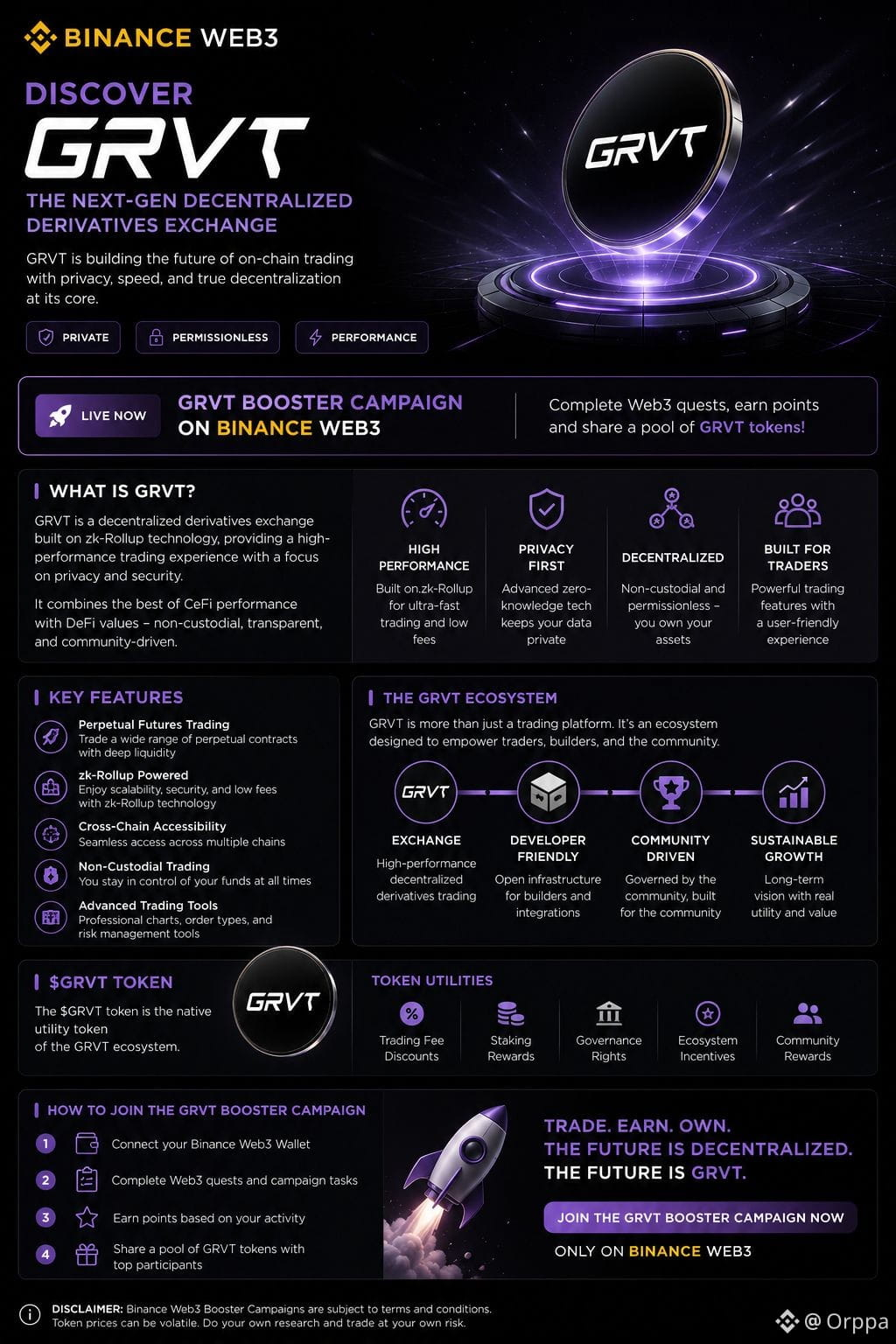
Discover GRVT – A New Generation of Decentralized Trading
The blockchain industry continues to evolve, and one project attracting attention is @grvt_io , a decentralized derivatives exchange designed to combine the performance of centralized exchanges with the transparency and security of decentralized finance.
Unlike traditional exchanges where users often give up custody of their assets, GRVT is focused on delivering a non-custodial trading experience, allowing traders to maintain greater control over their funds while benefiting from a modern trading platform.
🔹 What makes GRVT interesting?
✅ High-Performance Trading
GRVT aims to provide a fast and efficient trading experience capable of supporting active traders while reducing unnecessary friction.
✅ Privacy & Security
The project leverages advanced blockchain technologies to enhance user privacy and strengthen security without sacrificing usability.
✅ Decentralized Infrastructure
Built with decentralization in mind, GRVT is working toward an ecosystem where users can access professional trading tools without relying entirely on centralized custodians.
✅ Designed for Web3
GRVT embraces the principles of Web3 by giving users greater ownership of their digital assets while encouraging community participation and ecosystem growth.
🌐 GRVT on Binance Web3
The current GRVT Booster Campaign on Binance Web3 gives users an opportunity to explore the ecosystem through interactive quests. By completing eligible tasks, participants can earn campaign points and compete for a share of the available reward pool according to the campaign rules.
This campaign is also a great way for newcomers to experience Web3 wallets, decentralized applications, and the GRVT ecosystem in a simple, guided way.
💡 Why I'm following this project
I enjoy discovering projects that focus on improving the decentralized trading experience, and GRVT is one of the platforms I'm currently exploring.
As always, remember to do your own research (DYOR) before participating in any blockchain project or campaign.
#grvt @grvt_io
Discover GRVT – A New Generation of Decentralized Trading
The blockchain industry continues to evolve, and one project attracting attention is @grvt_io , a decentralized derivatives exchange designed to combine the performance of centralized exchanges with the transparency and security of decentralized finance.
Unlike traditional exchanges where users often give up custody of their assets, GRVT is focused on delivering a non-custodial trading experience, allowing traders to maintain greater control over their funds while benefiting from a modern trading platform.
🔹 What makes GRVT interesting?
✅ High-Performance Trading
GRVT aims to provide a fast and efficient trading experience capable of supporting active traders while reducing unnecessary friction.
✅ Privacy & Security
The project leverages advanced blockchain technologies to enhance user privacy and strengthen security without sacrificing usability.
✅ Decentralized Infrastructure
Built with decentralization in mind, GRVT is working toward an ecosystem where users can access professional trading tools without relying entirely on centralized custodians.
✅ Designed for Web3
GRVT embraces the principles of Web3 by giving users greater ownership of their digital assets while encouraging community participation and ecosystem growth.
🌐 GRVT on Binance Web3
The current GRVT Booster Campaign on Binance Web3 gives users an opportunity to explore the ecosystem through interactive quests. By completing eligible tasks, participants can earn campaign points and compete for a share of the available reward pool according to the campaign rules.
This campaign is also a great way for newcomers to experience Web3 wallets, decentralized applications, and the GRVT ecosystem in a simple, guided way.
💡 Why I'm following this project
I enjoy discovering projects that focus on improving the decentralized trading experience, and GRVT is one of the platforms I'm currently exploring.
As always, remember to do your own research (DYOR) before participating in any blockchain project or campaign.
#grvt @grvt_io
The blockchain industry continues to evolve, and one project attracting attention is @grvt_io , a decentralized derivatives exchange designed to combine the performance of centralized exchanges with the transparency and security of decentralized finance.
Unlike traditional exchanges where users often give up custody of their assets, GRVT is focused on delivering a non-custodial trading experience, allowing traders to maintain greater control over their funds while benefiting from a modern trading platform.
🔹 What makes GRVT interesting?
✅ High-Performance Trading
GRVT aims to provide a fast and efficient trading experience capable of supporting active traders while reducing unnecessary friction.
✅ Privacy & Security
The project leverages advanced blockchain technologies to enhance user privacy and strengthen security without sacrificing usability.
✅ Decentralized Infrastructure
Built with decentralization in mind, GRVT is working toward an ecosystem where users can access professional trading tools without relying entirely on centralized custodians.
✅ Designed for Web3
GRVT embraces the principles of Web3 by giving users greater ownership of their digital assets while encouraging community participation and ecosystem growth.
🌐 GRVT on Binance Web3
The current GRVT Booster Campaign on Binance Web3 gives users an opportunity to explore the ecosystem through interactive quests. By completing eligible tasks, participants can earn campaign points and compete for a share of the available reward pool according to the campaign rules.
This campaign is also a great way for newcomers to experience Web3 wallets, decentralized applications, and the GRVT ecosystem in a simple, guided way.
💡 Why I'm following this project
I enjoy discovering projects that focus on improving the decentralized trading experience, and GRVT is one of the platforms I'm currently exploring.
As always, remember to do your own research (DYOR) before participating in any blockchain project or campaign.
#grvt @grvt_io
73
·
--
Join the binance new event pick and win.
win upto 1 bnb. try now
#BinancePickAndWin
https://www.binance.com/activity/pick-and-win/2026-football-challenge?ref=1254230398
Join the binance new event pick and win.
win upto 1 bnb. try now
#BinancePickAndWin
https://www.binance.com/activity/pick-and-win/2026-football-challenge?ref=1254230398
win upto 1 bnb. try now
#BinancePickAndWin
https://www.binance.com/activity/pick-and-win/2026-football-challenge?ref=1254230398
13
·
--
The GRVT Booster Campaign has officially arrived on Binance Web3! 🚀
This is a great chance to explore the GRVT ecosystem while completing simple Web3 tasks and collecting valuable reward points. Whether you're a regular Binance Web3 user or just getting started, joining early could help you maximize your rewards before the campaign ends.
Don't miss the opportunity—connect your wallet, complete the missions, and start earning today!
#BinanceWeb3 #grvt @grvt_io
The GRVT Booster Campaign has officially arrived on Binance Web3! 🚀
This is a great chance to explore the GRVT ecosystem while completing simple Web3 tasks and collecting valuable reward points. Whether you're a regular Binance Web3 user or just getting started, joining early could help you maximize your rewards before the campaign ends.
Don't miss the opportunity—connect your wallet, complete the missions, and start earning today!
#BinanceWeb3 #grvt @grvt_io
This is a great chance to explore the GRVT ecosystem while completing simple Web3 tasks and collecting valuable reward points. Whether you're a regular Binance Web3 user or just getting started, joining early could help you maximize your rewards before the campaign ends.
Don't miss the opportunity—connect your wallet, complete the missions, and start earning today!
#BinanceWeb3 #grvt @grvt_io

1
85
·
--
Join the binance new event pick and win.
win upto 1 bnb. try now
#BinancePickAndWin
https://www.binance.com/activity/pick-and-win/2026-football-challenge?ref=1254230398
Join the binance new event pick and win.
win upto 1 bnb. try now
#BinancePickAndWin
https://www.binance.com/activity/pick-and-win/2026-football-challenge?ref=1254230398
win upto 1 bnb. try now
#BinancePickAndWin
https://www.binance.com/activity/pick-and-win/2026-football-challenge?ref=1254230398
12
Log in to explore more content
Join global crypto users on Binance Square
⚡️ Get latest and useful information about crypto.
💬 Trusted by the world’s largest crypto exchange.
👍 Discover real insights from verified creators.
Email / Phone number