
olga_web3
28 Posts

olga_web3
Report
Block User
2 Following
0 Followers
5 Liked
Posts
·
--
Buying shares no longer requires thinking in terms of the price of a whole share.
In the classic model, a high price per share can become a barrier for a smaller position.
In bStocks, tokenized representation makes it possible to gain fractional exposure to the corresponding share.
Binance sets a minimum threshold of $5 to access partial exposure.
For me, it’s not the $5 figure itself that matters, but the change in the unit of access: an investor can build a position with the capital they have available, rather than based on the cost of an entire share.
In this case, tokenization does not change the economics of the underlying asset, but the way digital access to it is provided.
#bStocks #FractionalInvesting #BinanceUkraine
Buying shares no longer requires thinking in terms of the price of a whole share.
In the classic model, a high price per share can become a barrier for a smaller position.
In bStocks, tokenized representation makes it possible to gain fractional exposure to the corresponding share.
Binance sets a minimum threshold of $5 to access partial exposure.
For me, it’s not the $5 figure itself that matters, but the change in the unit of access: an investor can build a position with the capital they have available, rather than based on the cost of an entire share.
In this case, tokenization does not change the economics of the underlying asset, but the way digital access to it is provided.
#bStocks #FractionalInvesting #BinanceUkraine
In the classic model, a high price per share can become a barrier for a smaller position.
In bStocks, tokenized representation makes it possible to gain fractional exposure to the corresponding share.
Binance sets a minimum threshold of $5 to access partial exposure.
For me, it’s not the $5 figure itself that matters, but the change in the unit of access: an investor can build a position with the capital they have available, rather than based on the cost of an entire share.
In this case, tokenization does not change the economics of the underlying asset, but the way digital access to it is provided.
#bStocks #FractionalInvesting #BinanceUkraine
94
·
--
Bullish
Tokenization isn’t just when a stock is simply «put into the blockchain».
For me, the main change begins after the financial asset receives a blockchain representation.
In a traditional system, an asset is tied to specific infrastructure.
In a tokenized model, its digital representation can acquire properties that previously didn’t exist in that form.
Transferability.
A token can be moved between compatible addresses and environments, if the asset’s terms allow it.
Composability.
A token can interact with other blockchain primitives—for example, DEXs, lending, or collateral mechanisms—if they support that specific asset.
Programmability.
Rules for interacting with the asset can be built directly into smart contracts.
This creates the opportunity to automate parts of financial operations.
So, for me, bStocks are interesting not because of the mere fact that shares appear on the blockchain.
The value is that the financial asset gains a new digital format for interaction—it can be moved, combined with other primitives, and used in programmable scenarios.
Tokenization changes not only where the asset is represented, but also what can be done with that representation.
$NVDAB #bStocks #Tokenization
Tokenization isn’t just when a stock is simply «put into the blockchain».
For me, the main change begins after the financial asset receives a blockchain representation.
In a traditional system, an asset is tied to specific infrastructure.
In a tokenized model, its digital representation can acquire properties that previously didn’t exist in that form.
Transferability.
A token can be moved between compatible addresses and environments, if the asset’s terms allow it.
Composability.
A token can interact with other blockchain primitives—for example, DEXs, lending, or collateral mechanisms—if they support that specific asset.
Programmability.
Rules for interacting with the asset can be built directly into smart contracts.
This creates the opportunity to automate parts of financial operations.
So, for me, bStocks are interesting not because of the mere fact that shares appear on the blockchain.
The value is that the financial asset gains a new digital format for interaction—it can be moved, combined with other primitives, and used in programmable scenarios.
Tokenization changes not only where the asset is represented, but also what can be done with that representation.
$NVDAB #bStocks #Tokenization
For me, the main change begins after the financial asset receives a blockchain representation.
In a traditional system, an asset is tied to specific infrastructure.
In a tokenized model, its digital representation can acquire properties that previously didn’t exist in that form.
Transferability.
A token can be moved between compatible addresses and environments, if the asset’s terms allow it.
Composability.
A token can interact with other blockchain primitives—for example, DEXs, lending, or collateral mechanisms—if they support that specific asset.
Programmability.
Rules for interacting with the asset can be built directly into smart contracts.
This creates the opportunity to automate parts of financial operations.
So, for me, bStocks are interesting not because of the mere fact that shares appear on the blockchain.
The value is that the financial asset gains a new digital format for interaction—it can be moved, combined with other primitives, and used in programmable scenarios.
Tokenization changes not only where the asset is represented, but also what can be done with that representation.
$NVDAB #bStocks #Tokenization
108
·
--
Hi everyone!
There’s an asset parameter that people often notice only when they want to do something with it. That’s custody.
After buying, I usually think about price, yield, or risk. But it’s equally important to understand where the asset actually is and who has control over access to it.
If the asset stays inside a broker or exchange system, its further use is limited by the capabilities of that infrastructure.
Tokenized assets work differently. For example, bStocks exist as BEP-20 tokens on BNB Smart Chain, so supported assets can be moved to a compatible Web3 environment.
From that point on, custody affects practical possibilities: you can store the asset in your own wallet, move it over the network, or use it in supported Web3 scenarios.
So for me, custody isn’t a technical detail after purchase. It’s part of the investment structure itself, determining how mobile and programmable the asset will be.
Price shows how much the asset costs. Custody determines what you can do with it next.
#bStocks #custody
Hi everyone!
There’s an asset parameter that people often notice only when they want to do something with it. That’s custody.
After buying, I usually think about price, yield, or risk. But it’s equally important to understand where the asset actually is and who has control over access to it.
If the asset stays inside a broker or exchange system, its further use is limited by the capabilities of that infrastructure.
Tokenized assets work differently. For example, bStocks exist as BEP-20 tokens on BNB Smart Chain, so supported assets can be moved to a compatible Web3 environment.
From that point on, custody affects practical possibilities: you can store the asset in your own wallet, move it over the network, or use it in supported Web3 scenarios.
So for me, custody isn’t a technical detail after purchase. It’s part of the investment structure itself, determining how mobile and programmable the asset will be.
Price shows how much the asset costs. Custody determines what you can do with it next.
#bStocks #custody
There’s an asset parameter that people often notice only when they want to do something with it. That’s custody.
After buying, I usually think about price, yield, or risk. But it’s equally important to understand where the asset actually is and who has control over access to it.
If the asset stays inside a broker or exchange system, its further use is limited by the capabilities of that infrastructure.
Tokenized assets work differently. For example, bStocks exist as BEP-20 tokens on BNB Smart Chain, so supported assets can be moved to a compatible Web3 environment.
From that point on, custody affects practical possibilities: you can store the asset in your own wallet, move it over the network, or use it in supported Web3 scenarios.
So for me, custody isn’t a technical detail after purchase. It’s part of the investment structure itself, determining how mobile and programmable the asset will be.
Price shows how much the asset costs. Custody determines what you can do with it next.
#bStocks #custody
1
79
·
--
Bullish
At what point does the exchange stop being the only place where your asset lives?
For a typical exchange balance, the answer is simple: the asset remains inside the platform, and access to it happens through your account and its infrastructure.
With bStocks, the model can be different.
A tokenized share is represented as a BEP-20 token on BNB Smart Chain, so with the product’s support you can withdraw it to a compatible Web3 wallet.
Here, it’s not only the storage location that changes.
On the exchange, I interact with the asset through the platform’s interface. In self-custody, I already control the wallet and access to the token myself. The exchange remains a place where you can buy and sell bStocks, but it stops being the only point of interaction with the asset.
This opens up other scenarios: keeping the token separately, moving it within a supported network, or using it in compatible Web3 protocols.
At the same time, freedom comes with a price: after moving to self-custody, responsibility for wallet security and keys is on the user.
That’s why I see the main difference like this: the exchange provides an environment for working with the asset, while self-custody allows you to decide where and how this asset is stored and used.
#bStocks #SelfCustody #BinanceUkraine
At what point does the exchange stop being the only place where your asset lives?
For a typical exchange balance, the answer is simple: the asset remains inside the platform, and access to it happens through your account and its infrastructure.
With bStocks, the model can be different.
A tokenized share is represented as a BEP-20 token on BNB Smart Chain, so with the product’s support you can withdraw it to a compatible Web3 wallet.
Here, it’s not only the storage location that changes.
On the exchange, I interact with the asset through the platform’s interface. In self-custody, I already control the wallet and access to the token myself. The exchange remains a place where you can buy and sell bStocks, but it stops being the only point of interaction with the asset.
This opens up other scenarios: keeping the token separately, moving it within a supported network, or using it in compatible Web3 protocols.
At the same time, freedom comes with a price: after moving to self-custody, responsibility for wallet security and keys is on the user.
That’s why I see the main difference like this: the exchange provides an environment for working with the asset, while self-custody allows you to decide where and how this asset is stored and used.
#bStocks #SelfCustody #BinanceUkraine
For a typical exchange balance, the answer is simple: the asset remains inside the platform, and access to it happens through your account and its infrastructure.
With bStocks, the model can be different.
A tokenized share is represented as a BEP-20 token on BNB Smart Chain, so with the product’s support you can withdraw it to a compatible Web3 wallet.
Here, it’s not only the storage location that changes.
On the exchange, I interact with the asset through the platform’s interface. In self-custody, I already control the wallet and access to the token myself. The exchange remains a place where you can buy and sell bStocks, but it stops being the only point of interaction with the asset.
This opens up other scenarios: keeping the token separately, moving it within a supported network, or using it in compatible Web3 protocols.
At the same time, freedom comes with a price: after moving to self-custody, responsibility for wallet security and keys is on the user.
That’s why I see the main difference like this: the exchange provides an environment for working with the asset, while self-custody allows you to decide where and how this asset is stored and used.
#bStocks #SelfCustody #BinanceUkraine
65
·
--
Good morning!
On the screen, it looks simple: I deposited assets into the Vault — and received shares.
But I got curious about what happens to this capital after the Deposit.
TermMax V2 Vault is built on ERC-4626, but the standard here is just the foundation. Next comes order management and priority-based queues for depositing and withdrawing funds.
This matters when the Vault interacts with different orders and markets. Capital needs not only to be accepted, but also properly allocated and returned to the user at the right moment.
There’s also a separate access-control layer. Role-based permissions determine who can perform specific administrative actions, and critical parameter changes go through a timelock.
So for me, TermMax Vault is interesting not for ERC-4626 itself.
What’s more interesting is that around the standard Vault, there’s an infrastructure that handles allocation, orders, queues, and change control.
The user sees Deposit.
Under it, a whole liquidity management system runs.
@termmax #TermMax
Good morning!
On the screen, it looks simple: I deposited assets into the Vault — and received shares.
But I got curious about what happens to this capital after the Deposit.
TermMax V2 Vault is built on ERC-4626, but the standard here is just the foundation. Next comes order management and priority-based queues for depositing and withdrawing funds.
This matters when the Vault interacts with different orders and markets. Capital needs not only to be accepted, but also properly allocated and returned to the user at the right moment.
There’s also a separate access-control layer. Role-based permissions determine who can perform specific administrative actions, and critical parameter changes go through a timelock.
So for me, TermMax Vault is interesting not for ERC-4626 itself.
What’s more interesting is that around the standard Vault, there’s an infrastructure that handles allocation, orders, queues, and change control.
The user sees Deposit.
Under it, a whole liquidity management system runs.
@TermMax #TermMax
On the screen, it looks simple: I deposited assets into the Vault — and received shares.
But I got curious about what happens to this capital after the Deposit.
TermMax V2 Vault is built on ERC-4626, but the standard here is just the foundation. Next comes order management and priority-based queues for depositing and withdrawing funds.
This matters when the Vault interacts with different orders and markets. Capital needs not only to be accepted, but also properly allocated and returned to the user at the right moment.
There’s also a separate access-control layer. Role-based permissions determine who can perform specific administrative actions, and critical parameter changes go through a timelock.
So for me, TermMax Vault is interesting not for ERC-4626 itself.
What’s more interesting is that around the standard Vault, there’s an infrastructure that handles allocation, orders, queues, and change control.
The user sees Deposit.
Under it, a whole liquidity management system runs.
@TermMax #TermMax
80
·
--
Bullish
Hi🫶
I was wondering about something that isn’t visible directly in the interface:
what does the Vault earn if the borrower hasn’t arrived yet?
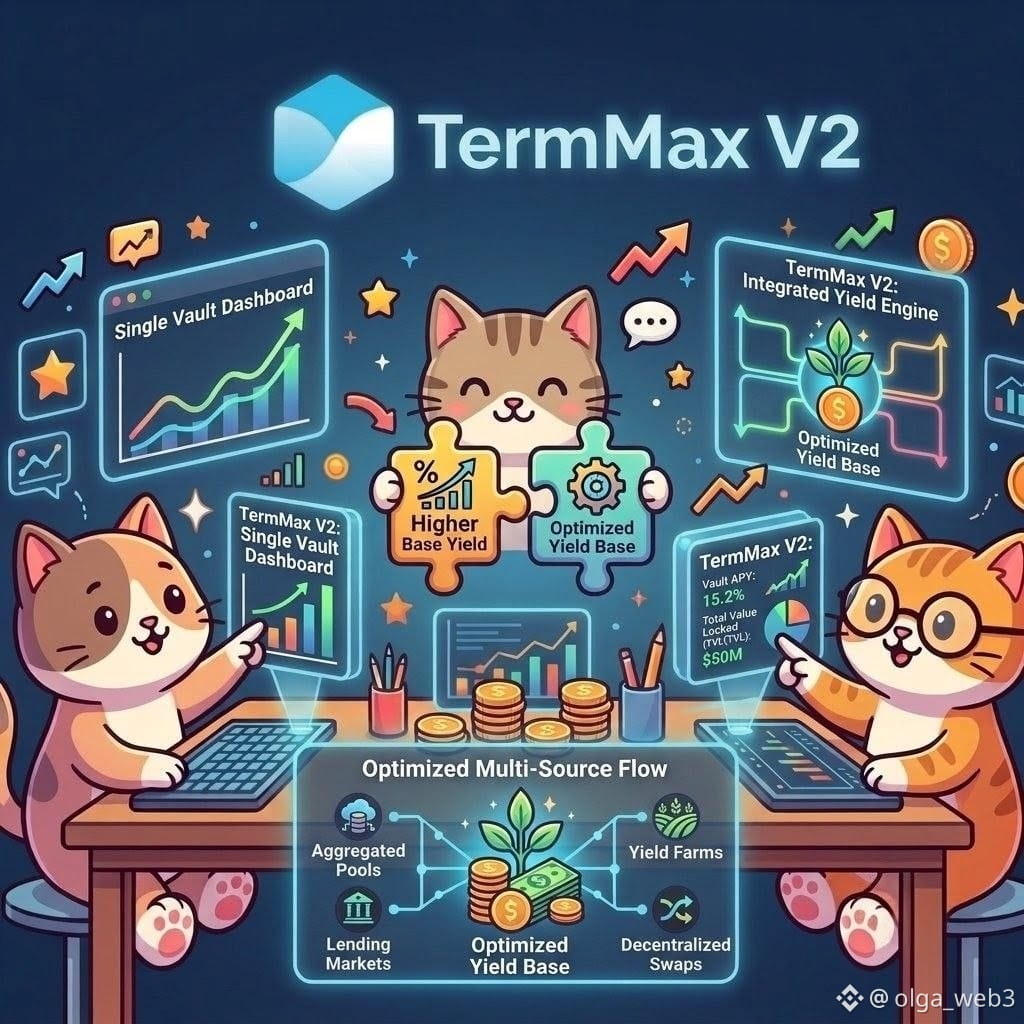
In TermMax V2, there’s a Composable Base Yield for this.
The logic is interesting: liquidity shouldn’t just sit and wait for its fixed-rate agreement. When the capital isn’t being used in the main market, it can be deployed in other DeFi strategies to generate base yield.
This is where an important difference from a typical lending pool comes in.
In a simplified way, the capital has two scenarios:
there is demand → fixed-rate lending
there is no demand → base yield
For the user, this means less dependence on how quickly the borrower shows up.
For the Vault itself—higher capital efficiency, because liquidity gets the ability to work even between fixed-rate agreements.
I like this idea for another reason as well.
Yield here isn’t tied to a single source. Base yield can be combined with other strategies, so the Vault architecture becomes more flexible.
As a result, TermMax V2 aims to solve not only the question of “how to provide a loan at a fixed rate,” but also, much more practically:
how to make sure capital stays idle for as little time as possible.
@termmax #TermMax
Hi🫶
I was wondering about something that isn’t visible directly in the interface:
what does the Vault earn if the borrower hasn’t arrived yet?
In TermMax V2, there’s a Composable Base Yield for this.
The logic is interesting: liquidity shouldn’t just sit and wait for its fixed-rate agreement. When the capital isn’t being used in the main market, it can be deployed in other DeFi strategies to generate base yield.
This is where an important difference from a typical lending pool comes in.
In a simplified way, the capital has two scenarios:
there is demand → fixed-rate lending
there is no demand → base yield
For the user, this means less dependence on how quickly the borrower shows up.
For the Vault itself—higher capital efficiency, because liquidity gets the ability to work even between fixed-rate agreements.
I like this idea for another reason as well.
Yield here isn’t tied to a single source. Base yield can be combined with other strategies, so the Vault architecture becomes more flexible.
As a result, TermMax V2 aims to solve not only the question of “how to provide a loan at a fixed rate,” but also, much more practically:
how to make sure capital stays idle for as little time as possible.
@TermMax #TermMax
I was wondering about something that isn’t visible directly in the interface:
what does the Vault earn if the borrower hasn’t arrived yet?
In TermMax V2, there’s a Composable Base Yield for this.
The logic is interesting: liquidity shouldn’t just sit and wait for its fixed-rate agreement. When the capital isn’t being used in the main market, it can be deployed in other DeFi strategies to generate base yield.
This is where an important difference from a typical lending pool comes in.
In a simplified way, the capital has two scenarios:
there is demand → fixed-rate lending
there is no demand → base yield
For the user, this means less dependence on how quickly the borrower shows up.
For the Vault itself—higher capital efficiency, because liquidity gets the ability to work even between fixed-rate agreements.
I like this idea for another reason as well.
Yield here isn’t tied to a single source. Base yield can be combined with other strategies, so the Vault architecture becomes more flexible.
As a result, TermMax V2 aims to solve not only the question of “how to provide a loan at a fixed rate,” but also, much more practically:
how to make sure capital stays idle for as little time as possible.
@TermMax #TermMax
1
87
·
--
In regular DeFi, I’m used to seeing a position as something that simply exists until it’s closed.
At TermMax, the logic is different.
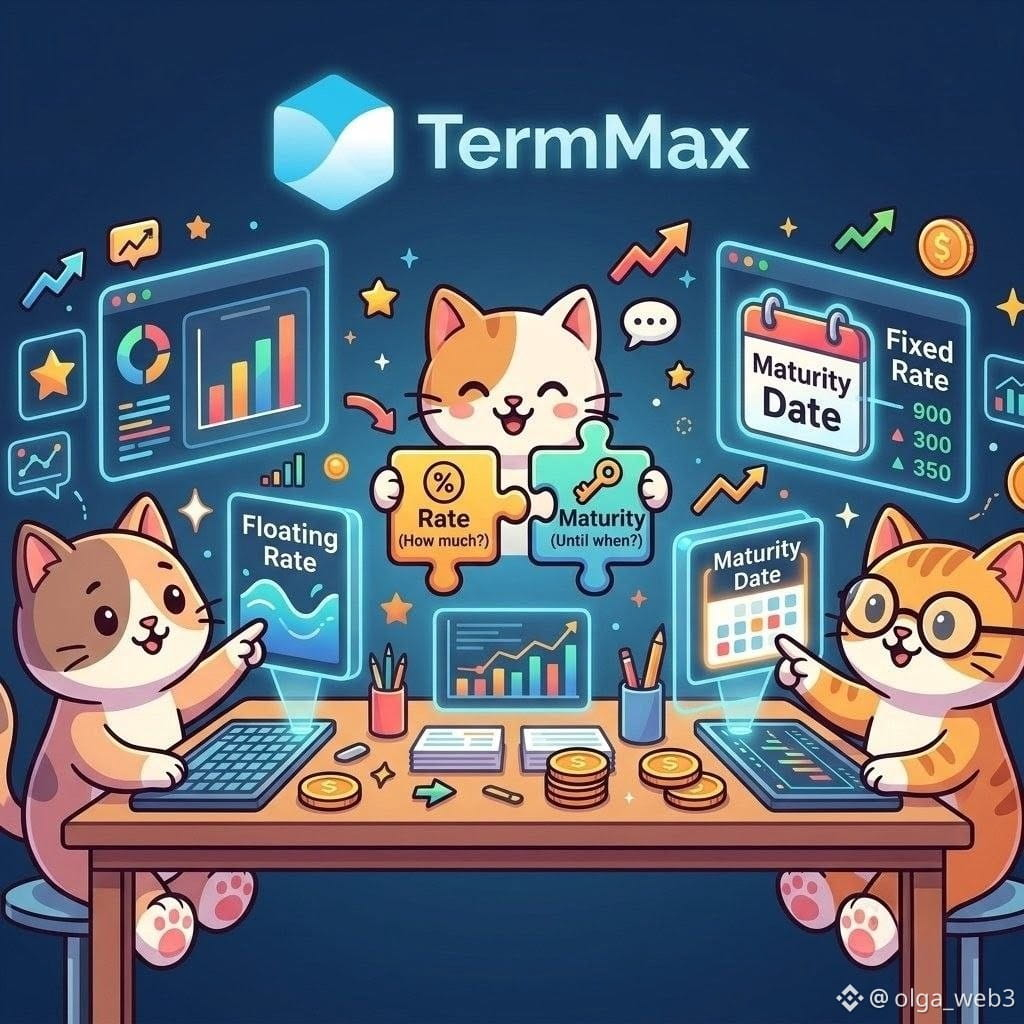
Here, in a fixed-rate market, there’s immediately a specific maturity — the date when the loan term ends.
At first glance, it’s just a date in the interface. In reality, it ties several things together at once: the rate, the debt, repayment, and time.
Borrowers know in advance when they need to return the position. Lenders understand when their investment horizon ends.
That very certainty is what distinguishes fixed-rate lending from classic floating lending, where the rate can change with the market.
I like to view maturity not as a limitation, but as a point around which the entire financial contract is built.
The rate answers the question “how much?”.
Maturity answers “until when?”.
Together, they create a completely different type of on-chain financial instrument.
@termmax #TermMax
In regular DeFi, I’m used to seeing a position as something that simply exists until it’s closed.
At TermMax, the logic is different.
Here, in a fixed-rate market, there’s immediately a specific maturity — the date when the loan term ends.
At first glance, it’s just a date in the interface. In reality, it ties several things together at once: the rate, the debt, repayment, and time.
Borrowers know in advance when they need to return the position. Lenders understand when their investment horizon ends.
That very certainty is what distinguishes fixed-rate lending from classic floating lending, where the rate can change with the market.
I like to view maturity not as a limitation, but as a point around which the entire financial contract is built.
The rate answers the question “how much?”.
Maturity answers “until when?”.
Together, they create a completely different type of on-chain financial instrument.
@TermMax #TermMax
At TermMax, the logic is different.
Here, in a fixed-rate market, there’s immediately a specific maturity — the date when the loan term ends.
At first glance, it’s just a date in the interface. In reality, it ties several things together at once: the rate, the debt, repayment, and time.
Borrowers know in advance when they need to return the position. Lenders understand when their investment horizon ends.
That very certainty is what distinguishes fixed-rate lending from classic floating lending, where the rate can change with the market.
I like to view maturity not as a limitation, but as a point around which the entire financial contract is built.
The rate answers the question “how much?”.
Maturity answers “until when?”.
Together, they create a completely different type of on-chain financial instrument.
@TermMax #TermMax
83
·
--
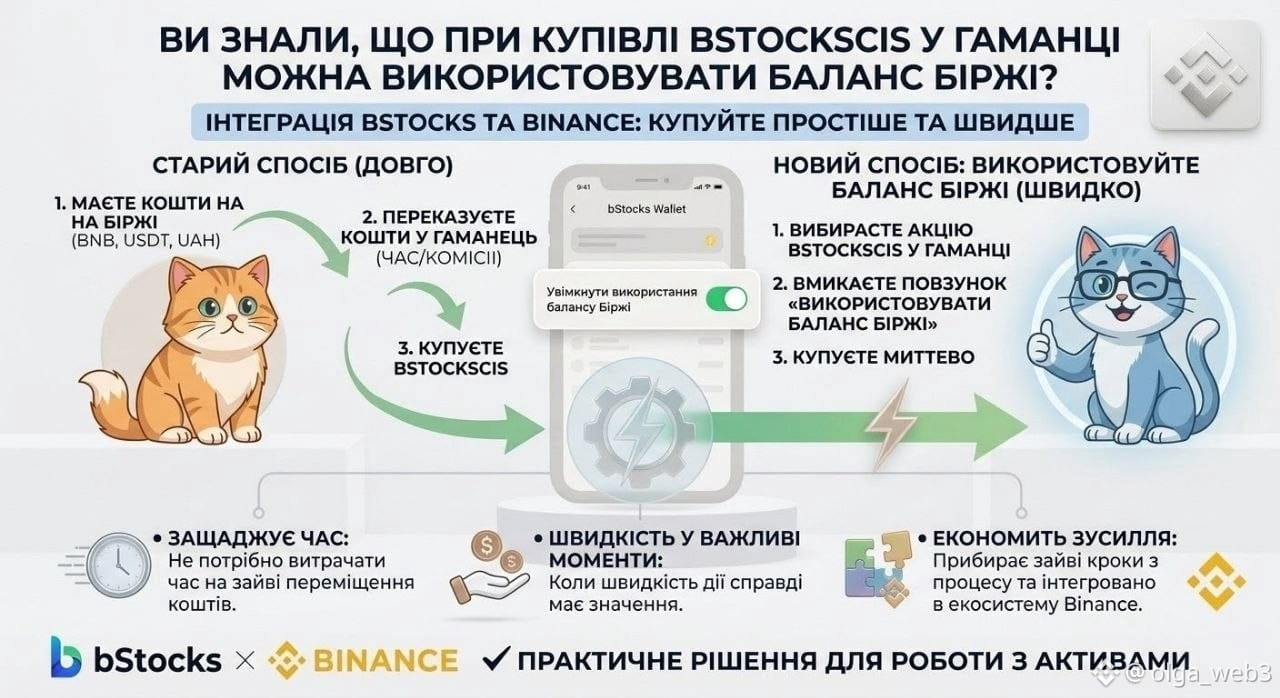
Did you know that when purchasing bStocksCIS in your wallet, you can use the exchange balance?
This feature seems very practical to me.
No need to waste time on extra fund transfers before buying one or another bStocksCIS share. Especially in those important moments when speed really matters.
So next time you don’t have enough funds in your wallet to make a purchase, just turn on the slider—and use the exchange balance.
These kinds of decisions save time and remove unnecessary steps from the process.
For me, this is yet another example of how integrating bStocks into the Binance ecosystem can make working with assets easier.
#bStocksCIS @BinanceCIS
Did you know that when purchasing bStocksCIS in your wallet, you can use the exchange balance?
This feature seems very practical to me.
No need to waste time on extra fund transfers before buying one or another bStocksCIS share. Especially in those important moments when speed really matters.
So next time you don’t have enough funds in your wallet to make a purchase, just turn on the slider—and use the exchange balance.
These kinds of decisions save time and remove unnecessary steps from the process.
For me, this is yet another example of how integrating bStocks into the Binance ecosystem can make working with assets easier.
#bStocksCIS @BinanceCIS
This feature seems very practical to me.
No need to waste time on extra fund transfers before buying one or another bStocksCIS share. Especially in those important moments when speed really matters.
So next time you don’t have enough funds in your wallet to make a purchase, just turn on the slider—and use the exchange balance.
These kinds of decisions save time and remove unnecessary steps from the process.
For me, this is yet another example of how integrating bStocks into the Binance ecosystem can make working with assets easier.
#bStocksCIS @BinanceCIS
1
1
81
·
--
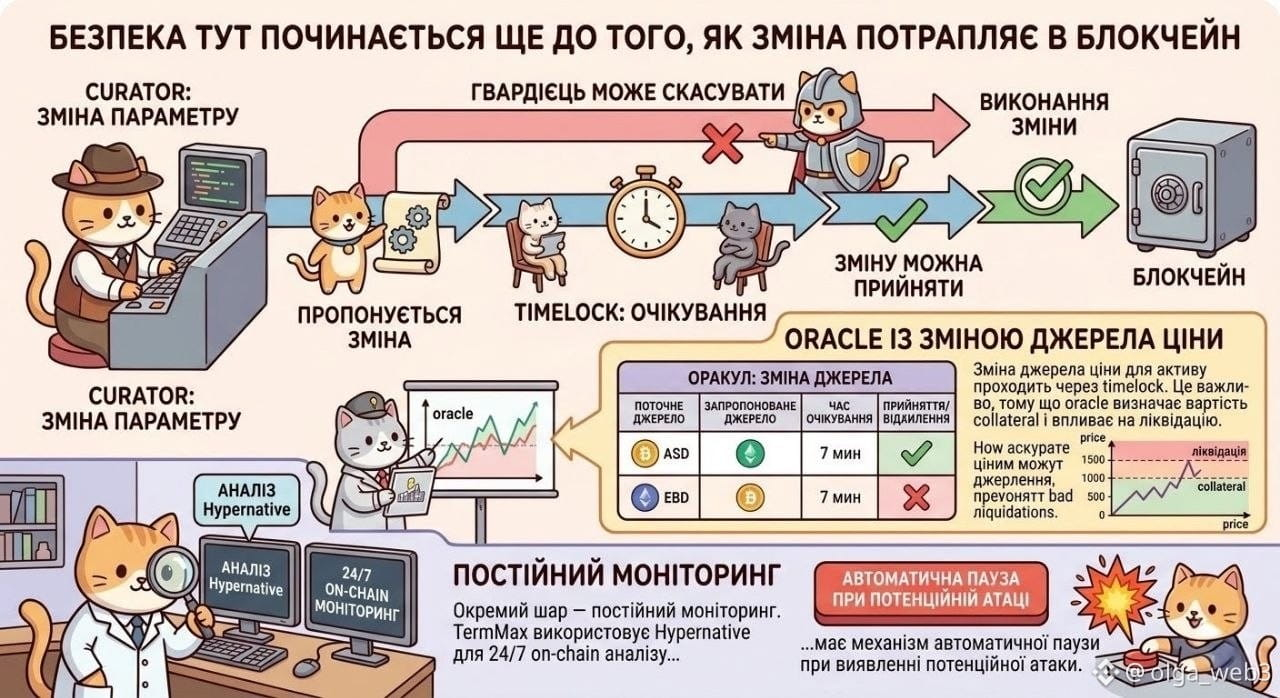
Security starts even before a change reaches the blockchain.
For example, a Curator can’t simply change an important parameter and apply it instantly.
First, the change is proposed; then a timelock is started; and only after the waiting period ends can it be accepted. During this time, the Guardian can cancel it.
It gets even more interesting with the oracle.
A change to the price source for an asset also goes through a timelock. This is important because the oracle determines the value of collateral and directly affects liquidation decisions.
Another layer is continuous monitoring. TermMax uses Hypernative for 24/7 on-chain analysis and has an automatic pause mechanism when a potential attack is detected.
In other words, I liked the approach itself:
not to wait for problems in the blockchain, but to create several checkpoints where a risky change can be checked or stopped before it’s executed.
@termmax #TermMax
Security starts even before a change reaches the blockchain.
For example, a Curator can’t simply change an important parameter and apply it instantly.
First, the change is proposed; then a timelock is started; and only after the waiting period ends can it be accepted. During this time, the Guardian can cancel it.
It gets even more interesting with the oracle.
A change to the price source for an asset also goes through a timelock. This is important because the oracle determines the value of collateral and directly affects liquidation decisions.
Another layer is continuous monitoring. TermMax uses Hypernative for 24/7 on-chain analysis and has an automatic pause mechanism when a potential attack is detected.
In other words, I liked the approach itself:
not to wait for problems in the blockchain, but to create several checkpoints where a risky change can be checked or stopped before it’s executed.
@TermMax #TermMax
For example, a Curator can’t simply change an important parameter and apply it instantly.
First, the change is proposed; then a timelock is started; and only after the waiting period ends can it be accepted. During this time, the Guardian can cancel it.
It gets even more interesting with the oracle.
A change to the price source for an asset also goes through a timelock. This is important because the oracle determines the value of collateral and directly affects liquidation decisions.
Another layer is continuous monitoring. TermMax uses Hypernative for 24/7 on-chain analysis and has an automatic pause mechanism when a potential attack is detected.
In other words, I liked the approach itself:
not to wait for problems in the blockchain, but to create several checkpoints where a risky change can be checked or stopped before it’s executed.
@TermMax #TermMax
97
·
--
Greetings to all parishioner-catlings 🐱
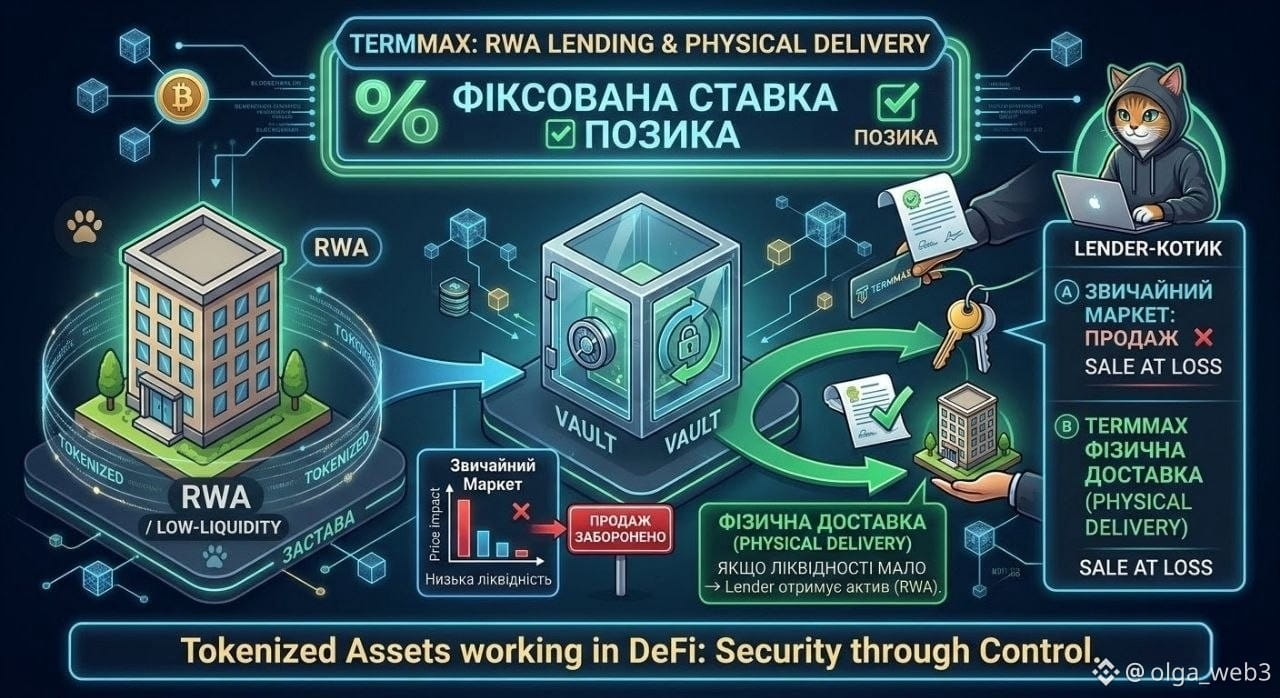
Today I’d like to look at an interesting aspect of TermMax—how fixed-rate lending can work with RWA and low-liquidity assets.
With a liquid asset, everything is more or less straightforward: if collateral needs to be sold, it can be moved to the market. But what do you do when liquidity is scarce, and a large sale by itself could significantly affect the price?
For such a scenario, TermMax provides for physical delivery. If the collateral can’t be realized effectively through the market, the lender may receive the actual asset instead of it being forcibly sold.
Fixed-rate lending adds another important detail here—the loan terms are set in advance. There is a specific rate, a defined term, and a clear position structure.
For me, this is a good example of why RWA is needed at all in terms of credit infrastructure.
Tokenizing a real asset is only the first step. It gets much more interesting when it gains the ability to work as collateral in a full-fledged on-chain financial environment.
#termmax @termmax
Greetings to all parishioner-catlings 🐱
Today I’d like to look at an interesting aspect of TermMax—how fixed-rate lending can work with RWA and low-liquidity assets.
With a liquid asset, everything is more or less straightforward: if collateral needs to be sold, it can be moved to the market. But what do you do when liquidity is scarce, and a large sale by itself could significantly affect the price?
For such a scenario, TermMax provides for physical delivery. If the collateral can’t be realized effectively through the market, the lender may receive the actual asset instead of it being forcibly sold.
Fixed-rate lending adds another important detail here—the loan terms are set in advance. There is a specific rate, a defined term, and a clear position structure.
For me, this is a good example of why RWA is needed at all in terms of credit infrastructure.
Tokenizing a real asset is only the first step. It gets much more interesting when it gains the ability to work as collateral in a full-fledged on-chain financial environment.
#termmax @TermMax
Today I’d like to look at an interesting aspect of TermMax—how fixed-rate lending can work with RWA and low-liquidity assets.
With a liquid asset, everything is more or less straightforward: if collateral needs to be sold, it can be moved to the market. But what do you do when liquidity is scarce, and a large sale by itself could significantly affect the price?
For such a scenario, TermMax provides for physical delivery. If the collateral can’t be realized effectively through the market, the lender may receive the actual asset instead of it being forcibly sold.
Fixed-rate lending adds another important detail here—the loan terms are set in advance. There is a specific rate, a defined term, and a clear position structure.
For me, this is a good example of why RWA is needed at all in terms of credit infrastructure.
Tokenizing a real asset is only the first step. It gets much more interesting when it gains the ability to work as collateral in a full-fledged on-chain financial environment.
#termmax @TermMax
74
·
--
Hi there! Myaa!
I never get tired of looking for all-new technical ways to implement bStocks on the blockchain.
We have another use case that I really like.
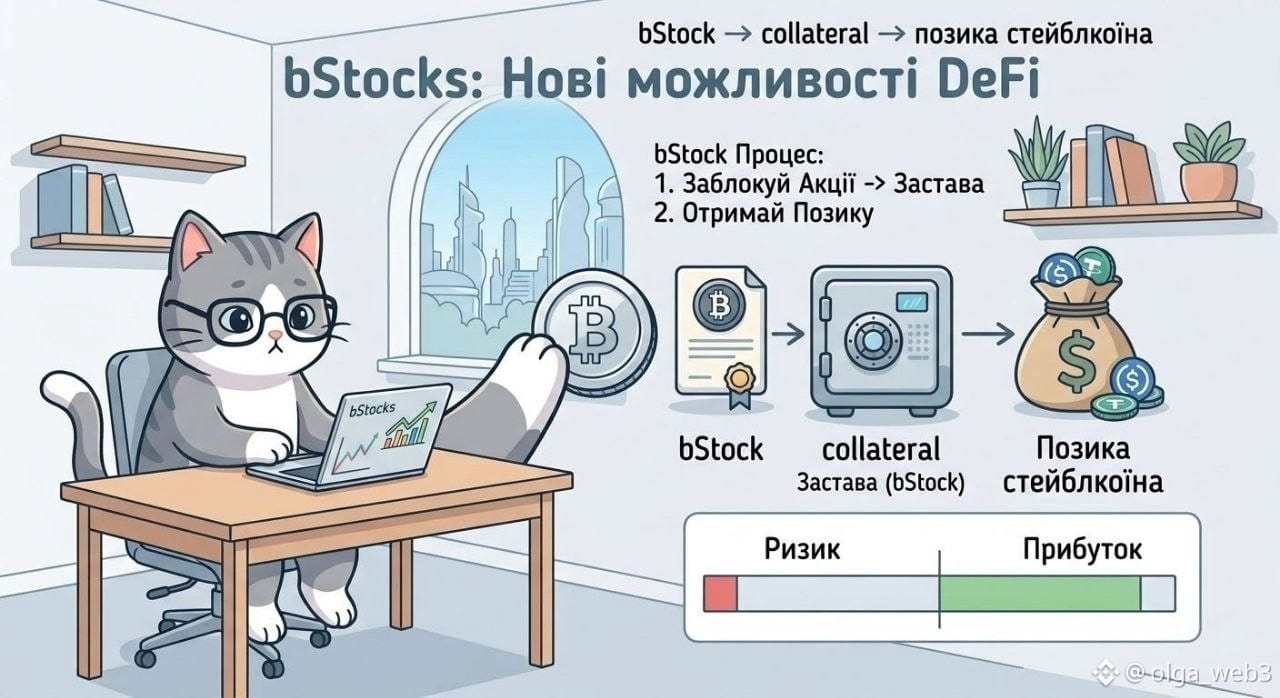
bStock → collateral → stablecoin loan.
If a specific bStock is supported by a lending protocol, you can deposit it as collateral and borrow stablecoins against it.
Instead of selling the share just for liquidity, I can keep the bStock with myself, use it as collateral, and get capital backed by that collateral.
Here, for me, the main power of tokenization shows up.
The share is no longer a regular asset that just sits as dead weight in a portfolio. It can become part of another financial operation within DeFi.
But along with this comes a risk: if the bStock price falls, the value of the collateral decreases and the risk of liquidation increases.
The most interesting part here isn’t the loan itself.
What’s fascinating is that the blockchain adds new ways to use shares without forcing me to sell it first.
#bStocksCIS @BinanceCIS
Hi there! Myaa!
I never get tired of looking for all-new technical ways to implement bStocks on the blockchain.
We have another use case that I really like.
bStock → collateral → stablecoin loan.
If a specific bStock is supported by a lending protocol, you can deposit it as collateral and borrow stablecoins against it.
Instead of selling the share just for liquidity, I can keep the bStock with myself, use it as collateral, and get capital backed by that collateral.
Here, for me, the main power of tokenization shows up.
The share is no longer a regular asset that just sits as dead weight in a portfolio. It can become part of another financial operation within DeFi.
But along with this comes a risk: if the bStock price falls, the value of the collateral decreases and the risk of liquidation increases.
The most interesting part here isn’t the loan itself.
What’s fascinating is that the blockchain adds new ways to use shares without forcing me to sell it first.
#bStocksCIS @BinanceCIS
I never get tired of looking for all-new technical ways to implement bStocks on the blockchain.
We have another use case that I really like.
bStock → collateral → stablecoin loan.
If a specific bStock is supported by a lending protocol, you can deposit it as collateral and borrow stablecoins against it.
Instead of selling the share just for liquidity, I can keep the bStock with myself, use it as collateral, and get capital backed by that collateral.
Here, for me, the main power of tokenization shows up.
The share is no longer a regular asset that just sits as dead weight in a portfolio. It can become part of another financial operation within DeFi.
But along with this comes a risk: if the bStock price falls, the value of the collateral decreases and the risk of liquidation increases.
The most interesting part here isn’t the loan itself.
What’s fascinating is that the blockchain adds new ways to use shares without forcing me to sell it first.
#bStocksCIS @BinanceCIS
67
·
--
Hi, my kitty cats 🐱
Today I have an interesting, very straight-up very interesting topic — how Settlement works under the hood in bStocks.
Here I got curious not just about how quickly a deal goes through, but about what happens to the asset after the order has already been executed.
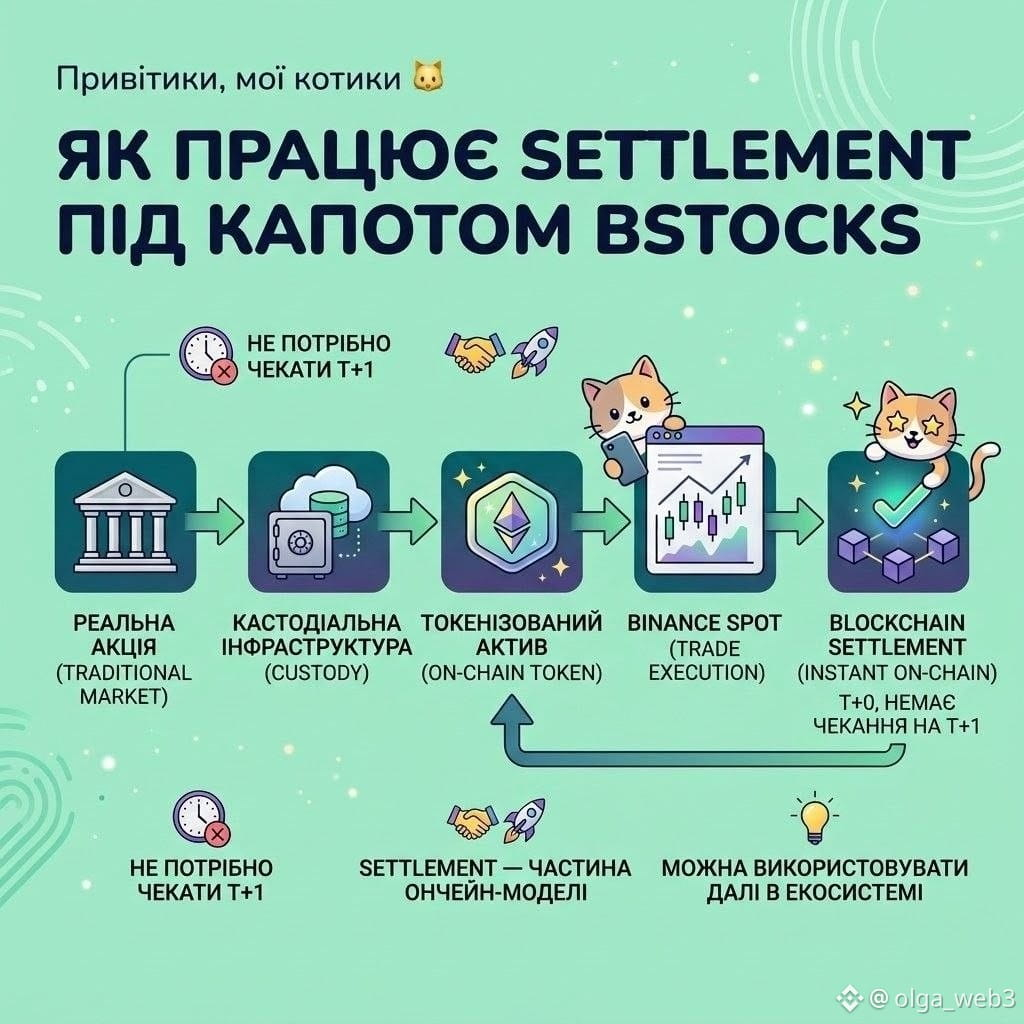
In typical financial infrastructure, between trade execution and final settlement there’s a separate process. In the US, it currently runs on the T+1 model.
In bStocks, the logic is different.
You trade a tokenized asset on Binance Spot, and its settlement happens in a digital environment. That means there’s no need to wait for the next business day for the settlement of the tokenized asset itself to complete.
And this is where it gets really interesting.
Settlement becomes part of the asset’s on-chain model itself, not a separate step after trading.
After settlement, the token can be used further in the scenarios supported by the ecosystem.
At the same time, the bStock itself doesn’t exist out of thin air — there is a corresponding real share left as collateral behind it.
So under the hood we have this interesting connection:
Real share → Custodial infrastructure → Tokenized asset → Binance Spot → Blockchain settlement.
This whole construction, in my opinion, is what makes bStocks the most interesting.
#bStocksCIS @BinanceCIS
Hi, my kitty cats 🐱
Today I have an interesting, very straight-up very interesting topic — how Settlement works under the hood in bStocks.
Here I got curious not just about how quickly a deal goes through, but about what happens to the asset after the order has already been executed.
In typical financial infrastructure, between trade execution and final settlement there’s a separate process. In the US, it currently runs on the T+1 model.
In bStocks, the logic is different.
You trade a tokenized asset on Binance Spot, and its settlement happens in a digital environment. That means there’s no need to wait for the next business day for the settlement of the tokenized asset itself to complete.
And this is where it gets really interesting.
Settlement becomes part of the asset’s on-chain model itself, not a separate step after trading.
After settlement, the token can be used further in the scenarios supported by the ecosystem.
At the same time, the bStock itself doesn’t exist out of thin air — there is a corresponding real share left as collateral behind it.
So under the hood we have this interesting connection:
Real share → Custodial infrastructure → Tokenized asset → Binance Spot → Blockchain settlement.
This whole construction, in my opinion, is what makes bStocks the most interesting.
#bStocksCIS @BinanceCIS
Today I have an interesting, very straight-up very interesting topic — how Settlement works under the hood in bStocks.
Here I got curious not just about how quickly a deal goes through, but about what happens to the asset after the order has already been executed.
In typical financial infrastructure, between trade execution and final settlement there’s a separate process. In the US, it currently runs on the T+1 model.
In bStocks, the logic is different.
You trade a tokenized asset on Binance Spot, and its settlement happens in a digital environment. That means there’s no need to wait for the next business day for the settlement of the tokenized asset itself to complete.
And this is where it gets really interesting.
Settlement becomes part of the asset’s on-chain model itself, not a separate step after trading.
After settlement, the token can be used further in the scenarios supported by the ecosystem.
At the same time, the bStock itself doesn’t exist out of thin air — there is a corresponding real share left as collateral behind it.
So under the hood we have this interesting connection:
Real share → Custodial infrastructure → Tokenized asset → Binance Spot → Blockchain settlement.
This whole construction, in my opinion, is what makes bStocks the most interesting.
#bStocksCIS @BinanceCIS
94
·
--
Can you eliminate yourself on bStocks at all?
I decided to figure it out because the word “liquidation” often sounds scarier than it really is.
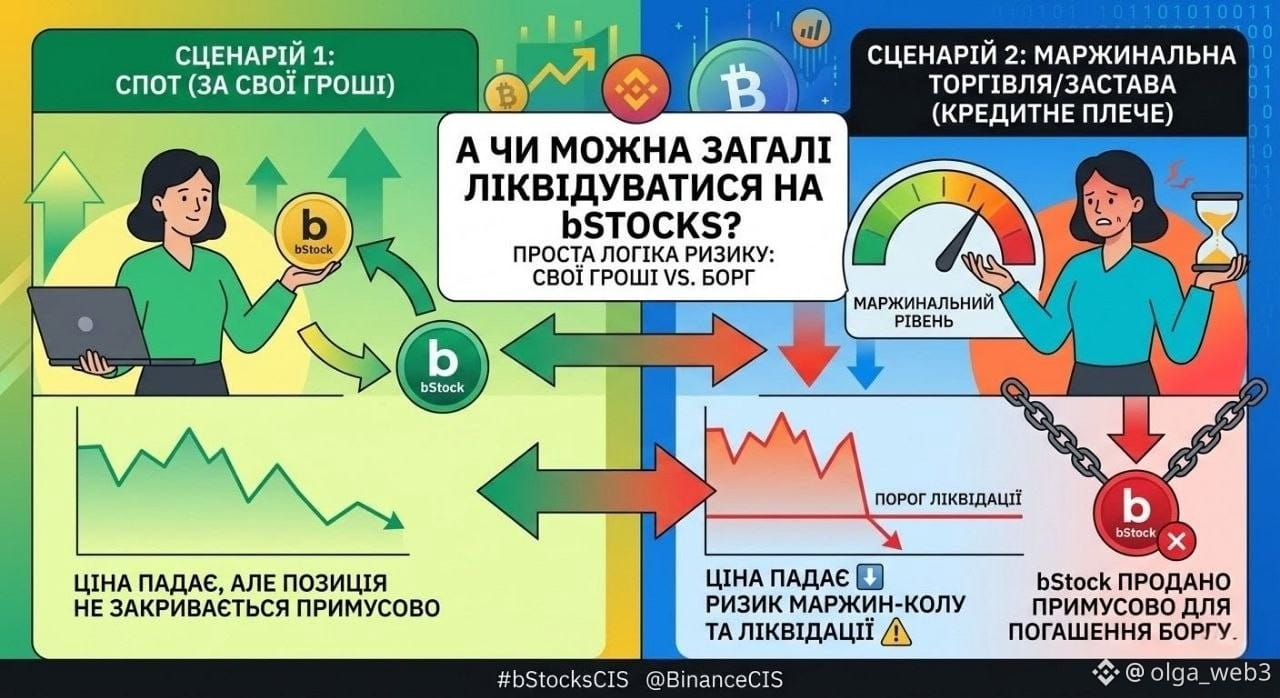
If I buy a bStock on the spot with my own money, a price drop by itself does not mean an automatic position close.
But the situation changes if bStocks are used as collateral in a margin scenario. Here, a debt appears. If the collateral price falls, its value decreases, and the margin level worsens.
When a critical threshold is reached, a margin call can occur, and then the position may be forcibly closed.
That’s why I set a simple rule for myself:
spot — I watch the price;
margin — I watch not only the price, but also the collateral, the debt, and the leverage.
That’s why it’s important to understand where your risk lies before using margin opportunities.
#bStocksCIS @BinanceCIS
Can you eliminate yourself on bStocks at all?
I decided to figure it out because the word “liquidation” often sounds scarier than it really is.
If I buy a bStock on the spot with my own money, a price drop by itself does not mean an automatic position close.
But the situation changes if bStocks are used as collateral in a margin scenario. Here, a debt appears. If the collateral price falls, its value decreases, and the margin level worsens.
When a critical threshold is reached, a margin call can occur, and then the position may be forcibly closed.
That’s why I set a simple rule for myself:
spot — I watch the price;
margin — I watch not only the price, but also the collateral, the debt, and the leverage.
That’s why it’s important to understand where your risk lies before using margin opportunities.
#bStocksCIS @BinanceCIS
I decided to figure it out because the word “liquidation” often sounds scarier than it really is.
If I buy a bStock on the spot with my own money, a price drop by itself does not mean an automatic position close.
But the situation changes if bStocks are used as collateral in a margin scenario. Here, a debt appears. If the collateral price falls, its value decreases, and the margin level worsens.
When a critical threshold is reached, a margin call can occur, and then the position may be forcibly closed.
That’s why I set a simple rule for myself:
spot — I watch the price;
margin — I watch not only the price, but also the collateral, the debt, and the leverage.
That’s why it’s important to understand where your risk lies before using margin opportunities.
#bStocksCIS @BinanceCIS
84
·
--
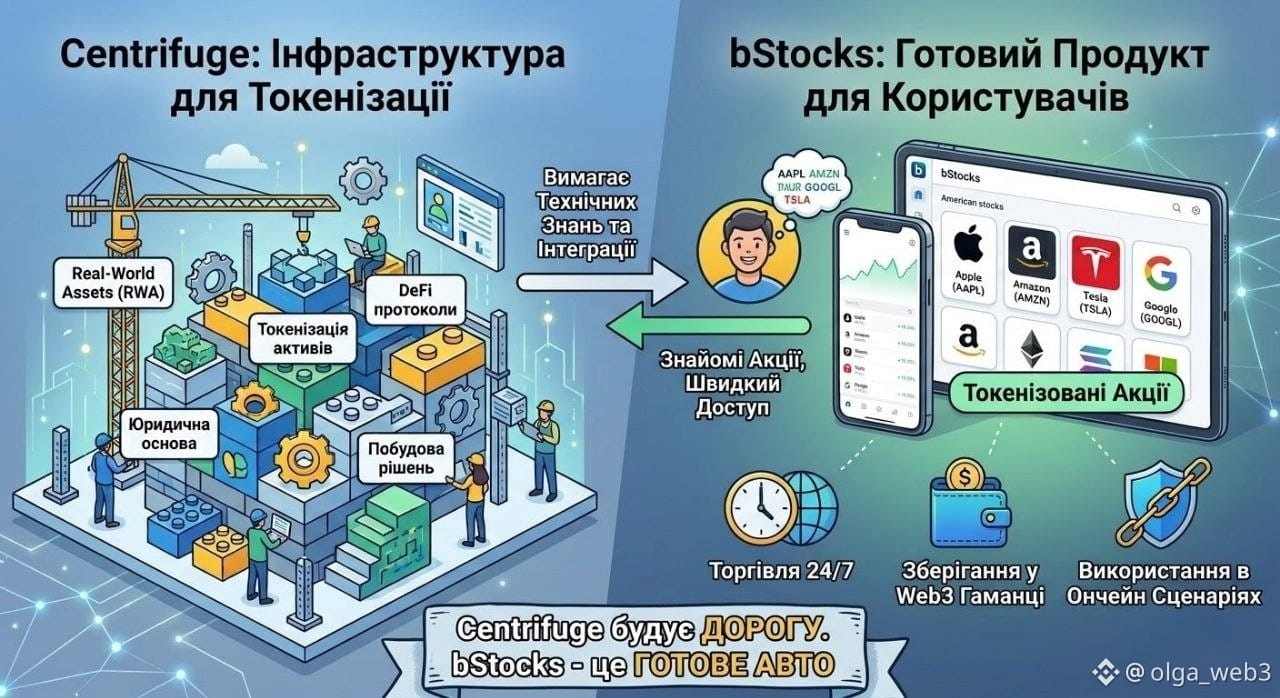
Centrifuge and bStocks solve different problems. But if we look at what’s happening already now, then the advantage of bStocks is obvious to me.
Centrifuge is more about the infrastructure on which you can build the tokenization of various real-world assets.
And bStocks is already a ready-made product that an ordinary user can open and immediately see familiar US stocks in token format.
And that’s what I like the most.
No need to first figure out how the entire RWA infrastructure works.
You see the stock you know.
You can trade it 24/7, store it in a compatible Web3 wallet, and use supported on-chain scenarios.
So for me, bStocks already looks less like an experiment in tokenization.
They’re already showing how this model can work for a regular user.
And when it comes specifically to mass adoption of tokenized stocks, I can see bStocks ahead right now.
#bStocksCIS @BinanceCIS
Centrifuge and bStocks solve different problems. But if we look at what’s happening already now, then the advantage of bStocks is obvious to me.
Centrifuge is more about the infrastructure on which you can build the tokenization of various real-world assets.
And bStocks is already a ready-made product that an ordinary user can open and immediately see familiar US stocks in token format.
And that’s what I like the most.
No need to first figure out how the entire RWA infrastructure works.
You see the stock you know.
You can trade it 24/7, store it in a compatible Web3 wallet, and use supported on-chain scenarios.
So for me, bStocks already looks less like an experiment in tokenization.
They’re already showing how this model can work for a regular user.
And when it comes specifically to mass adoption of tokenized stocks, I can see bStocks ahead right now.
#bStocksCIS @BinanceCIS
Centrifuge is more about the infrastructure on which you can build the tokenization of various real-world assets.
And bStocks is already a ready-made product that an ordinary user can open and immediately see familiar US stocks in token format.
And that’s what I like the most.
No need to first figure out how the entire RWA infrastructure works.
You see the stock you know.
You can trade it 24/7, store it in a compatible Web3 wallet, and use supported on-chain scenarios.
So for me, bStocks already looks less like an experiment in tokenization.
They’re already showing how this model can work for a regular user.
And when it comes specifically to mass adoption of tokenized stocks, I can see bStocks ahead right now.
#bStocksCIS @BinanceCIS
78
·
--
Bullish
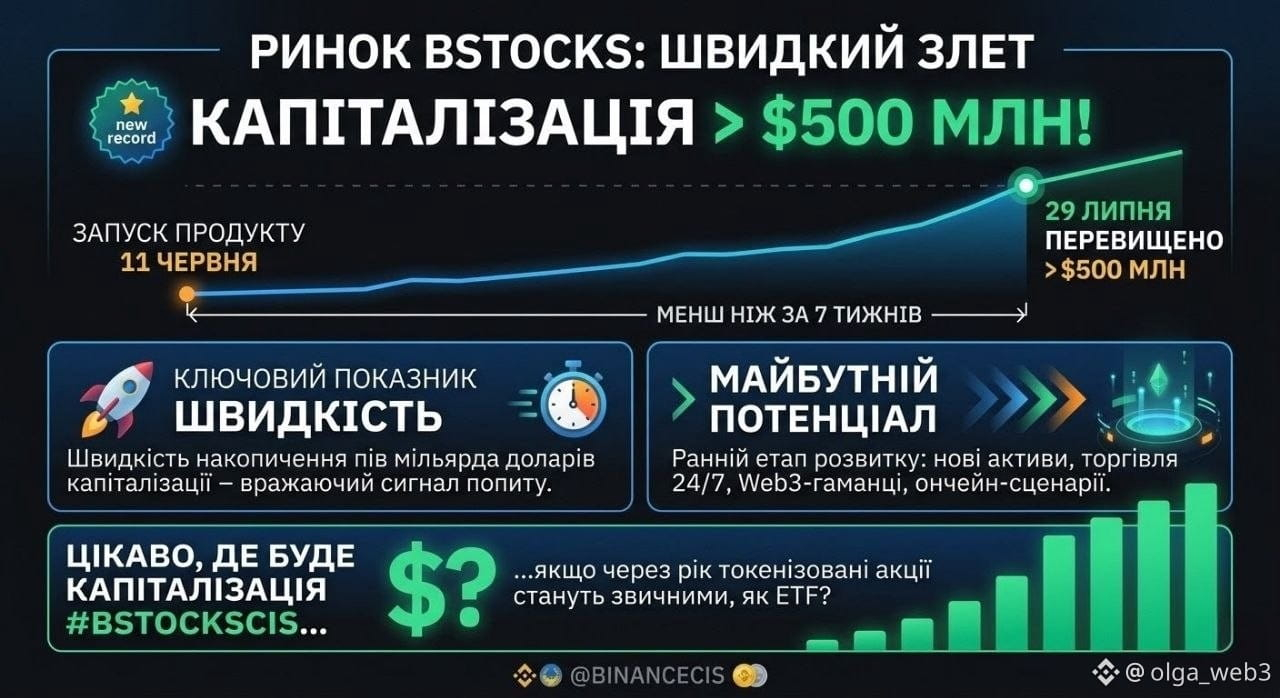
Did you know how much the entire bStocks market costs right now?
I myself didn’t expect the figure to be so noticeable already.
On July 29, the bStocks market capitalization surpassed $500 million. And it happened in less than seven weeks after the product launched on June 11.
What interests me here isn’t even the number itself.
It’s the speed.
In such a short time, tokenized stocks have already gathered more than half a billion dollars in market capitalization.
And if you look at what’s happening next — new assets, trading 24/7, Web3 wallets, and a gradual expansion of on-chain scenarios — it becomes clear that this is still a very early stage.
I’m not making a future forecast based on these $500 million.
But as a demand signal, I like this number.
It will be interesting to see where bStocks market capitalization will be in a year, if tokenized stocks become as familiar to people as an ETF is today?
#bStocksCIS @BinanceCIS $AMZNB
{spot}(AMZNBUSDT)
Did you know how much the entire bStocks market costs right now?
I myself didn’t expect the figure to be so noticeable already.
On July 29, the bStocks market capitalization surpassed $500 million. And it happened in less than seven weeks after the product launched on June 11.
What interests me here isn’t even the number itself.
It’s the speed.
In such a short time, tokenized stocks have already gathered more than half a billion dollars in market capitalization.
And if you look at what’s happening next — new assets, trading 24/7, Web3 wallets, and a gradual expansion of on-chain scenarios — it becomes clear that this is still a very early stage.
I’m not making a future forecast based on these $500 million.
But as a demand signal, I like this number.
It will be interesting to see where bStocks market capitalization will be in a year, if tokenized stocks become as familiar to people as an ETF is today?
#bStocksCIS @BinanceCIS $AMZNB
I myself didn’t expect the figure to be so noticeable already.
On July 29, the bStocks market capitalization surpassed $500 million. And it happened in less than seven weeks after the product launched on June 11.
What interests me here isn’t even the number itself.
It’s the speed.
In such a short time, tokenized stocks have already gathered more than half a billion dollars in market capitalization.
And if you look at what’s happening next — new assets, trading 24/7, Web3 wallets, and a gradual expansion of on-chain scenarios — it becomes clear that this is still a very early stage.
I’m not making a future forecast based on these $500 million.
But as a demand signal, I like this number.
It will be interesting to see where bStocks market capitalization will be in a year, if tokenized stocks become as familiar to people as an ETF is today?
#bStocksCIS @BinanceCIS $AMZNB
73
·
--
Hi, friends! 👋🏻
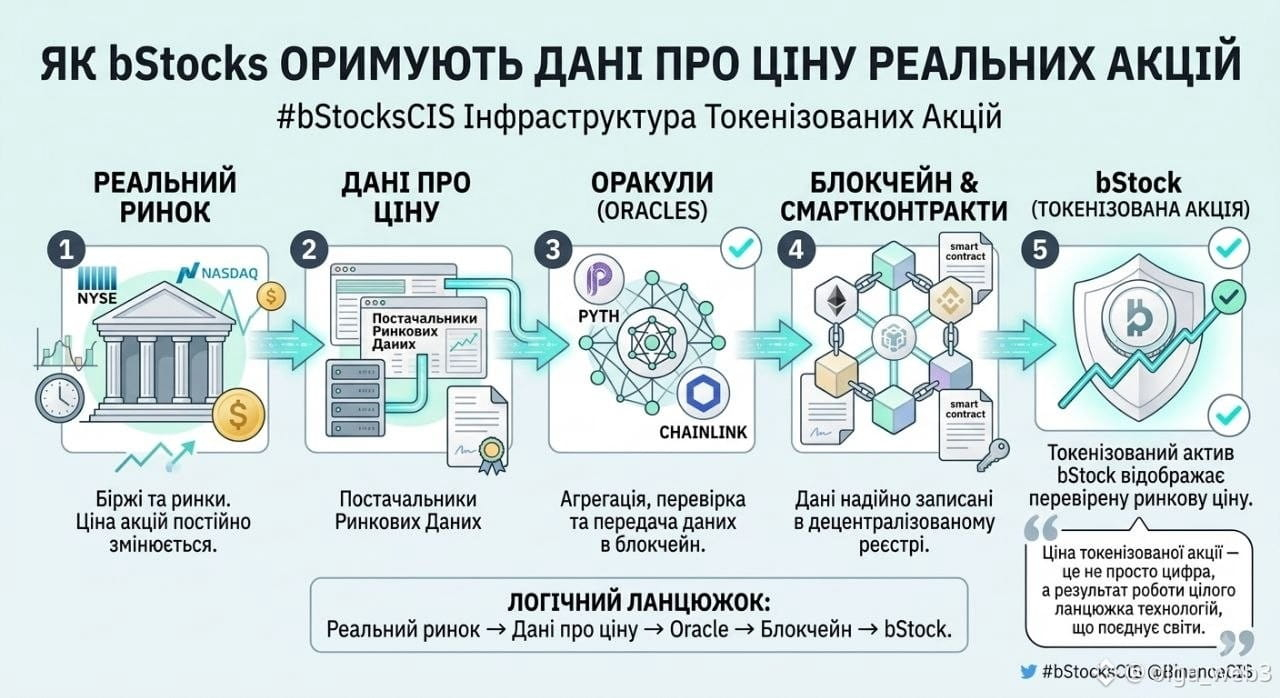
I decided to figure out how bStocks get data about the price of a real stock. Because this process has an interesting technical part that isn’t visible to the user.
On the stock market, the price changes constantly. But the blockchain itself does not have access to this data. That’s why we need a mechanism that can pass information from an external market into the blockchain.
That’s where oracles come in.
PYTH receives market data from providers, aggregates it, and forms price feeds for use in the blockchain.
Chainlink uses a network of independent oracle nodes and various data sources to pass information to smart contracts.
At the same time, it’s important not to mix up the concepts: I’m not saying that PYTH and Chainlink are the only data sources for all bStocks. The specific infrastructure can differ depending on the scenario.
But the logic itself seems really interesting to me:
real market → price data → oracle → blockchain → bStock.
So when we see the price of a tokenized stock, behind it there isn’t just one technology, but an entire chain that connects the traditional financial market with the blockchain.
It’s these kinds of details that make me look at #bStocksCIS not just as tokenized stocks, but as an entire infrastructure around them.
@BinanceCIS
Hi, friends! 👋🏻
I decided to figure out how bStocks get data about the price of a real stock. Because this process has an interesting technical part that isn’t visible to the user.
On the stock market, the price changes constantly. But the blockchain itself does not have access to this data. That’s why we need a mechanism that can pass information from an external market into the blockchain.
That’s where oracles come in.
PYTH receives market data from providers, aggregates it, and forms price feeds for use in the blockchain.
Chainlink uses a network of independent oracle nodes and various data sources to pass information to smart contracts.
At the same time, it’s important not to mix up the concepts: I’m not saying that PYTH and Chainlink are the only data sources for all bStocks. The specific infrastructure can differ depending on the scenario.
But the logic itself seems really interesting to me:
real market → price data → oracle → blockchain → bStock.
So when we see the price of a tokenized stock, behind it there isn’t just one technology, but an entire chain that connects the traditional financial market with the blockchain.
It’s these kinds of details that make me look at #bStocksCIS not just as tokenized stocks, but as an entire infrastructure around them.
@BinanceCIS
I decided to figure out how bStocks get data about the price of a real stock. Because this process has an interesting technical part that isn’t visible to the user.
On the stock market, the price changes constantly. But the blockchain itself does not have access to this data. That’s why we need a mechanism that can pass information from an external market into the blockchain.
That’s where oracles come in.
PYTH receives market data from providers, aggregates it, and forms price feeds for use in the blockchain.
Chainlink uses a network of independent oracle nodes and various data sources to pass information to smart contracts.
At the same time, it’s important not to mix up the concepts: I’m not saying that PYTH and Chainlink are the only data sources for all bStocks. The specific infrastructure can differ depending on the scenario.
But the logic itself seems really interesting to me:
real market → price data → oracle → blockchain → bStock.
So when we see the price of a tokenized stock, behind it there isn’t just one technology, but an entire chain that connects the traditional financial market with the blockchain.
It’s these kinds of details that make me look at #bStocksCIS not just as tokenized stocks, but as an entire infrastructure around them.
@BinanceCIS
134
·
--
Bullish
Hello my dear ones!
And what if the main value of bStocks isn’t that you can buy a tokenized stock?
I see something more interesting.
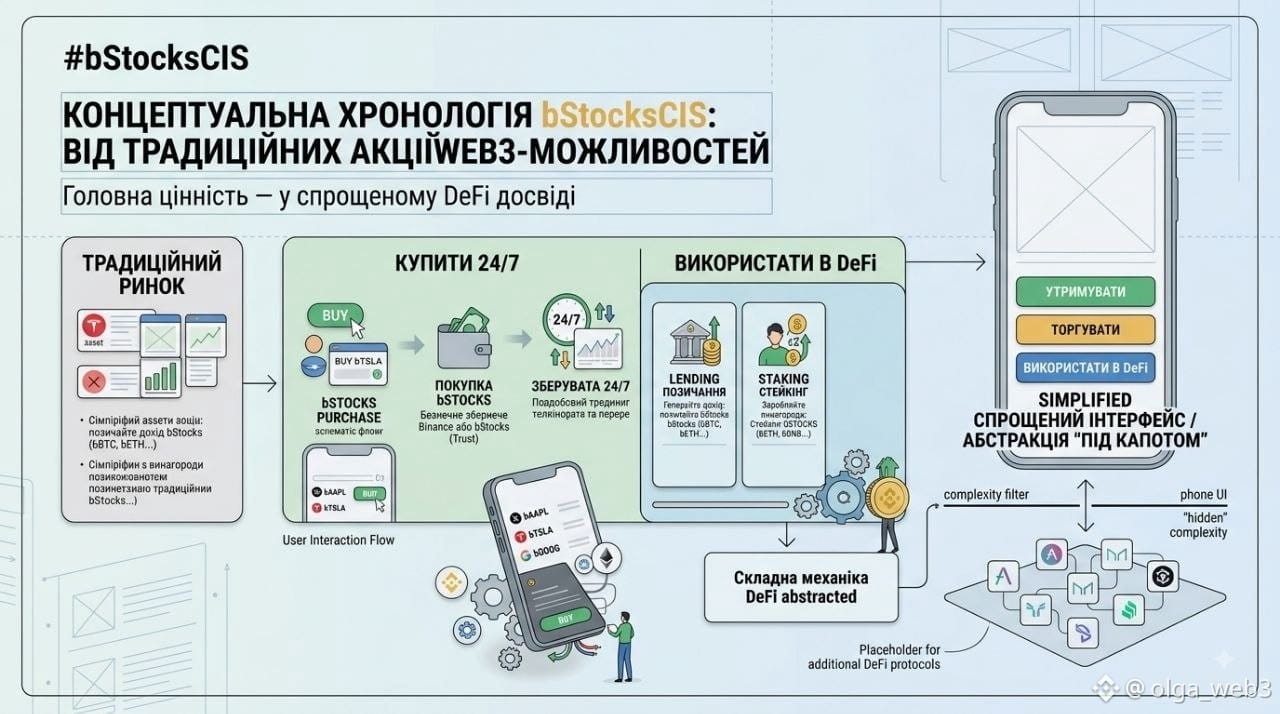
Today you can trade bStock 24/7, withdraw it to a compatible Web3 wallet, and use it in supported DeFi scenarios. Binance mentions, in particular, lending and staking.
So the logic can already look like this:
bought → you hold → you trade → you use it in available Web3 scenarios.
And now the most interesting part.
If all of this can be gradually brought together in one simple interface, a newcomer won’t need to figure out dozens of protocols.
They just see:
Hold
Trade
Use in lending
And all the complex mechanics stays “under the hood.”
That’s exactly where I see the potential of $bStocksCIS: not just moving stocks onto a blockchain, but making working with them as clear as possible—even for someone who is just starting to get familiar with Web3.
A traditional asset on the outside. Web3 capabilities on the inside. A simple user experience.
This model really seems interesting to me.
#bStocksCIS @BinanceCIS $AMZNB
{spot}(AMZNBUSDT)
Hello my dear ones!
And what if the main value of bStocks isn’t that you can buy a tokenized stock?
I see something more interesting.
Today you can trade bStock 24/7, withdraw it to a compatible Web3 wallet, and use it in supported DeFi scenarios. Binance mentions, in particular, lending and staking.
So the logic can already look like this:
bought → you hold → you trade → you use it in available Web3 scenarios.
And now the most interesting part.
If all of this can be gradually brought together in one simple interface, a newcomer won’t need to figure out dozens of protocols.
They just see:
Hold
Trade
Use in lending
And all the complex mechanics stays “under the hood.”
That’s exactly where I see the potential of $bStocksCIS: not just moving stocks onto a blockchain, but making working with them as clear as possible—even for someone who is just starting to get familiar with Web3.
A traditional asset on the outside. Web3 capabilities on the inside. A simple user experience.
This model really seems interesting to me.
#bStocksCIS @BinanceCIS $AMZNB
And what if the main value of bStocks isn’t that you can buy a tokenized stock?
I see something more interesting.
Today you can trade bStock 24/7, withdraw it to a compatible Web3 wallet, and use it in supported DeFi scenarios. Binance mentions, in particular, lending and staking.
So the logic can already look like this:
bought → you hold → you trade → you use it in available Web3 scenarios.
And now the most interesting part.
If all of this can be gradually brought together in one simple interface, a newcomer won’t need to figure out dozens of protocols.
They just see:
Hold
Trade
Use in lending
And all the complex mechanics stays “under the hood.”
That’s exactly where I see the potential of $bStocksCIS: not just moving stocks onto a blockchain, but making working with them as clear as possible—even for someone who is just starting to get familiar with Web3.
A traditional asset on the outside. Web3 capabilities on the inside. A simple user experience.
This model really seems interesting to me.
#bStocksCIS @BinanceCIS $AMZNB
71
·
--
Bullish
Hi everyone!
I saw bStocks in token format and thought: if the asset is already on the blockchain, then it can be used in DeFi without any issues.
But tokenization ≠ automatic access to everything in DeFi.
Now, before any such scenario, I check four things:
bStock → network → protocol → official support.
And only if all four points match, do I consider the next steps.
For me, this is an important nuance: the blockchain opens up opportunities, but it doesn’t automatically make the asset universally accessible.
So I no longer assume things—I verify first, then act.
#bStocksCIS @BinanceCIS
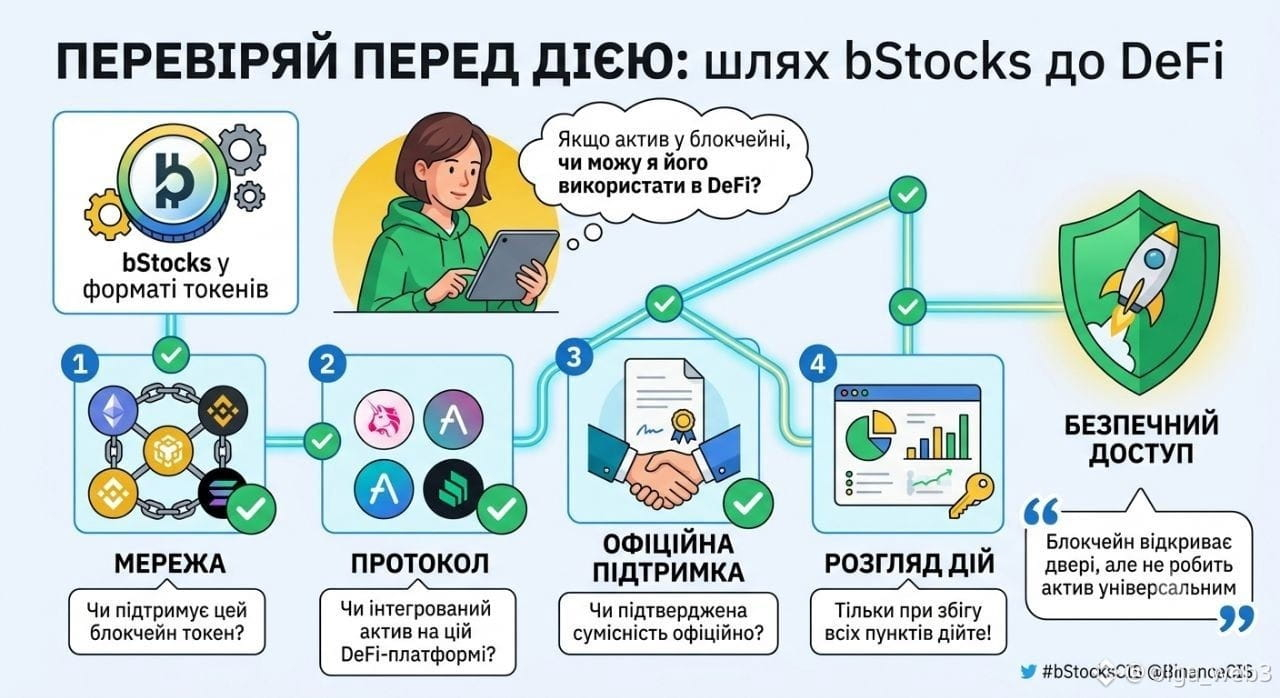
Hi everyone!
I saw bStocks in token format and thought: if the asset is already on the blockchain, then it can be used in DeFi without any issues.
But tokenization ≠ automatic access to everything in DeFi.
Now, before any such scenario, I check four things:
bStock → network → protocol → official support.
And only if all four points match, do I consider the next steps.
For me, this is an important nuance: the blockchain opens up opportunities, but it doesn’t automatically make the asset universally accessible.
So I no longer assume things—I verify first, then act.
#bStocksCIS @BinanceCIS
I saw bStocks in token format and thought: if the asset is already on the blockchain, then it can be used in DeFi without any issues.
But tokenization ≠ automatic access to everything in DeFi.
Now, before any such scenario, I check four things:
bStock → network → protocol → official support.
And only if all four points match, do I consider the next steps.
For me, this is an important nuance: the blockchain opens up opportunities, but it doesn’t automatically make the asset universally accessible.
So I no longer assume things—I verify first, then act.
#bStocksCIS @BinanceCIS
76
·
--
Bullish
I found an interesting way to build a watchlist through bStocks.
Before, I would simply add companies that caught my attention to the list. Now I approach it a bit differently: I treat the available bStocks as a starting point for research.
For example, when I see NVIDIA, I don’t just add it to my watchlist—I ask myself:
why did I pay attention to it right now?
Then I look at the sector, the competitors, the company’s results, and the factors that could affect the price.
And that’s where bStocks became a convenient filter for me. Instead of a chaotic list of dozens of names, I form a small group of assets that I actually want to research.
As a result, my watchlist stopped being just a list of tickers.
$NVDAB $MSFTB $AMZNB
Now it’s a list of ideas that I want to check.
And I like this approach more: fewer random names, more understanding of why a specific asset ended up on my list in the first place.
#bStocksCIS @BinanceCIS
I found an interesting way to build a watchlist through bStocks.
Before, I would simply add companies that caught my attention to the list. Now I approach it a bit differently: I treat the available bStocks as a starting point for research.
For example, when I see NVIDIA, I don’t just add it to my watchlist—I ask myself:
why did I pay attention to it right now?
Then I look at the sector, the competitors, the company’s results, and the factors that could affect the price.
And that’s where bStocks became a convenient filter for me. Instead of a chaotic list of dozens of names, I form a small group of assets that I actually want to research.
As a result, my watchlist stopped being just a list of tickers.
$NVDAB $MSFTB $AMZNB
Now it’s a list of ideas that I want to check.
And I like this approach more: fewer random names, more understanding of why a specific asset ended up on my list in the first place.
#bStocksCIS @BinanceCIS
Before, I would simply add companies that caught my attention to the list. Now I approach it a bit differently: I treat the available bStocks as a starting point for research.
For example, when I see NVIDIA, I don’t just add it to my watchlist—I ask myself:
why did I pay attention to it right now?
Then I look at the sector, the competitors, the company’s results, and the factors that could affect the price.
And that’s where bStocks became a convenient filter for me. Instead of a chaotic list of dozens of names, I form a small group of assets that I actually want to research.
As a result, my watchlist stopped being just a list of tickers.
$NVDAB $MSFTB $AMZNB
Now it’s a list of ideas that I want to check.
And I like this approach more: fewer random names, more understanding of why a specific asset ended up on my list in the first place.
#bStocksCIS @BinanceCIS

191
·
--
Bullish
Not long ago, I didn’t even think I could so easily get access to a new format of investment assets.
So now I’m genuinely pleased that #bStocksCIS makes it possible to work with tokenized stocks through a familiar crypto environment.
And for me, the value here isn’t only in the ability to buy or sell bStock.
What really resonated with me is the feeling of accessibility. The thing that once seemed far away is gradually becoming part of a familiar digital environment.
I remember when I didn’t even consider a similar scenario as something real.
And now I look at it completely differently.
The most interesting part is that I started to see bStocks not just as a new tool, but as an expansion of opportunities for an investor.
The ability to track assets, build your own strategy, and work with them in a format that previously seemed less accessible.
These are the changes I like the most—when you first think, “Interesting, a new feature,” and then catch yourself thinking🤔
“Hold on. Not long ago, even the idea of such an opportunity wasn’t in my head.”
And that’s exactly why I’ll be keeping a close eye on the development of #bStocksCIS .
Have you ever had a feeling like that, when a new technology suddenly made accessible what you hadn’t even thought about before?
@BinanceCIS
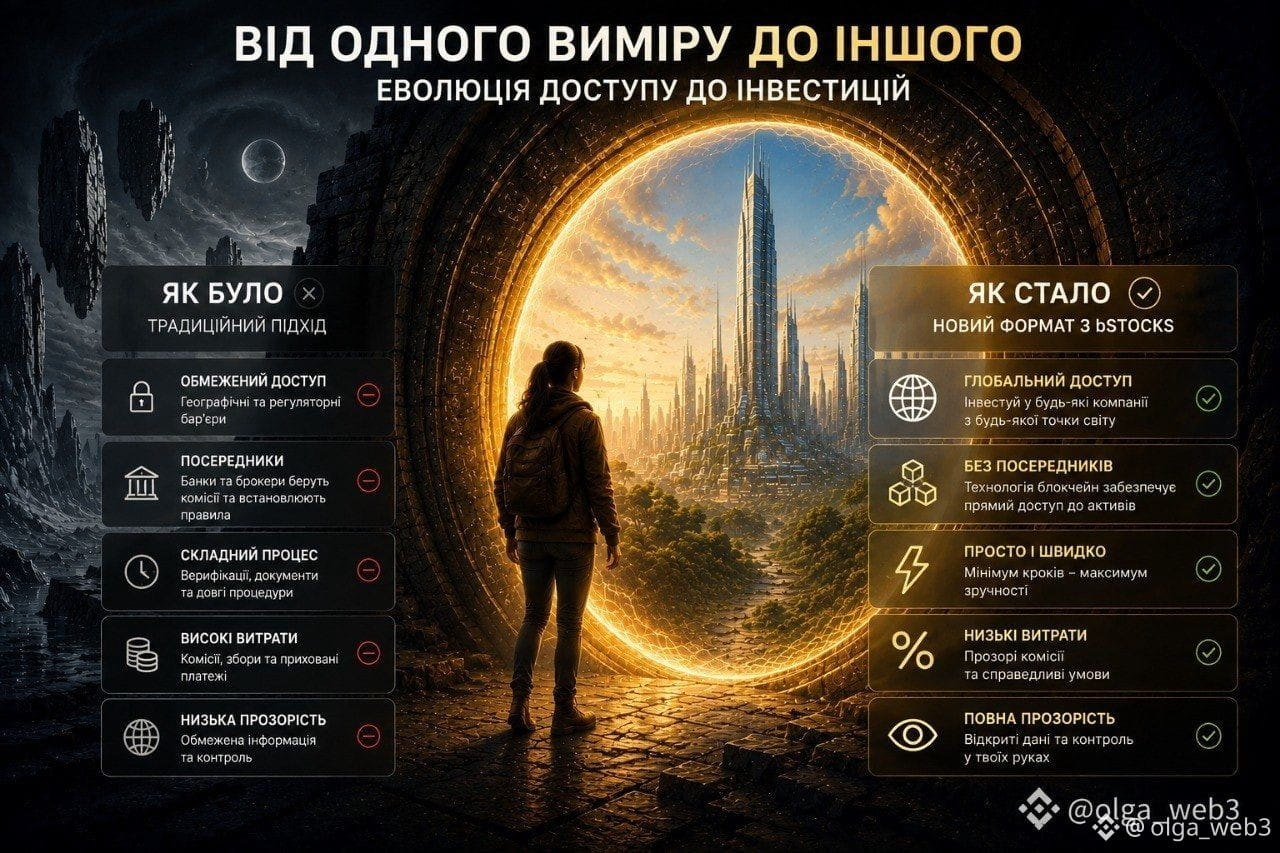
Not long ago, I didn’t even think I could so easily get access to a new format of investment assets.
So now I’m genuinely pleased that #bStocksCIS makes it possible to work with tokenized stocks through a familiar crypto environment.
And for me, the value here isn’t only in the ability to buy or sell bStock.
What really resonated with me is the feeling of accessibility. The thing that once seemed far away is gradually becoming part of a familiar digital environment.
I remember when I didn’t even consider a similar scenario as something real.
And now I look at it completely differently.
The most interesting part is that I started to see bStocks not just as a new tool, but as an expansion of opportunities for an investor.
The ability to track assets, build your own strategy, and work with them in a format that previously seemed less accessible.
These are the changes I like the most—when you first think, “Interesting, a new feature,” and then catch yourself thinking🤔
“Hold on. Not long ago, even the idea of such an opportunity wasn’t in my head.”
And that’s exactly why I’ll be keeping a close eye on the development of #bStocksCIS .
Have you ever had a feeling like that, when a new technology suddenly made accessible what you hadn’t even thought about before?
@BinanceCIS
So now I’m genuinely pleased that #bStocksCIS makes it possible to work with tokenized stocks through a familiar crypto environment.
And for me, the value here isn’t only in the ability to buy or sell bStock.
What really resonated with me is the feeling of accessibility. The thing that once seemed far away is gradually becoming part of a familiar digital environment.
I remember when I didn’t even consider a similar scenario as something real.
And now I look at it completely differently.
The most interesting part is that I started to see bStocks not just as a new tool, but as an expansion of opportunities for an investor.
The ability to track assets, build your own strategy, and work with them in a format that previously seemed less accessible.
These are the changes I like the most—when you first think, “Interesting, a new feature,” and then catch yourself thinking🤔
“Hold on. Not long ago, even the idea of such an opportunity wasn’t in my head.”
And that’s exactly why I’ll be keeping a close eye on the development of #bStocksCIS .
Have you ever had a feeling like that, when a new technology suddenly made accessible what you hadn’t even thought about before?
@BinanceCIS
71
Log in to explore more content
Join global crypto users on Binance Square
⚡️ Get latest and useful information about crypto.
💬 Trusted by the world’s largest crypto exchange.
👍 Discover real insights from verified creators.
Email / Phone number
Trending Topics
AIStocksWhatNext
1.1M views
7,252 Discussing
Share & Win Traffic Reward in our Trending Hashtag Campaign
✨Topic: What Other Investment Opportunities Remain as AI Stocks Keep Rising?
👉How to Join:
Publish a short post or article with hashtag #AIStocksWhatNext
Share whether you’re bullish or bearish, and post your AI stock holdings or trade — using the trade widget may improve your eligibility.
You can also strengthen your post by sharing data or charts, and avoiding AI-generated images.
✍️Create content based on the below angles:
- Nvidia says chip sales will double next year, and top AI companies keep hitting record revenue, the compute spend behind it is just as staggering. Is AI demand really taking off? And how long can it last? AI stocks are up across the board. Is this a real breakout, or just a short-term bounce?
- Industry leaders are calling to slow down AI development, while Trump plans to build an “AI Force”, claiming AI could account for 25% of U.S. GDP in the future. Whose side are you on? Will state-level backing be a long-term win for AI stocks?
- Are you buying AI stocks? Share your AI-related trade/holdings with our trade sharing widget.
⏰Campaign Period:
- 2026-09-22 7:00 - 2026-09-24 4:00 UTC
🎁Reward:
- Qualified posts that comply with the above guidelines and contain more than 100 words will be reviewed and may receive a random traffic boost of 500 to 3,000 views. You will receive a notification from your feed secretary if your post is selected.
- Get a chance to have your article featured on Binance Square Official
Need ideas for your post? Visit the topic page #AIStocksWhatNext or the Square Guide on How to Post for Better Reach.
Binance Square Official
·621 Likes
·1.8M views
US10YTreasuryYieldHits19YearHigh
0 views
0 Discussing
SpotBitcoinETFsInflow$2.31BInFourDays
12 views
8 Discussing