

sajjad Ahmed 804
5k Posts

sajjad Ahmed 804
Report
Block User
he crypto sajjad Ahmed 804 market price trading value and all coin
11 Following
28.0K+ Followers
9.2K+ Liked
Posts
All
Quotes
Live
·
--
Bullish
$NIL /USDT BUY SETUP
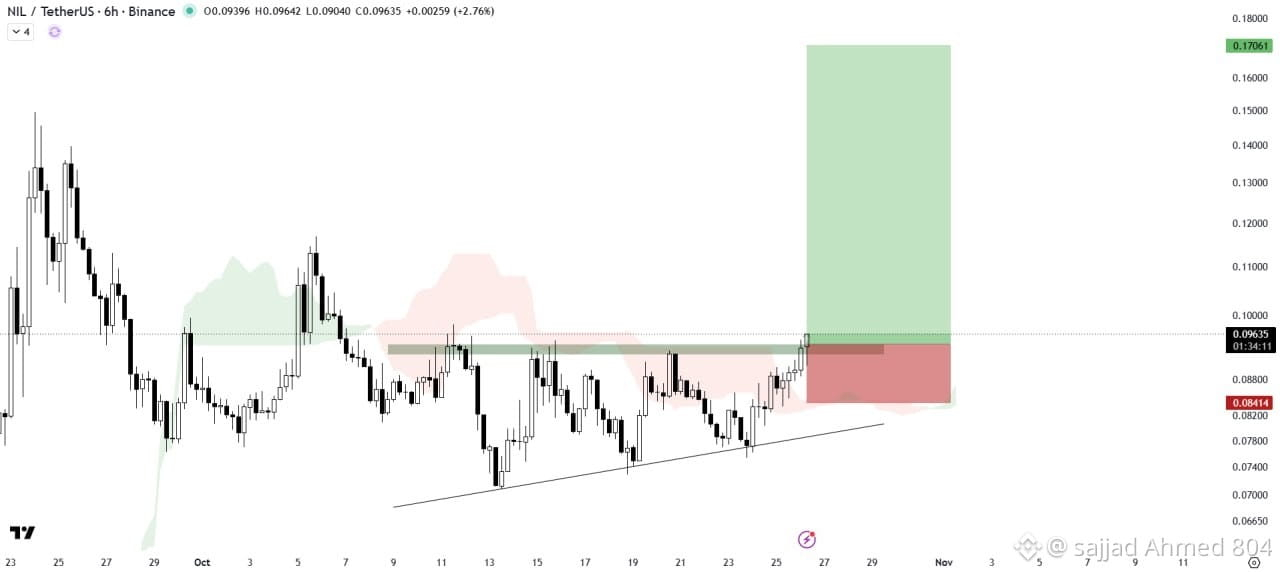
NIL has successfully broken out of the ascending triangle pattern with strong trading volume, indicating increasing buying pressure and strengthening bullish momentum.
The Ichimoku cloud is acting as a key support zone, providing additional strength to the current market structure and supporting the bullish outlook.
If NIL continues to maintain its momentum and holds above the breakout zone, the price could move higher and potentially initiate a strong bullish rally.
Traders should closely monitor price action and volume for further confirmation before expecting a sustained upward move.
$NIL /USDT BUY SETUP
NIL has successfully broken out of the ascending triangle pattern with strong trading volume, indicating increasing buying pressure and strengthening bullish momentum.
The Ichimoku cloud is acting as a key support zone, providing additional strength to the current market structure and supporting the bullish outlook.
If NIL continues to maintain its momentum and holds above the breakout zone, the price could move higher and potentially initiate a strong bullish rally.
Traders should closely monitor price action and volume for further confirmation before expecting a sustained upward move.
NIL has successfully broken out of the ascending triangle pattern with strong trading volume, indicating increasing buying pressure and strengthening bullish momentum.
The Ichimoku cloud is acting as a key support zone, providing additional strength to the current market structure and supporting the bullish outlook.
If NIL continues to maintain its momentum and holds above the breakout zone, the price could move higher and potentially initiate a strong bullish rally.
Traders should closely monitor price action and volume for further confirmation before expecting a sustained upward move.
70
·
--
Bullish
$BTC DOMINANCE ANALYSIS
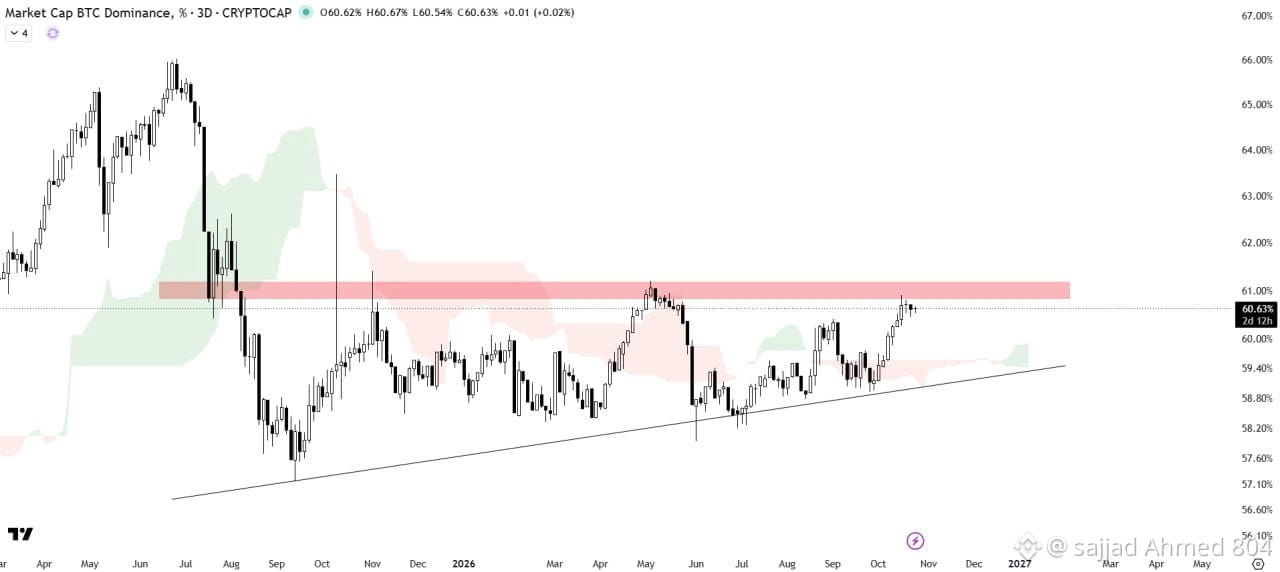
BTC Dominance is facing resistance at the horizontal supply zone of the ascending triangle pattern, while the Ichimoku cloud continues to act as an important support area.
A confirmed breakout above the supply zone could push BTC.D higher, potentially putting additional pressure on altcoins. However, if the price breaks below the Ichimoku cloud, it could signal weakening momentum and open the door for further downside.
For now, the market is at a crucial decision point, and we need confirmation before anticipating the next major move. Keep watching the key resistance and support levels closely.
Remember, BTC Dominance often moves inversely to the altcoin market cap, so any significant move in BTC.D could influence the overall altcoin market direction.
$BTC DOMINANCE ANALYSIS
BTC Dominance is facing resistance at the horizontal supply zone of the ascending triangle pattern, while the Ichimoku cloud continues to act as an important support area.
A confirmed breakout above the supply zone could push BTC.D higher, potentially putting additional pressure on altcoins. However, if the price breaks below the Ichimoku cloud, it could signal weakening momentum and open the door for further downside.
For now, the market is at a crucial decision point, and we need confirmation before anticipating the next major move. Keep watching the key resistance and support levels closely.
Remember, BTC Dominance often moves inversely to the altcoin market cap, so any significant move in BTC.D could influence the overall altcoin market direction.
BTC Dominance is facing resistance at the horizontal supply zone of the ascending triangle pattern, while the Ichimoku cloud continues to act as an important support area.
A confirmed breakout above the supply zone could push BTC.D higher, potentially putting additional pressure on altcoins. However, if the price breaks below the Ichimoku cloud, it could signal weakening momentum and open the door for further downside.
For now, the market is at a crucial decision point, and we need confirmation before anticipating the next major move. Keep watching the key resistance and support levels closely.
Remember, BTC Dominance often moves inversely to the altcoin market cap, so any significant move in BTC.D could influence the overall altcoin market direction.
63
·
--
Bullish
$TOTL.ETF MARKET CAP ANALYSIS
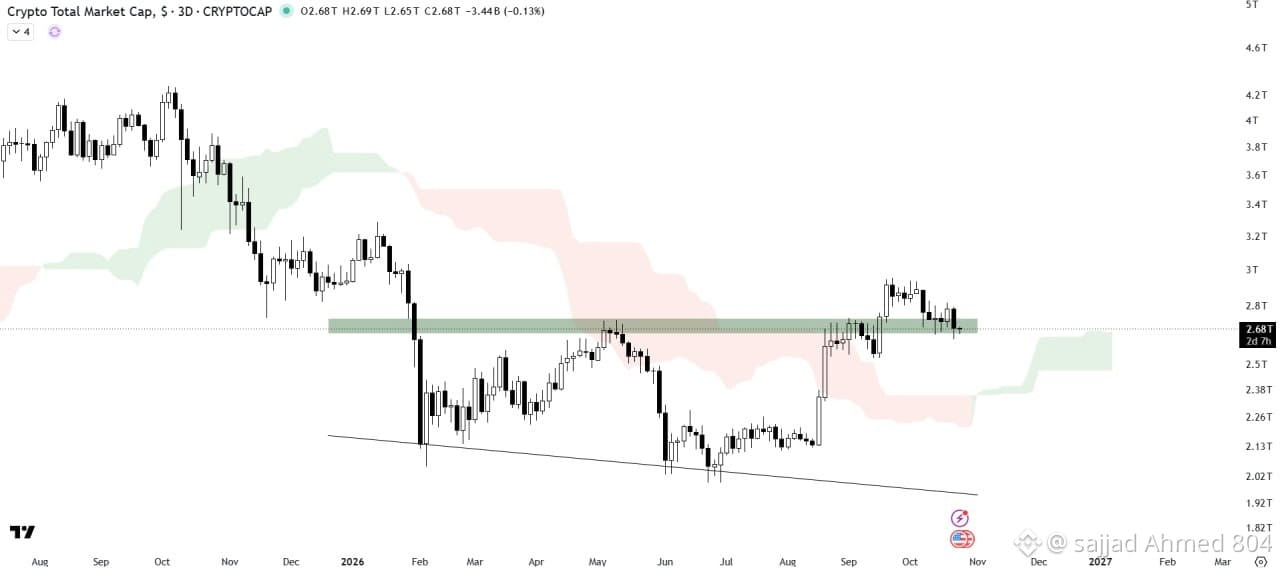
The Total Market Cap is retesting a key horizontal S/R level, while the Ichimoku cloud continues to act as an important support zone. This structure keeps the possibility of a bullish recovery in focus.
If buyers successfully defend this level and maintain upward momentum, the market could see a strong rally, potentially boosting confidence across the entire crypto market.
However, a failed retest and breakdown below this support could shift momentum toward the bears and open the door to further downside. The next price movement will be crucial in determining market direction.
Traders should closely monitor the support level, Ichimoku cloud, and breakout confirmation before making any decisions.
$TOTL.ETF MARKET CAP ANALYSIS
The Total Market Cap is retesting a key horizontal S/R level, while the Ichimoku cloud continues to act as an important support zone. This structure keeps the possibility of a bullish recovery in focus.
If buyers successfully defend this level and maintain upward momentum, the market could see a strong rally, potentially boosting confidence across the entire crypto market.
However, a failed retest and breakdown below this support could shift momentum toward the bears and open the door to further downside. The next price movement will be crucial in determining market direction.
Traders should closely monitor the support level, Ichimoku cloud, and breakout confirmation before making any decisions.
The Total Market Cap is retesting a key horizontal S/R level, while the Ichimoku cloud continues to act as an important support zone. This structure keeps the possibility of a bullish recovery in focus.
If buyers successfully defend this level and maintain upward momentum, the market could see a strong rally, potentially boosting confidence across the entire crypto market.
However, a failed retest and breakdown below this support could shift momentum toward the bears and open the door to further downside. The next price movement will be crucial in determining market direction.
Traders should closely monitor the support level, Ichimoku cloud, and breakout confirmation before making any decisions.
TOTLETF+0.01%
75
·
--
Bearish
$ALT MARKET CAP ANALYSIS
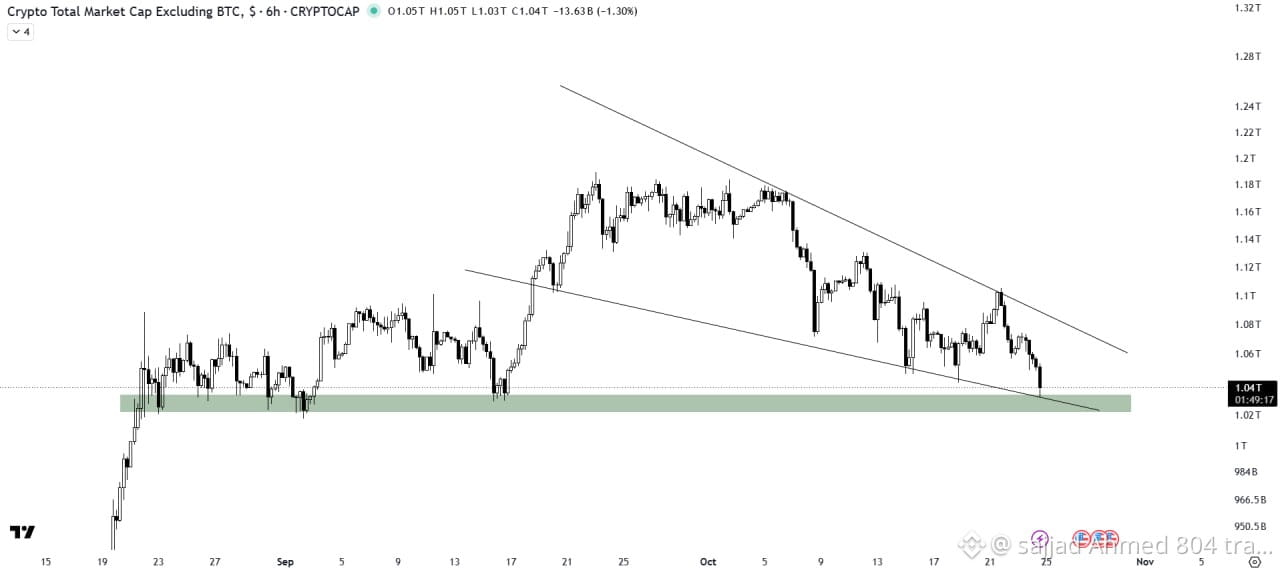
The altcoin market is holding above a key horizontal demand zone while respecting the support trendline of the falling wedge pattern.
If buyers continue to defend these critical support levels, the market could see a potential recovery and renewed bullish momentum.
A confirmed breakout above the wedge resistance would strengthen the bullish outlook and could open the door for a broader rally across altcoins.
The next move will be crucial in determining whether altcoins are ready for a stronger recovery or need more time to consolidate.
Altcoins | CryptoMarket | Altseason
$ALT MARKET CAP ANALYSIS
The altcoin market is holding above a key horizontal demand zone while respecting the support trendline of the falling wedge pattern.
If buyers continue to defend these critical support levels, the market could see a potential recovery and renewed bullish momentum.
A confirmed breakout above the wedge resistance would strengthen the bullish outlook and could open the door for a broader rally across altcoins.
The next move will be crucial in determining whether altcoins are ready for a stronger recovery or need more time to consolidate.
Altcoins | CryptoMarket | Altseason
The altcoin market is holding above a key horizontal demand zone while respecting the support trendline of the falling wedge pattern.
If buyers continue to defend these critical support levels, the market could see a potential recovery and renewed bullish momentum.
A confirmed breakout above the wedge resistance would strengthen the bullish outlook and could open the door for a broader rally across altcoins.
The next move will be crucial in determining whether altcoins are ready for a stronger recovery or need more time to consolidate.
Altcoins | CryptoMarket | Altseason
953
·
--
Bullish
I’ve been around long enough to remember when the internet felt a bit more random. You could start looking for one thing, click a few links, and suddenly find yourself somewhere completely unexpected. There was something exciting about not knowing what you might discover next.
That’s honestly how I ended up reading about Dusk Network while jumping between blockchain and AI projects.
At first, I saw it described as a privacy blockchain for financial applications. Then I learned it’s a layer-1 blockchain behind the Confidential Security Contract, or $BMT , standard, with support for confidential smart contracts. I found that interesting, but I probably would have moved on if something else hadn’t caught my eye.
I kept reading and came across the idea of Dusk as decentralized infrastructure for hosting, running inference on, and verifying AI models at scale. I’m still trying to wrap my head around all of it, so I won’t pretend I have it figured out.
But the thought of open intelligence took me back to the early internet. Openness and accessibility felt important back then. Maybe that’s why this idea stuck with me. I’m not convinced of anything yet, but I’m genuinely curious enough to keep digging.
I’ve been around long enough to remember when the internet felt a bit more random. You could start looking for one thing, click a few links, and suddenly find yourself somewhere completely unexpected. There was something exciting about not knowing what you might discover next.
That’s honestly how I ended up reading about Dusk Network while jumping between blockchain and AI projects.
At first, I saw it described as a privacy blockchain for financial applications. Then I learned it’s a layer-1 blockchain behind the Confidential Security Contract, or $BMT , standard, with support for confidential smart contracts. I found that interesting, but I probably would have moved on if something else hadn’t caught my eye.
I kept reading and came across the idea of Dusk as decentralized infrastructure for hosting, running inference on, and verifying AI models at scale. I’m still trying to wrap my head around all of it, so I won’t pretend I have it figured out.
But the thought of open intelligence took me back to the early internet. Openness and accessibility felt important back then. Maybe that’s why this idea stuck with me. I’m not convinced of anything yet, but I’m genuinely curious enough to keep digging.
That’s honestly how I ended up reading about Dusk Network while jumping between blockchain and AI projects.
At first, I saw it described as a privacy blockchain for financial applications. Then I learned it’s a layer-1 blockchain behind the Confidential Security Contract, or $BMT , standard, with support for confidential smart contracts. I found that interesting, but I probably would have moved on if something else hadn’t caught my eye.
I kept reading and came across the idea of Dusk as decentralized infrastructure for hosting, running inference on, and verifying AI models at scale. I’m still trying to wrap my head around all of it, so I won’t pretend I have it figured out.
But the thought of open intelligence took me back to the early internet. Openness and accessibility felt important back then. Maybe that’s why this idea stuck with me. I’m not convinced of anything yet, but I’m genuinely curious enough to keep digging.

65
·
--
Bearish
I’ve been around long enough to remember when the internet felt a bit more random. You could start looking for one thing, click a few links, and suddenly find yourself somewhere completely unexpected. There was something exciting about not knowing what you might discover next.
That’s honestly how I ended up reading about Dusk Network while jumping between blockchain and AI projects.
At first, I saw it described as a privacy blockchain for financial applications. Then I learned it’s a layer-1 blockchain behind the Confidential Security Contract, or $ETH , standard, with support for confidential smart contracts. I found that interesting, but I probably would have moved on if something else hadn’t caught my eye.
I kept reading and came across the idea of Dusk as decentralized infrastructure for hosting, running inference on, and verifying AI models at scale. I’m still trying to wrap my head around all of it, so I won’t pretend I have it figured out.
But the thought of open intelligence took me back to the early internet. Openness and accessibility felt important back then. Maybe that’s why this idea stuck with me. I’m not convinced of anything yet, but I’m genuinely curious enough to keep digging.
I’ve been around long enough to remember when the internet felt a bit more random. You could start looking for one thing, click a few links, and suddenly find yourself somewhere completely unexpected. There was something exciting about not knowing what you might discover next.
That’s honestly how I ended up reading about Dusk Network while jumping between blockchain and AI projects.
At first, I saw it described as a privacy blockchain for financial applications. Then I learned it’s a layer-1 blockchain behind the Confidential Security Contract, or $ETH , standard, with support for confidential smart contracts. I found that interesting, but I probably would have moved on if something else hadn’t caught my eye.
I kept reading and came across the idea of Dusk as decentralized infrastructure for hosting, running inference on, and verifying AI models at scale. I’m still trying to wrap my head around all of it, so I won’t pretend I have it figured out.
But the thought of open intelligence took me back to the early internet. Openness and accessibility felt important back then. Maybe that’s why this idea stuck with me. I’m not convinced of anything yet, but I’m genuinely curious enough to keep digging.
That’s honestly how I ended up reading about Dusk Network while jumping between blockchain and AI projects.
At first, I saw it described as a privacy blockchain for financial applications. Then I learned it’s a layer-1 blockchain behind the Confidential Security Contract, or $ETH , standard, with support for confidential smart contracts. I found that interesting, but I probably would have moved on if something else hadn’t caught my eye.
I kept reading and came across the idea of Dusk as decentralized infrastructure for hosting, running inference on, and verifying AI models at scale. I’m still trying to wrap my head around all of it, so I won’t pretend I have it figured out.
But the thought of open intelligence took me back to the early internet. Openness and accessibility felt important back then. Maybe that’s why this idea stuck with me. I’m not convinced of anything yet, but I’m genuinely curious enough to keep digging.

174
·
--
Bearish
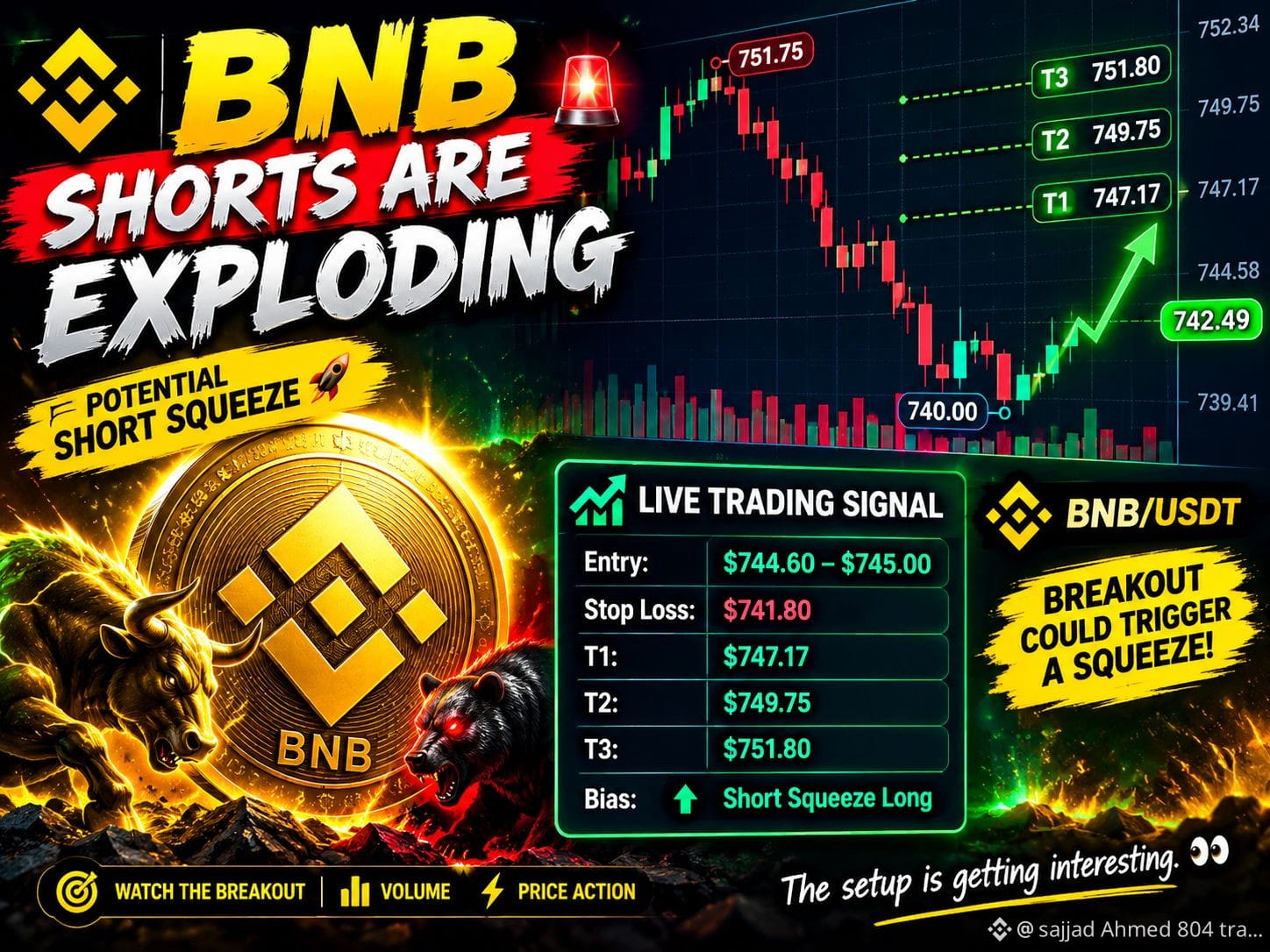
$BNB is trading around $742.49 after a sharp decline from $751.75 to $740.00. The recent selloff came with increased trading volume, while the price is now attempting a recovery.
That's a critical moment for bearish positioning.
If $BNB starts moving higher and breaks above nearby resistance, short covering could provide fuel for a potential rebound. However, the chart does not confirm a massive surge in Bitfinex short positions.
Live Trading Signal:
Entry: $744.60–$745.00
Stop Loss: $741.80
T1: $747.17
T2: $749.75
T3: $751.80
Bias: Short Squeeze Long
Key Support: $740.00
Key Resistance: $744.60
Watch the breakout and volume for confirmation.
$BNB is trading around $742.49 after a sharp decline from $751.75 to $740.00. The recent selloff came with increased trading volume, while the price is now attempting a recovery.
That's a critical moment for bearish positioning.
If $BNB starts moving higher and breaks above nearby resistance, short covering could provide fuel for a potential rebound. However, the chart does not confirm a massive surge in Bitfinex short positions.
Live Trading Signal:
Entry: $744.60–$745.00
Stop Loss: $741.80
T1: $747.17
T2: $749.75
T3: $751.80
Bias: Short Squeeze Long
Key Support: $740.00
Key Resistance: $744.60
Watch the breakout and volume for confirmation.
That's a critical moment for bearish positioning.
If $BNB starts moving higher and breaks above nearby resistance, short covering could provide fuel for a potential rebound. However, the chart does not confirm a massive surge in Bitfinex short positions.
Live Trading Signal:
Entry: $744.60–$745.00
Stop Loss: $741.80
T1: $747.17
T2: $749.75
T3: $751.80
Bias: Short Squeeze Long
Key Support: $740.00
Key Resistance: $744.60
Watch the breakout and volume for confirmation.
235
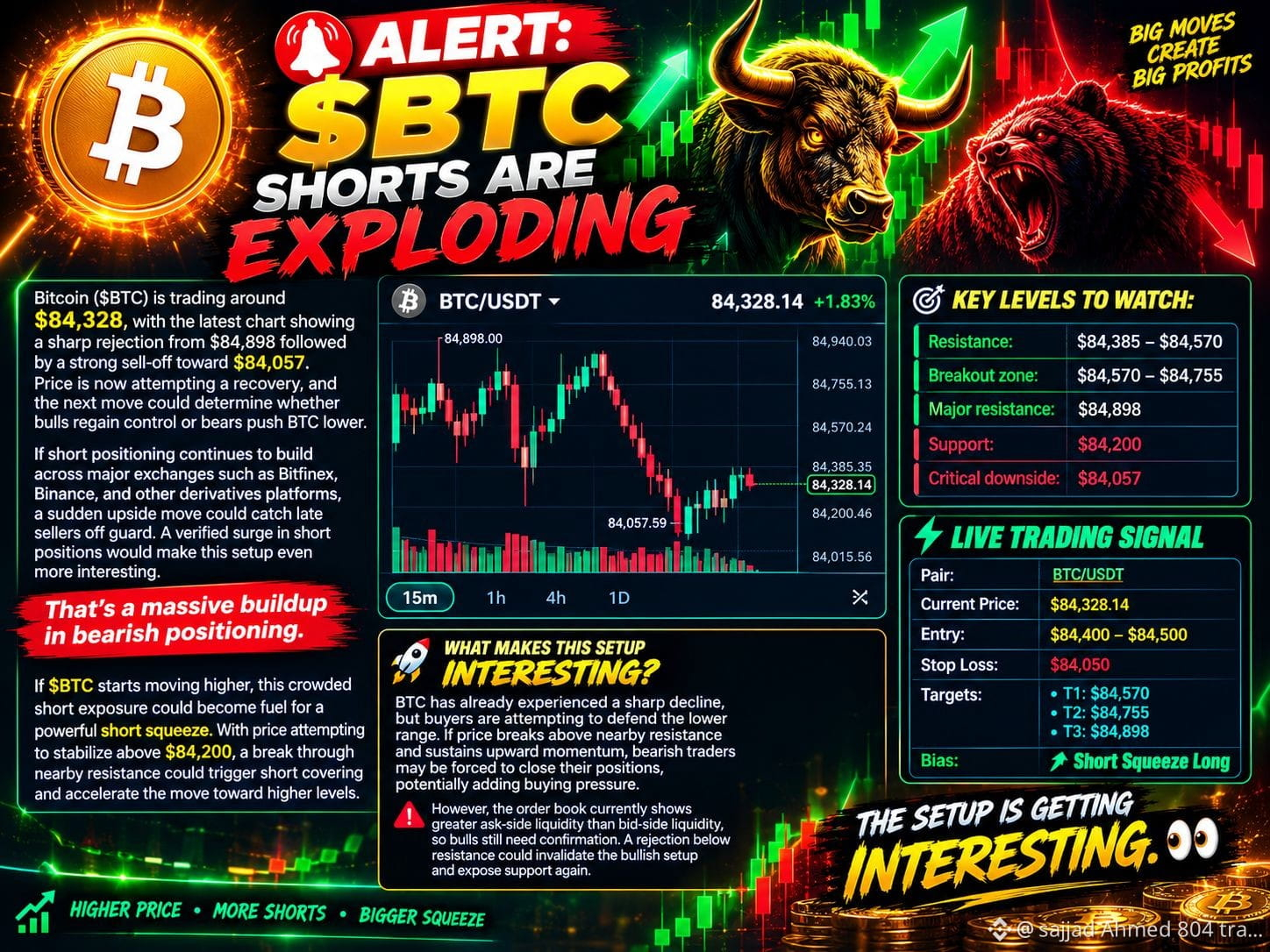
Bitcoin ($BTC ) is trading around $84,328, with the latest chart showing a sharp rejection from $84,898 followed by a strong sell-off toward $84,057. Price is now attempting a recovery, and the next move could determine whether bulls regain control or bears push BTC lower.
If short positioning continues to build across major exchanges such as Bitfinex, Binance, and other derivatives platforms, a sudden upside move could catch late sellers off guard. A verified surge in short positions would make this setup even more interesting.
That's a massive buildup in bearish positioning.
If $BTC starts moving higher, this crowded short exposure could become fuel for a powerful short squeeze. With price attempting to stabilize above $84,200, a break through nearby resistance could trigger short covering and accelerate the move toward higher levels.
Bitcoin ($BTC ) is trading around $84,328, with the latest chart showing a sharp rejection from $84,898 followed by a strong sell-off toward $84,057. Price is now attempting a recovery, and the next move could determine whether bulls regain control or bears push BTC lower.
If short positioning continues to build across major exchanges such as Bitfinex, Binance, and other derivatives platforms, a sudden upside move could catch late sellers off guard. A verified surge in short positions would make this setup even more interesting.
That's a massive buildup in bearish positioning.
If $BTC starts moving higher, this crowded short exposure could become fuel for a powerful short squeeze. With price attempting to stabilize above $84,200, a break through nearby resistance could trigger short covering and accelerate the move toward higher levels.
If short positioning continues to build across major exchanges such as Bitfinex, Binance, and other derivatives platforms, a sudden upside move could catch late sellers off guard. A verified surge in short positions would make this setup even more interesting.
That's a massive buildup in bearish positioning.
If $BTC starts moving higher, this crowded short exposure could become fuel for a powerful short squeeze. With price attempting to stabilize above $84,200, a break through nearby resistance could trigger short covering and accelerate the move toward higher levels.
110
·
--
Bullish
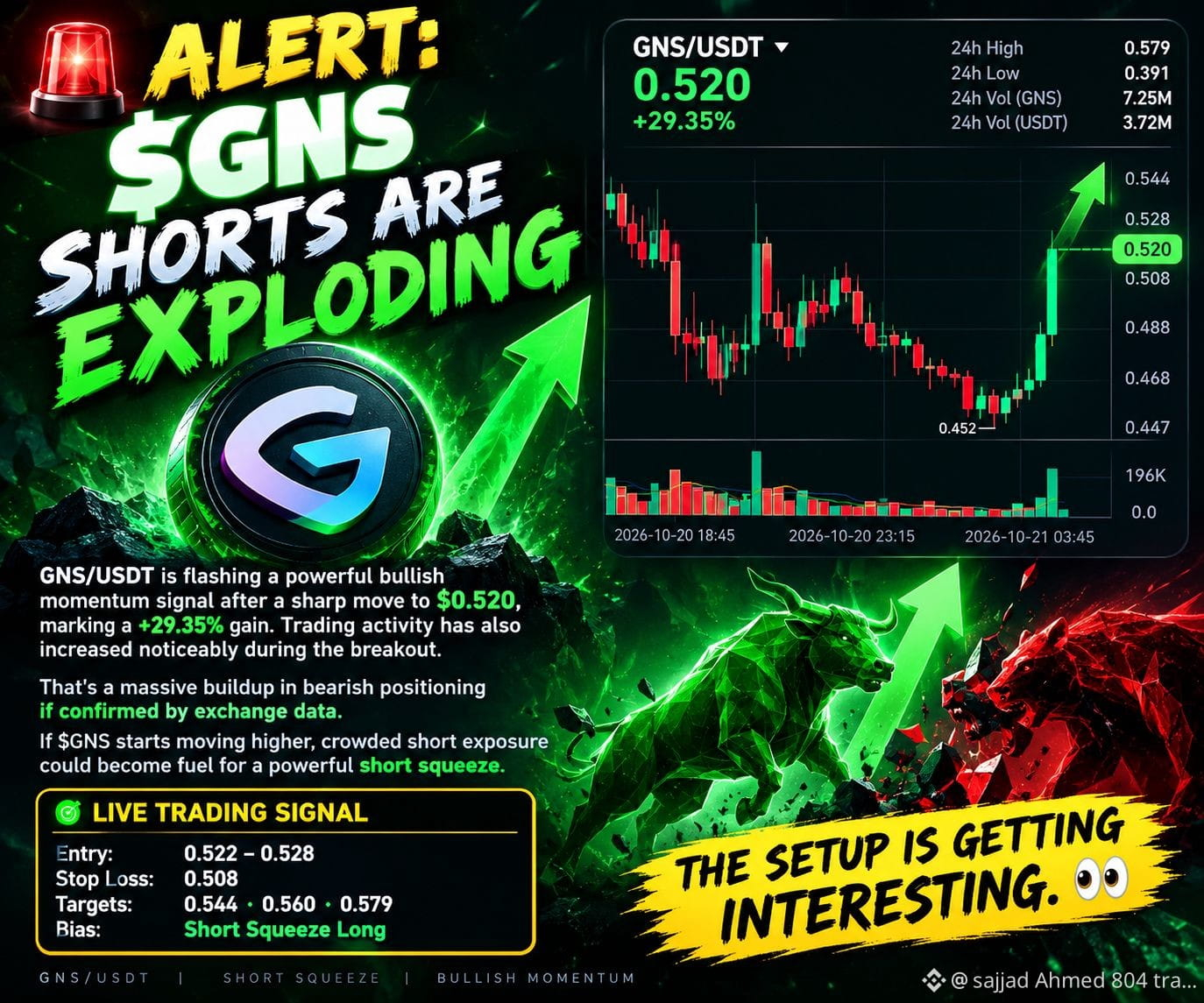
$GNS /USDT is flashing a powerful bullish momentum signal after a sharp move to $0.520, marking a +29.35% gain. The latest chart shows an aggressive green candle pushing price upward from the recent lows near $0.452. Trading activity has also increased noticeably during the breakout, suggesting that buyers have returned with considerable strength. However, the screenshot does not provide verified Bitfinex short-position figures, so a 5,000%–20,000% surge in shorts cannot be confirmed.
That's a massive buildup in bearish positioning if confirmed by exchange data.
If $GNS starts moving higher, crowded short exposure could become fuel for a powerful short squeeze. The sudden upward move could pressure traders holding bearish positions, potentially triggering forced buybacks and accelerating the rally. Momentum is clearly stronger than it was during the recent decline, but the next move depends on whether buyers can maintain control above the breakout area.
Key levels to watch: GNS is currently trading around $0.520, with a reported 24-hour high of $0.579 and low of $0.391. The recent price action shows a recovery from approximately $0.452, followed by a sharp push through the $0.488 region. Holding above the breakout area could support another attempt toward nearby resistance. A rejection, however, could quickly send price back toward support.
The next important signal is whether GNS can sustain its momentum rather than surrendering the latest gains. Strong follow-through and continued buying activity would strengthen the bullish setup. A rapid drop below the breakout zone would weaken it.
$GNS /USDT is flashing a powerful bullish momentum signal after a sharp move to $0.520, marking a +29.35% gain. The latest chart shows an aggressive green candle pushing price upward from the recent lows near $0.452. Trading activity has also increased noticeably during the breakout, suggesting that buyers have returned with considerable strength. However, the screenshot does not provide verified Bitfinex short-position figures, so a 5,000%–20,000% surge in shorts cannot be confirmed.
That's a massive buildup in bearish positioning if confirmed by exchange data.
If $GNS starts moving higher, crowded short exposure could become fuel for a powerful short squeeze. The sudden upward move could pressure traders holding bearish positions, potentially triggering forced buybacks and accelerating the rally. Momentum is clearly stronger than it was during the recent decline, but the next move depends on whether buyers can maintain control above the breakout area.
Key levels to watch: GNS is currently trading around $0.520, with a reported 24-hour high of $0.579 and low of $0.391. The recent price action shows a recovery from approximately $0.452, followed by a sharp push through the $0.488 region. Holding above the breakout area could support another attempt toward nearby resistance. A rejection, however, could quickly send price back toward support.
The next important signal is whether GNS can sustain its momentum rather than surrendering the latest gains. Strong follow-through and continued buying activity would strengthen the bullish setup. A rapid drop below the breakout zone would weaken it.
That's a massive buildup in bearish positioning if confirmed by exchange data.
If $GNS starts moving higher, crowded short exposure could become fuel for a powerful short squeeze. The sudden upward move could pressure traders holding bearish positions, potentially triggering forced buybacks and accelerating the rally. Momentum is clearly stronger than it was during the recent decline, but the next move depends on whether buyers can maintain control above the breakout area.
Key levels to watch: GNS is currently trading around $0.520, with a reported 24-hour high of $0.579 and low of $0.391. The recent price action shows a recovery from approximately $0.452, followed by a sharp push through the $0.488 region. Holding above the breakout area could support another attempt toward nearby resistance. A rejection, however, could quickly send price back toward support.
The next important signal is whether GNS can sustain its momentum rather than surrendering the latest gains. Strong follow-through and continued buying activity would strengthen the bullish setup. A rapid drop below the breakout zone would weaken it.
219
·
--
Bullish
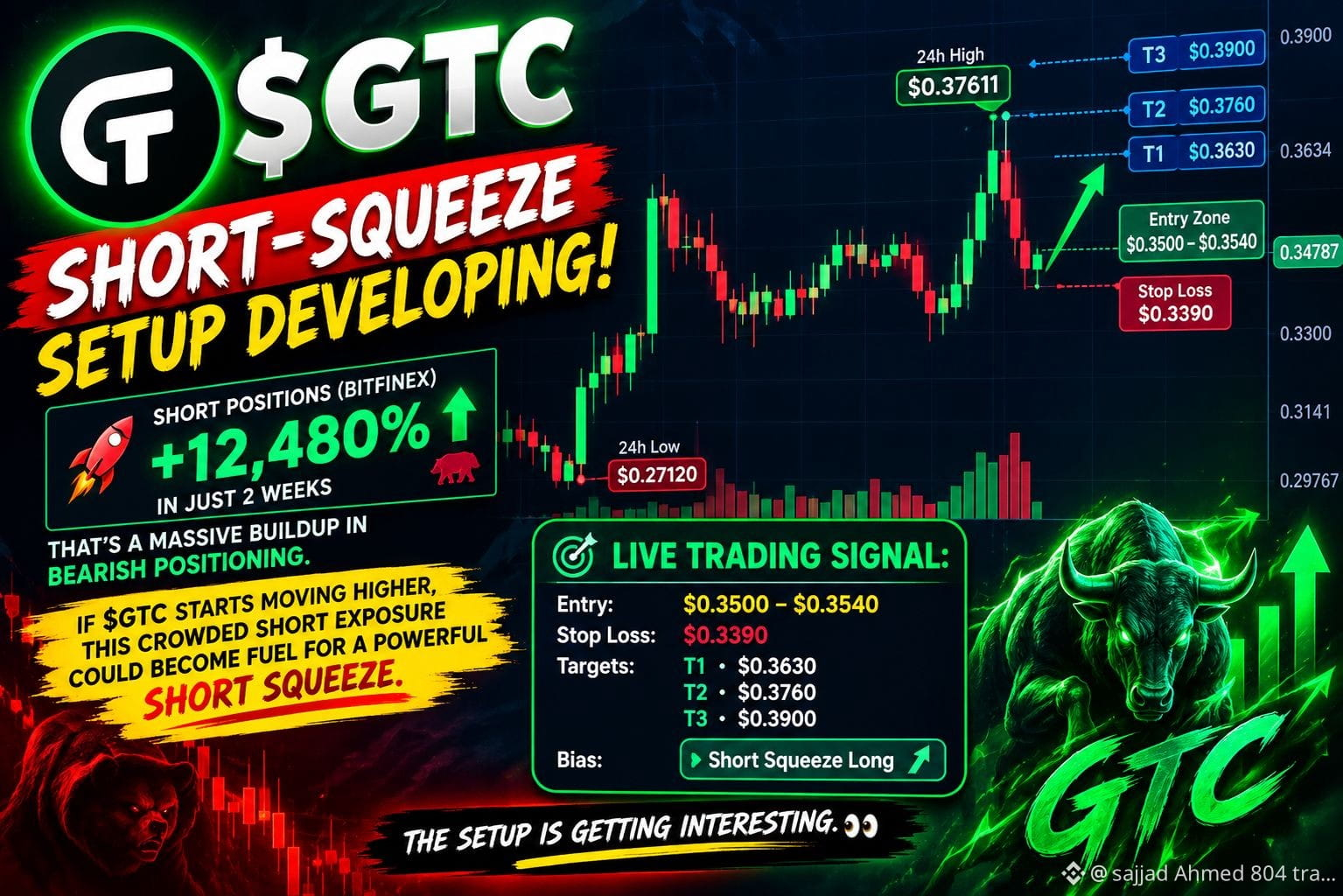
$GTC is showing explosive momentum, and the latest chart suggests that bulls are preparing for another serious test of overhead resistance. GTC/USDT is trading around $0.34787, up 25.22%, after climbing from the $0.27120 daily low to a high of $0.37611. Buyers have already demonstrated that they can push price higher aggressively, but the latest rejection shows that the next move needs confirmation.
The derivatives market adds another interesting angle. Binance GTCUSDT perpetual funding was negative at -0.0234% at 00:00 UTC on October 20, following substantially more negative readings during previous sessions. Negative funding can indicate that bearish positioning is paying a premium, creating conditions where a sustained upward move may pressure short sellers. However, these readings do not establish a verified 5,000%–20,000% increase in short positions on Bitfinex.
Pandabull
That's a potentially powerful bearish-positioning setup to watch.
If $GTC starts moving higher and resistance breaks, crowded short exposure could become fuel for a powerful short squeeze. Forced covering can accelerate an existing move, especially when price rises quickly and sellers scramble to manage their positions.
The immediate level to watch is $0.3500. A convincing move above this area could bring fresh momentum into the market. Beyond that, $0.3634 becomes the next important resistance zone, followed by the recent high near $0.37611.
A clean breakout above the daily high would strengthen the bullish continuation scenario. But another rejection could send price back toward nearby support, so confirmation matters.
$GTC is showing explosive momentum, and the latest chart suggests that bulls are preparing for another serious test of overhead resistance. GTC/USDT is trading around $0.34787, up 25.22%, after climbing from the $0.27120 daily low to a high of $0.37611. Buyers have already demonstrated that they can push price higher aggressively, but the latest rejection shows that the next move needs confirmation.
The derivatives market adds another interesting angle. Binance GTCUSDT perpetual funding was negative at -0.0234% at 00:00 UTC on October 20, following substantially more negative readings during previous sessions. Negative funding can indicate that bearish positioning is paying a premium, creating conditions where a sustained upward move may pressure short sellers. However, these readings do not establish a verified 5,000%–20,000% increase in short positions on Bitfinex.
Pandabull
That's a potentially powerful bearish-positioning setup to watch.
If $GTC starts moving higher and resistance breaks, crowded short exposure could become fuel for a powerful short squeeze. Forced covering can accelerate an existing move, especially when price rises quickly and sellers scramble to manage their positions.
The immediate level to watch is $0.3500. A convincing move above this area could bring fresh momentum into the market. Beyond that, $0.3634 becomes the next important resistance zone, followed by the recent high near $0.37611.
A clean breakout above the daily high would strengthen the bullish continuation scenario. But another rejection could send price back toward nearby support, so confirmation matters.
The derivatives market adds another interesting angle. Binance GTCUSDT perpetual funding was negative at -0.0234% at 00:00 UTC on October 20, following substantially more negative readings during previous sessions. Negative funding can indicate that bearish positioning is paying a premium, creating conditions where a sustained upward move may pressure short sellers. However, these readings do not establish a verified 5,000%–20,000% increase in short positions on Bitfinex.
Pandabull
That's a potentially powerful bearish-positioning setup to watch.
If $GTC starts moving higher and resistance breaks, crowded short exposure could become fuel for a powerful short squeeze. Forced covering can accelerate an existing move, especially when price rises quickly and sellers scramble to manage their positions.
The immediate level to watch is $0.3500. A convincing move above this area could bring fresh momentum into the market. Beyond that, $0.3634 becomes the next important resistance zone, followed by the recent high near $0.37611.
A clean breakout above the daily high would strengthen the bullish continuation scenario. But another rejection could send price back toward nearby support, so confirmation matters.
1
115
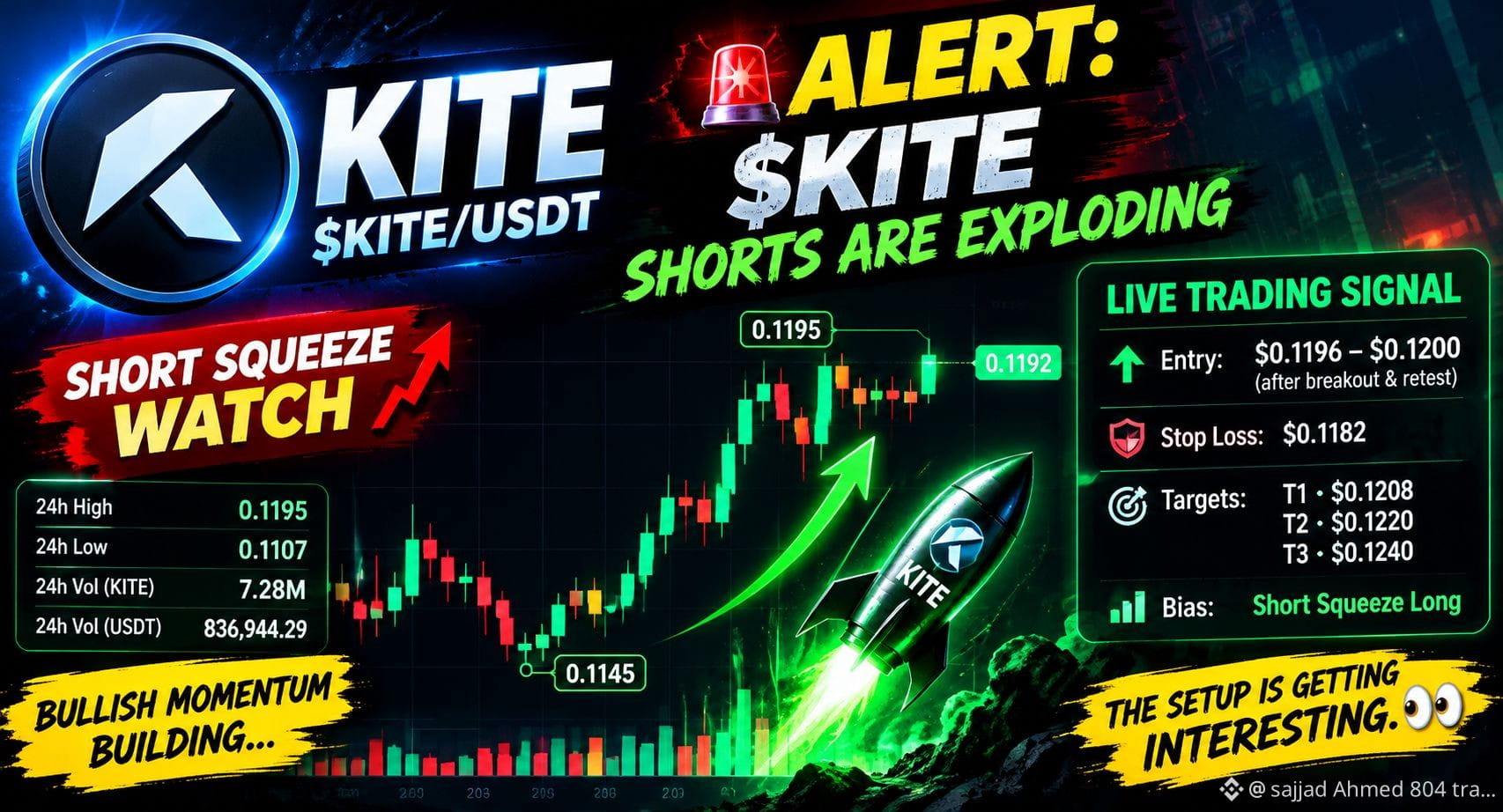
$KITE /USDT is approaching a critical resistance zone after a strong recovery from the $0.1145 area. The screenshot shows KITE trading around $0.1192, up 3.65% over 24 hours, with a recorded high of $0.1195. However, a 5,000%–20,000% surge in short positions cannot be verified from the chart, so those figures should not be presented as actual exchange data.
That's a potential turning point for short-term momentum.
If $KITE breaks above $0.1195 and holds the breakout, bearish traders entering near resistance could face increasing pressure. A confirmed move higher could attract additional buying and create conditions for a short squeeze. But a failed breakout could send price back toward nearby support.
The key level to watch is $0.1195.
The recent candles show buyers pushing price back toward the local high after a pullback. That recovery is worth watching, but confirmation matters more than the first breakout candle. The screenshot also shows approximately $836,944 in 24-hour USDT volume, while the order book displays more sell-side liquidity than buy-side liquidity at the moment captured.
Live Trading Signal:
Entry: $0.1196–$0.1200, only after a confirmed breakout and successful retest.
Stop Loss: $0.1182.
Targets: T1 • $0.1208
T2 • $0.1220
T3 • $0.1240
Bias: Short Squeeze Long — conditional on breakout confirmation.
$KITE /USDT is approaching a critical resistance zone after a strong recovery from the $0.1145 area. The screenshot shows KITE trading around $0.1192, up 3.65% over 24 hours, with a recorded high of $0.1195. However, a 5,000%–20,000% surge in short positions cannot be verified from the chart, so those figures should not be presented as actual exchange data.
That's a potential turning point for short-term momentum.
If $KITE breaks above $0.1195 and holds the breakout, bearish traders entering near resistance could face increasing pressure. A confirmed move higher could attract additional buying and create conditions for a short squeeze. But a failed breakout could send price back toward nearby support.
The key level to watch is $0.1195.
The recent candles show buyers pushing price back toward the local high after a pullback. That recovery is worth watching, but confirmation matters more than the first breakout candle. The screenshot also shows approximately $836,944 in 24-hour USDT volume, while the order book displays more sell-side liquidity than buy-side liquidity at the moment captured.
Live Trading Signal:
Entry: $0.1196–$0.1200, only after a confirmed breakout and successful retest.
Stop Loss: $0.1182.
Targets: T1 • $0.1208
T2 • $0.1220
T3 • $0.1240
Bias: Short Squeeze Long — conditional on breakout confirmation.
That's a potential turning point for short-term momentum.
If $KITE breaks above $0.1195 and holds the breakout, bearish traders entering near resistance could face increasing pressure. A confirmed move higher could attract additional buying and create conditions for a short squeeze. But a failed breakout could send price back toward nearby support.
The key level to watch is $0.1195.
The recent candles show buyers pushing price back toward the local high after a pullback. That recovery is worth watching, but confirmation matters more than the first breakout candle. The screenshot also shows approximately $836,944 in 24-hour USDT volume, while the order book displays more sell-side liquidity than buy-side liquidity at the moment captured.
Live Trading Signal:
Entry: $0.1196–$0.1200, only after a confirmed breakout and successful retest.
Stop Loss: $0.1182.
Targets: T1 • $0.1208
T2 • $0.1220
T3 • $0.1240
Bias: Short Squeeze Long — conditional on breakout confirmation.
123
·
--
Bullish
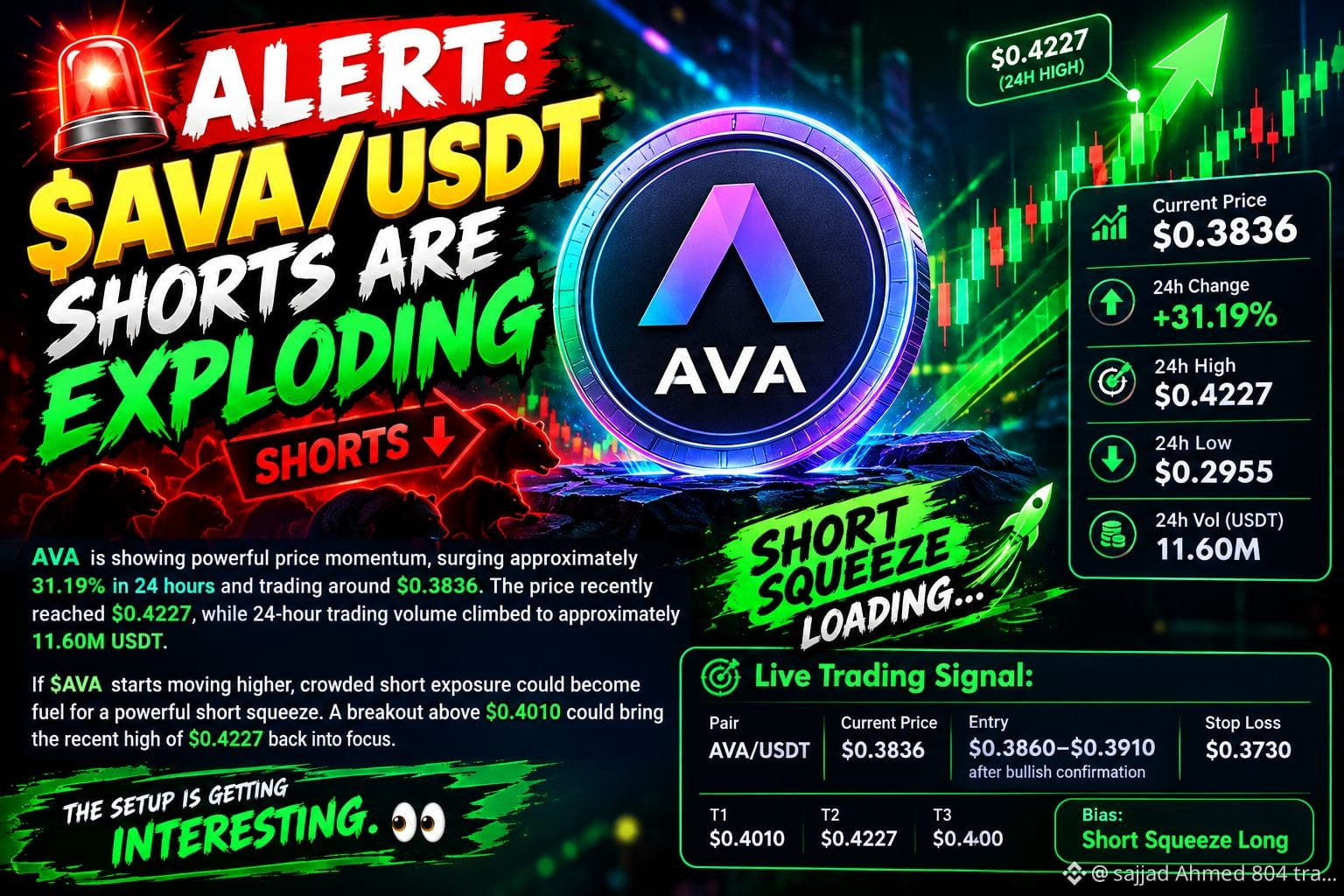
🚨 $AVA is showing powerful price momentum, surging approximately 31.19% in 24 hours and trading around $0.3836. The price recently reached $0.4227, while 24-hour trading volume climbed to approximately 11.60M USDT. This puts AVA at a critical point where the next move could determine whether bullish momentum returns.
Short positions on Bitfinex have not been independently verified, so the scale of any short buildup remains uncertain. However, if bearish positioning is increasing while AVA holds above key support, a sudden upward move could put short sellers under serious pressure.
That's a massive potential buildup in bearish positioning if short exposure continues rising.
If $AVA starts moving higher, crowded short exposure could become fuel for a powerful short squeeze. A breakout above $0.4010 could bring the recent high of $0.4227 back into focus. If buying pressure accelerates, the market could attempt another leg higher as short sellers rush to cover their positions.
Live Trading Signal:
Pair: AVA/USDT
Current Price: $0.3836
Entry: $0.3860–$0.3910 after bullish confirmation
Stop Loss: $0.3730
T1: $0.4010
T2: $0.4227
T3: $0.4400
Bias: Short Squeeze Long
The setup is getting interesting.
🚨 $AVA is showing powerful price momentum, surging approximately 31.19% in 24 hours and trading around $0.3836. The price recently reached $0.4227, while 24-hour trading volume climbed to approximately 11.60M USDT. This puts AVA at a critical point where the next move could determine whether bullish momentum returns.
Short positions on Bitfinex have not been independently verified, so the scale of any short buildup remains uncertain. However, if bearish positioning is increasing while AVA holds above key support, a sudden upward move could put short sellers under serious pressure.
That's a massive potential buildup in bearish positioning if short exposure continues rising.
If $AVA starts moving higher, crowded short exposure could become fuel for a powerful short squeeze. A breakout above $0.4010 could bring the recent high of $0.4227 back into focus. If buying pressure accelerates, the market could attempt another leg higher as short sellers rush to cover their positions.
Live Trading Signal:
Pair: AVA/USDT
Current Price: $0.3836
Entry: $0.3860–$0.3910 after bullish confirmation
Stop Loss: $0.3730
T1: $0.4010
T2: $0.4227
T3: $0.4400
Bias: Short Squeeze Long
The setup is getting interesting.
Short positions on Bitfinex have not been independently verified, so the scale of any short buildup remains uncertain. However, if bearish positioning is increasing while AVA holds above key support, a sudden upward move could put short sellers under serious pressure.
That's a massive potential buildup in bearish positioning if short exposure continues rising.
If $AVA starts moving higher, crowded short exposure could become fuel for a powerful short squeeze. A breakout above $0.4010 could bring the recent high of $0.4227 back into focus. If buying pressure accelerates, the market could attempt another leg higher as short sellers rush to cover their positions.
Live Trading Signal:
Pair: AVA/USDT
Current Price: $0.3836
Entry: $0.3860–$0.3910 after bullish confirmation
Stop Loss: $0.3730
T1: $0.4010
T2: $0.4227
T3: $0.4400
Bias: Short Squeeze Long
The setup is getting interesting.
151
Verified
Nillion is working on a problem most blockchains still struggle with: keeping sensitive data private while actually using it.
Its Covenants technology, starting with Dusk, focuses on protecting trading instructions until they're needed.
A stop-loss shouldn't have to expose your strategy to the whole market.
That's what makes Nillion interesting to me. Privacy isn't just about hiding information. It's about deciding when to reveal it.
#nil $NIL @nillionnetwork
Nillion is working on a problem most blockchains still struggle with: keeping sensitive data private while actually using it.
Its Covenants technology, starting with Dusk, focuses on protecting trading instructions until they're needed.
A stop-loss shouldn't have to expose your strategy to the whole market.
That's what makes Nillion interesting to me. Privacy isn't just about hiding information. It's about deciding when to reveal it.
#nil $NIL @Nillion
Its Covenants technology, starting with Dusk, focuses on protecting trading instructions until they're needed.
A stop-loss shouldn't have to expose your strategy to the whole market.
That's what makes Nillion interesting to me. Privacy isn't just about hiding information. It's about deciding when to reveal it.
#nil $NIL @Nillion

1
194
Removing tokens permanently from circulation helps create natural scarcity.
Removing tokens permanently from circulation helps create natural scarcity.


Ledger Bull
·
--
BullishAevo is changing the game with its tokenomics!
$AEVO is evolving beyond a simple governance token.
Real trading activity is now connected to supply reduction.
74 million AEVO tokens have already been burned.
Monthly buybacks use trading fees to purchase and permanently remove tokens from circulation.
Even the 1 million AEVO distributed weekly comes from the existing fixed supply.
No new issuance from weekly rewards.
No scheduled unlocks remaining.
Just a clear mechanism connecting trading activity with token supply.
While $ARB , $OP , and $DYDX follow their own token models, Aevo is taking a different approach.
For me, the interesting part is the fee-funded buybacks and supply reduction mechanism, not the hype.
Not financial advice , just information post
#AEVO #Tokenomics #DeFi #CryptoTrading #Blockchain .
$AEVO is evolving beyond a simple governance token.
Real trading activity is now connected to supply reduction.
74 million AEVO tokens have already been burned.
Monthly buybacks use trading fees to purchase and permanently remove tokens from circulation.
Even the 1 million AEVO distributed weekly comes from the existing fixed supply.
No new issuance from weekly rewards.
No scheduled unlocks remaining.
Just a clear mechanism connecting trading activity with token supply.
While $ARB , $OP , and $DYDX follow their own token models, Aevo is taking a different approach.
For me, the interesting part is the fee-funded buybacks and supply reduction mechanism, not the hype.
Not financial advice , just information post
#AEVO #Tokenomics #DeFi #CryptoTrading #Blockchain .

116
$SYN /USDC is moving higher with a +4.94% gain. The price is currently around $0.18478, showing steady upside momentum during the session. While SYN is not leading the board, the move still places it among the stronger-performing assets shown in the screenshot. The next test is whether buyers can maintain the current structure and gradually push price toward higher resistance zones. A healthy consolidation would strengthen the setup, while a quick rejection could bring short-term profit-taking. For now, SYN is showing constructive momentum and remains an interesting asset to watch if broader altcoin strength continues.
#FedMinutesFocusOnOctoberPause #BinanceLaunchesBinanceIntelligence
$SYN /USDC is moving higher with a +4.94% gain. The price is currently around $0.18478, showing steady upside momentum during the session. While SYN is not leading the board, the move still places it among the stronger-performing assets shown in the screenshot. The next test is whether buyers can maintain the current structure and gradually push price toward higher resistance zones. A healthy consolidation would strengthen the setup, while a quick rejection could bring short-term profit-taking. For now, SYN is showing constructive momentum and remains an interesting asset to watch if broader altcoin strength continues.
#FedMinutesFocusOnOctoberPause #BinanceLaunchesBinanceIntelligence
#FedMinutesFocusOnOctoberPause #BinanceLaunchesBinanceIntelligence
127
$SAND /USDC is also up +4.94%, closely matching the strength in SAND/USDT. Trading around $0.06991, the pair is showing consistent momentum across both markets. That alignment is worth noting because it suggests the move is not isolated to one trading pair. The next challenge is whether SAND can maintain its position above the recent trading zone. If buyers continue supporting the price, the current move could develop into a stronger trend. However, after a positive session, profit-taking can appear quickly. SAND remains one of the assets worth monitoring as the market decides whether this momentum can continue.
#FedMinutesFocusOnOctoberPause #BinanceLaunchesBinanceIntelligence
$SAND /USDC is also up +4.94%, closely matching the strength in SAND/USDT. Trading around $0.06991, the pair is showing consistent momentum across both markets. That alignment is worth noting because it suggests the move is not isolated to one trading pair. The next challenge is whether SAND can maintain its position above the recent trading zone. If buyers continue supporting the price, the current move could develop into a stronger trend. However, after a positive session, profit-taking can appear quickly. SAND remains one of the assets worth monitoring as the market decides whether this momentum can continue.
#FedMinutesFocusOnOctoberPause #BinanceLaunchesBinanceIntelligence
#FedMinutesFocusOnOctoberPause #BinanceLaunchesBinanceIntelligence
226
$TRX /XRP is gaining +4.60%, showing positive momentum against XRP. The current price is around 0.2321, with buyers pushing the pair higher during the session. Compared with some of the double-digit movers on the list, the gain is more moderate, but the move still signals improving relative strength. The key now is whether TRX can hold the advance and build support around the current zone. Continued buying could strengthen the trend, while a quick pullback would suggest that traders are taking profits. For now, TRX/XRP remains a notable performer in this market snapshot.
#FedMinutesFocusOnOctoberPause #BinanceLaunchesBinanceIntelligence
$TRX /XRP is gaining +4.60%, showing positive momentum against XRP. The current price is around 0.2321, with buyers pushing the pair higher during the session. Compared with some of the double-digit movers on the list, the gain is more moderate, but the move still signals improving relative strength. The key now is whether TRX can hold the advance and build support around the current zone. Continued buying could strengthen the trend, while a quick pullback would suggest that traders are taking profits. For now, TRX/XRP remains a notable performer in this market snapshot.
#FedMinutesFocusOnOctoberPause #BinanceLaunchesBinanceIntelligence
#FedMinutesFocusOnOctoberPause #BinanceLaunchesBinanceIntelligence
101
$ORCA /USDC is showing a +6.45% gain, keeping strong momentum alive. The price is around $2.723, with buyers pushing the token higher during the current session. Interestingly, ORCA/USDT is also showing almost the same performance, suggesting consistent strength across both pairs. The next step is whether ORCA can maintain its current zone after the initial rally. A controlled consolidation would provide a stronger signal than another sudden spike. If buyers continue defending higher prices, the momentum could remain active. For now, ORCA is clearly benefiting from the broader strength visible across the market.
#FedMinutesFocusOnOctoberPause #BinanceLaunchesBinanceIntelligence
$ORCA /USDC is showing a +6.45% gain, keeping strong momentum alive. The price is around $2.723, with buyers pushing the token higher during the current session. Interestingly, ORCA/USDT is also showing almost the same performance, suggesting consistent strength across both pairs. The next step is whether ORCA can maintain its current zone after the initial rally. A controlled consolidation would provide a stronger signal than another sudden spike. If buyers continue defending higher prices, the momentum could remain active. For now, ORCA is clearly benefiting from the broader strength visible across the market.
#FedMinutesFocusOnOctoberPause #BinanceLaunchesBinanceIntelligence
#FedMinutesFocusOnOctoberPause #BinanceLaunchesBinanceIntelligence
31
$ORCA /USDT is climbing +6.41% and continues to show healthy buying interest. Trading around $2.723, the pair is moving almost identically to ORCA/USDC. That makes the current strength more interesting because both markets are reflecting similar momentum. The key level from here is not simply the daily percentage gain, but whether price can stay elevated after the first wave of buyers slows down. If ORCA builds support around the current range, traders may look for continuation. If price quickly falls back, the move could turn into a short-term momentum spike instead.
#FedMinutesFocusOnOctoberPause #BinanceLaunchesBinanceIntelligence
$ORCA /USDT is climbing +6.41% and continues to show healthy buying interest. Trading around $2.723, the pair is moving almost identically to ORCA/USDC. That makes the current strength more interesting because both markets are reflecting similar momentum. The key level from here is not simply the daily percentage gain, but whether price can stay elevated after the first wave of buyers slows down. If ORCA builds support around the current range, traders may look for continuation. If price quickly falls back, the move could turn into a short-term momentum spike instead.
#FedMinutesFocusOnOctoberPause #BinanceLaunchesBinanceIntelligence
#FedMinutesFocusOnOctoberPause #BinanceLaunchesBinanceIntelligence
115
$ATM /USDT is posting a solid +5.39% gain. The price is currently around $1.095, showing that buyers are steadily pushing the asset higher. While the percentage move is smaller than some of the top performers, ATM is still participating in the broader market strength. The important part now is whether buyers can continue building higher lows instead of allowing the move to fade. Sustained demand near the current price could keep momentum alive. After a strong session, however, traders should remain alert for profit-taking. ATM has definitely entered the group of coins worth watching for continuation.
#FedMinutesFocusOnOctoberPause #BinanceLaunchesBinanceIntelligence
$ATM /USDT is posting a solid +5.39% gain. The price is currently around $1.095, showing that buyers are steadily pushing the asset higher. While the percentage move is smaller than some of the top performers, ATM is still participating in the broader market strength. The important part now is whether buyers can continue building higher lows instead of allowing the move to fade. Sustained demand near the current price could keep momentum alive. After a strong session, however, traders should remain alert for profit-taking. ATM has definitely entered the group of coins worth watching for continuation.
#FedMinutesFocusOnOctoberPause #BinanceLaunchesBinanceIntelligence
#FedMinutesFocusOnOctoberPause #BinanceLaunchesBinanceIntelligence
214
Log in to explore more content
Join global crypto users on Binance Square
⚡️ Get latest and useful information about crypto.
💬 Trusted by the world’s largest crypto exchange.
👍 Discover real insights from verified creators.
Email / Phone number