Binance Square
kingcrypto503
6k Posts

kingcrypto503

ALLAH IS GREAT. X ID Alijaan71974
504 Following
179 Followers
1.0K+ Liked
Posts
·
--
Before Smarter AI, We Need Stronger FoundationsMost conversations about AI start with the models themselves. Bigger models. Better reasoning. Faster responses. I used to think that was where the real innovation lived. But the more I look at how AI systems are actually deployed, the more it feels like the foundation matters just as much as the intelligence sitting on top of it. It's a bit like building a city. People admire the skyline, yet very few think about the water pipes, power grid, or roads underneath. Those invisible systems rarely make headlines—until they fail. AI infrastructure feels similar. Security is easy to treat as a feature that comes later, when in reality it quietly shapes everything that follows. You can already see hints of this in onchain systems. A protocol with clever mechanics but weak security often spends more energy recovering trust than improving the product. The second-order cost isn't only the exploit itself. It's the slowdown in experimentation, the extra friction between participants, and the hesitation to build on top of uncertain foundations. That makes me wonder if secure infrastructure does more than protect AI. As these systems scale, it may influence what kinds of ideas people are willing to test in the first place. Confidence becomes a resource, not just a feeling. When builders trust the underlying systems, they tend to take more thoughtful risks, and those choices compound over time. I'm not certain secure infrastructure is the biggest driver of AI innovation. But I find myself thinking that the most important breakthroughs may depend less on making intelligence more capable, and more on making its foundations quietly dependable. #Newt @NewtonProtocol l $VANRY $BEL #newt #newt $NEWT

Before Smarter AI, We Need Stronger Foundations

Most conversations about AI start with the models themselves. Bigger models. Better reasoning. Faster responses.
I used to think that was where the real innovation lived. But the more I look at how AI systems are actually deployed, the more it feels like the foundation matters just as much as the intelligence sitting on top of it.
It's a bit like building a city. People admire the skyline, yet very few think about the water pipes, power grid, or roads underneath. Those invisible systems rarely make headlines—until they fail. AI infrastructure feels similar. Security is easy to treat as a feature that comes later, when in reality it quietly shapes everything that follows.
You can already see hints of this in onchain systems. A protocol with clever mechanics but weak security often spends more energy recovering trust than improving the product. The second-order cost isn't only the exploit itself. It's the slowdown in experimentation, the extra friction between participants, and the hesitation to build on top of uncertain foundations.
That makes me wonder if secure infrastructure does more than protect AI. As these systems scale, it may influence what kinds of ideas people are willing to test in the first place. Confidence becomes a resource, not just a feeling. When builders trust the underlying systems, they tend to take more thoughtful risks, and those choices compound over time.
I'm not certain secure infrastructure is the biggest driver of AI innovation. But I find myself thinking that the most important breakthroughs may depend less on making intelligence more capable, and more on making its foundations quietly dependable.
#Newt @NewtonProtocol l $VANRY $BEL #newt #newt $NEWT
Here’s a draft that leans reflective rather than promotional: Most people assume the big story in AI and Web3 is speed: faster agents, faster execution, faster everything. But that might be the least interesting part. The more important shift is trust. At first, I thought protocols like Newton were mainly about automation — letting software do things we used to do manually. That seemed useful, but still familiar. Then the deeper idea started to take shape: the real change is not that an agent can act, but that it can act within rules people can verify. That is a different category entirely. A simple analogy: a well-run kitchen is not impressive because the chef can cook quickly. It matters because every station, timer, and handoff is predictable. When the system scales, the value is not just more meals. It is fewer mistakes, less confusion, and less need for constant supervision. In Web3, that kind of structure matters even more, because the cost of a wrong action can be permanent. That is where Newton becomes interesting to think about. If AI agents can be constrained by transparent, onchain rules, then they stop being lone black boxes and start becoming participants in a shared system. The second-order effect is not just automation. It is composability with accountability. And once that scales, the questions change. Not “Can an agent do this task?” but “Who defined the boundaries, who can audit them, and what new behavior becomes possible because those boundaries are trustworthy?” I do not think that makes the future obvious. But it does make it more interesting. #Newt @NewtonProtocol l $VANRY $BEL #newt #newt $NEWT
Here’s a draft that leans reflective rather than promotional:

Most people assume the big story in AI and Web3 is speed: faster agents, faster execution, faster everything. But that might be the least interesting part. The more important shift is trust.

At first, I thought protocols like Newton were mainly about automation — letting software do things we used to do manually. That seemed useful, but still familiar. Then the deeper idea started to take shape: the real change is not that an agent can act, but that it can act within rules people can verify. That is a different category entirely.

A simple analogy: a well-run kitchen is not impressive because the chef can cook quickly. It matters because every station, timer, and handoff is predictable. When the system scales, the value is not just more meals. It is fewer mistakes, less confusion, and less need for constant supervision. In Web3, that kind of structure matters even more, because the cost of a wrong action can be permanent.

That is where Newton becomes interesting to think about. If AI agents can be constrained by transparent, onchain rules, then they stop being lone black boxes and start becoming participants in a shared system. The second-order effect is not just automation. It is composability with accountability.

And once that scales, the questions change. Not “Can an agent do this task?” but “Who defined the boundaries, who can audit them, and what new behavior becomes possible because those boundaries are trustworthy?”

I do not think that makes the future obvious. But it does make it more interesting.

#Newt @NewtonProtocol l $VANRY $BEL #newt #newt $NEWT
Most people assume the hardest part of decentralized finance is removing human intermediaries. I'm starting to think the harder challenge is deciding which decisions should remain human in the first place. I used to see AI agents as tools for speed—automating trades, moving liquidity, or managing positions faster than any individual could. But the more I thought about it, the more I realized that speed is only the surface. The deeper question is whether automation can be trusted without quietly recreating the same dependence DeFi was meant to avoid. Imagine setting up automatic bill payments. You don't check every transaction because the rules are clear, visible, and predictable. AI agents in DeFi shouldn't be very different. Protocols like Newton Protocol are interesting not because they make agents "smarter," but because they focus on making automated actions verifiable, constrained, and accountable rather than invisible. The overlooked shift isn't that AI can execute more tasks. It's that trusted automation changes how people interact with financial systems. Instead of constantly making micro-decisions, users begin designing rules, permissions, and boundaries. That moves human judgment one level higher—from executing actions to defining intent. If this model scales, the biggest change may not be faster markets. It may be a gradual shift in what it means to participate onchain. People could spend less time reacting to opportunities and more time deciding the principles their agents should follow. Whether that leads to a healthier financial ecosystem is still an open question. But it seems worth asking before autonomous agents become ordinary rather than exceptional. #Newt @NewtonProtocol l $VANRY $BEL #newt #newt $NEWT
Most people assume the hardest part of decentralized finance is removing human intermediaries. I'm starting to think the harder challenge is deciding which decisions should remain human in the first place.
I used to see AI agents as tools for speed—automating trades, moving liquidity, or managing positions faster than any individual could. But the more I thought about it, the more I realized that speed is only the surface. The deeper question is whether automation can be trusted without quietly recreating the same dependence DeFi was meant to avoid.
Imagine setting up automatic bill payments. You don't check every transaction because the rules are clear, visible, and predictable. AI agents in DeFi shouldn't be very different. Protocols like Newton Protocol are interesting not because they make agents "smarter," but because they focus on making automated actions verifiable, constrained, and accountable rather than invisible.
The overlooked shift isn't that AI can execute more tasks. It's that trusted automation changes how people interact with financial systems. Instead of constantly making micro-decisions, users begin designing rules, permissions, and boundaries. That moves human judgment one level higher—from executing actions to defining intent.
If this model scales, the biggest change may not be faster markets. It may be a gradual shift in what it means to participate onchain. People could spend less time reacting to opportunities and more time deciding the principles their agents should follow.
Whether that leads to a healthier financial ecosystem is still an open question. But it seems worth asking before autonomous agents become ordinary rather than exceptional.

#Newt @NewtonProtocol l $VANRY $BEL #newt #newt $NEWT
The safest systems are rarely the ones that can do the most — they are the ones that know when, how,A seatbelt does not make a car faster. A bank vault does not make money more useful. A keycard does not make a door more open. And yet, these are the systems we trust. Not because they are flashy. Because they are bounded. That is the deeper principle: power becomes reliable only when it is paired with restraint. Capability matters. But control matters more. Before a system can be trusted, it has to be authorized, verifiable, and accountable. That principle is becoming critical in AI, crypto, Web3, and every emerging technology built to act on our behalf. Because the real question is no longer, “Can it do the task?” The real question is, “Should it be allowed to do it — and can we prove it did it correctly?” That shift changes everything. From simple automation to governed automation. From raw intelligence to responsible execution. That’s where Newton Protocol stands out. By enabling secure, verifiable execution for AI-driven actions, it helps bridge the gap between autonomous intelligence and trustworthy automation. In simple terms, its value is philosophical before it is technical: it gives action a conscience. It says that speed alone is not enough, and that autonomy without proof is just another kind of risk. That’s why the next wave of systems will not be judged only by what they can do, but by what they can be trusted to do. And maybe that is the real frontier: not building systems that act faster, but building systems that deserve more of our trust. #Newt @NewtonProtocol l $VANRY $BEL #newt #newt $NEWT

The safest systems are rarely the ones that can do the most — they are the ones that know when, how,

A seatbelt does not make a car faster.
A bank vault does not make money more useful.
A keycard does not make a door more open.
And yet, these are the systems we trust.
Not because they are flashy.
Because they are bounded.
That is the deeper principle: power becomes reliable only when it is paired with restraint. Capability matters. But control matters more. Before a system can be trusted, it has to be authorized, verifiable, and accountable.
That principle is becoming critical in AI, crypto, Web3, and every emerging technology built to act on our behalf.
Because the real question is no longer, “Can it do the task?”
The real question is, “Should it be allowed to do it — and can we prove it did it correctly?”
That shift changes everything.
From simple automation to governed automation.
From raw intelligence to responsible execution.
That’s where Newton Protocol stands out. By enabling secure, verifiable execution for AI-driven actions, it helps bridge the gap between autonomous intelligence and trustworthy automation.
In simple terms, its value is philosophical before it is technical: it gives action a conscience. It says that speed alone is not enough, and that autonomy without proof is just another kind of risk.
That’s why the next wave of systems will not be judged only by what they can do, but by what they can be trusted to do.
And maybe that is the real frontier: not building systems that act faster, but building systems that deserve more of our trust.
#Newt @NewtonProtocol l $VANRY $BEL #newt #newt $NEWT
The most reliable systems aren't the ones that can do everything. They're the ones that know when not to act. A bridge isn't trusted because it holds weight once. It's trusted because it survives thousands of crossings. A hospital doesn't earn confidence because it has advanced equipment. It earns it because every decision follows clear protocols. A bank isn't secure because money moves quickly. It's secure because every transfer is governed by rules before it happens #Newt @NewtonProtocol l $VANRY $BEL #newt #newt $NEWT
The most reliable systems aren't the ones that can do everything.
They're the ones that know when not to act.
A bridge isn't trusted because it holds weight once. It's trusted because it survives thousands of crossings.
A hospital doesn't earn confidence because it has advanced equipment. It earns it because every decision follows clear protocols.
A bank isn't secure because money moves quickly. It's secure because every transfer is governed by rules before it happens

#Newt @NewtonProtocol l $VANRY $BEL #newt #newt $NEWT
The safest systems are rarely the fastest at first. They are the ones that know when to stop.A car is not safer because it can go anywhere. It is safer because it has brakes. A bank vault is not trusted because it is open. It is trusted because it knows what must stay locked. A good school does not just teach more. It sets rules for when learning is allowed, and when judgment has to lead. That is the deeper principle: reliability is not only about capability. It is about restraint. Not just “can it do this?” The real question is, “who decides, under what rules, and with what proof?” That question matters everywhere now — especially in AI, crypto, and Web3. Because the frontier has changed. We are no longer only building systems that execute. We are building systems that act. And once systems can act on their own, the challenge is no longer speed. It is authorization. That is why Newton Protocol (NEWT) is gaining attention from developers. It is designed as a decentralized policy engine for onchain transaction authorization — a layer that lets rules live closer to execution, rather than being patched on afterward. Its own docs describe the problem plainly: smart contracts often lack offchain context, while traditional safeguards can be bypassed by direct contract calls or autonomous agents. Newton’s answer is to encode and enforce policies such as spend limits, sanctions screening, and fraud prevention at the protocol level. And that is the real shift. From ability to accountability. From “the transaction can happen” to “the transaction should happen.” From trusting interfaces to trusting enforcement. Developers are drawn to that shift because it solves a practical and philosophical problem at once. Practical, because Newton is built to work across EVM-compatible networks like Ethereum, Base, and Arbitrum, and the project says its mainnet beta is live with onchain enforcement starting in DeFi vaults. Philosophical, because it treats rules as infrastructure, not as an afterthought. That is what makes Newton interesting. Not because it adds another layer of complexity. Because it gives builders something rarer: a way to make power answerable to policy. And maybe that is where the future is heading. Not toward systems that merely do more — but toward systems that can explain why they were allowed to do it in the first place. #Newt @NewtonProtocol l $VANRY $BEL #newt #newt $NEWT

The safest systems are rarely the fastest at first. They are the ones that know when to stop.

A car is not safer because it can go anywhere. It is safer because it has brakes. A bank vault is not trusted because it is open. It is trusted because it knows what must stay locked. A good school does not just teach more. It sets rules for when learning is allowed, and when judgment has to lead.
That is the deeper principle: reliability is not only about capability. It is about restraint. Not just “can it do this?” The real question is, “who decides, under what rules, and with what proof?”
That question matters everywhere now — especially in AI, crypto, and Web3. Because the frontier has changed. We are no longer only building systems that execute. We are building systems that act. And once systems can act on their own, the challenge is no longer speed. It is authorization.
That is why Newton Protocol (NEWT) is gaining attention from developers. It is designed as a decentralized policy engine for onchain transaction authorization — a layer that lets rules live closer to execution, rather than being patched on afterward. Its own docs describe the problem plainly: smart contracts often lack offchain context, while traditional safeguards can be bypassed by direct contract calls or autonomous agents. Newton’s answer is to encode and enforce policies such as spend limits, sanctions screening, and fraud prevention at the protocol level.
And that is the real shift. From ability to accountability. From “the transaction can happen” to “the transaction should happen.” From trusting interfaces to trusting enforcement.
Developers are drawn to that shift because it solves a practical and philosophical problem at once. Practical, because Newton is built to work across EVM-compatible networks like Ethereum, Base, and Arbitrum, and the project says its mainnet beta is live with onchain enforcement starting in DeFi vaults. Philosophical, because it treats rules as infrastructure, not as an afterthought.
That is what makes Newton interesting. Not because it adds another layer of complexity. Because it gives builders something rarer: a way to make power answerable to policy.
And maybe that is where the future is heading. Not toward systems that merely do more — but toward systems that can explain why they were allowed to do it in the first place.
#Newt @NewtonProtocol l $VANRY $BEL #newt #newt $NEWT
Beyond Automation: How Newton Protocol Is Shaping the Next EraMost people assume the evolution of AI in crypto is mainly about making things faster—faster trading, faster execution, faster decisions. I believed that for a long time. But the more I explored projects like Newton Protocol, the more I realized that speed might be the least interesting part of the story. The real shift isn't that AI can do more. It's that AI can be given clear boundaries for what it should and shouldn't do. Think about autopay on your bank account. We trust it not because it is intelligent, but because it follows rules we already understand. AI agents onchain may evolve in a similar way. Instead of replacing human judgment, they could operate within permissions that users define in advance. That changes the relationship between humans and automation. Most discussions focus on convenience. The deeper implication is trust. When millions of AI agents begin interacting with decentralized systems, the challenge won't be whether they can execute transactions. It will be whether those actions remain transparent, verifiable, and accountable without constant human supervision. That's why Newton Protocol caught my attention. Rather than treating AI as something that should have unlimited autonomy, it explores how programmable permissions can become part of the infrastructure itself. If that approach scales, it could quietly reshape how individuals, institutions, and autonomous software cooperate onchain. Maybe the future of AI in crypto isn't about creating agents that think like humans. Maybe it's about building systems where intelligence is useful precisely because its boundaries are clear. That feels like a more durable direction—and one that's still unfolding. #Newt @NewtonProtocol l $VANRY $BEL #newt #newt $NEWT

Beyond Automation: How Newton Protocol Is Shaping the Next Era

Most people assume the evolution of AI in crypto is mainly about making things faster—faster trading, faster execution, faster decisions. I believed that for a long time. But the more I explored projects like Newton Protocol, the more I realized that speed might be the least interesting part of the story.
The real shift isn't that AI can do more. It's that AI can be given clear boundaries for what it should and shouldn't do.
Think about autopay on your bank account. We trust it not because it is intelligent, but because it follows rules we already understand. AI agents onchain may evolve in a similar way. Instead of replacing human judgment, they could operate within permissions that users define in advance. That changes the relationship between humans and automation.
Most discussions focus on convenience. The deeper implication is trust. When millions of AI agents begin interacting with decentralized systems, the challenge won't be whether they can execute transactions. It will be whether those actions remain transparent, verifiable, and accountable without constant human supervision.
That's why Newton Protocol caught my attention. Rather than treating AI as something that should have unlimited autonomy, it explores how programmable permissions can become part of the infrastructure itself. If that approach scales, it could quietly reshape how individuals, institutions, and autonomous software cooperate onchain.
Maybe the future of AI in crypto isn't about creating agents that think like humans. Maybe it's about building systems where intelligence is useful precisely because its boundaries are clear.
That feels like a more durable direction—and one that's still unfolding.
#Newt @NewtonProtocol l $VANRY $BEL #newt #newt $NEWT
Most people assume automation is mainly about speed: fewer clicks, faster execution, less friction. That was my first assumption too. But the more I think about systems like Newton Protocol, the more that idea feels incomplete. What matters is not just that a trade can happen automatically. It is that the rules can sit in front of the trade before anything executes. Newton describes itself as an onchain authorization layer and policy engine, designed to enforce spend limits, screening, and other permissions at the moment of authorization rather than after the fact. That sounds technical, but the real shift is almost mundane: you stop trusting your future self to remember every constraint. It reminds me of autopay on a bill. The value is not the payment itself. It is that the decision has already been made under clear rules, before distraction, panic, or overconfidence get involved. That is the part people often miss. When automation scales, the second-order effect is not merely convenience. It is that more capital can move under explicit permissions, with less dependence on one-off human judgment or opaque bots. In a market where onchain finance already runs into hundreds of billions in monthly flow, the difference between “automation” and “authorized automation” starts to matter a lot. Maybe the deeper question is not whether machines can trade for us. It is whether we can make delegation feel precise enough to trust. And that is still an open problem, even when the code looks elegant. #Newt @NewtonProtocol l $VANRY $BEL #newt #newt $NEWT
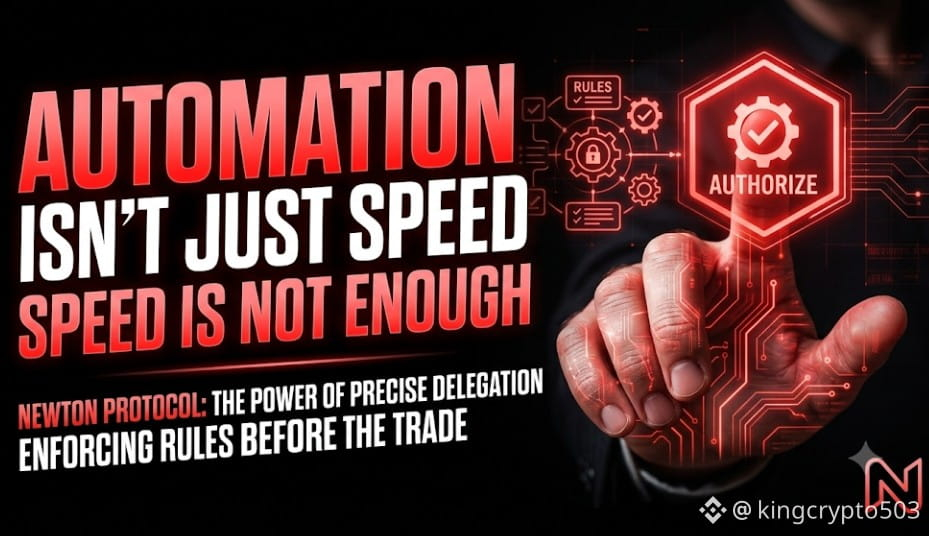
Most people assume automation is mainly about speed: fewer clicks, faster execution, less friction. That was my first assumption too. But the more I think about systems like Newton Protocol, the more that idea feels incomplete.
What matters is not just that a trade can happen automatically. It is that the rules can sit in front of the trade before anything executes. Newton describes itself as an onchain authorization layer and policy engine, designed to enforce spend limits, screening, and other permissions at the moment of authorization rather than after the fact. That sounds technical, but the real shift is almost mundane: you stop trusting your future self to remember every constraint.
It reminds me of autopay on a bill. The value is not the payment itself. It is that the decision has already been made under clear rules, before distraction, panic, or overconfidence get involved.
That is the part people often miss. When automation scales, the second-order effect is not merely convenience. It is that more capital can move under explicit permissions, with less dependence on one-off human judgment or opaque bots. In a market where onchain finance already runs into hundreds of billions in monthly flow, the difference between “automation” and “authorized automation” starts to matter a lot.
Maybe the deeper question is not whether machines can trade for us. It is whether we can make delegation feel precise enough to trust. And that is still an open problem, even when the code looks elegant.

#Newt @NewtonProtocol l $VANRY $BEL #newt #newt $NEWT
Newton Protocol and the Future of Constrained AutonomyMost people assume the future of AI on blockchain is about making agents smarter. That feels intuitive. If AI can analyze faster and execute instantly, then better decisions should naturally follow. Lately, I've started to think that's only half the story. What changed my perspective wasn't the intelligence of the agent, but the question of permission. An AI that can act without clearly defined boundaries isn't necessarily useful—it can simply become another source of uncertainty. The interesting part of Newton Protocol isn't that it gives AI more freedom. It's that it tries to define how much freedom an agent should have in the first place. A simple analogy came to mind. We trust a house sitter with our home keys, but we don't hand them access to every bank account, password, and legal document we own. Trust isn't built by removing limits; it's built by setting the right ones. Digital agents may end up working the same way. The overlooked consequence appears when this model scales. If millions of onchain actions are executed by AI, the real challenge won't be transaction speed or automation. It will be designing systems where authority is delegated carefully, transparently, and reversibly. In that world, governance becomes just as important as intelligence. That also changes how we think about blockchain itself. Instead of acting only as a ledger that records what happened, it could become a framework that defines what is allowed to happen before an action is ever taken. I'm not certain this is the direction the ecosystem will ultimately follow. But if AI becomes a permanent participant in onchain economies, the biggest innovation may not be smarter agents—it may be better rules for trusting them. And that's a much more interesting problem to solve. #Newt #NEWT @NewtonProtocol l $VANRY $BEL #newt $NEWT

Newton Protocol and the Future of Constrained Autonomy

Most people assume the future of AI on blockchain is about making agents smarter. That feels intuitive. If AI can analyze faster and execute instantly, then better decisions should naturally follow.
Lately, I've started to think that's only half the story.
What changed my perspective wasn't the intelligence of the agent, but the question of permission. An AI that can act without clearly defined boundaries isn't necessarily useful—it can simply become another source of uncertainty. The interesting part of Newton Protocol isn't that it gives AI more freedom. It's that it tries to define how much freedom an agent should have in the first place.
A simple analogy came to mind. We trust a house sitter with our home keys, but we don't hand them access to every bank account, password, and legal document we own. Trust isn't built by removing limits; it's built by setting the right ones. Digital agents may end up working the same way.
The overlooked consequence appears when this model scales. If millions of onchain actions are executed by AI, the real challenge won't be transaction speed or automation. It will be designing systems where authority is delegated carefully, transparently, and reversibly. In that world, governance becomes just as important as intelligence.
That also changes how we think about blockchain itself. Instead of acting only as a ledger that records what happened, it could become a framework that defines what is allowed to happen before an action is ever taken.
I'm not certain this is the direction the ecosystem will ultimately follow. But if AI becomes a permanent participant in onchain economies, the biggest innovation may not be smarter agents—it may be better rules for trusting them. And that's a much more interesting problem to solve.
#Newt #NEWT @NewtonProtocol l $VANRY $BEL #newt $NEWT
Most people hear “rollup” and assume the main benefit is cheaper, faster transactions. That is true, but it feels incomplete. In Newton Protocol’s case, the more interesting idea is that a rollup can make AI agents feel less like loose software and more like something operating inside a bounded system. Newton describes itself as an onchain authorization layer, built to encode, verify, and enforce rules before transactions execute, and its whitepaper frames the design around policy, security, and cross-chain execution rather than raw throughput alone. At first, I thought this was just another “AI plus crypto” project with better plumbing. Then the deeper shift became clear: if an AI agent can act on capital, the real bottleneck is not intelligence, but permission. A system can be smart and still be unsafe. Newton’s rollup idea seems aimed at turning those permissions into something explicit, verifiable, and easier to enforce. A simple analogy: it is the difference between giving someone your house key and giving them a key that only opens the front door between 9 a.m. and 5 p.m. The first is trust. The second is control. What most people overlook is the second-order effect. Once AI actions are constrained inside a dedicated execution layer, the conversation changes from “Can this agent trade?” to “What exactly should it be allowed to do, and how do we prove it stayed inside those limits?” That matters even more when the system scales, because automation at low volume is a convenience; automation at high volume becomes infrastructure. Maybe that is the real promise here: not faster AI for its own sake, but AI that can be trusted to move inside narrower, clearer boundaries. And in crypto, boundaries may end up mattering more than speed. #Newt #NEWT @NewtonProtocol l $VANRY $BEL #newt $NEWT
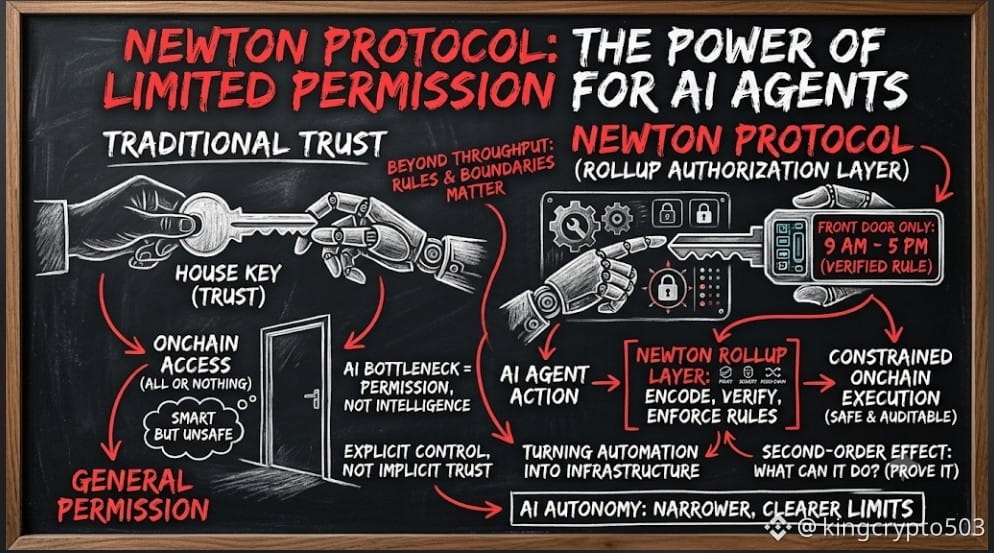
Most people hear “rollup” and assume the main benefit is cheaper, faster transactions. That is true, but it feels incomplete. In Newton Protocol’s case, the more interesting idea is that a rollup can make AI agents feel less like loose software and more like something operating inside a bounded system. Newton describes itself as an onchain authorization layer, built to encode, verify, and enforce rules before transactions execute, and its whitepaper frames the design around policy, security, and cross-chain execution rather than raw throughput alone.
At first, I thought this was just another “AI plus crypto” project with better plumbing. Then the deeper shift became clear: if an AI agent can act on capital, the real bottleneck is not intelligence, but permission. A system can be smart and still be unsafe. Newton’s rollup idea seems aimed at turning those permissions into something explicit, verifiable, and easier to enforce.
A simple analogy: it is the difference between giving someone your house key and giving them a key that only opens the front door between 9 a.m. and 5 p.m. The first is trust. The second is control.
What most people overlook is the second-order effect. Once AI actions are constrained inside a dedicated execution layer, the conversation changes from “Can this agent trade?” to “What exactly should it be allowed to do, and how do we prove it stayed inside those limits?” That matters even more when the system scales, because automation at low volume is a convenience; automation at high volume becomes infrastructure.
Maybe that is the real promise here: not faster AI for its own sake, but AI that can be trusted to move inside narrower, clearer boundaries. And in crypto, boundaries may end up mattering more than speed.

#Newt #NEWT @NewtonProtocol l $VANRY $BEL #newt $NEWT
Newton Protocol and the Quiet Evolution of Onchain AutomationMost people assume automation is valuable because it helps us do things faster. That seems reasonable, and for a long time I believed the same. But the more I think about AI and blockchain together, the more I feel speed is actually the least interesting part of the story. What changes isn't just how quickly tasks get done. It's who—or what—we're willing to trust with making decisions and taking action. That's why Newton Protocol has caught my attention. Rather than treating AI as a tool that simply responds to prompts, it enables autonomous agents to execute onchain tasks in a way that's transparent, verifiable, and governed by decentralized rules. The technology itself is important, but the shift in behavior it enables may be even more significant. A simple analogy comes to mind. Imagine hiring someone to manage your daily errands. If they quietly disappear for a few hours and return saying everything is finished, you'd probably have questions. But if every action is recorded, every instruction is followed, and the process can be verified at any time, your relationship with delegation changes. You stop worrying about every individual task and start focusing on the outcomes that matter. I think that's the part many people overlook. The first-order benefit is obvious: less manual work. The second-order effect is that people begin designing systems with the expectation that reliable autonomous agents exist. Workflows become continuous rather than reactive. Coordination becomes less dependent on constant human intervention. The bottleneck slowly shifts from execution to judgment—deciding what should be automated, under which constraints, and where human oversight still matters most. If that transition happens gradually, the impact may be larger than any single protocol or application. We won't just interact with blockchains differently; we'll rethink how responsibility, trust, and coordination are distributed across digital systems. I'm not certain that's exactly where this leads. But it feels like a more interesting question than simply asking how AI can make blockchain faster. #Newt #NEWT @NewtonProtocol l $NEWT $VANRY $BEL

Newton Protocol and the Quiet Evolution of Onchain Automation

Most people assume automation is valuable because it helps us do things faster. That seems reasonable, and for a long time I believed the same. But the more I think about AI and blockchain together, the more I feel speed is actually the least interesting part of the story.
What changes isn't just how quickly tasks get done. It's who—or what—we're willing to trust with making decisions and taking action.
That's why Newton Protocol has caught my attention. Rather than treating AI as a tool that simply responds to prompts, it enables autonomous agents to execute onchain tasks in a way that's transparent, verifiable, and governed by decentralized rules. The technology itself is important, but the shift in behavior it enables may be even more significant.
A simple analogy comes to mind. Imagine hiring someone to manage your daily errands. If they quietly disappear for a few hours and return saying everything is finished, you'd probably have questions. But if every action is recorded, every instruction is followed, and the process can be verified at any time, your relationship with delegation changes. You stop worrying about every individual task and start focusing on the outcomes that matter.
I think that's the part many people overlook.
The first-order benefit is obvious: less manual work. The second-order effect is that people begin designing systems with the expectation that reliable autonomous agents exist. Workflows become continuous rather than reactive. Coordination becomes less dependent on constant human intervention. The bottleneck slowly shifts from execution to judgment—deciding what should be automated, under which constraints, and where human oversight still matters most.
If that transition happens gradually, the impact may be larger than any single protocol or application. We won't just interact with blockchains differently; we'll rethink how responsibility, trust, and coordination are distributed across digital systems.
I'm not certain that's exactly where this leads. But it feels like a more interesting question than simply asking how AI can make blockchain faster.
#Newt #NEWT @NewtonProtocol l $NEWT $VANRY $BEL
Most people hear “developer marketplace” and think of a faster way to ship apps. I’ve started to suspect the more important thing is subtler: a marketplace is also a way to standardize judgment. On Newton, that matters because the protocol is built as an onchain authorization layer that enforces policies before a transaction executes, and its developer tooling is centered on reusable policy packs and SDKs. At first, I read that as a feature for builders. Then the frame shifted. The real value may not be “developers can build more.” It may be that developers can package trust, risk checks, and compliance logic so other people do not have to reinvent them every time. Newton’s open-source policy packs already point in that direction. A simple analogy: it is the difference between cooking from scratch every night and keeping a pantry of ingredients that already fit together. In an onchain vault context, that could mean reusing guardrails for concentration limits, sanctions screening, or identity checks instead of hard-coding them one by one. That is the hidden shift most people miss. The second-order effect is not just convenience; it is legibility. When rules become modular, they become easier to audit, easier to compare, and harder to treat as invisible assumptions. And if this scales, the story changes again. A marketplace like this stops being a catalog of tools and starts looking like shared infrastructure for how onchain systems decide what is allowed. That may matter more than the headline use case, because the next phase of crypto may be less about making actions possible and more about making them accountable. Newton is already live in mainnet beta on Base and Ethereum, which makes that question feel less hypothetical. #Newt #NEWT @NewtonProtocol $BREV $TLM #newt $NEWT
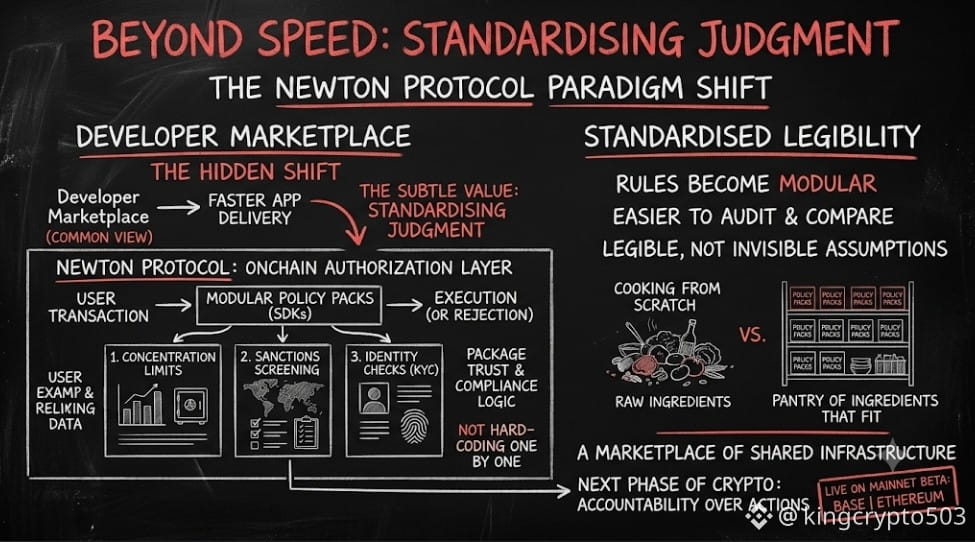
Most people hear “developer marketplace” and think of a faster way to ship apps. I’ve started to suspect the more important thing is subtler: a marketplace is also a way to standardize judgment. On Newton, that matters because the protocol is built as an onchain authorization layer that enforces policies before a transaction executes, and its developer tooling is centered on reusable policy packs and SDKs.
At first, I read that as a feature for builders. Then the frame shifted. The real value may not be “developers can build more.” It may be that developers can package trust, risk checks, and compliance logic so other people do not have to reinvent them every time. Newton’s open-source policy packs already point in that direction.
A simple analogy: it is the difference between cooking from scratch every night and keeping a pantry of ingredients that already fit together. In an onchain vault context, that could mean reusing guardrails for concentration limits, sanctions screening, or identity checks instead of hard-coding them one by one.
That is the hidden shift most people miss. The second-order effect is not just convenience; it is legibility. When rules become modular, they become easier to audit, easier to compare, and harder to treat as invisible assumptions.
And if this scales, the story changes again. A marketplace like this stops being a catalog of tools and starts looking like shared infrastructure for how onchain systems decide what is allowed. That may matter more than the headline use case, because the next phase of crypto may be less about making actions possible and more about making them accountable. Newton is already live in mainnet beta on Base and Ethereum, which makes that question feel less hypothetical.

#Newt #NEWT @NewtonProtocol $BREV $TLM #newt $NEWT
Article
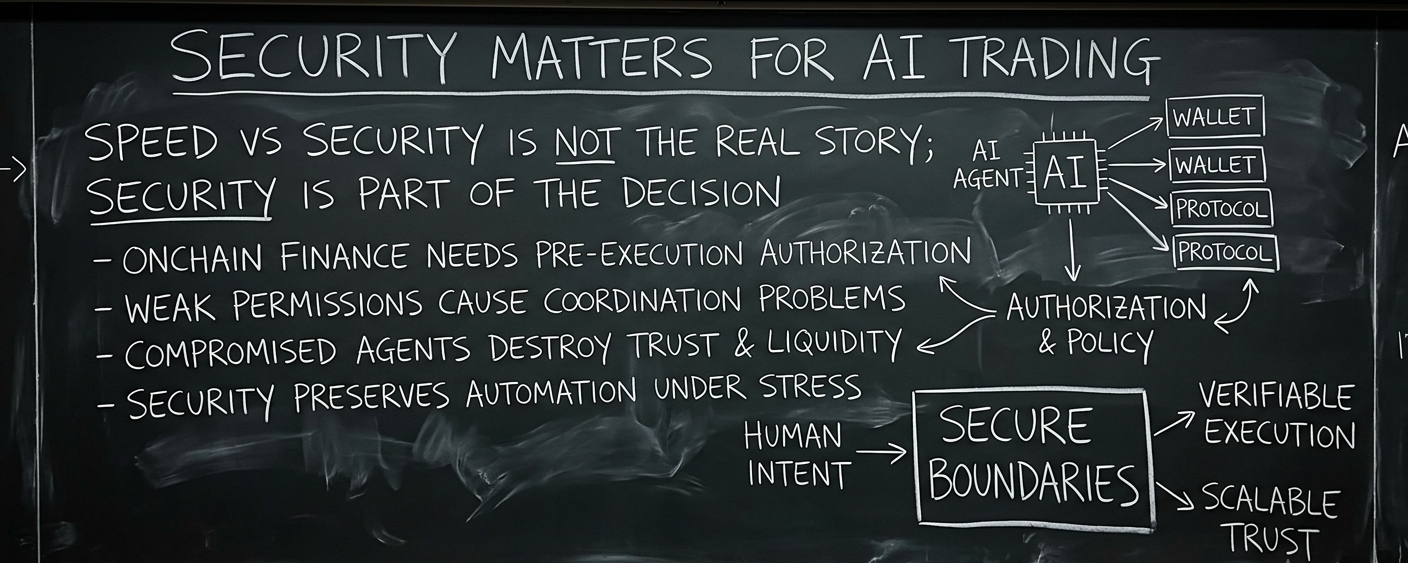
Why Security Matters for AI TradingMost people hear “AI trading” and assume the main question is speed. Faster models, faster execution, faster responses to market moves. That sounds right at first. But the more I think about it, the more I suspect speed is not the real story. Security is. My first instinct was to treat security as a defensive layer — something important, but secondary. A seatbelt, not the engine. But with AI trading, that framing feels incomplete. Once a system is allowed to make financial decisions on its own, security stops being a feature you add at the edge. It becomes part of the decision itself. Newton Protocol is interesting to me because it points in that direction: not just automation, but verifiable automation for onchain financial actions and AI agents. Its whitepaper frames the problem clearly: onchain finance is already moving at scale, and yet transaction authorization still often happens after the fact, not before execution. That detail matters more than it sounds like it does. A simple analogy: handing your car to a valet is one thing. Handing your car to a valet who can also decide where to drive, when to refuel, and whether to take a shortcut through traffic is another. At that point, the issue is no longer “Can they drive?” It is “What boundaries exist before the car leaves the lot?” That is how I now think about AI trading. At small scale, a mistake looks like a bad trade. At larger scale, the failure mode changes. A weak permission system can become a coordination problem. A compromised agent can become a trust problem. A trust problem can become a liquidity problem. And once enough capital relies on the same automation layer, one mistake is no longer isolated. It is propagated. That is the second-order effect people miss. Security is not only about preventing theft. It is about preserving the usefulness of automation under stress. Because when an AI agent is trading, the obvious risk is that it loses money. The deeper risk is that everyone else starts designing around the possibility that it might. They add more friction. They narrow permissions. They reduce autonomy. They build conservative limits into systems that were supposed to feel seamless. The result is less of the scale and composability that made the technology interesting in the first place. This is where Newton’s emphasis on authorization, policy, and verifiability feels important rather than decorative. If an agent can act across chains, wallets, and protocols, then the question is not merely whether it can execute. It is whether it can execute only within the intent that was actually granted. That sounds technical, but the real issue is human. We do not scale trust by asking people to trust harder. We scale it by making trust legible, bounded, and inspectable. The internet learned this. Exchanges learned this. Smart contracts learned this the hard way. So maybe the real promise of AI trading is not that machines will trade for us. It is that they might eventually operate with enough structure that we can let them. And that “enough structure” is what security is quietly doing. I do not think this is the final answer. The tradeoff between autonomy and control is still messy, and probably always will be. But the more I look at AI trading, the clearer it becomes that security is not what slows the future down. It is what keeps the future from collapsing the first time it arrives. @NewtonProtocol #Newt $NEWT $TLM $BREV {spot}(NEWTUSDT)

Why Security Matters for AI Trading

Most people hear “AI trading” and assume the main question is speed. Faster models, faster execution, faster responses to market moves. That sounds right at first. But the more I think about it, the more I suspect speed is not the real story. Security is.
My first instinct was to treat security as a defensive layer — something important, but secondary. A seatbelt, not the engine. But with AI trading, that framing feels incomplete. Once a system is allowed to make financial decisions on its own, security stops being a feature you add at the edge. It becomes part of the decision itself.
Newton Protocol is interesting to me because it points in that direction: not just automation, but verifiable automation for onchain financial actions and AI agents. Its whitepaper frames the problem clearly: onchain finance is already moving at scale, and yet transaction authorization still often happens after the fact, not before execution. That detail matters more than it sounds like it does.
A simple analogy: handing your car to a valet is one thing. Handing your car to a valet who can also decide where to drive, when to refuel, and whether to take a shortcut through traffic is another. At that point, the issue is no longer “Can they drive?” It is “What boundaries exist before the car leaves the lot?”
That is how I now think about AI trading. At small scale, a mistake looks like a bad trade. At larger scale, the failure mode changes. A weak permission system can become a coordination problem. A compromised agent can become a trust problem. A trust problem can become a liquidity problem. And once enough capital relies on the same automation layer, one mistake is no longer isolated. It is propagated.
That is the second-order effect people miss. Security is not only about preventing theft. It is about preserving the usefulness of automation under stress.
Because when an AI agent is trading, the obvious risk is that it loses money. The deeper risk is that everyone else starts designing around the possibility that it might. They add more friction. They narrow permissions. They reduce autonomy. They build conservative limits into systems that were supposed to feel seamless. The result is less of the scale and composability that made the technology interesting in the first place.
This is where Newton’s emphasis on authorization, policy, and verifiability feels important rather than decorative. If an agent can act across chains, wallets, and protocols, then the question is not merely whether it can execute. It is whether it can execute only within the intent that was actually granted.
That sounds technical, but the real issue is human. We do not scale trust by asking people to trust harder. We scale it by making trust legible, bounded, and inspectable. The internet learned this. Exchanges learned this. Smart contracts learned this the hard way.
So maybe the real promise of AI trading is not that machines will trade for us. It is that they might eventually operate with enough structure that we can let them. And that “enough structure” is what security is quietly doing.
I do not think this is the final answer. The tradeoff between autonomy and control is still messy, and probably always will be. But the more I look at AI trading, the clearer it becomes that security is not what slows the future down. It is what keeps the future from collapsing the first time it arrives.
@NewtonProtocol #Newt $NEWT $TLM $BREV
Most people seem to assume AI agents will make Web3 faster. I used to think the same. That felt like the obvious win: fewer clicks, fewer steps, less friction. But the more I sat with it, the more I started to think the real change is not speed. It is delegation. An agent is not just a better interface. It is something that can hold a small piece of your intent while you are doing something else. That sounds convenient, but it also changes how trust works. A wallet is passive. An agent is active. And once systems like Newton Protocol start making that delegation more practical, the question is no longer “Can software help me transact?” It becomes “What parts of my onchain life am I willing to let software manage on my behalf?” A simple analogy: setting up autopay for one bill feels harmless. Setting it up for every bill changes how you relate to money. Web3 agents may do the same for onchain behavior. The overlooked part is the second-order effect. If agents scale, the market may stop optimizing for human attention and start optimizing for machine legibility. Protocols, vaults, permissions, and incentives may need to be designed so an agent can understand them, not just a person. That is a very different internet. Maybe that is the real shift. Not “AI in Web3,” but Web3 becoming something that can be negotiated by software at scale. I am not sure yet whether that ends up making the system more open or just more abstract. Probably some of both. #Newt #NEWT @NewtonProtocol $NEWT $BREV $TLM
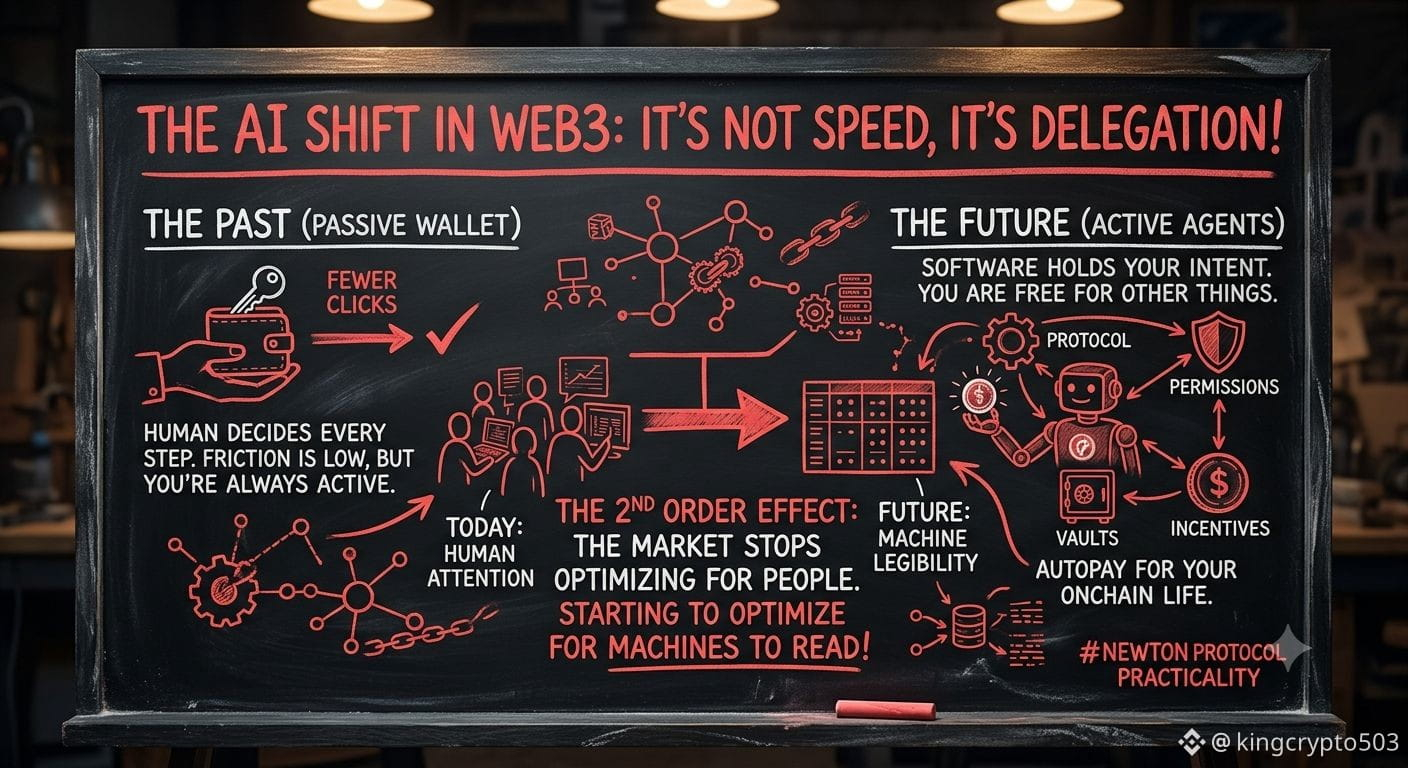
Most people seem to assume AI agents will make Web3 faster. I used to think the same.
That felt like the obvious win: fewer clicks, fewer steps, less friction. But the more I sat with it, the more I started to think the real change is not speed. It is delegation.
An agent is not just a better interface. It is something that can hold a small piece of your intent while you are doing something else. That sounds convenient, but it also changes how trust works. A wallet is passive. An agent is active. And once systems like Newton Protocol start making that delegation more practical, the question is no longer “Can software help me transact?” It becomes “What parts of my onchain life am I willing to let software manage on my behalf?”
A simple analogy: setting up autopay for one bill feels harmless. Setting it up for every bill changes how you relate to money. Web3 agents may do the same for onchain behavior.
The overlooked part is the second-order effect. If agents scale, the market may stop optimizing for human attention and start optimizing for machine legibility. Protocols, vaults, permissions, and incentives may need to be designed so an agent can understand them, not just a person. That is a very different internet.
Maybe that is the real shift. Not “AI in Web3,” but Web3 becoming something that can be negotiated by software at scale. I am not sure yet whether that ends up making the system more open or just more abstract. Probably some of both.

#Newt #NEWT @NewtonProtocol $NEWT $BREV $TLM
Intelligence Needs Discipline: Why Newton Protocol Puts Policy Before ActionWhat does it really mean for an AI system to be smart if it cannot be trusted with the consequences of its own actions? That question sits quietly underneath a lot of the excitement around automation, and it becomes sharper the moment money, identity, or permission enters the picture. Newton Protocol approaches that problem by making policy part of the path a transaction must travel, not a last-minute check bolted on afterward. In its own terms, Newton is an authorization layer for onchain transactions and a decentralized policy engine for programmable compliance and authorization. It is built as an EigenLayer AVS, and its docs describe it as a way to enforce spend limits, sanctions screening, fraud prevention, and other rules directly in smart contracts before execution. That idea matters because so much of today’s AI infrastructure is clever in the wrong place. We have systems that can draft, decide, optimize, and route, but when those systems touch assets or regulated actions, they often remain too loose, too centralized, or too easy to bypass. Newton’s answer is to move the point of judgment closer to the act itself. Its policy flow evaluates an intent before settlement, using a decentralized network of EigenLayer operators to run Rego policies and return a BLS attestation. In the protocol’s multichain design, source-chain operator state is cached and destination-chain verifier contracts validate the certificate, so enforcement can travel across Ethereum, Base, and other chains without turning into a fragile manual process. There is something quietly revealing in that architecture. The protocol is not just saying, “be safer.” It is saying that safety has to be enforceable in motion. That is a harder claim than it sounds. In many real systems, the problem is not that rules do not exist; it is that they live in dashboards, internal policies, or web interfaces that a determined actor can step around with a direct contract call or a poorly timed automation. Newton’s own materials repeatedly frame this gap as the reason it exists: the enforcement layer has lagged behind the speed at which capital, stablecoins, RWAs, and AI agents are moving onchain. Mainnet beta is now live, the protocol is live on Base and Ethereum, and the team says it is already enforcing rules onchain, starting with DeFi vaults. In practical terms, the promise is not abstract. A vault manager can encode exposure limits. A payments system can block transfers that violate jurisdictional rules. A protocol can ask whether a wallet corresponds to a real human before letting it vote or receive an airdrop. Newton’s use-case pages describe policy evaluation as something that happens before execution, with the result cryptographically attested rather than merely logged. The same pattern appears in its integrations with data sources such as Persona, Veriff, Human Passport, Etherscan, and Massive, which the project presents as ways to bring identity, compliance, network data, and market signals into programmable guardrails. That is where the “smarter AI” part becomes less about raw intelligence and more about discipline. An AI agent can be impressive at finding opportunities, but an opportunity without boundary is just another way to create damage faster. Secure infrastructure does not make an agent wiser in some mystical sense; it makes its judgment legible, auditable, and harder to distort. Newton’s design leans on verifiability rather than trust in one operator, and the protocol says its evaluations are credibly neutral because they run through a decentralized operator network secured by EigenLayer restaking. That choice is not glamorous, but it is the kind of choice that decides whether an autonomous system remains a tool or becomes a liability with better prose. Still, every promise of secure infrastructure hides its own burden. Systems like this do not remove human error; they relocate it. Someone still has to decide what the policy should say, what data source is trustworthy, what threshold is humane, and what happens when the world changes faster than the rulebook. Newton emphasizes that policies are updatable without redeploying contracts, which is useful precisely because regulations, fraud patterns, and market conditions do not sit still. But flexibility creates a second-order risk: the more adaptable the policy layer becomes, the more tempting it is to believe the system is self-correcting when it is really only as good as the people curating it. There is also the quieter problem of coordination. A decentralized operator network sounds elegant until one remembers that coordination is where many systems fail in practice. Operators must agree, data sources must remain reliable, and the chain of verification must hold across environments that are not equally mature. Newton’s multichain model explains this with unusual clarity: one chain acts as the security foundation, another consumes the attestation, and verifier contracts bridge the gap. That separation is clean on paper, yet in the real world it means more moving parts, more assumptions, and more places where a mismatch can appear between policy intention and operational reality. Secure infrastructure is often less about perfection than about containing failure so it does not spread quietly. From a human perspective, this matters because the costs of failure are never evenly distributed. When a policy is too loose, institutions absorb losses, users absorb uncertainty, and the public absorbs the fallout when systems are blamed for not being “responsible enough.” When a policy is too strict, legitimate users can be excluded, delayed, or silently judged by signals they do not understand. Newton’s own examples show both sides of that tension: protecting protocols from Sybil attacks and bot networks on one hand, and enabling compliance-grade identity and jurisdictional enforcement on the other. The deeper question is not whether a system can block bad behavior. It is whether it can do so without flattening human complexity into a set of opaque yes-or-no decisions. That is why the protocol’s emphasis on cryptographic attestation feels more important than the particular rule set. An attestation says, in effect, that a decision happened under an agreed process. It is a modest claim, but modest claims scale better than heroic ones. The 2025 materials also described Newton as using trusted execution environments and zero-knowledge proofs to support verifiable automation, which points to a broader philosophy: the system should prove that enforcement occurred without exposing everything it had to look at. That is not just a technical preference. It is a way of acknowledging that trust in digital systems is always a negotiation between visibility and restraint. And perhaps that is the deepest appeal of Newton Protocol: it treats infrastructure as a moral shape, not just a technical stack. Every system teaches its users something about power. A system that asks for blind trust teaches passivity. A system that exposes too much teaches surveillance. A system like Newton, at least in ambition, tries to teach a different lesson: that authority can be distributed, policy can be explicit, and automation can be held to a standard before it acts. Whether that standard remains robust under scale, pressure, and creative misuse is the real test, and it is one no architecture can answer in advance. So the more interesting question may not be whether secure infrastructure makes AI smarter, but what kind of intelligence we are trying to build in the first place. Intelligence that moves fast without restraint is only another form of noise. Intelligence that can explain itself, prove itself, and remain answerable to the world around it begins to look less like a machine and more like a system with discipline. Newton Protocol sits in that uneasy space between aspiration and enforcement, where the promise is real, the trade-offs are real, and the hardest work may still be ahead. Maybe that is exactly where the future needs to be thought about: not as a destination, but as a set of rules we are still learning how to trust. #Newt #NEWT @NewtonProtocol l $NEWT $BREV $TLM

Intelligence Needs Discipline: Why Newton Protocol Puts Policy Before Action

What does it really mean for an AI system to be smart if it cannot be trusted with the consequences of its own actions? That question sits quietly underneath a lot of the excitement around automation, and it becomes sharper the moment money, identity, or permission enters the picture. Newton Protocol approaches that problem by making policy part of the path a transaction must travel, not a last-minute check bolted on afterward. In its own terms, Newton is an authorization layer for onchain transactions and a decentralized policy engine for programmable compliance and authorization. It is built as an EigenLayer AVS, and its docs describe it as a way to enforce spend limits, sanctions screening, fraud prevention, and other rules directly in smart contracts before execution.
That idea matters because so much of today’s AI infrastructure is clever in the wrong place. We have systems that can draft, decide, optimize, and route, but when those systems touch assets or regulated actions, they often remain too loose, too centralized, or too easy to bypass. Newton’s answer is to move the point of judgment closer to the act itself. Its policy flow evaluates an intent before settlement, using a decentralized network of EigenLayer operators to run Rego policies and return a BLS attestation. In the protocol’s multichain design, source-chain operator state is cached and destination-chain verifier contracts validate the certificate, so enforcement can travel across Ethereum, Base, and other chains without turning into a fragile manual process.
There is something quietly revealing in that architecture. The protocol is not just saying, “be safer.” It is saying that safety has to be enforceable in motion. That is a harder claim than it sounds. In many real systems, the problem is not that rules do not exist; it is that they live in dashboards, internal policies, or web interfaces that a determined actor can step around with a direct contract call or a poorly timed automation. Newton’s own materials repeatedly frame this gap as the reason it exists: the enforcement layer has lagged behind the speed at which capital, stablecoins, RWAs, and AI agents are moving onchain. Mainnet beta is now live, the protocol is live on Base and Ethereum, and the team says it is already enforcing rules onchain, starting with DeFi vaults.
In practical terms, the promise is not abstract. A vault manager can encode exposure limits. A payments system can block transfers that violate jurisdictional rules. A protocol can ask whether a wallet corresponds to a real human before letting it vote or receive an airdrop. Newton’s use-case pages describe policy evaluation as something that happens before execution, with the result cryptographically attested rather than merely logged. The same pattern appears in its integrations with data sources such as Persona, Veriff, Human Passport, Etherscan, and Massive, which the project presents as ways to bring identity, compliance, network data, and market signals into programmable guardrails.
That is where the “smarter AI” part becomes less about raw intelligence and more about discipline. An AI agent can be impressive at finding opportunities, but an opportunity without boundary is just another way to create damage faster. Secure infrastructure does not make an agent wiser in some mystical sense; it makes its judgment legible, auditable, and harder to distort. Newton’s design leans on verifiability rather than trust in one operator, and the protocol says its evaluations are credibly neutral because they run through a decentralized operator network secured by EigenLayer restaking. That choice is not glamorous, but it is the kind of choice that decides whether an autonomous system remains a tool or becomes a liability with better prose.
Still, every promise of secure infrastructure hides its own burden. Systems like this do not remove human error; they relocate it. Someone still has to decide what the policy should say, what data source is trustworthy, what threshold is humane, and what happens when the world changes faster than the rulebook. Newton emphasizes that policies are updatable without redeploying contracts, which is useful precisely because regulations, fraud patterns, and market conditions do not sit still. But flexibility creates a second-order risk: the more adaptable the policy layer becomes, the more tempting it is to believe the system is self-correcting when it is really only as good as the people curating it.
There is also the quieter problem of coordination. A decentralized operator network sounds elegant until one remembers that coordination is where many systems fail in practice. Operators must agree, data sources must remain reliable, and the chain of verification must hold across environments that are not equally mature. Newton’s multichain model explains this with unusual clarity: one chain acts as the security foundation, another consumes the attestation, and verifier contracts bridge the gap. That separation is clean on paper, yet in the real world it means more moving parts, more assumptions, and more places where a mismatch can appear between policy intention and operational reality. Secure infrastructure is often less about perfection than about containing failure so it does not spread quietly.
From a human perspective, this matters because the costs of failure are never evenly distributed. When a policy is too loose, institutions absorb losses, users absorb uncertainty, and the public absorbs the fallout when systems are blamed for not being “responsible enough.” When a policy is too strict, legitimate users can be excluded, delayed, or silently judged by signals they do not understand. Newton’s own examples show both sides of that tension: protecting protocols from Sybil attacks and bot networks on one hand, and enabling compliance-grade identity and jurisdictional enforcement on the other. The deeper question is not whether a system can block bad behavior. It is whether it can do so without flattening human complexity into a set of opaque yes-or-no decisions.
That is why the protocol’s emphasis on cryptographic attestation feels more important than the particular rule set. An attestation says, in effect, that a decision happened under an agreed process. It is a modest claim, but modest claims scale better than heroic ones. The 2025 materials also described Newton as using trusted execution environments and zero-knowledge proofs to support verifiable automation, which points to a broader philosophy: the system should prove that enforcement occurred without exposing everything it had to look at. That is not just a technical preference. It is a way of acknowledging that trust in digital systems is always a negotiation between visibility and restraint.
And perhaps that is the deepest appeal of Newton Protocol: it treats infrastructure as a moral shape, not just a technical stack. Every system teaches its users something about power. A system that asks for blind trust teaches passivity. A system that exposes too much teaches surveillance. A system like Newton, at least in ambition, tries to teach a different lesson: that authority can be distributed, policy can be explicit, and automation can be held to a standard before it acts. Whether that standard remains robust under scale, pressure, and creative misuse is the real test, and it is one no architecture can answer in advance.
So the more interesting question may not be whether secure infrastructure makes AI smarter, but what kind of intelligence we are trying to build in the first place. Intelligence that moves fast without restraint is only another form of noise. Intelligence that can explain itself, prove itself, and remain answerable to the world around it begins to look less like a machine and more like a system with discipline. Newton Protocol sits in that uneasy space between aspiration and enforcement, where the promise is real, the trade-offs are real, and the hardest work may still be ahead. Maybe that is exactly where the future needs to be thought about: not as a destination, but as a set of rules we are still learning how to trust.
#Newt #NEWT @NewtonProtocol l $NEWT $BREV $TLM
I went into Newton Protocol assuming it would be another AI automation story wrapped in cleaner branding. That was my first mistake. The more I sat with it, the less it felt like “AI doing things for users” and the more it felt like a trust problem disguised as a product problem. What surprised me was how much of the real conversation sits outside the flashy part. Anyone can demo automation. The harder part is deciding what gets delegated, what stays under human control, and how much proof a user actually needs before they stop treating the system like a black box. That tension feels more important than the feature list itself. What kept coming back to me is that crypto users do not trust convenience for free. They usually rent it until something breaks, then they suddenly become very strict about verification, permissions, and reversibility. That is why projects like this are not just competing on performance. They are competing on user psychology, and that is a much harsher market than people admit. One thing I do not see discussed enough is the hidden tradeoff between autonomy and accountability. If an AI agent acts too independently, users get nervous. If it needs too much approval, the whole point starts to collapse. That middle ground is awkward, and I suspect the real challenge is not technical capability but designing a system people are willing to blame, audit, and keep using after a mistake. I could be wrong, but that is what makes Newton Protocol interesting to me: it is not only asking whether AI can automate crypto workflows, it is asking whether trust can be engineered well enough to survive normal human fear. That feels like the real test. The question is whether users want less friction badly enough to accept a new kind of responsibility. #Newt #NEWT @NewtonProtocol l $NEWT $BREV $TLM
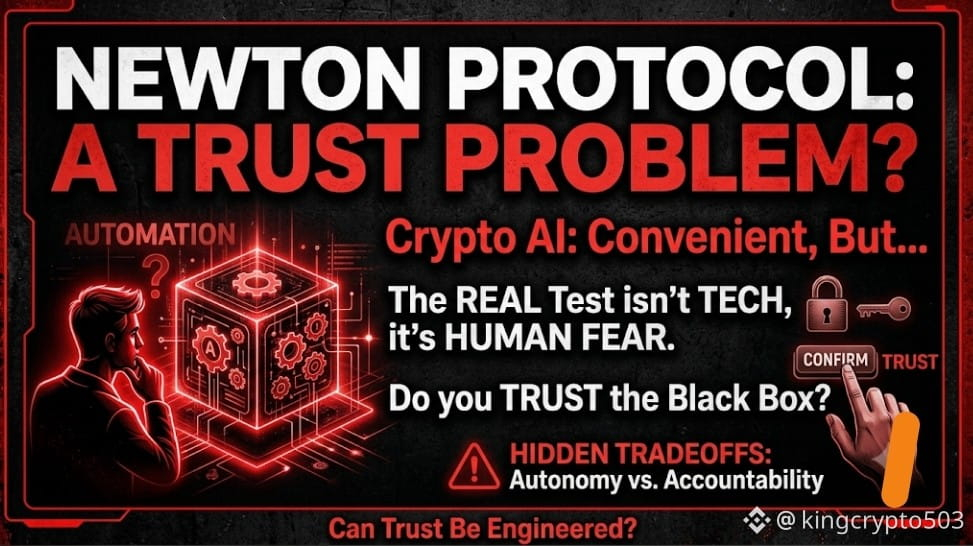
I went into Newton Protocol assuming it would be another AI automation story wrapped in cleaner branding. That was my first mistake. The more I sat with it, the less it felt like “AI doing things for users” and the more it felt like a trust problem disguised as a product problem.
What surprised me was how much of the real conversation sits outside the flashy part. Anyone can demo automation. The harder part is deciding what gets delegated, what stays under human control, and how much proof a user actually needs before they stop treating the system like a black box. That tension feels more important than the feature list itself.
What kept coming back to me is that crypto users do not trust convenience for free. They usually rent it until something breaks, then they suddenly become very strict about verification, permissions, and reversibility. That is why projects like this are not just competing on performance. They are competing on user psychology, and that is a much harsher market than people admit.
One thing I do not see discussed enough is the hidden tradeoff between autonomy and accountability. If an AI agent acts too independently, users get nervous. If it needs too much approval, the whole point starts to collapse. That middle ground is awkward, and I suspect the real challenge is not technical capability but designing a system people are willing to blame, audit, and keep using after a mistake.
I could be wrong, but that is what makes Newton Protocol interesting to me: it is not only asking whether AI can automate crypto workflows, it is asking whether trust can be engineered well enough to survive normal human fear. That feels like the real test. The question is whether users want less friction badly enough to accept a new kind of responsibility.

#Newt #NEWT @NewtonProtocol l $NEWT $BREV $TLM
NEWTON Can Be Upgradeable, but Initialization Still Defines SecurityI assumed that if NEWTON could be added to an existing upgradeable contract, the difficult part was already solved. The more I looked at it, the more I realized that compatibility isn't the same as safety. Being able to plug something into an existing system sounds convenient, but initialization quietly decides whether that flexibility becomes an advantage or an expensive mistake. What surprised me wasn't the upgrade itself. It was how much attention the initialization process deserves even after everything appears technically compatible. I don't see many people discussing that the contract can be perfectly upgradeable and still end up in an unexpected state if initialization isn't handled carefully. That's the kind of detail that rarely trends but often matters later. I kept wondering why these conversations don't get as much attention as token launches or ecosystem announcements. Maybe it's because infrastructure decisions don't create immediate excitement, even though they shape how confidently builders deploy and how much trust users eventually place in a protocol. Markets often reward visible progress long before they price in operational discipline. One thing I could be wrong about, but I think initialization is treated like a deployment checklist when it really behaves more like part of the security model. The tradeoff is subtle. Making upgrades easier also increases the importance of getting every initialization path right. A small oversight at that stage can have consequences that aren't obvious until much later, when changing course becomes far more difficult. The more time I spend looking at projects like this, the less I separate technical design from user confidence. Sometimes the details people skip over are exactly the ones that determine whether an upgrade earns trust over multiple cycles. If initialization carries that much weight, should we spend more time evaluating deployment assumptions than celebrating upgradeability itself? #Newt #NEWT @NewtonProtocol l $NEWT $BREV $TLM

NEWTON Can Be Upgradeable, but Initialization Still Defines Security

I assumed that if NEWTON could be added to an existing upgradeable contract, the difficult part was already solved. The more I looked at it, the more I realized that compatibility isn't the same as safety. Being able to plug something into an existing system sounds convenient, but initialization quietly decides whether that flexibility becomes an advantage or an expensive mistake.
What surprised me wasn't the upgrade itself. It was how much attention the initialization process deserves even after everything appears technically compatible. I don't see many people discussing that the contract can be perfectly upgradeable and still end up in an unexpected state if initialization isn't handled carefully. That's the kind of detail that rarely trends but often matters later.
I kept wondering why these conversations don't get as much attention as token launches or ecosystem announcements. Maybe it's because infrastructure decisions don't create immediate excitement, even though they shape how confidently builders deploy and how much trust users eventually place in a protocol. Markets often reward visible progress long before they price in operational discipline.
One thing I could be wrong about, but I think initialization is treated like a deployment checklist when it really behaves more like part of the security model. The tradeoff is subtle. Making upgrades easier also increases the importance of getting every initialization path right. A small oversight at that stage can have consequences that aren't obvious until much later, when changing course becomes far more difficult.
The more time I spend looking at projects like this, the less I separate technical design from user confidence. Sometimes the details people skip over are exactly the ones that determine whether an upgrade earns trust over multiple cycles. If initialization carries that much weight, should we spend more time evaluating deployment assumptions than celebrating upgradeability itself?
#Newt #NEWT @NewtonProtocol l $NEWT $BREV $TLM
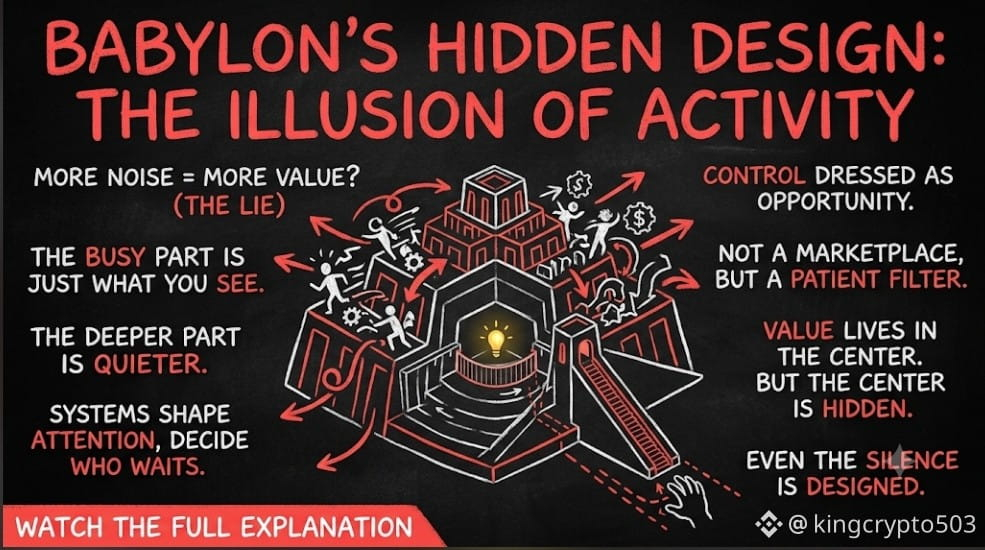
I used to think the busiest systems were the healthiest ones. Maybe that was just an easy story to believe. You see numbers moving, people reacting, constant activity everywhere, and it starts to feel like progress. But after spending time around Newton Protocol, I caught myself paying less attention to what was happening on the surface and more to the strange quiet beneath it. That feeling stayed with me. The visible movement almost seemed designed to keep my eyes occupied while something else decided what actually mattered. Not in an obvious way. Just enough to make me wonder whether the system cared about participation as much as it cared about directing it. That difference is easy to miss. A small thought. Sometimes what feels like freedom is only a carefully measured path. The more I watched AI-powered trading settle into the rhythm of the protocol, the less it looked like a race for speed and the more it felt like a conversation between invisible rules. Decisions appeared effortless, but the boundaries around those decisions felt surprisingly deliberate. It made me question what was really being optimized. Efficiency, maybe. Stability, perhaps. Or simply behavior that remains predictable enough to shape. Limits are not always accidents. Now I don't think I was looking at the wrong things before. I just wasn't noticing what stayed still while everything else kept moving. That's where the weight seems to gather. I still can't say I've figured Newton Protocol out. But I no longer assume the loudest signals are the most important ones. Sometimes the quiet parts explain far more than the noise ever could. #Newt #NEWT @NewtonProtocol l $NEWT $BREV $TLM
I used to think the busiest systems were the healthiest ones. Maybe that was just an easy story to believe. You see numbers moving, people reacting, constant activity everywhere, and it starts to feel like progress. But after spending time around Newton Protocol, I caught myself paying less attention to what was happening on the surface and more to the strange quiet beneath it.
That feeling stayed with me. The visible movement almost seemed designed to keep my eyes occupied while something else decided what actually mattered. Not in an obvious way. Just enough to make me wonder whether the system cared about participation as much as it cared about directing it. That difference is easy to miss.
A small thought.
Sometimes what feels like freedom is only a carefully measured path.
The more I watched AI-powered trading settle into the rhythm of the protocol, the less it looked like a race for speed and the more it felt like a conversation between invisible rules. Decisions appeared effortless, but the boundaries around those decisions felt surprisingly deliberate. It made me question what was really being optimized. Efficiency, maybe. Stability, perhaps. Or simply behavior that remains predictable enough to shape.
Limits are not always accidents.
Now I don't think I was looking at the wrong things before. I just wasn't noticing what stayed still while everything else kept moving. That's where the weight seems to gather. I still can't say I've figured Newton Protocol out. But I no longer assume the loudest signals are the most important ones. Sometimes the quiet parts explain far more than the noise ever could.

#Newt #NEWT @NewtonProtocol l $NEWT $BREV $TLM
Why AI Developers Need NEWT with Newton ProtocolI used to assume the smartest systems were the ones that moved the fastest. More transactions. More users. More updates. It all looked like progress from the outside. I never questioned it much because movement has a way of convincing us that something meaningful must be happening. Maybe that is what most platforms quietly rely on. But after spending enough time inside digital ecosystems, I started noticing something else. The busiest places were not always the most valuable ones. Sometimes they were simply the easiest to notice. The important decisions were happening somewhere else, far away from the dashboards and visible metrics. That realization arrived slowly. Almost by accident. A strange thought. Maybe every system is teaching us long before it rewards us. That is why NEWT and Newton Protocol caught my attention in a different way. Not because they promise more activity, but because they make me wonder what kind of behavior a network should actually encourage. Every platform has incentives, even when they are invisible. Every rule shapes choices, even when it feels effortless. We often imagine technology as neutral, but design is rarely neutral. Someone always decides what becomes frictionless and what remains difficult. And that decision matters more than most people notice. We celebrate growth because it is easy to measure. We celebrate engagement because it fills charts with movement. But invisible value is different. Trust grows quietly. Coordination happens without demanding attention. The strongest parts of a system are often the ones nobody is talking about because they simply keep everything balanced in the background. I keep wondering if some limitations are there for a reason. Maybe not every restriction is a barrier. Maybe some are quiet ways of protecting the system from becoming predictable, exploitable, or empty. What feels slow at first can sometimes preserve something much bigger than speed. That thought keeps returning. The longer I watch these systems evolve, the less interested I become in what they display on the surface. Activity is easy to manufacture. Attention is easy to capture. But genuine alignment is much harder to build, and even harder to maintain. I still catch myself looking at the obvious signals first. Old habits stay around. But now I pause a little longer before believing them. Because sometimes the most important part of a system is not what it lets everyone see. It is what it quietly chooses to protect.$NEWT #Newt @NewtonProtocol

Why AI Developers Need NEWT with Newton Protocol

I used to assume the smartest systems were the ones that moved the fastest. More transactions. More users. More updates. It all looked like progress from the outside. I never questioned it much because movement has a way of convincing us that something meaningful must be happening. Maybe that is what most platforms quietly rely on.
But after spending enough time inside digital ecosystems, I started noticing something else. The busiest places were not always the most valuable ones. Sometimes they were simply the easiest to notice. The important decisions were happening somewhere else, far away from the dashboards and visible metrics. That realization arrived slowly. Almost by accident.
A strange thought.
Maybe every system is teaching us long before it rewards us.
That is why NEWT and Newton Protocol caught my attention in a different way. Not because they promise more activity, but because they make me wonder what kind of behavior a network should actually encourage. Every platform has incentives, even when they are invisible. Every rule shapes choices, even when it feels effortless. We often imagine technology as neutral, but design is rarely neutral. Someone always decides what becomes frictionless and what remains difficult.
And that decision matters more than most people notice.
We celebrate growth because it is easy to measure. We celebrate engagement because it fills charts with movement. But invisible value is different. Trust grows quietly. Coordination happens without demanding attention. The strongest parts of a system are often the ones nobody is talking about because they simply keep everything balanced in the background.
I keep wondering if some limitations are there for a reason. Maybe not every restriction is a barrier. Maybe some are quiet ways of protecting the system from becoming predictable, exploitable, or empty. What feels slow at first can sometimes preserve something much bigger than speed.
That thought keeps returning.
The longer I watch these systems evolve, the less interested I become in what they display on the surface. Activity is easy to manufacture. Attention is easy to capture. But genuine alignment is much harder to build, and even harder to maintain.
I still catch myself looking at the obvious signals first. Old habits stay around. But now I pause a little longer before believing them. Because sometimes the most important part of a system is not what it lets everyone see.
It is what it quietly chooses to protect.$NEWT #Newt @NewtonProtocol
I assumed Secure Rollups were just another scaling concept wrapped in new terminology. After spending some time looking into @NewtonProtocol , that assumption started to change. What caught my attention wasn't the technical complexity, but the way the project approaches trust. It made me think less about transaction speed and more about how confidence is built into onchain systems. One thing I don't see many people discussing is that infrastructure isn't only competing on performance anymore. It's also competing on predictability. The more I looked at Newton Protocol, the more it felt like an attempt to reduce uncertainty rather than simply increase efficiency. That difference is subtle, but it matters when users are deciding where to deploy capital or automate activity. I also kept wondering if this reflects a broader shift in crypto. As the ecosystem matures, people seem less interested in chasing every new narrative and more interested in systems they don't have to constantly second-guess. Reliable infrastructure may never generate the loudest headlines, yet it often shapes user behavior more than the applications built on top of it. I could be wrong, but there's a tradeoff worth paying attention to. Projects focused on stronger security assumptions often have a harder time explaining their value because the biggest benefit is what doesn't happen. If everything works quietly in the background, how do users recognize that value? I'm curious whether Secure Rollups will eventually become something people actively choose—or simply expect by default.#newt $NEWT
I assumed Secure Rollups were just another scaling concept wrapped in new terminology. After spending some time looking into @NewtonProtocol , that assumption started to change. What caught my attention wasn't the technical complexity, but the way the project approaches trust. It made me think less about transaction speed and more about how confidence is built into onchain systems.

One thing I don't see many people discussing is that infrastructure isn't only competing on performance anymore. It's also competing on predictability. The more I looked at Newton Protocol, the more it felt like an attempt to reduce uncertainty rather than simply increase efficiency. That difference is subtle, but it matters when users are deciding where to deploy capital or automate activity.

I also kept wondering if this reflects a broader shift in crypto. As the ecosystem matures, people seem less interested in chasing every new narrative and more interested in systems they don't have to constantly second-guess. Reliable infrastructure may never generate the loudest headlines, yet it often shapes user behavior more than the applications built on top of it.

I could be wrong, but there's a tradeoff worth paying attention to. Projects focused on stronger security assumptions often have a harder time explaining their value because the biggest benefit is what doesn't happen. If everything works quietly in the background, how do users recognize that value? I'm curious whether Secure Rollups will eventually become something people actively choose—or simply expect by default.#newt $NEWT
Log in to explore more content
Join global crypto users on Binance Square
⚡️ Get latest and useful information about crypto.
💬 Trusted by the world’s largest crypto exchange.
👍 Discover real insights from verified creators.
Email / Phone number
Sitemap
Cookie Preferences
Platform T&Cs