

假装在抄底
3k Posts

假装在抄底
 Square Verified+
Report
Block User
有钱不上北上广,落难必空以太坊,你空大饼我硬扛, 主打一个心态强!! 现货合约返佣:MY675 钱包返佣:MY6751
Open Trade

APM Holder
Frequent Trader
1.3 Years
1.2K+ Following
33.6K+ Followers
19.5K+ Liked
Posts
Portfolio
All
Quotes
Videos
Live
PINNED
·
--
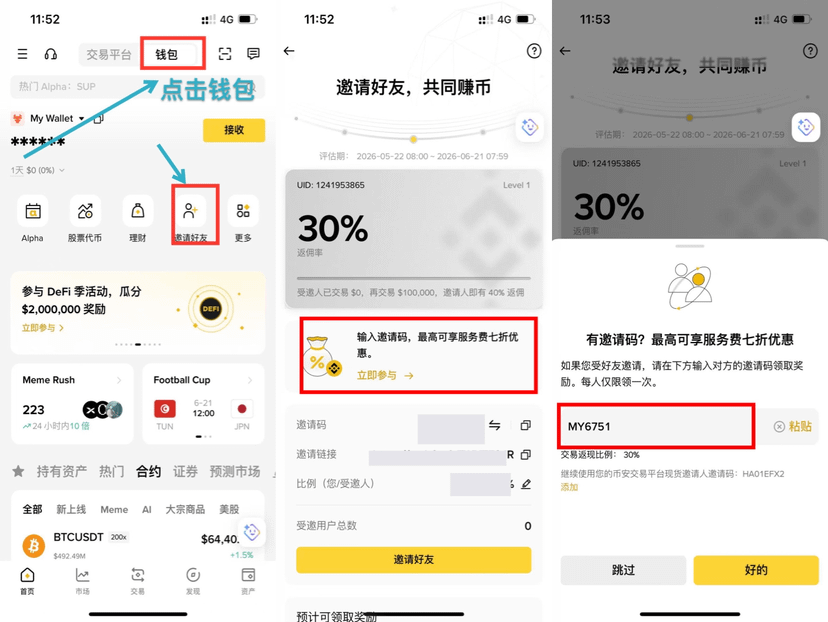
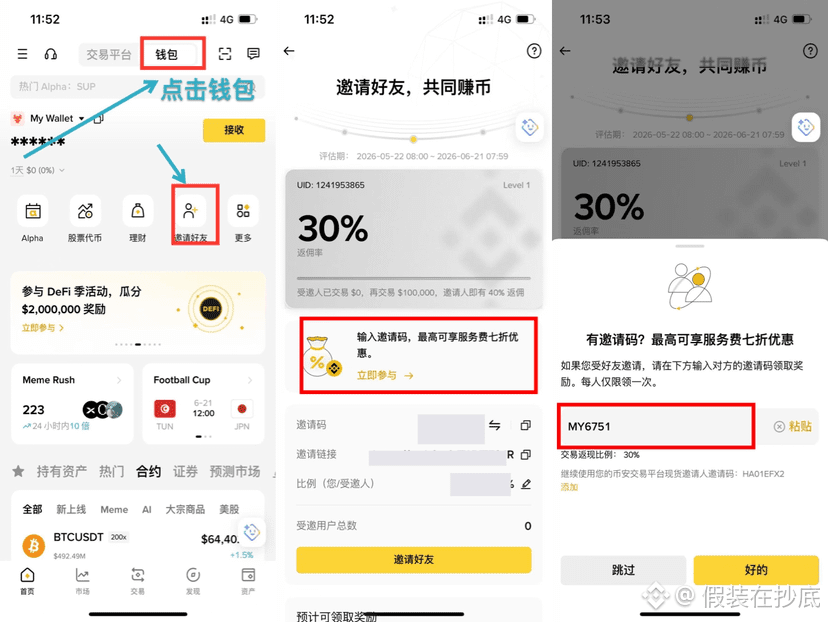
⚠️ Reminder, brothers: Use Binance invite code MY6751 to save 30% on fees (highest across the entire web). Automatic credit. Even old accounts that are already in use can fill it in. Alpha, spot, trading contest, futures, and tokenized stocks—everything saves 30%.
Done in three steps:
1️⃣ Binance App → Wallet → Invite Friends
2️⃣ Tap "Enter invite code" to reduce fees by 30%
3️⃣ Enter MY6751
⚠️ Reminder, brothers: Use Binance invite code MY6751 to save 30% on fees (highest across the entire web). Automatic credit. Even old accounts that are already in use can fill it in. Alpha, spot, trading contest, futures, and tokenized stocks—everything saves 30%.
Done in three steps:
1️⃣ Binance App → Wallet → Invite Friends
2️⃣ Tap "Enter invite code" to reduce fees by 30%
3️⃣ Enter MY6751
Done in three steps:
1️⃣ Binance App → Wallet → Invite Friends
2️⃣ Tap "Enter invite code" to reduce fees by 30%
3️⃣ Enter MY6751
2.9k
18
190
2.9k
·
--
Verified
📆Today 16:00 Binance Alpha listing Concrete (CT)
CT total supply is 1 billion coins, with no inflation. It’s mainly used for treasury management and protocol configuration. It does not represent ownership in Concrete, and it does not come with any dividend rights. As of now, about 93.54 million coins have already been minted on-chain, roughly 9.35% of the total supply. However, minted amount doesn’t equal actual circulating supply; the official initial circulating supply is still unclear.
The pre-market price was around $0.33, which suggests the $0.11 initial anchor isn’t that low. But the sell pressure at the Alpha airdrop opening likely won’t be small either. Most likely, it will first be pumped and then dumped, with very high volatility.
My approach to selling the airdrop:
When it reaches $0.18, sell 70%
When it reaches $0.24, sell the remaining 30%
If it opens and immediately holds above $0.24, don’t wait for a higher price—take profits first. You’re selling for certainty with the airdrop; don’t give up gains just to make a little more.
📆Today 16:00 Binance Alpha listing Concrete (CT)
CT total supply is 1 billion coins, with no inflation. It’s mainly used for treasury management and protocol configuration. It does not represent ownership in Concrete, and it does not come with any dividend rights. As of now, about 93.54 million coins have already been minted on-chain, roughly 9.35% of the total supply. However, minted amount doesn’t equal actual circulating supply; the official initial circulating supply is still unclear.
The pre-market price was around $0.33, which suggests the $0.11 initial anchor isn’t that low. But the sell pressure at the Alpha airdrop opening likely won’t be small either. Most likely, it will first be pumped and then dumped, with very high volatility.
My approach to selling the airdrop:
When it reaches $0.18, sell 70%
When it reaches $0.24, sell the remaining 30%
If it opens and immediately holds above $0.24, don’t wait for a higher price—take profits first. You’re selling for certainty with the airdrop; don’t give up gains just to make a little more.
CT total supply is 1 billion coins, with no inflation. It’s mainly used for treasury management and protocol configuration. It does not represent ownership in Concrete, and it does not come with any dividend rights. As of now, about 93.54 million coins have already been minted on-chain, roughly 9.35% of the total supply. However, minted amount doesn’t equal actual circulating supply; the official initial circulating supply is still unclear.
The pre-market price was around $0.33, which suggests the $0.11 initial anchor isn’t that low. But the sell pressure at the Alpha airdrop opening likely won’t be small either. Most likely, it will first be pumped and then dumped, with very high volatility.
My approach to selling the airdrop:
When it reaches $0.18, sell 70%
When it reaches $0.24, sell the remaining 30%
If it opens and immediately holds above $0.24, don’t wait for a higher price—take profits first. You’re selling for certainty with the airdrop; don’t give up gains just to make a little more.
4
11
2.4k
·
--
📆Today 17:00, pPOLY launches on Binance
Let’s get to the point: pPOLY is not Polymarket’s official platform token, and it’s not the same as directly holding Polymarket shares. It’s an SPV token issued by Paimon Finance, giving users indirect exposure to equity related to Polymarket.
The subscription price is $15.5. The total allocation is roughly $4.8 million, with about 309,700 tokens actually distributed. The allocation mainly references Alpha points and the prior on-chain activity of bStocks. Subscribing will not consume Alpha points; after oversubscription, tokens are allocated according to the rules, and any unused funds are refunded.
On the order book: below $15.5 there is about 2 million U of liquidity, with the thickest buy support around $13.95 to $15.48. But this only reflects the pool’s bids—it does not mean $15.5 is protected or risk-free.
What really needs attention is that the pool above is very shallow. On-chain estimates suggest that buy orders of about 100k U could push the price to around $26. The price can indeed be bid up quickly, but once the $4.8 million subscription allocation lands, others will cash out as well—so chasing above $20 blindly is not suitable.
Strategy:
$19.8: sell 60%, profit about 28%
$24.8: sell the remaining portion, profit about 60%
Placing limit orders slightly below $20 and $25 makes it easier to sell before/at the integer breakpoints. If it rockets to above $25 right at the open, I’ll choose to take profits as soon as possible and won’t try to guess the top.
Pros of pPOLY: the Polymarket narrative is hot enough, Binance Wallet’s first-phase Pre-Access includes built-in traffic, and the token allocation structure is simple. Cons are also clear: it’s just a third-party SPV exposure. The underlying shareholding ratio, redemption mechanism, fees, and the relationship to Polymarket authorization are not fully transparent.
One more thing: the “1 billion total supply” shown in the contract is mainly for accounting/measurement; in practice, only about 322,600 tokens are actually minted on BSC. Using the 1 billion total supply to calculate FDV directly has little value. What really matters is the SPV’s underlying entitlements and secondary-market liquidity.
In one sentence: subscriptions can be participated in, and you can sell at the open—but don’t treat a third-party SPV token as Polymarket’s official equity. $15.5 is the subscription price; $20 to $25 is the emotion/realization zone. Once it runs into the low $20s, chasing puts you at risk of buying the subscription crowd’s exit liquidity.
📆Today 17:00, pPOLY launches on Binance
Let’s get to the point: pPOLY is not Polymarket’s official platform token, and it’s not the same as directly holding Polymarket shares. It’s an SPV token issued by Paimon Finance, giving users indirect exposure to equity related to Polymarket.
The subscription price is $15.5. The total allocation is roughly $4.8 million, with about 309,700 tokens actually distributed. The allocation mainly references Alpha points and the prior on-chain activity of bStocks. Subscribing will not consume Alpha points; after oversubscription, tokens are allocated according to the rules, and any unused funds are refunded.
On the order book: below $15.5 there is about 2 million U of liquidity, with the thickest buy support around $13.95 to $15.48. But this only reflects the pool’s bids—it does not mean $15.5 is protected or risk-free.
What really needs attention is that the pool above is very shallow. On-chain estimates suggest that buy orders of about 100k U could push the price to around $26. The price can indeed be bid up quickly, but once the $4.8 million subscription allocation lands, others will cash out as well—so chasing above $20 blindly is not suitable.
Strategy:
$19.8: sell 60%, profit about 28%
$24.8: sell the remaining portion, profit about 60%
Placing limit orders slightly below $20 and $25 makes it easier to sell before/at the integer breakpoints. If it rockets to above $25 right at the open, I’ll choose to take profits as soon as possible and won’t try to guess the top.
Pros of pPOLY: the Polymarket narrative is hot enough, Binance Wallet’s first-phase Pre-Access includes built-in traffic, and the token allocation structure is simple. Cons are also clear: it’s just a third-party SPV exposure. The underlying shareholding ratio, redemption mechanism, fees, and the relationship to Polymarket authorization are not fully transparent.
One more thing: the “1 billion total supply” shown in the contract is mainly for accounting/measurement; in practice, only about 322,600 tokens are actually minted on BSC. Using the 1 billion total supply to calculate FDV directly has little value. What really matters is the SPV’s underlying entitlements and secondary-market liquidity.
In one sentence: subscriptions can be participated in, and you can sell at the open—but don’t treat a third-party SPV token as Polymarket’s official equity. $15.5 is the subscription price; $20 to $25 is the emotion/realization zone. Once it runs into the low $20s, chasing puts you at risk of buying the subscription crowd’s exit liquidity.
Let’s get to the point: pPOLY is not Polymarket’s official platform token, and it’s not the same as directly holding Polymarket shares. It’s an SPV token issued by Paimon Finance, giving users indirect exposure to equity related to Polymarket.
The subscription price is $15.5. The total allocation is roughly $4.8 million, with about 309,700 tokens actually distributed. The allocation mainly references Alpha points and the prior on-chain activity of bStocks. Subscribing will not consume Alpha points; after oversubscription, tokens are allocated according to the rules, and any unused funds are refunded.
On the order book: below $15.5 there is about 2 million U of liquidity, with the thickest buy support around $13.95 to $15.48. But this only reflects the pool’s bids—it does not mean $15.5 is protected or risk-free.
What really needs attention is that the pool above is very shallow. On-chain estimates suggest that buy orders of about 100k U could push the price to around $26. The price can indeed be bid up quickly, but once the $4.8 million subscription allocation lands, others will cash out as well—so chasing above $20 blindly is not suitable.
Strategy:
$19.8: sell 60%, profit about 28%
$24.8: sell the remaining portion, profit about 60%
Placing limit orders slightly below $20 and $25 makes it easier to sell before/at the integer breakpoints. If it rockets to above $25 right at the open, I’ll choose to take profits as soon as possible and won’t try to guess the top.
Pros of pPOLY: the Polymarket narrative is hot enough, Binance Wallet’s first-phase Pre-Access includes built-in traffic, and the token allocation structure is simple. Cons are also clear: it’s just a third-party SPV exposure. The underlying shareholding ratio, redemption mechanism, fees, and the relationship to Polymarket authorization are not fully transparent.
One more thing: the “1 billion total supply” shown in the contract is mainly for accounting/measurement; in practice, only about 322,600 tokens are actually minted on BSC. Using the 1 billion total supply to calculate FDV directly has little value. What really matters is the SPV’s underlying entitlements and secondary-market liquidity.
In one sentence: subscriptions can be participated in, and you can sell at the open—but don’t treat a third-party SPV token as Polymarket’s official equity. $15.5 is the subscription price; $20 to $25 is the emotion/realization zone. Once it runs into the low $20s, chasing puts you at risk of buying the subscription crowd’s exit liquidity.
1
2
454
·
--
🔥Latest Alpha Points +5 Bonus—Beginner-Friendly Step-by-Step Guide!
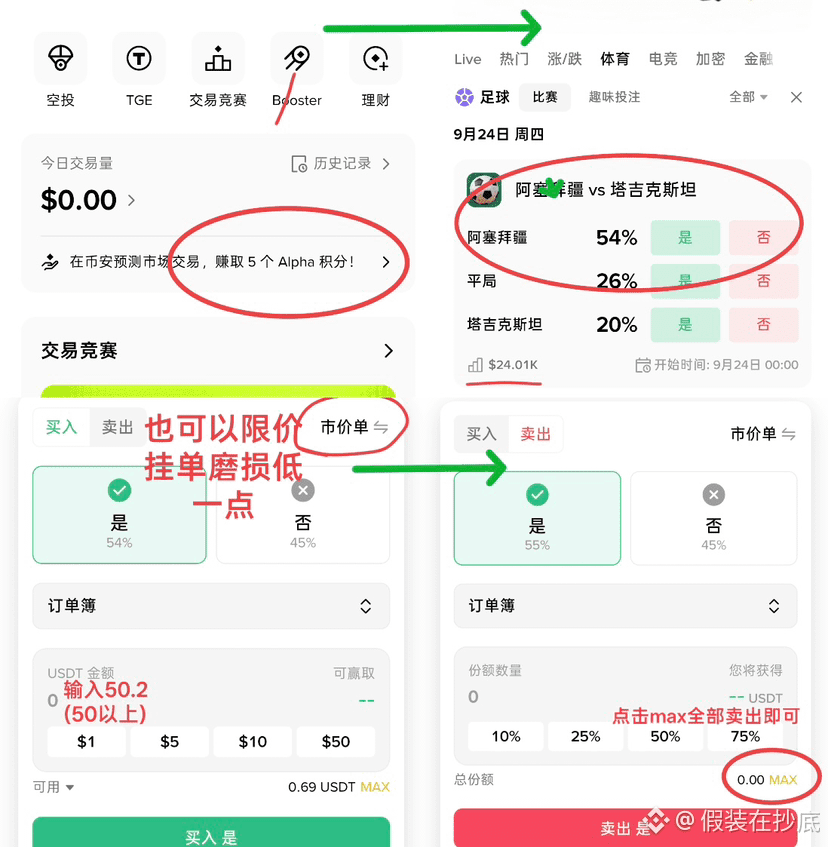
The latest Alpha points-boosting promotion is here again. This time, the method is through Binance Wallet’s 【Predict Football Predictions】. I put together a one-image text version—follow along at your own pace and go for it~
📌 Quick Overview
· Reward: Alpha Points +5
· Time: Sep 23, 8:00 to Sep 30, 7:59 (Beijing Time)
· Requirement: Football prediction buy amount ≥ 50U
· Estimated friction/loss (wear & tear): ~1.5U - 2U
🛠️ My hands-on steps (takes about 3 minutes)
1. Prepare funds: Withdraw 51U to your Binance Wallet in advance (add +1U to cover wear & tear so you still have at least 50U—otherwise you may miss the reward).
2. Find the entry: Open the Alpha interface, locate this points-boosting activity. The system will automatically redirect you to the “Sports - Azerbaijan vs Tajikistan” prediction page.
3. Place the order: Click “Yes” to go to the order page. Buy prediction amounts of 50U or more.
4. Sell quickly: After the order is completed, immediately click “Sell”, select “max” to sell all shares. Task done.
💡 Personal Tips & Avoid-the-Pitfalls Guide
· Market price vs limit order: Some bloggers recommend using limit orders to reduce wear & tear, but it’s easier to get stuck and waste time. My personal suggestion is: once the order book depth looks good, move fast—use market price to buy and sell quickly. Convenience matters most! With market price + fees, the wear & tear is about ~1.65U. If you also have a wallet invite code, you can save a bit more (Binance Wallet uses invite code MY6751, 30% auto rebate).
· Trading discipline: Don’t hesitate—buy fast, sell fast. Our goal is to lock in those 5 Alpha points reliably!
My mindset:
Pay 50U to get 5 Alpha—basically like free money. Everyone, combine your score situation and choose the most cost-effective day—no need to force it.
If you have questions, chat in the comments. Wishing everyone smooth “free money” runs!
#alpha积分规则 #ALPHA🔥
🔥Latest Alpha Points +5 Bonus—Beginner-Friendly Step-by-Step Guide!
The latest Alpha points-boosting promotion is here again. This time, the method is through Binance Wallet’s 【Predict Football Predictions】. I put together a one-image text version—follow along at your own pace and go for it~
📌 Quick Overview
· Reward: Alpha Points +5
· Time: Sep 23, 8:00 to Sep 30, 7:59 (Beijing Time)
· Requirement: Football prediction buy amount ≥ 50U
· Estimated friction/loss (wear & tear): ~1.5U - 2U
🛠️ My hands-on steps (takes about 3 minutes)
1. Prepare funds: Withdraw 51U to your Binance Wallet in advance (add +1U to cover wear & tear so you still have at least 50U—otherwise you may miss the reward).
2. Find the entry: Open the Alpha interface, locate this points-boosting activity. The system will automatically redirect you to the “Sports - Azerbaijan vs Tajikistan” prediction page.
3. Place the order: Click “Yes” to go to the order page. Buy prediction amounts of 50U or more.
4. Sell quickly: After the order is completed, immediately click “Sell”, select “max” to sell all shares. Task done.
💡 Personal Tips & Avoid-the-Pitfalls Guide
· Market price vs limit order: Some bloggers recommend using limit orders to reduce wear & tear, but it’s easier to get stuck and waste time. My personal suggestion is: once the order book depth looks good, move fast—use market price to buy and sell quickly. Convenience matters most! With market price + fees, the wear & tear is about ~1.65U. If you also have a wallet invite code, you can save a bit more (Binance Wallet uses invite code MY6751, 30% auto rebate).
· Trading discipline: Don’t hesitate—buy fast, sell fast. Our goal is to lock in those 5 Alpha points reliably!
My mindset:
Pay 50U to get 5 Alpha—basically like free money. Everyone, combine your score situation and choose the most cost-effective day—no need to force it.
If you have questions, chat in the comments. Wishing everyone smooth “free money” runs!
#alpha积分规则 #ALPHA🔥
The latest Alpha points-boosting promotion is here again. This time, the method is through Binance Wallet’s 【Predict Football Predictions】. I put together a one-image text version—follow along at your own pace and go for it~
📌 Quick Overview
· Reward: Alpha Points +5
· Time: Sep 23, 8:00 to Sep 30, 7:59 (Beijing Time)
· Requirement: Football prediction buy amount ≥ 50U
· Estimated friction/loss (wear & tear): ~1.5U - 2U
🛠️ My hands-on steps (takes about 3 minutes)
1. Prepare funds: Withdraw 51U to your Binance Wallet in advance (add +1U to cover wear & tear so you still have at least 50U—otherwise you may miss the reward).
2. Find the entry: Open the Alpha interface, locate this points-boosting activity. The system will automatically redirect you to the “Sports - Azerbaijan vs Tajikistan” prediction page.
3. Place the order: Click “Yes” to go to the order page. Buy prediction amounts of 50U or more.
4. Sell quickly: After the order is completed, immediately click “Sell”, select “max” to sell all shares. Task done.
💡 Personal Tips & Avoid-the-Pitfalls Guide
· Market price vs limit order: Some bloggers recommend using limit orders to reduce wear & tear, but it’s easier to get stuck and waste time. My personal suggestion is: once the order book depth looks good, move fast—use market price to buy and sell quickly. Convenience matters most! With market price + fees, the wear & tear is about ~1.65U. If you also have a wallet invite code, you can save a bit more (Binance Wallet uses invite code MY6751, 30% auto rebate).
· Trading discipline: Don’t hesitate—buy fast, sell fast. Our goal is to lock in those 5 Alpha points reliably!
My mindset:
Pay 50U to get 5 Alpha—basically like free money. Everyone, combine your score situation and choose the most cost-effective day—no need to force it.
If you have questions, chat in the comments. Wishing everyone smooth “free money” runs!
#alpha积分规则 #ALPHA🔥
5
4
1.5k
·
--
📆Tonight around 21:00, Binance Alpha will list apM Fashion (APM)
This isn’t a new project, but an old coin from 2019 that’s being reissued. Originally, it mainly focused on membership points and payments for the Korean apparel wholesale market. Now it adds new narratives like AI and ZK verification.
The project’s advantages include offline scenarios, and behind it is a $5 million investment from DWF Labs. However, the old APM price has already dropped by more than 99%. This time, the total supply of the new coin is expanded to 10 billion units. The old coins are exchanged for new ones at a 1:2 ratio, with rewards distributed over 36 months. In plain terms, it’s an old project being restarted with a new contract.
The initial price of the new-coin pool is about $0.002, which corresponds to a $20 million FDV. Below the pool, there are roughly 350,000 USDT supporting it, but between $0.002 and $0.008 there are only 40 million sell orders. The pool is relatively thin, so even a small amount of capital could push the price up.
The market expects initial circulating supply of about 11.5%. Binance Alpha could receive roughly 100 million coins, about 1% of the total supply. However, the point-claim threshold and the number of coins per allocation have not been officially announced yet—follow the Binance page.
My airdrop selling plan:
$0.008: sell 60%, lock in profits first
$0.012: sell the remaining portion, no more holding for a run
$0.008 corresponds to an $80 million FDV, which is already 4x the pool’s initial valuation. $0.012 corresponds to a $120 million FDV. For a restarted old-coin project with continuous subsequent unlocks, this valuation is not cheap.
One-sentence summary: It has offline business and funding support, but the old coin’s history is too bad, and the new coin supply is also huge. In the short term, it might get pulled up because the pool is shallow; in the long term, sell pressure is very clear. You can claim the airdrop—if it pumps, sell soon. Don’t chase.
#alpha #ALPHA🔥
📆Tonight around 21:00, Binance Alpha will list apM Fashion (APM)
This isn’t a new project, but an old coin from 2019 that’s being reissued. Originally, it mainly focused on membership points and payments for the Korean apparel wholesale market. Now it adds new narratives like AI and ZK verification.
The project’s advantages include offline scenarios, and behind it is a $5 million investment from DWF Labs. However, the old APM price has already dropped by more than 99%. This time, the total supply of the new coin is expanded to 10 billion units. The old coins are exchanged for new ones at a 1:2 ratio, with rewards distributed over 36 months. In plain terms, it’s an old project being restarted with a new contract.
The initial price of the new-coin pool is about $0.002, which corresponds to a $20 million FDV. Below the pool, there are roughly 350,000 USDT supporting it, but between $0.002 and $0.008 there are only 40 million sell orders. The pool is relatively thin, so even a small amount of capital could push the price up.
The market expects initial circulating supply of about 11.5%. Binance Alpha could receive roughly 100 million coins, about 1% of the total supply. However, the point-claim threshold and the number of coins per allocation have not been officially announced yet—follow the Binance page.
My airdrop selling plan:
$0.008: sell 60%, lock in profits first
$0.012: sell the remaining portion, no more holding for a run
$0.008 corresponds to an $80 million FDV, which is already 4x the pool’s initial valuation. $0.012 corresponds to a $120 million FDV. For a restarted old-coin project with continuous subsequent unlocks, this valuation is not cheap.
One-sentence summary: It has offline business and funding support, but the old coin’s history is too bad, and the new coin supply is also huge. In the short term, it might get pulled up because the pool is shallow; in the long term, sell pressure is very clear. You can claim the airdrop—if it pumps, sell soon. Don’t chase.
#alpha #ALPHA🔥
This isn’t a new project, but an old coin from 2019 that’s being reissued. Originally, it mainly focused on membership points and payments for the Korean apparel wholesale market. Now it adds new narratives like AI and ZK verification.
The project’s advantages include offline scenarios, and behind it is a $5 million investment from DWF Labs. However, the old APM price has already dropped by more than 99%. This time, the total supply of the new coin is expanded to 10 billion units. The old coins are exchanged for new ones at a 1:2 ratio, with rewards distributed over 36 months. In plain terms, it’s an old project being restarted with a new contract.
The initial price of the new-coin pool is about $0.002, which corresponds to a $20 million FDV. Below the pool, there are roughly 350,000 USDT supporting it, but between $0.002 and $0.008 there are only 40 million sell orders. The pool is relatively thin, so even a small amount of capital could push the price up.
The market expects initial circulating supply of about 11.5%. Binance Alpha could receive roughly 100 million coins, about 1% of the total supply. However, the point-claim threshold and the number of coins per allocation have not been officially announced yet—follow the Binance page.
My airdrop selling plan:
$0.008: sell 60%, lock in profits first
$0.012: sell the remaining portion, no more holding for a run
$0.008 corresponds to an $80 million FDV, which is already 4x the pool’s initial valuation. $0.012 corresponds to a $120 million FDV. For a restarted old-coin project with continuous subsequent unlocks, this valuation is not cheap.
One-sentence summary: It has offline business and funding support, but the old coin’s history is too bad, and the new coin supply is also huge. In the short term, it might get pulled up because the pool is shallow; in the long term, sell pressure is very clear. You can claim the airdrop—if it pumps, sell soon. Don’t chase.
#alpha #ALPHA🔥
6
4
19
2.5k
·
--
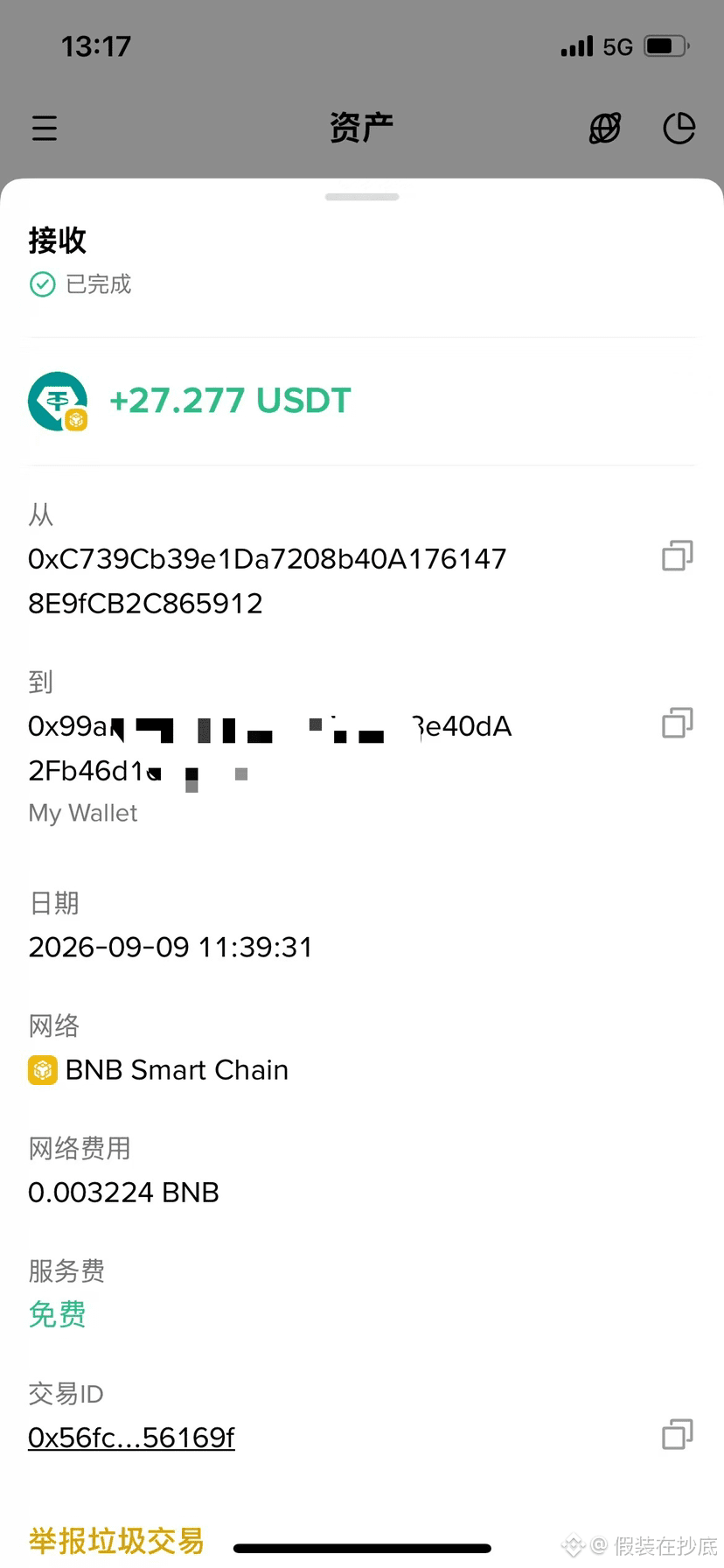
“10U War God” Episode 1: Rewards of 27U were paid out—value for money is still pretty good.
Episode 2 is starting again. It’s the usual routine: directly hedge to open the order, make enough 10U, then run. The tutorial is here—see my previous posts below 👇🏻.
#10U战神
“10U War God” Episode 1: Rewards of 27U were paid out—value for money is still pretty good.
Episode 2 is starting again. It’s the usual routine: directly hedge to open the order, make enough 10U, then run. The tutorial is here—see my previous posts below 👇🏻.
#10U战神
Episode 2 is starting again. It’s the usual routine: directly hedge to open the order, make enough 10U, then run. The tutorial is here—see my previous posts below 👇🏻.
#10U战神
假装在抄底
·
--
Tutorial for “10U Battle God” is here!
Straight to the point: I’ll teach you how to use contract-based high-heat Meme coins like $龙虾 or $币安人生 . Buy $200 in your wallet, use 1x leverage on the contract to short $200 as a hedge, and once you’ve made $10, you’re done—then you’ve secured a guaranteed chance to split 50,000 USDT.
⚠️ Reminder, brothers: Before joining the event, you can use the Binance wallet invite code MY6751 to save 30% on fees (highest on the whole network), with automatic credit. Even existing older accounts that are already in use can fill in Alpha, Spot, Trading, Contracts, and Tokenized Stocks—everything saves 30%.
Three steps to finish:
1️⃣ Binance App → Wallet → Invite Friends
2️⃣ Click “Enter invite code” to reduce fees by 30%
3️⃣ Enter MY6751
#撸毛攻略 #10U战神
#美国7月零售销售下降0.6%
#Cboe申请3倍比特币与以太坊ETF
Straight to the point: I’ll teach you how to use contract-based high-heat Meme coins like $龙虾 or $币安人生 . Buy $200 in your wallet, use 1x leverage on the contract to short $200 as a hedge, and once you’ve made $10, you’re done—then you’ve secured a guaranteed chance to split 50,000 USDT.
⚠️ Reminder, brothers: Before joining the event, you can use the Binance wallet invite code MY6751 to save 30% on fees (highest on the whole network), with automatic credit. Even existing older accounts that are already in use can fill in Alpha, Spot, Trading, Contracts, and Tokenized Stocks—everything saves 30%.
Three steps to finish:
1️⃣ Binance App → Wallet → Invite Friends
2️⃣ Click “Enter invite code” to reduce fees by 30%
3️⃣ Enter MY6751
#撸毛攻略 #10U战神
#美国7月零售销售下降0.6%
#Cboe申请3倍比特币与以太坊ETF
2
370
·
--
Verified
📅 Tonight at 20:00, Binance Alpha will list Canopy (CNPY)
Canopy is positioned as “using AI to rapidly develop on-chain applications.” In simple terms, it makes complex tasks like building chains and deploying apps much easier. The project acquired Tanssi’s core technology and completed a $8.5 million funding round, with investors including Arrington, Fenbushi, Borderless, and SNZ—so the background is decent.
But there are a few things to watch out for:
The project’s official website claims 350,000 users and 25,000 developers, but the numbers are mainly based on testnet data. It’s not clear yet what the real revenue is or what mainnet demand looks like.
CNPY’s maximum supply is 560 million. CMC shows circulating supply of about 67.12 million, but on-chain total supply is already over 228 million. The gap between different metrics is huge. How much investors, the team, and airdrops can actually sell hasn’t been explained clearly.
The on-chain pool’s reference price is around $0.1116, which corresponds to an FDV of $62.5 million. The pool isn’t deep—some analysis suggests that a $200,000 buy could push the price to around $0.24, meaning it’s easy to get a big pump and then a big dump right after launch.
Also, tonight exchanges like Bitget and Gate will open at 20:00 as well, and there’s no exclusive two-hour window for Binance. Binance’s airdrops, the project’s airdrops, and other platforms’ liquidity may all hit the market together. After a spike, be careful about a pullback.
My airdrop selling strategy:
Above 0.18: sell half—lock in the profit first
0.24: sell most of the remaining—keep at most 10% to watch
The logic is simple: the pool’s floor price is about $0.1116, and $0.18 is likely reachable in the first wave of the pump. On-chain estimates suggest that a ~$200,000 buy could push price toward $0.24, which is a relatively clear profit-taking zone.
If it opens directly above $0.24, you don’t need to wait for limit orders—just sell in batches at market price. The key of a free airdrop is to realize gains, not to guess the very highest point.
📅 Tonight at 20:00, Binance Alpha will list Canopy (CNPY)
Canopy is positioned as “using AI to rapidly develop on-chain applications.” In simple terms, it makes complex tasks like building chains and deploying apps much easier. The project acquired Tanssi’s core technology and completed a $8.5 million funding round, with investors including Arrington, Fenbushi, Borderless, and SNZ—so the background is decent.
But there are a few things to watch out for:
The project’s official website claims 350,000 users and 25,000 developers, but the numbers are mainly based on testnet data. It’s not clear yet what the real revenue is or what mainnet demand looks like.
CNPY’s maximum supply is 560 million. CMC shows circulating supply of about 67.12 million, but on-chain total supply is already over 228 million. The gap between different metrics is huge. How much investors, the team, and airdrops can actually sell hasn’t been explained clearly.
The on-chain pool’s reference price is around $0.1116, which corresponds to an FDV of $62.5 million. The pool isn’t deep—some analysis suggests that a $200,000 buy could push the price to around $0.24, meaning it’s easy to get a big pump and then a big dump right after launch.
Also, tonight exchanges like Bitget and Gate will open at 20:00 as well, and there’s no exclusive two-hour window for Binance. Binance’s airdrops, the project’s airdrops, and other platforms’ liquidity may all hit the market together. After a spike, be careful about a pullback.
My airdrop selling strategy:
Above 0.18: sell half—lock in the profit first
0.24: sell most of the remaining—keep at most 10% to watch
The logic is simple: the pool’s floor price is about $0.1116, and $0.18 is likely reachable in the first wave of the pump. On-chain estimates suggest that a ~$200,000 buy could push price toward $0.24, which is a relatively clear profit-taking zone.
If it opens directly above $0.24, you don’t need to wait for limit orders—just sell in batches at market price. The key of a free airdrop is to realize gains, not to guess the very highest point.
Canopy is positioned as “using AI to rapidly develop on-chain applications.” In simple terms, it makes complex tasks like building chains and deploying apps much easier. The project acquired Tanssi’s core technology and completed a $8.5 million funding round, with investors including Arrington, Fenbushi, Borderless, and SNZ—so the background is decent.
But there are a few things to watch out for:
The project’s official website claims 350,000 users and 25,000 developers, but the numbers are mainly based on testnet data. It’s not clear yet what the real revenue is or what mainnet demand looks like.
CNPY’s maximum supply is 560 million. CMC shows circulating supply of about 67.12 million, but on-chain total supply is already over 228 million. The gap between different metrics is huge. How much investors, the team, and airdrops can actually sell hasn’t been explained clearly.
The on-chain pool’s reference price is around $0.1116, which corresponds to an FDV of $62.5 million. The pool isn’t deep—some analysis suggests that a $200,000 buy could push the price to around $0.24, meaning it’s easy to get a big pump and then a big dump right after launch.
Also, tonight exchanges like Bitget and Gate will open at 20:00 as well, and there’s no exclusive two-hour window for Binance. Binance’s airdrops, the project’s airdrops, and other platforms’ liquidity may all hit the market together. After a spike, be careful about a pullback.
My airdrop selling strategy:
Above 0.18: sell half—lock in the profit first
0.24: sell most of the remaining—keep at most 10% to watch
The logic is simple: the pool’s floor price is about $0.1116, and $0.18 is likely reachable in the first wave of the pump. On-chain estimates suggest that a ~$200,000 buy could push price toward $0.24, which is a relatively clear profit-taking zone.
If it opens directly above $0.24, you don’t need to wait for limit orders—just sell in batches at market price. The key of a free airdrop is to realize gains, not to guess the very highest point.
4
3
655
·
--
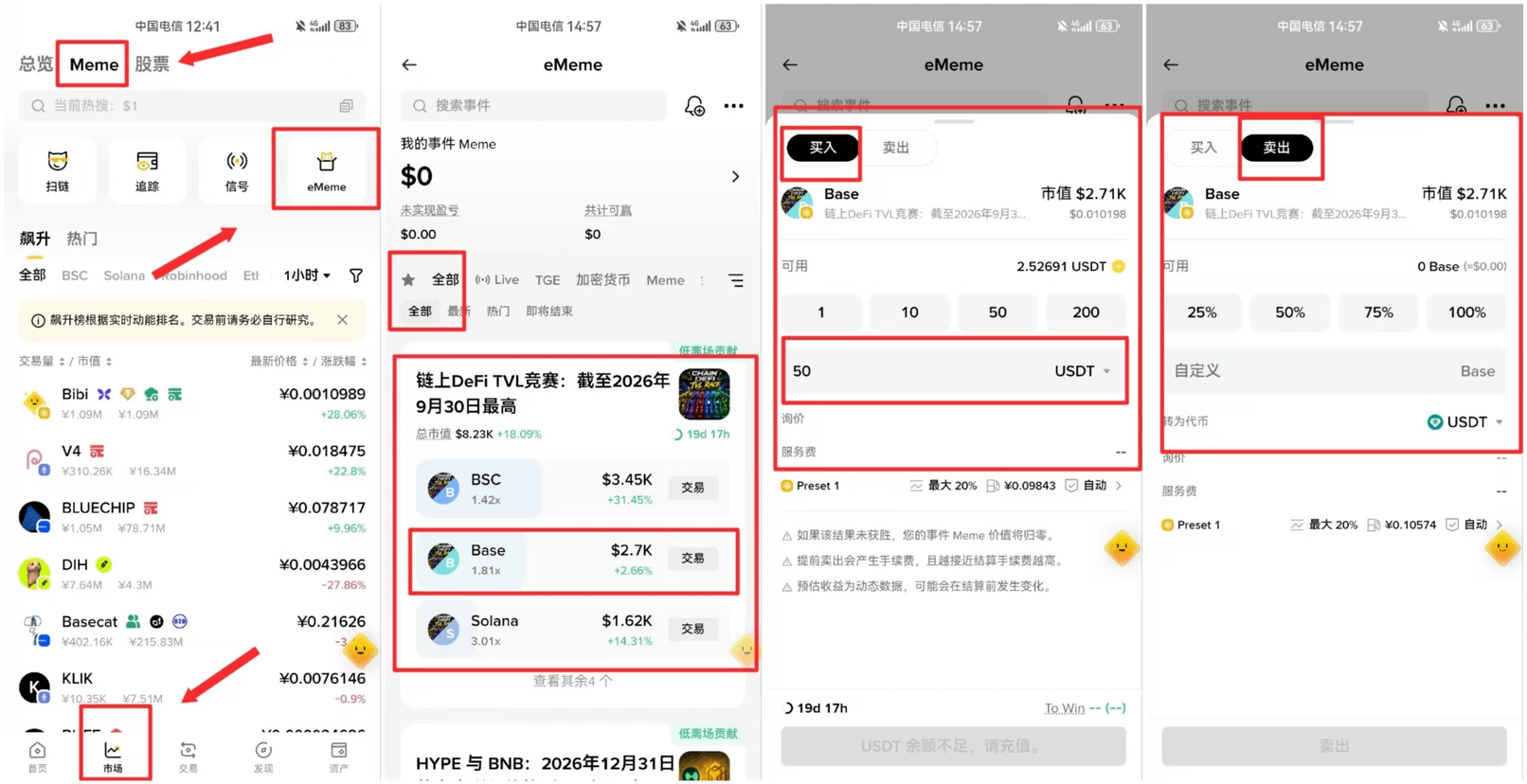
Alpha Task 5 Points Sprint Guide 🔥
There’s a high chance of an airdrop tomorrow, so you can start the 5-point task today.
Task overview
Trade 50 U of eMeme in the Binance Wallet to get 5 Alpha points.
(Note: only the “eMeme” token counts — don’t buy the wrong pool!)
How to get there
Binance Wallet → bottom-left “Market” → choose “Meme” at the top → find the “eMeme” entry on the right
Personal tips
· Buying 51 U is safer (after slippage, anything under 50 U may not qualify, so don’t cut it too close)
· Choose the “DeFi TVL Competition” pool on the Base chain; slippage is around 1.5 U, so it’s good value
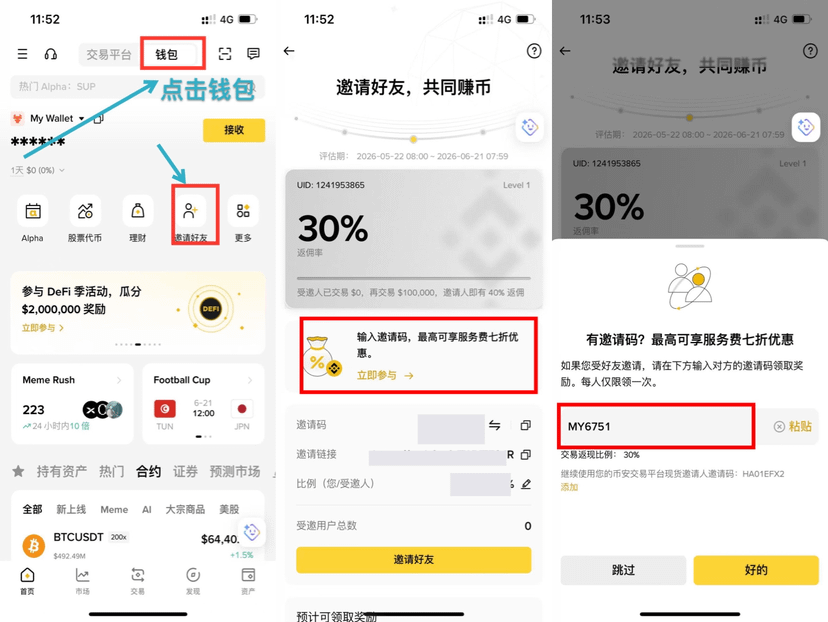
(eMeme service fee is 0.5%. Binding the wallet referral code MY6751 gives a 30% Binance Wallet rebate, which can save another 0.15 U on this task. See the image tutorial for how to bind the referral code.)
Alpha Task 5 Points Sprint Guide 🔥
There’s a high chance of an airdrop tomorrow, so you can start the 5-point task today.
Task overview
Trade 50 U of eMeme in the Binance Wallet to get 5 Alpha points.
(Note: only the “eMeme” token counts — don’t buy the wrong pool!)
How to get there
Binance Wallet → bottom-left “Market” → choose “Meme” at the top → find the “eMeme” entry on the right
Personal tips
· Buying 51 U is safer (after slippage, anything under 50 U may not qualify, so don’t cut it too close)
· Choose the “DeFi TVL Competition” pool on the Base chain; slippage is around 1.5 U, so it’s good value
(eMeme service fee is 0.5%. Binding the wallet referral code MY6751 gives a 30% Binance Wallet rebate, which can save another 0.15 U on this task. See the image tutorial for how to bind the referral code.)
There’s a high chance of an airdrop tomorrow, so you can start the 5-point task today.
Task overview
Trade 50 U of eMeme in the Binance Wallet to get 5 Alpha points.
(Note: only the “eMeme” token counts — don’t buy the wrong pool!)
How to get there
Binance Wallet → bottom-left “Market” → choose “Meme” at the top → find the “eMeme” entry on the right
Personal tips
· Buying 51 U is safer (after slippage, anything under 50 U may not qualify, so don’t cut it too close)
· Choose the “DeFi TVL Competition” pool on the Base chain; slippage is around 1.5 U, so it’s good value
(eMeme service fee is 0.5%. Binding the wallet referral code MY6751 gives a 30% Binance Wallet rebate, which can save another 0.15 U on this task. See the image tutorial for how to bind the referral code.)
9
2
9
1.8k
·
--
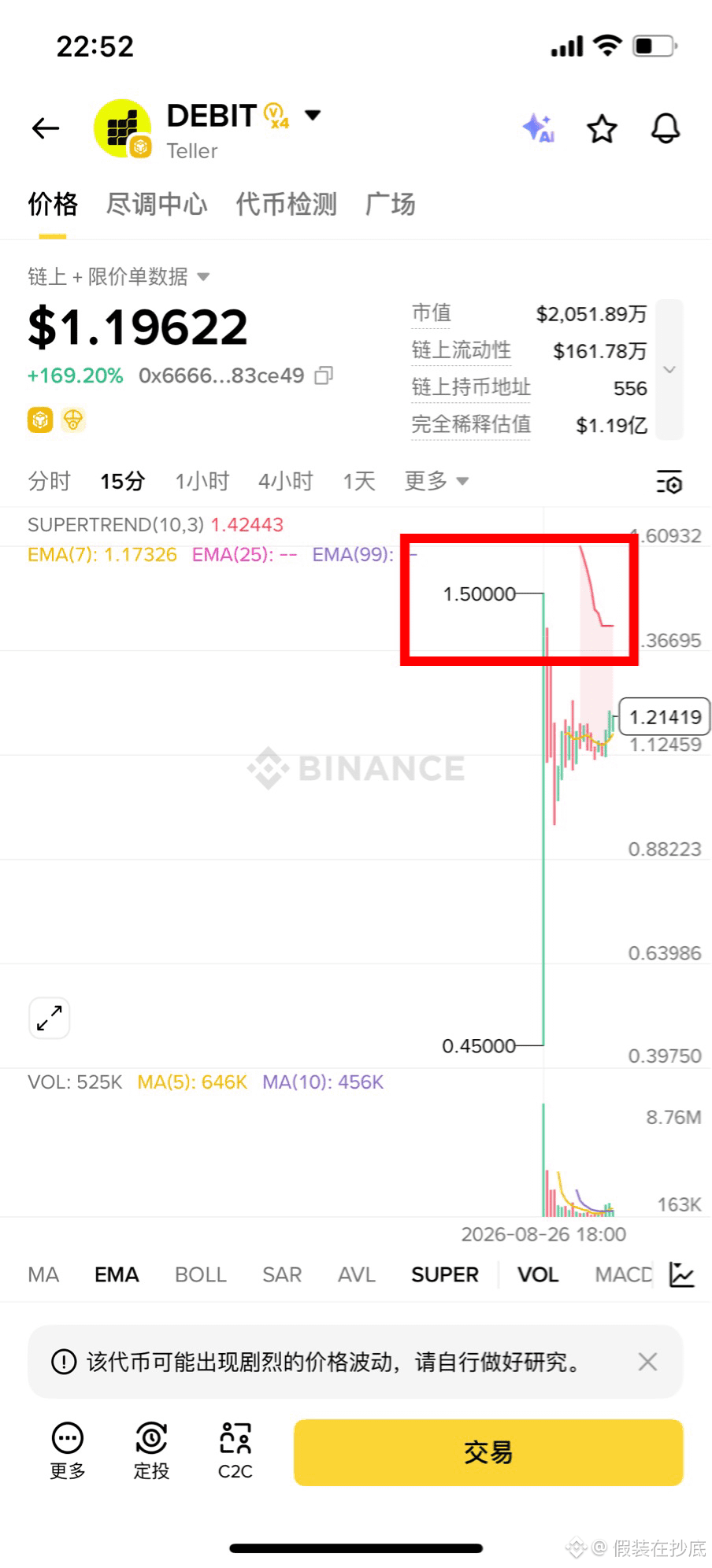
$DEBIT highest point 1.5 and my preset clearing line—exactly to the penny, no difference at all.
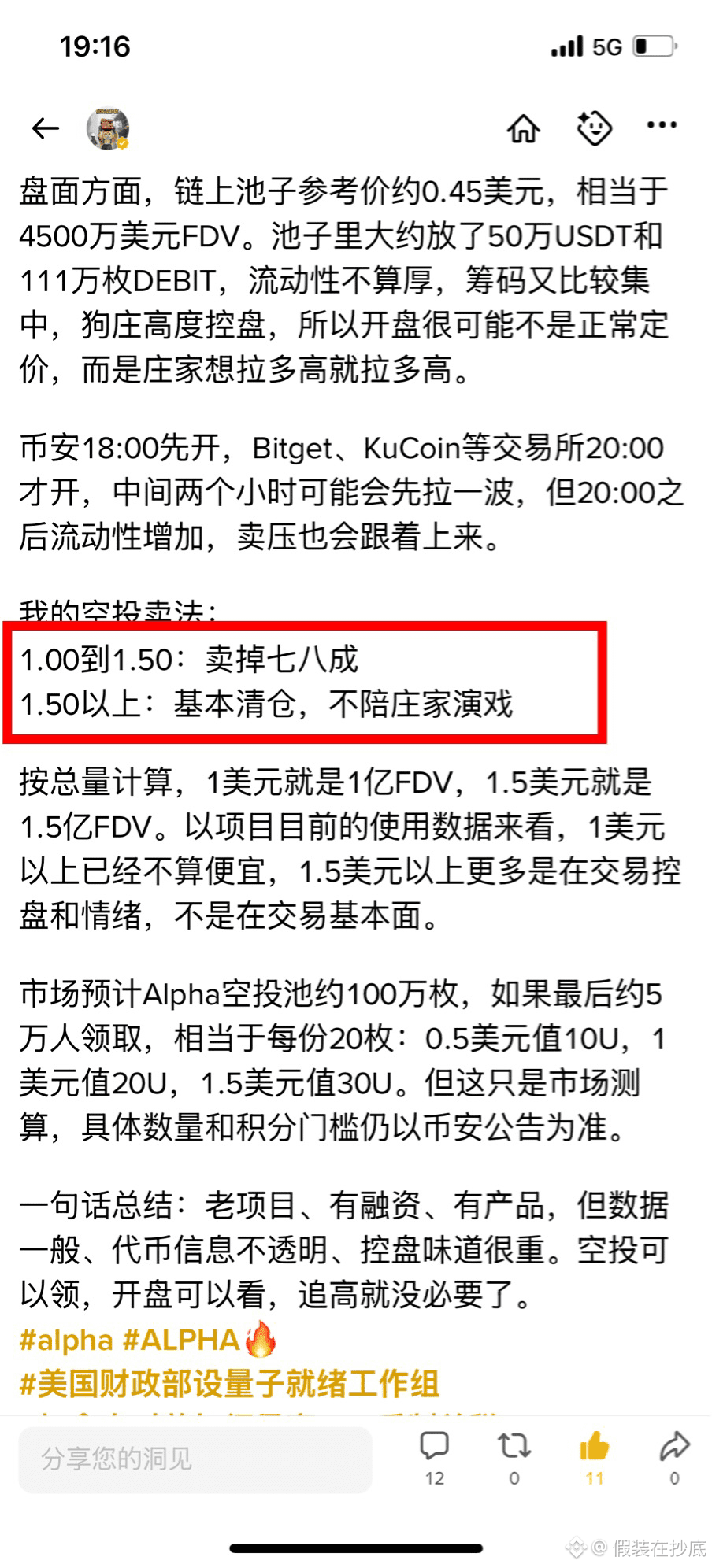
Before the open I wrote it clearly: above 1.5, basically fully clear. Today, right at the open it straight-line surged to 1.5, precisely hitting the take-profit line, and I followed the plan to the end.
Is it too much if I give this run a little brag? 😉 What price did you sell at, and what price did you enter? Comment below!
{alpha}(560x66661c7229901f568f16bd1551b3ba826f83ce49)
$DEBIT highest point 1.5 and my preset clearing line—exactly to the penny, no difference at all.
Before the open I wrote it clearly: above 1.5, basically fully clear. Today, right at the open it straight-line surged to 1.5, precisely hitting the take-profit line, and I followed the plan to the end.
Is it too much if I give this run a little brag? 😉 What price did you sell at, and what price did you enter? Comment below!
Before the open I wrote it clearly: above 1.5, basically fully clear. Today, right at the open it straight-line surged to 1.5, precisely hitting the take-profit line, and I followed the plan to the end.
Is it too much if I give this run a little brag? 😉 What price did you sell at, and what price did you enter? Comment below!
假装在抄底
·
--
📆Today at 18:00, Binance Alpha will launch Teller (DEBIT)
In simple terms, this is a long-standing lending project that started around 2019–2020. It focuses on on-chain lending and unsecured loans. Total funding is about $7.85 million, with investors including Blockchain Capital, Franklin Templeton, Toyota Ventures, and others—so the background is solid.
The total token supply is close to 100 million coins and can be verified on-chain. However, the initial circulating amount, unlock rules, and full tokenomics have not been disclosed publicly to date—this is the biggest risk.
In terms of the order book, the on-chain pool reference price is around $0.45, which corresponds to $45 million FDV. The pool contains about 500k USDT and 1.11 million DEBIT. Liquidity isn’t that thick, and the chips are relatively concentrated. The so-called “big player” has a high level of control (market maker/whale style), so the opening price is very likely not a normal valuation—it's more like they will pull it as high as they want.
Binance opens first at 18:00; exchanges like Bitget and KuCoin open at 20:00. In the two-hour gap, there may be an initial push. But after 20:00, liquidity increases and sell pressure will likely follow.
My airdrop-selling plan:
1.00 to 1.50: Sell about 70–80%
Above 1.50: Basically fully exit—no need to participate in the “show” with the big player.
Based on total supply, $1 equals 100 million FDV, and $1.5 equals 150 million FDV. Judging by the project’s current usage data, anything above $1 is no longer “cheap.” Above $1.5 is mostly about trading control and sentiment—not about trading fundamentals.
Market expects the Alpha airdrop pool to be around 1 million tokens. If about 50,000 people claim, that’s 20 tokens per share: $0.5 worth = 10U, $1 worth = 20U, $1.5 worth = 30U. But this is only market estimation—exact numbers and point thresholds are still subject to Binance’s announcement.
One-sentence summary: Old project, good funding, real product—but mediocre data, opaque token info, and a strong “controlled market” vibe. You can claim the airdrop and watch the opening, but there’s no need to chase after a high pump.
#alpha #ALPHA🔥
#美国财政部设量子就绪工作组
#加拿大对美加征最高50%反制关税
In simple terms, this is a long-standing lending project that started around 2019–2020. It focuses on on-chain lending and unsecured loans. Total funding is about $7.85 million, with investors including Blockchain Capital, Franklin Templeton, Toyota Ventures, and others—so the background is solid.
The total token supply is close to 100 million coins and can be verified on-chain. However, the initial circulating amount, unlock rules, and full tokenomics have not been disclosed publicly to date—this is the biggest risk.
In terms of the order book, the on-chain pool reference price is around $0.45, which corresponds to $45 million FDV. The pool contains about 500k USDT and 1.11 million DEBIT. Liquidity isn’t that thick, and the chips are relatively concentrated. The so-called “big player” has a high level of control (market maker/whale style), so the opening price is very likely not a normal valuation—it's more like they will pull it as high as they want.
Binance opens first at 18:00; exchanges like Bitget and KuCoin open at 20:00. In the two-hour gap, there may be an initial push. But after 20:00, liquidity increases and sell pressure will likely follow.
My airdrop-selling plan:
1.00 to 1.50: Sell about 70–80%
Above 1.50: Basically fully exit—no need to participate in the “show” with the big player.
Based on total supply, $1 equals 100 million FDV, and $1.5 equals 150 million FDV. Judging by the project’s current usage data, anything above $1 is no longer “cheap.” Above $1.5 is mostly about trading control and sentiment—not about trading fundamentals.
Market expects the Alpha airdrop pool to be around 1 million tokens. If about 50,000 people claim, that’s 20 tokens per share: $0.5 worth = 10U, $1 worth = 20U, $1.5 worth = 30U. But this is only market estimation—exact numbers and point thresholds are still subject to Binance’s announcement.
One-sentence summary: Old project, good funding, real product—but mediocre data, opaque token info, and a strong “controlled market” vibe. You can claim the airdrop and watch the opening, but there’s no need to chase after a high pump.
#alpha #ALPHA🔥
#美国财政部设量子就绪工作组
#加拿大对美加征最高50%反制关税
4
2
1.1k
·
--
Weekend cleaning out old phones, I dug up a video from ten years ago. The new phone can still play it, but the recording interface doesn’t have that old format. A friend asked, “Why not delete the decoder too?” I pointed at the screen and said: the old footage can’t be played anymore, and the past would get cut off in midstream.
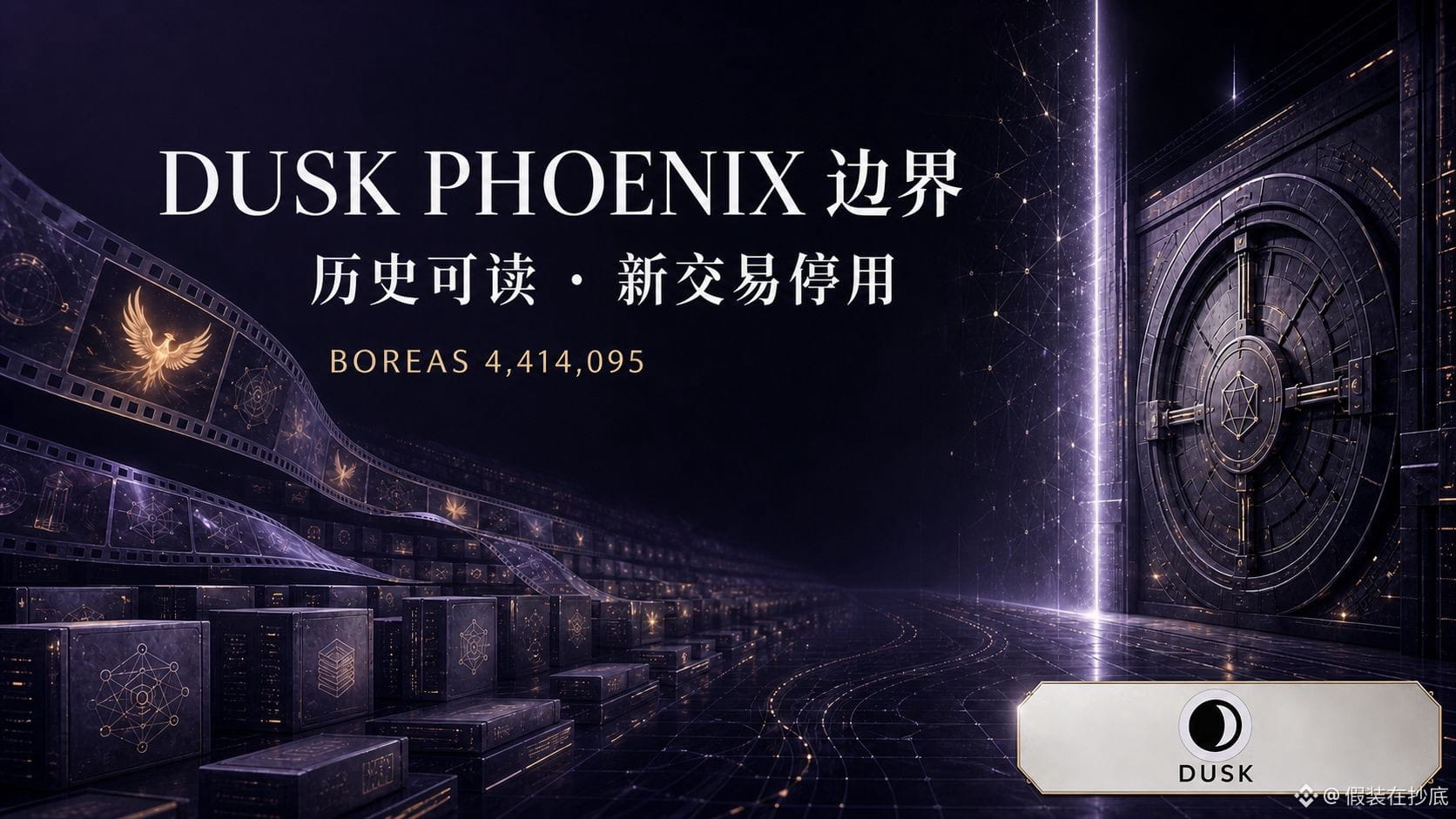
DUSK is similar after upgrading Boreas to process Phoenix. The official update notes show that the main network deployed Boreas on June 10, 2026 at block height 4,414,095. After the restart boundary, new Phoenix transactions were disabled, but nodes kept Phoenix decoding and historical execution capabilities. Old blocks need replay, and the browser also needs to read past transactions and events—so “stop adding new ones” isn’t the same as “delete the history.”
This boundary is very useful for ordinary users. If your wallet still keeps old Phoenix records, they remain part of DUSK’s historical data. But if you want to initiate a new action, you need to check the transaction entry points your current wallet supports; you can’t just follow the old tutorial and click through it item by item. The testnet timing is different too: after Boreas is activated, Phoenix is temporarily kept until block 4,000,000, when it is finally closed. If you only look at the upgrade name, it’s easy to mistakenly map the testnet schedule onto the mainnet. #dusk
When I verify DUSK transactions, I do four steps: first confirm whether it’s the mainnet or testnet, then check the Rusk node version and its height, next identify the transaction type, and finally use the browser to inspect the receipt. If an old transaction shows as failed, I’ll also look at historical revert events. By keeping the ability to read old accounts, DUSK helps nodes verify history, and also makes reconciliation easier among wallets, browsers, and exchanges.
That old video reminds me: when systems upgrade, the biggest risk is mixing up “disabling an entry point” with “wiping the archive” into the same thing. DUSK’s line for Phoenix is very clear: after the line, it won’t accept new transactions; before the line, the records can still be verified. When reading DUSK announcements, it’s more reliable to write down the network, height, and transaction type on paper than to rely on just the upgrade name. @Dusk_Foundation $DUSK
Weekend cleaning out old phones, I dug up a video from ten years ago. The new phone can still play it, but the recording interface doesn’t have that old format. A friend asked, “Why not delete the decoder too?” I pointed at the screen and said: the old footage can’t be played anymore, and the past would get cut off in midstream.
DUSK is similar after upgrading Boreas to process Phoenix. The official update notes show that the main network deployed Boreas on June 10, 2026 at block height 4,414,095. After the restart boundary, new Phoenix transactions were disabled, but nodes kept Phoenix decoding and historical execution capabilities. Old blocks need replay, and the browser also needs to read past transactions and events—so “stop adding new ones” isn’t the same as “delete the history.”
This boundary is very useful for ordinary users. If your wallet still keeps old Phoenix records, they remain part of DUSK’s historical data. But if you want to initiate a new action, you need to check the transaction entry points your current wallet supports; you can’t just follow the old tutorial and click through it item by item. The testnet timing is different too: after Boreas is activated, Phoenix is temporarily kept until block 4,000,000, when it is finally closed. If you only look at the upgrade name, it’s easy to mistakenly map the testnet schedule onto the mainnet. #dusk
When I verify DUSK transactions, I do four steps: first confirm whether it’s the mainnet or testnet, then check the Rusk node version and its height, next identify the transaction type, and finally use the browser to inspect the receipt. If an old transaction shows as failed, I’ll also look at historical revert events. By keeping the ability to read old accounts, DUSK helps nodes verify history, and also makes reconciliation easier among wallets, browsers, and exchanges.
That old video reminds me: when systems upgrade, the biggest risk is mixing up “disabling an entry point” with “wiping the archive” into the same thing. DUSK’s line for Phoenix is very clear: after the line, it won’t accept new transactions; before the line, the records can still be verified. When reading DUSK announcements, it’s more reliable to write down the network, height, and transaction type on paper than to rely on just the upgrade name. @Dusk $DUSK
DUSK is similar after upgrading Boreas to process Phoenix. The official update notes show that the main network deployed Boreas on June 10, 2026 at block height 4,414,095. After the restart boundary, new Phoenix transactions were disabled, but nodes kept Phoenix decoding and historical execution capabilities. Old blocks need replay, and the browser also needs to read past transactions and events—so “stop adding new ones” isn’t the same as “delete the history.”
This boundary is very useful for ordinary users. If your wallet still keeps old Phoenix records, they remain part of DUSK’s historical data. But if you want to initiate a new action, you need to check the transaction entry points your current wallet supports; you can’t just follow the old tutorial and click through it item by item. The testnet timing is different too: after Boreas is activated, Phoenix is temporarily kept until block 4,000,000, when it is finally closed. If you only look at the upgrade name, it’s easy to mistakenly map the testnet schedule onto the mainnet. #dusk
When I verify DUSK transactions, I do four steps: first confirm whether it’s the mainnet or testnet, then check the Rusk node version and its height, next identify the transaction type, and finally use the browser to inspect the receipt. If an old transaction shows as failed, I’ll also look at historical revert events. By keeping the ability to read old accounts, DUSK helps nodes verify history, and also makes reconciliation easier among wallets, browsers, and exchanges.
That old video reminds me: when systems upgrade, the biggest risk is mixing up “disabling an entry point” with “wiping the archive” into the same thing. DUSK’s line for Phoenix is very clear: after the line, it won’t accept new transactions; before the line, the records can still be verified. When reading DUSK announcements, it’s more reliable to write down the network, height, and transaction type on paper than to rely on just the upgrade name. @Dusk $DUSK
1
307
·
--
📆Today at 18:00, Binance Alpha will launch Teller (DEBIT)
In simple terms, this is a long-standing lending project that started around 2019–2020. It focuses on on-chain lending and unsecured loans. Total funding is about $7.85 million, with investors including Blockchain Capital, Franklin Templeton, Toyota Ventures, and others—so the background is solid.
The total token supply is close to 100 million coins and can be verified on-chain. However, the initial circulating amount, unlock rules, and full tokenomics have not been disclosed publicly to date—this is the biggest risk.
In terms of the order book, the on-chain pool reference price is around $0.45, which corresponds to $45 million FDV. The pool contains about 500k USDT and 1.11 million DEBIT. Liquidity isn’t that thick, and the chips are relatively concentrated. The so-called “big player” has a high level of control (market maker/whale style), so the opening price is very likely not a normal valuation—it's more like they will pull it as high as they want.
Binance opens first at 18:00; exchanges like Bitget and KuCoin open at 20:00. In the two-hour gap, there may be an initial push. But after 20:00, liquidity increases and sell pressure will likely follow.
My airdrop-selling plan:
1.00 to 1.50: Sell about 70–80%
Above 1.50: Basically fully exit—no need to participate in the “show” with the big player.
Based on total supply, $1 equals 100 million FDV, and $1.5 equals 150 million FDV. Judging by the project’s current usage data, anything above $1 is no longer “cheap.” Above $1.5 is mostly about trading control and sentiment—not about trading fundamentals.
Market expects the Alpha airdrop pool to be around 1 million tokens. If about 50,000 people claim, that’s 20 tokens per share: $0.5 worth = 10U, $1 worth = 20U, $1.5 worth = 30U. But this is only market estimation—exact numbers and point thresholds are still subject to Binance’s announcement.
One-sentence summary: Old project, good funding, real product—but mediocre data, opaque token info, and a strong “controlled market” vibe. You can claim the airdrop and watch the opening, but there’s no need to chase after a high pump.
#alpha #ALPHA🔥
#美国财政部设量子就绪工作组
#加拿大对美加征最高50%反制关税
📆Today at 18:00, Binance Alpha will launch Teller (DEBIT)
In simple terms, this is a long-standing lending project that started around 2019–2020. It focuses on on-chain lending and unsecured loans. Total funding is about $7.85 million, with investors including Blockchain Capital, Franklin Templeton, Toyota Ventures, and others—so the background is solid.
The total token supply is close to 100 million coins and can be verified on-chain. However, the initial circulating amount, unlock rules, and full tokenomics have not been disclosed publicly to date—this is the biggest risk.
In terms of the order book, the on-chain pool reference price is around $0.45, which corresponds to $45 million FDV. The pool contains about 500k USDT and 1.11 million DEBIT. Liquidity isn’t that thick, and the chips are relatively concentrated. The so-called “big player” has a high level of control (market maker/whale style), so the opening price is very likely not a normal valuation—it's more like they will pull it as high as they want.
Binance opens first at 18:00; exchanges like Bitget and KuCoin open at 20:00. In the two-hour gap, there may be an initial push. But after 20:00, liquidity increases and sell pressure will likely follow.
My airdrop-selling plan:
1.00 to 1.50: Sell about 70–80%
Above 1.50: Basically fully exit—no need to participate in the “show” with the big player.
Based on total supply, $1 equals 100 million FDV, and $1.5 equals 150 million FDV. Judging by the project’s current usage data, anything above $1 is no longer “cheap.” Above $1.5 is mostly about trading control and sentiment—not about trading fundamentals.
Market expects the Alpha airdrop pool to be around 1 million tokens. If about 50,000 people claim, that’s 20 tokens per share: $0.5 worth = 10U, $1 worth = 20U, $1.5 worth = 30U. But this is only market estimation—exact numbers and point thresholds are still subject to Binance’s announcement.
One-sentence summary: Old project, good funding, real product—but mediocre data, opaque token info, and a strong “controlled market” vibe. You can claim the airdrop and watch the opening, but there’s no need to chase after a high pump.
#alpha #ALPHA🔥
#美国财政部设量子就绪工作组
#加拿大对美加征最高50%反制关税
In simple terms, this is a long-standing lending project that started around 2019–2020. It focuses on on-chain lending and unsecured loans. Total funding is about $7.85 million, with investors including Blockchain Capital, Franklin Templeton, Toyota Ventures, and others—so the background is solid.
The total token supply is close to 100 million coins and can be verified on-chain. However, the initial circulating amount, unlock rules, and full tokenomics have not been disclosed publicly to date—this is the biggest risk.
In terms of the order book, the on-chain pool reference price is around $0.45, which corresponds to $45 million FDV. The pool contains about 500k USDT and 1.11 million DEBIT. Liquidity isn’t that thick, and the chips are relatively concentrated. The so-called “big player” has a high level of control (market maker/whale style), so the opening price is very likely not a normal valuation—it's more like they will pull it as high as they want.
Binance opens first at 18:00; exchanges like Bitget and KuCoin open at 20:00. In the two-hour gap, there may be an initial push. But after 20:00, liquidity increases and sell pressure will likely follow.
My airdrop-selling plan:
1.00 to 1.50: Sell about 70–80%
Above 1.50: Basically fully exit—no need to participate in the “show” with the big player.
Based on total supply, $1 equals 100 million FDV, and $1.5 equals 150 million FDV. Judging by the project’s current usage data, anything above $1 is no longer “cheap.” Above $1.5 is mostly about trading control and sentiment—not about trading fundamentals.
Market expects the Alpha airdrop pool to be around 1 million tokens. If about 50,000 people claim, that’s 20 tokens per share: $0.5 worth = 10U, $1 worth = 20U, $1.5 worth = 30U. But this is only market estimation—exact numbers and point thresholds are still subject to Binance’s announcement.
One-sentence summary: Old project, good funding, real product—but mediocre data, opaque token info, and a strong “controlled market” vibe. You can claim the airdrop and watch the opening, but there’s no need to chase after a high pump.
#alpha #ALPHA🔥
#美国财政部设量子就绪工作组
#加拿大对美加征最高50%反制关税
12
1
12
3.3k
·
--
$TMX precise top-dodging, the script once again verified.
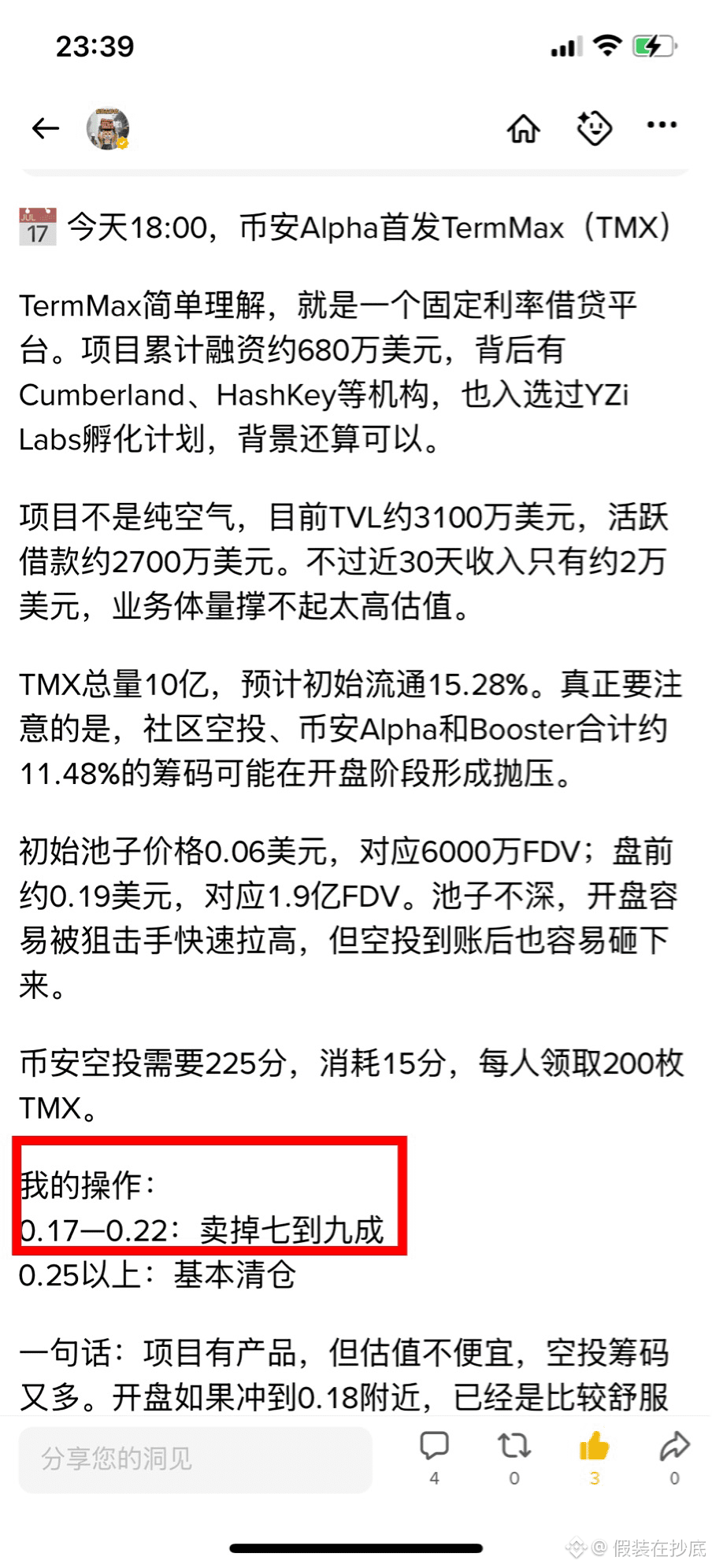
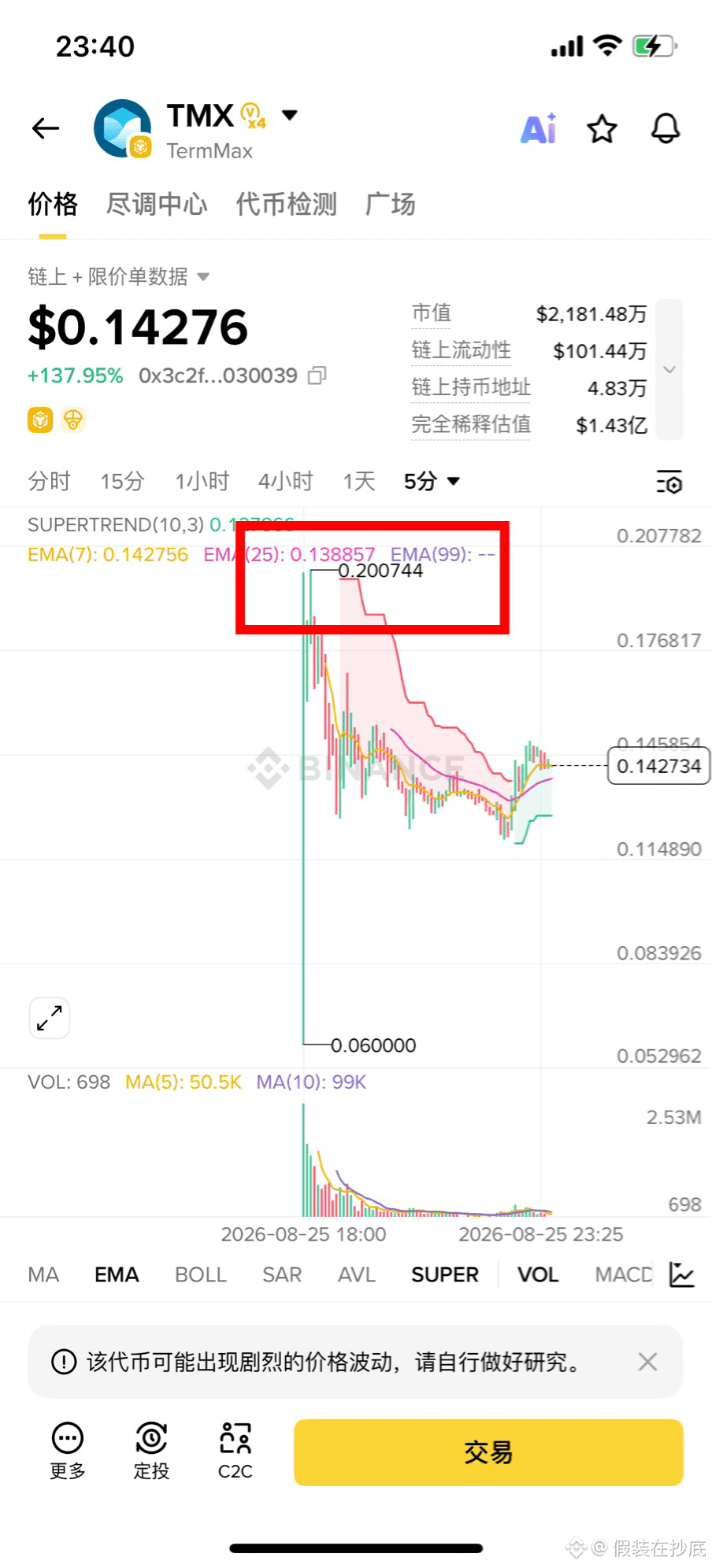
The pre-market plan was written very clearly: sell 70% to 90% at 0.17–0.22, and essentially fully exit above 0.25.
Today’s open was pushed directly to around 0.2, just as expected, followed by a pullback. Unfortunately, the official account doesn’t give this post much traffic🤣. The guys who saw my post should have sold most of the way already—leave a little core position and treat the next contract like buying a lottery ticket.
With big airdrops and a thin pool, this kind of movement is really not surprising. Don’t chase the exact top—just earn money within the rules.
Next round continues.
#alpha #ALPHA🔥
#比特币受阻于81000美元50周均线
#哈萨克斯坦下调石油产量预期至9600万吨
$TMX precise top-dodging, the script once again verified.
The pre-market plan was written very clearly: sell 70% to 90% at 0.17–0.22, and essentially fully exit above 0.25.
Today’s open was pushed directly to around 0.2, just as expected, followed by a pullback. Unfortunately, the official account doesn’t give this post much traffic🤣. The guys who saw my post should have sold most of the way already—leave a little core position and treat the next contract like buying a lottery ticket.
With big airdrops and a thin pool, this kind of movement is really not surprising. Don’t chase the exact top—just earn money within the rules.
Next round continues.
#alpha #ALPHA🔥
#比特币受阻于81000美元50周均线
#哈萨克斯坦下调石油产量预期至9600万吨
The pre-market plan was written very clearly: sell 70% to 90% at 0.17–0.22, and essentially fully exit above 0.25.
Today’s open was pushed directly to around 0.2, just as expected, followed by a pullback. Unfortunately, the official account doesn’t give this post much traffic🤣. The guys who saw my post should have sold most of the way already—leave a little core position and treat the next contract like buying a lottery ticket.
With big airdrops and a thin pool, this kind of movement is really not surprising. Don’t chase the exact top—just earn money within the rules.
Next round continues.
#alpha #ALPHA🔥
#比特币受阻于81000美元50周均线
#哈萨克斯坦下调石油产量预期至9600万吨
假装在抄底
·
--
📅 Today 18:00, Binance Alpha launches TermMax (TMX)
In simple terms, TermMax is a fixed-rate lending platform. The project has raised around $6.8 million in total funding. Behind it are institutions such as Cumberland and HashKey. It was also selected for the YZi Labs incubation program, so the background looks relatively solid.
It’s not pure hype: currently TVL is about $31 million, and active borrowing is about $27 million. However, over the past 30 days, revenue is only around $20,000, so the business scale can’t support a very high valuation.
TMX total supply is 1 billion, with an estimated initial circulating supply of 15.28%. What you really need to watch is that community airdrops, Binance Alpha, and Booster combined account for about 11.48% of the tokens—these chips may create sell pressure right at the opening.
Initial pool price is $0.06, corresponding to $60 million FDV; pre-market is about $0.19, corresponding to $190 million FDV. The pool is not deep, so at the open it’s easy for snipers to quickly push the price up—but once the airdrops arrive, it can also be easy for the price to get dumped.
To get the Binance airdrop, you need 225 points: it consumes 15 points, and each person can claim 200 TMX.
My plan:
0.17–0.22: sell 70%–90%
0.25+: basically full exit
One sentence: The project has a product, but the valuation isn’t cheap, and the number of airdrop tokens is also large. If it spikes to around $0.18 at the open, that’s already a fairly comfortable selling point—don’t hold out for “one more” just because a big exchange might list it, and don’t chase the very first big green candle after listing.
$TAC $ONG $STAR
#Alpha #ALPHA🔥
#BTC触及80000美元
#油价维持跌势
#ZEC突破关键阻力涨75.5%
In simple terms, TermMax is a fixed-rate lending platform. The project has raised around $6.8 million in total funding. Behind it are institutions such as Cumberland and HashKey. It was also selected for the YZi Labs incubation program, so the background looks relatively solid.
It’s not pure hype: currently TVL is about $31 million, and active borrowing is about $27 million. However, over the past 30 days, revenue is only around $20,000, so the business scale can’t support a very high valuation.
TMX total supply is 1 billion, with an estimated initial circulating supply of 15.28%. What you really need to watch is that community airdrops, Binance Alpha, and Booster combined account for about 11.48% of the tokens—these chips may create sell pressure right at the opening.
Initial pool price is $0.06, corresponding to $60 million FDV; pre-market is about $0.19, corresponding to $190 million FDV. The pool is not deep, so at the open it’s easy for snipers to quickly push the price up—but once the airdrops arrive, it can also be easy for the price to get dumped.
To get the Binance airdrop, you need 225 points: it consumes 15 points, and each person can claim 200 TMX.
My plan:
0.17–0.22: sell 70%–90%
0.25+: basically full exit
One sentence: The project has a product, but the valuation isn’t cheap, and the number of airdrop tokens is also large. If it spikes to around $0.18 at the open, that’s already a fairly comfortable selling point—don’t hold out for “one more” just because a big exchange might list it, and don’t chase the very first big green candle after listing.
$TAC $ONG $STAR
#Alpha #ALPHA🔥
#BTC触及80000美元
#油价维持跌势
#ZEC突破关键阻力涨75.5%
2
1
800
·
--
The community elevator keeps breaking down. Someone in the owners’ group posted a renovation proposal. At first, I thought that if the vote count was high enough, construction could start. Later I realized that it also requires quoting, review, construction testing, and acceptance. On-chain governance can be easy to misread, too: when a proposal is published and it only shows that the discussion has a formal venue, it doesn’t mean the mainnet code will change immediately.
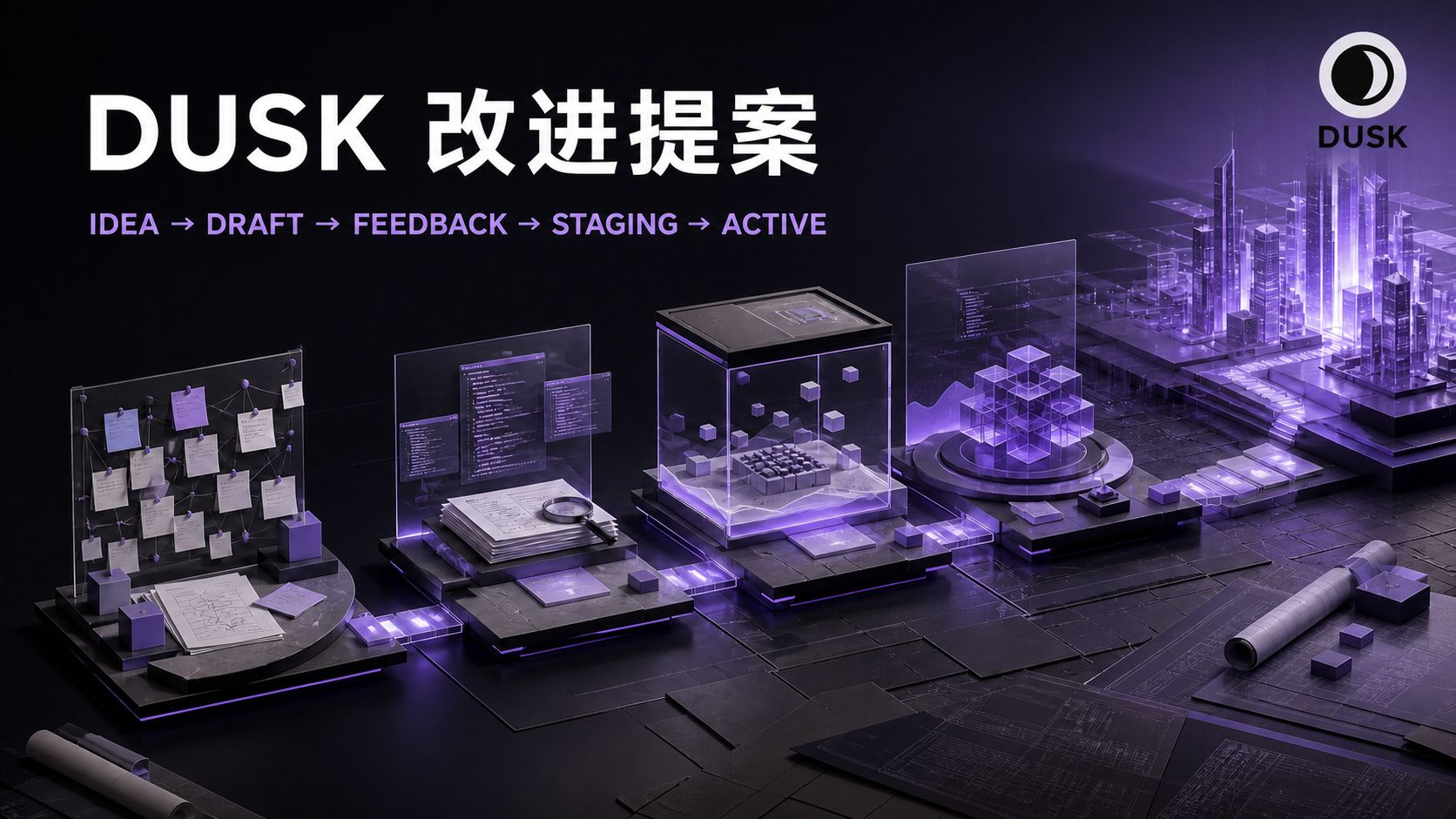
Dusk packages protocol changes into a DIP, or Dusk Improvement Proposal. The official process starts from an Idea; once the idea takes shape, it moves into Draft and receives a number. Then, if it involves making a prototype or achieving technical results, it goes into Feedback. When it’s close to completion, it transitions to Staging. Code-related DIPs are first placed on the Nocturne testnet. Only after consensus is reached are they marked as Active, and the成果 is merged into the production environment. #dusk
One thing I like about this process is that changes to the DUSK protocol must leave behind a complete record. A proposal has to document the motivation, technical specifications, trade-offs, backward compatibility, testing, security impact, and implementation links. A Stagnant proposal that hasn’t continued development for six months may be moved to Dead. Later on, when people look back on an upgrade, the community can trace which risks were discussed at the time—not just see announcements for the new version.
But “anyone can submit” doesn’t automatically mean “anyone can change the rules.” DIP editors participate in review, numbering, merging, and tracking implementation. Node operators also have to install the software that includes the changes. The current public description doesn’t provide a voting threshold calculated by holdings according to $DUSK , nor does it define “reaching consensus” as an explicit percentage. I won’t package an open discussion as if on-chain governance is already completed.
When I watch the upgrade for @Dusk_Foundation , I’ll verify four things separately: what state the DIP is in, whether the implementation code is public, whether the Nocturne test results can be rechecked, and when mainnet nodes adopt it. Likes in the group only show that the idea is popular. Only Active status and actual deployment tell you how far the Dusk rules have progressed.
The community elevator keeps breaking down. Someone in the owners’ group posted a renovation proposal. At first, I thought that if the vote count was high enough, construction could start. Later I realized that it also requires quoting, review, construction testing, and acceptance. On-chain governance can be easy to misread, too: when a proposal is published and it only shows that the discussion has a formal venue, it doesn’t mean the mainnet code will change immediately.
Dusk packages protocol changes into a DIP, or Dusk Improvement Proposal. The official process starts from an Idea; once the idea takes shape, it moves into Draft and receives a number. Then, if it involves making a prototype or achieving technical results, it goes into Feedback. When it’s close to completion, it transitions to Staging. Code-related DIPs are first placed on the Nocturne testnet. Only after consensus is reached are they marked as Active, and the成果 is merged into the production environment. #dusk
One thing I like about this process is that changes to the DUSK protocol must leave behind a complete record. A proposal has to document the motivation, technical specifications, trade-offs, backward compatibility, testing, security impact, and implementation links. A Stagnant proposal that hasn’t continued development for six months may be moved to Dead. Later on, when people look back on an upgrade, the community can trace which risks were discussed at the time—not just see announcements for the new version.
But “anyone can submit” doesn’t automatically mean “anyone can change the rules.” DIP editors participate in review, numbering, merging, and tracking implementation. Node operators also have to install the software that includes the changes. The current public description doesn’t provide a voting threshold calculated by holdings according to $DUSK , nor does it define “reaching consensus” as an explicit percentage. I won’t package an open discussion as if on-chain governance is already completed.
When I watch the upgrade for @Dusk , I’ll verify four things separately: what state the DIP is in, whether the implementation code is public, whether the Nocturne test results can be rechecked, and when mainnet nodes adopt it. Likes in the group only show that the idea is popular. Only Active status and actual deployment tell you how far the Dusk rules have progressed.
Dusk packages protocol changes into a DIP, or Dusk Improvement Proposal. The official process starts from an Idea; once the idea takes shape, it moves into Draft and receives a number. Then, if it involves making a prototype or achieving technical results, it goes into Feedback. When it’s close to completion, it transitions to Staging. Code-related DIPs are first placed on the Nocturne testnet. Only after consensus is reached are they marked as Active, and the成果 is merged into the production environment. #dusk
One thing I like about this process is that changes to the DUSK protocol must leave behind a complete record. A proposal has to document the motivation, technical specifications, trade-offs, backward compatibility, testing, security impact, and implementation links. A Stagnant proposal that hasn’t continued development for six months may be moved to Dead. Later on, when people look back on an upgrade, the community can trace which risks were discussed at the time—not just see announcements for the new version.
But “anyone can submit” doesn’t automatically mean “anyone can change the rules.” DIP editors participate in review, numbering, merging, and tracking implementation. Node operators also have to install the software that includes the changes. The current public description doesn’t provide a voting threshold calculated by holdings according to $DUSK , nor does it define “reaching consensus” as an explicit percentage. I won’t package an open discussion as if on-chain governance is already completed.
When I watch the upgrade for @Dusk , I’ll verify four things separately: what state the DIP is in, whether the implementation code is public, whether the Nocturne test results can be rechecked, and when mainnet nodes adopt it. Likes in the group only show that the idea is popular. Only Active status and actual deployment tell you how far the Dusk rules have progressed.
2
2
623
·
--
Verified
📅 Today 18:00, Binance Alpha launches TermMax (TMX)
In simple terms, TermMax is a fixed-rate lending platform. The project has raised around $6.8 million in total funding. Behind it are institutions such as Cumberland and HashKey. It was also selected for the YZi Labs incubation program, so the background looks relatively solid.
It’s not pure hype: currently TVL is about $31 million, and active borrowing is about $27 million. However, over the past 30 days, revenue is only around $20,000, so the business scale can’t support a very high valuation.
TMX total supply is 1 billion, with an estimated initial circulating supply of 15.28%. What you really need to watch is that community airdrops, Binance Alpha, and Booster combined account for about 11.48% of the tokens—these chips may create sell pressure right at the opening.
Initial pool price is $0.06, corresponding to $60 million FDV; pre-market is about $0.19, corresponding to $190 million FDV. The pool is not deep, so at the open it’s easy for snipers to quickly push the price up—but once the airdrops arrive, it can also be easy for the price to get dumped.
To get the Binance airdrop, you need 225 points: it consumes 15 points, and each person can claim 200 TMX.
My plan:
0.17–0.22: sell 70%–90%
0.25+: basically full exit
One sentence: The project has a product, but the valuation isn’t cheap, and the number of airdrop tokens is also large. If it spikes to around $0.18 at the open, that’s already a fairly comfortable selling point—don’t hold out for “one more” just because a big exchange might list it, and don’t chase the very first big green candle after listing.
$TAC $ONG $STAR
#Alpha #ALPHA🔥
#BTC触及80000美元
#油价维持跌势
#ZEC突破关键阻力涨75.5%
📅 Today 18:00, Binance Alpha launches TermMax (TMX)
In simple terms, TermMax is a fixed-rate lending platform. The project has raised around $6.8 million in total funding. Behind it are institutions such as Cumberland and HashKey. It was also selected for the YZi Labs incubation program, so the background looks relatively solid.
It’s not pure hype: currently TVL is about $31 million, and active borrowing is about $27 million. However, over the past 30 days, revenue is only around $20,000, so the business scale can’t support a very high valuation.
TMX total supply is 1 billion, with an estimated initial circulating supply of 15.28%. What you really need to watch is that community airdrops, Binance Alpha, and Booster combined account for about 11.48% of the tokens—these chips may create sell pressure right at the opening.
Initial pool price is $0.06, corresponding to $60 million FDV; pre-market is about $0.19, corresponding to $190 million FDV. The pool is not deep, so at the open it’s easy for snipers to quickly push the price up—but once the airdrops arrive, it can also be easy for the price to get dumped.
To get the Binance airdrop, you need 225 points: it consumes 15 points, and each person can claim 200 TMX.
My plan:
0.17–0.22: sell 70%–90%
0.25+: basically full exit
One sentence: The project has a product, but the valuation isn’t cheap, and the number of airdrop tokens is also large. If it spikes to around $0.18 at the open, that’s already a fairly comfortable selling point—don’t hold out for “one more” just because a big exchange might list it, and don’t chase the very first big green candle after listing.
$TAC $ONG $STAR
#Alpha #ALPHA🔥
#BTC触及80000美元
#油价维持跌势
#ZEC突破关键阻力涨75.5%
In simple terms, TermMax is a fixed-rate lending platform. The project has raised around $6.8 million in total funding. Behind it are institutions such as Cumberland and HashKey. It was also selected for the YZi Labs incubation program, so the background looks relatively solid.
It’s not pure hype: currently TVL is about $31 million, and active borrowing is about $27 million. However, over the past 30 days, revenue is only around $20,000, so the business scale can’t support a very high valuation.
TMX total supply is 1 billion, with an estimated initial circulating supply of 15.28%. What you really need to watch is that community airdrops, Binance Alpha, and Booster combined account for about 11.48% of the tokens—these chips may create sell pressure right at the opening.
Initial pool price is $0.06, corresponding to $60 million FDV; pre-market is about $0.19, corresponding to $190 million FDV. The pool is not deep, so at the open it’s easy for snipers to quickly push the price up—but once the airdrops arrive, it can also be easy for the price to get dumped.
To get the Binance airdrop, you need 225 points: it consumes 15 points, and each person can claim 200 TMX.
My plan:
0.17–0.22: sell 70%–90%
0.25+: basically full exit
One sentence: The project has a product, but the valuation isn’t cheap, and the number of airdrop tokens is also large. If it spikes to around $0.18 at the open, that’s already a fairly comfortable selling point—don’t hold out for “one more” just because a big exchange might list it, and don’t chase the very first big green candle after listing.
$TAC $ONG $STAR
#Alpha #ALPHA🔥
#BTC触及80000美元
#油价维持跌势
#ZEC突破关键阻力涨75.5%
4
1
3
708
·
--
Someone in the group posted a screenshot of a wallet: the balance suddenly increased by 5,000 DUSK ($DUSK ). Immediately, someone asked whether it can be transferred to an exchange. When you see numbers like this, the first thing you shouldn’t do is check the price—you should see which network the wallet is connected to. Even though it’s written as DUSK, the tasks carried by testnet tokens and mainnet assets are completely different.
Dusk’s official network documentation lists Mainnet, Nocturne Testnet, and internal Devnet. Nocturne’s Chain ID is 2. It’s mainly for developers to test protocol upgrades, smart contracts, and nodes. The official faucet distributes testnet DUSK via a Discord bot, and the example amounts in the node guide are 5,000 DUSK. The documentation also clearly states: testnet DUSK has no real-world monetary value.#dusk
These DUSK still have a purpose. Deploying test contracts, sending transactions, practicing staking, or checking the wallet flow all consume the tokens in the corresponding network. Even if the transaction succeeds, it will leave a hash and block record. That only proves the operation ran in the test environment; it can’t be used to conclude that mainnet assets have arrived, nor can you treat the test balance by multiplying it with the market price as your holdings.
I’ll verify things in four places: the wallet network name, the Chain ID, the node address, and the browser domain. Relying only on the DUSK symbol is the easiest way to get things wrong, because the interface can use the same ticker. If the recipient is an exchange, you also need to check which chains the platform supports. Even if a testnet address looks similar in format, it still has no充值 value.
Test records also can’t be used to submit results for a product early. A successful deployment of the contract on Nocturne shows that the code can run under the current test conditions. However, audits, mainnet parameters, real load, and asset risks still must be verified separately. The smoother the testing is, the more you should keep the network name in the screenshot—so that later it doesn’t get cut into something like “DUSK added a large amount transfer.”
When looking at @Dusk_Foundation , I treat testnet DUSK like training mileage in a practice track: it lets you check operations, but it can’t be used to drive to the used-car market and sell for money. Before managing $DUSK , recognize the network first—no matter how large the balance is, you still need to see which ledger it belongs to.
Someone in the group posted a screenshot of a wallet: the balance suddenly increased by 5,000 DUSK ($DUSK ). Immediately, someone asked whether it can be transferred to an exchange. When you see numbers like this, the first thing you shouldn’t do is check the price—you should see which network the wallet is connected to. Even though it’s written as DUSK, the tasks carried by testnet tokens and mainnet assets are completely different.
Dusk’s official network documentation lists Mainnet, Nocturne Testnet, and internal Devnet. Nocturne’s Chain ID is 2. It’s mainly for developers to test protocol upgrades, smart contracts, and nodes. The official faucet distributes testnet DUSK via a Discord bot, and the example amounts in the node guide are 5,000 DUSK. The documentation also clearly states: testnet DUSK has no real-world monetary value.#dusk
These DUSK still have a purpose. Deploying test contracts, sending transactions, practicing staking, or checking the wallet flow all consume the tokens in the corresponding network. Even if the transaction succeeds, it will leave a hash and block record. That only proves the operation ran in the test environment; it can’t be used to conclude that mainnet assets have arrived, nor can you treat the test balance by multiplying it with the market price as your holdings.
I’ll verify things in four places: the wallet network name, the Chain ID, the node address, and the browser domain. Relying only on the DUSK symbol is the easiest way to get things wrong, because the interface can use the same ticker. If the recipient is an exchange, you also need to check which chains the platform supports. Even if a testnet address looks similar in format, it still has no充值 value.
Test records also can’t be used to submit results for a product early. A successful deployment of the contract on Nocturne shows that the code can run under the current test conditions. However, audits, mainnet parameters, real load, and asset risks still must be verified separately. The smoother the testing is, the more you should keep the network name in the screenshot—so that later it doesn’t get cut into something like “DUSK added a large amount transfer.”
When looking at @Dusk , I treat testnet DUSK like training mileage in a practice track: it lets you check operations, but it can’t be used to drive to the used-car market and sell for money. Before managing $DUSK , recognize the network first—no matter how large the balance is, you still need to see which ledger it belongs to.
Dusk’s official network documentation lists Mainnet, Nocturne Testnet, and internal Devnet. Nocturne’s Chain ID is 2. It’s mainly for developers to test protocol upgrades, smart contracts, and nodes. The official faucet distributes testnet DUSK via a Discord bot, and the example amounts in the node guide are 5,000 DUSK. The documentation also clearly states: testnet DUSK has no real-world monetary value.#dusk
These DUSK still have a purpose. Deploying test contracts, sending transactions, practicing staking, or checking the wallet flow all consume the tokens in the corresponding network. Even if the transaction succeeds, it will leave a hash and block record. That only proves the operation ran in the test environment; it can’t be used to conclude that mainnet assets have arrived, nor can you treat the test balance by multiplying it with the market price as your holdings.
I’ll verify things in four places: the wallet network name, the Chain ID, the node address, and the browser domain. Relying only on the DUSK symbol is the easiest way to get things wrong, because the interface can use the same ticker. If the recipient is an exchange, you also need to check which chains the platform supports. Even if a testnet address looks similar in format, it still has no充值 value.
Test records also can’t be used to submit results for a product early. A successful deployment of the contract on Nocturne shows that the code can run under the current test conditions. However, audits, mainnet parameters, real load, and asset risks still must be verified separately. The smoother the testing is, the more you should keep the network name in the screenshot—so that later it doesn’t get cut into something like “DUSK added a large amount transfer.”
When looking at @Dusk , I treat testnet DUSK like training mileage in a practice track: it lets you check operations, but it can’t be used to drive to the used-car market and sell for money. Before managing $DUSK , recognize the network first—no matter how large the balance is, you still need to see which ledger it belongs to.
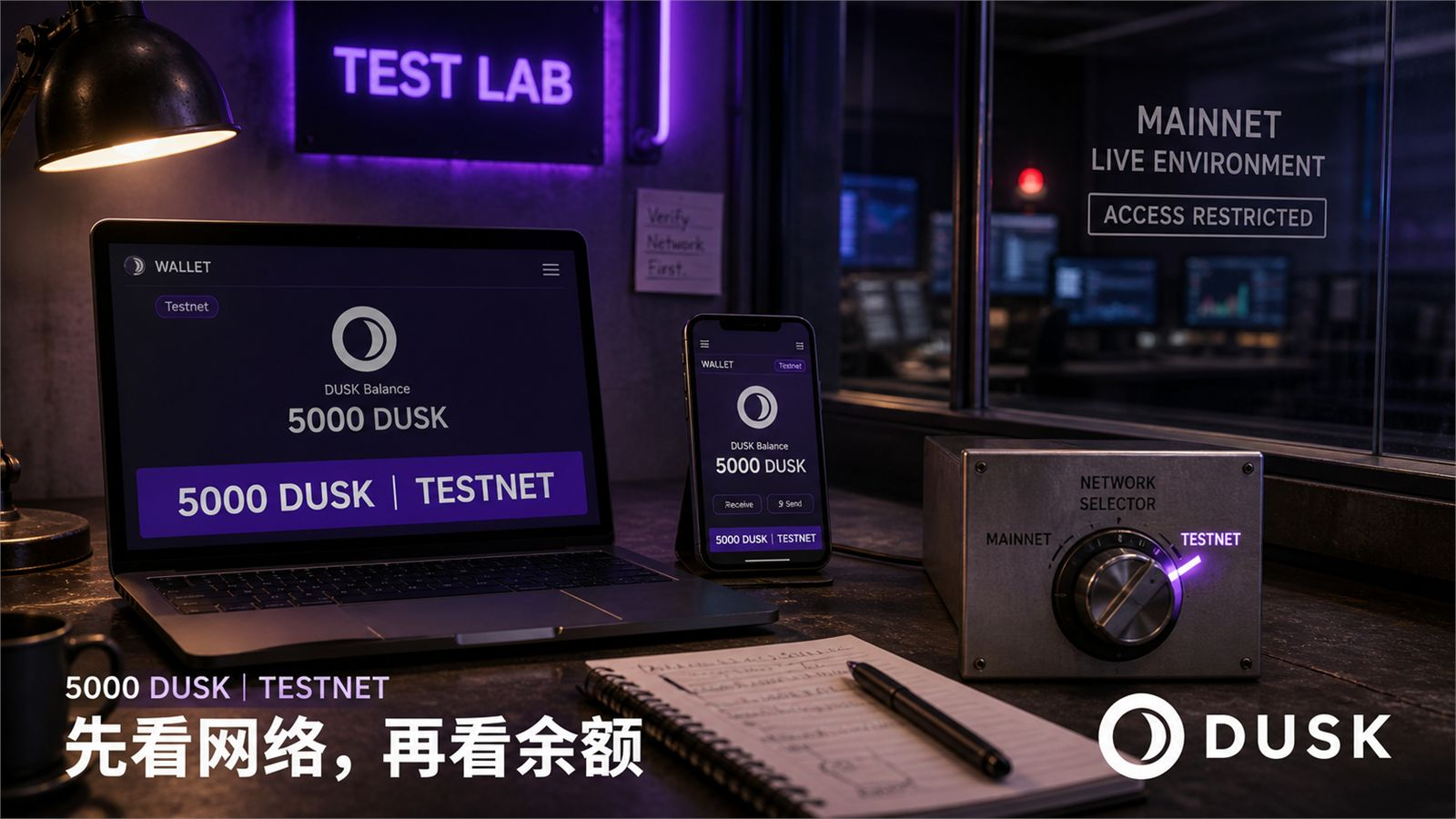
1
482
·
--
A small shop is short of money for equipment, so the boss splits the ownership of the coffee machine into a thousand online shares, pricing each one quite low. But my first reaction is still a three-part question: Who wants to buy? Who recognizes the rights the buyer receives? And when they want to exit later, who will they sell to? Making the shares smaller only reduces the amount subscribed each time—orders, legal documents, and liquidity don’t automatically appear just because the token is divided. #dusk
The Dusk article on small and medium-sized enterprise (SME) financing, released on August 15, also lays out this distinction clearly. If a company issues a digital security, it must first define the tool structure and the rights involved, and then handle investor eligibility verification, subscription allocation, ownership updates, ongoing services, and secondary trading. With the DUSK chain, you get one extra Token, but it only accomplishes a very short part of that entire workflow.
I’m more interested in how @Dusk_Foundation and NPEX connect these steps. NPEX provides experience in issuance and trading on a Dutch-regulated market, while Dusk handles tokenization, privacy, transfer rules, and the settlement infrastructure. Dusk Trade sits at the application layer, helping investors discover assets, connect wallets, complete onboarding, carry out buying and selling, and coordinate payments. The three roles each manage a segment, so the issuer doesn’t have to keep reconciling spreadsheets back and forth between advisers, banks, registries, and trading venues.
This route also has several real-world barriers. On-chain rules can’t replace corporate approvals, notarization, sanctions screening, and legal liability. Splitting assets even more finely also can’t conjure buyers, quotes, or ongoing matched trades. If a particular SME corporate bond goes live but hardly anyone trades it, the technology will still run—and the financing experience won’t improve.
So in evaluating DUSK’s RWA progress, I’ll track four tangible, verifiable outcomes: how many real issuers actually enter the process, how many eligible investors complete subscriptions, how often effective secondary-market trades occur, and whether payment and ownership records can be reconciled against the same underlying business. Huge asset scales make for good posters; these four items are closer to the real process of a company actually getting funded.
@Dusk_Foundation is building a regulated financing channel, while $DUSK handles network fees and security. The next time I see “assets have been put on-chain,” I’ll first look for a continuous trail left behind by issuance, holding, trading, and settlement. #dusk
A small shop is short of money for equipment, so the boss splits the ownership of the coffee machine into a thousand online shares, pricing each one quite low. But my first reaction is still a three-part question: Who wants to buy? Who recognizes the rights the buyer receives? And when they want to exit later, who will they sell to? Making the shares smaller only reduces the amount subscribed each time—orders, legal documents, and liquidity don’t automatically appear just because the token is divided. #dusk
The Dusk article on small and medium-sized enterprise (SME) financing, released on August 15, also lays out this distinction clearly. If a company issues a digital security, it must first define the tool structure and the rights involved, and then handle investor eligibility verification, subscription allocation, ownership updates, ongoing services, and secondary trading. With the DUSK chain, you get one extra Token, but it only accomplishes a very short part of that entire workflow.
I’m more interested in how @Dusk and NPEX connect these steps. NPEX provides experience in issuance and trading on a Dutch-regulated market, while Dusk handles tokenization, privacy, transfer rules, and the settlement infrastructure. Dusk Trade sits at the application layer, helping investors discover assets, connect wallets, complete onboarding, carry out buying and selling, and coordinate payments. The three roles each manage a segment, so the issuer doesn’t have to keep reconciling spreadsheets back and forth between advisers, banks, registries, and trading venues.
This route also has several real-world barriers. On-chain rules can’t replace corporate approvals, notarization, sanctions screening, and legal liability. Splitting assets even more finely also can’t conjure buyers, quotes, or ongoing matched trades. If a particular SME corporate bond goes live but hardly anyone trades it, the technology will still run—and the financing experience won’t improve.
So in evaluating DUSK’s RWA progress, I’ll track four tangible, verifiable outcomes: how many real issuers actually enter the process, how many eligible investors complete subscriptions, how often effective secondary-market trades occur, and whether payment and ownership records can be reconciled against the same underlying business. Huge asset scales make for good posters; these four items are closer to the real process of a company actually getting funded.
@Dusk is building a regulated financing channel, while $DUSK handles network fees and security. The next time I see “assets have been put on-chain,” I’ll first look for a continuous trail left behind by issuance, holding, trading, and settlement. #dusk
The Dusk article on small and medium-sized enterprise (SME) financing, released on August 15, also lays out this distinction clearly. If a company issues a digital security, it must first define the tool structure and the rights involved, and then handle investor eligibility verification, subscription allocation, ownership updates, ongoing services, and secondary trading. With the DUSK chain, you get one extra Token, but it only accomplishes a very short part of that entire workflow.
I’m more interested in how @Dusk and NPEX connect these steps. NPEX provides experience in issuance and trading on a Dutch-regulated market, while Dusk handles tokenization, privacy, transfer rules, and the settlement infrastructure. Dusk Trade sits at the application layer, helping investors discover assets, connect wallets, complete onboarding, carry out buying and selling, and coordinate payments. The three roles each manage a segment, so the issuer doesn’t have to keep reconciling spreadsheets back and forth between advisers, banks, registries, and trading venues.
This route also has several real-world barriers. On-chain rules can’t replace corporate approvals, notarization, sanctions screening, and legal liability. Splitting assets even more finely also can’t conjure buyers, quotes, or ongoing matched trades. If a particular SME corporate bond goes live but hardly anyone trades it, the technology will still run—and the financing experience won’t improve.
So in evaluating DUSK’s RWA progress, I’ll track four tangible, verifiable outcomes: how many real issuers actually enter the process, how many eligible investors complete subscriptions, how often effective secondary-market trades occur, and whether payment and ownership records can be reconciled against the same underlying business. Huge asset scales make for good posters; these four items are closer to the real process of a company actually getting funded.
@Dusk is building a regulated financing channel, while $DUSK handles network fees and security. The next time I see “assets have been put on-chain,” I’ll first look for a continuous trail left behind by issuance, holding, trading, and settlement. #dusk

1
3
583
·
--
When I withdraw from exchanges, I’m used to treating the Memo as an optional add-on: fill it if it exists, leave it blank if it doesn’t. While organizing the steps to move DUSK from the mainnet to BSC, I realized that on this path, Memo actually acts as the delivery address. After the bridge account receives DUSK from the mainnet, it uses the 0x address inside the Memo to determine which party should receive the BEP20 DUSK.
The operation entry is the Dusk mainnet Web Wallet. The recipient field must be filled with the official BSC bridge account, and the Memo should be filled with a BSC address that you control. Both fields are long strings, but they have different responsibilities: the former sends the DUSK into the bridge, while the latter tells the bridge through which door to release it. If the Memo is missing or formatted incorrectly, the system can’t route automatically, and in serious cases you may not be able to retrieve funds.
There’s also a small hurdle with the amount. The bridge deducts 1 $DUSK from the sending amount, and you also need to prepare the Dusk mainnet transaction fee. The sending amount must be greater than 1 DUSK. If you send only 1 DUSK or less, after paying the bridge fee there won’t be any DUSK that arrives on the BSC side. If it’s your first time, consider doing a small test transaction first.
My checking order is written on paper: get the bridge account from the official page at @Dusk_Foundation ; compare the full accounts step by step; confirm that the Memo is the BSC address you control; check the amount and transaction fee; after sending, save the DUSK transaction hash. The mainnet browser will show success first, but the BSC side still needs to be processed—common processing time is about an hour, and network conditions may extend the wait.
If it still hasn’t arrived after an hour, first check whether the original transaction succeeded, then check the Memo—not immediately send a second DUSK. If the destination is an exchange, also confirm that it explicitly supports depositing BEP20 DUSK to that address; don’t assume compatibility just because it starts with 0x.
This process is a lot like shipping a package: the bridge account is the transfer warehouse, the Memo is the final street address, and the transaction hash is the tracking number. Missing any of the three, and customer support will have a hard time locating it. When managing $DUSK, clicking send is fast—so make sure each address does its job with less stress. Follow @Dusk_Foundation and double-check before bridging. #dusk
When I withdraw from exchanges, I’m used to treating the Memo as an optional add-on: fill it if it exists, leave it blank if it doesn’t. While organizing the steps to move DUSK from the mainnet to BSC, I realized that on this path, Memo actually acts as the delivery address. After the bridge account receives DUSK from the mainnet, it uses the 0x address inside the Memo to determine which party should receive the BEP20 DUSK.
The operation entry is the Dusk mainnet Web Wallet. The recipient field must be filled with the official BSC bridge account, and the Memo should be filled with a BSC address that you control. Both fields are long strings, but they have different responsibilities: the former sends the DUSK into the bridge, while the latter tells the bridge through which door to release it. If the Memo is missing or formatted incorrectly, the system can’t route automatically, and in serious cases you may not be able to retrieve funds.
There’s also a small hurdle with the amount. The bridge deducts 1 $DUSK from the sending amount, and you also need to prepare the Dusk mainnet transaction fee. The sending amount must be greater than 1 DUSK. If you send only 1 DUSK or less, after paying the bridge fee there won’t be any DUSK that arrives on the BSC side. If it’s your first time, consider doing a small test transaction first.
My checking order is written on paper: get the bridge account from the official page at @Dusk ; compare the full accounts step by step; confirm that the Memo is the BSC address you control; check the amount and transaction fee; after sending, save the DUSK transaction hash. The mainnet browser will show success first, but the BSC side still needs to be processed—common processing time is about an hour, and network conditions may extend the wait.
If it still hasn’t arrived after an hour, first check whether the original transaction succeeded, then check the Memo—not immediately send a second DUSK. If the destination is an exchange, also confirm that it explicitly supports depositing BEP20 DUSK to that address; don’t assume compatibility just because it starts with 0x.
This process is a lot like shipping a package: the bridge account is the transfer warehouse, the Memo is the final street address, and the transaction hash is the tracking number. Missing any of the three, and customer support will have a hard time locating it. When managing $DUSK , clicking send is fast—so make sure each address does its job with less stress. Follow @Dusk and double-check before bridging. #dusk
The operation entry is the Dusk mainnet Web Wallet. The recipient field must be filled with the official BSC bridge account, and the Memo should be filled with a BSC address that you control. Both fields are long strings, but they have different responsibilities: the former sends the DUSK into the bridge, while the latter tells the bridge through which door to release it. If the Memo is missing or formatted incorrectly, the system can’t route automatically, and in serious cases you may not be able to retrieve funds.
There’s also a small hurdle with the amount. The bridge deducts 1 $DUSK from the sending amount, and you also need to prepare the Dusk mainnet transaction fee. The sending amount must be greater than 1 DUSK. If you send only 1 DUSK or less, after paying the bridge fee there won’t be any DUSK that arrives on the BSC side. If it’s your first time, consider doing a small test transaction first.
My checking order is written on paper: get the bridge account from the official page at @Dusk ; compare the full accounts step by step; confirm that the Memo is the BSC address you control; check the amount and transaction fee; after sending, save the DUSK transaction hash. The mainnet browser will show success first, but the BSC side still needs to be processed—common processing time is about an hour, and network conditions may extend the wait.
If it still hasn’t arrived after an hour, first check whether the original transaction succeeded, then check the Memo—not immediately send a second DUSK. If the destination is an exchange, also confirm that it explicitly supports depositing BEP20 DUSK to that address; don’t assume compatibility just because it starts with 0x.
This process is a lot like shipping a package: the bridge account is the transfer warehouse, the Memo is the final street address, and the transaction hash is the tracking number. Missing any of the three, and customer support will have a hard time locating it. When managing $DUSK , clicking send is fast—so make sure each address does its job with less stress. Follow @Dusk and double-check before bridging. #dusk
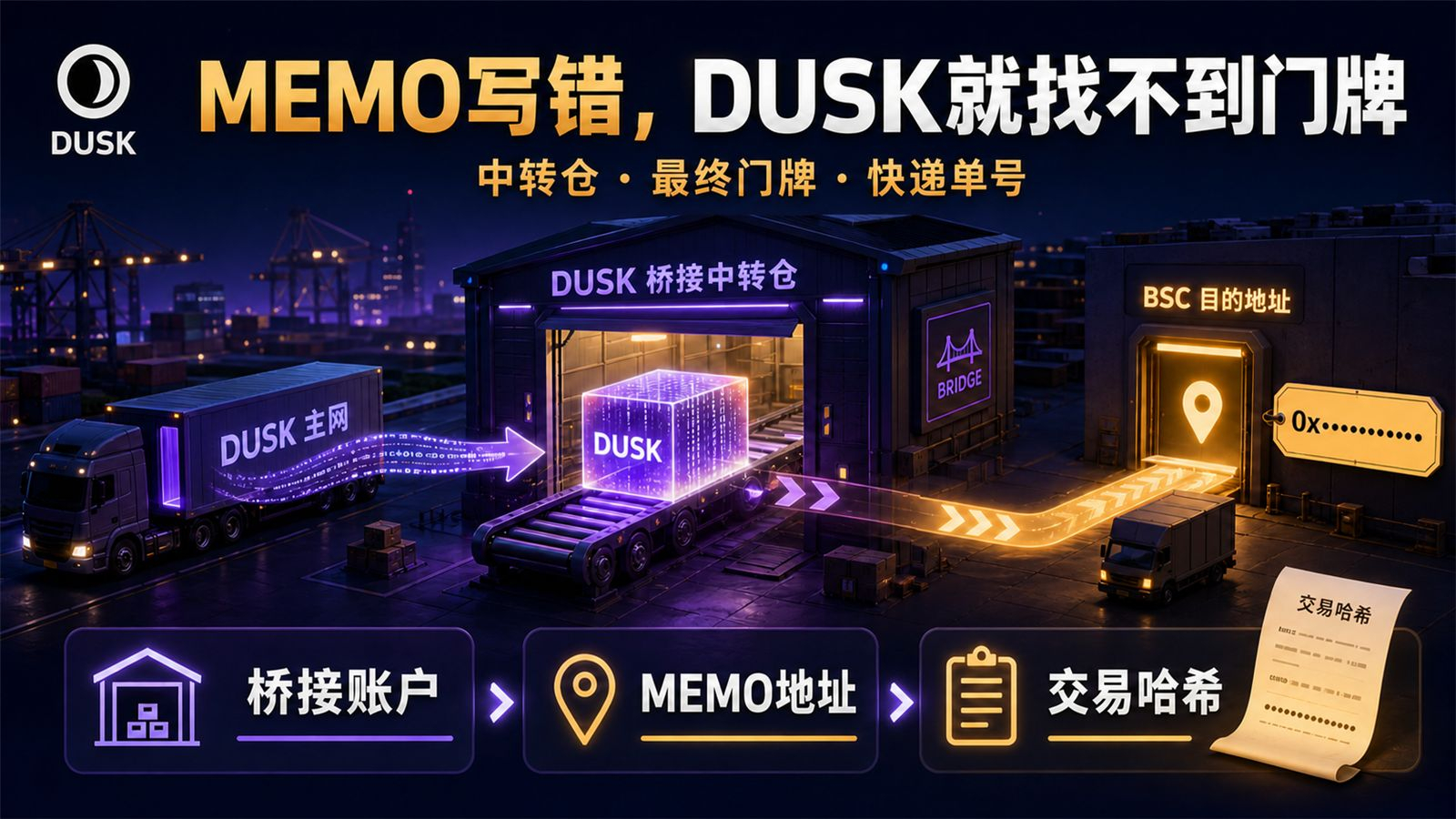
1
2
480
·
--
#dusk $DUSK @Dusk_Foundation
When checking DUSK messages in the morning, someone in the group forwarded a segment of a private chat. The avatar, name, and project description were all very similar. The other party claimed to be a member of the Dusk team and said they could help handle wallet synchronization. They also sent a “special access link.” This kind of script is designed to target users when they’re anxious—especially when DUSK hasn’t appeared for a while, people are often quick to click.
Dusk’s official documentation provides a “Verify Team Account” tool. You can look up, by channel and account, whether the other party belongs to a team account that can be verified. My process is to first pause at the chat window—no downloading files, no signing anything, and no connecting a wallet. Then I copy the full account to verify, and only afterward I confirm the link through Dusk’s official documentation or known official channels.
The verification page also spells out the boundaries: this tool is mainly for checking team members who communicate with external partners, and it doesn’t cover 100% of cases. If the account shows “not verified,” it may be a false negative. If you have sufficient reason to believe the other party is valid, you should continue to do triple confirmation via official channels or documentation. You can’t treat “not found” as conclusive evidence of a scam, and you can’t grant access just because the avatar includes the DUSK label.
I handle private chats in three categories. If we’re only discussing public information, I can leave it in the group for everyone to verify. If they ask to connect a wallet, sign an unfamiliar message, or install software, I pause immediately. If they request a seed phrase, private key, or verification code, I refuse outright and report them. Verifying a Dusk team identity answers whether “this account is within the verifiable scope.” The wallet pop-up answers whether “I agree to this operation.” Both gates must be examined carefully by you.
One more detail: search engine ads, screenshots of group announcements, and forwarded links can all expire or be impersonated. The safest approach is to manually enter Dusk’s official documentation and then open the verification page. When you need to submit a question, keep the account, channel, time, link, and chat screenshots—but block out the seed phrase, private key, and passwords.
When managing $DUSK , being half a minute slow is usually easier than chasing after assets. The name for @Dusk_Foundation must be checked via the official entry, and every connection and signature in the DUSK wallet must be confirmed by you as well. #dusk
#dusk $DUSK @Dusk
When checking DUSK messages in the morning, someone in the group forwarded a segment of a private chat. The avatar, name, and project description were all very similar. The other party claimed to be a member of the Dusk team and said they could help handle wallet synchronization. They also sent a “special access link.” This kind of script is designed to target users when they’re anxious—especially when DUSK hasn’t appeared for a while, people are often quick to click.
Dusk’s official documentation provides a “Verify Team Account” tool. You can look up, by channel and account, whether the other party belongs to a team account that can be verified. My process is to first pause at the chat window—no downloading files, no signing anything, and no connecting a wallet. Then I copy the full account to verify, and only afterward I confirm the link through Dusk’s official documentation or known official channels.
The verification page also spells out the boundaries: this tool is mainly for checking team members who communicate with external partners, and it doesn’t cover 100% of cases. If the account shows “not verified,” it may be a false negative. If you have sufficient reason to believe the other party is valid, you should continue to do triple confirmation via official channels or documentation. You can’t treat “not found” as conclusive evidence of a scam, and you can’t grant access just because the avatar includes the DUSK label.
I handle private chats in three categories. If we’re only discussing public information, I can leave it in the group for everyone to verify. If they ask to connect a wallet, sign an unfamiliar message, or install software, I pause immediately. If they request a seed phrase, private key, or verification code, I refuse outright and report them. Verifying a Dusk team identity answers whether “this account is within the verifiable scope.” The wallet pop-up answers whether “I agree to this operation.” Both gates must be examined carefully by you.
One more detail: search engine ads, screenshots of group announcements, and forwarded links can all expire or be impersonated. The safest approach is to manually enter Dusk’s official documentation and then open the verification page. When you need to submit a question, keep the account, channel, time, link, and chat screenshots—but block out the seed phrase, private key, and passwords.
When managing $DUSK , being half a minute slow is usually easier than chasing after assets. The name for @Dusk must be checked via the official entry, and every connection and signature in the DUSK wallet must be confirmed by you as well. #dusk
When checking DUSK messages in the morning, someone in the group forwarded a segment of a private chat. The avatar, name, and project description were all very similar. The other party claimed to be a member of the Dusk team and said they could help handle wallet synchronization. They also sent a “special access link.” This kind of script is designed to target users when they’re anxious—especially when DUSK hasn’t appeared for a while, people are often quick to click.
Dusk’s official documentation provides a “Verify Team Account” tool. You can look up, by channel and account, whether the other party belongs to a team account that can be verified. My process is to first pause at the chat window—no downloading files, no signing anything, and no connecting a wallet. Then I copy the full account to verify, and only afterward I confirm the link through Dusk’s official documentation or known official channels.
The verification page also spells out the boundaries: this tool is mainly for checking team members who communicate with external partners, and it doesn’t cover 100% of cases. If the account shows “not verified,” it may be a false negative. If you have sufficient reason to believe the other party is valid, you should continue to do triple confirmation via official channels or documentation. You can’t treat “not found” as conclusive evidence of a scam, and you can’t grant access just because the avatar includes the DUSK label.
I handle private chats in three categories. If we’re only discussing public information, I can leave it in the group for everyone to verify. If they ask to connect a wallet, sign an unfamiliar message, or install software, I pause immediately. If they request a seed phrase, private key, or verification code, I refuse outright and report them. Verifying a Dusk team identity answers whether “this account is within the verifiable scope.” The wallet pop-up answers whether “I agree to this operation.” Both gates must be examined carefully by you.
One more detail: search engine ads, screenshots of group announcements, and forwarded links can all expire or be impersonated. The safest approach is to manually enter Dusk’s official documentation and then open the verification page. When you need to submit a question, keep the account, channel, time, link, and chat screenshots—but block out the seed phrase, private key, and passwords.
When managing $DUSK , being half a minute slow is usually easier than chasing after assets. The name for @Dusk must be checked via the official entry, and every connection and signature in the DUSK wallet must be confirmed by you as well. #dusk
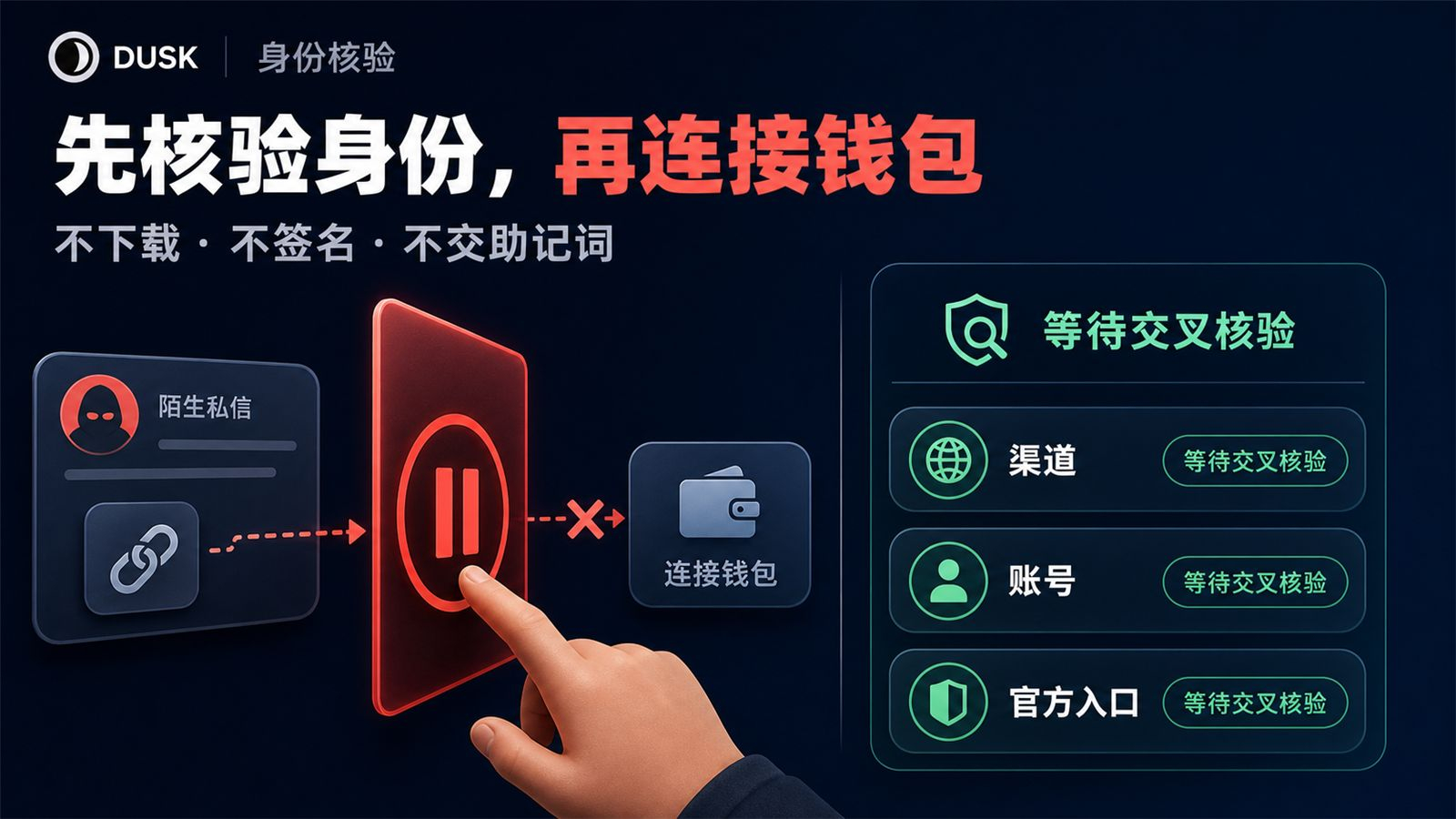
2
3
714
·
--
#termmax @termmax
Before, when I chose a yield vault, I would first look at the APY, then at whether I could redeem anytime. After studying the @termmax Vault, I changed the order: first confirm where the money will be placed, and then consider the returns.
The TermMax Vault uses ERC-4626 shares. After funds enter, the Curator allocates them into approved markets and orders, and the Allocator can also adjust supply and the withdrawal queue. The official documentation states that redemptions are processed according to the priority order in the withdrawal queue; when there is a large redemption, the Curator may need to adjust orders or redeem positions.
This process reminds me of taking a number at a restaurant. Holding a number doesn’t mean the kitchen already has a ready-made dish. When the Vault retains enough readily available assets, withdrawals get processed more smoothly; when a larger portion of funds sits in orders or time-locked positions, the settlement timing will be affected by the queue. ERC-4626 standardizes shares, but liquidity still depends on the TermMax Vault’s asset state at that moment.
I check four things: which Markets the funds are in, whether the share in any single market is too high, how the withdrawal queue is ordered, and whether the Curator has submitted any fees or whitelist changes. TermMax is supervised with timelocks and a Guardian; some sensitive changes require waiting, and the Guardian can revoke pending changes before they take effect.
High APY is still attractive to me, but I’ll leave room for liquidity. Money I might need in the short term won’t all go into a vault with a longer duration and fuller positions. Only the portion intended for long-term allocation gets handed to the Curator to manage, and the fund arrangement is more relaxed.
When I open TermMax next time, I’ll first look at asset allocation, the queue, and permission records, and only then review the yield card. The vault saves me time on managing individual markets, but I still need a few minutes to confirm where the exit will be. When you choose a TermMax Vault, do you look at APY first or the withdrawal queue? 🙂
#termmax @TermMax
Before, when I chose a yield vault, I would first look at the APY, then at whether I could redeem anytime. After studying the @TermMax Vault, I changed the order: first confirm where the money will be placed, and then consider the returns.
The TermMax Vault uses ERC-4626 shares. After funds enter, the Curator allocates them into approved markets and orders, and the Allocator can also adjust supply and the withdrawal queue. The official documentation states that redemptions are processed according to the priority order in the withdrawal queue; when there is a large redemption, the Curator may need to adjust orders or redeem positions.
This process reminds me of taking a number at a restaurant. Holding a number doesn’t mean the kitchen already has a ready-made dish. When the Vault retains enough readily available assets, withdrawals get processed more smoothly; when a larger portion of funds sits in orders or time-locked positions, the settlement timing will be affected by the queue. ERC-4626 standardizes shares, but liquidity still depends on the TermMax Vault’s asset state at that moment.
I check four things: which Markets the funds are in, whether the share in any single market is too high, how the withdrawal queue is ordered, and whether the Curator has submitted any fees or whitelist changes. TermMax is supervised with timelocks and a Guardian; some sensitive changes require waiting, and the Guardian can revoke pending changes before they take effect.
High APY is still attractive to me, but I’ll leave room for liquidity. Money I might need in the short term won’t all go into a vault with a longer duration and fuller positions. Only the portion intended for long-term allocation gets handed to the Curator to manage, and the fund arrangement is more relaxed.
When I open TermMax next time, I’ll first look at asset allocation, the queue, and permission records, and only then review the yield card. The vault saves me time on managing individual markets, but I still need a few minutes to confirm where the exit will be. When you choose a TermMax Vault, do you look at APY first or the withdrawal queue? 🙂
Before, when I chose a yield vault, I would first look at the APY, then at whether I could redeem anytime. After studying the @TermMax Vault, I changed the order: first confirm where the money will be placed, and then consider the returns.
The TermMax Vault uses ERC-4626 shares. After funds enter, the Curator allocates them into approved markets and orders, and the Allocator can also adjust supply and the withdrawal queue. The official documentation states that redemptions are processed according to the priority order in the withdrawal queue; when there is a large redemption, the Curator may need to adjust orders or redeem positions.
This process reminds me of taking a number at a restaurant. Holding a number doesn’t mean the kitchen already has a ready-made dish. When the Vault retains enough readily available assets, withdrawals get processed more smoothly; when a larger portion of funds sits in orders or time-locked positions, the settlement timing will be affected by the queue. ERC-4626 standardizes shares, but liquidity still depends on the TermMax Vault’s asset state at that moment.
I check four things: which Markets the funds are in, whether the share in any single market is too high, how the withdrawal queue is ordered, and whether the Curator has submitted any fees or whitelist changes. TermMax is supervised with timelocks and a Guardian; some sensitive changes require waiting, and the Guardian can revoke pending changes before they take effect.
High APY is still attractive to me, but I’ll leave room for liquidity. Money I might need in the short term won’t all go into a vault with a longer duration and fuller positions. Only the portion intended for long-term allocation gets handed to the Curator to manage, and the fund arrangement is more relaxed.
When I open TermMax next time, I’ll first look at asset allocation, the queue, and permission records, and only then review the yield card. The vault saves me time on managing individual markets, but I still need a few minutes to confirm where the exit will be. When you choose a TermMax Vault, do you look at APY first or the withdrawal queue? 🙂

1
2
378
·
--
#dusk
I received an alert about an abnormal VPS login before dawn. People running DUSK nodes fear two things most: the machine goes down, and the DUSK in your wallet gets taken as well. Reinstalling a node isn’t hard—the hard part is whether permissions were split beforehand. The operational documentation for @Dusk_Foundation treats the node server as a “hot environment.” Even if the wallet data is statically encrypted, you still can’t treat it like a safe.
DUSK staking can be configured with a separate owner key. The server only stores the consensus.keys required to participate in consensus—responsible for voting and signing. The owner key stays on another device or an offline wallet, controlling the ability to解除 staking and withdrawals. If the server is compromised, attackers may be able to disrupt node operation and create punishment risk, but they still can’t directly take the staked DUSK using only the consensus keys.
This kind of privilege separation is similar to an employee card and the owner’s bank U-key (dongle). The employee card needs to be used daily to open the store and handle cash, so it must be online. The bank U-key, in normal circumstances, shouldn’t be left at the cash counter. If both keys end up crammed into the same VPS, even if the permission names look great, the attacker who gains access still gets a whole chain of control.
Recovery has a clear path too. As long as the recovery phrase still exists, the operator can restore the wallet on a new machine, re-export the consensus keys, and won’t need to stake DUSK again. But during migration, never let the same consensus key run on two active nodes at the same time. If the old machine hasn’t been shut down yet and the new one already starts signing, conflicting behavior may occur and trigger harsh DUSK penalties—the damage can grow from downtime to staked funds being destroyed. Before going live, also compare the block explorer heights to ensure the new node has synced to the latest state of the DUSK mainnet, then resume consensus participation.
My node checklist includes four items: offline backup of the recovery phrase; keep the owner key and consensus key separate; use SSH key-based login only; and confirm the old node is completely stopped before switching machines. It’s easy to research annualized returns after buying $DUSK . Guarding DUSK, however, depends on these unobtrusive steps. Node profits come from performing responsibilities—the placement of keys determines whether a single server incident stays in the ops layer, or burns all the way down to the asset layer.
#dusk
I received an alert about an abnormal VPS login before dawn. People running DUSK nodes fear two things most: the machine goes down, and the DUSK in your wallet gets taken as well. Reinstalling a node isn’t hard—the hard part is whether permissions were split beforehand. The operational documentation for @Dusk treats the node server as a “hot environment.” Even if the wallet data is statically encrypted, you still can’t treat it like a safe.
DUSK staking can be configured with a separate owner key. The server only stores the consensus.keys required to participate in consensus—responsible for voting and signing. The owner key stays on another device or an offline wallet, controlling the ability to解除 staking and withdrawals. If the server is compromised, attackers may be able to disrupt node operation and create punishment risk, but they still can’t directly take the staked DUSK using only the consensus keys.
This kind of privilege separation is similar to an employee card and the owner’s bank U-key (dongle). The employee card needs to be used daily to open the store and handle cash, so it must be online. The bank U-key, in normal circumstances, shouldn’t be left at the cash counter. If both keys end up crammed into the same VPS, even if the permission names look great, the attacker who gains access still gets a whole chain of control.
Recovery has a clear path too. As long as the recovery phrase still exists, the operator can restore the wallet on a new machine, re-export the consensus keys, and won’t need to stake DUSK again. But during migration, never let the same consensus key run on two active nodes at the same time. If the old machine hasn’t been shut down yet and the new one already starts signing, conflicting behavior may occur and trigger harsh DUSK penalties—the damage can grow from downtime to staked funds being destroyed. Before going live, also compare the block explorer heights to ensure the new node has synced to the latest state of the DUSK mainnet, then resume consensus participation.
My node checklist includes four items: offline backup of the recovery phrase; keep the owner key and consensus key separate; use SSH key-based login only; and confirm the old node is completely stopped before switching machines. It’s easy to research annualized returns after buying $DUSK . Guarding DUSK, however, depends on these unobtrusive steps. Node profits come from performing responsibilities—the placement of keys determines whether a single server incident stays in the ops layer, or burns all the way down to the asset layer.
I received an alert about an abnormal VPS login before dawn. People running DUSK nodes fear two things most: the machine goes down, and the DUSK in your wallet gets taken as well. Reinstalling a node isn’t hard—the hard part is whether permissions were split beforehand. The operational documentation for @Dusk treats the node server as a “hot environment.” Even if the wallet data is statically encrypted, you still can’t treat it like a safe.
DUSK staking can be configured with a separate owner key. The server only stores the consensus.keys required to participate in consensus—responsible for voting and signing. The owner key stays on another device or an offline wallet, controlling the ability to解除 staking and withdrawals. If the server is compromised, attackers may be able to disrupt node operation and create punishment risk, but they still can’t directly take the staked DUSK using only the consensus keys.
This kind of privilege separation is similar to an employee card and the owner’s bank U-key (dongle). The employee card needs to be used daily to open the store and handle cash, so it must be online. The bank U-key, in normal circumstances, shouldn’t be left at the cash counter. If both keys end up crammed into the same VPS, even if the permission names look great, the attacker who gains access still gets a whole chain of control.
Recovery has a clear path too. As long as the recovery phrase still exists, the operator can restore the wallet on a new machine, re-export the consensus keys, and won’t need to stake DUSK again. But during migration, never let the same consensus key run on two active nodes at the same time. If the old machine hasn’t been shut down yet and the new one already starts signing, conflicting behavior may occur and trigger harsh DUSK penalties—the damage can grow from downtime to staked funds being destroyed. Before going live, also compare the block explorer heights to ensure the new node has synced to the latest state of the DUSK mainnet, then resume consensus participation.
My node checklist includes four items: offline backup of the recovery phrase; keep the owner key and consensus key separate; use SSH key-based login only; and confirm the old node is completely stopped before switching machines. It’s easy to research annualized returns after buying $DUSK . Guarding DUSK, however, depends on these unobtrusive steps. Node profits come from performing responsibilities—the placement of keys determines whether a single server incident stays in the ops layer, or burns all the way down to the asset layer.
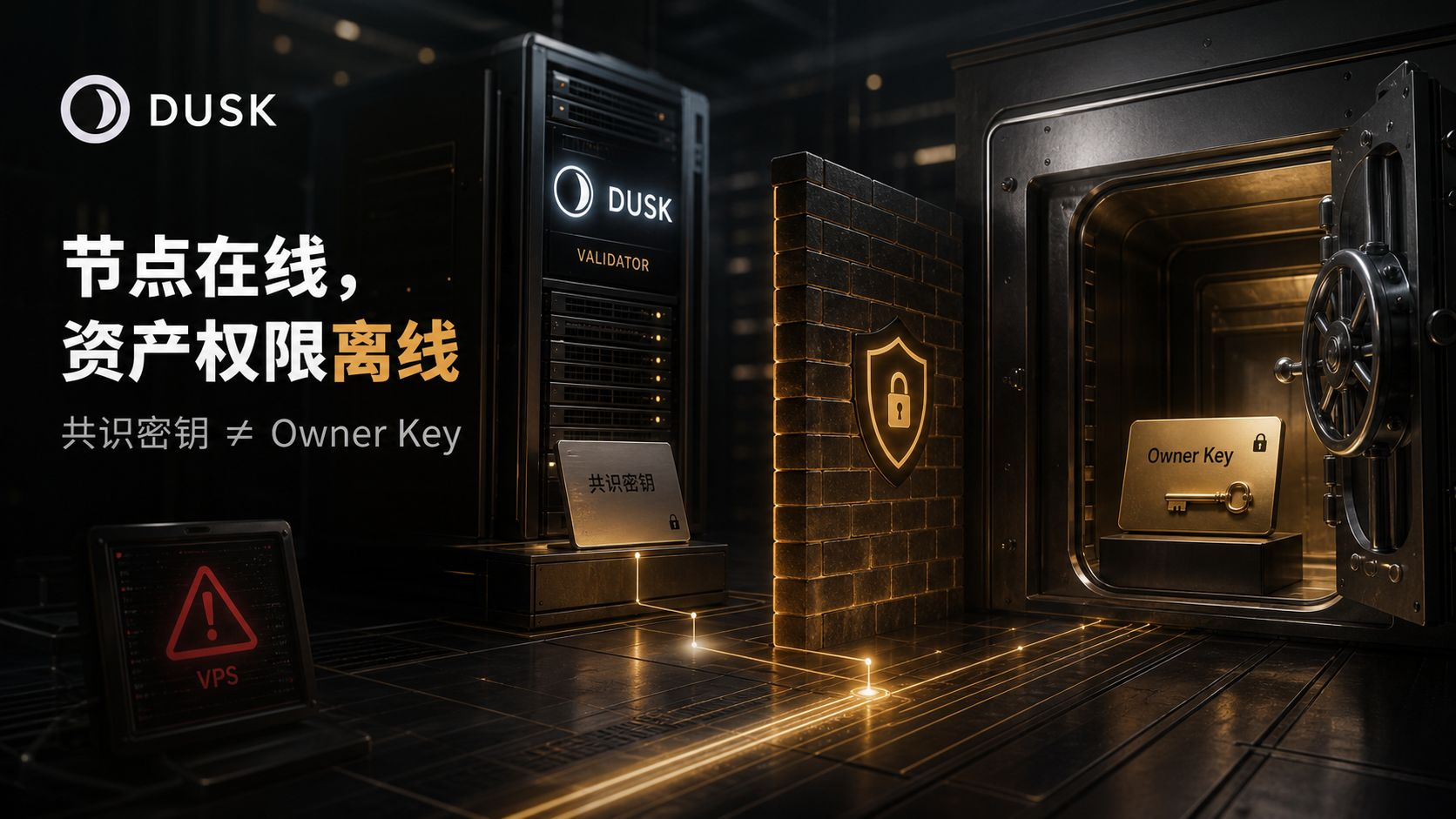
3
3
488
Log in to explore more content
Join global crypto users on Binance Square
⚡️ Get latest and useful information about crypto.
💬 Trusted by the world’s largest crypto exchange.
👍 Discover real insights from verified creators.
Email / Phone number
Trending Topics
BNBSurpasses$790
10,124 views
83 Discussing
$BNB strategic long plan -> FOCUS NOW
BNB has created 2 strong lows after taking out internal liquidity
I'm expecting a move towards swing high $815-$830 and looking for a long on a retest of the green box
#BNBSurpasses$790 #bnb
Ghost Writer
·4 Likes
·4.9k views
ZamaRises15.99%ToIntradayHigh$0.09
4,512 views
71 Discussing
BitcoinSpotETFsDraw$6.34BInflowsInQ3
3,534 views
57 Discussing