
Misha619
10 Posts

Misha619
Report
Block User
7 Following
33 Followers
20 Liked
Posts
·
--
Leverage increases exposure position, not the quality of the idea
Let’s say a trader has 100 USDT in margin and opens a position worth 500 USDT with 5x leverage.
A 2% move of the underlying asset against the position would result in roughly a 10 USDT loss before considering fees, funding, and the specifics of margin. That’s about 10% of the initial 100 USDT, even though the actual move itself was only 2%.
That’s why I would plan a TradFi Perp in this order:
1. Maximum allowable loss.
2. The level where the scenario becomes invalid.
3. The required position notional.
4. Only then—leverage.
Liquidation can happen earlier than the simple arithmetic “100% divided by leverage,” because maintenance margin and risk rules apply.
Leverage is a regulator of position size, not a way to make a weak thesis stronger.
#TradFi
Leverage increases exposure position, not the quality of the idea
Let’s say a trader has 100 USDT in margin and opens a position worth 500 USDT with 5x leverage.
A 2% move of the underlying asset against the position would result in roughly a 10 USDT loss before considering fees, funding, and the specifics of margin. That’s about 10% of the initial 100 USDT, even though the actual move itself was only 2%.
That’s why I would plan a TradFi Perp in this order:
1. Maximum allowable loss.
2. The level where the scenario becomes invalid.
3. The required position notional.
4. Only then—leverage.
Liquidation can happen earlier than the simple arithmetic “100% divided by leverage,” because maintenance margin and risk rules apply.
Leverage is a regulator of position size, not a way to make a weak thesis stronger.
#TradFi
Let’s say a trader has 100 USDT in margin and opens a position worth 500 USDT with 5x leverage.
A 2% move of the underlying asset against the position would result in roughly a 10 USDT loss before considering fees, funding, and the specifics of margin. That’s about 10% of the initial 100 USDT, even though the actual move itself was only 2%.
That’s why I would plan a TradFi Perp in this order:
1. Maximum allowable loss.
2. The level where the scenario becomes invalid.
3. The required position notional.
4. Only then—leverage.
Liquidation can happen earlier than the simple arithmetic “100% divided by leverage,” because maintenance margin and risk rules apply.
Leverage is a regulator of position size, not a way to make a weak thesis stronger.
#TradFi
109
·
--
What 1:1 collateral actually means
The phrase “bStock is backed 1:1” sounds like a guarantee, but it answers only one question: what is behind the token.
According to Binance, each bStock is backed by a corresponding U.S. share that is held by a regulated custodian. At the same time, bStock does not make the holder a direct shareholder of the company and does not grant voting rights.
The collateral also does not fix a market price. The value changes along with the underlying asset, and the execution price on Spot depends not only on the asset but also on liquidity and the spread.
So, before buying, I would split the verification into four questions:
1. Which exact company does the token represent?
2. How narrow is the spread?
3. What risks exist for the issuer and the custodian?
4. Is the product available in my jurisdiction?
1:1 collateral explains the product structure, but it does not guarantee profit.
#bStocks
What 1:1 collateral actually means
The phrase “bStock is backed 1:1” sounds like a guarantee, but it answers only one question: what is behind the token.
According to Binance, each bStock is backed by a corresponding U.S. share that is held by a regulated custodian. At the same time, bStock does not make the holder a direct shareholder of the company and does not grant voting rights.
The collateral also does not fix a market price. The value changes along with the underlying asset, and the execution price on Spot depends not only on the asset but also on liquidity and the spread.
So, before buying, I would split the verification into four questions:
1. Which exact company does the token represent?
2. How narrow is the spread?
3. What risks exist for the issuer and the custodian?
4. Is the product available in my jurisdiction?
1:1 collateral explains the product structure, but it does not guarantee profit.
#bStocks
The phrase “bStock is backed 1:1” sounds like a guarantee, but it answers only one question: what is behind the token.
According to Binance, each bStock is backed by a corresponding U.S. share that is held by a regulated custodian. At the same time, bStock does not make the holder a direct shareholder of the company and does not grant voting rights.
The collateral also does not fix a market price. The value changes along with the underlying asset, and the execution price on Spot depends not only on the asset but also on liquidity and the spread.
So, before buying, I would split the verification into four questions:
1. Which exact company does the token represent?
2. How narrow is the spread?
3. What risks exist for the issuer and the custodian?
4. Is the product available in my jurisdiction?
1:1 collateral explains the product structure, but it does not guarantee profit.
#bStocks
86
·
--
The Road to TGE: Who’s Behind the Project?
#TermMax I’m closing the week with a background check-up, because the team weighs more than a landing page.
Term Structure Labs raised $4.25M back in 2023 from Cumberland (DRW), HashKey Capital, LongLing Capital, and MZ Web3 Fund, went through the YZi Labs accelerator (formerly Binance Labs), and reached 837 thousand registered wallets. Peak TVL was over $64M, and peak activity hit 170 thousand users per day.
Next on the roadmap is the TGE for the TMX token: a fixed 1 billion supply, listings on CEXs, a claim for early users, and staking—everything is planned for this quarter.
Personally, I don’t expect 10x gains from every TGE, but a team with institutional backing and a live product is no longer a lottery ticket.
@termmax $TMX
What are you looking forward to most from the TGE? 👇
The Road to TGE: Who’s Behind the Project?
#TermMax I’m closing the week with a background check-up, because the team weighs more than a landing page.
Term Structure Labs raised $4.25M back in 2023 from Cumberland (DRW), HashKey Capital, LongLing Capital, and MZ Web3 Fund, went through the YZi Labs accelerator (formerly Binance Labs), and reached 837 thousand registered wallets. Peak TVL was over $64M, and peak activity hit 170 thousand users per day.
Next on the roadmap is the TGE for the TMX token: a fixed 1 billion supply, listings on CEXs, a claim for early users, and staking—everything is planned for this quarter.
Personally, I don’t expect 10x gains from every TGE, but a team with institutional backing and a live product is no longer a lottery ticket.
@TermMax $TMX
What are you looking forward to most from the TGE? 👇
#TermMax I’m closing the week with a background check-up, because the team weighs more than a landing page.
Term Structure Labs raised $4.25M back in 2023 from Cumberland (DRW), HashKey Capital, LongLing Capital, and MZ Web3 Fund, went through the YZi Labs accelerator (formerly Binance Labs), and reached 837 thousand registered wallets. Peak TVL was over $64M, and peak activity hit 170 thousand users per day.
Next on the roadmap is the TGE for the TMX token: a fixed 1 billion supply, listings on CEXs, a claim for early users, and staking—everything is planned for this quarter.
Personally, I don’t expect 10x gains from every TGE, but a team with institutional backing and a live product is no longer a lottery ticket.
@TermMax $TMX
What are you looking forward to most from the TGE? 👇

77
·
--
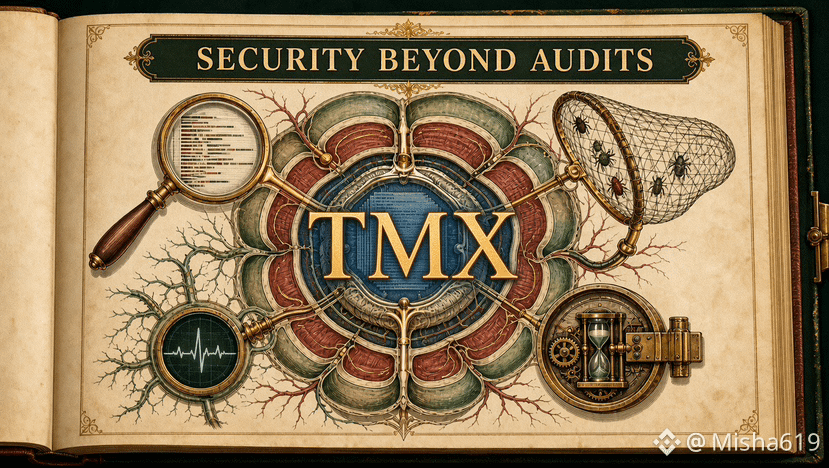
Security: what’s behind the word “audited”?
#TermMax Liking a protocol is easy; trusting it with a deposit is a different conversation. So I went to check the security, not the banners.
What I found on TermMax: a DeFiSafety rating of 93%, an auditors’ contest on Spearbit, bug bounties on Immunefi and Hypernative, which scans transactions 24/7. Plus a timelock for upgrades—code changes don’t happen suddenly, there’s time to react.
Now, the spoon of bitterness—without it, nowhere: no audit equals a guarantee. Smart contract risk in DeFi never disappears; it only becomes more expensive for the attacker. Anyone promising otherwise is selling a fairy tale.
Personally, my filter is simple: a live bug bounty and timelock are mandatory; everything else is just accumulated bonuses.
@termmax $TMX💙
What’s the main security marker for you? 🤔
Security: what’s behind the word “audited”?
#TermMax Liking a protocol is easy; trusting it with a deposit is a different conversation. So I went to check the security, not the banners.
What I found on TermMax: a DeFiSafety rating of 93%, an auditors’ contest on Spearbit, bug bounties on Immunefi and Hypernative, which scans transactions 24/7. Plus a timelock for upgrades—code changes don’t happen suddenly, there’s time to react.
Now, the spoon of bitterness—without it, nowhere: no audit equals a guarantee. Smart contract risk in DeFi never disappears; it only becomes more expensive for the attacker. Anyone promising otherwise is selling a fairy tale.
Personally, my filter is simple: a live bug bounty and timelock are mandatory; everything else is just accumulated bonuses.
@TermMax $TMX💙
What’s the main security marker for you? 🤔
#TermMax Liking a protocol is easy; trusting it with a deposit is a different conversation. So I went to check the security, not the banners.
What I found on TermMax: a DeFiSafety rating of 93%, an auditors’ contest on Spearbit, bug bounties on Immunefi and Hypernative, which scans transactions 24/7. Plus a timelock for upgrades—code changes don’t happen suddenly, there’s time to react.
Now, the spoon of bitterness—without it, nowhere: no audit equals a guarantee. Smart contract risk in DeFi never disappears; it only becomes more expensive for the attacker. Anyone promising otherwise is selling a fairy tale.
Personally, my filter is simple: a live bug bounty and timelock are mandatory; everything else is just accumulated bonuses.
@TermMax $TMX💙
What’s the main security marker for you? 🤔
1
1
87
·
--
Shoulder with no liquidation price
#TermMax Do you remember last year’s October—when in a single day, a billion positions evaporated on the perps? After days like that, the phrase “shoulder without liquidation” sounds like marketing. But here, the mechanics are actually different.
With TermMax Alpha, you pay a fixed premium upfront—so that’s the only possible loss. No maintenance margin, no liquidation price, no call at 4 a.m. The token drops—only the premium burns. It rises—your leverage works for you.
In essence, it’s option-like logic applied to fresh Alpha tokens, where perps simply don’t exist yet. And honestly: even in the sideways market, the premium still burns—no free X’s here.
Personally, I think any tool is fair when the maximum loss is known before you enter, not after.
@termmax $TMX
What will you choose for a volatile listing? 👇
Shoulder with no liquidation price
#TermMax Do you remember last year’s October—when in a single day, a billion positions evaporated on the perps? After days like that, the phrase “shoulder without liquidation” sounds like marketing. But here, the mechanics are actually different.
With TermMax Alpha, you pay a fixed premium upfront—so that’s the only possible loss. No maintenance margin, no liquidation price, no call at 4 a.m. The token drops—only the premium burns. It rises—your leverage works for you.
In essence, it’s option-like logic applied to fresh Alpha tokens, where perps simply don’t exist yet. And honestly: even in the sideways market, the premium still burns—no free X’s here.
Personally, I think any tool is fair when the maximum loss is known before you enter, not after.
@TermMax $TMX
What will you choose for a volatile listing? 👇
#TermMax Do you remember last year’s October—when in a single day, a billion positions evaporated on the perps? After days like that, the phrase “shoulder without liquidation” sounds like marketing. But here, the mechanics are actually different.
With TermMax Alpha, you pay a fixed premium upfront—so that’s the only possible loss. No maintenance margin, no liquidation price, no call at 4 a.m. The token drops—only the premium burns. It rises—your leverage works for you.
In essence, it’s option-like logic applied to fresh Alpha tokens, where perps simply don’t exist yet. And honestly: even in the sideways market, the premium still burns—no free X’s here.
Personally, I think any tool is fair when the maximum loss is known before you enter, not after.
@TermMax $TMX
What will you choose for a volatile listing? 👇

92
·
--
Who manages the money in vaults?
#TermMax I looked into who actually manages the money in the TermMax vaults, and the list surprised me: Keyrock, MEV Capital, Edge Capital — firms that have been doing market-making in crypto and TradFi for years.
The logic for lazy capital is simple: you don’t want to place orders yourself and chase the rates—so you deposit into a vault, and the curator allocates it across markets. Meanwhile, idle funds don’t sleep: the protocol automatically parks them in Aave or Morpho.
But the curator is a human factor: their strategy, their mistakes. That’s why before depositing, look at the history of the specific vault—not the APY figure on the storefront.
Personally, the “a pro manages, I just watch” format is fine for part of my portfolio, but definitely not for all of it.
@termmax $TMX
Would you trust your deposit to a curator? 👇
Who manages the money in vaults?
#TermMax I looked into who actually manages the money in the TermMax vaults, and the list surprised me: Keyrock, MEV Capital, Edge Capital — firms that have been doing market-making in crypto and TradFi for years.
The logic for lazy capital is simple: you don’t want to place orders yourself and chase the rates—so you deposit into a vault, and the curator allocates it across markets. Meanwhile, idle funds don’t sleep: the protocol automatically parks them in Aave or Morpho.
But the curator is a human factor: their strategy, their mistakes. That’s why before depositing, look at the history of the specific vault—not the APY figure on the storefront.
Personally, the “a pro manages, I just watch” format is fine for part of my portfolio, but definitely not for all of it.
@TermMax $TMX
Would you trust your deposit to a curator? 👇
#TermMax I looked into who actually manages the money in the TermMax vaults, and the list surprised me: Keyrock, MEV Capital, Edge Capital — firms that have been doing market-making in crypto and TradFi for years.
The logic for lazy capital is simple: you don’t want to place orders yourself and chase the rates—so you deposit into a vault, and the curator allocates it across markets. Meanwhile, idle funds don’t sleep: the protocol automatically parks them in Aave or Morpho.
But the curator is a human factor: their strategy, their mistakes. That’s why before depositing, look at the history of the specific vault—not the APY figure on the storefront.
Personally, the “a pro manages, I just watch” format is fine for part of my portfolio, but definitely not for all of it.
@TermMax $TMX
Would you trust your deposit to a curator? 👇

62
·
--
When the rate is decided not by you
#TermMax A familiar story: you take a DeFi loan at 8%, and within two weeks the rate is already 23% because someone large withdrew liquidity from the pool. A floating percentage is when the terms of your credit are decided not by you.
That’s exactly what hooked me on TermMax: here the rate and the term are fixed at the time the deal is made. Borrow at 10% until a specific date—and no matter what happens in the market, the price of your money won’t change.
And this isn’t a garage project anymore: it’s #36 among all landings on DeFiLlama and 7+ networks, from Ethereum to BNB Chain.
Personally, I’m picky about lending: I want to know the cost of money in advance, not play roulette with bad utilization.
@termmax $TMX
Has a floating rate ever bitten you? 👇
When the rate is decided not by you
#TermMax A familiar story: you take a DeFi loan at 8%, and within two weeks the rate is already 23% because someone large withdrew liquidity from the pool. A floating percentage is when the terms of your credit are decided not by you.
That’s exactly what hooked me on TermMax: here the rate and the term are fixed at the time the deal is made. Borrow at 10% until a specific date—and no matter what happens in the market, the price of your money won’t change.
And this isn’t a garage project anymore: it’s #36 among all landings on DeFiLlama and 7+ networks, from Ethereum to BNB Chain.
Personally, I’m picky about lending: I want to know the cost of money in advance, not play roulette with bad utilization.
@TermMax $TMX
Has a floating rate ever bitten you? 👇
#TermMax A familiar story: you take a DeFi loan at 8%, and within two weeks the rate is already 23% because someone large withdrew liquidity from the pool. A floating percentage is when the terms of your credit are decided not by you.
That’s exactly what hooked me on TermMax: here the rate and the term are fixed at the time the deal is made. Borrow at 10% until a specific date—and no matter what happens in the market, the price of your money won’t change.
And this isn’t a garage project anymore: it’s #36 among all landings on DeFiLlama and 7+ networks, from Ethereum to BNB Chain.
Personally, I’m picky about lending: I want to know the cost of money in advance, not play roulette with bad utilization.
@TermMax $TMX
Has a floating rate ever bitten you? 👇

91
·
--

Article
My thoughts on ROBORecently, I started reading more about $ROBO and honestly — the topic seems more interesting than I initially thought. At first, it seemed like just another AI token, but when I dug a little deeper, it became clear that the idea is a bit broader.
@cryptoviu promotes the concept of the so-called “robot economy.” If you think logically, in the future AI agents and robots may perform many tasks: delivering something, processing information, managing services, or even interacting with each other. But for such a system to function properly, it needs a basic infrastructure — identification, payments, and interaction rules.
My thoughts on ROBO
Recently, I started reading more about $ROBO and honestly — the topic seems more interesting than I initially thought. At first, it seemed like just another AI token, but when I dug a little deeper, it became clear that the idea is a bit broader.
@My crypto person promotes the concept of the so-called “robot economy.” If you think logically, in the future AI agents and robots may perform many tasks: delivering something, processing information, managing services, or even interacting with each other. But for such a system to function properly, it needs a basic infrastructure — identification, payments, and interaction rules.
@My crypto person promotes the concept of the so-called “robot economy.” If you think logically, in the future AI agents and robots may perform many tasks: delivering something, processing information, managing services, or even interacting with each other. But for such a system to function properly, it needs a basic infrastructure — identification, payments, and interaction rules.
17
17
·
--
#robo $ROBO Lately I looked more closely at $ROBO and understood why this is no longer just “another AI token”.
@FabricFND is laying the foundation for a “robot economy”. If AI agents and robots become autonomous executors of tasks—delivering, analyzing data, managing services, and interacting with each other—then they need infrastructure:
• on-chain identity (DID) so it’s clear “who is who”;
• payments;
• coordination rules and governance.
Without this, the machine economy quickly turns into chaos.
In the ROBO model, the token serves a real function. It’s network fuel: transaction fees, identity verification, task settlement, and staking to coordinate agents and deploy hardware (Robot Genesis). Plus there’s a reputation score mechanism—agents stake $ROBO, and if they work incorrectly, slashing is possible. In other words, there is economic accountability.
That’s why ROBO looks like a bet on infrastructure for autonomous agents, not just a token “for pumping.” After the growth, the price holds around ~0.05—the market is watching the narrative and waiting for integrations.
Next, the key is updates from @FabricFND and real use cases. If scaling is confirmed, “robot economy” could become its own wave in the AI sector 🧠
#ROBO $ROBO
{spot}(ROBOUSDT)
#robo $ROBO Lately I looked more closely at $ROBO and understood why this is no longer just “another AI token”.
@Fabric Foundation is laying the foundation for a “robot economy”. If AI agents and robots become autonomous executors of tasks—delivering, analyzing data, managing services, and interacting with each other—then they need infrastructure:
• on-chain identity (DID) so it’s clear “who is who”;
• payments;
• coordination rules and governance.
Without this, the machine economy quickly turns into chaos.
In the ROBO model, the token serves a real function. It’s network fuel: transaction fees, identity verification, task settlement, and staking to coordinate agents and deploy hardware (Robot Genesis). Plus there’s a reputation score mechanism—agents stake $ROBO , and if they work incorrectly, slashing is possible. In other words, there is economic accountability.
That’s why ROBO looks like a bet on infrastructure for autonomous agents, not just a token “for pumping.” After the growth, the price holds around ~0.05—the market is watching the narrative and waiting for integrations.
Next, the key is updates from @Fabric Foundation and real use cases. If scaling is confirmed, “robot economy” could become its own wave in the AI sector 🧠
#ROBO $ROBO
@Fabric Foundation is laying the foundation for a “robot economy”. If AI agents and robots become autonomous executors of tasks—delivering, analyzing data, managing services, and interacting with each other—then they need infrastructure:
• on-chain identity (DID) so it’s clear “who is who”;
• payments;
• coordination rules and governance.
Without this, the machine economy quickly turns into chaos.
In the ROBO model, the token serves a real function. It’s network fuel: transaction fees, identity verification, task settlement, and staking to coordinate agents and deploy hardware (Robot Genesis). Plus there’s a reputation score mechanism—agents stake $ROBO , and if they work incorrectly, slashing is possible. In other words, there is economic accountability.
That’s why ROBO looks like a bet on infrastructure for autonomous agents, not just a token “for pumping.” After the growth, the price holds around ~0.05—the market is watching the narrative and waiting for integrations.
Next, the key is updates from @Fabric Foundation and real use cases. If scaling is confirmed, “robot economy” could become its own wave in the AI sector 🧠
#ROBO $ROBO
9
9
Log in to explore more content
Join global crypto users on Binance Square
⚡️ Get latest and useful information about crypto.
💬 Trusted by the world’s largest crypto exchange.
👍 Discover real insights from verified creators.
Email / Phone number
Trending Topics
FedRateWatch
1.5M views
6,803 Discussing
Share & Win Traffic Reward in our Trending Hashtag Campaign
✨Topic: FOMC September, What's The Fed's Next Move?
👉How to Join:
Publish a short post or article with hashtag #FedRateWatch
Create content based on the below angles:
- August core CPI rose 0.3% month-over-month, and the odds of a 25bp hike this week are now close to 90%. Do you anticipate a rate hike this week? Is it a one-off, or the start of a longer hiking cycle?
- If the hike lands, how does it play out for BTC, tech stocks, and gold? Bullish or bearish?
- How are you planning to trade next? Share your BTC, stocks or gold trade/holdings with our trade sharing widget.
⏰Campaign Period:
- 2026-09-15 11:00 - 2026-09-17 3:00 UTC
🎁Reward:
- Qualified posts that comply with the above guidelines and contain more than 100 words will be reviewed and may receive a random traffic boost of 500 to 3,000 views. You will receive a notification from your feed secretary if your post is selected.
- Get a chance to have your article featured on Binance Square Official
Need ideas for your post? Visit the topic page #FedRateWatch or the Square Guide on How to Post for Better Reach.
Binance Square Official
·650 Likes
·1.7M views
ZcashRises6%
57,599 views
680 Discussing
XRPSinks10%
38,253 views
445 Discussing