
DON MEGALODON
2k Posts

DON MEGALODON
DeFi WiFi ХуеFi 🙄 Web3 Нас тупил
Open Trade
High-Frequency Trader
6 Years
3 Following
119 Followers
448 Liked
Posts
Portfolio
All
Quotes
sorry...

asrar khan 95
·
--
vIran’s central bank using vast quantities of cryptocurrency championed by Farage, says report
Regime appears to have turned to digital currency issued by Tether in the face of sanctions
Iran’s central bank has undertaken a ‘systematic accumulation’ of Tether coins,
This article is more than 1 month old
Iran’s central bank using vast quantities of cryptocurrency championed by Farage, says report
This article is more than 1 month old
Regime appears to have turned to digital currency issued by Tether in the face of sanctions
Tom Burgis and Michael Goodier
Wed 21 Jan 2026 06.00 GMT
Share
Prefer the Guardian on Google
Iran’s central bank appears to have been using vast quantities of a cryptocurrency championed by Nigel Farage, according to a new report.
Elliptic, a crypto analytics company, said it had traced at least $507m (£377m) of cryptocurrency issued by Tether – a company touted by the Reform UK leader – passing through accounts that appear to be controlled by Iran’s central bank.
Elliptic’s report tracked what it says is the Iranian central bank’s “systematic accumulation” of Tether stablecoins, a type of crypto that is pegged to the dollar so it can easily be exchanged for hard currency.
This pointed to “a sophisticated strategy to bypass the global banking system”, perhaps to trade or to prop up the rial, Iran’s currency.
With thousands confirmed dead in the brutal suppression of protests, the Iranian regime’s apparent use of Tether’s stablecoins raises questions for Farage about his support for the cryptocurrency.
In September, Farage revealed he was planning to raise Tether during a meeting with the governor of the Bank of England, Andrew Bailey.
“I’m going to go tomorrow to say this,” Farage told LBC radio. “You know, Tether is a stablecoin. Stablecoins are the way which money goes from conventional currencies through into cryptocurrencies and back again. Tether is about to be valued as a $500bn company.”
Farage criticised Bailey for imposing restrictions on crypto and urged the UK to catch up with the US, where Donald Trump, who chose Howard Lutnick, Tether’s banker, as his commerce secretary, has reversed efforts to police digital currencies.
Farage added: “You know, stablecoins, crypto – this world is enormous, and I’ve been urging for years that London should embrace it. We should become a global trading centre for this stuff, under proper regulation.”
One of Tether’s major shareholders, the tech investor Christopher Harborne, is Reform’s biggest donor. His lawyers said Harborne, who does not hold an executive post at Tether, is not responsible for illicit activities by its users. Suggestions that Harborne profits from Iran’s use of Tether stablecoins were “baseless drivel”, the lawyers said.
A spokesperson for Reform UK said “many companies and organisations across the globe” use Tether. They added: “All donations to Reform UK comply with electoral law and regulations. We stringently vet each donation. We continue to actively support the Iranian people in their fight for freedom.”
Booming demand for Tether’s stablecoin – known as USDT – has generated huge returns from the real-currency reserves the company holds to maintain its peg to the dollar. Tether’s $13bn annual profits are one-and-a-half times those of McDonald’s.
Some of that demand comes from illicit sources. In the face of US, UN and other sanctions that make it difficult to trade, buy foreign currency and hold accounts with most banks, it seems Iranians and their rulers have turned to Tether’s stablecoins.
Last year, Israel revealed what it said were dozens of crypto accounts used by Iran’s Revolutionary Guards.
That prompted a prominent Iranian businessman to complain on X about the regime’s failure to keep its dealings secret. His post contained two crypto account numbers the businessman said were used by Iran’s central bank.
It was through this apparently inadvertent disclosure that Elliptic’s researchers found connections between 50 accounts, concluding with a “high level of confidence” that they were controlled by Iran’s central bank.
Accounts said to be tied to Iran have received more than $500m in Tether crypto
Daily value of USDT received by accounts flagged as belonging to the Central Bank of Iran
A Tether representative did not address questions about Iranian central bank use of its stablecoins, but said: “Tether maintains a zero-tolerance policy toward the criminal use of our financial products.”
The representative said Tether followed US sanctions guidelines. “We work closely with law enforcement globally to identify and promptly, upon request, freeze assets to prevent further movement whenever they are identified to be in connection to illegal activity or illicit actors.”
They added that Tether has collaborated with more than 310 law enforcement agencies across 62 countries and frozen more than $3.4bn in assets “linked to criminal activity”.
Tether has frozen the suspected Revolutionary Guards accounts identified by Israel last year but most of those that appear to have been used by the Iranian central bank seem to remain active.
Now is not the time to look away
It’s the Guardian’s job to keep a close focus on events in the Middle East for our global audience.
With reporters sharing live updates around the clock, we’re well-placed to provide comprehensive, fact-checked reporting to show the world what is happening in the region. But we can’t do it without your support.
We rely on the generosity of our readers, whose support helps to keep our correspondents on the ground and our reporting free from commercial or political influence.
We appreciate that not everyone can afford to pay for news, but if you can, can we count on your support? Here are three good reasons to make the choice to fund us today:
1. Our quality, investigative journalism is a scrutinising force.
2. We are independent and have no billionaire owner dictating what we do – your money directly powers our reporting.
3. It doesn’t cost much, and takes less time than it took to read this message.
Choosing to back us on a monthly basis makes the most impact, meaning we can continue to cover the story from every angle: the conflict, the plight of those affected and what it all means for the future of the regio
#BTCUSTDP
#ETHUSTD
#TETHERUSTD
Iran’s central bank has undertaken a ‘systematic accumulation’ of Tether coins,
This article is more than 1 month old
Iran’s central bank using vast quantities of cryptocurrency championed by Farage, says report
This article is more than 1 month old
Regime appears to have turned to digital currency issued by Tether in the face of sanctions
Tom Burgis and Michael Goodier
Wed 21 Jan 2026 06.00 GMT
Share
Prefer the Guardian on Google
Iran’s central bank appears to have been using vast quantities of a cryptocurrency championed by Nigel Farage, according to a new report.
Elliptic, a crypto analytics company, said it had traced at least $507m (£377m) of cryptocurrency issued by Tether – a company touted by the Reform UK leader – passing through accounts that appear to be controlled by Iran’s central bank.
Elliptic’s report tracked what it says is the Iranian central bank’s “systematic accumulation” of Tether stablecoins, a type of crypto that is pegged to the dollar so it can easily be exchanged for hard currency.
This pointed to “a sophisticated strategy to bypass the global banking system”, perhaps to trade or to prop up the rial, Iran’s currency.
With thousands confirmed dead in the brutal suppression of protests, the Iranian regime’s apparent use of Tether’s stablecoins raises questions for Farage about his support for the cryptocurrency.
In September, Farage revealed he was planning to raise Tether during a meeting with the governor of the Bank of England, Andrew Bailey.
“I’m going to go tomorrow to say this,” Farage told LBC radio. “You know, Tether is a stablecoin. Stablecoins are the way which money goes from conventional currencies through into cryptocurrencies and back again. Tether is about to be valued as a $500bn company.”
Farage criticised Bailey for imposing restrictions on crypto and urged the UK to catch up with the US, where Donald Trump, who chose Howard Lutnick, Tether’s banker, as his commerce secretary, has reversed efforts to police digital currencies.
Farage added: “You know, stablecoins, crypto – this world is enormous, and I’ve been urging for years that London should embrace it. We should become a global trading centre for this stuff, under proper regulation.”
One of Tether’s major shareholders, the tech investor Christopher Harborne, is Reform’s biggest donor. His lawyers said Harborne, who does not hold an executive post at Tether, is not responsible for illicit activities by its users. Suggestions that Harborne profits from Iran’s use of Tether stablecoins were “baseless drivel”, the lawyers said.
A spokesperson for Reform UK said “many companies and organisations across the globe” use Tether. They added: “All donations to Reform UK comply with electoral law and regulations. We stringently vet each donation. We continue to actively support the Iranian people in their fight for freedom.”
Booming demand for Tether’s stablecoin – known as USDT – has generated huge returns from the real-currency reserves the company holds to maintain its peg to the dollar. Tether’s $13bn annual profits are one-and-a-half times those of McDonald’s.
Some of that demand comes from illicit sources. In the face of US, UN and other sanctions that make it difficult to trade, buy foreign currency and hold accounts with most banks, it seems Iranians and their rulers have turned to Tether’s stablecoins.
Last year, Israel revealed what it said were dozens of crypto accounts used by Iran’s Revolutionary Guards.
That prompted a prominent Iranian businessman to complain on X about the regime’s failure to keep its dealings secret. His post contained two crypto account numbers the businessman said were used by Iran’s central bank.
It was through this apparently inadvertent disclosure that Elliptic’s researchers found connections between 50 accounts, concluding with a “high level of confidence” that they were controlled by Iran’s central bank.
Accounts said to be tied to Iran have received more than $500m in Tether crypto
Daily value of USDT received by accounts flagged as belonging to the Central Bank of Iran
A Tether representative did not address questions about Iranian central bank use of its stablecoins, but said: “Tether maintains a zero-tolerance policy toward the criminal use of our financial products.”
The representative said Tether followed US sanctions guidelines. “We work closely with law enforcement globally to identify and promptly, upon request, freeze assets to prevent further movement whenever they are identified to be in connection to illegal activity or illicit actors.”
They added that Tether has collaborated with more than 310 law enforcement agencies across 62 countries and frozen more than $3.4bn in assets “linked to criminal activity”.
Tether has frozen the suspected Revolutionary Guards accounts identified by Israel last year but most of those that appear to have been used by the Iranian central bank seem to remain active.
Now is not the time to look away
It’s the Guardian’s job to keep a close focus on events in the Middle East for our global audience.
With reporters sharing live updates around the clock, we’re well-placed to provide comprehensive, fact-checked reporting to show the world what is happening in the region. But we can’t do it without your support.
We rely on the generosity of our readers, whose support helps to keep our correspondents on the ground and our reporting free from commercial or political influence.
We appreciate that not everyone can afford to pay for news, but if you can, can we count on your support? Here are three good reasons to make the choice to fund us today:
1. Our quality, investigative journalism is a scrutinising force.
2. We are independent and have no billionaire owner dictating what we do – your money directly powers our reporting.
3. It doesn’t cost much, and takes less time than it took to read this message.
Choosing to back us on a monthly basis makes the most impact, meaning we can continue to cover the story from every angle: the conflict, the plight of those affected and what it all means for the future of the regio
#BTCUSTDP
#ETHUSTD
#TETHERUSTD

Bulls do not go to work. But those who service them do.

Come income
·
--
Almost a month has passed since the crypto crash
It's already the 25th day, and the chart is still in a sideways trend with no significant changes
What nonsense is this? Bulls, push up
Tomorrow is Monday, time to go back to work again.
Oh, how I want to get rich quickly😁😭
Well, see you at McDonald's.
Free register🤣
Wishing everyone well😉
It's already the 25th day, and the chart is still in a sideways trend with no significant changes
What nonsense is this? Bulls, push up
Tomorrow is Monday, time to go back to work again.
Oh, how I want to get rich quickly😁😭
Well, see you at McDonald's.
Free register🤣
Wishing everyone well😉

Yes, no one trusts him, he is only interested in money, and he is ready to take it even from his own grandmother🙄

Celeste Samide Pobq
·
--
Next target is Pakistan
"Stop clapping for Trump and trust him more"
If Israel succeeds in Iran and after a regime change, the next government will work under Israel and America, and the next number will be Pakistan. Netanyahu has mentioned several times that after Iran, they will eliminate Pakistan's nuclear parity.
Will India and Israel conspire against Pakistan? Trump is a friend of Netanyahu, and Netanyahu is a close friend of Modi. India will team up with Israel to wage war against Pakistan, and America will fully support it.
Journalist Hamid Mir
"Stop clapping for Trump and trust him more"
If Israel succeeds in Iran and after a regime change, the next government will work under Israel and America, and the next number will be Pakistan. Netanyahu has mentioned several times that after Iran, they will eliminate Pakistan's nuclear parity.
Will India and Israel conspire against Pakistan? Trump is a friend of Netanyahu, and Netanyahu is a close friend of Modi. India will team up with Israel to wage war against Pakistan, and America will fully support it.
Journalist Hamid Mir
no, you can start with just 5 dollars. still, until you make ten times down - wisdom will not come to you

SuTic
·
--
Hello everyone
Please advise experienced millionaires.
Is it worth starting with $100-200?
Or would it be better to save up a bit more and start with a larger amount? (Thank you)
Please advise experienced millionaires.
Is it worth starting with $100-200?
Or would it be better to save up a bit more and start with a larger amount? (Thank you)
and who cares about "what you wanted there"? the market lives by its own rules, either you go with the flow of the market, or you dry up on the sidelines...

SkyPatil
·
--
i am new to binance starting with $100 today. i just wanted a decent return of 14% to 20% return on my investment annually. please guide me anyone, if possible.... thank you 🙏#begineer #PassiveIncome
the Ramadan spin is even tougher, everything is pressed in half a second. from the very first second "the rewards are over" 🙄

V L
·
--
Binance is ridiculous, what is the point of saving spins if it's almost impossible to use them

1. you buy pink glasses with them. 2. You break them with the glasses inside. 3. That's it, you are an investor.

Syelore
·
--
Guys, a question for those who know more about crypto. How is it better to invest 30$ to start multiplying them and move forward? Perhaps the help of someone from you will change my life)
see the transaction hash in the blockchain, everything is there, check the hash in the wallet

jordaan
·
--
i recently withdraw from phantom wallet through sol network to binance but i dint get that amount in binance account can someone pls help me out...
yes, almost the whole square is a nuisance in the ears and ai-slop🙄

BlackFreeRio3
·
--
people do not believe the words of the channel Golos baffeta, he pours nonsense into people's ears, and like a rat he got scared and blocked me for telling the truth! spread it!


poor souls, if you only knew how you are being deceived, just look out the window😂

туз козырный
·
--
get lost, you have been fooled. you have internet and all messengers are turned off, and you are waiting for a miracle from the government
and the child was born nft by subscription. the main thing is that others are jealous, otherwise not all by themselves...

Maksym Mykhailovskyi
·
--
In the fan house of the series "Stranger Things", a story occurred that could easily have become a separate episode — about digital madness and love without the consent of the other party.
A girl under the pseudonym Kaylee Keery became so fascinated with the actor playing Steve Harrington — Joe Keery — that she decided not to wait for favors from reality. With the help of neural networks and Photoshop, she literally edited her life with the actor: walks, hugs, cozy domestic life, an exemplary husband by her side. Everything looked so "real" that at first, almost no one had any questions.
Then — more. About 19 thousand people followed the blog until "footage from the maternity hospital" appeared in the feed. A fake baby, touching captions, and then — an announcement of a second pregnancy. And it was here that the collective "what?" finally caught up with what was happening.
After a barrage of criticism and demands to block the account for fakes and harassment, the author hid the page. But she refused to delete her virtual family. Because, apparently, if one is to live in a fictional reality — then to the end.
When one really wants to marry a celebrity, but he doesn't know about it, filters, AI, and a rich imagination come to the rescue.
$BTC $ETH $BNB
A girl under the pseudonym Kaylee Keery became so fascinated with the actor playing Steve Harrington — Joe Keery — that she decided not to wait for favors from reality. With the help of neural networks and Photoshop, she literally edited her life with the actor: walks, hugs, cozy domestic life, an exemplary husband by her side. Everything looked so "real" that at first, almost no one had any questions.
Then — more. About 19 thousand people followed the blog until "footage from the maternity hospital" appeared in the feed. A fake baby, touching captions, and then — an announcement of a second pregnancy. And it was here that the collective "what?" finally caught up with what was happening.
After a barrage of criticism and demands to block the account for fakes and harassment, the author hid the page. But she refused to delete her virtual family. Because, apparently, if one is to live in a fictional reality — then to the end.
When one really wants to marry a celebrity, but he doesn't know about it, filters, AI, and a rich imagination come to the rescue.
$BTC $ETH $BNB



the author mixed everything together, scalpers are often forced to sell at a loss to close positions, while hamsters usually go into crypto in their underwear to get rich.
Ди Гамблер
·
--
About hamsters. Holders are often confused with hamsters, but they are not the same. Hamsters are particularly skittish participants in the market; initially (when the market is going up) they are afraid of missing out on making a lot of money, and then (when the market is going down) they fear losing everything.
Often, hamsters sell cheaper what they bought for more. And then they buy back for more what they sold for less.
Holders, on the other hand, are not afraid of downturns. During downturns, they buy, and during uptrends, they... buy again. This is the very small percentage of all market participants who came into crypto not for the multipliers.
#хомяки #холдеры
Often, hamsters sell cheaper what they bought for more. And then they buy back for more what they sold for less.
Holders, on the other hand, are not afraid of downturns. During downturns, they buy, and during uptrends, they... buy again. This is the very small percentage of all market participants who came into crypto not for the multipliers.
#хомяки #холдеры
a million bttc costs several times cheaper
Hanzo Hasashi777
·
--
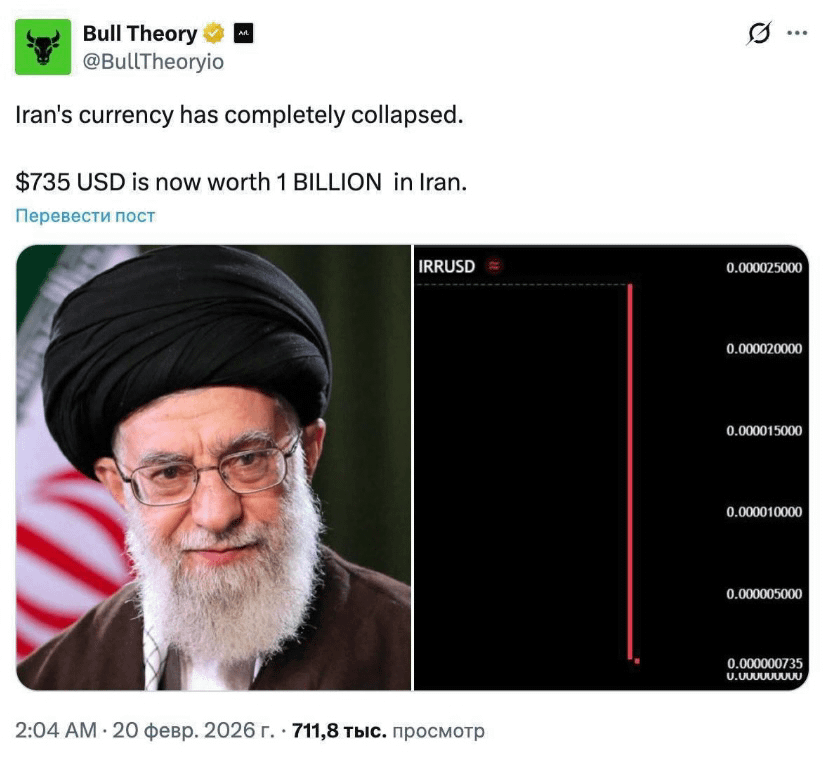
Becoming a billionaire is now much easier than before
For only 735$ you can buy 1 billion Iranian currency
For only 735$ you can buy 1 billion Iranian currency
Log in to explore more content