

POETA
56 Posts

POETA
Report
Block User

BTC Holder
Frequent Trader
7 Years
6 Following
33 Followers
22 Liked
Posts
All
Quotes
Videos
·
--
See translation
Projeção de nossa última análise do BTCUSDT!
Acompanhe até o fim. 😉
Projeção de nossa última análise do BTCUSDT!
Acompanhe até o fim. 😉
Acompanhe até o fim. 😉
41
·
--
The 5-minute chart of BTCUSDT shows a bearish structure in consolidation in the purple box; if it breaks the current support, the downside targets are at 82,750 USDT, 81,400 USDT, and 80,600 USDT, while a buying reaction needs to break the immediate resistance at 83,300 USDT toward 83,800 USDT. The downward trend is invalidated only if the price exceeds the main resistance at 84,600 USDT.
Well, since everything is just speculation, let's see what might happen! 🙌🏻
The 5-minute chart of BTCUSDT shows a bearish structure in consolidation in the purple box; if it breaks the current support, the downside targets are at 82,750 USDT, 81,400 USDT, and 80,600 USDT, while a buying reaction needs to break the immediate resistance at 83,300 USDT toward 83,800 USDT. The downward trend is invalidated only if the price exceeds the main resistance at 84,600 USDT.
Well, since everything is just speculation, let's see what might happen! 🙌🏻
Well, since everything is just speculation, let's see what might happen! 🙌🏻
625
·
--
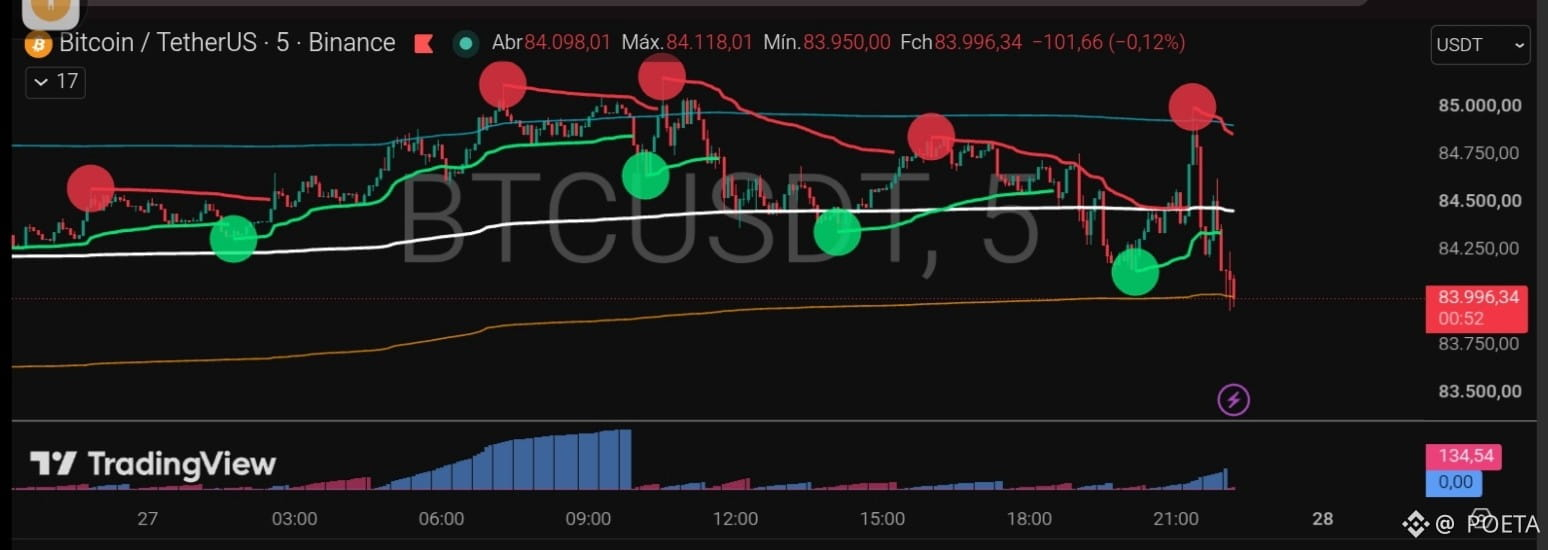
Bitcoin faces a strong rejection in the $85,000 USDT range on the 5-minute chart, being pushed toward the $83,996 USDT region.
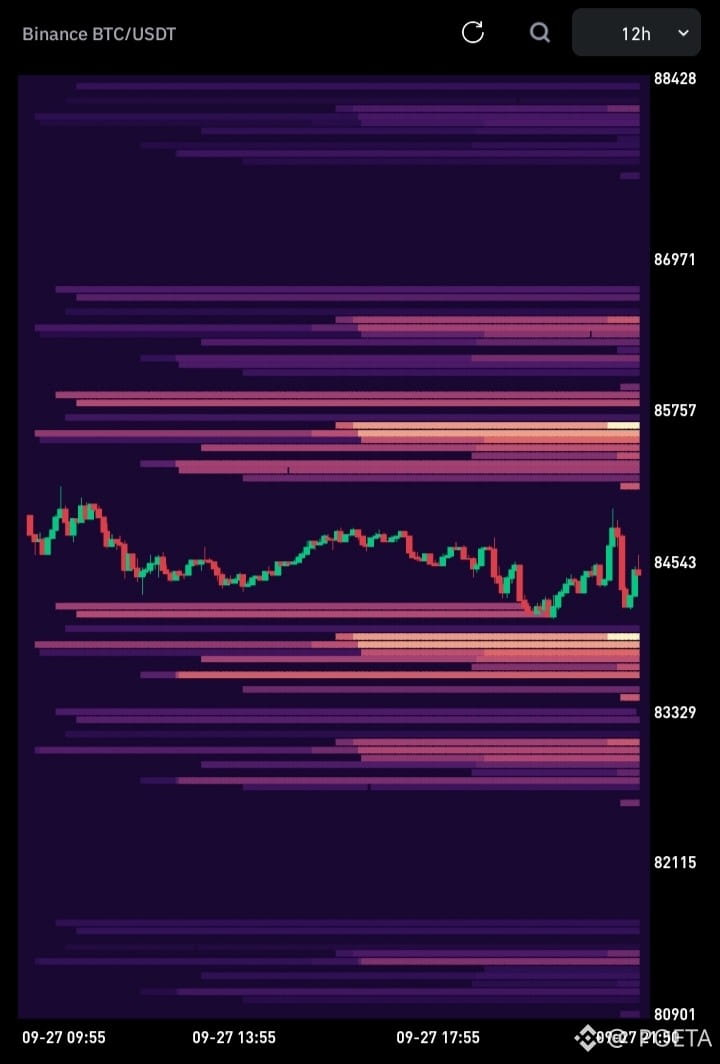
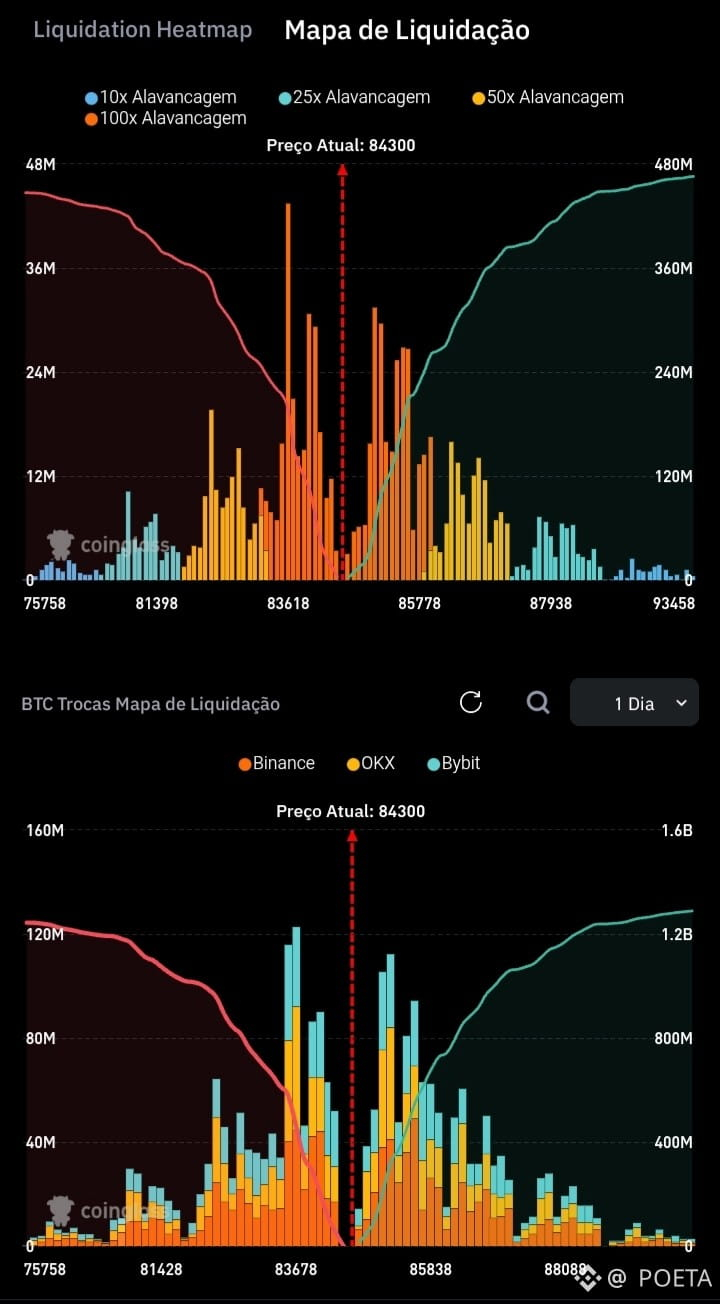
Below the current price, there is a high concentration of liquidations from long positions between $83,600 and $83,800 USDT, acting as a strong magnet of attraction in the short term. At the same time, Binance’s order book shows a large wall of accumulated buy orders in the $83,300 to $83,800 USDT zone, positioned to absorb this drop.
The most likely move over the next few hours is an immediate search for liquidity in the $83,600–$83,800 USDT range, where the support from the buy orders should act in an attempt to trigger a rebound back to the higher resistance levels.
#btc #BTC #vwap #VWAPs #heatmap
Bitcoin faces a strong rejection in the $85,000 USDT range on the 5-minute chart, being pushed toward the $83,996 USDT region.
Below the current price, there is a high concentration of liquidations from long positions between $83,600 and $83,800 USDT, acting as a strong magnet of attraction in the short term. At the same time, Binance’s order book shows a large wall of accumulated buy orders in the $83,300 to $83,800 USDT zone, positioned to absorb this drop.
The most likely move over the next few hours is an immediate search for liquidity in the $83,600–$83,800 USDT range, where the support from the buy orders should act in an attempt to trigger a rebound back to the higher resistance levels.
#btc #BTC #vwap #VWAPs #heatmap
Below the current price, there is a high concentration of liquidations from long positions between $83,600 and $83,800 USDT, acting as a strong magnet of attraction in the short term. At the same time, Binance’s order book shows a large wall of accumulated buy orders in the $83,300 to $83,800 USDT zone, positioned to absorb this drop.
The most likely move over the next few hours is an immediate search for liquidity in the $83,600–$83,800 USDT range, where the support from the buy orders should act in an attempt to trigger a rebound back to the higher resistance levels.
#btc #BTC #vwap #VWAPs #heatmap
288
·
--
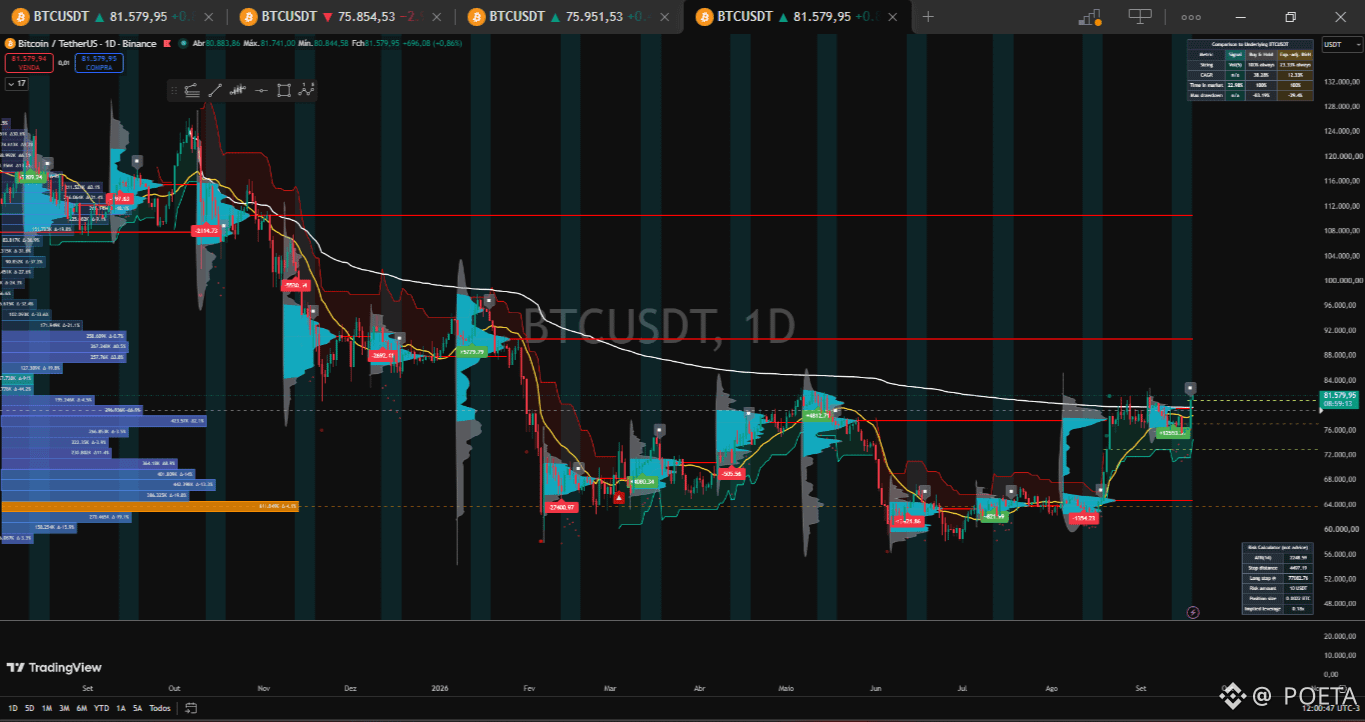
The BTCUSDT chart on the daily timeframe shows a recovery moment, accompanied by different flow, trend, and volume tools. The price, currently in the 81,579.95 region, managed to break above the yellow Flow average and also the most recent monthly POC, located approximately between 76 and 78 thousand dollars. This staying above those references suggests that the market is accepting higher prices.
At the same time, the Volume Profile shows the main areas where trading was concentrated and makes it possible to identify levels that could act as support or resistance. Above the current price there are still important POCs, mainly in the regions near 88 thousand and 108 thousand dollars. Therefore, although the recent move shows signs of recovery, there are still relevant levels that may hinder a direct continuation of the rally.
The main point is that BTC is trying to turn a recovery into a more consistent bullish structure. However, the previous drop, from approximately 120 thousand to 60 thousand dollars, is still part of the broader context and indicates that the larger structure has not been fully reversed. Thus, the current scenario can be interpreted as a recovery within a structure that still needs to confirm its trend change.
The indicator reading favors, at this moment, a sideways upward continuation as long as the price remains above the yellow average and the most recent monthly POC. On the other hand, losing these references could weaken this reading and put the price back into a correction phase.
In summary, the chart shows signs of recovery and a strengthening of price, but it still does not allow considering the structural change as fully confirmed. The next moves will depend mainly on BTC’s ability to remain above the volume regions recently achieved and, subsequently, to face the upper POCs.
The BTCUSDT chart on the daily timeframe shows a recovery moment, accompanied by different flow, trend, and volume tools. The price, currently in the 81,579.95 region, managed to break above the yellow Flow average and also the most recent monthly POC, located approximately between 76 and 78 thousand dollars. This staying above those references suggests that the market is accepting higher prices.
At the same time, the Volume Profile shows the main areas where trading was concentrated and makes it possible to identify levels that could act as support or resistance. Above the current price there are still important POCs, mainly in the regions near 88 thousand and 108 thousand dollars. Therefore, although the recent move shows signs of recovery, there are still relevant levels that may hinder a direct continuation of the rally.
The main point is that BTC is trying to turn a recovery into a more consistent bullish structure. However, the previous drop, from approximately 120 thousand to 60 thousand dollars, is still part of the broader context and indicates that the larger structure has not been fully reversed. Thus, the current scenario can be interpreted as a recovery within a structure that still needs to confirm its trend change.
The indicator reading favors, at this moment, a sideways upward continuation as long as the price remains above the yellow average and the most recent monthly POC. On the other hand, losing these references could weaken this reading and put the price back into a correction phase.
In summary, the chart shows signs of recovery and a strengthening of price, but it still does not allow considering the structural change as fully confirmed. The next moves will depend mainly on BTC’s ability to remain above the volume regions recently achieved and, subsequently, to face the upper POCs.
At the same time, the Volume Profile shows the main areas where trading was concentrated and makes it possible to identify levels that could act as support or resistance. Above the current price there are still important POCs, mainly in the regions near 88 thousand and 108 thousand dollars. Therefore, although the recent move shows signs of recovery, there are still relevant levels that may hinder a direct continuation of the rally.
The main point is that BTC is trying to turn a recovery into a more consistent bullish structure. However, the previous drop, from approximately 120 thousand to 60 thousand dollars, is still part of the broader context and indicates that the larger structure has not been fully reversed. Thus, the current scenario can be interpreted as a recovery within a structure that still needs to confirm its trend change.
The indicator reading favors, at this moment, a sideways upward continuation as long as the price remains above the yellow average and the most recent monthly POC. On the other hand, losing these references could weaken this reading and put the price back into a correction phase.
In summary, the chart shows signs of recovery and a strengthening of price, but it still does not allow considering the structural change as fully confirmed. The next moves will depend mainly on BTC’s ability to remain above the volume regions recently achieved and, subsequently, to face the upper POCs.
488
·
--
#ETH
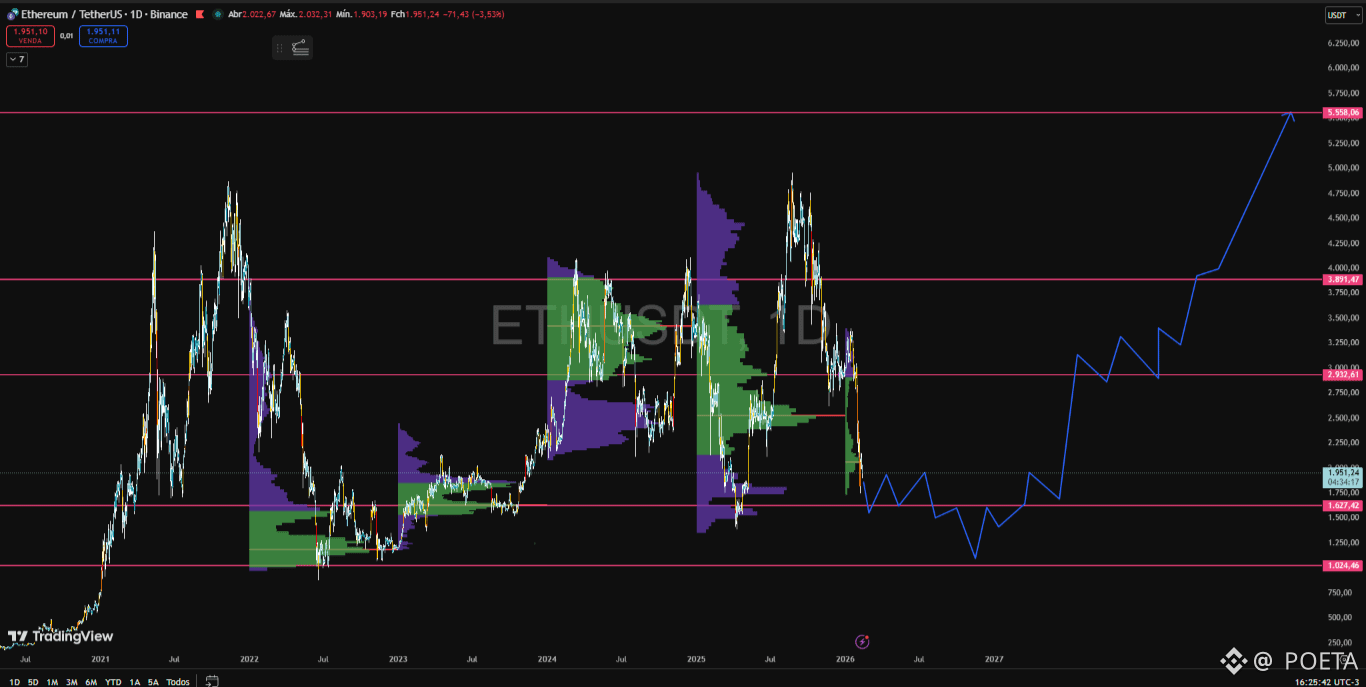
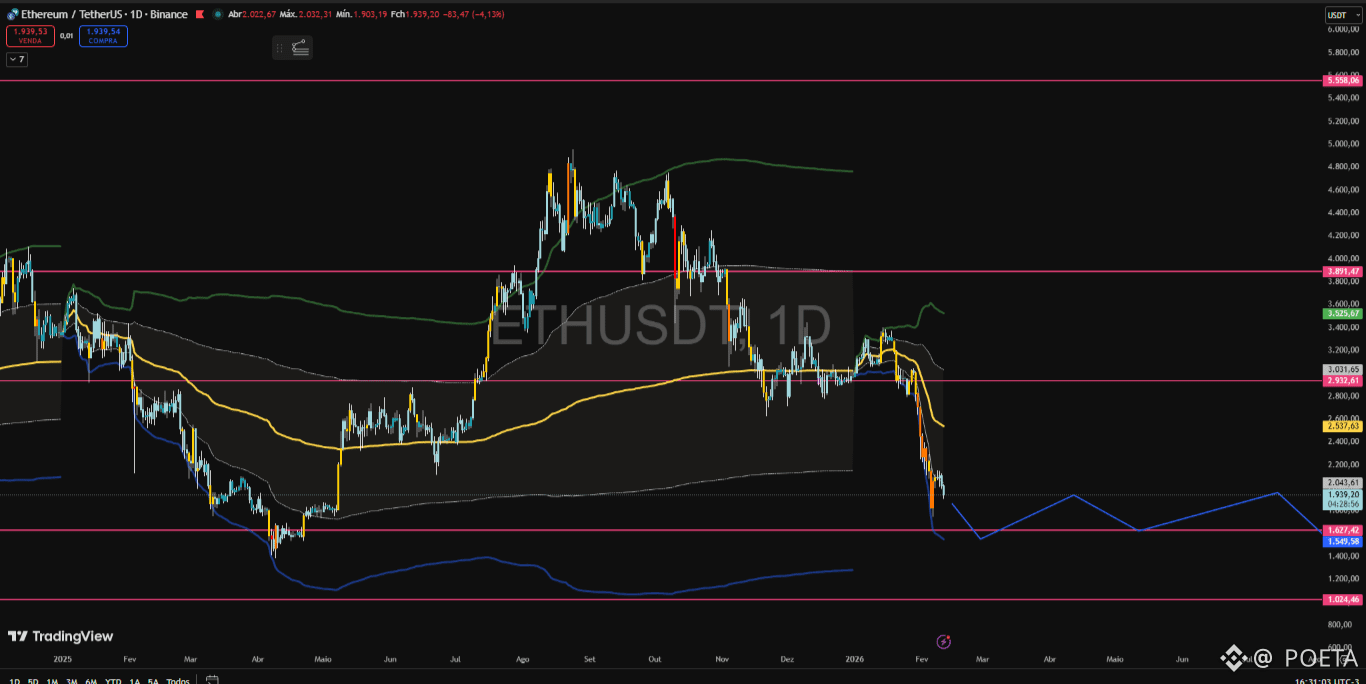
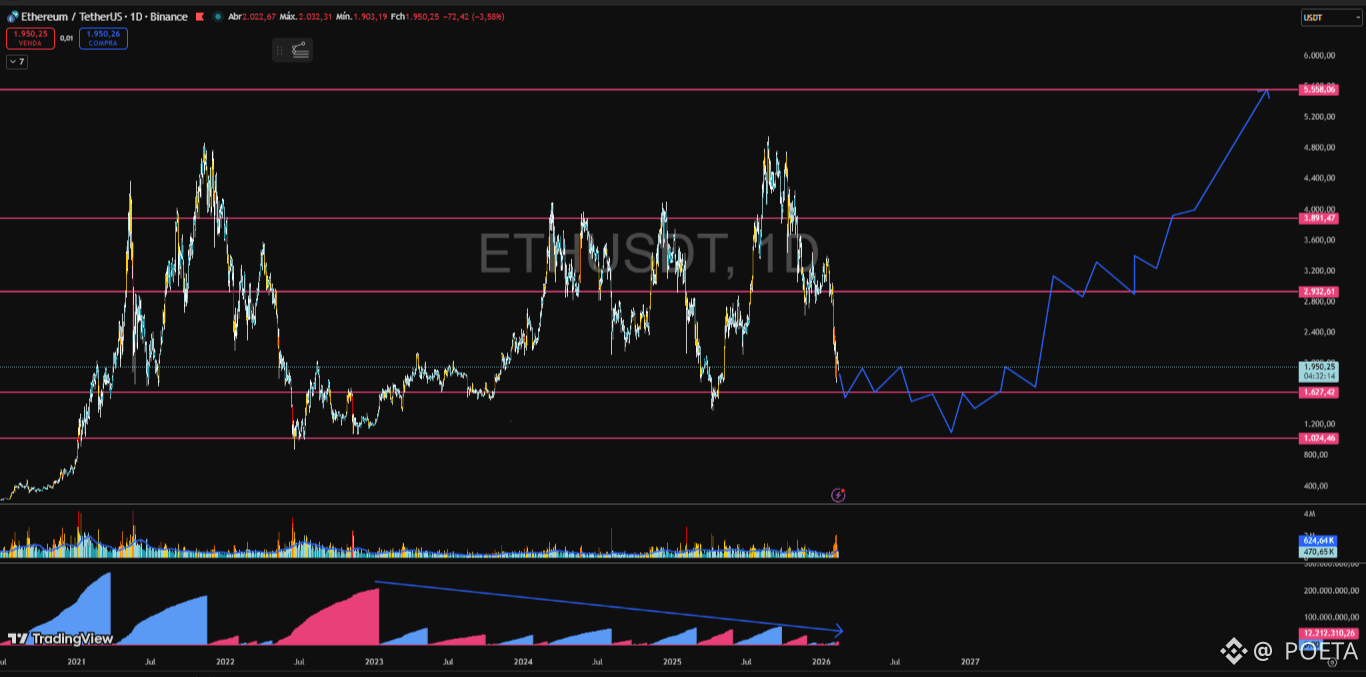
In the daily chart of ETHUSDT, the structure remains bearish after the consistent loss of the 2.932 region, which now acts as relevant resistance, maintaining the sequence of lower highs and lows and control in the hands of sellers; the range between 1.950 and 1.670 sets a decisive intermediate support, with 1.670 being a critical level that, if lost with acceptance below, could open space for acceleration down to 1.200–1.050 and even macro support at 1.024, while the volume profile reinforces a strong supply zone between 2.800 and 3.200, hindering immediate recoveries; the bullish projection up to 3.891 and subsequently 5.558 is structurally plausible within the historical context of the asset, but it depends on a consistent recovery above 2.932 with increased volume and, mainly, a clear break of the bearish structure on the daily, as only above 3.891 would the technical path become freer for expansion, maintaining, until then, a predominant corrective bias to bearish. The last projection would be near 5.500, but not so soon, perhaps by the end of the year this may happen.
#ETH
In the daily chart of ETHUSDT, the structure remains bearish after the consistent loss of the 2.932 region, which now acts as relevant resistance, maintaining the sequence of lower highs and lows and control in the hands of sellers; the range between 1.950 and 1.670 sets a decisive intermediate support, with 1.670 being a critical level that, if lost with acceptance below, could open space for acceleration down to 1.200–1.050 and even macro support at 1.024, while the volume profile reinforces a strong supply zone between 2.800 and 3.200, hindering immediate recoveries; the bullish projection up to 3.891 and subsequently 5.558 is structurally plausible within the historical context of the asset, but it depends on a consistent recovery above 2.932 with increased volume and, mainly, a clear break of the bearish structure on the daily, as only above 3.891 would the technical path become freer for expansion, maintaining, until then, a predominant corrective bias to bearish. The last projection would be near 5.500, but not so soon, perhaps by the end of the year this may happen.
In the daily chart of ETHUSDT, the structure remains bearish after the consistent loss of the 2.932 region, which now acts as relevant resistance, maintaining the sequence of lower highs and lows and control in the hands of sellers; the range between 1.950 and 1.670 sets a decisive intermediate support, with 1.670 being a critical level that, if lost with acceptance below, could open space for acceleration down to 1.200–1.050 and even macro support at 1.024, while the volume profile reinforces a strong supply zone between 2.800 and 3.200, hindering immediate recoveries; the bullish projection up to 3.891 and subsequently 5.558 is structurally plausible within the historical context of the asset, but it depends on a consistent recovery above 2.932 with increased volume and, mainly, a clear break of the bearish structure on the daily, as only above 3.891 would the technical path become freer for expansion, maintaining, until then, a predominant corrective bias to bearish. The last projection would be near 5.500, but not so soon, perhaps by the end of the year this may happen.
102
·
--
#BTC
More or less, this is what I think!
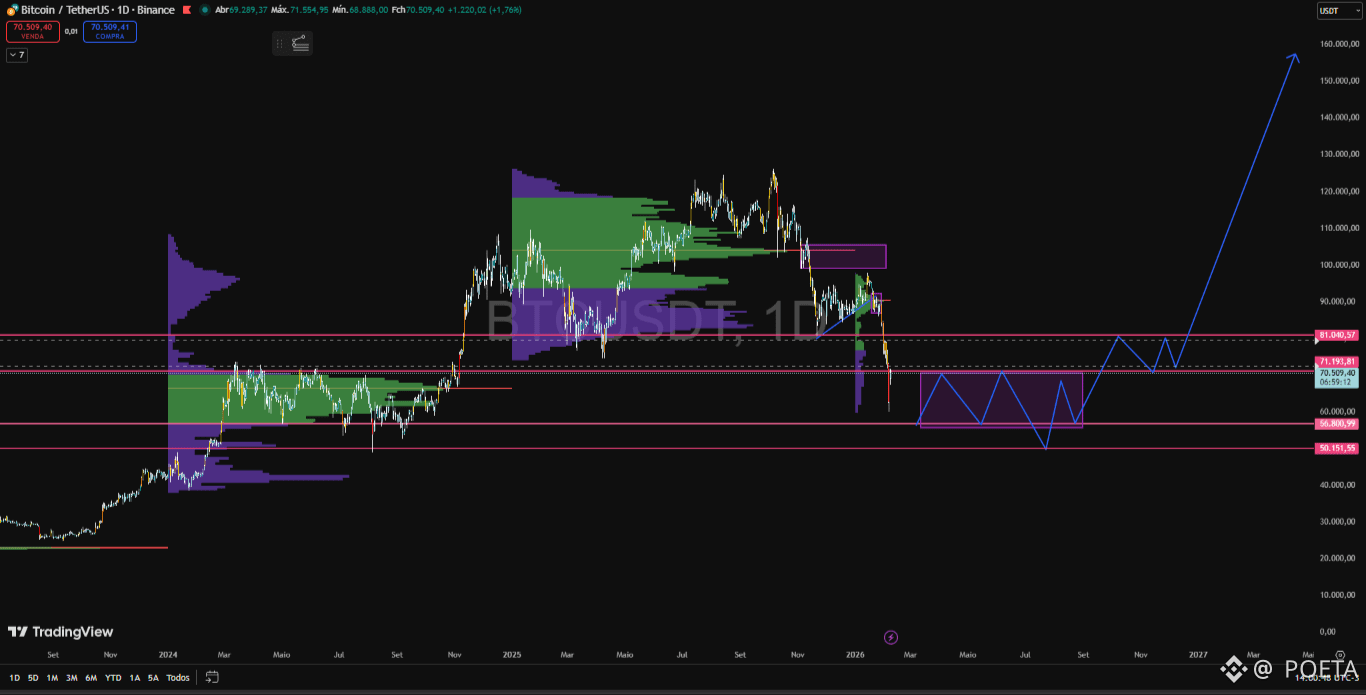
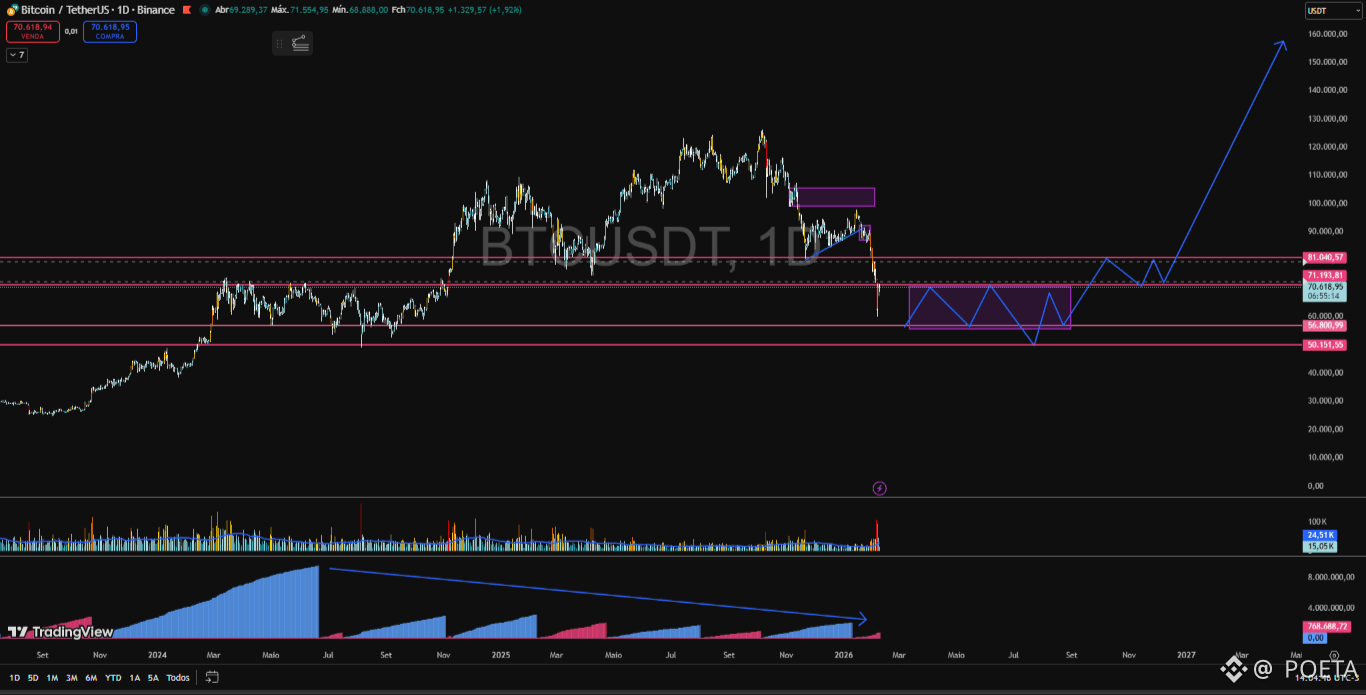
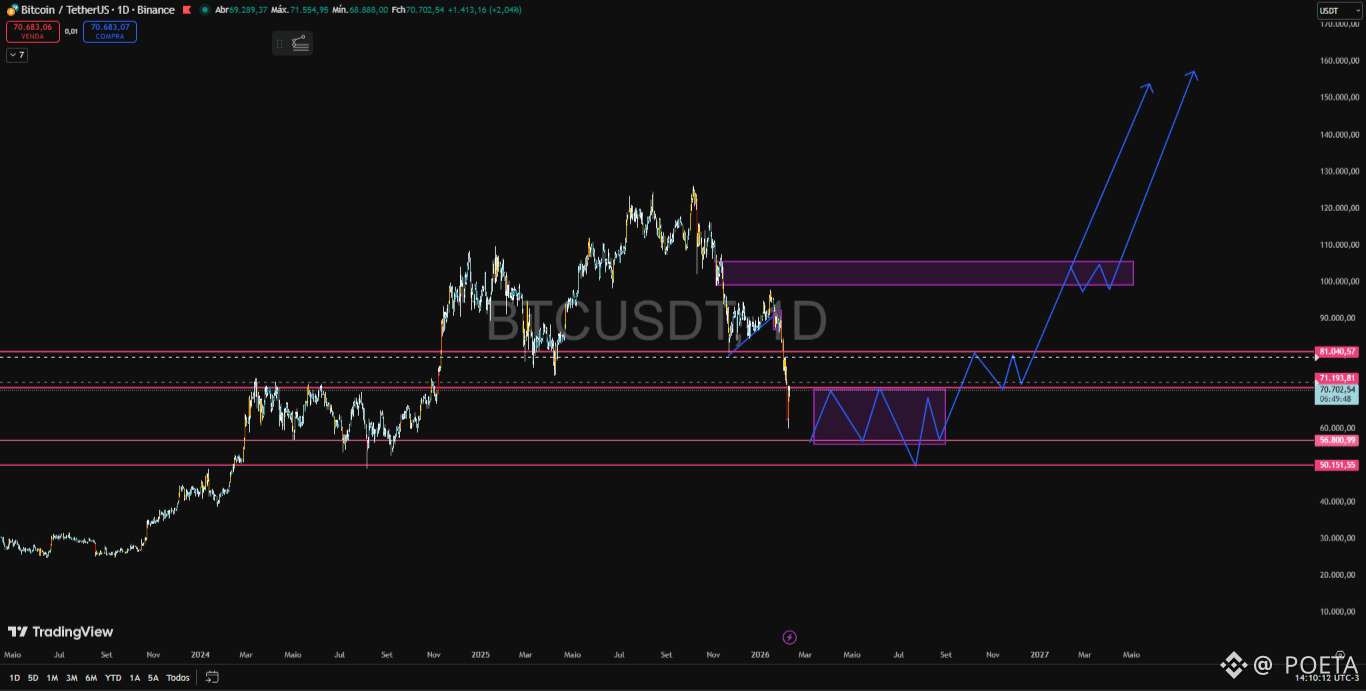
BTC lost the value range between 70–72k after a consistent rejection in the supply zone between 95–100k, which shifts the context to a corrective phase characterized more by broad consolidation than by immediate directional decline; in this scenario, the range between 56–60k emerges as the main price absorption area, with a likelihood of sideways movements and liquidity sweeps, and an extension to 50–52k is not ruled out before a more significant reaction, while the structural resumption of the rise is only strengthened by reclaiming and accepting above 72–75k and subsequently transforming the 81k region into support, a necessary condition for the market to return to working on longer projections towards 140–160k throughout the cycle.
Well, I hope that the critics on duty can contribute with their charts or arguments about this. Here, my intent is to share what I think in particular, in order to illustrate how it will be in the coming months of this year 2026, so please be sensible about my point of view.
#BTC
More or less, this is what I think!
BTC lost the value range between 70–72k after a consistent rejection in the supply zone between 95–100k, which shifts the context to a corrective phase characterized more by broad consolidation than by immediate directional decline; in this scenario, the range between 56–60k emerges as the main price absorption area, with a likelihood of sideways movements and liquidity sweeps, and an extension to 50–52k is not ruled out before a more significant reaction, while the structural resumption of the rise is only strengthened by reclaiming and accepting above 72–75k and subsequently transforming the 81k region into support, a necessary condition for the market to return to working on longer projections towards 140–160k throughout the cycle.
Well, I hope that the critics on duty can contribute with their charts or arguments about this. Here, my intent is to share what I think in particular, in order to illustrate how it will be in the coming months of this year 2026, so please be sensible about my point of view.
More or less, this is what I think!
BTC lost the value range between 70–72k after a consistent rejection in the supply zone between 95–100k, which shifts the context to a corrective phase characterized more by broad consolidation than by immediate directional decline; in this scenario, the range between 56–60k emerges as the main price absorption area, with a likelihood of sideways movements and liquidity sweeps, and an extension to 50–52k is not ruled out before a more significant reaction, while the structural resumption of the rise is only strengthened by reclaiming and accepting above 72–75k and subsequently transforming the 81k region into support, a necessary condition for the market to return to working on longer projections towards 140–160k throughout the cycle.
Well, I hope that the critics on duty can contribute with their charts or arguments about this. Here, my intent is to share what I think in particular, in order to illustrate how it will be in the coming months of this year 2026, so please be sensible about my point of view.
2
1
906
·
--
#BTC
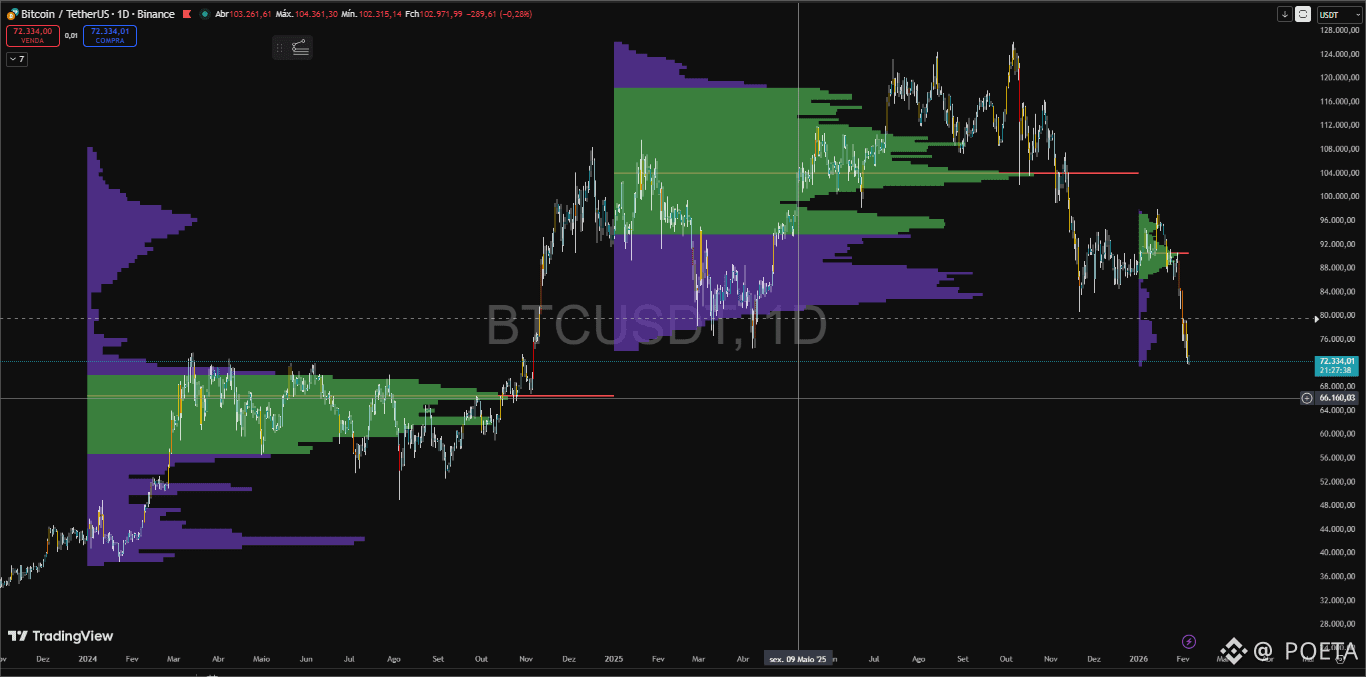
No BTC/USDT (1D), the price underwent a strong correction after losing the large value area between 98,000–104,000, a region that previously supported market equilibrium and now acts as relevant resistance. The breakdown of this range triggered selling acceleration, driving the price directly to lower volume zones, where the movement tends to be faster. Currently, the market is operating near the region of 72,000–74,000, which coincides with technical support and a previous reaction area, making this level crucial to determine whether there will be just a deeper correction or a more prolonged structural change.
If the 72,000 region is lost with acceptance, the price tends to seek the next important zone at 66,000–64,000, where there is a historical concentration of volume and old market equilibrium, functioning as a more robust support. On the upside, any attempt at recovery faces immediate resistance at 78,000–80,000 and, above that, the range of 88,000–92,000 appears as a critical rejection zone, as it was a recent consolidation area before the last leg down. As long as the price remains below these upper regions, the bias remains defensive, with the market prioritizing the search for liquidity at lower levels.
#BTC
No BTC/USDT (1D), the price underwent a strong correction after losing the large value area between 98,000–104,000, a region that previously supported market equilibrium and now acts as relevant resistance. The breakdown of this range triggered selling acceleration, driving the price directly to lower volume zones, where the movement tends to be faster. Currently, the market is operating near the region of 72,000–74,000, which coincides with technical support and a previous reaction area, making this level crucial to determine whether there will be just a deeper correction or a more prolonged structural change.
If the 72,000 region is lost with acceptance, the price tends to seek the next important zone at 66,000–64,000, where there is a historical concentration of volume and old market equilibrium, functioning as a more robust support. On the upside, any attempt at recovery faces immediate resistance at 78,000–80,000 and, above that, the range of 88,000–92,000 appears as a critical rejection zone, as it was a recent consolidation area before the last leg down. As long as the price remains below these upper regions, the bias remains defensive, with the market prioritizing the search for liquidity at lower levels.
No BTC/USDT (1D), the price underwent a strong correction after losing the large value area between 98,000–104,000, a region that previously supported market equilibrium and now acts as relevant resistance. The breakdown of this range triggered selling acceleration, driving the price directly to lower volume zones, where the movement tends to be faster. Currently, the market is operating near the region of 72,000–74,000, which coincides with technical support and a previous reaction area, making this level crucial to determine whether there will be just a deeper correction or a more prolonged structural change.
If the 72,000 region is lost with acceptance, the price tends to seek the next important zone at 66,000–64,000, where there is a historical concentration of volume and old market equilibrium, functioning as a more robust support. On the upside, any attempt at recovery faces immediate resistance at 78,000–80,000 and, above that, the range of 88,000–92,000 appears as a critical rejection zone, as it was a recent consolidation area before the last leg down. As long as the price remains below these upper regions, the bias remains defensive, with the market prioritizing the search for liquidity at lower levels.
69
·
--
#STX
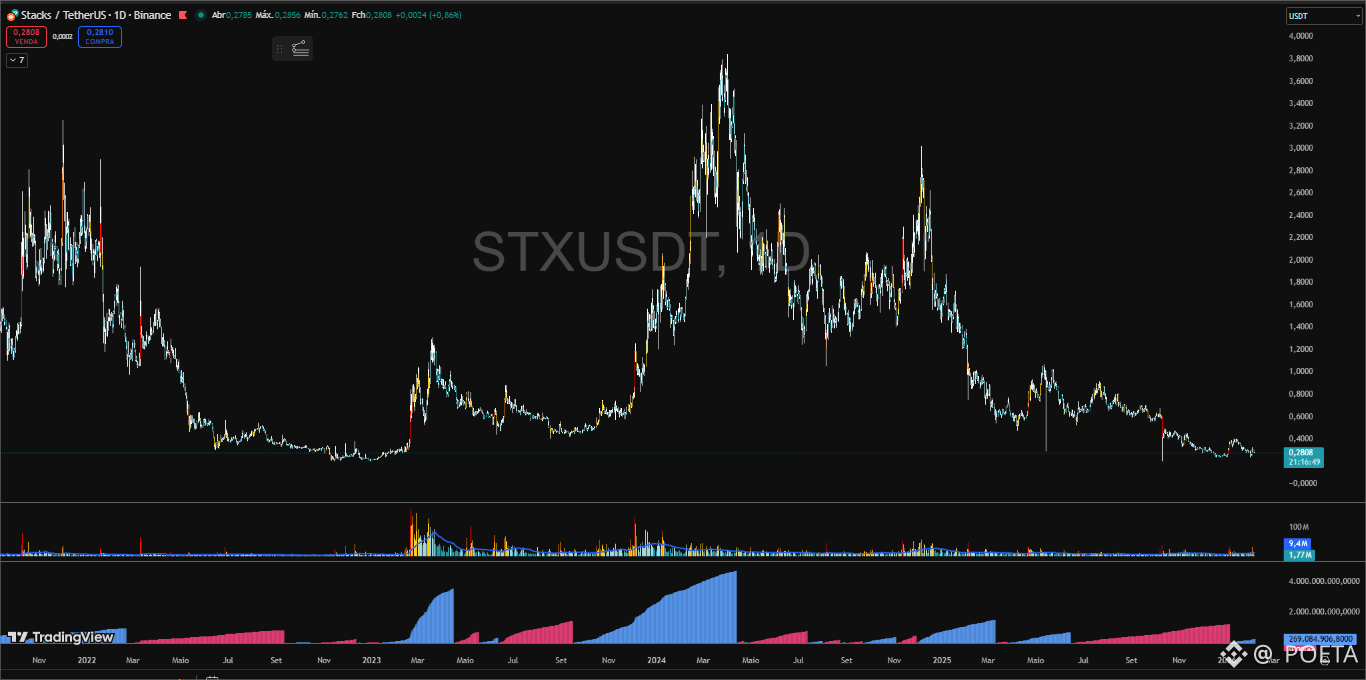
STX/USDT (1D): the asset maintains a strong bearish structure, with lower highs and lower lows and a lack of significant demand in the current movement. The region between 0.34–0.32 tends to be tested as the next support zone and, if there is no consistent reaction, the price may extend the decline to 0.28–0.26, where the last visible consolidation level exists. To the upside, any corrective bounce tends to encounter resistance already at 0.40–0.45, maintaining the predominantly selling bias while below these ranges.
#STX
STX/USDT (1D): the asset maintains a strong bearish structure, with lower highs and lower lows and a lack of significant demand in the current movement. The region between 0.34–0.32 tends to be tested as the next support zone and, if there is no consistent reaction, the price may extend the decline to 0.28–0.26, where the last visible consolidation level exists. To the upside, any corrective bounce tends to encounter resistance already at 0.40–0.45, maintaining the predominantly selling bias while below these ranges.
STX/USDT (1D): the asset maintains a strong bearish structure, with lower highs and lower lows and a lack of significant demand in the current movement. The region between 0.34–0.32 tends to be tested as the next support zone and, if there is no consistent reaction, the price may extend the decline to 0.28–0.26, where the last visible consolidation level exists. To the upside, any corrective bounce tends to encounter resistance already at 0.40–0.45, maintaining the predominantly selling bias while below these ranges.
101
·
--
#SOL
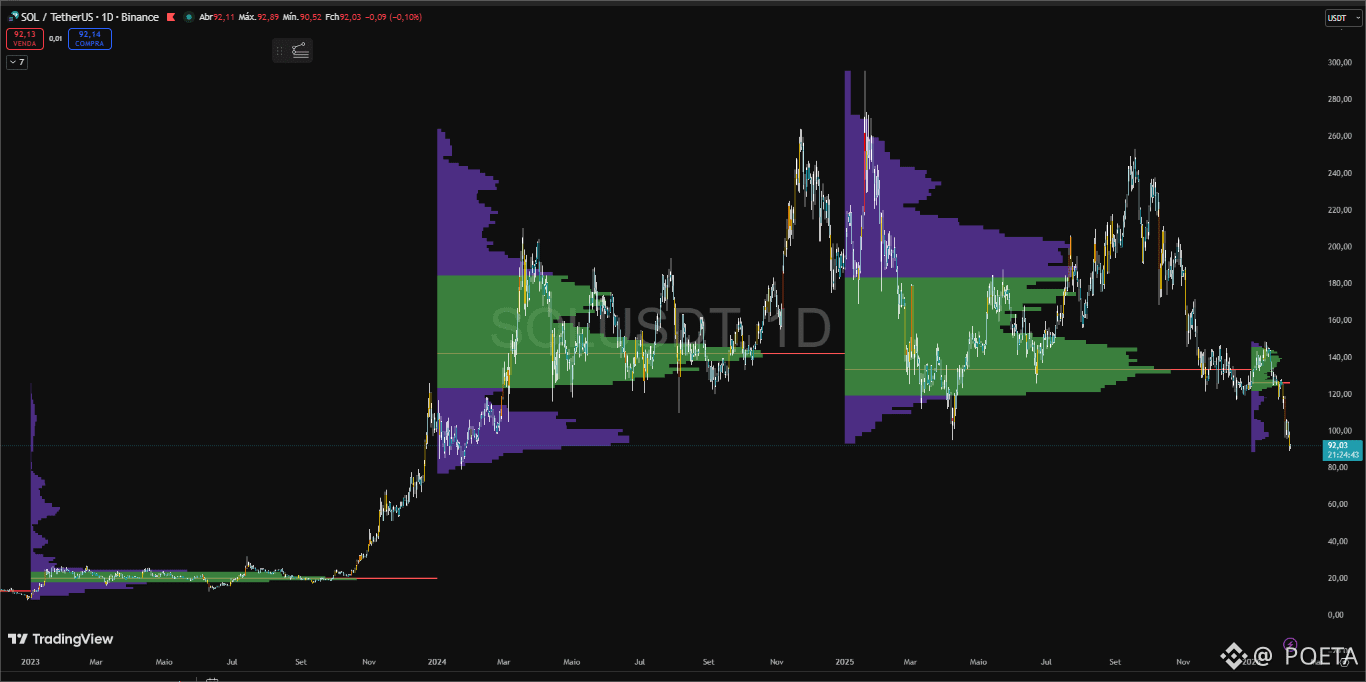
SOL/USDT (1D): the price is under pressure, but it is already close to a relevant demand zone between 95–90, which reduces the likelihood of a deeper drop without a reaction first. The nearest and most realistic resistance region is at 105–108, where there has been recent acceptance and volume, while the range of 115–120 becomes a more distant target dependent on continued buying. The scenario only gains a weaker bias if there is a clear loss of 90, which would open up space for 80–75 as the next equilibrium zone.
#SOL
SOL/USDT (1D): the price is under pressure, but it is already close to a relevant demand zone between 95–90, which reduces the likelihood of a deeper drop without a reaction first. The nearest and most realistic resistance region is at 105–108, where there has been recent acceptance and volume, while the range of 115–120 becomes a more distant target dependent on continued buying. The scenario only gains a weaker bias if there is a clear loss of 90, which would open up space for 80–75 as the next equilibrium zone.
SOL/USDT (1D): the price is under pressure, but it is already close to a relevant demand zone between 95–90, which reduces the likelihood of a deeper drop without a reaction first. The nearest and most realistic resistance region is at 105–108, where there has been recent acceptance and volume, while the range of 115–120 becomes a more distant target dependent on continued buying. The scenario only gains a weaker bias if there is a clear loss of 90, which would open up space for 80–75 as the next equilibrium zone.
430
·
--
#TRX
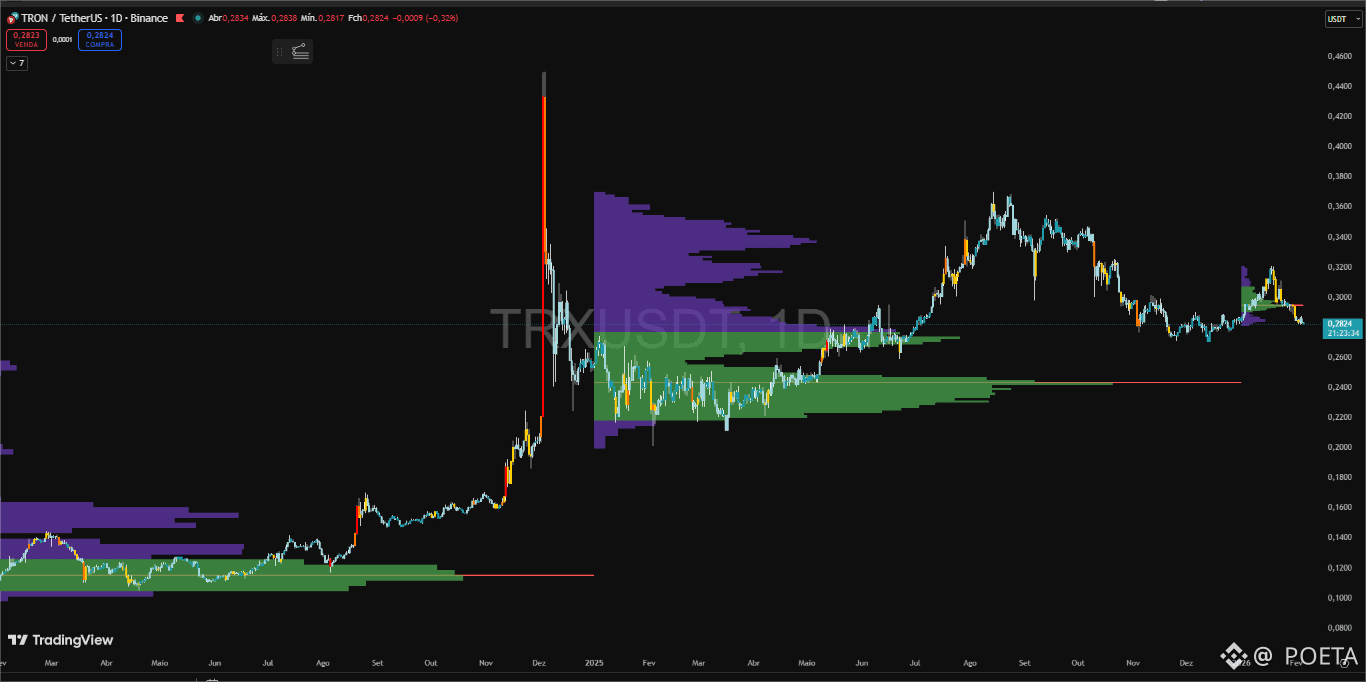
In TRX/USDT (1D), the price undergoes a moderate correction after a strong upward trend, remaining above the main older volume zones. The region between 0.28–0.27 acts as immediate support and, as long as it is defended, the market tends to continue consolidating. A clearer loss of this range may lead the price to seek the area of higher acceptance at 0.25–0.24. To the upside, any reactions encounter resistance at 0.30–0.32, and above that, the region of 0.34–0.36 becomes the main rejection point again.
#TRX
In TRX/USDT (1D), the price undergoes a moderate correction after a strong upward trend, remaining above the main older volume zones. The region between 0.28–0.27 acts as immediate support and, as long as it is defended, the market tends to continue consolidating. A clearer loss of this range may lead the price to seek the area of higher acceptance at 0.25–0.24. To the upside, any reactions encounter resistance at 0.30–0.32, and above that, the region of 0.34–0.36 becomes the main rejection point again.
In TRX/USDT (1D), the price undergoes a moderate correction after a strong upward trend, remaining above the main older volume zones. The region between 0.28–0.27 acts as immediate support and, as long as it is defended, the market tends to continue consolidating. A clearer loss of this range may lead the price to seek the area of higher acceptance at 0.25–0.24. To the upside, any reactions encounter resistance at 0.30–0.32, and above that, the region of 0.34–0.36 becomes the main rejection point again.
94
·
--
#BNB
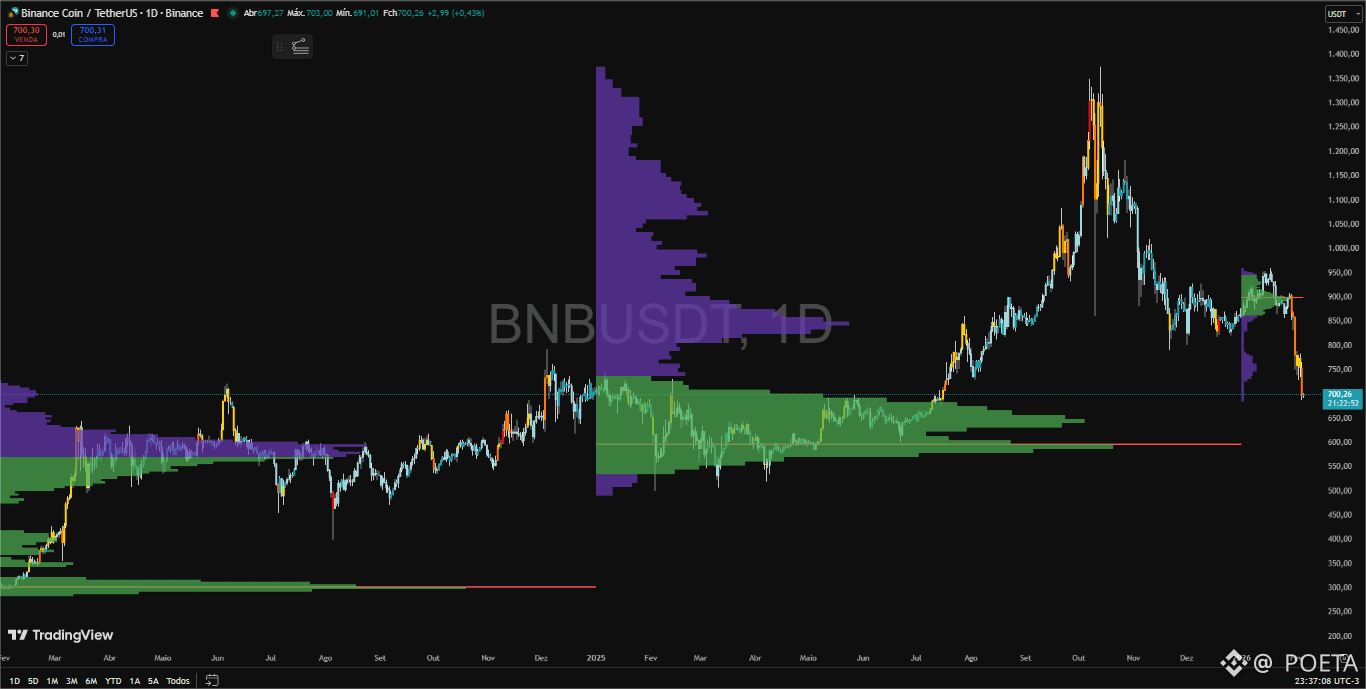
In the BNB/USDT (1D), the price comes from a strong correction after the peak and is now testing an important support area between 700–680, which coincides with a previous volume and defense zone. Losing this range could open up space for a more accelerated movement towards 640–620, where the next relevant area of balance exists. To the upside, any reaction tends to find resistance at 760–800, and only above this region would the price have room to seek again the range of 880–920, which was an old area of acceptance before the last rejection.
#BNB
In the BNB/USDT (1D), the price comes from a strong correction after the peak and is now testing an important support area between 700–680, which coincides with a previous volume and defense zone. Losing this range could open up space for a more accelerated movement towards 640–620, where the next relevant area of balance exists. To the upside, any reaction tends to find resistance at 760–800, and only above this region would the price have room to seek again the range of 880–920, which was an old area of acceptance before the last rejection.
In the BNB/USDT (1D), the price comes from a strong correction after the peak and is now testing an important support area between 700–680, which coincides with a previous volume and defense zone. Losing this range could open up space for a more accelerated movement towards 640–620, where the next relevant area of balance exists. To the upside, any reaction tends to find resistance at 760–800, and only above this region would the price have room to seek again the range of 880–920, which was an old area of acceptance before the last rejection.
73
·
--
#XRP
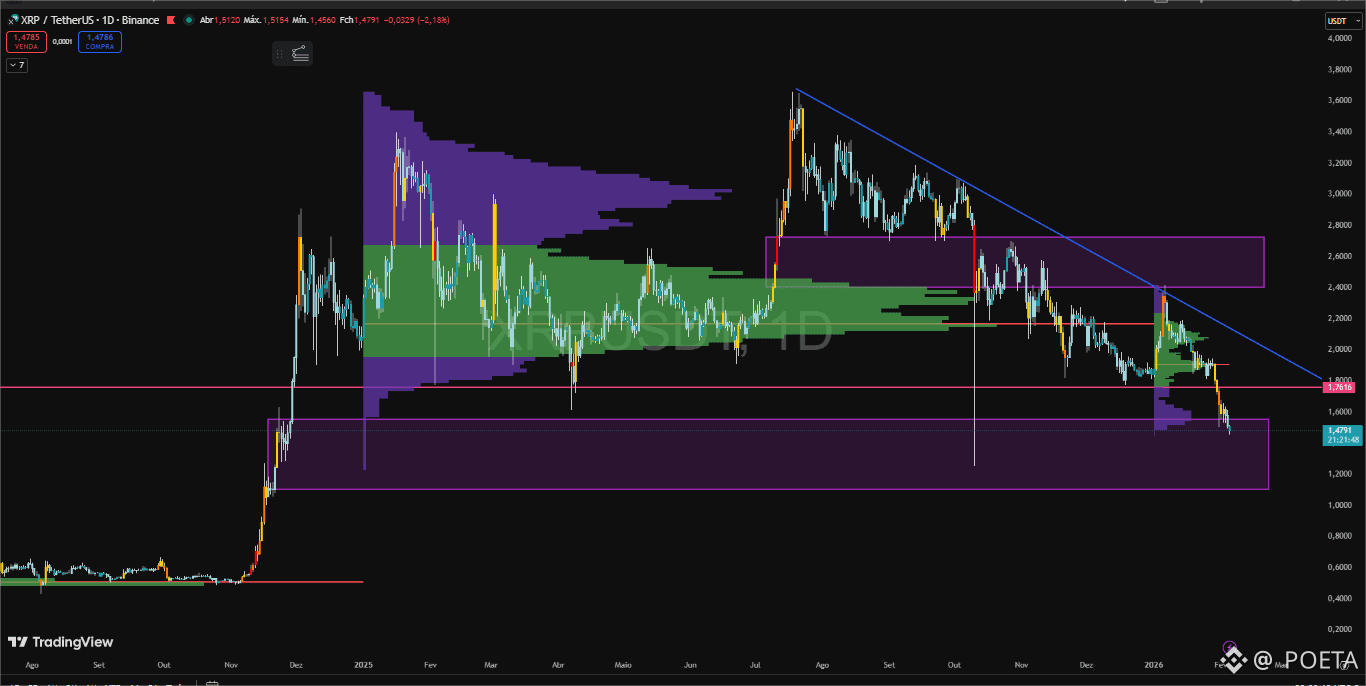
XRP/USDT (1D), although the structure is still descending, the price is approaching a relevant demand zone between 1.50–1.40, where there was previous defense and presence of volume. From this region, it makes sense to expect a reaction movement that could first target 1.90–2.00 and, maintaining acceptance above these ranges, return to the region of 2.30–2.40, which coincides with an old area of value and important resistance. The scenario only weakens if the price decisively breaks the zone of 1.40–1.30, which would open up space for lower levels.
#XRP
XRP/USDT (1D), although the structure is still descending, the price is approaching a relevant demand zone between 1.50–1.40, where there was previous defense and presence of volume. From this region, it makes sense to expect a reaction movement that could first target 1.90–2.00 and, maintaining acceptance above these ranges, return to the region of 2.30–2.40, which coincides with an old area of value and important resistance. The scenario only weakens if the price decisively breaks the zone of 1.40–1.30, which would open up space for lower levels.
XRP/USDT (1D), although the structure is still descending, the price is approaching a relevant demand zone between 1.50–1.40, where there was previous defense and presence of volume. From this region, it makes sense to expect a reaction movement that could first target 1.90–2.00 and, maintaining acceptance above these ranges, return to the region of 2.30–2.40, which coincides with an old area of value and important resistance. The scenario only weakens if the price decisively breaks the zone of 1.40–1.30, which would open up space for lower levels.
7
5
1
1.3k
·
--
#ZEC
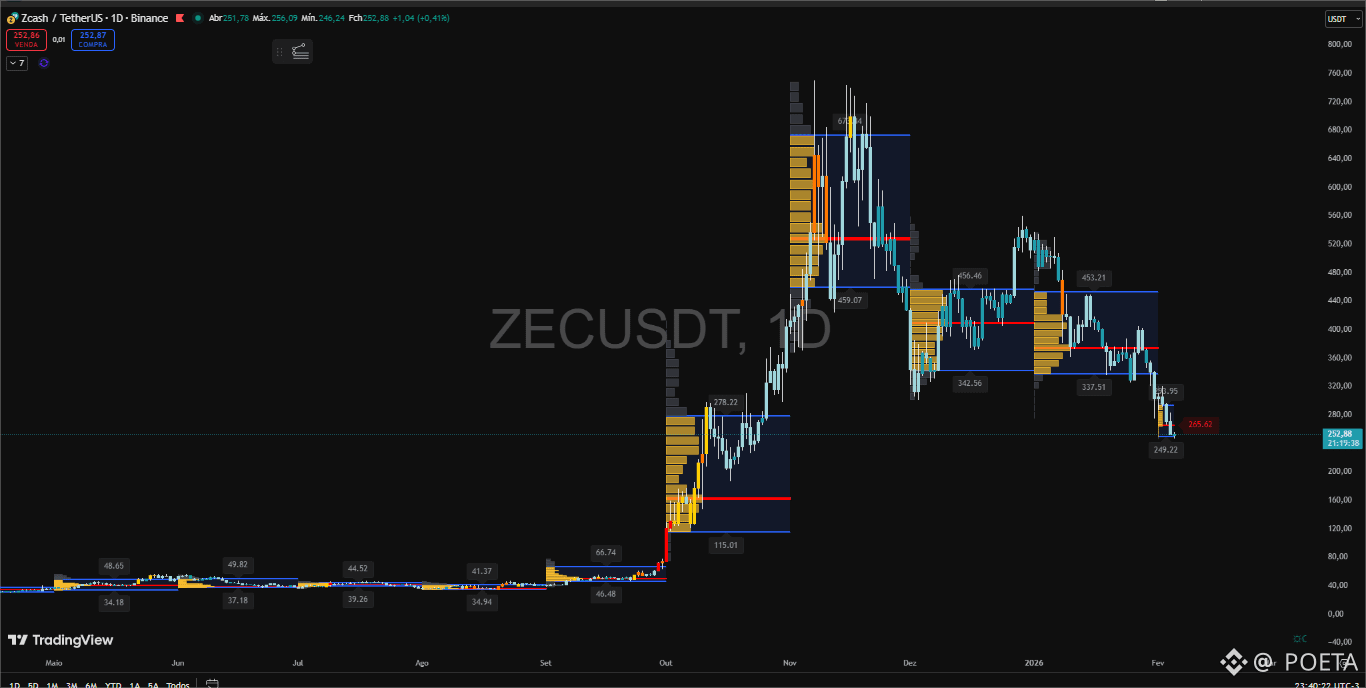
No ZEC/USDT (1D), the price continues in corrective movement after strong expansion, trading below the recent major value areas, which indicates a loss of acceptance at higher levels. The region between 260–250 acts as immediate support, and losing this range may lead the price to seek lower levels at 220–200, where there is a history of previous balance. Upward, any bounce tends to face relevant resistance at 300–320, and above that, the zone between 360–400 remains the main area of selling rejection.
#ZEC
No ZEC/USDT (1D), the price continues in corrective movement after strong expansion, trading below the recent major value areas, which indicates a loss of acceptance at higher levels. The region between 260–250 acts as immediate support, and losing this range may lead the price to seek lower levels at 220–200, where there is a history of previous balance. Upward, any bounce tends to face relevant resistance at 300–320, and above that, the zone between 360–400 remains the main area of selling rejection.
No ZEC/USDT (1D), the price continues in corrective movement after strong expansion, trading below the recent major value areas, which indicates a loss of acceptance at higher levels. The region between 260–250 acts as immediate support, and losing this range may lead the price to seek lower levels at 220–200, where there is a history of previous balance. Upward, any bounce tends to face relevant resistance at 300–320, and above that, the zone between 360–400 remains the main area of selling rejection.
95
·
--
#ADA
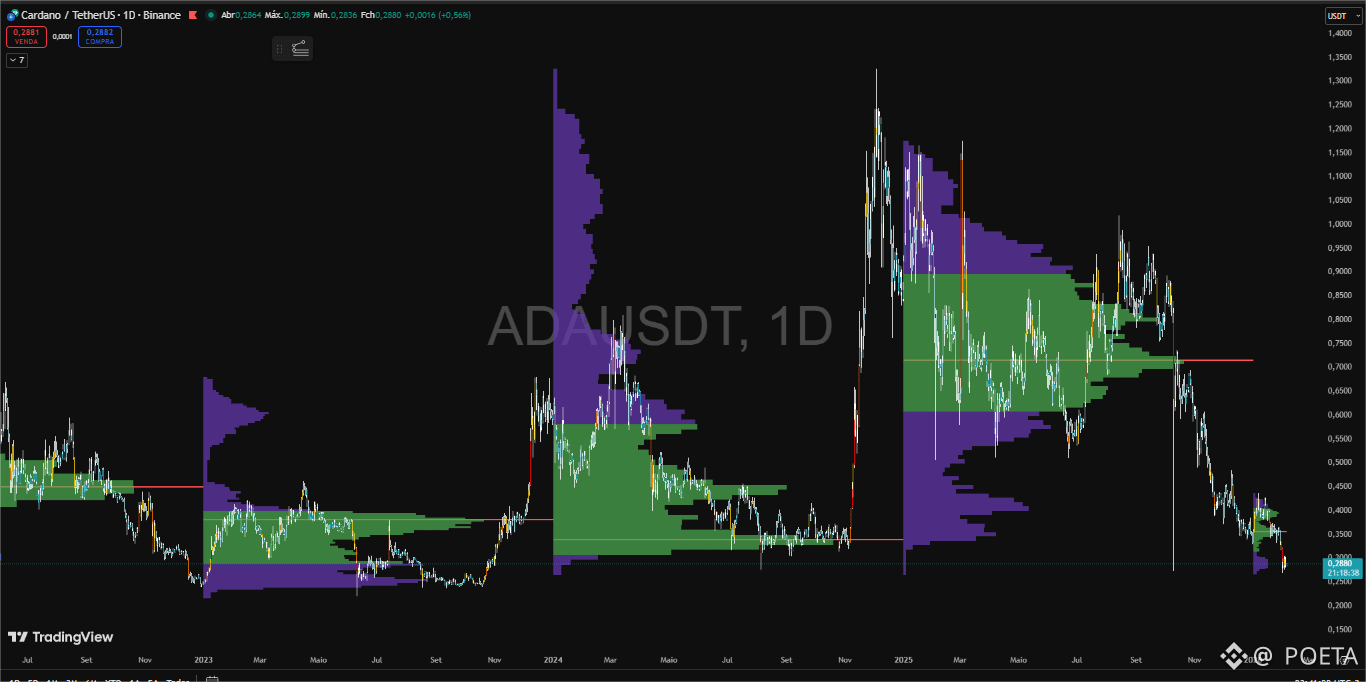
No ADA/USDT (1D), the price continues in a downtrend, trading below the main value areas. The region between 0.34–0.36 appears as immediate support, while a clearer loss of this level may lead the price to seek lower zones at 0.30–0.28, which are areas of low volume and possible acceleration of movement. To the upside, any reaction tends to face relevant resistance at 0.40–0.43, an old acceptance area that now acts as a rejection zone.
#ADA
No ADA/USDT (1D), the price continues in a downtrend, trading below the main value areas. The region between 0.34–0.36 appears as immediate support, while a clearer loss of this level may lead the price to seek lower zones at 0.30–0.28, which are areas of low volume and possible acceleration of movement. To the upside, any reaction tends to face relevant resistance at 0.40–0.43, an old acceptance area that now acts as a rejection zone.
No ADA/USDT (1D), the price continues in a downtrend, trading below the main value areas. The region between 0.34–0.36 appears as immediate support, while a clearer loss of this level may lead the price to seek lower zones at 0.30–0.28, which are areas of low volume and possible acceleration of movement. To the upside, any reaction tends to face relevant resistance at 0.40–0.43, an old acceptance area that now acts as a rejection zone.
135
·
--
#CHZ
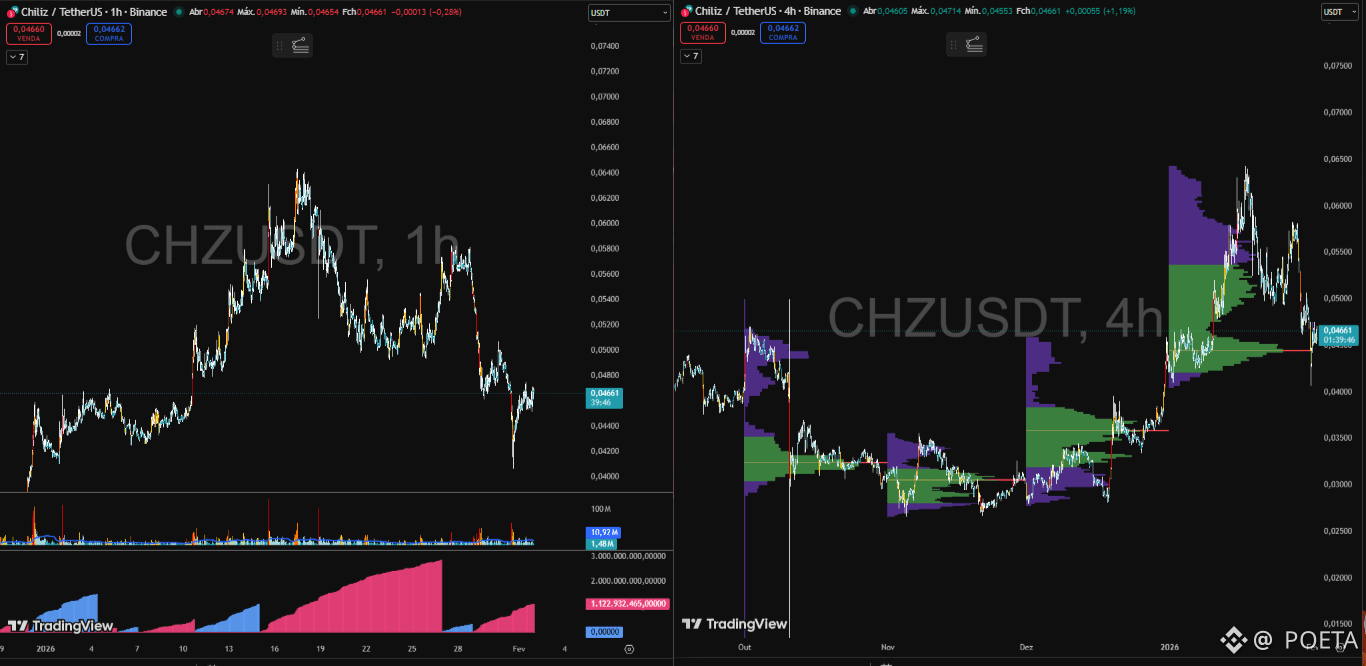
Based on the 1h and 4h charts of CHZ/USDT, the asset is in a correction phase after a significant rally, approaching a crucial support region around 0.0460, where the 4h chart volume indicates a strong concentration of trades (POC - Point of Control). In the short term, the best region for tactical purchases is between 0.0445 and 0.0460, taking advantage of the buyer defense in this value zone to seek a technical rebound; on the other hand, the region from 0.0520 to 0.0540 acts as the most relevant immediate resistance, being the ideal zone for profit-taking or caution, as the price has shown exhaustion and selling pressure upon reaching these levels recently.
Will COPA 2026 save the liquidity of this cryptocurrency?
#CHZ
Based on the 1h and 4h charts of CHZ/USDT, the asset is in a correction phase after a significant rally, approaching a crucial support region around 0.0460, where the 4h chart volume indicates a strong concentration of trades (POC - Point of Control). In the short term, the best region for tactical purchases is between 0.0445 and 0.0460, taking advantage of the buyer defense in this value zone to seek a technical rebound; on the other hand, the region from 0.0520 to 0.0540 acts as the most relevant immediate resistance, being the ideal zone for profit-taking or caution, as the price has shown exhaustion and selling pressure upon reaching these levels recently.
Will COPA 2026 save the liquidity of this cryptocurrency?
Based on the 1h and 4h charts of CHZ/USDT, the asset is in a correction phase after a significant rally, approaching a crucial support region around 0.0460, where the 4h chart volume indicates a strong concentration of trades (POC - Point of Control). In the short term, the best region for tactical purchases is between 0.0445 and 0.0460, taking advantage of the buyer defense in this value zone to seek a technical rebound; on the other hand, the region from 0.0520 to 0.0540 acts as the most relevant immediate resistance, being the ideal zone for profit-taking or caution, as the price has shown exhaustion and selling pressure upon reaching these levels recently.
Will COPA 2026 save the liquidity of this cryptocurrency?
97
·
--
Bearish
#TA
Will it be a good opportunity for selling?
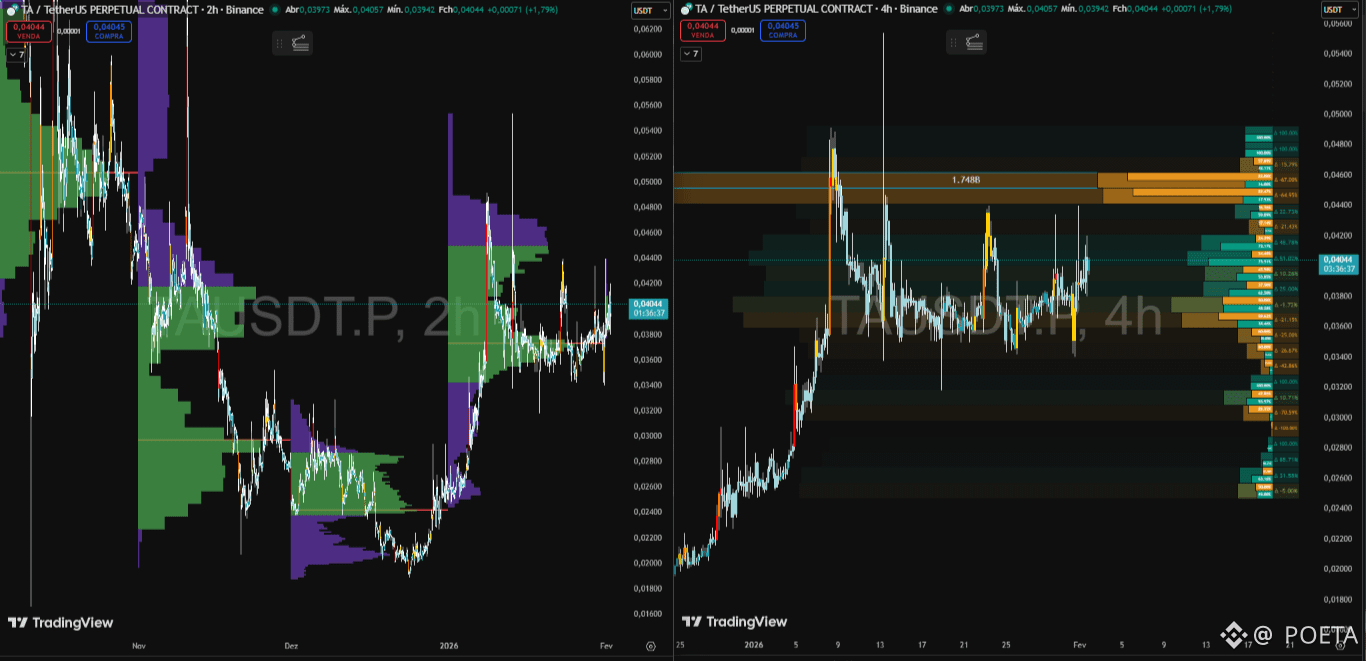
Let's see. I will wait for it to reach 0.039–0.040 → weak or 0.043–0.046 → strong
#TA
Will it be a good opportunity for selling?
Let's see. I will wait for it to reach 0.039–0.040 → weak or 0.043–0.046 → strong
Will it be a good opportunity for selling?
Let's see. I will wait for it to reach 0.039–0.040 → weak or 0.043–0.046 → strong
138
·
--
#BTC
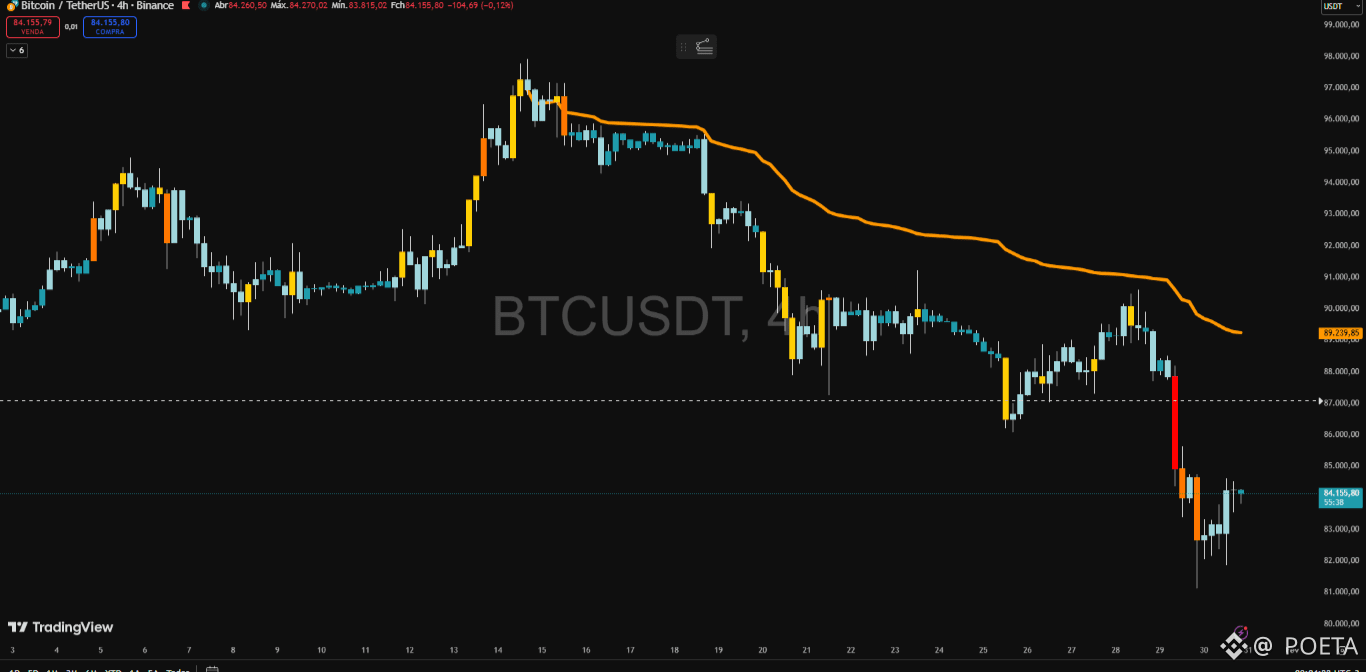
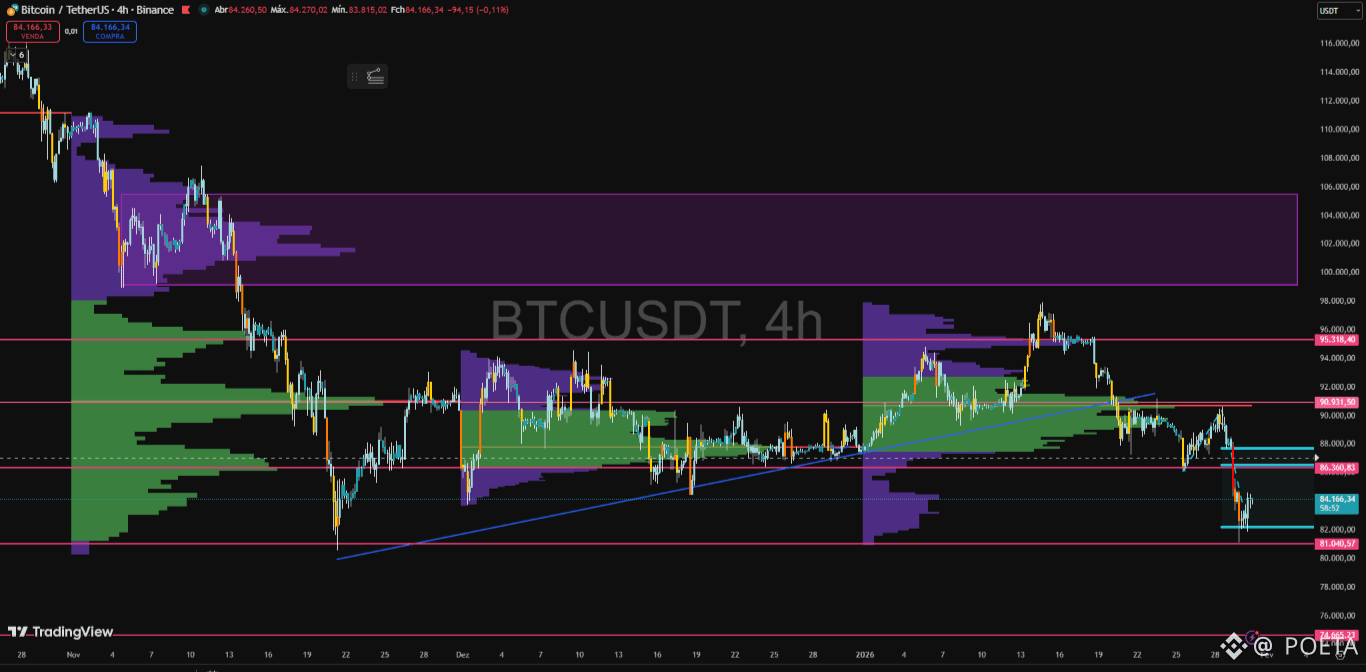
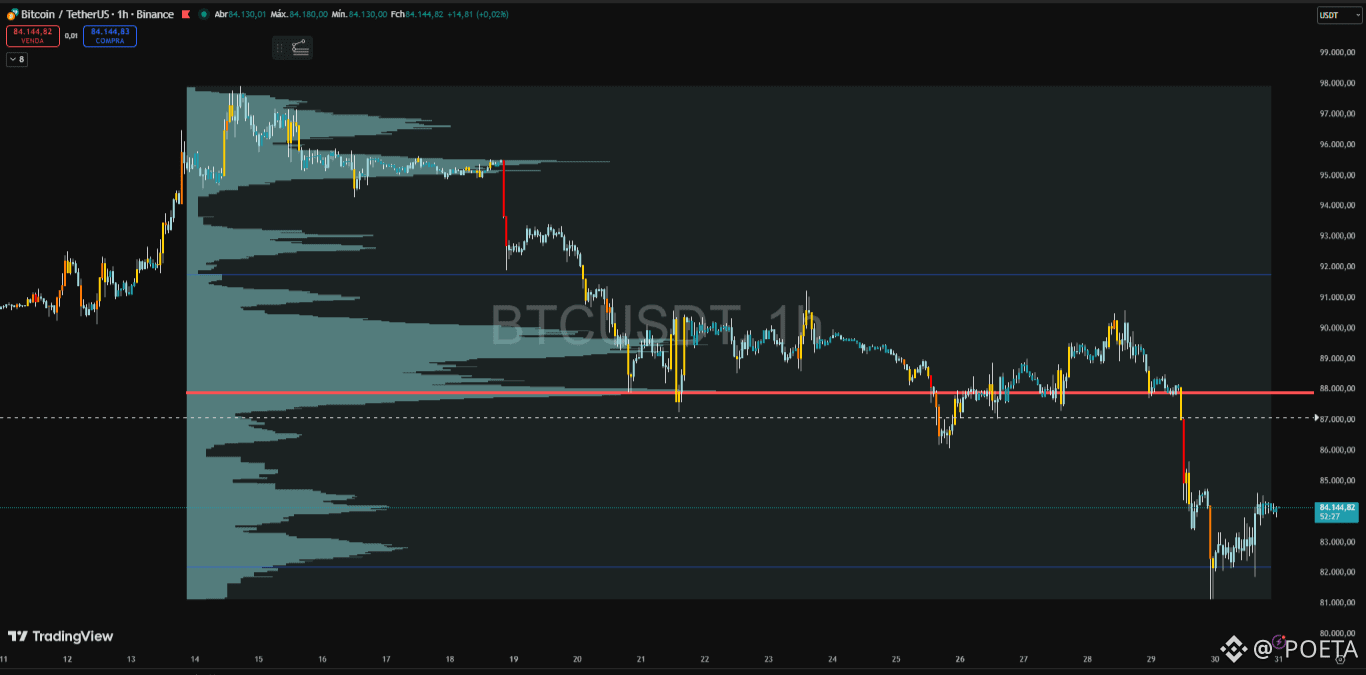
If the price can hold in the current region, it is possible that it will first target the range between 85,800 and 86,800, where there has already been a recent reaction. Above that, the region between 88,000 and 89,200 is likely to create difficulty, as it concentrates a large volume traded previously and now acts as a rejection zone. A consistent return and acceptance above this range would reduce selling pressure in the short term.
If the current region fails, the most likely movement occurs towards the range between 82,500 and 83,500, where there are previous defense references. Below this, the region between 80,500 and 81,000 becomes a critical level, as it marks an area where the market has already rejected lower prices. Acceptance below these levels would indicate a continuation of weakness and a lack of value reconstruction in the short term.
#BTC
If the price can hold in the current region, it is possible that it will first target the range between 85,800 and 86,800, where there has already been a recent reaction. Above that, the region between 88,000 and 89,200 is likely to create difficulty, as it concentrates a large volume traded previously and now acts as a rejection zone. A consistent return and acceptance above this range would reduce selling pressure in the short term.
If the current region fails, the most likely movement occurs towards the range between 82,500 and 83,500, where there are previous defense references. Below this, the region between 80,500 and 81,000 becomes a critical level, as it marks an area where the market has already rejected lower prices. Acceptance below these levels would indicate a continuation of weakness and a lack of value reconstruction in the short term.
If the price can hold in the current region, it is possible that it will first target the range between 85,800 and 86,800, where there has already been a recent reaction. Above that, the region between 88,000 and 89,200 is likely to create difficulty, as it concentrates a large volume traded previously and now acts as a rejection zone. A consistent return and acceptance above this range would reduce selling pressure in the short term.
If the current region fails, the most likely movement occurs towards the range between 82,500 and 83,500, where there are previous defense references. Below this, the region between 80,500 and 81,000 becomes a critical level, as it marks an area where the market has already rejected lower prices. Acceptance below these levels would indicate a continuation of weakness and a lack of value reconstruction in the short term.
77
·
--
#HOME
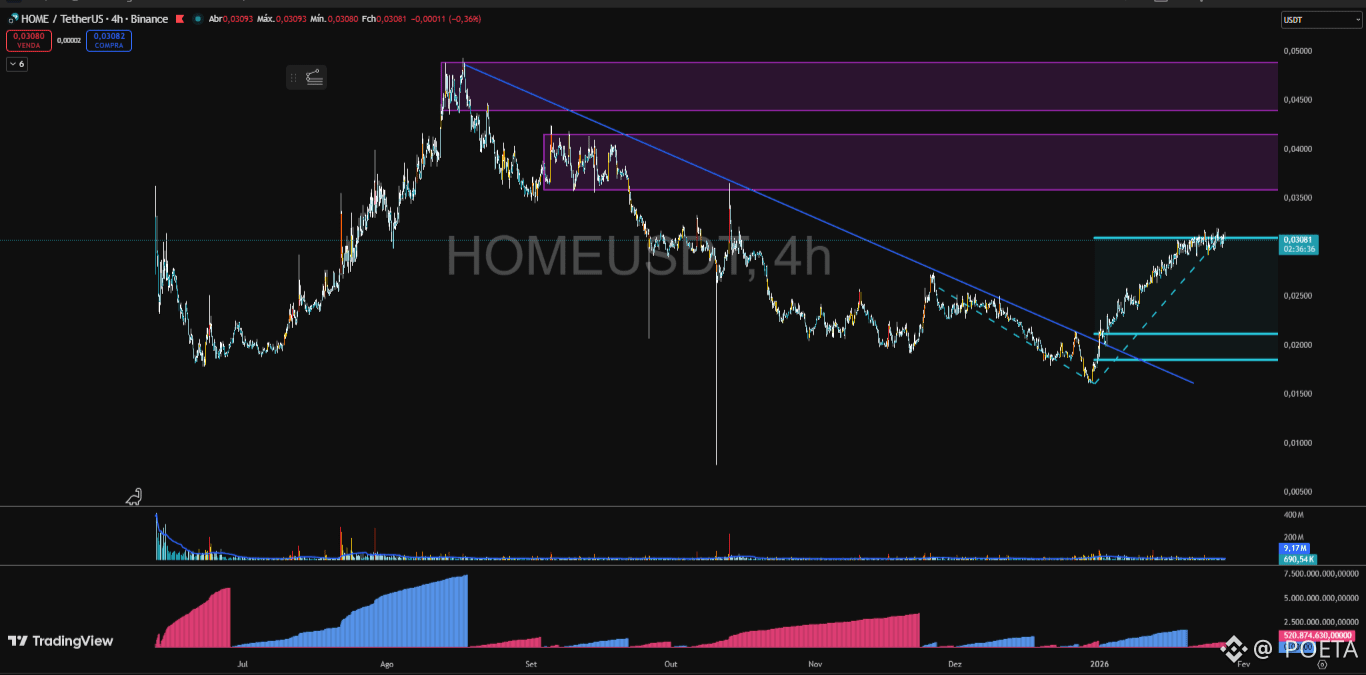
The HOME/USDT chart on the 4-hour time frame indicates a promising trend reversal after breaking a downtrend line (DTL) that had dominated the price for months. Recently, the asset established solid support in the 0.015 region and began a rapid recovery trajectory, surpassing intermediate levels and signaling that market sentiment has shifted from pessimistic to optimistic. In the short term, the continuation of this rise depends on maintaining the price above the newly formed support zones in blue, which would provide strength to seek new targets.
In the near future, projections point to testing critical resistance zones marked by the upper purple rectangles, located between 0.035 and 0.045. If buying volume continues to accompany the current movement, the price tends to fill the liquidity void left by the previous drop, aiming to recover historical highs near 0.050. However, it is natural to expect small corrections or consolidations before reaching these levels, acting as a "breath" for the asset to consolidate its new position in the market before further expansions.
#HOME
The HOME/USDT chart on the 4-hour time frame indicates a promising trend reversal after breaking a downtrend line (DTL) that had dominated the price for months. Recently, the asset established solid support in the 0.015 region and began a rapid recovery trajectory, surpassing intermediate levels and signaling that market sentiment has shifted from pessimistic to optimistic. In the short term, the continuation of this rise depends on maintaining the price above the newly formed support zones in blue, which would provide strength to seek new targets.
In the near future, projections point to testing critical resistance zones marked by the upper purple rectangles, located between 0.035 and 0.045. If buying volume continues to accompany the current movement, the price tends to fill the liquidity void left by the previous drop, aiming to recover historical highs near 0.050. However, it is natural to expect small corrections or consolidations before reaching these levels, acting as a "breath" for the asset to consolidate its new position in the market before further expansions.
The HOME/USDT chart on the 4-hour time frame indicates a promising trend reversal after breaking a downtrend line (DTL) that had dominated the price for months. Recently, the asset established solid support in the 0.015 region and began a rapid recovery trajectory, surpassing intermediate levels and signaling that market sentiment has shifted from pessimistic to optimistic. In the short term, the continuation of this rise depends on maintaining the price above the newly formed support zones in blue, which would provide strength to seek new targets.
In the near future, projections point to testing critical resistance zones marked by the upper purple rectangles, located between 0.035 and 0.045. If buying volume continues to accompany the current movement, the price tends to fill the liquidity void left by the previous drop, aiming to recover historical highs near 0.050. However, it is natural to expect small corrections or consolidations before reaching these levels, acting as a "breath" for the asset to consolidate its new position in the market before further expansions.
75
·
--
#GPS
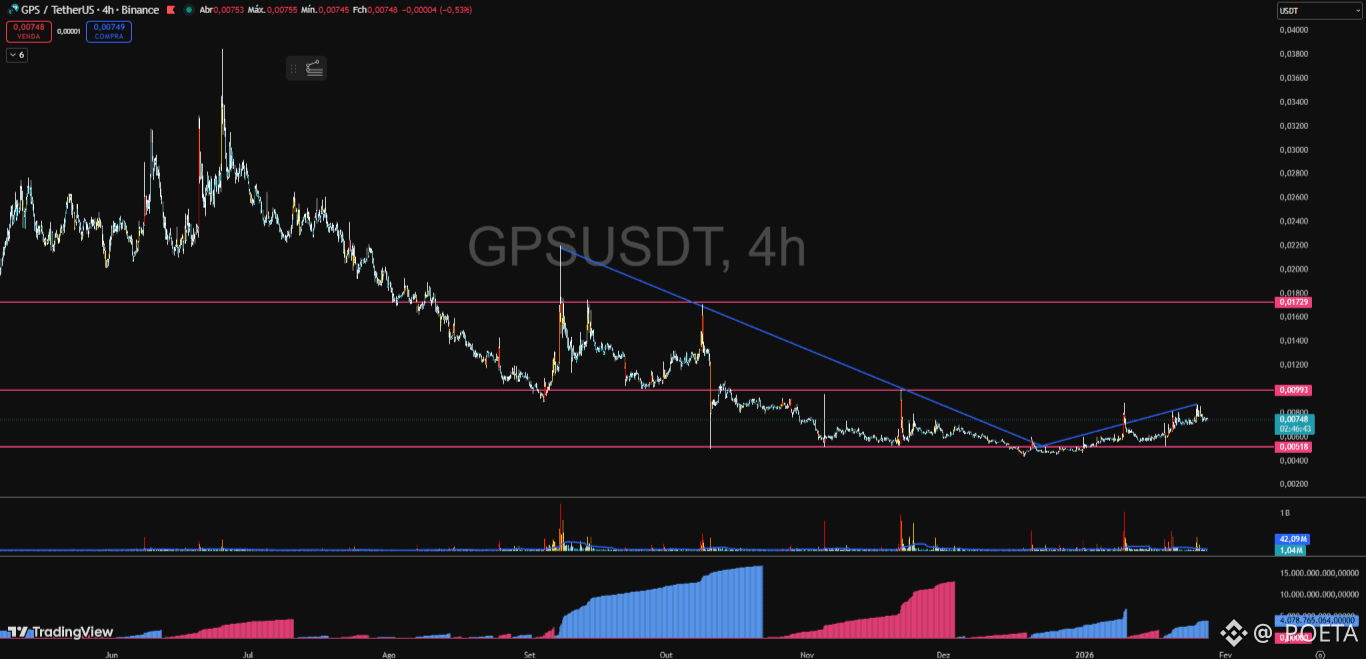
The GPS/USDT chart shows that the asset has finally halted the bleeding of the downtrend by breaking the blue descending trend line, now entering a phase of lateral accumulation. The price is compressed between the main support at 0.00518 and the resistance at 0.00991; only a breakout of this resistance with real financial volume would pave the way to target 0.01729. However, the future projection is cautious, as the current volume is irrelevant, suggesting a lack of institutional interest at the moment. The main difficulty lies in the fundamental fragility of the project: if there is no delivery of utility or real demand for the token, any attempt at a rally will be absorbed by investors trapped at higher prices trying to exit at "break-even", which could keep the asset stagnant or force it to lose the current support in case of pessimism in the broader market.
#GPS
The GPS/USDT chart shows that the asset has finally halted the bleeding of the downtrend by breaking the blue descending trend line, now entering a phase of lateral accumulation. The price is compressed between the main support at 0.00518 and the resistance at 0.00991; only a breakout of this resistance with real financial volume would pave the way to target 0.01729. However, the future projection is cautious, as the current volume is irrelevant, suggesting a lack of institutional interest at the moment. The main difficulty lies in the fundamental fragility of the project: if there is no delivery of utility or real demand for the token, any attempt at a rally will be absorbed by investors trapped at higher prices trying to exit at "break-even", which could keep the asset stagnant or force it to lose the current support in case of pessimism in the broader market.
The GPS/USDT chart shows that the asset has finally halted the bleeding of the downtrend by breaking the blue descending trend line, now entering a phase of lateral accumulation. The price is compressed between the main support at 0.00518 and the resistance at 0.00991; only a breakout of this resistance with real financial volume would pave the way to target 0.01729. However, the future projection is cautious, as the current volume is irrelevant, suggesting a lack of institutional interest at the moment. The main difficulty lies in the fundamental fragility of the project: if there is no delivery of utility or real demand for the token, any attempt at a rally will be absorbed by investors trapped at higher prices trying to exit at "break-even", which could keep the asset stagnant or force it to lose the current support in case of pessimism in the broader market.
104
·
--
#MON
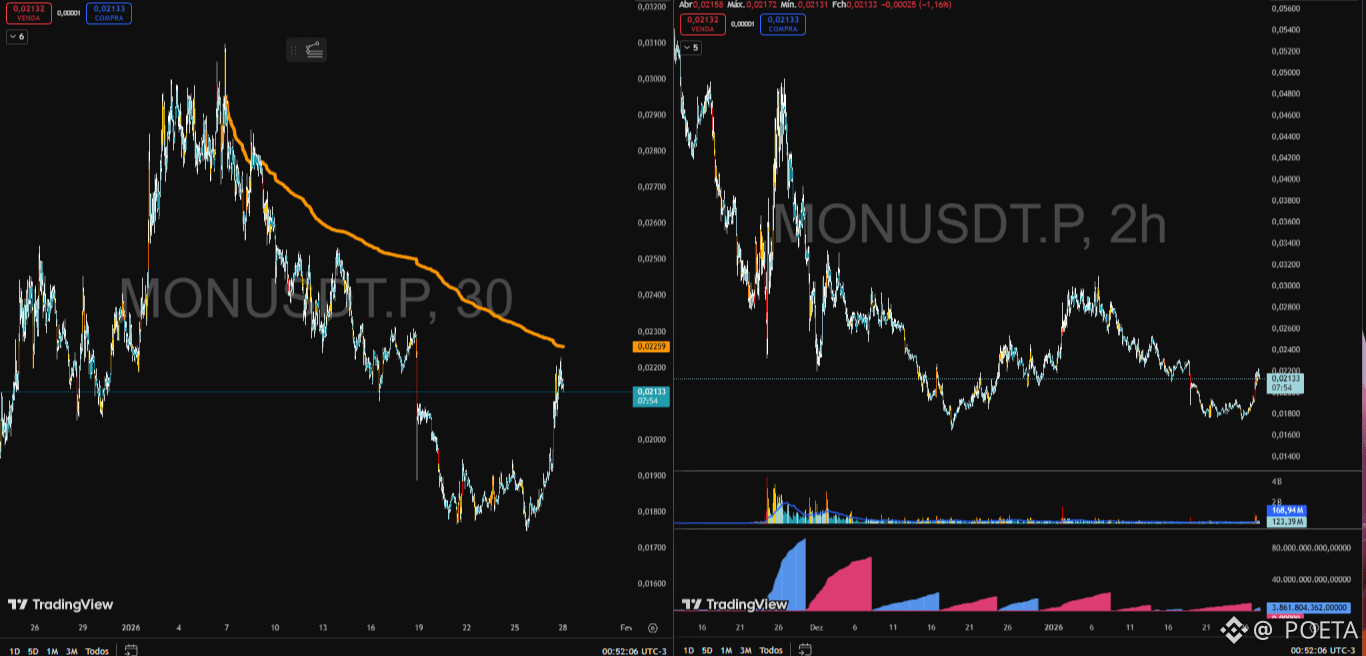
The chart of the MONUSDT pair shows that the currency is in a moment of attempting recovery after a prolonged downtrend. In the 30-minute chart (left), the price is testing the orange moving average (an important resistance), indicating that if it manages to break and maintain above $0.0225, it could target levels close to $0.026 in the short term. However, the 2-hour chart (right) reveals a lateralization structure (accumulation), with solid support in the $0.017 - $0.018 region. The volume and flow indicators suggest that the market is "breathing", but still without an explosive buying force. The immediate projection is for consolidation with a moderate bullish bias, as long as Bitcoin does not pull the market down; the breakout of the orange average is the necessary trigger to confirm the end of the recent decline.
#MON
The chart of the MONUSDT pair shows that the currency is in a moment of attempting recovery after a prolonged downtrend. In the 30-minute chart (left), the price is testing the orange moving average (an important resistance), indicating that if it manages to break and maintain above $0.0225, it could target levels close to $0.026 in the short term. However, the 2-hour chart (right) reveals a lateralization structure (accumulation), with solid support in the $0.017 - $0.018 region. The volume and flow indicators suggest that the market is "breathing", but still without an explosive buying force. The immediate projection is for consolidation with a moderate bullish bias, as long as Bitcoin does not pull the market down; the breakout of the orange average is the necessary trigger to confirm the end of the recent decline.
The chart of the MONUSDT pair shows that the currency is in a moment of attempting recovery after a prolonged downtrend. In the 30-minute chart (left), the price is testing the orange moving average (an important resistance), indicating that if it manages to break and maintain above $0.0225, it could target levels close to $0.026 in the short term. However, the 2-hour chart (right) reveals a lateralization structure (accumulation), with solid support in the $0.017 - $0.018 region. The volume and flow indicators suggest that the market is "breathing", but still without an explosive buying force. The immediate projection is for consolidation with a moderate bullish bias, as long as Bitcoin does not pull the market down; the breakout of the orange average is the necessary trigger to confirm the end of the recent decline.
61
Log in to explore more content
Join global crypto users on Binance Square
⚡️ Get latest and useful information about crypto.
💬 Trusted by the world’s largest crypto exchange.
👍 Discover real insights from verified creators.
Email / Phone number
Trending Topics
GoldFallsTo$4144
1,096 views
34 Discussing
🚨 GOLD CRASHES TO $4,144! 🥶📉
#GoldFallsTo$4144
Gold just suffered a sharp sell-off, with spot gold dropping around 3.3% to $4,144/oz.
🔥 What’s driving the dump?
• Higher oil prices are fueling inflation fears
• Markets are pricing higher-for-longer Fed rates
• A stronger U.S. dollar is pressuring bullion
• Rising geopolitical risk is adding volatility
⚠️ Gold has now broken below recent support, putting $4,100 and potentially $4,000 on traders’ radar.
💬 Is this a healthy correction—or the start of a deeper gold sell-off?
#GOLD #XAUUSD #goldprice
$GOLD.US $XAU
ASHFAQ NAEEM
·0 Likes
·97 views
QNTFallsOver40%FromMorningHigh
6,687 views
259 Discussing
KospiFalls2.7%SamsungSKHynixDropOver5%
204 views
48 Discussing