A Khoa, the former Bitcoin king of Vietnam, announced bankruptcy during a live video broadcast on February 10, 2026.
The reason is long-term investment failures leading to wealth loss.
Khoa purchased a large amount of Bitcoin at a very low price in 2011 (reportedly about 3,000 coins), and later achieved financial freedom by selling during several important bull market phases.
Reports state that he sold 500 coins for about $1,000 each in 2014 for studying abroad; he sold again when Bitcoin rose to about $20,000 in 2017; and partially liquidated when the price reached around $60,000 in 2021.
He is said to still hold remaining Bitcoin and plans to sell when prices are higher. However, he recently suspected to have suffered losses of over $128 million due to leveraged contract trading, which went wrong.
Currently, his income mainly relies on YouTube, but it is unstable. He once became wealthy through Bitcoin and advises everyone to be cautious with leverage.
The Reality of Delegated Airdrop Failures: Discussing the Easy Pitfalls in Web3 through the 'Fried Chicken Brother' Incident
Recently, there has been rampant speculation about a certain KOL "Fried Chicken Brother" allegedly defrauding over 10 million U. Many big names have fallen for it, which is truly disheartening. Regardless of the truth behind the details, just looking at such events reveals an old problem: delegated airdrops = high-risk trust games. Many people do not lose due to technology, but rather due to human nature. Some time ago, I encountered a similar situation where a fan privately messaged me, saying they handed over 30,000 U to a group friend to delegate, with the reasoning being, "The other party lost money and is in financial difficulty, wanting to earn some extra money." The result is predictable: they went completely offline. To put it realistically: if a person can truly stabilize their earnings, why wouldn't they increase their own capital and operate multiple accounts? How can you trust someone who doesn't even have principal to help you make stable profits?
Recently, many people have complained, "Isn't Binance Alpha's change to blind boxes a sign that even the landlord's family is out of grain?"
Today, I discovered a clever meme in the community: BN read backwards is actually NB, and the more I think about it, the more fitting it seems. Binance exchange truly deserves the term NB, say it with me: Binance is awesome!
Alright, back to the point. If we look at blind boxes from another perspective, it's the platform optimizing its ecosystem, rather than cutting back. In the past, fixed airdrops were easily monopolized by studios and scripts, making it difficult for ordinary users to participate;
Blind boxes concentrate multiple projects in the same event, making rewards more random and fair, and reducing the pressure on everyone to frequently switch accounts and rush.
More importantly, the blind box mechanism allows for a more sustainable event rhythm, avoiding excessive short-term resource depletion, which ultimately protects both users and project parties in the long run.
The gameplay has changed, but the opportunities have not diminished; in fact, it is more suitable for long-term participants. For example, the @Plasma ecosystem of $XPL emphasizes content and community interaction. Under the new blind box system, continued participation actually makes it easier to achieve stable returns. #plasma
In today's crypto market filled with speculation and short-term emotions, there are not many project teams truly labeled as 'conscientious', but the ecosystems represented by piev and xpl are actively changing people's stereotypes about project teams. Many projects go live, create hype, and then go silent, while the piev team chooses a long-term construction route, maintaining continuous updates from product features to community interactions, allowing users to genuinely feel a sense of participation rather than just doing a round of traffic harvesting.
First, let's talk about piev, which is inherently more user-experience-oriented in its mechanism design. The rules of the activities are public and transparent, the rewards are distributed at a stable pace, and there are basically no 'last-minute rule changes', which is quite rare in the current market environment. Many old users feedback that although there are no extreme profits during participation, the overall profit curve is stable, the risks are controllable, and it feels more like a team seriously making products rather than just a project team that shouts slogans.
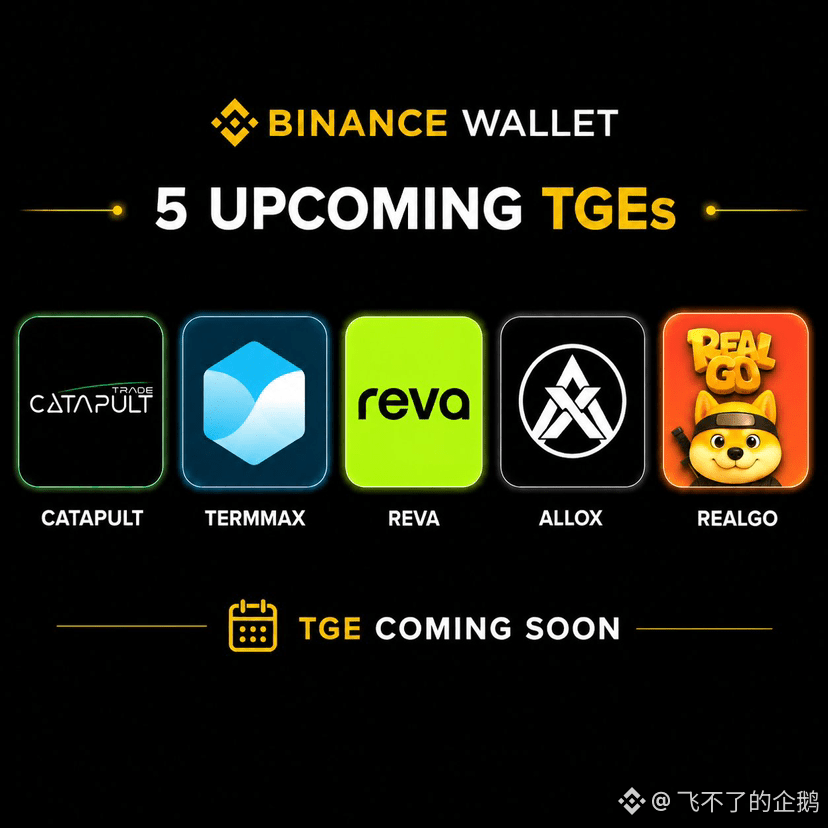
#币安钱包 is about to launch the "Alpha Blind Box" gameplay:
This revamped new gameplay, is it really a benefit or just a new trick? We will know after today's real test,
Using Alpha points to exchange for blind boxes, randomly obtaining different project tokens in the same activity. Although the types are different, the official initial value is set to be the same, essentially a game of luck + rhythm.
The first phase will be released on 2026/2/11 by @Binance Wallet . Many players feel that the new model may have its rewards in the early stages, and as long as the score is sufficient, it is worth trying.
However, there are concerns about the possibility of a crash upon launch, whether it will affect real profits, and there is a hope for a certain safety mechanism,
After all, participating in Alpha involves real money and time commitment.
Personally, I look forward to future projects with high community activity, like #Plasma and $XPL , which have strong task transparency, also being included in the blind box pool. At least the participation experience will be clearer, and it will be easier to build long-term confidence. #plasma
XPL Creator Phase One Rewards Distributed, Averaging 100 to 200U, This Wave Really Has Something!
Recently, many friends participating in @Plasma creator activities should have received the first phase rewards, averaging around 100 to 200U. To be honest, this result has exceeded many people's expectations. At first, many people participated with a trial-and-error mindset, as there are too many creator activities, some with opaque rewards and others with long cycles. However, this time $XPL the overall pace of the first phase distribution was quite straightforward, and the speed of funds arriving was efficient, at least allowing those who genuinely participated in content creation to feel the tangible rewards.
Looking back at the beginning of the activity, many people were not optimistic about the #plasma creator tasks. Some felt the rules were too complex, while others thought the rewards might be diluted. However, as more high-quality content emerged, community discussions gradually heated up, and the topic of XPL also noticeably increased in popularity. It can be said that this activity is not just a simple airdrop, but more like an attempt at a content ecosystem, allowing ordinary users to participate in project development by sharing their views.
Binance Wallet has released a teaser for 'WHAT’S IN THE BOX?', suggesting that Alpha points may see a real upgrade in functionality, and the community is already buzzing.
Some speculate it may be linked to new project rights, while others hope it will be like the @Plasma ecosystem, directly converting points into real participation opportunities.
If future tasks can combine with high-interaction ones like $XPL and #Plasma , perhaps the small investors can actually benefit, instead of just providing perks for the big players.
If Binance really goes bankrupt, would it be beneficial for us Chinese users?
If one day Binance really disappears, would it be beneficial for us Chinese users? Many may not have seriously considered this reality. Although everyone is complaining, the vast majority of assets are still with Binance.
Without mentioning anything else, how many exchanges have truly taken the Chinese-speaking community seriously in recent years? From activities, tutorials to community operations, projects like @Plasma can spread quickly in the Chinese-speaking circle largely because of the presence of Binance and its user base.
You should take a look at some foreign exchanges, such as CB and Kraken, where the interface is primarily in English, customer service responses are slow, and there is almost no support for activities of Chinese-speaking users. Many have even experienced inexplicable risk control freezes.
The XPL Creator Rankings have become a bit difficult to understand; there are hardly any real comments, likes, or shares!
In the top ranks, there are many pieces of content with no likes, no comments, and hardly any real interaction, yet the scores are ridiculously high, even consistently staying at the top.
So may I ask what standard the #plasma creator activity uses to assign scores? If it’s just based on views, can’t people just manipulate exposure to get on the list?
Those who genuinely write content and interact seriously are instead overlooked; is such a rule really fair?
I hope Binance Square can clarify the scoring mechanism a bit more, otherwise, the current leaderboard looks more like “who can manipulate their way up” rather than who has good content. $XPL @Plasma #Plasma
From a novice stumbling through to gradually getting the hang of it, my real experience in the @plasma and $XPL community
Recently, I saw quite a bit of discussion about @Plasma on Binance Square. At first, I didn't pay much attention, but later I noticed many people mentioning that $XPL had very active community interactions, which made me start to pay more attention. When I first participated in #plasma related tasks, to be honest, I was a complete novice and didn't even understand many of the rules. I just approached it with a trial-and-error mindset to create content and interact. Along the way, I encountered some pitfalls, such as my content not being counted towards the score, which was a bit disappointing. However, as I explored more, I found that the community atmosphere was quite friendly, and many experienced players would actively share their experiences, such as how to improve content quality and how to participate in activities better.
This is my first time participating in the creator event for @Plasma . To be honest, I am just a beginner and don’t really understand the rules. I saw the $XPL and #Plasma tasks and wrote a lot in a hurry, only to find that my scores didn’t count.
At that moment, I was really a bit confused and somewhat wronged, but later I saw the official notice from Binance Square about score corrections, and I instantly felt respected. There are people looking after newcomers and listening to them.
I have to say that Binance really does well in this respect. If a mistake is made, they are willing to correct it and give creators opportunities. Now I have even more motivation to keep writing and hope to make the content of $XPL better and better with everyone!
When creating content on some platforms: paying transaction fees + staying up late to complete tasks + being lectured in the end. When creating content on Binance: if you write and work seriously, there will definitely be rewards. After being in the game for a while, you will understand that the gap is not small.
What’s really ridiculous is not that you didn’t make money, but that you paid transaction fees to help the platform work, and in the end, they seriously tell you: 'It’s not the platform’s problem; it’s that you didn’t work hard enough.'