
ksushique
8 Posts
ksushique
Report
Block User
18 Following
7 Followers
19 Liked
Posts
·
--
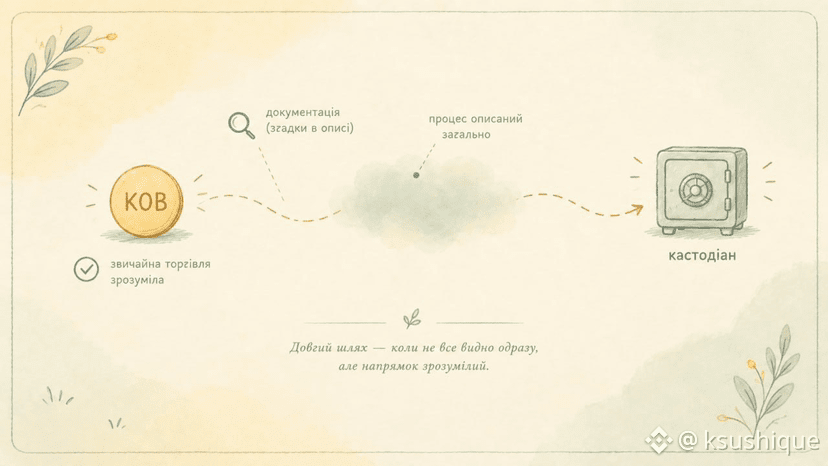
I tried to find in Binance documentation how the redemption of KOB back into an actual Coca-Cola stock works. It turns out it’s not as clear as I would have liked.
For the token, everything is straightforward: you buy, hold, sell—standard spot logic. But the process of transitioning from the token to the actual paper on the custodian’s side is described very generally, without clear steps for a regular user.
This doesn’t mean the mechanism doesn’t exist. It’s more that it isn’t designed for everyday use—it exists as a structural guarantee that the token is backed by something. Most people never reach this stage; they simply hold or sell KOB like any other asset.
For me, that’s fine—redemption wasn’t my goal. But as a matter of understanding the product, it’s worth knowing this in advance rather than figuring it out at the moment when you suddenly need it.
On #bStocksBinance, this topic is almost never brought up, even though it’s a direct part of how the backing works. In @Binance_Ukraine I’d like to see a more detailed explanation of this specific step.
2
162
·
--
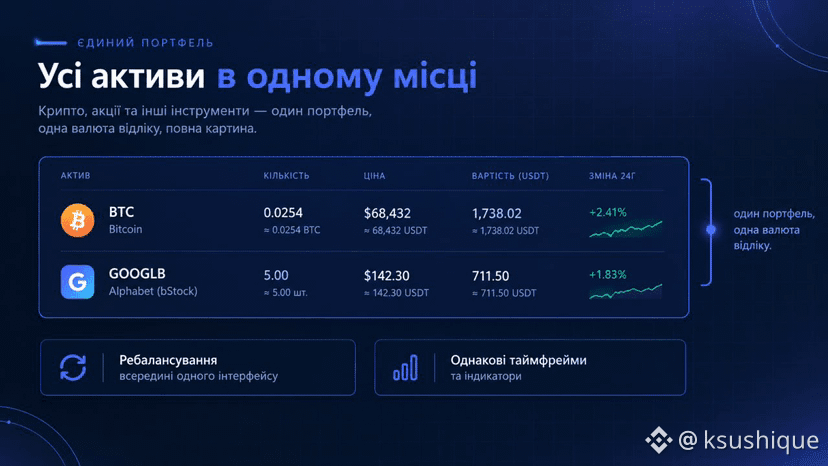
Opened my portfolio on Binance and saw $BTC and $GOOGLB in one list, without switching between apps.
Previously, I would have had to keep a separate brokerage account and a separate crypto wallet, look at two different balances, and calculate the total amount manually. Here, everything is simply made into one line of assets, with a single reference currency.
This changes the portfolio management logic itself. Rebalancing between crypto and a tokenized stock doesn’t require withdrawing funds anywhere—just sell one asset and buy another within a single interface.
The price chart for GOOGLB looks the same as for any crypto pair, with the same timeframes and indicators. I didn’t notice any differences in the analysis tools, even though the underlying asset is completely different.
Practical details like #bStocksBinance should be discussed more often, not just the fact of tokenization itself. In the community @Binance_Ukraine it also comes up in discussions regularly.
Has anyone already moved part of their traditional portfolio specifically for the sake of having one single interface?
2
99
·
--
I placed a limit order at $METAB instead of a market order to see how it performs on this pair.
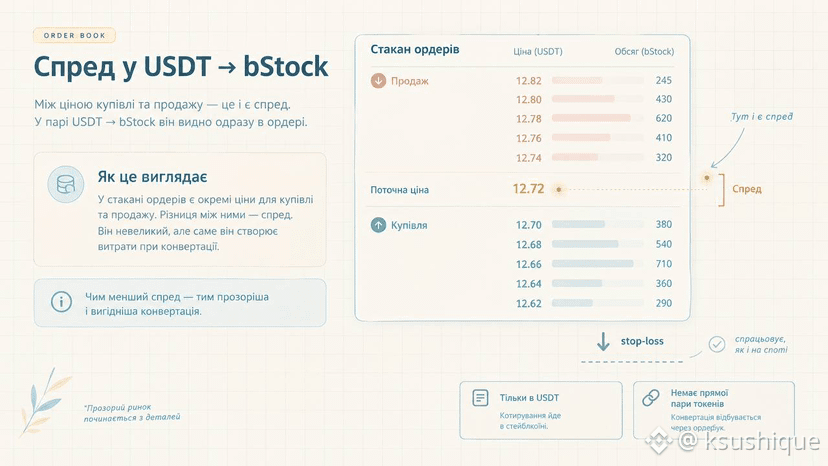
I expected a delay, as it usually happens with less liquid tokens. Instead, the order executed almost immediately; the order book updated smoothly, without any sudden jumps between bids/asks. The spread was narrow even during off-peak hours.
After that, I tried setting a stop-loss below the current price, just to see whether the logic works the same way as it does on regular spot pairs. It worked identically; I didn’t notice any special limitations specifically for bStocks.
The only thing to keep in mind: the pair trades only against USDT, without direct transitions into other tokens. In other words, first the conversion, then the order.
At #bStocksBinance , people often ask whether these tokens behave differently in the order book compared to regular crypto. From my experience with $METAB , I didn’t see any difference in the order mechanics.
Has anyone among @Binance_Ukraine tested limit orders on other bStocks pairs?
1
169
·
--
I calculated how much I was losing on converting hryvnia to dollars every time I wanted to buy something American. The number didn’t sit right with me.
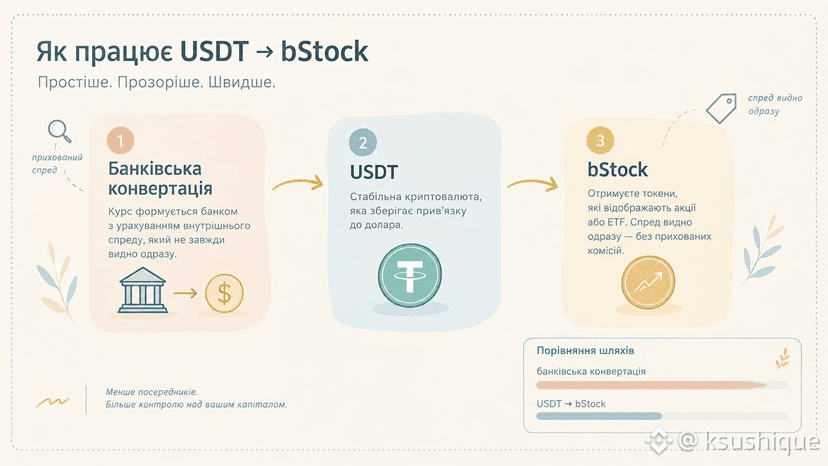
The bank uses its own rate, not the interbank one. Plus there’s a transfer fee, and sometimes there’s also a hidden spread inside the rate itself—which they simply don’t show as a separate line. On small amounts it’s barely noticeable; with regular purchases it adds up.
I tried it another way. I bought USDT for hryvnia with a single order, then $NFLXB directly for USDT. No bank between me and the Netflix action. The rate is visible right away in the order book, without hidden markups—and it’s great that #bStocksBinance has such conditions.
This doesn’t mean there are zero costs—there are still some on the order itself, just less and more transparent. And the custodian still holds the real share behind the token; it doesn’t simplify the product itself, only the path to it.
For some, the difference of a few percent isn’t a big deal; for others, it’s crucial. Who from the community @Binance_Ukraine has already calculated their real loss from bank conversion?
1
5
357
·
--
I assembled a small basket of four bStocks instead of buying a single ETF for the technology sector.
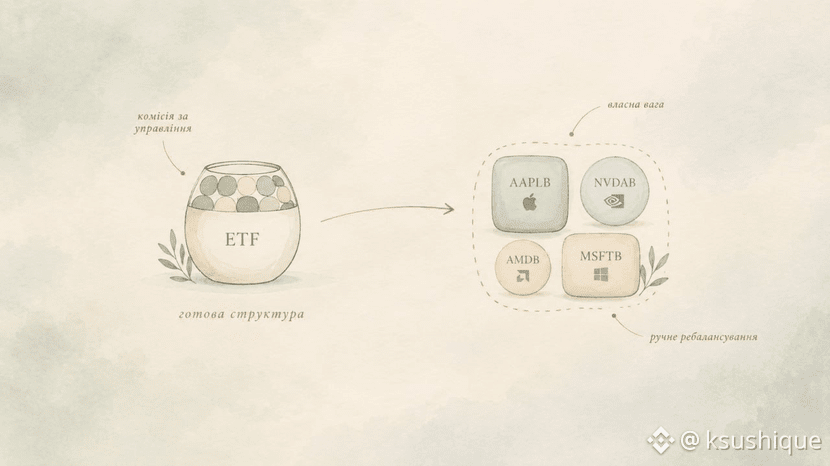
The idea is simple. An ETF gives you diversification right away, but you don’t choose the weight of each company, you pay a management commission, and you depend on the fund’s rebalancing. With bStocks, you can build a similar structure yourself—for example using AAPLB, NVDAB, AMDB, and MSFTB—and decide for yourself how much of each token to hold.
The difference isn’t noticeable immediately, but when one of the companies suddenly drops. In an ETF, it just slightly drags down the overall result. In your own basket, you can see exactly which position is pulling the rest down, and you can adjust the weight manually rather than waiting for the next index review.
There’s also a downside. It means more decisions and more responsibility for each choice. In this sense, an ETF is a simpler option for those who don’t want to keep tracking the portfolio composition all the time.
Has anyone already tried building their own basket with bStocks instead of a ready-made ETF?
3
145
·
--
I tried to open an account with an American broker three years ago. Back then I was still in Ukraine. It didn’t work because of residency requirements, paperwork red tape, and the minimum deposit—which simply wasn’t available at that time.
Now I hold $AMZNB . Same Amazon, only without needing to prove to someone that I have the right to invest there. The custodian holds the real share 1:1, and the token just reflects its price, so I don’t need to open a foreign account to get this exposure.
This isn’t about “better than a share.” It’s about access that simply didn’t exist in my case before. TradFi still works on the principle of “first prove you have the right,” whereas here you buy the token and hold the token.
The risk is different too, and I remember it: it’s not direct ownership, but trust in the custodian and the regulated structure. But for someone who had absolutely no access to the U.S. market in the first place, this is the difference between “impossible” and “possible, with nuances.”
Did someone else come to #bStocks specifically because there was no access to a regular broker, not because it was convenient?

4
644
·
--
#BinanceTurns9 Binance is celebrating 9 years — thanks to you, we have a cool space for trading and bringing ideas to life. We are confident in our safety and convenience.
#BinanceTurns9 Binance is celebrating 9 years — thanks to you, we have a cool space for trading and bringing ideas to life. We are confident in our safety and convenience.

1
1
Log in to explore more content
Join global crypto users on Binance Square
⚡️ Get latest and useful information about crypto.
💬 Trusted by the world’s largest crypto exchange.
👍 Discover real insights from verified creators.
Email / Phone number
Trending Topics
WillMarketsStageAThanksgivingReliefRally?
4,400 views
144 Discussing
Markets enter Thanksgiving week after a sharp sell-off, with investors looking for a catalyst to stabilize risk assets.
The key event this week is Wednesday's October PCE inflation report and Q3 GDP revision, both scheduled for November 25 at 8:30 AM ET, according to the official US Bureau of Economic Analysis calendar.
The inflation data could influence expectations for the Federal Reserve's next policy decision. A softer-than-expected reading could support a relief rally across stocks and crypto, while hotter inflation may keep pressure on risk assets.
US markets will also be closed on Thanksgiving Day, creating a shortened trading week with potentially thinner liquidity.
My view: a relief rally is possible, but confirmation is still needed. Watch inflation data, market breadth, Bitcoin's recovery, and whether buyers can reclaim key resistance levels.
A bounce is not necessarily a reversal.
HOLD $BTC
#WillMarketsStageAThanksgivingReliefRally?
Waseem Ahmad mir
·0 Likes
·77 views
BessentSoftensStanceOnHuang’sNvidiaReturn
3,002 views
85 Discussing
MuskWarnsOfAICashCrunch
3,222 views
89 Discussing