
Bad_Gate
480 Posts

Bad_Gate
Arrogance is not in our dictionary
We own people's hearts... It's not difficult. Realizing things will be difficult, so don't miss the opportunity!! BADGATE 💋
Frequent Trader
1.8 Years
250 Following
152 Followers
217 Liked
Posts
All
Quotes







Binance Square Official
·
--
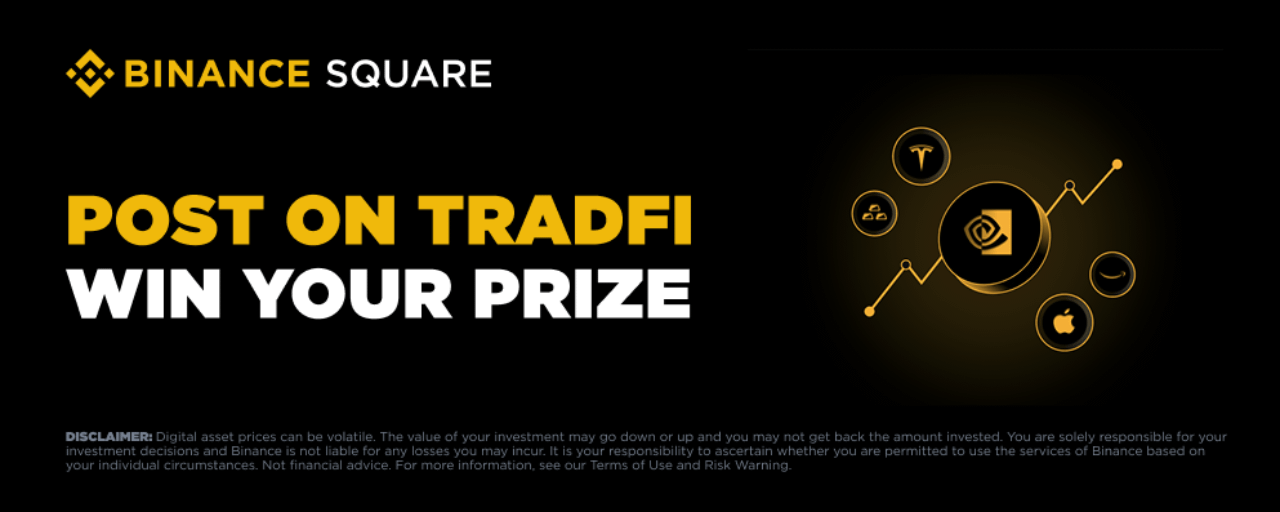
Post on TradFi, Win Your Prize!
Gold is pulling back from its highs, top tech stocks are under pressure, and commodities are swinging. If you’ve been watching the charts every day, you’ve probably got some thoughts on the global market. Let’s hear your take! Create TradFi-related original English content on Binance Square during the campaign period, and get a chance to share in the voucher rewards!
Campaign Period
May 20, 11:00 – May 28, 23:59 (UTC)
How to Participate?
During the campaign period, publish at least 1 piece of original English content on Square related to identified TradFi topics, and enter the chance to share in the voucher rewards!
Notes: TradFi is short for Traditional Finance, as opposed to DeFi (Decentralized Finance). TradFi refers to the conventional financial system comprising mainstream institutions and markets, such as the stock markets, traditional banking, precious metals like gold, commodities like oil, and index ETFs.
The eligible content must meet all the following criteria:
Each content must contain more than 100 charactersInclude the hashtag #PostonTradFi Create content in English;The content must be relevant to at least one of the following topics:US stocks & tech giants: With the Mag 7 diverging at highs, which one is your ultimate stalwart, and which one is pure hype?Gold & precious metals: Gold's recent pullback, a bull market peak or a buy-the-dip opportunity?Crude oil & commodities: What is your outlook on the upcoming cycles of global crude oil?
Reward Distribution
After the campaign ends, 50 creators will be selected based on the valid views per eligible content*, and equally share $1,000 worth of token voucher rewards! The voucher rewards will be distributed before 2026-06-18.
Terms & Conditions
Creators must include the #PostonTradFi hashtag in their published content, and the content must be relevant to at least one of the recommended TradFi topics.*Valid views per eligible content: The calculation window of the valid views per eligible content is valid until 23:59 (UTC) on day T+1 since the content's initial publication. For example, if a user publishes his/her first TradFi-related content on May 20, 2026, at 20:00 (UTC), the calculation window for valid views will be from May 20, 2026, 20:00 (UTC) to May 21, 2026, 23:59 (UTC). If any participant is found to have suspicious views, artificial engagement, or is suspected of using automated bots to boost volume, they will be disqualified from rewards and those views will not be counted toward the valid views per content. If a user publishes multiple eligible contents during the campaign period, only the content with the highest valid views will be taken into account.Users are encouraged to add TradFi-related token tickers in the content. You can find TradFi-related token tickers by visiting Binance Futures.Published content must be original. Plagiarism or malicious spamming will result in disqualification from winning.Posts involving Red Packets or giveaways will be deemed ineligible for rewards.Any modification of previously published posts with high engagement to repurpose them as campaign submissions will result in disqualification.Illegally bulk-registered accounts are not eligible to participate or receive any rewards.Only data from Binance Square posts will be taken into account for rewards calculation. Users may check their voucher rewards via Profile > Rewards Hub. The validity period for the token voucher is set at 90 days from the day of distribution.Any posts found to violate Binance’s Community or Content Guidelines will be deemed ineligible for activity rewards.Participants are required to keep their campaign-related posts published for a minimum of 30 days following the activity end date. Deleting posts within this period is not permitted.Your participation in the Binance Square sharing activity indicates that you agree to accept the violations listed in the Community Management Guidelines or the Binance Square Community Platform Terms of Use. If an account is involved in a violation, Binance reserves the right to cancel its reward eligibility.Binance reserves the right to disqualify any participants who tamper with Binance program code, or interfere with the operation of Binance program code with other software.During the activity period, if there are cheating behaviors such as malicious volume boosting, mass registration of alternative accounts, self-buying and self-selling, or wash trading, Binance will strictly review and cancel the participation eligibility.Binance reserves the right at any time in its sole and absolute discretion to determine and/or amend or vary these terms and conditions without prior notice, including but not limited to canceling, extending, terminating or suspending this activity, the eligibility terms and criteria, the selection and number of winners, and the timing of any act to be done, and all participants shall be bound by these amendments.Binance reserves the right of final interpretation of this Activity and other, including the spotlighting of specific content from time to time.
Campaign Period
May 20, 11:00 – May 28, 23:59 (UTC)
How to Participate?
During the campaign period, publish at least 1 piece of original English content on Square related to identified TradFi topics, and enter the chance to share in the voucher rewards!
Notes: TradFi is short for Traditional Finance, as opposed to DeFi (Decentralized Finance). TradFi refers to the conventional financial system comprising mainstream institutions and markets, such as the stock markets, traditional banking, precious metals like gold, commodities like oil, and index ETFs.
The eligible content must meet all the following criteria:
Each content must contain more than 100 charactersInclude the hashtag #PostonTradFi Create content in English;The content must be relevant to at least one of the following topics:US stocks & tech giants: With the Mag 7 diverging at highs, which one is your ultimate stalwart, and which one is pure hype?Gold & precious metals: Gold's recent pullback, a bull market peak or a buy-the-dip opportunity?Crude oil & commodities: What is your outlook on the upcoming cycles of global crude oil?
Reward Distribution
After the campaign ends, 50 creators will be selected based on the valid views per eligible content*, and equally share $1,000 worth of token voucher rewards! The voucher rewards will be distributed before 2026-06-18.
Terms & Conditions
Creators must include the #PostonTradFi hashtag in their published content, and the content must be relevant to at least one of the recommended TradFi topics.*Valid views per eligible content: The calculation window of the valid views per eligible content is valid until 23:59 (UTC) on day T+1 since the content's initial publication. For example, if a user publishes his/her first TradFi-related content on May 20, 2026, at 20:00 (UTC), the calculation window for valid views will be from May 20, 2026, 20:00 (UTC) to May 21, 2026, 23:59 (UTC). If any participant is found to have suspicious views, artificial engagement, or is suspected of using automated bots to boost volume, they will be disqualified from rewards and those views will not be counted toward the valid views per content. If a user publishes multiple eligible contents during the campaign period, only the content with the highest valid views will be taken into account.Users are encouraged to add TradFi-related token tickers in the content. You can find TradFi-related token tickers by visiting Binance Futures.Published content must be original. Plagiarism or malicious spamming will result in disqualification from winning.Posts involving Red Packets or giveaways will be deemed ineligible for rewards.Any modification of previously published posts with high engagement to repurpose them as campaign submissions will result in disqualification.Illegally bulk-registered accounts are not eligible to participate or receive any rewards.Only data from Binance Square posts will be taken into account for rewards calculation. Users may check their voucher rewards via Profile > Rewards Hub. The validity period for the token voucher is set at 90 days from the day of distribution.Any posts found to violate Binance’s Community or Content Guidelines will be deemed ineligible for activity rewards.Participants are required to keep their campaign-related posts published for a minimum of 30 days following the activity end date. Deleting posts within this period is not permitted.Your participation in the Binance Square sharing activity indicates that you agree to accept the violations listed in the Community Management Guidelines or the Binance Square Community Platform Terms of Use. If an account is involved in a violation, Binance reserves the right to cancel its reward eligibility.Binance reserves the right to disqualify any participants who tamper with Binance program code, or interfere with the operation of Binance program code with other software.During the activity period, if there are cheating behaviors such as malicious volume boosting, mass registration of alternative accounts, self-buying and self-selling, or wash trading, Binance will strictly review and cancel the participation eligibility.Binance reserves the right at any time in its sole and absolute discretion to determine and/or amend or vary these terms and conditions without prior notice, including but not limited to canceling, extending, terminating or suspending this activity, the eligibility terms and criteria, the selection and number of winners, and the timing of any act to be done, and all participants shall be bound by these amendments.Binance reserves the right of final interpretation of this Activity and other, including the spotlighting of specific content from time to time.


Bad_Gate
·
--
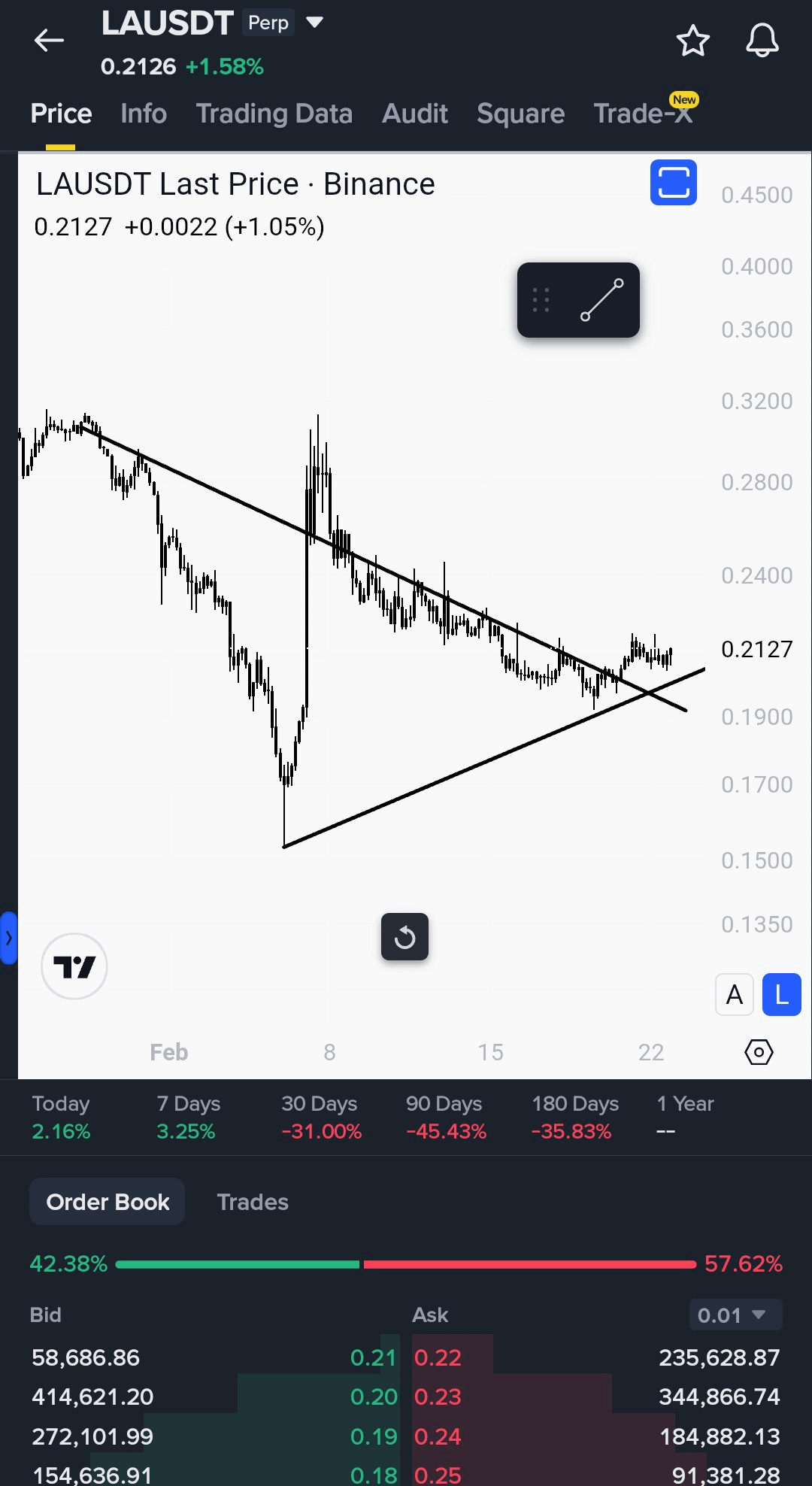
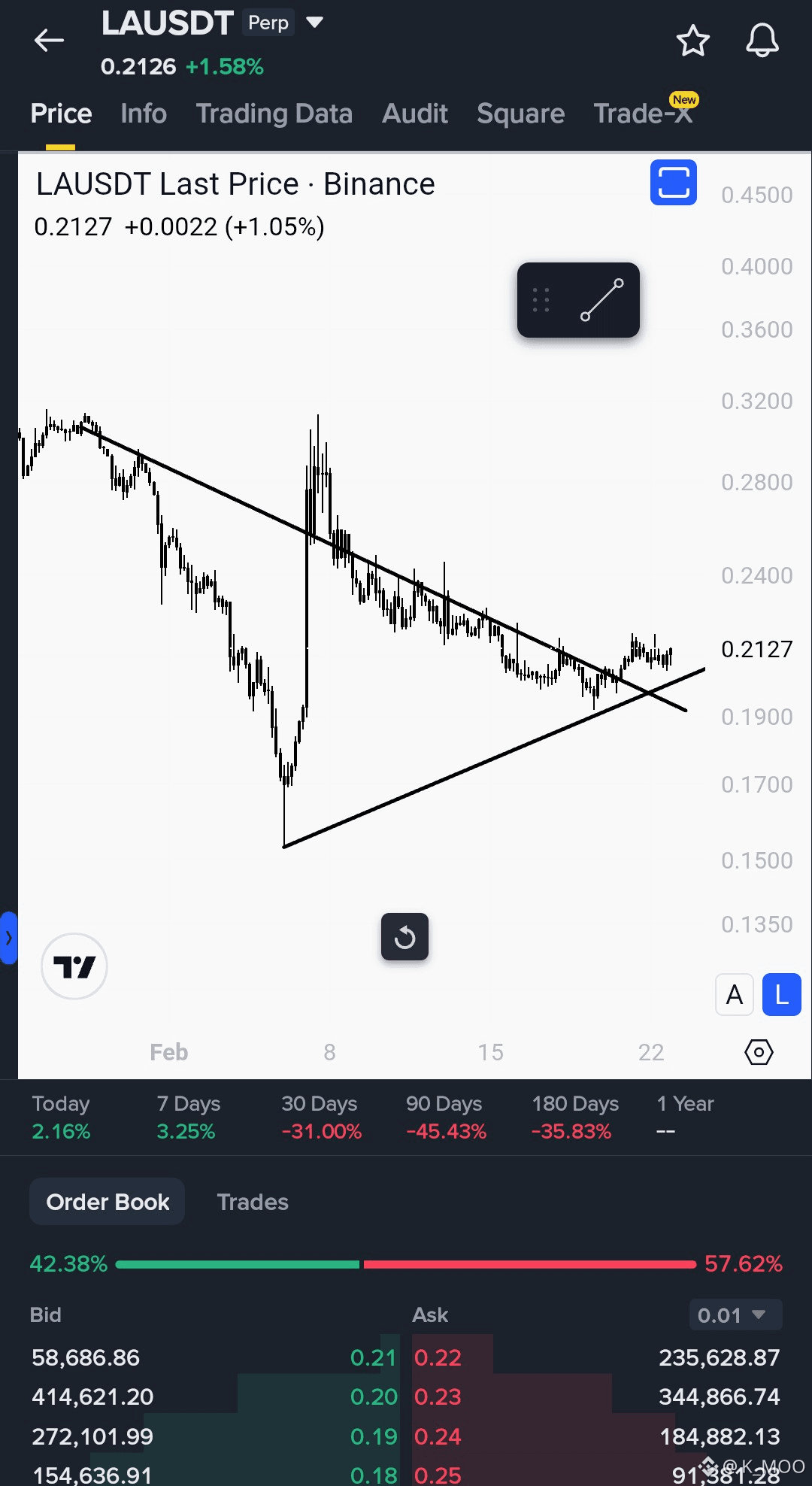
Bullish🔥🔥 $LA GREAT breakout
🐎 It's a clear breakout, let's open buy positions...
Stop loss at $0.196
⚠ This is not financial advice or consultation...do your own research (DYOR).
Good luck.
#la
#TradingCommunity
$LA
🐎 It's a clear breakout, let's open buy positions...
Stop loss at $0.196
⚠ This is not financial advice or consultation...do your own research (DYOR).
Good luck.
#la
#TradingCommunity
$LA
Binance Square Official
·
--
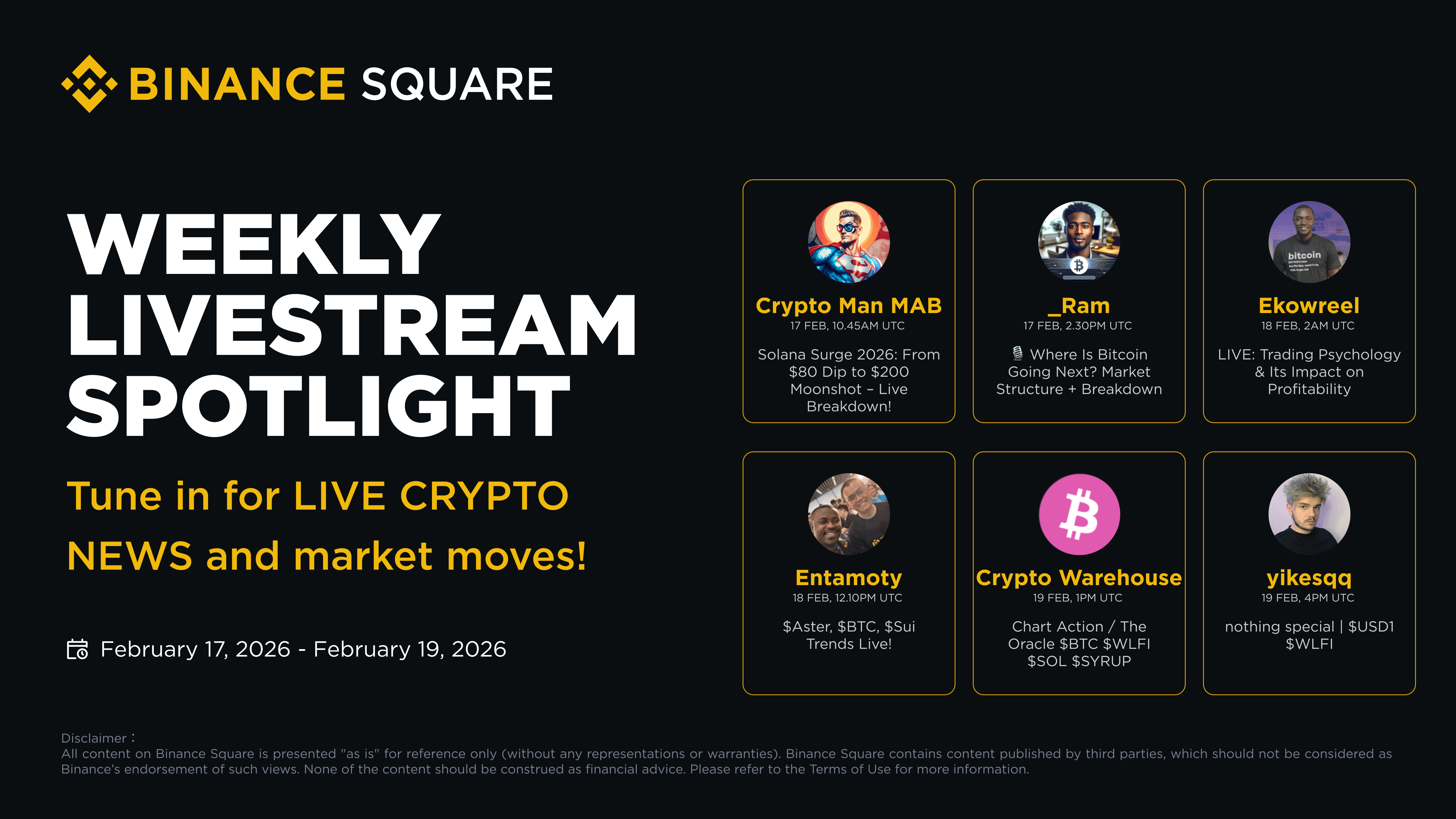
BullishBinance Square Trading Live Stream Preview
📅 February 17, 2026 to February 19, 2026
Crypto Man MAB: February 17, 10.45AM UTC
https://www.binance.com/en/square/profile/crypto_man_mab
_Ram: February 17, 2.30PM UTC
https://www.binance.com/en/square/audio?id=36567240979346
Ekowreel: February 18, 2AM UTC
https://www.binance.com/en/square/audio?id=36571026287482
Entamoty: February 18, 12.10PM UTC
https://www.binance.com/en/square/audio?id=36571048244089
Crypto Warehouse: February 19, 1PM UTC
https://www.binance.com/en/square/audio?id=36571999948721
yikesqq: February 19, 4PM UTC
https://www.binance.com/en/square/audio?id=36486759062842
Wishing everyone a prosperous Lunar New Year! 🧧
Get your trading edge with our daily livestreams on Binance Square! 🚀
📅 February 17, 2026 to February 19, 2026
Crypto Man MAB: February 17, 10.45AM UTC
https://www.binance.com/en/square/profile/crypto_man_mab
_Ram: February 17, 2.30PM UTC
https://www.binance.com/en/square/audio?id=36567240979346
Ekowreel: February 18, 2AM UTC
https://www.binance.com/en/square/audio?id=36571026287482
Entamoty: February 18, 12.10PM UTC
https://www.binance.com/en/square/audio?id=36571048244089
Crypto Warehouse: February 19, 1PM UTC
https://www.binance.com/en/square/audio?id=36571999948721
yikesqq: February 19, 4PM UTC
https://www.binance.com/en/square/audio?id=36486759062842
Wishing everyone a prosperous Lunar New Year! 🧧
Get your trading edge with our daily livestreams on Binance Square! 🚀

Holy Haein
·
--
Vanar Chain: Powering the Future of Web3 Through Innovation, Scalability, and Creator Empowerment
The evolution of blockchain technology is no longer defined by experimentation alone it is defined by execution, scalability, and real world application. In this rapidly advancing digital landscape, @Vanarchain is positioning itself as a next generation infrastructure layer designed to unlock true Web3 potential. At the center of this expanding ecosystem stands VANRY, the utility token driving performance, participation, and long term value creation.
Vanar Chain represents a strategic shift from speculative blockchain narratives toward sustainable ecosystem engineering. While many networks focus solely on transaction throughput or temporary market attention, Vanar is building a comprehensive environment where creators, developers, enterprises, and communities can operate seamlessly. The emphasis is clear deliver infrastructure that supports mass adoption without compromising security or decentralization.
One of the most compelling aspects of Vanar Chain is its commitment to empowering creators. In the Web3 economy, creators are no longer just content producers; they are ecosystem builders. Through initiatives like CreatorPad and broader ecosystem support, vanar is creating pathways for innovation, funding access, and scalable deployment. This approach transforms ideas into tangible blockchain powered products, accelerating development cycles and strengthening ecosystem depth.
Scalability remains one of the most critical challenges in blockchain technology. Vanar Chain addresses this through performance optimized architecture, enabling efficient smart contract deployment and smooth transaction processing. As decentralized applications grow in complexity and user demand increases, networks must be prepared to handle sustained activity without performance degradation. VANRY plays a vital role in facilitating this infrastructure, supporting transactions, governance mechanisms, and ecosystem incentives.
Security and reliability are equally important pillars. Trust is foundational in decentralized systems, and Vanar Chain’s focus on structural integrity reflects long term vision. Projects building within the Vanar ecosystem benefit from a framework engineered for resilience and scalability, reducing friction for developers and users alike. This creates an environment where innovation can thrive without unnecessary technical barriers.
Community alignment is another defining strength of Vanar Chain. A blockchain is only as powerful as the network of participants supporting it. The vanar community demonstrates growing engagement, strategic discussion, and long-term conviction. Rather than short-lived enthusiasm, the ecosystem reflects measured confidence rooted in roadmap clarity and technological advancement. VANRY holders are not passive observers they are contributors to a rapidly expanding decentralized infrastructure.
In addition to technical innovation, Vanar Chain understands the importance of accessibility. Web3 adoption depends on user-friendly onboarding, intuitive interfaces, and seamless integration with existing digital systems. By prioritizing usability alongside performance, vanar is reducing entry barriers and expanding its reach beyond traditional crypto-native audiences. This forward-thinking strategy positions Vanar Chain as a bridge between early blockchain adopters and mainstream digital users.
The broader market environment further strengthens Vanar’s outlook. As global industries increasingly explore tokenization, digital ownership, decentralized finance, and creator economies, demand for reliable and scalable blockchain infrastructure continues to rise. Vanar Chain is strategically aligned with these macro trends. VANRY represents participation in an ecosystem designed to capitalize on long-term digital transformation rather than temporary speculation cycles.
Momentum in blockchain is not built overnight. It is constructed through consistent upgrades, ecosystem expansion, and disciplined strategic planning. vanar reflects this philosophy in its measured growth trajectory. Each development milestone strengthens the foundation upon which future innovation will be built. This cumulative progress compounds over time, creating sustainable value within the #Vanar ecosystem.
Looking ahead, the trajectory remains decisively bullish. Vanar Chain combines technical sophistication, creator empowerment, scalability solutions, and community alignment into a unified vision. As decentralized infrastructure becomes increasingly central to the global digital economy, projects that prioritize structural excellence and long term execution will emerge as leaders. Vanar Chain is positioning itself within that leadership category.
In conclusion, vanar is not simply launching a blockchain it is architecting a scalable, creator driven Web3 ecosystem engineered for longevity. VANRY stands as the core utility asset fueling this expansion. With innovation at its foundation and community conviction at its core, the Vanar ecosystem is building momentum that extends beyond short term term cycles. The future of decentralized infrastructure demands strength, vision, and execution and Vanar Chain is rising to meet that challenge.
#vanar $VANRY
Vanar Chain represents a strategic shift from speculative blockchain narratives toward sustainable ecosystem engineering. While many networks focus solely on transaction throughput or temporary market attention, Vanar is building a comprehensive environment where creators, developers, enterprises, and communities can operate seamlessly. The emphasis is clear deliver infrastructure that supports mass adoption without compromising security or decentralization.
One of the most compelling aspects of Vanar Chain is its commitment to empowering creators. In the Web3 economy, creators are no longer just content producers; they are ecosystem builders. Through initiatives like CreatorPad and broader ecosystem support, vanar is creating pathways for innovation, funding access, and scalable deployment. This approach transforms ideas into tangible blockchain powered products, accelerating development cycles and strengthening ecosystem depth.
Scalability remains one of the most critical challenges in blockchain technology. Vanar Chain addresses this through performance optimized architecture, enabling efficient smart contract deployment and smooth transaction processing. As decentralized applications grow in complexity and user demand increases, networks must be prepared to handle sustained activity without performance degradation. VANRY plays a vital role in facilitating this infrastructure, supporting transactions, governance mechanisms, and ecosystem incentives.
Security and reliability are equally important pillars. Trust is foundational in decentralized systems, and Vanar Chain’s focus on structural integrity reflects long term vision. Projects building within the Vanar ecosystem benefit from a framework engineered for resilience and scalability, reducing friction for developers and users alike. This creates an environment where innovation can thrive without unnecessary technical barriers.
Community alignment is another defining strength of Vanar Chain. A blockchain is only as powerful as the network of participants supporting it. The vanar community demonstrates growing engagement, strategic discussion, and long-term conviction. Rather than short-lived enthusiasm, the ecosystem reflects measured confidence rooted in roadmap clarity and technological advancement. VANRY holders are not passive observers they are contributors to a rapidly expanding decentralized infrastructure.
In addition to technical innovation, Vanar Chain understands the importance of accessibility. Web3 adoption depends on user-friendly onboarding, intuitive interfaces, and seamless integration with existing digital systems. By prioritizing usability alongside performance, vanar is reducing entry barriers and expanding its reach beyond traditional crypto-native audiences. This forward-thinking strategy positions Vanar Chain as a bridge between early blockchain adopters and mainstream digital users.
The broader market environment further strengthens Vanar’s outlook. As global industries increasingly explore tokenization, digital ownership, decentralized finance, and creator economies, demand for reliable and scalable blockchain infrastructure continues to rise. Vanar Chain is strategically aligned with these macro trends. VANRY represents participation in an ecosystem designed to capitalize on long-term digital transformation rather than temporary speculation cycles.
Momentum in blockchain is not built overnight. It is constructed through consistent upgrades, ecosystem expansion, and disciplined strategic planning. vanar reflects this philosophy in its measured growth trajectory. Each development milestone strengthens the foundation upon which future innovation will be built. This cumulative progress compounds over time, creating sustainable value within the #Vanar ecosystem.
Looking ahead, the trajectory remains decisively bullish. Vanar Chain combines technical sophistication, creator empowerment, scalability solutions, and community alignment into a unified vision. As decentralized infrastructure becomes increasingly central to the global digital economy, projects that prioritize structural excellence and long term execution will emerge as leaders. Vanar Chain is positioning itself within that leadership category.
In conclusion, vanar is not simply launching a blockchain it is architecting a scalable, creator driven Web3 ecosystem engineered for longevity. VANRY stands as the core utility asset fueling this expansion. With innovation at its foundation and community conviction at its core, the Vanar ecosystem is building momentum that extends beyond short term term cycles. The future of decentralized infrastructure demands strength, vision, and execution and Vanar Chain is rising to meet that challenge.
#vanar $VANRY
Log in to explore more content