

Juanito Labs
102 Posts

Juanito Labs
Report
Block User
Datos, análisis y señales para entender mejor el mercado crypto.

PROM Holder
Occasional Trader
5.3 Years
0 Following
264 Followers
253 Liked
Posts
PINNED
·
--
Bullish
I want to give a little value to people who are starting in this world or want to enter, they are advice, recommendations and realities that could be helpful.
The first thing you should know is that there must be a balance, for one person to win another has to lose, that's where your gain or loss comes from.
Related to the previous point, in this market there are many experienced people, if you are new it is very likely that when investing you will lose part of your money, I recommend investing an amount that you are willing to lose in the worst case scenario without it making you financially unstable.
If you are going through a bad economic time and want to enter this market to compensate for that lack, I recommend not doing so, in this market you have to be patient when investing.
Investments should not be made based on emotions or needs, you must design your own strategy based on many aspects that you consider favorable, for this it is necessary to study the market before investing or use a very small amount of money to experiment. Learn basic trading concepts so that a red candle does not make you panic and sell your cryptocurrencies at a lower price than you bought them.
You should know that the best investments are made in the long term, preferably with altcoins if you are not willing to risk. Additionally, the market moves by Bitcoin, it is a good guide to know when it is favorable to invest, if Bitcoin is cheap it is very likely that the other currencies will also be cheap, if Bitcoin is expensive it is very likely that the other currencies will break their all-time highs.
I recommend you study the market in high season so that you know how much a token can grow and in low season so that you also know how much a token can go down, so you will have a reference when investing.
If your investment is worth 10-20% less and you sell just lost, do not panic and hold, making a bad investment is not always losing, sometimes it is having to wait longer to receive a return.
I want to give a little value to people who are starting in this world or want to enter, they are advice, recommendations and realities that could be helpful.
The first thing you should know is that there must be a balance, for one person to win another has to lose, that's where your gain or loss comes from.
Related to the previous point, in this market there are many experienced people, if you are new it is very likely that when investing you will lose part of your money, I recommend investing an amount that you are willing to lose in the worst case scenario without it making you financially unstable.
If you are going through a bad economic time and want to enter this market to compensate for that lack, I recommend not doing so, in this market you have to be patient when investing.
Investments should not be made based on emotions or needs, you must design your own strategy based on many aspects that you consider favorable, for this it is necessary to study the market before investing or use a very small amount of money to experiment. Learn basic trading concepts so that a red candle does not make you panic and sell your cryptocurrencies at a lower price than you bought them.
You should know that the best investments are made in the long term, preferably with altcoins if you are not willing to risk. Additionally, the market moves by Bitcoin, it is a good guide to know when it is favorable to invest, if Bitcoin is cheap it is very likely that the other currencies will also be cheap, if Bitcoin is expensive it is very likely that the other currencies will break their all-time highs.
I recommend you study the market in high season so that you know how much a token can grow and in low season so that you also know how much a token can go down, so you will have a reference when investing.
If your investment is worth 10-20% less and you sell just lost, do not panic and hold, making a bad investment is not always losing, sometimes it is having to wait longer to receive a return.
The first thing you should know is that there must be a balance, for one person to win another has to lose, that's where your gain or loss comes from.
Related to the previous point, in this market there are many experienced people, if you are new it is very likely that when investing you will lose part of your money, I recommend investing an amount that you are willing to lose in the worst case scenario without it making you financially unstable.
If you are going through a bad economic time and want to enter this market to compensate for that lack, I recommend not doing so, in this market you have to be patient when investing.
Investments should not be made based on emotions or needs, you must design your own strategy based on many aspects that you consider favorable, for this it is necessary to study the market before investing or use a very small amount of money to experiment. Learn basic trading concepts so that a red candle does not make you panic and sell your cryptocurrencies at a lower price than you bought them.
You should know that the best investments are made in the long term, preferably with altcoins if you are not willing to risk. Additionally, the market moves by Bitcoin, it is a good guide to know when it is favorable to invest, if Bitcoin is cheap it is very likely that the other currencies will also be cheap, if Bitcoin is expensive it is very likely that the other currencies will break their all-time highs.
I recommend you study the market in high season so that you know how much a token can grow and in low season so that you also know how much a token can go down, so you will have a reference when investing.
If your investment is worth 10-20% less and you sell just lost, do not panic and hold, making a bad investment is not always losing, sometimes it is having to wait longer to receive a return.

14
107
35k
·
--
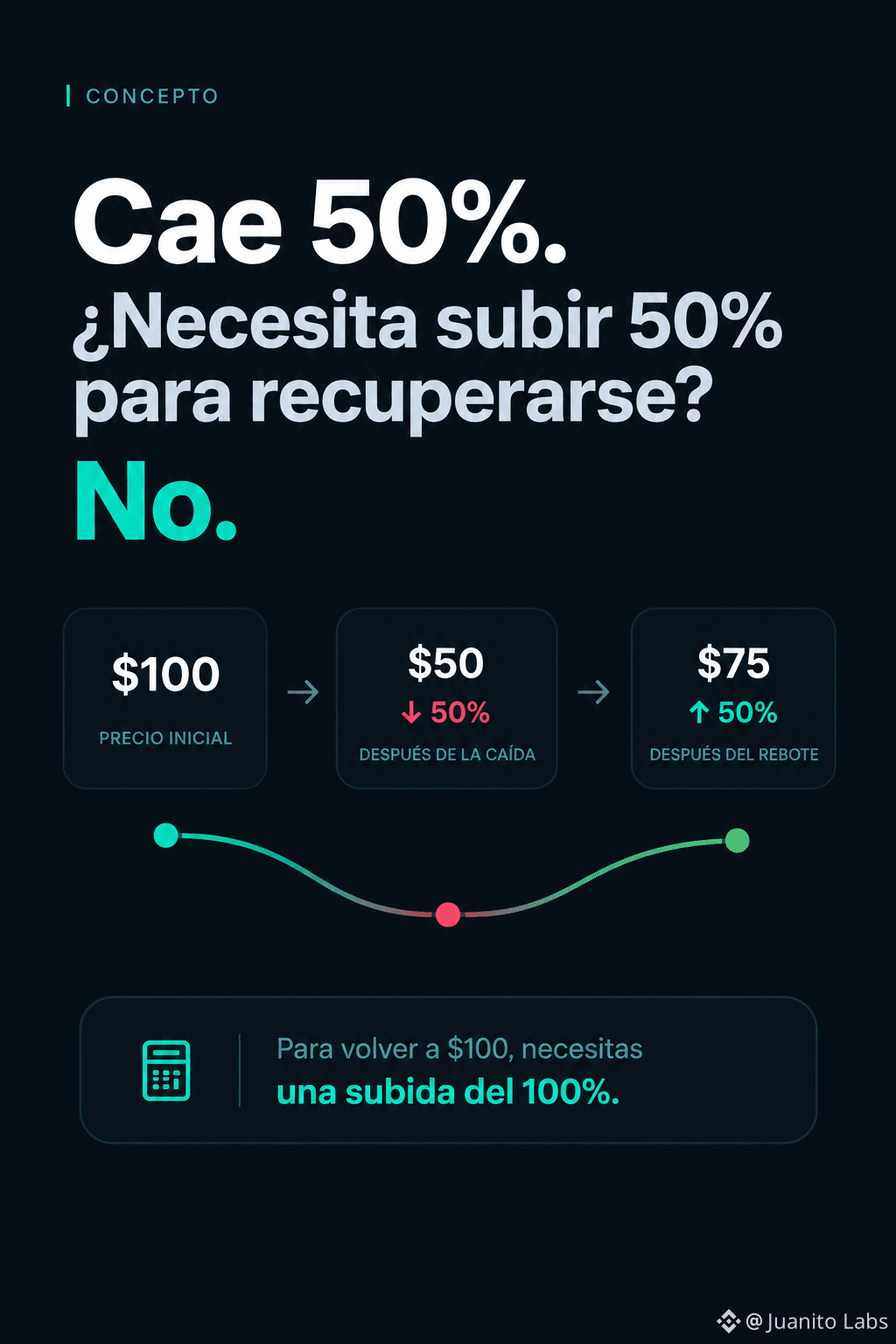
The price drops 50%; does it need to rise 50% to recover? The answer is no!
Imagine you buy a crypto for $100. The price drops 50% and now you have $50. Then it rises 50% and at this point it’s not worth $100 again—it’s now worth $75.
The reason is simple: that 50% increase is calculated on the remaining $50, not on the original $100.
This teaches us that a loss and a gain of the same percentage do not cancel each other out.
Sometimes the math tells a very different story than what it seems at first glance, and this can affect your analysis if you don’t know this concept.
The price drops 50%; does it need to rise 50% to recover? The answer is no!
Imagine you buy a crypto for $100. The price drops 50% and now you have $50. Then it rises 50% and at this point it’s not worth $100 again—it’s now worth $75.
The reason is simple: that 50% increase is calculated on the remaining $50, not on the original $100.
This teaches us that a loss and a gain of the same percentage do not cancel each other out.
Sometimes the math tells a very different story than what it seems at first glance, and this can affect your analysis if you don’t know this concept.
Imagine you buy a crypto for $100. The price drops 50% and now you have $50. Then it rises 50% and at this point it’s not worth $100 again—it’s now worth $75.
The reason is simple: that 50% increase is calculated on the remaining $50, not on the original $100.
This teaches us that a loss and a gain of the same percentage do not cancel each other out.
Sometimes the math tells a very different story than what it seems at first glance, and this can affect your analysis if you don’t know this concept.
5
6k
·
--
Bearish
I’m looking forward to having $RIVER go down even more to buy quite a lot. This volatility in the Alpha projects could turn out extremely well or extremely badly; I think the risk is worth it😈💸
{alpha}(560xda7ad9dea9397cffddae2f8a052b82f1484252b3)
I’m looking forward to having $RIVER go down even more to buy quite a lot. This volatility in the Alpha projects could turn out extremely well or extremely badly; I think the risk is worth it😈💸
2
2
1k
·
--
The asset $NIL is showing a remarkable streak of consecutive closes, standing out for its recent movement. In the last four hours, the close has surpassed the maximum recorded in the past 90 days, a sign of a potential breakout. This kind of behavior is not typical, which could draw the market’s attention.
This is not financial advice. Only educational observation of market data.
The asset $NIL is showing a remarkable streak of consecutive closes, standing out for its recent movement. In the last four hours, the close has surpassed the maximum recorded in the past 90 days, a sign of a potential breakout. This kind of behavior is not typical, which could draw the market’s attention.
This is not financial advice. Only educational observation of market data.
This is not financial advice. Only educational observation of market data.
458
·
--
Bullish
If AI continues to grow, NVIDIA won’t be the only one to win. #aistockswhatnext
When we think about the AI boom, we normally think about NVIDIA, AMD, or the big companies developing models.
But there’s something easy to forget: AI doesn’t work in thin air.
It needs chips.
It needs memory.
It needs servers.
It needs data centers.
It needs electricity.
It needs cooling.
It needs networking capable of moving enormous amounts of information.
And while everyone is watching the stock performance of the companies that make the chips, an entire economy is being built around them.
In fact, NVIDIA is paying increasing attention specifically to that infrastructure. This week, it unveiled a program for power and cooling products aimed at its “AI factories,” and it’s also working with Google and Emerald AI on systems that allow data centers to adapt their electricity usage to grid conditions.
I find this interesting because it changes the question.
It’s no longer just:
“How far can AI stocks go?”
We can also ask:
“What does AI need in order to keep growing?”
And then completely different sectors come into view: energy, cooling, networking, storage, data centers, and computing.
But there’s another layer I’m even more interested in: Web3.
If AI needs more and more computing capacity, storage, infrastructure, and payment systems, some decentralized networks might try to become part of that infrastructure.
That’s where concepts like DePIN, decentralized computing, storage, AI agents, and on-chain payments come in.
The interesting question is a different one:
Which projects are truly solving part of this infrastructure—and capturing value from it?
Maybe the next big AI-related opportunity isn’t about manufacturing the next chip; maybe it’s about everything that makes it possible for those chips to work.
Which part of this chain do you think we’re still underestimating?
{spot}(NVDABUSDT)
If AI continues to grow, NVIDIA won’t be the only one to win. #aistockswhatnext
When we think about the AI boom, we normally think about NVIDIA, AMD, or the big companies developing models.
But there’s something easy to forget: AI doesn’t work in thin air.
It needs chips.
It needs memory.
It needs servers.
It needs data centers.
It needs electricity.
It needs cooling.
It needs networking capable of moving enormous amounts of information.
And while everyone is watching the stock performance of the companies that make the chips, an entire economy is being built around them.
In fact, NVIDIA is paying increasing attention specifically to that infrastructure. This week, it unveiled a program for power and cooling products aimed at its “AI factories,” and it’s also working with Google and Emerald AI on systems that allow data centers to adapt their electricity usage to grid conditions.
I find this interesting because it changes the question.
It’s no longer just:
“How far can AI stocks go?”
We can also ask:
“What does AI need in order to keep growing?”
And then completely different sectors come into view: energy, cooling, networking, storage, data centers, and computing.
But there’s another layer I’m even more interested in: Web3.
If AI needs more and more computing capacity, storage, infrastructure, and payment systems, some decentralized networks might try to become part of that infrastructure.
That’s where concepts like DePIN, decentralized computing, storage, AI agents, and on-chain payments come in.
The interesting question is a different one:
Which projects are truly solving part of this infrastructure—and capturing value from it?
Maybe the next big AI-related opportunity isn’t about manufacturing the next chip; maybe it’s about everything that makes it possible for those chips to work.
Which part of this chain do you think we’re still underestimating?
When we think about the AI boom, we normally think about NVIDIA, AMD, or the big companies developing models.
But there’s something easy to forget: AI doesn’t work in thin air.
It needs chips.
It needs memory.
It needs servers.
It needs data centers.
It needs electricity.
It needs cooling.
It needs networking capable of moving enormous amounts of information.
And while everyone is watching the stock performance of the companies that make the chips, an entire economy is being built around them.
In fact, NVIDIA is paying increasing attention specifically to that infrastructure. This week, it unveiled a program for power and cooling products aimed at its “AI factories,” and it’s also working with Google and Emerald AI on systems that allow data centers to adapt their electricity usage to grid conditions.
I find this interesting because it changes the question.
It’s no longer just:
“How far can AI stocks go?”
We can also ask:
“What does AI need in order to keep growing?”
And then completely different sectors come into view: energy, cooling, networking, storage, data centers, and computing.
But there’s another layer I’m even more interested in: Web3.
If AI needs more and more computing capacity, storage, infrastructure, and payment systems, some decentralized networks might try to become part of that infrastructure.
That’s where concepts like DePIN, decentralized computing, storage, AI agents, and on-chain payments come in.
The interesting question is a different one:
Which projects are truly solving part of this infrastructure—and capturing value from it?
Maybe the next big AI-related opportunity isn’t about manufacturing the next chip; maybe it’s about everything that makes it possible for those chips to work.
Which part of this chain do you think we’re still underestimating?
4
3
1.5k
·
--
$NIL acaba to break a key level that had been maintained previously. The return in the last hour is at +6.70, which means it has surpassed its recent reference, indicating a move outside the usual range.
This is not financial advice. Just educational market data observation.
$NIL acaba to break a key level that had been maintained previously. The return in the last hour is at +6.70, which means it has surpassed its recent reference, indicating a move outside the usual range.
This is not financial advice. Just educational market data observation.
This is not financial advice. Just educational market data observation.
163
·
--
Bearish
$XVS No todo the risk of DeFi appears in the chart.
Sometimes we talk about crypto as if it were all about buying a token, waiting for it to go up, and selling it.
But behind all that are protocols, networks, liquidity, oracles, smart contracts, and decisions that can completely change the rules of the game.
Look at what’s happening with Venus Protocol.
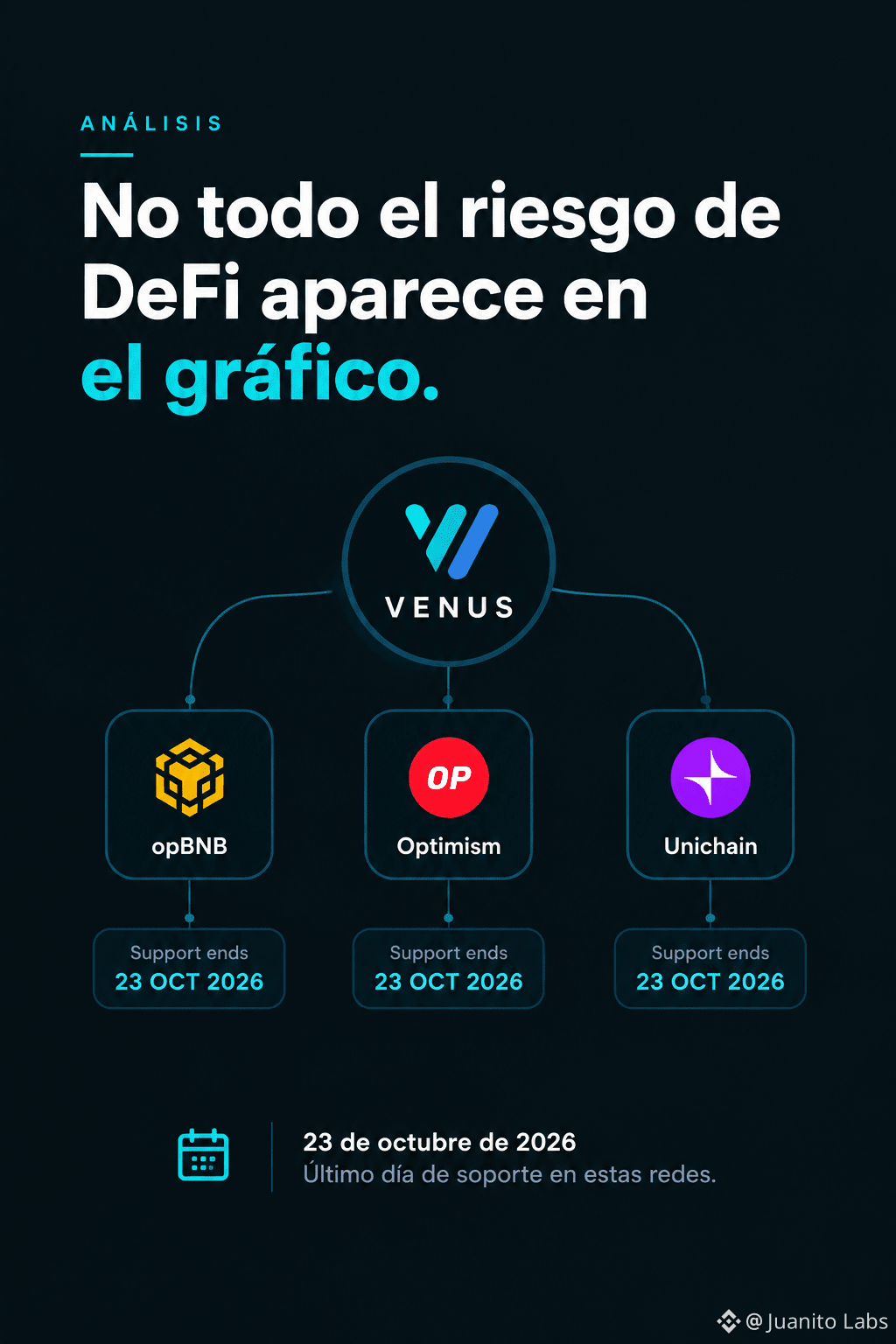
Venus will stop supporting opBNB, Optimism, and Unichain on October 23, 2026.
Why? Because activity on those networks no longer seems to justify the cost of maintaining them.
And this is where it becomes important for users.
If you have funds supplied or open loans on Venus on any of these networks, you’ll need to close or migrate your positions and withdraw your funds before the shutdown.
This doesn’t mean Venus will automatically liquidate everyone. In fact, the process is designed to reduce positions progressively and avoid forced liquidations.
But think about what that means:
A strategy that works today may stop being available simply because the protocol decided to stop maintaining that infrastructure.
And that’s something we often forget when talking about Web3.
DeFi also needs maintenance.
It also has costs.
It also has governance.
And it can also make decisions that directly affect people who use the protocol.
Next time you see a token moving, remember that the chart only tells part of the story.
{spot}(XVSUSDT)
$XVS No todo the risk of DeFi appears in the chart.
Sometimes we talk about crypto as if it were all about buying a token, waiting for it to go up, and selling it.
But behind all that are protocols, networks, liquidity, oracles, smart contracts, and decisions that can completely change the rules of the game.
Look at what’s happening with Venus Protocol.
Venus will stop supporting opBNB, Optimism, and Unichain on October 23, 2026.
Why? Because activity on those networks no longer seems to justify the cost of maintaining them.
And this is where it becomes important for users.
If you have funds supplied or open loans on Venus on any of these networks, you’ll need to close or migrate your positions and withdraw your funds before the shutdown.
This doesn’t mean Venus will automatically liquidate everyone. In fact, the process is designed to reduce positions progressively and avoid forced liquidations.
But think about what that means:
A strategy that works today may stop being available simply because the protocol decided to stop maintaining that infrastructure.
And that’s something we often forget when talking about Web3.
DeFi also needs maintenance.
It also has costs.
It also has governance.
And it can also make decisions that directly affect people who use the protocol.
Next time you see a token moving, remember that the chart only tells part of the story.
Sometimes we talk about crypto as if it were all about buying a token, waiting for it to go up, and selling it.
But behind all that are protocols, networks, liquidity, oracles, smart contracts, and decisions that can completely change the rules of the game.
Look at what’s happening with Venus Protocol.
Venus will stop supporting opBNB, Optimism, and Unichain on October 23, 2026.
Why? Because activity on those networks no longer seems to justify the cost of maintaining them.
And this is where it becomes important for users.
If you have funds supplied or open loans on Venus on any of these networks, you’ll need to close or migrate your positions and withdraw your funds before the shutdown.
This doesn’t mean Venus will automatically liquidate everyone. In fact, the process is designed to reduce positions progressively and avoid forced liquidations.
But think about what that means:
A strategy that works today may stop being available simply because the protocol decided to stop maintaining that infrastructure.
And that’s something we often forget when talking about Web3.
DeFi also needs maintenance.
It also has costs.
It also has governance.
And it can also make decisions that directly affect people who use the protocol.
Next time you see a token moving, remember that the chart only tells part of the story.
440
·
--
$ZEC concentration of two uncommon readings in the same stretch. The volume of the last hour is 3.04 times the average of the last 20 hours, while its return exceeded the recent reference with a Z-Score of +4.16. This return, significantly deviated from its reference, aligns with the elevated volume activity.
This is not financial advice. Just an educational observation of market data.
$ZEC concentration of two uncommon readings in the same stretch. The volume of the last hour is 3.04 times the average of the last 20 hours, while its return exceeded the recent reference with a Z-Score of +4.16. This return, significantly deviated from its reference, aligns with the elevated volume activity.
This is not financial advice. Just an educational observation of market data.
This is not financial advice. Just an educational observation of market data.
719
·
--
Bullish
$PEPE a $1, the illusion of many and the reality of NADIE.
Every so often I see the same idea "If PEPE hits $1, I’ll retire.”
And I understand where it comes from. When you see that a token costs a few-millionths of a dollar, it’s very easy to imagine what would happen to your coins if one day they were worth $1.
The problem is that we’re looking at the price of a single unit, when we should be looking at how much the whole project would need to be worth.
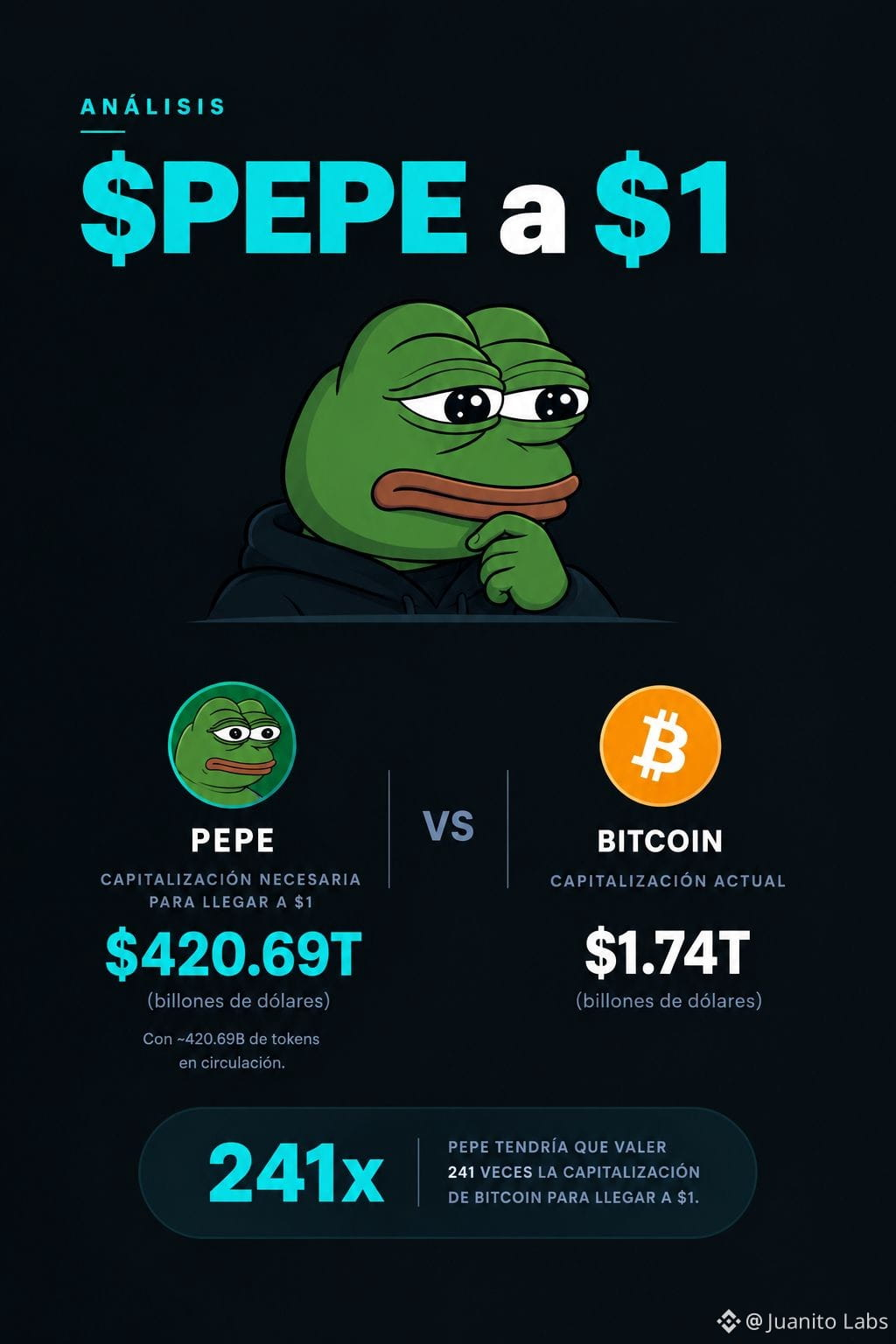
Currently there are around 420.69 trillion PEPE in circulation. If each one reached $1, PEPE would have a market capitalization of approximately $420.69 trillion.
To put that number in context:
Bitcoin is currently around $1.74 trillion in market cap.
PEPE would need to be worth approximately 241 times the current market cap of $BTC for each PEPE to cost $1.
And there’s something even more interesting: no other cryptocurrency has managed to surpass Bitcoin’s market cap. Bitcoin is still by far the most highly valued crypto asset.
The problem shows up when greed starts replacing analysis, and we stop asking what would need to happen for our expectation to come true.
Waiting years for those $1 because “it has to get there someday” also has a cost: while you wait for an extremely demanding possibility, you could be ignoring other projects, other cycles, and other opportunities that actually fit a more realistic valuation.
You don’t need a token to reach $1 to make money—you need to understand what you’re buying, what it’s worth, and what would need to happen for your expectation to make sense.
The market can surprise us.
But it shouldn’t force us to ignore the math.
{spot}(PEPEUSDT)
$PEPE a $1, the illusion of many and the reality of NADIE.
Every so often I see the same idea "If PEPE hits $1, I’ll retire.”
And I understand where it comes from. When you see that a token costs a few-millionths of a dollar, it’s very easy to imagine what would happen to your coins if one day they were worth $1.
The problem is that we’re looking at the price of a single unit, when we should be looking at how much the whole project would need to be worth.
Currently there are around 420.69 trillion PEPE in circulation. If each one reached $1, PEPE would have a market capitalization of approximately $420.69 trillion.
To put that number in context:
Bitcoin is currently around $1.74 trillion in market cap.
PEPE would need to be worth approximately 241 times the current market cap of $BTC for each PEPE to cost $1.
And there’s something even more interesting: no other cryptocurrency has managed to surpass Bitcoin’s market cap. Bitcoin is still by far the most highly valued crypto asset.
The problem shows up when greed starts replacing analysis, and we stop asking what would need to happen for our expectation to come true.
Waiting years for those $1 because “it has to get there someday” also has a cost: while you wait for an extremely demanding possibility, you could be ignoring other projects, other cycles, and other opportunities that actually fit a more realistic valuation.
You don’t need a token to reach $1 to make money—you need to understand what you’re buying, what it’s worth, and what would need to happen for your expectation to make sense.
The market can surprise us.
But it shouldn’t force us to ignore the math.
Every so often I see the same idea "If PEPE hits $1, I’ll retire.”
And I understand where it comes from. When you see that a token costs a few-millionths of a dollar, it’s very easy to imagine what would happen to your coins if one day they were worth $1.
The problem is that we’re looking at the price of a single unit, when we should be looking at how much the whole project would need to be worth.
Currently there are around 420.69 trillion PEPE in circulation. If each one reached $1, PEPE would have a market capitalization of approximately $420.69 trillion.
To put that number in context:
Bitcoin is currently around $1.74 trillion in market cap.
PEPE would need to be worth approximately 241 times the current market cap of $BTC for each PEPE to cost $1.
And there’s something even more interesting: no other cryptocurrency has managed to surpass Bitcoin’s market cap. Bitcoin is still by far the most highly valued crypto asset.
The problem shows up when greed starts replacing analysis, and we stop asking what would need to happen for our expectation to come true.
Waiting years for those $1 because “it has to get there someday” also has a cost: while you wait for an extremely demanding possibility, you could be ignoring other projects, other cycles, and other opportunities that actually fit a more realistic valuation.
You don’t need a token to reach $1 to make money—you need to understand what you’re buying, what it’s worth, and what would need to happen for your expectation to make sense.
The market can surprise us.
But it shouldn’t force us to ignore the math.
2
1
12
4.4k
·
--
$KERNEL shows two highlighted readings. The relative volume of the last hour surged to 6.67 times the average of the last 20 hours. In addition, the close surpassed the maximum of the last 90 days, marking a key moment in its performance.
This is not financial advice. Only an educational observation of market data.
$KERNEL shows two highlighted readings. The relative volume of the last hour surged to 6.67 times the average of the last 20 hours. In addition, the close surpassed the maximum of the last 90 days, marking a key moment in its performance.
This is not financial advice. Only an educational observation of market data.
This is not financial advice. Only an educational observation of market data.
450
·
--
Bullish
Verified
This week there are several unlocks worth keeping on your radar.
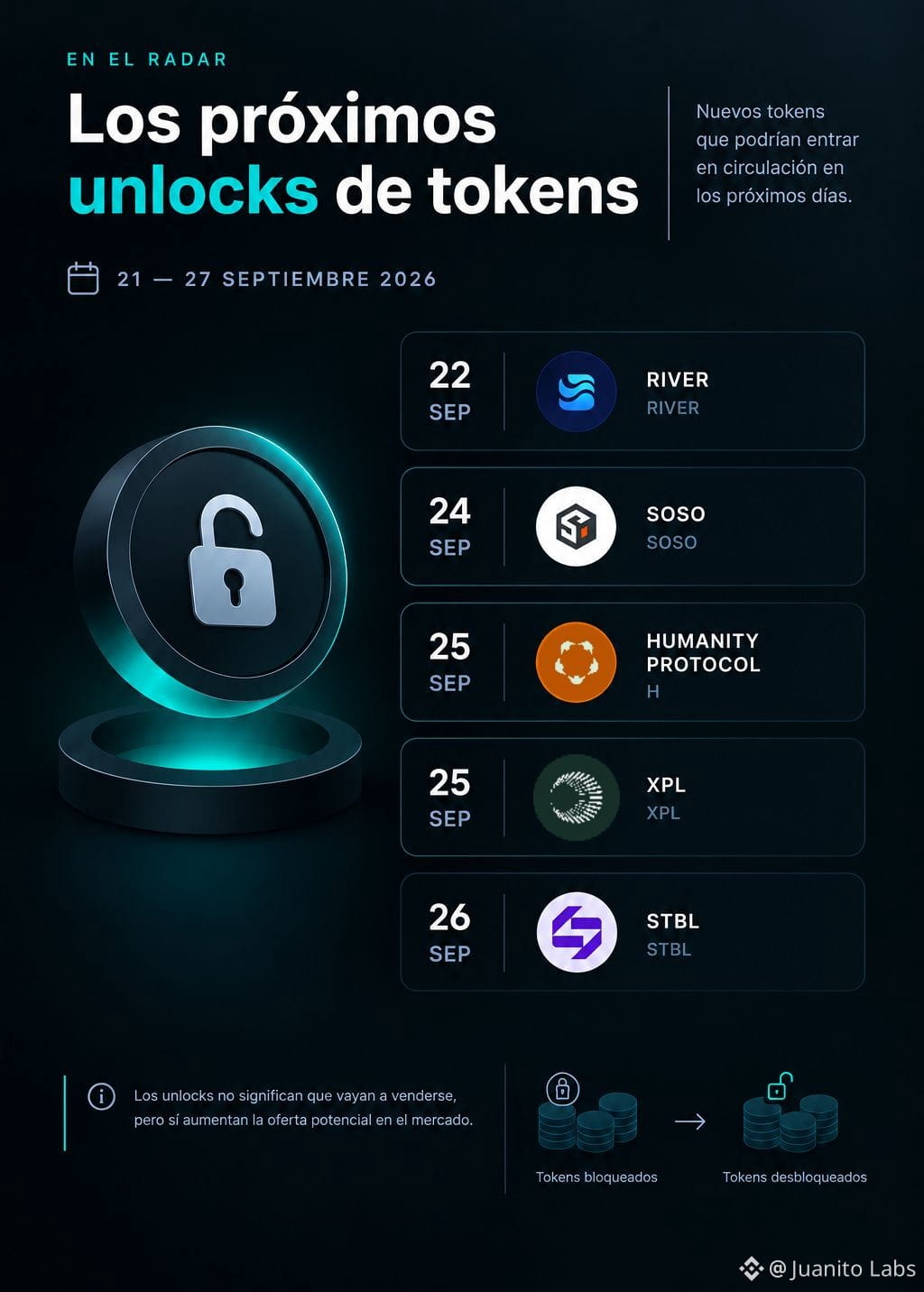
Between September 22 and 26, millions of tokens will be released. Some cases draw special attention:
$RIVER unlocks ~1.56M tokens, valued at about $1.86M
{alpha}(560xda7ad9dea9397cffddae2f8a052b82f1484252b3)
$SOSO ~23.46M (~$6.8M)
$H ~266M (~$19.2M)
$XPL ~1.76B (~$158M)
{spot}(XPLUSDT)
$STBL ~210M (~$5.3M)
{alpha}(560x8dedf84656fa932157e27c060d8613824e7979e3)
And there’s one detail that I think is important: H and XPL have their unlock on the same day, September 25. In the case of XPL, the ~1.76B represents around 63.2% of its circulating supply.
An unlock doesn’t mean those tokens are going to be sold; it simply means they become available. Also, not all of these tokens are listed on Binance Spot; some require other access routes, such as decentralized exchanges. That’s why, if any of them interests you to track, it’s also a good idea to check where they’re actually available and not assume you can buy them directly on Binance.
In the end, an unlock isn’t necessarily a bullish or bearish signal. It’s simply a change in the supply that’s available—something worth knowing before interpreting the chart.
Data: Binance News / Token Unlocks.
This week there are several unlocks worth keeping on your radar.
Between September 22 and 26, millions of tokens will be released. Some cases draw special attention:
$RIVER unlocks ~1.56M tokens, valued at about $1.86M
$SOSO ~23.46M (~$6.8M)
$H ~266M (~$19.2M)
$XPL ~1.76B (~$158M)
$STBL ~210M (~$5.3M)
And there’s one detail that I think is important: H and XPL have their unlock on the same day, September 25. In the case of XPL, the ~1.76B represents around 63.2% of its circulating supply.
An unlock doesn’t mean those tokens are going to be sold; it simply means they become available. Also, not all of these tokens are listed on Binance Spot; some require other access routes, such as decentralized exchanges. That’s why, if any of them interests you to track, it’s also a good idea to check where they’re actually available and not assume you can buy them directly on Binance.
In the end, an unlock isn’t necessarily a bullish or bearish signal. It’s simply a change in the supply that’s available—something worth knowing before interpreting the chart.
Data: Binance News / Token Unlocks.
Between September 22 and 26, millions of tokens will be released. Some cases draw special attention:
$RIVER unlocks ~1.56M tokens, valued at about $1.86M
$SOSO ~23.46M (~$6.8M)
$H ~266M (~$19.2M)
$XPL ~1.76B (~$158M)
$STBL ~210M (~$5.3M)
And there’s one detail that I think is important: H and XPL have their unlock on the same day, September 25. In the case of XPL, the ~1.76B represents around 63.2% of its circulating supply.
An unlock doesn’t mean those tokens are going to be sold; it simply means they become available. Also, not all of these tokens are listed on Binance Spot; some require other access routes, such as decentralized exchanges. That’s why, if any of them interests you to track, it’s also a good idea to check where they’re actually available and not assume you can buy them directly on Binance.
In the end, an unlock isn’t necessarily a bullish or bearish signal. It’s simply a change in the supply that’s available—something worth knowing before interpreting the chart.
Data: Binance News / Token Unlocks.
1.1k
·
--
Verified
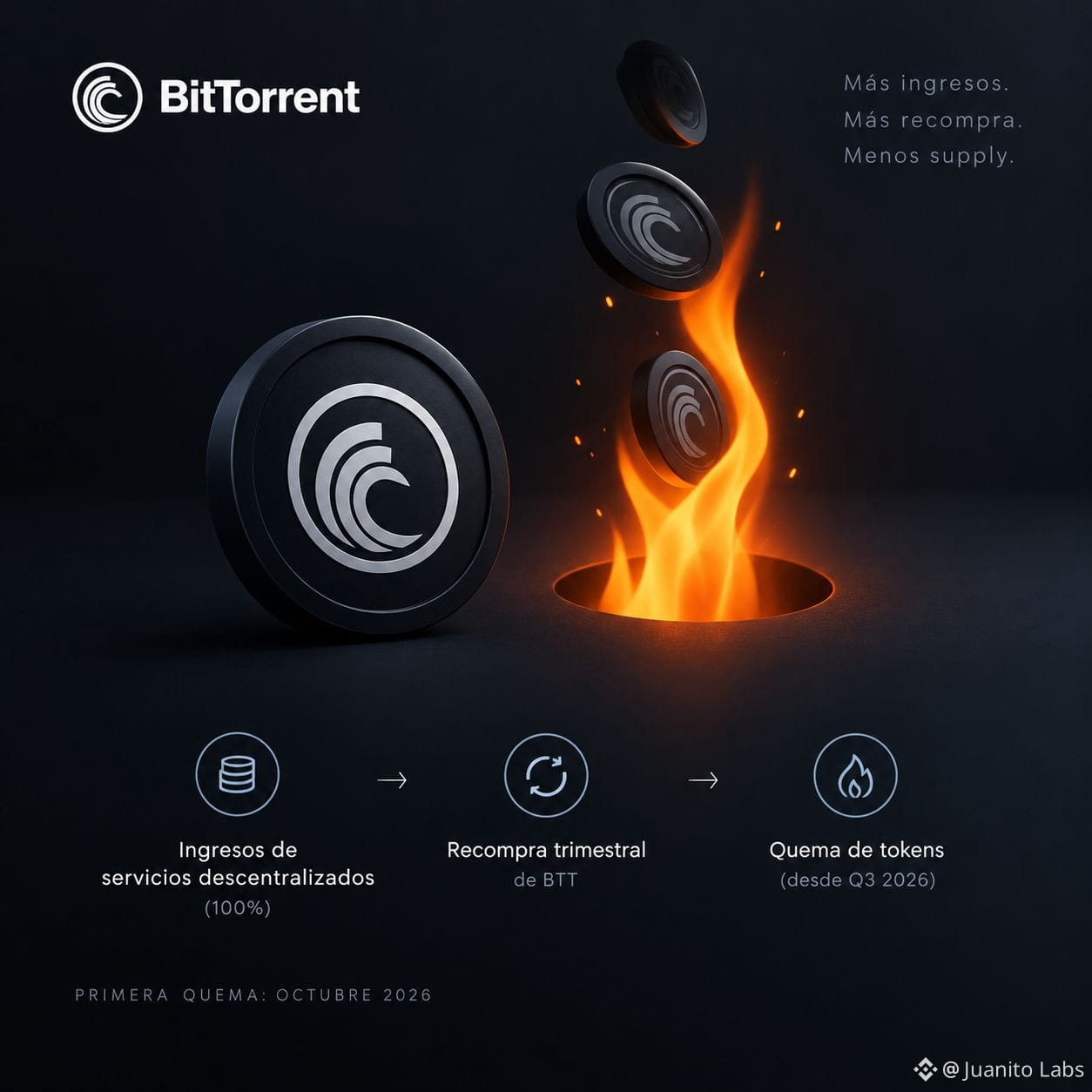
There is something that could change the story of $BTTC
BitTorrent announced a buyback and burn program in which 100% of the revenue from its decentralized services will be used to repurchase BTTC each quarter. Then, those tokens will be burned.
The first burn is scheduled for October.
And here is what I find interesting: with nearly 987 billion BTTC in circulation, we still don't know how much supply this mechanism will actually be able to remove.
If the first burn turns out to be significant, the story of BTT could start to look different. If it ends up being small compared to its massive supply, that will also be an important signal.
October should give us the first real data!
{spot}(BTTCUSDT)
There is something that could change the story of $BTTC
BitTorrent announced a buyback and burn program in which 100% of the revenue from its decentralized services will be used to repurchase BTTC each quarter. Then, those tokens will be burned.
The first burn is scheduled for October.
And here is what I find interesting: with nearly 987 billion BTTC in circulation, we still don't know how much supply this mechanism will actually be able to remove.
If the first burn turns out to be significant, the story of BTT could start to look different. If it ends up being small compared to its massive supply, that will also be an important signal.
October should give us the first real data!
BitTorrent announced a buyback and burn program in which 100% of the revenue from its decentralized services will be used to repurchase BTTC each quarter. Then, those tokens will be burned.
The first burn is scheduled for October.
And here is what I find interesting: with nearly 987 billion BTTC in circulation, we still don't know how much supply this mechanism will actually be able to remove.
If the first burn turns out to be significant, the story of BTT could start to look different. If it ends up being small compared to its massive supply, that will also be an important signal.
October should give us the first real data!
4
18
3.4k
·
--
$AVAX acaba of experiencing an unusual movement in the final stretch. Its performance is about 22.0 pp above BTC in approximately 24 hours, highlighting a notable trend compared to its usual benchmark.
This is not financial advice. Just an educational observation of market data.
$AVAX acaba of experiencing an unusual movement in the final stretch. Its performance is about 22.0 pp above BTC in approximately 24 hours, highlighting a notable trend compared to its usual benchmark.
This is not financial advice. Just an educational observation of market data.
This is not financial advice. Just an educational observation of market data.
2
591
·
--
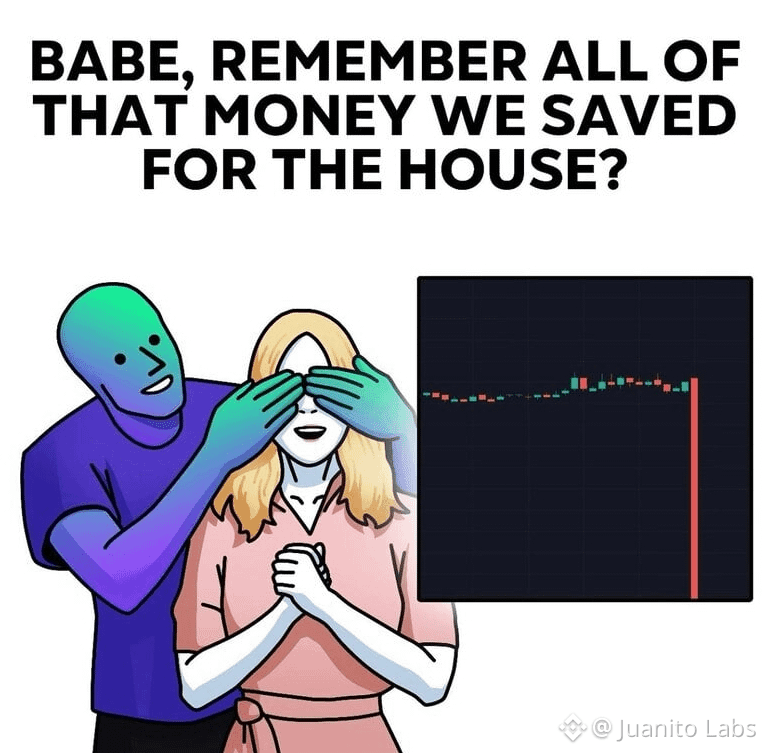
The same chart can tell completely different stories.
With $LSK someone who was inside for the $0.10 could see a rise up to $0.80 and even after a strong correction, still remain well above their initial price.
But someone who entered near $0.80 saw the exact same movement… from the other side.
The price is the same for everyone. The story depends on when you arrived, and the blame isn’t on the market—it’s only on your decisions (for better or worse).
{spot}(LSKUSDT)
The same chart can tell completely different stories.
With $LSK someone who was inside for the $0.10 could see a rise up to $0.80 and even after a strong correction, still remain well above their initial price.
But someone who entered near $0.80 saw the exact same movement… from the other side.
The price is the same for everyone. The story depends on when you arrived, and the blame isn’t on the market—it’s only on your decisions (for better or worse).
With $LSK someone who was inside for the $0.10 could see a rise up to $0.80 and even after a strong correction, still remain well above their initial price.
But someone who entered near $0.80 saw the exact same movement… from the other side.
The price is the same for everyone. The story depends on when you arrived, and the blame isn’t on the market—it’s only on your decisions (for better or worse).
2k
·
--
The movement of $F stands out for a volume that exceeds its usual activity. In the last hour, the relative volume reached 3.49 times the average of the past 20 hours, while volatility also increased, being 2.57 times higher than that of the week. This combination of factors indicates an unusual situation in the market, although the extreme reading could reflect low volatility as a reference.
This is not financial advice. Just an educational observation of market data.
The movement of $F stands out for a volume that exceeds its usual activity. In the last hour, the relative volume reached 3.49 times the average of the past 20 hours, while volatility also increased, being 2.57 times higher than that of the week. This combination of factors indicates an unusual situation in the market, although the extreme reading could reflect low volatility as a reference.
This is not financial advice. Just an educational observation of market data.
This is not financial advice. Just an educational observation of market data.
271
·
--
The volume of $SYN ha has experienced a notable increase, standing out above its recent activity. Over the last four hours, three have closed higher, reflecting bullish persistence. This trend has generated renewed interest in the asset.
This is not financial advice. Just educational observation of market data.
The volume of $SYN ha has experienced a notable increase, standing out above its recent activity. Over the last four hours, three have closed higher, reflecting bullish persistence. This trend has generated renewed interest in the asset.
This is not financial advice. Just educational observation of market data.
This is not financial advice. Just educational observation of market data.
510
·
--
$C acaba to break through a key level in its structure. The volume of the last hour is 12.90 times the average of the last 20 hours, an indication of intense activity that exceeds the usual.
This is not financial advice. Only educational observation of market data.
$C acaba to break through a key level in its structure. The volume of the last hour is 12.90 times the average of the last 20 hours, an indication of intense activity that exceeds the usual.
This is not financial advice. Only educational observation of market data.
This is not financial advice. Only educational observation of market data.
166
·
--
$NEAR concentrates on two uncommon readings in the same stretch. Its performance has outperformed BTC by 23.6 pp in approximately 24 hours, a notable contrast in its performance versus other cryptocurrencies. This kind of move highlights attention in its recent activity.
This is not financial advice. Just educational observation of market data.
$NEAR concentrates on two uncommon readings in the same stretch. Its performance has outperformed BTC by 23.6 pp in approximately 24 hours, a notable contrast in its performance versus other cryptocurrencies. This kind of move highlights attention in its recent activity.
This is not financial advice. Just educational observation of market data.
This is not financial advice. Just educational observation of market data.
430
·
--
In $GENIUS two interesting readings coincide now. The return of the last hour ended up above its recent reference, with a Z-Score of +3.16. In addition, the recent volatility is 2.62 times that of the week.
This is not financial advice. Just an educational observation of market data.
In $GENIUS two interesting readings coincide now. The return of the last hour ended up above its recent reference, with a Z-Score of +3.16. In addition, the recent volatility is 2.62 times that of the week.
This is not financial advice. Just an educational observation of market data.
This is not financial advice. Just an educational observation of market data.
122
·
--
$COTI currently shows two notable readings. The close has surpassed the maximum of the past 90 days, while the return over the last hour is above its recent reference with a Z-Score of +3.25, indicating performance that is unusual.
This is not financial advice. Just an educational observation of market data.
$COTI currently shows two notable readings. The close has surpassed the maximum of the past 90 days, while the return over the last hour is above its recent reference with a Z-Score of +3.25, indicating performance that is unusual.
This is not financial advice. Just an educational observation of market data.
This is not financial advice. Just an educational observation of market data.
367
Log in to explore more content
Join global crypto users on Binance Square
⚡️ Get latest and useful information about crypto.
💬 Trusted by the world’s largest crypto exchange.
👍 Discover real insights from verified creators.
Email / Phone number