

疯狂的Jerrick
759 Posts

疯狂的Jerrick
Report
Block User
前微软高管|前欣旺达高管|独立交易者|实盘在公域
交易没有少走的弯路,但凡少走一点,你都走不出来。
There are no avoidable detours in trading. Skip even one, and you’d never make it through.
欢迎关注,每天都有一些手搓的交易感悟!
Open Trade

BNB Holder
High-Frequency Trader
8.4 Years
90 Following
4.8K+ Followers
878 Liked
Posts
Portfolio
All
Quotes
Videos
Live
PINNED
·
--

Article
Challenge Account Backtest: 70% Drawdown—Blood and Tears Recap, Summary of 5 Fatal Mistakes!Today, I’m going back to review and recap the issue of the challenge account dropping by 70%.
1. You grab too many of the so-called “shanzhai” coins at the same time, and you also don’t test their liquidity. Some of these coins have very poor liquidity and can be easily broken through. Then, with one big needle move, the slippage is extremely severe—especially those I thought were still at a low position, about to complete a catch-up rally. They can be wiped out in one pot very easily. For example: I saw that within Chinese listings, Binance Life had started rising, but the “lobster” and me—f*cking—were still at a low level, and there were signs it was about to move up. So I bided my time at the low level. But I also set my stop-loss too wide, so once the big cake starts poking needles, these coins that are still low get poked even harder. The stop-loss and slippage are still too large. The lesson here is: don’t hold too many shanzhai coins at the same time. Low-position shanzhai coins usually have terrible liquidity, so you need to be cautious when holding them.
Challenge Account Backtest: 70% Drawdown—Blood and Tears Recap, Summary of 5 Fatal Mistakes!
Today, I’m going back to review and recap the issue of the challenge account dropping by 70%.
1. You grab too many of the so-called “shanzhai” coins at the same time, and you also don’t test their liquidity. Some of these coins have very poor liquidity and can be easily broken through. Then, with one big needle move, the slippage is extremely severe—especially those I thought were still at a low position, about to complete a catch-up rally. They can be wiped out in one pot very easily. For example: I saw that within Chinese listings, Binance Life had started rising, but the “lobster” and me—f*cking—were still at a low level, and there were signs it was about to move up. So I bided my time at the low level. But I also set my stop-loss too wide, so once the big cake starts poking needles, these coins that are still low get poked even harder. The stop-loss and slippage are still too large. The lesson here is: don’t hold too many shanzhai coins at the same time. Low-position shanzhai coins usually have terrible liquidity, so you need to be cautious when holding them.
1. You grab too many of the so-called “shanzhai” coins at the same time, and you also don’t test their liquidity. Some of these coins have very poor liquidity and can be easily broken through. Then, with one big needle move, the slippage is extremely severe—especially those I thought were still at a low position, about to complete a catch-up rally. They can be wiped out in one pot very easily. For example: I saw that within Chinese listings, Binance Life had started rising, but the “lobster” and me—f*cking—were still at a low level, and there were signs it was about to move up. So I bided my time at the low level. But I also set my stop-loss too wide, so once the big cake starts poking needles, these coins that are still low get poked even harder. The stop-loss and slippage are still too large. The lesson here is: don’t hold too many shanzhai coins at the same time. Low-position shanzhai coins usually have terrible liquidity, so you need to be cautious when holding them.
6
2
5
2.8k
·
--
Bearish
I thought I’d figured it out. Turns out, I hadn’t!
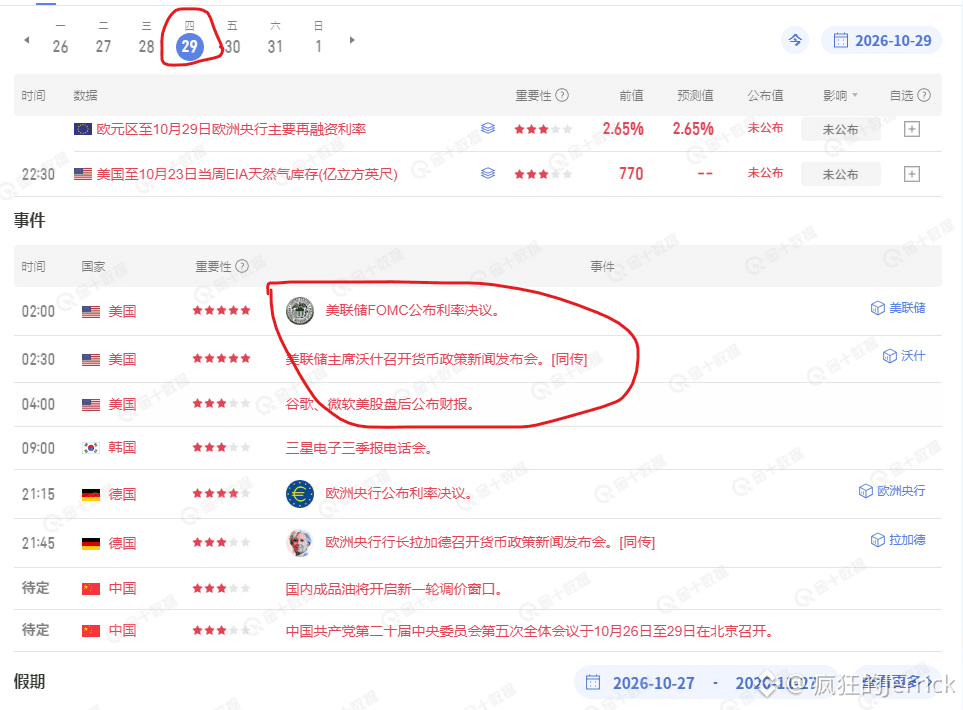
The indices and Bitcoin are both waiting for Wednesday’s macroeconomic data release.
So over the past couple of days,
things have mostly been moving sideways,
and a big move seems unlikely.
Those of you holding positions are probably feeling pretty conflicted.
As for me:
last night, I got shaken out by a bit of volatility that now looks insignificant.
And it feels awful.
I was fully loaded with short positions,
but now I’m trying to figure out where I can find a good spot to get back in.
This morning, I opened a short position,
but after thinking it over,
I closed it all out again.
Why is trading so hard?
The hard part is,
you think you’ve finally figured it out.
Then you dive back into the market,
and it still tosses you around until you’re battered and bruised.
To put it in plain terms,
when I thought I was about to start trading long-term,
and catch the big swings,
I got shaken out by the little fluctuations in the candlestick patterns I saw along the way.
Why are the great traders so great?
Why are people who can compound their positions all so perceptive
and technically skilled?
I feel like I understand it a little better now.
#Strategy未购比特币斥资2.05亿美元回购STRC
I thought I’d figured it out. Turns out, I hadn’t!
The indices and Bitcoin are both waiting for Wednesday’s macroeconomic data release.
So over the past couple of days,
things have mostly been moving sideways,
and a big move seems unlikely.
Those of you holding positions are probably feeling pretty conflicted.
As for me:
last night, I got shaken out by a bit of volatility that now looks insignificant.
And it feels awful.
I was fully loaded with short positions,
but now I’m trying to figure out where I can find a good spot to get back in.
This morning, I opened a short position,
but after thinking it over,
I closed it all out again.
Why is trading so hard?
The hard part is,
you think you’ve finally figured it out.
Then you dive back into the market,
and it still tosses you around until you’re battered and bruised.
To put it in plain terms,
when I thought I was about to start trading long-term,
and catch the big swings,
I got shaken out by the little fluctuations in the candlestick patterns I saw along the way.
Why are the great traders so great?
Why are people who can compound their positions all so perceptive
and technically skilled?
I feel like I understand it a little better now.
#Strategy未购比特币斥资2.05亿美元回购STRC
The indices and Bitcoin are both waiting for Wednesday’s macroeconomic data release.
So over the past couple of days,
things have mostly been moving sideways,
and a big move seems unlikely.
Those of you holding positions are probably feeling pretty conflicted.
As for me:
last night, I got shaken out by a bit of volatility that now looks insignificant.
And it feels awful.
I was fully loaded with short positions,
but now I’m trying to figure out where I can find a good spot to get back in.
This morning, I opened a short position,
but after thinking it over,
I closed it all out again.
Why is trading so hard?
The hard part is,
you think you’ve finally figured it out.
Then you dive back into the market,
and it still tosses you around until you’re battered and bruised.
To put it in plain terms,
when I thought I was about to start trading long-term,
and catch the big swings,
I got shaken out by the little fluctuations in the candlestick patterns I saw along the way.
Why are the great traders so great?
Why are people who can compound their positions all so perceptive
and technically skilled?
I feel like I understand it a little better now.
#Strategy未购比特币斥资2.05亿美元回购STRC
1
279
·
--
Bearish
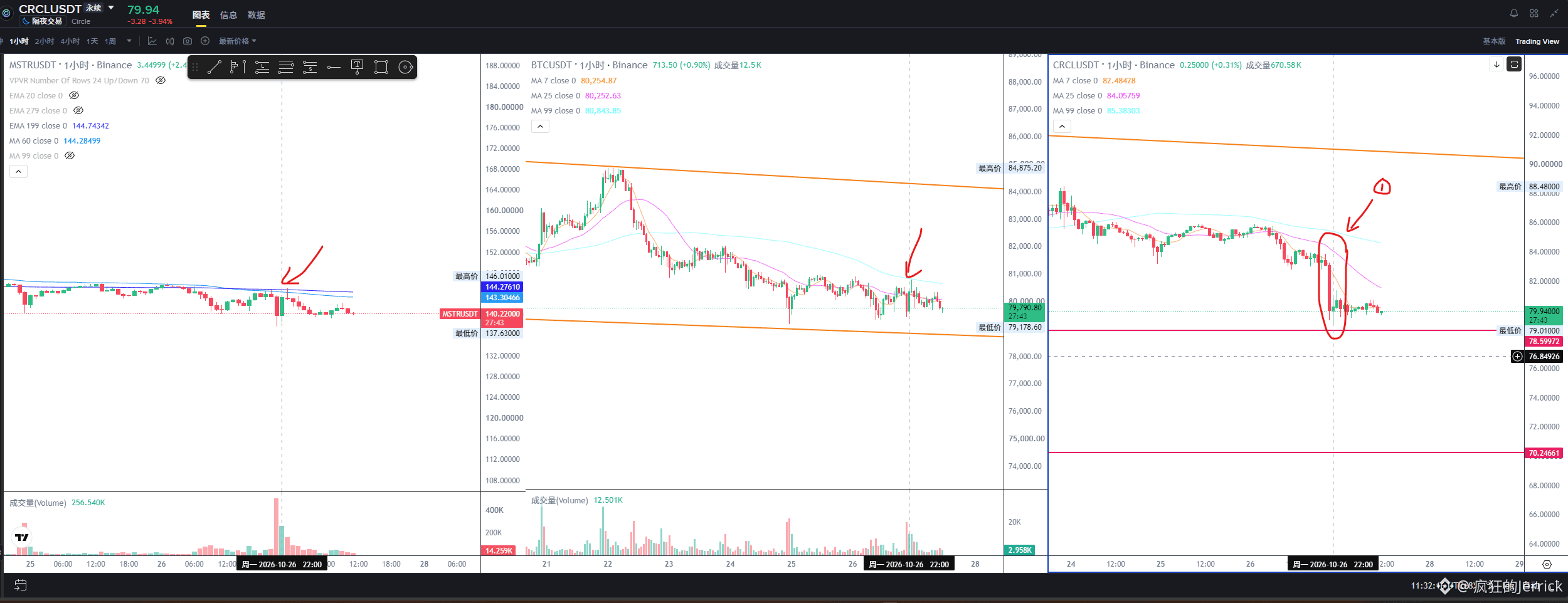
I’ve noticed a few patterns with MSTR vs. CIRCL vs. BTC.
1. When Bitcoin goes up, MSTR and CIRCL rise about twice as much as Bitcoin. When they fall, they also drop about twice as much.
2. In other words, in a strong market, if Bitcoin makes a new low but MSTR doesn’t, that could mean the bottom is in.
3. If a reversal is forming, the four-hour or one-hour chart patterns for CIRCL, MSTR, and BTC will be about 90% consistent. If even one of them doesn’t line up, there’s a good chance the price will continue in the direction of the existing four-hour trend. For example, in the chart, both MSTR and BTC formed a strong bullish engulfing candle at an important level, but Circle didn’t. So if the existing four-hour trend is bearish, I’d still expect the price to continue following that bearish trend.
So here’s the trading plan:
If Bitcoin takes a huge dive, keep a close eye on whether CIRCL and MSTR make new lows after Bitcoin hits a recent low. If they don’t, buy MSTR. I’ll start with a 5x leveraged position!
If you enjoyed this, feel free to like and comment. I share hand-written trading insights every day!
#Strategy未购比特币斥资2.05亿美元回购STRC
$MSTR
$BTC
{future}(BTCUSDT)
I’ve noticed a few patterns with MSTR vs. CIRCL vs. BTC.
1. When Bitcoin goes up, MSTR and CIRCL rise about twice as much as Bitcoin. When they fall, they also drop about twice as much.
2. In other words, in a strong market, if Bitcoin makes a new low but MSTR doesn’t, that could mean the bottom is in.
3. If a reversal is forming, the four-hour or one-hour chart patterns for CIRCL, MSTR, and BTC will be about 90% consistent. If even one of them doesn’t line up, there’s a good chance the price will continue in the direction of the existing four-hour trend. For example, in the chart, both MSTR and BTC formed a strong bullish engulfing candle at an important level, but Circle didn’t. So if the existing four-hour trend is bearish, I’d still expect the price to continue following that bearish trend.
So here’s the trading plan:
If Bitcoin takes a huge dive, keep a close eye on whether CIRCL and MSTR make new lows after Bitcoin hits a recent low. If they don’t, buy MSTR. I’ll start with a 5x leveraged position!
If you enjoyed this, feel free to like and comment. I share hand-written trading insights every day!
#Strategy未购比特币斥资2.05亿美元回购STRC
$MSTR
$BTC
1. When Bitcoin goes up, MSTR and CIRCL rise about twice as much as Bitcoin. When they fall, they also drop about twice as much.
2. In other words, in a strong market, if Bitcoin makes a new low but MSTR doesn’t, that could mean the bottom is in.
3. If a reversal is forming, the four-hour or one-hour chart patterns for CIRCL, MSTR, and BTC will be about 90% consistent. If even one of them doesn’t line up, there’s a good chance the price will continue in the direction of the existing four-hour trend. For example, in the chart, both MSTR and BTC formed a strong bullish engulfing candle at an important level, but Circle didn’t. So if the existing four-hour trend is bearish, I’d still expect the price to continue following that bearish trend.
So here’s the trading plan:
If Bitcoin takes a huge dive, keep a close eye on whether CIRCL and MSTR make new lows after Bitcoin hits a recent low. If they don’t, buy MSTR. I’ll start with a 5x leveraged position!
If you enjoyed this, feel free to like and comment. I share hand-written trading insights every day!
#Strategy未购比特币斥资2.05亿美元回购STRC
$MSTR
$BTC
1
533
·
--

Article
After watching so many top traders, you’ll find that the word they talk about most is “waiting”!In this market, everyone you think has top-tier predictive abilities is actually a top-tier trader.
The effort they put in behind the scenes is probably beyond what most people can imagine.
Aoying has spent 48 hours monitoring the charts nonstop.
GCR spends more than 120 hours every week honing his craft.
Bitcoin Emperor can identify the approximate future trend at any point on any 15-minute candlestick chart in history.
Every trader’s journey is a lonely one,
No top trader’s journey has ever been smooth sailing.
It’s these huge ups and downs, these major drawdowns, that can lead to profound realizations,
After watching so many top traders, you’ll find that the word they talk about most is “waiting”!
In this market, everyone you think has top-tier predictive abilities is actually a top-tier trader.
The effort they put in behind the scenes is probably beyond what most people can imagine.
Aoying has spent 48 hours monitoring the charts nonstop.
GCR spends more than 120 hours every week honing his craft.
Bitcoin Emperor can identify the approximate future trend at any point on any 15-minute candlestick chart in history.
Every trader’s journey is a lonely one,
No top trader’s journey has ever been smooth sailing.
It’s these huge ups and downs, these major drawdowns, that can lead to profound realizations,
The effort they put in behind the scenes is probably beyond what most people can imagine.
Aoying has spent 48 hours monitoring the charts nonstop.
GCR spends more than 120 hours every week honing his craft.
Bitcoin Emperor can identify the approximate future trend at any point on any 15-minute candlestick chart in history.
Every trader’s journey is a lonely one,
No top trader’s journey has ever been smooth sailing.
It’s these huge ups and downs, these major drawdowns, that can lead to profound realizations,
374
·
--

Article
“It’s impossible to make money trading stocks (or crypto)”—I only began to understand this after reading the Diamond Sutra!Let me explain why I went to read the Diamond Sutra today, and the relationship between trading and the Diamond Sutra!
I’d been watching videos and reading theories about rolling positions lately,
Then I came across a video about stock trading and stumbled upon a completely new theory: Aigu Theory,
It said, “If you can’t understand that ‘it’s impossible to make money trading stocks,’ you’ll end up losing your shirt!”
That completely threw me for a loop.
Because I really couldn’t understand that statement.
I thought it was really profound,
so I went and watched some videos about Aigu Theory,
“It’s impossible to make money trading stocks (or crypto)”—I only began to understand this after reading the Diamond Sutra!
Let me explain why I went to read the Diamond Sutra today, and the relationship between trading and the Diamond Sutra!
I’d been watching videos and reading theories about rolling positions lately,
Then I came across a video about stock trading and stumbled upon a completely new theory: Aigu Theory,
It said, “If you can’t understand that ‘it’s impossible to make money trading stocks,’ you’ll end up losing your shirt!”
That completely threw me for a loop.
Because I really couldn’t understand that statement.
I thought it was really profound,
so I went and watched some videos about Aigu Theory,
I’d been watching videos and reading theories about rolling positions lately,
Then I came across a video about stock trading and stumbled upon a completely new theory: Aigu Theory,
It said, “If you can’t understand that ‘it’s impossible to make money trading stocks,’ you’ll end up losing your shirt!”
That completely threw me for a loop.
Because I really couldn’t understand that statement.
I thought it was really profound,
so I went and watched some videos about Aigu Theory,
1
223
·
--
Bearish
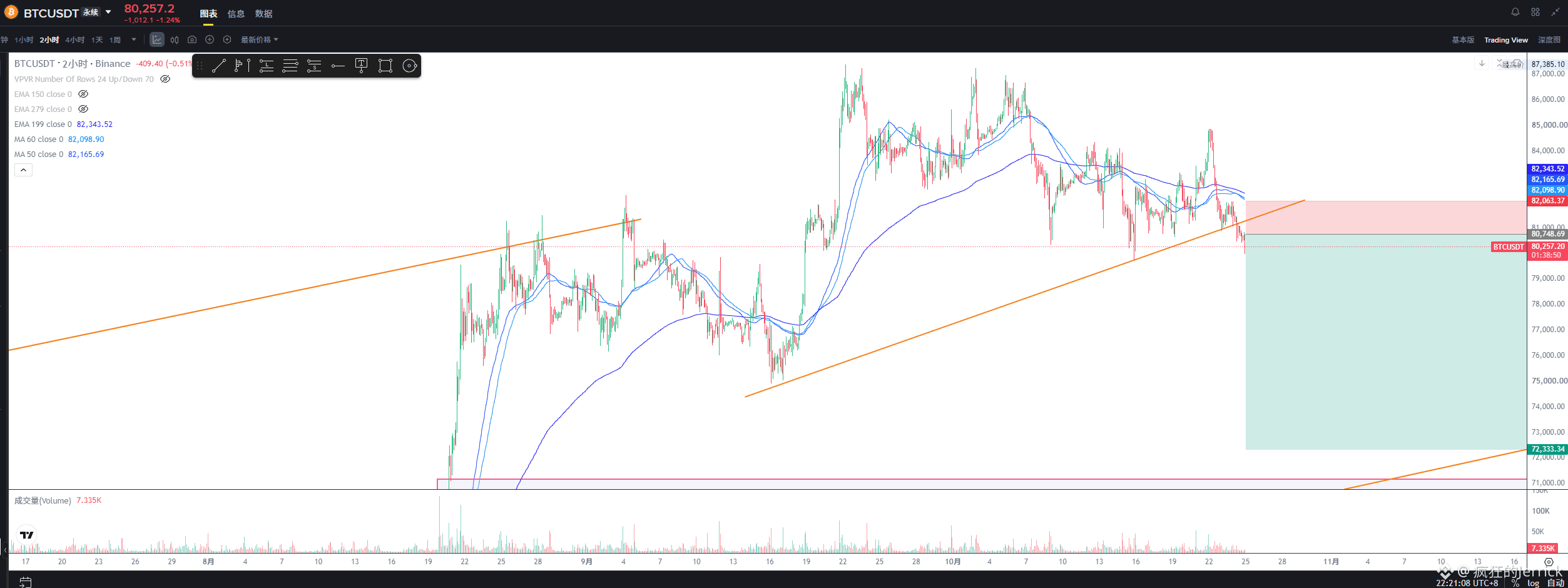
After I posted this morning,
I basically filled up my positions.
Today's price action has been pretty choppy,
but it's still largely in line with our analysis.
It's still following the broader trend,
with a downward chop.
$BTC
The bigger picture will depend on Sunday night and Monday.
After I posted this morning,
I basically filled up my positions.
Today's price action has been pretty choppy,
but it's still largely in line with our analysis.
It's still following the broader trend,
with a downward chop.
$BTC
The bigger picture will depend on Sunday night and Monday.
I basically filled up my positions.
Today's price action has been pretty choppy,
but it's still largely in line with our analysis.
It's still following the broader trend,
with a downward chop.
$BTC
The bigger picture will depend on Sunday night and Monday.
1
2
697
·
--
Bearish
$BTC
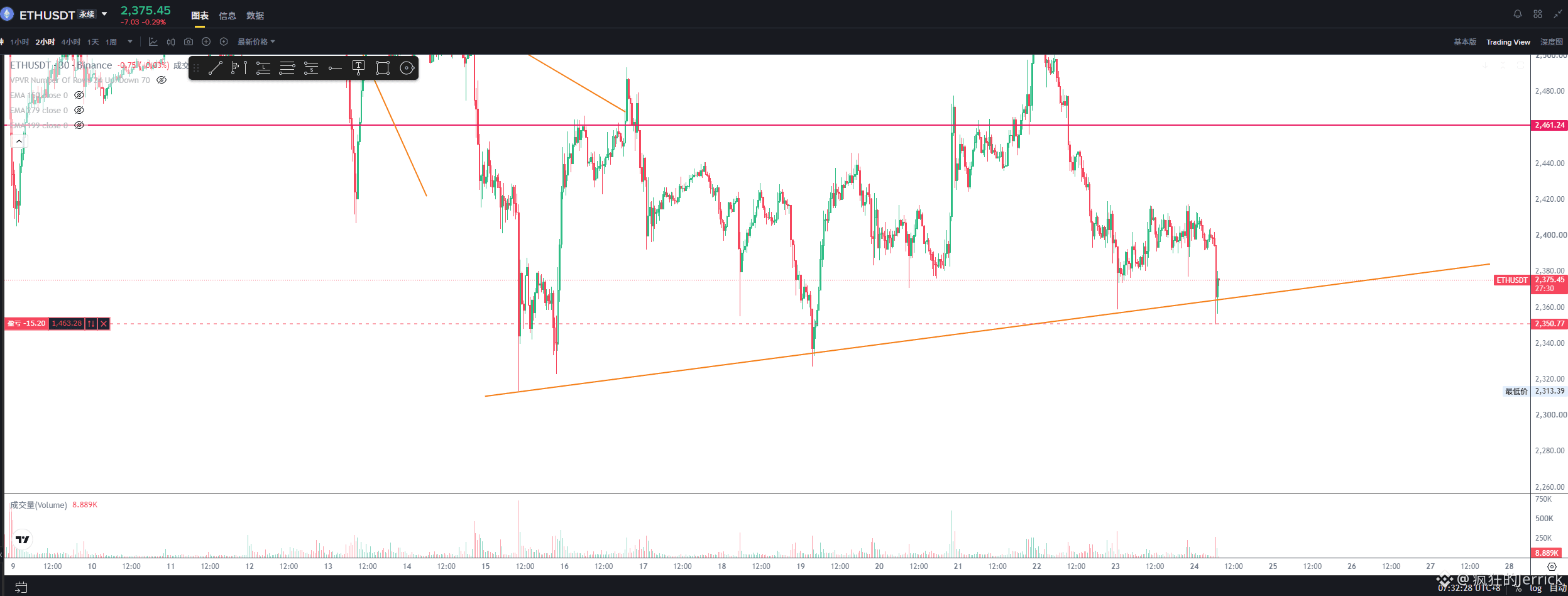
From my perspective, BTC has broken down!
Maybe it's because I posted yesterday about a major shakeout in the crypto market being just around the corner, so I'm especially wary of BTC's drop! But in any case, a lot of people haven't been able to figure out why BTC has been trading sideways at this level for so long.
So many have chosen to wait.
I think waiting is definitely the best choice.
When you can't make sense of the market, just wait.
Wait for a pullback,
wait for the market to choose a direction,
wait for a setup and pattern you recognize,
wait until all the coins start showing the same pattern.
At around 6:50 this morning, I woke up and picked up my phone.
I saw BTC had fallen below 81115,
and my conditional order at 80781 had been filled.
I also checked my ETH conditional order, and that had been filled too.
Both were trend-following short positions.
It's the weekend,
so I'm not sure what liquidity will be like.
Weekends are usually pretty sluggish,
and narrow-range trading is the norm.
There aren't any big institutions at work either,
so I guess we'll have to wait until Monday for a more decisive move down.
The short positions I'm holding have now gone from profit to loss.
Looks like quite a few people are buying the dip here.
But in my view,
the previous period of choppy trading has already worn down the bulls' momentum too much,
so the odds of a V-shaped recovery from here are very low.
The overall trend is still down.
Let's make the most of every step along the way.
If you like this, feel free to leave a like and comment. I share my own trading insights every day!
The challenge to turn 500U into 1M is still on!
#黄金自7月以来首次跌破4000美元
$BTC
From my perspective, BTC has broken down!
Maybe it's because I posted yesterday about a major shakeout in the crypto market being just around the corner, so I'm especially wary of BTC's drop! But in any case, a lot of people haven't been able to figure out why BTC has been trading sideways at this level for so long.
So many have chosen to wait.
I think waiting is definitely the best choice.
When you can't make sense of the market, just wait.
Wait for a pullback,
wait for the market to choose a direction,
wait for a setup and pattern you recognize,
wait until all the coins start showing the same pattern.
At around 6:50 this morning, I woke up and picked up my phone.
I saw BTC had fallen below 81115,
and my conditional order at 80781 had been filled.
I also checked my ETH conditional order, and that had been filled too.
Both were trend-following short positions.
It's the weekend,
so I'm not sure what liquidity will be like.
Weekends are usually pretty sluggish,
and narrow-range trading is the norm.
There aren't any big institutions at work either,
so I guess we'll have to wait until Monday for a more decisive move down.
The short positions I'm holding have now gone from profit to loss.
Looks like quite a few people are buying the dip here.
But in my view,
the previous period of choppy trading has already worn down the bulls' momentum too much,
so the odds of a V-shaped recovery from here are very low.
The overall trend is still down.
Let's make the most of every step along the way.
If you like this, feel free to leave a like and comment. I share my own trading insights every day!
The challenge to turn 500U into 1M is still on!
#黄金自7月以来首次跌破4000美元
From my perspective, BTC has broken down!
Maybe it's because I posted yesterday about a major shakeout in the crypto market being just around the corner, so I'm especially wary of BTC's drop! But in any case, a lot of people haven't been able to figure out why BTC has been trading sideways at this level for so long.
So many have chosen to wait.
I think waiting is definitely the best choice.
When you can't make sense of the market, just wait.
Wait for a pullback,
wait for the market to choose a direction,
wait for a setup and pattern you recognize,
wait until all the coins start showing the same pattern.
At around 6:50 this morning, I woke up and picked up my phone.
I saw BTC had fallen below 81115,
and my conditional order at 80781 had been filled.
I also checked my ETH conditional order, and that had been filled too.
Both were trend-following short positions.
It's the weekend,
so I'm not sure what liquidity will be like.
Weekends are usually pretty sluggish,
and narrow-range trading is the norm.
There aren't any big institutions at work either,
so I guess we'll have to wait until Monday for a more decisive move down.
The short positions I'm holding have now gone from profit to loss.
Looks like quite a few people are buying the dip here.
But in my view,
the previous period of choppy trading has already worn down the bulls' momentum too much,
so the odds of a V-shaped recovery from here are very low.
The overall trend is still down.
Let's make the most of every step along the way.
If you like this, feel free to leave a like and comment. I share my own trading insights every day!
The challenge to turn 500U into 1M is still on!
#黄金自7月以来首次跌破4000美元
1
1.7k
·
--

Article
After All This Waiting, a Major Shakeout in the Crypto Market Is Just Around the Corner!I think a major shakeout in the crypto market is just around the corner!
Several signals I've been watching closely lately suggest that Bitcoin is about to break down sharply,
By a major drop, I mean a move below 74,000 to trigger long stop-losses, followed by consolidation and then an upward breakout.
A historical candlestick pattern worth referencing is the one from March 3 to 10, 2023. Quite a few prominent influencers have mentioned this pattern and its price action. In other words, ever since AI came along, traders across the market have become much better at reading charts and have gained a lot of experience.
The signals mentioned above mainly include the following:
After All This Waiting, a Major Shakeout in the Crypto Market Is Just Around the Corner!
I think a major shakeout in the crypto market is just around the corner!
Several signals I've been watching closely lately suggest that Bitcoin is about to break down sharply,
By a major drop, I mean a move below 74,000 to trigger long stop-losses, followed by consolidation and then an upward breakout.
A historical candlestick pattern worth referencing is the one from March 3 to 10, 2023. Quite a few prominent influencers have mentioned this pattern and its price action. In other words, ever since AI came along, traders across the market have become much better at reading charts and have gained a lot of experience.
The signals mentioned above mainly include the following:
Several signals I've been watching closely lately suggest that Bitcoin is about to break down sharply,
By a major drop, I mean a move below 74,000 to trigger long stop-losses, followed by consolidation and then an upward breakout.
A historical candlestick pattern worth referencing is the one from March 3 to 10, 2023. Quite a few prominent influencers have mentioned this pattern and its price action. In other words, ever since AI came along, traders across the market have become much better at reading charts and have gained a lot of experience.
The signals mentioned above mainly include the following:
588
·
--
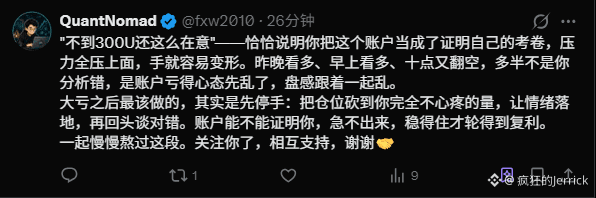
Why do I take a 200U loss so seriously?
First of all, thanks to this friend for showing interest!
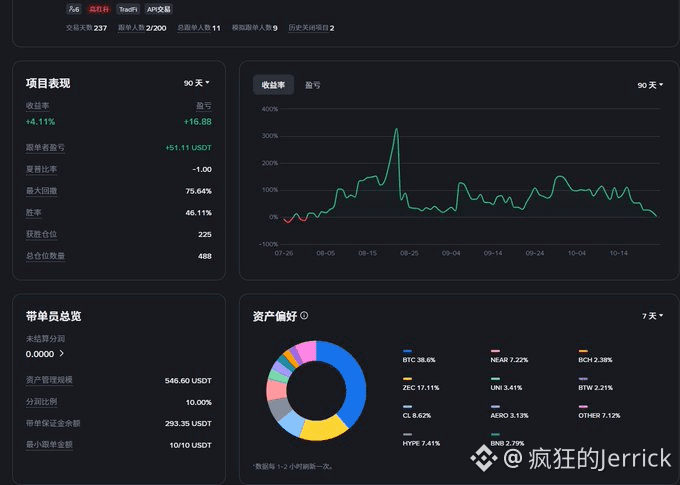
This is a challenge account (a 500U challenge to reach $1M), and it’s my public Binance account. Anyone can view it, and the full position history is available to browse. So it’s basically a live trading account. I don’t have to post on other platforms every day about what trades I opened or how much I made.
I’ve set some milestones for myself ([500U到1M,各里程碑的计划!](https://app.binance.com/uni-qr/cart/359400992590556?l=zh-CN&r=TAR0XN45&uc=web_square_share_link&uco=P270ycDDrJAMd_wjrUng7Q&us=copylink)), and when I reach one, I’ll make a dedicated post about it on my X account.
For many people in crypto, 300U really isn’t much, but for me, it’s already a lot.
I’ve always believed that:
1) If I don’t value small amounts of money, I won’t be able to make big money either.
2) If my trading skills aren’t up to scratch, starting out by putting a lot of money into trading is a huge mistake.
3) It’s been a little over two months since I started this 500U challenge. There have been big losses and big wins along the way, but the equity curve hasn’t reached consistent profitability yet. That means my trading skills still aren’t good enough and need more work.
{future}(BTCUSDT)
4) Losses and drawdowns themselves aren’t important. What matters most is whether I can learn something from each loss and drawdown, and whether I’m improving. That’s what I care about.
5) I’ve also been exploring different approaches during this time. A lot of people say you need to find a trading system that suits your personality. I only formally started two months ago, so that’s still a very short time. This system needs a lot more time and refinement.
6) I’ve always treasured the chance to learn from every excellent trader I’ve come across (Ao Ying, Tony, Fei Zhai, Wu Fan, and other teachers). I hope to learn from them and adapt what I learn to suit myself. Every trader has their own individual path to walk, one that reflects their unique style.
7) I’m actually not under too much pressure. At the end of the day, I’m just not skilled enough yet. I wouldn’t say my execution is distorted, because I don’t think I’ve fully developed as a trader yet.
Hope we can all encourage each other!
Feel free to like and follow. I share some hands-on trading reflections every day!
Why do I take a 200U loss so seriously?
First of all, thanks to this friend for showing interest!
This is a challenge account (a 500U challenge to reach $1M), and it’s my public Binance account. Anyone can view it, and the full position history is available to browse. So it’s basically a live trading account. I don’t have to post on other platforms every day about what trades I opened or how much I made.
I’ve set some milestones for myself (500U到1M,各里程碑的计划!), and when I reach one, I’ll make a dedicated post about it on my X account.
For many people in crypto, 300U really isn’t much, but for me, it’s already a lot.
I’ve always believed that:
1) If I don’t value small amounts of money, I won’t be able to make big money either.
2) If my trading skills aren’t up to scratch, starting out by putting a lot of money into trading is a huge mistake.
3) It’s been a little over two months since I started this 500U challenge. There have been big losses and big wins along the way, but the equity curve hasn’t reached consistent profitability yet. That means my trading skills still aren’t good enough and need more work.
4) Losses and drawdowns themselves aren’t important. What matters most is whether I can learn something from each loss and drawdown, and whether I’m improving. That’s what I care about.
5) I’ve also been exploring different approaches during this time. A lot of people say you need to find a trading system that suits your personality. I only formally started two months ago, so that’s still a very short time. This system needs a lot more time and refinement.
6) I’ve always treasured the chance to learn from every excellent trader I’ve come across (Ao Ying, Tony, Fei Zhai, Wu Fan, and other teachers). I hope to learn from them and adapt what I learn to suit myself. Every trader has their own individual path to walk, one that reflects their unique style.
7) I’m actually not under too much pressure. At the end of the day, I’m just not skilled enough yet. I wouldn’t say my execution is distorted, because I don’t think I’ve fully developed as a trader yet.
Hope we can all encourage each other!
Feel free to like and follow. I share some hands-on trading reflections every day!
First of all, thanks to this friend for showing interest!
This is a challenge account (a 500U challenge to reach $1M), and it’s my public Binance account. Anyone can view it, and the full position history is available to browse. So it’s basically a live trading account. I don’t have to post on other platforms every day about what trades I opened or how much I made.
I’ve set some milestones for myself (500U到1M,各里程碑的计划!), and when I reach one, I’ll make a dedicated post about it on my X account.
For many people in crypto, 300U really isn’t much, but for me, it’s already a lot.
I’ve always believed that:
1) If I don’t value small amounts of money, I won’t be able to make big money either.
2) If my trading skills aren’t up to scratch, starting out by putting a lot of money into trading is a huge mistake.
3) It’s been a little over two months since I started this 500U challenge. There have been big losses and big wins along the way, but the equity curve hasn’t reached consistent profitability yet. That means my trading skills still aren’t good enough and need more work.
4) Losses and drawdowns themselves aren’t important. What matters most is whether I can learn something from each loss and drawdown, and whether I’m improving. That’s what I care about.
5) I’ve also been exploring different approaches during this time. A lot of people say you need to find a trading system that suits your personality. I only formally started two months ago, so that’s still a very short time. This system needs a lot more time and refinement.
6) I’ve always treasured the chance to learn from every excellent trader I’ve come across (Ao Ying, Tony, Fei Zhai, Wu Fan, and other teachers). I hope to learn from them and adapt what I learn to suit myself. Every trader has their own individual path to walk, one that reflects their unique style.
7) I’m actually not under too much pressure. At the end of the day, I’m just not skilled enough yet. I wouldn’t say my execution is distorted, because I don’t think I’ve fully developed as a trader yet.
Hope we can all encourage each other!
Feel free to like and follow. I share some hands-on trading reflections every day!
疯狂的Jerrick
·
--
BearishWhat should we do when we're taking big losses?
I was bullish last night and still bullish this morning, but around ten o’clock I turned completely bearish!
Most of last night’s profits were wiped out by losses or fees! And I could feel it starting to affect my mindset!
My challenge account has hit a new low again recently!
There’s less than 300U left!
A lot of the time, even if I’m making money in my other accounts, I still feel awful if the challenge account is losing!
Because this is the account I trade live with.
Whether I can grow this account is what proves whether my trading skills have improved and whether my trading system works!
That’s why I’ve always cared so much about this account’s profit and loss.
But today it hit another recent low!
All in all,
these are still some of the same old problems!
I don’t want to talk about those old problems today.
I just want to share what I did afterward today and what I learned!
After taking a nap at noon,
I felt like there wasn’t much happening in the market today,
so I hopped on my little electric scooter and went to MixC World.
Then I went to Vector Coffee to look for a book I hadn’t finished reading before—Donald Trump’s Never Give Up.
I could only find an unopened copy,
and the one I’d already started reading was nowhere to be found.
So I thought, I shouldn’t let the trip go to waste. I’d read something related to trading instead!
So I reread The King of Trading, a collection of quotes from Teacher Tony that I’d saved on my phone earlier!
Halfway through, I had a special realization:
When you’re losing, you should read lots of reviews by excellent traders or collections of their quotes!
Because that’s when you’re best able to absorb what you read and relate to it!
Whatever you do, find the right moment to do the things that give you the most value for your effort!
And when you’re losing, your desire to learn is at its strongest. That’s when learning gives you the most value!
That’s when you’re most likely to take in other people’s knowledge and insights and feel a real connection with them!
Trading is about finding the right moment to do the right thing—the thing with the highest probability of success!
Hope we can all learn from one another!
Feel free to like and follow. I share a few candid trading reflections every day!
$BTC
I was bullish last night and still bullish this morning, but around ten o’clock I turned completely bearish!
Most of last night’s profits were wiped out by losses or fees! And I could feel it starting to affect my mindset!
My challenge account has hit a new low again recently!
There’s less than 300U left!
A lot of the time, even if I’m making money in my other accounts, I still feel awful if the challenge account is losing!
Because this is the account I trade live with.
Whether I can grow this account is what proves whether my trading skills have improved and whether my trading system works!
That’s why I’ve always cared so much about this account’s profit and loss.
But today it hit another recent low!
All in all,
these are still some of the same old problems!
I don’t want to talk about those old problems today.
I just want to share what I did afterward today and what I learned!
After taking a nap at noon,
I felt like there wasn’t much happening in the market today,
so I hopped on my little electric scooter and went to MixC World.
Then I went to Vector Coffee to look for a book I hadn’t finished reading before—Donald Trump’s Never Give Up.
I could only find an unopened copy,
and the one I’d already started reading was nowhere to be found.
So I thought, I shouldn’t let the trip go to waste. I’d read something related to trading instead!
So I reread The King of Trading, a collection of quotes from Teacher Tony that I’d saved on my phone earlier!
Halfway through, I had a special realization:
When you’re losing, you should read lots of reviews by excellent traders or collections of their quotes!
Because that’s when you’re best able to absorb what you read and relate to it!
Whatever you do, find the right moment to do the things that give you the most value for your effort!
And when you’re losing, your desire to learn is at its strongest. That’s when learning gives you the most value!
That’s when you’re most likely to take in other people’s knowledge and insights and feel a real connection with them!
Trading is about finding the right moment to do the right thing—the thing with the highest probability of success!
Hope we can all learn from one another!
Feel free to like and follow. I share a few candid trading reflections every day!
$BTC
328
·
--
Bearish
What should we do when we're taking big losses?
I was bullish last night and still bullish this morning, but around ten o’clock I turned completely bearish!
Most of last night’s profits were wiped out by losses or fees! And I could feel it starting to affect my mindset!
My challenge account has hit a new low again recently!
There’s less than 300U left!
A lot of the time, even if I’m making money in my other accounts, I still feel awful if the challenge account is losing!
Because this is the account I trade live with.
Whether I can grow this account is what proves whether my trading skills have improved and whether my trading system works!
That’s why I’ve always cared so much about this account’s profit and loss.
But today it hit another recent low!
All in all,
these are still some of the same old problems!
I don’t want to talk about those old problems today.
I just want to share what I did afterward today and what I learned!
After taking a nap at noon,
I felt like there wasn’t much happening in the market today,
so I hopped on my little electric scooter and went to MixC World.
Then I went to Vector Coffee to look for a book I hadn’t finished reading before—Donald Trump’s Never Give Up.
I could only find an unopened copy,
and the one I’d already started reading was nowhere to be found.
So I thought, I shouldn’t let the trip go to waste. I’d read something related to trading instead!
So I reread The King of Trading, a collection of quotes from Teacher Tony that I’d saved on my phone earlier!
Halfway through, I had a special realization:
When you’re losing, you should read lots of reviews by excellent traders or collections of their quotes!
Because that’s when you’re best able to absorb what you read and relate to it!
Whatever you do, find the right moment to do the things that give you the most value for your effort!
And when you’re losing, your desire to learn is at its strongest. That’s when learning gives you the most value!
That’s when you’re most likely to take in other people’s knowledge and insights and feel a real connection with them!
Trading is about finding the right moment to do the right thing—the thing with the highest probability of success!
Hope we can all learn from one another!
Feel free to like and follow. I share a few candid trading reflections every day!
$BTC
What should we do when we're taking big losses?
I was bullish last night and still bullish this morning, but around ten o’clock I turned completely bearish!
Most of last night’s profits were wiped out by losses or fees! And I could feel it starting to affect my mindset!
My challenge account has hit a new low again recently!
There’s less than 300U left!
A lot of the time, even if I’m making money in my other accounts, I still feel awful if the challenge account is losing!
Because this is the account I trade live with.
Whether I can grow this account is what proves whether my trading skills have improved and whether my trading system works!
That’s why I’ve always cared so much about this account’s profit and loss.
But today it hit another recent low!
All in all,
these are still some of the same old problems!
I don’t want to talk about those old problems today.
I just want to share what I did afterward today and what I learned!
After taking a nap at noon,
I felt like there wasn’t much happening in the market today,
so I hopped on my little electric scooter and went to MixC World.
Then I went to Vector Coffee to look for a book I hadn’t finished reading before—Donald Trump’s Never Give Up.
I could only find an unopened copy,
and the one I’d already started reading was nowhere to be found.
So I thought, I shouldn’t let the trip go to waste. I’d read something related to trading instead!
So I reread The King of Trading, a collection of quotes from Teacher Tony that I’d saved on my phone earlier!
Halfway through, I had a special realization:
When you’re losing, you should read lots of reviews by excellent traders or collections of their quotes!
Because that’s when you’re best able to absorb what you read and relate to it!
Whatever you do, find the right moment to do the things that give you the most value for your effort!
And when you’re losing, your desire to learn is at its strongest. That’s when learning gives you the most value!
That’s when you’re most likely to take in other people’s knowledge and insights and feel a real connection with them!
Trading is about finding the right moment to do the right thing—the thing with the highest probability of success!
Hope we can all learn from one another!
Feel free to like and follow. I share a few candid trading reflections every day!
$BTC
I was bullish last night and still bullish this morning, but around ten o’clock I turned completely bearish!
Most of last night’s profits were wiped out by losses or fees! And I could feel it starting to affect my mindset!
My challenge account has hit a new low again recently!
There’s less than 300U left!
A lot of the time, even if I’m making money in my other accounts, I still feel awful if the challenge account is losing!
Because this is the account I trade live with.
Whether I can grow this account is what proves whether my trading skills have improved and whether my trading system works!
That’s why I’ve always cared so much about this account’s profit and loss.
But today it hit another recent low!
All in all,
these are still some of the same old problems!
I don’t want to talk about those old problems today.
I just want to share what I did afterward today and what I learned!
After taking a nap at noon,
I felt like there wasn’t much happening in the market today,
so I hopped on my little electric scooter and went to MixC World.
Then I went to Vector Coffee to look for a book I hadn’t finished reading before—Donald Trump’s Never Give Up.
I could only find an unopened copy,
and the one I’d already started reading was nowhere to be found.
So I thought, I shouldn’t let the trip go to waste. I’d read something related to trading instead!
So I reread The King of Trading, a collection of quotes from Teacher Tony that I’d saved on my phone earlier!
Halfway through, I had a special realization:
When you’re losing, you should read lots of reviews by excellent traders or collections of their quotes!
Because that’s when you’re best able to absorb what you read and relate to it!
Whatever you do, find the right moment to do the things that give you the most value for your effort!
And when you’re losing, your desire to learn is at its strongest. That’s when learning gives you the most value!
That’s when you’re most likely to take in other people’s knowledge and insights and feel a real connection with them!
Trading is about finding the right moment to do the right thing—the thing with the highest probability of success!
Hope we can all learn from one another!
Feel free to like and follow. I share a few candid trading reflections every day!
$BTC
1.2k
2
37
1.2k
·
--
Bearish
Bracing for impact—I’ve closed all my positions. Here are the reasons:
1. The market is too weak. All the major coins have been dropping so smoothly, with absolutely no sign of resistance. I couldn’t keep my composure either, so I decided to close everything.
2. Before 7 a.m., the Nasdaq 100 had already been signaling that a downtrend was coming. Lately, I’ve been watching the correlation between the Nasdaq and Bitcoin, and it does seem that Bitcoin tends to follow the Nasdaq 100. But I still wanted to stick with my view from yesterday—that Bitcoin would keep moving up and that the pullback was just a short-term correction. But when I saw all the major coins caught in a massive sell-off, I just couldn’t take it anymore, so I closed all my positions.
3. Gold has also been looking weak. I can’t see anything in the broader market suggesting that sentiment is stabilizing; it’s all PVP sentiment.
4. Since my confidence was already telling me things looked bad, I decided to close everything for now. If the market stabilizes, I can always get back in. There’s no shortage of opportunities in crypto.
{future}(BTCUSDT)
Bracing for impact—I’ve closed all my positions. Here are the reasons:
1. The market is too weak. All the major coins have been dropping so smoothly, with absolutely no sign of resistance. I couldn’t keep my composure either, so I decided to close everything.
2. Before 7 a.m., the Nasdaq 100 had already been signaling that a downtrend was coming. Lately, I’ve been watching the correlation between the Nasdaq and Bitcoin, and it does seem that Bitcoin tends to follow the Nasdaq 100. But I still wanted to stick with my view from yesterday—that Bitcoin would keep moving up and that the pullback was just a short-term correction. But when I saw all the major coins caught in a massive sell-off, I just couldn’t take it anymore, so I closed all my positions.
3. Gold has also been looking weak. I can’t see anything in the broader market suggesting that sentiment is stabilizing; it’s all PVP sentiment.
4. Since my confidence was already telling me things looked bad, I decided to close everything for now. If the market stabilizes, I can always get back in. There’s no shortage of opportunities in crypto.
1. The market is too weak. All the major coins have been dropping so smoothly, with absolutely no sign of resistance. I couldn’t keep my composure either, so I decided to close everything.
2. Before 7 a.m., the Nasdaq 100 had already been signaling that a downtrend was coming. Lately, I’ve been watching the correlation between the Nasdaq and Bitcoin, and it does seem that Bitcoin tends to follow the Nasdaq 100. But I still wanted to stick with my view from yesterday—that Bitcoin would keep moving up and that the pullback was just a short-term correction. But when I saw all the major coins caught in a massive sell-off, I just couldn’t take it anymore, so I closed all my positions.
3. Gold has also been looking weak. I can’t see anything in the broader market suggesting that sentiment is stabilizing; it’s all PVP sentiment.
4. Since my confidence was already telling me things looked bad, I decided to close everything for now. If the market stabilizes, I can always get back in. There’s no shortage of opportunities in crypto.
疯狂的Jerrick
·
--
BullishThe signals from the previous two posts have both been confirmed!
1. Yesterday I mentioned BTC’s B zone (根据当前行情,找到一些区域规律). Today, we’ve seen further confirmation of that signal: the B zone is beginning to follow the pattern that emerged after the A zone. This just goes to show that historical data and patterns are still worth seeking out and understanding.
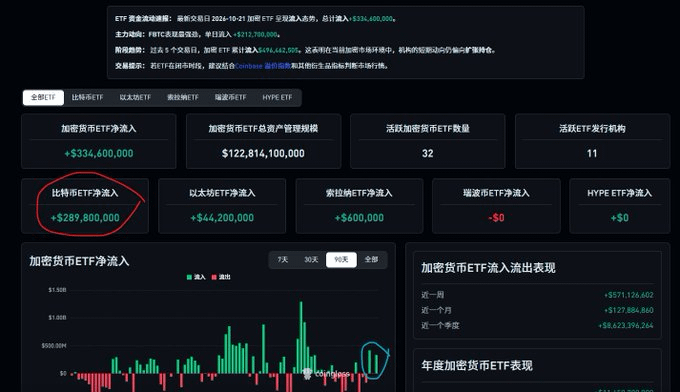
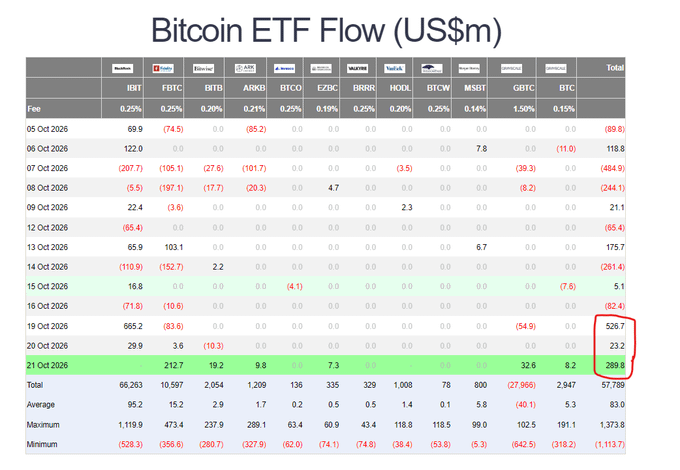
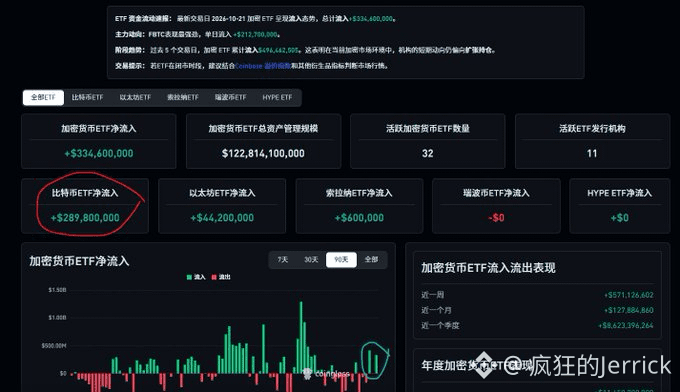
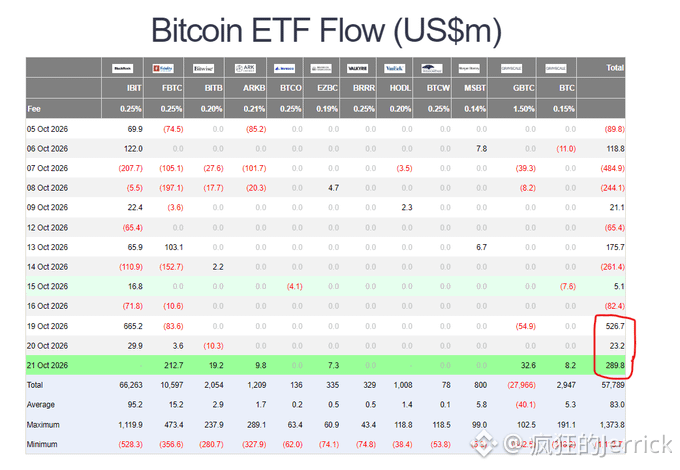
2. The ETF signal I mentioned yesterday (BTC的这个信号,让我开启了多头仓位!) has received even stronger confirmation today. According to preliminary figures, net inflows into BTC have reached $289M. Several major cryptocurrency ETFs are also seeing inflows. ZEC is relatively strong, while HYPE is lagging a bit. It seems the big players aren’t ready to step in at this time or price level.
As I said yesterday, at this level, I’d rather be wrong than miss the move. And now we’ve indeed broken upward. However, it still doesn’t feel great to enter a trade. There’s a little more room to the upside now, but the pullbacks have also been pretty severe. Most major coins are moving upward rather sluggishly. The key is whether BTC can continue higher and open up more room to run.
As for my personal trades:
I’m still holding yesterday’s ETH position and will move my stop-loss up depending on the situation.
My gold trade from yesterday was stopped out. I thought about it, and it looks a lot like the pattern I mentioned earlier (发现了大饼的一些规律可参考): first, the stops on the two consecutive positions that look like a double bottom get taken out, and then the price rallies back up. Gold seems to have entered a pretty intense PVP phase lately. Without big moves, it’s hard to trade.
Also, I put together and post some thoughts and observations every day. If you find them helpful, please like and follow.
You can also vote for Crazy Jerrick and help them become one of the Top 100 Blockchain Creators of 2026! 立即投票🙏
1. Yesterday I mentioned BTC’s B zone (根据当前行情,找到一些区域规律). Today, we’ve seen further confirmation of that signal: the B zone is beginning to follow the pattern that emerged after the A zone. This just goes to show that historical data and patterns are still worth seeking out and understanding.
2. The ETF signal I mentioned yesterday (BTC的这个信号,让我开启了多头仓位!) has received even stronger confirmation today. According to preliminary figures, net inflows into BTC have reached $289M. Several major cryptocurrency ETFs are also seeing inflows. ZEC is relatively strong, while HYPE is lagging a bit. It seems the big players aren’t ready to step in at this time or price level.
As I said yesterday, at this level, I’d rather be wrong than miss the move. And now we’ve indeed broken upward. However, it still doesn’t feel great to enter a trade. There’s a little more room to the upside now, but the pullbacks have also been pretty severe. Most major coins are moving upward rather sluggishly. The key is whether BTC can continue higher and open up more room to run.
As for my personal trades:
I’m still holding yesterday’s ETH position and will move my stop-loss up depending on the situation.
My gold trade from yesterday was stopped out. I thought about it, and it looks a lot like the pattern I mentioned earlier (发现了大饼的一些规律可参考): first, the stops on the two consecutive positions that look like a double bottom get taken out, and then the price rallies back up. Gold seems to have entered a pretty intense PVP phase lately. Without big moves, it’s hard to trade.
Also, I put together and post some thoughts and observations every day. If you find them helpful, please like and follow.
You can also vote for Crazy Jerrick and help them become one of the Top 100 Blockchain Creators of 2026! 立即投票🙏
303
·
--
Bullish
The signals from the previous two posts have both been confirmed!
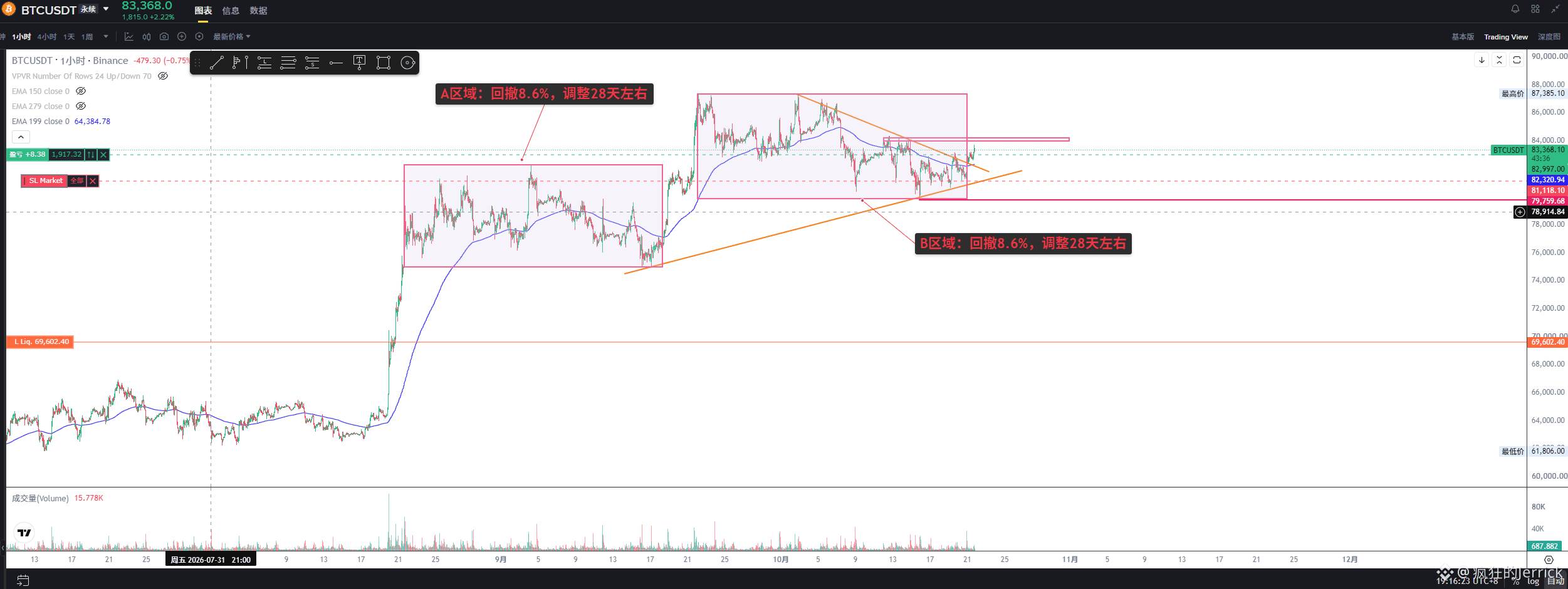
1. Yesterday I mentioned BTC’s B zone ([根据当前行情,找到一些区域规律](https://app.binance.com/uni-qr/cpos/379660188563133?l=zh-CN&r=TAR0XN45&uc=web_square_share_link&uco=P270ycDDrJAMd_wjrUng7Q&us=copylink)). Today, we’ve seen further confirmation of that signal: the B zone is beginning to follow the pattern that emerged after the A zone. This just goes to show that historical data and patterns are still worth seeking out and understanding.
2. The ETF signal I mentioned yesterday ([BTC的这个信号,让我开启了多头仓位!](https://app.binance.com/uni-qr/cart/379520561653146?l=zh-CN&r=TAR0XN45&uc=web_square_share_link&uco=P270ycDDrJAMd_wjrUng7Q&us=copylink)) has received even stronger confirmation today. According to preliminary figures, net inflows into BTC have reached $289M. Several major cryptocurrency ETFs are also seeing inflows. ZEC is relatively strong, while HYPE is lagging a bit. It seems the big players aren’t ready to step in at this time or price level.
As I said yesterday, at this level, I’d rather be wrong than miss the move. And now we’ve indeed broken upward. However, it still doesn’t feel great to enter a trade. There’s a little more room to the upside now, but the pullbacks have also been pretty severe. Most major coins are moving upward rather sluggishly. The key is whether BTC can continue higher and open up more room to run.
As for my personal trades:
I’m still holding yesterday’s ETH position and will move my stop-loss up depending on the situation.
My gold trade from yesterday was stopped out. I thought about it, and it looks a lot like the pattern I mentioned earlier ([发现了大饼的一些规律可参考](https://app.binance.com/uni-qr/cpos/379139983453017?l=zh-CN&r=TAR0XN45&uc=web_square_share_link&uco=P270ycDDrJAMd_wjrUng7Q&us=copylink)): first, the stops on the two consecutive positions that look like a double bottom get taken out, and then the price rallies back up. Gold seems to have entered a pretty intense PVP phase lately. Without big moves, it’s hard to trade.
Also, I put together and post some thoughts and observations every day. If you find them helpful, please like and follow.
You can also vote for Crazy Jerrick and help them become one of the Top 100 Blockchain Creators of 2026! [立即投票](https://app.binance.com/uni-qr/cact26user/724)🙏
The signals from the previous two posts have both been confirmed!
1. Yesterday I mentioned BTC’s B zone (根据当前行情,找到一些区域规律). Today, we’ve seen further confirmation of that signal: the B zone is beginning to follow the pattern that emerged after the A zone. This just goes to show that historical data and patterns are still worth seeking out and understanding.
2. The ETF signal I mentioned yesterday (BTC的这个信号,让我开启了多头仓位!) has received even stronger confirmation today. According to preliminary figures, net inflows into BTC have reached $289M. Several major cryptocurrency ETFs are also seeing inflows. ZEC is relatively strong, while HYPE is lagging a bit. It seems the big players aren’t ready to step in at this time or price level.
As I said yesterday, at this level, I’d rather be wrong than miss the move. And now we’ve indeed broken upward. However, it still doesn’t feel great to enter a trade. There’s a little more room to the upside now, but the pullbacks have also been pretty severe. Most major coins are moving upward rather sluggishly. The key is whether BTC can continue higher and open up more room to run.
As for my personal trades:
I’m still holding yesterday’s ETH position and will move my stop-loss up depending on the situation.
My gold trade from yesterday was stopped out. I thought about it, and it looks a lot like the pattern I mentioned earlier (发现了大饼的一些规律可参考): first, the stops on the two consecutive positions that look like a double bottom get taken out, and then the price rallies back up. Gold seems to have entered a pretty intense PVP phase lately. Without big moves, it’s hard to trade.
Also, I put together and post some thoughts and observations every day. If you find them helpful, please like and follow.
You can also vote for Crazy Jerrick and help them become one of the Top 100 Blockchain Creators of 2026! 立即投票🙏
1. Yesterday I mentioned BTC’s B zone (根据当前行情,找到一些区域规律). Today, we’ve seen further confirmation of that signal: the B zone is beginning to follow the pattern that emerged after the A zone. This just goes to show that historical data and patterns are still worth seeking out and understanding.
2. The ETF signal I mentioned yesterday (BTC的这个信号,让我开启了多头仓位!) has received even stronger confirmation today. According to preliminary figures, net inflows into BTC have reached $289M. Several major cryptocurrency ETFs are also seeing inflows. ZEC is relatively strong, while HYPE is lagging a bit. It seems the big players aren’t ready to step in at this time or price level.
As I said yesterday, at this level, I’d rather be wrong than miss the move. And now we’ve indeed broken upward. However, it still doesn’t feel great to enter a trade. There’s a little more room to the upside now, but the pullbacks have also been pretty severe. Most major coins are moving upward rather sluggishly. The key is whether BTC can continue higher and open up more room to run.
As for my personal trades:
I’m still holding yesterday’s ETH position and will move my stop-loss up depending on the situation.
My gold trade from yesterday was stopped out. I thought about it, and it looks a lot like the pattern I mentioned earlier (发现了大饼的一些规律可参考): first, the stops on the two consecutive positions that look like a double bottom get taken out, and then the price rallies back up. Gold seems to have entered a pretty intense PVP phase lately. Without big moves, it’s hard to trade.
Also, I put together and post some thoughts and observations every day. If you find them helpful, please like and follow.
You can also vote for Crazy Jerrick and help them become one of the Top 100 Blockchain Creators of 2026! 立即投票🙏
1
301
·
--
Bullish
When it comes to trading, I always like looking for patterns.
And I share them for free.
Even though these insights don’t always get much feedback,
I hope that if they resonate with you,
you’ll give this a like and drop a wave of 666s in the comments.
This time, I’m talking about Bitcoin.
History really does have an uncanny way of repeating itself!
As you can see in the chart, the correction duration and pullback magnitude in areas A and B are almost identical.
So where will the price go next after this pullback?
I’m leaning toward a move higher.
What do you think?
$BTC
{future}(BTCUSDT)
#GENIUS法案预计2027年1月18日生效
When it comes to trading, I always like looking for patterns.
And I share them for free.
Even though these insights don’t always get much feedback,
I hope that if they resonate with you,
you’ll give this a like and drop a wave of 666s in the comments.
This time, I’m talking about Bitcoin.
History really does have an uncanny way of repeating itself!
As you can see in the chart, the correction duration and pullback magnitude in areas A and B are almost identical.
So where will the price go next after this pullback?
I’m leaning toward a move higher.
What do you think?
$BTC
#GENIUS法案预计2027年1月18日生效
And I share them for free.
Even though these insights don’t always get much feedback,
I hope that if they resonate with you,
you’ll give this a like and drop a wave of 666s in the comments.
This time, I’m talking about Bitcoin.
History really does have an uncanny way of repeating itself!
As you can see in the chart, the correction duration and pullback magnitude in areas A and B are almost identical.
So where will the price go next after this pullback?
I’m leaning toward a move higher.
What do you think?
$BTC
#GENIUS法案预计2027年1月18日生效
1
155
·
--
In trading, what ultimately sets you apart isn’t just your skills and market insight—it’s your ability to keep learning and refining your approach.
I’ve always believed there are no shortcuts on the trading journey. Studying market dynamics a little more, reviewing your trades one more time, and avoiding just one more mistake—all of it adds up to progress.
That’s why I truly appreciate creators who are willing to share their trading insights over the long term and study the markets seriously.
Vote now for Crazy Jerrick and help him become one of the 2026 Top 100 Blockchain Creators! [立即投票](https://app.binance.com/uni-qr/cact26user/724)
If you value his content too, please cast your vote.
Thank you for every bit of support! 🙏
In trading, what ultimately sets you apart isn’t just your skills and market insight—it’s your ability to keep learning and refining your approach.
I’ve always believed there are no shortcuts on the trading journey. Studying market dynamics a little more, reviewing your trades one more time, and avoiding just one more mistake—all of it adds up to progress.
That’s why I truly appreciate creators who are willing to share their trading insights over the long term and study the markets seriously.
Vote now for Crazy Jerrick and help him become one of the 2026 Top 100 Blockchain Creators! 立即投票
If you value his content too, please cast your vote.
Thank you for every bit of support! 🙏
I’ve always believed there are no shortcuts on the trading journey. Studying market dynamics a little more, reviewing your trades one more time, and avoiding just one more mistake—all of it adds up to progress.
That’s why I truly appreciate creators who are willing to share their trading insights over the long term and study the markets seriously.
Vote now for Crazy Jerrick and help him become one of the 2026 Top 100 Blockchain Creators! 立即投票
If you value his content too, please cast your vote.
Thank you for every bit of support! 🙏

2
244
·
--

Article
This ETF signal for BTC prompted me to open a long position!This ETF signal for BTC prompted me to open a long position!
It's been a while since I last analyzed BTC ETF flows.
Although ETF flows have been net outflows overall until recently,
However, compared with the inflows a month earlier,
ETF flows from large institutions are still somewhat restrained.
There hasn't been an unlimited outflow.
BTC:
You can also see it from ETF inflows and outflows:
overall, flows have been net outflows over the past 13 days,
But it hasn't been a constant net outflow—
there have also been some inflows.
Overall, though,
outflows have exceeded inflows.
This ETF signal for BTC prompted me to open a long position!
This ETF signal for BTC prompted me to open a long position!
It's been a while since I last analyzed BTC ETF flows.
Although ETF flows have been net outflows overall until recently,
However, compared with the inflows a month earlier,
ETF flows from large institutions are still somewhat restrained.
There hasn't been an unlimited outflow.
BTC:
You can also see it from ETF inflows and outflows:
overall, flows have been net outflows over the past 13 days,
But it hasn't been a constant net outflow—
there have also been some inflows.
Overall, though,
outflows have exceeded inflows.
It's been a while since I last analyzed BTC ETF flows.
Although ETF flows have been net outflows overall until recently,
However, compared with the inflows a month earlier,
ETF flows from large institutions are still somewhat restrained.
There hasn't been an unlimited outflow.
BTC:
You can also see it from ETF inflows and outflows:
overall, flows have been net outflows over the past 13 days,
But it hasn't been a constant net outflow—
there have also been some inflows.
Overall, though,
outflows have exceeded inflows.
1
271
·
--
Do you really think you understand the position-rolling strategy?
In my previous post, I mentioned that we should put Brother Sun’s theory into practice.
If you want to do something,
first study 100 relevant case studies.
When it comes to position-rolling,
I’m going to study 100 position-rolling cases.
But after searching around, I may not be able to find 100 completely different cases.
So I’ll spend 10 days on it,
watching at least 10 position-rolling strategy cases each day.
There are bound to be some repeated cases.
For example, if I watch tutorials on YouTube,
the ones that most people find will probably be by creators like BIT浪浪, 肥宅, 午饭, and others.
That’s fine.
I’ll spend 10 days on it,
searching for and watching them at least once every day.
Every trading guru will have different analysts sharing their take on YouTube.
So I’ll look for different analysts and watch their videos.
As long as I watch more than 10 cases a day,
those 10 could all be live position-rolling trades by Bit浪浪,
but analyzed and posted by 10 different YouTubers.
By looking at the analysis from different YouTubers,
we can put this theory into practice from a range of analytical perspectives.
That will give us a very systematic understanding of position-rolling.
To be honest,
after spending all of yesterday browsing through different position-rolling strategies,
I came to this conclusion:
the strategy behind position-rolling is actually very simple.
But the people who can put it into practice
are definitely not simple people.
They’ve almost certainly spent years learning the ropes in this market,
and have probably had their accounts liquidated many times.
They’ve also worked their way up from being complete beginners.
It’s impossible that they started using a position-rolling strategy right away and suddenly made a lot of money. (Even if they did, they’d eventually lose it all.)
If they’re able to use the position-rolling strategy successfully now,
it’s surely because they spent a long time exploring a wide range of trading strategies,
perhaps even poring over countless complicated ones.
Only then did they simplify things,
and finally grasp the true meaning of the position-rolling strategy.
As the saying goes, the greatest truths are the simplest.
I watched a lot of position-rolling strategies yesterday and took some notes. I’ll put them together and share them in 10 days. If you’d like to learn, follow along—we can improve together.
Do you really think you understand the position-rolling strategy?
In my previous post, I mentioned that we should put Brother Sun’s theory into practice.
If you want to do something,
first study 100 relevant case studies.
When it comes to position-rolling,
I’m going to study 100 position-rolling cases.
But after searching around, I may not be able to find 100 completely different cases.
So I’ll spend 10 days on it,
watching at least 10 position-rolling strategy cases each day.
There are bound to be some repeated cases.
For example, if I watch tutorials on YouTube,
the ones that most people find will probably be by creators like BIT浪浪, 肥宅, 午饭, and others.
That’s fine.
I’ll spend 10 days on it,
searching for and watching them at least once every day.
Every trading guru will have different analysts sharing their take on YouTube.
So I’ll look for different analysts and watch their videos.
As long as I watch more than 10 cases a day,
those 10 could all be live position-rolling trades by Bit浪浪,
but analyzed and posted by 10 different YouTubers.
By looking at the analysis from different YouTubers,
we can put this theory into practice from a range of analytical perspectives.
That will give us a very systematic understanding of position-rolling.
To be honest,
after spending all of yesterday browsing through different position-rolling strategies,
I came to this conclusion:
the strategy behind position-rolling is actually very simple.
But the people who can put it into practice
are definitely not simple people.
They’ve almost certainly spent years learning the ropes in this market,
and have probably had their accounts liquidated many times.
They’ve also worked their way up from being complete beginners.
It’s impossible that they started using a position-rolling strategy right away and suddenly made a lot of money. (Even if they did, they’d eventually lose it all.)
If they’re able to use the position-rolling strategy successfully now,
it’s surely because they spent a long time exploring a wide range of trading strategies,
perhaps even poring over countless complicated ones.
Only then did they simplify things,
and finally grasp the true meaning of the position-rolling strategy.
As the saying goes, the greatest truths are the simplest.
I watched a lot of position-rolling strategies yesterday and took some notes. I’ll put them together and share them in 10 days. If you’d like to learn, follow along—we can improve together.
In my previous post, I mentioned that we should put Brother Sun’s theory into practice.
If you want to do something,
first study 100 relevant case studies.
When it comes to position-rolling,
I’m going to study 100 position-rolling cases.
But after searching around, I may not be able to find 100 completely different cases.
So I’ll spend 10 days on it,
watching at least 10 position-rolling strategy cases each day.
There are bound to be some repeated cases.
For example, if I watch tutorials on YouTube,
the ones that most people find will probably be by creators like BIT浪浪, 肥宅, 午饭, and others.
That’s fine.
I’ll spend 10 days on it,
searching for and watching them at least once every day.
Every trading guru will have different analysts sharing their take on YouTube.
So I’ll look for different analysts and watch their videos.
As long as I watch more than 10 cases a day,
those 10 could all be live position-rolling trades by Bit浪浪,
but analyzed and posted by 10 different YouTubers.
By looking at the analysis from different YouTubers,
we can put this theory into practice from a range of analytical perspectives.
That will give us a very systematic understanding of position-rolling.
To be honest,
after spending all of yesterday browsing through different position-rolling strategies,
I came to this conclusion:
the strategy behind position-rolling is actually very simple.
But the people who can put it into practice
are definitely not simple people.
They’ve almost certainly spent years learning the ropes in this market,
and have probably had their accounts liquidated many times.
They’ve also worked their way up from being complete beginners.
It’s impossible that they started using a position-rolling strategy right away and suddenly made a lot of money. (Even if they did, they’d eventually lose it all.)
If they’re able to use the position-rolling strategy successfully now,
it’s surely because they spent a long time exploring a wide range of trading strategies,
perhaps even poring over countless complicated ones.
Only then did they simplify things,
and finally grasp the true meaning of the position-rolling strategy.
As the saying goes, the greatest truths are the simplest.
I watched a lot of position-rolling strategies yesterday and took some notes. I’ll put them together and share them in 10 days. If you’d like to learn, follow along—we can improve together.

262
·
--
I’ve noticed some patterns in Bitcoin’s price action, and today I’ve gained a new perspective on the market. If you’re interested, feel free to use this as a reference.
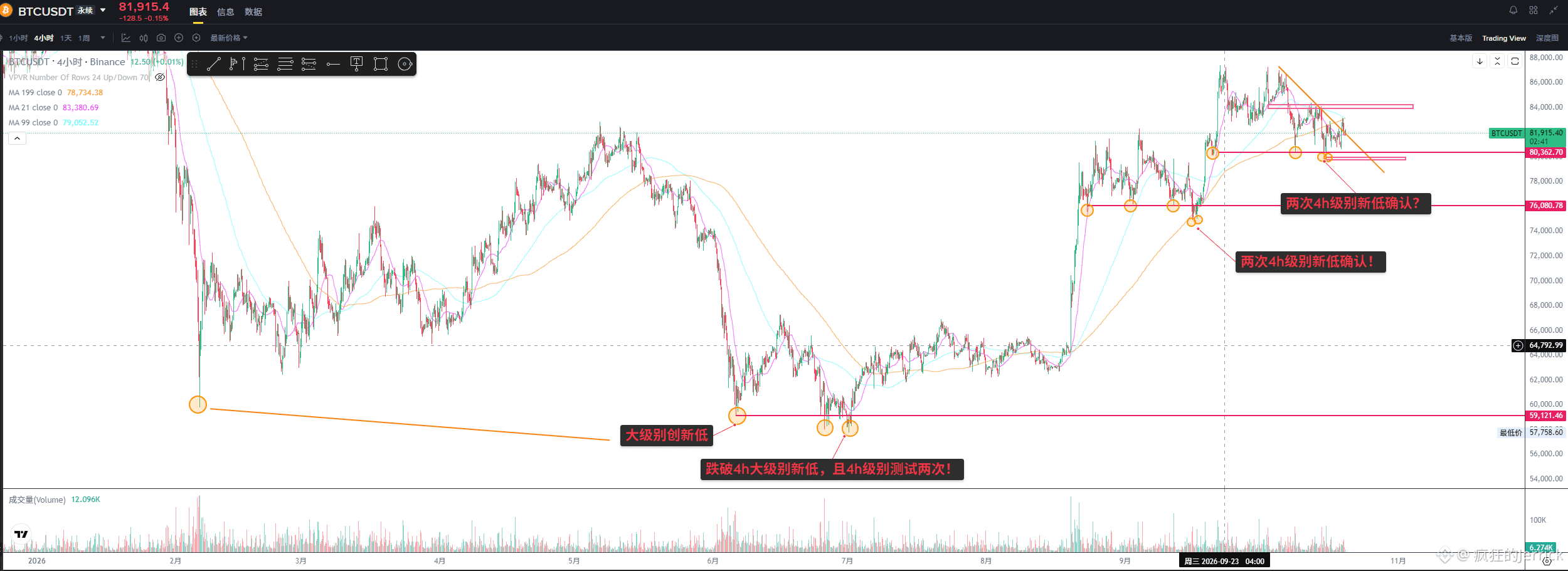
1. In the past, we generally looked for a double bottom to confirm a bottom, whether on a larger or smaller time frame. We usually preferred—or felt more confident when—the second bottom was slightly higher than the first. But recently, it seems that major players have been pushing prices below previous lows to take out liquidity, then testing those levels a second time before reversing.
2. Major reversals usually begin only after price makes a new low below a previous major low. This new low generally won’t be much lower than the previous one, but it must be confirmed by at least two tests over a period of four hours or more.
3. The time between the two tests of a reversal low generally depends on the scale of the reversal. The same applies when a new low forms on a larger time frame. This includes both a bull-to-bear reversal and the time frame of a pullback within a bull market. For example, the first bull-to-bear reversal took five days to confirm the new low with two tests. During the second pullback, the correction was shorter, so confirmation also took less time—within two days.
Of course, this is just a study of Bitcoin candlestick patterns, and I haven’t yet looked at other assets. I believe many highly liquid assets may show similar patterns. Feel free to apply these ideas elsewhere, and keep researching, learning, and using them as a reference.
$BTC
Please like and follow. I’ll share all my thoughts for free in the future.
I’ve noticed some patterns in Bitcoin’s price action, and today I’ve gained a new perspective on the market. If you’re interested, feel free to use this as a reference.
1. In the past, we generally looked for a double bottom to confirm a bottom, whether on a larger or smaller time frame. We usually preferred—or felt more confident when—the second bottom was slightly higher than the first. But recently, it seems that major players have been pushing prices below previous lows to take out liquidity, then testing those levels a second time before reversing.
2. Major reversals usually begin only after price makes a new low below a previous major low. This new low generally won’t be much lower than the previous one, but it must be confirmed by at least two tests over a period of four hours or more.
3. The time between the two tests of a reversal low generally depends on the scale of the reversal. The same applies when a new low forms on a larger time frame. This includes both a bull-to-bear reversal and the time frame of a pullback within a bull market. For example, the first bull-to-bear reversal took five days to confirm the new low with two tests. During the second pullback, the correction was shorter, so confirmation also took less time—within two days.
Of course, this is just a study of Bitcoin candlestick patterns, and I haven’t yet looked at other assets. I believe many highly liquid assets may show similar patterns. Feel free to apply these ideas elsewhere, and keep researching, learning, and using them as a reference.
$BTC
Please like and follow. I’ll share all my thoughts for free in the future.
1. In the past, we generally looked for a double bottom to confirm a bottom, whether on a larger or smaller time frame. We usually preferred—or felt more confident when—the second bottom was slightly higher than the first. But recently, it seems that major players have been pushing prices below previous lows to take out liquidity, then testing those levels a second time before reversing.
2. Major reversals usually begin only after price makes a new low below a previous major low. This new low generally won’t be much lower than the previous one, but it must be confirmed by at least two tests over a period of four hours or more.
3. The time between the two tests of a reversal low generally depends on the scale of the reversal. The same applies when a new low forms on a larger time frame. This includes both a bull-to-bear reversal and the time frame of a pullback within a bull market. For example, the first bull-to-bear reversal took five days to confirm the new low with two tests. During the second pullback, the correction was shorter, so confirmation also took less time—within two days.
Of course, this is just a study of Bitcoin candlestick patterns, and I haven’t yet looked at other assets. I believe many highly liquid assets may show similar patterns. Feel free to apply these ideas elsewhere, and keep researching, learning, and using them as a reference.
$BTC
Please like and follow. I’ll share all my thoughts for free in the future.
424
·
--
Recently, I’ve started to see rolling positions a little differently.
But I still haven’t fully grasped it, so I need to spend more time studying this strategy.
The rolling-position strategy and the swing-trading strategy I’ve talked about recently are essentially the same thing.
But as Sun said, if I’m going to start studying and learning something, I should first look at 100 relevant examples. Otherwise, it’s easy to fool myself into thinking I understand it when I’ve only grasped the basics—and end up looking like an idiot.
Please keep me accountable. Otherwise, I might stop at 99 examples and convince myself I understand it.
Starting tomorrow, I’ll study 100 examples of the rolling-position strategy, and write down my own takeaways from each one. Otherwise, I’ll get lazy again and won’t come up with anything worthwhile.
The market lately seems to be forming a bottom. I’ve already opened a starter position here, which also means I’ve begun the trial-position phase of my rolling-position strategy.
If you’re interested, follow me and let’s learn together. $BTC
#比特币重回8.2万美元上方
Recently, I’ve started to see rolling positions a little differently.
But I still haven’t fully grasped it, so I need to spend more time studying this strategy.
The rolling-position strategy and the swing-trading strategy I’ve talked about recently are essentially the same thing.
But as Sun said, if I’m going to start studying and learning something, I should first look at 100 relevant examples. Otherwise, it’s easy to fool myself into thinking I understand it when I’ve only grasped the basics—and end up looking like an idiot.
Please keep me accountable. Otherwise, I might stop at 99 examples and convince myself I understand it.
Starting tomorrow, I’ll study 100 examples of the rolling-position strategy, and write down my own takeaways from each one. Otherwise, I’ll get lazy again and won’t come up with anything worthwhile.
The market lately seems to be forming a bottom. I’ve already opened a starter position here, which also means I’ve begun the trial-position phase of my rolling-position strategy.
If you’re interested, follow me and let’s learn together. $BTC
#比特币重回8.2万美元上方
But I still haven’t fully grasped it, so I need to spend more time studying this strategy.
The rolling-position strategy and the swing-trading strategy I’ve talked about recently are essentially the same thing.
But as Sun said, if I’m going to start studying and learning something, I should first look at 100 relevant examples. Otherwise, it’s easy to fool myself into thinking I understand it when I’ve only grasped the basics—and end up looking like an idiot.
Please keep me accountable. Otherwise, I might stop at 99 examples and convince myself I understand it.
Starting tomorrow, I’ll study 100 examples of the rolling-position strategy, and write down my own takeaways from each one. Otherwise, I’ll get lazy again and won’t come up with anything worthwhile.
The market lately seems to be forming a bottom. I’ve already opened a starter position here, which also means I’ve begun the trial-position phase of my rolling-position strategy.
If you’re interested, follow me and let’s learn together. $BTC
#比特币重回8.2万美元上方
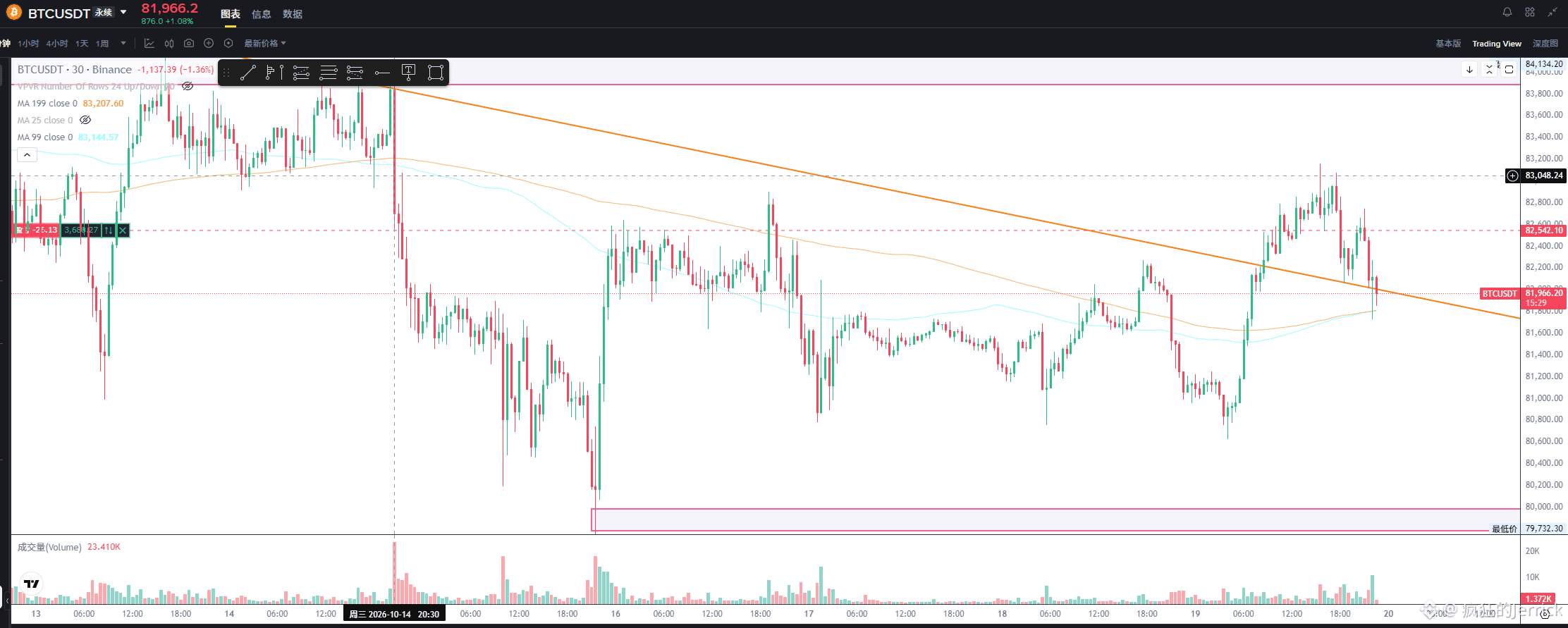
1
1
757
·
--
Musk's ideas are always so quirky.
This time, it's basically an act of charity.
He owns so many shares.
This charitable move not only earned him goodwill,
but also tied SpaceX stock to the vast majority of Americans,
which is good for SpaceX in the long run.
#SpaceX财报前涨9.8%
$SPCX
{future}(SPCXUSDT)
Musk's ideas are always so quirky.
This time, it's basically an act of charity.
He owns so many shares.
This charitable move not only earned him goodwill,
but also tied SpaceX stock to the vast majority of Americans,
which is good for SpaceX in the long run.
#SpaceX财报前涨9.8%
$SPCX
This time, it's basically an act of charity.
He owns so many shares.
This charitable move not only earned him goodwill,
but also tied SpaceX stock to the vast majority of Americans,
which is good for SpaceX in the long run.
#SpaceX财报前涨9.8%
$SPCX
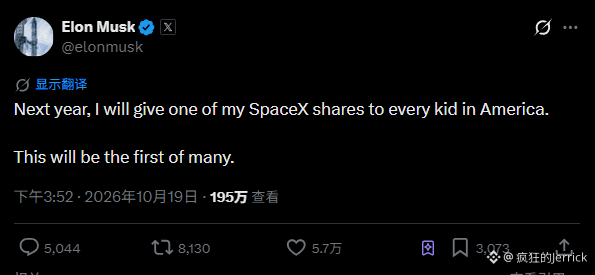
236
·
--
I had another new realization about chasing highs today!
For any stock you buy after it’s already risen, if you can’t find higher highs and higher lows in the shorter-term structure, get rid of it as soon as possible.
$BTC
It will not only eat into your capital,
{future}(BTCUSDT)
but also drain your motivation, time, and energy.
I had another new realization about chasing highs today!
For any stock you buy after it’s already risen, if you can’t find higher highs and higher lows in the shorter-term structure, get rid of it as soon as possible.
$BTC
It will not only eat into your capital,
but also drain your motivation, time, and energy.
For any stock you buy after it’s already risen, if you can’t find higher highs and higher lows in the shorter-term structure, get rid of it as soon as possible.
$BTC
It will not only eat into your capital,
but also drain your motivation, time, and energy.
当前BTC是反转的起点!
57%
当前BTC仍然在震荡区间!
43%
21 votes • Voting closed
1
2
623
Log in to explore more content
Join global crypto users on Binance Square
⚡️ Get latest and useful information about crypto.
💬 Trusted by the world’s largest crypto exchange.
👍 Discover real insights from verified creators.
Email / Phone number