
詹哥玩币
455 Posts

詹哥玩币
Report
Block User
18年老韭,几轮牛熊幸存者|看趋势,找价值,抓异动,只聊实战,不吹爆富!|喜欢的点个关注!
225 Following
1.0K+ Followers
121 Liked
Posts
All
Quotes
·
--
Verified
$AVAX is gaining strength—can JOE ride the wave?
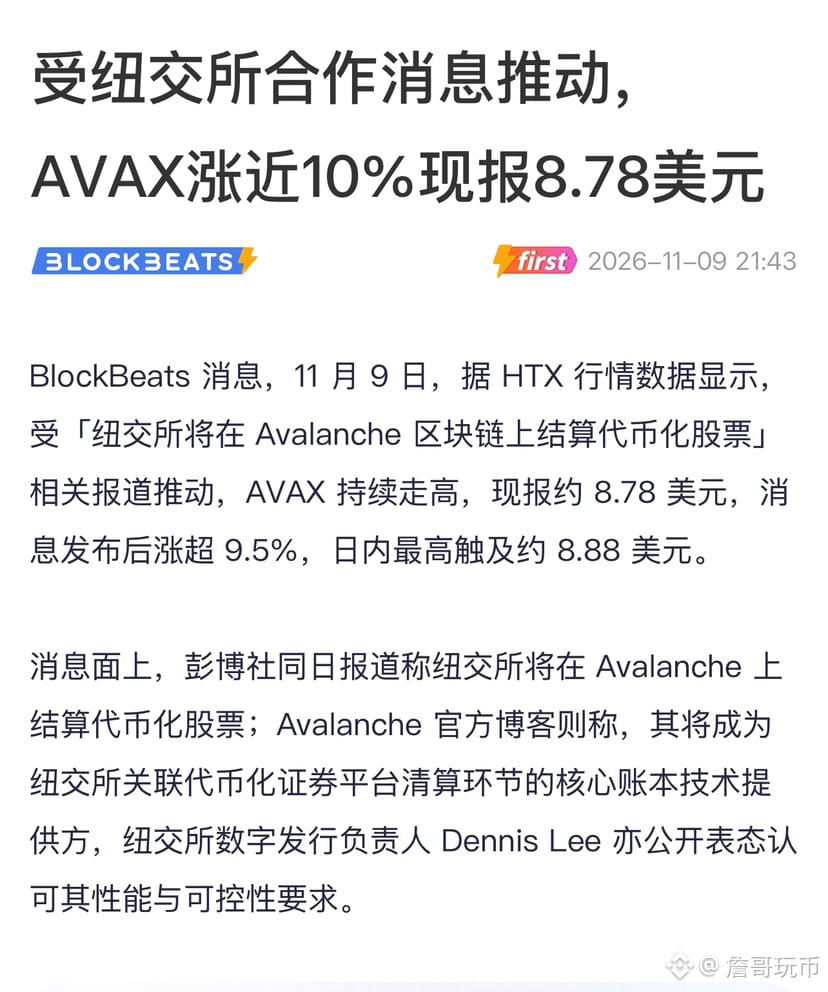
Recently, $AVAX has been performing strongly. It’s not just the price that’s moving; there’s also some interesting news: market reports say the NYSE will settle tokenized stocks on the Avalanche blockchain. For beginners, this can be understood as “traditional finance starting to use this blockchain,” which could draw more attention from investors to the Avalanche ecosystem.
Technically, $AVAX has broken through a key price level on the daily chart. Put simply, it has moved above a level it failed to hold above several times before, which could make short-term sentiment easier to ignite.
What about $JOE? It’s also part of the Avalanche ecosystem. A common pattern in crypto is that when a leading blockchain rises, smaller coins in the same ecosystem may get a boost from investors along the way.
But here’s the catch: $JOE’s trading volume is currently on the low side, and trading activity is insufficient. With coins like this, entering or exiting a position can mean greater slippage and sharper volatility. It’s not suitable for a large position—think of it as a high-risk small-cap coin, and don’t get carried away.
{future}(AVAXUSDT)
{future}(JOEUSDT)
$AVAX is gaining strength—can JOE ride the wave?
Recently, $AVAX has been performing strongly. It’s not just the price that’s moving; there’s also some interesting news: market reports say the NYSE will settle tokenized stocks on the Avalanche blockchain. For beginners, this can be understood as “traditional finance starting to use this blockchain,” which could draw more attention from investors to the Avalanche ecosystem.
Technically, $AVAX has broken through a key price level on the daily chart. Put simply, it has moved above a level it failed to hold above several times before, which could make short-term sentiment easier to ignite.
What about $JOE? It’s also part of the Avalanche ecosystem. A common pattern in crypto is that when a leading blockchain rises, smaller coins in the same ecosystem may get a boost from investors along the way.
But here’s the catch: $JOE’s trading volume is currently on the low side, and trading activity is insufficient. With coins like this, entering or exiting a position can mean greater slippage and sharper volatility. It’s not suitable for a large position—think of it as a high-risk small-cap coin, and don’t get carried away.
588
·
--
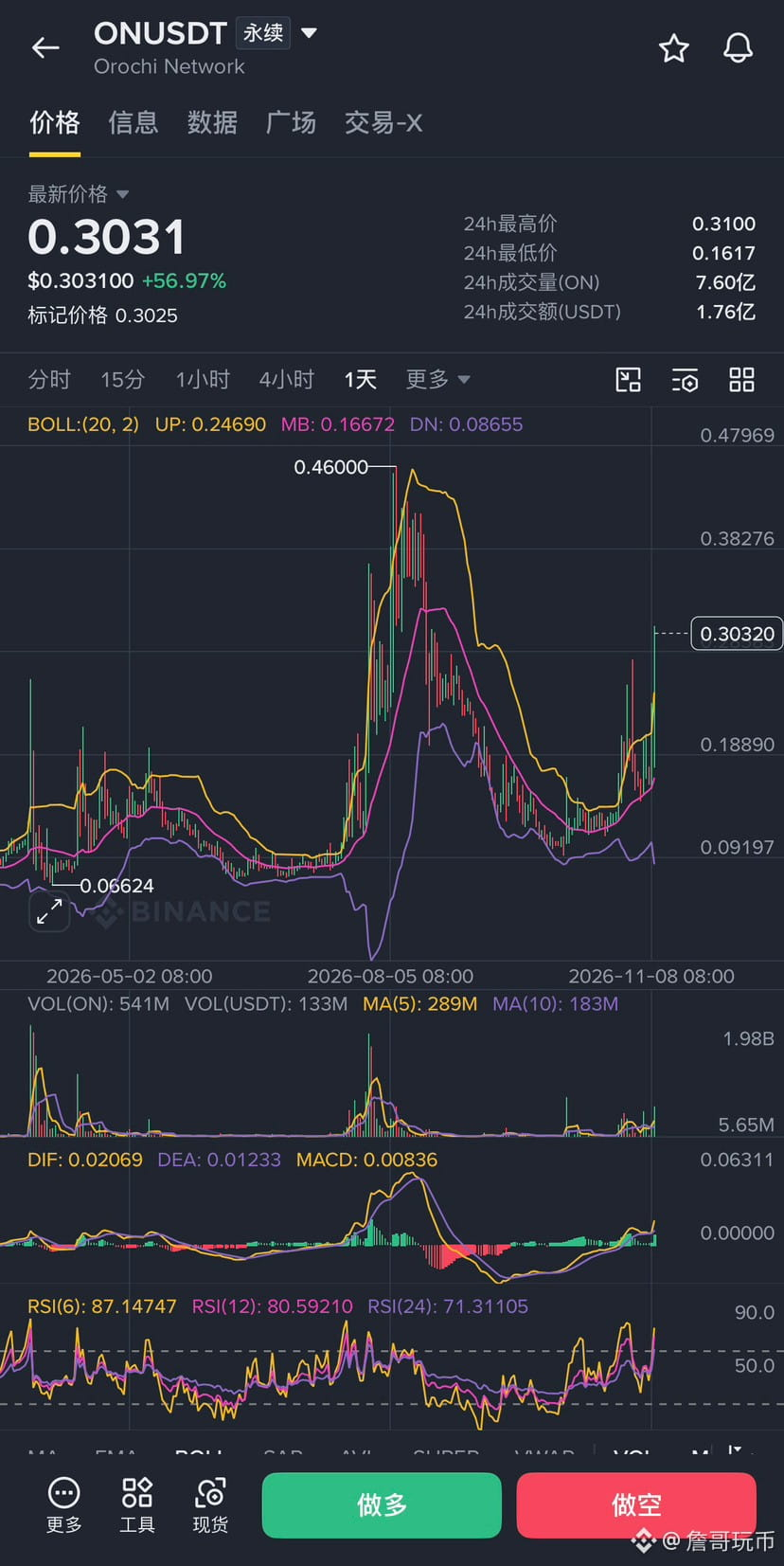
💥 Shorts getting slaughtered! Behind $ON 's 86% surge, what game are the big players really playing? (Ultra-simple strategy included)
I. Why the explosive surge?
1. Fundamental catalysts: zkDatabase's mainnet officially launched + expansion into verifiable AI, giving capital a narrative to target.
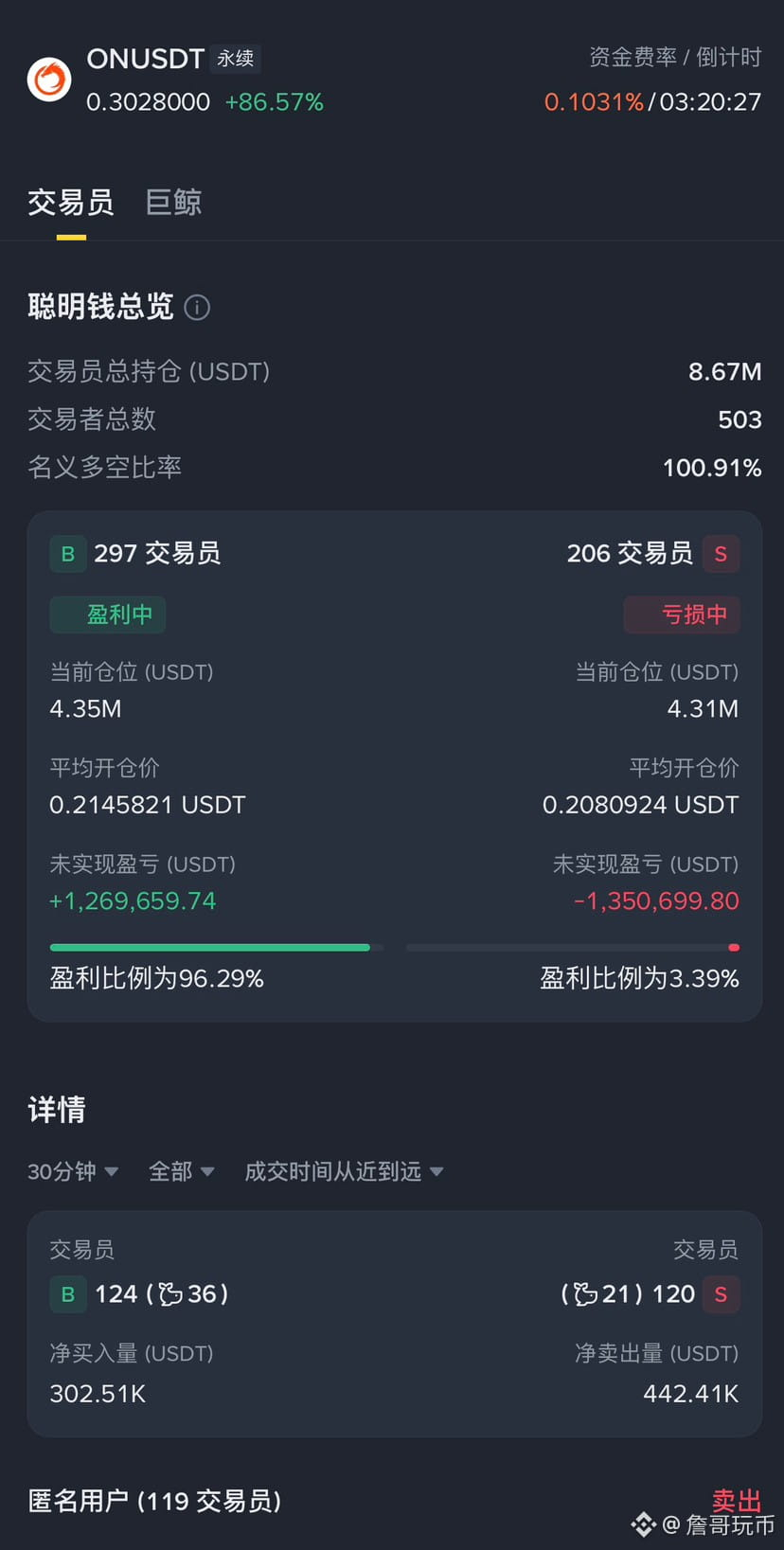
2. A cascading short squeeze: After a shakeout, a high-volume breakout above the previous high triggered highly leveraged short positions. The current funding rate is as high as 0.1031%, and shorts are continuing to bleed.
3. Hidden risk: Longs' average entry price is around 0.2146, with huge unrealized gains. If profit-takers close their positions all at once, it could easily trigger a stampede.
II. Current market (extremely overbought)
· 4H RSI is as high as 93, and 1D RSI is 87; the price has deviated significantly above the upper Bollinger Band.
· Long/short ratio: 100%. Bulls and bears are battling fiercely around the 0.30 level, with extremely violent wicks in both directions.
III. Short-term contract levels (high risk—avoid large positions)
🎯 Long (buy a pullback; don't chase the price)
· Entry: 0.256–0.270 (on a pullback near the upper Bollinger Band)
· Stop-loss: 0.245 (a break below invalidates the structure)
· Take-profit: 0.295 / 0.310
🎯 Short (very small position; beware of a squeeze)
· Entry: 0.305–0.315 (use a small position if the price stalls after a spike or forms a long upper wick)
· Stop-loss: 0.325 (strict stop-loss; never hold and hope)
· Take-profit: 0.270 / 0.256
{future}(ONUSDT)
💥 Shorts getting slaughtered! Behind $ON 's 86% surge, what game are the big players really playing? (Ultra-simple strategy included)
I. Why the explosive surge?
1. Fundamental catalysts: zkDatabase's mainnet officially launched + expansion into verifiable AI, giving capital a narrative to target.
2. A cascading short squeeze: After a shakeout, a high-volume breakout above the previous high triggered highly leveraged short positions. The current funding rate is as high as 0.1031%, and shorts are continuing to bleed.
3. Hidden risk: Longs' average entry price is around 0.2146, with huge unrealized gains. If profit-takers close their positions all at once, it could easily trigger a stampede.
II. Current market (extremely overbought)
· 4H RSI is as high as 93, and 1D RSI is 87; the price has deviated significantly above the upper Bollinger Band.
· Long/short ratio: 100%. Bulls and bears are battling fiercely around the 0.30 level, with extremely violent wicks in both directions.
III. Short-term contract levels (high risk—avoid large positions)
🎯 Long (buy a pullback; don't chase the price)
· Entry: 0.256–0.270 (on a pullback near the upper Bollinger Band)
· Stop-loss: 0.245 (a break below invalidates the structure)
· Take-profit: 0.295 / 0.310
🎯 Short (very small position; beware of a squeeze)
· Entry: 0.305–0.315 (use a small position if the price stalls after a spike or forms a long upper wick)
· Stop-loss: 0.325 (strict stop-loss; never hold and hope)
· Take-profit: 0.270 / 0.256
298
·
--
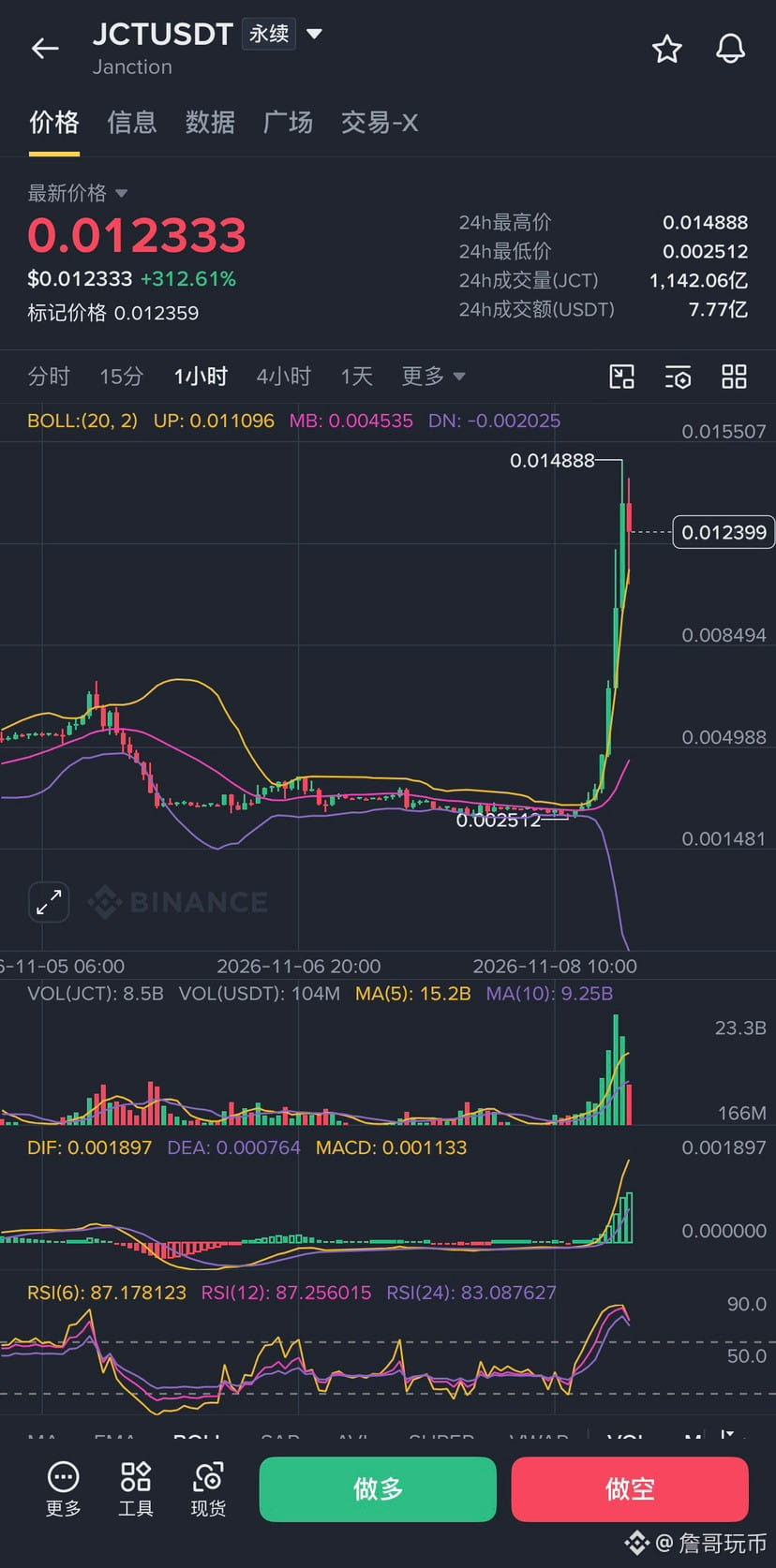
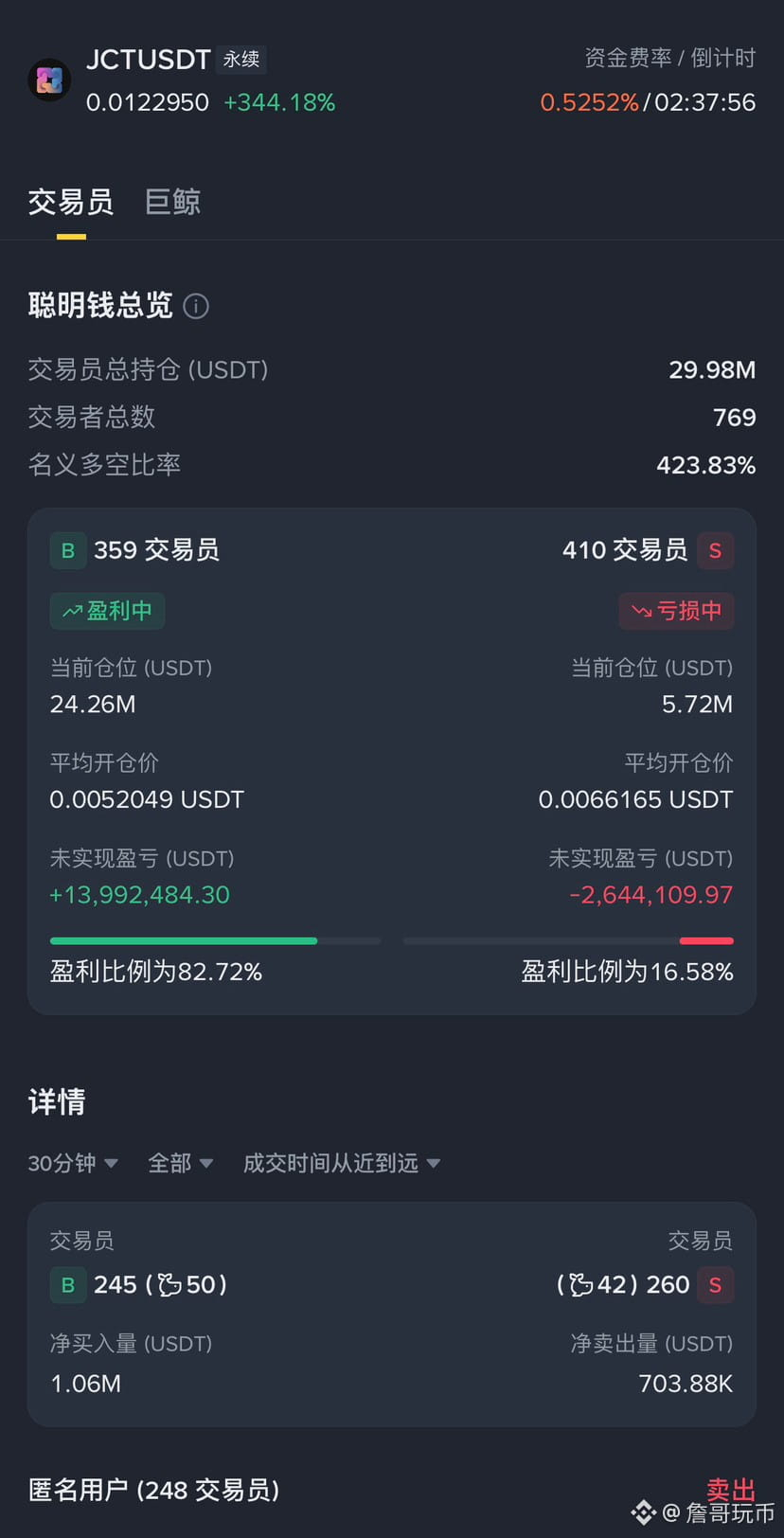
🚀 $JCT Up 344%? Is the short squeeze over, or is this a game of catching falling knives? Quick look at short-term strategies
I. Why the surge?
1. Extreme short squeeze: Small market cap + shallow order book; over 6.17 million U in short positions were liquidated in 4 hours, triggering a chain reaction.
2. FOMO: The AI + DePIN narrative, combined with its recent Binance listing and airdrop incentives, drew in a flood of capital.
3. ⚠️Fatal risk: On November 10, tokens equal to 10.2% of the circulating supply will be unlocked. After the surge, a sell-off could hit at any time.
II. Short-term futures levels (high risk—don't go in heavy)
🎯 Long strategy (buy pullbacks only; don't chase the price)
· Entry: Go long if the price pulls back to 0.0095 - 0.0105 and stabilizes
· Stop-loss: 0.0085 (a breakdown means the squeeze is over)
· Take-profit: 0.0135 / 0.0148 (previous high)
🎯 Short strategy (very small position; beware of a squeeze)
· Entry: Open a small short if the price spikes to 0.0135 - 0.0145 while volume contracts
· Stop-loss: 0.0152 (strict stop-loss; never ride out the loss)
· Take-profit: 0.0105 / 0.0088
#JCT #FuturesTrading #ShortTermStrategy
{future}(JCTUSDT)
🚀 $JCT Up 344%? Is the short squeeze over, or is this a game of catching falling knives? Quick look at short-term strategies
I. Why the surge?
1. Extreme short squeeze: Small market cap + shallow order book; over 6.17 million U in short positions were liquidated in 4 hours, triggering a chain reaction.
2. FOMO: The AI + DePIN narrative, combined with its recent Binance listing and airdrop incentives, drew in a flood of capital.
3. ⚠️Fatal risk: On November 10, tokens equal to 10.2% of the circulating supply will be unlocked. After the surge, a sell-off could hit at any time.
II. Short-term futures levels (high risk—don't go in heavy)
🎯 Long strategy (buy pullbacks only; don't chase the price)
· Entry: Go long if the price pulls back to 0.0095 - 0.0105 and stabilizes
· Stop-loss: 0.0085 (a breakdown means the squeeze is over)
· Take-profit: 0.0135 / 0.0148 (previous high)
🎯 Short strategy (very small position; beware of a squeeze)
· Entry: Open a small short if the price spikes to 0.0135 - 0.0145 while volume contracts
· Stop-loss: 0.0152 (strict stop-loss; never ride out the loss)
· Take-profit: 0.0105 / 0.0088
#JCT #FuturesTrading #ShortTermStrategy
583
·
--
🚀 $KOMA Surge Explained & Short-Term Levels for Beginners
Why the surge?
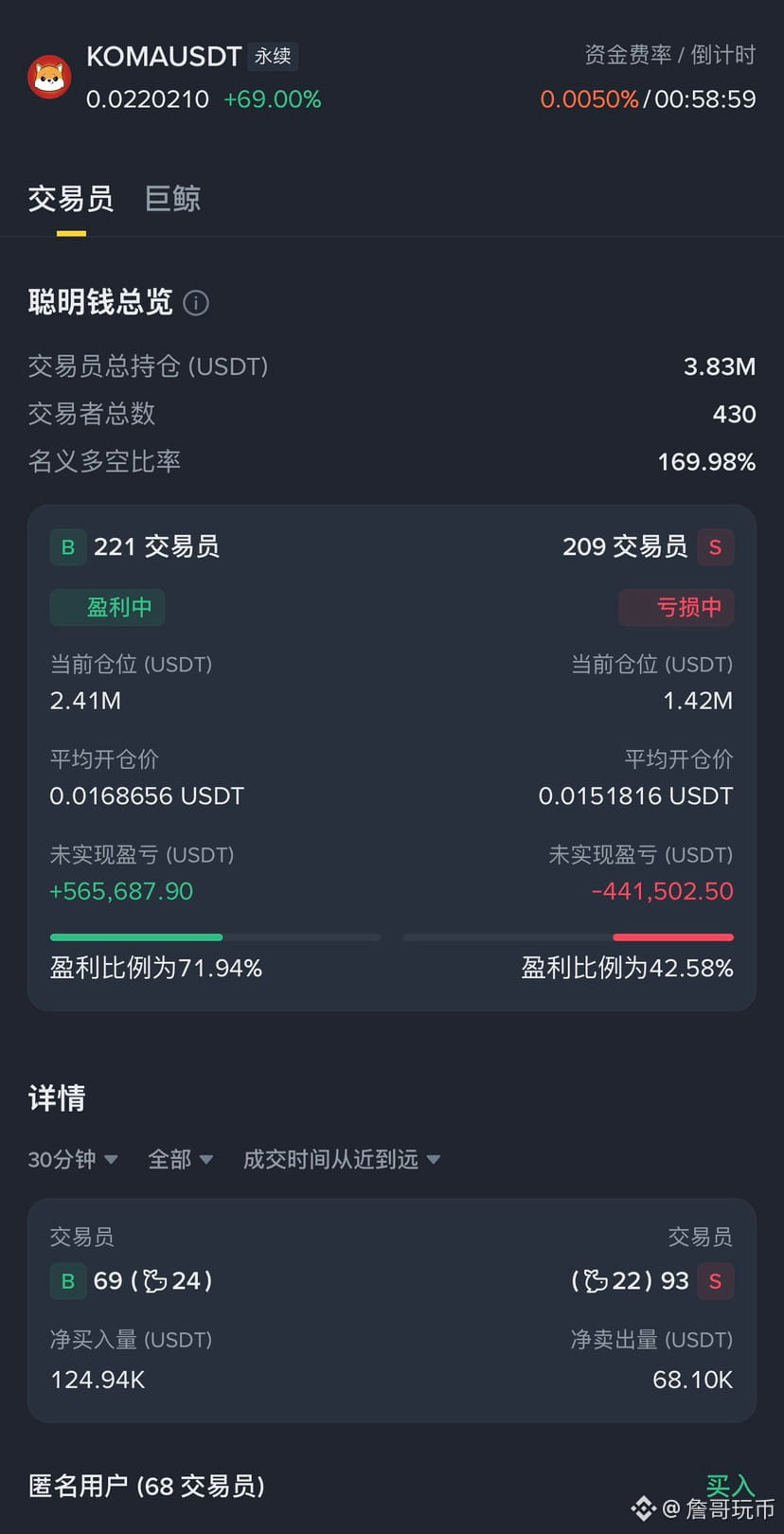
It's not because the fundamentals improved; it's purely due to capital rotation + a cascade of short liquidations. With a small market cap and low liquidity, it can take off as soon as funds push it up. On top of that, forced liquidations of short positions sent buying pressure straight through the roof.
Can you chase it now?
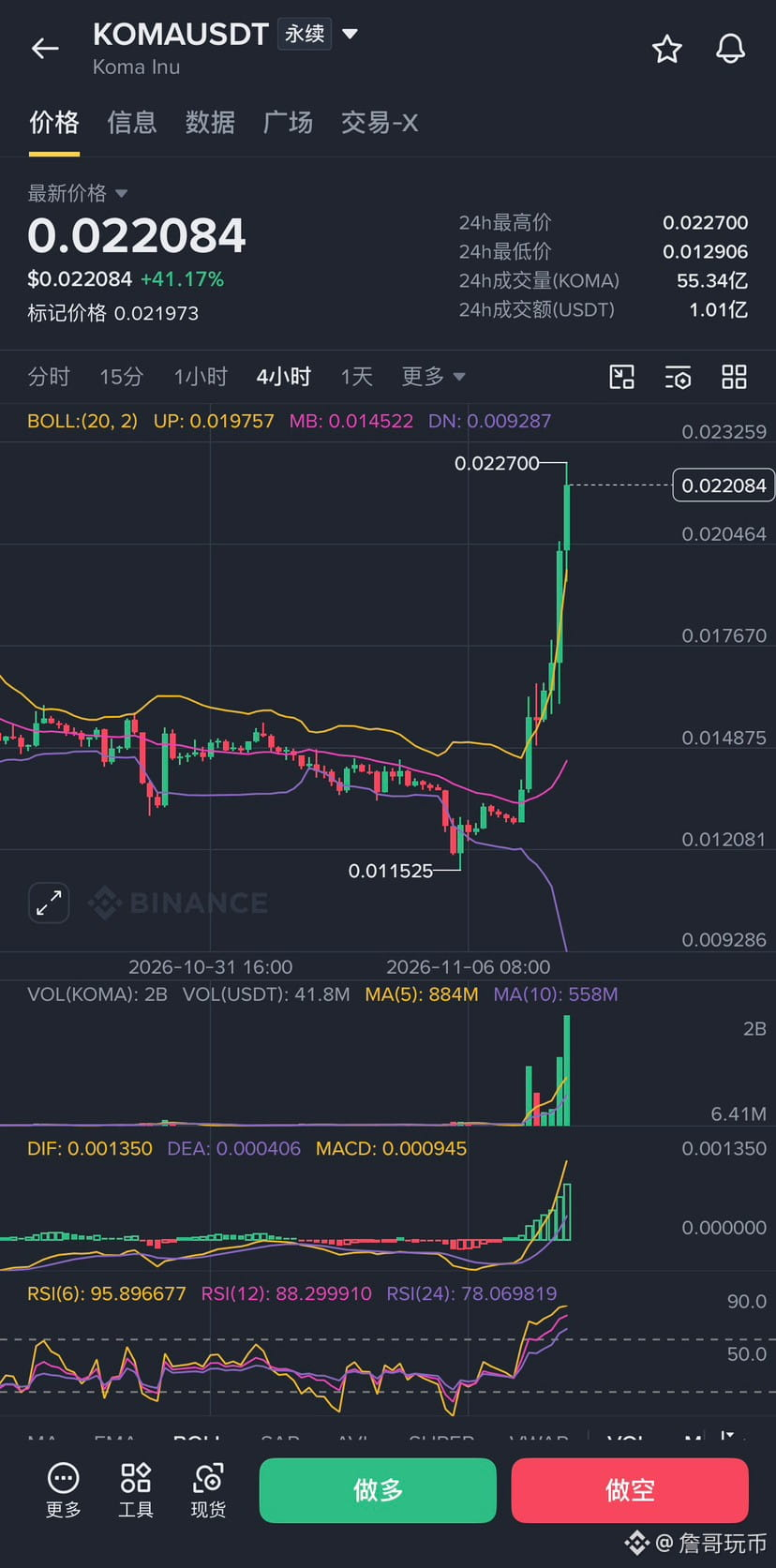
As shown in the screenshot, RSI(6) has already soared to 95.89 (extremely overbought), and the price has shot “off the rails” beyond the Bollinger Bands. Chasing a long here could easily leave you holding the bag, while shorting carries the risk that the market maker will keep squeezing shorts.
💡 Short-term strategy for beginners (always use stop-losses):
🔴 Short (bet on a pullback):
Wait for the price to break below 0.022 before entering.
· Stop-loss: 0.0227 (above today's high)
· Take-profit: First target 0.0205, second target 0.0192.
🟢 Long (bet on a short squeeze):
Whatever you do, don't chase the price! Wait for it to pull back to around 0.0205 ~ 0.0200 and stabilize before entering with a small position.
· Stop-loss: 0.0195
· Take-profit: Around 0.0220.
{future}(KOMAUSDT)
🚀 $KOMA Surge Explained & Short-Term Levels for Beginners
Why the surge?
It's not because the fundamentals improved; it's purely due to capital rotation + a cascade of short liquidations. With a small market cap and low liquidity, it can take off as soon as funds push it up. On top of that, forced liquidations of short positions sent buying pressure straight through the roof.
Can you chase it now?
As shown in the screenshot, RSI(6) has already soared to 95.89 (extremely overbought), and the price has shot “off the rails” beyond the Bollinger Bands. Chasing a long here could easily leave you holding the bag, while shorting carries the risk that the market maker will keep squeezing shorts.
💡 Short-term strategy for beginners (always use stop-losses):
🔴 Short (bet on a pullback):
Wait for the price to break below 0.022 before entering.
· Stop-loss: 0.0227 (above today's high)
· Take-profit: First target 0.0205, second target 0.0192.
🟢 Long (bet on a short squeeze):
Whatever you do, don't chase the price! Wait for it to pull back to around 0.0205 ~ 0.0200 and stabilize before entering with a small position.
· Stop-loss: 0.0195
· Take-profit: Around 0.0220.
353
·
--
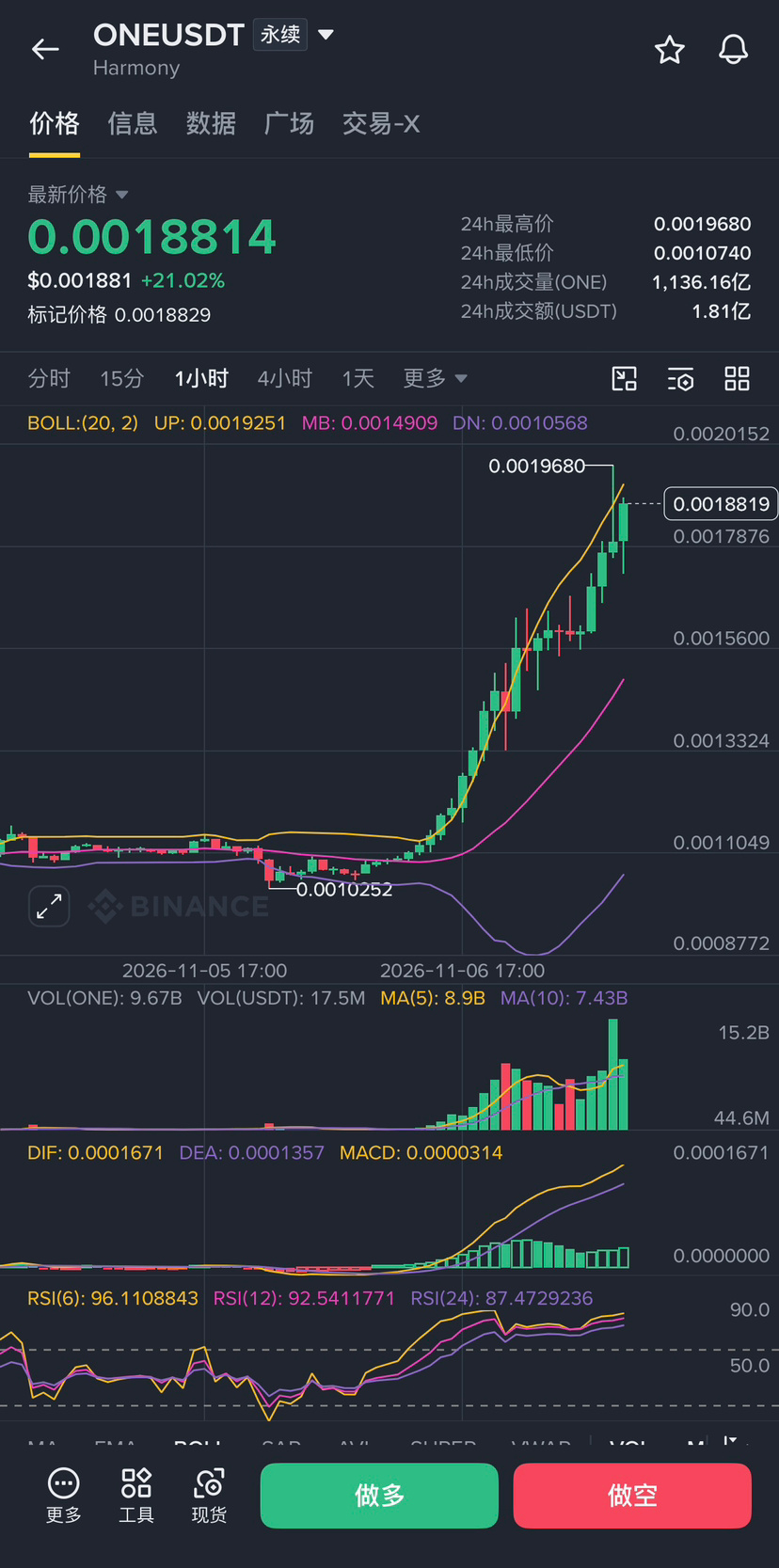
$ONE Short liquidations are still ongoing. Those who went long following the strategy yesterday have successfully taken profits!
{future}(ONEUSDT)
$ONE Short liquidations are still ongoing. Those who went long following the strategy yesterday have successfully taken profits!
詹哥玩币
·
--
$ONE Surged 50%! Is this a fundamental reversal? No, it’s an extreme short squeeze!
📈 Why the price surged:
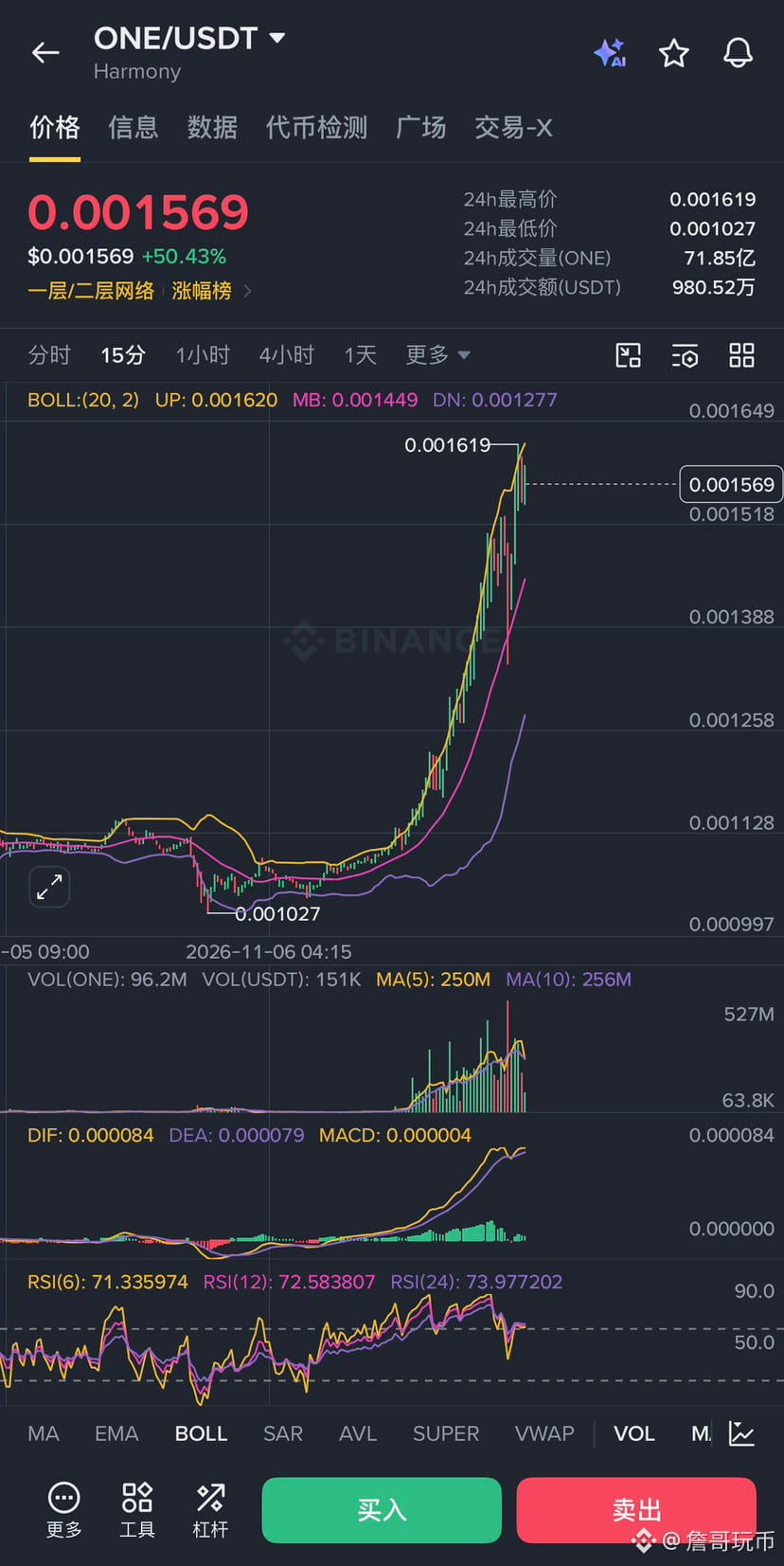
At its core, this is a combination of “narrative reshuffling” and speculative capital. Shutting down the old L1 mainnet, migrating to Ethereum, and pivoting to AI video have layered multiple narratives on top of the token’s low market cap and high price sensitivity, triggering a short squeeze. This is not a fundamental reversal.
🔥 Extremely overbought market + major short-side losses:
· Technicals: RSI is overbought across the board on the 15-minute chart (71–74), and the price has touched the upper Bollinger Band. Momentum is strong, but the risk of a short-term pullback is increasing.
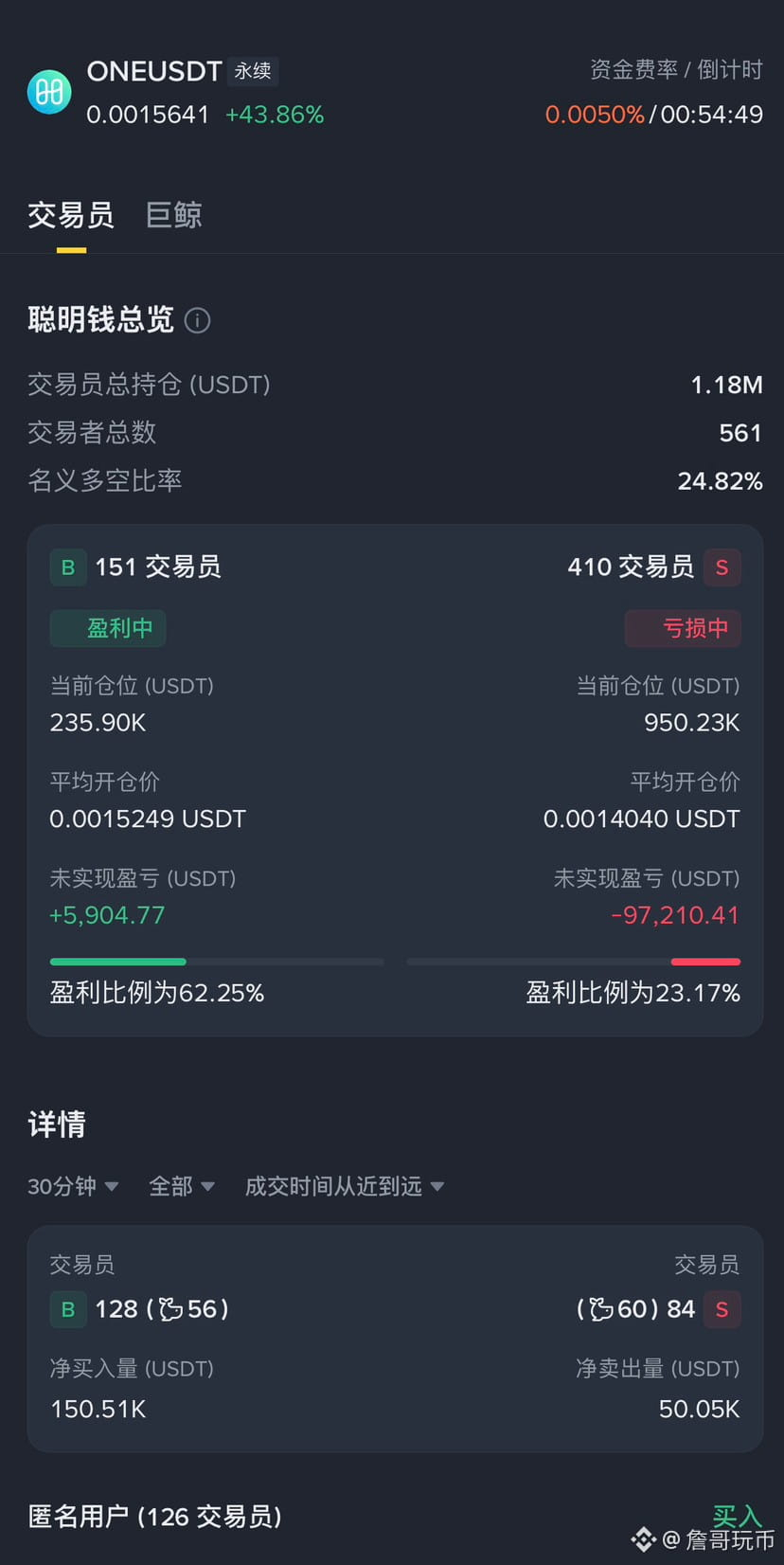
· Capital flows: Funding rates across the market are around -0.4%. Shorts are overcrowded and have to pay longs.
· Smart money: 410 traders are sitting on losing short positions, with total unrealized losses exceeding 97,000 U. Any further price rise could easily trigger a cascade of liquidations.
🎯 Short-term futures trading strategies:
1. Buy the pullback (preferred, more conservative)
· Entry: 0.001480–0.001510 (near the middle Bollinger Band; don’t chase the price)
· Stop-loss: 0.001420 (below the shorts’ average entry cost; invalidates the setup)
· Take-profit: 0.001620 / 0.001700
· Risk/reward ratio: 1:2 or better
2. Buy the breakout (quick in, quick out)
· Condition: The 15-minute candle closes firmly above 0.001620 on increased volume
· Stop-loss: 0.001550
· Take-profit: 0.001700
3. Short near the top (extremely high risk; not recommended right now)
Shorting while funding rates are negative means paying funding fees every day, and the market is still in a short-squeeze phase. Wait for a bearish RSI divergence and for funding rates to turn positive before considering this strategy.
⚠️ Key warning:
Low-market-cap tokens have poor liquidity and are highly prone to sharp wicks. Narrative-driven rallies are fragile. Don’t overleverage, and always use a strict stop-loss!
289
·
--
$ONE Surged 50%! Is this a fundamental reversal? No, it’s an extreme short squeeze!
📈 Why the price surged:
At its core, this is a combination of “narrative reshuffling” and speculative capital. Shutting down the old L1 mainnet, migrating to Ethereum, and pivoting to AI video have layered multiple narratives on top of the token’s low market cap and high price sensitivity, triggering a short squeeze. This is not a fundamental reversal.
🔥 Extremely overbought market + major short-side losses:
· Technicals: RSI is overbought across the board on the 15-minute chart (71–74), and the price has touched the upper Bollinger Band. Momentum is strong, but the risk of a short-term pullback is increasing.
· Capital flows: Funding rates across the market are around -0.4%. Shorts are overcrowded and have to pay longs.
· Smart money: 410 traders are sitting on losing short positions, with total unrealized losses exceeding 97,000 U. Any further price rise could easily trigger a cascade of liquidations.
🎯 Short-term futures trading strategies:
1. Buy the pullback (preferred, more conservative)
· Entry: 0.001480–0.001510 (near the middle Bollinger Band; don’t chase the price)
· Stop-loss: 0.001420 (below the shorts’ average entry cost; invalidates the setup)
· Take-profit: 0.001620 / 0.001700
· Risk/reward ratio: 1:2 or better
2. Buy the breakout (quick in, quick out)
· Condition: The 15-minute candle closes firmly above 0.001620 on increased volume
· Stop-loss: 0.001550
· Take-profit: 0.001700
3. Short near the top (extremely high risk; not recommended right now)
Shorting while funding rates are negative means paying funding fees every day, and the market is still in a short-squeeze phase. Wait for a bearish RSI divergence and for funding rates to turn positive before considering this strategy.
⚠️ Key warning:
Low-market-cap tokens have poor liquidity and are highly prone to sharp wicks. Narrative-driven rallies are fragile. Don’t overleverage, and always use a strict stop-loss!
{future}(ONEUSDT)
$ONE Surged 50%! Is this a fundamental reversal? No, it’s an extreme short squeeze!
📈 Why the price surged:
At its core, this is a combination of “narrative reshuffling” and speculative capital. Shutting down the old L1 mainnet, migrating to Ethereum, and pivoting to AI video have layered multiple narratives on top of the token’s low market cap and high price sensitivity, triggering a short squeeze. This is not a fundamental reversal.
🔥 Extremely overbought market + major short-side losses:
· Technicals: RSI is overbought across the board on the 15-minute chart (71–74), and the price has touched the upper Bollinger Band. Momentum is strong, but the risk of a short-term pullback is increasing.
· Capital flows: Funding rates across the market are around -0.4%. Shorts are overcrowded and have to pay longs.
· Smart money: 410 traders are sitting on losing short positions, with total unrealized losses exceeding 97,000 U. Any further price rise could easily trigger a cascade of liquidations.
🎯 Short-term futures trading strategies:
1. Buy the pullback (preferred, more conservative)
· Entry: 0.001480–0.001510 (near the middle Bollinger Band; don’t chase the price)
· Stop-loss: 0.001420 (below the shorts’ average entry cost; invalidates the setup)
· Take-profit: 0.001620 / 0.001700
· Risk/reward ratio: 1:2 or better
2. Buy the breakout (quick in, quick out)
· Condition: The 15-minute candle closes firmly above 0.001620 on increased volume
· Stop-loss: 0.001550
· Take-profit: 0.001700
3. Short near the top (extremely high risk; not recommended right now)
Shorting while funding rates are negative means paying funding fees every day, and the market is still in a short-squeeze phase. Wait for a bearish RSI divergence and for funding rates to turn positive before considering this strategy.
⚠️ Key warning:
Low-market-cap tokens have poor liquidity and are highly prone to sharp wicks. Narrative-driven rallies are fragile. Don’t overleverage, and always use a strict stop-loss!
1
302
·
--
$SOL This cycle: certainty lies in infrastructure, not in an “ecosystem-wide rally”
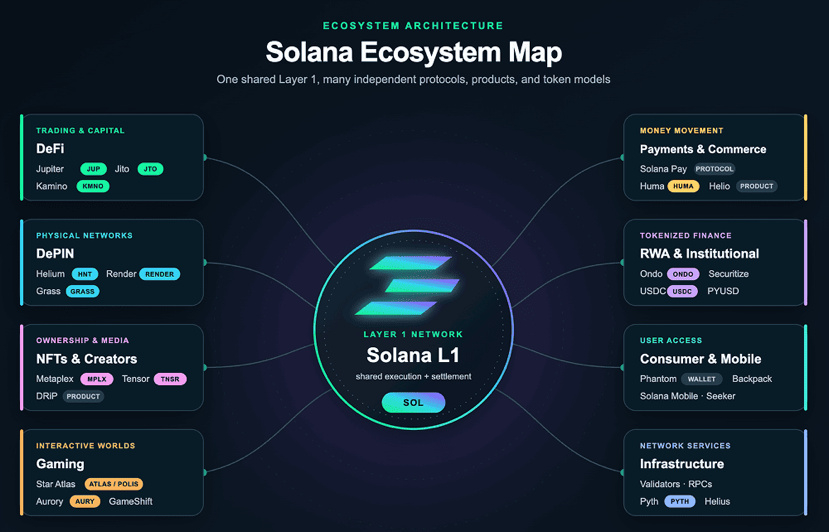
SOL is currently around $90, versus a previous high of $295, leaving roughly 230% upside to $300. The core thesis is not the Meme narrative, but the Alpenglow upgrade, which cuts finality from 12.8 seconds to 150 milliseconds. Transaction confirmations will be nearly instant, allowing exchanges, payment providers, and market makers to genuinely use Solana as a settlement layer. Combined with ETF inflows and RWA adoption on-chain, buying is shifting from retail toward institutional allocation. A $300 target is fundamentally a re-rating of infrastructure, not an extrapolation of sentiment.
But certainty in SOL ≠ certainty in ecosystem tokens. The linear relationship from the previous cycle—“SOL rises, ecosystem tokens broadly rise 5–10x”—is unlikely to hold this time.
The ecosystem, ranked by “strength of value capture”:
RAY — The strongest buyback discipline. 12% of trading fees are used for daily open-market buybacks and permanently removed from circulation; over 30% of the circulating supply has already been eliminated. LaunchLab integrates the launch process into the protocol, creating the shortest path for fees to flow back. Its deflationary evidence is the strongest. The risk is its dependence on launchpad activity for trading volume.
JUP — A fundamental shift on the supply side. In February 2026, the DAO stopped net new issuance, shifting from continuous releases to a frozen supply. 50% of on-chain revenue goes to Litterbox buybacks for a strategic reserve, rather than being directly burned. The thesis is real, but value capture is one step removed.
MET — Fundamentals are rising, but the token hasn’t kept up. September fees reached $31.43 million, nearly doubling month over month, and DLMM Pro addresses a real pain point. But buybacks are discretionary: there were buybacks in Q1 but none in Q2, and they aren’t automatically linked to revenue. The token’s beta to platform growth is weak.
PUMP — Buybacks have been halved. In April, the buyback allocation was cut from 100% of net revenue to 50%. Even the previous 100% buyback policy failed to keep the price sustainably above its launch valuation. The token lacks any hard use case beyond governance, competition in the Meme sector is intensifying, and its edge is narrowing.
For smaller investors, there’s only one screening criterion: are buybacks automatic, is deflation verifiable, and is the token itself required by the protocol? By this measure, RAY is the strongest, followed by JUP. MET needs buybacks to shift from discretionary to automatic before it can fundamentally change. PUMP depends on whether the Meme cycle returns—a low-certainty bet.
{future}(SOLUSDT)
{future}(RAYSOLUSDT)
{future}(METUSDT)
$SOL This cycle: certainty lies in infrastructure, not in an “ecosystem-wide rally”
SOL is currently around $90, versus a previous high of $295, leaving roughly 230% upside to $300. The core thesis is not the Meme narrative, but the Alpenglow upgrade, which cuts finality from 12.8 seconds to 150 milliseconds. Transaction confirmations will be nearly instant, allowing exchanges, payment providers, and market makers to genuinely use Solana as a settlement layer. Combined with ETF inflows and RWA adoption on-chain, buying is shifting from retail toward institutional allocation. A $300 target is fundamentally a re-rating of infrastructure, not an extrapolation of sentiment.
But certainty in SOL ≠ certainty in ecosystem tokens. The linear relationship from the previous cycle—“SOL rises, ecosystem tokens broadly rise 5–10x”—is unlikely to hold this time.
The ecosystem, ranked by “strength of value capture”:
RAY — The strongest buyback discipline. 12% of trading fees are used for daily open-market buybacks and permanently removed from circulation; over 30% of the circulating supply has already been eliminated. LaunchLab integrates the launch process into the protocol, creating the shortest path for fees to flow back. Its deflationary evidence is the strongest. The risk is its dependence on launchpad activity for trading volume.
JUP — A fundamental shift on the supply side. In February 2026, the DAO stopped net new issuance, shifting from continuous releases to a frozen supply. 50% of on-chain revenue goes to Litterbox buybacks for a strategic reserve, rather than being directly burned. The thesis is real, but value capture is one step removed.
MET — Fundamentals are rising, but the token hasn’t kept up. September fees reached $31.43 million, nearly doubling month over month, and DLMM Pro addresses a real pain point. But buybacks are discretionary: there were buybacks in Q1 but none in Q2, and they aren’t automatically linked to revenue. The token’s beta to platform growth is weak.
PUMP — Buybacks have been halved. In April, the buyback allocation was cut from 100% of net revenue to 50%. Even the previous 100% buyback policy failed to keep the price sustainably above its launch valuation. The token lacks any hard use case beyond governance, competition in the Meme sector is intensifying, and its edge is narrowing.
For smaller investors, there’s only one screening criterion: are buybacks automatic, is deflation verifiable, and is the token itself required by the protocol? By this measure, RAY is the strongest, followed by JUP. MET needs buybacks to shift from discretionary to automatic before it can fundamentally change. PUMP depends on whether the Meme cycle returns—a low-certainty bet.
1.1k
·
--

Article
Stop Betting on Narratives Alone! The 2026 bull market is handsomely rewarding DeFi projects that generate real revenue 🔥Everyone, have you figured out what’s driving the market at the start of 2026? The market’s fundamentals have undergone a major reversal!
While most people are still watching BTC trade sideways, the data doesn’t lie: since the start of 2026, a basket of leading DeFi tokens (including HYPE, LIT, AERO, AAVE, ENA, and 12 others) has gained more than twice as much on average as BTC!
This is about far more than simple sector rotation—it’s a fundamental restructuring of the market: crypto is moving away from “hype-driven speculation” and returning to fundamentals, with a focus on real yield.
Stop Betting on Narratives Alone! The 2026 bull market is handsomely rewarding DeFi projects that generate real revenue 🔥
Everyone, have you figured out what’s driving the market at the start of 2026? The market’s fundamentals have undergone a major reversal!
While most people are still watching BTC trade sideways, the data doesn’t lie: since the start of 2026, a basket of leading DeFi tokens (including HYPE, LIT, AERO, AAVE, ENA, and 12 others) has gained more than twice as much on average as BTC!
This is about far more than simple sector rotation—it’s a fundamental restructuring of the market: crypto is moving away from “hype-driven speculation” and returning to fundamentals, with a focus on real yield.
1
1.1k
·
--
$CLANKER Why the sudden takeoff? Short-term price level analysis
🚀 Why did it suddenly skyrocket?
1. Narrative catalyst: Mask Network is taking over, with a rebrand and new features launching on November 4, giving investors a reason to speculate.
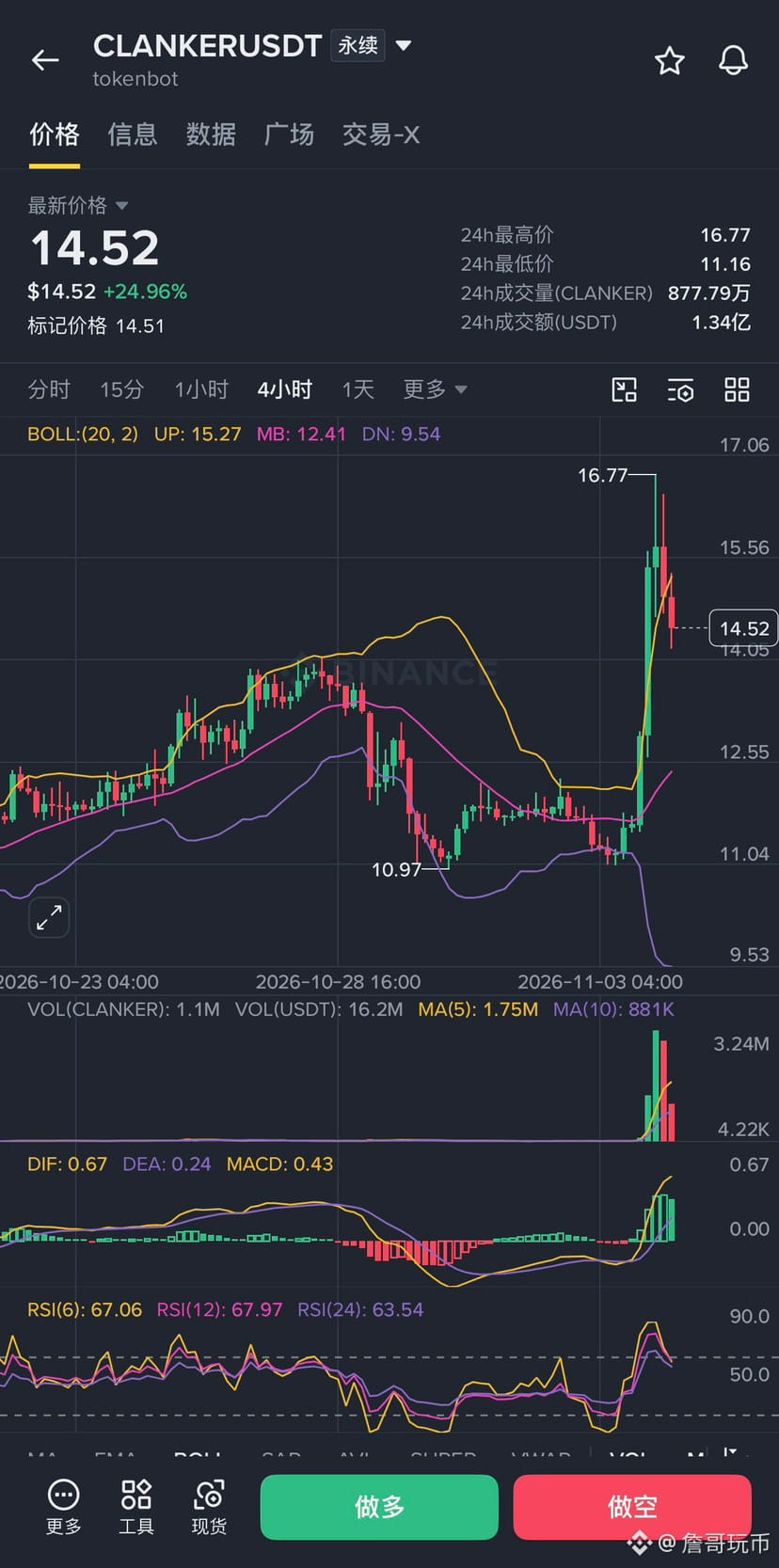
2. A short squeeze fueled by low liquidity: 24-hour trading volume is only around 13 million, making the market very thin. Market data shows short positions (820,000 U) far exceed long positions (540,000 U), and shorts are currently profitable. Major players pushed the price up, directly liquidating shorts (with an average entry price around 15.6), triggering a wave of short covering and creating a sharp “short squeeze” rally.
3. Technically overbought: The 4-hour chart has touched the upper Bollinger Band (15.27), and the RSI is approaching 70. The market is severely overbought in the short term, making it extremely risky to chase the rally.
🎯 Short-term contract levels (quick in, quick out)
The current price (14.52) is very close to the high and near the short liquidation zone, so the preferred strategy is to open short positions on a price rise.
Plan 1: Short on a rise (preferred)
· Entry: Scale into shorts in the 14.50–14.80 range
· Stop-loss: 15.30 (exit if a surge in volume pushes price above the upper Bollinger Band)
· Take-profit: First target 13.20, second target 12.50 (a pullback to the middle Bollinger Band)
· Position size: Small (<15%)
Plan 2: Buy the pullback (alternative)
· Entry: 12.50–13.00 (wait for confirmation of support, such as a long lower wick)
· Stop-loss: 12.20
· Take-profit: 14.00
· Position size: Very small (<10%)
{future}(CLANKERUSDT)
$CLANKER Why the sudden takeoff? Short-term price level analysis
🚀 Why did it suddenly skyrocket?
1. Narrative catalyst: Mask Network is taking over, with a rebrand and new features launching on November 4, giving investors a reason to speculate.
2. A short squeeze fueled by low liquidity: 24-hour trading volume is only around 13 million, making the market very thin. Market data shows short positions (820,000 U) far exceed long positions (540,000 U), and shorts are currently profitable. Major players pushed the price up, directly liquidating shorts (with an average entry price around 15.6), triggering a wave of short covering and creating a sharp “short squeeze” rally.
3. Technically overbought: The 4-hour chart has touched the upper Bollinger Band (15.27), and the RSI is approaching 70. The market is severely overbought in the short term, making it extremely risky to chase the rally.
🎯 Short-term contract levels (quick in, quick out)
The current price (14.52) is very close to the high and near the short liquidation zone, so the preferred strategy is to open short positions on a price rise.
Plan 1: Short on a rise (preferred)
· Entry: Scale into shorts in the 14.50–14.80 range
· Stop-loss: 15.30 (exit if a surge in volume pushes price above the upper Bollinger Band)
· Take-profit: First target 13.20, second target 12.50 (a pullback to the middle Bollinger Band)
· Position size: Small (<15%)
Plan 2: Buy the pullback (alternative)
· Entry: 12.50–13.00 (wait for confirmation of support, such as a long lower wick)
· Stop-loss: 12.20
· Take-profit: 14.00
· Position size: Very small (<10%)
215
·
--
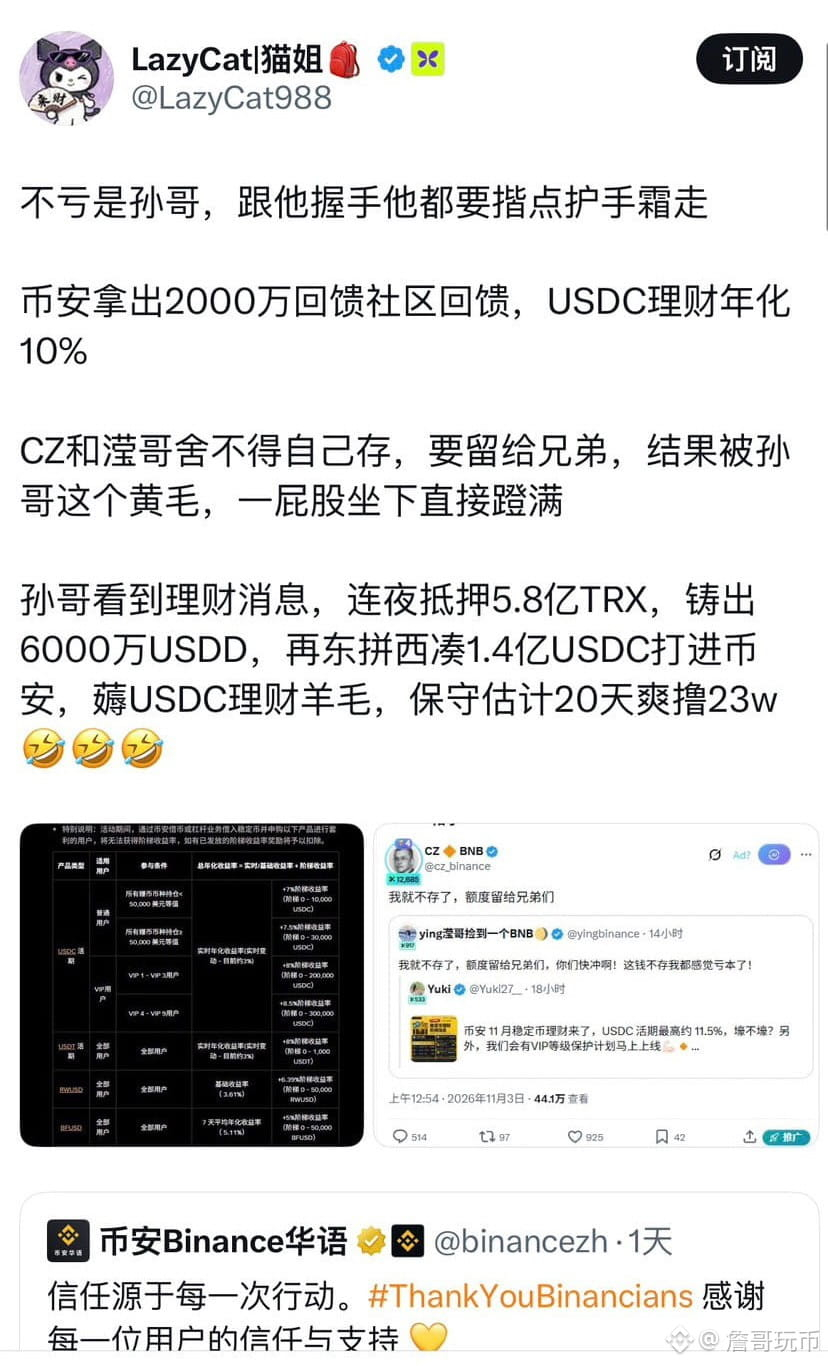
It had to be Sun 🈹! He takes every last feather—scraped together 200 million USDC overnight and filled the entire quota in one fell swoop.
Binance’s 10% USDC Earn offer was politely described by CZ and Brother Ying as “for the brothers.” Then Sun 🈹 showed up overnight and plonked himself down on the whole allocation!
A hilarious comment from a netizen: “Shake hands with Sun 🈹 and he’ll even rub off some of your hand cream on his way out.” Sun 🈹 has really mastered the art of taking every last bit.
Check out Sun 🈹’s extreme play: He collateralized 580 million TRX overnight, minted 60 million USDD, cobbled together 200 million USDC, and dumped it straight into Binance Earn to collect interest. At a 10% annual yield, a conservative estimate puts his take at 230,000 US dollars in just 20 days! That’s what you call top-tier capital efficiency.
While ordinary folks are still hesitating, Sun 🈹 has already snapped up the whole lot. Brothers, did you manage to grab any of the quota?
{future}(TRXUSDT)
It had to be Sun 🈹! He takes every last feather—scraped together 200 million USDC overnight and filled the entire quota in one fell swoop.
Binance’s 10% USDC Earn offer was politely described by CZ and Brother Ying as “for the brothers.” Then Sun 🈹 showed up overnight and plonked himself down on the whole allocation!
A hilarious comment from a netizen: “Shake hands with Sun 🈹 and he’ll even rub off some of your hand cream on his way out.” Sun 🈹 has really mastered the art of taking every last bit.
Check out Sun 🈹’s extreme play: He collateralized 580 million TRX overnight, minted 60 million USDD, cobbled together 200 million USDC, and dumped it straight into Binance Earn to collect interest. At a 10% annual yield, a conservative estimate puts his take at 230,000 US dollars in just 20 days! That’s what you call top-tier capital efficiency.
While ordinary folks are still hesitating, Sun 🈹 has already snapped up the whole lot. Brothers, did you manage to grab any of the quota?

222
·
--
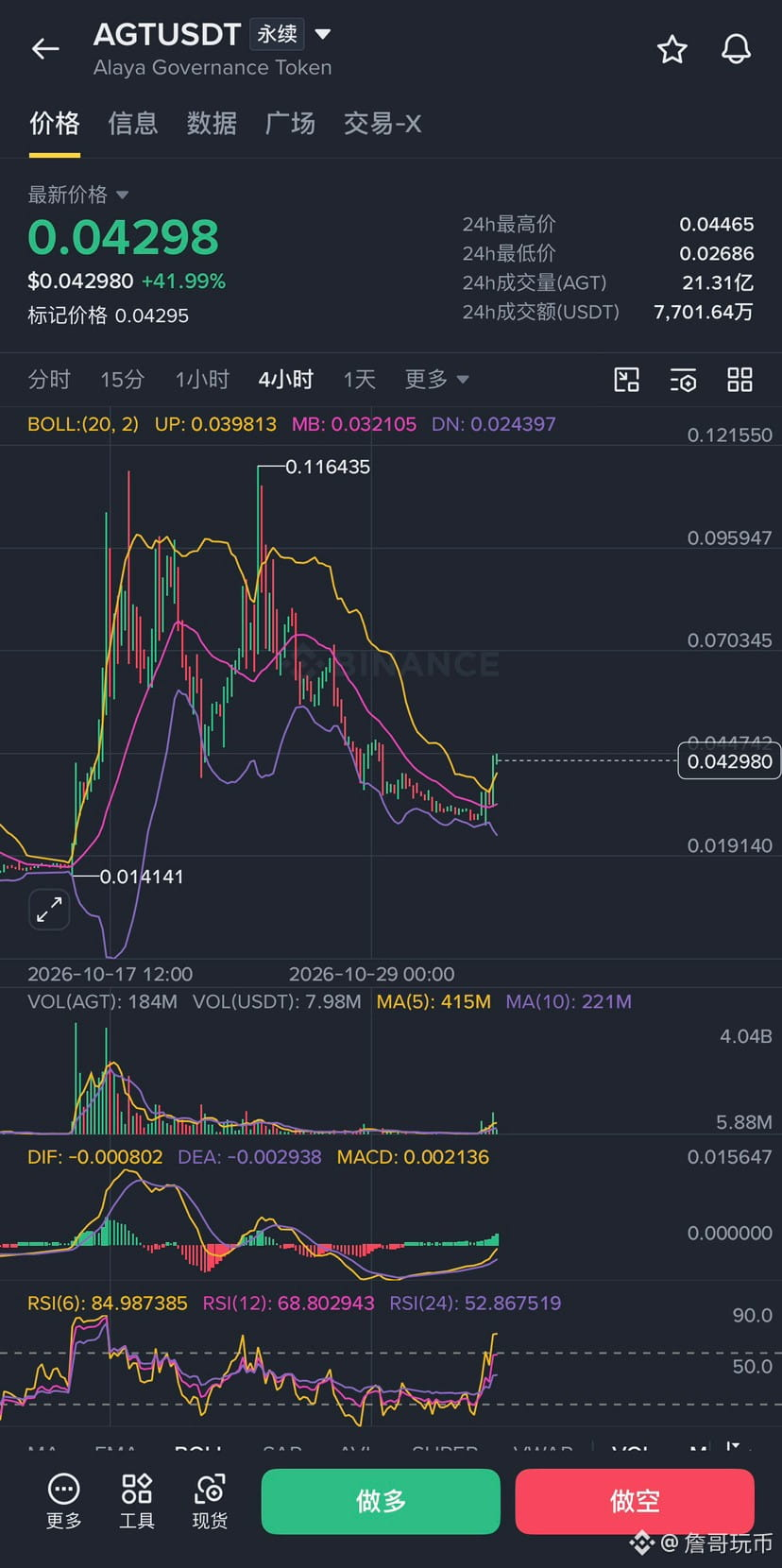
$AGT Soaring 40% against the market! The old troublemaker token is acting up—how to trade it short-term?
The broader market is falling, but AGT is rising. It surged nearly 50% at its peak today and is currently around 0.043. The surge comes down to three factors:
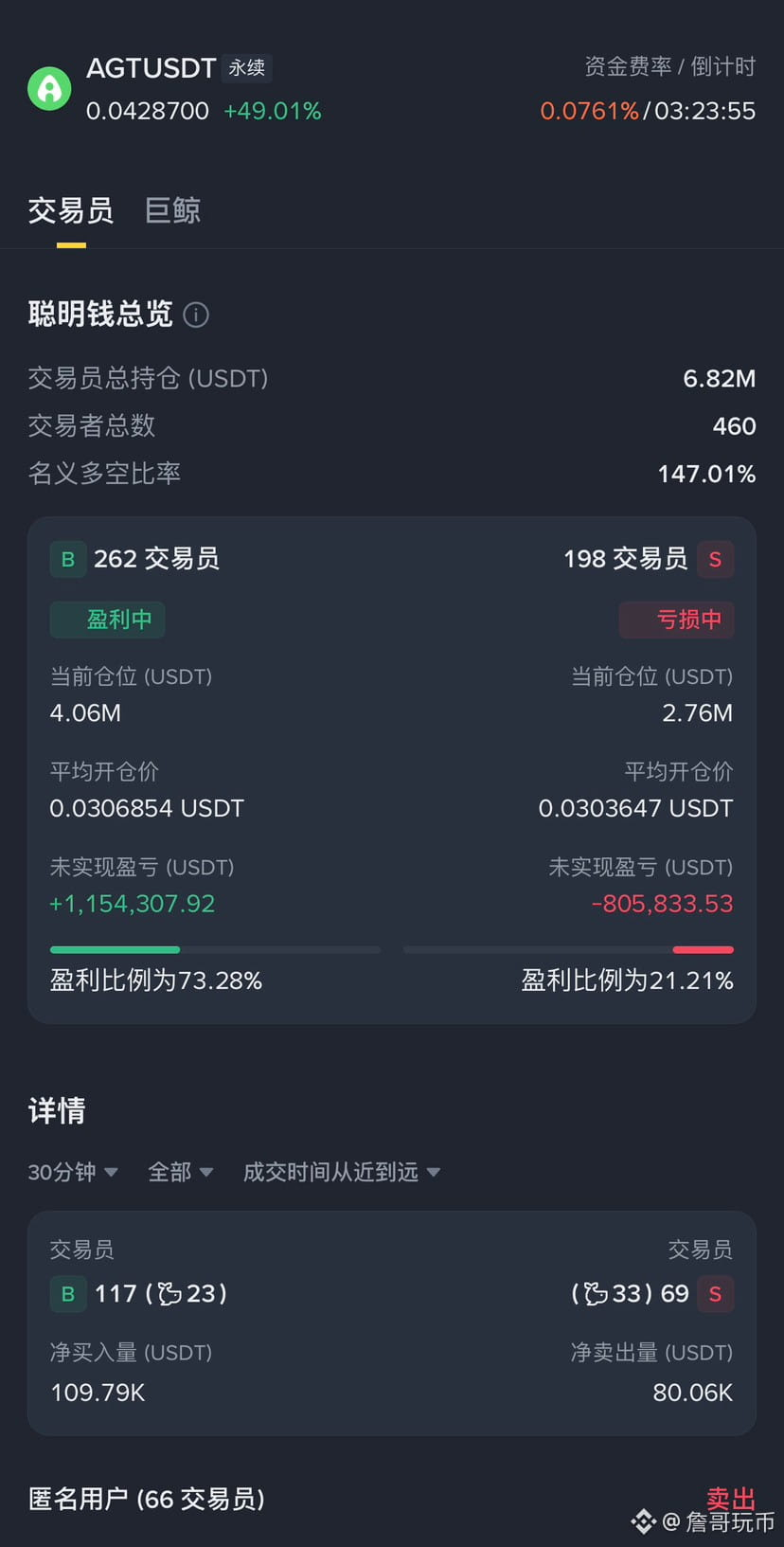
1. Leveraged buying: Whales are opening concentrated long positions with high leverage in a thin order book. The capital involved isn't huge, but it can send the price soaring in an instant.
2. Riding the AI hype: Purely sentiment-driven speculation, with no substantial positive developments recently.
3. Longs are sitting on hefty unrealized profits: The average cost basis for smart money is 0.0306, and it's now up over 40%—they could dump at any moment to cash out.
Technical outlook:
RSI(6) is extremely overbought at 85, and tokens unlock on November 13 (a major bearish catalyst). Chasing the rally carries significant risk.
Short-term futures levels:
🔴 Short (preferred): Open a small short position in the 0.043–0.044 range. Stop-loss at 0.047. Target 0.038–0.039; if it breaks below that, watch 0.032.
🟢 Long (on a pullback only): Don't chase the rally! Wait for a pullback to 0.0385 and enter only if it stabilizes. Stop-loss at 0.036. Target 0.044.
{future}(AGTUSDT)
$AGT Soaring 40% against the market! The old troublemaker token is acting up—how to trade it short-term?
The broader market is falling, but AGT is rising. It surged nearly 50% at its peak today and is currently around 0.043. The surge comes down to three factors:
1. Leveraged buying: Whales are opening concentrated long positions with high leverage in a thin order book. The capital involved isn't huge, but it can send the price soaring in an instant.
2. Riding the AI hype: Purely sentiment-driven speculation, with no substantial positive developments recently.
3. Longs are sitting on hefty unrealized profits: The average cost basis for smart money is 0.0306, and it's now up over 40%—they could dump at any moment to cash out.
Technical outlook:
RSI(6) is extremely overbought at 85, and tokens unlock on November 13 (a major bearish catalyst). Chasing the rally carries significant risk.
Short-term futures levels:
🔴 Short (preferred): Open a small short position in the 0.043–0.044 range. Stop-loss at 0.047. Target 0.038–0.039; if it breaks below that, watch 0.032.
🟢 Long (on a pullback only): Don't chase the rally! Wait for a pullback to 0.0385 and enter only if it stabilizes. Stop-loss at 0.036. Target 0.044.
348
·
--
The “Golden Pit” After Panic Selling: $牛来 Short-Term Rebound Analysis
I. Key Takeaway
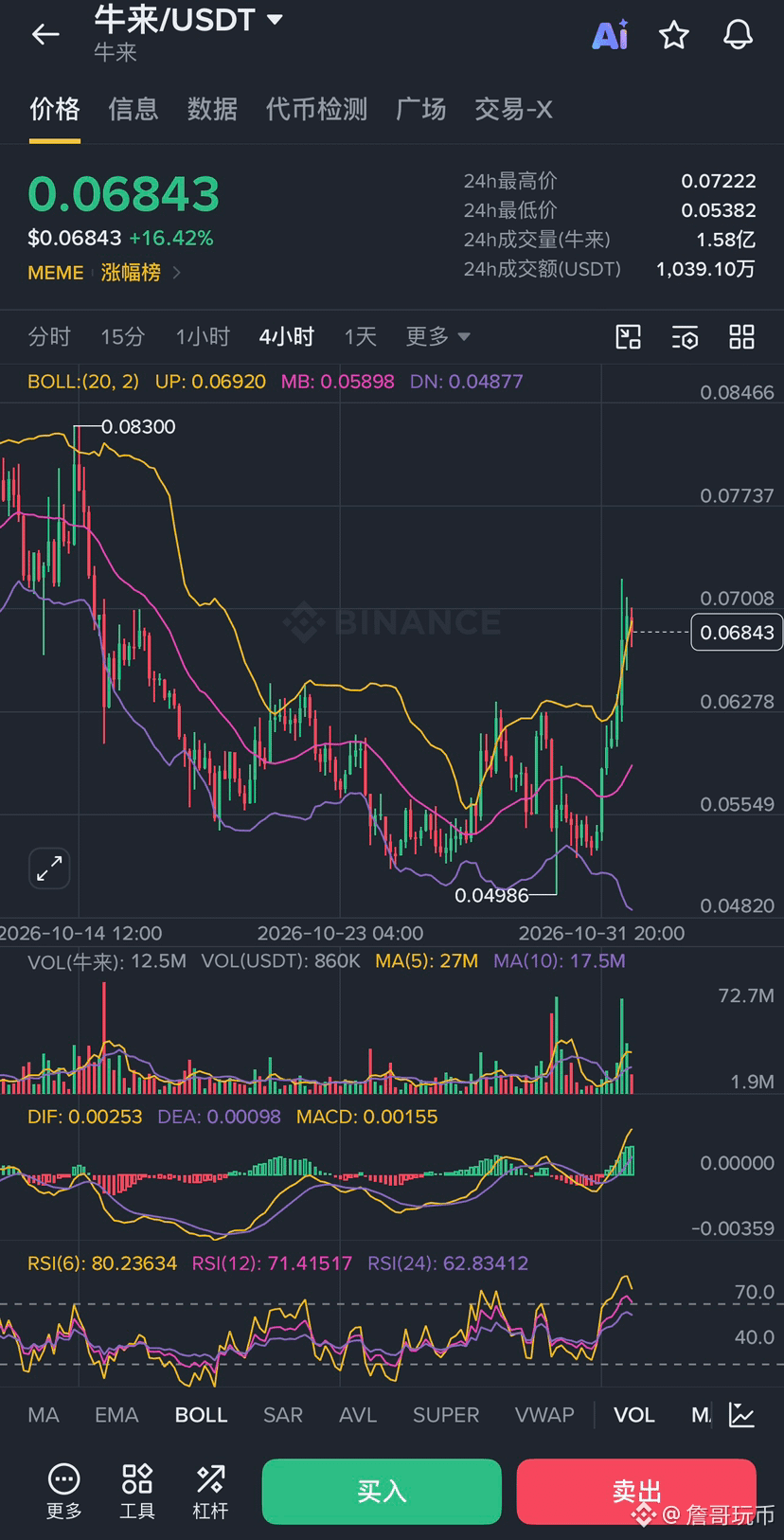
Niu Lai has most likely confirmed a short-term bottom at 0.04986. The current move is an oversold rebound following panic selling. Since Meme coins have no fundamental support, this is only suitable for short-term trading—not a trend reversal.
II. Event-Driven Factors
The Binance hack triggered panic across the market, and Niu Lai, as a high-beta Meme coin, was indiscriminately sold off. CZ then pledged full compensation, sentiment recovered, and funds flowed back into oversold sectors, creating a “golden pit.”
III. Technical Analysis
On the 4-hour chart, the MACD has formed a bullish crossover and is pointing upward; the price has moved above the Bollinger middle band, and trading volume has increased. However, RSI(6) has reached the overbought zone at 80, so a short-term pullback is possible. Avoid chasing the price higher.
IV. Short-Term Trading Levels
· Entry: Enter with a small position if the price stabilizes after pulling back to 0.065–0.067; alternatively, go long on a strong breakout above 0.0722.
· Stop-loss: Set at 0.058 for all positions (exit if the price falls below the Bollinger middle band).
· Take-profit: First target: 0.085 (reduce position); second target: 0.11.
· Risk management: If 24-hour trading volume falls below 30 million U, it signals waning interest—exit immediately.
Summary: The event has created a short-term opportunity, but heavy selling pressure remains overhead. Trade quickly and strictly use stop-losses.
{future}(牛来USDT)
The “Golden Pit” After Panic Selling: $牛来 Short-Term Rebound Analysis
I. Key Takeaway
Niu Lai has most likely confirmed a short-term bottom at 0.04986. The current move is an oversold rebound following panic selling. Since Meme coins have no fundamental support, this is only suitable for short-term trading—not a trend reversal.
II. Event-Driven Factors
The Binance hack triggered panic across the market, and Niu Lai, as a high-beta Meme coin, was indiscriminately sold off. CZ then pledged full compensation, sentiment recovered, and funds flowed back into oversold sectors, creating a “golden pit.”
III. Technical Analysis
On the 4-hour chart, the MACD has formed a bullish crossover and is pointing upward; the price has moved above the Bollinger middle band, and trading volume has increased. However, RSI(6) has reached the overbought zone at 80, so a short-term pullback is possible. Avoid chasing the price higher.
IV. Short-Term Trading Levels
· Entry: Enter with a small position if the price stabilizes after pulling back to 0.065–0.067; alternatively, go long on a strong breakout above 0.0722.
· Stop-loss: Set at 0.058 for all positions (exit if the price falls below the Bollinger middle band).
· Take-profit: First target: 0.085 (reduce position); second target: 0.11.
· Risk management: If 24-hour trading volume falls below 30 million U, it signals waning interest—exit immediately.
Summary: The event has created a short-term opportunity, but heavy selling pressure remains overhead. Trade quickly and strictly use stop-losses.
2.9k
·
--
Article
A $6.3 Billion Wake-Up Call: Binance Hit, and UNI Up 5% Is Just the Appetizer?This Binance security incident was no small matter.
According to the official announcement, the attackers gained access to service containers through a DevOps engineer’s compromised laptop and submitted unauthorized withdrawal transactions. The total impact is estimated at around $6.3 billion; about $3 billion has been frozen on-chain, and the losses will be covered by the SAFU fund and Binance’s own funds. Private keys were not leaked. Deposits and withdrawals have been suspended until security checks are complete.
But the market has already cast its vote.
In the 24 hours after the incident, UNI climbed from 6.66 to 7.03, up more than 5%. BTC barely moved over the same period, while the funding rate was just +0.01% and open interest stood at $42 million—more like spot buying than a sentiment bubble fueled by leverage. DEX trading volume across the market over 24 hours ranged from $12.5 billion to $16.4 billion. Money really is moving on-chain.
A $6.3 Billion Wake-Up Call: Binance Hit, and UNI Up 5% Is Just the Appetizer?
This Binance security incident was no small matter.
According to the official announcement, the attackers gained access to service containers through a DevOps engineer’s compromised laptop and submitted unauthorized withdrawal transactions. The total impact is estimated at around $6.3 billion; about $3 billion has been frozen on-chain, and the losses will be covered by the SAFU fund and Binance’s own funds. Private keys were not leaked. Deposits and withdrawals have been suspended until security checks are complete.
But the market has already cast its vote.
In the 24 hours after the incident, UNI climbed from 6.66 to 7.03, up more than 5%. BTC barely moved over the same period, while the funding rate was just +0.01% and open interest stood at $42 million—more like spot buying than a sentiment bubble fueled by leverage. DEX trading volume across the market over 24 hours ranged from $12.5 billion to $16.4 billion. Money really is moving on-chain.
1
1.7k
·
--
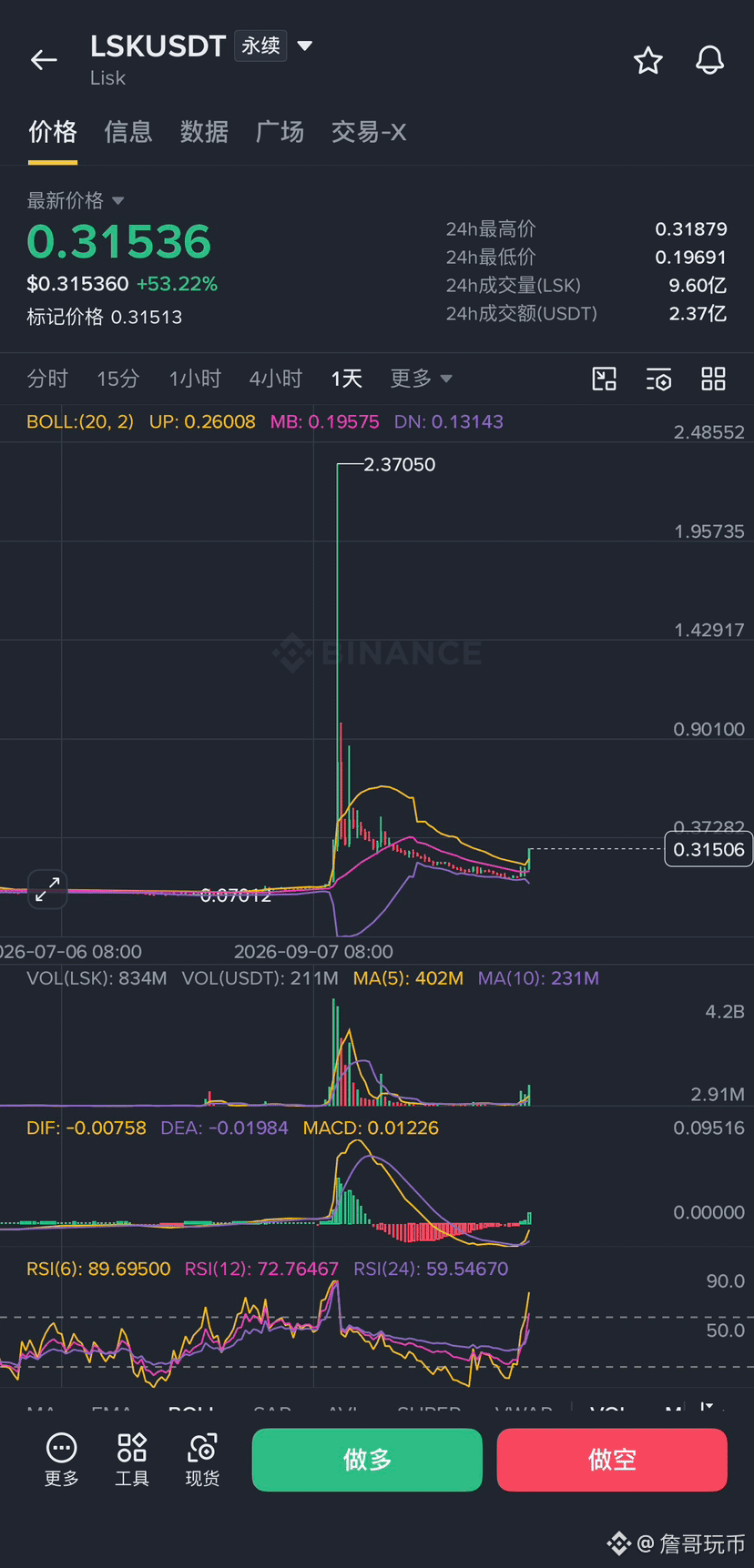
$LSK Surges 53%: Dead-Cat Bounce or Comeback? A Quick Look at Short-Term Levels
Straight to the point: The fundamentals haven’t recovered. This is a short squeeze triggered by extremely negative funding rates and a thin order book—in essence, a “structural dead-cat bounce.”
Why the price surged:
1. Narrative catalyst: The chain is set to shut down at the end of October, and a proposal to burn 100 million tokens gave bulls an emotional excuse to buy.
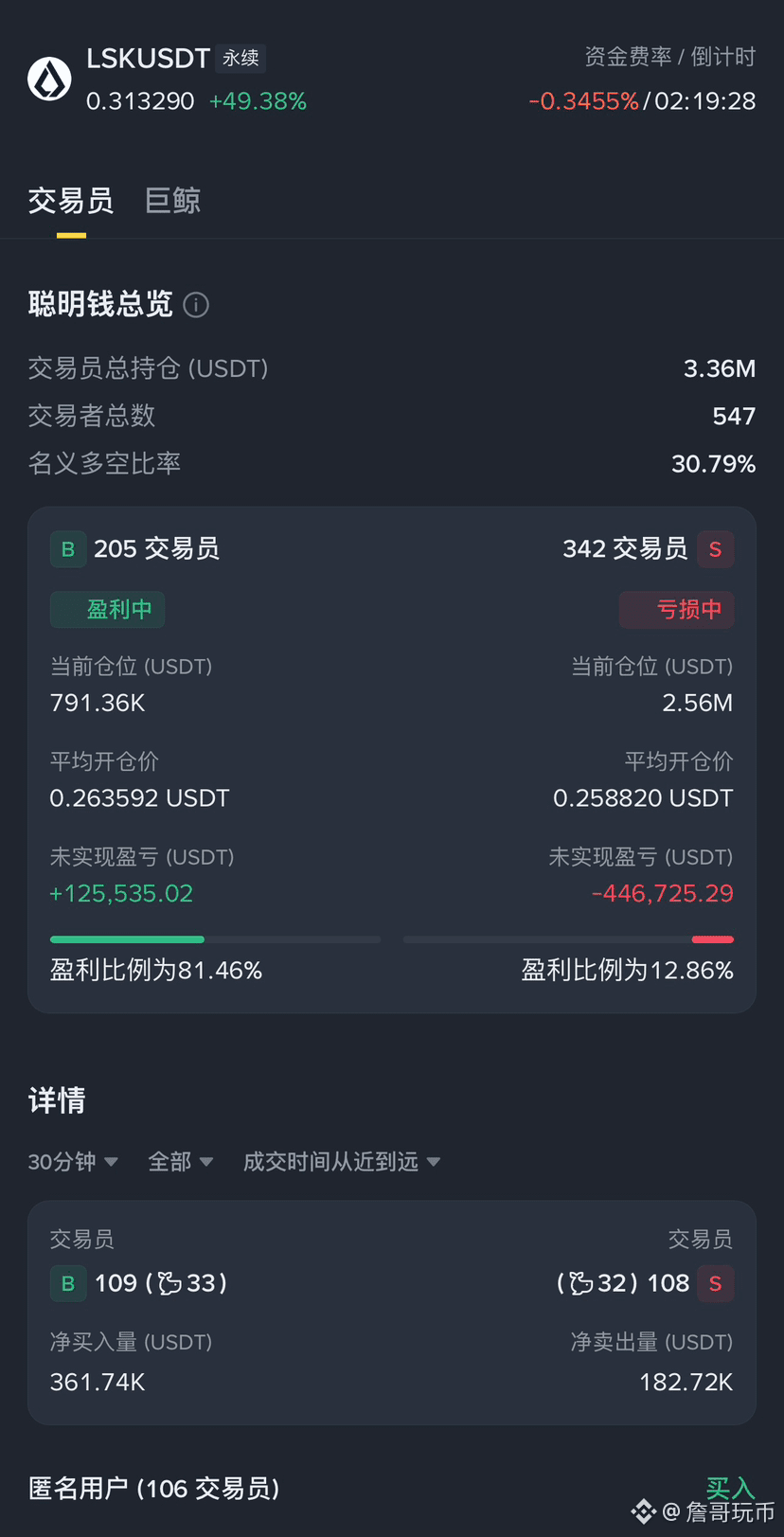
2. Fuel for the short squeeze: The funding rate reached -0.3455%. A screenshot shows 342 short accounts holding their positions, with an average entry price of 0.2588 and unrealized losses totaling as much as 446,000 U. Short-covering buy orders became the rocket fuel for the rally.
3. Extremely thin liquidity: The order book is shallow, so even moderate capital can push the price up by double digits.
Short-term futures levels (do not chase the rally):
· Long setup (wait for a pullback):
· Entry: Patiently wait for a pullback to the 0.260–0.280 support zone, and only enter with a small position if signs of a bottom appear on the 1-hour chart.
· Stop-loss: 0.240 (a break below this level would signal that the short-squeeze momentum is fading).
· Target: Take profits in stages at 0.340–0.350.
· Short setup (play a stall in the rally):
· Entry: Try a small short if signs of stalling, such as long upper wicks or price-volume divergence, appear in the 0.340–0.350 zone.
· Stop-loss: Above 0.360.
· Target: 0.280–0.260.
· Warning: The biggest risk for shorts is the negative funding rate draining your funds. Stick to short-term mean reversion; absolutely do not hold a short position for the long term.
In one sentence: You can trade short-term in the direction of the short-squeeze momentum, but keep your position small and use a hard stop-loss. Don’t mistake a “dead-cat bounce” for a “king’s return.”
{future}(LSKUSDT)
$LSK Surges 53%: Dead-Cat Bounce or Comeback? A Quick Look at Short-Term Levels
Straight to the point: The fundamentals haven’t recovered. This is a short squeeze triggered by extremely negative funding rates and a thin order book—in essence, a “structural dead-cat bounce.”
Why the price surged:
1. Narrative catalyst: The chain is set to shut down at the end of October, and a proposal to burn 100 million tokens gave bulls an emotional excuse to buy.
2. Fuel for the short squeeze: The funding rate reached -0.3455%. A screenshot shows 342 short accounts holding their positions, with an average entry price of 0.2588 and unrealized losses totaling as much as 446,000 U. Short-covering buy orders became the rocket fuel for the rally.
3. Extremely thin liquidity: The order book is shallow, so even moderate capital can push the price up by double digits.
Short-term futures levels (do not chase the rally):
· Long setup (wait for a pullback):
· Entry: Patiently wait for a pullback to the 0.260–0.280 support zone, and only enter with a small position if signs of a bottom appear on the 1-hour chart.
· Stop-loss: 0.240 (a break below this level would signal that the short-squeeze momentum is fading).
· Target: Take profits in stages at 0.340–0.350.
· Short setup (play a stall in the rally):
· Entry: Try a small short if signs of stalling, such as long upper wicks or price-volume divergence, appear in the 0.340–0.350 zone.
· Stop-loss: Above 0.360.
· Target: 0.280–0.260.
· Warning: The biggest risk for shorts is the negative funding rate draining your funds. Stick to short-term mean reversion; absolutely do not hold a short position for the long term.
In one sentence: You can trade short-term in the direction of the short-squeeze momentum, but keep your position small and use a hard stop-loss. Don’t mistake a “dead-cat bounce” for a “king’s return.”
299
·
--
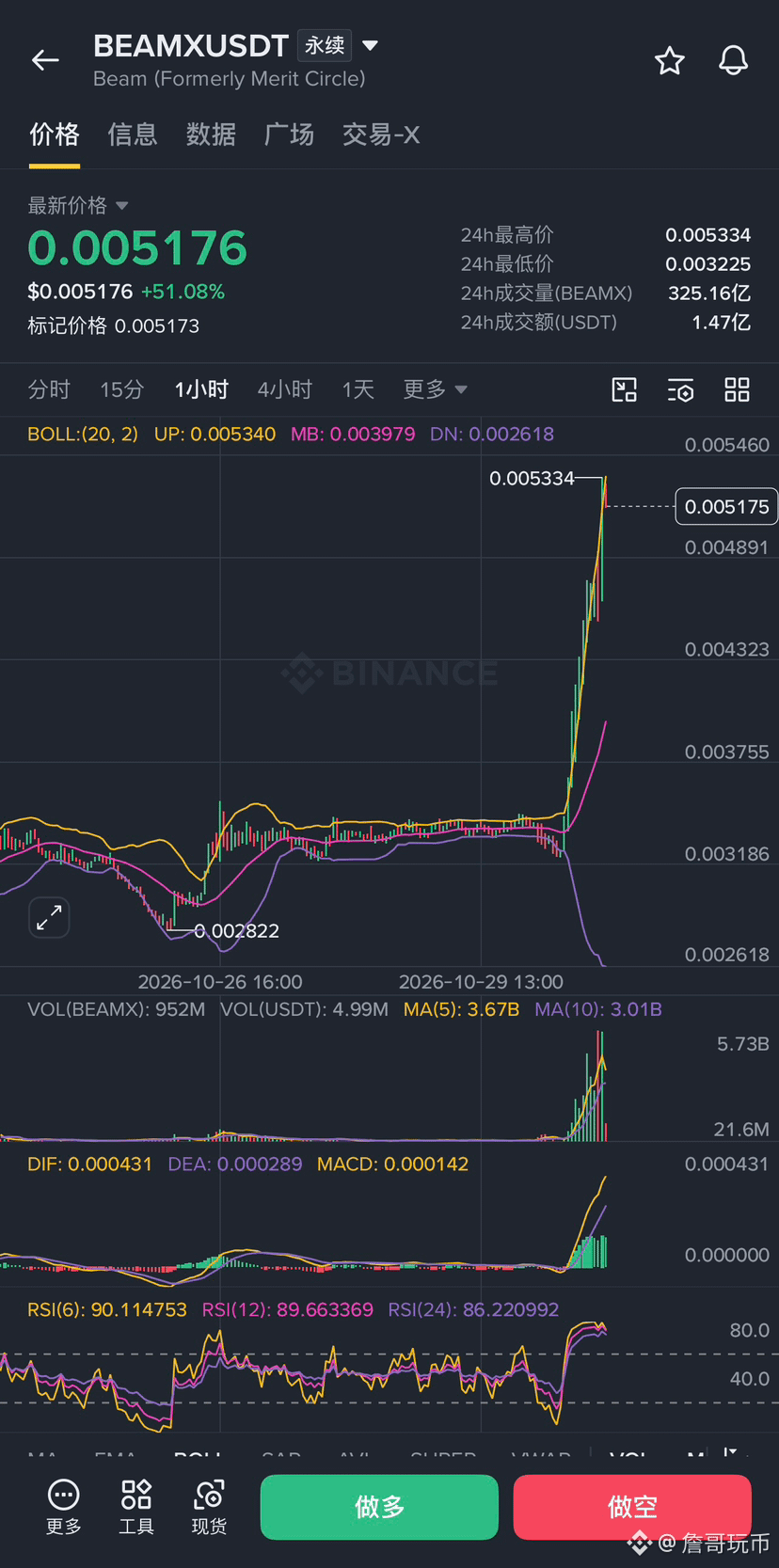
Market-wide bloodbath, $BEAMX surges 53% against the trend: token-burn catalyst and short-squeeze cascade
The market plunged today amid rumors of a Binance hack, but BEAMX bucked the trend and soared over 50% (high: 0.005334). There are three key reasons:
1. Positive catalyst: The Beam Foundation announced it would burn approximately $3.3 million worth of tokens held by the hacker, sharply reducing the circulating supply.
2. Short squeeze: The data is extremely lopsided. There are far more shorts (456) than longs (264), and unrealized losses for shorts have reached as high as -4.33 million U, with only 10.96% in profit. A push from spot buyers was enough to liquidate the shorts.
3. Flight to safety: With the broader market unstable, hot money is flowing into low-market-cap altcoins for quick trades.
Suggested futures entry levels (current price: 0.005176)
Caution: The 1H RSI has surged to 90, indicating extreme overbought conditions. Do not chase the price here!
🔴 Short positions (fade the top / short on a breakdown)
· Trial short zone: 0.0053–0.0054 (previous high and upper Bollinger Band). Enter only if a long upper wick forms or the price stalls on heavy volume.
· Stop-loss: 0.0056 (to guard against a short-squeeze wick).
· Breakdown short: Enter in the direction of the move if the price breaks below 0.0048 on heavy volume; target 0.0043.
🟢 Long positions (buy the pullback / go long on a breakout)
· Pullback zone: 0.0041–0.0043 (the consolidation area before the rally). Try a small long position if the price stabilizes on declining volume.
· Stop-loss: 0.0036.
· Breakout long: Chase the move only after the price breaks above and holds the previous high of 0.005334 on heavy volume.
⚠️ Reminder: Small-cap coins with negative funding rates and high RSI can easily “liquidate shorts first, then wipe out longs.” Always use stop-losses and keep positions small!
{future}(BEAMXUSDT)
Market-wide bloodbath, $BEAMX surges 53% against the trend: token-burn catalyst and short-squeeze cascade
The market plunged today amid rumors of a Binance hack, but BEAMX bucked the trend and soared over 50% (high: 0.005334). There are three key reasons:
1. Positive catalyst: The Beam Foundation announced it would burn approximately $3.3 million worth of tokens held by the hacker, sharply reducing the circulating supply.
2. Short squeeze: The data is extremely lopsided. There are far more shorts (456) than longs (264), and unrealized losses for shorts have reached as high as -4.33 million U, with only 10.96% in profit. A push from spot buyers was enough to liquidate the shorts.
3. Flight to safety: With the broader market unstable, hot money is flowing into low-market-cap altcoins for quick trades.
Suggested futures entry levels (current price: 0.005176)
Caution: The 1H RSI has surged to 90, indicating extreme overbought conditions. Do not chase the price here!
🔴 Short positions (fade the top / short on a breakdown)
· Trial short zone: 0.0053–0.0054 (previous high and upper Bollinger Band). Enter only if a long upper wick forms or the price stalls on heavy volume.
· Stop-loss: 0.0056 (to guard against a short-squeeze wick).
· Breakdown short: Enter in the direction of the move if the price breaks below 0.0048 on heavy volume; target 0.0043.
🟢 Long positions (buy the pullback / go long on a breakout)
· Pullback zone: 0.0041–0.0043 (the consolidation area before the rally). Try a small long position if the price stabilizes on declining volume.
· Stop-loss: 0.0036.
· Breakout long: Chase the move only after the price breaks above and holds the previous high of 0.005334 on heavy volume.
⚠️ Reminder: Small-cap coins with negative funding rates and high RSI can easily “liquidate shorts first, then wipe out longs.” Always use stop-losses and keep positions small!
422
·
--
Market-wide bloodbath, $PARTI surges 50% against the trend: short-squeeze meat grinder and short-term levels
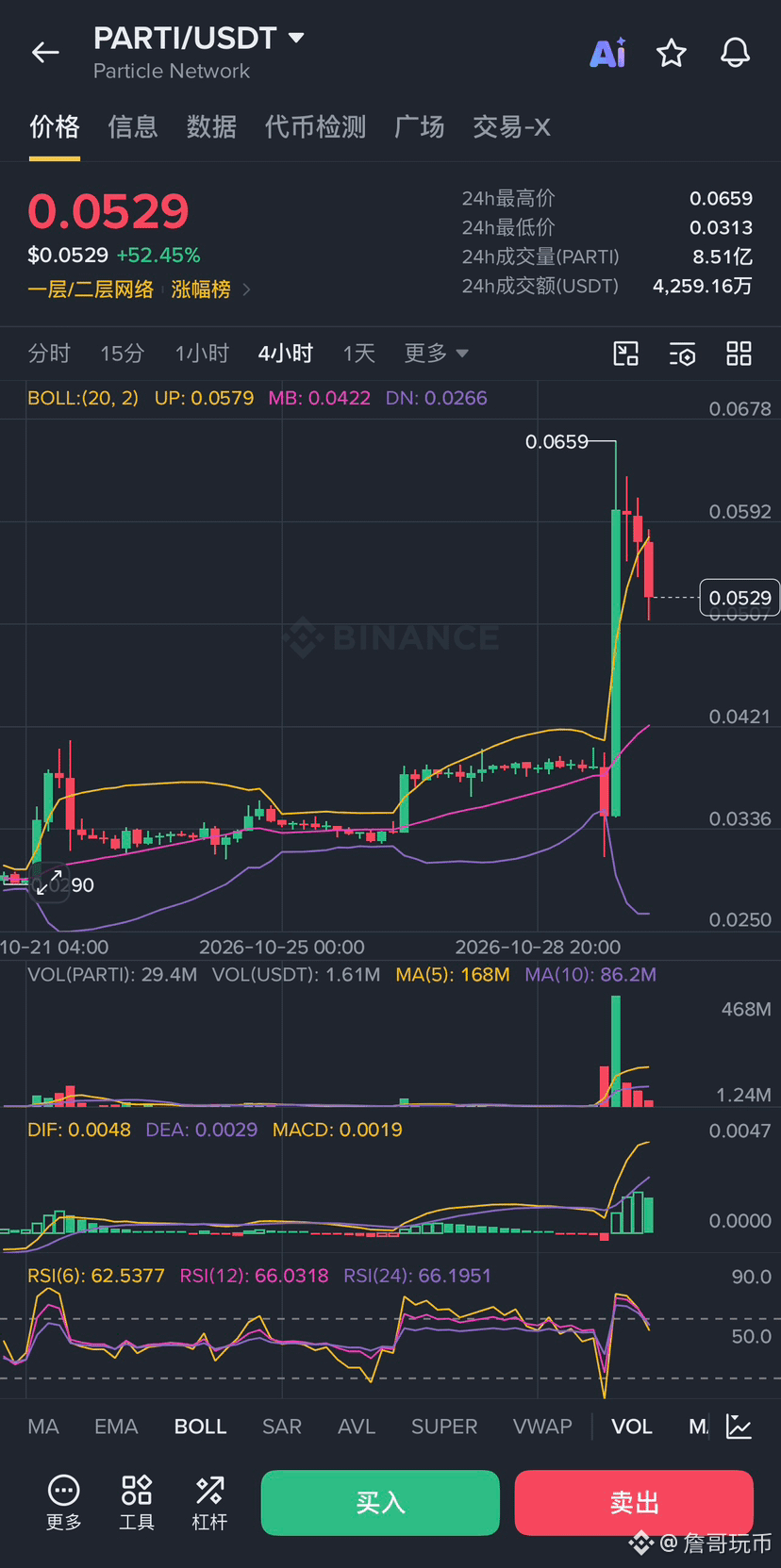
Today, rumors of a Binance hack triggered a market-wide plunge, but PARTI surged +52% against the trend (peaking at 0.0659). This wasn’t value discovery, but a classic battle for funds amid panic selling.
Why did it surge against the trend?
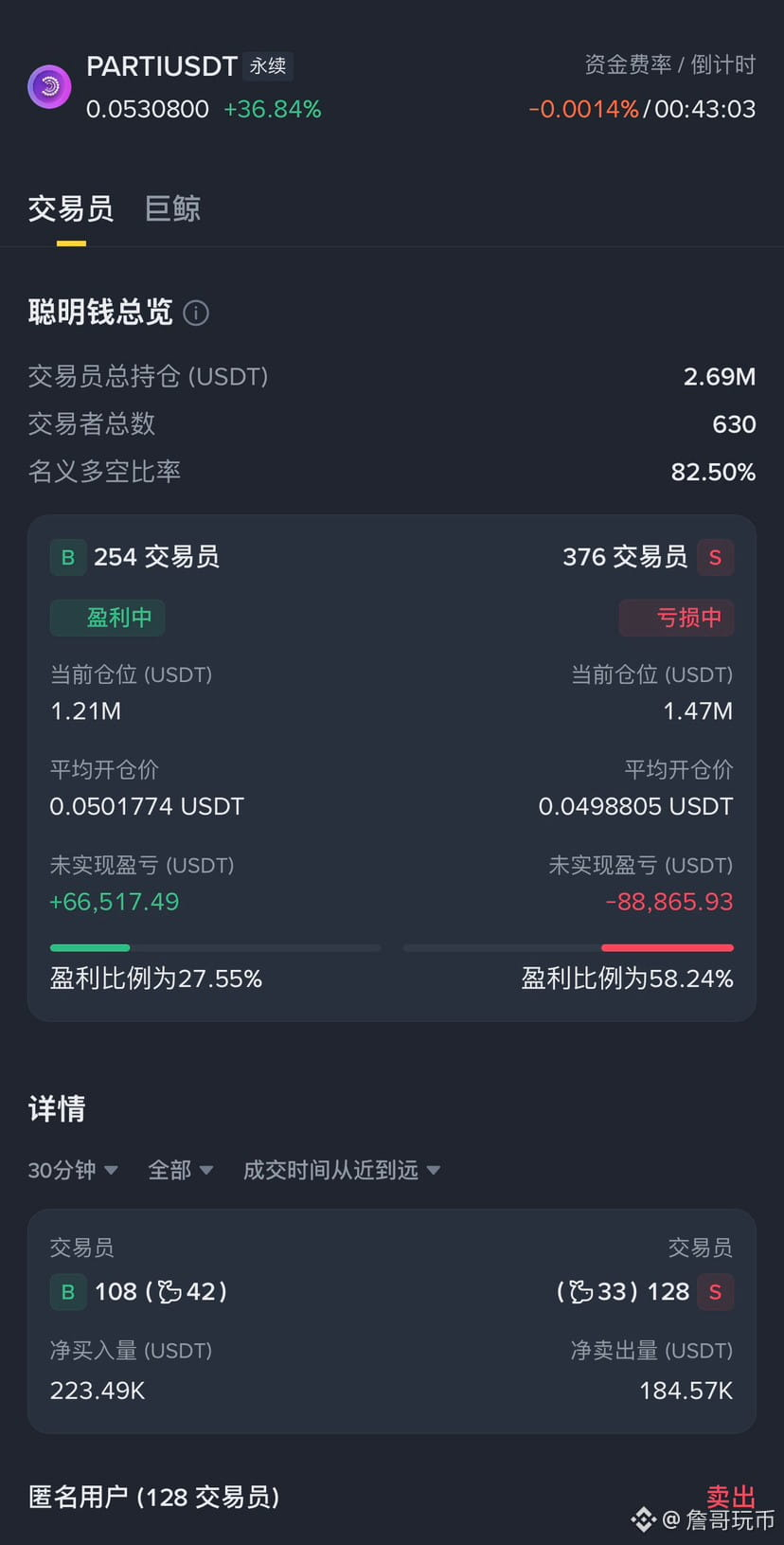
1. Short squeeze: Before the rally, the funding rate reached -1% (an annualized -1101%), making it extremely costly to hold short positions. The screenshot also showed more short accounts (376) than long accounts (254), with shorts suffering heavy losses. A push from spot buyers forced shorts to close, triggering a cascading squeeze.
2. Speculative flight of capital: With the broader market unstable, hot money flowed into small-cap coins with very low circulating market caps. Trading volume surged in the four hours before the rally, but open interest remained extremely low, indicating that this was purely short-term capital moving in and out quickly.
Suggested futures levels
🔴 Short entry levels (fade the top on the right side / short a breakdown)
• Early short-entry zone: 0.058 - 0.060 (the upper Bollinger Band and a high-volume trading zone). Only consider a small short position if you see a volume-backed failure to rise or a long upper wick. Do not place orders in advance.
• Breakdown short entry: Below 0.048. If the price breaks below 0.048 on high volume, it indicates that the short-squeeze momentum is fading, and you can follow the trend with a short.
• Stop-loss for shorts: 0.066 (above the previous high). In a short squeeze, strict stop-losses are essential.
• Take-profit for shorts: Targets to the downside at 0.048 -> 0.042 -> 0.038.
🟢 Long entry levels (buy a pullback / chase a breakout)
• Buy a pullback: 0.042 - 0.048. This is the high-volume support zone before the rally; consider a small long position if selling volume dries up and the price stabilizes.
• Stop-loss for longs: 0.038.
• Breakout entry: Enter on the right side after the price breaks above and holds the previous high of 0.0659 on high volume. Set the stop-loss at the low of the breakout candle!
{future}(PARTIUSDT)
Market-wide bloodbath, $PARTI surges 50% against the trend: short-squeeze meat grinder and short-term levels
Today, rumors of a Binance hack triggered a market-wide plunge, but PARTI surged +52% against the trend (peaking at 0.0659). This wasn’t value discovery, but a classic battle for funds amid panic selling.
Why did it surge against the trend?
1. Short squeeze: Before the rally, the funding rate reached -1% (an annualized -1101%), making it extremely costly to hold short positions. The screenshot also showed more short accounts (376) than long accounts (254), with shorts suffering heavy losses. A push from spot buyers forced shorts to close, triggering a cascading squeeze.
2. Speculative flight of capital: With the broader market unstable, hot money flowed into small-cap coins with very low circulating market caps. Trading volume surged in the four hours before the rally, but open interest remained extremely low, indicating that this was purely short-term capital moving in and out quickly.
Suggested futures levels
🔴 Short entry levels (fade the top on the right side / short a breakdown)
• Early short-entry zone: 0.058 - 0.060 (the upper Bollinger Band and a high-volume trading zone). Only consider a small short position if you see a volume-backed failure to rise or a long upper wick. Do not place orders in advance.
• Breakdown short entry: Below 0.048. If the price breaks below 0.048 on high volume, it indicates that the short-squeeze momentum is fading, and you can follow the trend with a short.
• Stop-loss for shorts: 0.066 (above the previous high). In a short squeeze, strict stop-losses are essential.
• Take-profit for shorts: Targets to the downside at 0.048 -> 0.042 -> 0.038.
🟢 Long entry levels (buy a pullback / chase a breakout)
• Buy a pullback: 0.042 - 0.048. This is the high-volume support zone before the rally; consider a small long position if selling volume dries up and the price stabilizes.
• Stop-loss for longs: 0.038.
• Breakout entry: Enter on the right side after the price breaks above and holds the previous high of 0.0659 on high volume. Set the stop-loss at the low of the breakout candle!
184
·
--
Article
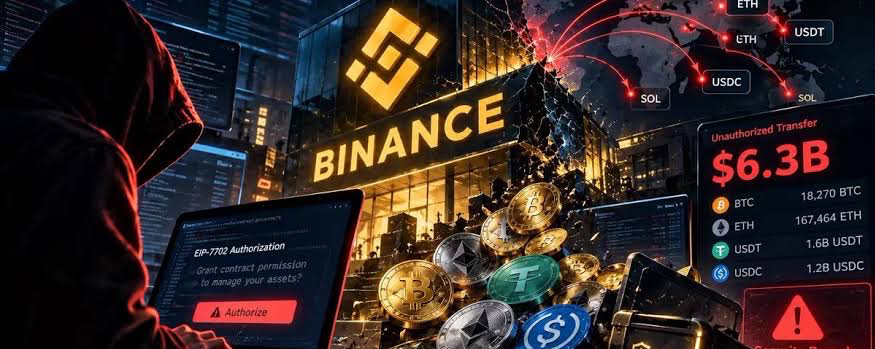
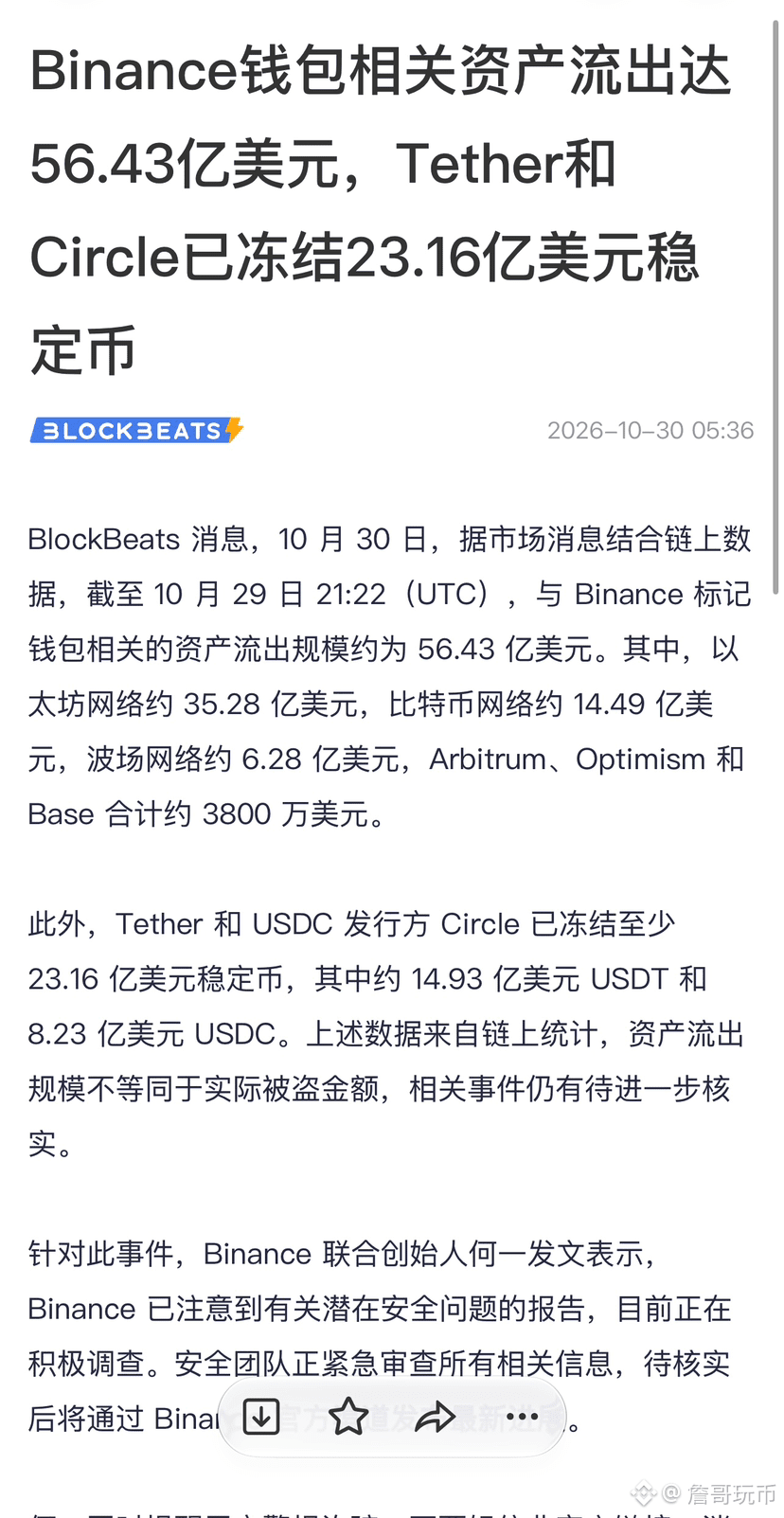
$5.6 Billion Stolen from Binance: Which Assets Are Worth Buying on the Dip?Here’s the bottom line: in this sell-off, the risks that have been most fully priced in are not BTC or ETH, but BNB and the stablecoins that have already been frozen. The headlines look bad for BTC, but in reality its funds are being locked up involuntarily; ETH is the true source of selling pressure to watch.
1. Let’s get the numbers straight: half has already been frozen
About $5.6 billion flowed out of Binance’s hot wallets, and roughly $3 billion has now been confirmed frozen. The vast majority of the frozen funds were centralized assets issued by companies, such as USDT, USDC, and RLUSD: Tether froze $1.567 billion, Circle froze nearly all $823 million in USDC, and Ripple also helped block about $200 million in RLUSD. The stablecoin risk had largely been dealt with by the morning of the incident.
$5.6 Billion Stolen from Binance: Which Assets Are Worth Buying on the Dip?
Here’s the bottom line: in this sell-off, the risks that have been most fully priced in are not BTC or ETH, but BNB and the stablecoins that have already been frozen. The headlines look bad for BTC, but in reality its funds are being locked up involuntarily; ETH is the true source of selling pressure to watch.
1. Let’s get the numbers straight: half has already been frozen
About $5.6 billion flowed out of Binance’s hot wallets, and roughly $3 billion has now been confirmed frozen. The vast majority of the frozen funds were centralized assets issued by companies, such as USDT, USDC, and RLUSD: Tether froze $1.567 billion, Circle froze nearly all $823 million in USDC, and Ripple also helped block about $200 million in RLUSD. The stablecoin risk had largely been dealt with by the morning of the incident.
3
1.4k
·
--
Black swan events happen year after year. Don’t give up your positions easily—buy the dip when the time is right, and wait for brighter days!
{future}(BNBUSDT)
Black swan events happen year after year. Don’t give up your positions easily—buy the dip when the time is right, and wait for brighter days!
238
·
--
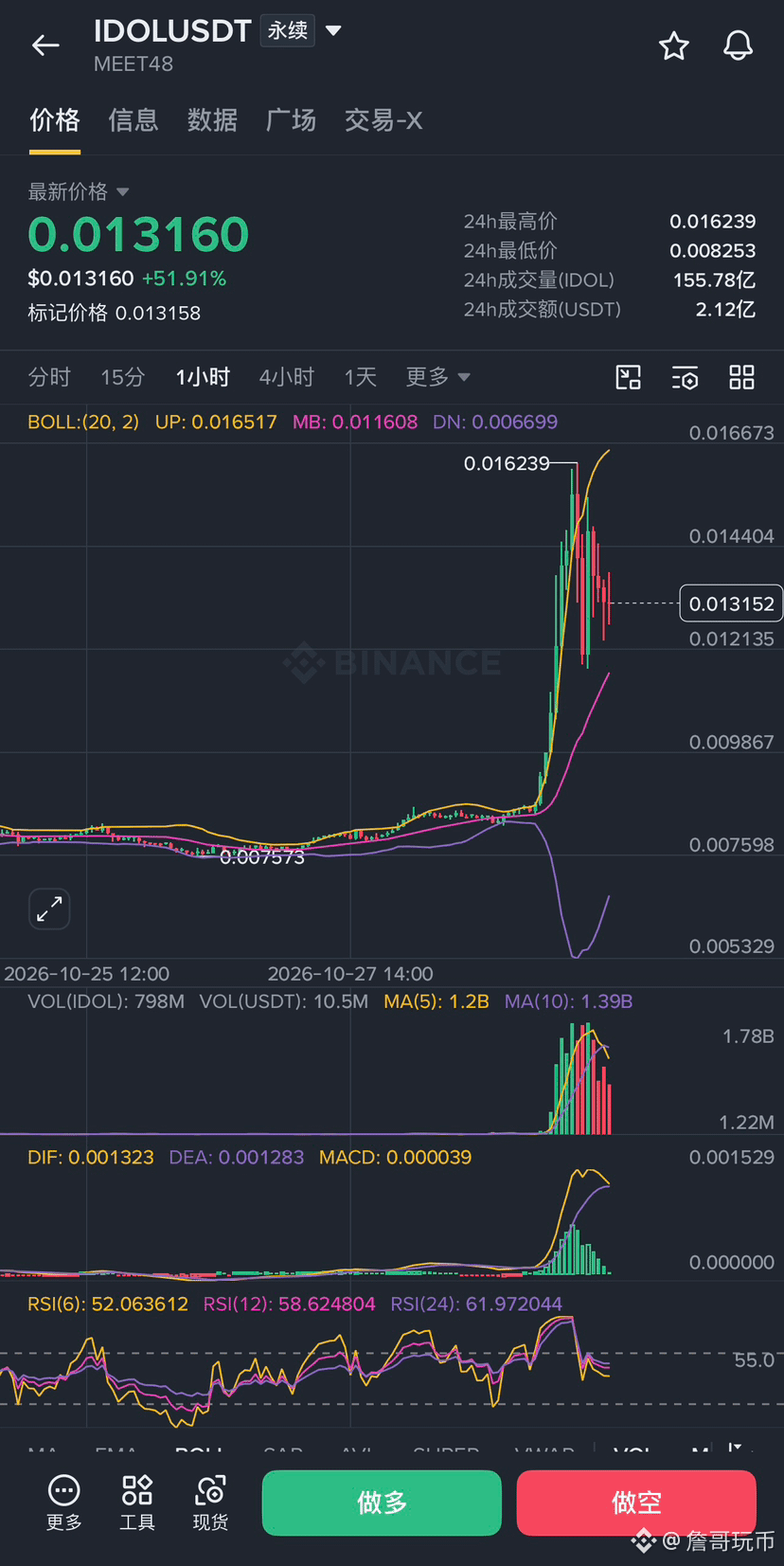
$IDOL Decoding the Surge & a Simple Short-Term Strategy
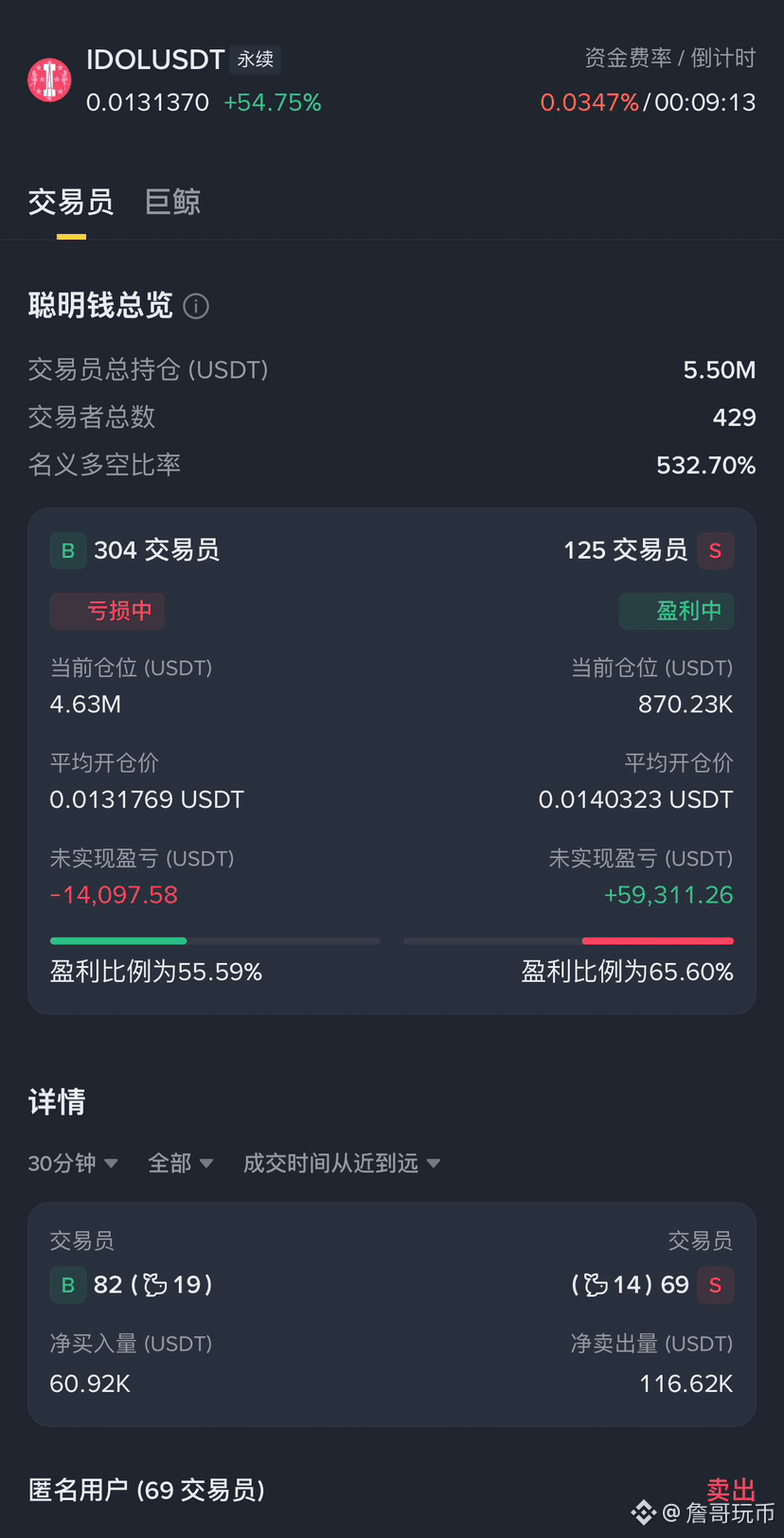
The key to the surge: MEET48’s AI + fan narrative provides a foundation, while its small market cap makes it easy to pump. Extremely high leverage (long/short ratio: 532%) brought in a flood of longs, triggering a short squeeze. But longs are now deeply underwater, net selling over the past 30 minutes exceeds net buying, and funds are fleeing at these high levels.
Short-term contract levels (bearish bias; beware of sharp wicks at high levels):
🔴 Short: Scale in between 0.0135 and 0.0140 on a rebound.
Stop-loss: 0.0148.
Take-profit: 0.0120; if it breaks below, watch 0.0108.
🟢 Long (ultra-short-term only): If the price stabilizes after retesting 0.0115–0.0118, consider a small long position. Stop-loss: 0.0108. Do not chase longs at the current price!
⚠️ Discipline: This is a classic sentiment-driven short squeeze, and the reversal can come quickly. Use low leverage, set stop-losses, and get in and out fast!
{future}(IDOLUSDT)
$IDOL Decoding the Surge & a Simple Short-Term Strategy
The key to the surge: MEET48’s AI + fan narrative provides a foundation, while its small market cap makes it easy to pump. Extremely high leverage (long/short ratio: 532%) brought in a flood of longs, triggering a short squeeze. But longs are now deeply underwater, net selling over the past 30 minutes exceeds net buying, and funds are fleeing at these high levels.
Short-term contract levels (bearish bias; beware of sharp wicks at high levels):
🔴 Short: Scale in between 0.0135 and 0.0140 on a rebound.
Stop-loss: 0.0148.
Take-profit: 0.0120; if it breaks below, watch 0.0108.
🟢 Long (ultra-short-term only): If the price stabilizes after retesting 0.0115–0.0118, consider a small long position. Stop-loss: 0.0108. Do not chase longs at the current price!
⚠️ Discipline: This is a classic sentiment-driven short squeeze, and the reversal can come quickly. Use low leverage, set stop-losses, and get in and out fast!
159
·
--

Article
Binance’s New Favorite PREDICT Is About to Launch: A Wealth-Building Legend or an Overvalued “Meat Grinder”?Recently, PREDICT (@predictdotfun) caught fire thanks to Binance Wallet’s Prime Sale event. Many followers have messaged me privately asking whether this token is worth jumping into and what to make of its pre-market contracts.
In today’s deep dive, we’ll take a closer look at its underlying token model, true valuation potential, and key make-or-break levels after launch. Here’s the conclusion upfront: sentiment is sharply divided, and short-term speculation carries extremely high risk—don’t get caught up in the hype!
📊 I. Tokenomics: The double-edged sword of low circulating supply and long lock-up periods
PREDICT has a total supply of 1 billion tokens. Take a closer look at its token allocation, and you’ll find a classic “highly concentrated” structure:
Binance’s New Favorite PREDICT Is About to Launch: A Wealth-Building Legend or an Overvalued “Meat Grinder”?
Recently, PREDICT (@predictdotfun) caught fire thanks to Binance Wallet’s Prime Sale event. Many followers have messaged me privately asking whether this token is worth jumping into and what to make of its pre-market contracts.
In today’s deep dive, we’ll take a closer look at its underlying token model, true valuation potential, and key make-or-break levels after launch. Here’s the conclusion upfront: sentiment is sharply divided, and short-term speculation carries extremely high risk—don’t get caught up in the hype!
📊 I. Tokenomics: The double-edged sword of low circulating supply and long lock-up periods
PREDICT has a total supply of 1 billion tokens. Take a closer look at its token allocation, and you’ll find a classic “highly concentrated” structure:
428
Log in to explore more content
Join global crypto users on Binance Square
⚡️ Get latest and useful information about crypto.
💬 Trusted by the world’s largest crypto exchange.
👍 Discover real insights from verified creators.
Email / Phone number
Trending Topics
NvidiaInvestigatesAfterHuang’sAffairApology
206,693 views
1,689 Discussing
Nvidia Board Opens Probe Into Whether Huang Was Target of Foreign Intelligence Effort
Binance News
·21 Likes
·55k views
CPITestsDecemberRateOutlook
656,388 views
2,785 Discussing
AnthropicRejectsIPODelayValuationinQuestion
38,017 views
397 Discussing